
PART 1: THE WOMAN THEY EXPECTED TO BREAK
The first thing Julian said when he saw me was, “God, Mara. You look worse than I expected.”
He didn’t lower his voice.
That was the point.
People were already watching.
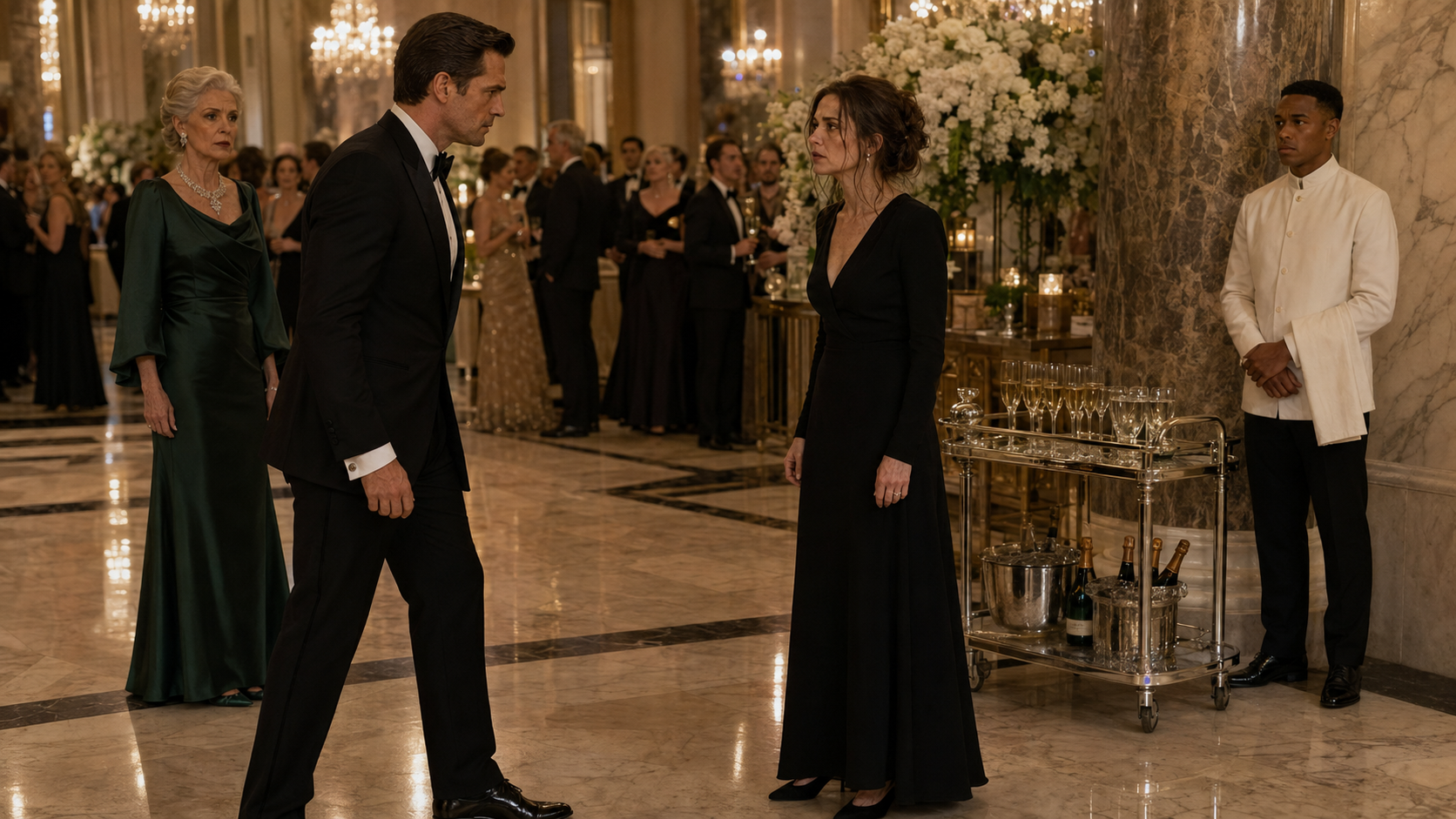
They had been watching since the second I stepped through the arched doors of the ballroom, damp from the cold mist outside, one hand curled around the strap of my evening bag and the other hanging uselessly at my side.
The room glittered around me.
Crystal chandeliers.
White roses floating in shallow silver bowls.
Men in black tuxedos and women in gowns that looked poured over their bodies.
Champagne moved through the crowd on polished trolleys.
A string quartet played near the sweeping staircase, soft enough to be ignored and expensive enough to remind everyone what kind of room they were standing in.
And then there was me.
My hair had started coming loose from the pins at the back of my head.
My eyes burned from three nights without real sleep.
The black dress Beatrice had selected for me two weeks earlier fit perfectly, which somehow made everything worse. It was elegant and severe, a dress designed to tell a room that I belonged among people who never questioned the cost of anything.
But I didn’t look like I belonged.
I looked like I had survived the journey there by force.
Julian smiled when he noticed the silence widening around us.
Not a warm smile.
A relieved one.
He had wanted them to see me like this.
I understood that immediately.
I had spent years learning how Julian communicated when he thought he was being subtle.
His fingers tightened around the stem of his champagne glass.
His jaw loosened.
His shoulders relaxed.
He looked at me the way a prosecutor might look at a witness who had arrived already trembling.
“You could have at least fixed your hair,” he said.
A few people nearby pretended not to hear.
Others made no effort.
I stopped three feet away from him.
“I came,” I said.
His eyebrows lifted.
“That’s your defense?”
“I’m not defending anything.”
That erased his smile for half a second.
Only half.
Then he laughed.
“Of course not.”
He turned slightly toward the people standing beside him.
There were four of them.
I knew all of their names.
Two of them had eaten dinner in my home.
One had toasted Julian and me on our anniversary.
Another had once spent twenty minutes telling me how lucky I was to have married into a family like his.
None of them looked at me directly now.
Julian took a slow sip of champagne.
“You disappear for two days,” he said, “ignore calls, refuse to answer messages, terrify everyone, and then arrive looking like you crawled out of a ditch.”
My face stayed still.
That mattered.
He was telling the story the way he wanted it remembered.
Not loudly enough for the whole ballroom to hear.
Just loudly enough for the nearest circle to carry it outward.
That was how things worked in Julian’s world.
Nobody needed a microphone.
Cruelty traveled perfectly well in whispers.
“I said I would come tonight,” I told him.
“You also said a lot of other things.”
His eyes held mine.
The warning was there.
I felt it.
A year earlier, maybe even six months earlier, it would have worked.
My stomach would have tightened.
I would have lowered my voice.
I would have tried to calm him down.
I would have asked what he needed from me so we could get through the evening without a scene.
That was always the word.
Scene.
As if humiliation only became humiliation when the person being humiliated reacted to it.
Julian leaned closer.
“You’re embarrassing yourself.”
“I haven’t done anything.”
“You walked in looking like that.”
I almost smiled.
He really believed that was enough.
Maybe once, it had been.
Before I could answer, I heard the sharp click of heels behind him.
Then Beatrice appeared.
She did not hurry.
Beatrice never hurried.
She moved through every room as though she had paid for the floor beneath everyone else’s feet.
She wore dark green silk and diamonds at her throat.
Her silver-blond hair was swept back in the same perfect shape it had been in every photograph taken of her for the last twenty years.
At sixty-two, she was still the most intimidating person in almost any room.
Not because she shouted.
Beatrice almost never shouted.
She had spent a lifetime discovering that disdain worked better when delivered quietly.
Her gaze traveled over me.
Hair.
Face.
Dress.
Shoes.
Then back to my eyes.
“What happened to you?”
No hello.
No concern.
Just disgust.
I stared at her.
“Good evening, Beatrice.”
Her lips thinned.
“Do not be insolent.”
Julian exhaled as if I had already exhausted him.
His mother stepped closer.
“People have been asking where you were.”
“I’m here now.”
“That was not what I said.”
“No.”
Her eyes sharpened.
For the smallest second, something passed through them.
Suspicion.
It was gone almost immediately.
Beatrice knew how to hide uncertainty better than Julian did.
But I had seen it.
And I stored it away.
“What have you been doing?” she asked.
The question sounded casual.
It wasn’t.
My hand tightened around my purse.
“Thinking.”
Julian laughed again.
“Oh, that’s reassuring.”
Beatrice ignored him.
Her eyes stayed on me.
“About what?”
There it was again.
Too fast.
Too interested.
I could hear the quartet playing behind us.
A violin rose above the murmur of conversation.
Around us, the room had resumed pretending we weren’t the center of attention.
But everyone close enough was listening.
I looked at Beatrice.
“Tonight.”
She didn’t believe me.
That made two of us.
Because I had thought about many things during those two missing days.
I had thought about the first dinner when Julian had corrected me in front of his friends and then kissed my forehead afterward as if affection canceled humiliation.
I had thought about the way Beatrice had once taken a wineglass from my hand at a reception and said, “You’re much prettier when you don’t talk so much.”
I had thought about the hundreds of tiny moments I had dismissed because none of them seemed large enough to justify the feeling building inside me.
I had thought about how control rarely announces itself as control in the beginning.
At first it sounds like advice.
Wear this.
Don’t say that.
Smile.
Call her back.
Come with me.
Don’t embarrass me.
You’re overreacting.
You’re tired.
You’re emotional.
Let me handle it.
Eventually, I had stopped noticing how often my life was being translated back to me by somebody else.
Julian telling me what I had meant.
Beatrice telling me how I had appeared.
Their friends telling me how lucky I was.
And me slowly, carefully, becoming quieter.
Until two days ago.
Two days ago, something inside me had finally become still.
Not shattered.
Still.
There is a difference.
Breaking is loud.
Breaking is tears and slammed doors and shaking hands.
What happened to me had been almost silent.
I had simply realized I no longer cared whether Julian understood me.
That realization frightened me more than any argument we had ever had.
Because once it arrived, I could not send it away.
Beatrice reached for my elbow.
“Come with me.”
I stepped back before she touched me.
Her hand stopped in the air.
Julian saw it.
So did three other people.
Beatrice lowered her hand slowly.
“Mara.”
“I’m staying here.”
Her expression hardened.
“We are not having this conversation publicly.”
“We’re not having a conversation.”
Julian’s face changed.
That was the first moment he stopped enjoying himself.
“You need to calm down.”
I looked at him.
“I am calm.”
“You’re obviously not.”
“I haven’t raised my voice.”
“That doesn’t mean you’re calm.”
There it was.
The old trap.
He would tell me how I felt.
Then he would react to the feeling he had assigned to me.
Then I would find myself defending an emotion I hadn’t expressed.
The room had started to feel very quiet again.
Beatrice noticed.
She noticed everything.
Her voice softened.
That was worse.
“Mara, darling, whatever this is, we can discuss it upstairs.”
The endearment sounded so unnatural in her mouth that I nearly laughed.
She must have seen something in my face because her expression flickered.
A warning.
I understood what she was offering.
Privacy.
Which meant control.
Behind closed doors, Julian could pace.
Beatrice could speak slowly and tell me I was confused.
They could take turns explaining how much damage I was doing to myself.
Then, when I finally became exhausted enough, I would agree to something just to make the conversation stop.
It had happened before.
Not tonight.
“No,” I said.
Julian put down his glass.
The sound of crystal touching silver seemed much louder than it should have.
He moved closer.
“You promised me you wouldn’t do this.”
My heart beat once.
Hard.
I kept my face empty.
“I promised I would attend the gala.”
“You know what I mean.”
“Yes.”
His stare narrowed.
“Then stop.”
It would have been easy.
That was the terrible thing.
It would have been so easy to lower my eyes.
Smile.
Tell him I was tired.
Let Beatrice guide me upstairs.
Let everyone decide they had witnessed a difficult wife being managed by a patient husband and his elegant mother.
By morning, the story would be polished.
Mara had been overwhelmed.
Mara had been unstable.
Mara had made a scene.
Julian had handled it beautifully.
Beatrice had been gracious.
And somewhere inside all those carefully arranged words, I would disappear.
I looked across the ballroom.
Near the entrance, a clock was built into the marble arch above the doors.
9:17.
Thirteen minutes.
That was all I needed.
Thirteen minutes.
Julian followed my gaze.
“What are you looking at?”
“Nothing.”
He glanced toward the doors.
Then back at me.
His suspicion finally arrived.
“Mara.”
I met his eyes.
“Yes?”
For the first time that evening, he looked uncertain.
And for the first time in years, I realized I liked the feeling.
Not because he was afraid.
He wasn’t.
Not yet.
But because the balance had shifted by an inch.
And Julian had noticed.
He leaned closer.
“What did you do?”
My pulse stayed steady.
I let three seconds pass.
Then I said, “I came to your gala.”
He stared at me.
The orchestra continued playing.
Champagne continued pouring.
People continued smiling.
But I could feel the question moving through him.
What did you do?
He had asked it as an accusation.
He had no idea it was the first correct question he had asked me in years.
And I wasn’t going to answer it.
Not yet.
PART 2: THE LAST PERFORMANCE
For the next ten minutes, Julian stayed close enough to touch me.
He pretended it was affection.
Anyone watching from across the room would have seen a husband standing protectively beside his exhausted wife.
I felt the truth in the way his hand settled against the small of my back.
Not gently.
Firmly.
A reminder.
Stay.
Smile.
Behave.
I had lived for years inside gestures that looked different from the outside.
A hand at my waist.
A kiss to my temple.
A whispered sentence near my ear.
Everything photographable.
Nothing obvious enough to defend myself against without sounding ridiculous.
So I let his hand stay there.
For now.
“You’re going to stand with me during the speech,” he murmured.
“No.”
His fingers pressed harder.
“Excuse me?”
“I said no.”
He smiled at a passing couple.
“Stop doing that.”
“Doing what?”
“Making me repeat myself.”
“Then listen the first time.”
His smile remained in place, but his eyes turned cold.
“You disappear. You arrive late. You look deliberately awful. And now you’re going to punish me in public?”
I turned my head.
“Do you hear yourself?”
“I’m trying to protect you.”
“From what?”
“From what people are going to think.”
That almost made me sad.
Almost.
Because once, I had believed him when he said things like that.
I had thought love meant having someone who understood the world better than I did.
Someone who could guide me through rooms where everyone knew rules I hadn’t been taught.
Julian had been brilliant at making control feel like rescue.
When we first met, his confidence had made me feel safe.
He could walk into any restaurant and somehow get the table that had supposedly been unavailable.
He remembered names.
He knew which fork to use without looking.
He could charm a furious donor, soothe an offended board member, and make a waiter feel like the most important person in the room within the same five minutes.
I had admired him.
Then I had loved him.
Then, slowly, I had started organizing myself around him.
At first because I wanted to.
Later because it was easier.
Eventually because I had forgotten where accommodation ended and surrender began.
“What do you think they’re going to think?” I asked.
Julian glanced around.
“Not here.”
“You brought it up here.”
His jaw moved.
“Mara.”
“Yes?”
He hated when I answered him calmly.
Anger he knew how to handle.
Tears were even easier.
Calmness gave him nothing to push against.
He leaned toward my ear.
“You are not going to destroy tonight because you’re angry with me.”
“I’m not angry.”
“That’s worse.”
I looked at him.
He realized what he had said.
For once, he didn’t try to correct it.
A burst of applause came from the center of the ballroom.
Someone had stepped onto the stage.
Julian’s attention snapped toward the sound.
His speech was approaching.
This gala mattered to him.
I knew that.
It was one of the reasons I had chosen it.
Not because I wanted to ruin what he had built.
That would have been too easy for him to understand.
He understood revenge.
He understood embarrassment.
He understood winning and losing.
What he did not understand was refusal.
My refusal to play the role he had written for me was more dangerous to him than any public accusation could have been.
Beatrice returned.
Her expression had changed.
The contempt remained, but something nervous moved beneath it now.
She stopped directly in front of me.
“I need to speak with you.”
“You already said that.”
“Alone.”
“No.”
Her nostrils flared.
Julian looked between us.
“What is this?”
Beatrice ignored him.
“Mara, come upstairs.”
“No.”
“Now.”
“No.”
Julian’s voice sharpened.
“Mother.”
She turned toward him.
Not fully.
Just enough.
“Not now.”
I watched them.
That small exchange mattered.
Beatrice knew something Julian didn’t.
Or thought she did.
I kept my breathing slow.
Julian caught it too.
“What happened?”
“Nothing.”
“Then why are you acting like this?”
Beatrice’s eyes moved to me.
I saw calculation.
Then she smiled.
The smile was beautiful.
It made me cold.
“Mara and I had a misunderstanding earlier this week.”
I said nothing.
Julian turned toward me.
“What misunderstanding?”
Beatrice answered for me.
“Nothing important.”
“Then why—”
“Julian.”
One word.
He stopped.
He was forty-one years old, admired by almost everyone in this ballroom, and still one word from his mother could pull him upright like a boy.
I had noticed it years ago.
I had simply never understood how much it explained.
Beatrice faced me again.
“Please.”
That word surprised me.
Not because it was polite.
Because it was desperate.
Very slightly.
Nobody else would have heard it.
I did.
I tilted my head.
“Are you asking?”
Her mouth hardened.
“Yes.”
“No.”
The softness vanished.
“You ungrateful little—”
“Mother.”
This time Julian did touch her arm.
Beatrice looked at him as if he had committed a betrayal.
Then she seemed to remember where we were.
She straightened.
Three people nearby looked away too late.
A server approached with a champagne trolley.
Silver rails.
Two shelves.
Dozens of narrow crystal flutes.
Bottles resting in ice.
He stopped when he realized we were blocking his path.
“Excuse me.”
Julian waved him around impatiently.
The trolley changed direction and passed behind us.
I watched it go.
Not because I knew what would happen later.
Not consciously.
But something about its wheels squeaking softly against the polished floor lodged in my mind.
My eyes went to the clock again.
9:24.
Six minutes.
Beatrice noticed this time.
“What are you waiting for?”
My gaze returned to hers.
“Why do you think I’m waiting for something?”
She didn’t answer.
Julian stared at me.
The suspicion in his face deepened.
I almost felt sorry for him.
He had spent so long assuming he knew every version of me that it had never occurred to him I might become someone he could not read.
A woman approached us.
Eleanor Vale.
One of Beatrice’s oldest friends.
She was in her seventies, wrapped in blue satin and enough diamonds to catch every light in the room.
“Mara,” she said, touching my hand. “There you are. We were worried.”
Julian answered before I could.
“She needed some time to herself.”
I looked at him.
Eleanor smiled carefully.
“Of course.”
“I’m standing right here,” I said.
A silence opened.
Julian’s hand tightened against my back.
Eleanor blinked.
Then she looked at me properly.
For the first time that night, someone actually looked.
Not at my hair.
Not at the dress.
Not at the expression Julian wanted them to interpret.
At me.
“Are you all right?” she asked.
Julian laughed.
“She’s exhausted.”
“I asked Mara.”
Julian went still.
Beatrice’s face became stone.
I looked at Eleanor.
There were a hundred possible answers.
I chose the simplest.
“Not yet.”
Eleanor’s eyes changed.
She understood something.
Not everything.
She didn’t need to.
Julian stepped in immediately.
“She’s been under a lot of stress.”
I turned toward him.
“Stop speaking for me.”
There.
Not loud.
Not dramatic.
But the sentence landed.
Eleanor lowered her hand.
Julian stared at me.
“Mara.”
“You keep telling people what I think. How I feel. Why I left. Why I came back. Stop.”
His face reddened.
“We are not doing this.”
“I’m not doing anything.”
“You’re making a spectacle of yourself.”
“No.”
I looked around us.
At Eleanor.
At Beatrice.
At the people pretending not to watch.
Then back at Julian.
“You are.”
His expression cracked.
Only for a second.
But the thing underneath was not embarrassment.
It was fury.
“You think this is funny?”
“No.”
“You think walking in here looking half-dead gives you some kind of power?”
Beatrice whispered, “Julian.”
He ignored her.
That was unusual.
He stepped closer.
“You disappear without explanation. You humiliate me in front of people who have known my family for decades. You make my mother worry herself sick.”
Beatrice’s eyes flicked toward him at that.
I almost admired the lie.
Worry herself sick.
Beatrice looked as though worry had been bred out of her bloodline generations ago.
“And then,” Julian continued, “you stand there acting like you’re the victim.”
The word hit something old inside me.
Victim.
He had always hated that word.
Not because I used it.
I never had.
Because he feared I might.
I felt several people stop pretending.
The audience had formed now.
Not a circle.
People like these were too sophisticated for that.
But conversations had died.
Faces angled toward us.
The quartet played on.
The clock above the entrance changed.
9:27.
Three minutes.
I looked at Julian.
“What do you want me to say?”
His chest rose.
“I want you to stop behaving like this.”
“Like what?”
“Like a stranger.”
That almost hurt.
Because in one way, it was the truest thing he had said all evening.
I was a stranger to him.
Not because I had changed overnight.
Because he had never bothered to know the parts of me that didn’t serve him.
I swallowed.
“What would make you happy, Julian?”
The question relaxed him slightly.
There she is, I saw him think.
The Mara who negotiates.
The Mara who bends.
He lowered his voice.
“Come upstairs. Fix your face. Fix your hair. Stand beside me during the speech. Smile. We go home together. Tomorrow, we talk.”
Tomorrow.
There was always a tomorrow with Julian.
Tomorrow, we would talk.
Tomorrow, he would listen.
Tomorrow, things would change.
Tomorrow was where every promise went to die.
“And if I don’t?”
His face hardened again.
“Don’t do this.”
“That isn’t an answer.”
“You know the answer.”
“No.”
I did.
But I wanted him to say it.
He wouldn’t.
Julian’s power depended on implications.
Threats were much cleaner when the victim supplied the ending herself.
Beatrice stepped toward me.
“That is enough.”
I turned to her.
Her voice dropped until only Julian and I could hear.
“You have no idea what you are doing.”
I held her gaze.
“I think I do.”
“No. You don’t.”
9:29.
One minute.
Beatrice saw me look.
This time, she followed my eyes directly to the clock.
Then to the doors.
Her face changed.
“Mara.”
I looked back at her.
The contempt disappeared.
For one bare second, I saw fear.
Not of me.
Of losing control of what happened next.
She moved closer.
“What have you arranged?”
Julian frowned.
“What are you talking about?”
Beatrice ignored him.
“Answer me.”
I felt my heartbeat.
One.
Two.
Three.
The minute changed.
9:30.
Something inside me unclenched.
I had made it.
I slipped Julian’s hand away from my back.
He stared down at his empty hand.
Then at me.
And I said, very quietly, “I don’t have to answer you anymore.”
PART 3: THE MOMENT THE ROOM CHANGED
For a second, nobody moved.
Not Julian.
Not Beatrice.
Not me.
Even the people around us seemed caught in the pause.
Then Julian laughed.
It was a strange laugh.
Too quick.
Too loud.
He looked around as if inviting everyone else to share the joke.
No one did.
“Mara,” he said, “you’re being ridiculous.”
I took one step backward.
His eyes dropped to my feet.
He noticed.
The tiniest movement.
The first real distance I had put between us all night.
“Where are you going?”
“Home.”
“No.”
The word came automatically.
He didn’t even seem to realize he had said it.
I looked at him.
His face shifted.
“I mean, not like this.”
“Like what?”
“You can’t just walk out in the middle of the gala.”
“I walked in.”
“That’s different.”
“Why?”
His mouth opened.
Closed.
He looked at the people watching us.
The answer was obvious.
Because walking in had obeyed him.
Walking out would not.
Beatrice recovered before he did.
“You’re not thinking clearly.”
“I’ve been thinking more clearly than I have in years.”
Her eyes flashed.
“Do you hear yourself?”
“Yes.”
“Then listen to what you sound like.”
I almost laughed.
There it was again.
Beatrice had always been the better version of Julian.
Sharper.
Less emotional.
More precise.
Julian tried to define my feelings.
Beatrice tried to define reality.
If she said I was unstable, then stability meant obeying her.
If she said I was ungrateful, gratitude meant surrender.
If she said I was confused, clarity belonged to her.
I had spent too long arguing inside definitions they had written.
Not anymore.
I turned toward the exit.
Julian caught my wrist.
The room stopped breathing.
His grip wasn’t violent.
That would have been easier.
It was firm enough to stop me and discreet enough that he believed no one would object.
“Mara.”
I looked down at his hand.
Then back at his face.
“Let go.”
“You need to calm down.”
“I am calm.”
“Then stop acting insane.”
A small sound moved through the people nearest us.
Julian heard it.
His expression changed.
He knew he had gone too far.
So he softened immediately.
His thumb moved over my wrist.
A loving gesture.
A correction for the audience.
“Come on,” he murmured. “You’re exhausted.”
“Let go.”
“We’ll talk upstairs.”
“No.”
“Mara.”
“Julian.”
His grip tightened.
Not much.
Enough.
My pulse beat beneath his fingers.
I thought about all the times I had apologized just to make a moment end.
All the times I had told myself endurance was maturity.
All the times I had confused staying quiet with staying dignified.
And something astonishing happened.
I stopped being afraid of the scene.
That was the final weapon they had held over me.
Not money.
Not reputation.
Not the room.
The scene.
The possibility that people would watch.
That people would judge.
That Julian would tell the story first.
That Beatrice would raise one eyebrow and destroy me without lifting her voice.
For years, the fear of public embarrassment had kept me obedient in private.
Now the public was already watching.
And I was still standing.
So what was left to fear?
I leaned slightly toward Julian.
“Take your hand off me.”
He smiled.
Not at me.
At the crowd.
“See?” he said softly. “This is what I’m talking about.”
That was the moment.
The final little piece.
He wasn’t trying to calm me.
He was performing me.
Creating the version of Mara he needed them to remember.
I looked around.
At Eleanor.
At a server frozen beside a column.
At two women near the orchestra who had stopped speaking.
At Beatrice.
At Julian.
Then I smiled.
It was not a large smile.
But Julian’s vanished when he saw it.
“What?” he asked.
I shook my head.
“Nothing.”
“What is funny?”
“You.”
His grip went still.
I had never said that to him.
Not once.
Beatrice moved fast.
Faster than I expected.
She stepped between us and reached for my free arm.
“Mara, stop this now.”
I pulled back.
Her fingers caught fabric instead of skin.
The shoulder of my dress shifted.
Someone gasped.
Beatrice’s face changed.
The polished mask slipped.
She grabbed again.
Not to hurt me.
To control me.
To pull me closer.
To force the scene smaller.
“Mara.”
“No.”
“You are coming upstairs.”
“No.”
Her hand closed around my upper arm.
I moved before I thought.
One hand caught her wrist.
The other braced lightly against her forearm.
I turned.
Not hard.
Not violently.
I simply used the direction she was already moving.
Beatrice stumbled past me.
The crowd opened.
Her heel skidded on the floor.
She caught the edge of a high cocktail table before she fell.
A glass tipped.
Champagne spilled across the white linen.
The room gasped.
Beatrice stared at me.
I stared back.
Neither of us spoke.
I had not hit her.
I had not shoved her.
But I had stopped her.
Physically.
Publicly.
And for Beatrice, that was almost unimaginable.
Julian released my wrist.
For one second, I thought he finally understood.
Then he looked at his mother.
At the spilled champagne.
At the people watching.
And humiliation transformed him.
“What the hell is wrong with you?”
I stepped back.
“Don’t.”
“You just attacked my mother.”
“I redirected her.”
The words came out before I could reconsider them.
Someone nearby made a choking sound that might have been a laugh.
That made everything worse.
Julian’s face darkened.
“Are you out of your mind?”
Beatrice straightened.
“Julian.”
But this time he was past hearing her.
“You think you can walk in here after everything we’ve done for you and behave like trash?”
The word went through me.
Not because it hurt.
Because it didn’t.
That surprised me.
Once, Julian’s contempt had the power to rearrange my sense of myself.
Now it sounded small.
Desperate.
He stepped toward me.
I moved backward again.
My hip nearly touched something metal.
I heard the faint clink of glass.
The champagne trolley.
The same one from earlier.
It had stopped behind me while the server waited for a path through the crowd.
I registered it.
Silver frame.
Two shelves.
Ice bucket on the bottom.
Glasses on the top.
Julian saw me looking behind myself and misread it.
He thought I was cornered.
His confidence returned.
“Mara.”
He pointed toward the staircase.
“Upstairs.”
“No.”
“I am not asking you.”
“I know.”
“You’re making a mistake.”
“Maybe.”
“You will regret this tomorrow.”
“Maybe.”
“You think people here respect this?”
“I don’t care.”
That stunned him.
I watched it happen.
Every muscle in his face seemed to lose its instruction.
Because he believed I cared more than anything.
About their respect.
Their invitations.
Their whispers.
Their approval.
That had always been the leash.
I looked him in the eyes.
“I don’t care what they think.”
Julian’s gaze moved over my shoulder.
To the crowd.
He saw them.
Really saw them.
And something inside him snapped.
He reached for me.
I still don’t know exactly what he intended.
Maybe my shoulders.
Maybe my arms.
Maybe just to catch me before I could turn away.
It didn’t matter.
I saw the movement.
And I was done being caught.
I stepped sideways.
His right hand missed me.
His body followed the reach.
I planted my left foot.
Then I drove my right heel sharply into the outside of his thigh, just above the knee.
Not wildly.
Not with rage.
With purpose.
His leg buckled.
Momentum did the rest.
Julian twisted.
His shoulder slammed into the champagne trolley.
The server jumped backward.
The trolley rolled half a foot, struck the edge of a column, and tipped.
Julian went down with it.
The sound was spectacular.
Metal crashed.
Crystal shattered.
Champagne bottles struck the marble floor.
One burst open.
Cold foam sprayed across Julian’s jacket.
A dozen people screamed.
Then came silence.
Absolute silence.
Julian lay half-tangled in the lower shelf of the trolley, one knee on the floor, one hand braced against broken glass.
His white shirt was soaked.
Champagne ran through his hair.
A silver ice bucket rolled in a slow circle beside him before falling onto its side.
I stared.
The whole room stared.
For one absurd moment, I wanted to laugh.
Not because he was hurt.
He wasn’t.
I had made sure of that.
I had aimed for his balance, not his body.
But the image was so perfectly, impossibly wrong for Julian that my mind almost rejected it.
Julian, who controlled photographs.
Julian, who adjusted his cuff links before stepping out of cars.
Julian, who had once made us leave a restaurant through the kitchen because he saw someone he disliked near the front entrance.
Julian was sitting in broken crystal and champagne.
In front of everyone.
Beatrice made a sound like I had stabbed him.
“Julian!”
She rushed forward.
He pushed the trolley away violently.
A few more glasses shattered.
Then he looked at me.
I will never forget his face.
There was no charm left.
No patience.
No performance.
Only shock.
And beneath it, finally, fear.
Not fear that I would hurt him.
Fear that I had stopped being manageable.
“Mara,” he said.
My name sounded different in his mouth.
I took a breath.
My hands were shaking now.
I tucked them against my sides.
Beatrice knelt beside him.
“What did you do?”
She looked at me with open hatred.
No refinement.
No polished contempt.
Hatred.
I met her eyes.
Then Julian’s.
Then I picked up my evening bag from where it had slipped onto the floor.
Nobody tried to stop me.
I turned.
And walked toward the doors.
The crowd separated before I reached them.
Not dramatically.
No one announced anything.
People simply moved.
One step.
Then another.
A corridor opened.
I could feel their eyes.
Every one of them.
For years, that feeling would have destroyed me.
Now it held me upright.
I passed Eleanor.
She didn’t speak.
But as I went by, she moved half a step farther aside.
Enough to make the path wider.
I kept walking.
Behind me, I heard Julian shouting my name.
“Mara!”
I did not turn.
“Mara!”
The quartet had stopped playing.
My shoes struck marble.
One.
Two.
Three.
The doors were getting closer.
A staff member reached for the handle.
Before he could open it, Beatrice’s voice cut through the ballroom.
“If you walk out that door, do not expect to come back.”
That stopped me.
Not because I was afraid.
Because I wanted to hear the words clearly.
The whole room waited.
I turned my head.
Beatrice stood beside Julian, one hand gripping his shoulder.
Her face was pale with rage.
Julian had managed to get to his feet.
Champagne dripped from his sleeve.
His stare burned into me.
Beatrice repeated herself.
“You leave now, and you are finished here.”
I looked at her.
I thought of all the years I had treated belonging as something she could grant or remove.
Then I looked at Julian.
His chest was rising hard.
He waited.
Maybe he still believed I would come back.
Maybe they both did.
I smiled.
This time, not at the crowd.
At them.
“I know.”
Then I walked out.
PART 4: THE DOOR THAT WAS ALREADY OPEN
The cold hit me first.
Sharp.
Clean.
Real.
The ballroom doors closed behind me, cutting off the light and noise almost instantly.
For a second, I stood beneath the stone awning without moving.
Rain misted the street.
Not heavy rain.
Just enough to turn the pavement black and make the city lights smear gold across the road.
My lungs refused to work properly.
I pressed one hand against my ribs.
Breathe.
I had done it.
The thought arrived, but I couldn’t feel it yet.
My body was still inside the ballroom.
My wrist still remembered Julian’s hand.
My arm still remembered Beatrice’s fingers.
My ears still held the crash of crystal.
I had imagined leaving a hundred times.
In some versions, I was magnificent.
Calm.
Untouchable.
I walked away without looking back and felt nothing but freedom.
Reality was different.
My knees trembled.
My mouth was dry.
The adrenaline running through me was so intense I almost felt sick.
I looked down.
A faint red mark circled my wrist where Julian had gripped me.
It would fade.
That mattered.
For some reason, that tiny fact nearly broke me.
It would fade.
I closed my eyes.
Behind the doors, I could imagine the room exploding back into sound.
People talking.
Julian ordering someone to find me.
Beatrice deciding what story would be told.
The server trying to save what remained of the champagne trolley.
Someone probably already had a phone out.
By morning, half the city might know.
Maybe more.
The old Mara would have been horrified.
The new one was still getting used to breathing.
A doorman stepped toward me.
“Mrs.—”
“Don’t.”
He stopped.
I opened my eyes.
His face softened.
“Would you like me to call a car?”
I looked past him.
Across the circular drive.
A black sedan waited beneath a streetlamp.
Engine running.
Rear lights glowing red through the mist.
The doorman followed my gaze.
“That yours?”
“Yes.”
The answer came without hesitation.
Because this part had been decided before I entered the ballroom.
The sedan had been waiting since 9:28.
Two minutes early.
Exactly as arranged.
I started walking.
Every step away from the building felt unreal.
My heels clicked over wet stone.
The wind moved my loosened hair across my face.
I did not fix it.
I did not look back at the gala.
Halfway across the drive, the rear door of the sedan opened.
Already open.
Waiting for me.
I stopped.
Only for one second.
Because seeing that open door made the entire night become real.
Until then, some part of me had still been waiting for the plan to fail.
For Julian to stop me.
For Beatrice to corner me upstairs.
For my courage to evaporate.
For me to apologize.
For me to return to the shape they had made for me.
But the car was there.
The door was open.
And suddenly I remembered myself forty-eight hours earlier, sitting alone in a dark room with no music, no television, no lights except the pale glow of the city coming through the windows.
I had been crying then.
Not dramatically.
Quietly.
The kind of crying that leaves no relief afterward.
I had stared at my phone on the table for almost an hour.
Julian called thirteen times.
Beatrice called four.
Messages piled up.
WHERE ARE YOU?
Call me immediately.
This is childish.
People are asking questions.
You cannot simply disappear.
Think about what you are doing.
And finally, from Julian:
If you make me come find you, this gets worse.
That had been the message.
Not the worst thing he had ever said.
Not even close.
But it was the sentence that made everything clear.
If you make me come find you, this gets worse.
I had read it again.
And again.
Then I placed the phone facedown.
Something inside me became very quiet.
I stopped asking whether I had enough reason.
Enough reason to leave.
Enough reason to be angry.
Enough reason to embarrass him.
Enough reason to disappoint Beatrice.
Enough reason to trust my own exhaustion.
The question itself had been another prison.
I didn’t need permission to reach my limit.
I had spent years waiting for one undeniable moment.
One cruelty large enough.
One betrayal obvious enough.
One public disaster that would prove I was justified.
But lives do not always break that way.
Sometimes they disappear by teaspoons.
A correction here.
A humiliation there.
A boundary moved.
A friend avoided because your husband disliked her.
A dress changed because his mother thought the first one looked cheap.
A sentence swallowed.
A disagreement postponed.
A room left early.
A truth softened until even you no longer remember its original shape.
Nothing dramatic enough to make you run.
Just enough to make you vanish slowly.
And then one day, you realize you are almost gone.
That was what happened to me.
So I had made the call.
Not tonight’s call.
The first one.
The one that arranged the car.
The one that made sure there would be a door open at exactly the moment I needed one.
I had not known whether I would be able to walk through it.
That was why the driver had been told to wait no matter what.
Even if I came out crying.
Even if I came out an hour late.
Even if I didn’t come out at all.
The car would be there.
Because I needed one decision already made for me by the version of myself who had still been brave enough to make it.
Now I stood in the rain looking at that open door.
And I understood.
The hardest part had never been leaving the ballroom.
The hardest part had been making sure I had somewhere to go when fear tried to turn me around.
I crossed the last few feet.
The driver remained facing forward.
No questions.
Exactly what I had asked for.
I lowered myself into the back seat.
Warm leather.
Dark interior.
A faint clean scent of cedar.
The city disappeared behind tinted glass.
I pulled the door closed.
The sound was soft.
Almost gentle.
And just like that, Julian’s world was outside.
I sat still.
My hands rested in my lap.
They were shaking badly now.
I stared at them.
For years, I had imagined courage as the absence of fear.
I had been wrong.
Courage was sitting in the back of a car with your whole body trembling and still not opening the door to go back.
The driver looked at me through the mirror.
“Ready?”
My throat tightened.
I looked through the rear window.
The gala entrance remained visible.
Light spilled from beneath the awning.
A figure appeared behind the glass doors.
Then another.
Someone was coming outside.
Julian?
Beatrice?
Security?
I didn’t wait to find out.
“Yes,” I said.
The sedan moved.
Slowly at first.
Then faster as we reached the street.
The gala vanished behind rain and traffic.
I released a breath I felt as though I had been holding for years.
My evening bag was still clutched in my hand.
I opened it.
Inside were only three things.
A key.
A folded handkerchief.
And a phone.
Not the phone Julian knew.
Not the one filled with missed calls and messages and years of ordinary life.
This one was small.
Black.
Silent.
Unused except for one purpose.
I took it out.
The screen lit my fingers.
There was no name saved.
Only one number.
I stared at it.
My heart was still beating too fast.
The city rolled past the window.
For the first time that night, there was nobody telling me what expression belonged on my face.
Nobody telling me to fix my hair.
Nobody telling me I was tired.
Nobody telling me I was angry.
Nobody telling me what I would regret tomorrow.
I looked at my reflection in the glass.
I did look exhausted.
Julian had been right about that.
My mascara had smudged beneath one eye.
A strand of hair was stuck to my cheek.
My lips were almost colorless.
I looked nothing like the woman Beatrice had spent years trying to polish.
And yet I recognized myself more clearly than I had in a long time.
I pressed the number.
The phone rang once.
Someone answered.
No greeting.
No name.
Just silence.
Waiting.
I looked back through the rear window one final time.
The ballroom was gone.
I thought I would feel grief.
Maybe it would come later.
I thought I would feel triumph.
Maybe that would come later too.
What I felt was simpler.
Space.
For the first time in years, there was space between what they wanted and what I would do.
I spoke.
“It’s finished.”
Silence on the other end.
My fingers stopped shaking.
I watched the rain slide down the glass.
Then I said the words I had been carrying with me since before I walked into the gala.
“Begin phase two.”
I ended the call.
And the sedan disappeared into the city.
PART 5: EVERYTHING LOOKED DIFFERENT AFTERWARD
Later, people would remember the champagne.
That was inevitable.
They would remember Julian falling into the trolley.
They would remember Beatrice stumbling against the table.
They would remember the sound of breaking crystal and the way I walked through the ballroom while nobody dared to stand in front of me.
Those were the parts that would be repeated.
The visible parts.
The dramatic parts.
But if anyone had asked me when the evening truly changed, I would not have said the kick.
I would not have said the door.
I would not even have said the phone call.
It happened earlier.
Much earlier.
It happened when Julian looked at me in front of all those people and said I looked worse than he expected.
Because hidden inside that sentence was an assumption.
He expected me to be wounded.
He expected me to be exhausted.
He expected me to come anyway.
More than that, he expected my exhaustion to make me easier to control.
And Beatrice expected the same thing.
That was why every moment after I arrived became stranger in retrospect.
Her demand that I go upstairs.
Julian’s insistence that I stand beside him during the speech.
The way both of them kept trying to define my behavior before I could speak for myself.
The way Julian kept one hand against my back.
The way Beatrice watched the clock after she saw me watching it.
The way her contempt sharpened into suspicion.
The way Julian asked the question he should have asked much sooner.
What did you do?
At the time, those moments had felt disconnected.
By the time the car carried me away, they no longer did.
They had both understood one thing before they understood anything else.
The version of me they knew was disappearing.
That was what frightened them.
Not a secret.
Not a scandal.
Not even public humiliation.
Loss of control.
Julian had built his certainty around the belief that I would always care more about keeping peace than protecting myself.
Beatrice had built hers around the belief that shame could always push me back into place.
They had mistaken my patience for permanence.
My silence for agreement.
My exhaustion for weakness.
And my return to the gala for surrender.
They had been wrong.
But I had been wrong too.
For years, I thought leaving required certainty.
I thought I needed to know exactly what happened afterward.
Where I would go.
Who I would become.
What everyone would say.
How Julian would respond.
What Beatrice would do.
What I would lose.
What I might regret.
I thought freedom had to arrive with a complete map.
It didn’t.
Sometimes freedom is only an open door.
Sometimes it is a car waiting in the rain.
Sometimes it is one sentence spoken into a phone while the life behind you is still collapsing.
I leaned my head against the cool glass.
The city moved around me.
Traffic lights shifted from red to green.
People hurried beneath umbrellas.
Restaurants glowed.
Buses sighed at curbs.
Thousands of strangers continued living ordinary lives, unaware that mine had just split cleanly into before and after.
The phone remained dark in my hand.
I knew Julian would be calling my other number.
I knew Beatrice would already be deciding how to contain what had happened.
I knew the crowd would leave the ballroom carrying different versions of the same story.
Some would say I had lost control.
Some would say Julian had pushed me too far.
Some would say Beatrice had provoked me.
Some would insist I had planned the entire thing.
They would be partly right.
I had planned to leave.
I had planned the car.
I had planned the call.
I had planned not to let them take me upstairs.
I had not planned the champagne trolley.
That was Julian.
He had spent the entire evening pushing me backward.
In the end, he simply failed to notice what was behind him.
I almost smiled at that.
Then the smile disappeared.
Because phase one had not been victory.
It had been separation.
That distinction mattered.
I had not walked out because I believed everything was over.
I walked out because I finally understood something I should have understood much sooner.
You cannot begin anything while someone else is still deciding whether you are allowed to leave.
So I left.
The rest would come next.
Whatever Julian believed he knew about me had been built from years of watching me compromise.
Whatever Beatrice believed she could predict had been built from years of seeing me retreat.
Neither of them had ever met the woman in the back seat of that sedan.
If they had, perhaps the evening would have gone differently.
Maybe Beatrice would not have reached for me.
Maybe Julian would have let go when I asked.
Maybe they would have understood that every command was making the distance between us larger.
But they hadn’t.
And now the distance was real.
The car turned onto a darker street.
The bright center of the city fell behind us.
I closed my eyes.
For the first time in three days, exhaustion began to feel like something I might actually be allowed to surrender to.
Not defeat.
Sleep.
Rest.
My own silence.
I loosened my grip on the phone.
One question remained.
The same question the people in that ballroom would eventually ask after the shock faded.
The same question Julian would ask once anger gave way to thought.
The same question Beatrice had almost asked me before everything collapsed.
If Mara knew she was leaving…
If the car was already there…
If the phone was already waiting…
If walking out of that ballroom was only phase one…
Then what had I been preparing to set in motion the moment I escaped?
I opened my eyes.
Outside, the rain kept falling.
The driver looked at me once in the mirror, then back at the road.
I said nothing.
Some answers only become dangerous when spoken too early.
Behind us, Julian still had the ballroom.
Beatrice still had the crowd.
They still had their names, their certainty, their polished version of events.
For one more night, they could believe those things were enough.
I let them.
Because somewhere behind the dark screen of the phone in my hand, someone had already received my instruction.
It’s finished.
Begin phase two.
And for the first time since I had known Julian, I was no longer waiting to see what he would do next.
He was about to start wondering what I would.
Để lại một bình luận