
PART 1: THERE WAS NO CHAIR FOR ME
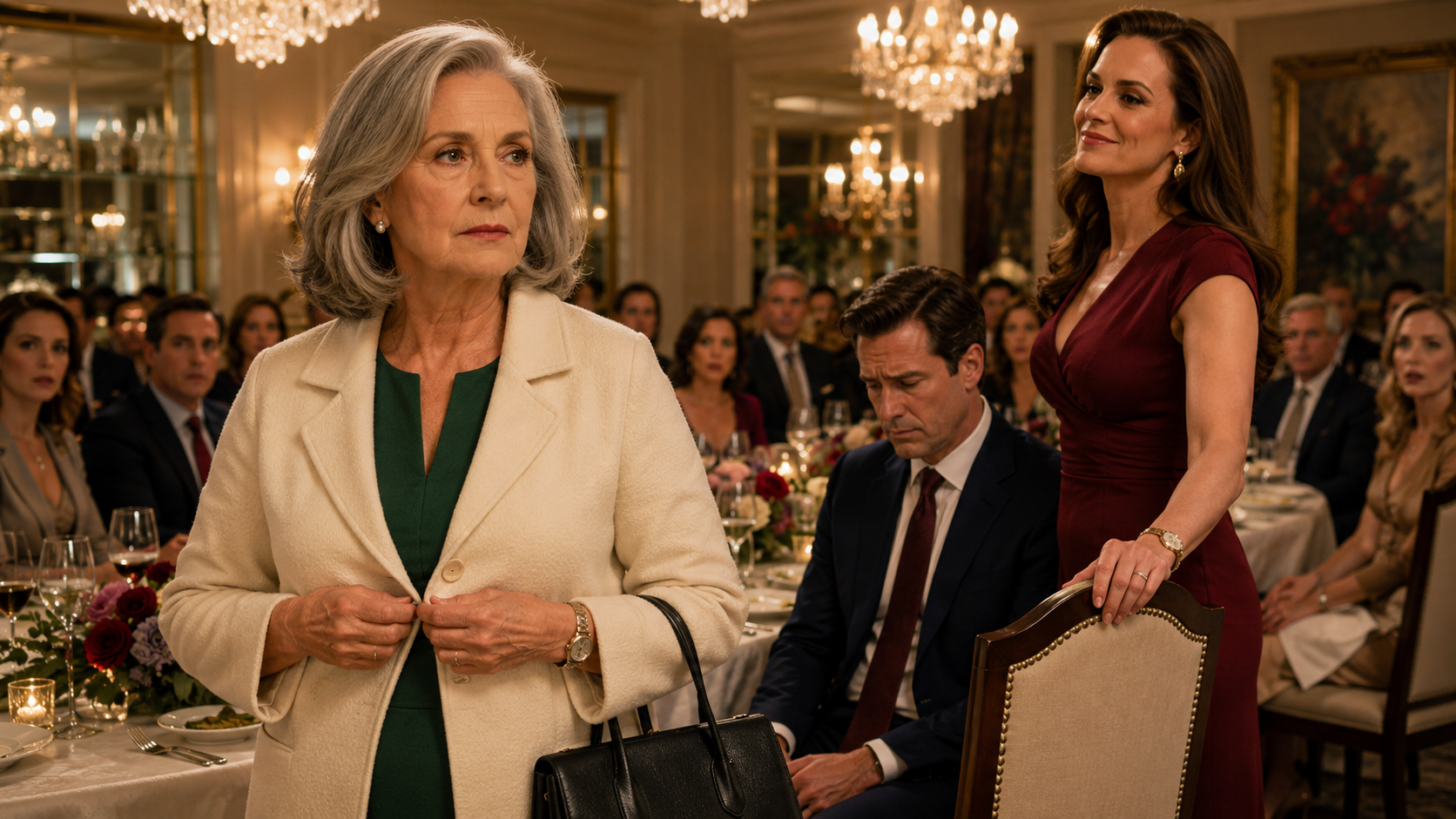
“There’s no chair for you, Wilma. Go eat in the restroom. You’re used to being invisible.”
My daughter-in-law said it loudly enough for the whole table to hear.
Then she smiled.
Not the awkward kind of smile people use when a joke lands wrong. Not the nervous little twitch of someone who realizes she has gone too far.
This smile was polished.
Deliberate.
The smile of a woman who believed she owned the room, the evening, and my son.
Twenty-four guests went quiet.
Twenty-four people looked at me.
No one said my name.
For one strange second, all I could hear was the faint clink of ice against crystal and the muted jazz coming through the ceiling speakers.
The private dining room glowed beneath brass chandeliers. White linen covered the long table. Imported flowers spilled from low glass arrangements. Burgundy wine rested in decanters that probably cost more than my first month’s rent after I got married.
Everything looked warm.
Beautiful.
Expensive.
And I had paid for every bit of it.
The room.
The flowers.
The wine.
The appetizers Tessa had added that afternoon.
The special cake she had insisted needed edible gold along the edges because, in her words, “Reid has finally arrived.”
Even the extra service charge the restaurant manager, Mr. Alvarez, had warned me about in a discreet phone call three days earlier.
I had told him not to worry.
My son had worked hard.
I wanted him to have one beautiful night.
After years of chasing promotions from executives who could never remember whether he had one child or none, Reid had finally been made regional director.
He had called me the afternoon he found out.
“Mom,” he had said, breathless, “I got it.”
I had been standing in the kitchen with a grocery bag in one hand.
For a second, I was not sixty-eight years old.
I was thirty-two again, holding a six-year-old boy who had brought home his first perfect spelling test and was waiting for me to act as if he had won a Nobel Prize.
“I knew you would,” I told him.
That was a lie.
I had not known.
But mothers say certain lies because they are really another kind of truth.
I knew he could.
That was enough.
Two days later, Tessa called.
She wanted a dinner.
Not just dinner.
A celebration.
A proper one.
Her voice changed whenever money entered a conversation. It became softer, almost musical.
“We don’t want to do anything tacky,” she said. “Reid needs to celebrate with the right people.”
I should have paid more attention to that phrase.
The right people.
Executives.
Clients.
Friends from their neighborhood.
Two couples from the country club.
A former boss.
A man Reid was trying to impress.
Tessa’s sister.
Tessa’s sister’s husband.
A few people I had met only once.
And me.
I had assumed I was one of the right people because I was his mother.
That was my mistake.
I offered to cover the dinner before Reid could worry about the cost.
I did it quietly.
That was how I had done most things in his life.
Quietly.
When his first car broke down during his sophomore year of college, I paid the mechanic before Reid could find out the engine repair cost more than he had in his bank account.
When he lost his first real job, he never knew the reason his rent did not bounce was because I transferred money to him for three months.
When he wanted to propose to Tessa but complained the engagement ring she liked was outside his budget, I never bought the ring. I had enough sense not to do that.
But I did pay off the last of his student loan.
I told myself it was different.
It always seemed different when I was doing it.
That was how I softened his falls.
Not because Reid was weak.
Because I loved him.
There is a dangerous line between helping someone stand and teaching them that the ground will always rise to catch them.
I had crossed it so many times I could no longer see where it had been.
And now my daughter-in-law stood behind the only empty chair at the table, one manicured hand pressed across its back like she was guarding royal property.
“I’m serious,” Tessa said.
She laughed.
“You’ll be much more comfortable in there. It’s private.”
A few people laughed with her.
Not because it was funny.
Because cruelty feels safer when it has an audience.
I looked at Reid.
My son.
The boy I had held through fevers.
The teenager who once called me from a gas station at two in the morning because he was too drunk to drive and knew I would come without yelling.
The man who had hugged me so hard after his father’s funeral that I could feel him trembling through his suit jacket.
He stared at his plate.
His fork didn’t move.
His mouth stayed shut.
There were a hundred things he could have done.
He could have said, “Tessa, stop.”
He could have pulled out another chair.
He could have stood and given me his.
He could have laughed awkwardly and said she had gone too far.
He could have looked at me.
He did none of those things.
His eyes stayed on the tablecloth.
That was the moment something inside me became still.
Tessa had humiliated me.
But Reid had permitted it.
And somehow, permission hurt worse than the insult.
I had spent most of my life believing anger was loud.
I had been wrong.
Real anger can be extremely quiet.
It is the silence that comes when a person finally stops negotiating with what hurts them.
I reached for the top button of my coat.
Tessa’s smile shifted slightly.
She had expected something from me.
Embarrassment, perhaps.
Tears.
An argument she could later retell as proof that I was emotional or difficult.
I gave her none of it.
I buttoned my coat.
Then the second button.
My hands were perfectly steady.
“Enjoy your dinner,” I said.
Reid finally looked up.
“Mom—”
But he stopped.
Maybe he saw my face.
Maybe he realized too late that the silence had lasted too long.
I walked toward the door.
No one stopped me.
I felt every pair of eyes following me.
Near the doorway, one of the servers moved aside and gave me a look I still remember.
Not pity.
Recognition.
As if she had seen this sort of thing before.
As if people who served expensive dinners learned very quickly that money could buy beautiful rooms but not beautiful behavior.
I stepped into the hallway.
Behind me, conversation began almost immediately.
Low voices.
Chairs moving.
Someone laughing too loudly.
The door shut.
I stood there for several seconds.
My chest hurt.
That surprised me.
I had survived losing my husband.
I had survived years when my business account had less money in it than my electric bill.
I had survived men twice my size laughing in my face when I told them I owned the trucks they were unloading.
I had survived banks refusing to lend me money because they wanted to know whether my husband could guarantee the loan.
I had survived strikes, fuel shortages, lawsuits, accidents, recessions, dishonest contractors, and one winter when three of my six trucks broke down in the same week.
Yet there in that quiet restaurant hallway, after one stupid sentence about eating in a restroom, I felt something crack.
Because humiliation from strangers bruises pride.
Humiliation from family reaches bone.
I walked outside.
The night air felt clean.
Sharp.
Honest.
I breathed it in.
Then I started walking.
I had no idea where I was going.
I just knew I did not want to sit in my car yet.
I passed restaurants full of people leaning over small tables. A couple argued near a taxi. Someone laughed from an open bar doorway. Cars swept through the intersection, headlights flashing over the wet pavement.
Three blocks from the restaurant, I found a bench beneath a streetlamp.
I sat.
For the first time that night, there was no one watching me.
My hands began to shake.
I put them in my lap.
I let them shake.
Then I took my phone from my handbag.
I had two calls to make.
And by morning, my son’s life would not look quite the same.
PART 2: THE TWO CALLS
My attorney answered on the third ring.
“Wilma?”
Daniel Mercer had represented me for nineteen years, which meant he had learned to recognize the difference between my business voice and my personal one.
That night, I was using both.
“Are you at home?” I asked.
“I am. What happened?”
“Nothing you need to worry about.”
That was another old habit.
I had spent decades telling people not to worry while I quietly rearranged the world behind the scenes.
There was a pause.
“All right,” Daniel said carefully.
“For eleven months, you’ve been telling me the offer is good.”
Another pause.
He knew exactly what I meant.
Tate Freight.
My company.
My life’s work.
Forty-two years earlier, it had been one leased delivery truck, a borrowed office chair, and a desk squeezed into the back room of a tire shop.
I had been twenty-six.
Reid’s father, Arthur, was still alive then.
He worked construction and thought I had lost my mind.
Not because he didn’t believe in me.
Because he knew what I was risking.
We had a mortgage.
A baby.
No savings worth mentioning.
And I had decided I wanted to start a freight company in an industry where half the men I called asked whether they could speak to my boss.
“I am the boss,” I would tell them.
Some laughed.
Some hung up.
A few gave me a chance.
One truck became three.
Three became nine.
Nine became twenty-seven.
By the time Arthur died, Tate Freight had terminals in two states.
By the time Reid graduated college, we were in three.
Now we operated across four states.
Warehouses.
Contracts.
A fleet I had stopped counting personally years ago.
Hundreds of employees.
A management team smarter than I was in areas I was proud to admit I no longer understood.
And one buyer who had spent nearly a year trying to convince me to let it go.
“One hundred sixty-five million,” Daniel said.
His voice was cautious.
Not because the number was new.
Because my answer was.
For months, I had refused.
I always found another reason to delay.
The timing.
The tax structure.
The employee agreements.
The transition plan.
The truth was simpler.
I did not know who I was without the company.
And a part of me had been holding it for Reid.
Not legally.
Not formally.
I had never promised him the company.
He had never worked there.
Freight bored him.
He had built his own career elsewhere, which I respected.
But deep inside me was the foolish maternal thought that Tate Freight was a kind of fortress.
Something solid.
Something permanent.
Something that would always be there if Reid ever fell hard enough.
That night, sitting under a streetlamp after my son watched his wife tell me to eat in a restroom, I understood the truth.
I had spent my entire life building safety nets for a grown man who had not even been willing to pull out a chair for me.
“Are you sure?” Daniel asked.
I looked back toward the distant glow of the restaurant windows.
I could not see the private dining room from there.
Only light.
“Yes,” I said.
“Wilma, once we accept, things move quickly.”
“I know.”
“You told me last month you wanted more time.”
“I did.”
“And now?”
“Now I’m done waiting.”
He was silent.
Daniel never pried into my family, but he knew enough to hear what I was not saying.
“You want me to accept the final offer?”
“Yes.”
“One hundred sixty-five million.”
“Yes.”
“Tonight?”
“Tonight.”
He exhaled slowly.
“All right.”
“Daniel?”
“Yes?”
“Make sure the employee protections stay exactly where we negotiated them.”
“They will.”
“I won’t sell without them.”
“I know.”
That mattered.
Whatever had happened at dinner had nothing to do with the people who had spent years working beside me.
My anger belonged to my family.
I would not make strangers pay for it.
“Accept the offer,” I said.
“I’ll send the formal notice.”
“Thank you.”
I ended the call.
For several seconds, I stared at my phone.
I expected to feel grief.
Instead, I felt light.
Not happy.
Not yet.
Just lighter.
As though I had been carrying something so long I had mistaken its weight for part of my body.
Then I made my second call.
Mr. Alvarez answered immediately.
“Maison Laurent. This is Gabriel Alvarez.”
“This is Mrs. Tate.”
His tone changed.
“Good evening, Mrs. Tate.”
I could picture him straightening.
He knew who had actually booked the room.
Tessa did not.
The guests did not.
Reid only knew I had offered to “help with dinner.” I doubted he understood the full amount.
I had asked Mr. Alvarez to keep my name off everything.
No special acknowledgment.
No toast.
No mention on the printed menus.
No fuss.
I wanted Reid to feel celebrated.
That had been enough for me.
“Is everything satisfactory?” Mr. Alvarez asked.
“No.”
“I’m very sorry to hear that.”
“I’ve left the dinner.”
A small silence.
Then, “I see.”
“I need you to remove my card from the reservation.”
This time the pause was longer.
“Mrs. Tate, the party has already ordered dinner and several bottles from the reserve list.”
“I understand.”
“The total will likely be just under four thousand dollars, depending on additional orders.”
“I understand that too.”
“Would you like me to inform Mr. Tate?”
“No.”
“Mrs. Tate—”
“Please wait until they ask for the check.”
There was another silence.
Professional.
Careful.
Then he said, “Of course.”
“No scene,” I added. “No explanation. Simply tell them the payment method provided by the original host is no longer authorized.”
“Yes, ma’am.”
“And Gabriel?”
“Yes?”
“Please make sure your servers receive their gratuity tonight. If the party fails to cover it, call me tomorrow. I won’t punish your staff for something they didn’t do.”
His voice softened.
“I understand.”
I ended the call.
That was it.
Two calls.
Forty-two years of work changed direction with the first.
One evening changed direction with the second.
I stood from the bench.
My knees were stiff.
I walked back to my car and drove home.
Home was not the house Reid and Tessa liked posting online.
I owned a larger property outside the city. Reid called it “the estate,” which always made me laugh because Arthur and I had bought it when the roof leaked in three places and squirrels lived in the attic.
Over the years, I renovated it.
Then after Arthur died, it became too large.
Too quiet.
Too full of rooms I did not enter.
So I bought a modest apartment on Sycamore Street near the center of town.
Two bedrooms.
One small balcony.
A kitchen I could clean in fifteen minutes.
No marble foyer.
No gate.
No staff.
No one impressed by the size of it.
Tessa hated the apartment.
“Why would you live here when you don’t have to?” she once asked.
Because I liked knowing what I needed.
That was my answer.
She never understood it.
At home, I changed out of my dinner clothes.
I hung my coat carefully.
I made tea.
Then I sat in the armchair beside the window.
At 9:07, my phone rang.
Reid.
I watched it ring until it stopped.
At 9:12, he called again.
At 9:18, again.
At 9:23, I answered.
“Mom?”
His voice was tight.
Not frightened.
Embarrassed.
“There’s been a mistake.”
“What kind?”
“The restaurant says the payment method was removed.”
“I see.”
“The bill is almost four thousand dollars.”
“How unfortunate.”
“Mom.”
“What?”
“Everyone’s just sitting here.”
I looked down at my tea.
Steam curled above the cup.
“Tessa is humiliated,” he said.
I almost smiled.
“Is she?”
“Can you please fix this?”
There it was.
Not Are you okay?
Not I’m sorry.
Not I should have stopped her.
Fix this.
The old request.
The familiar one.
Mom, the car.
Mom, the rent.
Mom, I made a mistake.
Mom, can you help?
Mom, can you make the sharp thing soft?
I let the silence stretch.
Then I asked, “Do you remember what your wife said to me tonight?”
Nothing.
“Reid?”
“Yes.”
“And do you remember what you did when she said it?”
The silence became heavier.
In the background, I heard Tessa’s voice.
“Ask her if she’s paying or not.”
Still sharp.
Still certain.
Still convinced I was small.
I closed my eyes.
“Put me on speaker,” I said.
“Mom—”
“Now, Reid.”
A click.
Restaurant noise filled the phone.
Then faded.
Twenty-four people were listening again.
This time, I had chosen the room.
“I have an announcement,” I said calmly.
“And every person at that table is going to hear it.”
No one spoke.
I could almost see them.
The white linen.
The crystal.
Tessa standing there with her perfect hair and her hand wrapped around a wineglass.
Reid staring at the table again.
“First,” I said, “there has been no mistake with the bill.”
I heard someone shift.
“The card was removed because I removed it.”
Tessa’s voice cut in immediately.
“You can’t be serious.”
“I’m not finished.”
Maybe it was my tone.
Maybe it was the fact that I had never spoken to her that way before.
She went silent.
“I reserved that room,” I continued. “I selected the dinner package. I approved the wine. I paid the deposit. I authorized the additions. I arranged the cake. I was the person who intended to pay for this evening.”
Someone whispered, “Oh my God.”
I continued.
“I asked the restaurant not to mention my name because tonight was supposed to be about Reid.”
“Mom,” Reid said quietly.
“No. You had your chance to speak.”
That ended it.
I did not raise my voice.
I did not need to.
“For most of my son’s life, I have tried to make things easier for him. Sometimes he knew. Sometimes he didn’t. I did it because I loved him. I never kept a record because I never believed love should come with invoices.”
My throat tightened.
I stopped for one second.
Then I continued.
“But tonight, while his wife told me to take my dinner into a restroom because there was no chair for me, my son sat there and said nothing.”
A terrible stillness came through the phone.
“That silence taught me something I should have learned a long time ago.”
Reid whispered, “Mom, please.”
“It taught me that protecting someone from consequences can eventually make them believe consequences belong to other people.”
No one interrupted.
“So tonight, the bill belongs to the people who ate the dinner.”
Tessa gave a short, disbelieving laugh.
“This is insane.”
“No,” I said. “What was insane was expecting me to pay four thousand dollars for the privilege of being told to eat beside a sink.”
Someone at the table coughed.
Another person muttered something I could not hear.
Tessa said, “You’re doing this because of a joke?”
“No.”
I leaned back in my chair.
“I’m doing this because of what happened after the joke.”
Silence.
I spoke directly to Reid.
“You could have stopped it with three words.”
I heard him breathing.
“You could have said, ‘Don’t speak to her that way.’ You didn’t.”
“Mom, I froze.”
“Then remember what freezing costs.”
That one hurt me to say.
I said it anyway.
“And there is one more thing.”
The room went still again.
“About twenty minutes ago, I instructed my attorney to accept the final offer for Tate Freight.”
I heard Reid inhale.
Tessa spoke before he could.
“What offer?”
I looked at the dark window across from me.
“The company has been sold.”
“What?”
“For one hundred sixty-five million dollars.”
This time, the reaction came from several people at once.
A gasp.
A chair scraping.
Someone saying, “Jesus.”
Tessa did not speak for several seconds.
Then her voice changed.
Completely.
The sharpness disappeared.
“Wilma.”
It was almost tender.
I had never hated a sound more.
“Don’t,” I said.
She stopped.
Reid sounded stunned.
“You sold the company tonight?”
“I accepted the offer tonight.”
“Because of dinner?”
“No.”
That was important.
I wanted him to understand.
“I sold it because tonight finally made me see how much of my life I have spent preparing to rescue people who do not respect the person doing the rescuing.”
“Mom, I never asked you to sell anything.”
“You’re right.”
I took a breath.
“This is not a punishment. Tate Freight is mine. I built it. I decided it was time.”
No one said anything.
“As for my money,” I continued, “nothing about tonight is anyone else’s business. Not Reid’s. Not Tessa’s. Not the people at that table.”
Tessa spoke quietly.
“Wilma, we should discuss this as a family.”
“We just did.”
I ended the call.
For a moment, I sat perfectly still.
Then my hands began shaking again.
I put the phone facedown.
And for the first time in forty-two years, I let someone else figure out how to pay the bill.
PART 3: WHAT SILENCE COSTS
Reid arrived at my apartment at 11:46 that night.
I knew the exact time because I had been unable to sleep.
His knock was soft.
Three taps.
Pause.
Two more.
The way he had knocked as a teenager when he came home late and hoped I was asleep.
I stood in the hallway for several seconds before opening the door.
He was alone.
His tie was loose.
His hair, usually neat, had been pushed back with his hands so many times it stood up along one side.
“Can I come in?”
I moved aside.
He entered.
His eyes flicked around the apartment as if he had never seen it before.
Maybe he hadn’t.
Not really.
People rarely look closely at places they consider temporary.
“Where’s Tessa?” I asked.
“Home.”
“How did dinner end?”
His jaw tightened.
“We paid.”
“Good.”
“Some people split the check.”
“I’m sure the restaurant appreciated it.”
“Mom.”
I walked into the kitchen.
He followed.
I did not offer him tea.
That sounds petty.
Maybe it was.
But I had spent my whole life offering something.
Food.
Money.
Excuses.
Comfort.
That night, I wanted to see what happened if I simply stood still.
Reid pulled out a chair at my kitchen table.
He did not sit until I did.
Interesting.
“I’m sorry,” he said.
I looked at him.
“For what?”
His eyes narrowed slightly.
“You know what for.”
“I want to hear you say it.”
He exhaled.
“For what Tessa said.”
“That’s Tessa’s apology.”
His expression changed.
I had surprised him.
“I’m sorry I didn’t stop her.”
I waited.
He looked down.
“I should have.”
“Yes.”
“I was shocked.”
“So was I.”
“I didn’t know what to say.”
“You’re forty-one years old, Reid.”
“I know.”
“You manage dozens of people.”
“I know.”
“You sit in meetings with vice presidents and tell them when they’re wrong.”
“I know.”
“But when your wife told your mother to eat in a restroom, words became difficult.”
He winced.
I did not enjoy hurting him.
That was the worst part.
Even angry, I still wanted to reach across the table and make it easier.
I wrapped both hands around the edge of my chair instead.
“She was angry before dinner,” he said.
“At me?”
“She thought you were judging her.”
“For what?”
“The seating.”
I laughed once.
Not because it was funny.
“The seating?”
“She said you kept asking questions about the guest list.”
“I asked where I was sitting.”
“I know.”
“And?”
He rubbed his forehead.
“There was a mix-up.”
“No.”
I looked at him.
“There was no mix-up.”
He stared back.
I remembered arriving that evening.
Tessa had greeted me with a kiss that never touched my cheek.
“Oh, you wore that,” she had said.
I thought it was nothing.
Then I saw the place cards.
Twenty-four names.
I looked twice.
Mine was not there.
I assumed the restaurant had made a mistake.
When I quietly asked Tessa, she said, “We’ll figure it out.”
Ten minutes later, there was still no place card.
Then the guests entered.
Then the last empty chair became the one Tessa stood behind.
Not an accident.
A choice.
Other memories followed.
Small ones.
Tessa correcting me in front of people when I pronounced the name of a wine differently.
Tessa once telling Reid, within earshot of me, that I “didn’t understand their world.”
Tessa asking me to use the side entrance at one of their parties because the photographer was taking pictures in the foyer.
At the time, she claimed she was joking.
Always joking.
Cruel people love jokes.
Jokes give them a doorway to escape through when someone finally objects.
I looked at Reid.
“How long has she spoken about me that way when I’m not around?”
His face answered before his mouth did.
That hurt more than I expected.
“Reid.”
He looked away.
“She thinks you look down on her.”
“I don’t.”
“I know.”
“Does she?”
He did not answer.
I felt something cold move through me.
“Tessa thinks I look down on her, so she decided to humiliate me?”
“She feels like you never accepted her.”
“I welcomed her into my home.”
“I know.”
“I paid for your wedding rehearsal dinner.”
“I know.”
“I was there when her mother was in the hospital.”
“I know.”
“I sat with Tessa for six hours because you were on a plane and she was frightened.”
“I know.”
His voice had become very quiet.
“Then what did acceptance need to look like, Reid?”
He had no answer.
That was when I finally understood something about Tessa.
Maybe she had always seen kindness as weakness because she could not imagine giving without gaining power.
And maybe Reid had confused keeping peace with being a good husband.
I knew that instinct.
I had spent years keeping peace too.
Peace is a lovely word.
Sometimes it means compassion.
Sometimes it means everyone agrees to let the cruelest person in the room remain comfortable.
“Did you know I paid for tonight?” I asked.
“I knew you were helping.”
“Helping.”
He nodded reluctantly.
“I didn’t know it was everything.”
“Why do you think Tessa believed she could order extra wine?”
He frowned.
“She told me the restaurant had included it.”
“No.”
His face changed.
“She knew?”
“She knew someone else was covering the bill.”
I did not know how much Tessa understood, so I would not accuse her of knowing it was me.
But Reid knew enough now.
He leaned back.
“God.”
I studied my son.
He looked tired.
Older.
For the first time that evening, I saw something beneath his embarrassment.
Shame.
Real shame.
It did not make me feel better.
But it mattered.
“What happens now?” he asked.
“With what?”
“The company.”
“The lawyers handle it.”
“And you?”
“I wake up tomorrow.”
He almost smiled.
It disappeared quickly.
“I mean, are you really done?”
“With Tate Freight?”
He nodded.
“I think so.”
“What will you do?”
That question had frightened me for almost a year.
Now it did not.
“I’ll find out.”
He looked down at his hands.
Then he said, “You weren’t going to leave me the company, were you?”
I stared at him.
There was something almost childlike in the question.
Not greed.
Fear.
The fear of realizing a future had existed in your imagination without ever being promised.
“I don’t know what I was going to do,” I said truthfully. “That was part of the problem.”
He swallowed.
“I think I assumed…”
“Yes.”
He stopped.
“You assumed.”
He nodded.
I reached across the table then.
Not to comfort him.
To make sure he looked at me.
I touched two fingers to his wrist.
“Listen carefully. I am not disinheriting you. I am not trying to ruin your life. I am not playing a game with money.”
His eyes lifted.
“I am simply finished letting money serve as proof that I love you.”
His eyes filled.
That almost broke me.
I continued before I could lose my nerve.
“You will never have to earn my love. But access to my time, my help, my trust, my presence—those things require respect.”
He blinked.
“I do respect you.”
“Then learn to make it visible when it costs you something.”
A tear slid down his cheek.
He wiped it away immediately.
I let him.
For years, I had mistaken removing pain for love.
Maybe love sometimes means leaving the pain where it belongs long enough for someone to learn from it.
He stood after midnight.
At the door, he turned.
“Tessa said you planned the whole thing to embarrass her.”
I actually laughed.
A real laugh this time.
“Of course she did.”
“I told her that didn’t make sense.”
“No, it doesn’t.”
“She says taking away the card was cruel.”
I looked at him for a long moment.
“Did you tell her sending me to the restroom was cruel?”
His face went red.
“Not clearly enough.”
“Then perhaps you know what to do next.”
He nodded.
I opened the door.
He stepped into the hallway.
“Mom?”
“Yes?”
“I am sorry.”
This time, there was no explanation after it.
No but.
No mention of shock.
No defense of Tessa.
Just the words.
I believed him.
I was not ready to forgive him.
Those are different things.
“I know,” I said.
He left.
I locked the door.
Then I stood in my quiet apartment and cried.
Not because of the money.
Not because of the restaurant.
Not even because of Tessa.
I cried for every time I had made myself smaller so my son would never have to feel uncomfortable.
For every rescue I had called love.
For every silence I had excused because I did not want to make things worse.
And I cried because I finally understood that the most painful thing I had lost that evening was not respect.
It was an illusion.
PART 4: THE TRUTH THAT HAD BEEN SITTING THERE
The next morning, I woke at six out of habit.
For forty-two years, my body had believed six o’clock belonged to Tate Freight.
It did not know about the sale.
I lay in bed staring at the ceiling.
For several seconds, I felt panic.
Then I remembered.
The dinner.
The bench.
Daniel.
The offer.
Reid.
My stomach dropped.
I wanted to undo everything.
That frightened me more than anything.
Not because I regretted it.
Because old habits are strongest when they feel like mercy.
I could call Daniel.
I could tell him I had been emotional.
I could call Mr. Alvarez and reimburse Reid.
I could text Tessa.
I could apologize for the public announcement.
I could smooth the whole thing flat.
I could make everyone comfortable again.
My phone was on the nightstand.
I stared at it.
Then I got up.
I made coffee.
I did not call anyone.
At 7:14, Daniel emailed me confirmation.
The buyer had accepted our final conditions.
The sale was moving forward.
Employee contracts would remain protected.
Senior management would retain operational authority through the transition period.
My role would shrink in stages.
There it was.
The end of an era reduced to paragraphs, signatures, dates, and attachments.
I expected to feel hollow.
Instead, I felt something I had not felt in years.
Curiosity.
What would I do with a Tuesday morning if no one needed me?
I almost laughed.
At 8:03, Tessa texted.
We need to talk.
I did not answer.
At 8:17:
Last night got out of control.
At 8:26:
You embarrassed Reid in front of important people.
There it was.
Not I embarrassed you.
You embarrassed Reid.
At 8:31:
Please don’t make permanent financial decisions while you’re upset.
I set the phone facedown.
By ten, I had seven messages.
At eleven, she called.
At noon, she called again.
I ignored both.
Around one, Reid sent a single text.
I told her to stop contacting you today. I meant what I said last night. I’m sorry.
I read it twice.
Then I put my phone away.
For the next several weeks, the sale occupied me.
There were meetings.
Documents.
Audits.
Calls.
Forty-two years does not disappear because a woman gets insulted at dinner.
I still had work to finish.
And doing it reminded me that my life had always been larger than the role my family had reduced me to.
At Tate Freight, people called me Mrs. Tate.
Some called me Wilma.
A few of the drivers who had been with me for decades called me Boss even though I had asked them to stop years ago.
They knew me as the woman who could read a fuel report and spot a problem before the accountants did.
They knew I remembered the names of mechanics’ children.
They knew I had slept on the office couch during storms.
They knew I once drove six hours myself because a shipment of medical equipment could not wait and we were short a driver.
I had allowed myself to become invisible in one room because I was loved in it.
Or believed I was.
That was the strange part.
I had never been invisible.
I had simply spent years around people who benefited from pretending I was.
Three weeks after the dinner, Reid came to see me again.
He brought no flowers.
No gift.
No expensive peace offering.
I appreciated that.
We sat on my balcony.
The air had turned cooler.
For several minutes, we talked about nothing important.
Traffic.
Work.
A neighbor’s dog that barked every morning at exactly seven.
Then he said, “Tessa and I are having problems.”
I did not react.
That sentence was dangerous.
A mother hears it and wants to become judge, jury, rescuer, and army.
I had retired from at least three of those jobs.
“I’m sorry,” I said.
“She thinks you’ve always hated her.”
“I don’t hate her.”
“I told her that.”
“What did she say?”
“That you act superior.”
I looked at him.
“Do you think I do?”
“No.”
“Then why did you let her believe it?”
His jaw tightened.
“I don’t know.”
“Try.”
He leaned back in the chair.
For a long time, he looked out over the street.
Then he said something I did not expect.
“Because it was easier.”
There it was.
The truth.
Plain.
Ugly.
Useful.
“Tessa would complain after we saw you,” he said. “About something you said. Or didn’t say. Or your expression. Or the way you changed the subject.”
“And what did you do?”
“I told her she was probably right.”
The words struck harder than I expected.
He saw it.
“I’m sorry.”
“Why?”
“Because if I told her she was being unfair, we fought.”
“So you made me guilty because I wasn’t in the room to argue.”
His face tightened.
“Yes.”
I looked away.
Below us, a woman pushed a stroller across the street.
Life continued with astonishing indifference.
“I thought I was keeping peace,” he said.
“No.”
He nodded.
“I know that now.”
I turned back.
“What changed?”
“The dinner.”
I said nothing.
He rubbed his palms together.
“When you left, Tessa acted like you were ridiculous. She kept making jokes. Then when the bill came, she got angry. Not embarrassed first. Angry.”
I remembered her voice through the phone.
Ask her if she’s paying or not.
“She said you were manipulating us.”
I almost responded.
He raised a hand.
“I know. Let me finish.”
So I did.
“She kept saying you had ruined my night. And I realized she never once said she was sorry for what she said to you.”
My chest tightened.
“I asked her if she understood why you left.”
“And?”
“She said you left because you wanted attention.”
I laughed quietly.
Reid looked miserable.
“I heard it differently that time.”
“How?”
“I heard how she talks about you.”
I waited.
“She’s been doing it for years.”
“Yes.”
“I know.”
He looked at me.
“And I let her.”
That was the part I had needed.
Not because I wanted him to blame his wife.
Because I wanted him to see his own place in it.
Tessa was responsible for her behavior.
Reid was responsible for his.
I was responsible for mine.
That is the only kind of accountability that changes anything.
“What happened after that?” I asked.
“We argued.”
“I’m not asking for details.”
“I know.”
He looked down.
“But I told her I’m not going to sit there anymore while she humiliates you.”
“Good.”
“She said I’m choosing you over her.”
“Are you?”
“No.”
He looked at me quickly.
“I told her I’m choosing what’s right over what’s easy.”
For the first time in weeks, I felt warmth move through the ache.
“That’s a better answer.”
He nodded.
Then he smiled faintly.
“You always do that.”
“Do what?”
“Make me feel like I’m twelve and I just figured out long division.”
“You were terrible at long division.”
“I was eight.”
“And terrible.”
He laughed.
I laughed too.
It felt unfamiliar.
Then his expression became serious.
“Mom, I need to ask something.”
“What?”
“Were there other times?”
I knew what he meant.
“With Tessa?”
He nodded.
I thought about lying.
Not to protect Tessa.
To protect Reid.
Then I remembered the entire reason we were sitting there.
“Yes.”
He closed his eyes.
I told him about the side entrance.
His face changed.
I told him about the comments.
The little ones.
The remarks about my clothes.
My apartment.
My unwillingness to replace my old sedan with something more impressive.
The time Tessa told a guest I was “old-school” because I did not understand expensive vacations.
The time she asked whether I wanted help reading the wine list.
None of them mattered alone.
That is how contempt often works.
It arrives as crumbs so no single one seems worth a confrontation.
Only when you look backward do you see the trail.
“Why didn’t you tell me?” Reid asked.
I almost became angry.
Then I stopped.
Because the answer was mine.
“Because I didn’t want to cause trouble in your marriage.”
He stared at me.
I stared back.
Then we both understood it at the same time.
He had kept silent to preserve peace.
So had I.
Different reasons.
Same result.
Tessa had been given a room with no walls.
“I guess I taught you that,” I said quietly.
“No.”
“Yes.”
I looked at my son.
“I taught you that love means swallowing discomfort so other people don’t have to feel it.”
His eyes filled.
“So did I.”
We sat there in silence.
Not all silence is cowardice.
Some silence is two people finally admitting the truth.
Then he asked, “What do you want me to do?”
I shook my head.
“No.”
“What?”
“I am not telling you how to manage your marriage.”
“I’m asking.”
“And I’m saying no.”
He looked frustrated.
“I don’t want another life decision resting on me.”
He became still.
“You chose Tessa. You love her. You know your marriage better than I do. Decide what kind of husband you want to be and what kind of behavior you are willing to live beside.”
“And you?”
“I’ll decide what behavior I allow near me.”
That answer seemed to settle something in him.
He nodded.
Before he left, he hugged me.
Not the quick side hug he had given me at parties for years.
A real one.
I felt his cheek against my hair.
“I’m sorry I made you feel invisible,” he whispered.
My throat closed.
I held him tighter.
Then I said the hardest thing I had said since the dinner.
“You didn’t make me invisible.”
He pulled back.
“I helped.”
He frowned.
“I kept showing up where I was being diminished and calling it family harmony.”
He shook his head.
“Mom—”
“It matters that I know my part too.”
He looked at me for a long time.
Then he nodded.
That night, after he left, I received one more text from Tessa.
Not angry this time.
I would like to apologize in person when you’re ready.
I stared at it.
I did not answer immediately.
An apology was not a magic key.
But perhaps it could be a door.
If it was real.
PART 5: MY OWN CHAIR
I agreed to meet Tessa nine days later.
Not at my apartment.
Not at their house.
Not at Maison Laurent.
I chose a small café two blocks from my office.
Neutral ground.
I arrived first.
Old habit.
Tessa entered three minutes late.
Also an old habit.
She looked different.
Not physically.
Her hair was still perfect.
Her coat was expensive.
Her nails were immaculate.
But she did not enter like someone expecting the room to rearrange itself around her.
She sat across from me.
For several seconds, neither of us spoke.
Then she said, “Thank you for meeting me.”
I nodded.
She folded her hands.
“I owe you an apology.”
“Yes.”
She blinked.
Maybe she expected me to rescue her from the discomfort.
I did not.
“What I said at dinner was cruel.”
“Yes.”
“I was angry.”
“That explains it. It does not excuse it.”
“I know.”
I watched her carefully.
She swallowed.
“I wanted to embarrass you.”
That surprised me.
Not because I did not know.
Because she admitted it.
“Why?”
Her eyes dropped.
“Because I thought you were embarrassing me.”
“How?”
She took a breath.
“I felt like nothing I did was good enough around you.”
“Tessa, I barely criticized you.”
“That was worse.”
I frowned.
She laughed once, bitterly.
“Do you know how insane that sounds?”
“A little.”
She almost smiled.
Then her face tightened again.
“You never cared about the things I cared about. The house. The parties. Where we traveled. Clothes. The people we knew.”
“That’s true.”
“I thought you were judging me.”
“I wasn’t.”
“I know that now.”
“How?”
“Because Reid finally told me what you paid for over the years.”
I went still.
“He should not have done that.”
“No amounts,” she said quickly. “He didn’t give me details. He just told me how often you helped him and never told anyone.”
I said nothing.
Tessa looked at her hands.
“I thought you were quiet because you believed you were better than me.”
“And?”
“Maybe you were just quiet.”
“Yes.”
She looked up.
“I didn’t know what to do with someone who didn’t compete.”
That sentence told me more about Tessa than anything she had ever said.
“I was always competing,” she continued. “With other women. Other couples. Other houses. Other careers. Then I married Reid, and there you were.”
I frowned.
“I wasn’t competing with you.”
“I know.”
Her eyes filled.
“That made it worse.”
I understood then.
Not everything.
But enough.
Tessa had not seen my lack of competition as peace.
She had seen it as superiority.
She had mistaken my indifference to status for silent judgment because status was the language she understood.
That did not absolve her.
But it made the cruelty less mysterious.
“I kept trying to make you react,” she said.
“The comments.”
She nodded.
“The jokes.”
Another nod.
“The seating?”
Her face flushed.
“Yes.”
There it was.
Confirmation.
I had known.
Hearing it still hurt.
“You intentionally left me without a seat.”
“Yes.”
“Why?”
She wiped beneath one eye before the tear could fall.
“Because I wanted you to feel small.”
I sat back.
The café noises seemed to fade.
Milk steaming.
Cups clinking.
Someone laughing near the front window.
“I succeeded,” she said.
“For about twenty minutes.”
She looked at me.
I let that sit between us.
Then I said, “Do you know what the worst part was?”
“The restroom comment.”
“No.”
Her face changed.
“Reid’s silence.”
She looked down.
“I know.”
“You wanted me small. He allowed it.”
“I know.”
“And afterward, when I removed my card, you still believed the real problem was the bill.”
She shut her eyes.
“Yes.”
“Why?”
“Because I was humiliated.”
“So was I.”
“I know.”
“No.”
My voice sharpened.
“You know now.”
Her eyes opened.
I did not enjoy the pain in her face.
But I would not soften the truth anymore.
“There is a difference.”
She nodded.
“You’re right.”
We sat quietly.
Then she said, “I’m sorry.”
I watched her.
No explanation came after it.
No accusation.
No but.
“I’m sorry I humiliated you. I’m sorry I used Reid’s promotion as an excuse to make myself look important. I’m sorry I let other people laugh at you. And I’m sorry I acted like your money mattered more than your dignity.”
That last sentence reached somewhere deep.
I looked away.
Outside the window, people moved down the sidewalk under gray afternoon light.
For years, I had imagined apologies as things that repaired the past.
They do not.
Nothing repairs the past.
A real apology simply tells the truth about it.
“What happens now?” Tessa asked.
I smiled faintly.
Reid had asked the same thing.
Everyone wanted to know what happened next.
I had spent a lifetime deciding for them.
Not anymore.
“That depends on what you do next.”
“With us?”
“With yourself.”
She frowned.
“I don’t understand.”
“You don’t have to like me.”
“I do like you.”
“Tessa.”
She stopped.
“You don’t have to pretend. You don’t have to turn me into your mother. You don’t have to invite me everywhere. But if I am somewhere, you will treat me with basic dignity.”
“I will.”
“And if you don’t, I will leave.”
Her face tightened.
“I understand.”
“I will not argue. I will not beg Reid to defend me. I will not explain myself. I will simply leave.”
She nodded.
“And my money will not be part of our relationship.”
Her eyes flickered.
Not greed.
Awareness.
“That means no gifts?” she asked.
“It means gifts will be gifts. Not obligations. Not expectations. Not proof of love.”
She nodded slowly.
“I understand.”
“I hope you do.”
When we stood, Tessa hesitated.
Then she held out her hand.
It was strangely formal.
I looked at it.
Then I took it.
We did not hug.
Some beginnings do not need hugs.
Sometimes respect is enough.
The sale of Tate Freight closed two months later.
The final number remained one hundred sixty-five million before taxes and fees.
People assumed the money changed me.
It did not.
Money had never been the most important thing I owned.
The sale changed something else.
My time.
For the first time since I was twenty-six, no truck was waiting for me.
No warehouse alarm could wake me at two in the morning.
No quarterly report sat on my desk like a threat.
I stayed on through the transition long enough to keep my promises to employees.
Then I left.
On my final afternoon, I stood inside the main terminal while the management team gave speeches I begged them not to give.
Someone brought a cake.
Not edible gold.
Just chocolate.
Perfect.
One of my oldest drivers, a man named Calvin who had been with us twenty-eight years, hugged me and said, “What are you going to do now, Boss?”
I looked around.
The building hummed around us.
Forklifts.
Radios.
Engines.
People calling across the loading floor.
My whole adult life.
“I have no idea,” I told him.
He grinned.
“About damn time.”
That evening, Reid called.
“Are you free?”
“I am unemployed.”
He laughed.
“Dinner?”
I hesitated.
“With who?”
“Me.”
“Just you?”
“Just me.”
I agreed.
He picked a small Italian restaurant near Sycamore Street.
No private room.
No chandeliers.
No imported flowers.
When I arrived, Reid was already there.
And there were two chairs.
I noticed immediately.
Of course I did.
He noticed me noticing.
His face tightened for half a second.
Then he stood and pulled one out.
“For you,” he said.
Three words.
That was all.
I sat.
He sat across from me.
We ordered pasta.
Cheap wine.
Bread with too much butter.
Halfway through dinner, he told me he and Tessa were in counseling.
I said I hoped it helped.
He said things were difficult.
I said difficult was not always bad.
He told me she had changed in some ways.
I said change takes time.
He did not ask me to fix anything.
I did not offer.
That felt like progress.
When the check arrived, Reid reached for it.
“So,” he said, “I’ve been informed there can be severe consequences for allowing my mother to pay for dinner.”
I laughed.
The waiter looked confused.
Reid handed him a card.
“This one’s mine.”
I raised an eyebrow.
“You sure?”
“Completely.”
The waiter left.
Reid looked at me.
Then his smile faded.
“I still think about that night.”
“So do I.”
“I wish I could go back.”
“You can’t.”
“I know.”
He looked down.
“I would stand up.”
I studied him.
“I know.”
“How?”
“Because you’re sitting differently now.”
He looked confused.
I smiled.
“You finally understand that keeping your seat can sometimes cost more than giving it up.”
His eyes filled.
Mine did too.
Neither of us mentioned it.
Outside, the evening had turned cool.
We walked slowly toward my apartment.
At the corner, Reid hugged me goodbye.
Then he stopped.
“One question.”
“What?”
“What did you do with the restaurant money?”
I stared at him.
“What restaurant money?”
“The four thousand dollars you didn’t spend that night.”
I laughed so hard a woman walking past us turned around.
“I kept it.”
“That’s it?”
“That’s it.”
“No symbolic donation?”
“No.”
“No dramatic purchase?”
“No.”
“No lesson?”
“I bought groceries the next morning.”
He shook his head.
“That is the most Mom answer possible.”
“Good.”
He kissed my forehead.
Then he left.
I walked the rest of the way home alone.
My apartment was quiet when I entered.
I turned on one lamp.
Put my keys in the bowl by the door.
Hung my coat.
Ordinary things.
Beautiful things.
For decades, I thought love meant making sure the people I cared about never reached the edge of the table.
I thought it meant pulling out chairs before they noticed they needed one.
Paying bills before they felt the weight.
Opening doors before they had to knock.
I thought love was anticipating every fall.
That night at Maison Laurent taught me something else.
Love without boundaries can become permission.
Silence can become agreement.
Generosity can become expectation.
And a person can disappear inside her own kindness if she is not careful.
Tessa thought she had sent me to a restroom.
She had not.
She had sent me out a door I should have walked through years earlier.
The restaurant bill was paid.
The company was sold.
My son learned to speak.
My daughter-in-law learned that humiliation has consequences.
And I learned something I should have understood long before I turned sixty-eight.
A chair is a small thing.
Wood.
Fabric.
Four legs.
A place at a table.
But sometimes a chair tells you everything.
Who expects you.
Who values you.
Who believes you belong.
And who assumes you will accept standing in the corner because you always have before.
I do not stand in corners anymore.
I do not pay for the privilege of being disrespected.
I do not confuse being needed with being loved.
And whenever I enter a room now, I never wonder whether there is a chair for me.
If there isn’t, I leave.
Because I finally understand that I spent forty-two years building something worth one hundred sixty-five million dollars.
But the most valuable thing I ever learned to own was my place at the table.
Để lại một bình luận