
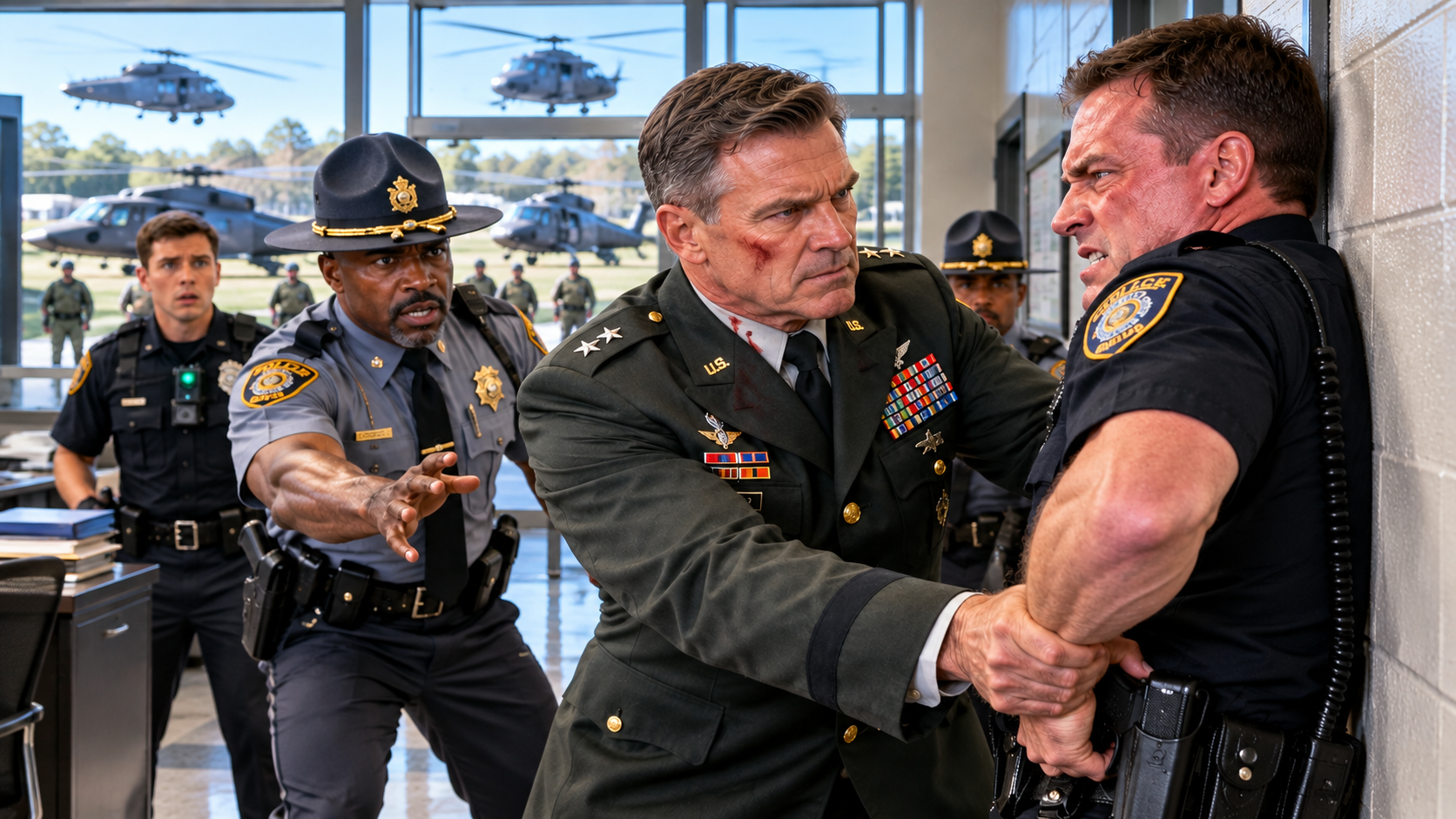

He thought I was alone on a forgotten Georgia highway. He had no idea my wife was already calling the Pentagon.
PART 1: THE GUN AGAINST MY SKULL
The first thing I remember clearly is the sound of Officer Brett Cheney taking the slack out of his trigger.
It was almost nothing.
A tiny metallic pressure.
A soft mechanical click beneath the roar of passing traffic.
But after three combat tours, I knew exactly what it meant.
His Glock was pressed against the base of my skull.
My face was grinding into sun-baked asphalt on the shoulder of a highway outside Carthage, Georgia. Blood from my cheek had begun to drip across the pavement. Cheney’s boot was planted between my shoulder blades, and every time I breathed, his weight drove the rough gravel deeper into my skin.
Ten feet away, Sergeant Calvin Hendry was on his knees with his hands locked behind his head.
“Don’t move, General!” he shouted.
Cheney pressed the pistol harder against me.
“Tell your boy to shut his mouth.”
I stared at a crushed soda can lying inches from my face and forced myself to breathe.
In.
Out.
Slow.
Controlled.
The same way I had taught young officers to breathe when mortars were falling close enough to shake dust from the ceiling.
Only this wasn’t Baghdad.
It wasn’t Kandahar.
There were no insurgents hiding in a marketplace.
No incoming rounds.
No fog of war.
There was only a county police officer standing over an unarmed American citizen who had complied with every command he’d given.
And I understood something terrifying.
Cheney wanted me afraid.
More than that, he wanted me to give him something.
A sudden movement.
An angry word.
A hand lifting from the pavement.
Anything he could turn into justification.
“Officer Cheney,” I said slowly, reading the name stitched above his badge when he’d first approached our vehicle, “my hands are visible. Sergeant Hendry’s hands are visible. We are complying with your instructions.”
“I said shut up.”
His boot shifted against my spine.
Pain shot through my ribs.
I gritted my teeth.
My name is Nathaniel Langford.
At the time, I was fifty-four years old, a Major General in the United States Army. Two stars. Thirty-one years in uniform. Three combat tours between Iraq and Afghanistan. More funerals than I care to remember. More letters to mothers and wives than any commander should ever have to write.
None of that should have mattered on the side of that highway.
A general is not above the law.
Neither is a police officer.
That was precisely why I had told Hendry, before we left Fort Harmon that morning, that I did not want an escort convoy.
I was visiting my mother.
Not attending a ceremony.
Not inspecting troops.
My mother was eighty-two and recovering from hip surgery. She lived outside Savannah with my younger sister, and she had made one request when I called three nights earlier.
Come as my son.
Not as a general.
So I left the official sedan behind.
No flags.
No security detail.
No advance team.
Just my civilian SUV and Sergeant Calvin Hendry, my aide for the previous eighteen months, who had volunteered to drive because he knew I’d been awake most of the night finishing operational reports.
I was still in uniform because I had come directly from headquarters.
Hendry had been teasing me twenty minutes earlier.
“Sir, your mother is going to make you change clothes before she lets you sit on her couch.”
“She’ll make you change too.”
“I’m not the one wearing two stars into her living room.”
“She knew me before the stars.”
“Exactly why she’s dangerous.”
I had laughed.
Then the blue lights appeared.
Hendry checked the speedometer.
“Fifty in a fifty-five.”
“I see it.”
“You want me to pull over?”
“It’s a police car, Sergeant. Yes.”
He signaled immediately and eased onto the gravel shoulder.
Both hands went to the top of the steering wheel before Cheney had even stepped out of his cruiser.
That habit came from years of military travel.
Make your hands visible.
Be respectful.
Don’t escalate.
I lowered my passenger window.
Cheney approached slowly, his right hand resting near his holster.
He was perhaps thirty-eight. Broad shoulders. Mirrored sunglasses. Shaved head. A jaw that seemed permanently clenched.
He stopped behind Hendry’s window instead of mine.
“License and registration.”
Hendry handed him both documents along with his military identification.
Cheney barely glanced at the ID.
“Is there a problem, Officer?” Hendry asked.
Cheney leaned toward the open window.
His nostrils flared theatrically.
Then he said four words that changed everything.
“I smell marijuana.”
Hendry looked at me.
I looked at him.
For half a second, neither of us understood.
Our SUV had been detailed the previous afternoon.
Neither of us smoked.
Neither of us used marijuana.
There was nothing in that vehicle except two bottles of water, my briefcase, a garment bag, and a small wrapped gift for my mother.
“Officer,” Hendry said carefully, “there is no marijuana in this vehicle.”
Cheney’s hand dropped to his pistol.
“Step out.”
“Certainly. May I unbuckle—”
“STEP OUT!”
His weapon came up.
Not pointed toward the ground.
Not at low ready.
Straight through the window.
Straight at my face.
I remember seeing my own reflection in the side of the slide.
“Both of you! Hands where I can see them!”
Everything after that happened fast.
Hendry unbuckled slowly.
I opened my door.
Before my second foot touched the pavement, Cheney rounded the rear of the SUV and seized me by the collar.
“Officer—”
He yanked me forward.
I lost my balance.
My knees struck asphalt.
Then my face.
White light flashed through my vision.
I tasted blood.
Cheney twisted my arm behind me.
“Stop resisting!”
“I am not resisting.”
“Stop resisting!”
“I’m complying.”
He drove his knee between my shoulders.
Then his boot replaced it.
I heard Hendry shouting.
“He’s not resisting! Sir, don’t move!”
Cheney drew the Glock again.
That was when I told him who I was.
Not because rank made me more deserving of safety than anyone else.
I told him because I thought it might force him to realize the scale of the mistake he was making.
“Officer, I am Major General Nathaniel Langford, United States Army.”
He laughed.
Actually laughed.
“I don’t give a damn if you’re the President of the United States, boy.”
The last word was deliberate.
I felt it more sharply than the gravel cutting my cheek.
Then he racked the slide.
The Glock touched my skull.
“Move one inch,” he whispered, “and I’ll end you right here.”
That was when I stopped believing this was a traffic stop gone wrong.
This man knew exactly what he was doing.
And somewhere beyond the pain, beyond the humiliation, beyond the cold muzzle against my skin, another thought rose.
My wife.
Eleanor.
I had called her when we left the base.
She knew our route.
She knew we should have reached my mother’s house before noon.
More importantly, she knew something else.
My SUV’s emergency system was still connected.
And my phone had begun transmitting the moment Hendry pressed the emergency button hidden beside the steering column.
I didn’t know whether the signal had gone through.
I didn’t know who had received it.
But I knew my wife.
If Eleanor believed something was wrong, she would not stop with a local dispatcher.
She knew exactly whom to call.
Cheney did not.
He pulled me to my feet and shoved me toward his cruiser.
“You’re under arrest.”
“For what?”
“Possession. Resisting. Threatening an officer.”
“You haven’t searched the vehicle.”
His mouth curled into a smile.
“Not yet.”
That smile told me everything.
I looked at Hendry.
He saw it too.
And for the first time that morning, I wasn’t afraid of what Cheney might find.
I was afraid of what he intended to put there.
PART 2: THE PRECINCT
Cheney handcuffed us both.
Tight.
Far tighter than necessary.
When Hendry complained that his fingers were going numb, Cheney gave the cuffs another click.
“You military boys always this sensitive?”
Hendry looked at me.
I shook my head once.
Do not engage.
Cheney placed us in separate vehicles after a second patrol car arrived.
The other officer’s name was Deputy Mason Pike.
Younger.
Maybe twenty-six.
Unlike Cheney, Pike looked nervous.
He kept staring at my uniform.
Then at the stars on my shoulders.
Then back at Cheney.
“Boss,” Pike said quietly, “you sure about this?”
Cheney turned.
“What?”
“The vehicle. The IDs. Maybe we ought to call—”
“You calling me a liar?”
“No.”
“Then search the SUV.”
Pike didn’t move.
Cheney stepped closer.
“I said search it.”
I watched from the back of the cruiser.
There are moments when an organization tells you what it is without saying a word.
Pike’s shoulders dropped.
He put on gloves.
Then he obeyed.
That frightened me more than Cheney’s shouting.
A dangerous man is one problem.
A system that has learned to accommodate him is another.
Cheney drove me to the Carthage Police Precinct, a low brick building tucked behind a gas station and an auto-parts shop.
Population signs told me Carthage was a town of fewer than six thousand people.
The precinct parking lot contained five patrol vehicles.
No cameras were visible inside the rear corridor where Cheney took me.
He noticed me looking.
“Something interesting?”
“Just observing.”
“Army teach you that?”
“Life did.”
He shoved me through a steel door.
The booking room smelled of stale coffee, disinfectant, and sweat.
Behind the desk sat a heavyset officer with silver hair and reading glasses.
His nameplate read LIEUTENANT RUSSELL VANE.
He looked up.
First at Cheney.
Then at me.
Then slowly at my uniform.
His expression changed.
“Brett.”
“Traffic stop.”
Vane removed his glasses.
“What happened?”
“Vehicle smelled like weed. Driver got mouthy. This one interfered.”
“I did not interfere,” I said.
Cheney shoved me into a chair.
Vane looked at the stars on my shoulders.
“Sir, are those genuine?”
“Yes.”
Cheney laughed.
“Oh, come on.”
Vane ignored him.
“Name?”
“Major General Nathaniel James Langford.”
Vane’s face went still.
He knew the name.
I saw it instantly.
Maybe from news reports.
Maybe from a local military ceremony.
Maybe because any competent law-enforcement officer in Georgia understood that several major Army installations operated within the state.
“Brett,” he said, much more quietly, “come into my office.”
“I’m booking him.”
“Office.”
For half a second I thought the situation might turn.
Then Cheney leaned toward him.
“They had product in the vehicle.”
Vane froze.
I watched their eyes meet.
Not surprise.
Recognition.
Something passed between them.
Something practiced.
Vane looked toward the hallway where Pike had just entered carrying a clear evidence bag.
Inside it was a small plastic pouch containing what appeared to be marijuana.
Pike’s face had gone pale.
Cheney smiled at me.
“There it is.”
I stared at the bag.
Then at Pike.
“Where exactly did you find that?”
Pike opened his mouth.
Cheney answered first.
“Under the passenger seat.”
“My seat?”
“That’s right.”
Interesting.
He had chosen me.
Not Hendry.
Maybe because of the uniform.
Maybe because humiliating the more senior man pleased him.
“Then you’ll have body-camera footage of the discovery.”
Nobody spoke.
I looked at Cheney’s chest.
No body camera.
Then Pike’s.
He had one.
A small green light was blinking.
Cheney followed my eyes.
His face changed.
“Pike.”
The young deputy swallowed.
“Yeah?”
“Turn that thing off.”
“Department policy says—”
“Turn it off.”
Pike hesitated.
Then reached toward the camera.
“Deputy,” I said.
Every man in the room looked at me.
“If that camera has recorded what happened today, I strongly advise you not to alter, delete, disable, or destroy any portion of it.”
Cheney crossed the room in two strides.
He grabbed me by the front of my uniform.
“You don’t advise anybody in my building.”
I looked directly into his eyes.
“Then consider it a warning.”
His fist hit me beneath the ribs.
Hard.
The chair nearly tipped.
Hendry, being brought through the doorway at that moment, saw it happen.
“Get your hands off him!”
Two officers grabbed Hendry.
Cheney turned.
“Put him in holding.”
“Sir!” Hendry shouted to me.
“I’m all right.”
“General—”
“Sergeant.”
He stopped struggling immediately.
Training.
Discipline.
Trust.
They took him away.
Cheney leaned over me.
“You think those stars mean something here?”
“No.”
That surprised him.
I continued.
“They mean something to me. They remind me of people I’m responsible for. But in this room, under the Constitution, you and I are citizens subject to the same law.”
His jaw tightened.
“Don’t lecture me.”
“I’m not.”
I lowered my voice.
“I’m telling you that you still have time to stop.”
For the first time, there was something behind his arrogance.
Not fear.
Not yet.
But uncertainty.
It vanished almost immediately.
He turned toward Vane.
“Book him.”
Vane didn’t move.
“Brett—”
“I said book him.”
I spent the next forty minutes in a holding room without knowing whether anyone outside that precinct knew where I was.
There was no clock.
No window.
Only a concrete bench bolted to the wall.
My cheek had swollen.
My ribs hurt when I inhaled deeply.
Blood had dried along the collar of my uniform.
I tested my fingers.
No fracture.
Probably bruised ribs.
I had experienced worse.
But war wounds made sense.
This didn’t.
That was the part I could not reconcile.
I kept replaying the stop.
The false claim about marijuana.
The unnecessary firearm.
The way Cheney had immediately chosen language that created an official narrative: resisting, threatening, possession.
The bag Pike carried inside.
Vane’s reaction.
Not shock.
Recognition.
I had spent enough of my career evaluating command failures to understand a pattern.
One bad actor could do enormous damage.
But sustained misconduct required silence.
Sometimes fear.
Sometimes convenience.
Sometimes complicity.
A door opened.
Lieutenant Vane stepped inside alone.
He closed it behind him.
For several seconds, neither of us spoke.
Then he placed my wallet on the bench.
Inside it were my driver’s license and military identification.
“I verified who you are.”
“I assumed you would.”
He rubbed his forehead.
“This has become complicated.”
“No, Lieutenant. It’s actually very simple.”
He looked at me.
“An officer claimed probable cause based on a smell that did not exist. He pointed a loaded firearm at two compliant men, assaulted me, threatened to kill me, and apparently manufactured narcotics evidence.”
“You need to be careful making accusations like that.”
“And you need to be careful deciding what happens next.”
His eyes hardened.
“Is that a threat?”
“No.”
I leaned forward despite the pain in my ribs.
“It’s advice from one commander to another.”
He stared at me.
I continued.
“Whatever happened before I entered this building is now outside your control. What happens after I entered it is not.”
Vane looked toward the door.
I saw his throat move.
“You don’t know Brett.”
“No. But you do.”
Silence.
That was my answer.
I lowered my voice.
“How many times have you cleaned up after him?”
His eyes snapped toward me.
I hadn’t known.
Not for certain.
But leadership teaches you to recognize shame.
He looked away.
Then something vibrated on his belt.
His phone.
He checked the screen.
The blood drained from his face.
“What is it?” I asked.
He didn’t answer.
The phone began ringing again almost immediately.
He silenced it.
Then another telephone started ringing somewhere outside.
Then another.
Voices rose in the corridor.
I heard someone say, “State office.”
Another voice: “No, sir, we do not have confirmation—”
Then the main desk phone rang continuously.
Vane stared through the small window in the door.
“What did you do?” he whispered.
“Nothing.”
“What did you do?”
“I was sitting in a vehicle when your officer put a gun in my face.”
A dispatcher appeared outside the glass.
She looked terrified.
“Lieutenant?”
Vane opened the door.
“What?”
“There’s somebody from Army headquarters asking for General Langford.”
Vane turned slowly toward me.
I said nothing.
The dispatcher continued.
“And the Georgia State Patrol is asking whether he’s in our custody.”
Vane’s mouth opened.
No words came.
Then, faintly, from somewhere beyond the concrete walls, I heard a sound I had known most of my adult life.
At first it was only a distant rhythmic vibration.
Whump.
Whump.
Whump.
The dispatcher looked toward the ceiling.
The sound grew louder.
Whump-whump-whump-whump.
Rotor blades.
More than one aircraft.
Vane walked toward the front of the precinct.
I stood.
My wrists were still cuffed.
He looked back at me.
“You stay here.”
Then someone outside screamed:
“Lieutenant, you need to see this.”
The rotor noise became thunder.
And for the first time since Officer Brett Cheney had pressed a gun to my skull, I allowed myself to believe that Eleanor had found me.
PART 3: MY WIFE’S PHONE CALL
What I learned later was that Eleanor knew something was wrong nineteen minutes after the traffic stop began.
My wife had spent twenty-seven years married to an Army officer.
That meant she understood silence.
Deployments teach families strange kinds of mathematics.
How many days since the last call.
How long a satellite connection normally lasts.
Which delays are ordinary.
Which aren’t.
That morning, I had told Eleanor I would call when we passed Carthage.
I didn’t.
At first, she assumed I was talking to Hendry.
Then my SUV’s emergency notification reached her phone.
The system had been installed because of my position, though I rarely thought about it.
Hendry did.
When Cheney ordered us out of the vehicle, Calvin had pressed the concealed distress switch beneath the steering column before raising his hands.
The system transmitted our coordinates.
Eleanor called me.
No answer.
She called Hendry.
No answer.
Then she called the operations duty officer at my command.
“Something is wrong with Nate.”
According to Eleanor, the captain initially tried to reassure her.
“Ma’am, the general may just be tied up—”
“My husband’s emergency locator activated on a highway in Georgia. His phone is not moving. His aide’s phone is not moving. Find out why.”
There are people who shout when they are frightened.
Eleanor becomes quieter.
That is far more effective.
Within minutes, headquarters was trying our phones.
Then local dispatch.
Then county dispatch.
Nobody could initially explain where we were.
The duty officer elevated it.
My chief of staff was contacted.
Military law enforcement was notified because a senior Army commander had triggered an emergency alert and disappeared from communication.
Eleanor called again.
This time the question was different.
“Have you found him?”
“We’re working on it, ma’am.”
“Work faster.”
By then someone had traced the location to the Carthage jurisdiction.
A call went to the precinct.
The person answering reportedly said there was no one named Langford in custody.
That statement changed everything.
Because I had already been booked.
They had my identification.
They knew exactly who I was.
The false denial traveled upward through official channels faster than Cheney could have imagined.
Army operations personnel requested immediate verification.
State authorities were alerted.
A nearby military aviation unit already had aircraft in the air on scheduled training.
Those aircraft were redirected—not for an assault, not to storm a civilian police station, but to establish contact, provide rapid military liaison and medical support, and confirm the location of a senior officer whose emergency beacon had activated and whose detention was being denied.
Eleanor, meanwhile, had made another call.
Not to some secret red telephone.
Not directly to a room full of generals waiting for her command.
Reality is usually less theatrical than rumor.
But the effect was nearly the same.
She contacted an emergency operations number she had been given years earlier for family contingencies connected to my command responsibilities.
From there, the notification moved through Army channels, including personnel at the Pentagon.
By the time Cheney returned to the precinct carrying paperwork meant to transform his roadside assault into an official arrest, senior officials in multiple agencies already knew my name.
And they knew something did not match.
I did not know any of this as I stood in the holding room listening to helicopters approach.
All I knew was that Lieutenant Vane was suddenly sweating.
The front door opened.
A uniformed officer rushed through the hallway.
“Three helicopters!”
Vane snapped, “What?”
“Three. Maybe four.”
The building vibrated.
Loose papers stirred on a desk as rotor wash hammered the parking lot.
Someone outside shouted.
Through the narrow holding-room window I saw officers moving toward the front entrance.
Cheney appeared at the end of the corridor.
He looked annoyed rather than frightened.
“What the hell is going on?”
Vane turned on him.
“Did you tell dispatch we didn’t have him?”
Cheney stopped.
“Have who?”
“Him!”
Vane pointed at me.
Cheney looked through the glass.
Then back at Vane.
“I don’t know what you’re talking about.”
“The Army called. State Patrol called. Now there are helicopters outside.”
Cheney’s expression changed.
Only slightly.
But I saw it.
Fear.
He walked to the front window.
The color left his face.
“What did this son of a—”
Vane grabbed his arm.
“Stop.”
Cheney looked at him.
It may have been the first time anyone inside that building had said that word to him and meant it.
“Stop,” Vane repeated.
Cheney jerked his arm free.
“This is my arrest.”
“No.”
“Russ—”
“No.”
The front doors opened again.
A Carthage officer stepped backward into the lobby with both hands visible.
Behind him stood a Georgia State Patrol captain and two troopers.
Outside, beyond the glass, I caught glimpses of military helicopters settling into an open field beside the municipal building.
Dust rolled across the lot in brown clouds.
The rotor wash bent young pine trees nearly sideways.
People from nearby businesses had stepped outside.
Phones were raised.
Traffic had stopped.
Cheney stared at the scene as though reality itself had betrayed him.
The State Patrol captain entered.
“Who’s in charge?”
Vane raised one hand.
“I am.”
“I’m Captain Marcus Hale. We received a request to locate Major General Nathaniel Langford.”
Vane swallowed.
“He’s here.”
“Is he injured?”
Vane didn’t answer quickly enough.
Hale’s eyes narrowed.
“Where is he?”
Vane led him toward my room.
When the door opened, Hale saw the cuffs first.
Then the blood on my collar.
Then the bruising on my face.
His expression hardened.
“General Langford?”
“Yes.”
“Sir, are you in need of medical attention?”
“I’d appreciate having these cuffs removed first.”
Vane reached for his key.
Cheney pushed forward.
“He’s under arrest.”
Every head turned.
Hale looked at him.
“For what?”
“Narcotics possession. Resisting arrest. Threatening an officer.”
“Was a weapon recovered?”
“No.”
“Contraband?”
“Yes.”
“Where?”
“In the vehicle.”
“Who recovered it?”
Cheney hesitated.
“Pike.”
“Where is Deputy Pike?”
Nobody answered.
Hale looked around.
“Get him.”
Cheney stepped closer.
“Captain, this is a local investigation.”
Hale’s voice remained calm.
“So investigate it. Nobody is interfering with lawful authority.”
He pointed toward me.
“But a senior military officer triggered an emergency signal, his command was initially told he was not in your custody, and I am looking at him bleeding while handcuffed in a holding room. I intend to establish what occurred.”
Cheney laughed bitterly.
“So because he’s a general, everybody comes running.”
I spoke for the first time.
“No.”
He looked at me.
“This isn’t about me being a general.”
I raised my cuffed hands.
“This is about whether your story is true.”
Vane unlocked the cuffs.
The pressure left my wrists.
I rubbed the circulation back into my hands.
“Where is Sergeant Hendry?”
Vane pointed toward another room.
“Release him.”
Cheney snapped, “Don’t.”
Vane ignored him.
That was the moment Cheney realized he was losing control.
He lunged toward the evidence desk.
I saw it immediately.
So did Hale.
“Officer.”
Cheney stopped.
“Step away from the evidence.”
“I was securing it.”
“Step away.”
Two State Patrol troopers moved subtly apart.
Not threatening.
Positioning.
Cheney’s hand hovered near his belt.
Old instincts tightened my stomach.
I had seen that posture before.
The body chooses before the mind admits what it has chosen.
“Cheney,” I said.
He looked at me.
“Don’t.”
His face twisted.
“You shut your mouth.”
Hale said, “Hands away from your weapon.”
“I haven’t done anything.”
“Then there won’t be a problem.”
For several seconds, the room held its breath.
Then a young voice came from the hallway.
“Captain?”
Deputy Mason Pike stood there.
His body camera was still attached to his chest.
Cheney looked at it.
Pike looked at Cheney.
Hale’s eyes moved between them.
“Deputy, was your camera active during the vehicle search?”
Pike’s lips parted.
Cheney said, “Don’t answer that.”
Hale did not raise his voice.
“Officer Cheney, you will not instruct a witness.”
“I’m his supervisor.”
“Not in this inquiry.”
Pike’s hands began trembling.
He reached toward the body camera.
For a moment I thought he was going to remove it.
Instead, he placed both hands at his sides.
“Yes, sir.”
Cheney stared at him.
Pike swallowed.
“It was running.”
Nobody moved.
Hale asked the next question.
“Did you recover marijuana from General Langford’s vehicle?”
Pike looked at the floor.
Cheney’s face turned scarlet.
“Mason.”
Pike closed his eyes.
When he opened them, he looked at me.
There was shame in his face.
And fear.
“No, sir.”
The room went silent.
Hale waited.
Pike’s voice broke.
“It was already in the evidence bag when Officer Cheney gave it to me.”
Cheney moved.
Fast.
His hand went toward his holster.
Three people shouted at once.
“Hands!”
“Don’t move!”
“Cheney!”
I was closest.
Too close.
His fingers touched the grip of his Glock.
I stepped toward him, seized his wrist with both hands, and drove it against the wall before he could clear leather.
Pain exploded through my injured ribs.
Cheney cursed and swung his free arm.
Hale and one of the troopers slammed into him.
The Glock fell to the floor.
A trooper kicked it away.
Seconds later, Brett Cheney was face-down.
Hands behind his back.
For a strange moment, the symmetry of it sickened me.
His cheek pressed to the tile.
His arms pulled behind him.
Officers surrounding him.
He turned his head toward me.
Hatred poured from his eyes.
“You think you won because you brought an army?”
I was breathing hard.
My ribs felt like broken glass.
“No.”
I looked down at him.
“You lost because one man finally told the truth.”
Behind me, Deputy Pike began to cry.
Outside, the helicopters were still turning.
But the storm was no longer coming.
It had arrived.
PART 4: THE VIDEO
The body-camera footage lasted thirty-seven minutes.
I watched it two days later.
I almost wished I hadn’t.
There are things you experience once with your body and then again with your mind.
The second time can hurt more.
The investigation moved quickly after Cheney was detained.
The Georgia Bureau of Investigation became involved.
Military authorities coordinated because Hendry and I were active-duty personnel, but I made one thing clear from the beginning.
I wanted no special jurisdiction invented for me.
No shortcuts.
No pressure on investigators.
No one protecting me because of my rank.
“If the evidence clears him,” I told the investigators, “then clear him.”
The lead investigator looked at my bruised face.
“And if it doesn’t?”
“Follow it wherever it goes.”
Hendry sat beside me when we watched the recording.
Eleanor sat on my other side.
She had arrived at the hospital the evening of the incident.
I had been standing beside the examination table when she entered.
She crossed the room without speaking.
Then she slapped me.
Not hard.
More insult than injury.
I stared at her.
She immediately wrapped both arms around me.
“You scared ten years off my life.”
“I was busy.”
“Apparently.”
She stepped back and looked at my bruises.
Her eyes filled.
“Did he really put a gun to your head?”
I nodded.
Eleanor touched the bandage on my cheek with two fingers.
Then she turned away.
My wife almost never cries in front of other people.
That evening, she did.
Now, forty-eight hours later, we sat in a secure conference room as an investigator played Pike’s body-camera recording.
The video began when he arrived at the roadside.
The image bounced as he stepped from his cruiser.
Cheney stood beside our SUV.
Hendry and I were already on the ground.
My stomach tightened.
On the screen, Cheney shouted:
“Suspects are noncompliant.”
Hendry’s voice answered immediately.
“We are complying with every order.”
I watched myself lying face-down on the road.
Cheney’s boot was on my back.
The gun was in his hand.
Pike approached.
“Boss, what’s going on?”
“Vehicle reeks of weed.”
The microphone captured Pike inhaling near the open door.
Then silence.
“Smell it?” Cheney asked.
A long pause.
“Not really.”
Cheney looked directly at him.
“Smell it?”
Another pause.
Then Pike said quietly, “Yeah.”
Beside me, Hendry whispered, “There.”
I nodded.
The footage continued.
Cheney ordered Pike to search.
Pike put on gloves.
He opened the driver’s side door.
Checked the console.
The rear seat.
The cargo area.
Then the passenger side.
Nothing.
He returned to Cheney.
“Clean.”
Cheney glanced toward us.
Then toward Pike.
“You didn’t check properly.”
“I checked.”
Cheney walked to his patrol car.
The body camera showed him opening the trunk.
His back blocked the view for perhaps three seconds.
Then he turned around.
Something small was concealed in his palm.
My hands clenched.
Eleanor reached over and placed her hand on mine.
Cheney walked to Pike.
“Search under the passenger seat again.”
Pike stared at him.
“I already did.”
“Do it again.”
Then Cheney’s hand moved.
Quick.
Subtle.
The camera caught it.
He slipped the small packet into the young deputy’s gloved hand.
Pike froze.
Even knowing what had happened, watching the moment was almost unbearable.
Cheney leaned toward him.
“Now find it.”
The video continued.
Pike stood completely still.
“Boss…”
“Do your job.”
Pike looked toward me.
Then at the packet in his hand.
Then toward the camera on his own chest.
Cheney followed his gaze.
That was the first time his confidence cracked.
“Turn that off.”
Pike didn’t.
The recording showed him walking to the SUV.
But he did not place the packet beneath the seat.
Instead, he stood beside the open passenger door for nearly twenty seconds.
Then he walked back.
“Found it.”
Cheney smiled.
“Where?”
“Under the passenger seat.”
Watching it, I understood something I had missed that day.
Pike had lied.
But he had refused to complete the full lie.
He never planted the drugs inside my vehicle.
He kept the bag in his hand.
That distinction did not absolve him.
But it mattered.
The video later captured our arrival at the precinct.
It captured Vane asking questions.
It captured Cheney striking me.
It captured me warning Pike not to disable his camera.
Then it captured something none of us expected.
Because Pike never actually switched it off.
He only covered the lens briefly when Cheney ordered him to.
Audio continued.
We heard Cheney and Vane speaking in the hallway.
Vane’s voice:
“You’ve gone too far this time.”
Cheney:
“Don’t start.”
“You pulled a gun on him.”
“He reached.”
“The deputy says he didn’t.”
“Whose side are you on?”
Then Vane said the sentence that ended his career.
“The same side I’ve been on every other time I cleaned up your mess.”
No one in the conference room moved.
The investigator paused the footage.
Eleanor looked at me.
I stared at the frozen image.
Every other time.
That was the clue I had sensed in the booking room.
This wasn’t an isolated collapse of judgment.
It was a pattern.
The inquiry widened.
Complaints that had been dismissed were reopened.
Traffic stops were reviewed.
Arrest reports were compared against camera recordings.
Evidence logs were audited.
Not every accusation against Cheney proved true.
That mattered too.
Justice is not replacing one assumption with another.
But enough was verified.
There had been previous allegations of unlawful searches.
A motorist had complained that Cheney threatened him after he questioned a search.
A young woman had filed a complaint about property seized from her vehicle that never appeared in an evidence log.
Another man had accused Cheney of inventing the smell of marijuana as probable cause.
The complaint had been marked “unsubstantiated.”
Lieutenant Vane had signed the review.
When investigators asked him why, he eventually stopped defending himself.
He admitted he had known Cheney was aggressive.
He admitted he had ignored inconsistencies.
He admitted he had accepted explanations he would never have accepted from another officer.
Why?
At first Vane called it loyalty.
Then pressure.
Then protecting the department.
Eventually, under questioning, he said the only honest thing.
“I was afraid of what would happen if I challenged him.”
When I heard that, I felt no satisfaction.
Only anger.
Fear is human.
Cowardice becomes institutional when a leader asks subordinates to pay the price for his fear.
Pike reached a cooperation agreement.
He admitted lying at the scene.
He admitted falsely saying he smelled marijuana after Cheney pressured him.
He admitted carrying the evidence bag.
But the body-camera footage supported his claim that he had not planted it and had preserved the recording rather than destroying it.
I met him once before the formal proceedings.
He requested it.
I almost declined.
Then I remembered the hallway.
His shaking hands.
His decision to speak.
We met in a plain interview room.
Pike entered wearing civilian clothes.
He looked younger without the uniform.
“General.”
“Mr. Pike.”
He sat across from me.
For a while, he stared at his hands.
Then he said, “I should’ve stopped him on the road.”
“Yes.”
He flinched.
Maybe he expected reassurance.
I wasn’t going to lie to make him feel better.
“You should have.”
He nodded.
“I knew something was wrong.”
“I know.”
“I was scared.”
“So was Sergeant Hendry.”
Pike looked up.
“So was I.”
His eyes widened slightly.
“You?”
“I had a loaded gun pressed against my skull. Of course I was afraid.”
He looked down again.
“I thought generals didn’t—”
“Feel fear?”
He nodded.
“Fear isn’t the difference between courage and cowardice.”
I leaned forward.
“What you do next is.”
His jaw tightened.
“I keep thinking about all the other people.”
I understood.
The people who hadn’t been generals.
The people whose wives didn’t know emergency Army numbers.
The people who had no command center trying to locate them.
The people who couldn’t summon state investigators merely by being recognized.
That truth had haunted me from the beginning.
“What happened to me became visible because of who I am,” I said. “But what happened was wrong before anyone knew my rank.”
Pike wiped his eyes.
“I’m sorry.”
“I believe you.”
He looked up.
“That doesn’t erase it.”
“No.”
I stood.
“But telling the truth prevented him from finishing the lie.”
As I reached the door, Pike spoke again.
“General?”
I turned.
“If the helicopters hadn’t come… what do you think would’ve happened?”
I thought about the gun.
The evidence bag.
The booking room.
Cheney’s certainty.
Then I answered truthfully.
“I don’t know.”
That uncertainty stayed with me longer than the bruises.
Because the helicopters had come.
The calls had been made.
People had responded.
I had been found.
But I couldn’t stop thinking about the people whose emergency beacon had never existed.
PART 5: WHEN THE ROTORS STOPPED
Six months later, I returned to Carthage.
Not in uniform.
No stars.
No aide.
No helicopters.
I drove myself.
The highway looked exactly the same.
That disturbed me.
The place where a man points a gun at your head should look different afterward.
It should carry some mark.
A scar.
A burned patch of earth.
Something.
Instead, sunlight lay across the pavement.
Cars passed.
Pine trees moved in the breeze.
A family in a minivan drove by without slowing.
I pulled onto the same gravel shoulder where Hendry and I had been stopped.
For several minutes, I remained behind the wheel.
Cheney had been indicted on multiple charges arising from my stop and from conduct uncovered during the broader investigation.
The courts would determine the exact legal consequences.
I had testified.
Hendry had testified.
Pike had testified.
Vane had resigned and faced his own proceedings for actions related to evidence handling and official reporting.
The town government had brought in outside oversight and begun reviewing policies on searches, cameras, complaints, and evidence storage.
People called that justice.
Maybe part of it was.
But justice is a word people like to use when punishment begins.
I had learned to think about it differently.
Justice starts much earlier.
It starts when someone tells the truth before punishment is certain.
When a deputy leaves his camera running.
When a supervisor refuses to alter a report.
When a dispatcher records an uncomfortable call.
When a citizen asks why.
When an institution chooses embarrassment over concealment.
When a person with authority remembers that authority is borrowed.
I stepped out of the SUV.
The September air was warm, though nothing like the brutal heat of that first day.
I walked toward the patch of shoulder where Cheney had forced me down.
I could not identify the exact spot.
Perhaps that was good.
My phone rang.
Eleanor.
I answered.
“Where are you?”
“On the highway.”
A pause.
“That highway?”
“Yes.”
“Nate.”
“I’m fine.”
“You always say that when you’re somewhere doing something you didn’t tell me about.”
I smiled.
“Thirty years and you’ve learned nothing.”
“Thirty years is exactly why I know.”
I looked down the road toward Carthage.
“Do you regret making the calls?”
“What kind of question is that?”
“People said the response was excessive.”
“People weren’t there.”
“Neither were you.”
“No.”
Her voice softened.
“But I heard your emergency alert. You disappeared. Local authorities told the Army you weren’t in custody when you were. What exactly was I supposed to do?”
I knew the answer.
Still, I asked.
“What would you have done if nobody listened?”
She didn’t hesitate.
“Called the next person.”
“And then?”
“The next.”
“And then?”
“The next.”
I laughed quietly.
“That’s what I thought.”
“Nathaniel.”
“Yes?”
“If a man puts a gun against my husband’s head, I am not worrying about whether my phone calls inconvenience his afternoon.”
I closed my eyes.
For the first time in weeks, the memory of the Glock against my skull did not come with rage.
It came with her voice.
Steady.
Uncompromising.
Alive.
“I love you,” I said.
“I love you too. Now get off the side of the highway before some officer pulls over to ask what you’re doing.”
I laughed.
“That isn’t funny.”
“It was a little funny.”
I ended the call.
A few minutes later another vehicle pulled onto the shoulder behind mine.
My body reacted before my mind did.
Heart rate rising.
Shoulders tightening.
Hands visible.
Then I saw who stepped out.
Calvin Hendry.
He had no business being there.
Which meant Eleanor had called him.
I should have known.
He walked toward me wearing jeans and a polo shirt.
“You stalking me, Sergeant?”
“No, sir.”
“Then what are you doing here?”
“Mrs. Langford said you were having one of your dramatic introspective moments.”
I stared at him.
“She said that?”
“Not those words.”
“What words did she use?”
“I value my career, sir.”
He stood beside me.
For a while we watched traffic.
Then Hendry said, “I still dream about it.”
I looked at him.
He kept his eyes on the highway.
“The gun.”
I nodded.
“So do I.”
“I thought he was going to kill you.”
“So did I.”
Hendry finally looked at me.
“You never said that.”
“I didn’t think I needed to.”
“You were so calm.”
“No. I was controlled.”
“What’s the difference?”
“Calm means you’re not afraid.”
I looked toward the patch of asphalt.
“Control means you’re afraid and decide what you’re going to do anyway.”
Hendry nodded slowly.
We stood there another minute.
Then he said, “You ever think about what would’ve happened if I hadn’t hit the emergency button?”
“Yes.”
“Me too.”
I turned toward him.
“Calvin.”
“Sir?”
“You did exactly what you were trained to do.”
“I almost didn’t.”
“Why?”
“I thought it might make things worse.”
I understood that immediately.
People imagine courage as certainty.
Most of the time, courage is pressing the button while wondering whether you shouldn’t.
“You pressed it anyway.”
“Yes, sir.”
“That’s the part that matters.”
He looked toward Carthage.
“People keep telling the story like the helicopters saved us.”
“They didn’t.”
Hendry gave me a surprised look.
I smiled.
“The helicopters were impressive.”
“Very.”
“But by the time they arrived, the most important things had already happened.”
He thought about that.
Then nodded.
He had pressed the emergency button.
Eleanor had refused to accept silence.
The duty officer had escalated the call.
Someone had noticed the precinct’s false denial.
Pike had left his camera running.
Tiny decisions.
Each made before anyone knew how the story would end.
That was what brought Cheney down.
Not rank.
Not spectacle.
Not rotors over a police station.
Choices.
We drove into Carthage together.
The old precinct building was still there, but the sign had changed.
Temporary leadership had taken over during the investigation.
New cameras had been installed in booking areas and hallways.
Body-camera rules had been rewritten so individual officers could not casually order subordinates to disable recording during enforcement actions.
The town had invited me to speak at a public meeting.
I had resisted for weeks.
Eventually I agreed under one condition.
No military uniform.
No honor guard.
No introduction listing medals or commands.
I wanted to speak as the man who had been lying on the highway.
The meeting was held inside a high-school auditorium.
Nearly every seat was filled.
Some people applauded when I entered.
Others did not.
I was glad for both.
Applause wasn’t the point.
At the front sat town officials, state investigators, police representatives, and residents.
Deputy Pike sat near the back.
When he saw me, he nodded once.
I nodded back.
I stepped to the microphone.
For a moment, I looked across the room.
I had addressed thousands of soldiers.
Briefed cabinet officials.
Spoken at memorials.
Given orders in rooms where lives depended on clarity.
Still, this felt different.
“My name is Nathaniel Langford.”
No rank.
Just my name.
“Several months ago, on a highway outside this town, a police officer put a loaded weapon against the back of my head.”
The auditorium became completely silent.
“I have been asked many times what I thought in that moment.”
I paused.
“The truth is, I thought I might die.”
A woman in the front row lowered her eyes.
“I did not think about my rank. I did not think about medals. I did not think about commands. I thought about my wife. My mother. My children. I thought about how quickly a lie can become an official story when the person telling it has authority.”
Nobody moved.
“I was fortunate.”
I looked toward Pike.
“Someone preserved a recording.”
Then toward the town officials.
“People outside the building asked questions.”
Then toward the audience.
“And when inconsistencies appeared, investigators followed them.”
I gripped the sides of the lectern.
“But I want to be absolutely clear about something.”
I felt again the asphalt against my cheek.
The boot between my shoulders.
The steel against my skull.
“What happened to me would have been wrong if I had been unemployed.”
A murmur moved through the room.
“It would have been wrong if I had been nineteen.”
Another pause.
“If I had been homeless.”
Silence.
“If I had been difficult.”
I looked across the audience.
“If I had been afraid and angry.”
My voice hardened.
“The law does not become more important because the victim has two stars on his shoulders.”
Someone began applauding.
I raised a hand.
The room quieted.
“And law enforcement does not become dishonorable because one officer violated his oath.”
Several uniformed officers looked up.
“The answer to abused authority is not hatred of all authority. The answer is accountability.”
That time, the applause came slowly.
Not explosive.
Not theatrical.
Better.
Honest.
After the meeting, people approached me one at a time.
Some shook my hand.
Some told me stories.
A few defended officers who had served the town honorably for years and resented being judged because of Cheney.
I told them I understood.
One elderly man came forward last.
He wore mechanic’s coveralls.
His hands were permanently darkened by grease.
“You probably don’t remember me,” he said.
“I don’t believe we’ve met.”
“No.”
He glanced toward the exit.
“Cheney stopped my boy two years ago.”
I waited.
“Said he smelled weed.”
My stomach tightened.
“He didn’t find anything. But he kept my son on the road almost two hours. Threw everything he owned onto the shoulder.”
The man’s eyes filled.
“My boy complained.”
“What happened?”
“Nothing.”
He gave a bitter laugh.
“They told him the officer acted within procedure.”
I didn’t know what to say.
The man looked directly at me.
“When I saw those helicopters on television, I thought, that’s what it takes.”
“What?”
“For somebody to listen.”
The words hit harder than Cheney’s fist had.
I stepped away from the lectern.
“No.”
The man frowned.
I shook my head.
“That cannot be what it takes.”
He stared at me.
Then slowly held out his hand.
I took it.
Outside, evening had fallen over Carthage.
Hendry waited beside my SUV.
Eleanor had driven down that afternoon and was talking with a group of residents near the entrance.
When she saw me, she excused herself and walked over.
“How did it go?”
“I think I talked too long.”
“You always talk too long.”
“I’m a general.”
“Not tonight.”
I smiled.
“Apparently not.”
She took my hand.
The three of us stood there beneath the parking-lot lights.
For a moment, the town was quiet.
No sirens.
No rotor blades.
No shouting.
Just insects buzzing beneath lamps and cars moving along the highway in the distance.
I thought about Brett Cheney.
The first time I’d seen him, he had been walking toward our SUV convinced he controlled everything that would happen next.
He controlled the uniform.
The badge.
The gun.
The arrest report.
The door to the cell.
He thought that meant he controlled the truth.
That was his fatal mistake.
Truth does not always arrive dramatically.
Sometimes it comes from a blinking green light on a frightened deputy’s chest.
Sometimes from a wife refusing to stop dialing.
Sometimes from a sergeant pressing an emergency switch beneath a dashboard.
Sometimes from one lieutenant finally admitting that he’d been afraid.
And yes, sometimes it arrives beneath the thunder of military helicopters descending into a dusty field beside a tiny police precinct.
But the helicopters were never the real power.
The truth was.
As Eleanor and I walked toward the SUV, I heard an aircraft somewhere high above us.
Not a helicopter.
Probably a commercial jet.
Still, I looked up.
For months, rotor noise had taken me back to that holding room.
To Vane’s pale face.
To Cheney standing in the corridor as the world he controlled suddenly became much larger than his badge.
That night, the sound meant something different.
I squeezed Eleanor’s hand.
She looked at me.
“What?”
“Nothing.”
“You have that look.”
“What look?”
“The one where you’re turning something into a speech.”
“I’m not.”
“Liar.”
Hendry opened the driver’s door, then caught himself.
“Nope. I’m off duty.”
He tossed me the keys.
I caught them.
Eleanor laughed.
I climbed behind the wheel.
Before starting the engine, I looked one last time at the town.
Brett Cheney had believed power meant making another human being helpless.
He was wrong.
Real power was the ability to make someone helpless—and choosing restraint.
Real strength was being afraid—and telling the truth anyway.
Real leadership was not protecting your people from consequences.
It was making sure no one was placed beyond them.
I started the SUV.
Eleanor rested her hand on my arm.
Hendry buckled himself into the back seat.
We pulled onto the highway and headed south toward my mother’s house.
Six months late, in a way.
She still had the wrapped birthday present I had never delivered that afternoon.
When I finally gave it to her, she opened it, looked at the watch inside, and shook her head.
“You went through all that trouble for this?”
“I didn’t exactly schedule the arrest, Mom.”
She looked at the scar on my cheek.
Then at Eleanor.
Then at Hendry.
Finally she reached across the table and took my hand.
“You’ve spent your whole life commanding soldiers.”
“Yes, ma’am.”
“And you’re still learning.”
“Learning what?”
She smiled.
“That nobody survives alone.”
I had no answer for that.
So I sat beside my mother, with my wife across from me and the sergeant who had saved my life arguing with my sister about football, and I listened to the ordinary noise of people I loved.
Months earlier, I had lain on a highway with a weapon pressed against my skull while a corrupt officer whispered that one movement would end my life.
He believed the moment belonged to him.
For a few terrifying minutes, perhaps it did.
But he had not counted on the people beyond that highway.
He had not counted on a recording.
He had not counted on a frightened deputy finding enough courage to speak.
He had not counted on my aide pressing a button.
And most of all, he had not counted on Eleanor Langford picking up a telephone.
By the time Brett Cheney understood what he had unleashed, the rotor blades were already beating across the Georgia sky.
And the truth was on its way.
Leave a Reply