

PART 1: THE MICROPHONE
My father told two hundred Army families that I had been dishonorably discharged.
Then he smiled.
Not a nervous smile.
Not the embarrassed expression of a man who had let something private slip in public.
It was the small, satisfied smile I had seen across dinner tables, promotion ceremonies, Christmas photographs, and hospital waiting rooms for most of my life.
The smile meant he believed he had finally won.
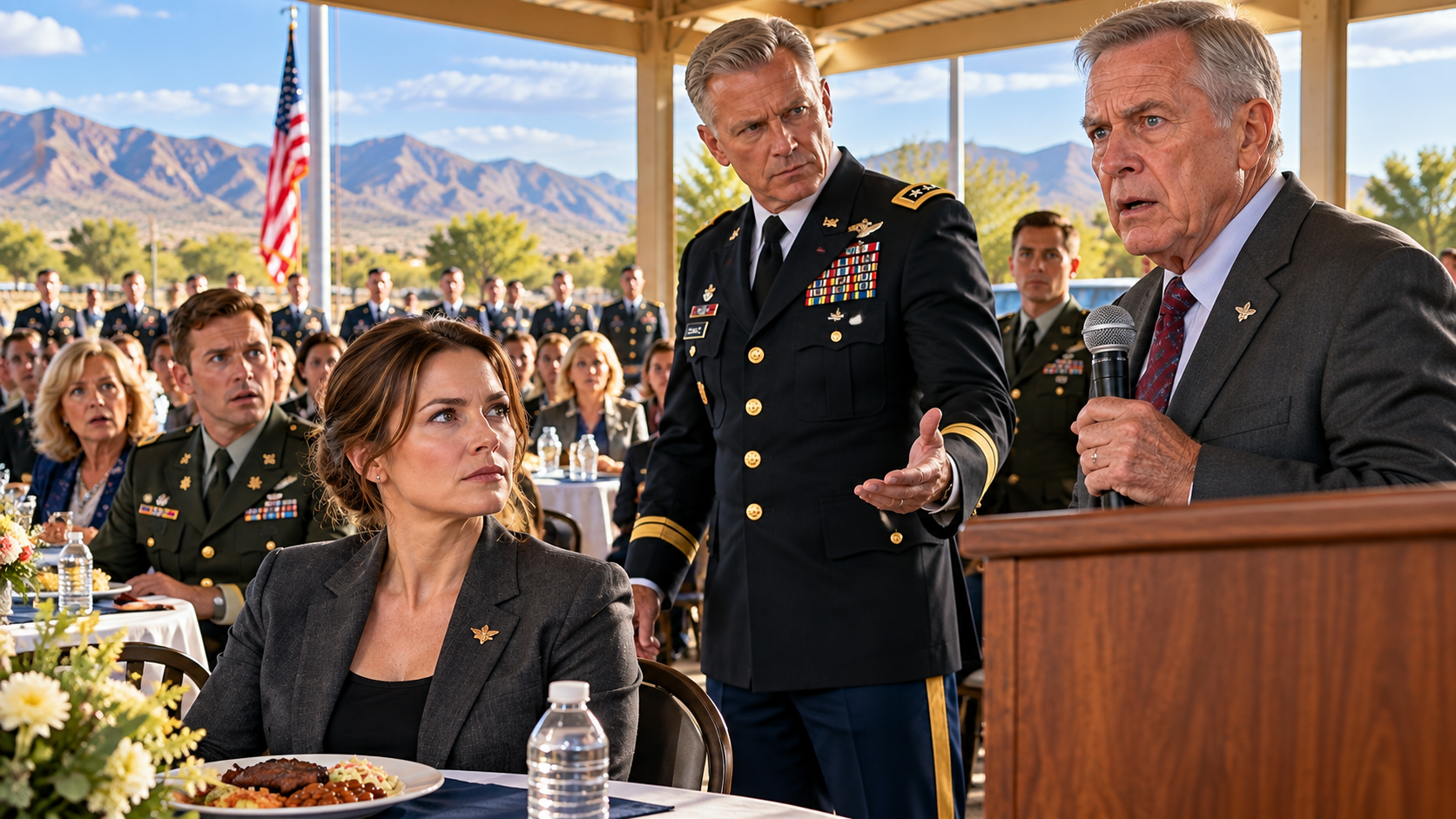
“She was dishonorably discharged,” Colonel Marshall Kincaid, United States Army retired, announced into the microphone.
His voice carried beneath the pavilion at Fort Huachuca and spilled out toward the parking lot.
“My own daughter couldn’t serve with honor, and she’s been lying to all of you ever since.”
The entire pavilion seemed to inhale.
Then nothing.
No conversation.
No laughter from the children near the picnic tables.
No scraping of plastic forks against paper plates.
Somewhere beyond the pavilion roof, the Arizona wind moved across the post, and a metal halyard tapped against a flagpole.
Clink.
Clink.
Clink.
I looked at the untouched brisket on my plate.
Barbecue sauce had begun to harden along one edge.
For some reason, that was what I noticed.
Not the two hundred people.
Not the faces turning toward me.
Not the wives and husbands who knew my father by reputation.
Not the young soldiers who had probably heard stories about Colonel Kincaid before they ever shook his hand.
I watched a fly land beside my cornbread.
Across the pavilion, my mother had gone completely still.
Her fingers tightened around a plastic cup of water.
Beside her sat my younger brother.
Major Garrett Kincaid.
Dress greens.
Straight shoulders.
Perfect ribbons.
Gold oak leaf catching the last orange light coming off the mountains.
Garrett did not look at me.
Neither did my mother.
That hurt more than my father’s accusation.
It should not have.
I was forty-one years old.
I had spent enough nights under hostile skies to understand that danger did not always announce itself with explosions.
Sometimes danger wore your last name.
Sometimes it raised you.
Sometimes it called what it did love.
My father adjusted the microphone.
“She works for some contractor now,” he continued.
A few uncomfortable chuckles moved through the crowd and died immediately.
“No real unit. No real record. No honorable service.”
My jaw tightened.
There were records.
Thousands of pages of them, probably.
The problem was that almost nobody standing beneath that pavilion had the clearance to read the interesting ones.
My father knew that.
Or at least he knew enough to use the silence surrounding my work against me.
That had always been his talent.
He could turn whatever I was forbidden to explain into proof that I had nothing worth explaining.
“She claims she deployed,” he said.
My mother whispered something.
He ignored her.
“But somehow there are never any photographs, are there?”
More silence.
“No stories. No medals she can discuss. No unit buddies she brings around. No record anybody here can verify.”
That almost made me laugh.
Almost.
Instead, I lifted my water bottle and took a drink.
My hand did not shake.
I was proud of that.
On the collar of my charcoal blazer sat a bronze pin no larger than my thumbnail.
Most people probably assumed it was decorative.
My father certainly did.
It had been given to a small group of us after a communications recovery operation that technically had never happened in a location I was still not permitted to name.
There had been no public ceremony.
No photographer.
No hometown newspaper.
No proud father pinning anything to my chest.
Just a conference room with reinforced walls, eight exhausted people, bad coffee, and a senior officer who had looked around the table and said:
“If this network had stayed down another hour, people would have died.”
Then he handed each of us a pin.
I had worn mine exactly three times.
That afternoon was the third.
My father lifted his drink.
“She wanted all of you to believe she was some kind of operator.”
There it was.
Operator.
He said the word with contempt.
My father had spent his career in conventional commands.
Battalion photographs.
Change-of-command ceremonies.
Flags.
Speeches.
Visible authority.
He understood a world where rank stood on your chest and accomplishments could be printed in a biography and read aloud at retirement dinners.
I had chosen communications.
Then network operations.
Then work that slowly became less visible the better I got at it.
He hated that.
When I was twenty-five, he called it hiding behind computers.
When I was thirty, he called it avoiding real command.
When I deployed somewhere I could not discuss, he called it convenient.
When I returned exhausted and ten pounds lighter, he asked why there were no photographs.
When Garrett deployed with an infantry support element, my father printed a map and put pins in it.
When I deployed six months later, he told relatives I was “traveling for work.”
I had learned not to correct him.
Correction only gave him another surface to strike.
So I remained seated.
He wanted me standing.
He wanted tears.
Anger.
A shouted denial.
Anything he could later describe as instability.
And that word mattered.
Stable.
Stable enough.
I had heard it before.
Not from him.
From a recording.
My father had made two calls months earlier to officers in my chain of command.
Two calls he apparently believed would remain private.
On the first recording he said:
“My daughter needs correction.”
On the second:
“I have serious concerns about her judgment. Her loyalty. Frankly, whether she is stable enough for increased responsibility.”
Both calls had been made during periods when I was being evaluated for promotion to Major.
I had been passed over twice.
Garrett had been selected on his first look.
My father toasted him with eighteen-year-old Scotch.
Then he asked me, in front of twelve relatives, whether I had considered that maybe the Army had finally figured me out.
Three months later, after the second non-selection, I left active service with an honorable characterization and moved directly into defense network support work.
My father turned that into abandonment.
Then failure.
Then disgrace.
And finally, dishonorable discharge.
A lie became easier for him every time nobody challenged it.
Under the pavilion, he looked directly at me.
“So, Adelaide,” he said.
He used my name like a summons.
“If I’m wrong, stand up and tell everybody.”
My mother finally looked at me.
Her face was pale.
Garrett remained motionless.
I set my water bottle down.
I could have stood.
I could have told them about the honorable separation certificate in my locked desk at home.
I could have told them about the personnel review currently examining outside interference in my promotion process.
I could have told them about the two recordings.
I could have told Garrett that some of the communications architecture his unit had trusted overseas carried my authorization code through its original fielding package.
I could have explained why, during one terrible night he had once described at Thanksgiving, his redundant network had remained available after the primary system failed.
I could have told him that I had spent eleven straight hours in a windowless operations center three countries away helping keep that architecture alive.
Instead, I looked at my father.
“No,” I said.
His eyebrows rose.
“No?”
“I’m not doing this with you.”
His smile widened.
Then somebody behind me spoke.
“Colonel Kincaid?”
The voice was quiet.
It did not need to be louder.
Certain people spend enough years commanding rooms that volume becomes unnecessary.
My father lowered the microphone.
Several soldiers near the pavilion entrance stood automatically.
I turned.
A senior officer in dress uniform had stopped just inside the shade.
Two people accompanied him, but I barely noticed them.
I knew his face.
Not personally.
Not well.
But I had seen it on secure video conferences and at the far end of briefing rooms where people like me sat near the wall until somebody needed an answer nobody else could provide.
Lieutenant General Nathaniel Mercer.
He was supposed to have been across the installation at another event.
Apparently plans had changed.
His eyes moved toward the podium.
Then toward Garrett.
Then they reached me.
For half a second, nothing happened.
Then his attention dropped to the bronze pin on my collar.
His expression changed.
Not dramatically.
Just recognition.
He walked toward my table.
My father frowned.
Garrett finally lifted his head.
General Mercer stopped several feet from me.
“Ma’am.”
I rose.
“General.”
My father looked between us.
Mercer’s gaze returned to my pin.
“Haven’t seen one of those in a while.”
“No, sir.”
“You were with the recovery cell?”
I felt every eye in the pavilion move toward me.
There were questions I could answer and questions I could not.
“Yes, sir.”
General Mercer nodded once.
Then he turned toward my father.
“Sir,” he said carefully, “before you say another word about your daughter’s record, you may want to know whose signature is attached to the network authority your son’s unit used in theater.”
My father stared at him.
The microphone remained in his hand.
Nobody moved.
Mercer looked at me.
And Garrett slowly turned in his chair.
For the first time that afternoon, my brother looked afraid.
Not of me.
Of what he was beginning to understand.
“Adelaide?” he said.
General Mercer answered before I could.
“Captain Kincaid.”
My father’s face changed at the word Captain.
The lie he had told depended on making everyone believe I had left the Army in disgrace.
Mercer continued.
“She was one of the officers responsible for validating the contingency architecture your unit depended on.”
Garrett stood.
“What architecture?”
Mercer looked at him.
“You know exactly which one, Major.”
Garrett went pale.
And I knew he did.
Because three years earlier, sitting across from me at Thanksgiving, my brother had told our family about the worst night of his deployment.
He just had never known I was part of it.
Until now.
PART 2: THE CHILD HE COULD DISPLAY
My father did not always hate my career.
At first, he simply believed it belonged to him.
That was the difference I understood too late.
When I commissioned, he stood straighter than anyone at the ceremony.
He corrected people who called me Lieutenant before the oath was finished.
He told strangers that military service was “in the blood.”
The photographs from that day are still in my mother’s house.
My father in dress uniform.
Me beside him.
Garrett, still in college, grinning at the camera.
My mother crying because she cried at everything important.
For a while, I thought my father was proud.
Then I realized he was proud of the version of me he expected to exist.
That version followed his path.
That version asked for his advice.
That version chose assignments he understood.
That version made decisions he could explain to his friends.
I did not.
My first mistake, according to my father, was discovering I was good at something he considered secondary.
Systems.
Networks.
Communications architecture.
I liked the logic of it.
Not because machines were easier than people.
They were not.
Anyone who says that has never tried to restore a damaged operational network while exhausted officers are shouting for service and three organizations are blaming one another for the outage.
I liked it because systems did not care about family mythology.
A packet either reached its destination or it did not.
A network either had redundancy or it did not.
A vulnerability either existed or it did not.
Competence could hide for a while.
But eventually, under enough pressure, it revealed itself.
People were different.
My father could be wrong for twenty years and still sound convincing.
My first deployment was ordinary enough that I could tell my parents where I had been.
The second was less simple.
By the third, my work had crossed into compartments I learned not to discuss outside secure spaces.
That was when my father began telling people I had become secretive.
He said it like a character flaw.
“You used to tell us what you were doing,” he complained once.
“I used to be allowed to.”
He leaned back in his chair.
“That’s convenient.”
I remember staring at him.
“What does that mean?”
“It means every time somebody asks what you’ve accomplished, the answer is classified.”
My mother had been setting plates on the dinner table.
She stopped.
“Marshall.”
“What?”
“You know she can’t discuss her work.”
He shrugged.
“I know what she says.”
Garrett laughed awkwardly.
I looked at him.
He immediately focused on his plate.
That was how the family worked.
My father pushed.
My mother softened.
Garrett disappeared.
I resisted.
Then everyone blamed me for making dinner uncomfortable.
Garrett and I had been close as children.
That was the part nobody understood when they eventually saw us as adults.
He was four years younger.
When we were kids, I was the person who taught him to ride a bicycle, helped him hide a broken garage window, and picked him up after his first girlfriend dumped him.
I went to his high school games when my father was overseas.
I edited his college essays.
The night before he commissioned, Garrett called me from his hotel room because he was convinced he had made a mistake.
“What if I’m bad at this?” he asked.
“You’ll learn.”
“Dad makes it sound like you either have command presence or you don’t.”
“Dad makes everything sound hereditary.”
Garrett laughed.
Then became quiet.
“You think I can do it?”
“Yes.”
I meant it.
For years, I was his safest person.
Then we both became officers.
My father found a new way to divide us.
At first, the comparisons were small.
Garrett had the better evaluation.
Garrett had the tougher assignment.
Garrett’s commander had called him a natural leader.
Why couldn’t I get a command position like his?
Why did I keep taking technical roles?
Why was my career so difficult to explain?
Then Garrett made Captain.
My father threw a dinner.
When I made Captain, I got a text message.
Proud of you. Keep pushing.
That was all.
I told myself it did not matter.
By thirty-five, I had become excellent at telling myself things did not matter.
The work mattered.
That was what I repeated.
The people depending on the systems mattered.
The mission mattered.
Recognition did not.
Then came the first promotion board for Major.
My record was strong.
Not perfect.
Nobody’s is.
But strong.
My senior rater told me I was competitive.
A colonel I respected said he expected my name on the list.
It was not.
I remember opening the result alone.
There were thousands of names.
I searched twice.
Then a third time.
Nothing.
The disappointment was physical.
Not dramatic.
Just heavy.
Like somebody had set a sandbag behind my ribs.
That evening, Garrett called.
“I’m sorry.”
“Thanks.”
“Dad says not to worry. Lots of good officers get picked up second look.”
I closed my eyes.
“Did I ask what Dad said?”
“No.”
“Then why are you telling me?”
Silence.
“Adelaide—”
“Sorry.”
“No. I get it.”
He did not get it.
But he was trying.
That was still the old Garrett.
The second board changed everything.
Between the two boards, my assignments became more sensitive.
I helped certify field network configurations, reviewed emergency communications authorities, and spent months supporting deployments nobody at home knew about.
During one assignment, a senior officer asked me to brief a room full of commanders because an established architecture had a failure point nobody wanted to acknowledge.
I was the junior person in the room.
I told them anyway.
The plan changed.
Later, a colonel pulled me aside.
“You know half the room hated you for ten minutes.”
“I noticed.”
“You were right.”
“That usually helps.”
He laughed.
“You’re ready for field grade.”
I remembered that sentence when my second promotion result came out.
Again, my name was missing.
I stared at the screen until the letters blurred.
Two non-selections.
Depending on timing and circumstances, careers can narrow very quickly after that.
Mine did.
I received the usual professional language.
Needs of the Army.
Competitive process.
Continued service options.
Transition planning.
Nothing in the paperwork said dishonorable.
Nothing said misconduct.
Nothing said unstable.
I was separated honorably and moved into work supporting defense communications programs where my experience was still useful.
My father treated it like exile.
Garrett made Major six months later.
That promotion dinner was when the distance between us became permanent.
My father stood with a glass in his hand.
“To Major Garrett Kincaid,” he said.
Everyone cheered.
I did too.
Garrett deserved his promotion.
That fact mattered.
I had never wanted his success taken away.
My anger had never been about Garrett wearing the oak leaf.
It was about the way my father looked at me while he toasted him.
“You see?” he said later when only the family remained.
I knew immediately what he meant.
“See what?”
“When you keep your head down, do your job, and stop trying to prove you’re smarter than everyone, the institution rewards you.”
Garrett looked uncomfortable.
“Dad.”
“What?”
“Not tonight.”
My father ignored him.
He looked at me.
“The Army is very good at identifying character eventually.”
I put my wineglass down.
My mother whispered, “Marshall, please.”
I stood.
My father smiled.
“Running away?”
“No.”
“Looks like it.”
I walked toward the door.
Then stopped.
“You know what’s interesting?”
He waited.
“You’ve never once asked me what my commanders said about why I wasn’t selected.”
He gave a dismissive shrug.
“Results speak.”
“Do they?”
“Yes.”
I looked at Garrett.
He stared at the table.
That hurt.
Then I left.
Months passed.
My father began retelling the story.
At first he said I had been forced out.
Then he said I had been removed.
Then he said the Army had “ended my service.”
By the time extended family heard it, I had apparently been discharged for undisclosed reasons.
I corrected my mother once.
Only once.
“Mom, my discharge was honorable.”
“I know.”
“Then why do you let him say otherwise?”
Her eyes filled with tears.
“Because arguing with him makes everything worse.”
“For who?”
She had no answer.
That was the moment I understood my mother’s silence was not neutrality.
Silence protected the loudest person in the room.
The truth began to surface eleven months later.
I was at work when Colonel Miriam Reyes called me.
She had been in my chain during my final active-duty years.
We had not spoken since I left.
Her voice sounded strange.
Careful.
“Adelaide, are you somewhere private?”
I closed my office door.
“Yes, ma’am.”
“I need to ask you a question.”
“Okay.”
“Did you know your father contacted members of your chain of command before your promotion boards?”
My hand froze around my phone.
“What?”
There was a pause.
“Colonel Kincaid contacted at least two officers.”
I sat down.
I remember the hum of the ventilation system.
The fluorescent light above my desk.
A notification appearing on my computer monitor.
Everything ordinary.
Everything suddenly different.
“What did he say?”
Reyes exhaled.
“I’m not going to summarize something you may be able to hear yourself.”
“Hear?”
“Two of the conversations were preserved.”
My stomach turned cold.
“Why?”
“One officer had already received concerning outside communications related to personnel matters and was documenting them. The other call became part of a later review.”
I did not speak.
Reyes continued.
“Adelaide, I need you to listen carefully. I am not telling you those calls alone determined either board result. Promotion decisions involve multiple factors. Nobody can responsibly promise you a direct causal line.”
“I understand.”
“But the contacts were improper enough that questions are being asked.”
I swallowed.
“What exactly did my father say?”
Another pause.
Then she told me one sentence.
My daughter needs correction.
I closed my eyes.
For the first time in years, I felt like I was sixteen again.
Standing in our kitchen.
My father explaining that humiliation was instruction.
That obedience was maturity.
That resistance proved he had been right to punish me.
Reyes spoke again.
“There’s more.”
“What?”
“He questioned your judgment.”
I waited.
“Your loyalty.”
My fingers tightened around the phone.
“And your emotional stability.”
There it was.
The word.
Stable.
The word my father used whenever anger made him uncomfortable.
The word he used to transform my reaction to his behavior into proof that his behavior was necessary.
I looked at the wall of my office.
“Who is reviewing this?”
She told me.
I listened.
Then I made a decision.
I did not call my father.
I did not call Garrett.
I did not confront my mother.
Instead, I submitted the documentation I had.
Evaluation reports.
Promotion counseling.
Deployment records.
Commendations.
Correspondence.
Every piece of the career my father had spent years pretending did not exist.
Then I signed the formal request for review.
If he wanted my record examined, it would be examined properly.
All of it.
That process was still underway when my mother called and asked me to attend the family event at Fort Huachuca.
“Garrett will be there,” she said.
“I assumed.”
“Your father is speaking.”
“That is not helping your case.”
“Adelaide.”
I closed my eyes.
She sounded tired.
“Please.”
So I went.
I wore a charcoal blazer.
I sat at the back.
I tried to be invisible.
And my father took the microphone.
PART 3: THE NIGHT GARRETT REMEMBERED
General Mercer did not raise his voice.
That made my father’s silence worse.
Garrett had stood so quickly his chair scraped backward against the concrete.
“What network?” he asked again.
Mercer studied him.
“The emergency contingency architecture used by your task force after the primary relay failure.”
I watched my brother’s face.
He knew.
Of course he knew.
Soldiers forget ordinary nights.
They do not forget the night everything almost goes dark.
Garrett looked at me.
“You were involved with that?”
I felt two hundred people listening.
I hated it.
My father had turned my private service into public theater, and now even the truth felt contaminated by the stage he had built.
“I helped validate part of the architecture before your deployment,” I said.
Garrett shook his head.
“That system had been in place for months.”
“Yes.”
“But the night the primary went down—”
“I know.”
He stopped.
My father finally found his voice.
“This is absurd.”
General Mercer turned.
“Sir?”
“Adelaide worked communications. That does not mean she was somehow responsible for my son’s mission.”
“I didn’t say I was responsible for his mission.”
My father looked at me.
I continued.
“I said I helped keep a system available.”
Garrett was still staring at me.
“You knew about that night?”
I could hear his voice from three years earlier.
Thanksgiving.
My mother’s dining room.
Garrett had just returned from deployment.
He had talked more that night than usual because my father kept asking questions.
The story began with a communications failure.
Their primary path went down during a rapidly deteriorating situation.
Backup capability had carried traffic long enough for his element to coordinate movement, pass updated positions, and maintain contact when losing communications would have made an already dangerous situation worse.
Garrett had described it in the clean, compressed language soldiers use around family.
It got bad.
We lost primary.
Backup held.
We got everyone out.
My father had clapped him on the shoulder.
“That’s why redundancy matters.”
I had almost laughed.
Instead, I asked Garrett one question.
“What package were you running?”
He told me.
I went quiet.
He had not noticed.
Now, beneath the pavilion, he remembered.
“You asked me about it,” he said.
“Yes.”
“At Thanksgiving.”
“Yes.”
His mouth opened.
Closed.
“You already knew.”
“I recognized the architecture.”
“Why didn’t you tell me?”
I looked at my father.
“Because I wasn’t allowed to tell you what I had done.”
General Mercer watched us without interrupting.
Garrett stepped closer.
“Were you there?”
That question was more complicated.
“No.”
His shoulders dropped slightly.
Then I added, “Not where you were.”
He looked confused.
“I was supporting from another location.”
“How close?”
“Garrett.”
He understood the warning in my voice.
There were details I still could not discuss.
Even now.
Even here.
Especially here.
He nodded slowly.
“But you were working the outage?”
I hesitated.
“Yes.”
His face changed.
The pavilion disappeared for me.
For a moment, it was just my brother and me.
He looked younger.
Like the twenty-two-year-old who had called me from his hotel room the night before commissioning.
“What did you do?”
“Nothing dramatic.”
My father scoffed.
General Mercer looked sharply at him.
I continued.
“The primary route failed. The contingency path started carrying more load than expected. We had instability across part of the network.”
Garrett’s eyes narrowed.
“You’re saying you were one of the people on the other end.”
“Yes.”
I could still remember that night.
The room had been cold.
Operations centers are always either freezing or suffocating.
There is apparently no middle temperature available to national defense.
Three monitors in front of me.
Two headsets.
Half a cup of coffee I never finished.
The first alert came shortly after 0200 local.
A path degradation.
Then another.
Then the primary relay dropped.
Traffic shifted.
Too much of it.
Alarms multiplied.
A civilian engineer beside me cursed under his breath.
Someone behind us said, “If the secondary fails, they lose reachback.”
I was already moving.
We had designed the contingency route for exactly that kind of failure, but no plan survives first contact with actual demand.
The system began choking.
Not collapsing.
Not yet.
But close.
I spent the next eleven hours working with people whose names Garrett would never know.
Engineers.
Signal officers.
Network controllers.
Operations staff.
Nobody kicked down a door.
Nobody fired a weapon.
Nobody received applause.
We moved traffic.
Rebalanced loads.
Protected critical channels.
Cut nonessential demand.
Restored paths.
Watched capacity.
Argued about priorities.
Made decisions with partial information.
And somewhere far away, my brother’s unit stayed connected.
I had known he was in that theater.
I had not known his exact unit was on the network when the outage started.
Then a task-force identifier flashed across one of the coordination messages.
I recognized it.
For one terrible second, I stopped breathing.
Garrett.
I remember gripping the desk.
The engineer beside me looked over.
“You good?”
“Yes.”
I was not.
But the network did not care whose brother was on it.
So I worked.
That was the night I stopped thinking of communications as invisible support.
Invisible did not mean unimportant.
Silence could save lives.
Redundancy could save lives.
A green status light on a screen could mean somebody, somewhere, was still able to call for what they needed.
I came off shift eleven hours later and sat alone in a stairwell.
I could not call Garrett.
I could not call my mother.
I could not tell my father.
So I put my face in my hands and cried for exactly four minutes.
Then I went back upstairs.
Weeks later came the pin.
General Mercer had been part of the senior review that followed.
That was why he recognized it.
Under the pavilion, Garrett rubbed a hand across his mouth.
“I thought the backup just worked.”
I almost smiled.
“That’s usually the goal.”
A few people laughed softly.
The tension shifted.
My father felt it.
I could see the moment he realized the room was no longer his.
He raised the microphone.
“So she worked on a network.”
My mother whispered, “Marshall, stop.”
He continued.
“That hardly changes the facts.”
I looked at him.
“What facts?”
“You were removed from service.”
“No.”
“Passed over twice.”
“Yes.”
“And separated.”
“Honorably.”
His jaw tightened.
“Because the Army did not promote you.”
“Yes.”
He spread one hand toward the crowd.
“Then what exactly am I lying about?”
I stared at him.
There it was.
The trick.
My father could move a line an inch at a time until suddenly everyone was standing somewhere else.
Dishonorably discharged became separated.
Lying about deployment became admitting I had served.
No real record became a debate about promotion.
He survived by constantly shrinking his accusation after it was disproven.
Usually people became too exhausted to follow.
I was not tired anymore.
“You said I was dishonorably discharged.”
His face hardened.
“A technical distinction.”
“No.”
The word came out louder than I intended.
The pavilion went silent again.
I stepped away from my table.
“A dishonorable discharge is not a technical distinction. You know that better than almost anyone here.”
He lowered the microphone slightly.
I kept walking until only a few yards separated us.
“You know exactly what that phrase means. You knew it when you said it. You knew it every time you said it before today.”
My mother stood.
“Adelaide—”
“No, Mom.”
She froze.
I looked at my father.
“I was honorably separated. You know that.”
He stared at me.
“You also know why my promotion history is under review.”
That changed him.
It was small.
But I saw it.
His left hand tightened around the microphone.
Garrett saw it too.
“What review?” he asked.
My father looked toward him.
“Nothing that concerns you.”
Garrett’s expression changed.
For the first time in my life, I saw my brother look at our father the way I had looked at him for years.
Not as an authority.
As a man capable of lying.
“What review?” Garrett repeated.
I answered.
“A review into outside interference with my chain of command.”
My father’s face flushed.
“That is not what happened.”
“Then tell him what happened.”
“This is neither the time nor the place.”
A bitter laugh escaped me.
“You chose the time and the place.”
Nobody moved.
My father looked around the pavilion as if suddenly remembering the audience he had gathered.
“That’s enough.”
“No.”
The word felt strange.
Not because I had never said it.
Because this time I did not care what came afterward.
“You wanted everyone here to hear about my record. They can hear all of it.”
His eyes narrowed.
“Adelaide.”
“You called two officers in my chain before my promotion boards.”
Garrett went still.
My mother covered her mouth.
My father shook his head.
“I spoke to colleagues.”
“You spoke about me.”
“I had concerns.”
“You told one of them I needed correction.”
His face drained.
That sentence had not been public.
Until then.
He knew immediately what its existence meant.
“You don’t know what was said.”
“Yes, I do.”
“How?”
“The calls were recorded.”
My mother sat down hard.
Garrett whispered, “Jesus.”
My father looked at General Mercer.
Mercer’s expression gave him nothing.
Then my father looked back at me.
“You listened to private conversations?”
I almost laughed.
He had publicly accused me of dishonorable service in front of two hundred strangers, and somehow privacy had become sacred.
“The conversations are part of an official review.”
“I was trying to help you.”
There it was.
The sentence I had expected.
The sentence I had heard my entire life.
I was trying to help you.
When he read my private letters because he worried about my judgment.
When he called a college professor because he thought I was being disrespectful.
When he contacted my first company commander after commissioning to “offer perspective” about how I handled criticism.
Every boundary he crossed was assistance.
Every wound was instruction.
Every humiliation was love.
“You questioned my loyalty,” I said.
His mouth tightened.
“You were becoming difficult.”
“You questioned my stability.”
“I said I had concerns.”
“To my chain of command.”
“I am your father.”
“You were a retired colonel trying to influence officers evaluating me.”
His voice rose.
“I knew you better than they did!”
“No.”
That stopped him.
For years, I had argued with my father using facts.
That afternoon I finally understood the argument had never been about facts.
It was about ownership.
“You knew your daughter,” I said. “You did not know Captain Kincaid.”
The microphone lowered.
I could hear wind moving through the open sides of the pavilion.
I continued.
“You never sat in one of my operations centers. You never read my evaluations. You never watched me brief a commander. You never saw me work a network failure. You never deployed with me. You never saw the things I was responsible for because you were not cleared to see them.”
His eyes flicked toward the people watching.
I took another step.
“And instead of accepting that there were parts of my life you did not control, you decided those parts did not exist.”
My father’s mouth opened.
Garrett interrupted.
“Dad.”
He sounded sick.
My father looked at him.
Garrett asked the question I had been too afraid to ask for months.
“Did you contact her commanders before both boards?”
My father said nothing.
“Dad.”
“I spoke to people.”
Garrett stared at him.
“Why?”
“Because she was heading in the wrong direction.”
“What direction?”
“She challenged authority.”
I laughed once.
My father pointed toward me.
“That. That attitude. You think because you’re technically competent, normal standards don’t apply to you.”
General Mercer spoke for the first time in several minutes.
“Colonel.”
My father turned.
Mercer’s voice remained controlled.
“I would be very careful about characterizing professional disagreement as instability.”
My father stiffened.
“You don’t know the family history.”
“No, sir.”
Mercer looked at me.
“But I know enough of Captain Kincaid’s professional history to say competence was never her problem.”
The sentence hit me harder than I expected.
I looked away.
For years I had imagined vindication as something triumphant.
It was not.
It hurt.
Because hearing somebody say the truth out loud showed me exactly how long I had lived without hearing it.
Garrett came toward me.
Slowly.
“Adelaide.”
I looked at him.
His eyes were wet.
“I didn’t know.”
“I know.”
“I swear to God, I didn’t know he called anyone.”
“I know.”
“I thought…”
He stopped.
“What?”
He looked ashamed.
“I thought you were bitter because I made Major.”
That hurt.
I nodded anyway.
“Part of me was.”
His eyes dropped.
“But not because you didn’t deserve it.”
He looked up.
“I was angry because every time Dad celebrated you, he used your success as evidence that I was a failure.”
Garrett closed his eyes.
“I let him.”
“Yes.”
He flinched.
I did not take it back.
“I let him do it to me too,” I said.
Garrett looked at our father.
Then at the oak leaf on his own shoulder.
Something in his expression broke.
“Did my unit really use her system?” he asked Mercer.
General Mercer answered carefully.
“Major, no operational capability belongs to one person. A great many people built, fielded, maintained, and protected that architecture.”
Garrett nodded.
Mercer continued.
“But your sister’s name is on the authorization package for the contingency configuration, and she was part of the team that kept the wider network functioning during the incident you’re referring to.”
Garrett swallowed.
“So when I came home talking about how that backup saved us…”
“She already knew.”
My brother looked at me.
I nodded.
His voice dropped.
“Why didn’t you say anything?”
“Because service isn’t always a story you get to tell.”
My father made a disgusted sound.
I turned.
“What?”
He shook his head.
“This entire thing is theater now.”
The irony was so complete that several people visibly reacted.
My mother stood again.
This time she looked at him.
Not me.
“Marshall.”
He ignored her.
She said his name louder.
“Marshall.”
He turned.
My mother had spent forty-four years lowering her voice around my father.
That afternoon, for the first time I could remember, she did not.
“Did you interfere with her career?”
He stared at her.
“I tried to protect this family.”
“From what?”
His face tightened.
“From embarrassment.”
No one breathed.
My mother’s expression changed.
It was not anger.
Anger would have been easier.
It was recognition.
The kind that arrives years late and makes you reinterpret your entire life at once.
She looked at me.
Then back at him.
“You embarrassed her.”
My father straightened.
“I protected the Kincaid name.”
Garrett gave a short, broken laugh.
“The Kincaid name?”
My father looked at him.
Garrett took off his service cap and set it on the table.
“I was alive on that deployment partly because people like her did jobs you couldn’t brag about at dinner.”
My father’s face went red.
“That is enough.”
Garrett shook his head.
“No.”
My brother looked at me.
Then he said something I would remember long after the pavilion, the review, and every promotion list had faded into memory.
“I think it’s the first time it isn’t.”
PART 4: WHAT THE RECORD SAID
The crowd did not erupt.
Real life rarely gives you that kind of clean satisfaction.
Nobody applauded.
Nobody booed my father.
There was no cinematic wave of people choosing sides.
There were only two hundred uncomfortable witnesses realizing they had been invited into something deeply private.
Some looked away.
Some stared.
A few quietly gathered their children.
General Mercer stepped toward my father and held out one hand.
“Sir, I think the microphone has served its purpose.”
For a second, I thought my father might refuse.
Then he handed it over.
The gesture looked like surrender.
It was not.
Men like my father did not surrender in public.
They retreated and rewrote.
I knew before the evening ended that he would tell himself a different version of what had happened.
In his version, I ambushed him.
General Mercer humiliated him.
Garrett became emotional.
My mother misunderstood.
The recordings lacked context.
The audience had been biased.
Anything except the possibility that he had done exactly what everyone saw.
General Mercer switched off the microphone.
Then he looked at me.
“Captain, a word?”
We walked beyond the pavilion.
The sunset had faded behind the mountains.
Heat still rose from the pavement.
For a moment, neither of us spoke.
Then Mercer said, “I’m sorry that happened publicly.”
“Thank you, sir.”
“I also need to be clear about something.”
“Yes, sir.”
“What I said in there should not be interpreted as prejudging the personnel review.”
“I understand.”
“Promotion processes are complicated. There are limits to what anyone can reconstruct after the fact.”
“I understand.”
He studied me.
“You filed the request yourself?”
“Yes.”
“Good.”
That single word mattered.
Not because I needed him to save me.
Because he understood I had not been waiting for someone to ride into a pavilion and rescue me.
The truth was already moving before he walked in.
I had moved it.
Slowly.
Quietly.
Through the proper channels.
I had submitted documents.
Written statements.
Dates.
Names.
Evaluations.
I had sat through interviews where people asked whether I had ever given my father permission to discuss my career.
I had answered humiliating questions because they were necessary.
I had listened to the first recording in a secure office with Colonel Reyes sitting beside me.
My father’s voice came through the speakers clearly.
Calm.
Professional.
Almost warm.
That was the worst part.
He sounded reasonable.
“I’m speaking as her father, but also as someone who understands the institution.”
Then:
“Adelaide has always had difficulty accepting correction.”
Then:
“She is capable, certainly, but increased authority may reinforce some very troubling tendencies.”
Then:
“My daughter needs correction.”
I had not cried until later.
The second call was worse.
He questioned whether certain sensitive assignments had “distorted my sense of my own importance.”
He used the words judgment.
Loyalty.
Stability.
He never explicitly said, Do not promote her.
He was too smart for that.
He simply planted doubt in places where doubt could grow.
Maybe it changed nothing.
Maybe it changed everything.
That uncertainty was part of the damage.
I would never know whether I would have made Major without him.
That was what he had taken.
Not only rank.
Not only time.
Certainty.
He had contaminated every explanation.
General Mercer looked toward the pavilion.
“You know your father approached me once.”
I turned.
“What?”
“Years ago. Not formally.”
My stomach tightened.
“He asked about your work.”
“What did you tell him?”
“That I wasn’t going to discuss an officer’s classified responsibilities with a family member.”
Despite everything, I laughed.
Mercer almost smiled.
“He did not enjoy that answer.”
“No. He wouldn’t.”
Mercer’s expression became serious again.
“Captain Kincaid, your work stood on its own before today. It will stand on its own after today.”
I looked away toward the mountains.
“Sometimes it didn’t feel like it.”
“I imagine not.”
He started to leave.
Then stopped.
“One more thing.”
“Yes, sir?”
“That pin?”
I touched the bronze at my collar.
“You earned it.”
My throat tightened.
“I know.”
“Good.”
Then he walked away.
I stayed outside another minute.
When I returned to the pavilion, most people had resumed moving.
Not normally.
But enough.
My father was gone.
My mother sat alone.
Garrett stood several feet away talking to another officer.
When he saw me, he ended the conversation and came over.
“Dad left.”
“I assumed.”
“He told Mom you set him up.”
“Of course he did.”
Garrett rubbed the back of his neck.
“You knew he was going to say that stuff?”
“No.”
“You didn’t invite Mercer?”
I stared at him.
“No.”
“Sorry.”
“You should be.”
He nodded.
“I am.”
We stood in silence.
Then he said, “I need to ask you something.”
“Okay.”
“Did you ever hate me?”
The question surprised me.
“No.”
“Not even after the promotion?”
“I hated being compared to you.”
“That’s not what I asked.”
I looked at him.
There had been nights when his face on my father’s mantel felt unbearable.
Moments when his success became a blade even though he had not sharpened it.
Times when I saw the gold oak leaf on his uniform and felt something ugly move inside me.
“I resented you sometimes.”
He nodded.
“I think I resented you too.”
“For what?”
“You could leave.”
I stared at him.
Garrett looked toward our mother.
“You would fight with Dad and then leave. I stayed.”
“You were an adult.”
“I know.”
“That’s not an excuse.”
“I know.”
He sounded tired.
“I kept thinking if I did everything right, he’d stop comparing us.”
I almost smiled.
“Did it work?”
“No.”
“What did he compare?”
“Different things.”
“Like?”
Garrett hesitated.
“You were smarter.”
I laughed.
“I’m serious.”
“I’m not smarter than you.”
“He said you thought you were.”
“That sounds more like him.”
Garrett nodded.
“He’d tell me not to get arrogant like Adelaide. Not to question senior people like Adelaide. Not to get distracted by technical rabbit holes like Adelaide.”
I stared at him.
My father had used me against Garrett too.
Not as a failure.
As a warning.
I had spent years imagining my brother safely occupying the favored position.
Maybe there was no favored position.
Maybe there were only different methods of control.
Garrett looked at me.
“The night overseas.”
I waited.
“I don’t talk about all of it.”
“You don’t have to.”
“Our primary communications went down at exactly the wrong time.”
“I know.”
“We had people moving. We had incomplete information. Everyone was trying to figure out what was happening.”
He swallowed.
“When the backup came up, I remember hearing a voice over the net and thinking it was the best sound I’d ever heard.”
I felt pressure behind my eyes.
Garrett continued.
“If that system had failed too…”
He stopped.
I did not fill in the sentence.
Neither of us needed to.
He looked at me.
“You were awake somewhere working on it.”
“Yes.”
“And I came home and let Dad call you a failure.”
My voice softened.
“You didn’t know.”
“I knew enough to ask.”
That was true.
I said nothing.
He took a breath.
“I’m sorry.”
Not the quick apology people use to end discomfort.
A real one.
“I’m sorry I never asked what happened after your second board. I’m sorry I believed him because believing him was easier than calling you. I’m sorry I sat there today.”
I looked toward our mother.
She was watching us.
“I needed you to say something.”
“I know.”
“You didn’t.”
“I know.”
That mattered too.
Apologies did not erase facts.
They acknowledged them.
I nodded.
“Okay.”
Garrett looked surprised.
“Okay?”
“It means I heard you.”
“Are we okay?”
“No.”
His face fell.
I touched his arm.
“But maybe we can be.”
My mother came toward us.
She looked older than she had that morning.
“Adelaide.”
I turned.
Her voice shook.
“I should have stopped him.”
“Yes.”
She closed her eyes.
“I kept telling myself I was keeping the family together.”
“I know.”
“I thought if I didn’t challenge him, things would calm down.”
“They didn’t.”
“No.”
Tears slipped down her face.
I wanted to comfort her.
That instinct was automatic.
I resisted it.
For once, my mother needed to remain inside the discomfort of what she had chosen.
“I knew your discharge was honorable,” she said.
“Yes.”
“And I still let him say it wasn’t.”
“Yes.”
“I’m sorry.”
I nodded.
Behind her, families were leaving.
The pavilion lights had come on.
Insects circled the bulbs.
Plastic tablecloths lifted in the evening wind.
The stage where my father had tried to erase me looked suddenly small.
My mother reached for my hand.
I let her hold it.
Not because everything was forgiven.
Because I still loved her.
Those two truths were allowed to exist at the same time.
Three weeks later, I received the first formal letter.
The review found no evidence of misconduct supporting my father’s description of my separation.
That part had never been seriously in question.
My characterization of service was honorable.
My record said so plainly.
The more difficult question concerned the contacts before my promotion boards.
The review could document that the calls occurred.
It could document what my father said.
It could document that his status as a retired senior officer gave his words weight they would not have carried from an ordinary parent.
What it could not do was prove precisely how much those words affected every decision that followed.
I read that sentence five times.
Then I closed the document.
For two days, I was furious.
I wanted certainty.
I wanted somebody to write:
Your father cost you Major.
I wanted a clean villain.
A clean injury.
A clean correction.
Instead I got institutional language.
Potentially prejudicial.
Improper external communication.
Material concern.
Insufficient basis to determine specific causal effect.
On the third day, Colonel Reyes called.
“How are you doing?”
“You want the professional answer?”
“No.”
“I hate uncertainty.”
“So does everyone.”
“I want to know if he did it.”
“You know what he did.”
“That’s not the same thing.”
“No.”
I stared out my office window.
She continued.
“You may never know whether you would have been selected.”
“I know.”
“But you do know he tried to influence people evaluating you.”
“Yes.”
“You know that was wrong.”
“Yes.”
“And now it is documented.”
I said nothing.
Reyes lowered her voice.
“Don’t let the absence of a perfect answer become another thing he gets to control.”
I leaned back in my chair.
That sentence stayed with me.
A month later, I was notified that portions of my record would receive additional review and that I was eligible for reconsideration through the appropriate process.
No promise.
No guarantee.
Just another look.
This time without my father standing invisibly behind the board.
I submitted.
Then I went back to work.
PART 5: THE OAK LEAF
My father did not call me for four months.
He sent messages.
That was different.
The first arrived two days after the pavilion.
You humiliated me publicly.
I deleted it.
The second came the following week.
There are two sides to every story.
Deleted.
Then:
Someday you will understand that everything I did was to protect you.
I did not delete that one immediately.
I stared at it for a long time.
Then I typed:
Protect me from what?
I never sent it.
Because I finally knew the answer.
He had not been protecting me.
He had been protecting his idea of me.
The daughter he could explain.
The officer whose career reflected his judgment.
The child whose success confirmed his authority.
When I stopped fitting that shape, he treated my independence as betrayal.
My mother began seeing me alone.
At first the lunches were awkward.
She kept trying to give me updates about my father.
I stopped her.
“I don’t need reports.”
“He misses you.”
“That may be true.”
“He’s very hurt.”
“That may also be true.”
“He thinks—”
“Mom.”
She stopped.
“I’m not asking you to choose between us. But I’m not discussing him every time we meet.”
She nodded.
Slowly, she learned.
Garrett called every Sunday.
Not long conversations.
Sometimes ten minutes.
Sometimes forty.
At first he asked careful questions about my work and became frustrated when I could not answer.
Eventually he learned to ask better questions.
Do you like what you’re doing?
Are they treating you well?
Are you sleeping?
Do you miss active duty?
That last question was complicated.
“Yes,” I told him.
“Would you go back?”
“I don’t know.”
“You loved it.”
“I loved parts of it.”
“Do you regret leaving?”
“Some days.”
He was quiet.
Then he said, “I used to think getting out meant you quit.”
I smiled without humor.
“I know.”
“I was wrong.”
“Yes.”
He sighed.
“You really enjoy making me work for forgiveness.”
“I’ve waited years. You can survive a few months.”
He laughed.
That sound felt familiar.
Like my little brother had briefly returned.
Six months after the pavilion, Garrett asked me to meet him for coffee.
He arrived in civilian clothes carrying a small envelope.
“What’s that?”
“Nothing dramatic.”
I raised an eyebrow.
He slid it across the table.
Inside was a photograph.
His unit overseas.
Rows of tired faces.
Dust.
Equipment.
Garrett near the center.
On the back he had written a date.
The date of the network failure.
I looked at him.
“I wanted you to have it.”
“Why?”
“Because you said there were never photographs.”
My throat tightened.
“That’s not exactly what I said.”
“I know.”
He tapped the picture.
“You’re not in it.”
“No.”
“But you were part of that night.”
I looked down again.
For years, my father had treated the absence of photographs as proof that I had not been there.
Garrett had given me a photograph precisely because I was not in it.
Because invisible did not mean absent.
I slipped it back into the envelope.
“Thank you.”
He nodded.
Then his expression changed.
“There’s something else.”
“What?”
“Dad called me.”
My body tightened automatically.
“When?”
“Yesterday.”
“What did he want?”
“He asked me to talk to you.”
“Of course.”
“I told him no.”
I looked at him.
Garrett stared into his coffee.
“He said you’re destroying the family.”
“What did you say?”
“That he should probably stop assigning one person responsibility for whatever happens to all four of us.”
I laughed.
Garrett smiled.
Then became serious.
“He still thinks he was right.”
“I know.”
“You don’t seem angry.”
“I am.”
“You hide it well.”
“No.”
I shook my head.
“I just finally realized anger doesn’t require access.”
“What does that mean?”
“It means I can be angry at him without letting him back into my life just so he can watch.”
Garrett sat with that.
Then nodded.
The reconsideration board met that winter.
I told almost nobody.
Not my mother.
Not Garrett.
Definitely not my father.
Colonel Reyes knew.
A few people at work knew because I needed documents.
Then I waited.
Waiting for promotion results when you are twenty-eight feels exciting.
Waiting at forty-one feels different.
You know too much.
You understand selection is not a verdict on human worth.
You understand exceptional officers can be passed over and mediocre officers can slip through.
You understand institutions are made of people, and people carry bias, pressure, incomplete information, good intentions, bad instincts, and limited time.
Still, when the email arrived, my hands shook.
I was sitting at my kitchen table.
6:17 in the morning.
Coffee beside me.
The subject line looked ordinary.
I opened the message.
Read the first paragraph.
Then the second.
I stopped breathing.
Selected.
I read it again.
Selected for promotion to Major following reconsideration.
For several seconds, I did nothing.
No music.
No cheering.
No general walking into the room.
Just morning light through the blinds.
A refrigerator humming.
My bare feet against the kitchen floor.
I covered my mouth.
Then I cried.
Not because a gold oak leaf suddenly proved my father wrong.
He had been wrong before the board ever met.
Not because Major made me more honorable than Captain.
It did not.
I cried for the years I had spent wondering.
For the version of myself who opened two promotion lists and searched for a name that was not there.
For the officer who believed maybe her father knew something everyone else saw.
For the woman sitting under a pavilion while two hundred people watched her family turn her career into a public accusation.
I cried because the record had finally moved.
Not back to where it would have been.
There was no way to recover that timeline.
But forward.
My phone rang.
Colonel Reyes.
I answered.
“You saw it?”
“Yes.”
“And?”
I laughed through tears.
“Yes.”
“Congratulations, Major.”
That was the first time anyone called me that.
I closed my eyes.
“Thank you.”
“You earned the reconsideration.”
“That sounds carefully worded.”
“It is.”
I laughed again.
She continued.
“What happens next will involve administrative decisions and options. Don’t make any choices today.”
“I won’t.”
“Celebrate.”
“I’m not good at that.”
“Learn.”
After we hung up, I sat in silence.
Then I called Garrett.
He answered half asleep.
“Hello?”
“I made Major.”
Nothing.
Then a crash.
“What?”
“I made Major.”
He shouted so loudly I pulled the phone away from my ear.
“You’re serious?”
“Yes.”
“Adelaide!”
I started laughing.
He was laughing too.
For thirty seconds we sounded like children.
Then he became quiet.
“I’m proud of you.”
The words hit me unexpectedly.
“Thanks.”
“Does Mom know?”
“No.”
“Can I tell her?”
“Yes.”
A pause.
Then:
“Dad?”
“No.”
Garrett did not argue.
“Okay.”
My mother cried when she called.
Of course she did.
That evening, she came over with a small cake.
Garrett joined by video because he was away.
We ate at my kitchen table.
There were no speeches.
No expensive Scotch.
No comparison.
No one said finally.
That word would have made the years before feel like failure.
They were not.
My mother asked whether there would be a ceremony.
“Probably something small.”
“I’d like to come.”
I looked at her.
“I’d like that.”
Garrett leaned toward the camera.
“I’m coming too.”
“You don’t know the date.”
“I’ll figure it out.”
I smiled.
My mother hesitated.
Then asked the question she had clearly been carrying all evening.
“Will your father be invited?”
Silence.
I looked down at my plate.
Six months earlier, I would have felt guilty.
A year earlier, terrified.
Five years earlier, I probably would have invited him automatically and spent the entire ceremony watching his face.
Now the answer was simple.
“No.”
My mother nodded.
No argument.
No tears.
Just acceptance.
The ceremony happened in a secure facility conference room that looked almost offensively ordinary.
Twenty-three chairs.
A podium.
A flag.
Bad carpet.
Garrett sat in the front row.
My mother beside him.
Colonel Reyes attended.
So did several people from my current work.
General Mercer was not there.
He did not need to be.
This was not his victory.
It was mine.
Before the ceremony, Garrett found me in the hallway.
He wore his uniform.
So did I.
For the first time, we stood facing each other with matching gold oak leaves.
He looked at my shoulder.
Then at his.
“Dad would have made this unbearable.”
I laughed.
“Yes.”
“He’d have found a way to compare dates of rank.”
“Probably.”
“Or assignments.”
“Definitely.”
Garrett smiled.
Then reached into his pocket.
“I brought something.”
He handed me the bronze pin.
My bronze pin.
I stared at it.
“You left it at Mom’s after the pavilion,” he said. “She found it under the tablecloth.”
I had assumed I lost it later.
I rolled it between my fingers.
Small.
Unimpressive.
Heavy with memory.
“I thought you might want it today.”
Regulations meant it was not something I could simply place wherever I wanted on the uniform.
So I closed my fist around it.
“Thanks.”
Garrett nodded toward the oak leaf.
“How does it feel?”
I thought about the question.
“Quieter than I expected.”
He smiled.
“Good quiet?”
“Yes.”
When the ceremony began, I stood at the front of the room.
The orders were read.
My mother came forward.
So did Garrett.
For years, my father had imagined that if I ever reached Major, he would be part of it.
I knew because he once told me.
“When you finally get that oak leaf,” he had said, “I’ll pin it on myself.”
At the time, I assumed he meant it affectionately.
Only later did I understand the sentence.
Even my future achievement belonged to him.
Not this one.
My mother stood on one side.
Garrett on the other.
Their hands were careful.
When they finished, I looked down.
Major.
The rank my father had tried to make evidence of my inadequacy.
The rank my brother had worn while I pretended not to hurt.
The rank I once believed might prove I deserved to exist in the same family photograph.
Now it meant something different.
It meant my record had been reconsidered.
Nothing more.
Nothing less.
And strangely, that was enough.
Afterward, we took photographs.
Many photographs.
My mother insisted.
Garrett complained and then posed for every one.
In the last picture, we stood side by side.
Major Garrett Kincaid.
Major Adelaide Kincaid.
Same rank.
Different careers.
Different wounds.
Neither one evidence against the other.
A week later, an envelope arrived at my house.
No return address.
I recognized my father’s handwriting.
I almost threw it away.
Instead, I opened it.
The letter was four pages.
He wrote about sacrifice.
Family.
Legacy.
Respect.
Misunderstanding.
He said the calls had been made out of concern.
He said he regretted “how events unfolded.”
He said he had never intended to harm my career.
He said he hoped my promotion would allow me to “move beyond old resentment.”
There was no apology.
Not really.
No sentence that said:
I lied.
I interfered.
I hurt you.
I was wrong.
At the end he wrote:
You will always be my daughter.
I sat at my kitchen table with the letter in front of me.
Years earlier, that sentence would have trapped me.
Now I understood something.
Being his daughter did not make him my commanding officer.
It did not give him authority over my career.
My memory.
My anger.
My boundaries.
Or the truth.
I folded the pages.
Placed them back into the envelope.
Then put the envelope in a drawer.
I did not write back.
Maybe someday I would.
Maybe not.
That was mine to decide.
Months later, Fort Huachuca hosted another event.
I almost declined the invitation.
Then I went.
Not because I wanted to reclaim anything.
Because avoidance was beginning to feel like another way my father occupied space.
The same mountains stood beyond the installation.
The same dry air.
The same evening light.
Different pavilion.
Different people.
I wore civilian clothes.
The bronze pin sat on my collar.
A young captain approached me after a technical panel.
“Major Kincaid?”
“Yes?”
“I heard you worked on some of the early contingency network architecture.”
I smiled.
“Some of it.”
“My unit uses descendants of that system.”
“Hopefully better versions.”
He laughed.
Then looked at the bronze pin.
“What’s that?”
For years, questions like that made me defensive.
I had spent too much time believing that if I could not explain everything, people would assume there was nothing to explain.
I touched the pin.
“Something from an old assignment.”
The captain waited.
I smiled.
“That’s about all I can tell you.”
He nodded.
“No problem, ma’am.”
And that was it.
No suspicion.
No accusation.
No demand that I prove myself by violating obligations I had kept for years.
He simply accepted the boundary.
I watched him walk away.
My phone vibrated.
A message from Garrett.
Dinner Sunday?
I typed:
Only if you’re cooking.
His response came immediately.
Coward.
I laughed.
Then I looked toward the mountains.
For most of my life, I thought vindication would sound like a room full of people admitting my father had lied.
I thought justice would mean certainty.
A document proving exactly what he cost me.
An apology.
A public reversal.
Maybe even shame equal to what he had given me.
I got some of those things.
Not all.
What I received instead was more useful.
My official record said honorable.
My work had mattered even when my family could not see it.
The systems I helped maintain had carried voices through dangerous nights.
My brother had come home.
My promotion had been reconsidered.
My mother had finally stopped treating silence as peace.
Garrett and I were learning how to be siblings without standing on opposite sides of our father’s approval.
And me?
I stopped trying to win a trial my father had been holding in his head since I was young.
That was the part nobody under the pavilion could have understood when he took the microphone.
He thought my career could be erased because he had spent years narrating it.
He thought rank belonged to whoever spoke loudest.
He thought secrecy meant emptiness.
He thought my silence meant surrender.
He was wrong.
Some of the most important things I ever did happened in rooms my family would never see.
Some of the people who depended on my work would never know my name.
For years, that invisibility wounded me because my father taught me that if something could not be displayed, it did not count.
I know better now.
The night Garrett’s network nearly failed, nobody cared what rank I would wear years later.
Nobody cared whether my father approved of me.
Nobody cared whether there would ever be a photograph.
The system either stayed alive or it did not.
We kept it alive.
My brother came home.
And years later, when my father tried to erase me beneath an Arizona pavilion, the truth did not need me to shout.
It was already there.
In the record.
In the recordings.
In the signature on the network authority.
In Garrett’s memory of a voice returning over the net when he thought the connection might be gone.
And in a small bronze pin my father had looked at without ever understanding what it meant.
He had spent years believing my silence proved I had nothing to say.
The truth was simpler.
I had served in places he could not follow.
And I no longer needed his permission for that service to count.
Leave a Reply