
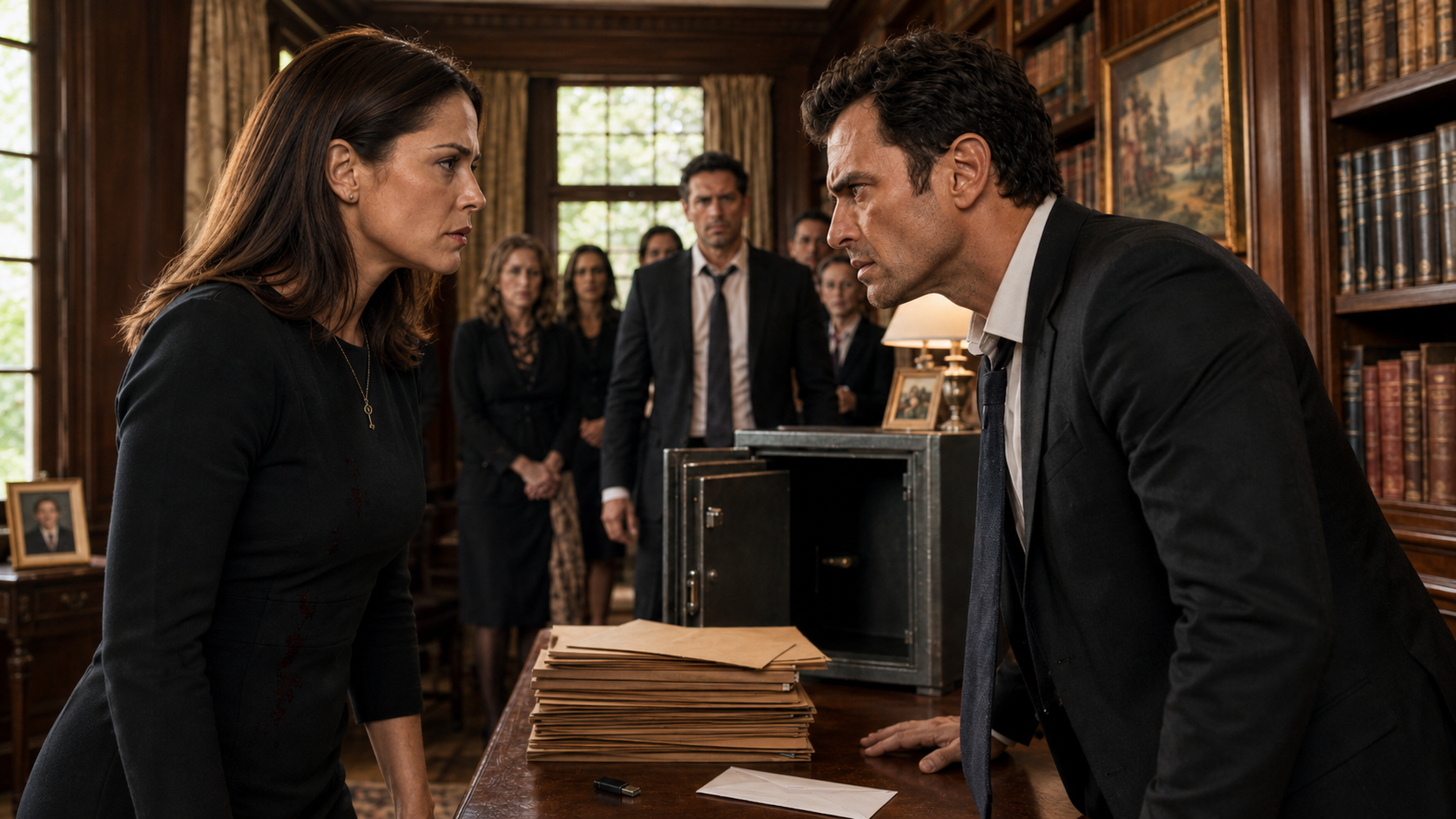
My Brother Hit Me at Our Father’s Funeral for an Inheritance He Had Already Stolen
PART 1: THE KEY AROUND MY NECK
My brother punched me before the final prayer over our father was finished.
One second, I was standing beside Dad’s coffin with my hands clasped tightly enough to hurt, listening to the minister speak about mercy and remembrance.
The next, Julian’s fist struck the left side of my mouth.
My head snapped back.
I tasted blood before I felt pain.
Someone screamed. A chair scraped against the church floor. My aunt Margaret grabbed my arm as I stumbled into the end of a pew, and three bright drops of blood fell onto the front of the black dress I had spent twenty minutes choosing that morning because Dad had once told me I looked strong in black.
“Give me the key!” Julian shouted.
Two of our cousins caught him before he could reach me again.
He fought them like a man being robbed in front of his own eyes.
“She’s stealing my inheritance!” he screamed. “Ask her! Ask Elena what she did with Dad’s money!”
Every face in the church turned toward me.
That was Julian’s gift.
He could make a room believe the loudest emotion belonged to the most injured person.
Even when he was the one who had thrown the punch.
I pressed Aunt Margaret’s handkerchief to my split lip and looked at him across the aisle.
His tie had come loose. His expensive dark suit pulled tight across his shoulders as he struggled against our cousins. His eyes were red, but I knew my brother well enough to know the difference between grief and rage.
This was rage.
Not because our father was dead.
Because Julian wanted something.
The small brass key hanging beneath my dress felt suddenly hot against my skin.
“Give it to me!” he shouted again.
I didn’t move.
The minister stood frozen beside Dad’s coffin.
Julian’s wife, Serena, was three rows back. One hand covered her mouth, though I noticed her eyes had gone straight to my throat when Julian demanded the key.
Of course they had.
They both knew about the safe.
Almost everyone in our family did.
Dad’s old steel safe had been in his study for as long as I could remember. When Julian and I were children, he told us it held “things more dangerous than money.”
We thought that meant a gun.
When we were teenagers, Julian decided it meant cash.
By the time we were adults, the story had grown.
There were supposedly bearer bonds.
Property deeds.
Gold certificates.
Emergency money.
Jewelry that had belonged to our mother.
Two million dollars in cash, according to Julian.
Dad never corrected him.
That should have warned me.
Dad corrected almost everything.
He corrected newspaper grammar with a red pen. He corrected television anchors when they mispronounced foreign cities. He corrected waiters who brought him decaf instead of regular coffee.
But whenever Julian talked about the fortune in the safe, Dad only smiled.
Now I finally understood why.
“Elena,” Julian said, lowering his voice.
Our cousins still held his arms.
He stared at the blood on my mouth without one flicker of shame.
“Give me Dad’s key.”
“No.”
His face twisted again.
“That belongs to the family.”
“I am family.”
“You know what I mean.”
I did.
Julian had always used the word family when he meant himself.
Dad pays for family.
Family should help me with the business.
Family doesn’t keep records.
Family doesn’t ask when I’ll repay it.
Family doesn’t embarrass family by saying no.
For almost forty years, our father had forgiven him.
For most of those years, so had I.
That ended six weeks before Dad died.
The minister cleared his throat carefully. “Perhaps this is not the place—”
“It’s exactly the place,” Julian snapped. “She’s been controlling Dad for months.”
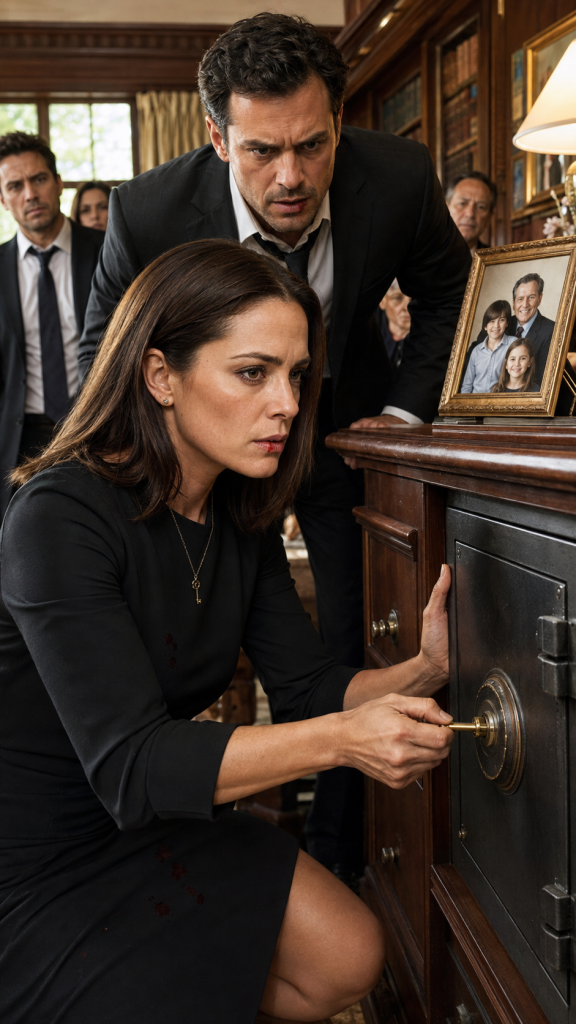
A murmur passed through the mourners.
That hurt more than the punch.
Not because I believed him.
Because I knew some of them might.
I had been the one taking Dad to his cardiologist appointments.
I had picked up prescriptions at midnight.
I had argued with insurance representatives.
I had learned how to help him stand without making him feel weak.
During his last week, I slept in the chair beside his hospital bed because he became frightened when he woke in darkness and didn’t recognize the room.
Julian visited twice.
Both times he asked Dad about finances.
But I was the unmarried daughter.
The quiet one.
The one who had moved back into Dad’s house temporarily when his condition worsened.
To people who preferred simple explanations, that could be turned into a story.
Julian knew it.
He always knew where other people’s doubts lived.
I removed the bloodstained handkerchief from my lip.
“The safe will be opened at the house,” I said.
Julian stopped struggling.
“In front of everyone.”
He stared at me.
“And before anything inside is touched,” I continued, “Dad’s attorney will be present.”
Julian barked out a laugh.
“Dad’s attorney?”
“Yes.”
“You mean your attorney now?”
“No. I mean Samuel Price.”
The name had an effect.
Julian’s smile weakened.
Samuel had handled Dad’s legal affairs for more than twenty years.
Julian knew him.
More importantly, Julian knew Samuel was not easy to intimidate.
Our uncle Raymond stepped into the aisle.
He was Dad’s younger brother, though grief had made him look older that morning.
“Elena,” he said, “why do you have the key at all?”
I met his eyes.
“Dad gave it to me.”
“When?”
“Before he died.”
Raymond’s mouth tightened.
“Your father would never choose you over his son.”
The church became so quiet I could hear the faint hum of the air-conditioning.
I looked toward the coffin.
Dad had spent half his life fighting that exact assumption.
Not publicly.
Not dramatically.
Just in a hundred exhausting little ways.
Julian gets the business because he’s the son.
Julian should have the house because he’ll carry the name.
Julian deserves another chance because men make mistakes.
Elena is responsible, so Elena can manage.
Elena doesn’t need help.
Elena will understand.
I had understood until understanding became another word for surrender.
“He didn’t choose me over Julian,” I said quietly. “He chose someone he trusted.”
For once, Julian had no immediate answer.
Then he pointed at me.
“You hear that? She admits it.”
“No,” Aunt Margaret said sharply. “She said your father trusted her.”
Julian rounded on her.
“And you think that makes sense?”
My aunt looked from my bleeding mouth to his clenched fists.
“At the moment,” she said, “it makes excellent sense.”
Nobody laughed.
But Julian heard the judgment anyway.
His cheeks darkened.
I should have been shaking.
Instead, something in me became cold and clear.
Six weeks earlier, Dad had warned me this moment would come.
Not the punch.
He had not predicted that.
But the accusation.
The relatives.
The performance.
The certainty with which Julian would demand what he believed was his.
Dad had been lying in his bed at home when he called me into the study for what turned out to be the last time.
He looked smaller than the man who had once carried me on his shoulders through a flooded street because I refused to ruin my new shoes.
His hands trembled when he took the brass key from his pocket.
“Elena.”
I had knelt beside his chair.
“You need to rest.”
“I’ve rested enough.”
“Dad—”
“Listen.”
That word had stopped me.
He closed my fingers around the key.
“When I die, Julian will ask for this.”
My stomach tightened.
“Why?”
“You know why.”
I had.
I just didn’t want to say it.
Dad’s voice had become thin with illness, but his eyes were still sharp.
“Do not give it to him.”
“What’s in the safe?”
“Not what he thinks.”
I stared at him.
“Then tell me.”
“No.”
I nearly laughed from frustration.
Even dying, my father could turn a conversation into a test.
“Dad.”
“You know enough already.”
That frightened me.
I had known something was wrong with his accounts.
Not everything.
Just fragments.
A transfer Dad swore he hadn’t approved.
A statement that disappeared from the mail.
A bank representative who called twice asking whether Dad had authorized changes to his online access.
Julian had explanations for all of it.
Dad had asked him to help.
Dad was confused because of medication.
It was only temporary.
He would straighten everything out.
Dad had believed some of those explanations.
Or pretended to.
Then one afternoon I found him sitting alone at the kitchen table with a bank statement in front of him and tears in his eyes.
My father had buried his wife.
He had survived surgery.
He had watched the business he built from nothing nearly collapse during a recession.
I had never seen him cry over money.
That day he folded the statement before I could read it.
“Don’t ask me yet,” he said.
At the time, I obeyed.
Now, standing inside the church with blood on my dress, I wished I hadn’t.
Dad had squeezed my hand around the key that afternoon in his study.
“Promise me,” he said.
“Promise you what?”
“That you’ll wait.”
“For what?”
“For him to become certain.”
I understood he meant Julian.
“Certain of what?”
“That he has already won.”
I looked at Dad, disturbed by the bitterness in his voice.
“Why would you want that?”
His expression changed.
Not anger.
Pain.
“Because your brother has spent his whole life escaping consequences through doubt. There is always doubt. Maybe he misunderstood. Maybe someone misheard him. Maybe there’s another explanation.”
Dad leaned back, exhausted.
“This time, there can’t be.”
I wanted to ask more.
He wouldn’t tell me.
He only made me promise three things.
Keep the key.
Do not open the safe alone.
Call Samuel before the family gathered at the house after the funeral.
I did all three.
Now Julian was walking straight into whatever Dad had prepared.
And from the way he kept staring at the chain beneath my collar, he had no idea.
We left the church under a gray afternoon sky.
People spoke softly around me as if volume itself might trigger another disaster.
Julian was driven separately to Dad’s house by Serena.
I rode with Aunt Margaret.
She kept glancing at me.
“Do you need the hospital?”
“No.”
“That lip may need stitches.”
“It doesn’t.”
“You’re sure?”
“I’m sure.”
She sighed.
“You always say you’re fine before you decide whether you actually are.”
That was something Dad might have said.
I turned toward the window so she wouldn’t see my eyes fill.
The house came into view twenty minutes later.
Dad’s house.
Not Julian’s.
Not mine.
Dad’s.
A redbrick colonial with white shutters, a maple tree that dropped leaves into the gutters every October, and one loose stone on the front walkway Dad had promised to repair for three years.
There were already cars lining the street.
The funeral reception had become something else.
A gathering.
A tribunal.
Maybe an audience.
Inside, people barely touched the food Aunt Margaret’s church friends had arranged.
Everyone seemed to drift toward the study.
Julian was already there.
He stood near Dad’s desk with a glass of whiskey.
I almost told him not to use Dad’s good crystal.
Then I realized how absurd that thought was.
Serena leaned against the fireplace.
She wore a black designer dress and a diamond bracelet that caught the light whenever she moved her wrist.
Three months earlier, Julian had told me he couldn’t afford to contribute to Dad’s home nurse.
I stared at the bracelet.
Serena noticed.
Her fingers covered it.
Interesting.
Julian raised his glass toward me.
“Finally.”
“You’ve been here six minutes.”
“Long enough.”
He looked around the study as though mentally placing price tags on everything.
Dad’s books.
Dad’s desk.
Dad’s leather chair.
The framed photograph of Mom.
“Let’s get this over with,” he said.
Uncle Raymond stood beside him.
Several relatives remained in the doorway.
Nobody wanted to admit they were watching.
Nobody left.
Julian gestured toward the steel safe set into the lower cabinetry behind Dad’s desk.
“Open it.”
“We wait for Samuel.”
“I’m not waiting for your little legal performance.”
“It was Dad’s instruction.”
“Dad could barely remember what day it was.”
Something in me snapped taut.
I looked straight at him.
“He remembered enough.”
Julian’s mouth curled.
“Enough to suddenly make you executor?”
“Yes.”
That was the first time I had said it in the house.
A few relatives exchanged looks.
Julian laughed.
“You?”
“Yes.”
“Dad made you executor?”
“He did.”
“He told me I’d handle the estate.”
“When?”
Julian hesitated.
“Plenty of times.”
“Before or after you stopped visiting unless you needed something?”
“Elena,” Raymond warned.
“No,” I said, without looking away from Julian. “If we’re going to do this in front of everyone, then we’re going to do it honestly.”
Julian set down his glass hard enough to splash whiskey across Dad’s desk.
“He told me there was at least two million in that safe.”
Serena shifted near the fireplace.
There it was.
The number.
Not Dad’s number.
Julian’s.
He had repeated it so many times that he seemed to believe our father had actually promised it to him.
“Cash,” Julian continued. “Bonds. Deeds. Mom’s jewelry.”
I stared at him.
“Mom’s jewelry?”
“Don’t start.”
“She didn’t have two million dollars in jewelry.”
“That’s not the point.”
“What is the point?”
“The point is that what’s inside belongs to the family.”
Again.
Family.
Meaning Julian.
His voice rose.
“You’re not taking it.”
“I haven’t taken anything.”
“You took the key.”
“Dad gave me the key.”
“You took control of his accounts.”
“No. I didn’t.”
“You isolated him.”
“I cared for him.”
“You made him change his will.”
“I didn’t ask him to change anything.”
Julian stepped closer.
The cousins who had restrained him at the church immediately shifted as well.
He noticed and gave a humorless smile.
Then he leaned toward me.
“Open it,” he whispered. “Then get out of my house.”
I looked at him for a long moment.
“It isn’t your house.”
His eyes hardened.
“Everything Dad owned is mine.”
The room seemed to contract around those words.
I felt the key against my chest.
Dad’s warning came back to me.
Wait for him to become certain.
He was certain now.
So certain he was willing to say it in front of witnesses.
I reached beneath my collar and lifted the chain over my head.
The little brass key swung from my fingers.
Julian stared at it.
Greed is an ugly word.
People imagine greed looks wild.
Hungry.
Desperate.
Julian’s didn’t.
His expression softened.
For the first time all day, he looked almost peaceful.
He thought the fight was over.
He thought I was about to open a steel door and hand his future back to him.
I knelt in front of the safe.
My hands shook once.
Then stopped.
I inserted the key.
Behind me, someone held their breath.
I turned it.
The lock clicked.
I pulled open the heavy door.
There were no bundles of cash.
No velvet boxes.
No gold certificates.
No bearer bonds.
No glittering inheritance.
Only six thick sealed folders stacked neatly on one shelf.
A flash drive.
And a white envelope with my name written across the front in Dad’s unmistakable handwriting.
For several seconds, nobody spoke.
Then Julian said, “What the hell is this?”
I didn’t answer.
His face had changed.
Not disappointment.
Fear.
It was small at first.
Just a tightening around his eyes.
But I saw it.
I lifted the envelope.
Julian moved instantly.
“Give me that.”
I stood.
“No.”
He took one step toward me.
Our cousin Daniel blocked him.
“What are those folders?” Raymond demanded.
“I don’t know yet.”
“You opened the safe.”
“I haven’t opened the documents.”
Julian gave a sharp laugh.
“You expect anyone to believe that?”
“Yes.”
“Why?”
“Because Dad told me not to.”
I turned the envelope over.
The flap was sealed.
“Before anyone touches these documents,” I said, “Dad asked that his attorney be present.”
A calm voice came from the hallway.
“I’m already here.”
Everyone turned.
Samuel Price stepped into the study carrying a leather case.
He was in his early sixties, silver-haired, compact, and so controlled that even his sympathy had always sounded carefully notarized.
But he was not alone.
A woman in a navy suit entered behind him.
Then a man carrying a slim black portfolio.
Julian stopped breathing for half a second.
I had never seen either of them before.
Samuel looked first at my mouth.
His expression darkened.
“What happened?”
“Julian hit her at the church,” Aunt Margaret said.
Samuel turned his eyes toward my brother.
Julian lifted both hands.
“Oh, come on. It got out of control.”
The woman in the navy suit observed him without expression.
Samuel looked back at me.
“Elena, are you all right to continue?”
“Yes.”
He nodded.
Then he indicated the two people beside him.
“This is Dana Walsh and Michael Trent. They’re bank investigators who have been reviewing irregularities connected to several of your father’s accounts.”
The room went silent.
Serena lowered her hand from her bracelet.
Julian’s whiskey glass slipped slightly in his fingers.
Samuel walked toward the safe.
“Mr. Mercer asked them to be present when these materials were opened.”
Dad.
Even dead, he had arranged the room.
The witnesses.
The order.
The timing.
I looked at Julian.
For the first time that day, my brother was no longer looking at me as the weak sister he could frighten.
He was looking at me as something else.
A witness.
And suddenly I understood the last thing Dad had told me about him.
Grief makes greedy people careless.
I just hadn’t understood that Dad was counting on it.
PART 2: WHAT DAD HAD BEEN HIDING
Samuel did not allow anyone to touch the folders.
That infuriated Julian.
“These are family documents,” he said.
“They are estate documents,” Samuel replied.
“Same thing.”
“No.”
The single word landed harder than a speech.
Samuel placed his case on Dad’s desk and opened it.
“I’ll also remind everyone that Elena Mercer is the duly appointed executor under the most recent valid will.”
Julian stared at him.
“You knew about that?”
“Yes.”
“And you didn’t tell me?”
“I represented your father.”
“I’m his son.”
“Yes.”
Samuel said it without emphasis.
That somehow made it worse.
Julian turned on me.
“You’ve been planning this together.”
“No.”
“You expect me to believe Dad secretly rewrote his will and filled a safe with accusations without you knowing?”
“I knew he changed the executor.”
“What else?”
“Nothing.”
“That’s a lie.”
I almost answered.
Then I remembered Dad’s face.
There is always doubt.
Maybe he misunderstood.
Maybe someone misheard him.
Maybe there’s another explanation.
So instead of arguing, I looked at Samuel.
“Can we open them?”
He nodded.
“Yes.”
Dad had labeled the six folders by month.
November.
December.
January.
February.
March.
April.
His last six months.
My chest tightened.
He had been sick through all of them.
Samuel opened the November folder first.
Inside were bank statements, copies of transfer authorizations, handwritten notes, and printed emails.
The room blurred around me for a moment.
I recognized Dad’s handwriting.
Every page contained small comments in the margins.
DID NOT AUTHORIZE.
ASKED J. 11/19.
CLAIMS TEMPORARY.
CALL BANK.
PASSWORD CHANGED AGAIN.
I sat down in Dad’s chair because my knees suddenly felt unreliable.
Dana Walsh, the bank investigator, moved closer to the desk.
She examined one page.
Then another.
Julian stood near the fireplace now.
He had stopped demanding the key.
That was the first clue that mattered.
If he truly believed I had stolen his inheritance, he should have been furious that the safe was empty.
Instead, he was watching the paperwork.
He knew what it was.
Samuel opened December.
More statements.
More transfers.
Some small.
Some not.
Twenty-five thousand.
Forty thousand.
Seventy-five thousand.
A hundred and twenty thousand.
The money moved through accounts I didn’t recognize.
I looked at Julian.
His jaw flexed.
Serena sat down.
I remembered Christmas.
Dad had been exhausted that year.
He fell asleep in his chair while the rest of us were eating dessert.
Julian had complained because Dad refused to invest another hundred thousand dollars in one of his ventures.
“You act like you’re poor,” he had said.
Dad woke enough to answer.
“I’m beginning to understand the value of pretending.”
At the time, I thought he meant Julian’s business requests.
Now the memory chilled me.
He already knew.
Maybe not everything.
But enough.
Samuel opened January.
My father’s physical decline was visible even in his handwriting.
The early notes were square and careful.
By January, the letters leaned.
By March, some lines shook.
Yet the records became more detailed.
Dates.
Times.
Names of bank employees.
Printed screenshots.
Copies of text messages.
And again, Julian’s name.
JULIAN SAYS I APPROVED THIS.
I DID NOT.
ASKED WHY ONLINE ACCESS LOCKED.
JULIAN SAYS SECURITY UPDATE.
I stared at the sentence until the words stopped looking real.
A memory surfaced.
Dad handing me his tablet.
“Elena, does this website look different?”
I had checked.
“No.”
“My password doesn’t work.”
“Did you change it?”
“No.”
I reset it for him.
Two days later, it stopped working again.
Julian told me Dad had probably forgotten the new password.
I believed him.
Why wouldn’t I?
Dad was on strong medication by then.
He mixed up appointment times occasionally.
Once he called me by Mom’s name.
Julian used that uncertainty like camouflage.
My stomach turned.
Samuel opened the fourth folder.
February.
This one contained a notarized statement.
Samuel looked at me before reading.
“Your father dictated this to me in my office on February eighteenth.”
Julian spoke immediately.
“He was medicated.”
Samuel didn’t look at him.
“He was examined that morning by his physician, who provided a written opinion regarding his mental capacity.”
He removed another document.
“The opinion is attached.”
Julian’s face tightened.
I heard Serena whisper, “Julian.”
He ignored her.
Samuel began reading Dad’s statement aloud.
He did not dramatize it.
He didn’t need to.
Dad described noticing withdrawals he did not remember approving.
He described asking Julian for assistance with online banking during his illness.
He described giving Julian temporary access for the limited purpose of paying certain expenses.
He described discovering that money had moved beyond those expenses.
He described confronting him.
Julian had said the transfers were temporary.
Investments.
Short-term placements.
Funds that would be returned.
Dad had waited.
The money did not come back.
I closed my eyes.
I could hear my brother’s voice from dozens of family dinners.
It’s temporary.
You worry too much.
Dad knows.
I already talked to Dad.
Why are you always making everything dramatic, Elena?
I opened my eyes again.
Julian was staring at Samuel as though hatred alone might stop him.
It didn’t.
The statement continued.
Dad had instructed Julian in writing to stop making transfers.
The transfers continued.
Dad changed his passwords.
His access was altered again.
Dad contacted Samuel.
Samuel contacted the bank.
The investigation began quietly.
Julian laughed suddenly.
It was too loud.
“You’re all acting like this proves something.”
Dana looked at him.
“It documents Mr. Mercer’s complaint.”
“It documents an old man being confused.”
My chair scraped backward as I stood.
“He wasn’t confused.”
Julian pointed at me.
“You don’t get to decide that.”
“No. His doctor did.”
His eyes flashed.
“You think sitting beside his bed made you an expert?”
“No.”
“Then stop pretending you knew what was happening inside his head.”
I almost shouted.
Instead I looked at the papers again.
Dad had known Julian would attack his mind first.
So he had documented it.
Medical assessments.
Dates.
Witnesses.
I felt a surge of grief so sharp I had to grip the desk.
He had spent part of his final months proving he was still himself.
Because his own son had made confusion useful.
“How much?” Raymond asked.
Nobody answered.
He looked at Dana.
“How much money are we talking about?”
Dana exchanged a glance with Samuel.
Samuel opened the March folder.
“This was the preliminary reconciliation as of March thirty-first.”
He placed a summary sheet on the desk.
I read the total twice.
Then a third time.
$1,842,600.
The room seemed to tilt.
Aunt Margaret sat down abruptly.
Raymond whispered, “Jesus.”
I stared at the figure.
Almost one million eight hundred fifty thousand dollars.
Gone.
Transferred or withdrawn over several months.
Julian’s famous two million.
That was why he believed the number.
He hadn’t imagined it.
He had seen it.
He had touched most of it.
My eyes went to Serena’s bracelet.
She folded her arms over it.
“Julian,” I said.
He shook his head.
“No.”
“Almost two million dollars?”
“It wasn’t like that.”
“What was it like?”
“They were investments.”
“Whose?”
“Dad knew.”
I looked at Samuel.
Samuel said nothing.
He didn’t need to.
Dad’s written statement sat between us.
DID NOT AUTHORIZE.
I turned back to Julian.
“Did you move this money?”
His nostrils flared.
“Some of it.”
A collective sound passed through the room.
Not quite a gasp.
Something uglier.
Recognition.
Julian heard it.
He immediately corrected himself.
“With permission.”
“How much?”
“That’s none of your business.”
“I’m executor.”
“You love saying that.”
“How much, Julian?”
“You think that makes you powerful?”
“No.”
I touched my swollen lip.
“But this makes me tired of being afraid of you.”
He stared at me.
For once, I stared back.
Dana spoke.
“Mr. Mercer, I would advise you to be careful about characterizing any disputed transactions in front of this many witnesses.”
Julian turned toward her.
“Who exactly are you?”
“I told you,” Samuel said.
“A bank investigator,” Julian mocked. “What does that mean? You’re a cop now?”
“No,” Dana said. “It means your father disputed a pattern of transactions, and I was assigned to investigate.”
“I had authorization.”
“Then the records will establish that.”
“They will.”
She nodded.
“Good.”
Her calmness made him more agitated.
Julian had always done best against people who matched his emotion.
Fight him, and he became the victim.
Accuse him, and he demanded proof.
Raise your voice, and he called you unstable.
Dana gave him nothing.
She simply turned back to the documents.
Samuel opened April.
Dad died on April twenty-sixth.
The folder contained records through April twenty-second.
Four days before his death.
The final pages were the most painful.
Not because of the amounts.
Because Dad’s handwriting had become almost illegible.
One sentence was underlined twice.
HE THINKS I DON’T KNOW.
Another:
DO NOT CONFRONT UNTIL RECORDS COMPLETE.
And finally:
ELENA MUST NOT BE LEFT TO FIGHT HIM WITHOUT PROOF.
I stopped breathing.
The room disappeared.
I touched the line with one fingertip.
Dad had known.
Not only what Julian had done.
He had known what would happen after he was gone.
That Julian would come for me.
That he would accuse me.
That he would use volume, shame, tradition, and family pressure to make me surrender.
My eyes filled so fast I couldn’t hide it.
All morning I had held myself together.
Through the coffin.
Through the burial prayers.
Through Julian’s fist.
Through the blood.
Those few crooked words broke me.
Elena must not be left to fight him without proof.
I covered my mouth and turned away.
Aunt Margaret put her hand on my shoulder.
Nobody spoke.
Even Julian was silent.
For a moment, I was six years old again, standing at the bottom of the stairs during a thunderstorm, waiting for Dad to come down because he had promised I would never have to be afraid alone.
He had kept that promise longer than I knew.
Samuel gave me several seconds.
Then he said gently, “There’s one more item.”
The flash drive.
Julian’s attention snapped toward it.
“What’s on that?”
“I don’t know,” I said.
Samuel did.
I could tell.
Dad had arranged everything with him.
Samuel took a laptop from his bag and inserted the drive.
“There are several recordings,” he said.
Julian became very still.
“Recordings of what?”
“Conversations.”
My heart began pounding.
“With who?”
Samuel looked at him.
“With you.”
Serena stood so quickly her chair scraped across the floor.
“Julian.”
He turned toward her.
“What?”
“What did you say?”
His face changed again.
Not guilt.
Calculation.
He was trying to remember.
Every conversation.
Every promise.
Every lie.
Dad had spent months pretending to be weaker than he was.
And Julian, believing himself safe, had kept talking.
Samuel clicked the first audio file.
Dad’s voice filled the study.
Weak.
Breathless.
But unmistakably clear.
“Julian, I’m asking you again. Where did the money go?”
My brother’s recorded voice answered almost immediately.
“Dad, stop worrying about it. You’re going to get yourself worked up.”
“I asked where it went.”
“I moved it.”
“Why?”
“Because sitting in your accounts was stupid.”
“Did I tell you to move it?”
A pause.
Then Julian laughed on the recording.
“You told me to handle things.”
“I told you to pay expenses.”
“You’re splitting hairs.”
“I am asking you to put it back.”
“Fine.”
“When?”
“I said fine.”
“Julian.”
“What?”
“When will you put it back?”
Another pause.
Then the sentence that changed the room.
“Why does it matter? Eventually it’s mine anyway.”
Nobody moved.
The recording continued.
Dad’s voice was quieter.
“Why would you think that?”
“Because I’m your son.”
“You have a sister.”
“Elena doesn’t care about money.”
My throat tightened.
Dad answered, “That does not mean she is entitled to less.”
Julian sighed loudly on the recording.
“Oh, for God’s sake. She has her little career. She doesn’t have kids. What does she need all this for?”
Serena looked down.
The recording ended.
The silence afterward was absolute.
I stared at my brother.
He stared at the laptop.
All my life, Julian had said things about me as jokes.
Elena doesn’t need much.
Elena likes being independent.
Elena’s not interested in the business.
Elena would rather read than live.
Elena doesn’t care about money.
Each sentence sounded harmless by itself.
Together they had become permission.
Permission to take my share.
Permission to decide what I needed.
Permission to treat Dad’s estate as something already owned.
Samuel reached for the second file.
Julian suddenly stepped forward.
“That’s enough.”
“No,” I said.
His eyes moved to me.
I wiped the last trace of blood from my mouth.
“For once, Julian, we’re going to hear all of it.”
Samuel pressed play.
And my dead father asked my living brother a question I had never been brave enough to ask.
“How much of my money have you already spent?”
Julian’s recorded answer came after a long silence.
“Enough that you’re going to have to trust me.”
PART 3: THE SON WHO WAS ALWAYS FORGIVEN
There is a strange cruelty in hearing the past become evidence.
Memories had always been soft things to me.
Imperfect.
Personal.
A sentence remembered one way by me and another way by Julian.
An argument Dad claimed never happened exactly as I described it.
A promise that changed depending on who repeated it.
The recordings took that softness away.
Dad had captured dates.
Numbers.
Admissions.
Not dramatic confessions.
Something worse.
Casual certainty.
Julian sounded annoyed by the idea that Dad wanted his own money back.
On one recording, he complained that reversing a transfer would “wreck everything.”
On another, he insisted he could restore the funds after a business deal closed.
Dad repeatedly asked what business deal.
Julian never gave a clear answer.
That was not surprising.
My brother had spent fifteen years attaching the word business to whatever he needed people to stop questioning.
A restaurant partnership that never opened.
An online retail company that vanished after eighteen months.
Property renovations that somehow required money before there was any property.
Consulting.
Development.
Importing.
Private financing.
He was always one successful quarter away from paying everyone back.
Dad believed him longer than I did.
Maybe because fathers want to believe sons eventually become the men they keep promising to be.
Maybe because Julian reminded Dad of himself when he was younger—confident, restless, willing to risk everything.
The difference was that Dad risked his own money.
Julian preferred ours.
Samuel played another recording.
Dad sounded tired.
“Your sister asked me about the missing statement.”
Julian responded instantly.
“What did you tell her?”
“That I would handle it.”
“Good.”
“Why is that good?”
“Because Elena panics.”
I almost laughed.
I had spent my whole life being told I was too cautious.
Now apparently caution had become panic.
Dad said, “Your sister does not panic.”
“She’ll make this into some enormous family issue.”
“You made it a family issue when you moved family money.”
“I moved your money.”
“Exactly.”
A pause.
Then Julian said, “You’re really going to do this now? With your health?”
Dad’s breathing became audible.
Julian continued.
“You need to focus on getting better, not bank statements.”
It sounded caring.
That was what made it vicious.
He had turned Dad’s illness into a reason Dad shouldn’t question him.
I glanced at my brother.
He would not meet my eyes.
I remembered January.
Dad had asked me to drive him to the bank one morning.
Julian arrived at the house before we left.
He said the roads were icy.
They weren’t.
He said Dad looked exhausted.
He did.
He said he would handle whatever Dad needed.
Dad canceled the trip.
That evening, Julian told me, “You need to stop dragging him around. He’s sick.”
I felt guilty for days.
Now I wondered whether that trip had been about the accounts.
How many times had Julian used my concern for Dad to keep us apart?
How many times had I helped him without knowing?
The thought made me sick.
“I should have seen it,” I whispered.
Aunt Margaret heard.
“No.”
“I was there.”
“So was everybody else.”
“But I was there every day.”
She squeezed my shoulder.
“And your father hid it because he was ashamed.”
I looked at her.
She nodded toward the documents.
“He was protecting you too, sweetheart. Maybe not in the best way. But that’s what he was doing.”
Dad had always hated asking for help.
Julian knew that.
So did I.
The difference was Julian had used it.
Samuel stopped the recording.
“There’s no benefit to playing every file in front of the family,” he said.
Julian seized on that.
“Exactly.”
Samuel looked at him.
“I said in front of the family.”
Julian’s relief vanished.
“Copies have already been preserved.”
I saw Serena close her eyes.
Samuel continued.
“The originals, the statements, Mr. Mercer’s written declaration, his physician’s capacity assessment, and related account records were duplicated before his death.”
Julian stared at the safe.
Understanding arrived slowly.
The safe had never been the only copy.
Dad had expected Julian might get the key.
Or destroy the contents.
Or pressure me into handing them over.
The documents inside the safe were not the evidence itself.
They were the reveal.
The trap was bigger than the box.
I almost smiled.
That was Dad.
Always have a backup.
He kept spare batteries in every drawer.
Emergency cash in the freezer.
Duplicate keys hidden in places none of us discovered until we moved furniture.
Of course he would never put the only proof inside one metal box.
Julian looked at Samuel.
“So what? What happens now?”
“That depends partly on the findings.”
“You keep saying investigation as if I’m some criminal.”
Nobody answered.
His voice grew louder.
“I had authority to manage Dad’s finances.”
Dana finally looked up.
“Limited authority.”
“He told me to handle things.”
“Certain household and business expenses.”
“You weren’t there.”
“No. Which is why we use records.”
He laughed bitterly.
“Records.”
“Yes.”
“You people love paper.”
“I do,” Samuel said.
Despite everything, Aunt Margaret made a small sound that might have been a laugh.
Julian glared at her.
Then he turned toward Uncle Raymond.
“Tell them.”
Raymond looked startled.
“Tell them what?”
“Dad said I would handle the estate.”
Raymond rubbed one hand over his mouth.
“He said years ago that you’d probably take over the family assets.”
“There.”
Samuel spoke.
“Years ago is not the operative date.”
Julian ignored him.
“He always said it.”
Raymond’s eyes moved toward me.
Then back to Julian.
“He also said you had to stop asking him for money.”
Julian stiffened.
“I’m not doing this.”
“You asked me to tell them.”
“That’s not what I meant.”
“What did you mean?”
“I meant tell them Dad trusted me.”
Raymond looked at him for a long time.
Then his eyes dropped to the documents.
“I thought he did.”
Something passed across Julian’s face.
That hurt him.
I could tell.
For all his arrogance, he needed people to believe in the version of him he sold.
Dad’s successful son.
The future of the family.
The man who took risks others were too timid to take.
Raymond had believed that version.
Maybe that was why he challenged me in the church.
Now he looked old.
Embarrassed.
“I thought Elena had gotten into his head,” Raymond said.
I felt the words like a bruise.
He looked at me.
“I’m sorry.”
I wanted to say it was fine.
That was my habit.
Make other people comfortable before I understood my own pain.
Instead I said, “You should be.”
He nodded.
“I should.”
It was strangely easier to forgive him after that.
Julian could not tolerate the silence that followed.
“So now what?” he demanded. “You all stand around judging me?”
I looked at him.
“You hit me at Dad’s funeral because you thought I had stolen from you.”
He flinched.
Barely.
I continued.
“But you had already taken almost two million dollars from him.”
“It wasn’t stolen.”
“Then why were you afraid of those folders?”
“I wasn’t.”
“You stopped asking where the money in the safe was.”
“I was trying to understand what Dad did.”
“No. You knew.”
“Elena—”
“You knew what the papers might say.”
“You don’t know anything.”
“Then tell me.”
He stared at me.
“What?”
“Tell me where it went.”
His jaw tightened.
“You want to humiliate me.”
“No.”
“Yes, you do. This whole thing is your revenge.”
“For what?”
“For being invisible your whole life.”
The cruelty of it was so precise I knew he had carried the sentence for years.
I felt it enter me.
Then something unexpected happened.
It didn’t stay.
Maybe grief had changed the shape of me.
Maybe his fist had.
Maybe Dad’s note had.
But Julian could no longer tell me who I was and have me automatically believe him.
“You’re wrong,” I said.
He scoffed.
“You always hated that Dad listened to me.”
“No. I hated cleaning up after you.”
His face went still.
I continued.
“I hated lying to Mom about why Dad was upset after you borrowed money again. I hated telling creditors you were out of town. I hated watching Dad pretend your failures didn’t scare him.”
“Shut up.”
“I hated being told to understand.”
“Elena.”
“Because you were under pressure.”
His face darkened.
“Stop.”
“Because your deal was almost done.”
“Stop.”
“Because this time would be different.”
He slammed his hand against the desk.
“STOP!”
Several relatives jumped.
I did not.
The room went silent.
Julian was breathing hard.
For one brief second, the charming mask was gone.
All that remained was a frightened man who had built his identity on never being forced to finish a consequence.
I lowered my voice.
“Where did the money go?”
Serena answered.
“Some of it is gone.”
Julian turned.
“Serena.”
Her eyes were wet.
“You need to stop.”
“Don’t.”
“This is already bad.”
“Be quiet.”
“No.”
It was the first time I had ever heard her refuse him in front of us.
She removed the diamond bracelet from her wrist.
Slowly.
She placed it on Dad’s desk.
“I didn’t know where all of it came from,” she said.
Julian laughed in disbelief.
“Are you serious?”
“I knew you were using money from your father.”
“You knew he agreed.”
“You told me he agreed.”
“He did.”
Serena looked toward the documents.
“Apparently not.”
Julian stared at her as if betrayal were something only other people could commit against him.
I studied Serena.
I did not suddenly trust her.
The jewelry.
The vacations.
The new car.
She had enjoyed money Julian could not explain.
But I also recognized something in her face.
The same thing I had seen in my own mirror after years of Julian telling me reality was whatever he needed it to be.
Maybe she had chosen not to ask.
Maybe that was its own kind of guilt.
But she was not going to save him now.
“How much is gone?” I asked again.
Julian looked at the ceiling.
Then at the safe.
Then at Samuel.
His shoulders dropped.
“I don’t know.”
Dana spoke.
“Our preliminary tracing suggests a substantial portion was used to cover existing obligations.”
“What obligations?” I asked.
Julian said, “Business.”
I almost laughed.
Of course.
“What business?”
“You wouldn’t understand.”
There it was.
The old weapon.
I felt no pain this time.
“Try me.”
He glared at me.
“A development deal stalled.”
“So you took Dad’s money.”
“I used liquidity.”
“Dad’s liquidity.”
“I was protecting the investment.”
“What investment?”
“My company.”
“Dad didn’t own your company.”
“He helped start it.”
“That doesn’t mean you could empty his account.”
“I didn’t empty it.”
“Almost two million dollars.”
“He had more.”
The words escaped before Julian could stop them.
The entire room seemed to hear the ugliness at once.
He had more.
As if the amount Dad retained made the amount Julian took irrelevant.
Julian saw our faces.
“Oh, don’t look at me like that.”
Nobody spoke.
“You all took from him,” he said. “Every one of you.”
Raymond frowned.
“What are you talking about?”
“Birthday checks. Loans. Trips. College. Weddings.”
“Those were gifts,” Aunt Margaret said.
“So was the money he gave me.”
Dad’s voice came from the laptop again.
Samuel had not intentionally started another file.
The audio player had advanced automatically.
My father’s voice, weak but clear, filled the room.
“A gift is something I choose to give you.”
Julian went white.
On the recording, his own voice answered.
“You’re really going to hold this over my head?”
“I am going to ask you to return what you took.”
“You won’t need it.”
“That is not your decision.”
“You’re dying.”
A sound moved through the room.
Serena covered her mouth.
I could not breathe.
Julian lunged toward the laptop.
Daniel caught him.
“Turn it off!” Julian shouted.
Samuel closed the computer.
But it was too late.
The sentence remained.
You’re dying.
I looked at my brother.
Not the man who hit me.
Not the man accused of draining Dad’s accounts.
My brother.
The boy Dad had taught to ride a bicycle.
The teenager Dad waited up for.
The adult Dad bailed out again and again because love kept making room where judgment should have stood.
“You said that to him?” I whispered.
Julian’s eyes filled.
For the first time all day, real tears.
“He was.”
I recoiled.
He shook his head.
“No, I don’t mean—Elena, that’s not what I meant.”
“What did you mean?”
“I was angry.”
“Dad was dying.”
“I know!”
“And you told him he wouldn’t need his own money because he was dying.”
“I said something horrible.”
“You said what you believed.”
“No.”
“Yes.”
His voice broke.
“You think I don’t know that?”
The anger left me for one confused second.
Because there was shame in his face now.
Actual shame.
And somehow that made it harder.
If he had been completely heartless, I could have hated him cleanly.
But people are rarely kind enough to become monsters without leftovers of humanity.
Julian looked toward Dad’s photograph.
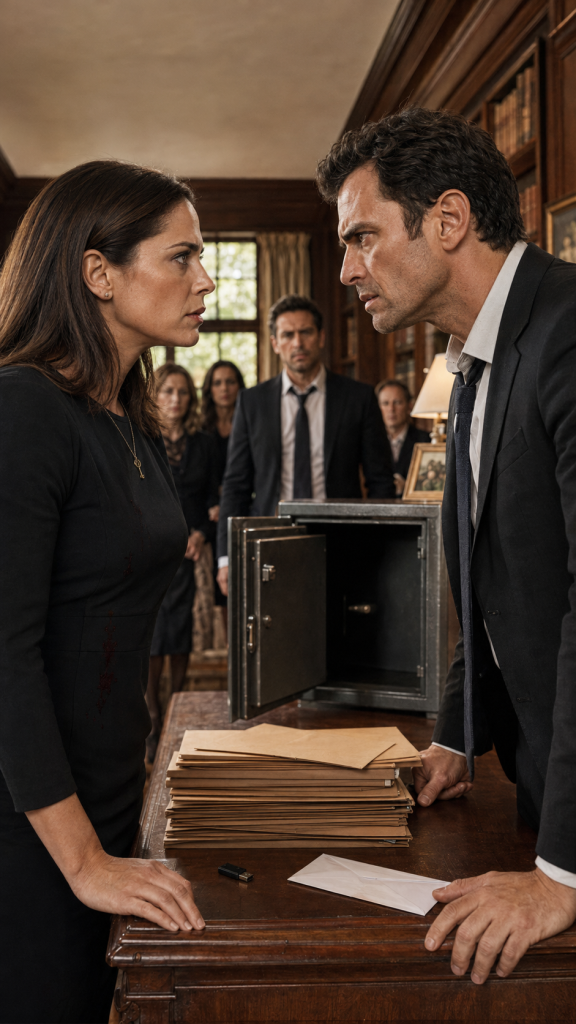
“I was going to put it back.”
Samuel said nothing.
Julian laughed once, miserably.
“I know how that sounds.”
“It sounds familiar,” I said.
He looked at me.
“I had a deal closing.”
“Another deal.”
“Yes.”
“Like the others.”
“This one was real.”
“They’re always real until they fail.”
“You think I wanted any of this?”
“You made choices.”
“I was under pressure.”
There it was again.
The family excuse.
I almost smiled from exhaustion.
“You were always under pressure, Julian.”
He stared at me.
“And somehow Dad always had to pay for it.”
His face crumpled for half a second.
Then hardened again.
“You have no idea what he expected from me.”
That stopped me.
Because it was true.
Not completely.
But enough.
Dad had expected more from Julian.
Not because he loved him more.
Because Julian encouraged it.
He wanted the praise that came with being the son who would continue everything.
He wanted the authority.
The status.
The confidence.
Maybe he had been afraid of failing Dad long before he started stealing from him.
But fear was not innocence.
Pressure was not permission.
“You could have told him you were failing,” I said.
Julian looked away.
“I couldn’t.”
“Why?”
“You wouldn’t understand.”
“Then explain it.”
His eyes returned to mine.
“Because you were allowed to be ordinary.”
The insult surprised me.
So did the pain behind it.
He gestured around Dad’s study.
“You got to choose your life. Dad never looked at you and saw the next version of himself.”
I swallowed.
“No. He looked at me and saw the person who would stay when everybody else left.”
Julian flinched.
Neither role had been fair.
But only one of us had used unfairness to justify theft.
I stepped closer to him.
“You were afraid to disappoint Dad.”
His mouth tightened.
“So you robbed him instead.”
He looked at the floor.
And that was when I knew.
Not just suspected.
Not just believed.
Knew.
He had done it.
He had taken the money.
He had planned to restore it.
His plans had failed.
Then Dad had discovered him.
And rather than confess, Julian had kept moving money, kept buying time, kept telling himself the estate would eventually make the numbers meaningless.
All morning he thought the safe contained enough wealth to rescue him.
That was why he wanted the key so badly.
He wasn’t only fighting for an inheritance.
He was fighting for the money he needed to cover the money he had already taken.
Dad understood that.
Which meant the empty safe was not merely a revelation.
It was the last door closing.
Samuel reached for the envelope with my name.
“Elena,” he said, “your father directed that this be given to you after the financial records were reviewed.”
My hands trembled as I took it.
Julian looked at the envelope.
For the first time, he did not ask for it.
I broke the seal.
Inside was a single handwritten letter.
My father’s handwriting shook across the page.
I began to read.
Then stopped when I reached the second paragraph.
Samuel asked quietly, “Do you want privacy?”
I looked at Julian.
“No.”
Because Dad had written one line I knew my brother needed to hear.
I read it aloud.
“Julian will say I stopped loving him.”
My brother’s head lifted.
I continued.
“He will be wrong.”
My voice almost failed.
I forced it steady.
“I love my son. That is why I can no longer protect him from what he has done.”
Julian shut his eyes.
And Dad’s final lesson moved from the dead into the living.
PART 4: WHAT LOVE DOES NOT EXCUSE
I did not read the rest of Dad’s letter aloud.
Some things still belonged to me.
That surprised Julian.
I could see it in his face.
He had spent the day accusing me of wanting an audience, of planning humiliation, of turning Dad’s death into revenge.
If revenge had been what I wanted, I could have read every private disappointment Dad had written.
Instead, I folded the letter.
Julian watched.
“That’s it?”
“That’s what?”
“You’re not going to read the rest?”
“No.”
“Why?”
“Because it’s addressed to me.”
His laugh was bitter.
“Convenient.”
I slid the letter back into its envelope.
“Believe whatever helps you get through the next five minutes.”
His eyes narrowed.
That line sounded like him.
Maybe that was why it worked.
Samuel began organizing the folders.
“The family gathering should end.”
Julian stared at him.
“You don’t get to throw me out of my father’s house.”
“Elena is the executor.”
Julian looked at me.
There it was.
The next test.
All day he had expected me to behave like the version of myself he knew.
Avoid the scene.
Protect Dad’s memory.
Protect him from embarrassment.
Keep peace.
Say we could discuss it tomorrow.
I looked around Dad’s study.
At the half-full whiskey glass.
At Mom’s photograph.
At Dad’s handwriting spread across the desk like a final act of defiance.
Then at the dried blood on my dress.
“You need to leave,” I said.
Julian laughed.
“Elena.”
“You hit me at Dad’s funeral.”
“You want me to apologize?”
“No.”
That startled him.
“I want you to leave.”
“You’re my sister.”
“Yes.”
“You can’t just—”
“Leave.”
Something in my voice must have convinced him.
He stared at me for several seconds.
Then he grabbed his jacket from the back of a chair.
Serena did not move.
He looked at her.
“Are you coming?”
She stared at the bracelet on Dad’s desk.
Then slowly nodded.
She picked it up.
I thought she would put it back on.
Instead she placed it in her purse without looking at anyone.
Julian saw.
“What are you doing?”
“We’re going home.”
“No. What are you doing?”
She looked at him.
“I don’t know yet.”
He understood the answer.
So did I.
Their marriage was not my story to solve.
I felt no satisfaction watching fear enter his face.
Only exhaustion.
At the door, Julian stopped.
He looked back at me.
“So this is what you wanted.”
I shook my head.
“I wanted to bury Dad.”
That was the truth.
It silenced him.
Then he left.
The house emptied slowly afterward.
Some relatives hugged me.
Some avoided my eyes.
Several apologized for believing Julian’s accusations.
I accepted none of the apologies quickly.
Not because I wanted to punish them.
Because I finally understood that forgiveness given automatically is often just another way of refusing to admit something hurt.
Uncle Raymond stayed.
He stood by Dad’s bookshelves after everyone else had gone.
“I owe you more than an apology,” he said.
I sat behind Dad’s desk.
My lip had started throbbing again.
“What do you owe me?”
“The truth.”
I looked up.
He rubbed his palms together.
“Julian asked me about the safe three weeks ago.”
My stomach tightened.
“What did he say?”
“He asked whether your father had ever told me the combination.”
“It uses a key.”
“I know. I told him that.”
“What else?”
“He asked whether I thought your father kept cash in there.”
Of course.
“What did you say?”
“That I thought so.”
“Why?”
Raymond looked embarrassed.
“Because years ago your father joked about keeping enough money in there to survive the end of civilization.”
Despite myself, I smiled.
“That sounds like him.”
“I didn’t know Julian was serious.”
“What did Julian say?”
“He said your father had promised him what was inside.”
My smile vanished.
Raymond continued.
“I believed him.”
“Why?”
The question came out harder than I intended.
He accepted it.
“Because your brother speaks like a man who has already been agreed with.”
That sentence explained half my childhood.
Raymond sat across from me.
“He said you were preventing him from seeing financial documents.”
“I wasn’t.”
“I know that now.”
“You could have asked me.”
“I should have.”
“Why didn’t you?”
He looked toward Dad’s photograph.
“Because I thought I knew the family.”
I understood.
That was the danger.
Not strangers.
People who already had a story about us.
Julian was the son.
I was the dependable daughter.
Dad was the strong father.
Serena was the glamorous wife.
Raymond was the loyal brother.
We had all become roles.
And when reality changed, people kept trusting the roles longer than the evidence.
Raymond left after promising to provide Samuel with a written account of Julian’s questions about the safe.
I did not ask him to.
That mattered to me.
For once, somebody else had decided to step forward without making me drag them.
By evening, only Samuel and the investigators remained.
Dana reviewed the folders at the dining-room table.
Michael worked quietly beside her.
Samuel brought me ice wrapped in a dish towel.
I held it against my lip.
“Dad knew Julian would come for the safe,” I said.
“Yes.”
“How much did he tell you?”
“Enough.”
“That isn’t an answer.”
“No.”
I gave him a look.
He almost smiled.
“You sound like your father.”
“Today, everybody keeps saying things like that.”
“Take it as a warning.”
That made me laugh.
It hurt my lip.
I winced.
Samuel became serious again.
“Your father initially wanted to confront Julian privately.”
“What changed?”
“The transfers continued.”
I looked toward the dining room.
“Even after Dad told him to stop.”
“Yes.”
“Why didn’t Dad report him immediately?”
Samuel took his time answering.
“Because Julian was his son.”
I looked down.
“And because your father hoped the money would be returned before formal action became necessary.”
“So Dad gave him another chance.”
“Yes.”
“Of course he did.”
“Elena.”
“I’m not blaming Dad.”
But part of me was.
That was the terrible truth.
I loved my father.
I missed him so much I sometimes forgot to inhale.
And I was angry with him.
Angry that he had forgiven Julian so many times that consequences became something the rest of us carried.
Angry that he had hidden the truth from me until his death.
Angry that even his protection arrived as another responsibility placed in my hands.
The key.
The safe.
The estate.
The evidence.
Dad had left me the job of finishing what he could not.
Samuel must have seen something in my face.
“He regretted it.”
“What?”
“Waiting.”
I looked at him.
“He told me he had spent years confusing mercy with rescue.”
That sounded exactly like Dad.
I pressed the ice harder against my lip.
“Did he say anything about me?”
Samuel hesitated.
I hated that hesitation.
“Say it.”
“He regretted relying on you so much.”
My throat tightened.
“He said you became responsible because the family rewarded your brother for being irresponsible.”
I looked away.
“That’s dramatic.”
“He was dying. Dying people sometimes become efficient.”
I laughed once.
Then cried.
It happened without warning.
No graceful tears.
No cinematic silence.
I bent forward and covered my face.
“I’m so angry at him.”
“I know.”
“He should have told me.”
“Yes.”
“He should have stopped Julian years ago.”
“Yes.”
“He should still be here.”
Samuel did not answer that.
There was nothing to say.
I cried for several minutes.
Then I wiped my face and went to wash the blood from my dress.
Some stains lighten before they disappear.
Others only spread when you rub them.
I ran cold water over the fabric and watched pink swirl into the sink.
I thought of Julian as a boy.
He used to check under my bed for monsters.
He broke a neighbor’s window once because two older boys made me cry.
When Mom died, he slept on the floor outside my bedroom because I had nightmares.
People asked afterward how a brother like that becomes a man who can punch his sister at their father’s funeral.
But that question was too easy.
Cruel people are not cruel every minute of their lives.
That is why we stay.
That is why we forgive.
That is why betrayal is betrayal.
Julian had loved me.
He had also learned that my love could be used.
Both things were true.
By the time I returned downstairs, Dana had finished a preliminary review.
She explained the situation carefully.
Some funds appeared recoverable.
Some transfers led to accounts still under review.
Some money had apparently gone toward debts and purchases that could not simply be reversed.
Nothing would be solved in one afternoon.
Dad’s estate would have to make formal claims.
The bank would continue its review.
Samuel would handle the legal process connected to the estate.
There could be additional consequences for Julian depending on what the records established.
I listened without asking for revenge.
I wanted something simpler.
“What happens to Dad’s will?”
Samuel looked at me.
“The will stands unless successfully challenged.”
“Will Julian challenge it?”
“Yes.”
He answered too quickly.
I sighed.
“Of course.”
“Your father anticipated that.”
“Of course he did.”
Samuel removed another document from his case.
“This is not from the safe.”
I stared at him.
“What is it?”
“A letter your father instructed me to provide only if Julian disputed his testamentary capacity or accused you of manipulation.”
I almost laughed from disbelief.
Dad had built contingencies inside contingencies.
“What does it say?”
“It documents why he appointed you executor.”
I looked at the sealed letter.
“Do I want to know?”
“That depends.”
“On?”
“How much of your father’s mind you want to carry tonight.”
I thought about the key.
The safe.
The recordings.
The sentence in Dad’s letter.
I love my son. That is why I can no longer protect him from what he has done.
“Not tonight.”
Samuel nodded.
He placed it back in his case.
For the first time all day, I made a decision that had nothing to do with protecting Julian, preserving appearances, or completing one of Dad’s instructions.
I was tired.
So I stopped.
That night, I slept in Dad’s house alone.
I thought I would be frightened.
Instead, the silence felt honest.
At two in the morning, I went into his study and sat on the floor in front of the open safe.
The six folders had been removed as evidence.
The shelf was empty.
I stared into it.
For years, Julian believed that little steel box contained the family fortune.
But Dad had turned it into something else.
A mirror.
Julian opened it expecting wealth.
What he found was himself.
My phone buzzed.
A message from Julian.
I stared at his name for a long time before opening it.
Dad set me up.
That was all.
I typed three different replies.
Deleted all of them.
Then I wrote:
Dad asked you to stop. You didn’t.
Three dots appeared immediately.
Then vanished.
Returned.
Vanished again.
Finally:
You don’t know everything.
I looked toward the empty safe.
For most of my life, that sentence would have worked.
It would have kept me awake.
Made me question.
Made me wonder whether I had been unfair.
Not this time.
I placed the phone facedown.
The next morning, Julian filed to challenge Dad’s will.
And in doing so, he triggered the final thing our father had prepared.
PART 5: THE INHERITANCE HE COULDN’T TAKE
Julian’s challenge was exactly what Samuel expected.
He claimed Dad lacked mental capacity when the final will was executed.
He claimed I had isolated Dad.
He claimed I had influenced him.
He claimed the financial investigation had been manufactured because Dad was confused and I was suspicious of Julian.
If I had heard those accusations six months earlier, I might have fallen apart.
Instead, I read them in Samuel’s office with my hands flat on the table.
“He’s saying I manipulated Dad because I lived with him.”
“Yes,” Samuel said.
“He asked me to move in.”
“I know.”
“He’s saying I restricted visits.”
“Did you?”
“No.”
“Then we answer that.”
“He barely visited.”
“Then records will reflect that.”
“He’s saying Dad was incompetent.”
“Your father expected that.”
Samuel placed the sealed letter from his case between us.
The contingency letter.
I stared at it.
“Now?”
“Now.”
He opened it.
Dad had written it three weeks before he died.
Unlike the notes in the April folder, this letter had been dictated and typed.
His signature was weak at the bottom.
The first paragraph was clinical.
He named his physicians.
He confirmed he understood the nature of his estate.
He confirmed he understood the identity of his children.
He confirmed the purpose of the document.
Then Dad stopped sounding like a legal client and started sounding like my father.
He explained that he had appointed me executor not because he loved Julian less, but because I had demonstrated judgment when Julian had demonstrated entitlement.
He described my years of managing household expenses without using Dad’s money as my own.
He described my refusal to take payment for caring for him beyond reimbursement of expenses.
He described a conversation I had forgotten.
Two years earlier, Dad offered to pay the remaining balance on my mortgage.
I refused.
Not because I didn’t want the money.
I did.
I refused because he had already given me enough, and I knew Julian was asking him for another business loan at the same time.
Dad remembered.
I had not realized it mattered.
Then came the sentence that made me stop reading.
Elena has sometimes mistaken self-erasure for loyalty. I contributed to that mistake.
I stared at the page.
Samuel waited.
I read it again.
Self-erasure.
Such a severe phrase.
I wanted to reject it.
Then I thought about the funeral.
About standing there bleeding and still worrying that telling Julian to leave might upset the family.
Dad knew me too well.
The letter continued.
He wrote that he had spent years assuming I needed less because I asked for less.
That he had treated my competence as proof I required less support.
That this had been unfair.
I cried silently.
Not because he had finally seen me.
Because he had seen me before he died and I had not known.
Dad also addressed Julian.
He acknowledged placing expectations on him.
He acknowledged praising risk when Julian was young.
He acknowledged rescuing him from financial mistakes too often.
But he refused to accept those failures as excuses for what came later.
A parent can help create a weakness without becoming responsible for every choice the adult child makes because of it.
I folded the letter.
“That’s enough.”
Samuel nodded.
The will challenge did not last long.
Dad had been too careful.
Medical assessments supported his capacity.
Samuel had contemporaneous notes.
Other witnesses confirmed Dad understood his decisions.
The bank records supported the timeline.
The recordings destroyed the claim that Dad had imagined unauthorized transfers.
And Julian’s own conduct at the funeral became difficult to explain.
He had loudly accused me of stealing an inheritance from a safe he seemed unusually desperate to open.
Several relatives provided statements.
Including Uncle Raymond.
Including Aunt Margaret.
Including Daniel.
Serena did not testify against him about conversations inside their marriage.
But she did confirm something simpler.
Julian had expected the safe to contain enough money to solve what he called “the situation.”
That phrase mattered.
Not because it proved everything.
Because it matched everything else.
The truth had been there all along.
In his urgency.
In the number he kept repeating.
In the expensive purchases.
In the missing statements.
In his insistence that Dad was confused.
In his certainty that money eventually belonging to him was almost the same as money already belonging to him.
The challenge failed.
But the financial investigation continued.
Weeks became months.
Grief changed shape.
At first, Dad’s absence was everywhere.
His coffee mug.
His reading glasses beside the bed.
A grocery list in his handwriting.
A voicemail I could not delete.
Eventually, the house began to feel less like the place where he had died and more like the place where he had lived.
I repaired the loose stone on the front walkway.
It cost eighty-three dollars.
Dad would have been furious he waited three years.
I laughed when the contractor handed me the invoice.
Some funds were recovered.
Not all.
Accounts connected to Julian still held assets purchased with Dad’s money.
Other money was gone into debts and failed ventures.
The estate pursued what could reasonably be traced.
I did not demand that Samuel destroy Julian financially just to satisfy me.
I also did not ask Samuel to protect him.
That distinction became important.
For the first time in our family, consequences were allowed to arrive without someone rushing to soften them.
Julian sold several assets.
His company collapsed.
The large house he and Serena rented disappeared from the family Christmas card because there was no family Christmas card that year.
They separated.
I heard about it from Aunt Margaret, not from Julian.
I did not celebrate.
There was nothing joyful about watching a brother’s life break apart, even when he had loosened the screws himself.
But I also stopped calling tragedy what was really consequence.
Those are not always the same thing.
As for the punch at the funeral, I reported it.
That decision divided the family more than the stolen money did.
Money can be complicated.
Violence is embarrassingly simple.
Some relatives told me Julian had “lost control for one second.”
Some reminded me his father had just died.
Some said involving authorities would make reconciliation impossible.
I listened.
Then I asked one question.
“If he had hit Serena in front of all of us, would you tell her not to report it?”
Nobody gave me a useful answer.
So I stopped asking for permission.
Julian eventually sent me an apology.
Not a good one.
The first version arrived by text.
I’m sorry things got out of hand.
I did not reply.
A week later:
I shouldn’t have hit you.
Better.
Still no reply.
Then, three months after the funeral, he called.
I watched his name light up my phone.
For a long time, I considered letting it ring out.
Then I answered.
“Elena.”
His voice sounded different.
Smaller.
“Julian.”
Silence.
Neither of us knew how to speak without our old roles.
Finally he said, “I know you hate me.”
I looked out the kitchen window at Dad’s maple tree.
“I don’t.”
He breathed out.
“That almost makes it worse.”
“I’m not responsible for making this easier.”
“I know.”
That was new.
I waited.
He said, “I kept thinking I could fix it.”
“The money?”
“Everything.”
I said nothing.
“The first transfer wasn’t supposed to stay out,” he continued. “I had a payment due. If I missed it, the deal collapsed. Dad had plenty sitting there. I thought I’d move it for two weeks.”
“Dad told you to stop.”
“I know.”
“But you kept going.”
“Yes.”
“Why?”
His voice roughened.
“Because after the first hole, the only thing I could think about was filling it.”
“So you dug another one.”
“Yes.”
It was the first simple answer he had given me in years.
No explanation.
No insult.
No business language.
Just yes.
He continued.
“I thought the development deal would pay everything back. Then that started failing, and I had other debts, and Serena thought things were going well, and Dad kept asking questions.”
“Serena’s expectations didn’t make you steal.”
“I know.”
Another new sentence.
I leaned against the counter.
“Why did you hit me?”
A long silence.
“Because I thought you were about to take the last thing that could save me.”
“The safe.”
“Yes.”
“You really believed there was two million dollars inside?”
“Something close.”
“Why?”
“Dad told me years ago he kept enough in there that none of us would ever need to panic.”
I almost smiled.
Dad’s jokes.
Julian had heard a promise inside one.
“And when he gave you the key,” Julian said, “I thought he’d chosen you.”
“He did choose me.”
Julian went silent.
“To execute the estate,” I added. “Not to replace you.”
“That’s not what it felt like.”
“I know.”
He breathed.
“I spent my whole life thinking everything was a competition with you.”
“I didn’t.”
“I know that now.”
Another silence.
Then he said, “That might be the worst part.”
I understood what he meant.
I had never been competing.
Which meant Julian had spent years winning races I was not running.
“What do you want from me?” I asked.
“I don’t know.”
“Then why did you call?”
His answer came quietly.
“Because Dad said you’d be the one person I couldn’t charm after he was gone.”
Despite everything, I laughed.
A real laugh.
Julian did too.
For half a second, we sounded like brother and sister again.
Then the past returned between us.
“I’m sorry,” he said.
Not for things getting out of hand.
Not for how I felt.
Not for the situation.
“I stole from Dad. I lied to you. I made people think you were manipulating him. And I hit you.”
I closed my eyes.
There it was.
Not redemption.
Truth.
They are not the same thing.
“I hear you,” I said.
He swallowed audibly.
“Do you forgive me?”
I opened my eyes.
Once, I would have said yes because he sounded broken.
Once, I would have believed forgiveness was something a good sister should provide on demand.
Dad’s letter had taught me otherwise.
“I don’t know yet.”
Julian was quiet.
Then he said, “Okay.”
That was the first consequence he accepted from me without argument.
We ended the call.
I stood alone in Dad’s kitchen afterward.
My hands were shaking.
But I did not feel weak.
I felt sad.
There is a difference.
Almost a year after the funeral, the estate was finally settled enough for me to close the house.
Dad had not disinherited Julian completely.
That surprised everyone.
It did not surprise Samuel.
“He loved him,” Samuel said.
Dad’s plan was painfully precise.
Any valid amount Julian owed the estate would be accounted for before further distribution to him.
What remained after debts, recoveries, taxes, and expenses would be divided according to the will.
Dad had not tried to erase his son.
He had refused to let Julian profit from what he took.
That was all.
Justice, stripped of drama.
The safe remained in the study until the last week.
I almost left it for whoever bought the house.
Instead, I opened it one final time.
The steel door groaned.
The shelf was empty.
No money had ever been waiting for us there.
No secret fortune.
No miracle inheritance.
Only proof.
I thought about how differently Julian and I had understood wealth.
He believed wealth was the thing inside the safe.
The amount.
The property.
The number that proved he had won.
Dad, in the last months of his life, had filled the safe with something money could not buy back once lost.
Trust.
Or, more accurately, the record of where trust had died.
I reached into my pocket and removed the brass key.
For months, I had kept it on the same chain around my neck.
At first because Dad told me to.
Later because I couldn’t bear to put it down.
I held it in my palm.
That tiny piece of metal had caused a punch.
A public accusation.
A family rupture.
But the key itself had never been powerful.
The power was in what we believed it opened.
Julian believed it opened a fortune.
I believed it opened Dad’s last secret.
In the end, it opened the truth.
I placed the key inside the empty safe.
Then I closed the door.
I didn’t lock it.
There was nothing left to protect.
As I walked out of the study, I noticed Dad’s photograph sitting on the desk.
Mom had taken it years earlier.
Dad was standing beside the maple tree, sleeves rolled up, looking irritated because she had interrupted him while he was cleaning the gutters.
I picked up the frame.
That one I kept.
Outside, the late afternoon sun stretched across the front lawn.
The repaired stone on the walkway no longer moved beneath my foot.
I stopped at the curb and looked back at the house.
For months, people had asked me what I inherited.
They meant money.
Property.
Accounts.
They wanted a number.
I never gave them one.
What Dad left me could not be written on a check.
He left me proof that love does not require blindness.
That forgiveness does not cancel consequence.
That being the reliable person in a family does not mean becoming the place where everyone else dumps the weight they refuse to carry.
And he left me one final apology, hidden inside a sentence I almost couldn’t bear to read.
Elena has sometimes mistaken self-erasure for loyalty. I contributed to that mistake.
I had spent years disappearing so the people I loved could remain comfortable.
Julian’s anger.
Dad’s expectations.
Raymond’s assumptions.
The family peace.
I had called it patience.
I had called it loyalty.
I had called it love.
At Dad’s funeral, Julian struck me because I refused to surrender a key.
But the real thing I refused to surrender that day was much larger.
My right to know what had happened.
My right to say no.
My right to stop protecting a man who had hurt us simply because he was my brother.
The blood washed out of my black dress eventually.
A faint shadow remained if I held the fabric under bright light.
I kept the dress.
Not because I wanted to remember the punch.
Because I wanted to remember what happened afterward.
Julian screamed that I was stealing his inheritance.
Then I opened the safe in front of everyone.
There was no money inside.
Only six folders, a flash drive, and the truth our father had spent his final months making impossible to deny.
My brother had been so desperate to inherit Dad’s fortune that he never realized he had already taken it.
And Dad had been wise enough to leave behind the one thing Julian could not spend.
The evidence.
Để lại một bình luận