
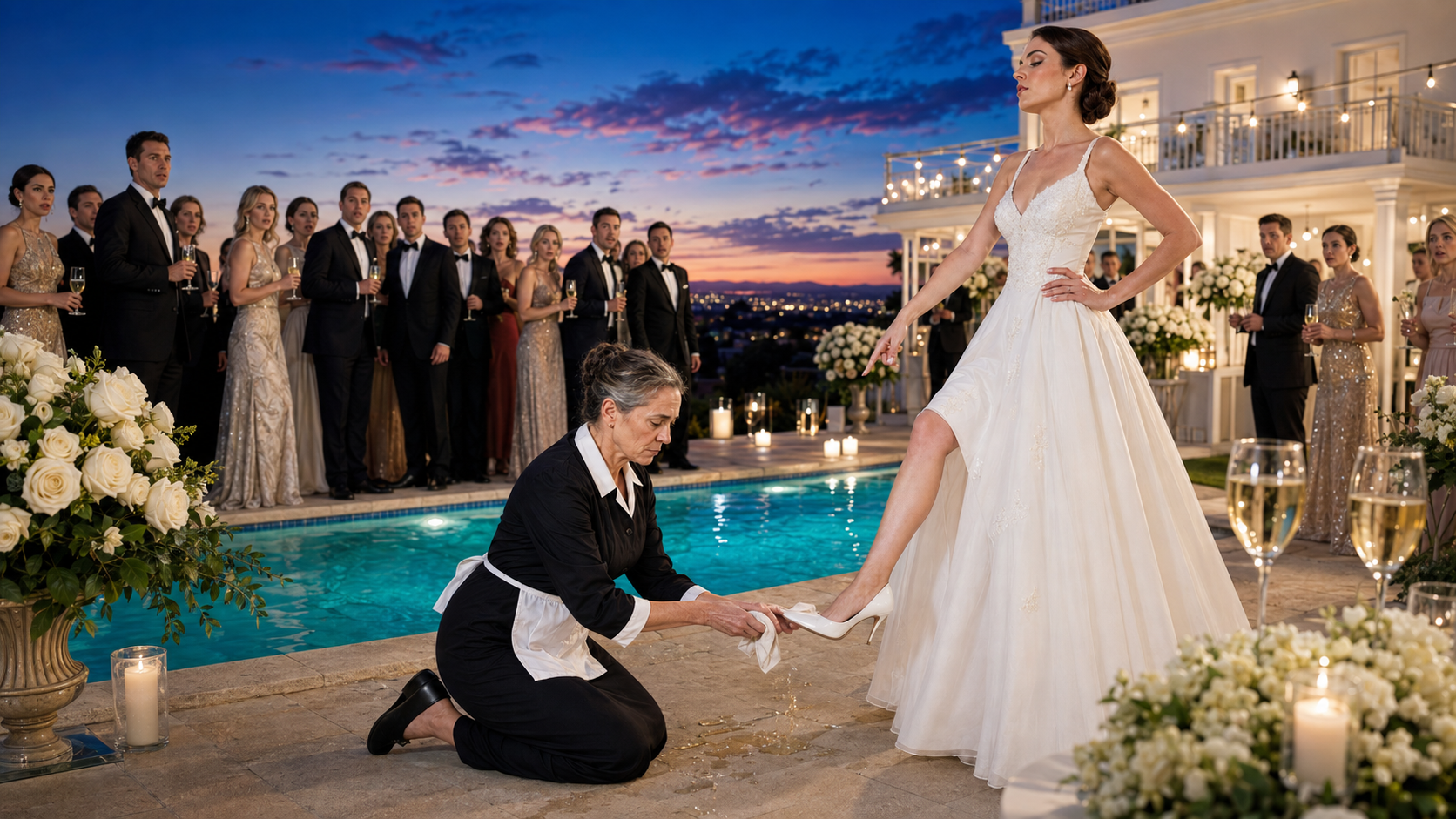
PART 1: THE WOMAN ON HER KNEES
The first time I saw Lenora Voss on my wedding day, she was carrying a tray of champagne.
For one strange second, I thought I had imagined her.
She stood near the terrace doors in a black maid’s uniform, her silver-streaked hair pinned neatly at the back of her head, her face carefully blank as she offered crystal glasses to people who had no idea who she was.
No one stared.
No one whispered.
No one knew.
But I did.
I knew exactly whose hands were holding that tray.
Those hands had once touched my father.
Those lips had once told him things he should only have heard from my mother.
That woman had helped destroy my family.
And now she was serving drinks at my wedding.
I had arranged it that way.
“Are you all right?”
I turned.
Julian stood beside me in his tuxedo, looking so handsome that the sight of him almost hurt.
My husband.
Or at least, he would officially become my husband after the reception ended and the last of the legal documents were signed.
We had already exchanged vows beneath an arch of white roses overlooking the pool. Guests were drinking champagne. Music drifted over the terrace. My bridesmaids were taking photographs near the garden.
Everything was exactly as I had planned it.
Including Lenora.
“I’m fine,” I told Julian.
His eyes moved toward the serving staff.
“Something bothering you?”
“No.”
He smiled and touched my waist.
“You look like you’re about to fire somebody.”
“Maybe I am.”
He laughed.
I didn’t.
Julian kissed my temple and was pulled away by his best man before he could ask anything else.
I watched him go.
Then I looked back at Lenora.
She was already watching me.
Our eyes met across the terrace.
Her face barely changed.
Mine probably didn’t either.
That had been one of the rules.
No scenes unless I wanted them.
No explanations.
No telling anyone who she was.
She would work as temporary staff from morning until the reception ended. She would follow instructions. She would serve my guests.
And afterward, I would sign away my right to challenge a valuable claim involving property and business interests tied to my father.
That was our agreement.
Her dignity for one day.
My signature afterward.
When I first offered it to her, Lenora had stared at me for a long time.
“You want me to work at your wedding?”
“Yes.”
“As a maid.”
“Yes.”
She had known what I was doing.
I hadn’t tried to hide it.
Years earlier, my father, Richard Bellamy, had become involved with her while he was still married to my mother.
Lenora had known he had a wife.
She had known he had a daughter.
She had known there was a family waiting at home.
And she had still taken his calls.
Still met him.
Still believed whatever promises he made.
My mother had found out.
I was eleven when the Bellamy house stopped feeling like a home.
I remembered plates going cold because my mother had forgotten to eat.
I remembered standing outside her bedroom and hearing her cry into a pillow because she didn’t want me to hear.
I remembered my father lowering his voice behind closed doors.
I remembered the word mistake.
I remembered my mother saying, “A mistake happens once, Richard.”
Then silence.
Then another door closing.
My mother eventually left.
I went with her.
For a while, we stayed with my maternal grandparents. Eventually, I stayed there more than I stayed anywhere else.
My father’s money kept arriving.
My father himself did not.
My mother never became the same woman again.
She recovered enough to function. Enough to smile sometimes. Enough to make sure I never missed school and always had birthdays and Christmas mornings and everything a child was supposed to have.
But there had always been a tiredness in her after that.
A quiet humiliation.
Years later, when I was old enough to understand, I learned Lenora had known all along.
That was the part I could never forgive.
Richard had betrayed his vows.
Lenora had helped him do it.
I hated them both.
My father had money, lawyers, influence, and the Bellamy name.
Lenora had disappeared.
Until she contacted me six months before my wedding.
She wanted my cooperation with an old financial arrangement my father had created during their relationship.
The structure was complicated, but the meaning was simple.
There was a valuable claim attached to a trust connected to one of my father’s properties and part of his business interests.
After my mother’s death, I inherited the right to contest it.
Lenora wanted me to withdraw that challenge.
She needed my signature.
I had laughed when she asked.
Then I had invited her to meet me.
And I had offered her a deal.
One day.
One uniform.
One wedding.
One day of being treated as invisible by the kind of people she had once imagined joining.
One day of following my instructions.
Then I would sign.
She should have walked away.
She didn’t.
That should have told me how badly she needed what was waiting behind my signature.
Instead, I saw her acceptance as permission to punish her.
That was my first mistake.
My second was believing I would know when to stop.
By the beginning of the reception, I had already sent her back twice for drinks that had been perfectly fine.
I had made her replace flowers that did not need replacing.
I had told her the napkins at my table were crooked.
Once, while she was adjusting them, I said quietly enough that only she could hear, “You were always good at cleaning up after other women’s husbands, weren’t you?”
Her hands stopped.
Only for a second.
Then she continued arranging the napkins.
“You agreed to follow instructions,” I reminded her.
“I remember.”
I wanted anger.
I wanted a sharp answer.
I wanted her to defend herself so I could tear the defense apart.
Instead, she endured it.
That made me angrier.
Because my mother had endured too.
And in my mind, those two things became tangled together until I could no longer tell the difference between justice and cruelty.
The champagne incident happened just after sunset.
I was standing with two bridesmaids when Lenora approached with a tray.
One of the glasses shifted as another guest turned too quickly.
Champagne splashed over the edge.
A few drops landed on my white heel.
Lenora immediately lowered the tray.
“I’m sorry.”
She reached for a cloth.
I looked at the wet mark on my shoe.
Then at her.
“Clean it.”
She bent slightly.
I pulled my foot back.
“On your knees.”
The bridesmaid beside me stopped smiling.
Lenora looked up.
The conversations around us continued for another few seconds before people began noticing the silence forming at our table.
Her face went pale.
“Audrey,” one of my friends murmured.
I ignored her.
Lenora’s eyes stayed on mine.
We both knew what this moment was really about.
Not champagne.
Not shoes.
Not a wedding.
Eleven years old.
My mother crying behind a locked bedroom door.
My father saying, It didn’t mean anything.
A woman I had never met taking up space in every room of my childhood.
“On your knees,” I repeated.
Lenora slowly lowered herself.
First one knee.
Then the other.
Somebody laughed nervously.
A few guests turned fully toward us.
I extended my foot.
Lenora began wiping the champagne from my shoe.
My heart was pounding.
I should have felt satisfied.
Instead, I felt something uglier.
Power.
“That’s what you’re paid for,” I said.
Her hand stopped.
Then continued.
She finished wiping my heel and started to rise.
That was when I saw her expression.
Not anger.
Not shame.
Pity.
She pitied me.
I don’t know if that was what she truly felt.
Maybe I only saw what my rage wanted to see.
But something in me broke open.
“Don’t look at me like that.”
Lenora straightened.
“I didn’t say anything.”
“You didn’t have to.”
“Audrey.”
It was one of my bridesmaids again.
I heard her.
I ignored her.
Lenora started to step away.
I caught her wrist.
She looked down at my hand.
“Let go.”
“You don’t get to walk away from me.”
Her eyes lifted.
For the first time all day, steel entered her voice.
“I already told you. I am sorry for what happened to your mother. But you cannot punish me enough to change the past.”
My palm struck her face before I even fully understood what I was doing.
The sound cracked across the terrace.
The music seemed to disappear.
Lenora stumbled.
Someone gasped.
I stared at my own hand.
A red mark appeared across her cheek.
I knew immediately I had crossed a line.
But shame can do strange things when pride is standing in front of an audience.
Instead of apologizing, I hardened.
Lenora turned away.
I reached for her again.
She jerked her arm from my grip.
We were too close to the pool.
“Don’t touch me.”
“You agreed to—”
“I agreed to work for you. I did not agree to be attacked.”
She tried to move past me.
I shoved her.
I wish I could say it was an accident.
It wasn’t.
Maybe I didn’t mean to send her into the pool.
But I meant to push her.
That distinction did not matter when her heel slipped against the wet stone.
Lenora fell backward.
There was a splash.
Screams erupted around me.
For a second, I stood frozen.
Then Lenora surfaced, coughing violently.
Her black uniform clung to her body.
She reached for the edge.
Someone shouted for help.
I looked down at her.
My anger was already draining away.
In its place came horror.
Not horror at her.
At myself.
Then I heard Julian.
“What the hell are you doing?”
The crowd separated.
He came running toward us.
His face was white with rage.
I turned toward him, humiliated and defensive and still too proud to admit what everyone had just seen.
“Relax,” I said.
“She’s just the maid.”
Julian stopped.
He looked past me.
Down into the pool.
His entire face changed.
Not slowly.
Instantly.
Like somebody had struck him.
“Mom?”
I stopped breathing.
Lenora stopped moving.
Julian’s voice broke.
“Mom?”
The word hit harder the second time.
I looked at Lenora.
She stared at Julian.
“No,” she whispered.
I looked between them.
Julian Mercer.
Lenora Voss.
I had known Julian’s mother had kept her maiden name after his parents separated when he was young.
He rarely spoke about her.
They had a complicated relationship, he once told me.
She lived quietly.
She hated social events.
She had declined every invitation connected to our wedding, including the ceremony itself.
I had never met her.
I had seen one old photograph of Julian with his parents when he was a child, but the woman had been younger, blonde, smiling, half hidden behind him.
It had never occurred to me.
Not once.
Lenora’s lips were trembling.
“You’re marrying Audrey Bellamy?”
Julian looked at her as if she had lost her mind.
“You know who she is?”
Lenora closed her eyes.
Everything inside me went cold.
Julian dropped to one knee and reached into the water.
“Give me your hand.”
He pulled his mother out.
She collapsed against him, coughing.
He removed his tuxedo jacket and wrapped it around her shoulders.
Then he stood.
He turned toward me.
I had never seen him look at me that way.
Not even during our worst argument.
“What did you do?”
I swallowed.
“Julian, I can explain.”
“You hit my mother.”
I glanced around.
Every face was turned toward us.
“I didn’t know she was your mother.”
He stared at me.
As soon as the words left my mouth, I understood how terrible they sounded.
As though humiliating her would have been acceptable if she belonged to no one I loved.
Julian understood it too.
“So that makes it all right?”
“No.”
“You made her get on her knees.”
“There’s something you don’t understand.”
“Then explain it.”
Lenora grabbed his arm.
“Julian, don’t.”
He looked down at her.
“Why are you dressed like this?”
She said nothing.
“Mom?”
Still nothing.
That was the moment everything should have come out.
The affair.
My father.
The agreement.
The property claim.
All of it.
Instead, Lenora whispered, “Please take me home.”
Julian looked at me once more.
Then his hand moved.
The slap happened so quickly I barely saw it.
My face snapped sideways.
The terrace erupted in gasps.
I tasted blood where my teeth caught the inside of my cheek.
Julian looked almost shocked by what he had done.
For one second, neither of us moved.
His violence did not erase mine.
Mine did not justify his.
We had managed to turn our wedding into something neither of us could take back.
Julian pulled his wedding ring from his finger.
“I can’t marry someone like you.”
He threw it down.
The ring struck the wet stone once and spun.
Then it fell flat.
No music.
No talking.
No laughter.
Just the sound of Lenora breathing behind him.
Julian guided his mother through the crowd.
Nobody stopped him.
I didn’t either.
I stood there in my wedding dress, my cheek burning, watching the man I loved walk away with the woman I had spent half my life hating.
For everyone else, the story was finished.
A cruel rich bride had humiliated an older maid.
The maid’s son had discovered the truth.
The groom had chosen his mother.
Wedding over.
Justice delivered.
But I wasn’t looking at Julian.
I was looking at Lenora.
Just before she disappeared through the doors, she looked back at me.
She should have looked relieved.
Instead, she looked terrified.
And suddenly I knew why.
The papers.
Our agreement.
She had endured everything for my signature.
The signature she had not received.
Julian had saved her from me.
But by destroying our marriage before the agreement was completed, he had also destroyed the only reason she had agreed to be there.
Lenora Voss had just suffered the worst humiliation of her life.
And unless I chose otherwise, she would walk away with nothing.
Julian had no idea.
More importantly, he still had no idea why his mother had been willing to kneel in front of me in the first place.
That truth was waiting for him at home.
And once he heard it, I suspected my broken engagement was going to become much more complicated.
I was right.
PART 2: WHAT JULIAN LEARNED THAT NIGHT
I left my wedding alone.
My grandparents’ driver took me back to the apartment I had owned before Julian and I moved in together.
I was still wearing my dress.
I remember staring at my reflection in the elevator.
My veil was gone.
My lipstick had faded.
My left cheek was red from Julian’s hand.
There was a faint smear of mascara beneath one eye.
I looked less like a bride than a woman who had survived an accident.
Except I had caused the accident.
That was the hardest part.
I could hate Lenora and still know what I had done was wrong.
Both things could exist at once.
My phone kept vibrating.
Friends.
Relatives.
My wedding planner.
Julian’s best man.
People asking whether I was safe.
People asking what had happened.
People pretending not to ask what had happened while clearly desperate to know what had happened.
I turned the phone off.
Then I sat on the floor beside my bed in a wedding dress that had cost more than my mother once earned in a year.
And I cried.
Not because Julian had left.
Not only because Julian had left.
I cried because somewhere between wanting Lenora to understand my mother’s humiliation and wanting to hurt her, I had become the ugliest person on that terrace.
I thought about my mother.
For years, I had imagined defending her.
Avenging her.
Making the people who broke her feel small.
But my mother had never been cruel.
Not even after what happened.
She had once told me, when I was old enough to ask whether she hated Lenora, “Your father made promises to me. She didn’t.”
I had argued.
“She knew about us.”
“Yes.”
“So she’s just as bad.”
“No, Audrey. She is responsible for her choices. Your father is responsible for his.”
At seventeen, I thought my mother was being weak.
Sitting there in my ruined wedding dress, I finally understood she had been trying to teach me something.
Pain did not become justice simply because the right person was hurting.
My phone lit up again after I switched it back on.
This time the name on the screen was my attorney.
I almost ignored it.
Then I answered.
“Ms. Bellamy?”
“Yes.”
“I’m sorry to call tonight.”
I closed my eyes.
“You heard.”
“I heard enough.”
Of course he had.
Half the people at the reception had phones.
“What do you need?”
“The Voss waiver.”
My eyes opened.
“What about it?”
“You instructed us not to release the completed documents until after the reception.”
“Yes.”
“So nothing has been executed.”
I looked toward the dark window.
“That means my challenge remains active.”
“Yes.”
“And Lenora gets nothing.”
“Legally, nothing has changed.”
I thanked him and ended the call.
For several minutes, I sat completely still.
Then I laughed once.
It wasn’t funny.
I had built the entire day around forcing Lenora to endure humiliation in exchange for something she desperately wanted.
Now the humiliation had happened.
The payment had not.
Even by my own cruel rules, that felt wrong.
But before I decided what to do, I needed to know why that claim mattered so much to her.
Not because I planned to reopen the past.
Because Julian was now connected to it.
The following afternoon, he called.
I watched his name ring until it stopped.
Then he called again.
And again.
On the fourth attempt, I answered.
“What?”
Silence.
Then his voice.
“I know.”
My grip tightened around the phone.
“Know what?”
“Who my mother was to your father.”
I said nothing.
He continued.
“She told me everything.”
“I doubt that.”
“Audrey.”
“Did she tell you she knew he was married?”
“Yes.”
“Did she tell you she knew about me?”
A pause.
“Yes.”
“Did she tell you why she was at the wedding?”
Another pause.
That one was longer.
“Yes.”
There it was.
The change.
I heard it before I could see it.
The night before, Julian had been furious.
Now his voice was controlled.
Careful.
“What exactly did she tell you?” I asked.
“That you offered to withdraw your claim if she worked the wedding.”
“That’s the short version.”
“You made her agree to be humiliated.”
“No. I made her agree to work. The humiliation was my choice.”
He was quiet.
I forced myself to continue.
“I hit her. I pushed her. That wasn’t part of anything she agreed to.”
“No.”
“And you hit me.”
Silence.
When he spoke again, his voice was lower.
“I shouldn’t have.”
“No.”
“I’m sorry.”
I wasn’t ready to forgive him.
I wasn’t even sure forgiveness was the correct question.
“Is that why you called?”
“No.”
Of course it wasn’t.
I stood and walked toward the window.
“Then why?”
“I want to understand.”
“You already understand.”
“I understand what she did. I understand what you did. I’m trying to understand the agreement.”
Something inside me shifted.
Barely.
But enough.
“The agreement?”
“My mother said the claim is worth a lot.”
I smiled without humor.
There it was.
Less than twenty-four hours.
“How much did she tell you?”
“That depends on what happens with your father’s holdings.”
“My father’s holdings have nothing to do with our marriage.”
“They might have something to do with your future.”
“I told you before we got engaged that I didn’t want Bellamy money.”
“I know.”
“Then why are we discussing it?”
He exhaled.
“We’re not. I’m asking.”
“No, Julian. You called me the day after ending our marriage in front of two hundred people, and one of your first questions is about a financial claim tied to my father.”
“That isn’t fair.”
I almost laughed.
“Fair?”
“I called because I’m worried about you too.”
“Are you?”
“Yes.”
“How worried?”
“What does that mean?”
“Worried enough to ask whether my face still hurts? Worried enough to ask whether I’ve slept? Worried enough to ask whether your mother is okay?”
“She is.”
“I’m glad.”
And I meant it.
That surprised me.
Julian was quiet again.
Then he said, “Your father is sick, isn’t he?”
I froze.
The question was not completely unreasonable.
Richard’s health had been unstable for months. It was not exactly a secret in Bellamy circles.
But I had never discussed details with Julian.
“Why?”
“My mother mentioned it.”
Of course she had.
“She said some of the trust arrangements change if he dies.”
My skin went cold.
“Julian.”
“I’m trying to understand what you’re dealing with.”
“No. You’re trying to understand what I might inherit.”
“That isn’t what I said.”
“It didn’t need to be.”
He became defensive.
“Jesus, Audrey. We were supposed to be married yesterday.”
“You threw your ring at me.”
“After I watched you push my mother into a pool.”
“Yes.”
“Do you think I was supposed to stand there calmly?”
“No. But apparently today you’re calm enough to discuss estate planning.”
He stopped talking.
That silence told me more than anything else could have.
I ended the call.
Three days later, flowers arrived.
White roses.
The same flowers from our wedding.
The card contained only four words.
We need to talk.
I threw them away.
The next morning, Julian came to my apartment.
I almost didn’t open the door.
When I did, he looked exhausted.
There were shadows beneath his eyes.
No ring.
No suit.
Just jeans and the dark sweater he wore when he wanted to seem less like the ambitious consultant who could charm a room and more like the man who used to cook pasta with me at midnight.
For one dangerous second, I remembered loving him.
Then I remembered him asking how sick my father was.
“What do you want?”
“To apologize.”
“You already did.”
“Not properly.”
I let him inside because part of me still needed answers.
Julian stood in my living room and looked around.
“You came back here.”
“Where else would I go?”
“Our place.”
“It stopped being ours when you left the wedding.”
His jaw tightened.
“I shouldn’t have hit you.”
“No.”
“What I saw—”
“Doesn’t matter.”
“I know.”
He rubbed his face.
“I saw my mother in the pool, Audrey. I lost control.”
“So did I.”
“Yes.”
Neither of us had anywhere to hide from that.
He looked at me.
“I loved you.”
Past tense.
I heard it.
So did he.
He corrected himself.
“I love you.”
“Which one?”
“What?”
“Loved or love?”
His expression changed.
“Audrey, come on.”
“No. You came here to talk. Talk.”
He moved closer.
“I don’t know what happened to us.”
“I do.”
“You hated my mother before you knew she was my mother.”
“I still hate what she did.”
“I know.”
“And I regret what I did to her.”
He studied me.
“Would you have regretted it if you hadn’t found out?”
That question hurt because I didn’t know the answer.
“I hope so.”
He looked away.
For a moment, I thought the conversation might remain honest.
Then he said, “What are you going to do about the agreement?”
There it was again.
I stared at him.
“My mother thinks you’ll keep the claim open now.”
“What do you think?”
“I think you were angry when you made that deal.”
“That wasn’t my question.”
He hesitated.
“I think giving away something worth that much because you feel guilty would be a mistake.”
I almost smiled.
“Interesting.”
“What?”
“You seemed very concerned about your mother’s suffering three days ago.”
“I am.”
“But not concerned enough to want her to receive what she endured it for.”
“That isn’t what I mean.”
“What do you mean?”
He stepped closer.
“If we ever fix this—”
My heartbeat slowed.
“If?”
He looked directly at me.
“That money doesn’t affect only you anymore.”
I felt something inside my chest go still.
“We aren’t married.”
“We almost were.”
“Almost doesn’t create joint ownership.”
“That’s not what I’m saying.”
“Then say what you are saying.”
His voice sharpened.
“You shouldn’t destroy your future because you’re angry at your father.”
My father.
Not Lenora.
Not the wedding.
My future.
I suddenly remembered little moments from the last year.
Julian asking why I refused to take a board seat in one of Richard’s companies.
Julian joking that most people would kill to have my problems.
Julian telling me that walking away from Bellamy money might feel noble at thirty but stupid at fifty.
None of those things had seemed sinister then.
Maybe they still weren’t.
That was the problem.
I didn’t know.
I didn’t know whether grief and shock were making me suspicious of everything.
Maybe Julian genuinely loved me.
Maybe he was asking about money because Lenora had explained how much was involved.
Maybe my father’s illness had simply made the future feel suddenly real.
Or maybe I had spent years watching one man betray my mother and had somehow fallen in love with another man who saw the Bellamy name before he saw me.
I needed to know.
So I gave Julian a reason to come closer.
A reason stronger than guilt.
Stronger than pride.
Maybe even stronger than money.
I looked down.
Then I placed one hand lightly over my stomach.
“Julian.”
His expression changed.
“What?”
I forced my voice to tremble.
“There’s something else.”
His eyes dropped to my hand.
Then lifted back to my face.
I let the silence stretch.
“I’m late.”
He stopped breathing.
“Audrey…”
“I haven’t seen a doctor yet.”
His face lost all color.
“Are you saying—”
“I’m saying I might be pregnant.”
Everything in Julian changed.
Everything.
And as he stared at me, I understood that my real test had just begun.
There was only one problem.
I wasn’t pregnant.
I had never been pregnant.
And if Julian came back to me now, I was going to find out exactly what he was coming back for.
PART 3: THE MAN WHO CAME BACK
Julian returned the next morning with breakfast.
The man who had ignored three of my messages during the week before our wedding because he was “buried in work” suddenly remembered exactly how I liked my coffee.
He brought fruit.
Toast.
The cinnamon pastries from the bakery six blocks away.
He stood outside my apartment holding two paper bags like we were a normal couple having a normal Sunday morning.
“I thought you might be hungry.”
I stared at him.
“You hate waiting in line at that bakery.”
He gave me a weak smile.
“You like it.”
Three days earlier he had thrown away his wedding ring.
Now he was buying my favorite pastries.
Pregnancy was powerful.
Even fake pregnancy.
I hated how easily the lie came to me after that.
I told myself it was temporary.
I told myself I was investigating.
I told myself Julian had earned my suspicion.
But lies always sound reasonable to the person telling them.
My father had probably told himself the same thing once.
That thought stayed with me.
I let Julian inside.
He put the food on the kitchen counter.
“When can you take a test?”
“I already did.”
His eyes widened.
I had anticipated that.
“It was unclear.”
“A test can be unclear?”
“Apparently.”
I hated every word.
“Then we should get another.”
“I will.”
“I can go.”
“No.”
“Audrey—”
“I said no.”
He stopped.
I took a breath.
“If this is real, I need time.”
His face softened.
“Of course.”
That was the Julian I remembered.
Gentle.
Patient.
The man who rubbed circles across the back of my hand when I was anxious.
The man who once drove four hours through a storm because my grandfather had been hospitalized and I told him I didn’t want to be alone.
Those things had happened.
They were real.
That complicated everything.
Julian sat across from me.
“I’ve been thinking about the wedding.”
“So have I.”
“I should never have hit you.”
“You’ve said that.”
“I know, but I need you to hear me.”
“I hear you.”
He looked down.
“I don’t know what happens with us.”
“Neither do I.”
“But if there’s a baby…”
There it was.
Not if we still love each other.
Not if we can forgive each other.
A baby.
He reached across the table.
I didn’t give him my hand.
“If there’s a baby,” he continued, “we have to figure this out.”
“We have to figure out how to be parents.”
“And us.”
“Maybe.”
His eyes sharpened.
“Maybe?”
“You ended our relationship.”
“I was angry.”
“You removed your ring.”
“You had just pushed my mother into a pool.”
“And now?”
“Now I know there was history.”
I stared at him.
“Does history make what I did better?”
“No.”
“Then why does knowing about it suddenly make you willing to reconsider me?”
He didn’t answer immediately.
I waited.
Finally he said, “Because I understand you weren’t just humiliating a random woman.”
That answer should have comforted me.
It didn’t.
“So if she had been random, I would be unforgivable.”
“That isn’t what I said.”
“It’s close.”
Julian leaned back.
“You’re trying to make me fail some test.”
My pulse jumped.
He had no idea how correct he was.
“I’m trying to understand why you’re here.”
“Because you might be carrying my child.”
“Only because of that?”
His eyes moved away.
“I still love you.”
Still.
I wanted to believe him.
That was the dangerous part.
Over the next two weeks, Julian became almost painfully attentive.
He texted every morning.
Called every night.
He asked how I felt.
Whether I was tired.
Whether I had eaten.
Whether I had cramps.
I told him I didn’t want to discuss medical details until I had confirmation.
He respected that.
Mostly.
Then the other questions started.
“Have you spoken to your father?”
“No.”
“Does he know we separated?”
“I’m sure someone told him.”
“Would he change anything because of the baby?”
I looked up from my coffee.
“What would he change?”
“His estate.”
I stared.
Julian immediately shook his head.
“That came out wrong.”
“Did it?”
“I mean because you’re his only child. If he had a grandchild—”
“He doesn’t know about the possible baby.”
“But eventually.”
“Eventually what?”
“It could matter.”
I put my cup down.
“To whom?”
He looked irritated.
“Why do you keep making money sound dirty?”
“Why do you keep bringing it up?”
“Because pretending money doesn’t matter is something only people with money get to do.”
That line stayed with me.
Because it wasn’t entirely wrong.
Julian had grown up differently from me.
His mother had struggled at times.
He had worked through college.
He had student debt.
He had built his career without a family name opening doors.
I knew that.
Maybe his interest was practical.
Maybe I was judging him from the safety of inherited privilege.
Then he asked about Lenora’s claim again.
“What happens if you withdraw the challenge?”
“She gets what she was promised.”
“By your father.”
“Yes.”
“How much?”
“I don’t know the exact current value.”
That was technically true.
“Millions?”
I watched his face.
“Why?”
“I’m asking.”
“You seem to ask a lot.”
He sighed.
“Audrey.”
“No. Tell me why you need the number.”
“Because my mother humiliated herself for it.”
“You mean because I humiliated her.”
His jaw tightened.
“Yes.”
“Then shouldn’t she get it?”
Julian looked away.
“That’s between you and her.”
“No. You’ve made it between us.”
He stood and walked toward the window.
Finally he said, “If you withdraw your challenge, does that affect what you inherit later?”
There it was.
Again.
I felt almost calm.
“Not directly.”
His shoulders loosened.
A tiny movement.
Almost invisible.
But I saw it.
“What does that mean?” he asked.
“It means the Voss claim is separate from most of my father’s estate.”
“Oh.”
One syllable.
But there was relief inside it.
That was when my suspicion became something colder.
I needed one final test.
So I called my attorney.
Not to discuss Julian.
To discuss Lenora.
“I want to honor the original agreement,” I said.
He was silent.
“Are you certain?”
“No.”
“That’s encouraging.”
Despite myself, I smiled.
“But I’m doing it anyway.”
“Because of what happened at the wedding?”
“Partly.”
“That may not be the best basis for a financial decision.”
“I made the agreement before the wedding. She completed what she agreed to do.”
“Technically, the reception ended early.”
“Because my fiancé discovered she was his mother after I pushed her into a swimming pool. I’m not going to use that as a contractual defense.”
He exhaled.
“Understood.”
“I also want the documents to make clear that this ends the dispute.”
“That was always the intention.”
“Then prepare them.”
Two days later, Lenora called me.
I hadn’t spoken to her since the wedding.
Seeing her name on my screen made my stomach tighten.
I answered.
“Hello.”
For several seconds, neither of us spoke.
Then she said, “Your attorney contacted mine.”
“Yes.”
“He said you’re proceeding.”
“Yes.”
“Why?”
I looked out the window.
“Because we had an agreement.”
“You don’t owe me anything after what happened.”
“That sentence makes no sense.”
“It does to me.”
“You worked the wedding.”
“I also hid something from you.”
I frowned.
“What?”
“My son.”
“You didn’t know.”
“No.”
“Then you didn’t hide him.”
“I should have known more about the man you were marrying.”
“Why?”
“Because I knew who you were.”
I thought about that.
“You thought I was just Richard Bellamy’s daughter.”
“Yes.”
“And Julian never told you my last name?”
Her silence answered me.
Their relationship truly had been complicated.
“How much does Julian know now?” I asked.
“Too much.”
Something in her voice made me sit straighter.
“What does that mean?”
“He asks questions.”
My grip tightened around the phone.
“What kind?”
“About Richard. About the trust. About what happens to you when Richard dies.”
The room seemed to narrow around me.
“Why are you telling me?”
“Because I recognize hunger when I hear it.”
That was a strange sentence coming from her.
I said nothing.
Lenora continued.
“I was younger than your father. Not young enough to be innocent. But young enough to believe that because a powerful man wanted me, I had somehow become powerful too.”
Her voice shook slightly.
“I told myself his marriage was already dead. I told myself your mother didn’t understand him. I told myself every lie that made it easier to look in the mirror.”
I closed my eyes.
“I don’t need a confession.”
“Maybe I do.”
“That’s not my responsibility.”
“I know.”
For the first time, I believed her when she said it.
She continued.
“Richard promised me security. Most of what he promised disappeared when the affair ended. This claim is one of the few things that remained documented well enough to matter.”
“And you were willing to work my wedding for it.”
“Yes.”
“Even knowing what I wanted.”
“Yes.”
“Why?”
A long silence.
Then she said, “Because getting older without security is frightening.”
Simple.
Not noble.
Not dramatic.
Just human.
I thought about Julian saying people without money did not have the luxury of pretending it didn’t matter.
Maybe he had learned that from her.
“Does Julian know the value?”
“Yes.”
My stomach dropped.
“How much?”
“He asked my attorney.”
“Did the attorney tell him?”
“I told him.”
Of course she had.
“He’s your son.”
“Yes.”
“He defended you.”
“Yes.”
Her voice became quieter.
“And then he began asking what you were worth.”
I closed my eyes.
There it was.
Not proof.
But close.
“Lenora.”
“Yes?”
“Did you tell him I might be pregnant?”
Silence.
“No.”
I opened my eyes.
“He told you?”
“No.”
“Good.”
She sounded confused.
“Why?”
“Because I wanted to know whether he would.”
Audrey, I imagined my mother saying.
Be careful what kind of person pain turns you into.
I almost stopped.
Almost told Lenora the truth.
Instead I said, “If Julian asks you anything else about my father’s estate, don’t lie to him.”
“What?”
“Tell him whatever you genuinely know.”
“Why would I do that?”
“Because I need to see how far he goes.”
Lenora understood before I finished speaking.
“You’re testing him.”
“I’m protecting myself.”
“Those are not always the same thing.”
“I know.”
She had no right to sound like my mother.
That angered me.
But not enough to make her wrong.
Before we ended the call, Lenora said something I did not expect.
“Audrey.”
“What?”
“I am sorry.”
“For the wedding?”
“No.”
My throat tightened.
“For your mother.”
I didn’t forgive her.
Not then.
Maybe not ever.
But I finally heard the apology without being eleven years old again.
That was something.
The following night, Julian came over with takeout.
Halfway through dinner, he smiled at me.
A real smile.
One I recognized.
“I’ve missed this.”
“What?”
“Us.”
I looked at him.
“There is no us right now.”
“There could be.”
“Because I might be pregnant?”
“Because maybe throwing everything away in one night was a mistake.”
I almost laughed.
“Interesting timing.”
He reached for my hand.
This time I let him take it.
Not because I trusted him.
Because I needed him close.
“How would you feel,” I asked slowly, “if I walked away from all of it?”
His thumb stopped moving against my skin.
“All of what?”
“The Bellamy money.”
He frowned.
“You’ve said that before.”
“I mean permanently.”
He released my hand.
“What happened?”
“Nothing.”
“Then why are we talking about this?”
“Answer the question.”
He leaned back.
“If there’s a child, you can’t make decisions like that only for yourself.”
My heart began beating harder.
“There isn’t a confirmed child.”
“You said—”
“I said I might be pregnant.”
He stared at me.
I continued.
“But suppose I am.”
“Okay.”
“Suppose I tell my father I don’t want his companies. I don’t want his properties. I don’t want his money.”
“That’s insane.”
The word came instantly.
No hesitation.
No gentle concern.
No philosophical argument.
Insane.
I smiled faintly.
“There you are.”
“What does that mean?”
“Nothing.”
“Audrey, your father is worth—”
He stopped.
I waited.
“Worth what?”
He looked away.
I felt something break.
Not loudly.
Quietly.
That was worse.
Because Julian knew.
Maybe not the exact number.
But enough.
The next morning, I signed Lenora’s waiver.
And that evening, I invited Julian to dinner.
There was one final question I needed answered.
Not whether he cared about money.
I already knew he did.
I needed to know whether he cared about me more.
PART 4: THE PRICE OF COMING BACK
Julian arrived wearing the blue shirt I once told him made his eyes look brighter.
That hurt more than it should have.
There is something cruel about seeing a familiar man inside someone you no longer recognize.
He kissed my cheek.
I let him.
“You look tired,” he said.
“I’ve been thinking.”
“About the baby?”
“About everything.”
He followed me into the living room.
I had placed a folder on the coffee table.
He noticed it immediately.
“What’s that?”
“Something I signed today.”
His eyes remained on the folder.
I sat.
Julian sat across from me.
“What did you sign?”
“The waiver.”
His expression emptied.
“What waiver?”
He knew.
I made him say it anyway.
“Lenora’s claim.”
He stared at me.
“You signed it?”
“Yes.”
“You withdrew your challenge?”
“Yes.”
“Without talking to me?”
A strange calm settled over me.
“Why would I need to talk to you?”
His face flushed.
“Because we’re trying to fix this.”
“Are we?”
“You know we are.”
“No. I know you’ve been coming here every day since I told you I might be pregnant.”
“That’s not fair.”
“You keep saying that.”
He stood.
“How much did you just give away?”
“I didn’t give anything away. I stopped contesting something my father promised your mother years ago.”
“That’s semantics.”
“Is it?”
“Yes.”
I watched him pace.
There was no concern for Lenora in his face now.
No anger over what I had done to her.
No relief that the agreement she had suffered for would finally be completed.
Only frustration.
“How much was it worth?” he demanded.
“I thought you knew.”
He stopped.
That landed.
“I know what my mother said.”
“What did she say?”
“That it could be several million depending on the valuation.”
There.
Out loud.
The number he had claimed not to care about.
I folded my hands in my lap.
“And?”
“And what?”
“Why does it upset you?”
“Because that money could have protected our child.”
“Our child who does not currently exist outside a possibility.”
His eyes narrowed.
“What is going on with you?”
I stood.
“Tell me something.”
“What?”
“If my father died tomorrow and left me nothing, would you still want me back?”
His expression changed.
“Yes.”
Too fast.
“If I signed away every Bellamy interest I could legally refuse, would you still want me?”
“Yes.”
“If I went back to living the way I did before my grandparents helped me? No estate. No family companies. No properties. Just my own income.”
“Yes.”
“Then why are you angry?”
“Because throwing away wealth to prove some moral point is irresponsible.”
“What moral point?”
“That you’re better than your father.”
“This isn’t about being better than him.”
“Then what is it about?”
“Knowing who would remain if Bellamy disappeared from my name.”
He went silent.
The words hung between us.
Julian looked at me for a long time.
Then his face softened.
“Audrey.”
I hated that tone.
Gentle.
Reasonable.
The tone people use when they want to convince you that your instincts are symptoms.
“You’ve been through something traumatic.”
“So have you.”
“Yes.”
“You watched me attack your mother.”
“Yes.”
“And yet here you are.”
“Because I love you.”
“You walked away when you thought I was simply cruel.”
His jaw tightened.
“You were cruel.”
“I was.”
“And then I learned what she had done to your family.”
“That doesn’t undo my cruelty.”
“No.”
“Then what changed?”
He opened his mouth.
Closed it.
I stepped closer.
“What changed, Julian?”
“You might be carrying my child.”
“That’s part of it.”
“All right.”
“What else?”
He looked away.
That was my answer.
But I wanted to hear him say it.
“What else?”
“Audrey, stop.”
“No.”
“You’re turning this into something ugly.”
“It became ugly at the wedding.”
“You’re obsessed with making everyone confess something.”
I flinched.
Because that was true.
Lenora.
My father.
Now Julian.
Maybe I had spent my whole life waiting for guilty people to say the sentence that would finally make pain feel reasonable.
It never worked.
But this time, I needed the truth for a different reason.
I needed to know whether I was about to make the same mistake my mother had made.
Trusting a man after he had already shown me who he could become.
“What did my name mean to you before Lenora explained the trust?” I asked.
Julian stared at me.
“What?”
“Before the wedding.”
“You were Audrey.”
“Only Audrey?”
“You know you weren’t.”
There.
I swallowed.
“Explain.”
He exhaled sharply.
“You were Richard Bellamy’s daughter. Of course I knew that.”
“Did it matter?”
“Yes.”
Pain tightened around my ribs.
He continued quickly.
“Not the way you think.”
“How?”
“It intimidated me.”
I waited.
“You came from a world I didn’t. Your grandparents had money. Your father had more. You could walk into rooms where people spent their entire careers trying to be invited.”
“That doesn’t answer me.”
“I loved you before I knew the details of your father’s estate.”
I searched his face.
He looked sincere.
That was almost worse.
“Then when did the details start mattering?”
Julian said nothing.
I knew.
“After your mother told you.”
He sat again, elbows on his knees.
“I had just watched the woman I loved assault my mother.”
I said nothing.
“I went home furious. I thought I would never speak to you again.”
His voice became quieter.
“Then Mom told me who you were to her. What your father had done. What she had done. What you had offered.”
He rubbed both hands over his face.
“And then?”
“And then she told me about the claim.”
I waited.
“She told me what Richard had promised her. She told me how Bellamy trusts worked. She told me what might eventually come to you.”
My chest tightened.
“And you changed your mind.”
“It wasn’t that simple.”
“It never is.”
Julian looked up.
“I realized everything was more complicated.”
“No. You realized I might be much richer than you thought.”
“That isn’t fair.”
“Stop saying that and answer me.”
His voice rose.
“Fine.”
The room went silent.
He stood.
“Fine. Yes. I thought about it.”
The truth finally entered the room.
“I thought about what your future could look like. Our future. A child’s future.”
“There was no child then.”
“No.”
“So ours.”
“Yes.”
“You thought about the money.”
“Yes.”
The word barely came out.
I felt tears burning behind my eyes.
Not because Julian had admitted caring about money.
Because he had also admitted something harder.
He had loved me.
I could hear it in the way he spoke.
He had loved me before the trust.
Before the estate.
Before Lenora explained any of it.
The beginning had not been entirely false.
That would have been easier.
A villain is simple.
A man who loves you and then discovers a price attached to losing you is much more dangerous.
Because part of him can still believe he is doing it for love.
Julian stepped toward me.
“Audrey, I didn’t come back only because of money.”
“Only.”
“No.”
“But it mattered.”
“Yes.”
“How much?”
“I don’t know.”
“That’s the first honest thing you’ve said tonight.”
His eyes filled with anger.
“What do you want from me?”
“The truth.”
“You think you’ve never cared about money?”
“I have.”
“You think your mother didn’t?”
“She cared about stability after my father betrayed her.”
“You think my mother didn’t care about stability?”
I stopped.
That hit exactly where he meant it to.
Julian continued.
“She humiliated herself because she was scared of getting older with nothing. You humiliated her because you had enough money to turn a financial dispute into revenge. But somehow I’m evil because I don’t think you should throw millions away?”
“I never called you evil.”
“You don’t have to.”
“I called you back because you might be choosing me for the wrong reason.”
“And you chose to lie to me.”
My blood went cold.
For one terrifying second, I thought he knew.
Then he continued.
“You’ve been pretending this is about responsibility when you’ve been testing me the whole time.”
He was right.
But not completely.
Not yet.
I walked toward the window.
The city lights blurred.
“Do you remember what you asked me the day after our wedding?”
Julian didn’t answer.
“You asked about my father’s health.”
“I was trying to understand.”
“You asked whether the trust changed when he died.”
“My mother brought it up.”
“You asked whether Lenora’s claim affected my inheritance.”
“I was concerned.”
“You asked whether I would still walk away from the Bellamy fortune.”
“Yes.”
I turned.
“And every time I answered in a way that meant less money, you became more afraid.”
“For our future.”
“We don’t have a future.”
His face changed.
The sentence landed harder than I expected.
“Audrey.”
“I signed Lenora’s waiver because I promised I would.”
“You don’t owe her.”
“I owed myself.”
“What does that mean?”
“It means I refuse to become my father.”
He frowned.
“My father made promises when they were convenient and abandoned them when they became expensive. I made a promise too.”
“You made it to punish her.”
“Yes.”
I swallowed.
“And I am ashamed of that. But she kept her side. I’m keeping mine.”
Julian stared at me.
“What about the rest?”
“The rest of what?”
“Your father’s estate.”
There it was again.
Even now.
I almost laughed.
“Still asking.”
He looked furious.
“Because if you’re pregnant, this isn’t just about you.”
I reached for the folder on the table.
My fingers rested on it.
“Julian.”
“What?”
“There is no baby.”
He stared at me.
I don’t think he understood at first.
“What?”
“I’m not pregnant.”
His face went completely blank.
“I never was.”
Silence.
The kind of silence that changes a room.
Julian’s lips parted.
No sound came out.
Then he whispered, “You lied.”
“Yes.”
His eyes darkened.
“You let me believe—”
“Yes.”
“For two weeks?”
“Yes.”
“You let me think I was going to be a father.”
Every word struck me.
I didn’t defend myself.
Because there was no clean defense.
“I did.”
His face twisted.
“You’re sick.”
“Maybe what I did was.”
“Maybe?”
“I wanted to know why you came back.”
“So you invented my child?”
“I said I might be pregnant.”
“You knew exactly what I was supposed to think!”
“Yes.”
He turned away from me and slammed one hand against the back of a chair.
I flinched.
For a second, the wedding came back.
The slap.
The pool.
The sound of his ring hitting stone.
Julian saw me flinch.
His hand fell.
We stared at each other.
“You’re afraid of me now?” he asked.
“I’m afraid of what both of us became around each other.”
His anger faltered.
I continued before I lost the courage.
“The pregnancy was wrong.”
“Yes.”
“I know.”
“You manipulated me.”
“Yes.”
“You wanted me to fail.”
“No.”
That was the truth.
His eyes narrowed.
“I wanted you to prove me wrong.”
My voice broke.
“I wanted you to come back and never ask about the money again.”
Julian said nothing.
“I wanted you to tell me you didn’t care if my father left me nothing. I wanted you to tell me you came back because losing me hurt more than discovering what marrying me could be worth.”
Tears finally slipped down my face.
“But you kept asking.”
His anger drained.
Not completely.
Enough.
“I did love you,” he said.
“I know.”
He looked surprised.
“That’s what makes this worse.”
I wiped my cheek.
“If you had been using me from the first day, I could hate you and be done.”
“Audrey—”
“But you weren’t.”
He closed his eyes.
“You loved me.”
“Yes.”
“And then my mother became your mother.”
“Yes.”
“And her secret became my money.”
His eyes opened.
“Yes.”
“And something changed.”
Julian looked down.
When he answered, his voice was barely audible.
“Yes.”
That was the answer I had brought him back to find.
Not that our whole relationship had been a con.
Not that every kiss had been calculated.
Not that Julian had proposed because he had secretly researched my inheritance.
The truth was less dramatic.
And more painful.
He had loved me.
Then he discovered exactly what losing me might cost.
And love was no longer the only reason he wanted to come back.
Once I knew that, there was no wedding left to save.
PART 5: WHAT WE INHERIT
Lenora came to my apartment three days later.
I almost refused to see her.
But there were things between us that could no longer remain hidden behind lawyers, dead marriages, or men named Bellamy and Mercer.
When I opened the door, she looked smaller than I remembered.
Not weak.
Just tired.
There was no maid’s uniform.
No expensive dress either.
Dark slacks.
A gray coat.
Her hair loose around her shoulders.
For the first time, I saw her as a person instead of a memory.
That did not erase what she had done.
But it changed the shape of my anger.
She looked at my face.
“Julian told me.”
“Everything?”
“That there is no baby.”
I stepped aside.
She entered.
We sat across from each other in the same room where I had confronted her son.
For several seconds, neither of us spoke.
Then Lenora said, “That was cruel.”
I almost laughed.
“You’re comfortable saying that to me now.”
“I should have said more at the wedding.”
“You did.”
“Not enough.”
“I shouldn’t have hit you.”
“No.”
“I shouldn’t have pushed you.”
“No.”
“I shouldn’t have made you kneel.”
She looked at me.
“No.”
Each answer hurt.
I needed them to.
“I’m sorry.”
Lenora’s expression changed.
It was the first apology I had ever given her.
She nodded once.
“I accept that you mean it.”
Not I forgive you.
I respected her more for that.
After a moment, she said, “I am sorry too.”
“I know.”
“No. I don’t think you do.”
She took a breath.
“Your father told me his marriage was finished.”
I felt my body tense.
“Don’t.”
“I’m not making excuses.”
“Good.”
“I believed him because I wanted to.”
That quieted me.
“He told me he stayed because of you. He told me your mother had stopped loving him. He told me things were complicated.”
Lenora looked down at her hands.
“All the usual things married men say when they want two lives at once.”
My throat tightened.
“When did you learn he was lying?”
“Almost immediately.”
“And you stayed.”
“Yes.”
There it was.
No excuse.
No attempt to make herself innocent.
“Why?”
She looked at me.
“Because by then I wanted him.”
Simple.
Ugly.
True.
“And because part of me thought if he chose me, it would prove I mattered.”
I looked away.
Lenora continued.
“He never truly chose anyone. Not your mother. Not me. He chose himself.”
I thought of my mother alone in that bedroom.
I thought of Lenora kneeling in front of me.
I thought of Julian asking about inheritance.
So many people rearranging their lives around Richard Bellamy’s desires and money.
My father had not even been at my wedding.
Yet somehow he had been everywhere.
“I hated you more than I hated him for a long time,” I admitted.
“I know.”
“Because you were easier.”
“I know that too.”
“He was my father.”
“Yes.”
“If I hated him completely, I had to admit he had chosen to hurt us.”
“Yes.”
“But if I hated you…”
“Then maybe he had been stolen.”
My eyes burned.
“Yes.”
Lenora nodded.
“My son did something similar.”
I looked at her.
“What?”
“He came home furious with you. Then I told him what Richard’s arrangements might mean.”
Her mouth tightened.
“And I watched his anger change.”
I said nothing.
“He still hated what you had done to me. But suddenly he wanted explanations. Context. Possibilities.”
“That’s what I saw too.”
“I should never have told him the numbers.”
“He would have found out eventually.”
“Maybe.”
She looked toward the window.
“He grew up watching me worry about money. I probably taught him more fear than I realized.”
“That doesn’t make his choices yours.”
A sad smile touched her mouth.
“That sounds like something your mother might have said.”
I stiffened.
Then, despite myself, I smiled too.
“Probably.”
We sat quietly.
Finally Lenora touched the folder I had placed on the table.
“My attorney says the waiver is complete.”
“It is.”
“You could reverse course before everything finishes processing.”
“I won’t.”
“Why?”
“Because I said I wouldn’t.”
She looked at me for a long time.
“Your mother would have been proud of that.”
My chest tightened.
“Don’t use her to make me feel better.”
“I’m not.”
Good.
I believed her.
When Lenora stood to leave, I asked the question I had been avoiding.
“What happens with Julian?”
She stopped.
“That depends on Julian.”
“He’s angry with you?”
“Yes.”
“Why?”
“Because I told him he was becoming the kind of person he claimed to hate.”
I almost smiled.
“What did he say?”
“That I had no right to judge anyone after what I did to your family.”
“That was effective.”
“It was.”
She gave me a tired look.
“He wasn’t wrong.”
“No.”
Lenora reached for the door.
Then she stopped.
“He did love you.”
“I know.”
“He still does.”
I swallowed.
“That isn’t enough.”
“No.”
She opened the door.
Before leaving, she turned back.
“For what it’s worth, I don’t think he knew what he wanted until he thought he could lose it.”
Then she left.
I stood there for a long time.
That sentence stayed with me.
Maybe it was true of all of us.
My mother had lost her marriage and discovered how much of herself she had given to it.
Lenora had lost my father and discovered how little his promises were worth.
Julian had lost me and discovered how much my name might be worth.
And I had nearly lost myself trying to make another woman pay for a wound she had helped create but did not create alone.
A week later, Julian asked to see me one last time.
I agreed.
We met at a small coffee shop where nobody knew our names.
No Bellamy estate.
No wedding guests.
No lawyers.
No pool.
Just two people sitting across from each other.
Julian looked different.
Not physically.
Something in the way he held himself.
Less certain.
“I’m still angry,” he said.
“You should be.”
“What you did with the pregnancy was terrible.”
“I know.”
“I don’t forgive it yet.”
“I’m not asking you to.”
He studied me.
“You’re not asking for anything.”
“No.”
He looked down at his coffee.
“I’ve been trying to figure out when it happened.”
“When what happened?”
“When I started thinking about the money.”
I waited.
“I knew your family had money before we started dating.”
“Yes.”
“But it was abstract.”
I nodded.
“I didn’t know numbers. I didn’t know trusts. I didn’t know what might come to you.”
“Okay.”
“I wanted you anyway.”
My eyes burned.
“I know.”
“After the wedding, Mom told me everything. And I remember sitting in her kitchen thinking that I had just walked away from you.”
He laughed once, bitterly.
“And then I thought about what else I had walked away from.”
There it was.
The truth without force.
No test.
No trap.
No argument.
Just truth.
“I hated myself for thinking it.”
“But you kept thinking it.”
“Yes.”
“Why?”
“Because once I knew, I couldn’t unknow it.”
I nodded slowly.
Julian looked at me.
“Then you said you might be pregnant.”
“And suddenly leaving became impossible.”
“Yes.”
“Because of the baby?”
“Mostly.”
I held his gaze.
He forced himself to continue.
“And because I started imagining a life.”
“What kind?”
“One where our child never worried about anything. Where my mother was secure. Where we were secure.”
“Where you were rich.”
“Yes.”
The honesty hurt.
But it also released something.
“I’m sorry,” he said.
“For wanting security?”
“For letting it become part of why I wanted you.”
I looked down.
“I’m sorry for making you believe there was a child.”
His jaw tightened.
“I know.”
“I wanted an answer badly enough that I justified hurting you.”
“Sounds familiar.”
I looked up.
Neither of us smiled.
Because it was true.
I had punished Lenora to answer an old wound.
Then I had manipulated Julian to answer a new fear.
Pain had started becoming my favorite excuse.
I could not keep living that way.
Julian reached into his pocket.
For one terrible second, I thought he had brought another ring.
He hadn’t.
He placed a small object on the table.
My wedding ring.
The one I had removed after coming home.
I had left it at our apartment.
“I found it in the bathroom drawer,” he said.
I stared at it.
“You kept it?”
“I didn’t know what else to do with it.”
Neither did I.
He pushed it toward me.
I picked it up.
The diamond caught the light.
Once, that ring had represented a future.
Then humiliation.
Then betrayal.
Now it was simply an object.
Beautiful.
Expensive.
And powerless unless I gave it meaning.
I closed my fingers around it.
“I’m not coming back,” I said.
Julian shut his eyes.
“I know.”
“No second wedding.”
“I know.”
“No engagement.”
“I know.”
His voice cracked on the last word.
I hated that part of me wanted to comfort him.
I still loved him.
Love does not disappear just because trust becomes impossible.
Sometimes that is what makes leaving so painful.
He opened his eyes.
“What will you do?”
“With my father?”
“With everything.”
I thought about it.
“I don’t know yet.”
He nodded.
“But whatever I do with the Bellamy estate will be my decision.”
“Yes.”
“And Lenora’s claim stays hers.”
He gave a small, tired laugh.
“She told me.”
“How did you react?”
“Badly.”
“I assumed.”
“She asked whether I had rescued her from the pool because I loved her or because I thought she might eventually be worth several million dollars.”
Despite myself, I laughed.
“What did you say?”
“That I didn’t know about the money then.”
“And?”
“She said that was exactly her point.”
My laughter faded.
Lenora Voss had understood the lesson before either of us.
Julian had chosen his mother at the wedding when he believed she was simply a humiliated maid.
That choice had been pure.
Then money entered the room.
And every decision afterward became harder to trust.
I stood.
Julian stood too.
For a moment, we faced each other.
The same two people who had stood beneath white roses and promised forever.
Except we knew more now.
About each other.
About ourselves.
Maybe too much.
“I hope you forgive me someday,” he said.
“For hitting me?”
“For all of it.”
“I hope you forgive me too.”
“For all of it?”
“Yes.”
He nodded.
Then he surprised me.
He didn’t try to kiss me.
Didn’t ask for another chance.
Didn’t promise he would change.
He simply said, “Goodbye, Audrey.”
“Goodbye, Julian.”
I walked out first.
Months later, people still occasionally talked about the wedding.
Some remembered only the video.
The rich bride.
The maid.
The slap.
The pool.
The groom throwing away his ring.
People like simple stories.
Victim.
Villain.
Hero.
Justice.
The truth was messier.
Lenora had knowingly helped a married man betray his family.
My father had been the one who broke his vows.
I had turned years of pain into deliberate humiliation.
Julian had defended his mother when he believed she had nothing.
Then he learned what marrying me might bring him, and his reasons became contaminated by possibility.
None of us left that story innocent.
But innocence was never what I needed.
I needed clarity.
I eventually stopped contesting Lenora’s claim completely.
What she did with it was her business.
I kept my distance from my father.
When people asked what I planned to do about the Bellamy fortune someday, I stopped answering.
For the first time in my life, I understood that refusing money simply to prove it could not control me was another way of allowing it to control me.
I would make that decision when the time came.
Not for Julian.
Not for Lenora.
Not against my father.
For myself.
As for the wedding ring, I never sold it.
I never wore it either.
I kept it in a small box in the back of a drawer.
Not because I hoped Julian would return.
Because I wanted to remember something.
The worst lies in my life had rarely begun as lies.
My father probably loved my mother once.
Lenora probably believed some of the things Richard told her.
Julian truly loved me before he understood what my name could give him.
And I truly believed I wanted justice before I made an older woman kneel in front of two hundred guests.
People do not always become monsters in one dramatic moment.
Sometimes they become worse one reasonable decision at a time.
One excuse.
One humiliation.
One secret.
One question about money that should not matter but suddenly does.
I spent years believing Lenora Voss had destroyed my family.
Then I spent one wedding day trying to destroy her dignity.
And when Julian came back to me, I nearly destroyed what remained of my own.
The strangest part was that the person who finally forced me to see it was the woman I had hated most.
On my wedding day, Lenora had knelt at my feet because I believed making her small would make my mother’s pain smaller too.
It didn’t.
Nothing could.
But when I finally stopped trying to punish the past, I discovered something my mother had understood years before I did.
You cannot choose what other people betray.
You cannot choose what they value more than you.
You cannot control whether love survives fear, pride, or money.
You can only decide what you will become after the truth comes out.
And the day Julian asked me whether I would still walk away from the Bellamy fortune, I thought I was testing him.
In the end, I was testing myself.
This time, I knew when to walk away.
Để lại một bình luận