
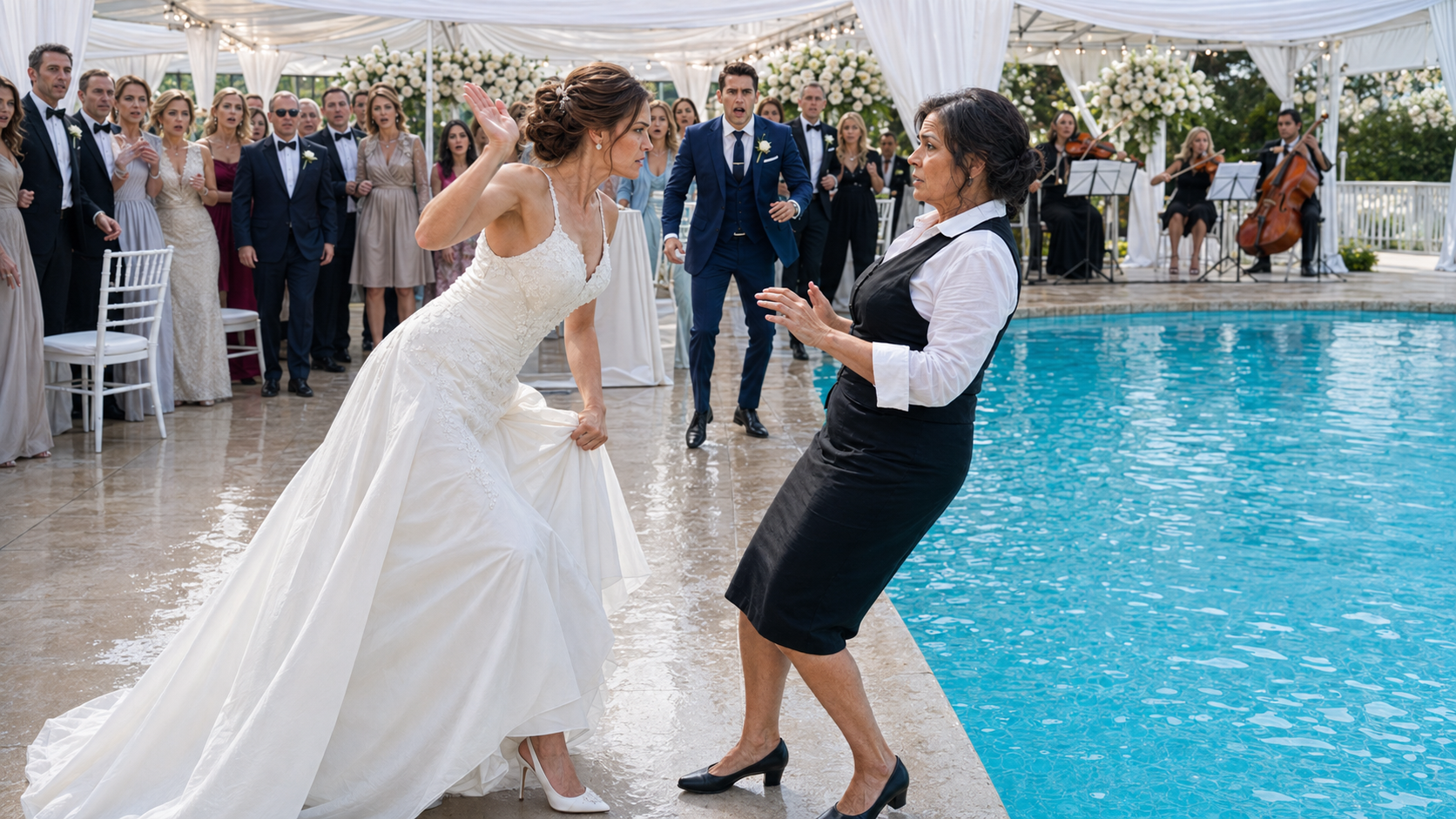
PART 1: THE WOMAN ON HER KNEES
The first time I made my future mother-in-law kneel at my feet, I had no idea she was my future mother-in-law.
I knew her by another name.
Lenora Voss.
The woman who had once helped destroy my mother’s marriage.
That was all I could see when I looked down at her on my wedding day.
Not a woman in her late fifties with tired eyes and silver threaded through her dark hair.
Not a temporary maid in a plain black-and-white uniform.
Not someone’s mother.
Not Julian’s mother.
Just Lenora Voss.
The woman whose name had lived inside my family like a stain no one could scrub away.
“Clean it,” I said.
Champagne glittered across the white leather of my heel.
Lenora already had a cloth in her hand. She bent automatically, probably hoping to wipe the spill before anyone noticed.
I moved my foot back.
“On your knees.”
The words came out colder than I expected.
Around us, the reception terrace changed.
It didn’t become silent immediately.
It happened gradually.
One conversation stopped.
Then another.
Then the laughter near the champagne tower disappeared.
The string quartet kept playing beneath the white canopy, but even the music suddenly seemed too delicate for what was happening.
Lenora looked up at me.
Her face did not show anger.
That almost made it worse.
There was something exhausted in her expression. Something controlled.
For half a second, I thought she might finally refuse.
Part of me wanted her to.
I wanted her to stand straight and tell me she had endured enough.
I wanted her to give me an excuse to unleash everything I had spent years imagining I would say to her.
Instead, Lenora slowly lowered herself onto both knees.
A bridesmaid behind me let out a small laugh.
Someone whispered my name.
I ignored them.
Lenora pressed the cloth against my shoe.
I watched her carefully wipe champagne from the white leather.
“That’s what you’re paid for,” I said.
Her hand paused.
Only for a second.
Then she continued.
Nobody there knew the truth.
They saw a wealthy bride humiliating a maid.
They did not know that three days earlier Lenora and I had been sitting across from each other in my father’s attorney’s private conference room.
They did not know that she had agreed to this.
Not the humiliation specifically.
I hadn’t put kneel in front of me while guests watch into the agreement.
But she had agreed to work the wedding.
To wear the uniform.
To follow my instructions for one day.
In exchange, after the ceremony and reception, I would sign away a valuable claim tied to my father’s property and business interests.
Lenora wanted that claim badly.
Badly enough to put on a maid’s uniform at the wedding of Richard Bellamy’s daughter.
Badly enough to serve champagne.
Badly enough to let people who would once have recognized her as part of my father’s world treat her as invisible.
And apparently, badly enough to kneel.
I had told myself the arrangement was fair.
She wanted something from me.
I wanted something from her.
But standing there in my wedding dress while she cleaned my shoe, I knew that wasn’t the whole truth.
I had wanted revenge.
I had wanted to see her lowered.
Because once, my mother had been the one brought low.
I was eight years old the first time I understood something was wrong in our house.
My mother had always loved breakfast.
Coffee, toast, fruit cut into perfect pieces.
Then suddenly there were mornings when she only sat at the table staring at the same untouched cup until it went cold.
There were afternoons when I came home and found her sitting alone in the upstairs room overlooking the garden.
She would smile when she saw me.
But her eyes always looked as if she had been crying before I entered.
Then came the arguments.
My father’s voice behind closed doors.
My mother’s voice, quieter but sharper.
A name I heard once and remembered forever.
Lenora.
After that, nothing in our house felt permanent.
My mother left eventually.
So did I.
I went with her at first, then spent most of my time living with my maternal grandparents while she tried to rebuild a life that had collapsed around her.
When I was older, the things adults had hidden from me became impossible to hide.
Richard Bellamy had betrayed his wife.
Lenora Voss had known he was married.
She had known he had a daughter.
And she had still been involved with him.
People gave me all kinds of explanations over the years.
My parents’ marriage was already troubled.
My father was the one who made vows, not Lenora.
Lenora had her own reasons.
Adults were complicated.
Relationships were complicated.
Maybe all of that was true.
But none of it changed what I had watched happen to my mother.
So when Lenora appeared again years later because of an old claim connected to my father’s assets, I recognized an opportunity I had once thought would never exist.
I could make her feel small.
Just once.
I could make her understand what powerlessness felt like.
I had thought that would satisfy something inside me.
It didn’t.
When Lenora finished cleaning my shoe, she pushed herself carefully upright.
Our eyes met.
There was no apology in hers.
That was what broke my control.
I had imagined this moment for years, and I think somewhere in my mind I had always expected her to look ashamed.
Instead, she looked tired.
As if my anger was merely another inconvenience she had decided to survive.
I heard myself say, “You could at least pretend you’re sorry.”
Her face tightened.
“For the champagne?”
“You know what I mean.”
Her eyes flickered toward the guests.
“Audrey.”
Hearing my name from her mouth made something old and ugly rise inside me.
“Don’t.”
“I’m trying to do what we agreed.”
“What we agreed?”
My voice rose.
She glanced around again.
That glance infuriated me.
She was worried someone might discover the agreement.
Worried about the property.
Worried about losing what she had come for.
Not worried about me.
Not worried about my mother.
I stepped closer.
“You knew he had a wife.”
Her face changed.
There.
Finally.
“You knew,” I repeated.
“This is neither the time nor the place.”
I laughed.
“You didn’t care about time and place when it was my mother’s marriage.”
“Audrey.”
“Did you ever think about her?”
Lenora lowered her voice.
“You don’t know everything that happened.”
“I know enough.”
“No. You know the part that hurt you.”
I slapped her.
The sound cracked across the terrace.
The quartet stopped.
Lenora staggered sideways.
A hand flew to her cheek.
For one frozen second, we stared at each other.
I wish I could say I regretted it immediately.
I didn’t.
Not immediately.
At that moment, I saw my mother sitting alone beside a cold cup of coffee.
I saw suitcases near my grandparents’ front door.
I saw my father standing in a hallway telling me things would make sense when I was older.
I saw Lenora’s name attached to all of it.
So when she turned as if to walk away, I caught her arm.
“We’re not finished.”
She pulled free.
“We are.”
Her voice was no longer tired.
It was firm.
Maybe that was what I had been trying to force out of her all day.
Some resistance.
Some proof that I could hurt her.
I followed.
She backed away.
Neither of us paid attention to the swimming pool beside the terrace until it was too late.
“Don’t touch me again,” Lenora said.
“You don’t get to order me around.”
“I am not ordering you. I am telling you that this has gone far enough.”
“You decided what was far enough years ago.”
Then I shoved her.
It was not a huge movement.
That detail haunted me later.
There was no dramatic windup.
No decision carefully formed in my mind.
Just both my hands against her shoulders and one furious push.
Lenora’s heel caught the wet stone near the edge.
Her eyes widened.
Then she disappeared backward into the pool.
Someone screamed.
Water exploded upward.
I stood there breathing hard.
For one terrible second, Lenora didn’t surface.
Then her head broke through the water.
She coughed violently and reached for the edge.
Her uniform clung to her.
Her hair had come loose.
People crowded closer.
I could hear shocked whispers all around me.
I should have reached down.
I should have helped her.
Instead, I stood above her, anger still burning so fiercely that it had not yet become shame.
Then a man shoved through the crowd.
“What the hell are you doing?”
Julian.
My groom.
My husband-to-be.
The man I had been planning to spend my life with.
He had been inside speaking with his father’s old friends and several members of the wedding party.
Now he stared at me as though he didn’t recognize me.
I tried to recover the version of myself he knew.
The calm version.
The controlled version.
I gestured toward the pool.
“Relax. She’s just the maid.”
Julian looked past me.
At Lenora.
His entire face changed.
I had never seen a human expression collapse so quickly.
Shock.
Recognition.
Fear.
Then rage.
“That’s my mother.”
The world stopped.
I thought I had misheard him.
“What?”
Julian was already moving.
He dropped to his knees beside the pool and reached for Lenora.
She stared up at him.
“Julian?”
Her voice sounded just as shocked as his.
He grabbed her wrists and helped pull her from the water.
Someone handed him a towel.
Julian ignored it and stripped off his suit jacket, wrapping it around her shoulders.
I couldn’t move.
Lenora looked at me.
I looked at her.
And in that single glance, I understood something impossible.
She hadn’t known either.
Lenora Voss knew I was Richard Bellamy’s daughter.
She had known exactly whose wedding she was working.
But she had not known my groom was her son.
And I—
I had known Julian Mercer’s mother was alive.
I knew he had a difficult relationship with her.
I knew she had kept her own surname after leaving his father years earlier.
I knew Julian rarely spoke about her.
But I had never asked to see a photograph.
Never pushed.
Never connected Lenora Voss to Julian Mercer.
The coincidence felt too brutal to be real.
Julian rose slowly.
His mother was behind him.
Soaked.
Shaking.
Humiliated.
He looked at the red mark across her cheek.
Then at me.
The slap came so fast I barely saw his hand move.
Pain exploded across my face.
My head snapped sideways.
Someone gasped.
I heard one of my bridesmaids cry out, “Julian!”
I touched my cheek.
He looked almost as shocked by what he had done as I was.
But the shock did not soften him.
He pulled the wedding ring from his finger.
Technically, we had already exchanged rings during the ceremony.
The reception had begun less than an hour earlier.
I had been married for less time than some people spent at lunch.
Julian stared at the ring in his hand.
Then at me.
“I can’t marry someone like you.”
He threw it onto the wet stone between us.
The little band bounced once.
Twice.
Then stopped near a puddle of pool water.
Nobody moved.
Not me.
Not Julian.
Not Lenora.
I could feel hundreds of eyes on us.
To everyone watching, the story was complete.
The cruel rich bride had tormented a maid.
The maid turned out to be the groom’s mother.
The groom defended her and walked away.
Simple.
Clean.
Almost satisfying.
Julian took Lenora by the arm.
“Come on, Mom.”
I said nothing.
I didn’t beg him to stay.
Didn’t chase him.
Didn’t explain.
Because while everyone else was staring at Julian, I was watching Lenora.
And Lenora did not look relieved.
She should have.
Her son had defended her.
The marriage had exploded.
She no longer had to endure another second under my instructions.
But Lenora looked terrified.
Her gaze dropped to my handbag sitting on a nearby chair.
Inside it was an envelope.
Inside the envelope were the papers I had promised to sign after the reception.
And suddenly I understood.
The agreement.
If the wedding ended now, Lenora had endured everything for nothing.
Julian didn’t know about the deal.
He didn’t know why his mother was dressed as a maid.
He didn’t know what she wanted from me.
And he still did not know the most dangerous truth of all.
Years before he met me, Lenora Voss had been involved with my father.
I stared at Julian as he guided his mother away.
Then Lenora looked back.
Our eyes met once more.
Fear was written across her face.
Not fear of me.
Fear of what her son was about to learn.
And that was when I realized my wedding had not ended the story.
It had only ripped the cover off it.
PART 2: WHAT THE GROOM DIDN’T KNOW
By midnight, photographs from my wedding were already spreading through private group chats.
By morning, they were everywhere that mattered to my family.
Not publicly at first.
The Bellamys had enough money and enough lawyers to slow that kind of thing down.
But among our friends, relatives, business associates and everyone who had attended the ceremony, there was no controlling the story.
The details changed depending on who told it.
I had ordered an elderly maid to crawl.
I had slapped her for spilling champagne.
I had deliberately pushed her into the pool.
Julian had rescued her.
Julian had slapped me.
Julian had ended the marriage in front of everyone.
Most of it was true.
That was the worst part.
I sat the next morning in the bridal suite wearing a hotel robe, looking at the dress hanging over the back of a chair.
The skirt was still perfectly white.
That seemed obscene.
Everything else had been destroyed.
My marriage.
My reputation.
Whatever illusion I still had that revenge would make me feel better.
But the dress was immaculate.
My cheek was swollen where Julian had struck me.
I looked at myself in the mirror for a long time.
I could have focused only on that.
He hit me.
That was true.
He should not have done it.
Also true.
But every time anger rose, another image came behind it.
My own hand crossing Lenora’s face.
My own hands shoving her.
I had become so certain that my pain justified what I was doing that I had stopped asking what kind of person I was becoming.
The irony was cruel.
For years, I had hated my father because he had injured other people and then lived as though his reasons should matter more than the damage.
Now I had done something similar.
Different act.
Same arrogance.
I was still sitting there when my phone rang.
Richard Bellamy.
My father.
I almost declined it.
Instead, I answered.
“Audrey.”
His voice sounded strained.
“What happened?”
“You already know.”
“I know what people are saying.”
“Then why call?”
“Because I want to hear it from you.”
I laughed bitterly.
“That would be a first.”
Silence.
I regretted the line as soon as I said it, not because it was false, but because I knew I was trying to drag him into a fight I had created.
Finally he said, “Was the woman Lenora?”
So he knew.
Of course he knew.
“Yes.”
Another silence.
Longer this time.
“What was she doing there?”
“She accepted a job.”
“A job?”
I looked toward the envelope still inside my handbag.
“Don’t pretend you don’t know about the claim.”
His breathing changed.
“Audrey.”
“She wanted it. I offered to surrender my position if she worked the wedding.”
He understood immediately.
My father had always been quick when money was involved.
“And what exactly did you expect her to do?”
“Serve.”
“That’s all?”
I closed my eyes.
“No.”
He exhaled.
The disappointment in that breath made anger rise in me.
“You don’t get to judge me.”
“I didn’t say I did.”
“You started this.”
“Yes.”
That stopped me.
Richard Bellamy rarely admitted guilt without wrapping it in explanations.
This time, he said only one word.
Yes.
I gripped the phone tighter.
“My mother suffered because of you.”
“I know.”
“And because of Lenora.”
Another pause.
“Yes.”
There was no satisfaction in hearing it.
None.
I had spent years wanting my father to say those words.
Now they landed in a room where my wedding dress hung abandoned and my marriage no longer existed.
Richard spoke carefully.
“What you did yesterday won’t repair what I did.”
“I know that now.”
“I’m sorry.”
“For what?”
His answer came quietly.
“For giving you something to become this angry about.”
I ended the call.
Not because I forgave him.
I didn’t.
But because I could not survive one more emotionally complicated conversation.
I thought the worst part of the day would be explaining the ruined wedding.
I was wrong.
At 4:17 that afternoon, Julian called.
I stared at his name until the phone almost stopped ringing.
Then I answered.
Neither of us said anything.
Finally, he spoke.
“My mother told me.”
My stomach tightened.
“How much?”
“Enough.”
I looked out the hotel window.
The city below seemed unnaturally normal.
“She told you about my father?”
“Yes.”
“And the agreement?”
“Yes.”
His voice had changed from the day before.
The raw fury was gone.
Something heavier had replaced it.
“She said you offered to give up your claim if she worked at the wedding.”
“She accepted.”
“That doesn’t excuse what you did.”
“I didn’t say it did.”
“You hit her.”
“You hit me.”
Silence.
Then Julian said, “I know.”
There was no defense.
I respected him slightly more for that.
“I shouldn’t have.”
“No, you shouldn’t.”
“You shoved my mother into a pool.”
“I know what I did.”
“So what am I supposed to do with that, Audrey?”
I swallowed.
“I don’t know.”
That was the first completely honest answer I had given anyone since the wedding.
Julian’s breathing softened.
“My mother says she didn’t know I was the groom.”
“She didn’t.”
“And you didn’t know she was my mother.”
“No.”
Another silence.
I could picture him walking through his apartment with one hand pressed against his forehead.
It was something he did whenever he was overwhelmed.
For a moment, I remembered the Julian I loved.
The man who would make coffee when I couldn’t sleep.
The man who could tell from the way I closed a door whether I needed conversation or quiet.
Grief hit so suddenly that I had to sit down.
Then he said, “Why didn’t you tell me about her?”
“Because I didn’t know she mattered to you.”
“She’s my mother.”
“You barely mentioned her.”
“That doesn’t mean she doesn’t matter.”
“No. It means I didn’t know.”
“You knew what you were planning.”
“Yes.”
“And you still married me without telling me you were using some woman at our wedding to settle an old score.”
When he said it like that, I had no answer.
Because that was exactly what I had done.
Julian continued.
“If I had known—”
“You would have stopped me?”
“Yes.”
“Even if she wasn’t your mother?”
He hesitated.
It was a small hesitation.
But I noticed.
“I’d like to think so,” he said.
That hurt more than a lie would have.
For several seconds, neither of us spoke.
Then Julian asked, “What happens to the agreement now?”
My eyes narrowed.
“What do you mean?”
“The property claim.”
“Why?”
“My mother says the papers weren’t signed.”
“They weren’t.”
“So is she getting what you promised?”
I looked toward my handbag again.
The envelope remained inside.
“I haven’t decided.”
“Audrey, she did what you asked.”
“Yes.”
“And more.”
His meaning was clear.
She endured humiliation.
I rubbed my forehead.
“I know.”
“What exactly is the claim worth?”
Something in me went still.
It was not an unreasonable question.
Not by itself.
His mother was involved.
He wanted to understand.
Still, I felt the first small shift.
“I thought you didn’t care about Bellamy money.”
“I don’t.”
“Then why ask?”
“Because my mother nearly drowned trying to get something from you that apparently matters.”
“She didn’t nearly drown.”
“That’s what you want to argue about?”
“No.”
I stood and walked toward the window.
Julian sighed.
“What happens if you don’t surrender it?”
“I keep my legal position.”
“And eventually?”
“That depends on my father.”
“On whether he dies?”
The question was sharp enough to make me turn, even though he wasn’t in the room.
“What?”
“I’m asking how it works.”
“My father is alive.”
“I know.”
“Then don’t discuss him like an estate.”
“I’m not.”
It should have ended there.
Instead Julian asked one more question.
“Is he sick?”
I stopped breathing for a moment.
“Why would you ask me that?”
“Because you said it depends on him.”
“That doesn’t mean he’s sick.”
“I was just asking.”
I said nothing.
Julian changed the subject.
We talked another six minutes.
About the wedding.
About returning gifts.
About the legal status of a marriage that had survived less than an afternoon.
About when we might exchange belongings.
But after the call ended, I sat there thinking about one thing.
Not his anger.
Not the slap.
Not his mother.
My father’s health.
Julian had never asked me about it before.
Not once.
And now, less than twenty-four hours after Lenora told him the truth about who I was and what might eventually be tied to the Bellamy name, he suddenly wanted to know.
I told myself not to become paranoid.
I had already allowed anger to turn Lenora into a symbol instead of a person.
I would not do the same thing to Julian.
But the question stayed with me.
And three days later, he called again.
This time, he didn’t sound angry.
He sounded almost gentle.
“I think we should talk in person.”
I looked at the unsigned property papers on my desk.
“About what?”
“Us.”
I almost laughed.
“There is no us.”
“I don’t know if I believe that anymore.”
My fingers tightened around the phone.
Three days earlier, Julian had thrown his ring onto wet stone and told me he could not marry someone like me.
Now he wanted to reconsider.
I asked quietly, “What changed?”
There was a pause.
“My mother told me things I didn’t know.”
I looked down at the Bellamy papers.
There it was.
Not an answer.
But the beginning of one.
PART 3: THE MAN WHO CAME BACK
I met Julian at a quiet restaurant where nobody from our usual circle was likely to see us.
That had been his suggestion.
I noticed that too.
Before the wedding, Julian had never cared who saw us.
Now discretion mattered.
I arrived first.
He came seven minutes later.
I knew because I had been watching the entrance.
When he walked toward my table, my chest betrayed me.
My heart still reacted to him.
That made me angry.
Not at Julian.
At myself.
Love does not disappear because a ring lands beside a swimming pool.
For months, I had imagined our future in small details.
His books mixed with mine.
His shoes by the door.
The way he would complain that I stole blankets.
Children had been a vague possibility, discussed only in the way engaged couples discuss things they assume they have time to decide.
Now he sat across from me looking like a man who had attended his own funeral and regretted something he had buried.
His gaze moved to my cheek.
The swelling was gone, but faint discoloration remained.
His jaw tightened.
“I’m sorry.”
I knew what he meant.
“For hitting me?”
“Yes.”
“Good.”
He looked down.
“I lost control.”
“So did I.”
“That doesn’t excuse me.”
“No.”
He nodded slowly.
It was the first thing between us that felt clean.
Neither of us excusing the worst thing we had done because the other had done something terrible too.
Then Julian looked at me.
“Why did you do it?”
I knew he wasn’t asking about the pool.
Not only the pool.
“Because I spent half my life blaming her.”
“For what happened to your mother.”
“Yes.”
“He was married.”
“I know.”
“Your father was the one who made vows.”
“I know that too.”
“But you punished her.”
“And him.”
“How?”
“By barely speaking to him for years. By refusing his offers. By building my life far enough away that he couldn’t pretend we were a normal family.”
Julian leaned back.
“You told me you didn’t want Bellamy money.”
“I didn’t.”
His eyes sharpened slightly.
“Didn’t?”
There.
Again.
A small thing.
A single word catching too much of his attention.
I felt something cold move through me.
“I still don’t know what I want,” I said.
He studied my face.
“With the money?”
“With any of it.”
“The company too?”
My stomach tightened.
“Why does that matter?”
“It doesn’t.”
“Then stop asking.”
He looked embarrassed.
“I’m trying to understand what my mother was talking about.”
“What exactly did she tell you?”
Julian hesitated.
“That there are assets and property interests tied to your father. That the claim you offered her is valuable. That what you personally control now isn’t necessarily the same as what might eventually come to you.”
I stared at him.
Lenora had explained more than I expected.
Julian continued, “I didn’t know any of that.”
“You knew who my father was.”
“I knew Richard Bellamy was wealthy.”
“There’s wealthy, and there’s Bellamy.”
His mouth tightened.
“That sounds awful when you say it like that.”
“It sounds accurate.”
“Audrey, I didn’t date you because of your father.”
“I never said you did.”
“You’re thinking it.”
I wasn’t.
Not yet.
But hearing him deny something I had not accused him of made the thought enter fully formed.
Before our wedding, Julian had seemed almost aggressively uninterested in my family money.
The first time I told him I had no intention of building a life around my father’s fortune, he had kissed my forehead and said, “Good. I want you, not his balance sheet.”
At the time, I had loved him for it.
Now that sentence came back differently.
Maybe because I was frightened.
Maybe because suspicion changes the sound of old memories.
I forced myself to stay calm.
“What do you want from me, Julian?”
His face softened.
“To understand whether we destroyed something in one terrible afternoon that didn’t have to be destroyed.”
“You ended it.”
“I watched you slap my mother and push her into a pool.”
“I know.”
“I reacted.”
“You took off your ring.”
“I know.”
“You announced in front of everyone that you couldn’t be married to someone like me.”
His eyes closed briefly.
“I know.”
“Then what are we discussing?”
He leaned forward.
“The fact that I still love you.”
For one second, every defense inside me weakened.
That was the danger.
I had wanted those words.
Even after everything.
Especially after everything.
I looked away.
Julian lowered his voice.
“My mother isn’t innocent.”
I turned back.
“What?”
“She told me about Richard.”
I said nothing.
“She told me she knew he was married.”
My throat tightened.
“And?”
“And I’m not defending it.”
That was not what I expected.
“She also told me you were a child when your family fell apart. That you watched your mother suffer. She understands why you hate her.”
“She doesn’t get to understand me.”
“Audrey.”
“No.”
I pushed my chair back slightly.
“I don’t need Lenora’s compassion.”
“I’m not saying you do.”
“Then what are you saying?”
“That the whole thing is uglier than either of us knew.”
I laughed without humor.
“That’s convenient.”
“What does that mean?”
“You walked away when the story was simple.”
He went still.
“Cruel bride. Helpless maid. Heroic son.”
“That’s not fair.”
“Maybe not.”
I leaned forward.
“But then your mother tells you who I am. She tells you what she wants from me. She tells you about the assets. Suddenly the story becomes complicated enough for reconciliation.”
His face hardened.
“You think this is about money?”
“I think I’m asking.”
“I loved you before I knew anything about the claim.”
“Yes.”
“And before I knew my mother had any connection to your father.”
“Yes.”
“So there’s your answer.”
I wanted to believe him.
The problem was that love and greed can exist in the same person.
So can grief and ambition.
So can tenderness and selfishness.
I had spent years making Lenora one thing in my mind.
The woman who ruined my mother.
That mistake had led me all the way to the edge of a swimming pool.
I would not simplify Julian just because I was afraid of what I might find.
“Why did you ask whether my father was sick?” I said.
Julian’s expression changed.
Only slightly.
But enough.
“I told you. I was trying to understand the situation.”
“What situation?”
“The inheritance.”
“You used the word.”
He frowned.
“What?”
“Inheritance.”
I had not.
Not on the phone.
Not once.
Julian rubbed his jaw.
“Fine. Yes. My mother explained that your position could become much more valuable someday.”
“And that made you curious.”
“Of course it did.”
“Why?”
“Because if we were married, your life would affect mine.”
I stared at him.
He heard it too late.
If we were married.
Not because we loved each other.
Not because we had planned a life.
Because my life would affect his.
He saw the expression on my face.
“That came out wrong.”
“Did it?”
“Yes.”
I picked up my bag.
Julian reached across the table.
“Audrey, don’t.”
I looked at his hand but didn’t take it.
“I need time.”
“We’ve already lost enough time.”
“It’s been four days.”
“I mean before all of this.”
I met his eyes.
He looked genuinely hurt.
That complicated everything.
So I asked the question that mattered.
“If my father left me nothing, would you still want me back?”
“Yes.”
Too fast.
The answer came before I finished speaking.
I stood.
Julian stood too.
“I mean it.”
“Then prove it.”
“How?”
“I don’t know yet.”
I left him there.
For the next two weeks, Julian became the man he had been before the wedding.
Almost.
He sent flowers.
I sent them back.
He wrote messages at midnight.
Some were apologies.
Some were memories.
Some were angry.
Some were heartbreakingly gentle.
He told me he missed me.
He told me he hated what had happened.
He told me he wanted another chance.
I began to soften.
Then he would ask one question too many.
Had I spoken to Richard recently?
Was my father doing well?
Had I decided what to do about Lenora’s claim?
Was I really serious when I once said I could walk away from everything Bellamy?
What would happen to my share if I did?
Each question had an explanation.
Together, they formed a pattern.
I started writing them down.
Not because I wanted to trap Julian.
Because I no longer trusted my own emotions.
If I wrote down the facts, maybe I could look at them without love rearranging them.
Before the wedding: Julian had almost never asked about my father’s wealth.
After Lenora told him what Audrey Bellamy might someday control: he asked repeatedly.
Before the wedding: he supported my distance from Richard.
After the wedding: he suggested repairing my relationship with him might be “good for everyone.”
Before the wedding: he told me he wanted a simple life with me.
After the wedding: he wanted to understand estate structures he had once joked were “Bellamy family nonsense.”
It was not proof.
But it was enough to make me afraid.
Then Lenora called.
I nearly didn’t answer.
“Audrey.”
Her voice made every muscle in my body tighten.
“What do you want?”
“The papers.”
Of course.
I closed my eyes.
“You called about the claim.”
“You promised.”
“I know.”
“You said if I worked the wedding—”
“I remember what I said.”
She went quiet.
Then, unexpectedly, she said, “I’m not calling to excuse myself.”
“For what?”
“For Richard.”
I sat very still.
“I knew he was married.”
The words I had wanted from her for years came through the phone without drama.
No music.
No crowd.
No revenge.
Just an older woman finally saying them.
“I knew,” she repeated.
“I told myself things that made it easier to live with. None of them changed the fact that I knew.”
My throat tightened.
“Why are you telling me this now?”
“Because you wanted me ashamed.”
I said nothing.
“I was.”
The answer startled me.
“You never looked ashamed.”
“People don’t always perform their guilt in the way we want them to.”
That line hurt.
Because it was true.
Lenora continued.
“I hurt your mother. Your father hurt her more. You were a child and all you understood was that your home disappeared.”
My eyes burned.
“You don’t get to talk about my mother.”
“All right.”
Her calmness infuriated me less than it once would have.
That frightened me too.
I whispered, “You accepted the job.”
“Yes.”
“You knew what I wanted.”
“I knew you hated me.”
“And you still came.”
“I wanted the claim.”
There was no attempt to make it noble.
No heroic explanation.
Just the truth.
“You wanted it that badly?”
“Yes.”
“Julian knows?”
“He knows I wanted it. He knows approximately what it represents.”
Approximately.
I looked at the notes I had made about Julian’s questions.
“What exactly did you tell him?”
Lenora hesitated.
“That Richard Bellamy’s daughter may eventually control far more than the single claim you offered me.”
A chill went through me.
“Why?”
“He asked.”
My fingers tightened.
“What did he ask?”
Lenora went silent.
“Lenora.”
“He wanted to know what you might inherit.”
There it was.
Not proof.
But something close.
My voice dropped.
“When?”
“The night of the wedding.”
I stopped breathing.
The night of the wedding.
Hours after he had thrown away his ring.
Hours after he had told everyone he could not be married to me.
Hours after bringing his soaked, humiliated mother home.
At some point during that same night, Julian had asked what I might inherit.
Lenora said quickly, “Audrey, don’t make the mistake of turning one question into an entire person.”
The irony almost made me laugh.
“Is that advice?”
“Yes.”
“From you?”
“Yes.”
I looked down at my notes.
“What does your son want from me?”
Lenora’s answer came slowly.
“I don’t know.”
I believed her.
And that was almost worse.
When the call ended, I sat alone for a long time.
Then I remembered something Julian had said during one of our first conversations about my family.
I want you, not his balance sheet.
Back then, it had sounded romantic.
Now I wondered why he had been thinking about the balance sheet at all.
I needed an answer.
But I also knew Julian well enough to understand that accusing him would produce nothing.
If I asked whether he wanted my money, he would say no.
If I asked whether his sudden interest in my father was suspicious, he would explain it away.
I needed something stronger.
Something that would bring him close enough to stop performing.
Something that would make him believe walking away from me was no longer simple.
I stared at my phone.
Then I called Julian.
He answered after one ring.
“Audrey?”
His voice was immediately hopeful.
I closed my eyes.
“There’s something I need to tell you.”
“What?”
I let several seconds pass.
When I spoke, I made my voice tremble.
That part wasn’t difficult.
“I think I might be pregnant.”
Silence.
Absolute silence.
Then Julian inhaled sharply.
“Are you sure?”
“No.”
“Have you taken a test?”
“I said I might be.”
Another silence.
But this one felt different.
Alive.
Calculating.
Then his voice softened in a way I had not heard since before the wedding.
“Where are you?”
And I knew I had just opened the door.
Now I needed to see why he walked through it.
PART 4: THE CHILD WHO DIDN’T EXIST
Julian arrived at my apartment thirty-eight minutes after I told him I might be pregnant.
He had never reached me that quickly during our engagement.
I noticed that.
I noticed everything now.
He stood outside my door breathing hard, hair disordered as if he had run from his car.
“Audrey.”
I stepped aside.
He entered.
For several seconds, neither of us knew what to do with our hands.
Before the wedding, he would have touched me automatically.
Now he seemed afraid.
Finally he said, “How late are you?”
I had prepared for the question.
“Enough to wonder.”
“Do you feel different?”
“A little.”
It was easy to lie when the lies were vague.
That frightened me.
Julian stared at me.
Then his eyes dropped toward my stomach.
There was nothing to see.
He knew that.
Still, his expression changed.
Wonder.
Fear.
Something almost tender.
For one painful second, guilt hit me so hard that I nearly confessed.
Julian had wanted children someday.
So had I, maybe.
And whatever I was doing now, I was using the idea of a child to test a man I had once trusted with my entire future.
There was nothing clean about it.
But then he asked, “Who knows?”
“No one.”
“Not your father?”
“No.”
His eyes lifted immediately.
“Do you think you should tell him?”
There it was.
Less than two minutes.
I felt the last of my guilt harden into determination.
“Why would I?”
“Because he’s your father.”
“You never cared whether I told him personal things before.”
“This is different.”
“How?”
Julian came closer.
“If there’s a child, Audrey, everything is different.”
I let him take my hand.
His fingers were warm.
Familiar.
Dangerously familiar.
He lowered himself onto the sofa beside me.
“We don’t have to decide anything tonight.”
“We already decided.”
“What?”
“Our marriage is over.”
His jaw tightened.
“That was before this.”
“Before a possible pregnancy?”
“Yes.”
I looked into his face.
“So you’d come back because of a baby?”
“No.”
His answer was immediate.
“I’d come back because I love you. But if there’s a child, then we owe it to him or her to try.”
It was exactly the kind of sentence a decent man might say.
That was what made everything so difficult.
I needed more.
Over the following week, I let Julian believe uncertainty.
I told him I had not taken a reliable test yet.
I told him stress had made everything confusing.
I refused to rush.
He hated waiting.
But he stayed close.
Closer than he had been since the wedding.
He brought dinner.
He called every morning.
He apologized again for hitting me.
He asked whether I was sleeping.
Whether I was eating.
Whether I needed a doctor.
Some of his concern was undeniably real.
That mattered.
I did not want to rewrite Julian into a villain just because suspicion had become useful to me.
So I watched.
And eventually, his questions drifted.
“If there is a baby,” he said one evening, “have you thought about what surname you’d use?”
I looked at him.
“That’s where your mind goes?”
“I’m just thinking ahead.”
“We don’t even know if there is a baby.”
“I know.”
He hesitated.
“But if there is, your father might see things differently.”
I set down my tea.
“Differently how?”
“About you.”
“My father and I have been complicated for years.”
“Exactly.”
I waited.
Julian continued carefully.
“A grandchild changes people.”
“Sometimes.”
“He might want you closer.”
“Maybe.”
“And if he did, would you still walk away from everything?”
There it was again.
Everything.
Not me.
Not us.
Everything.
I kept my face neutral.
“I don’t know.”
Julian leaned back.
“You always said you didn’t want his money.”
“People change.”
His eyes sharpened.
Only for a fraction of a second.
But I saw it.
“What changed?”
“I almost got married.”
His mouth twitched despite everything.
“You did get married.”
“Briefly.”
“We could fix that.”
“Could we?”
“Yes.”
He reached for my hand.
I let him take it.
“Maybe we shouldn’t have let one horrific day decide the rest of our lives.”
“You decided.”
“I know.”
“And now you’re undeciding.”
“I’m allowed to regret something.”
“Yes.”
“Do you want me to regret it?”
I looked at him.
“I want to know what you regret.”
His fingers tightened around mine.
“Losing you.”
Not the marriage.
Not the future.
Me.
Again, exactly the right answer.
I wanted to believe him so much that it hurt.
Then he asked about the claim.
“What are you going to do about my mother?”
The shift was so smooth he probably thought I wouldn’t notice.
“I haven’t decided.”
“She fulfilled her part.”
“Yes.”
“You promised.”
“Yes.”
“So why not sign?”
I studied him.
“Do you want me to?”
“She’s my mother.”
“That isn’t what I asked.”
He looked irritated.
“I don’t understand what you’re trying to make me say.”
“I’m not making you say anything.”
“Then yes. I think you should honor your agreement.”
I nodded.
That answer was fair.
More than fair.
Lenora had done what I required.
I had crossed every boundary.
Keeping the claim afterward would transform an ugly bargain into outright theft.
So I decided something that night.
Not for Julian.
Not for Lenora.
For myself.
I would sign.
But I would do it where Julian could see.
Not because I wanted to test whether he cared about that particular asset.
Because I needed to remove it from the equation.
If his mother got exactly what she had come for, then there would be no reason for Julian to reconcile with me for her sake.
Whatever remained would be about me.
Or about the rest of the Bellamy fortune.
The next morning, I called Lenora.
“I’ll sign the papers.”
She went silent.
“Thank you.”
“Don’t.”
“For what?”
“Thank me.”
Another pause.
“I did what I promised,” she said.
“Yes.”
“So did you.”
“Not yet.”
“When?”
“Friday.”
“Where?”
“My attorney’s office.”
I looked out the window.
“And I want Julian there.”
Lenora hesitated.
“Why?”
“Because I’m tired of people having separate conversations about me.”
She understood more than I said.
“Audrey.”
“What?”
“My son loved you.”
Loved.
Past tense.
I felt it.
“Did he?”
“Yes.”
“That isn’t the same thing as saying he loves me now.”
“No.”
I closed my eyes.
“Do you think he wants my money?”
Lenora breathed out slowly.
“I think learning what could be tied to your name affected him.”
That answer was careful.
“So yes.”
“I didn’t say that.”
“You didn’t have to.”
“I also think he was angry, shocked and trying to understand a family history no one had told him.”
“So you’re defending him.”
“I’m telling you that people can want more than one thing.”
That line stayed with me.
People can want more than one thing.
My father had probably loved my mother and still betrayed her.
Lenora could regret hurting my mother and still desperately want property tied to Richard.
Julian could love me and still care too much about what marrying me might bring him.
And I—
I could have been deeply wounded by Lenora and still have been wrong to humiliate her.
Human beings were inconvenient that way.
We did not become innocent just because someone else had hurt us first.
Friday came.
Julian arrived before Lenora.
He wore the navy suit I had always liked.
I wondered whether that was deliberate.
He sat beside me in the conference room.
No ring.
Neither of us wore one.
He looked at the documents.
“You’re really doing it?”
“Yes.”
“You’re giving up the claim?”
“Yes.”
He frowned.
“Do you know what it’s worth?”
I looked at him.
“I know.”
“It could become more valuable.”
“I know.”
“Especially if—”
He stopped.
“If what?”
“Nothing.”
“No. Finish.”
Julian rubbed a hand over his mouth.
“Especially depending on what happens with your father.”
The room seemed to cool.
I leaned back.
“You mean when he dies.”
“I didn’t say that.”
“You keep thinking it.”
“Because that’s how inheritance works, Audrey.”
“I’m aware.”
“I don’t understand why you’re acting like I’m doing something wrong just by acknowledging reality.”
“Because you never cared about this reality until your mother told you what it was worth.”
His eyes hardened.
“That’s not fair.”
The door opened before I could answer.
Lenora walked in.
She was dressed simply.
No maid’s uniform.
No disguise.
No attempt to make herself small.
For the first time since childhood, I looked at her without seeing her through a story I had already written.
She looked older than I remembered from the years when her name haunted my parents’ arguments.
Of course she did.
So did I.
Time had happened to both of us.
Lenora sat across from me.
Our attorney explained the papers.
I listened.
So did Julian.
When the documents were placed in front of me, I picked up the pen.
My hand hovered.
Lenora watched me.
I could make her suffer now.
I could delay.
Demand an apology.
Demand that she tell me everything about my father.
Demand that she kneel in another way.
Instead, I signed.
One page.
Then another.
Then the final page.
The claim I had used as bait on my wedding day no longer belonged to me.
The attorney collected the documents.
Lenora stared at them.
For a moment, she looked as if she might cry.
I felt no triumph.
Strangely, I felt lighter.
She looked at me.
“I am sorry about your mother.”
I swallowed.
“I believe you.”
It was the first mercy I had ever given her.
Maybe the first I had ever given myself.
Then Julian said, “So what happens to Audrey’s other interests?”
The room went silent.
Lenora slowly turned toward him.
I stared at him.
Julian seemed to realize the timing only after the question left his mouth.
He leaned back.
“I’m asking because all of this is obviously connected.”
My heart started beating harder.
“Connected to what?”
“To our future.”
I almost smiled.
There it was.
“Our future?”
“If we fix things.”
“And if we don’t?”
His jaw tightened.
“Audrey.”
“No. Tell me.”
Lenora stood.
“I should go.”
“Stay.”
She looked at me.
“This concerns you too.”
Julian’s voice sharpened.
“Mom, it doesn’t.”
I turned toward him.
“Why not? She’s the one who told you what my name might eventually be worth.”
His face went pale.
Lenora whispered, “Audrey.”
I kept my eyes on Julian.
“There’s one more thing we need to discuss.”
His gaze dropped instinctively toward my stomach.
And I knew exactly what he thought I meant.
The baby.
The child who did not exist.
The lie that had brought him all the way back to me.
I put both hands flat on the table.
Then I said, “I got my answer.”
Julian frowned.
“What answer?”
“The one I needed before I could decide whether to take you back.”
His expression changed.
“Audrey, what are you talking about?”
I looked directly into the eyes of the man I had nearly trusted for the rest of my life.
Then I prepared to tell him the truth.
PART 5: WHAT HE REALLY WANTED
“There is no baby.”
For several seconds, Julian did not react.
Not because he didn’t understand.
Because he understood perfectly.
His face emptied.
“What?”
“I’m not pregnant.”
Lenora closed her eyes.
Julian stared at me.
“You said—”
“I said I thought I might be.”
“You lied.”
“Yes.”
His chair scraped backward.
“You lied to me about a child?”
“I did.”
“What the hell is wrong with you?”
The anger in his voice was justified.
That was the problem with messy truths.
Sometimes the person you exposed still had every right to be furious with you.
I did not flinch.
“I needed to know why you came back.”
“So you invented a pregnancy?”
“Yes.”
“That’s insane.”
“Maybe.”
“Maybe?”
He stood.
“You let me believe I could be a father.”
“For a little over a week.”
“That’s supposed to make it better?”
“No.”
Julian laughed once.
It was an ugly, disbelieving sound.
“You humiliated my mother. You shoved her into a pool. Then you faked a pregnancy to test me.”
“Yes.”
He looked at Lenora.
“Are you hearing this?”
“I am.”
“And you’re just sitting there?”
Lenora’s expression hardened.
“What would you like me to do? Slap her?”
Silence.
The word landed between all three of us.
Julian looked away.
I felt my own cheek remember his hand.
Lenora continued quietly.
“I think Audrey has done several terrible things.”
“Thank you,” Julian snapped.
“I also think you should answer her.”
His face turned toward his mother.
“What?”
“She wanted to know why you came back.”
“I told her.”
“You told her you loved her.”
“I do.”
Lenora’s eyes moved toward me.
I could see pain there.
For him.
Maybe for both of us.
Then she looked back at her son.
“And then you spent a week asking what she might inherit.”
Julian’s face reddened.
“That isn’t what happened.”
“It is part of what happened.”
He turned on me.
“So that’s what this was? A trap?”
“A test.”
“That’s the same thing.”
“Probably.”
“You decided I was guilty and built a situation to prove it.”
“No.”
I shook my head.
“I built a situation where you could show me I was wrong.”
“That’s unbelievable.”
“Is it?”
“Yes.”
“Then tell me I’m wrong.”
He stared at me.
I stood.
My legs were shaking, but I did not want to sit anymore.
“Tell me why your first questions changed after your mother told you about my father.”
“I was trying to understand.”
“Tell me why you asked whether Richard was sick.”
“Because the value of those claims—”
He stopped.
I watched him.
Julian closed his eyes.
I said, “Finish the sentence.”
He did not.
“The value of those claims does what?”
“Audrey.”
“Depends on what happens to my father?”
His eyes opened.
“Yes.”
The word was barely audible.
I nodded.
“Tell me why, after I said I might be pregnant, you immediately started talking about whether I should tell Richard.”
“Because he’s your father.”
“Tell me why you started talking about a grandchild changing him.”
“Because it might.”
“Tell me why you asked whether I would still walk away from the Bellamy fortune.”
His voice rose.
“Because if there was going to be a child, it mattered!”
“To whom?”
“To us!”
“There was no us when you threw your ring into the ground.”
“I regretted that.”
“Before or after Lenora told you what I could inherit?”
He went completely still.
That was the question.
The one underneath all the others.
Lenora looked down.
Julian stared at me.
I could see him calculating again, but not money this time.
Memory.
Timeline.
Truth.
Finally he said, “I don’t know.”
The answer hit me harder than if he had simply admitted greed.
I whispered, “What?”
“I don’t know exactly when.”
His voice was quieter now.
The anger was draining out of him.
“I regretted leaving almost immediately.”
I said nothing.
“But I was furious with you.”
“You should have been.”
“I was disgusted by what you did.”
“You should have been.”
“I still loved you.”
My throat tightened.
Julian looked at the table between us.
“Then my mother told me who your father was to her.”
“You already knew who my father was.”
“Not like that.”
He shook his head.
“I knew Richard Bellamy was your father. I knew he had money. You made it clear you wanted nothing to do with most of it, so I treated it as something outside our life.”
“Until Lenora.”
“Yes.”
The admission hung in the room.
He continued.
“She told me about the property. The business interests. What your legal position might become.”
“And something changed.”
“Yes.”
My eyes burned.
Julian finally looked at me.
“But that doesn’t mean I never loved you.”
“I didn’t say it did.”
“It sounds like you’re saying our entire relationship was a lie.”
“No.”
I took a breath.
“That’s what I was trying to find out.”
“And?”
His voice cracked slightly.
“And I don’t think it was.”
He blinked.
For the first time since the wedding, neither of us was performing.
I continued.
“I think you loved me.”
His face softened with relief.
Then I finished.
“And I think once you understood what marrying Audrey Bellamy might mean, loving me stopped being the only reason you wanted the marriage.”
The relief disappeared.
Julian looked away.
I stepped closer.
“You came back because you missed me.”
He said nothing.
“And because you were angry with yourself.”
Nothing.
“And because maybe you thought we had destroyed something too quickly.”
His jaw tightened.
“And because my name had become more valuable to you than it had been the week before.”
He whispered, “That isn’t fair.”
“Then tell me no.”
He opened his mouth.
Nothing came out.
That was my answer.
Not a confession.
Not a villain revealing a secret plan.
Something worse, because it was ordinary.
Human.
Julian had not hunted me from the beginning because of money.
He had not built our relationship as some elaborate scheme.
He had loved me.
But then a door opened.
Behind it was wealth, power, property, inheritance and the possibility that marrying me might connect him to all of it.
And instead of closing that door, Julian had kept looking through it.
Maybe he told himself it was practical.
Maybe he believed he was thinking about our future.
Maybe he believed a possible child justified every question.
Maybe all those things were partly true.
People can want more than one thing.
Lenora had been right.
Julian pressed both palms to the table.
“So what? I’m not allowed to think about our financial future?”
“You are.”
“I’m not allowed to care what happens if your father leaves you an empire?”
“You are.”
“I’m not allowed to wonder what life our child could have?”
“There is no child.”
Pain crossed his face.
I hated myself for causing that pain.
But I kept going.
“You’re allowed to care about all of it.”
“Then what is this?”
“The problem is that you started caring about getting me back at almost exactly the same moment you discovered what I might be worth.”
“That is not why.”
“Not the only reason.”
He stared at me.
I waited.
Finally, very quietly, he said, “No.”
Lenora’s eyes closed again.
I felt something inside me break.
Not dramatically.
There was no sudden burst of grief.
Just a quiet internal sound.
Like a thread stretched too far.
I whispered, “Thank you.”
Julian looked confused.
“For what?”
“For finally telling me the truth.”
He stepped toward me.
“Audrey, I still love you.”
“I believe you.”
That surprised him.
Maybe it surprised me too.
“I believe you loved me before the wedding,” I said. “I believe part of you still does.”
“Then why are you ending this?”
“Because love isn’t the only thing in the room anymore.”
His expression crumpled.
“And you think your lie is better?”
“No.”
I shook my head.
“What I did was cruel.”
“The pregnancy?”
“Yes. And the wedding. Especially the wedding.”
I looked toward Lenora.
“I wanted her to become my mother’s pain.”
Lenora held my gaze.
“But she wasn’t,” I continued. “She was just a person who had helped cause it. What I did to her didn’t heal my mother. It didn’t punish my father. It only showed me what I was capable of becoming when I believed my pain gave me permission.”
Julian’s anger softened slightly.
I turned back to him.
“And lying to you showed me something else.”
“What?”
“That once trust becomes a test, the relationship is already dying.”
He looked as if I had struck him again.
Maybe I had.
Only this time, with something true.
I picked up my handbag.
Julian said, “So that’s it?”
I looked at him.
“Yes.”
“You’re walking away?”
“Yes.”
“From me?”
“Yes.”
“And the marriage?”
“We’ll finish whatever legal process needs finishing.”
His eyes shifted toward the papers our attorney had taken.
“And the Bellamy assets?”
I almost laughed.
Even now.
Even after everything.
He heard himself.
His face changed immediately.
“That’s not what I meant.”
“I know.”
I did know.
Maybe that was the saddest part.
Julian wasn’t a monster.
Neither was Lenora.
Neither was I.
We were three damaged people standing in a conference room surrounded by choices we could no longer pretend were accidents.
I moved toward the door.
Lenora spoke.
“Audrey.”
I stopped.
She stood.
For a moment, I saw the woman from the swimming pool again.
Soaked uniform.
Hair plastered against her face.
My handprint on her cheek.
I hated the memory.
“I meant what I said,” Lenora told me. “About your mother.”
I nodded.
“I know.”
“I’m sorry.”
“I know that too.”
It was not forgiveness.
Not completely.
Some wounds do not disappear because the right words finally arrive twenty years late.
But I no longer needed Lenora on her knees.
That mattered.
I opened the door.
Julian called my name.
I looked back.
His eyes were wet.
“Was any of it real to you?”
The question almost destroyed me.
I walked back toward him.
For one reckless second, I wanted to touch his face.
I stopped myself.
“All of it was real.”
He frowned.
“Then how can you leave?”
“Because real things can still become wrong.”
His eyes closed.
I whispered, “I loved you.”
“Loved?”
I knew exactly what he was asking.
Past tense.
Like Lenora had used.
I swallowed.
“I’m trying to make it past tense.”
Then I left.
Outside, the afternoon sun was almost painfully bright.
I stood on the sidewalk for a long time before getting into my car.
My phone rang.
My father.
I stared at Richard Bellamy’s name.
For years, almost every decision I had made around him had been a reaction.
Stay away because he wanted me near.
Reject money because he offered it.
Hate Lenora because he had wanted her.
Punish myself for still loving parts of the father who had broken our family.
For the first time, I wondered what my life might look like if Richard stopped being the center of every choice I made—even the choices designed to reject him.
I answered.
“Audrey?”
“Yes.”
“Are you all right?”
I looked back through the glass doors of the building.
Somewhere inside, Julian was probably still standing in the conference room with his mother.
“No,” I said.
Richard was quiet.
Then I added, “But I think I will be.”
I ended the call before he could answer.
Months later, people still occasionally asked what really happened at my wedding.
Some wanted gossip.
Some wanted the dramatic version.
The maid.
The pool.
The groom’s mother.
The slap.
The ring.
The ruined marriage.
I never gave them what they wanted.
Because the part that mattered had happened afterward.
I had spent years believing betrayal created two kinds of people.
The guilty and the wounded.
My father and my mother.
Lenora and me.
Julian and me.
But pain didn’t make anyone automatically good.
Guilt didn’t make anyone completely bad.
My mother had been hurt.
That was true.
My father had betrayed her.
That was true.
Lenora had knowingly participated.
Also true.
I had turned that truth into permission to humiliate another human being.
Julian had been right to be horrified.
Julian had been wrong to hit me.
He had loved me.
He had also become fascinated by what my name could give him.
I had loved him.
I had also lied to manipulate him into revealing it.
None of those truths canceled the others.
That was what I had finally learned.
The world was easier when I could decide someone was simply the villain.
Lenora Voss.
Richard Bellamy.
Julian Mercer.
But villains were useful because they allowed me to avoid looking at myself.
I had wanted Lenora on her knees because I thought seeing her beneath me would somehow raise my mother back up.
It didn’t.
I had wanted Julian to fail my test because being right about him seemed safer than risking trust again.
When he did fail, there was no victory in that either.
So I stopped looking for victory.
I kept my distance from Julian.
I honored the agreement with Lenora.
And when my father tried to discuss what I might someday inherit, I told him something I should have decided years earlier.
“My life will not be built around what you leave me.”
He asked if that meant I intended to reject everything.
I told him no.
Not automatically.
That surprised him.
It surprised me too.
Walking away from money just because it belonged to Richard was still letting Richard control me.
I would make those decisions when they became mine to make.
Not as revenge.
Not as punishment.
Not because Julian wanted them.
Not because Lenora wanted them.
Not because my father expected anything.
Mine.
That word took me years to understand.
My anger could be mine without controlling me.
My mother’s pain could matter without becoming my identity.
My father’s betrayal could be unforgivable without determining the rest of my life.
And the future I had once imagined with Julian could be real, beautiful and lost all at once.
Sometimes I still remember the sound of his ring hitting the wet stone beside the pool.
For a long time, I thought that was the moment my marriage ended.
It wasn’t.
My marriage ended in a conference room weeks later, when Julian finally admitted that discovering the Bellamy fortune had changed the way he looked at our future.
And when I finally admitted that I had become someone who needed to invent a pregnancy just to believe an answer.
That was the end.
Not the slap.
Not the pool.
Not the ruined wedding.
The truth.
And strangely, the truth hurt less than all the stories I had built to avoid it.
The last time I saw Lenora, she did not kneel.
Neither did I.
We simply stood across from each other as two women who had hurt each other for reasons that began long before either of us walked into that wedding.
Then she left with the property papers I had promised her.
I watched her go.
And for the first time since I was eight years old, I did not feel the need to follow.
Để lại một bình luận