
PART 1: THE GIRL WITH MY EYES
“What’s the matter, Maya? Did the rich guy you cheated on me with finally kick you to the curb?”
The words came out before I could stop them.
Maybe that was a lie.
The truth was, I had been waiting four years to say something like that.
I stood behind a folding table outside the soup kitchen near Union Station, gripping a metal ladle over a pot of steaming beef stew. The wind cut through downtown Chicago hard enough to make my eyes water, and people in the line hunched inside their coats as if trying to disappear into themselves.
Then Maya stepped in front of me.
My ex-wife.
For one second, I thought I had imagined her.
She looked smaller than I remembered.
Maya had always carried herself straight, even when she was tired. She used to walk into a room like she had somewhere important to be, chin up, shoulders back, dark hair pinned neatly behind her ears.
The woman standing across from me wore a faded denim jacket much too thin for November.
Her hair was damp.
Her cheeks were hollow.
There were shadows beneath her eyes.
Her lips were pale and cracked.
And when she recognized me, I saw something flicker across her face.
Not guilt.
Not anger.
Not even surprise.
Just exhaustion.
That should have stopped me.
It didn’t.
I let my mouth twist into the bitter smile I had practiced in my imagination for years.
“Guess money doesn’t last forever, huh?”
The volunteer beside me glanced over.
Maya lowered her eyes.
I expected a defense.
I expected her to tell me to go to hell.
I expected her to say the man she had chosen over me was still richer than I would ever be.
Instead she held out both hands for the bowl.
I dropped a ladleful of stew into it.
She whispered, “Thank you.”
Then she walked away.
That was it.
No argument.
No insult.
No explanation.
For four years, I had replayed the night our marriage ended until the memory had worn grooves into me.
I had imagined Maya laughing somewhere in a penthouse while I slept alone.
I had imagined expensive restaurants, European vacations, diamonds, all paid for by the older man in the photograph my mother had shown me.
Whenever anger cooled enough for doubt to creep in, I remembered our missing house fund.
Forty-two thousand dollars.
Gone the morning after Maya left.
My mother had looked me in the eyes and told me Maya had emptied the account.
So I hated her.
It was easier than wondering.
But there had been nothing victorious in Maya’s face when she took that bowl from me.
She looked hungry.
Actually hungry.
I watched her move down the sidewalk.
Something tightened in my chest.
“Victor?”
The volunteer beside me touched my arm.
“You okay?”
I barely heard her.
Maya was almost at the end of the block.
I put the ladle down.
“I’ll be back.”
Then I followed my ex-wife.
I kept twenty yards between us at first.
I didn’t know what I was doing.
Maybe I wanted to see where she lived.
Maybe I wanted proof that this was an act.
Maybe I wanted to catch sight of the expensive sedan from that old photograph pulling around the corner.
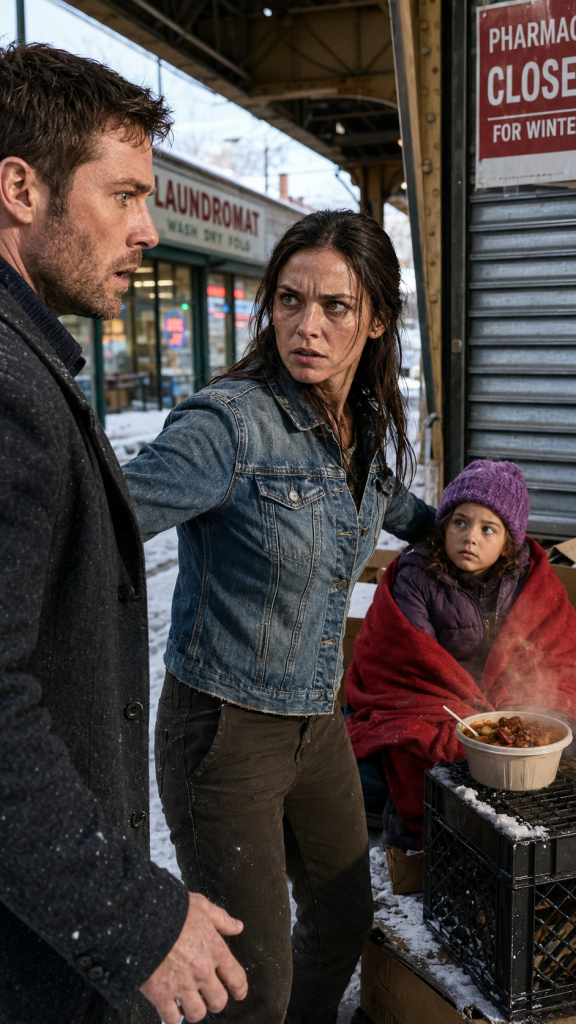
Instead, Maya crossed beneath the elevated tracks and stopped beside a narrow alley between a laundromat and a closed pharmacy.
She crouched.
That was when I saw the little girl.
She had been sitting on a milk crate behind a stack of cardboard boxes, wrapped in a red blanket.
She couldn’t have been more than four.
Maybe four and a half.
She wore a knitted purple hat and a puffy coat with a broken zipper. Her small hands were tucked beneath her arms for warmth.
The moment Maya approached, the girl’s face lit up.
“Mommy.”
Maya’s entire expression changed.
The exhaustion stayed.
But tenderness moved through it.
She knelt in front of the child.
“I got something warm, sweetheart.”
“You eat too.”
“I will.”
“You promise?”
Maya smiled.
“I promise.”
She peeled back the plastic lid and blew gently across the stew.
Then the little girl turned her head.
And looked directly at me.
My body stopped working.
The sidewalk seemed to tilt underneath my feet.
She had Maya’s dark hair.
Maya’s mouth.
Maya’s delicate chin.
But her eyes—
My eyes.
Gray-green.
The exact strange shade that had come from my father.
The exact eyes my mother used to tell me made me look permanently suspicious of the world.
The little girl stared at me with those eyes.
I heard myself whisper, “No.”
Maya looked over her shoulder.
The second she saw me, all warmth disappeared from her face.
She stood.
Slowly.
Her body moved between me and the child.
“Why did you follow me?”
I couldn’t answer.
My eyes kept slipping toward the girl.
She had a small freckle near her left eyebrow.
I had one in almost the same place.
“Maya…”
“Go back.”
“How old is she?”
Her jaw tightened.
“Go back to your soup kitchen, Victor.”
“How old is she?”
The girl looked between us.
“Mommy?”
Maya lowered her voice.
“It’s okay, sweetheart.”
Then she faced me again.
“Leave.”
My pulse roared in my ears.
The math had already started without my permission.
Four years.
The divorce.
The photograph.
Maya pressing a hand over her stomach.
I remembered something I had buried beneath rage.
Her voice shaking.
I’m pregnant, Victor.
At the time, I had thought it was manipulation.
One last desperate attempt to keep me from throwing her out.
I stared at the child.
“Maya.”
She didn’t move.
“Is she mine?”
Her face changed.
Not dramatically.
Just enough.
Her eyes filled with something I couldn’t name at first.
Then I recognized it.
Pain that had grown old.
Pain that had stopped expecting justice.
She said quietly, “You knew I was pregnant.”
The answer hit harder than any scream could have.
I stepped back.
“No.”
“Yes.”
“I thought…”
“I know what you thought.”
“I thought you were lying.”
“I know.”
“Maya, is she my daughter?”
The girl pressed closer to Maya’s side.
Maya put one arm around her.
I saw her hesitation.
Then she looked me directly in the eyes for the first time that morning.
“Yes.”
Everything inside me went silent.
Cars passed.
A train rattled somewhere overhead.
A horn blasted at the intersection.
But inside me, nothing moved.
I had a daughter.
For four years, somewhere in this city, I had a daughter.
While I had been congratulating myself for surviving betrayal, Maya had been raising my child.
I looked at the little girl again.
She had started eating the stew carefully from the edge of the bowl.
My stomach turned.
“What’s her name?”
Maya hesitated.
“Ellie.”
My daughter’s name was Ellie.
I had missed her first word.
Her first step.
Her first birthday.
Her second.
Her third.
Her fourth.
I didn’t even know what color she liked.
I didn’t know whether she slept with a night-light.
I didn’t know if she was afraid of thunderstorms.
I didn’t know her favorite food.
I had known she existed for less than sixty seconds.
And already the emptiness of those four years felt unbearable.
I swallowed hard.
“Why didn’t you tell me?”
Maya actually laughed.
It was a quiet sound.
There was no humor in it.
“I did.”
“I mean afterward.”
“I told you before you threw me out.”
“Maya—”
“I begged you to listen.”
“I was angry.”
“You called me a liar.”
“My mother showed me that picture.”
“And I told you what it was.”
“She said—”
Maya’s expression hardened.
“Your mother said many things.”
I looked away.
The forty-two thousand dollars flashed into my mind again.
“You took the house money.”
That made Maya go completely still.
“What?”
“The savings account. You emptied it the morning after you left.”
Her face turned white.
Not guilty white.
Confused white.
“What are you talking about?”
“Forty-two thousand dollars.”
“I never touched that account.”
“Maya—”
“I never had administrative access to it.”
I opened my mouth.
Nothing came.
She took one step toward me.
“You know that.”
I did know that.
Or I should have.
My mother had always handled the account.
I hated online banking. Passwords annoyed me. Auto-pay was easier. Mom had helped me “organize everything” after college and somehow never stopped.
Maya had hated it.
“You’re thirty-two years old,” she had once said. “Why does your mother have more access to our finances than I do?”
I had laughed.
“She’s good with money.”
Now the memory made me cold.
Maya stared at me.
“Did you ever look at the transaction?”
I couldn’t answer.
Her eyes widened.
“Oh my God.”
“I trusted—”
“You never looked.”
My shame arrived before the truth did.
“Maya…”
“You accused me of stealing forty-two thousand dollars, and you never even checked?”
“She told me you transferred it.”
“Who?”
I knew the answer before she said it.
But I still flinched.
“Evelyn.”
I felt sick.
Maya shook her head slowly.
“Of course.”
“No. My mother wouldn’t—”
“Stop.”
Her voice wasn’t loud.
It didn’t need to be.
“Please don’t stand here after four years and tell me what your mother would or wouldn’t do.”
Ellie tugged at her sleeve.
“Mommy, I’m cold.”
Maya’s anger vanished immediately.
She crouched.
“I know, baby.”
She wrapped the blanket tighter around Ellie’s shoulders.
I stared at the broken zipper on the little coat.
My daughter was cold.
My daughter was eating donated stew behind a laundromat.
And for the first time in four years, the story I had built my life around began to crack.
I reached for my wallet.
Maya saw the movement.
“No.”
“Please.”
“No.”
“I have cash.”
“And I said no.”
“For Ellie.”
Her eyes flashed.
“Don’t use her name like that.”
The words stopped me.
“You don’t get to see her for two minutes and make yourself useful with money.”
I let my hand fall.
“What do you want me to do?”
Maya stared at me as though the question offended her.
“Nothing.”
“I need to understand.”
“I needed you to understand four years ago.”
She gathered the empty bowl, wiped Ellie’s mouth with a napkin, and took her hand.
“Maya, wait.”
She stopped but didn’t turn.
I said the only thing I could think of.
“The envelope.”
Her shoulders stiffened.
“What?”
“You left an envelope.”
For the first time since I followed her, she looked genuinely shocked.
“You remember that?”
“You put it under the keys.”
Her eyes narrowed.
“Did you read it?”
My mouth went dry.
“No.”
Maya’s face slowly emptied.
Not anger.
Something worse.
“You didn’t read it.”
“I couldn’t find it afterward.”
She stared at me for several seconds.
Then she looked away.
“I see.”
“What was in it?”
She took Ellie’s hand tighter.
“Everything.”
Then she walked away.
I stood there until they disappeared around the corner.
That night, I drove to my mother’s house.
And for the first time in my life, I didn’t call before going inside.
Four years earlier, I had thought I was the victim.
Maya and I had been married for five years.
We weren’t rich, but we were building something.
At least Maya was.
The condo belonged to my mother, Evelyn, and she charged us low rent so we could save toward a house.
Maya treated that house fund like sacred money.
She packed lunches.
Skipped vacations.
Worked late.
She was an operations coordinator at a logistics company where managers twice her age called her whenever shipments went wrong.
I used to pretend I was proud of her.
Sometimes I was.
Other times I hated how competent she seemed.
I was a mid-level buyer at a distribution company where nobody called me after five.
Nobody needed me to fix crises.
Nobody trusted me with million-dollar shipments.
Instead of admitting that bothered me, I complained that Maya worked too much.
My mother noticed.
She always noticed weakness.
Then she pressed it.
“A wife shouldn’t make her husband feel second place.”
Or:
“A home needs a woman in it, not a business executive.”
Or:
“You seem stressed, Victor. I suppose Maya is working late again.”
Maya would look at me, waiting.
I never defended her.
My favorite response was always the same.
“She’s my mother. What do you want me to do?”
Now, driving toward Evelyn’s house, I heard that sentence differently.
It sounded like cowardice.
I pulled into the driveway.
The porch light was on.
Through the curtains, I could see my mother moving inside.
I didn’t knock.
I still had a key.
When I walked into the kitchen, she looked up from a mug of tea.
“Victor? You should’ve called.”
“Where’s the envelope?”
Her hand stopped halfway to the mug.
That was all.
A tiny pause.
But after seeing Ellie’s eyes that morning, I had become hungry for tiny things.
“What envelope?”
“The one Maya left when she moved out.”
My mother smiled too quickly.
“That was four years ago.”
“Where is it?”
“How would I know?”
“You were there.”
“So were you.”
I stared at her.
Something in my face must have frightened her, because she placed the mug down carefully.
“What happened?”
“I saw Maya today.”
The kitchen became very quiet.
Mom’s eyes narrowed.
“Where?”
“At a soup kitchen.”
A small expression crossed her face.
Satisfaction.
Barely visible.
But I saw it.
“I suppose life catches up with people,” she said.
My stomach twisted.
“She has a daughter.”
This time, my mother couldn’t hide it.
Her fingers tightened around the mug.
She knew.
I saw it immediately.
“You knew.”
“Victor—”
“You knew.”
“She said she was pregnant before she left.”
“You told me she was lying.”
“I said she might be lying.”
“You told me not to let her manipulate me.”
“Because you were vulnerable.”
“How old is Ellie?”
Mom blinked.
The name had slipped out of me deliberately.
I wanted to see whether she reacted.
She did.
Only slightly.
But enough.
“You know her name.”
My mother’s face changed.
“Victor.”
My blood went cold.
“How do you know my daughter’s name?”
She stood.
“Sit down.”
“No.”
“This is complicated.”
“Where is the envelope?”
“Lower your voice.”
“WHERE IS IT?”
She flinched.
I had never shouted at my mother like that.
Not when I was twelve.
Not when I was twenty.
Not when I was thirty-six.
She looked toward the hallway.
Then back at me.
“It may still be upstairs.”
I couldn’t breathe.
“Where?”
She didn’t answer quickly enough.
I pushed past her.
“Victor!”
I took the stairs two at a time.
My mother’s bedroom looked exactly as it always had.
Cream curtains.
Floral bedspread.
Vanity against the wall.
And suddenly I remembered something.
The morning Maya left, I had stood at the window watching her walk toward the bus stop with a duffel bag over her shoulder.
Behind me, my mother had been cleaning the entry table.
The envelope had disappeared.
I crossed the bedroom.
Pulled open the vanity drawers.
Jewelry.
Receipts.
Old photographs.
Hand lotion.
Nothing.
The bottom drawer stuck.
I yanked harder.
It opened.
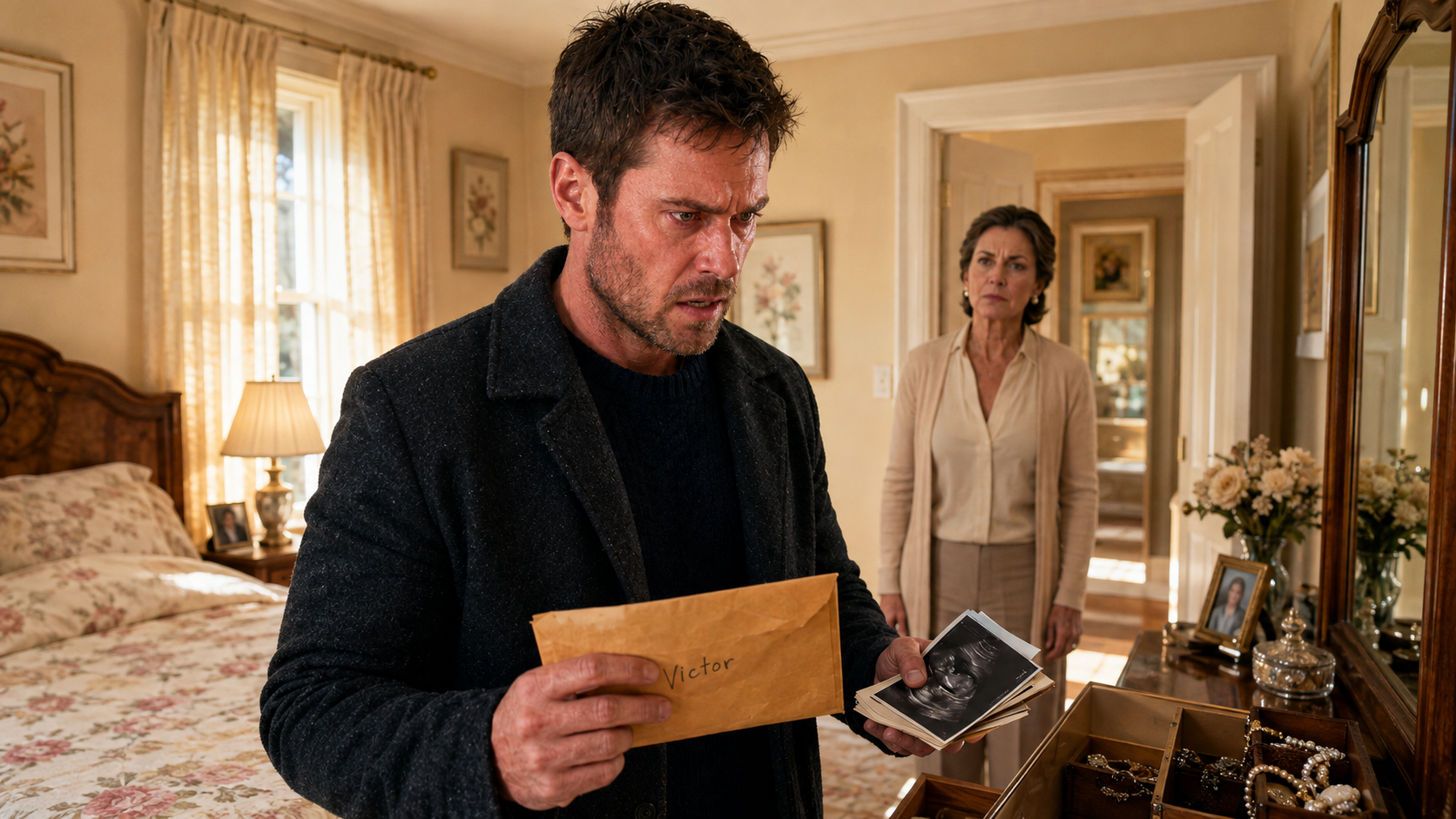
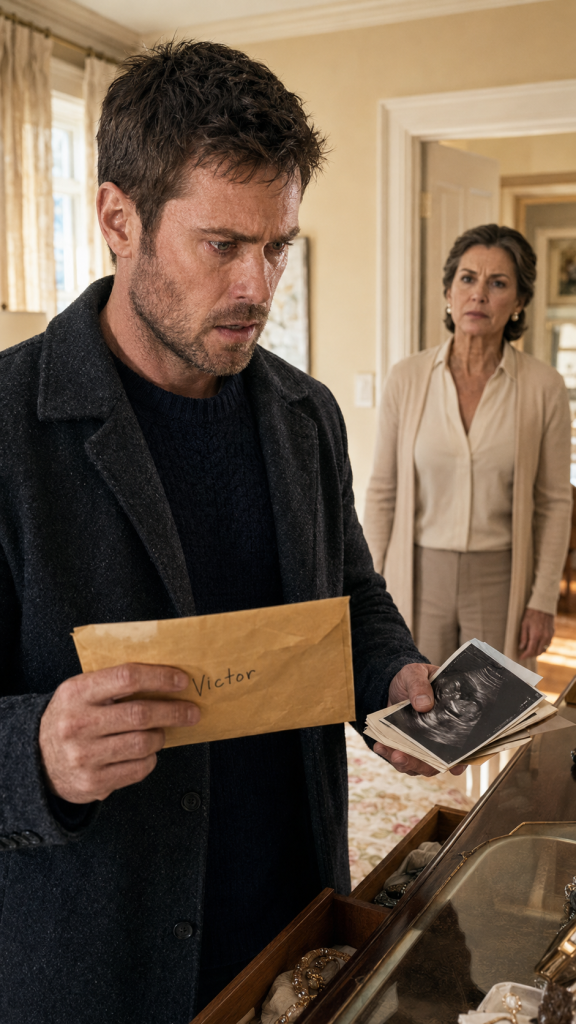
At the very back, beneath a stack of scarves, lay a yellowed manila envelope.
My name was written across the front.
Victor.
In Maya’s handwriting.
My hands began shaking.
Behind me, my mother whispered, “You don’t understand.”
I turned.
The woman who had controlled nearly every important decision in my adult life stood in the doorway.
For the first time, she looked small.
I tore the envelope open.
An ultrasound photograph slid into my hand.
Below it was a clinic document.
A due date.
Maya’s name.
A letter on legal-office stationery.
And three handwritten pages.
The first sentence destroyed what remained of my old life.
Victor, if you read nothing else, please read this: the baby is yours, and I have never cheated on you.
I had to sit down.
PART 2: THE ENVELOPE I NEVER READ
I read Maya’s letter three times.
The first time, I barely understood it.
The second time, I started shaking.
The third time, I cried.
Not loudly.
There was no dramatic collapse.
I just sat on the edge of my mother’s bed holding four-year-old paper while tears ran down my face.
Maya had written the letter the night I threw her out.
She explained everything.
The pregnancy.
The nausea.
The dizzy spells.
The clinic.
Thomas Vance.
The legal aid organization.
She had gone there because she was afraid of the way our finances were structured.
Not because I had hit her.
Not because she planned to divorce me.
Because she had realized that if something happened between us, she had no independent access to the money she had spent years helping us save.
That part hurt.
Because she had been right.
The letter said Thomas was a retired civil rights attorney volunteering with a legal defense program.
He had driven her home because she nearly fainted after a consultation.
She begged me to call the number on his letterhead.
She begged me to call the clinic.
She begged me to look at the uncropped photograph if my mother still had the original.
Then I reached the final page.
I don’t know whether you will believe me. I don’t know whether you want this baby. But I won’t beg you forever to trust your own wife.
I love you, Victor. That is what makes this unbearable.
If you decide you want to talk without your mother in the room, call me.
If you don’t, I will understand your silence as your answer.
I stared at the last line for a long time.
My silence had been her answer.
Not because I chose silence.
Because I never saw the letter.
I looked up.
My mother was still standing near the doorway.
“How could you?”
Her mouth tightened.
“I was protecting you.”
“From what?”
“From her.”
I laughed.
It sounded ugly.
“From my pregnant wife?”
“She was already talking to attorneys behind your back.”
“Because you controlled our money.”
“I helped you manage it.”
“You controlled it.”
“You were never good with details.”
“I was a grown man.”
“You needed help.”
I stood.
“And you stole the envelope.”
“I removed something written by a woman who had already deceived you.”
“She didn’t deceive me.”
“You don’t know that.”
I held up the attorney’s letter.
“Yes, I do.”
Mom’s face hardened.
“Paper can say anything.”
“Did you crop the picture?”
Her eyes flicked away.
My heart sank.
“Did you?”
“I removed irrelevant background.”
For several seconds, I simply stared at her.
“You removed the clinic.”
“It would have confused the issue.”
“You removed the prenatal banner.”
“I wanted you to focus on what mattered.”
“What mattered?”
“The man.”
“He was her lawyer.”
“He was an older man driving an expensive car.”
“That isn’t an affair.”
“She was getting into his car.”
“Because she was sick!”
Mom’s voice sharpened.
“You didn’t see how she treated you.”
“How did she treat me?”
“She made you feel inferior.”
I almost answered automatically.
Then I stopped.
That old poison.
That was the center of it.
Not adultery.
Not money.
Not concern.
My mother had seen my insecurity and fed it until I mistook it for evidence.
“She never said I was inferior.”
“She didn’t have to.”
“No. You said it.”
Her face tightened.
I felt something inside me shift.
For years, every argument with Maya had eventually included my mother.
Every disagreement ended with me defending Evelyn.
Every time Maya asked for boundaries, I accused her of trying to separate me from my family.
I remembered one evening when Maya had come home at ten thirty after solving a shipment crisis.
Mom had been sitting in our kitchen.
My kitchen.
Eating cake.
She had looked at the clock and said, “Some wives would be embarrassed.”
Maya had stared at me.
I had stared at the television.
That had been my contribution to my marriage.
Volume up.
Head down.
Cowardice disguised as peacekeeping.
I suddenly remembered why Maya had gone to legal aid.
Not to escape me.
To understand whether the money she contributed was actually safe.
“The forty-two thousand,” I said.
Mom’s expression changed again.
My chest tightened.
“You told me Maya transferred it.”
“She did.”
“I’m checking.”
“You don’t need to.”
“I haven’t checked in four years.”
“You trusted me.”
“I did.”
She stepped closer.
“Victor, you’re emotional.”
That phrase.
She had used it my entire life.
Whenever I disagreed with her, I was emotional.
Whenever I resisted her, I was confused.
Whenever I wanted something she didn’t approve of, I was being manipulated.
I took out my phone.
My banking app was still installed.
I couldn’t remember the password.
Mom started speaking.
“You should go home.”
I ignored her.
Reset password.
Security code.
New login.
The account history didn’t go back far enough.
I called the bank.
It took forty minutes.
My mother sat in silence.
I requested archived statements.
The representative emailed me a secure document.
February.
Four years earlier.
I opened it.
My vision blurred.
February 11.
Electronic transfer.
$42,000.
Destination account ending in 8803.
I knew those numbers.
My mother’s savings account.
I looked up.
She didn’t even try to deny it.
“How much is left?”
“Victor—”
“How much?”
“I used some.”
“For what?”
“Expenses.”
“Whose?”
“Ours.”
“There is no ours.”
“Don’t speak to me that way.”
I almost laughed again.
There it was.
Even now.
Even after stealing my wife’s letter.
Cropping evidence.
Moving our money.
Keeping me from my daughter.
She still believed the greatest offense in the room was my tone.
“You told me Maya stole it.”
“I was trying to help you move on.”
“You stole from me.”
“I moved money I had access to.”
“You told me my wife took it.”
“She was gone.”
“Because I threw her out.”
“She would’ve left eventually.”
“You don’t know that.”
“I know women like her.”
“What does that even mean?”
“Ambitious. Proud. Never satisfied.”
My hands curled into fists.
Maya had worked fifty-hour weeks to build a future with me.
She had tolerated my mother’s insults.
She had lived in a condo Mom owned because I insisted it was practical.
She had placed money into a savings account she couldn’t fully control because I told her to trust my family.
Then, when she became pregnant and tried to protect herself, we used that attempt as proof against her.
I pressed my palm against my forehead.
“You knew about Ellie.”
Mom stayed silent.
“How?”
“Someone mentioned seeing Maya with a child.”
“Who?”
“It doesn’t matter.”
“Did you see her?”
She looked away.
That was answer enough.
“When?”
“A few years ago.”
My chest tightened until I could barely inhale.
“You saw my daughter.”
“I saw a child.”
“You knew the timeline.”
“I didn’t know anything for certain.”
“You could have told me.”
“And done what? Let Maya drag you back into chaos?”
I stared at my mother.
Then I understood the most terrifying part.
She still believed she had done the right thing.
This hadn’t been one panicked decision.
It had been years of decisions.
One lie protecting another.
One theft protecting the lie.
One silence protecting the theft.
“Give me the money.”
Her head snapped up.
“What?”
“Whatever is left.”
“Victor, don’t be ridiculous.”
“It wasn’t yours.”
“It was in an account I helped manage.”
“It was mine and Maya’s.”
“You two were married. There is no hers and yours.”
“There apparently was when you blamed her for taking it.”
She said nothing.
I folded Maya’s letter and returned it to the envelope.
I kept the ultrasound in my hand.
My daughter looked like a grainy shadow.
A life I had refused before I ever saw her face.
At the bedroom door, I turned back.
“If you contact Maya or Ellie, I will consider it harassment.”
My mother looked offended.
“I am her grandmother.”
“No.”
The word came out instantly.
“You are my mother. That does not give you rights to a child you helped keep from me.”
Her face went pale.
“You can’t punish me forever for one mistake.”
“One mistake?”
I held up the envelope.
“This took four years.”
Then I left.
I didn’t sleep.
At three in the morning, I sat at my kitchen table with every archived bank statement I could download.
The truth became uglier with numbers.
Maya had not taken a cent.
The transfer had gone directly into my mother’s savings account.
There was no mystery.
No complicated fraud.
No secret lover.
Just a transaction I had been too lazy and too angry to verify.
I remembered the morning after Maya left.
Mom had made eggs.
I hadn’t eaten.
She had sat across from me and said, “I checked the account.”
Then she told me the money was gone.
I had put my face in my hands.
She had rubbed my back.
My mother had comforted me over a theft she committed.
I ran to the bathroom and vomited.
When I returned, the ultrasound photograph was still on the table.
I picked it up.
I wondered whether Maya had gone to those appointments alone.
Whether she had been afraid.
Whether she had listened to our daughter’s heartbeat without me.
Whether she had hoped I might still call.
Every question had the same answer.
I hadn’t been there.
At eight, I drove back to Union Station.
Maya wasn’t in the soup line.
I checked the laundromat.
The alley.
The pharmacy.
Nothing.
I went inside the soup kitchen and asked the coordinator if she knew Maya.
She studied me cautiously.
“We don’t give out information about guests.”
“I’m her ex-husband.”
“That does not make me more comfortable giving out information.”
Fair.
I took a breath.
“She has a little girl named Ellie.”
The woman’s expression sharpened.
I held up both hands.
“I am not trying to take the child. I’m not trying to cause trouble.”
“What do you want?”
“To apologize.”
She stared at me.
“I know that sounds useless.”
“It does.”
“I also need to make sure they have somewhere warm.”
“You can donate to the shelter.”
“I will.”
“Then donate.”
I almost turned away.
Then I took out the manila envelope.
“Maya left this for me four years ago. My mother hid it.”
The coordinator’s expression softened slightly.
Only slightly.
“I found out yesterday that Ellie is my daughter.”
She looked at me for several seconds.
Then she said, “Come back at four.”
“Will she be here?”
“I didn’t say that.”
At four, I returned.
At four twenty, Maya appeared.
Alone.
She stopped when she saw me.
“I told you to leave us alone.”
“I found the envelope.”
Every muscle in her face froze.
I held it out.
She didn’t take it.
“You read it?”
“All of it.”
Maya looked toward the street.
For a second, I thought she would walk away.
Instead she said, “And?”
There were a thousand things I wanted to tell her.
That I was sorry.
That I had been manipulated.
That my mother had lied.
That I loved her once.
That maybe some part of me still did.
Every one of those things sounded selfish.
So I started with the only fact that mattered.
“You didn’t take the money.”
Maya’s eyes narrowed.
“No.”
“My mother did.”
She closed her eyes.
For one second.
Then opened them again.
“I suspected.”
I stared at her.
“You did?”
“Who else had access?”
The simplicity of that question humiliated me.
“She transferred all forty-two thousand the morning after you left.”
Maya looked down.
I watched the knowledge settle into her.
That money had represented years of work for her.
Cancelled dinners.
Secondhand furniture.
Overtime shifts.
Every sacrifice she had made for a house she never got.
“She told me you stole it,” I said.
Maya gave me a tired look.
“And you believed her.”
“Yes.”
“Without checking.”
“Yes.”
“And now?”
“I know.”
“No, Victor.”
Her voice hardened.
“You know facts. That isn’t the same thing.”
I swallowed.
“What do you want me to say?”
“Nothing.”
“I owe you—”
“You owe Ellie.”
“Yes.”
The word came quickly.
Whatever else she denied me, I wouldn’t argue with that.
“I want to help.”
“You want to erase your guilt.”
“Maybe.”
She seemed surprised by the answer.
I forced myself to continue.
“Maybe part of me does. But guilt is mine to deal with. Ellie shouldn’t have to pay for it.”
Maya looked at me carefully.
“Where is she?”
“Safe.”
“Are you staying in a shelter?”
Her jaw tightened.
“I’m not discussing our situation with you today.”
“Okay.”
“You don’t get to follow us.”
“I won’t.”
“You don’t show up where she sleeps.”
“I won’t.”
“You don’t tell your mother where we are.”
“I already told her not to contact either of you.”
That got a reaction.
Maya looked directly at me.
“What happened?”
“I found the envelope in her vanity.”
Her mouth parted slightly.
“She kept it?”
“Four years.”
Maya looked away.
I could see tears gathering in her eyes.
She hated that I noticed.
“She knew what was in it?”
“I don’t know if she read it.”
“She knew enough.”
“Yes.”
“And the picture?”
“She admitted cropping it.”
That broke something.
Maya covered her mouth with one hand.
I stepped forward automatically.
She stepped back.
I stopped.
Her tears came silently.
Not because she still loved me.
Not because she wanted me back.
Because four years of being called a liar had finally received confirmation.
It had happened.
Someone had done it deliberately.
And the husband who was supposed to know her best had helped.
“I kept asking myself,” Maya whispered, “what I had done to make you believe her so quickly.”
I closed my eyes.
“Maya—”
“I thought maybe I had missed something. Maybe I had become too focused on work. Maybe I had stopped showing you I loved you. Maybe I had talked down to you without realizing it.”
“You didn’t.”
“You have no idea what I thought.”
“I know.”
“No, you don’t.”
She wiped her face roughly.
“You got to be angry. I got to question my own sanity.”
The words cut cleanly.
“I am sorry.”
She laughed once.
“Four years late.”
“Yes.”
She looked at me.
I didn’t defend myself.
Didn’t explain my insecurity.
Didn’t mention how persuasive my mother was.
Didn’t tell her I had been hurting too.
For once, I let the truth remain exactly where it belonged.
“I failed you.”
Her eyes filled again.
“Yes.”
“And I failed Ellie.”
“Yes.”
“I can’t undo that.”
“No.”
“But if you’ll let me, I want to start doing what I should have done.”
Maya folded her arms.
“And what exactly is that?”
“Listen.”
Her face changed slightly.
I continued.
“Then whatever comes after that.”
For the first time, she didn’t immediately tell me to go away.
PART 3: THE COST OF BELIEVING THE WRONG PERSON
Maya agreed to meet me three days later.
Public place.
No Ellie.
No mother.
Her rules.
I arrived twenty minutes early.
The diner was almost empty.
When Maya came in, she chose the booth with the clearest view of the front door.
I noticed.
Four years earlier, I wouldn’t have.
She ordered coffee.
Nothing else.
I ordered the same.
For a long time, neither of us spoke.
Finally she asked, “What do you want to know?”
I almost said everything.
But I had learned that wanting information did not automatically entitle me to it.
So I asked the most important question first.
“Is Ellie healthy?”
Maya’s shoulders loosened slightly.
“Yes.”
“Any medical issues?”
“No.”
“She’s in preschool?”
A pause.
“Not right now.”
I didn’t ask why.
Not yet.
“What does she like?”
That question seemed to catch Maya off guard.
“What?”
“Ellie. What does she like?”
Maya looked down at her coffee.
“Dinosaurs.”
I smiled before I could stop myself.
“Dinosaurs?”
“Specifically triceratops.”
“Why?”
“Because she says T. rex gets too much attention.”
A laugh escaped me.
It hurt.
Because the sentence sounded so much like something I might have said.
Maya noticed.
Her mouth trembled.
“She likes purple,” she continued. “She hates peas. She loves grilled cheese. She makes up songs when she’s nervous. She thinks every dog wants to be her friend.”
My chest tightened.
“Does she know about me?”
“Yes.”
I looked up sharply.
“What does she know?”
“That she has a father.”
“And?”
“That we don’t live together.”
“Does she know my name?”
“Yes.”
The diner blurred for a second.
“What did you tell her?”
“The truth she was old enough to understand.”
“Which was?”
“That her father and I had a very bad disagreement before she was born, and that sometimes adults make mistakes that hurt people.”
“You made it sound like both of us.”
“I wasn’t going to teach my child to hate half of herself.”
I looked down.
That was Maya.
Even after everything, she had protected Ellie from my failure.
“Why didn’t you contact me?”
She was quiet for a long time.
Then she said, “I almost did.”
My pulse jumped.
“After she was born?”
“Several times.”
“What stopped you?”
“You.”
I frowned.
Maya stared at me.
“The last time I saw you, I was standing in the doorway telling you I was pregnant, and you told me to stop manipulating you.”
I remembered.
Every word.
“Your mother took my keys. She took the debit card. You stood there.”
My throat tightened.
“I know.”
“I left you the envelope because I thought once you calmed down, you’d read it.”
“I didn’t know she took it.”
“You never called.”
“I thought you were with Thomas.”
“I know.”
“I thought you took the money.”
“I know.”
She rubbed both palms around the coffee mug for warmth.
“Then Ellie was born, and every time I considered contacting you, I remembered that room.”
Her voice softened.
“I had a newborn. I was exhausted. I had no savings. I was trying to figure out where we were going to live. I could not bring Evelyn back into my life.”
“I would’ve protected you.”
Maya looked at me.
I stopped.
The sentence died of embarrassment between us.
“No,” I said quietly. “I wouldn’t have.”
“At that time?”
“No.”
She nodded.
“That was the problem.”
I forced myself to ask.
“What happened after you left?”
Maya’s eyes drifted toward the window.
For several moments, she said nothing.
Then the years began coming out.
Not as one tragic speech.
Piece by piece.
She spent the first weeks sleeping on the couch of a coworker.
Her morning sickness worsened.
She used every dollar in her personal checking account for medical costs, transportation, food, and eventually a rented room.
She kept working as long as she could.
But stress and pregnancy complications reduced her hours.
After Ellie was born, childcare swallowed most of what she earned.
She took operations contracts when she could.
Administrative work.
Temporary logistics assignments.
Overnight inventory scheduling.
Anything that allowed her to keep Ellie near enough that she could get back quickly.
Sometimes she was stable.
Sometimes she wasn’t.
The soup kitchen wasn’t where she ate every day.
But during bad weeks, it kept groceries from becoming a choice between her dinner and Ellie’s.
“Why didn’t Thomas help?”
“He did.”
I hated the defensive edge in my voice.
Not because Thomas had done anything wrong.
Because some disgusting part of me was still comparing myself to the man I had imagined replacing me.
Maya heard it.
“Thomas helped me understand my rights. He helped me find temporary housing resources. He did not become my rich lover.”
Shame burned my face.
“I know.”
“Do you?”
“Yes.”
“He was seventy-one years old, Victor.”
I blinked.
Maya almost smiled.
It was the first hint of the woman I remembered.
“Your mother made him sound like some silver-haired playboy.”
“I know.”
“He volunteered three days a week and argued with nurses about parking validation.”
Despite everything, I laughed.
So did Maya.
For two seconds, we were us.
Then the moment passed.
I looked down at my hands.
“I don’t expect you to forgive me.”
“Good.”
“I do want to support Ellie.”
“That isn’t optional now that you know.”
“I agree.”
“I want a paternity test.”
My head lifted.
Maya’s expression stayed calm.
“Not because I doubt anything,” she said. “Because if you’re going to enter her life, I want everything documented. No questions later. No Evelyn whispering in your ear six months from now.”
My stomach turned.
“She won’t.”
“You said that about a lot of things.”
Fair.
“Okay.”
“I also want formal child support.”
“Okay.”
“And I want introductions to be slow.”
“Okay.”
“You’re agreeing quickly.”
“I spent four years refusing to listen. I’m trying something different.”
She studied me.
“Don’t make promises because you’re ashamed.”
“I’m not.”
“You don’t know what raising a child means.”
“No.”
“You don’t know what she needs.”
“No.”
“You don’t know her.”
That one hurt.
“No.”
Maya’s eyes softened for half a second.
I continued.
“But I want to.”
The paternity test came back two weeks later.
99.99 percent.
I already knew.
Still, seeing the result nearly brought me to my knees.
I sat in my car outside the clinic and stared at one line until the words blurred.
Biological father.
Me.
There was no undoing it now.
No uncertainty to hide behind.
I called Maya.
She answered on the fourth ring.
“Hello?”
“I got it.”
“I know.”
“I…”
My voice broke.
I pressed my forehead against the steering wheel.
“I don’t know what to say.”
“Then don’t say anything.”
I laughed weakly.
“Right.”
Silence.
Then I heard a small voice in the background.
“Mommy?”
Every muscle in my body tightened.
Maya covered the phone.
I couldn’t make out her answer.
When she came back, I asked, “Can I see her?”
A long pause.
“Saturday.”
I closed my eyes.
“Thank you.”
“Two hours.”
“Okay.”
“I’m there the whole time.”
“Of course.”
“Don’t bring gifts.”
I had already bought six.
I looked at the bags on the passenger floor.
“Okay.”
“Victor.”
“Yes?”
“Don’t tell her you’re going to be there forever.”
The sentence cut deeper than she intended.
Or exactly as deep.
“Why would I?”
“Because adults say things when they’re emotional.”
“I won’t.”
“She needs consistency, not speeches.”
I stared at the paternity test.
“I understand.”
“Saturday at eleven.”
She hung up.
I returned every gift except one.
A small plastic triceratops.
I kept it in the glove box.
Just in case.
I met my daughter in a public library.
Maya chose the children’s section.
Ellie sat at a little table coloring a picture of a dragon when I arrived.
She looked up.
I stopped.
Seeing her from twenty feet away had been one thing.
Seeing her knowing she was mine was something else entirely.
She wore yellow sneakers.
Purple leggings.
Her dark hair was tied into two uneven ponytails.
She held a green crayon in her left hand.
Left-handed.
Like me.
Maya stood.
“Ellie.”
The child looked from her mother to me.
“This is Victor.”
I wasn’t ready for the fact that my own daughter would meet me by my first name.
I deserved it.
“Hi,” I said.
Ellie stared.
Then she asked, “Are you my dad?”
Maya’s eyes snapped toward her.
Apparently that wasn’t the planned introduction.
I crouched so I wasn’t towering over her.
“Yes.”
Ellie considered this.
“Mommy said maybe.”
I looked at Maya.
She shrugged faintly.
“We were waiting for the test.”
Fair again.
Ellie studied my face.
Then she leaned closer.
“You have my eyes.”
My throat closed.
“I was going to say you have mine.”
She frowned.
“I had them first.”
Maya made a choking sound that might have been a laugh.
I smiled.
“You know what? You’re right.”
Ellie nodded, satisfied.
Then she returned to her coloring.
That was how my daughter accepted the biggest revelation of my life.
Apparently dragons were more urgent.
I sat across from her.
For twenty minutes, she mostly ignored me.
Then she asked me to sharpen a crayon.
Then she showed me the dragon’s wings.
Then she asked if I knew anything about dinosaurs.
I said, “A little.”
This was a mistake.
For the next forty minutes, I was tested with the seriousness of a doctoral examination.
Eventually she asked, “What’s your favorite?”
I remembered the plastic figure in my car.
“Triceratops.”
Her head shot up.
“Mine too!”
Maya gave me a suspicious look.
I lifted both hands.
“I’ve done research.”
Ellie laughed.
The sound hit a place in me I didn’t know existed.
When the two hours ended, I didn’t want to leave.
I left anyway.
Consistency, not speeches.
At the library door, Ellie waved.
“Bye, Victor.”
I waved back.
“Bye, Ellie.”
I made it to my car before crying.
That evening, my mother called seventeen times.
I ignored sixteen.
On the seventeenth, I answered.
“What?”
“Have you seen the child?”
“My daughter has a name.”
“I don’t appreciate being shut out.”
I almost laughed.
“You shut me out of her entire existence.”
“That is not fair.”
“Fair?”
“I made decisions based on what I believed was best.”
“You cropped the photograph.”
Silence.
“You hid the letter.”
Silence.
“You stole the money.”
“I did not steal it.”
“You moved it and lied about where it went.”
“I kept it safe.”
“How much is left?”
She refused to answer.
I already knew what I had to do.
“Maya gets all of it back.”
“Absolutely not.”
“It was our house fund.”
“You were married.”
“Yes.”
“Then half was yours.”
“And you took one hundred percent.”
“I used some to help you.”
“With what?”
“Property taxes. Repairs. Family expenses.”
“My family was Maya.”
Mom went silent.
I had never said it that way before.
“My family was my wife and unborn daughter,” I continued. “And you helped me throw them out.”
“She would’ve taken you away from me.”
There it was.
Finally.
Not morality.
Not protection.
Fear.
“You were my only child,” Mom said. “After your father died, it was always you and me. Then Maya came, and suddenly everything I did was wrong.”
“She asked for boundaries.”
“She wanted control.”
“She wanted me to grow up.”
My mother inhaled sharply.
I surprised myself by saying it.
But it was true.
Maya hadn’t been trying to steal me.
She had been asking me to become a husband.
I had refused.
Mom’s voice went cold.
“If you choose that woman over your own mother after everything I’ve done—”
“This isn’t a choice between you and Maya.”
“It always was.”
“No.”
For the first time, I understood exactly why our marriage had failed.
“It was only a choice because you made it one.”
Then I hung up.
PART 4: WHAT I OWED THEM
Getting the money back was easier than repairing the damage it represented.
My mother had spent nearly twelve thousand dollars.
Thirty thousand remained.
She resisted for another week.
Then I told her I had copies of the original transfer records and that I intended to speak to an attorney about recovering the full amount.
The next morning, the remaining money returned to my account.
I added twelve thousand from my own savings.
Then I transferred all forty-two thousand into a separate account that I could not casually touch.
I met Maya at the same diner.
I slid the statement across the table.
She looked at it.
Then at me.
“What is this?”
“The house fund.”
Her face hardened.
“I don’t want your money.”
“It isn’t mine.”
“Victor—”
“You contributed to that account for years.”
“So did you.”
“And I let my mother take it, then blamed you.”
“That doesn’t make all of it mine.”
“No. But it makes the decision about what happens to it yours.”
Maya pushed the statement back.
“I don’t want guilt money.”
“It isn’t guilt money.”
“It feels like it.”
“Then use it for Ellie.”
Her eyes flicked toward the number again.
“College. Housing. Whatever you think is right.”
“You don’t get to buy your way into her life.”
“I know.”
I held her gaze.
“That’s why this isn’t connected to whether you let me see her.”
Maya went quiet.
“You can tell me tomorrow that you don’t want contact outside formal support arrangements. The money is still yours.”
Something changed in her expression.
Not forgiveness.
Trust was too large a word.
Maybe the first inch of ground between us.
“What happened to Evelyn?”
“I don’t know.”
“You don’t know?”
“I haven’t seen her.”
Maya stared.
“You cut her off?”
“I set boundaries.”
Her mouth almost twisted into a smile.
“That phrase finally entered your vocabulary?”
“Painfully.”
A real laugh escaped her this time.
I smiled.
Then she became serious again.
“Victor.”
“Yes?”
“Don’t do this because you think we’re going back to what we were.”
“I don’t.”
It hurt to say.
But it was true.
What we were had been broken long before the photograph.
I had loved Maya.
But love without loyalty had turned out to be a word I used for myself.
“I don’t expect you to come back,” I said.
She watched me carefully.
“I want to be Ellie’s father. Whatever happens between you and me beyond that has to be your choice too.”
“And if my choice is nothing?”
“Then I learn to live with it.”
She looked down at the statement.
For a long time.
Then she whispered, “I used to picture our house.”
My chest tightened.
“So did I.”
“No.”
She shook her head.
“I really pictured it.”
A sad smile touched her mouth.
“Yellow kitchen. Small backyard. Window over the sink.”
I remembered.
She had shown me listings with kitchens like that.
I had teased her about the sink window.
“You said you wanted to watch the kids play outside while you washed dishes.”
“Then I got mad at myself for saying it because I hate washing dishes.”
I laughed.
Maya did too.
Then tears filled her eyes.
“I put almost every bonus I earned into that fund.”
“I know.”
“I skipped seeing my sister one Christmas because flights were expensive.”
“I know.”
“I thought we were building something.”
I couldn’t say we were.
Because clearly we hadn’t been.
She wiped her cheek.
“I’ll use it for Ellie.”
“Good.”
“Not all of it.”
“Whatever you want.”
“And you will still pay regular child support.”
“Yes.”
“And childcare.”
“Yes.”
“And medical expenses.”
“Yes.”
She narrowed her eyes.
“You’re making this very hard to argue with.”
“That’s new for me too.”
Weeks became months.
I learned fatherhood in small humiliations.
The first time I tried to put Ellie’s hair into a ponytail, she studied herself in the mirror and said, “I look worried.”
She was right.
The ponytail leaned sideways like it was trying to escape.
I learned she refused to eat toast if it was cut into squares but happily ate the same toast cut into triangles.
I learned that “five more minutes” at bedtime could somehow become forty-three minutes.
I learned that children ask questions while you’re driving that can dismantle you at sixty miles an hour.
“Why weren’t you there when I was a baby?”
My hands tightened on the steering wheel.
Maya and I had discussed this.
No lies.
No blaming Evelyn in a way that burdened Ellie.
No making a four-year-old responsible for adult pain.
So I said, “Your mom and I had a serious problem, and I made a bad decision.”
“What decision?”
“I didn’t listen when I should have.”
“To Mommy?”
“Yes.”
Ellie considered this.
“Mommy says listening ears are important.”
“She is correct.”
“Did you get a time-out?”
I almost laughed.
“In a way.”
“How long?”
“Four years.”
Ellie gasped.
“That is too long.”
“Yes.”
I looked at her in the rearview mirror.
“It was.”
She thought about this.
Then she asked, “Can we get pancakes?”
Children are merciful without trying.
Maya found a more stable logistics position after a former colleague recommended her for a permanent operations role.
I didn’t get her the job.
I didn’t arrange anything behind her back.
I was learning that helping someone did not mean taking control of their life.
The first thing she did with the restored money was secure a modest apartment in a safer neighborhood.
Two bedrooms.
Nothing luxurious.
But warm.
When I helped carry boxes upstairs, Ellie grabbed my hand and dragged me toward the kitchen.
“Look!”
There was a window over the sink.
I stopped.
Maya stood behind me holding a box.
Neither of us spoke.
The kitchen was small.
The cabinets were old.
The refrigerator hummed too loudly.
But sunlight came through that window and fell across the floor.
Maya looked away first.
“Coincidence.”
“Of course.”
Ellie spun in a circle.
“We have a yellow curtain!”
I smiled.
The curtain was yellow.
Something twisted inside me.
This was not the house Maya and I had saved for.
It was not the future we planned.
But after four years of uncertainty, she and Ellie had a place that was theirs.
No Evelyn with a spare key.
No one monitoring their spending.
No one deciding who belonged.
I carried the next box in without saying anything.
My mother showed up two weeks later.
I had not given her the address.
I still don’t know how she found it.
She stood in the hallway carrying a pink gift bag.
Maya opened the door.
I was inside assembling a bookshelf with Ellie.
The second I heard my mother’s voice, every muscle in my body tightened.
“I only want to meet my granddaughter.”
Maya’s face went blank.
Ellie looked up from the floor.
“Who’s that?”
I stood.
My mother saw me.
“Victor.”
I crossed the apartment and stepped into the hallway.
“Leave.”
Her expression hardened.
“I brought her a present.”
“I said leave.”
“She’s my family too.”
“No.”
“You cannot erase me.”
“No one is erasing you.”
Maya stepped beside me.
Her voice was calm.
“You made choices. Choices have consequences.”
Mom looked at her.
For four years, I had imagined Maya confronting my mother.
In those fantasies, I was always caught in the middle.
Now I understood how insulting that idea had been.
There was no middle.
There was right.
There was wrong.
And there was responsibility.
My mother raised her chin.
“I was trying to protect my son.”
Maya’s eyes hardened.
“You protected his dependence on you.”
“You always thought you were better than him.”
“No.”
Maya glanced at me.
Then back at Evelyn.
“I thought he was better than the man you encouraged him to be.”
The words landed quietly.
My mother turned toward me.
“Are you going to let her speak to me like that?”
Four years earlier, that sentence would have activated me instantly.
I would have told Maya to calm down.
I would have accused her of disrespect.
I would have restored the balance my mother preferred.
This time I said, “She’s right.”
Mom’s face collapsed.
Not because Maya insulted her.
Because I refused to correct Maya.
“Victor.”
“You lied to me.”
“I explained—”
“You hid proof that my wife was pregnant.”
“I thought—”
“You stole our money.”
“I returned it.”
“After I threatened legal action.”
She went silent.
I continued.
“You saw Ellie before I did.”
My mother’s eyes flicked toward the apartment.
“That wasn’t my fault.”
“You knew she might be mine.”
“I didn’t know.”
“You knew enough to stay quiet.”
I stepped between her and the doorway.
“You don’t get access to Ellie because you share DNA with her. You earn access by being safe.”
“I am safe.”
“No.”
My voice shook.
“You weren’t safe for my marriage. You weren’t safe for Maya. And you weren’t safe for me.”
For the first time, my mother looked genuinely wounded.
Part of me wanted to comfort her.
That instinct had been trained into me for decades.
Her sadness had always become my responsibility.
But I stayed where I was.
She whispered, “So this is it?”
“No.”
I took a breath.
“This is a boundary.”
Maya looked at me.
I almost smiled.
My mother didn’t.
“I won’t let you speak to me until you can acknowledge what you did without calling it protection.”
She stared at me.
“And if I can’t?”
“Then you don’t.”
Her face hardened.
She set the gift bag on the floor.
Then walked away.
I picked it up.
I didn’t give it to Ellie.
That mattered.
Not because the toy inside was dangerous.
Because access to a child was not something my mother could purchase around the edges of a boundary.
Four years earlier, I would’ve called that cruel.
Now I called it parenting.
PART 5: THE THINGS THAT CANNOT BE GIVEN BACK
A year after I saw Maya in the soup line, Ellie turned five.
Her birthday party was in a small neighborhood park.
Purple balloons.
A dinosaur cake.
A paper triceratops centerpiece that kept falling over in the wind.
There were twelve children, three exhausted parents, one preschool teacher, two spilled juice boxes, and enough frosting to damage an entire city block.
I loved every second.
Maya stood beneath a maple tree watching Ellie chase another child across the grass.
I walked over carrying two cups of coffee.
She accepted one.
“Thanks.”
We stood together.
Not touching.
A comfortable distance.
A distance I had learned not to fear.
Ellie fell dramatically near the slide, got up before either of us could move, and shouted, “I’m okay!”
Maya smiled.
“She gets that from you.”
“What?”
“The dramatic announcement.”
“I am a reserved person.”
Maya nearly spit out her coffee.
I grinned.
That sound—her laughter—still did something to me.
But I no longer treated every soft moment as proof that she would come back.
Some things healed.
Some things changed shape.
Some things remained scars.
My mother had written three letters during that year.
I returned the first unopened.
Read the second.
Answered the third.
She was in counseling.
She finally used the words I lied.
Not I protected you badly.
Not I made a mistake because I loved you.
I lied.
She admitted cropping the photograph because she knew the full image would weaken her accusation.
She admitted moving the money because she feared I might discover the truth and use the savings to go after Maya.
She admitted seeing Maya and Ellie outside a grocery store when Ellie was a toddler.
She had watched from her car.
She recognized my eyes.
She drove away.
That was the hardest admission to forgive.
I had not forgiven it yet.
Maybe I never would completely.
But I no longer confused forgiveness with pretending something hadn’t happened.
Mom had not met Ellie.
Maya said she might consider it someday if my mother’s actions remained consistent.
Someday was enough.
It had to be.
I looked toward my daughter.
She wore a cardboard dinosaur tail tied around her waist.
“Victor?”
Maya’s voice pulled me back.
“Yeah?”
“Do you remember the first thing you said to me when you saw me last year?”
I winced.
“I try not to.”
“I do.”
I looked down.
“I’m sorry.”
“I know.”
“No. I mean…”
I sighed.
“There are apologies that feel too small no matter how many times you say them.”
Maya watched Ellie.
“Yes.”
“I mocked you for being hungry.”
“Yes.”
“I thought seeing you suffer would make me feel better.”
She turned toward me.
I forced myself to keep going.
“I had built this picture of you in my head. Rich. Happy. Laughing at me. I wanted the universe to punish you for what I thought you did.”
Maya looked back at the children.
“And when you saw me?”
“I felt satisfied for about three seconds.”
“That long?”
“Maybe two.”
A faint smile.
“Then you said thank you.”
She grew quiet.
“I remember thinking you weren’t supposed to say that.”
“What was I supposed to say?”
“I don’t know. Something cruel.”
“I didn’t have the energy.”
“I know that now.”
I watched Ellie climb the slide backward despite repeated instructions from three adults.
“I followed you because I thought I’d see Thomas.”
Maya covered her face.
“Oh my God.”
“I know.”
“You thought a seventy-five-year-old retired lawyer was going to sweep around the corner in a Bentley?”
“He had a nice sedan.”
“He bought it used.”
“I know that now.”
She shook her head, laughing.
Then slowly the laughter faded.
“You know what the strange part is?”
“What?”
“I used to fantasize about you finding out.”
My chest tightened.
“What did you imagine?”
“Different versions.”
She stared into her coffee.
“Sometimes your mother confessed. Sometimes you found the bank statement. Sometimes Thomas walked into your office and handed you the original clinic record.”
“What happened after?”
“In the fantasies?”
“Yes.”
“You came running.”
I swallowed.
“And?”
“And I slammed the door in your face.”
I nodded.
“Reasonable.”
“Sometimes.”
She smiled sadly.
“Other times I let you in.”
My heart stumbled.
I said nothing.
Maya looked at me.
“I hated myself for that version.”
“Why?”
“Because after everything, part of me still wanted my husband to believe me.”
The word husband hurt more than it should have.
“I should have.”
“Yes.”
“I knew you.”
“Yes.”
“That is what makes it worse.”
Maya’s eyes filled.
I continued before I lost the courage.
“My mother gave me a lie I wanted to believe.”
She frowned slightly.
“I don’t understand.”
“I was jealous of you.”
Her expression changed.
“You worked harder. People trusted you. You had plans. You kept moving forward.”
“Victor—”
“I complained about your hours because admitting I felt insecure would have meant dealing with myself.”
I rubbed my hands together.
“So when Mom showed me that photograph, it gave all my resentment a story.”
Maya was silent.
“I didn’t believe her because the evidence was strong. I believed her because the lie made me feel less ashamed of myself.”
That was the ugliest truth I had learned.
Evelyn had manipulated me.
Yes.
She had lied.
Yes.
She had stolen.
Yes.
But I had been ready to believe her.
That part belonged to me.
Maya wiped one tear from her cheek.
“I spent years wondering why.”
“There isn’t a good why.”
“No.”
“Just the true one.”
She nodded.
Across the park, Ellie screamed, “DAD!”
My body reacted before my mind did.
I turned.
She was standing near the cake table, holding up the collapsed paper triceratops.
“You have to fix Mr. Horns!”
I smiled.
“Emergency.”
Maya laughed.
“Go.”
I started toward Ellie.
Then Maya touched my wrist.
I stopped.
Her fingers remained there for only a second.
“Victor.”
“Yeah?”
“You’re a good dad.”
I couldn’t speak.
Of every kind thing she could have said to me, that was the one I had never allowed myself to hope for.
My eyes burned.
“I’m trying.”
“I know.”
She released my wrist.
I fixed Mr. Horns with three pieces of tape.
Later that evening, after the party ended, I carried a sleeping Ellie upstairs to Maya’s apartment.
Her head rested on my shoulder.
One cardboard dinosaur claw was still taped to her hand.
Maya unlocked the door.
I carried Ellie to bed.
Purple blanket.
Stuffed triceratops.
Night-light shaped like a moon.
Things I knew now.
I knew she hated the sound of the vacuum.
I knew she asked for water exactly three minutes after bedtime.
I knew she sang when she was nervous.
I knew she loved pancakes with strawberries but not blueberries.
I knew she believed pigeons had meetings.
I knew her favorite book.
Her shoe size.
Her pediatrician’s name.
The way she scrunched her nose when lying.
The way she whispered “Mommy?” when she had nightmares.
I had missed four years.
I would never get them back.
But absence was no longer the only thing connecting me to my daughter.
I tucked the blanket beneath her chin.
Her eyes fluttered.
“Dad?”
It still stopped my heart every time.
“Yeah, bug?”
“Did you fix Mr. Horns?”
“Absolutely.”
“Good.”
She fell asleep again.
I stood there staring at her.
Maya waited in the doorway.
When I stepped into the hall, she closed Ellie’s door halfway.
“Coffee?”
It was almost nine.
I looked at her.
“You want coffee?”
She shrugged.
“Decaf.”
I smiled.
“Okay.”
We sat in the kitchen.
The yellow curtain moved slightly above the sink.
For a while, we talked about nothing important.
Ellie’s school.
A problem at Maya’s office.
My new position at work.
The neighbor downstairs who complained about everything.
It felt ordinary.
Once, ordinary had bored me.
Now it felt miraculous.
At some point, Maya became quiet.
“Victor?”
“Yeah?”
“I don’t know if I can ever be your wife again.”
I had known this conversation would come someday.
Still, the words hurt.
I put my coffee down.
“You don’t have to.”
“I need you to understand.”
“I do.”
“No, let me finish.”
I nodded.
She folded her hands.
“I trust you with Ellie now.”
I breathed slowly.
“That means more than you know.”
“I know you’ve changed.”
She looked toward the hallway.
“I’ve watched you show up when it’s inconvenient. I’ve watched you respect no when you wanted yes. I’ve watched you stop making excuses for Evelyn.”
I waited.
“But when I imagine being married to you again, part of me is still standing in that doorway with a duffel bag.”
I closed my eyes.
“I understand.”
“I loved you.”
“I know.”
“I think…”
She stopped.
“What?”
Maya looked at me.
“I think some part of me still does.”
Hope rose so violently that I had to fight it.
Not because hope was wrong.
Because I had learned not to turn Maya’s feelings into demands.
She continued.
“But love doesn’t erase fear.”
“No.”
“And I don’t want you waiting around as if being good long enough earns me back.”
“You’re not a prize.”
“Exactly.”
I smiled faintly.
“I’m learning.”
She smiled too.
“So what happens?”
I looked at the yellow curtain.
The small apartment.
The hallway where our daughter slept.
Then back at the woman I had once failed because I was more afraid of disappointing my mother than losing my wife.
“We have coffee.”
Maya blinked.
“What?”
“Tonight, we have coffee.”
A small smile appeared.
“And tomorrow?”
“I pick Ellie up from school.”
“And after that?”
“I don’t know.”
She studied me.
For once, not knowing didn’t scare me.
I had spent most of my life trying to force certainty by letting other people tell me what was true.
Who was right.
Who was wrong.
Who loved me.
Who betrayed me.
Who I should trust.
I finally understood that some things had to be built without guarantees.
Slowly.
Honestly.
One choice at a time.
So I said, “After that, we see.”
Maya’s eyes softened.
“That’s surprisingly mature.”
“Don’t sound so shocked.”
“I knew you before.”
“Ouch.”
She laughed.
I did too.
Then the apartment became quiet again.
Not uncomfortable.
Just quiet.
Through the kitchen window, I could see snow beginning to fall.
Small white flakes caught in the streetlights.
I thought about the morning one year earlier when Maya had stood in front of me in a soup line.
How easily I had mocked her.
How certain I had been.
That certainty frightened me now.
Because I had learned the hardest truth of my life:
A lie does not need to be perfect.
Sometimes it only needs to tell us what our pride already wants to hear.
My mother had given me the lie.
But I had opened the door for it.
Maya had paid the price.
Ellie had paid the price.
And remorse, no matter how sincere, could not return the years I had lost.
It could only tell me what to do with the years still ahead.
So I stopped asking whether I deserved another chance with Maya.
I stopped dreaming about repairing the exact marriage we had lost.
Instead, I tried to deserve the life I had been allowed to enter now.
I showed up.
I listened.
I checked the facts before believing what I wanted to believe.
I learned that boundaries were not betrayal.
I learned that love without courage could still destroy people.
And I learned that being a father had nothing to do with blood tests and everything to do with what happened after the results arrived.
Before I left that night, Maya walked me to the door.
“Victor.”
I turned.
She hesitated.
Then said, “Saturday, there’s a winter festival near the lake.”
“With Ellie?”
“Obviously.”
I smiled.
“Right.”
She rolled her eyes.
Then she added, “You could come with us.”
My chest tightened.
“Yeah.”
I didn’t make it bigger than it was.
I didn’t call it forgiveness.
I didn’t call it reconciliation.
I didn’t call it fate giving me back what I had lost.
I simply said, “I’d like that.”
Maya nodded.
“Ten o’clock.”
“I’ll be there.”
“I know.”
Those two words almost broke me.
Not I hope so.
Not don’t be late.
I know.
A year earlier, I had been a man standing behind a soup pot, mocking a woman whose suffering I thought proved me right.
Now I understood how wrong a person could be while feeling completely certain.
I stepped into the hall.
Maya started closing the door.
Then a sleepy voice came from inside.
“Dad?”
The door opened again.
Ellie shuffled toward us in dinosaur pajamas, rubbing one eye.
I crouched.
“What happened?”
“You forgot.”
“What?”
She lifted both arms.
“Hug.”
I couldn’t breathe for a second.
Then I wrapped my arms around my daughter.
She squeezed my neck.
“Okay,” she murmured.
“Okay what?”
“You can go now.”
Maya laughed behind her.
I held Ellie one second longer.
Just one.
Then I let go.
Because that was another thing I had learned.
Love was not holding on as tightly as possible.
Love was becoming someone people felt safe coming back to.
I stood.
“Good night, bug.”
“Night, Dad.”
Maya took Ellie’s hand.
Our eyes met.
“Saturday,” she said.
“Saturday.”
The door closed softly.
I stood in the hallway listening to their footsteps disappear into the apartment.
Then I walked downstairs into the snow.
Four years ago, Maya had walked away from me carrying one duffel bag, our unborn daughter, and the truth.
I had let her go because a lie was easier to believe than my wife.
I could never change that morning.
I could never give Maya back the nights she spent afraid.
I could never hold Ellie as a newborn or hear her first word the first time she said it.
Some losses remain losses.
Justice does not erase them.
Love does not erase them.
Forgiveness, if it comes, does not erase them either.
But the future is not the past.
And for the first time in my life, I understood that redemption wasn’t being declared innocent.
It was accepting that I wasn’t.
Then choosing, every day afterward, to become better than the man who had caused the damage.
At the bottom of the stairs, my phone vibrated.
A message from Maya.
A photograph.
Ellie was already back in bed, hugging her stuffed triceratops.
Underneath it, Maya had written:
She says don’t be late Saturday.
I stared at the picture until my vision blurred.
Then I typed back:
I won’t be.
This time, when someone I loved was waiting for me, I intended to show up.
Để lại một bình luận