

PART 1: THE PRICE OF BEING HIS WIFE
Less than twenty-four hours after my wedding, my mother-in-law put a price on my marriage.
Three thousand dollars a month.
“Read it carefully,” Eleanor said.
She slid a sheet of paper across the tempered-glass breakfast table with two perfectly manicured fingers, as if she were presenting me with a contract for a hostile acquisition instead of terms for living with my new husband.
I looked down.
Across the top, in bold black letters, were the words:
FINANCIAL RESPONSIBILITY AGREEMENT
For one absurd second, I thought it had to be a joke.
The sunlight pouring through the enormous windows of Julian’s family home made everything look beautiful—the imported marble floors, the sculpted gardens beyond the terrace, the silver tea service arranged beside Eleanor’s elbow.
Twenty-four hours earlier, those same gardens had been filled with white roses and champagne.
I had walked down an aisle toward Julian wearing a simple silk gown while he looked at me as though I were the only woman in the world.
He had held my hands in front of nearly a hundred guests.
“I choose you,” he had whispered.
I remembered the warmth in his eyes when he said it.
I remembered believing him.
Now Eleanor tapped one fingernail against the paper.
“This family isn’t a charity,” she said.
I slowly raised my eyes.
She was still wearing her ivory morning robe, her silver-blonde hair pinned neatly at the back of her head. Even at breakfast, Eleanor looked prepared for a photograph.
“My son earns his money through blood and sweat,” she continued. “You, on the other hand, are a low-level corporate employee.”
“Public relations assistant,” I corrected softly.
Her mouth curled.
“Exactly.”
Across the table, Julian lifted his cup of Earl Grey.
He didn’t look at me.
That hurt more than Eleanor’s contempt.
For almost two years, Julian had known me as Sienna Parker, a moderately paid PR assistant who lived carefully, checked restaurant prices before ordering and sometimes complained about rent.
That woman existed.
At least on paper.
I had created her.
I had created the cheap apartment.
The modest wardrobe.
The debit card I deliberately allowed to decline once when Julian suggested an expensive weekend in Napa.
I had created the story about my retired-teacher parents.
I had hidden the black Centurion card I normally carried beneath grocery receipts and loyalty cards.
I had traded chauffeured cars for rideshares, couture for outlet dresses and a gated estate overlooking the Pacific for a one-bedroom apartment where the upstairs neighbor played drums at midnight.
Why?
Because I had grown up surrounded by people who could smell wealth before they knew my last name.
My real name carried weight in financial circles.
My family had built Apex Capital Partners from a regional investment firm into an international private-equity powerhouse, and after my father stepped back, the largest voting block belonged to me.
People laughed harder when I entered rooms.
Men suddenly discovered we had “amazing chemistry.”
Women I barely knew wanted to become my closest friend.
Entrepreneurs proposed partnerships after two drinks.
Relatives I hadn’t heard from in ten years remembered my birthday.
I had spent half my adult life wondering where affection ended and access began.
So when I met Julian, I did something I had promised myself I would never do.
I lied.
Not about my personality.
Not about what I wanted.
Not about loving him.
Only about the size of the world waiting behind me.
At first, Julian had seemed different.
He picked me up from my supposedly cheap apartment without complaining about the neighborhood.
He ate takeout with me on the floor when I told him my imaginary dining table had broken.
When I refused expensive gifts, he said he respected my independence.
He told me he admired that I worked.
He said his family believed character mattered more than money.
I wanted desperately for that to be true.
Eleanor pushed the agreement closer.
“Three thousand dollars,” she said. “Every month. Rent and living expenses.”
I glanced at the number.
To the real me, three thousand dollars was insignificant.
I had once paid more than that for a bottle of Burgundy at a fundraising dinner because an eighty-year-old vintner had made me laugh.
But this wasn’t about the money.
It was about what the money represented.
Eleanor leaned back.
“Living in this neighborhood is a privilege. Julian’s house is worth more than four million dollars.”
“Your house,” I said.
Her eyebrows lifted.
“Excuse me?”
“You called it Julian’s house.”
I looked around.
“But this is your house, Eleanor. Julian moved back here eight months ago.”
Something flashed across her face.
Julian finally set his cup down.
“Sienna.”
I turned toward him.
He gave me the smile he used when he believed someone was being difficult in a business meeting.
Smooth.
Patient.
Condescending.
“Don’t start.”
My stomach tightened.
Eleanor crossed her arms.
“The distinction is irrelevant. You benefit from living here.”
“I’ve been here one night.”
“You married into this family.”
“Yes.”
I looked at Julian.
“That was my understanding.”
His jaw tightened.
Eleanor pushed a pen toward me.
“You will pay three thousand dollars on the first of every month. You will also contribute to groceries, housekeeping and family events when appropriate.”
I almost laughed at that.
“Housekeeping?”
Eleanor gave me a pointed look.
“We dismissed one of the weekday cleaners. There is no reason to pay someone to perform tasks a younger woman living here can easily handle.”
There it was.
Rent.
Living expenses.
And unpaid labor.
My honeymoon had lasted approximately eighteen hours.
I leaned back in my chair.
“Does Julian pay you three thousand dollars?”
Eleanor’s eyes narrowed.
“Julian is my son.”
“And I’m his wife.”
“You are new.”
I stared at her.
For the first time, I understood something I had been refusing to understand for months.
Every little remark.
Every test.
Every time Eleanor had asked what my salary was.
Every time she had made a face when I wore the same handbag twice.
Every time she praised Julian for being “generous enough” to date a woman beneath his station.
I had told myself she was protective.
Traditional.
Difficult.
I had told myself Julian wasn’t responsible for his mother.
But now he was sitting three feet away from me while she tried to turn our marriage into a tenancy agreement.
And he was silent.
I placed both palms on the table.
“Julian.”
He sighed.
“What?”
“We are husband and wife.”
“Yes, Sienna. I’m aware.”
“When you got down on one knee, you didn’t hand me a monthly price list.”
His expression changed.
Not much.
Just enough.
The tenderness disappeared.
“Sienna, stop throwing a tantrum.”
I went very still.
Eleanor smiled.
Julian continued, “My mother is right. Three thousand dollars a month to live in a four-million-dollar house is a steal.”
“A steal.”
“Yes.”
He actually laughed.
“Do you know what a place like this would cost you on the open market?”
I stared at the man I had married.
He had spent the previous evening removing pins from my hair and telling me he couldn’t believe I was finally his wife.
Now his voice sounded like a landlord negotiating a lease.
“Out there,” he said, gesturing vaguely toward the world beyond the glass doors, “you could work your entire pathetic life and never afford a corner of this living room.”
The silence afterward was almost beautiful.
Because something inside me broke so cleanly that it didn’t even hurt at first.
It simply separated.
Love on one side.
Truth on the other.
Julian pushed the pen closer.
“Sign it so we can have peace.”
I looked at the pen.
Then at him.
I thought about all the moments when I had almost told him who I was.
The weekend in Carmel when he fell asleep with his head in my lap.
The night my father had been hospitalized briefly for an arrhythmia and I almost called Julian from the private family wing.
The morning Julian proposed.
I had nearly confessed before saying yes.
But fear had stopped me.
Not fear that he would leave.
Fear that he would stay for the wrong reason.
Now I knew.
I didn’t cry.
I didn’t raise my voice.
I simply stood.
The movement was so calm that both of them looked confused.
“Three thousand a month,” I said softly, “to walk on eggshells and be an unpaid maid?”
Eleanor’s smile vanished.
I picked up the agreement.
For a moment Julian seemed to think I was finally going to sign it.
Instead, I folded the paper once.
Then again.
I placed it beside his teacup.
“I find that price a bit too cheap.”
Julian shot to his feet.
“What the hell are you talking about?”
I picked up my purse from the chair beside me.
His face reddened.
“If you hadn’t clung to me, you’d still be living in that flooded studio apartment!”
It hadn’t actually flooded.
I had invented a leaking ceiling once after Eleanor mocked my neighborhood.
But listening to Julian throw that lie back at me as proof of my inferiority was almost fascinating.
“Don’t push your luck, Sienna,” he snapped.
I looked at him.
Really looked at him.
And suddenly his expensive robe, his polished watch and his beautifully cultivated arrogance seemed almost small.
“You vastly overestimate your worth, Julian.”
His mouth fell open.
“You used three thousand dollars to price my worth as a bride,” I continued. “So let me return the favor.”
I glanced around the room.
“This four-million-dollar house of yours is far too cramped and pathetic for me.”
Eleanor made a choking sound.
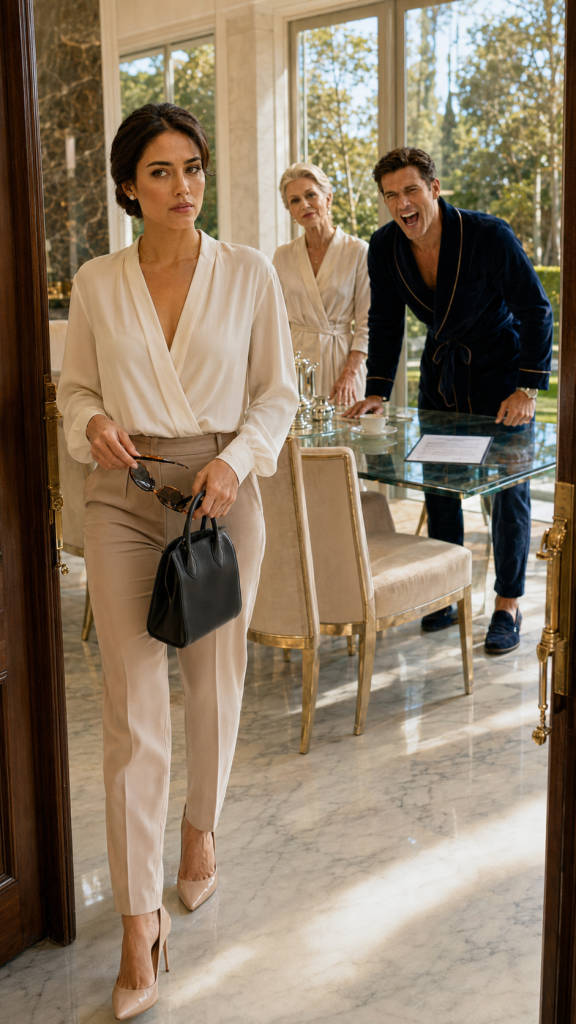
I slipped my sunglasses from my purse.

“I think I’ll go home.”
Julian barked out a laugh.
“Home?”
“Yes.”
“To where?”
“My estate.”
His laughter became louder.
I put on my sunglasses.
“My thirty-five-million-dollar estate, actually. It’s much more spacious.”
Eleanor stared.
Then she laughed too.
It was sharper than Julian’s.
“Have you lost your mind?”
“Possibly. I did marry into this family.”
Julian slapped one palm against the table.
“Your parents are retired teachers!”
“That is what I told you.”
The laughter stopped.
Only for a second.
Then Julian shook his head.
“No.”
I walked toward the mahogany doors.
Behind me Eleanor said, “She’s bluffing.”
Julian recovered quickly.
“Obviously.”
I reached the door.
For two years, I had kept my real life folded into locked rooms.
No security detail around Julian.
No family photographs where he could see them.
No society pages.
No meetings with Apex executives in public.
My closest staff knew the arrangement and hated it, but they had respected my decision.
I had wanted one relationship untouched by my surname.
Instead, I had discovered something worse than a man attracted to money.
I had found a man who measured human worth by it.
“Worthless things shouldn’t be kept in the house,” I said.
Eleanor’s face hardened.
I turned toward Julian.
“As for who is actually worthless…”
I smiled.
“Time will tell.”
He scoffed.
“Fine. Go have your little tantrum. When you calm down, we’ll discuss an apology.”
“There won’t be an apology.”
My fingers closed around the doorknob.
“And don’t bother calling your lawyer, Julian.”
That finally changed his expression.
I lowered my sunglasses just enough to meet his eyes.
“My legal team will deliver the divorce papers to your office this afternoon.”
His face went blank.
Eleanor whispered, “Divorce?”
“Yes.”
“You can’t be serious,” Julian said.
“I have never been more serious.”
“You’re ending a marriage over three thousand dollars?”
“No.”
I opened the door.
“I’m ending a marriage because you finally told me what you think I’m worth.”
Then I walked out.
They thought I was heading toward a dead end.
They had no idea that a black sedan was already turning through the gates.
And they had absolutely no idea who was waiting inside it.
PART 2: THE WOMAN THEY THOUGHT DIDN’T EXIST
The rear door of the sedan opened before I reached the curb.
“Mrs.—”
My chief of staff stopped herself.
Her eyes flicked toward the house behind me.
“Ms. Parker,” she corrected.
“Thank you, Mara.”
She studied my face.
Mara Bennett had worked with my family for twelve years and with me personally for six. She had watched me manage acquisitions worth billions without blinking.
She had also watched me spend two years pretending a forty-dollar dinner was a financial decision.
She hated Julian.
Not because she knew he was cruel.
Because she thought my experiment was dangerous.
“You’re carrying your purse,” she said.
“Yes.”
“You’re wearing yesterday’s wedding shoes.”
I looked down.
I was.
“And,” Mara added carefully, “you appear to have left your suitcase inside.”
“I did.”
She opened the door wider.
“I assume we’re not retrieving it?”
“No.”
That earned the smallest smile.
I climbed into the car.
Only after the door shut did I realize my hands were shaking.
Mara noticed.
She didn’t mention it.
“Home?” she asked.
I looked through the tinted glass at Eleanor’s four-million-dollar house.
Julian stood in the doorway now.
Even from the car, I could see his expression.
Annoyed.
Not frightened.
Not heartbroken.
Annoyed.
He still believed I would come back.
“Yes,” I said.
“Home.”
The gates disappeared behind us.
For ten minutes I said nothing.
The city moved around me in fragments—traffic lights, pedestrians, sunlight flashing against glass towers.
My phone buzzed.
Julian.
I declined the call.
It rang again.
Declined.
A text arrived.
Stop being dramatic and come back.
Then another.
My mother is willing to discuss lowering the amount.
I actually laughed.
Mara looked over.
I handed her the phone.
She read the messages and slowly returned it.
“Remarkable.”
“That’s one word.”
Another message appeared.
$2,000. Final offer.
I stared at it.
Then I turned my phone off.
Mara was silent for a moment.
“What happened?”
I told her.
The agreement.
The rent.
The housekeeping.
Julian calling my life pathetic.
By the time I finished, Mara’s mouth had become a straight line.
“Would you like me to contact Mr. Reyes?”
Daniel Reyes was my lead personal attorney.
“I already emailed him from the driveway.”
Mara blinked.
“You work quickly.”
“I married badly. I don’t intend to divorce slowly.”
That made her smile.
Then the smile faded.
“Sienna…”
I looked toward the window.
“I loved him.”
“I know.”
That was when the pain arrived.
Not at the breakfast table.
Not when Eleanor slid the contract toward me.
Not even when Julian called my life pathetic.
It came inside that quiet car, surrounded by people who finally knew exactly who I was.
I had loved him.
That was the humiliation.
My hidden wealth didn’t protect me from that.
Thirty-five million dollars in property did not make my chest hurt less.
Majority ownership in Apex did not erase the memory of Julian crying when I said yes to his proposal.
I leaned my head against the seat.
“What if I created this?”
Mara frowned.
“What?”
“What if hiding everything made him resent me? What if—”
“No.”
The sharpness in her voice startled me.
Mara rarely interrupted.
“You concealed your wealth,” she said. “You did not make him insult your work. You did not make him let his mother charge his bride rent the morning after the wedding.”
I closed my eyes.
“He thought I had less.”
“Exactly.”
Her voice softened.
“And look what he did with that belief.”
I didn’t answer.
Because that was the truth I couldn’t escape.
Had Julian believed I was wealthy, he might have been kind.
He might have defended me.
He might have told Eleanor to tear up the agreement.
But kindness that appears only in the presence of power is not kindness.
It is calculation.
Forty minutes later, the sedan turned onto a private coastal road.
Then through the first security gate.
Then the second.
The stone walls opened.
Home rose beyond them.
The house was not merely large.
It sat along a bluff above the Pacific, designed in warm limestone and glass, with terraces descending toward gardens and an infinity pool that seemed to spill directly into the ocean.
Thirty-five million dollars had been the most recent conservative appraisal.
Julian would have mocked the number if I told him.
He had mocked it.
As the car curved around the fountain, the front doors opened.
Several members of the household staff stepped outside.
Seven full-time housekeepers rotated across the estate, just as I had jokingly told Julian before leaving.
There were groundskeepers, security personnel, kitchen staff and maintenance workers as well, but none of them treated me the way Eleanor apparently thought household employees should be treated.
Because they were employees.
Not family members whose dignity was exchanged for shelter.
Mrs. Alvarez, who managed the household, met me on the steps.
Her eyes went directly to my wedding dress shoes.
Then to my empty hands.
“Oh,” she said.
That one syllable nearly destroyed me.
I hugged her.
Mrs. Alvarez had known me since I was sixteen.
She hugged me back without asking a single question.
When she finally released me, she touched my cheek.
“I’ll have tea brought upstairs.”
“Something stronger.”
Her brows rose.
“Before noon?”
“I’ve had a complicated morning.”
“Champagne, then.”
“Perfect.”
I walked into the foyer.
For two years, I had deliberately stayed away from this place whenever Julian might notice.
I told him my company occasionally sent me traveling.
I spent nights here while claiming to be visiting my parents.
I kept two wardrobes.
Two phones.
Two versions of myself.
Standing beneath the enormous modern chandelier, I suddenly wondered why I had worked so hard to make myself smaller for someone who enjoyed believing I was small.
Mara followed me into the library.
Daniel was already waiting by video call on the screen.
He was in his fifties, silver-haired and nearly impossible to surprise.
When he saw me, he removed his glasses.
“I was told you had a memorable first breakfast as a married woman.”
“You could say that.”
“Do you want out?”
“Yes.”
No hesitation.
Daniel studied me.
“Completely?”
“Completely.”
“Then we proceed.”
He didn’t ask whether I wanted time.
That was why I trusted him.
He explained the immediate steps.
Our marriage was less than a day old. Our finances had never been combined. We owned no property together. There were no children, no shared accounts, no joint investments and no business interests intertwining us.
Ending it would still require process.
But Julian had nothing financial to claim from the life I had built before meeting him simply because he had worn a wedding ring for one night.
“Serve him at his office,” I said.
Daniel paused.
“Today?”
“Yes.”
“Publicly?”
“No theatrics.”
I thought of Julian humiliating me across Eleanor’s breakfast table.
“I don’t want a spectacle. I want finality.”
“Understood.”
The screen went dark a few minutes later.
I poured myself a glass of champagne.
Mara remained beside the shelves.
“There is one complication,” she said.
I looked over.
“With Apex?”
She nodded.
I already knew.
Julian’s company, Valeon Systems, had spent most of the previous year searching for major expansion funding.
He had talked about it constantly.
The company had grown quickly in its first few years, then stalled.
Costs were rising.
Several projected contracts had been delayed.
Julian refused to call the situation a crisis.
He preferred phrases like temporary liquidity pressure and aggressive expansion cycle.
Apex Capital Partners was one of the firms considering a substantial investment package.
Julian didn’t know I was connected to Apex.
He certainly didn’t know I controlled more voting shares than any other individual shareholder.
I had deliberately stayed away from every stage of Valeon’s preliminary review.
I had told Apex’s investment committee that I knew Julian socially and did not want personal feelings influencing the process.
No one knew he was my fiancé except a handful of senior people bound by confidentiality.
Julian, meanwhile, had bragged to me about the deal repeatedly.
“Apex is interested,” he had said one night while we ate noodles in my little apartment.
“If this closes, Valeon enters another league.”
I had smiled and asked, “What if it doesn’t?”
He had looked almost offended.
“It will.”
Now Mara said, “Their final management presentation is Thursday.”
Three days away.
“I remember.”
“The committee expected you to remain absent.”
“I should.”
Mara watched me.
“They’re also presenting the recommendation to the majority ownership group afterward.”
Meaning me.
I took a sip of champagne.
“Has the analysis changed?”
“No.”
“Any personal information included?”
“None.”
“Then let the team do its work.”
Mara nodded.
That was important.
I could leave Julian.
I could refuse to rescue him.
I could refuse to allow my private assets to become his reward for treating me like dirt.
But I would not corrupt Apex’s process to punish an ex-husband.
If Valeon was a good investment, the committee would say so.
If it wasn’t, they would say that too.
Julian’s fate would be determined by the business he had actually built.
Not by my anger.
My phone turned on when I connected it to the charger.
Thirty-two missed calls.
Most from Julian.
Seven from Eleanor.
Two from numbers I didn’t recognize.
Then a message came through.
Sienna, enough. Come home. We can forget this happened.
I read it twice.
Not I’m sorry.
Not I love you.
Not I was wrong.
We can forget this happened.
Another message followed.
My lawyer says you have no grounds to take anything from me.
I laughed quietly.
Then typed the first response I had sent since leaving.
I don’t want anything from you.
Three dots appeared immediately.
Then stop this nonsense.
I stared at the screen.
For two years, I had wondered whether Julian loved me without money.
I finally had my answer.
He didn’t even respect me without it.
I placed the phone facedown.
At 2:17 that afternoon, Daniel called.
“The papers have been delivered.”
I closed my eyes.
“How did he react?”
“Would you like the diplomatic version?”
“No.”
“He called them fraudulent.”
I smiled despite myself.
“And then?”
“Then he called me.”
“Did you answer?”
“Yes.”
“What did he say?”
Daniel paused.
“He asked what kind of attorney represents a PR assistant.”
I looked toward the ocean.
“And what did you tell him?”
“I told him my hourly rate.”
I laughed.
Really laughed this time.
It felt good.
Then Daniel added, “He became very quiet.”
My phone began ringing again.
Julian.
I let it ring.
It stopped.
Then a message arrived.
Who the hell are you?
I looked at those five words for a long time.
Finally, I typed:
Your wife. For a few more weeks.
I sent it.
And somewhere across the city, the first crack appeared in Julian Vale’s certainty.
PART 3: THE NAME BEHIND THE DOOR
Julian discovered my address the next morning.
I still don’t know which part shocked him more—the security gates, the oceanfront property or the fact that the guards refused to let him through.
At 8:06 a.m., security called my bedroom.
“Ms. Parker, there’s a Mr. Julian Vale at the main gate.”
I was standing barefoot beside my windows with coffee in my hand.
“What does he want?”
“He says he’s your husband.”
The word twisted something inside me.
“Technically true.”
“He is demanding entry.”
“Technically irrelevant.”
The security officer hesitated.
“Would you like us to ask him to leave?”
“Yes.”
Five minutes later my phone rang.
I answered this time.
“Sienna.”
Julian sounded breathless.
Not angry.
Not yet.
“What?”
“What is this place?”
“My home.”
“Stop playing games.”
“I stopped yesterday.”
“Whose house is this?”
“Mine.”
Silence.
Then a disbelieving laugh.
“No.”
“Yes.”
“I looked it up.”
Of course he had.
Once he had the address, the shell companies and trusts holding different layers of ownership wouldn’t conceal the obvious forever.
The estate had appeared in architecture magazines years earlier.
My family name had been kept out of most lifestyle coverage, but people in finance knew.
“You expect me to believe you own a thirty-five-million-dollar property?”
“I don’t particularly care what you believe anymore.”
“Sienna, open the gate.”
“No.”
“I’m your husband.”
“And yesterday I was your tenant.”
His breathing changed.
“That’s not fair.”
I almost admired the audacity.
“Not fair?”
“My mother handled it badly.”
“Your mother handled it exactly how she wanted.”
“I should’ve explained.”
“You explained plenty.”
“I was under pressure.”
There it was.
The first excuse.
I set my coffee down.
“From what?”
He hesitated.
“Valeon is in the middle of major financing discussions. I have responsibilities. Mother has expenses. The house costs money. You moved in—”
“I moved in because we got married.”
“I know that.”
“Do you?”
His voice softened.
“Sienna, I said things I shouldn’t have.”
It was the closest he had come to an apology.
But then he ruined it.
“If I’d known…”
He stopped.
I stared at the ocean.
“If you’d known what?”
Nothing.
“Finish the sentence, Julian.”
He didn’t.
He didn’t need to.
If I’d known you were rich.
If I’d known this house was yours.
If I’d known you mattered.
My throat tightened.
“Goodbye, Julian.”
“Wait.”
I ended the call.
At nine thirty, Eleanor arrived.
Security called again.
This time I almost laughed.
“She says she is your mother-in-law.”
“Tell her I’m aware.”
“She has flowers.”
That did make me laugh.
“Of course she does.”
I could have refused.
I should have.
Instead, curiosity won.
“Bring her to the garden terrace. A guard stays nearby.”
Twenty minutes later Eleanor walked into my home.
For the first time since I met her, she had nothing to say.
Her eyes moved from the limestone foyer to the floating staircase, the paintings, the glass wall opening toward the ocean.
Mrs. Alvarez greeted her politely.
Another member of staff crossed the hall carrying fresh linens.
Two housekeepers were arranging flowers in the dining room.
Eleanor noticed everything.
Including the staff.
Especially the staff.
“You weren’t joking,” she murmured.
“No.”
We sat outside.
She placed an enormous bouquet of white roses between us.
The exact flowers from my wedding.
“How much is this property actually worth?”
I looked at her.
“That is your first question?”
Her mouth tightened.
“I was curious.”
“Thirty-five million at the last conservative valuation.”
She inhaled.
“And this is yours?”
“Yes.”
“Not your parents’?”
“Mine.”
Her eyes changed.
It happened so quickly another person might have missed it.
Contempt rearranged itself into calculation.
Suddenly her posture softened.
“Sienna.”
I almost preferred the sneer.
She reached toward my hand.
I moved mine.
“We’ve had a terrible misunderstanding.”
“No.”
Her smile trembled.
“Families fight.”
“This wasn’t a fight.”
“My generation believes people should contribute.”
“You told me I should pay rent and replace your dismissed cleaner.”
She flushed.
“That came out harshly.”
“You put it in writing.”
For once, Eleanor had no immediate answer.
She glanced toward the house again.
“Why would you hide this?”
“Because I wanted to know how people treated me when they believed I couldn’t help them.”
A flicker of irritation crossed her face.
“So you tested us.”
“I protected myself.”
“You lied.”
“Yes.”
I did not avoid responsibility.
“I lied about my wealth.”
She seized on it.
“Then how can you blame Julian for reacting badly when the entire marriage was built on deception?”
“Because my lie did not require him to be kind to me.”
She blinked.
“He thought I was ordinary,” I continued. “That was all. He thought I worked for a salary. He thought my parents were teachers. He thought my apartment was small.”
I leaned forward.
“And because he believed those things, he decided I deserved less respect.”
“That isn’t what happened.”
“It is exactly what happened.”
Eleanor’s voice sharpened.
“You humiliated him.”
“No. I refused to be humiliated by him.”
“He loves you.”
I studied her.
“If this house disappeared tomorrow, would you still be here?”
Her face answered before her mouth did.
I stood.
The meeting was over.
Eleanor stood too.
“You can’t throw away a marriage after one argument.”
“I can end a marriage after discovering what it actually is.”
“Julian will apologize.”
“He should apologize for himself. Not to save access to me.”
Her expression hardened.
Then she said the sentence that erased the last of my doubt.
“Do you have any idea what a union between your resources and Julian’s talent could become?”
There.
Not our love.
Not our marriage.
Our resources.
His talent.
I smiled sadly.
“Thank you, Eleanor.”
“For what?”
“For being consistent.”
I walked inside.
She followed me.
“Sienna.”
I stopped.
“You should leave.”
Her face flushed bright red.
“No one has ever spoken to me this way.”
“I can believe that.”
Mrs. Alvarez appeared quietly near the hall.
Eleanor noticed her.
For a strange second, we both remembered the breakfast table.
Housekeeping.
Unpaid labor.
Three thousand dollars.
“Mrs. Alvarez,” I said, “would you please show Mrs. Vale out?”
“With pleasure.”
Eleanor stared at me.
I almost smiled.
Then my phone buzzed.
Mara.
Valeon moved the Apex presentation to tomorrow. Julian requested attendance from senior ownership.
I read it twice.
Eleanor was still watching me.
“What is it?”
“Business.”
Her eyes sharpened.
“Anything involving Julian?”
I looked up.
For nearly two years, Julian had been trying to get inside the doors of Apex Capital Partners.
He had no idea those doors had always belonged to the woman he mocked for living in a cheap apartment.
“Possibly.”
That evening I reviewed the Valeon materials for the first time.
Not as a wife.
As an investor.
I sat in my library while the Pacific darkened beyond the windows and worked through hundreds of pages.
Revenue.
Debt.
Margins.
Customer concentration.
Projected expansion.
Cash position.
Management assumptions.
Julian wasn’t a fraud.
That would almost have been easier.
He was intelligent.
Ambitious.
Persuasive.
And dangerously convinced that confidence could substitute for caution.
Valeon had grown rapidly because Julian knew how to sell a vision.
But the numbers beneath that vision were strained.
His projections depended on contracts that were not guaranteed.
His cost assumptions were optimistic.
His proposed expansion would increase risk at exactly the moment the company needed stability.
The investment team had already raised those concerns months earlier.
Julian responded by promising aggressive growth.
I remembered conversations at dinner.
Complaints about “timid investors.”
Mocking remarks about analysts who “couldn’t see the big picture.”
At the time, I had listened as his girlfriend.
Now I saw the pattern.
Julian hated being questioned.
Eleanor had taught him that disagreement was disrespect.
Money was proof of worth.
Authority was proof of correctness.
And anyone with less money or authority could be dismissed.
Including me.
Around midnight, I reached the management-risk section.
Mara had attached notes from the review team.
One sentence had been underlined:
Leadership response to financial pressure remains a material concern.
I sat back.
It wasn’t about our marriage.
The professionals reviewing his company had independently noticed the same weakness I had seen at breakfast.
When Julian felt pressure, he pushed it downward.
He blamed.
He demanded.
He expected weaker people to absorb the cost.
I closed the file.
Tomorrow he would walk into Apex expecting to persuade powerful strangers to save his company.
He had no idea his supposedly pathetic wife would be sitting on the other side of the table.
PART 4: THE BOARDROOM
Apex occupied the upper floors of a steel-and-glass tower downtown.
I arrived at 8:15 the next morning through the private executive entrance.
For two years, I had avoided letting Julian see me anywhere near the building.
Now I wore a charcoal suit cut for me in Milan, a simple diamond watch and the black heels I normally reserved for board meetings.
No disguise.
No discounted blouse.
No company badge identifying me as an assistant.
Just me.
Mara walked beside me.
“You can still sit this meeting out,” she said.
“I know.”
“The committee’s recommendation is already substantially formed.”
“I know.”
“You also know he’s going to believe whatever decision happens today is personal.”
“I know.”
Mara sighed.
“You’re unusually irritating this morning.”
“I learned from marriage.”
We entered the private elevator.
My reflection stared back from the mirrored wall.
For a moment, I saw two women.
The Sienna who had rationed grocery money for show.
And the Sienna who could move nine-figure capital allocations with a vote.
Neither woman was false.
That was what Julian never understood.
Money had never created my character.
Lack of visible money had simply revealed his.
When we reached the board level, the investment team was already assembled.
I addressed the conflict directly.
“My personal relationship with Mr. Vale is ending,” I said. “That fact does not alter the underwriting standards. I will not direct the committee’s recommendation.”
Several heads nodded.
One senior partner, Thomas Reed, folded his hands.
“Our recommendation was drafted before we were informed of your marriage.”
“Good.”
“It is not favorable.”
I felt something tighten in my chest.
Not satisfaction.
Not exactly.
“Why?”
Thomas summarized what I had read.
Overextension.
Insufficient cushion.
Aggressive assumptions.
Leadership resistance to restructuring.
Valeon wasn’t necessarily doomed.
But Apex was not prepared to finance Julian’s expansion plan under current terms.
“We offered alternatives twice,” Thomas said. “Slower expansion. Lower initial capital. Governance controls.”
“And?”
“Mr. Vale rejected them.”
Of course he had.
“He says accepting them would signal weakness.”
I almost laughed.
Instead I nodded.
“Then proceed exactly as you would if I had never met him.”
At ten, Valeon’s delegation arrived.
I watched through the privacy glass of an adjoining office.
Julian entered first.
Navy suit.
Perfect tie.
Confidence restored.
Beside him were his finance director and two senior executives.
He shook hands.
He smiled.
He became the Julian I had fallen in love with.
Magnetic.
Focused.
Brilliant when he wanted to be.
For one painful moment, I remembered why I had believed in him.
Then I remembered the agreement on Eleanor’s table.
Thomas began the presentation.
Julian made his case.
For nearly an hour, I listened.
He was good.
Very good.
He spoke about market opportunities and product strength and future demand.
But each time someone asked about risk, his tone changed slightly.
He dismissed.
Deflected.
Minimized.
When one partner questioned his cost projections, Julian smiled.
“With respect, we understand our business better than external analysts.”
I closed my eyes briefly.
There it was.
Not cruelty.
Something more dangerous in business.
Arrogance disguised as certainty.
Near the end, Thomas said, “Before we conclude, a member of our majority ownership group will join us.”
Julian straightened.
He had been requesting that for weeks.
I knew because he had bragged about it at home.
“If I can get in front of the people who actually control Apex,” he had once told me, “the analysts won’t matter.”
I opened the door.
The boardroom went silent.
Julian looked toward me.
At first, he didn’t understand.
His eyes moved past me as if he expected someone important to follow.
Then Thomas stood.
“Ms. Parker.”
Julian’s face changed.
One of his executives stood as well.
Then another.
I walked to the empty chair at the far end of the table.
Thomas gestured.
“For those who have not met her formally, Sienna Parker represents the Parker family’s controlling position and currently holds the largest individual voting interest in Apex Capital Partners.”
Julian stopped breathing.
I could actually see it.
His face emptied.
Then color rushed back.
“Sienna?”
No one moved.
His finance director looked from him to me.
“You two know each other?”
Julian opened his mouth.
I answered.
“We’re married.”
Silence.
I added, “Temporarily.”
Thomas looked down.
Someone coughed.
Julian gripped the edge of the table.
“This is a joke.”
“No.”
“You work in PR.”
“I have worked in PR.”
That part had always been true.
Early in my career I had spent eighteen months inside one of Apex’s communications teams because my father insisted I understand operations before ownership.
I simply hadn’t worked there in the way Julian assumed.
“You told me—”
“I told you I worked a corporate job.”
“You said you were an assistant.”
“I deliberately allowed you to believe I had very little money.”
His eyes widened.
The embarrassment was transforming into fury.
“You manipulated me.”
I kept my voice calm.
“This isn’t the place.”
“You’re sitting there judging my company after lying to me for two years?”
Thomas intervened.
“Mr. Vale, today’s review was conducted independently.”
Julian ignored him.
“You did this.”
I stared at him.
“Did what?”
“You planned this.”
“No.”
“Valeon has been speaking with Apex for eleven months!”
“Yes.”
“And you never told me?”
“No.”
His laugh sounded broken.
“Jesus Christ.”
His finance director leaned toward him.
“Julian.”
He pushed the man’s hand away.
“You sat in my apartment while I talked about this deal.”
“My apartment?”
Julian froze.
I almost smiled.
“Yes,” I said. “The apartment I supposedly could never escape without you.”
The boardroom became painfully quiet again.
I shouldn’t have said it.
It was personal.
So I pulled myself back.
“Mr. Reed can finish the review.”
Julian stared at me.
“No. You tell me.”
I hesitated.
“Tell you what?”
“Are you rejecting the investment?”
Thomas spoke.
“The committee’s recommendation—”
“You.”
Julian pointed at me.
“I want to hear it from you.”
I looked around the room.
Then back at my husband.
“The committee concluded that Valeon’s proposed expansion is too aggressive for its current financial position.”
His jaw tightened.
“They offered you alternative structures.”
“I know.”
“You rejected them.”
“Because they cripple the company.”
“They reduce risk.”
“They reduce control.”
And there it was again.
Control.
I folded my hands.
“Apex will not finance the expansion under your proposed structure.”
His eyes burned.
“Because I asked you for rent?”
“No.”
My voice was quiet.
“Because your numbers don’t support your confidence.”
He flinched.
“And because when people challenge you, you don’t listen. Your own executives have documented that problem. The investment committee documented it months before I left you.”
Julian looked toward Thomas.
Thomas did not contradict me.
I continued.
“This decision does not belong to an angry wife. It belongs to professionals you repeatedly refused to hear.”
Julian’s voice dropped.
“You could override them.”
“Yes.”
The room became still.
That was the truth.
With enough pressure, enough calls, enough political capital within Apex, I could almost certainly force a different discussion.
His eyes changed when he realized it.
Hope.
Tiny.
Immediate.
“Sienna.”
I hated that hope.
Because suddenly his voice sounded like the man who had proposed to me.
“You know what I’ve built.”
“I do.”
“You know what Valeon means to me.”
“I do.”
“Then help me.”
I looked at him.
The words were simple.
But I heard everything beneath them.
Save me.
Prove you love me.
Use what you have.
Give me what I refused to give you.
Grace.
I thought about the breakfast table.
Three thousand dollars.
Sign it so we can have peace.
I leaned back.
“You had alternatives.”
“They’re bad alternatives.”
“They’re less profitable alternatives.”
“They weaken my position.”
“They protect the company.”
Julian clenched his jaw.
“You don’t understand.”
I almost smiled.
“That sentence is exactly why Apex won’t hand you the money.”
He stared at me.
For once, Julian had nothing to say.
Thomas closed the folder in front of him.
“The committee remains willing to discuss a smaller facility under revised governance and spending conditions.”
Julian looked toward him.
So this was not destruction.
It was not revenge.
It was a door.
Just not the door Julian wanted.
He looked back at me.
“You expect me to accept conditions after this?”
“I don’t expect you to do anything.”
My voice softened.
“But if you care about your company more than your pride, you’ll consider them.”
His face twisted.
“I loved you.”
The words hit harder than I expected.
I breathed in slowly.
“I loved you too.”
“Then how can you sit there?”
“Because love is not the same thing as obedience.”
I stood.
“And because yesterday morning, when you believed I had nothing you needed, you showed me exactly how much love you thought I deserved.”
Julian’s eyes dropped.
Just briefly.
Then he gathered his papers.
The meeting ended.
But before he left, he stopped beside my chair.
His voice was barely audible.
“Was any of it real?”
I looked at him.
“The apartment?”
His face tightened.
“No. Us.”
That was the cruelest question he had asked.
Because the answer was simple.
“Yes.”
I swallowed.
“That’s why this hurts.”
For the first time since breakfast, Julian looked wounded rather than angry.
Then he walked out.
PART 5: WHAT THREE THOUSAND DOLLARS REALLY COST
The flowers began arriving that afternoon.
Roses.
Peonies.
Orchids.
One arrangement so large it required two people to carry it.
I sent all of them to a nearby hospital.
Then came the messages.
I was angry.
I was stressed.
My mother pushed me.
I shouldn’t have said those things.
Then finally:
I’m sorry.
I stared at that one for a long time.
Two days earlier, it might have saved us.
Now it felt like a receipt printed after the store had burned down.
I didn’t answer.
Julian accepted Apex’s revised terms three weeks later.
Not happily.
Not gracefully.
But he accepted them.
The financing was smaller.
Expansion slowed.
The company agreed to tighter financial controls and outside oversight.
Valeon survived.
That mattered to me more than I expected.
I never wanted to destroy Julian.
I wanted him to face reality without using me as a cushion.
There was a difference.
Eleanor stopped calling after I refused her fourth invitation to “discuss things like adults.”
Then one evening she appeared at the estate again.
This time she came without flowers.
I agreed to see her.
She looked different.
Not poorer.
Not broken.
Just tired.
We sat in the same garden where she had first tried to repair our relationship after discovering my wealth.
For several minutes, neither of us spoke.
Finally she said, “Julian is moving out.”
“Of your house?”
She nodded.
“He says he needs his own place.”
I almost smiled.
“That might be healthy.”
Her mouth tightened.
“He blames me.”
“I doubt he blames only you.”
“No.”
She stared toward the ocean.
“He blames himself too.”
That surprised me.
Eleanor rubbed her hands together.
“I thought I was protecting him.”
“From what?”
She laughed bitterly.
“Women who wanted his money.”
The irony was almost unbearable.
She saw my expression.
“Yes,” she said. “I understand how ridiculous that sounds now.”
I waited.
“My husband died when Julian was twenty,” she continued. “He left debts I didn’t know existed. For years I was terrified of losing everything.”
That explained something.
It did not excuse it.
“I taught Julian that money meant safety,” she said. “Perhaps too well.”
“You taught him money meant value.”
She flinched.
“Yes.”
For the first time, Eleanor didn’t argue.
“We assumed you were with him because you wanted a better life.”
“I wanted a life with him.”
“I know that now.”
I looked at her.
“Would knowing it now have changed anything then?”
She was silent.
I appreciated the honesty.
Eventually she whispered, “Maybe not.”
That answer gave me more closure than any apology.
Eleanor stood to leave.
At the doors, she turned.
“Do you hate us?”
I thought about it.
“No.”
She seemed surprised.
“Hate takes energy.”
I looked back toward the ocean.
“I’d rather spend mine elsewhere.”
The divorce process remained painfully ordinary.
Forms.
Calls.
Signatures.
Lawyers.
People expect dramatic endings to arrive with shattered glasses and screaming matches.
Sometimes they arrive in conference rooms beneath fluorescent lights.
Sometimes love ends with a signature.
Julian requested one private conversation before everything became final.
I almost refused.
Then I decided I wanted one too.
We met at a quiet restaurant where we had eaten on our third date.
Back then, I had ordered the cheapest entrée because I was still learning how to pretend money mattered to me.
Julian had noticed.
“You can order whatever you want,” he’d said.
I had smiled.
“I know.”
That memory stayed with me as he entered the restaurant now.
He looked older.
Only a few months had passed.
But arrogance wears badly when reality begins scraping it away.
He sat across from me.
For several seconds, we simply looked at each other.
Then he said, “You look different.”
“I’m not.”
He smiled faintly.
“I suppose that’s the point.”
The waiter came.
I ordered wine without looking at the price.
Julian noticed.
Of course he did.
When we were alone, he said, “I accepted Apex’s terms.”
“I heard.”
“They were right.”
I raised my eyebrows.
“That must have hurt.”
He actually laughed.
“Yes.”
For a moment, I saw the man I used to love.
Then his expression sobered.
“We were burning too much cash. I kept thinking one big expansion would fix everything.”
“I know.”
“I didn’t want anyone telling me to slow down.”
“I know that too.”
He looked at his hands.
“My mother always said if people think you’re weak, they take from you.”
“And so you made sure you took first.”
He winced.
“I deserve that.”
Silence.
Then he said, “Why did you really do it?”
“Hide my money?”
“Yes.”
I took a breath.
“Because I’ve spent my entire life meeting people who changed the second they knew.”
“And you thought I would.”
“I hoped you wouldn’t.”
His face tightened.
“Was I ever close to passing your test?”
The question hurt.
“This wasn’t a test with a score, Julian.”
“It feels like one.”
“I didn’t create situations to trap you.”
I leaned forward.
“I lived as a woman with an ordinary salary. That’s all. I wanted to know whether someone could love me without access to everything behind me.”
“I did love you.”
“I believe you.”
His eyes lifted sharply.
That surprised him.
“You do?”
“Yes.”
I had thought about it for weeks.
Love was not always pure.
People could love and still be selfish.
Love and still be cruel.
Love and still choose pride.
Julian had loved me.
But he had also believed my lower financial status gave him permission to stand above me.
And eventually, that would have poisoned everything.
“You loved me,” I said. “But you didn’t respect the version of me you thought was poor.”
He looked away.
That landed.
“I keep replaying breakfast,” he murmured.
“So do I.”
“When I said your whole life couldn’t buy a corner of that room…”
His voice faded.
“You meant it.”
“Yes.”
That was more painful than if he’d lied.
He rubbed one hand across his face.
“Do you know what the worst part is?”
I waited.
“When you told me you had a thirty-five-million-dollar estate, I thought you were insane.”
Despite myself, I laughed.
He did too.
Quietly.
Then he looked at me.
“And twenty minutes later, after you left, I was still angry because I thought you’d come crawling back by dinner.”
My smile disappeared.
“I know.”
“How?”
“Your texts.”
He closed his eyes.
“Right.”
“Two thousand dollars. Final offer.”
He groaned.
“Please don’t remind me.”
“I saved that one.”
“You didn’t.”
“I absolutely did.”
For a few seconds, something almost gentle passed between us.
Then reality returned.
Julian reached into his jacket.
He placed a folded sheet of paper on the table.
My chest tightened.
He slid it toward me.
I opened it.
It was the Financial Responsibility Agreement.
The original.
Eleanor’s bold header.
The three-thousand-dollar amount.
My nonexistent housekeeping obligations.
Across the bottom, Julian had written one sentence by hand.
The most expensive $3,000 I ever asked for.
I stared at it.
He said, “I kept it because I didn’t want to forget.”
Something burned behind my eyes.
“You don’t need to punish yourself forever.”
“I’m not.”
He looked at me.
“I just don’t want to become that man again.”
I folded the paper.
“That part is up to you.”
He nodded.
Then came the question I had known was coming.
“Is there any chance?”
I looked at him.
He didn’t need to explain.
Any chance we stopped the divorce.
Any chance love could overcome the ugliness.
Any chance the man I married could become the man I thought I married.
I wished I could say yes.
That was the final wound.
Because a small part of me still remembered his hands shaking when he proposed.
His laugh in my little apartment.
The way he once stayed awake beside me all night when I had the flu.
People are rarely only monsters or heroes.
Sometimes the person who breaks your heart is also the person who once held it carefully.
But I had learned something I could not unlearn.
“No,” I said.
Julian closed his eyes.
I reached across the table.
For the last time, I took his hand.
“I hope you become someone who never makes another woman prove her worth to you.”
His fingers tightened around mine.
“I’m sorry.”
“I know.”
This time, I believed him.
It just wasn’t enough to rebuild what had been destroyed.
A week later, the divorce was finalized.
I returned home before sunset.
The estate was quiet.
Golden light stretched across the terrace while the Pacific rolled beneath the cliffs.
Mrs. Alvarez found me standing in the kitchen.
“Dinner at seven?”
“Yes.”
“Dining room?”
I looked toward the formal room.
Then I shook my head.
“Kitchen.”
She smiled.
“You own a dining room that seats twenty-four.”
“I know.”
“And you want to eat here?”
“Yes.”
She laughed.
“As you wish.”
The rest of the staff drifted in and out while dinner was prepared.
People talking.
Someone laughing.
A house feeling like a home rather than evidence of status.
I thought about Eleanor’s breakfast table.
Four million dollars.
Three thousand dollars a month.
A son who was apparently priceless.
A bride who needed to pay her share before she had earned the right to belong.
For most of my life, I had believed wealth made it difficult to know who people really were.
I had been wrong.
Money did not hide character.
Power did.
The moment people believed I had none, they showed me exactly how they wanted to treat someone beneath them.
Julian had seen a woman with an ordinary salary.
A woman with cheap luggage.
A woman whose parents were supposedly retired teachers.
A woman who couldn’t compete with his house, his watch, his company or his family name.
And instead of protecting that woman, he tried to make her grateful for the privilege of paying to remain beside him.
He did not know she could walk away.
That was his mistake.
Not because I had thirty-five million dollars in real estate.
Not because seven housekeepers worked under my roof.
Not because my legal team could serve divorce papers before lunch.
Not because I held the largest individual voting position in the investment firm his company desperately wanted.
His mistake was believing a woman needed those things before she was allowed to have dignity.
Months later, I found Eleanor’s agreement in a drawer.
I had brought it home from my final dinner with Julian without thinking.
I unfolded it.
The paper was creased now.
His handwritten sentence remained at the bottom.
The most expensive $3,000 I ever asked for.
I stood beside the fireplace for a moment.
Then I fed the agreement into the flames.
The edges curled first.
Then Eleanor’s signature disappeared.
Then Julian’s handwriting.
Then the number.
$3,000.
Gone.
I watched until there was nothing left but ash.
Mara came into the room carrying a folder.
She noticed the fire.
“Something important?”
“No.”
I smiled.
“Something overpriced.”
She gave me a suspicious look but didn’t ask.
I walked toward the terrace.
Outside, the evening air smelled of salt and jasmine.
For two years, I had hidden my world because I wanted someone to choose me without it.
In the end, I learned something better.
I didn’t need to shrink myself to discover whether someone loved me.
I only needed to pay attention to how they treated people they believed had less power.
That morning after my wedding, Eleanor thought she was giving me two choices.
Pay three thousand dollars every month.
Or pack my cheap bags and leave.
She never imagined there was a third choice.
I could walk out of her four-million-dollar house, return to my thirty-five-million-dollar home, divorce her son and never ask either of them for anything.
So that was exactly what I did.
Because Julian had been right about one thing.
Worthless things shouldn’t be kept in the house.
He just never realized I wasn’t talking about me.
Để lại một bình luận