
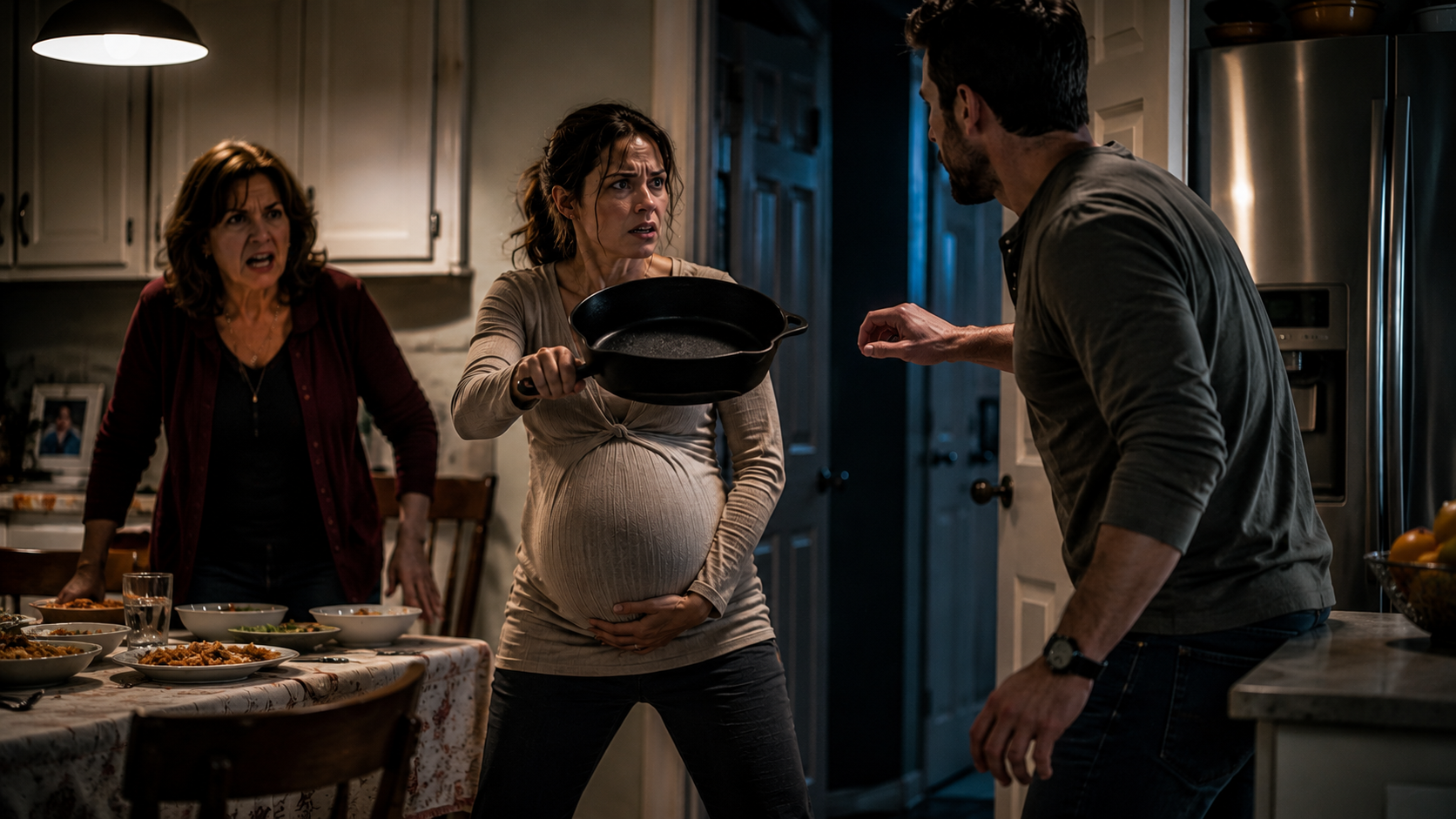
PART 1: THE MOMENT THE MASK FELL
My husband punched my eight-month-pregnant belly while his mother screamed for him to hit me again.
For one terrible second, I forgot how to breathe.
The kitchen disappeared.
The dinner table disappeared.
The woman shouting behind him disappeared.
There was only pain.
Deep, blinding pain.
And beneath it, one thought so powerful it drowned out everything else.
My baby.
I folded instinctively around my stomach, both arms wrapping across the place where my daughter had been moving only minutes before.
“Corey…”
My voice barely came out.
I stared at my husband and saw a stranger.
He stood less than three feet away from me beneath the cold fluorescent kitchen light, his chest rising and falling, his right hand still clenched.
Behind him, Lorraine—his mother—looked almost pleased.
“Hit her again!” she shouted.
That was the moment something inside me changed.
But the night had not begun with screaming.
It had begun with roast chicken.
That was what made it so difficult to accept afterward.
There had been potatoes on the table. Green beans. A pan of cornbread Lorraine had brought over wrapped in foil.
A normal family dinner.
The kind of meal that, from outside the window, might have looked warm.
Safe.
Ordinary.
But I had felt the tension from the moment Lorraine walked into our house.
I was thirty-four weeks pregnant, exhausted from twelve-hour hospital shifts I should probably have stopped working weeks earlier, and swollen enough that tying my own shoes had become a negotiation.
Still, I had cooked.
Not because I wanted to impress Lorraine.
I had given up on that years ago.
I cooked because Corey had asked me to.
“Just one peaceful dinner,” he had said that afternoon while I stood at the sink rinsing vegetables. “Mom’s excited about the baby. Try not to make everything an argument.”
I remember turning off the faucet.
“Try not to make everything an argument?”
“You know what I mean.”
“No, I don’t.”
He sighed like I was exhausting him.
That sigh had become familiar during my pregnancy.
Before I got pregnant, Corey had always described himself as close to his mother.
I thought I understood what that meant.
Sunday calls.
Holiday traditions.
Helping her when something broke at her house.
I had been raised to respect family loyalty. At first, I even admired it.
But after the pregnancy test turned positive, something shifted.
Lorraine stopped behaving like a grandmother waiting for a baby.
She behaved like someone awaiting the return of property.
She called the baby “our little Whitman.”
She bought nursery items without asking me.
She told people what hospital I would deliver at before I had told my own coworkers.
She criticized the names I liked.
She criticized breastfeeding.
She criticized the pediatrician I had chosen.
She even told me that after the birth, she would stay at our house for “at least six weeks” because I obviously wouldn’t know what I was doing.
I was a registered nurse.
I had spent years caring for newborns, postoperative patients, terrified families, dying parents, and people waking after surgeries they barely understood.
But according to Lorraine, I could not be trusted to change my own daughter’s diaper without instruction.
Every time I pushed back, Corey told me the same thing.
“She’s excited.”
Or:
“She means well.”
Or:
“You know how Mom is.”
That phrase had become a permission slip for anything.
You know how Mom is.
I did.
By eight months pregnant, I knew exactly how Lorraine was.
What I had not yet understood was how much of her lived inside my husband.
Dinner started quietly.
Lorraine complimented the chicken.
Corey talked about work.
I mostly listened.
My back hurt, the baby was pressing against my ribs, and all I wanted was a shower and bed.
Then Lorraine said, “I already packed my hospital bag.”
I looked up.
“Your what?”
“My hospital bag.” She smiled. “You could go into labor anytime now.”
I set down my fork.
“Why would you need a hospital bag?”
She laughed like I had made a joke.
“For the delivery.”
I looked at Corey.
He kept chewing.
“Lorraine,” I said carefully, “we talked about this.”
Her smile faded slightly.
“No. You talked.”
“I said I only want Corey in the delivery room.”
“Well, you’re hormonal.”
The fork in my hand went still.
“I’m not confused.”
“You might feel differently when the time comes.”
“I won’t.”
She leaned back.
“You have no idea what labor is like.”
“I work in a hospital.”
“That doesn’t mean you’ve given birth.”
“No. It means I know enough about my own comfort to decide who sees me during one of the most vulnerable moments of my life.”
Corey finally looked up.
“Can we not do this?”
I turned toward him.
“I’m not doing anything. I’m answering her.”
Lorraine gave a small laugh.
Not warm.
Not amused.
Something sharper.
“You know,” she said, “women these days think pregnancy makes them queens.”
I felt my daughter shift.
My palm moved automatically over my belly.
“I don’t think I’m a queen.”
“You certainly make enough demands.”
“Wanting privacy while I give birth isn’t a demand.”
“In our family, births are family events.”
I stared at her.
“This is my medical procedure.”
“That baby is a Whitman.”
The room seemed to change.
Corey stopped eating.
Lorraine placed her spoon down.
Then she picked it back up and struck it against the edge of the cast-iron skillet sitting on the table.
Metal hit metal with a hard, ugly sound.
“You really think you have a choice?” she asked.
Her voice had lost all sweetness.
“That baby is a Whitman. You are only carrying my family’s child.”
For a moment, I honestly thought I had misunderstood her.
Only carrying.
As if I were a container.
As if the little girl beneath my heart belonged to them while my body was nothing more than temporary housing.
I felt my face grow hot.
“No.”
Lorraine’s eyes narrowed.
I sat straighter despite the ache in my back.
“No, you will not be in that delivery room. This is my baby, my body, and my decision.”
Silence.
Heavy.
Absolute.
Then I looked at my husband.
I expected discomfort.
Maybe irritation.
Maybe even another lecture about keeping the peace.
What I expected was still the man I married.
“Corey?”
He slowly placed his fork on his plate.
“You embarrassed my mother.”
The sentence was so calm that it frightened me more than yelling would have.
“I embarrassed her?”
“You could’ve handled that differently.”
“I’ve handled it politely for months.”
“She’s the baby’s grandmother.”
“And I’m the baby’s mother.”
“You don’t have to throw that in her face.”
I almost laughed.
Not because anything was funny.
Because my mind had reached that strange place where reality becomes too absurd to process normally.
“Throw what in her face? The fact that I’m giving birth?”
His jaw tightened.
“Watch your tone.”
That frightened me.
Corey had never said those words to me before.
Not like that.
I pushed my chair back.
“I’m done with dinner.”
Lorraine spoke without looking away from me.
“Don’t let her walk away.”
I froze.
Corey stood.
My heartbeat changed immediately.
There are moments when the body understands danger before the mind accepts it.
I had seen it in patients.
A widening of the eyes.
A tremor in the fingers.
Breathing becoming shallow.
The nervous system screaming before the conscious mind catches up.
Corey moved between me and the kitchen doorway.
My husband was blocking my exit.
“Move,” I whispered.
“Sit down.”
“No.”
“We’re finishing this conversation.”
“There is no conversation.”
I stepped to the side.
He moved with me.
“Corey.”
“Stop acting dramatic.”
“Move.”
Lorraine remained at the table.
“Make her listen.”
I looked from her to him.
That was when I finally understood.
This was not a mother-in-law saying something cruel during an argument.
This was not a husband caught between his wife and his mother.
They were together.
I was the outsider.
“Corey,” I said, quieter now, “I’m pregnant.”
His face hardened.
“As if you ever let us forget.”
The words hurt almost as much as what came next.
I moved toward the doorway.
His hand closed around my upper arm.
Hard.
“Let go of me.”
“Stop.”
“You’re hurting me.”
I tried to pull free.
His grip tightened.
“Corey, let go.”
I twisted away, and he shoved me.
My lower back hit the counter.
Pain shot upward.
I gasped.
Both hands flew to my stomach.
“Please.”
I looked at him.
And I hated that I heard myself beg.
“You’re hurting the baby.”
For one second, I thought those words would reach him.
They didn’t.
He stepped closer.
Lorraine stood behind him.
“You’ve let her disrespect us long enough,” she said.
“Lorraine, stop this.”
She looked at me with open contempt.
“You came into this family and thought you could take my son away from me.”
“I never tried to take anybody away.”
“You controlled him.”
My mouth fell open.
Corey’s mother had shown up at our house without warning for years.
Corey took her calls during our anniversaries.
We had changed vacation plans because she “needed” him home.
I had swallowed frustration after frustration because I loved my husband.
And now I was being accused of controlling him.
“I have done everything I could to make room for you,” I said.
“That wasn’t your decision to make.”
“My marriage is my decision.”
Lorraine turned toward Corey.
“You hear that?”
He looked at me.
Not her.
Me.
And the expression on his face made my blood go cold.
“You always have to have the last word.”
“Corey, I am asking you to step away from me.”
“I said sit down.”
“No.”
His shoulder moved.
I saw the motion before I understood it.
Then his fist struck my stomach.
Pain tore through me.
I doubled over.
The sound that escaped me did not sound human.
My knees almost gave out.
My daughter.
My daughter.
My daughter.
I waited for her to move.
Nothing.
“Corey…”
Lorraine’s voice cut through the ringing in my ears.
“Hit her again!”
He raised his hand.
And I stopped being afraid of hurting his feelings.
Stopped being afraid of ending my marriage.
Stopped being afraid of what people would say.
Stopped wondering whether I could calm him down.
My hand swept blindly over the counter.
A towel.
A spoon.
The edge of a cutting board.
Then cold iron.
The skillet.
I wrapped my fingers around the handle and lifted it between us with both hands.
Corey stopped.
His eyes widened.
“What the hell are you doing?”
“Stay away from me.”
My voice shook.
But the skillet didn’t.
“Put that down.”
“Stay away.”
Lorraine moved closer behind him.
“You wouldn’t dare.”
I looked at her.
Then at my husband.
And something became perfectly clear.
They still believed I was asking permission.
I wasn’t.
“Come near me again,” I said, “and I will defend myself.”
Corey stared at me.
For the first time that night, I saw hesitation.
Not remorse.
Not concern for his unborn child.
Calculation.
That was somehow worse.
Then my daughter moved.
A tiny, weak roll beneath my palm.
Relief hit me so hard I almost sobbed.
She was alive.
And I was going to keep her that way.
Even if I had to walk through my husband to do it.
PART 2: THE WAY OUT
The skillet felt impossibly heavy in my hands.
My arms were trembling.
My stomach hurt where Corey had struck me, and every nurse instinct I possessed was screaming that I needed medical attention.
Now.
Placental abruption.
Preterm labor.
Fetal distress.
Internal injury.
Words from textbooks and emergency reports flashed through my head, each one worse than the last.
But before I could get to a hospital, I had to get out of my kitchen.
Corey took one slow step toward me.
I raised the skillet higher.
“Don’t.”
He stopped again.
“You’ve lost your mind.”
I almost couldn’t believe him.
“You punched a pregnant woman.”
“You shoved me first.”
I stared at him.
I had not.
We both knew I had not.
But he said it instantly.
Smoothly.
Like he was already rewriting the story.
Lorraine jumped in.
“I saw it.”
My eyes moved to her.
She crossed her arms.
“You attacked him.”
There it was.
The first draft of the lie.
I understood immediately what would happen if I stayed.
By morning, I would be unstable.
Hormonal.
Aggressive.
Dangerous.
Lorraine would repeat it until Corey believed his own version.
Maybe he already did.
I backed toward the side counter where my phone lay beside a stack of unopened mail.
Corey noticed.
“No.”
He moved.
I swung the skillet—not at him, but hard against the cabinet beside his shoulder.
The crash thundered through the kitchen.
He jerked back.
“Stay away from me!”
For the first time, my voice came out strong.
Lorraine flinched.
Corey cursed.
I grabbed my phone.
My thumb shook so badly I nearly dropped it.
“What are you doing?” Corey demanded.
I unlocked the screen.
“Calling 911.”
His expression changed.
Not into fear.
Into outrage.
“You’re calling the police on me?”
“You hit me.”
“You’re my wife!”
“As if that makes it better?”
Lorraine stepped forward.
“Think carefully about what you’re doing.”
I almost laughed again.
That strange, shocked laugh.
“I am.”
“You call the police and destroy this family, you will regret it.”
I looked at Corey.
He said nothing.
Not, Mom, stop.
Not, I’m sorry.
Not, Are you hurt?
He was watching my phone.
That told me everything.
I dialed.
When the dispatcher answered, my voice cracked.
“I’m eight months pregnant. My husband hit me in the stomach.”
Corey swore under his breath.
The dispatcher immediately asked whether I was in immediate danger.
“Yes.”
My eyes stayed on Corey.
“He’s still here.”
“Do you have a safe way to leave the home?”
The front door was beyond Corey.
The back door was through the laundry room at the far side of the kitchen.
Lorraine stood closer to that route, but she was not physically blocking it.
“Yes.”
“Can you move toward the exit?”
I gripped the skillet.
“Yes.”
Corey stepped forward.
I raised it.
The dispatcher heard me say, “Stay away from me.”
Her voice became firmer.
“Do not engage him if you can safely leave.”
I began moving sideways.
Corey followed.
“You’re really doing this?”
I kept moving.
“After everything I’ve done for you?”
My chest ached.
There are sentences that end marriages.
Sometimes they are confessions.
Sometimes they are betrayals.
Sometimes they are simply the wrong words spoken at the one moment when the truth can no longer hide.
After everything I’ve done for you.
Not I’m sorry.
Not I hurt you.
Not Is our baby okay?
His concern was himself.
His reputation.
His consequences.
I reached the laundry room.
Lorraine moved toward me.
“Give me that phone.”
“No.”
“You’re hysterical.”
I almost smiled.
I had heard that word before.
Not from patients.
From men describing women who were terrified.
Women who had been pushed beyond endurance and then punished for reacting.
I had never imagined it would be used on me.
“I’m not hysterical,” I said. “I’m leaving.”
“You’re not taking my granddaughter anywhere.”
That sentence stopped me colder than the threat before it.
My granddaughter.
Not your daughter.
Not the baby.
Mine.
Something in Lorraine’s eyes told me she meant it.
I shoved open the back door.
Cool night air hit my face.
Corey lunged.
I did not swing at him.
I held the skillet between us and screamed.
“BACK UP!”
He stopped.
Maybe it was the sound.
Maybe it was the fact that neighbors could hear us now.
Maybe he finally realized that once other people witnessed the situation, he could not control the narrative so easily.
A porch light came on next door.
Then another.
Good.
Let them see.
Let everyone see.
I stepped into the backyard.
Barefoot.
I had forgotten my shoes.
I didn’t care.
Gravel bit into my feet as I moved toward the side gate.
The dispatcher stayed with me.
“Officers are on the way. Are you bleeding?”
“No.”
“Are you having contractions?”
“I don’t know.”
My voice broke.
“My stomach hurts.”
“Stay on the line.”
I opened the gate.
Corey appeared at the back door.
“Come inside!”
I kept moving.
“Stop embarrassing us!”
Even then.
Embarrassment.
That was what he cared about.
A woman from across the street stepped onto her porch.
I knew her only enough to wave when collecting mail.
She saw me.
Saw the skillet.
Saw my pregnant stomach.
Saw Corey shouting from the house.
Her face changed.
“Are you okay?”
“No,” I shouted.
That one word almost broke me.
Because it was the first honest answer I had given anyone about my marriage in months.
No.
I was not okay.
Maybe I had not been okay for a long time.
I reached the sidewalk.
Sirens sounded in the distance.
Corey disappeared back inside.
Lorraine followed.
Of course they did.
They needed time to agree on their version.
I stood under a streetlamp in my socks, one hand holding my phone and the other wrapped around the cast-iron skillet like it was the only solid object left in my life.
Then my abdomen tightened.
Hard.
I sucked in a breath.
The dispatcher asked what happened.
“I think I’m having a contraction.”
“Sit down somewhere safe.”
I lowered myself onto the curb.
Another tightening came.
Fear flooded me.
Too early.
Please.
Please, sweetheart.
Stay with me.
I placed my palm against my belly.
“Move for Mommy.”
Nothing.
Tears filled my eyes.
“Please move.”
The police car turned onto our street.
A second vehicle followed.
Someone came running toward me.
I barely noticed.
All I could feel was my own hand pressed against my stomach.
Then—
A kick.
Stronger this time.
Right against my palm.
I sobbed.
The skillet slipped from my fingers and landed in the grass.
My daughter was still fighting.
So was I.
When the officers approached, I gave them my name and told them exactly what happened.
No softening.
No protecting Corey.
No phrases like we had a disagreement.
No things got out of hand.
I knew how victims sometimes changed words to survive the shame.
I had heard it in emergency rooms.
I had watched bruised women glance toward doors before answering questions.
I had wondered why they defended people who hurt them.
That night, sitting beneath a streetlight with my stomach aching, I understood.
Because telling the truth destroys the world you had been trying to preserve.
And sometimes the lie feels easier than admitting there was never a safe home to return to.
One officer went inside.
Another stayed with me until paramedics arrived.
They asked questions I had asked patients myself.
Where did he strike you?
Did you fall?
Any vaginal bleeding?
Loss of fluid?
Dizziness?
Difficulty breathing?
I answered automatically.
Clinically.
Until one paramedic said, “We need to transport you for monitoring.”
Then I looked toward the house.
Corey had come outside.
An officer stood beside him.
His face was furious.
Not scared.
Not ashamed.
Furious.
Lorraine stood in the doorway.
She was staring at me like I had betrayed them.
I realized then that neither of them understood what had happened.
They thought the worst thing I had done was call the police.
They still did not understand that the worst thing they had done was teach me I could never safely return to them.
The ambulance doors closed.
For the first time in years, Corey could not follow me.
And for the first time that night, I let myself cry.
PART 3: THE HEARTBEAT
Hospitals sound different when you are the patient.
I had worked around monitors for years.
I knew every beep.
Every alarm.
Every squeak of rubber wheels against polished floors.
I knew the smell of disinfectant and coffee at two in the morning.
I knew how nurses lowered their voices before delivering bad news.
I knew how doctors entered rooms when they were worried.
Knowledge is comforting until the danger belongs to you.
Then every familiar sound becomes a warning.
They took me directly to labor and delivery.
My work badge was still clipped to my pants.
I had forgotten I was wearing it.
One of the nurses noticed.
“You’re an RN?”
I nodded.
“Which unit?”
I told her.
Her expression softened.
That made everything worse.
Because suddenly I was not a nurse.
I was a woman in a hospital gown with marks forming on her arm and pain across her abdomen, waiting to learn whether her husband had injured their unborn child.
They strapped monitors around my stomach.
I watched the nurse search for the heartbeat.
Seconds passed.
Too many.
I knew they were not actually too many.
I knew babies moved.
I knew positioning mattered.
I knew panic distorted time.
None of that knowledge helped.
“Come on,” I whispered.
The nurse adjusted the monitor.
Then the room filled with the most beautiful sound I had ever heard.
Fast.
Steady.
Strong.
My daughter’s heartbeat.
I covered my face and sobbed.
The nurse placed a hand on my shoulder.
“She’s there.”
I nodded, unable to speak.
She’s there.
Those two words became the center of my world.
The contractions continued.
Not regular enough to mean active labor, but enough to keep everyone watching.
The physician examined me and ordered continued monitoring.
They were concerned about the abdominal trauma.
So was I.
I knew what they were looking for.
I also knew enough not to pretend I could diagnose myself.
So I did something nurses are notoriously terrible at doing.
I stopped trying to control the medical side of the room.
I let them care for me.
Hours passed.
A bruise began darkening where Corey had hit me.
Another appeared along my upper arm where his fingers had dug into my skin.
A police officer came to take a fuller statement.
This time, I did not hold a skillet.
I held a paper cup of water.
My hands still shook.
“Can you tell me what happened from the beginning?”
I could.
That was the problem.
I remembered everything.
Lorraine hitting her spoon against the skillet.
That baby is a Whitman.
Corey standing in the doorway.
You embarrassed my mother.
His hand around my arm.
My back against the counter.
The punch.
Lorraine screaming for another.
I told the officer all of it.
When I finished, she asked, “Has he hit you before?”
“No.”
The answer came quickly.
Then I hesitated.
“No,” I repeated. “Not like that.”
She waited.
I stared at the blanket covering my legs.
Had Corey hurt me before?
Not with his fist.
But he had grabbed my wrist during an argument two months earlier.
He released me immediately and said I was exaggerating when I complained.
He had blocked doors before.
Once, when I wanted to leave his mother’s house after Lorraine called me selfish, Corey stood in front of the car until I agreed to go back inside and apologize.
He had punched a wall during my second trimester because I refused to let Lorraine choose the nursery furniture.
I had told myself none of those things counted.
Stress.
Temper.
Pregnancy pressure.
Family problems.
I had categorized each warning separately so I would never have to see the pattern.
“He’s grabbed me,” I finally said.
The officer’s pen moved.
“He’s blocked me from leaving.”
More writing.
“He punched a wall once.”
“Did you feel afraid of him then?”
I wanted to say no.
Instead, I remembered cleaning drywall dust from the floor while Corey told me I had caused him to lose control.
“Yes.”
The word came out quietly.
“Yes, I did.”
The officer nodded.
Not triumphantly.
Not judgmentally.
Just acknowledging the truth I had finally said aloud.
“Do you have somewhere safe to stay when you’re discharged?”
I looked toward the dark hospital window.
My reflection stared back at me.
Pale face.
Messy hair.
Hospital gown.
Pregnant belly beneath straps and wires.
“I’m not going back there.”
That much I knew.
The house was in both our names.
My clothes were there.
The nursery was there.
The crib I had assembled with Corey was there.
The little stack of newborn diapers.
The blanket I had folded across the rocking chair.
My entire image of the future was inside that house.
But I would not take my daughter back into a place where her father had punched her before she was even born.
“No,” I repeated. “I’m not going home to him.”
The officer gave me information about requesting a protective order and retrieving belongings safely.
Normally, I might have been embarrassed that I needed those instructions.
That night, embarrassment seemed like a luxury.
I had more important things to survive.
My phone had been placed on the bedside table.
It vibrated again.
And again.
And again.
Corey.
Then Lorraine.
Then Corey.
I did not answer.
Eventually, Corey left a voicemail.
I stared at the notification for several minutes before listening.
His voice began soft.
“Hey. I know things got crazy.”
I closed my eyes.
Things got crazy.
Not I hit you.
“Mom was upset. You were upset. Everybody said things they didn’t mean.”
My jaw tightened.
Then came the sentence I had almost expected.
“But you can’t involve the police in private family problems.”
I opened my eyes.
There it was.
The version of reality he needed me to accept.
He continued.
“You need to call me. We need to figure out how to fix this before you ruin everything.”
Before I ruined everything.
My hand moved over the bruise forming beneath my gown.
The voicemail ended.
A minute later, Lorraine left one.
I should not have listened.
I did anyway.
“You have gone too far.”
No greeting.
No concern.
No question about the baby.
“You need to tell the police this was a misunderstanding. Corey could lose everything because you decided to throw a fit. And remember, you are carrying his child. You cannot cut this family out just because you’re angry.”
I stopped the recording.
For several seconds, I stared at the phone.
Then something extraordinary happened.
I stopped doubting myself.
Until then, there had been tiny moments of confusion.
Could I have said something differently?
Should I have left the table sooner?
Had I provoked Corey by picking up the skillet?
Should I have stayed calmer?
That is what shock does.
It searches for a version of events in which you had enough control to prevent what happened.
But Lorraine’s message erased the last of that confusion.
They were not sorry.
They were not frightened by what they had done.
They were frightened by consequences.
That difference mattered.
I saved both messages.
Not as some clever plan.
Not because I suddenly became an investigator.
I saved them because I knew I could not allow myself to forget who they were when they believed I was still weak enough to return.
Near dawn, the contractions slowed.
The fetal monitor remained reassuring.
No immediate sign told the doctors that I would deliver that night.
Relief came carefully.
No one promised me everything was fine forever.
Pregnancy did not work that way.
Trauma did not work that way.
But my daughter was still inside me.
Her heartbeat remained strong.
When the nurse finally unstrapped the monitor for a while, I placed both hands over my stomach.
“I’m sorry,” I whispered.
Tears slid into my hair.
“I’m so sorry I didn’t see it sooner.”
She moved beneath my hands.
I swallowed.
Then I made her the first promise I knew I would keep no matter what it cost.
“I will never make you grow up believing love is supposed to hurt.”
The door opened.
For a terrifying second, I expected Corey.
Instead, it was the nurse.
She carried paperwork.
“Someone is asking to see you,” she said.
My body stiffened.
“Who?”
“Your mother-in-law.”
My blood went cold.
“She says she’s family.”
I looked at the nurse.
“She is not coming into this room.”
The nurse nodded immediately.
“Okay.”
“No matter what she says.”
“She won’t be allowed in without your permission.”
I let out a shaky breath.
The nurse turned toward the door.
Then I said, “Wait.”
She looked back.
“Tell her something for me.”
I thought of Lorraine sitting at my dinner table.
You really think you have a choice?
I looked down at my daughter.
Then back at the nurse.
“Tell her I do.”
PART 4: WHAT THEY CALLED FAMILY
Lorraine stayed in the waiting area for almost an hour.
I knew because hospital security eventually informed me they had asked her to leave.
She had argued.
Of course she had.
She claimed she had a right to see her grandchild.
My daughter had not even been born yet, and Lorraine was already acting as if motherhood were a position she could overrule.
But she had made one mistake.
She had spent years teaching me that keeping peace mattered more than keeping boundaries.
The moment Corey hit me, peace stopped being my responsibility.
I was discharged later that morning with instructions to return immediately if I experienced bleeding, fluid loss, worsening pain, decreased fetal movement, regular contractions, or any other concerning symptom.
I knew the list.
I listened anyway.
Then I left the hospital without my husband.
That sentence felt impossible.
I had entered pregnancy believing Corey would hold my hand through labor.
I had imagined him cutting the cord.
I had imagined photographs.
Our first night home.
His face when our daughter opened her eyes.
Now I could not picture him near me without seeing his fist.
Grief is strange when the person you are grieving is still alive.
I mourned the husband I thought I had.
But I was beginning to understand that the man I missed might never have existed in the way I believed.
Maybe pieces of him had.
The man who brought me soup when I had the flu.
The man who danced badly in our kitchen when we first moved in.
The man who cried when I showed him the positive pregnancy test.
Those memories were real.
That was part of what hurt.
Abusive people are not monsters every second of every day.
If they were, nobody would love them.
Nobody would stay long enough to become confused.
The good memories had not been fake.
They simply had not been proof that I was safe.
I spent the next few days somewhere Corey could not easily reach me.
I turned off location sharing.
Changed passwords he knew.
Contacted my hospital and made sure he was no longer listed as someone who could receive information about me.
I requested protection from further contact.
Each decision felt small compared with what had happened in the kitchen.
But together, they became a wall.
Corey hated the wall.
His messages changed quickly.
First came apologies.
“I’m sorry.”
“I wasn’t myself.”
“I would never intentionally hurt the baby.”
“We both made mistakes.”
Then bargaining.
“We can go to counseling.”
“Mom will apologize.”
“You don’t have to throw away our marriage.”
Then anger.
“You’re keeping my child from me.”
“You’re making me look like a monster.”
“You know I’m not abusive.”
Then guilt.
“How can you do this to me when we’re about to become parents?”
The question almost made me angry enough to call him.
Almost.
Instead, I wrote one sentence on a piece of paper and kept it beside my phone.
He punched me while I was pregnant.
Whenever I began remembering only the good parts, I read it.
Whenever I wondered whether I had overreacted, I read it.
Whenever Lorraine left another message accusing me of destroying the family, I read it.
He punched me while I was pregnant.
Facts are useful when manipulation tries to rewrite memory.
Corey’s favorite argument was that it had happened only once.
As if one punch to a pregnant stomach were an acceptable number.
Lorraine’s favorite argument was that I had “provoked” him.
As if saying no to her presence in my delivery room were violence.
The more they spoke, the clearer everything became.
The delivery room argument had not caused the attack.
It had exposed the belief underneath our marriage.
Corey believed my boundaries were valid only when they did not disappoint his mother.
Lorraine believed my motherhood existed beneath her authority.
And both of them believed that when I resisted, force could return me to my proper place.
Once I understood that, I could not misunderstand it again.
A week passed.
Then another.
My body healed faster than my mind.
The bruises faded from purple to yellow.
The soreness eased.
But every unexpected sound made my heart race.
If someone walked too quickly behind me, I tensed.
If my phone rang late at night, my palms went cold.
At work, I had seen trauma.
I understood trauma.
Understanding did not make me immune to it.
The hardest moments came at night.
My daughter would move beneath my ribs, and I would remember the silence after Corey hit me.
Those few seconds when I had waited for her to move.
I would lie awake with one hand on my belly until she kicked.
Only then could I breathe.
At thirty-seven weeks, I returned for an appointment.
The doctor listened to the heartbeat.
Everything looked reassuring.
“You’re close,” she told me.
I smiled weakly.
Close.
The word carried excitement and terror.
Because labor meant I would meet my daughter.
It also meant confronting the decision that had started everything.
Who would be allowed in the room?
The answer was simpler now.
Not Corey.
Not Lorraine.
I had originally wanted my husband beside me because I believed he was the person who would make me feel safest.
Now his presence would do the opposite.
So I made my wishes clear.
My medical team knew there were safety concerns.
No information was to be given out.
No visitors without my approval.
The hospital where I had spent years caring for other people became a fortress around me before I ever needed it.
Lorraine learned somehow that I had changed the birth plan.
Her voicemail arrived that evening.
“You are punishing Corey by taking away the birth of his first child.”
I deleted it.
Another came.
“You cannot erase him as the father.”
Deleted.
Then:
“If you have that baby without telling us, you will regret what happens afterward.”
I stopped.
My finger hovered above the screen.
The old me would have listened again.
Analyzed her tone.
Wondered what she meant.
Tried to determine whether I was being unfair.
The woman holding the skillet in the kitchen had no interest in decoding threats.
I documented the message and forwarded what was necessary through the proper legal channels.
Then I blocked her.
Three nights later, my water broke at 2:13 in the morning.
There was no cinematic rush.
No screaming.
I woke because something felt wrong, sat up, and immediately knew.
For a few seconds I simply stared into the darkness.
Then fear climbed into my throat.
This was it.
I was going to have my baby.
And the man I had once expected to be beside me would not be there.
I put my feet on the floor.
A contraction tightened across my abdomen.
I breathed through it.
Another came several minutes later.
I gathered my bag.
My hands shook when I zipped it.
Inside were tiny clothes.
A soft blanket.
A hat.
Items I had packed in a different life.
I stood beside the door for one moment, looking back.
Then I placed a hand over my stomach.
“Okay, baby girl.”
My voice trembled.
“It’s you and me.”
But for the first time, those words did not feel lonely.
They felt strong.
At the hospital, the nurses already knew my situation.
No one made me explain everything while contracting.
No one asked why my husband was not there.
They simply protected the space around me.
Labor hurt in ways I had known intellectually but never physically.
Hours blurred.
Breathing.
Pressure.
Monitors.
Voices.
Water.
Pain.
Rest.
More pain.
At one point, exhausted and shaking, I thought of Corey.
Not because I wanted him there.
Because grief does not obey logic.
I remembered the day we painted the nursery.
He had gotten blue paint on his cheek even though we were painting the walls cream.
I had laughed so hard I cried.
He kissed my stomach and said, “I can’t wait to meet her.”
I cried then too.
A nurse asked if I needed anything.
I shook my head.
“No.”
What could I ask for?
Could someone give me back the version of my marriage I believed in?
Could someone separate the memory of his joy from the memory of his violence?
No.
Some losses cannot be repaired.
They can only be survived.
The contraction peaked.
I gripped the rail.
Then another memory came.
Corey standing in the kitchen.
Lorraine behind him.
His fist.
My daughter’s silence.
And the grief changed shape.
I stopped wishing he were there.
I became grateful he wasn’t.
Hours later, the room filled with urgent encouragement.
“One more.”
I cried out.
“I can’t.”
“Yes, you can.”
I had said those words to patients.
Now someone said them to me.
I gathered whatever strength remained.
I pushed.
And then—
A cry.
Sharp.
Angry.
Alive.
The room changed instantly.
I began sobbing before they even placed her against me.
My daughter.
Warm.
Small.
Real.
She cried against my chest.
I touched her face with shaking fingers.
“Hi.”
That was all I managed.
“Hi, baby.”
Her tiny hand opened against my skin.
I counted her fingers even though I could see they were all there.
I kissed her forehead.
The world narrowed to her breathing.
Her warmth.
The weight of her against me.
For months Lorraine had called her a Whitman.
As if a family name gave ownership.
But holding my daughter, I understood something Lorraine never had.
Love was not ownership.
Love did not demand access.
Love did not ignore boundaries.
Love did not strike someone and call obedience forgiveness.
Love protected.
Sometimes love meant holding on.
Sometimes it meant letting go.
And sometimes love meant standing in a kitchen with a cast-iron skillet and refusing to let the person you married take one more step toward you.
The nurse asked quietly, “Do you want us to notify anyone?”
I looked at my daughter.
“No.”
Then I reconsidered.
“There is one thing.”
The nurse waited.
“If anyone named Corey Whitman or Lorraine Whitman comes asking for me, I want security called.”
Her answer was immediate.
“Absolutely.”
My daughter yawned.
I smiled through tears.
For the first time since that dinner, I felt safe enough to close my eyes.
PART 5: THE WOMAN THEY COULD NOT BREAK
Corey learned his daughter had been born without him.
That was the consequence he talked about most.
Not the bruise he left on my body.
Not the terror he caused.
Not the fact that his daughter’s heartbeat had to be monitored because he struck the woman carrying her.
He focused on what had been taken from him.
The birth.
The first photograph.
The right to stand beside the bed.
But those things had not been taken from him without reason.
He had surrendered them the moment he turned himself from my support person into my greatest danger.
Our legal separation became real before I was emotionally ready for the word.
I had once believed ending a marriage required the death of love.
It does not.
Sometimes you can still love the memory of someone and know you must never live with them again.
Sometimes leaving is not proof that you feel nothing.
Sometimes it is proof that you finally value your safety more than your hope.
Corey tried to apologize.
A real apology this time, or something closer to one.
He admitted he had hit me.
He said he had been angry.
He said his mother had spent years telling him I was separating him from the family.
He said he felt trapped between us.
I listened only because there were practical matters that had to be handled.
When he finished, I asked one question.
“Did your mother move your arm?”
Silence.
“Did she close your fist?”
“No.”
“Did she make you hit me?”
“No.”
I swallowed.
“Then whatever influence she had on you, the hand was yours.”
He began crying.
Years earlier, that would have destroyed me.
I hated seeing Corey cry.
I used to cross rooms to comfort him.
That day, I stayed where I was.
“I’m sorry,” he said.
“I believe you’re sorry now.”
His eyes lifted with hope.
I continued.
“But being sorry doesn’t make you safe.”
The hope disappeared.
“You really won’t give me another chance?”
“You had another chance after you grabbed my wrist.”
His face changed.
“You had another chance after you blocked the door.”
“That wasn’t—”
“You had another chance after you punched the wall.”
“I never hit you then.”
“No. You taught me what might happen if I kept saying no.”
He looked down.
“And then I said no to your mother, and you proved me right.”
He had nothing to say.
That was our final real conversation about the marriage.
Lorraine never apologized.
Not truly.
She sent messages through relatives before I made it clear that I would not discuss the situation through anyone.
According to her, I was cruel.
Vindictive.
Unstable.
I had “stolen” her son’s child.
She told people I had attacked Corey with a skillet.
That part was technically easy to say because I had lifted one.
She simply left out the reason.
She left out the locked doorway.
The bruise.
The punch.
The command she screamed seconds before I picked it up.
But I learned something important in the months that followed.
You do not have to attend every trial held in someone else’s imagination.
I stopped defending myself to people determined not to understand.
The people who mattered knew enough.
More importantly, I knew.
The legal consequences did not erase what happened.
Nothing could.
But the incident no longer belonged only to the kitchen, hidden behind a closed door.
There were reports.
Medical documentation.
Protective boundaries.
There were professionals who had heard me say what happened.
For once, Corey and Lorraine could not simply decide on a version of events and force me to live inside it.
My daughter grew.
That became the real ending.
Not courtrooms.
Not arguments.
Not Lorraine’s anger.
My daughter.
The baby I thought I might lose that night became a loud, determined little person who hated socks and slept best with one fist beside her cheek.
During those first weeks, I sometimes stared at her while she slept.
I would remember the kitchen.
The sound of Lorraine’s spoon striking iron.
The look in Corey’s eyes.
The terrifying silence after the punch.
Then my daughter would stretch or sigh, and I would return to the present.
I had saved us.
It took me months to say that without guilt.
At first, I told myself the police saved me.
The paramedics saved me.
The hospital saved my daughter.
And they did help.
I will never minimize that.
But before any siren came down my street, I made a choice.
I picked up the skillet.
I said stop.
I called 911.
I walked out the door.
I told the truth.
I refused to go back.
Those choices were mine.
That mattered.
One afternoon, several months after my daughter was born, I unpacked one of the last boxes from the house I had shared with Corey.
Most of my belongings had been retrieved without me being alone with him.
I had avoided that kitchen.
I had no desire to see it again.
Inside the box were pots, serving dishes, a few utensils.
And at the bottom, wrapped in an old dish towel, was the cast-iron skillet.
I stopped breathing for a second.
I had not asked for it.
I had not even thought about it.
Yet there it was.
Heavy.
Black.
Ordinary.
I lifted it carefully.
For a moment, I was back beneath those fluorescent lights.
Corey moving toward me.
Lorraine behind him.
My daughter silent inside me.
My own voice saying, Stay away.
I expected fear.
Instead, I felt something else.
Grief.
Then anger.
Then gratitude.
Not toward the skillet itself.
Toward the woman who picked it up.
I barely recognized her now.
She was terrified.
Barefoot.
Pregnant.
Bruised.
But she had understood something before the rest of me caught up.
No one was coming into that kitchen to give her permission to survive.
She had to choose herself.
I carried the skillet to my new kitchen.
My daughter was asleep nearby.
Sunlight filled the room.
Not fluorescent light.
Warm afternoon sunlight.
For several minutes, I considered throwing the skillet away.
Maybe that would have been symbolic.
A clean break.
A dramatic ending.
But I was tired of letting that night decide what ordinary objects meant.
So I washed it.
Dried it.
Rubbed a thin layer of oil over the surface.
Then I put it in the cabinet with the rest of my cookware.
A skillet was just a skillet.
A kitchen could become safe again.
A life could become mine again.
Healing, I discovered, was not one brave moment.
It was hundreds of small decisions afterward.
Answering the phone when my attorney called even though my stomach tightened.
Going back to work.
Letting another person hold my baby while I showered.
Sleeping without checking the locks three times.
Learning not to apologize whenever I said no.
Trusting my own memory.
Trusting my instincts.
Trusting silence when silence was peaceful instead of dangerous.
The hardest lesson was understanding that boundaries do not become cruel simply because someone else hates them.
Lorraine taught me that by fighting every boundary I ever set.
Corey taught me that by trying to punish me for one.
My daughter taught me why I could never surrender them again.
Years from now, she may ask about her father.
I will tell her the truth in whatever way is appropriate for the age she is then.
I will not teach her to hate him.
I will not make her carry my rage.
But I will never lie to protect the image of a man who endangered us.
I will teach her something better.
That love without safety is not enough.
That family does not own your body.
That marriage does not erase consent.
That becoming angry at someone’s boundary does not give you permission to cross it.
That a person can apologize and still face consequences.
That forgiveness, if it ever comes, is not the same as reconciliation.
And that sometimes the strongest word a woman can learn is not yes.
It is no.
No, you may not be in the delivery room.
No, you may not decide what happens to my body.
No, you may not block the door.
No, you may not hurt me.
No, you may not rewrite what happened.
No, I am not coming back.
I used to think courage felt powerful.
It doesn’t always.
Sometimes courage is shaking so badly you can barely hold your phone.
Sometimes it is sitting barefoot on a curb praying your unborn baby will kick.
Sometimes it is hearing the person you love apologize and knowing love cannot make you trust him again.
Sometimes courage feels exactly like terror, except you keep moving anyway.
The night Corey hit me, Lorraine believed she was watching her son teach me my place in their family.
She was right about one thing.
I learned my place.
It was not beneath her.
It was not behind Corey.
It was not trapped inside a house where obedience was called love.
My place was beside my daughter.
Standing between her and anyone who believed they had the right to harm us.
Corey thought raising his fist would make me easier to control.
Lorraine thought humiliation would make me surrender.
Instead, they gave me the one truth I had been too afraid to face.
My marriage was not worth dying for.
My daughter was worth living for.
And the woman standing in that kitchen—the woman with one hand protecting her unborn child and the other wrapped around the handle of a cast-iron skillet—was not weak.
She had never been weak.
She had simply spent too long confusing endurance with love.
I know the difference now.
And neither of them will ever make me forget it again.
Để lại một bình luận