
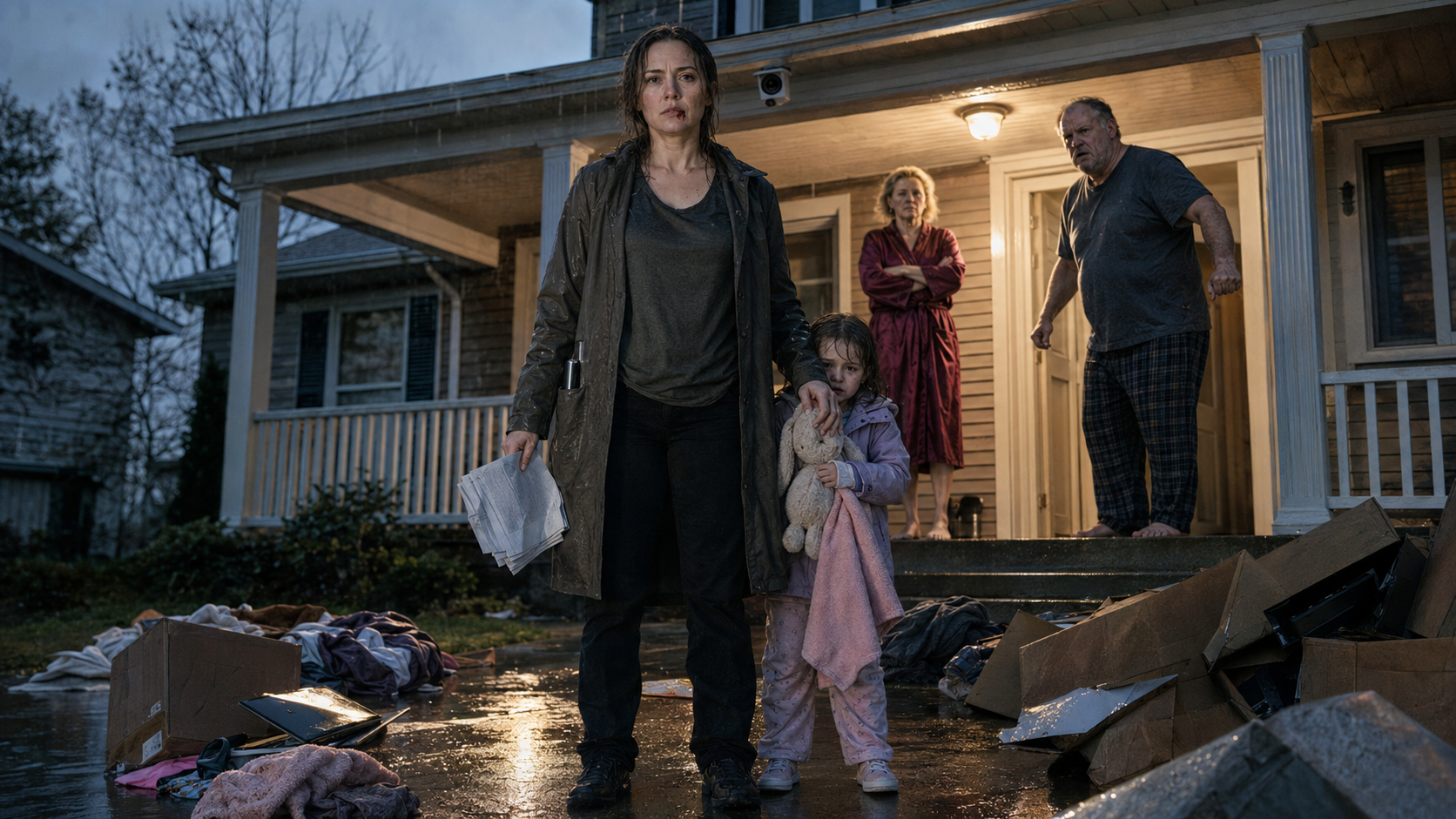
My parents thought one slap would finally teach me to obey. Instead, it taught me exactly what I had to do.
PART 1: THE SLAP
The slap split my lip open before I even understood my father had moved.
One second I was standing in the driveway holding my five-year-old daughter’s hospital discharge papers.
The next, I was on one knee in the rain, one palm pressed against the wet concrete, tasting blood.
Behind me, Hazel screamed.
“Mommy!”
That sound hurt worse than the slap.
I looked up.
My father, Harrison, stood over me with his thick hands curled into fists. His chest rose and fell beneath his old gray sweatshirt as if I had attacked him instead of the other way around.
My mother, Eleanor, stood on the porch in a silk robe.
She didn’t look shocked.
She smiled.
“Maybe now you’ll obey,” Harrison said.
Rain ran down my face and mixed with the blood on my chin.
I had just spent nearly six hours in the emergency room with Hazel after an asthma attack.
She was exhausted.
I was exhausted.
All I had wanted was to get her home, give her the medication the doctor prescribed, wrap her in the little pink blanket she always slept with, and sit beside her until she stopped being frightened.
Instead, almost everything we owned was scattered across my parents’ front lawn.
Cardboard boxes sagged in the rain.
My clothes lay half inside one of them.
Hazel’s shoes were soaked.
Her school backpack had landed in a puddle.
My work laptop sat beneath a dripping hedge.
And there, beside the driveway, was the pink blanket she had clutched against her chest in the ER.
Thrown outside like garbage.
My mother pointed at the boxes.
“You heard me. Pay her rent or get out.”
I stared at her.
“Her rent?”
She slapped one hand against her own chest.
“Mine. Two thousand dollars. Tonight.”
I slowly stood.
My knees felt weak, but I refused to let Harrison see it.
“You threw a sick child’s medication outside.”
“Don’t be dramatic.”
“Hazel was in the emergency room.”
“And that means everyone has to stop living because your daughter has asthma?”
Hazel made a small sound behind me.
I turned immediately.
She was standing beside my car with her stuffed rabbit clutched against her chest. One of its ears was soaked from the rain.
She looked terrified.
Not sick anymore.
Terrified.
Of my parents.
Of her grandparents.
That realization burned through whatever shock the slap had left inside me.
I reached for her.
“Come here, baby.”
She ran into my arms.
My father stepped forward.
“You’re not finished talking to us.”
I moved Hazel behind me.
“Yes, I am.”
His face changed.
Harrison had always hated that answer.
Growing up, I had learned there were only two acceptable responses in my parents’ house.
Yes.
Or silence.
Anything else was disrespect.
At thirty-three years old, I was still supposed to remember that.
My mother folded her arms.
“You’ve been living here for free long enough.”
I stared at her.
“For free?”
“Yes.”
“I paid your mortgage for eight months.”
Her eyes flickered.
Only for a second.
But I saw it.
The first of every month, money left my account.
Not a few hundred dollars for groceries.
Not some casual contribution.
The mortgage.
Eight months.
My parents had called it helping the family.
They had told me there was no reason for me to pay rent to some stranger when they had room upstairs.
So instead of paying rent elsewhere, I covered their mortgage while Hazel and I lived in two bedrooms at the end of the hall.
It had never been free.
And they knew it.
My father stepped closer.
“Don’t talk back to your mother.”
I looked at the blood on my fingers.
“You hit me in front of my daughter.”
His jaw hardened.
“Because you don’t listen.”
Hazel began crying again.
“Grandpa, stop.”
He didn’t even look at her.
That was the moment something inside me went completely still.
People often think fear always looks like panic.
Mine doesn’t.
When I am truly frightened, I become quiet.
I notice things.
Doors.
Phones.
Faces.
What people said five minutes earlier.
What they might deny five minutes later.
My parents had always mistaken that quiet for surrender.
My mother smiled down at me.
“You have one hour.”
“For what?”
“To transfer two thousand dollars.”
“You’re serious?”
“Cash, transfer, I don’t care.”
She leaned forward.
“Otherwise I call the police and tell them you attacked your father.”
I thought I had misheard her.
“You would lie to the police?”
Eleanor laughed.
“Who do you think they’re going to believe? A single mother with no house? Or us?”
My father smirked.
That was when my eyes lifted past them.
Above the porch was a small security camera.
I had installed it.
Months earlier, Harrison became convinced teenagers from the neighborhood were stealing tools from his garage.
Nobody had stolen anything, as far as I knew, but I ordered a camera anyway because listening to him complain every morning had become easier than arguing.
The system uploaded recordings automatically.
My parents knew there was a camera.
But they had apparently forgotten exactly where it pointed.
Straight across the driveway.
Straight at us.
Then I remembered something else.
My phone.
It was still inside the front pocket of my coat.
Recording.
I had started an audio recording while driving home from the hospital because I wanted to remember the discharge instructions I had repeated to myself at a red light.
When I pulled into the driveway and saw our belongings outside, I never stopped it.
My mother’s demand.
My father’s warning.
The slap.
“Maybe now you’ll obey.”
Her threat to lie to police.
All of it.
Harrison noticed me looking toward the porch.
“What are you staring at?”
I lowered my eyes.
“Nothing.”
My mother mistook that for defeat.
“There. Now you’re thinking sensibly.”
She held out her hand.
“Phone.”
“What?”
“If you’re transferring the money, do it now.”
I almost laughed.
The audacity of it was breathtaking.
My daughter had just left an emergency room.
Our belongings were being destroyed by rain.
My mouth was bleeding because my father had struck me.
And my mother still believed this was a negotiation.
I walked past them.
Eleanor blocked the porch steps.
“You are not coming back into this house until you pay me.”
“I wasn’t going inside.”
I bent down and grabbed Hazel’s stuffed rabbit.
Water dripped from its ears.
I squeezed some of it out and handed it to her.
She hugged it tightly.
“Is Bunny okay?” she whispered.
My throat closed.
“Bunny’s okay.”
“What about my blanket?”
“We’ll get it.”
My mother snapped, “Stop babying her.”
I turned toward her.
Hazel pressed herself against my leg.
I looked at the woman who had raised me.
For years, I had excused Eleanor’s cruelty by calling it bluntness.
I excused Harrison’s temper by saying he came from a hard generation.
I explained.
Minimized.
Forgave.
Paid.
And came back.
Every time.
Because they were my parents.
Because family was supposed to mean something.
But what did family mean to them?
Apparently it meant obedience.
Money.
Control.
And the certainty that I would keep accepting all three.
I opened my car door.
Eleanor’s voice followed me.
“Run away, then! You always run!”
I buckled Hazel into her booster seat.
She grabbed my sleeve before I could close the door.
“Mommy?”
“Yes?”
“Are we coming back?”
I looked at the house.
My childhood bedroom was behind one of those windows.
I had learned to ride a bicycle in this driveway.
I had sat on those porch steps after my first day of middle school.
My parents had once been the people I ran to when I was frightened.
Now my daughter was frightened of them.
“No,” I said.
Hazel searched my face.
“Never?”
I touched her cheek.
“Not to live here.”
She nodded.
The relief in her expression almost broke me.
I closed the door.
My mother was still standing on the porch.
“You leave and I’m calling the police.”
I walked toward the driver’s side.
“No,” I said.
She frowned.
I turned back.
“This time, I’m done running.”
Then I got in the car.
My hands shook so violently I had to grip the steering wheel with both of them.
Hazel cried quietly in the back seat.
I wanted to cry too.
I wanted to scream.
Instead, I drove.
Two streets away, I pulled into the parking lot of a closed pharmacy.
I checked Hazel’s breathing first.
Then her medication.
The rescue inhaler the hospital had sent home with us was still in my purse.
Thank God.
Only after I knew she was safe did I touch my lip.
My fingers came away red.
“Mommy, are you hurt?”
“A little.”
“Grandpa hit you.”
I looked at her through the rearview mirror.
“Yes.”
“Because you were bad?”
That question nearly destroyed me.
“No, sweetheart.”
I turned around so she could see my face.
“Listen to me. Grandpa hitting me was wrong. Adults don’t get to hurt people because they’re angry.”
“Even grandparents?”
“Even grandparents.”
She stared at Bunny.
Then whispered, “I don’t want to see him.”
I swallowed.
“You don’t have to.”
My phone buzzed.
MOM.
I didn’t answer.
It buzzed again.
Then a text arrived.
ONE HOUR.
Another.
$2,000 OR I CALL THE POLICE.
I stared at those words.
Then another message appeared.
DON’T TEST US.
For most of my life, those words would have worked.
Maybe not exactly those words.
But the feeling behind them.
Don’t upset your father.
Don’t embarrass your mother.
Don’t be ungrateful.
Don’t forget who helped you.
Don’t make this worse.
I had spent years managing their emotions as if they were my responsibility.
Tonight, I finally understood the cost.
I opened the audio recording.
It was still running.
Thirty-seven minutes.
I stopped it.
Saved it.
Then I opened the security camera app.
The porch camera showed my parents carrying another box toward the driveway.
I dragged backward through the timeline.
There I was.
Hazel beside me.
Harrison stepping forward.
His hand swinging.
My body hitting the ground.
It was all there.
Crystal clear.
For a long moment, I simply stared at the screen.
Then I saved the clip to my phone.
I uploaded a second copy to my email.
And a third to cloud storage.
My mother called again.
I declined it.
Then I dialed 911.
The dispatcher answered.
“911. What’s your emergency?”
I looked at Hazel in the rearview mirror.
She was hugging her wet rabbit and watching me.
“My father assaulted me in front of my five-year-old daughter,” I said. “My parents are threatening to make a false report if I don’t give them money.”
The dispatcher became very calm.
“Are you somewhere safe right now?”
“Yes.”
“Is your father with you?”
“No.”
“Do you have any injuries?”
“My lip is bleeding.”
“Do you need an ambulance?”
“No.”
She asked for the address.
I gave it to her.
Then she asked the question that changed everything.
“Do you have any evidence of what happened?”
I looked at the video frozen on my screen.
My father’s hand was still raised.
My mother’s face was visible behind him.
And suddenly, for the first time that night, I wasn’t afraid of what they might say.
“Yes,” I answered.
“I have all of it.”
And twenty minutes later, two police cars turned onto my parents’ street.
PART 2: THE STORY THEY TRIED TO TELL
I didn’t drive back immediately.
The dispatcher told me to remain where I felt safe until an officer contacted me, so Hazel and I stayed beneath the harsh white lights of the pharmacy parking lot.
I cleaned my lip with tissues from the glove compartment.
Hazel had stopped crying, but she hadn’t relaxed.
Every few minutes, she asked the same question.
“Are Grandma and Grandpa coming?”
“No.”
“Promise?”
“I promise.”
That word carried more weight than anything I had said all night.
At last my phone rang from an unfamiliar number.
“Is this Natalie?”
“Yes.”
“This is Officer Mercer. We’re at the residence you reported.”
I sat straighter.
“Okay.”
“We’ve spoken briefly with the homeowners. I’d like to speak with you somewhere separate.”
I nearly laughed at homeowners.
That was exactly how my mother would present herself.
Responsible homeowners.
Respected older couple.
And me?
The unstable single mother who lived under their roof.
The woman they supported.
The daughter who refused to pay her way.
Except bank records told a different story.
And so did the video.
Officer Mercer met me at the far side of a grocery-store parking lot a few minutes away.
His partner, Officer Diaz, remained several yards back while Mercer approached the car.
He looked at my swollen mouth first.
“Your daughter witnessed the assault?”
“Yes.”
Hazel stared at him from the back seat.
Mercer crouched slightly.
“Hi, Hazel. I’m Officer Mercer.”
She hugged Bunny harder.
“My grandpa hit my mommy.”
His expression changed.
“I heard something about that.”
“My mommy wasn’t bad.”
“No,” he said gently. “Nobody said she was.”
I had to look away.
Mercer took my statement.
I told him everything from the moment I pulled into the driveway.
The boxes.
The $2,000 demand.
The slap.
The threat.
When I reached the part where Eleanor claimed she would tell police I attacked Harrison, Mercer stopped writing.
“They told us there had been a family dispute.”
“Of course they did.”
“Your father said you became aggressive when they asked you to leave.”
My stomach tightened even though I had expected it.
“What exactly did he say?”
Mercer glanced at his notes.
“He said you stepped toward him and he put out an arm because he believed you might strike him.”
I almost admired the speed with which Harrison had rewritten reality.
“He slapped me.”
“Do you have the recording you mentioned?”
“Yes.”
I handed him my phone.
First I played the audio.
Rain hissed softly in the background.
Eleanor’s voice was unmistakable.
You have one hour. Cash, transfer, I don’t care. Otherwise I call the police and tell them you attacked your father.
Then my voice.
You would lie to the police?
Then her laugh.
Who do you think they’ll believe? A single mother with no house? Or us?
Officer Mercer didn’t react dramatically.
He simply looked at me.
“You also have video?”
I opened the security clip.
He watched Harrison step toward me.
Watched his arm move.
Watched me hit the driveway.
Then watched Hazel run toward me.
Mercer replayed it.
Once.
Twice.
Officer Diaz joined us.
They watched together.
When it finished, Diaz said quietly, “That’s pretty clear.”
Something inside my chest loosened.
Not because I wanted my father punished.
At least, not yet.
Because for the first time that night, somebody else had seen what happened and called it what it was.
Clear.
Not a misunderstanding.
Not family business.
Not me being too sensitive.
Clear.
Mercer asked whether I wanted to make a formal report.
For one second, old instincts came rushing back.
Dad could get in trouble.
Mom would blame me.
What would relatives think?
Would Harrison lose something because of me?
Then Hazel whispered from the back seat.
“Mommy?”
I turned.
She pointed toward my mouth.
“You’re bleeding again.”
I tasted blood.
And I remembered her asking if Grandpa hit me because I had been bad.
“Yes,” I told Mercer.
“I want to make the report.”
The words frightened me.
Then they freed me.
My parents were no longer standing on the porch when we returned.
The police asked me to remain in the car until they had spoken with them again.
Through the windshield, I saw Officer Mercer walk toward the house.
Harrison opened the door.
Even from a distance, I could see his irritation.
Then Mercer showed him something on the tablet.
The irritation disappeared.
My mother appeared behind him.
She crossed her arms.
Mercer spoke.
Eleanor pointed toward my car.
Then she began talking quickly.
I couldn’t hear the words, but I knew that movement.
She was explaining.
My mother could explain anything.
Why she insulted you.
Why she screamed.
Why she borrowed money.
Why your boundaries were unfair.
Why your memory was wrong.
Why whatever she had done had actually been caused by you.
For years, explanations had been enough.
That night they weren’t.
Officer Diaz walked toward my car.
“Your father is going to remain separated from you while we sort this out.”
I nodded.
“I need to get my daughter’s medication and as much of our property as I can.”
“You said your belongings were placed outside?”
“Yes.”
“We saw them.”
“Some things are still inside.”
“We’ll escort you.”
My mother hated that.
The moment I stepped from the car, she came down the porch stairs.
“Absolutely not.”
Mercer blocked her path.
“Ma’am, stay there.”
“This is my house.”
“Yes.”
“She doesn’t get to march inside after calling police on her father.”
I stopped.
Those words almost worked too.
Calling police on her father.
Not reporting an assault.
Calling police on Dad.
As though the relationship erased the action.
I looked at her.
“You threatened to call them first.”
Her face hardened.
“Because you were out of control.”
I nearly answered.
Mercer spoke before I could.
“We have the recording, ma’am.”
Eleanor stopped.
Her eyes snapped toward me.
“What recording?”
I said nothing.
Her face changed.
Then her gaze lifted slowly toward the porch camera.
There it was.
Understanding.
For the first time that evening, my mother looked afraid.
“You recorded us?”
“I protected myself.”
“You had no right.”
Officer Diaz gave her a strange look.
“It happened in the driveway.”
“This is private property.”
“That doesn’t make assault disappear.”
My father’s voice exploded from the porch.
“Oh, for God’s sake, I slapped my daughter!”
Silence.
Even Harrison seemed to realize what he had just admitted.
Mercer turned toward him.
Harrison threw both hands up.
“She was disrespecting her mother.”
I stared at him.
There it was.
The whole belief system in one sentence.
I could be struck because I was disrespectful.
At thirty-three.
In front of my child.
And he still believed that explanation made him sound reasonable.
Mercer’s tone became firmer.
“Sir, put your hands where I can see them.”
My mother stepped forward.
“Harrison.”
“Ma’am, stay back.”
Everything happened quickly after that.
I won’t pretend it felt triumphant.
Watching a police officer take my father’s arm and lead him toward a patrol car did not make me smile.
It made me shake.
Hazel buried her face against my coat.
My mother stared at me as though I had betrayed the family.
“You did this.”
I looked at her.
“No.”
My voice surprised me with how calm it sounded.
“He did.”
“You’re destroying your father over one slap?”
“I’m protecting my daughter from thinking this is normal.”
That silenced her.
Only for a moment.
Then she whispered, “You ungrateful little—”
“Ma’am.”
Mercer’s warning stopped her.
I walked inside.
The house smelled exactly the same as it had that morning.
Coffee.
Furniture polish.
My mother’s cinnamon candle.
It disturbed me how normal everything looked.
Hazel’s crayons were still on the kitchen table.
One of her drawings hung on the refrigerator.
A purple house.
Three stick figures.
Me.
Hazel.
Grandma.
She had drawn Grandpa farther away beside a tree.
I took the picture down.
I didn’t know why.
Maybe because I couldn’t stand the thought of Eleanor throwing that away too.
Upstairs, drawers had been emptied.
Closets stripped.
My mother had not tossed out random belongings in anger.
She had packed us.
That required time.
Planning.
She had done it while Hazel was in the emergency room.
That realization hurt almost as much as my father’s hand.
She knew my daughter was sick.
And while I sat beside Hazel’s hospital bed, Eleanor was carrying her stuffed animals into the rain.
I found Hazel’s remaining medications in the bathroom cabinet.
My passport.
Her birth certificate.
Work documents.
A small lockbox.
Officer Diaz helped me carry several dry bags downstairs.
When I passed the living room, I noticed an envelope on the coffee table.
My name was written across it.
I opened it.
Inside was a handwritten note.
$2,000 due immediately. If not paid, all property remaining after 24 hours will be disposed of.
I looked at the date.
That day.
Not tomorrow.
Not something my mother had been planning for weeks.
She had written it while we were at the hospital.
The demand had never really been about rent.
It was a test.
Would I pay because she ordered me to?
Would I obey because Harrison scared me?
Would I accept their version of reality because fighting back felt worse?
I folded the note and put it in my pocket.
Outside, Officer Mercer was finishing paperwork.
My father sat in the back of a patrol car.
My mother stood on the porch.
She stared at me as I loaded Hazel’s things.
“You’ll regret this,” she said.
I paused.
She continued.
“Your father won’t forgive you.”
For years, that sentence would have terrified me.
That night I realized I was more afraid of Hazel someday forgiving a man who treated her the way Harrison treated me.
“I can live with that,” I said.
I drove away.
Before I reached the end of the street, my phone buzzed.
A message from Eleanor.
WHEN YOUR FATHER COMES HOME, YOU BETTER FIX THIS. AND THE MORTGAGE IS DUE IN TWO DAYS.
I stared at the screen.
Then something almost absurd happened.
I laughed.
Not because anything was funny.
Because after everything—after the rain, after the slap, after the police—my mother still expected me to pay her mortgage.
She thought my money was automatic.
She thought I was automatic.
I opened my banking app.
For eight months, I had scheduled the same transfer.
I found the next payment.
My thumb hovered over the screen.
Then I pressed one button.
CANCEL RECURRING PAYMENT.
And for the first time, my parents were about to learn what “living for free” actually meant.
PART 3: WHAT FREE HAD COST ME
Hazel and I spent that night in a hotel.
Nothing luxurious.
Two beds.
A humming air conditioner.
A bathroom light that buzzed every few seconds.
It was nearly one in the morning before I got Hazel into clean pajamas.
Her pink blanket was too wet to use, so I wrapped her in a hotel comforter and placed Bunny near the heater.
She watched me from the bed.
“Is Grandma mad?”
“Yes.”
“Is Grandpa in jail?”
I sat beside her.
“He’s with the police right now.”
“Because he hit you?”
“Yes.”
She considered that.
Then she asked, “Will he hit you again?”
“No.”
I said it before I knew exactly how I would guarantee it.
But I knew I would.
That was enough.
I stayed awake after she fell asleep.
My lip had swollen.
My cheek ached.
Every time I closed my eyes, I saw Harrison’s hand coming toward me.
Then I heard his words.
Maybe now you’ll obey.
What bothered me most was how familiar the feeling was.
Not the slap itself.
The expectation beneath it.
Obey.
I began thinking about the past eight months.
Every mortgage transfer.
Every grocery run.
Every utility bill I covered because my mother complained money was tight.
Every time Eleanor told someone, “We took Natalie and Hazel in.”
She loved that phrase.
Took them in.
It made her sound generous.
It made me sound helpless.
But every month my money kept their house current.
I opened my banking history and downloaded the statements.
Eight mortgage payments.
Then I searched my messages.
There were dozens.
From Eleanor:
Mortgage comes out Monday.
Don’t forget the house payment.
Can you send it early this month?
And one from six months earlier:
As long as you’re covering the mortgage, we’re even. Don’t worry about rent.
I stared at that message for a long time.
There it was.
Their own agreement.
I took screenshots.
Not because I planned some dramatic revenge.
Because my mother had already demonstrated that truth meant nothing to her unless I could prove it.
I was done depending on anyone’s memory.
By two-thirty in the morning, I had created a folder.
Bank records.
Texts.
Audio.
Security footage.
The handwritten $2,000 demand.
Photographs of our belongings in the rain.
A photograph of my split lip.
I labeled the folder with the date.
Then I emailed another copy to myself.
Evidence makes decisions.
I had learned that lesson much later in life than I should have.
The next morning, Eleanor called seventeen times before nine.
I answered on the eighteenth.
Not because I wanted to.
Because I needed to know what she would say.
“Natalie.”
Her voice was sharp.
“Where are you?”
“Somewhere safe.”
“Oh, stop this nonsense.”
I almost hung up.
Then she said, “Your father is devastated.”
I looked at Hazel, who was eating cereal from a paper cup.
“Hazel was devastated.”
“He lost his temper.”
“He hit me.”
“One time.”
I felt something cold move through me.
“One time is enough.”
“Families don’t call police over one slap.”
“Apparently ours does.”
She inhaled sharply.
“You think you’re clever because of that video.”
“No.”
“You’ve humiliated your father.”
“He hit me in the driveway.”
“Because you were screaming at me.”
“I wasn’t.”
“That’s your version.”
“No, Mom. The recording is the version.”
Silence.
That was what evidence did.
It removed the room where she usually lived.
The space between what happened and what she could convince everyone had happened.
“You always were vindictive,” she said.
I laughed softly.
“You threw Hazel’s asthma medication into the rain.”
“It was in a box.”
“You packed her room while she was in the ER.”
“She needs to learn the world doesn’t revolve around her.”
I closed my eyes.
Hazel was five.
Five.
“Don’t ever say that about my daughter again.”
“There’s the attitude.”
“No.”
I stood and walked toward the window.
“There’s the boundary.”
Another silence.
Then Eleanor changed tactics.
She softened her voice.
“Natalie, listen. We’re all upset.”
I knew that tone.
It had repaired a thousand explosions without solving any of them.
“Your father shouldn’t have hit you.”
It was the closest thing to acknowledgment I had ever heard.
I waited.
“But you know how he gets when he’s disrespected.”
There it was.
I almost smiled.
“You can’t apologize without blaming me, can you?”
“I am trying to save this family.”
“No. You’re trying to restore the arrangement.”
“What arrangement?”
“The one where you do whatever you want and I keep paying.”
Her voice became cold again.
“So this is about money.”
“You made it about money when you demanded two thousand dollars while I was bleeding.”
“You owe us.”
“For what?”
“For everything we’ve done for you.”
I looked around the hotel room.
Hazel’s wet clothes hung over the shower rail.
My work laptop sat open beneath the air conditioner, drying.
“For letting me pay your mortgage?”
“We gave you a place to live.”
“And I paid for it.”
“Not enough.”
“Then you should have said that before I moved in.”
She didn’t answer.
Because that was the truth.
There had been no $2,000 rent.
No agreement.
No warning.
The number appeared only when my mother wanted to force me to prove that she could still make demands and I would obey.
Then she asked, “Did you cancel the mortgage payment?”
Straight to the point.
“Yes.”
She gasped.
“You had no right.”
I actually laughed.
“It comes from my bank account.”
“Harrison and I budgeted around that.”
“I know.”
“You can’t just stop.”
“You threw me out.”
“You chose to leave.”
My grip tightened around the phone.
“You put our belongings on the lawn.”
“You could come back.”
I froze.
“What?”
“Drop this ridiculous complaint against your father, send the payment, and we’ll discuss everything calmly.”
There it was.
Not love.
Not regret.
A transaction.
My father’s consequences in exchange for my obedience.
Money in exchange for shelter.
Silence in exchange for family.
“No.”
“Natalie.”
“No.”
“You need us.”
I looked at Hazel.
She had stopped eating.
She was watching my face.
“No, Mom.”
I kept my voice calm.
“I needed parents. That’s not the same thing.”
I ended the call.
My hands shook afterward.
Hazel climbed down from the bed.
“Was Grandma mean?”
I crouched in front of her.
“Grandma is angry.”
“She wants us to go back?”
“Yes.”
“Are we?”
“No.”
Hazel wrapped both arms around my neck.
“Good.”
One word.
Good.
I held her until my knees hurt.
Then I made another decision.
I called my employer and explained that I had a family emergency and needed two days away from work.
I called my bank and confirmed that no automatic transfer to my parents remained active.
I contacted the officer handling the report and sent the full video, audio file, photographs, and threatening text messages.
Then I began looking for somewhere else to live.
Not someday.
Now.
I had spent too long telling myself I could endure my parents because moving would be complicated.
Complicated was not the same as impossible.
By the end of the day, I had appointments to see three apartments.
They were smaller than my parents’ house.
One had ugly carpet.
Another faced a noisy street.
The third had a tiny kitchen.
Hazel loved it immediately.
Her potential bedroom had a window overlooking a maple tree.
“Can my bed go there?”
She pointed.
“If we get it.”
“Can Bunny sit by the window?”
“Yes.”
She smiled.
And suddenly I wanted that apartment more than I had ever wanted anything.
Not because it was impressive.
Because nobody inside it would be allowed to frighten my daughter.
That evening, Officer Mercer called.
“We reviewed the security footage you provided.”
My heart sped up.
“Okay.”
“Your statement is consistent with what we can see and hear.”
I sat on the edge of the hotel bed.
Hazel was coloring beside me.
“Thank you.”
“There may be follow-up from the investigating officer. Keep all messages from your parents.”
“I will.”
“Don’t engage if they become threatening. Call us.”
After we hung up, I stared at my phone.
A new text appeared.
From Eleanor.
Your father may have serious consequences because of you.
Then another.
If you cared about this family, you’d fix it.
I didn’t reply.
A third appeared.
WE STILL NEED THE MORTGAGE MONEY.
I almost deleted it.
Instead, I saved it with everything else.
Then I received a message I hadn’t expected.
From Harrison.
Just five words.
Come home and end this.
No apology.
No mention of Hazel.
No regret.
Just another command.
I looked at my daughter coloring a bright yellow sun above a little purple house.
Then I typed my first reply to either of them.
I am not coming home.
Three dots appeared immediately.
Then disappeared.
Then appeared again.
Finally, my father’s response arrived.
Then don’t expect a family.
I read it twice.
My chest hurt.
Some wounds still found the child inside you no matter how old you became.
But before I could answer, Hazel held up her drawing.
“Look, Mommy.”
There were only two people standing in front of the purple house this time.
Her.
And me.
Both smiling.
I took a photograph of it.
Then I blocked my father’s number.
And I realized the next thing I had to do would hurt more than leaving.
I had to stop trying to earn my place in a family that only offered one when I obeyed.
PART 4: THE PRICE OF MY OBEDIENCE
We moved into the little apartment eleven days later.
It wasn’t easy.
I wish I could say freedom arrived looking beautiful.
It didn’t.
Freedom arrived in borrowed moving boxes and cheap curtains.
It arrived with a mattress on the floor because I couldn’t replace all our damaged furniture at once.
It arrived with Hazel eating takeout noodles while I assembled a bookshelf with the wrong screwdriver.
It arrived with me waking at three in the morning convinced I had heard my father’s truck outside.
But it also arrived with silence.
Safe silence.
No footsteps outside my bedroom.
No mother opening the door without knocking.
No father raising his voice downstairs.
No tension whenever Hazel spilled juice or left toys in the hallway.
Three nights after we moved in, Hazel fell asleep on the couch.
I carried her to bed.
As I tucked the repaired pink blanket around her, she whispered sleepily, “I like our house.”
“It’s an apartment.”
She opened one eye.
“It’s our house.”
I smiled.
“Okay.”
She closed her eyes.
“Our house.”
I sat beside her long after she fell asleep.
For eight months, I had believed moving in with my parents was helping Hazel.
More space.
A backyard.
Family nearby.
I had ignored what she was learning while we lived there.
That Grandma could insult Mommy and Mommy would stay quiet.
That Grandpa could yell and everyone would adjust around him.
That love meant keeping powerful people calm.
I couldn’t change what she had seen.
But I could change what she saw next.
The first mortgage payment my parents had to make without me came due two days after we moved.
I knew because Eleanor found another way to contact me.
Email.
The payment is due. Call me immediately.
I deleted it.
Then another arrived.
We cannot reorganize everything overnight because you decided to have a tantrum.
Deleted.
Then:
After everything we’ve done for you, this is disgusting.
I stared at that one.
My first instinct was to defend myself.
I wanted to send screenshots.
Eight bank statements.
Her text telling me there was no rent as long as I paid the mortgage.
Photographs of our possessions soaked in rain.
I wanted to prove I wasn’t ungrateful.
Then I stopped.
I didn’t need to win an argument with my mother.
I needed to stop living inside it.
So I created one final email.
For eight months, I paid the mortgage as our agreed contribution while Hazel and I lived there. You then demanded an additional $2,000 without prior agreement, threw our belongings outside while Hazel was in the emergency room, and Dad assaulted me when I refused. I will not make further payments toward your home. Do not contact me about money again.
I read it once.
Then sent it.
Eleanor replied within minutes.
You sound like a lawyer.
I didn’t respond.
Another message came.
You’ll come crawling back.
That one almost made me smile.
Not because I felt powerful.
Because I knew something she didn’t.
I wasn’t waiting for her to invite me back anymore.
The hardest part wasn’t money.
It was grief.
People talk about cutting contact with someone as if closing a door removes the person from your life.
It doesn’t.
For weeks, I kept reaching for my phone whenever something happened.
Hazel lost her first tooth.
My instinct was to call Mom.
Then I remembered.
At the grocery store, I saw the brand of tea Harrison drank every morning.
My chest tightened.
I hated him for what he had done.
I also remembered sitting on his shoulders at a Fourth of July parade when I was six.
Both memories were true.
That was the part nobody warned me about.
A person can love you and still harm you.
A person can have good memories with you and still become unsafe.
You don’t have to erase one truth to accept the other.
I wasn’t leaving because my parents had never loved me.
I was leaving because whatever love existed between us had become tangled with control until I could no longer tell where one ended and the other began.
And Hazel deserved better than inheriting that confusion.
Several weeks after the assault, I received a call about arranging a time to collect the last of our belongings.
There were still boxes in the garage.
Books.
Winter clothes.
A small dresser that had belonged to Hazel since she was born.
I could have abandoned them.
But I realized something.
If I refused to go because I feared my father, then some part of his control remained.
So I requested a police escort.
I did not tell my parents until the time had been confirmed.
When I pulled onto the street, Officer Diaz was waiting.
My stomach twisted anyway.
The house looked unchanged.
Same trimmed hedges.
Same porch.
Same camera.
Different feeling.
Eleanor opened the garage before I reached the driveway.
Her face looked older.
Not broken.
Just tired.
Harrison stood several feet behind her.
He did not approach me.
For the first time in my life, my father looked at me and understood there was a line he could not cross without consequences.
It was strange how much taller I felt.
Eleanor pointed at several boxes.
“That’s everything.”
I began loading them into my car.
She watched silently for several minutes.
Then she couldn’t help herself.
“You really did this.”
I kept lifting.
“Did what?”
“Destroyed the family.”
I placed a box in the trunk.
“No.”
“You got your father arrested.”
“He hit me.”
“You stopped paying the mortgage.”
“You threw us out.”
“We gave you a home.”
“I paid toward that home every month.”
“Not enough!”
Officer Diaz glanced toward us.
I closed the trunk.
“Then you should have told me the price before I moved in.”
Eleanor’s face reddened.
“Two thousand dollars isn’t unreasonable.”
“It wasn’t the amount.”
“What?”
“It was the demand.”
She stared at me.
“You waited until I came home from the ER with Hazel. You put our things in the rain. You demanded money on the spot. Dad hit me when I said no.”
Her jaw tightened.
“You pushed us.”
There it was again.
Always my fault.
I opened my phone.
Eight bank statements were saved in the folder.
I held the screen where she could see.
“Eight months.”
“What?”
“Eight mortgage payments.”
She looked away.
“You told me I lived here for free.”
“I didn’t mean literally.”
I almost laughed.
The truth always became metaphorical when it stopped helping her.
I slid my phone back into my pocket.
“I’m done arguing about it.”
Eleanor stepped closer.
“You think that apartment makes you independent?”
“Yes.”
“You think you don’t need anybody?”
“No.”
I shook my head.
“I finally understand there’s a difference between needing people and allowing them to control me.”
Her face went strangely still.
For a second, I saw something wounded beneath the anger.
Then she whispered, “I am your mother.”
“I know.”
“You don’t just walk away from your mother.”
“I didn’t.”
I looked toward the lawn where our belongings had been dumped weeks earlier.
“You threw me out.”
That finally silenced her.
Harrison shifted behind her.
“Natalie.”
It was the first time he had spoken.
My entire body tightened.
He noticed.
So did Officer Diaz.
Harrison stopped where he was.
His voice lowered.
“You’re really going to keep this going?”
I knew exactly what he meant.
The police report.
The consequences.
The refusal to pretend.
“Yes.”
His eyes hardened.
“Over one slap?”
I looked at him.
“No.”
He frowned.
“Over the fact that you still call it one slap.”
He stared at me.
I continued.
“You hit me in front of Hazel and told me it was supposed to teach me obedience.”
His mouth opened.
Then closed.
“If you had called me the next morning and said, ‘I had no right to touch you,’ maybe I’d believe you understood.”
I swallowed.
“But every conversation has been about what this costs you.”
My mother’s eyes filled.
My father’s did not.
“Your reputation.”
I counted quietly.
“The mortgage. The police. The family.”
I pointed toward myself.
“Never my mouth bleeding.”
Then toward my car, though Hazel wasn’t with me.
“Never what your granddaughter saw.”
Harrison looked away.
That hurt more than anger.
Because for a second I wondered if shame had finally found him.
Then he said, “I was angry.”
I waited.
“I shouldn’t have hit you.”
My heart stopped.
It was the first time he had said it.
But then he added, “But you know how your mother can get when—”
I closed my eyes.
There it was.
The escape hatch.
Always.
I raised my hand.
“Stop.”
He did.
I looked at both of them.
“I spent my whole life accepting apologies with a ‘but’ attached.”
Neither spoke.
“I’m done.”
I turned toward the car.
Eleanor called my name.
This time there was fear in her voice.
“Natalie.”
I stopped but didn’t turn.
“What happens now?”
That question was bigger than the mortgage.
Bigger than the police report.
She was finally asking what happened when I stopped returning to my assigned place.
I looked back.
“Now you handle your house.”
Her face tightened.
“And your money.”
Harrison’s jaw moved.
“And your marriage.”
I opened my car door.
“And I handle mine.”
I drove away with the last of our belongings in the trunk.
I thought that would be the final confrontation.
It wasn’t.
Three days later, my mother sent me one last message.
Not about money.
Not about the house.
Not about my father.
Just five words.
Hazel asked about us yet?
And for the first time since that night, I didn’t know what to do.
PART 5: WHAT I CHOSE TO TEACH MY DAUGHTER
I stared at my mother’s message for almost ten minutes.
Hazel asked about us yet?
Part of me wanted to ignore it.
Another part wanted to answer with every cruel thing Eleanor had done.
But neither response felt right.
Because buried beneath the manipulation, there was a real question.
Hazel had asked about them.
Not often.
But she had.
She asked whether Grandma still had the cookies she liked.
She asked whether Grandpa’s tomatoes were growing.
Once, she asked whether Grandpa was still mad at Mommy.
I had answered carefully.
I wasn’t going to turn my daughter into a weapon.
My parents had done enough of that with love and loyalty.
I would not teach Hazel that people stopped existing simply because they hurt us.
But I also would not teach her that love required immediate access.
So I answered Eleanor.
Yes. She has asked. She also remembers what happened. She is afraid of Dad. I will not force her to see either of you.
My mother replied almost immediately.
He would never hurt Hazel.
I stared at the message.
Then I typed:
She watched him hurt me. To a five-year-old, that matters.
There was no answer.
Not that day.
Not the next.
For once, silence belonged to me.
Life did not magically become easy.
Without the convenience of living with my parents, my mornings were harder.
There was nobody downstairs if I had to leave early.
Nobody to grab milk on the way home.
Nobody to sit with Hazel while I finished a work call.
But each inconvenience came with something I hadn’t realized I was missing.
Peace.
Hazel began sleeping through the night again.
Her stuffed rabbit took its permanent place by the bedroom window.
Her pink blanket survived after three washes.
I bought a secondhand kitchen table.
On our first Saturday using it, Hazel spilled orange juice.
The glass tipped.
Juice ran across the table.
She froze.
Her eyes went wide.
Then she whispered, “I’m sorry.”
I grabbed a towel.
“It’s okay.”
Her shoulders stayed stiff.
“You’re not mad?”
“No.”
“It was an accident.”
“I know.”
She watched me wipe the table.
Then something in her relaxed.
That tiny moment told me more about what she had absorbed in my parents’ house than any conversation could have.
Children learn what home means by watching what happens when something goes wrong.
I wanted Hazel to learn that mistakes could be cleaned up.
Not punished with fear.
The case involving my father continued without me having to chase it.
I provided what was requested.
The security footage.
The audio.
The photographs.
My statement.
I refused every suggestion from my parents that I should change the truth to make things easier.
I didn’t need Harrison destroyed.
I didn’t need to humiliate him publicly.
I needed the truth preserved exactly as it happened.
That distinction mattered to me.
Because revenge would have kept me tied to them.
I wanted freedom.
There were consequences for Harrison, but the greatest consequence was not something a police officer could give him.
It was distance.
He no longer had automatic access to me.
My mother could no longer demand money and attach motherhood to the invoice.
They had to pay their own mortgage.
They had to change their own budget.
They had to live inside the house they had accused me of enjoying for free.
And I stopped feeling guilty about it.
Not overnight.
But slowly.
Every month, when the first arrived and no money left my account for their mortgage, I felt the old anxiety.
Then I looked around my apartment.
My rent was paid.
Hazel had food.
Her medication was in the cabinet.
My own bills were covered.
That money wasn’t being stolen from my parents.
It had simply returned to the life I was responsible for.
Mine.
And my daughter’s.
Almost four months after the night in the driveway, Eleanor called from a number I didn’t recognize.
I nearly declined.
Then something made me answer.
“Hello?”
She was quiet.
“Natalie?”
“Yes.”
“I won’t keep you.”
That was new.
My mother had never worried about taking up my time.
“Okay.”
Another pause.
“Your father is here.”
My body tightened.
“I won’t speak with him.”
“I know.”
No argument.
Also new.
Then she said, “I found Hazel’s drawing.”
My throat tightened.
“What drawing?”
“The one from the refrigerator.”
The purple house.
Three figures.
Grandma.
Me.
Hazel.
Grandpa farther away beside the tree.
“I thought you took it,” she said.
“I took one.”
“There were two.”
I closed my eyes.
“She drew another?”
“Yes.”
Eleanor’s voice broke slightly.
“She drew it the week before everything happened.”
I waited.
“On this one, she drew you holding her hand.”
I didn’t know what to say.
My mother continued.
“And she put your father behind the window.”
My stomach turned.
“Mom—”
“I asked her why when she drew it.”
I barely breathed.
“What did she say?”
Eleanor began crying.
Quietly.
“She said Grandpa was mad.”
I sat down.
For years, I had convinced myself Hazel didn’t understand the tension.
She was five.
Of course she understood.
Children don’t need adult vocabulary to recognize fear.
My mother whispered, “I should have seen it.”
I pressed my fingers against my eyes.
“Yes.”
No comfort.
No rescue.
Just truth.
Eleanor cried harder.
“I should have stopped him.”
“Yes.”
“And I shouldn’t have put your things outside.”
“No.”
“I was angry because you told me you couldn’t give me extra money that month.”
There it was.
A piece I had suspected but never needed.
Not a hidden conspiracy.
Just entitlement.
She had wanted more.
I said no.
She interpreted the word as rebellion.
“I wanted you to understand that this was our house.”
“I understood.”
“No.”
Her voice cracked.
“I think I wanted you to understand that I could make you leave.”
I closed my eyes.
At last.
The truth beneath the $2,000.
The boxes.
The rain.
The threat.
Control.
“I know.”
“I thought you’d pay.”
“I know.”
“I didn’t think you’d actually go.”
That sentence hurt in a way I couldn’t explain.
Because beneath all my mother’s cruelty had been absolute confidence.
She believed I would tolerate anything before I risked losing my family.
She had been right for years.
Just not that night.
“What do you want from me, Mom?”
“I don’t know.”
For once, I believed her.
“I wanted to say I’m sorry without asking you for anything.”
I waited for the but.
It didn’t come.
No defense.
No mortgage.
No request to save Harrison.
Just silence.
Finally I said, “Thank you.”
“Can you forgive me?”
I looked toward Hazel’s room.
Her door was open.
She was sitting on the floor arranging toy animals in a circle.
“I don’t know yet.”
My mother began to speak.
I stopped her gently.
“But I’m not saying never.”
She cried.
That was all I could give.
Anything more would have been dishonest.
“I understand,” she whispered.
Maybe she did.
Maybe she was beginning to.
I ended the call.
That night, Hazel and I sat together on our little couch.
“Mommy?”
“Yes?”
“Are Grandma and Grandpa still mad?”
“I think Grandma is sad.”
“Why?”
“Because she knows she made some bad choices.”
Hazel thought about that.
“Like throwing Bunny outside?”
I smiled despite myself.
“Yes. Like throwing Bunny outside.”
She hugged him.
“Bunny forgives her.”
“That’s very generous of Bunny.”
She looked serious.
“But Bunny doesn’t want to sleep there anymore.”
My eyes filled.
“Neither do I.”
Hazel leaned against me.
After a moment she asked, “Do you forgive Grandpa?”
That question was harder.
I kissed the top of her head.
“Not yet.”
“Because he hit you?”
“Yes.”
“Is that okay?”
“What?”
“Not forgiving yet.”
I looked down at her.
“Yes.”
I realized I needed her to hear this clearly.
“You can love somebody and still need space from them. You can hope somebody becomes better without letting them hurt you while you’re waiting.”
She nodded as if that made perfect sense.
Maybe to children, before adults complicate everything, it does.
Months later, the scar inside my lip was almost gone.
Sometimes my tongue still found the tiny ridge of tissue where Harrison’s ring had split the skin.
Every time it did, I remembered the wet driveway.
My mother’s silk robe.
Hazel screaming.
The boxes.
The camera.
And Harrison standing over me saying:
Maybe now you’ll obey.
He had believed pain would make me smaller.
For most of my life, fear had.
That night it didn’t.
It clarified everything.
My parents wanted two thousand dollars.
What they lost was worth far more.
They lost my unquestioning obedience.
They lost my financial support.
They lost the ability to rewrite what happened and make me apologize for their behavior.
Most importantly, they lost the assumption that being my parents gave them unlimited access to me and my child.
I didn’t celebrate that loss.
Some endings aren’t victories because everyone suffers less.
Sometimes they’re victories because the suffering finally stops traveling in the same direction.
From parent to child.
Then child to grandchild.
I could not change Harrison.
I couldn’t force Eleanor to become the mother I had always wanted.
But I could make one decision they never believed I would make.
I could refuse to pass their version of love on to Hazel.
One evening, while I was washing dishes, Hazel ran into the kitchen holding a piece of paper.
“I made our family.”
My hands went still.
She placed the drawing on the table.
There was our apartment.
The maple tree outside her window.
Bunny sitting beneath it, absurdly large.
Two figures stood in front of the building.
Hazel.
And me.
There was empty space beside us.
I expected to feel sad.
Instead, I noticed something.
She had drawn a door.
Wide open.
Not because anyone could walk through whenever they wanted.
Because it belonged to us.
We decided who entered.
I crouched beside her.
“It’s beautiful.”
“Can we put it on the refrigerator?”
“Absolutely.”
I found a magnet and placed it right in the middle.
Hazel smiled.
Then she ran back to her room.
I stood there for a while looking at those two little figures.
Months earlier, my mother had told me nobody would believe a single mother with no house.
She was wrong about several things.
The police believed evidence.
I learned to believe myself.
And Hazel didn’t need a huge house to feel safe.
She needed a home.
There was a difference.
I touched the small scar inside my lip.
My father had slapped me because he thought fear would make me obey.
My mother threw our belongings into the rain because she thought I would pay anything to be allowed back inside.
They both believed they knew exactly where my breaking point was.
They were right about one thing.
I did break that night.
Just not the way they expected.
The part of me that kept confusing obedience with love finally broke.
The part that kept paying for acceptance broke.
The part that believed being a good daughter meant allowing my parents to frighten my own child broke.
And once those pieces were gone, there was nothing left pulling me back toward that driveway.
I looked at Hazel’s drawing one last time.
Then I turned off the kitchen light and walked toward her room.
“Mommy?” she called.
“Coming.”
And I was.
Not running.
Not obeying.
Not begging to be let back into anyone else’s house.
I was simply walking toward my daughter, inside the safe little home we had chosen for ourselves.
For the first time in my life, that was enough.
Để lại một bình luận