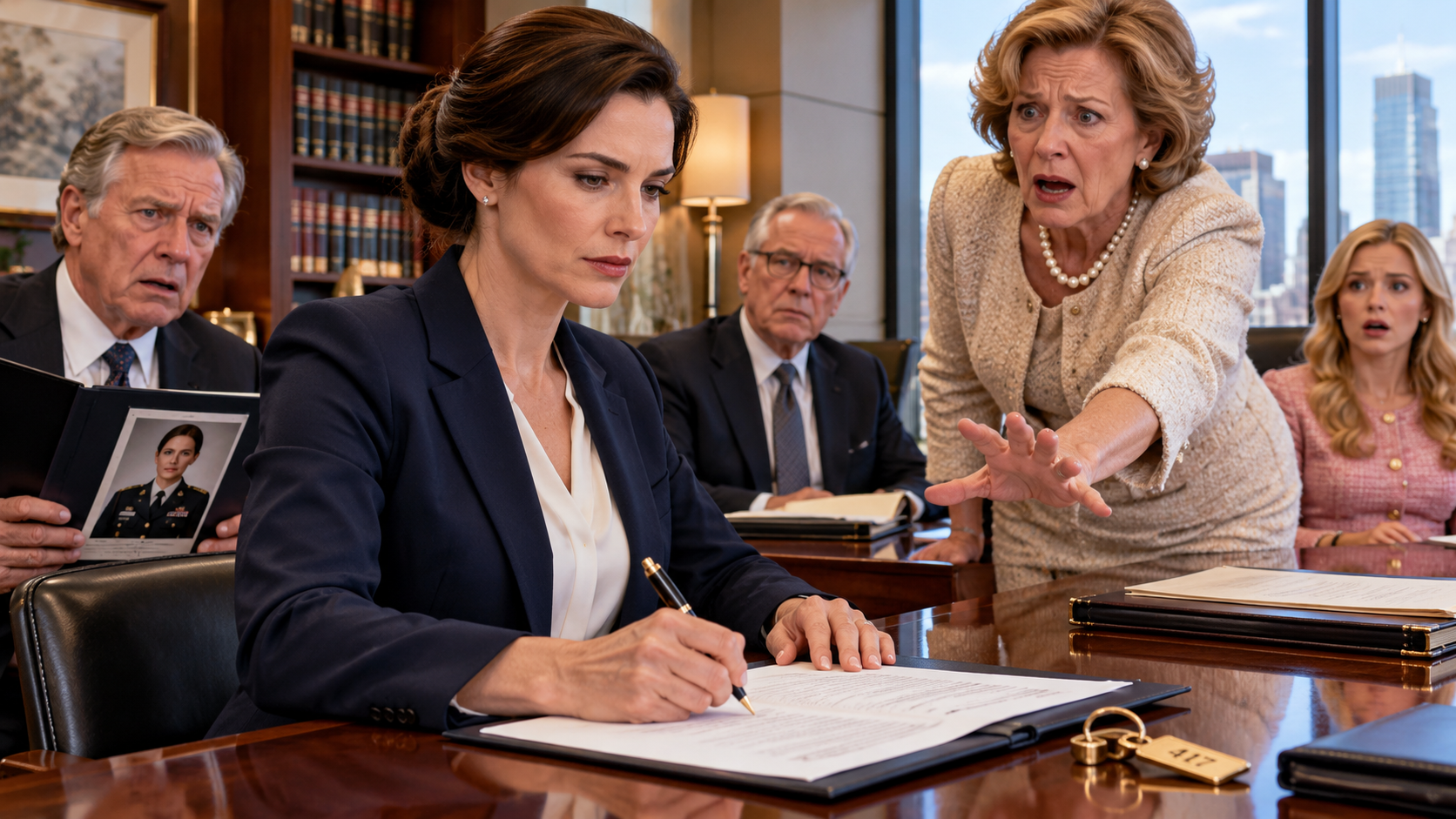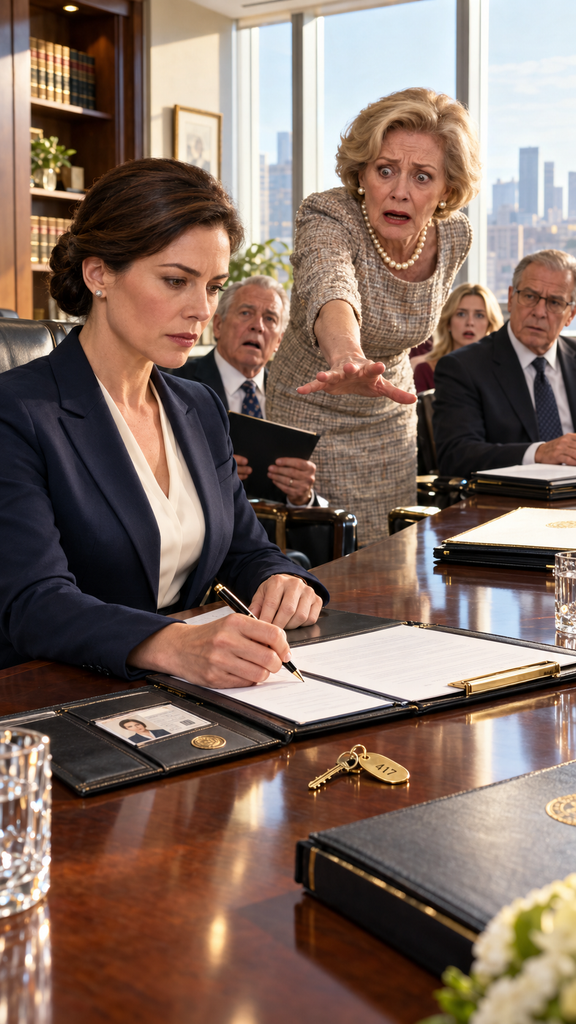


PART 1: THE SLAP HE THOUGHT WOULD END IT
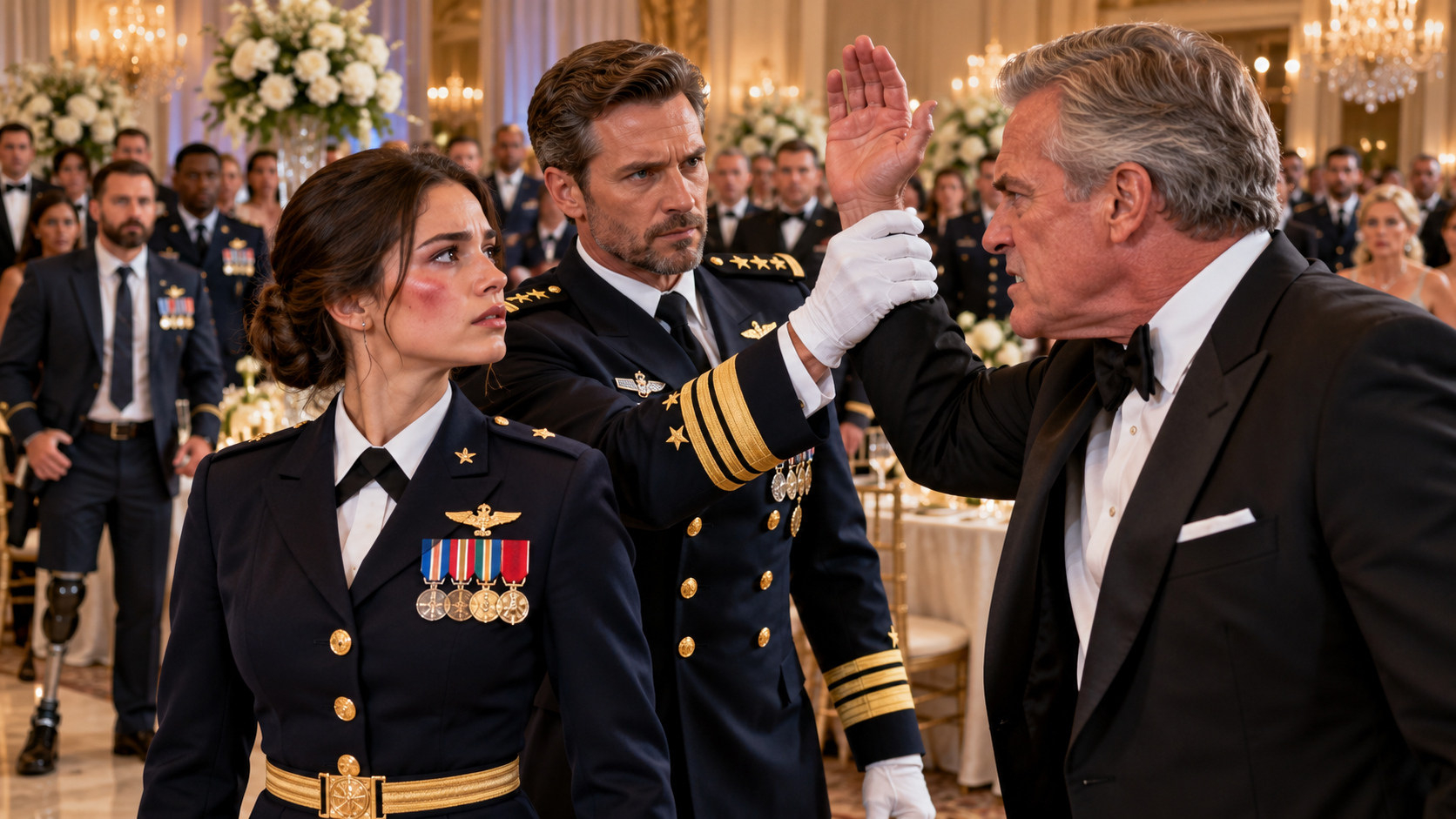
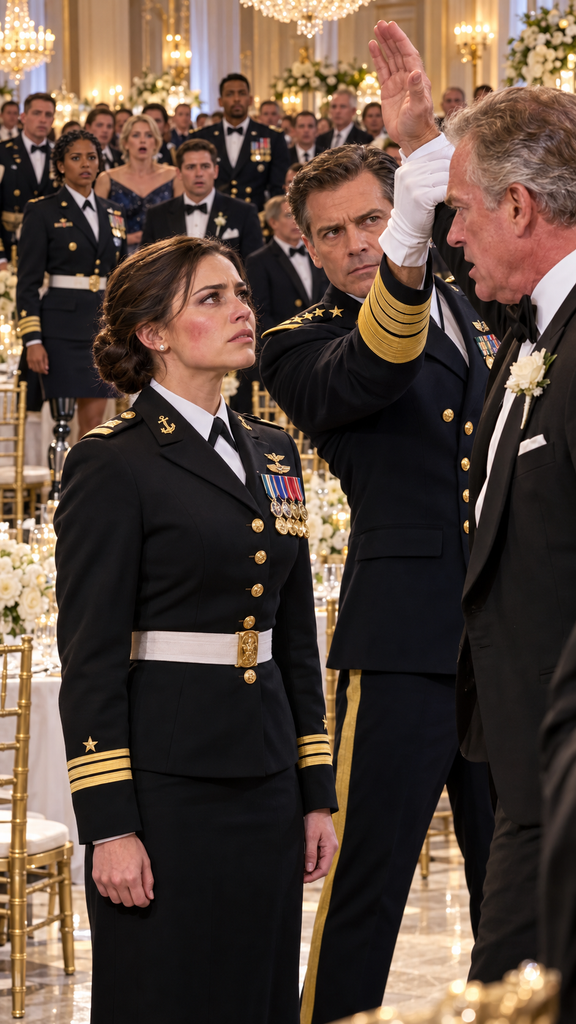
I watched Commander Brock Sullivan slap me across the face in front of 1,040 troops.
The crack echoed across the parade field.
For one endless second, not a single person moved.
He thought he had just reminded everyone that rank meant power.
He thought I would lower my head.
He thought I would apologize.
Instead, I stood perfectly still and tasted blood.
Copper.
Salt.
Memory.
The California sun hung high over Naval Amphibious Base Coronado, bleaching the sky above us and turning the parade field into a shimmering sea of tan uniforms.
More than a thousand service members stood in formation.
Navy SEALs.
Marines.
Sailors.
Soldiers assigned to the joint exercise.
Senior officers filled the reviewing stand behind us.
Every camera had been pointed toward the podium.
Every microphone was live.
My name is Captain Avery Hayes.
To almost everyone standing on that field, I was nothing more than a visiting officer attached to an administrative review team.
Quiet.
Unremarkable.
Easy to overlook.
That assumption had never bothered me.
Sometimes the safest place to hide is in plain sight.
Commander Brock Sullivan certainly believed he knew exactly who I was.
For three days, I had watched him move through the training exercise like a man who believed the ground became his property the moment his boots touched it.
He was impressive from a distance.
Broad shoulders.
Perfect uniform.
Rows of ribbons.
The easy confidence of a man accustomed to having people stop talking when he entered a room.
And he was good at what he did.
That was important.
Brock Sullivan had not built his reputation out of nothing.
He understood tactical planning.
He could read terrain.
He could command a room.
His people responded quickly to orders.
But there was something underneath all that polish.
Something I had learned to recognize years ago.
The difference between people obeying because they trust you…
and people obeying because they are afraid of what happens if they don’t.
That morning, I had asked him a question during the final exercise review.
Nothing dramatic.
Nothing disrespectful.
I had simply asked why a safety concern raised during the previous day’s amphibious movement had been omitted from his after-action briefing.
His eyes had changed immediately.
Not his expression.
His eyes.
People often reveal themselves in fractions of a second.
He stared at me as though I had forgotten my place.
“I believe the exercise was completed successfully, Captain.”
“That wasn’t my question.”
A few heads turned.
Brock smiled.
It was the kind of smile that contained no warmth.
“We’re in front of the formation.”
“I know.”
“Then perhaps you’d like to save administrative details for the administrators.”
I could feel Sergeant Major Thomas Reed watching us from beside the reviewing stand.
Reed was in his late fifties, built like a concrete pillar, with close-cropped gray hair and eyes that missed very little.
He and I had met before.
Years before.
In a country whose name never appeared on any public citation.
He knew who I was.
More importantly, he knew why I was really at Coronado.
Brock did not.
“I’d like you to answer the question,” I said.
That was when he walked toward me.
Slowly.
Deliberately.
A performance for the crowd.
He stopped less than two feet away.
“You have been on my base for three days,” he said.
Technically, it wasn’t his base.
But I understood what he meant.
“You have interrupted my officers. Questioned my procedures. Challenged my decisions.”
“I asked questions.”
“You undermined command authority.”
“No. I asked questions.”
His jaw tightened.
The microphone carried every word across the parade field.
I saw one of the public-affairs sailors beside the camera lower his eyes.
A Marine major near the platform shifted his weight.
Nobody intervened.
Not yet.
Brock leaned closer.
“Remember my rank.”
Then his hand exploded across my face.
The sound was like a rifle shot.
My head turned slightly.
My lip split against my teeth.
A drop of blood fell onto the toe of my tan combat boot.
Nobody breathed.
Nobody moved.
I didn’t fall.
I didn’t cry.
I didn’t touch my cheek.
I just looked down at that single red drop.
I’d tasted blood before.
I’d tasted it lying behind a collapsed wall with concrete dust filling my lungs while men searched for us twenty feet away.
I’d tasted it after an armored vehicle rolled into a ditch and broke two of my ribs.
I’d tasted it once while holding pressure against the neck of a nineteen-year-old radio operator and telling him he wasn’t allowed to die before extraction.
He hadn’t.
Thirty-seven Americans had come home over the years because of decisions I’d made.
Some decisions had been brilliant.
Some had been desperate.
Some still woke me at three in the morning.
None of them were printed on the résumé Commander Sullivan had been allowed to see.
Pages of my record remained classified.
Entire months had been reduced to black ink.
Mission names disappeared.
Locations disappeared.
Names disappeared.
That was the point.
Brock had looked at those missing pages and assumed there was nothing behind them.
I slowly raised my head.
“Apologize,” he ordered.
Whispers moved through the formation.
I looked directly into his eyes.
“For what?”
His nostrils flared.
“For disrespecting a superior officer.”
“You hit me.”
He gave a small shrug.
“That wasn’t a hit.”
Then he smiled.
“It was a correction.”
Something changed across the field.
Not visibly.
But I felt it.
A thousand people had just heard a commander explain exactly what he believed authority meant.
I reached into my jacket pocket.
Removed a white handkerchief.
Pressed it carefully against my lip.
Crimson spread across one corner.
I folded the cloth.
Once.
Twice.
Perfectly.
Methodically.
Brock laughed.
“Finished with your little performance, Captain?”
I put the handkerchief back into my pocket.
“No.”
His smile faded.
I met his eyes.
“You are.”
He stepped toward me again.
“What did you say?”
“You heard me.”
His face reddened.
Some people become quieter when they realize they have lost control.
Brock became louder.
“Captain Hayes, you are dangerously close to—”
“To what?”
He stopped.
I should have let the silence work.
Maybe I did let it work.
Maybe that was what finally pushed him over the edge.
Because I had seen men like Brock before.
Silence made them nervous.
They needed submission.
Needed the lowered eyes.
Needed the apology.
Needed proof that everyone around them still believed in the version of themselves they were performing.
I gave him none of it.
He lunged.
His fist came fast.
Powerful.
Driven by rage instead of discipline.
I didn’t retreat.
I stepped toward him.
Inside his reach.
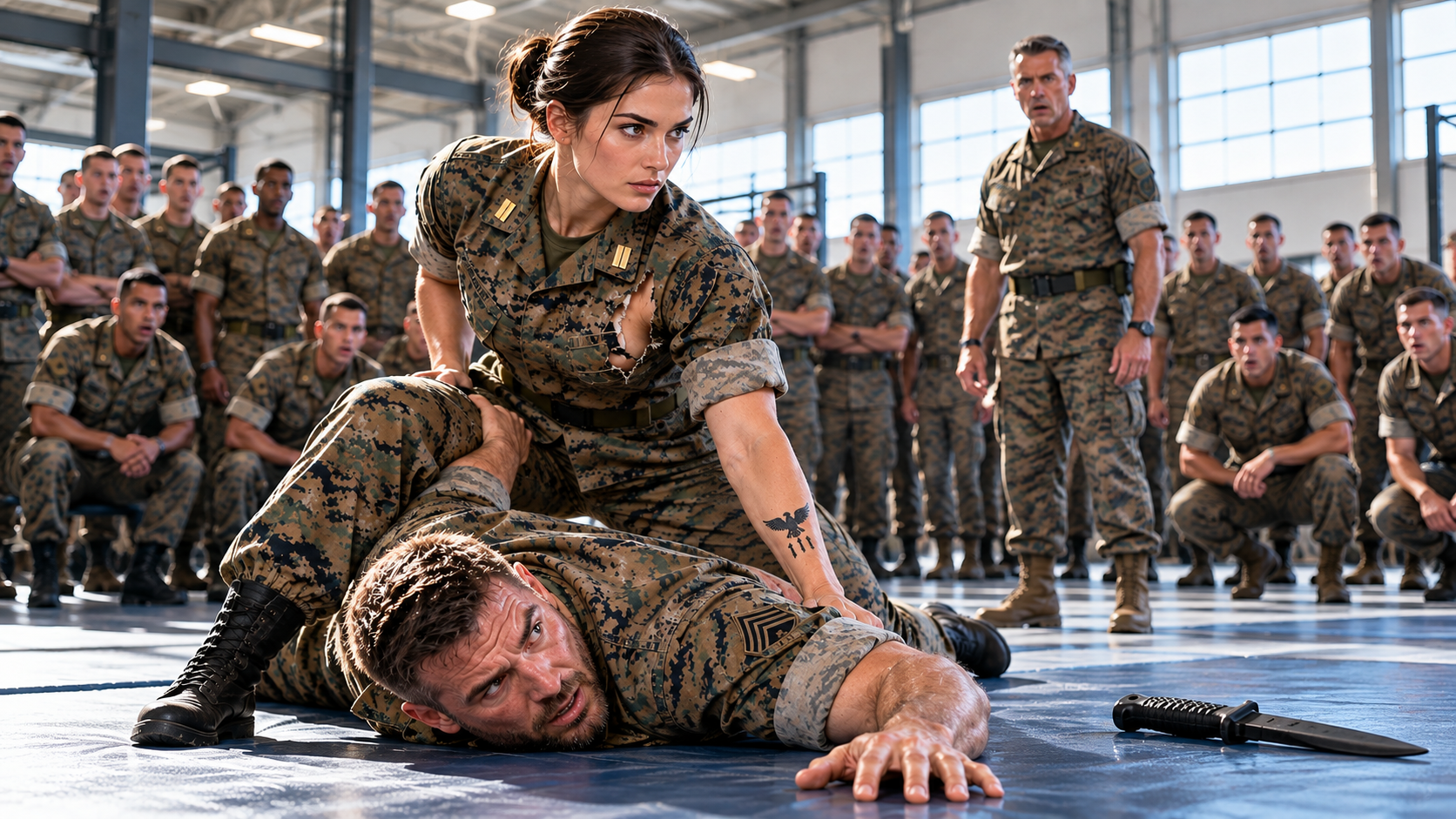
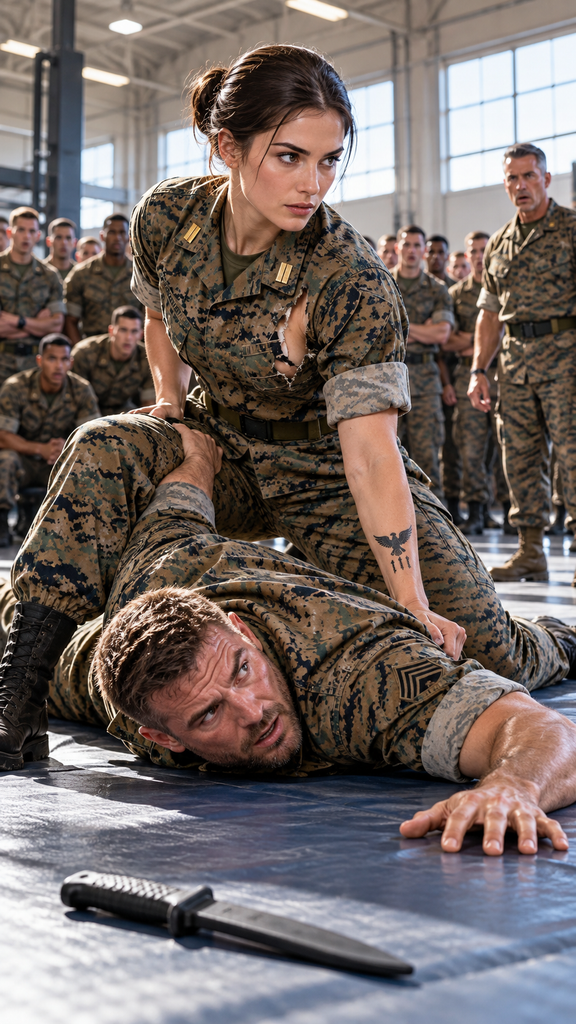
My left hand caught his wrist.
My right arm rotated across his elbow.
My hips turned.
There was no dramatic flourish.
No spinning kick.
No wasted movement.
Only balance.
Timing.
Training.
The kind repeated until the body remembers even when the mind is somewhere else.
His momentum did the rest.
Commander Brock Sullivan’s boots left the ground.
For half a heartbeat, the decorated SEAL commander was suspended almost sideways in the California sunlight.
Then I redirected him down.
Hard enough to stop him.
Controlled enough not to injure him.
His back struck the parade field.
A collective gasp swept through the ranks.
I still held his wrist.
He stared up at me.
The fury in his face had been replaced by something new.
Disbelief.
Then a voice thundered from the reviewing stand.
“COMMANDER SULLIVAN! STAND DOWN!”
Every officer on the field froze.
I knew that voice.
So did Brock.
Rear Admiral Nathan Mercer descended the steps of the reviewing stand.
Slowly.
His face was pale with anger.
Brock pushed himself onto one elbow.
“Admiral, she assaulted—”
“Do not finish that sentence.”
The microphone carried Mercer’s voice over the entire field.
Brock’s mouth closed.
Mercer walked toward us.
Sergeant Major Reed followed him.
And for the first time since the slap, I saw fear enter Brock Sullivan’s eyes.
Not because of what I had done.
Because of who was walking toward me.
The admiral stopped several feet away.
His gaze went first to my bleeding lip.
Then to Brock.
Then back to me.
“Captain Hayes.”
I released Brock’s wrist and stood.
“Admiral.”
Mercer drew himself upright.
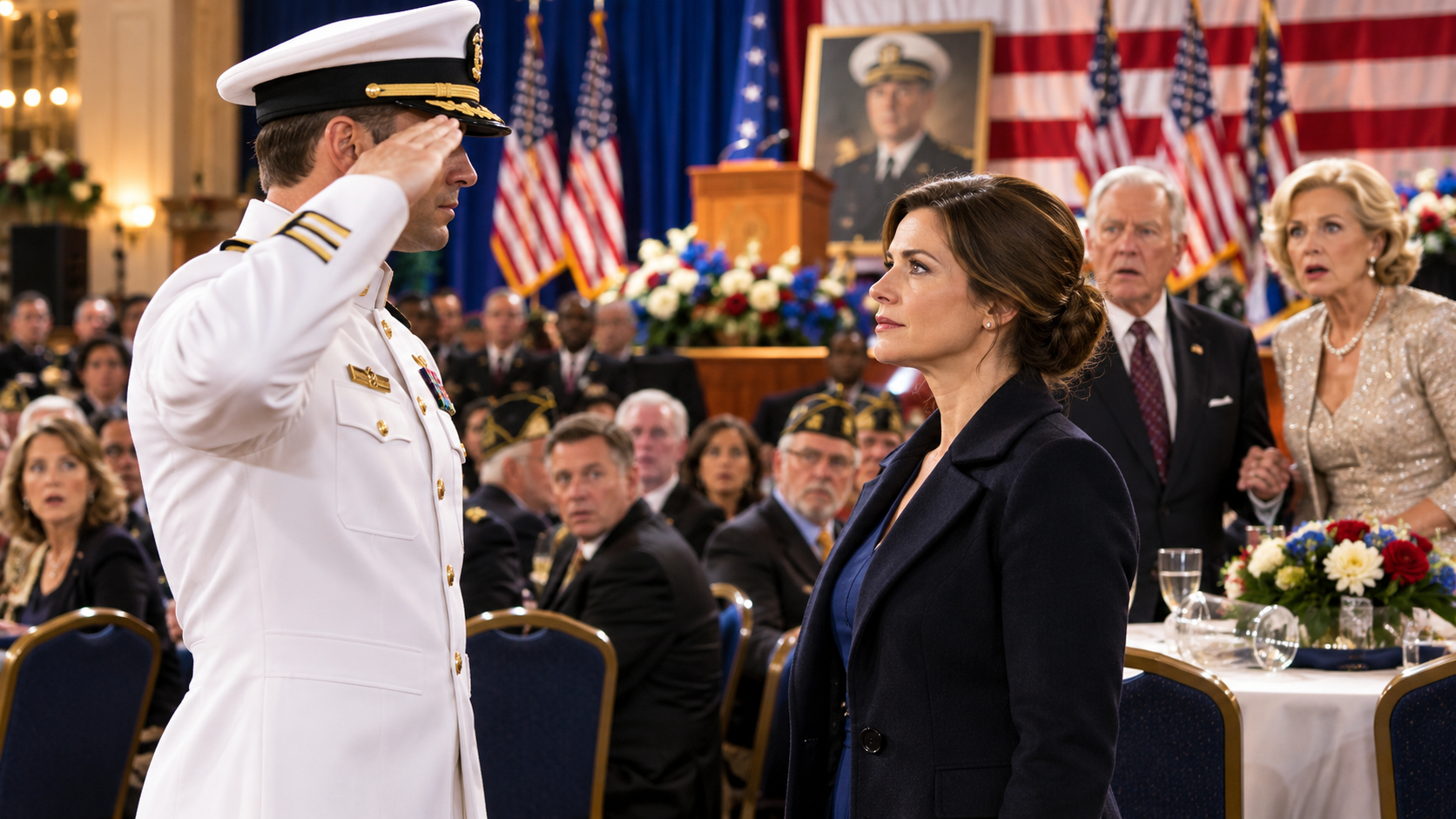
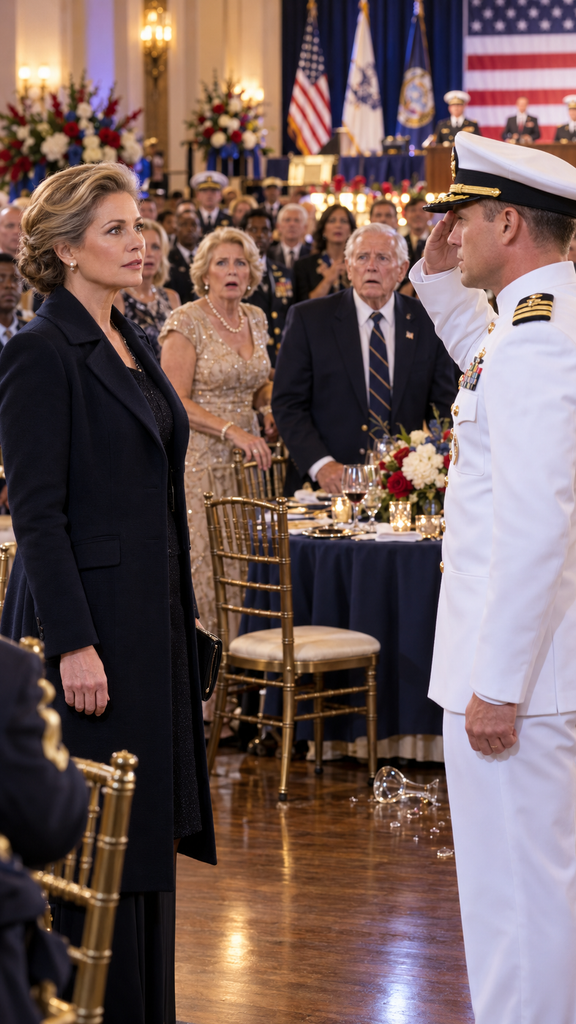
Then, in front of 1,040 service members, he saluted me.
A strange sound passed through the formation.
Not quite a gasp.
Not quite a whisper.
Brock stared.
Mercer held the salute until I returned it.
Then he turned toward Sullivan.
“Commander,” he said, “the officer you just struck is not an administrative observer.”
Brock’s face drained of color.
Mercer continued.
“Captain Avery Hayes is the operational evaluator assigned to this exercise under direct joint-command authority.”
Silence.
“Her presence here was deliberately restricted.”
Another silence.
“Her record was deliberately restricted.”
Reed’s eyes never left Brock.
“And you,” Mercer said, “have just demonstrated in front of the entire command exactly why she was sent here.”
Brock looked at me.
Really looked at me.
For the first time.
“What… exactly does that mean?”
I wiped the fresh blood from my lip.
“It means,” I said, “the evaluation isn’t over.”
PART 2: WHAT HE HADN’T BEEN ALLOWED TO KNOW
The worst mistake people make with classified records is assuming the black ink covers something glamorous.
Usually, it doesn’t.
Most of the things hidden behind those pages are ugly.
They smell like diesel fuel, sweat, scorched metal, wet earth and antiseptic.
They sound like helicopter blades in darkness.
Like radio static.
Like someone whispering coordinates because speaking any louder might get everybody killed.
They feel like deciding which door to breach when you know choosing the wrong one means somebody’s son doesn’t make it home.
There had never been anything glamorous about my work.
I had spent years attached to joint special operations elements whose existence was acknowledged only when convenient.
I had planned recoveries.
Led extraction teams.
Coordinated missions involving people whose names I was never supposed to repeat.
Sometimes I carried a rifle.
Sometimes a radio.
Sometimes nothing but a map and the responsibility for everyone marked on it.
Thirty-seven Americans were alive because certain operations succeeded.
I never counted them because I wanted praise.
I counted them because I remembered almost losing every one.
And because I remembered the names of those I couldn’t save.
Sergeant Major Reed had been there for one of those nights.
That was why he’d looked afraid when Brock struck me.
Not afraid for me.
He had seen me take worse.
He was afraid for Brock because he understood something Sullivan did not.
I had never cared much about humiliation.
But I cared deeply about discipline.
And there was nothing disciplined about what had happened on that parade field.
Rear Admiral Mercer ordered the formation dismissed.
Nobody moved at first.
It was as though 1,040 people had forgotten how.
“Dismiss the formation,” Mercer repeated.
The order rippled down the chain.
Commands were called.
Boots turned.
Units began moving away in controlled columns, but heads kept turning back.
Nobody wanted to admit they were watching.
Everybody was watching.
Brock climbed to his feet.
His uniform was dusty across the shoulders.
His face was still red.
“Admiral, I want to formally report that Captain Hayes used force against me.”
Mercer looked at him.
“You attempted to strike her a second time.”
“That’s not what happened.”
The live microphone was still on.
I glanced toward the podium.
So did Mercer.
The public-affairs chief rushed over and switched it off.
A little late.
Brock noticed too.
His expression changed.
He looked at the cameras.
Then at the retreating formation.
Then at the senior officers who had witnessed everything.
The moment finally became real to him.
“I was maintaining discipline,” he said.
Nobody answered.
He looked at Reed.
“Sergeant Major.”
Reed’s voice was flat.
“Sir.”
“You saw her attack me.”
Reed’s jaw moved once.
“I saw you strike Captain Hayes with an open hand.”
Brock stared at him.
“I also saw you attempt to strike her again.”
“Whose side are you on?”
That question told me more than almost anything else he had said.
Reed answered carefully.
“The side of the truth, sir.”
Brock’s eyes hardened.
“You’ve always had a problem with me.”
“No, sir.”
Reed paused.
“I’ve had problems with some of your decisions.”
The distinction landed hard.
Mercer motioned toward two senior officers standing nearby.
“Commander Sullivan is relieved from participation in the exercise effective immediately, pending review.”
Brock’s mouth opened.
“Admiral—”
“Immediately.”
“You cannot be serious.”
Mercer stepped closer.
“I just watched you strike an officer on a parade field because she asked a question.”
“She provoked me.”
The phrase hung in the air.
I saw the instant Brock realized how weak it sounded.
He tried again.
“She repeatedly challenged command authority.”
Mercer looked at me.
“Captain Hayes?”
I could have buried Brock Sullivan right there.
I could have listed everything I had observed over three days.
Every sharp interruption.
Every dismissive response.
Every moment when a junior officer tried to explain a concern and Brock answered before the sentence was finished.
But anger makes people sloppy.
I had spent too many years learning not to be sloppy.
So I said only what I could defend.
“I asked Commander Sullivan why an identified safety concern was absent from the final review.”
Mercer looked back at Brock.
“Did you answer?”
“The concern was insignificant.”
“Then why not say that?”
Brock had no response.
The sea wind moved across the parade field.
Behind the reviewing stand, flags snapped against their lines.
A medical corpsman approached me.
“Ma’am, I need to look at your lip.”
“I’m fine.”
He hesitated.
Reed raised an eyebrow at me.
I’d seen that look before too.
I sighed.
“All right.”
The corpsman examined the cut.
“No stitches.”
“Good.”
“Possible swelling.”
“I’ve survived swelling.”
He almost smiled.
Brock stood fifteen feet away, being informed that his access to the exercise command center had been suspended.
He kept looking at me.
Not with remorse.
Not yet.
He was calculating.
Trying to understand which part of the situation could still be controlled.
I knew that look.
I had seen it across interrogation tables.
Inside operations centers after plans went wrong.
On the faces of commanders who realized reality had stopped cooperating with the story they wanted to tell.
Finally, Brock pulled away from the officer speaking to him.
“This was a setup.”
Everyone turned.
He pointed at me.
“You came here under false pretenses.”
“No,” I said.
“You hid your authority.”
“My orders restricted my role.”
“You were testing me.”
“I was observing the exercise.”
“You wanted me to fail.”
I shook my head.
“If I’d wanted you to fail, Commander, I wouldn’t have needed to do anything.”
His lips parted.
I continued.
“All I had to do was watch.”
That hurt him more than the takedown.
I could see it.
Brock believed strength was something you demonstrated against other people.
He did not understand that sometimes the strongest thing you can do is give someone room to reveal themselves.
Mercer instructed him to leave the field.
Brock took three steps.
Then turned back.
His voice was quieter.
“You think one bad moment defines my career?”
That question was different.
For the first time, I heard something beneath the arrogance.
Fear.
Not fear of me.
Fear of losing the identity he had spent twenty years building.
I understood that fear better than he knew.
“No,” I said.
His eyes narrowed.
“One moment doesn’t define a career.”
For a fraction of a second, relief appeared on his face.
Then I finished.
“But a moment can reveal what years of reputation were hiding.”
He left without answering.
Reed watched him go.
Then he turned toward me.
“You still have the handkerchief?”
“Yes.”
“Evidence.”
I looked at him.
“I know.”
He nodded toward my boot.
The dried drop of blood remained on the leather.
“For the record,” he said, “I would’ve paid good money to see his face from your angle.”
“Sergeant Major.”
“Ma’am.”
I almost smiled.
Almost.
Then Mercer approached me again.
“Avery.”
The use of my first name meant the official audience was gone.
“You want out?”
“No.”
“You’ve completed enough.”
“No.”
He studied me.
“You know this changes everything.”
“Only if we let it.”
“People will talk.”
“They were already talking.”
“Footage will spread.”
“Then let the footage show what happened.”
Mercer lowered his voice.
“You could request Sullivan’s immediate removal from command.”
“I could.”
“Will you?”
I looked across the field.
The formations were gone now.
But the evidence of them remained.
Boot marks.
Empty water bottles near the staging area.
A forgotten clipboard on the grass.
The podium microphone standing beneath the sun.
I thought about the people who had watched.
The young sailors.
The Marines.
The officers.
The ones who had seen a commander slap another officer and remained motionless because military discipline told them not to break formation.
What mattered now wasn’t my pride.
It was what happened after.
“No,” I said.
Mercer looked surprised.
“Not yet.”
“Why?”
“Because I don’t want this decided by anger.”
“He assaulted you.”
“Yes.”
“In front of a thousand witnesses.”
“Yes.”
“Then what are you waiting for?”
I looked toward the command building where Brock had disappeared.
“The answer to one question.”
“What question?”
“Whether he understands what he did.”
PART 3: THE DIFFERENCE BETWEEN FEAR AND RESPECT
That afternoon, I sat alone in a small conference room with an ice pack against my face.
The swelling had arrived exactly as promised.
My lip had darkened.
A bruise was beginning to form along my cheek.
On the table in front of me lay the white handkerchief inside a clear evidence bag.
I hated seeing it there.
Not because of the blood.
Because of what it represented.
A moment captured and labeled.
People imagine military investigations as dramatic rooms filled with shouting attorneys and secret recordings.
Usually, they begin with paperwork.
Statements.
Times.
Locations.
Who stood where.
Who said what.
Precision matters.
Memory changes under pressure.
Records shouldn’t.
I wrote my statement by hand first.
Then typed it.
Then read it again.
No adjectives.
No speculation.
Commander Sullivan approached me.
Commander Sullivan struck me with an open right hand.
I asked why.
Commander Sullivan stated, “It was a correction.”
Commander Sullivan ordered me to apologize.
Commander Sullivan subsequently advanced and attempted to strike me with a closed fist.
I intercepted the movement and used sufficient force to stop the assault.
I did not mention arrogance.
Humiliation.
Cruelty.
Cowardice.
Those were interpretations.
The facts were worse.
A knock sounded.
“Come in.”
Sergeant Major Reed entered carrying two coffees.
He set one beside me.
“Black.”
“You remembered.”
“You threatened to fire a lieutenant once for putting cream in yours.”
“I did not.”
“You looked at him in a way that made him think you might.”
“Different thing.”
Reed sat.
For a while, neither of us spoke.
We had served together long enough ago that silence wasn’t uncomfortable.
Finally, he said, “You asked Mercer not to remove Sullivan permanently.”
“For now.”
“Why?”
“I want due process.”
Reed snorted softly.
“You always did enjoy doing things the hard way.”
“I enjoy doing them correctly.”
“That’s worse.”
I looked at him.
“What have you seen?”
His humor disappeared.
“Here?”
“With Sullivan.”
Reed leaned back.
I watched him choose his words.
“He’s not incompetent.”
“I know.”
“He’s not reckless in the field.”
“I know that too.”
“He believes pressure makes people sharper.”
“Sometimes it does.”
“He also believes humiliation is pressure.”
There it was.
Reed continued.
“He’ll challenge people publicly. Cut them off. Make them repeat answers until they sound uncertain. Some officers admire it.”
“Others?”
“Stop speaking unless they’re absolutely sure.”
That concerned me.
Not because people disliked their commander.
Command was not a popularity contest.
But silence inside a military unit can be lethal.
Every disaster I’ve ever studied had a moment before the disaster when someone noticed something.
A sound.
A reading.
A weather pattern.
A bad assumption.
A junior person who thought, That isn’t right.
The difference between a close call and a funeral sometimes comes down to whether that person feels safe enough to speak.
“What happened with the safety concern yesterday?” I asked.
Reed looked toward the closed door.
“A junior boat officer reported that the planned timing put two elements closer than expected during the approach.”
“Was she correct?”
“Close enough that the schedule was adjusted.”
“So the concern mattered.”
“Yes.”
“Why wasn’t it included in the final review?”
Reed’s mouth tightened.
“Sullivan believed including it made the operation sound less controlled than it was.”
I stared at him.
“Did he order it omitted?”
“I wasn’t in the room.”
Important distinction.
“What do you know?”
“I know it wasn’t in the draft after he reviewed it.”
That was enough to ask questions.
Not enough to accuse.
I made a note.
Reed watched me.
“You’re still evaluating him.”
“I’m evaluating the command.”
“After he hit you?”
“Especially after he hit me.”
He shook his head.
“You haven’t changed.”
“Neither have you.”
“That’s not true. My knees make noises now.”
Before I could answer, another knock sounded.
Rear Admiral Mercer entered.
He wasn’t smiling.
“Sullivan requested to make a statement.”
“Good.”
“He also requested you be present.”
That surprised me.
Reed raised an eyebrow.
“Why?”
“He says he wants to explain the context directly.”
I removed the ice pack from my face.
“What do you think?”
Mercer looked at me.
“I think you’re the one he hit.”
“That’s not what I asked.”
He exhaled.
“I think Sullivan still believes this is a misunderstanding he can control.”
“Then I should hear him.”
Twenty minutes later, I entered another conference room.
Brock was already seated.
No ribbons this time.
No reviewing stand.
No microphone.
No formation.
Just a man in uniform beneath fluorescent lights.
Two officers from the investigating command sat along the wall.
Mercer stood near the door.
Reed remained outside.
I sat opposite Brock.
He stared at the bruise on my face.
Something moved across his expression.
I couldn’t tell what.
“You asked for me,” I said.
He nodded.
“I wanted to apologize.”
I waited.
“I’m listening.”
His shoulders shifted.
“What happened this morning shouldn’t have happened.”
True.
“I was under pressure.”
Probably true.
“The exercise has been under scrutiny for weeks.”
Possible.
“I took your questions as an attempt to undermine me publicly.”
I said nothing.
“You kept pressing.”
Still nothing.
His jaw tightened slightly.
“I reacted.”
“You struck me.”
“Yes.”
“And then?”
He looked down.
“I attempted to strike you again.”
The room seemed to become quieter.
It was the first time he had said it plainly.
No correction.
No provocation.
No euphemism.
I leaned back.
“Why?”
His eyes lifted.
“Because you embarrassed me.”
There it was.
Not a tactical explanation.
Not command discipline.
Not military necessity.
A wound to his pride.
“And why did that justify hitting me?”
“It didn’t.”
“Did you know that before you hit me?”
He didn’t answer immediately.
That pause mattered.
“Yes.”
“Then why do it?”
His voice hardened.
“Because for one second, I wanted you to understand who was in charge.”
I felt something cold move through me.
Not fear.
Recognition.
I’d known men who thought that way.
In war zones.
In briefing rooms.
Sometimes behind desks.
They believed authority became weaker if it had to explain itself.
“You wanted me afraid of you,” I said.
“No.”
“Then what did you want?”
“Respect.”
I shook my head.
“No, Commander.”
His brow furrowed.
“You wanted obedience.”
“There’s a difference?”
“An enormous one.”
His hands closed on the edge of the table.
“I have led men into combat.”
“So have I.”
“I’ve brought people home.”
“So have I.”
“I have buried people.”
“So have I.”
His eyes flashed.
“Then don’t sit there and act like you don’t understand what command costs.”
I leaned forward.
“I understand exactly what it costs.”
For the first time, my voice sharpened.
“I understand what it costs when you’re the person whose decision puts someone through a door first.”
He stopped moving.
“I understand what it costs when a helicopter is six minutes out and someone has four minutes of blood left.”
Nobody in the room interrupted.
“I understand what it costs when a nineteen-year-old asks you if he’s going to die and you don’t know the answer.”
My throat tightened.
I forced it open.
“I understand what it costs to send people somewhere you cannot promise to bring them back from.”
Brock stared at me.
“That is why I will never confuse command with ownership.”
He said nothing.
“The people under us are not extensions of our ego.”
His face changed.
Just slightly.
“They don’t exist to prove we’re strong.”
Silence.
“And if they become afraid to tell us we’re wrong, then we are no longer leading them.”
I thought of thirty-seven names.
Thirty-seven voices.
Thirty-seven families that never knew how close the knock on their door had come.
“People came home because someone junior to me once said, ‘Captain, I think the map is wrong.’”
Brock’s eyes lowered.
“He was twenty-two.”
I could still remember his voice.
Nervous.
Barely audible beneath rotor noise.
“He had been in the unit five months.”
I looked at Brock.
“He was right.”
That sentence sat between us.
“If I had trained him to believe questioning me was disrespect, people would have died.”
Brock’s fingers loosened.
For the first time all day, he had nothing to say.
The investigating officer asked whether either of us needed a break.
Neither of us answered.
Finally, Brock spoke.
Quietly.
“What happens now?”
I looked at him.
“Now the truth gets written down.”
PART 4: WHEN THE ENTIRE FIELD LEARNED THE TRUTH
The investigation moved quickly because almost nothing about the central incident was disputed.
There were cameras.
Audio.
More than a thousand witnesses.
Brock Sullivan’s own statement.
Mine.
The question was never whether he had struck me.
The question was what that act meant for his command.
And that decision wasn’t mine alone.
I made sure of it.
Two days after the parade-field incident, senior leaders assembled in the same briefing auditorium where Sullivan had delivered the opening presentation for the exercise.
This time, there were no dramatic banners.
No formations.
No cameras for public release.
Just officers and senior enlisted leaders seated in rows.
Brock sat near the front.
I sat on the opposite side of the room.
The bruise on my face had turned dark purple.
I had considered covering it.
I didn’t.
Rear Admiral Mercer opened the session.
He did not speak about scandal.
He did not speak about embarrassment.
He spoke about command climate.
Readiness.
Trust.
The responsibility attached to authority.
Then he explained what most people in the room had not known.
My administrative title was real.
It just wasn’t complete.
I had been assigned to observe the exercise under restricted orders from a joint operational evaluation group.
My task was not to grade parade formations.
It was not to inspect paperwork.
It was to assess whether the participating units could exchange information honestly under pressure.
Whether concerns moved upward.
Whether commanders listened.
Whether junior personnel could challenge bad assumptions before those assumptions became casualties.
That was why my role had been intentionally understated.
Command behavior changes when everyone knows the evaluator is watching.
We wanted to see the command when it believed nobody important was in the room.
Mercer did not discuss my classified missions.
He didn’t need to.
He simply said, “Captain Hayes was selected for this responsibility because of extensive operational experience in environments where failures of communication carry immediate consequences.”
That was enough.
I saw several officers look toward me.
Brock did not.
His eyes remained fixed on the table.
Then the after-action findings began.
Most of them were normal.
Communications delays.
Equipment problems.
Timing concerns.
Coordination successes.
Training deficiencies.
Lessons learned.
The exercise had not been a disaster.
Far from it.
Many elements had performed exceptionally well.
That mattered too.
Justice doesn’t require rewriting everything around a person into failure.
Brock Sullivan had done many things well.
His assault didn’t erase them.
And his successes didn’t erase the assault.
Both could be true.
That was something people often hated about reality.
It rarely came in clean colors.
When my turn came, I walked to the front of the room.
I did not use a prepared speech.
I looked across the rows of faces.
Some had been on the parade field.
Others had only seen the recording.
“Three days ago,” I began, “Commander Sullivan struck me after I questioned a command decision.”
Nobody moved.
“I am not going to discuss the disciplinary process. That process exists for a reason, and it does not belong to me.”
Brock finally raised his head.
“But I will discuss why the event matters to this evaluation.”
I clicked the presentation remote.
A sentence appeared on the screen.
INFORMATION MUST TRAVEL FASTER THAN EGO.
I let them read it.
“Every person in this room has worked for someone intimidating.”
A few expressions shifted.
“Some of those people were excellent leaders. Intimidating does not automatically mean abusive. Demanding does not mean cruel. High standards are not the problem.”
I looked around.
“The problem begins when a leader makes disagreement personally dangerous.”
Silence.
“When people learn that raising concerns results in humiliation, retaliation, ridicule or anger, they adapt.”
Another slide appeared.
Not numbers.
Just three words.
THEY STOP TALKING.
“That adaptation can look like discipline.”
I glanced toward Brock.
“It isn’t.”
He met my eyes.
“It is silence.”
For the next twenty minutes, I walked them through what I had observed.
I did not make Sullivan a monster.
That would have been easier.
It also would have been false.
I explained that his unit demonstrated strong tactical preparation.
I explained that many service members respected his operational experience.
I explained that his decisions were often fast and effective.
Then I explained the danger.
Too many conversations flowed one way.
Too many junior people looked toward senior faces before answering simple questions.
Too many concerns became softer as they climbed upward.
The omitted safety issue became the clearest example.
The initial report had been valid.
The operation had been adjusted because of it.
Yet by the final briefing, the concern had disappeared from the official narrative.
No conspiracy.
No grand cover-up.
Something simpler.
Someone wanted the operation to look cleaner than it had been.
Sometimes that’s how dangerous cultures begin.
Not with a crime.
With discomfort.
With someone deciding a mistake would be easier if nobody talked about it.
I finished without mentioning the slap again.
Mercer asked whether anyone had questions.
For several seconds, nobody raised a hand.
Then Brock Sullivan stood.
Every head turned.
Mercer watched him.
“Commander?”
Brock looked toward me.
I couldn’t read his face.
“I have one.”
“Go ahead.”
He remained standing.
“When you came here, had you already decided there was a command problem?”
“No.”
“Did Sergeant Major Reed tell you there was?”
“No.”
“Did anyone?”
“No.”
“Then when did you decide?”
I thought about it.
“I didn’t.”
Confusion moved across his face.
“You just spent twenty minutes describing one.”
“I identified behaviors that create risk.”
“So that’s a yes.”
“No.”
I set the remote down.
“I’m not here to decide whether you are a good man or a bad man.”
His jaw tightened.
“I’m here to identify what happened and why it matters.”
“What happened is that I made a mistake.”
“Yes.”
“One mistake.”
“Yes.”
Surprise moved through the room.
He had expected resistance.
I continued.
“The question is what you do with it.”
He stared at me.
“The report isn’t my verdict on your soul, Commander.”
Nobody breathed.
“It’s information.”
I pointed to the screen.
“You can reject it because it embarrasses you.”
Then I pointed toward him.
“Or you can use it.”
Brock stood very still.
A long time passed.
Then he sat down.
The disciplinary decision came that afternoon.
Commander Brock Sullivan was formally relieved of his current command responsibility pending completion of administrative and conduct review.
He would not resume leadership of the exercise.
Additional consequences would be determined through established military procedures.
Some people thought it was too little.
Others thought it was too much.
I refused every invitation to offer an opinion.
The decision wasn’t a trophy.
I had no interest in watching a man’s career burn just so I could feel warm beside the fire.
That evening, I walked alone toward the beach.
Coronado looked almost peaceful from a distance.
Waves rolled in beneath a fading orange sky.
Aircraft moved somewhere beyond the horizon.
I removed my boots and carried them in one hand.
The boot with the bloodstain was still marked faintly near the toe.
I sat on the sand.
For the first time since the incident, the anger reached me.
Not the clean anger of confrontation.
The delayed kind.
The kind that waits until the danger passes.
My hands shook.
I hated that.
I closed them into fists.
Opened them.
Closed them again.
A shadow appeared beside me.
Reed.
He lowered himself onto the sand with a grunt.
“Knees,” he explained.
“I didn’t ask.”
“Thought you looked lonely.”
“I was enjoying it.”
“Good. We can enjoy it together.”
We watched the ocean.
After a while, he asked, “You okay?”
“I’ve been hit harder.”
“That’s not what I asked.”
I looked down at the boot in my hand.
The blood was almost brown now.
“When he hit me, I wasn’t angry.”
Reed waited.
“I was thinking.”
“That’s what makes you unsettling.”
“I thought about everyone watching.”
He nodded.
“I thought about the young ones.”
The junior sailors.
The Marines.
The soldiers.
The people learning what leadership looked like from everyone senior to them.
“What do you think they learned?” Reed asked.
I stared toward the water.
“That depends on what we do next.”
PART 5: THE PEOPLE WHO NEVER NEED TO SHOUT
Three mornings later, 1,040 service members returned to the parade field.
Same sun.
Same ocean breeze.
Same reviewing stand.
Different silence.
The final joint exercise formation had originally been planned as a ceremony.
Awards.
Closing remarks.
Unit acknowledgments.
After what happened, there had been discussion about canceling it.
I argued against that.
Avoiding the field would have transformed it into something larger than it deserved to be.
So we returned.
I stood near the same podium where Brock had struck me.
The bruise remained visible.
I wore it without pride.
Bruises are not medals.
The formation settled.
Boots stopped moving.
The American flag shifted overhead.
Rear Admiral Mercer delivered brief closing remarks.
He recognized the training units.
Praised the work that deserved praise.
Mentioned lessons that would be incorporated into future exercises.
He never said Sullivan’s name.
Then he stepped away from the microphone.
“Captain Hayes.”
I walked forward.
More than a thousand faces turned toward me.
I had spoken under fire.
I had briefed rooms where every person outranked me.
I had called in coordinates while people were shooting back.
For some reason, standing in front of those 1,040 service members felt harder.
I placed my hands lightly on the podium.
I could see the exact place where I had stood three days earlier.
I could almost hear the slap again.
The sharp crack.
The silence afterward.
I looked down the formation.
“When I arrived here,” I said, “most of you didn’t know who I was.”
A few faces shifted.
“That was intentional.”
A faint ripple of amusement.
“My assignment required me to observe more than procedures. I was here to observe how information moved through this command.”
I paused.
“How people responded when plans changed.”
Another pause.
“How leaders responded when questioned.”
No one looked away.
“Three days ago, all of you witnessed an event that should not have happened.”
The field became utterly still.
“I’m not going to discuss disciplinary proceedings.”
My voice carried clearly through the speakers.
“But I want to say something about respect.”
The word hung over the formation.
“When I was younger, I believed respect came from competence.”
I looked toward the first row.
“Then I believed it came from experience.”
Toward the second.
“Then rank.”
Toward the third.
“I was wrong every time.”
A gull cried somewhere beyond the buildings.
“Competence can earn confidence.”
“Experience can earn credibility.”
“Rank can require obedience.”
I let the silence settle.
“But none of them automatically create respect.”
Several senior officers watched me carefully.
“Respect is what remains when people no longer have to obey you.”
That sentence moved differently through the crowd.
I could feel it.
“If the people around you speak honestly only because they know you will listen, that’s trust.”
I breathed.
“If they speak honestly even when the truth embarrasses you…”
I thought of the twenty-two-year-old who once told me my map was wrong.
“…that’s leadership.”
I looked toward Sergeant Major Reed.
He stood beside the platform.
Expression unreadable.
“If they become quiet because they fear your reaction, you may still have authority.”
I turned back to the formation.
“But you have lost something more important.”
No dramatic music.
No cheering.
That would have ruined it.
Just wind.
Boots.
Breathing.
A thousand people listening.
“I have led operations where a single sentence changed everything.”
My fingers touched the edge of the podium.
“Sometimes that sentence came from the most experienced person in the room.”
I smiled faintly.
“Sometimes it came from the youngest.”
A few faces relaxed.
“The uniform does not make anyone infallible.”
I stepped away from the podium slightly.
“Neither does a title.”
My eyes moved across the formation.
“Neither does a reputation.”
Then I said the thing I most wanted them to remember.
“Your responsibility grows with authority.”
Not your importance.
Not your entitlement.
Your responsibility.
“If you’re given command, people will trust you with things they cannot take back.”
Their safety.
Their careers.
Their confidence.
Sometimes their lives.
“Be worthy of that.”
I stepped away from the microphone.
For a second, nothing happened.
Then Rear Admiral Mercer saluted.
Sergeant Major Reed followed.
Then the senior officers.
Then the formation.
More than a thousand service members raised their hands almost as one.
I returned the salute.
No applause.
It was better that way.
When the ceremony ended, units began dispersing.
I stayed near the reviewing stand, speaking briefly with several officers.
A young sailor approached hesitantly.
He couldn’t have been more than twenty.
“Ma’am?”
“Yes?”
He looked terrified to be talking to me.
“I just wanted to say…”
He stopped.
I waited.
Three days earlier, I might have been impatient.
Now the moment felt important.
“Take your time.”
He swallowed.
“When Commander Sullivan hit you, I thought you were going to hit him back.”
“I did put him on the ground.”
The sailor’s eyes widened.
I smiled.
“A technical distinction.”
He laughed nervously.
Then his expression became serious.
“But before that.”
I understood.
“You thought I was going to retaliate.”
“Yes, ma’am.”
“I wanted to.”
His surprise made me almost laugh.
“I’m human.”
“Yes, ma’am.”
“But wanting to do something and deciding to do it are different.”
He nodded.
“That was the part I remembered.”
“What?”
“You didn’t look scared.”
I thought about that.
“I was scared.”
He blinked.
“Really?”
“Not of him.”
I looked toward the emptying parade field.
“I was scared of becoming exactly what he expected.”
The sailor frowned.
“I’m not sure I understand.”
“If I had answered humiliation with humiliation because it felt good, what would everyone have learned?”
His expression changed slowly.
I could see the understanding arrive.
“Same lesson.”
“Exactly.”
He nodded.
“Thank you, ma’am.”
He started away.
“Seaman.”
He turned.
“Yes, ma’am?”
“If you ever see something wrong in an operation, say it.”
“Even if the officer doesn’t like it?”
“Especially then.”
A smile appeared.
“Yes, ma’am.”
He left.
Reed came up beside me.
“You realize he’s going to repeat that conversation for the next twenty years.”
“Poor kid.”
“You’ve ruined him.”
“Tragic.”
We walked toward the edge of the field.
I had almost reached the parking area when I saw someone standing near the command building.
Brock Sullivan.
He wasn’t in operational gear.
Just a service uniform.
No audience around him.
No entourage.
He waited until I noticed him.
Reed stopped.
“You want company?”
“No.”
“You sure?”
“Yes.”
He studied Brock.
Then me.
“All right.”
He walked on.
I approached Sullivan.
We stopped several feet apart.
For the first time since I had met him, Brock looked tired.
Not defeated.
Not broken.
Just stripped of the energy required to constantly project certainty.
“I heard your speech,” he said.
“I assumed you might.”
“I wasn’t invited to the formation.”
I didn’t respond.
“They let me watch from the building.”
The wind moved between us.
Finally, he said, “I keep replaying it.”
“The speech?”
“The slap.”
I waited.
“I can tell you exactly what I was thinking.”
“I’m sure you can.”
“I thought everyone was watching me lose control of the situation.”
His mouth tightened.
“So I did the one thing that proved I had no control at all.”
That was the most honest sentence I had heard from him.
He looked down at my boot.
The bloodstain had almost disappeared after cleaning.
“You could have destroyed me publicly.”
“I could have tried.”
“You didn’t.”
“No.”
“Why?”
“Because I don’t want your humiliation.”
He looked up.
“I want you to understand.”
His face tightened.
“You think I don’t?”
“I don’t know.”
That answer seemed to surprise him.
“I’m not inside your head, Commander.”
I paused.
“And understanding isn’t something you say once in a conference room.”
He absorbed that.
Then nodded.
“My father was Navy.”
I said nothing.
“He believed public embarrassment made people stronger.”
A breeze tugged at his sleeve.
“He called it correction.”
The word struck differently now.
That wasn’t an excuse.
He didn’t offer it as one.
It was an explanation.
A pattern.
Something inherited and repeated until somebody finally refused to participate.
“I spent most of my career proving he was right.”
I looked at him.
“Maybe.”
His eyes hardened slightly.
Then softened.
“Or maybe proving him wrong felt too much like admitting what he did to you wasn’t necessary.”
Brock didn’t move.
For a moment, I thought I’d gone too far.
Then his shoulders lowered.
“I don’t know what happens to my career.”
“Neither do I.”
“Would you tell them to let me keep it?”
“No.”
The answer came immediately.
He flinched.
“Would you tell them to end it?”
“No.”
He studied me.
“Then what would you tell them?”
“The truth.”
“Which is?”
“You are an experienced officer who performed many parts of your job well.”
He waited.
“And you struck another officer because your authority was challenged.”
His jaw tightened.
“You attempted to strike her again.”
His eyes dropped.
“You created an environment where people sometimes measured the safety of speaking against the likelihood of your anger.”
No movement.
“And when confronted, you eventually accepted responsibility.”
I let the words settle.
“All of those things are true.”
He nodded slowly.
“I suppose I wanted you to tell me which one matters most.”
“That’s not my decision.”
“No.”
He looked toward the parade field.
“I spent twenty years thinking leadership meant nobody could see you doubt yourself.”
I said nothing.
He gave a quiet, humorless laugh.
“Turns out that’s exhausting.”
“It usually is.”
For the first time, he smiled.
Barely.
Then it disappeared.
“I’m sorry, Captain Hayes.”
No explanation after it.
No “but.”
No mention of pressure.
No mention of provocation.
Just the words.
“I’m sorry.”
I believed he meant them.
Forgiveness was a different matter.
People sometimes confuse accepting an apology with erasing consequences.
I didn’t.
“Thank you,” I said.
His eyes met mine.
“That’s all?”
“What were you expecting?”
“I don’t know.”
“Neither do I.”
That almost made him smile again.
He stepped aside.
I began walking.
“Captain.”
I stopped.
He stood behind me with his hands at his sides.
There was no audience.
No camera.
No microphone.
He saluted.
Not because procedure demanded it.
Not because I outranked him.
Not because anyone was watching.
Because he chose to.
I turned.
And returned the salute.
Then I walked away.
Months later, I would hear that Brock Sullivan’s future remained uncertain while the review process continued.
I didn’t follow every development.
That may sound strange.
But I had learned long ago that justice and revenge are different things.
Revenge requires you to keep watching.
Justice requires you to tell the truth and allow consequences to belong to the person who created them.
I kept the white handkerchief.
Not the evidence bag.
The handkerchief itself was eventually returned to me after the investigation no longer needed it.
The stain never completely washed out.
For a long time, it sat folded inside a drawer.
Sometimes I would see it while packing for another assignment.
A white square.
One faded red corner.
A reminder.
Not of the day a Navy SEAL commander struck me.
Not of putting him on the ground.
Not of 1,040 people watching.
It reminded me of the seconds afterward.
The moment when anger offered me a hundred easy choices.
Humiliate him.
Threaten him.
Prove I was tougher.
Prove I was more dangerous.
Prove I was someone he should have feared.
Instead, I stood still.
Because years of operations had taught me something violence never could.
The loudest person in the room does not always have the most power.
The highest rank does not automatically possess the most authority.
And the person capable of hurting you is not necessarily the person you should fear.
Real command is quieter than that.
It lives in the moment someone tells you an uncomfortable truth and you choose to listen.
It lives in the second before anger becomes action.
It lives in the responsibility to protect the people who have no choice but to trust your judgment.
Commander Brock Sullivan had tried to teach 1,040 troops that rank meant power.
Instead, he taught them something else.
So did I.
Because some warriors never need to raise their voices to command respect.
Sometimes they only have to stand still long enough for everyone else to see the difference.