
Category: Entertainment

  • FIVE MINUTES

    FIVE MINUTES

    PART 1: THE LINE SHE CROSSED

    The first thing my husband’s mistress took from me was not my marriage.

    It was my hair.

    I stood beneath the white lights of the executive restroom at Sterling National Logistics and stared at a woman I barely recognized.

    Half my hair hung to my shoulders.

    The rest was gone.

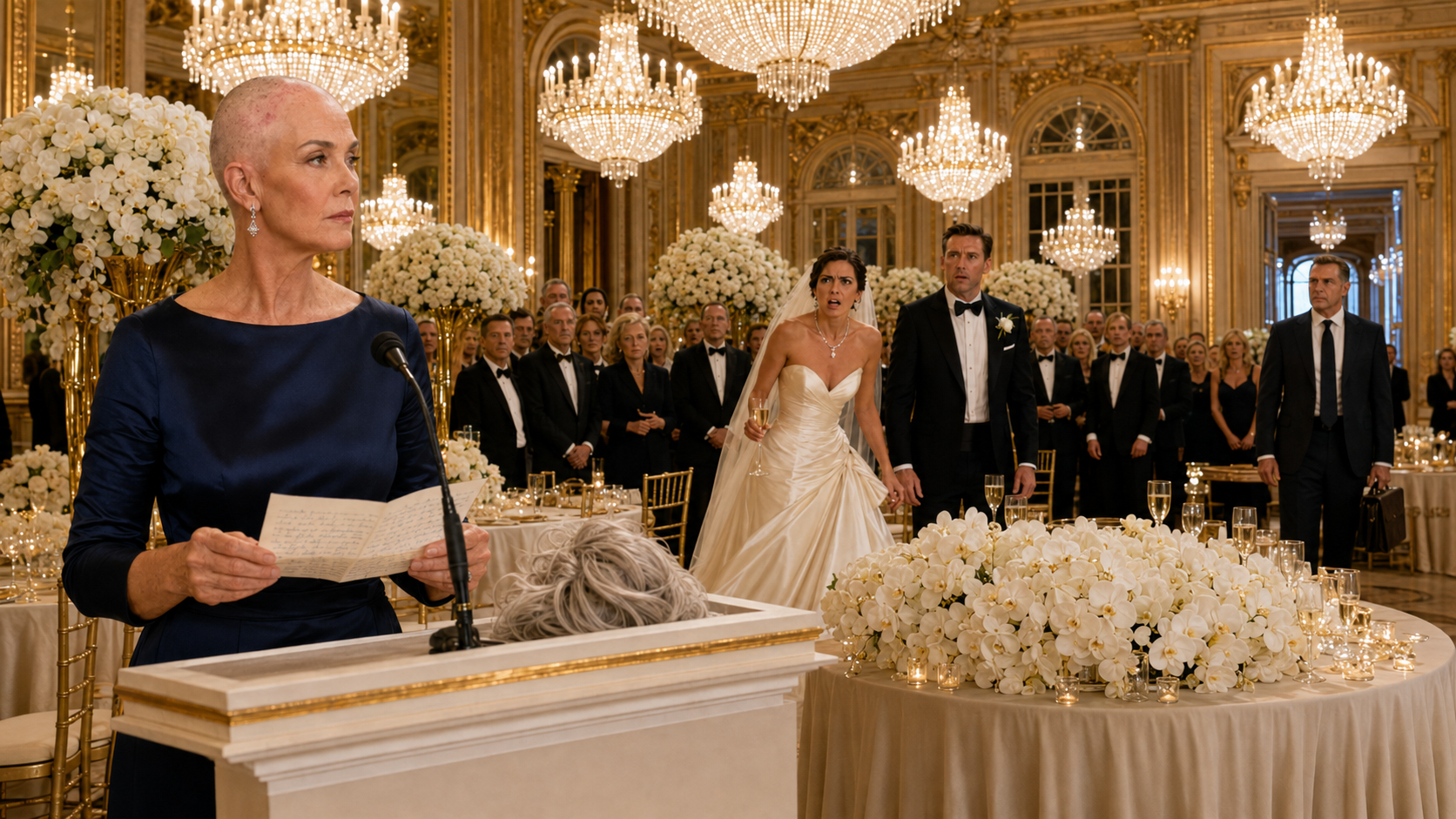
    Not neatly cut. Not styled. Hacked away in ugly strips that exposed pale skin along the side of my head. Loose strands clung to my blouse, my collar, the wet marble around the sink.

    Somewhere behind me, a security officer was asking questions.

    I barely heard him.

    Victoria Vance stood several feet away with her arms folded across her chest.

    She looked annoyed.

    Not horrified.

    Not ashamed.

    Annoyed.

    As if the inconvenience that afternoon was not that she had attacked her CEO’s wife with a pair of electric clippers, but that security had interrupted her before she could finish.

    Then the restroom door slammed open.

    “Sarah!”

    My husband rushed inside.

    Julian Sterling.

    CEO of one of the largest privately controlled logistics companies in the country.

    My husband of eleven years.

    The man whose last name I had taken before that name appeared on warehouses, freight trailers, charity galas, business magazines, and glass towers in twelve states.

    He stopped when he saw me.

    His face drained of color.

    For one second, I thought he finally understood.

    For one second, I thought Julian would look at the woman he had married, see what had been done to me, and become the man I once believed he was.

    Then Victoria whispered, “Julian.”

    He turned toward her.

    Not me.

    Her.

    “What were you thinking?” he demanded.

    There was panic in his voice.

    But it wasn’t outrage for me.

    It was fear for her.

    Fear of consequences.

    Fear of scandal.

    Fear that the little private world the two of them had been building inside his office had suddenly crashed into reality.

    Victoria lifted one shoulder.

    “I did it for us.”

    The room went silent.

    Even the security officers stopped speaking.

    I looked at Julian.

    He looked at her.

    And that was when something inside me became very still.

    I didn’t scream.

    I didn’t slap her.

    I didn’t ask him how long it had been happening.

    I didn’t demand to know how many nights he had told me there was a board dinner when he had actually been with her.

    All those questions had mattered an hour earlier.

    They didn’t anymore.

    I walked out.

    “Sarah.”

    Julian followed me into the corridor.

    I kept moving.

    “Sarah, wait.”

    His executive floor seemed endless now—glass walls, charcoal carpet, polished metal, people frozen behind desks pretending not to stare.

    They had heard.

    Of course they had.

    Some had probably seen Victoria drag me toward the restroom after our argument exploded.

    Some had seen security run after us.

    And every one of them was now watching the CEO’s wife walk toward the elevator with half her hair missing.

    Julian caught up with me.

    “Sarah, please.”

    I pressed the elevator button.

    “We need to talk.”

    I watched the numbers descend.

    “Not here,” he said quietly.

    That almost made me laugh.

    Not here.

    God forbid anyone embarrass Julian Sterling at his own company.

    The elevator arrived.

    I stepped inside.

    He started to follow.

    I raised one hand.

    “No.”

    Something in my face stopped him.

    The doors closed between us.

    Only then did my hands begin shaking.


    Three hours earlier, I had still been trying to save my marriage.

    That was the humiliating part.

    I had spent the morning convincing myself I might be imagining things.

    Julian had been coming home later and later for months.

    He guarded his phone in ways he never used to.

    He took calls outside.

    He showered the moment he walked through the door.

    When I asked what was wrong, he blamed expansion, fuel contracts, labor shortages, board pressure.

    Always something.

    Always work.

    Sterling National had been consuming our lives for almost fifteen years, so his excuses were believable.

    That was what made them effective.

    I knew exactly how brutal the company could be because I had helped build it.

    Most people didn’t know that.

    Julian was the public face.

    He loved cameras, interviews, podiums, photographs beside politicians and charity directors. I had always preferred contracts, operating models, negotiations, systems—the machinery behind the machinery.

    In our first years, we had worked from a rented office above a tire shop.

    I had negotiated our first major distribution agreement sitting at a folding table.

    I had designed the regional structure that allowed us to expand without drowning in overhead.

    Julian sold the dream.

    I made sure the dream could survive contact with reality.

    When the company became large enough to demand a public figurehead, Julian became CEO.

    I stepped away from daily operations.

    But I never gave away my founder’s stake.

    I never surrendered my board rights.

    And I never forgot how Sterling National actually worked.

    Julian, unfortunately, had begun to forget that.

    That afternoon, however, I hadn’t gone to the tower as a shareholder.

    I had gone as his wife.

    I brought lunch from the little Italian restaurant where we had celebrated our first profitable quarter.

    I even asked them to make the ridiculous lemon cake Julian used to love.

    The receptionist upstairs recognized me.

    “Mrs. Sterling.”

    Her smile came a second too late.

    That should have warned me.

    “Is Julian free?”

    “Mr. Sterling is in a meeting.”

    “With whom?”

    Her eyes flicked toward the executive suite.

    “Ms. Vance.”

    Victoria.

    Julian’s executive assistant.

    Thirty-two. Beautiful in the precise, polished way expensive places taught people to be beautiful.

    Perfect blond hair.

    Perfect posture.

    Perfect clothing.

    She had been working for Julian for two years.

    I had met her dozens of times.

    She had shaken my hand at Christmas parties.

    Sent flowers to our house on Julian’s behalf.

    Once, when Julian forgot our anniversary dinner because of a delayed flight, Victoria had called me personally to apologize for the scheduling problem.

    I had thanked her.

    That memory would disgust me later.

    I walked toward Julian’s office before the receptionist could stop me.

    His door was partially open.

    I pushed it wider.

    Victoria was sitting behind his desk.

    Wearing Julian’s suit jacket.

    Her bare legs crossed beneath the desk.

    Julian stood beside her, laughing at something she had just said.

    The lunch bag almost slipped from my hand.

    Victoria saw me first.

    Her smile disappeared.

    Julian followed her gaze.

    “Sarah.”

    His voice changed immediately.

    Victoria stood.

    Slowly.

    Deliberately.

    She adjusted the sleeves of my husband’s jacket.

    “So you’re finally here,” she said.

    Not surprised.

    Not embarrassed.

    Almost relieved.

    Julian stepped around the desk.

    “Sarah, this isn’t what it looks like.”

    I placed the lunch bag on a side table.

    My hand was remarkably steady.

    “Then explain it.”

    He opened his mouth.

    Nothing came out.

    Victoria smiled.

    “You should stop pretending you’re still his wife.”

    I looked at her.

    Then I looked at Julian.

    “Are you going to say anything?”

    He looked away.

    That silence was more painful than any confession could have been.

    Not because it proved he was sleeping with her.

    I already knew.

    His silence told me something worse.

    He had allowed her to believe she could speak to me that way.

    Maybe he had encouraged it.

    Maybe he had complained about me during hotel nights and late dinners.

    Maybe he had told Victoria I was cold.

    Controlling.

    Difficult.

    Maybe he had rewritten our entire marriage to make himself innocent.

    Whatever version he had given her, she believed she had won.

    I nodded once.

    “All right.”

    That was all I said.

    I turned toward the door.

    Victoria laughed behind me.

    “You’re just going to leave?”

    I stopped.

    I shouldn’t have.

    But I did.

    “What exactly would you like me to do?”

    Her expression hardened.

    “I’d like you to stop acting superior.”

    “I haven’t said anything to you.”

    “You don’t have to.”

    Julian sighed.

    “Victoria.”

    She ignored him.

    “You walk in here like you own the place.”

    That time I almost smiled.

    The irony would have been funny under different circumstances.

    Instead I said, “Give me my husband’s jacket.”

    Her cheeks flushed.

    “What?”

    “You’re wearing something that doesn’t belong to you.”

    She stepped toward me.

    “You mean like Julian?”

    “Victoria,” Julian warned.

    I looked directly at him.

    He sounded irritated.

    Still not angry.

    Still not defending me.

    “Keep him,” I said.

    I started walking again.

    Victoria grabbed my arm.

    I pulled away.

    “Don’t touch me.”

    Her eyes flashed.

    “You think you can humiliate me?”

    I stared at her.

    “I haven’t done anything to you.”

    “You came here to expose us.”

    “No. I came here with lunch.”

    I pointed toward the paper bag on the table.

    Something changed in her face when she saw it.

    Maybe because lunch made the truth uglier.

    I hadn’t arrived with a lawyer.

    I hadn’t arrived with cameras.

    I hadn’t come looking for revenge.

    I had come carrying my husband’s favorite cake.

    Victoria’s humiliation turned into rage.

    Everything after that happened quickly.

    She grabbed me again.

    I shoved her hand away.

    Julian moved between us too late.

    Victoria stumbled into the doorway of the private executive restroom beside his office.

    On the marble counter was a small cordless grooming trimmer Julian kept there for mornings after overnight travel.

    Victoria saw it.

    So did I.

    She picked it up.

    “Put that down,” Julian said.

    She switched it on.

    The buzzing filled the room.

    For the first time, I became afraid.

    “Victoria.”

    She lunged.

    I raised my arms.

    She caught a fistful of my hair and dragged the clippers across the side of my head.

    The sound changed as the blades hit hair.

    I screamed then.

    Not from pain.

    From shock.

    Hair dropped across my shoulder.

    I pushed her away.

    She came at me again.

    Julian grabbed her wrist.

    She tore free.

    The second pass took even more.

    By then people were running down the hallway.

    Security reached us seconds later.

    Those seconds were enough.

    Enough to leave me standing in front of a mirror looking like someone had tried to erase me.

    And when Julian finally arrived fully inside the restroom after security separated us, his first instinct was still to protect Victoria from what she had done.

    “I did it for us,” she said.

    That sentence ended my marriage.

    Not the affair.

    Not even the clippers.

    His silence afterward.

    That ended it.


    I reached my car in the underground garage and locked the doors.

    For several seconds, I sat without moving.

    Then I lowered the visor.

    My reflection appeared in the little mirror.

    I stared at myself.

    My eyes were dry.

    That frightened me more than crying would have.

    I reached for my phone.

    There were already four missed calls from Julian.

    I called him back.

    He answered instantly.

    “Sarah—”

    “You have exactly five minutes.”

    “What?”

    “Bring Victoria to my attorney’s office. Both of you.”

    Silence.

    Then: “Sarah, what are you talking about?”

    “You have five minutes to come there, let her apologize for what she did, and explain exactly what happened.”

    His voice dropped.

    “Can we please discuss this privately?”

    “No.”

    “Sarah—”

    “Five minutes, Julian.”

    He gave a nervous laugh.

    It was short and dismissive and familiar.

    The laugh he used when someone in a meeting made a demand he considered ridiculous.

    “Don’t be dramatic.”

    I closed my eyes.

    There it was.

    Even now.

    Even after everything.

    He still believed I was the emotional one.

    I spoke very slowly.

    “This is your last opportunity to make things right.”

    “With you?”

    “With yourself.”

    He exhaled sharply.

    “I can’t deal with this when you’re acting like this.”

    Then he hung up.

    For several seconds, I stared at the dark screen.

    A notification appeared.

    It was from my attorney, Rebecca Hale.

    The emergency injunction has been approved. We’re ready whenever you are.

    I read it twice.

    Then I looked through the windshield at the concrete columns around me.

    Julian thought I had called because I wanted an apology.

    He thought five minutes was a wife’s tantrum.

    He didn’t understand that I had stopped calling him as his wife.

    And in less than five minutes, I would start speaking to him as the woman who still owned nearly half of everything he had built his identity around.

    My phone timer reached zero.

    Julian wasn’t there.

    I called Rebecca.

    “Do it.”

    And for the first time that day, I heard my own voice sound completely certain.


    PART 2: WHAT JULIAN FORGOT

    Rebecca’s office occupied the upper floors of a building six blocks from Sterling National headquarters.

    By the time I entered through the private garage, she was waiting for me.

    She saw my hair and froze.

    “My God.”

    “Don’t.”

    Her expression tightened.

    “Sarah—”

    “If you ask me whether I’m okay, I’m going to start crying, and I don’t have time yet.”

    Rebecca nodded.

    That was one reason I trusted her.

    She understood when compassion needed to look like efficiency.

    She led me into a conference room.

    A folder rested on the table.

    Several documents were already open on her laptop.

    Three weeks earlier, I had hired Rebecca because I suspected Julian was having an affair.

    Not to destroy him.

    Not even necessarily to divorce him.

    I needed to know where I stood.

    After eleven years of marriage and nearly fifteen years tied together through Sterling National, separating our personal lives from our business interests would never be simple.

    So Rebecca had prepared options.

    Quietly.

    Carefully.

    The emergency order had nothing to do with Victoria shaving my head. It had already been requested to preserve records and prevent unilateral changes to the assets and corporate interests tied to our marriage while I determined whether to file for divorce.

    I had delayed activating everything because some pathetic part of me still hoped I would discover an explanation.

    That afternoon had provided one.

    Just not the one I wanted.

    Rebecca slid her laptop toward me.

    “The order has been entered. Julian can’t transfer, pledge, conceal, or materially alter the marital assets covered by it pending review. Our notices are going out now.”

    I nodded.

    “And Sterling?”

    “Different mechanism.”

    I knew.

    Sterling National wasn’t simply marital property.

    It had its own board, bylaws, founder agreements, voting structure.

    Documents Julian and I had signed long before either of us owned a house with a wine cellar.

    Documents he apparently no longer thought about.

    When we founded the company, we had divided ownership almost equally, with a small portion later allocated to senior employees and outside investors.

    Over the years, dilution changed the percentages.

    But our founder voting rights remained substantial.

    Julian had spent years behaving as though CEO meant owner.

    It didn’t.

    A CEO could be suspended.

    A CEO could be removed.

    A founder could still be forced to answer questions.

    Especially when his undisclosed relationship with a direct subordinate erupted into an assault on another founder inside company headquarters.

    Rebecca opened another document.

    “I’ve notified corporate counsel that you are requesting an emergency board session.”

    “Good.”

    “They’ll want evidence.”

    “They have cameras.”

    “Not inside the restroom.”

    “The hallway will be enough to show the beginning and the security response. There were witnesses inside his office before security arrived.”

    Rebecca watched me.

    “Sarah, did Julian touch you?”

    “No.”

    “Did he help Victoria?”

    “No.”

    That hurt to say in a way I hadn’t expected.

    Rebecca waited.

    I understood the question she wasn’t asking.

    “No,” I repeated. “He didn’t help me either.”

    Her jaw tightened.

    My phone rang.

    Julian.

    I let it ring.

    Again.

    Again.

    Then a message appeared.

    Where are you?

    Another.

    We need to contain this before employees start talking.

    I stared at the words.

    Not Are you hurt?

    Not I’m sorry.

    Contain this.

    Rebecca saw my expression.

    “What did he say?”

    I turned the phone toward her.

    She read it.

    “Keep that.”

    “I intend to.”

    The next call came from Sterling National’s general counsel.

    Rebecca answered and put him on speaker.

    “Sarah,” Martin Cole said carefully, “I’ve received your notice.”

    “Then you know what I’m asking for.”

    “I do.”

    “Has security preserved the footage?”

    A pause.

    “Yes.”

    “All of it?”

    “Yes.”

    “And incident reports?”

    “They’re being collected.”

    “Good.”

    Martin lowered his voice.

    “Julian is asking that this be treated as a personal domestic matter.”

    My entire body went cold.

    “A company employee assaulted a company founder inside company headquarters after announcing that she was in a relationship with the CEO.”

    Rebecca looked at me.

    I continued.

    “If corporate counsel believes that is a domestic matter, say so in writing.”

    Martin was silent.

    Then he sighed.

    “No. I don’t.”

    “When can the board meet?”

    “Four thirty.”

    I looked at the clock.

    Less than an hour.

    “I’ll be there.”

    When the call ended, Rebecca leaned back.

    “You know Julian is going to say you’re retaliating because of the affair.”

    “I know.”

    “He’ll say the board shouldn’t adjudicate your marriage.”

    “They shouldn’t.”

    “What do you want them to adjudicate?”

    I looked at my reflection in the black conference-room window.

    “My husband’s judgment.”


    Julian finally arrived at Rebecca’s office eighteen minutes after my five-minute deadline.

    Victoria was with him.

    The receptionist called upstairs.

    Rebecca looked at me.

    “Do you want them brought in?”

    I considered it.

    Some part of me wanted to see whether Victoria still looked defiant.

    Another part wanted to hear Julian explain why five minutes had somehow turned into eighteen.

    Then I realized I didn’t care.

    “No.”

    Rebecca relayed the answer.

    Less than thirty seconds later, my phone rang.

    Julian.

    I answered.

    “We’re downstairs.”

    “You’re late.”

    “Sarah, stop this.”

    “You had five minutes.”

    “I needed to calm Victoria down.”

    I almost laughed.

    There it was again.

    Victoria.

    Always Victoria.

    “What happened?” I asked quietly. “Did she have a difficult afternoon?”

    He went silent.

    I could hear traffic through his end of the call.

    Then he said, “That isn’t fair.”

    “No, Julian. What happened to me wasn’t fair.”

    “I know.”

    “Do you?”

    “Yes.”

    “Then why are you still standing beside her?”

    His breathing changed.

    “She made a terrible mistake.”

    “She attacked me.”

    “She lost control.”

    “She shaved my head.”

    “I know what she did!”

    His voice cracked across the line.

    Finally, anger.

    But I could no longer tell who it was directed at.

    “Then leave her downstairs,” I said. “Come up alone.”

    He hesitated.

    That hesitation told me Victoria was probably close enough to hear him.

    “I can’t abandon her right now.”

    I closed my eyes.

    “Thank you.”

    “For what?”

    “For answering the only question I still had.”

    “Sarah.”

    I hung up.

    Rebecca was staring at me.

    “He brought her,” she said.

    “Yes.”

    “But he won’t leave her.”

    “No.”

    There was pity in Rebecca’s eyes now.

    I hated it.

    “Let’s go to the board meeting.”


    The executive boardroom at Sterling National had floor-to-ceiling windows overlooking the city.

    I had helped choose that room.

    Julian wanted something impressive.

    I wanted something with enough wall space for route maps.

    He won.

    As usual, presentation had mattered more to him.

    When I walked in at four twenty-eight, conversations stopped.

    Six board members were present in person.

    Two appeared on video screens.

    Martin sat near the end.

    Julian was at the head of the table.

    Of course he was.

    Victoria wasn’t there.

    At least someone had finally understood that bringing her into the board meeting would be insane.

    Julian stared at my hair.

    For the first time since the restroom, something like genuine shame appeared in his eyes.

    “Sarah.”

    I took the seat opposite him.

    He looked at the board.

    “As everyone can see, my wife is understandably upset.”

    My wife.

    Not co-founder.

    Not shareholder.

    My wife.

    I almost admired the strategy.

    Make me emotional before I said a word.

    Turn this into marriage drama.

    He continued.

    “There was an inappropriate confrontation today between Sarah and a member of my staff. Victoria has been placed on administrative leave while—”

    “Who placed her on leave?” I asked.

    Julian looked at me.

    “I did.”

    “You mean after you brought her to my lawyer’s building eighteen minutes after she assaulted me?”

    Several heads turned toward him.

    Julian’s expression hardened.

    “That isn’t relevant.”

    “It seems relevant to your judgment.”

    “Sarah—”

    Martin interrupted.

    “We should review the incident report.”

    The security footage played first.

    There was no sound.

    It showed me entering Julian’s office carrying a lunch bag.

    Several minutes later, I appeared in the doorway again.

    Victoria followed.

    She grabbed my arm.

    I pulled away.

    She grabbed me again.

    We moved out of camera range toward the restroom.

    Julian followed.

    Twenty-eight seconds later, two employees ran from nearby offices.

    Then security.

    Forty-three seconds after that, one officer emerged holding the cordless clippers in a clear evidence bag.

    Nobody spoke when the footage ended.

    Martin read portions of the witness statements.

    Victoria had shouted at me.

    I had told her not to touch me.

    She had taken the clippers.

    Julian had ordered her to put them down.

    She had attacked anyway.

    That detail mattered.

    I would not lie about Julian simply because I hated him.

    He had not encouraged the assault.

    He had tried to stop it.

    But afterward, when the danger was over and he finally had a choice between comforting his injured wife and protecting his mistress, he had made that choice too.

    One of the independent directors, Margaret Sloan, looked at Julian.

    “Are you engaged in a romantic relationship with Ms. Vance?”

    Julian’s face changed.

    “This is not the forum—”

    “Are you?”

    He looked at me.

    I said nothing.

    Finally, he answered.

    “Yes.”

    Margaret folded her hands.

    “Did you disclose the relationship?”

    “No.”

    “Did she report directly to you?”

    “Yes.”

    The silence grew heavier.

    Julian leaned forward.

    “I recognize how this appears.”

    I spoke for the first time in several minutes.

    “It appears exactly as it is.”

    He glared at me.

    “You called this meeting to punish me.”

    “No.”

    “Don’t insult everyone’s intelligence.”

    “I called this meeting because the chief executive of this company concealed a relationship with his direct subordinate, allowed that relationship to poison the workplace, and then responded to an assault inside headquarters by trying to categorize it as a domestic dispute.”

    “That is not what happened.”

    Martin looked down.

    I took out my phone.

    “Would you like me to read your message?”

    Julian went pale.

    I read it anyway.

    “‘We need to contain this before employees start talking.’”

    Nobody moved.

    I set the phone on the table.

    “You weren’t worried about me. You were worried about exposure.”

    Julian’s voice became quiet.

    “Sarah, please.”

    Margaret closed her folder.

    “I move that Julian Sterling be placed on immediate administrative suspension pending a formal investigation into executive misconduct, conflicts of interest, and today’s incident.”

    Julian shot upright.

    “Absolutely not.”

    Another director seconded the motion.

    The vote began.

    Julian stared at each raised hand as though he couldn’t understand how the people around his table had suddenly stopped belonging to him.

    When the final vote was recorded, Margaret looked directly at him.

    “Effective immediately.”

    Julian didn’t move.

    Then he looked at me.

    And for the first time that day, he understood that five minutes had never been a threat.

    It had been mercy.

    And he had laughed at it.


    PART 3: THE COST OF SILENCE

    Julian followed me out of the boardroom.

    “You planned this.”

    I kept walking.

    “You planned all of this.”

    I stopped near the elevators.

    “Do you hear yourself?”

    His face was flushed.

    “You already had lawyers involved.”

    “Yes.”

    “You already had an injunction ready.”

    “Yes.”

    His eyes widened.

    “So you went to my office looking for a reason.”

    “I went to your office carrying lemon cake.”

    That stopped him.

    For one second, neither of us spoke.

    Then I said, “It’s probably still on the table beside your couch.”

    The anger disappeared from his face.

    What replaced it was worse.

    He remembered.

    Maybe he remembered the tiny restaurant we used to visit when Sterling National had six employees.

    Maybe he remembered eating that cake with plastic forks because we couldn’t afford champagne.

    Maybe, for half a second, he remembered me before he had decided I was merely the woman waiting at home.

    “I didn’t know you were coming,” he whispered.

    “I know.”

    “If I had—”

    “What? Hidden her?”

    He looked away.

    The elevator arrived.

    I stepped inside.

    Julian followed before I could stop him.

    “Sarah, please listen to me.”

    “No.”

    “I never wanted this.”

    “You wanted Victoria.”

    “I don’t mean that.”

    “You wanted your marriage, your girlfriend, your company, your reputation and everyone’s silence. You wanted all of it at once.”

    His eyes filled with frustration.

    “I made a mistake.”

    “No. A mistake is missing an exit.”

    “Don’t do this.”

    “You made choices.”

    The elevator descended.

    “You chose to have an affair with your employee. You chose not to disclose it. You chose to let her speak to me like I was an intruder in the company I helped build. After she attacked me, you chose to stand beside her. When I gave you one final opportunity to do the decent thing, you laughed.”

    “I didn’t understand what you meant.”

    “That is the problem.”

    The doors opened.

    I walked out.

    He called after me.

    “I’m still your husband.”

    I turned.

    “That stopped meaning what you think it means a long time ago.”


    I spent that night at Rebecca’s apartment.

    Not because I was afraid of Julian.

    Because I could not bear to go home and see evidence of the life we had pretended still existed.

    Rebecca found a stylist willing to come privately.

    Her name was Elena.

    She didn’t gasp when she saw me.

    She didn’t ask what happened until I told her.

    She simply touched the longest remaining section of my hair and said, “I can make this look intentional.”

    For some reason, that sentence broke me.

    I cried for the first time.

    Not delicately.

    Not one perfect tear sliding down my cheek.

    I folded over in the chair and sobbed so hard I couldn’t breathe.

    Rebecca sat beside me and held my hand.

    I cried over my hair.

    I cried over Julian.

    I cried over the lunch cooling in his office.

    I cried because Victoria had touched me with hatred while wearing my husband’s jacket.

    I cried because for months I had been shrinking my needs to avoid being called demanding.

    I cried because some part of me had known.

    And still I had walked into that building hoping to be wrong.

    When I finally stopped, Elena waited.

    Then she asked, “Ready?”

    I looked at myself.

    “Yes.”

    She cut away what Victoria had left.

    Not all of it.

    Just enough to turn violence into shape.

    When she finished, my hair was short.

    Much shorter than I had ever worn it.

    It exposed my face.

    There was nowhere to hide.

    I stared at the mirror.

    I didn’t look like the woman who had entered Sterling National carrying lunch.

    Maybe that was all right.


    The next morning, I woke to eighty-three messages.

    Most were from people who had no right to contact me.

    Employees.

    Board members.

    Friends.

    Acquaintances.

    Public-relations consultants.

    Two journalists.

    Three relatives of Julian’s.

    And Julian himself.

    His messages changed tone as the night progressed.

    Please come home.

    Then:

    We need to discuss the legal filing.

    Then:

    The board is overreacting.

    Then:

    Victoria is devastated.

    I stared at that one for a long time.

    Devastated.

    I deleted nothing.

    Rebecca told me not to.

    By eight, Sterling National had issued a brief internal notice confirming that Julian was on temporary leave pending an investigation and that Victoria had also been placed on leave.

    No details.

    No gossip.

    Exactly as it should have been.

    I wasn’t interested in publicly humiliating Julian.

    I wanted accountability, not spectacle.

    That distinction mattered to me.

    At nine thirty, Margaret Sloan called.

    “Can you come in?”

    “Why?”

    “We have a leadership problem.”

    “Interim CEO?”

    “Yes.”

    “I don’t want it.”

    A pause.

    “I didn’t ask you to take it.”

    Despite everything, I smiled.

    “Good.”

    Margaret continued.

    “But we need your help stabilizing operations. People are frightened. Rumors are everywhere.”

    “I’ll come.”

    When I returned to Sterling National, the receptionist who had seen me the previous afternoon stood as I approached.

    Her eyes went to my hair.

    Then immediately back to my face.

    “Mrs. Sterling.”

    “Sarah is fine.”

    She swallowed.

    “I wanted to say… yesterday…”

    “You don’t have to.”

    “I knew they were spending time together.”

    I stopped.

    Her voice shook.

    “A lot of us knew something was wrong. Nobody knew what to do.”

    There it was.

    Another piece.

    Not evidence of a new crime.

    Something simpler.

    Silence.

    The kind that grows around powerful people.

    The kind that lets everyone notice without anyone speaking.

    “Did Julian ever ask you to lie to me?” I asked.

    “No.”

    “Then don’t carry responsibility that isn’t yours.”

    Her eyes filled.

    I continued toward the elevators.

    But her words stayed with me.

    A lot of us knew.

    I had spent months wondering if I was paranoid while an entire office learned how not to look directly at the truth.


    The investigation moved quickly because the important facts were not complicated.

    Julian admitted the relationship.

    Victoria admitted attacking me.

    Security preserved the trimmer and documented my condition.

    Witnesses corroborated the argument.

    There was no great mystery to solve.

    The harder question was what kind of company Sterling National intended to be after everyone knew.

    Two days later, Victoria requested a meeting with me.

    Rebecca advised against it.

    “You owe her nothing.”

    “I know.”

    “Then why see her?”

    “Because I want to hear what she thinks an apology sounds like now.”

    We met in Rebecca’s conference room.

    Victoria entered without Julian.

    Her perfect blond hair was pulled into a low knot.

    She looked smaller than she had in his office.

    Not physically.

    The arrogance was gone.

    She sat across from me.

    For several seconds she stared at my new haircut.

    Then she whispered, “I’m sorry.”

    I waited.

    She swallowed.

    “I lost control.”

    “Yes.”

    “I never meant for it to become this.”

    “What did you mean for it to become?”

    She looked down.

    “I wanted you to understand that Julian had chosen me.”

    I felt something cold move through my chest.

    “And shaving my head was supposed to prove that?”

    Her eyes filled.

    “I was angry.”

    “At me.”

    “You looked at me like I was nothing.”

    “I barely looked at you.”

    “That was worse.”

    I studied her.

    Suddenly I understood something I hadn’t before.

    Victoria hadn’t attacked me because I threatened her relationship.

    She attacked me because my refusal to fight for Julian made her victory feel meaningless.

    She had built me into an enemy inside her head.

    The cold wife.

    The privileged founder.

    The woman standing between her and the future Julian had promised.

    If I didn’t compete, then what had she won?

    “Did Julian tell you we were divorcing?” I asked.

    Her eyes snapped up.

    I knew the answer before she spoke.

    “He said your marriage was over.”

    “But did he say we were divorcing?”

    She hesitated.

    “He said it was complicated.”

    Of course he did.

    “Did he tell you I was leaving the company completely?”

    “He said you weren’t involved anymore.”

    “I wasn’t involved in operations.”

    “He said the company was his.”

    I leaned back.

    There it was.

    Not a legal secret.

    A lie of emphasis.

    Julian had spent so long acting like Sterling National belonged to him that he had begun describing it that way to other people.

    Victoria’s voice became defensive.

    “He said you didn’t understand him. He said you cared more about control than you cared about him.”

    I almost felt sorry for her.

    Almost.

    “Victoria, Julian told you a version of our marriage that allowed him to sleep with you without feeling like the villain. You chose to believe it because it gave you what you wanted.”

    She began crying.

    “I love him.”

    “I don’t care.”

    The words came out quietly.

    That seemed to hurt her more.

    “I didn’t come here to discuss whether your feelings are real. You assaulted me.”

    “I know.”

    “You tried to humiliate me because you thought Julian’s affection made you untouchable.”

    She looked down.

    “I know.”

    “Do you?”

    She nodded.

    I stood.

    She looked startled.

    “That’s it?”

    “You apologized.”

    “What happens now?”

    “That isn’t my decision alone.”

    “Can you tell the board you accept my apology?”

    I understood then.

    This was not the apology I had offered Julian five minutes to deliver.

    That apology had been a chance for them to acknowledge what happened before consequences forced them to.

    This one had arrived afterward.

    After suspension.

    After lawyers.

    After fear.

    “I accept that you said you’re sorry,” I told her.

    Hope flickered across her face.

    “But forgiveness does not erase consequences.”

    The hope vanished.

    I walked toward the door.

    Behind me, she whispered, “He told me you would destroy us.”

    I stopped.

    Then I looked back at her.

    “No, Victoria.”

    My voice was calm.

    “You did that yourselves.”


    PART 4: THE MAN BEHIND THE TITLE

    Julian came home on the fourth night.

    I knew because the security system alerted my phone.

    By then I had moved into our guest suite temporarily while Rebecca prepared the divorce filing.

    I considered staying away.

    Then I decided I was tired of surrendering rooms.

    I drove home.

    Julian was sitting at the kitchen island when I entered.

    He looked older.

    There was no suit jacket.

    No tie.

    No polished CEO smile.

    Just a man staring at a glass of water as though he had forgotten what to do with it.

    His eyes lifted to my hair.

    “You cut it.”

    I set my bag down.

    “She already did most of the work.”

    He flinched.

    Good.

    He deserved to.

    “I deserved that.”

    “No.”

    He looked surprised.

    “You didn’t deserve to be mocked. You deserved to understand.”

    I walked to the other side of the island.

    He pushed the water away.

    “Victoria and I are finished.”

    I felt nothing.

    That surprised me.

    Four days earlier, those words might have mattered more than anything.

    Now they sounded administrative.

    “Okay.”

    His face twisted.

    “That’s all?”

    “What do you want me to say?”

    “I don’t know.”

    “That you chose me?”

    He went silent.

    “You’re too late.”

    “I know.”

    “Do you?”

    “Yes.”

    He rubbed both hands over his face.

    “I’ve been trying to understand how everything got this far.”

    “That should be interesting.”

    “Sarah, please.”

    I waited.

    Julian looked at me.

    “I liked the way she looked at me.”

    It was the first completely truthful thing he had said in months.

    I said nothing.

    “At work, everyone needed something. Investors wanted growth. Drivers wanted raises. Customers wanted lower rates. The board wanted margins. You…” He stopped.

    “Go ahead.”

    “You knew too much.”

    I frowned.

    He gave a bitter laugh.

    “You knew me before any of this.”

    He gestured vaguely, as if the entire house represented what he meant.

    “The interviews. The awards. The company. You remembered when I couldn’t convince a bank to give us a line of credit. You remembered when I was terrified before our first major pitch.”

    “So?”

    “So Victoria didn’t know that man.”

    I understood.

    “She only knew the CEO.”

    He nodded.

    “She thought everything I said was brilliant.”

    “And that felt good.”

    “Yes.”

    “What did I think?”

    His eyes met mine.

    “You challenged me.”

    “I always challenged you.”

    “I know.”

    “You used to love that.”

    “I know.”

    The sadness in his voice nearly reached me.

    Nearly.

    “But eventually,” I said, “you decided admiration was easier than partnership.”

    He looked down.

    “Yes.”

    The admission landed between us.

    There was no satisfaction in hearing it.

    Just grief.

    “Did you love her?”

    “I thought I did.”

    “That wasn’t my question.”

    Julian closed his eyes.

    “I don’t know.”

    “At least that’s honest.”

    “I never stopped loving you.”

    I felt anger then.

    Clean and sharp.

    “Don’t.”

    “Sarah—”

    “Don’t turn love into an excuse.”

    “I’m not.”

    “Yes, you are. You’re trying to make what you did sound tragic instead of selfish.”

    His face tightened.

    “I know I was selfish.”

    “You lied to both of us. You let her believe I was some obstacle in your life. You let me believe I was paranoid. Then when those two lies collided in your office, she attacked me.”

    “I tried to stop her.”

    “I know.”

    He looked startled.

    “I told the board that.”

    “Then why—”

    “Because I’m not trying to fabricate a monster, Julian. I don’t need to. The truth is enough.”

    He stared at me.

    I continued.

    “You did try to stop her. And then, once security had her under control, you looked at her before you looked at me.”

    Pain crossed his face.

    “I panicked.”

    “Exactly.”

    “I thought she had just ruined her life.”

    “And what did you think had happened to mine?”

    He opened his mouth.

    Nothing.

    “That was your five minutes.”

    “What?”

    “That was why I called you.”

    His brow furrowed.

    “You thought the five minutes were about the lawyer?”

    “Weren’t they?”

    “No.”

    I stepped closer.

    “I already had legal options. I already knew what I could do with the company. I already knew what divorce would look like. The five minutes had nothing to do with whether I could hurt you.”

    He stared at me.

    “I wanted to see whether, once the adrenaline stopped, you would do one decent thing without being forced.”

    His face slowly changed.

    “I asked you to bring Victoria to my attorney’s office because I wanted you to look at what she had done, look at me, and choose accountability.”

    “Sarah—”

    “You had five minutes to stop protecting yourself.”

    His eyes filled.

    “You laughed.”

    A tear slipped down his cheek.

    I had seen Julian cry only twice before.

    Once when his mother died.

    Once when we signed the first national account that saved our company from collapsing.

    Seeing it now did not heal me.

    “I thought you were bluffing,” he whispered.

    “I know.”

    “I thought you were angry.”

    “I was.”

    “I thought you’d calm down.”

    “I know.”

    He lowered his head.

    “And then the board called.”

    “Yes.”

    “And the injunction arrived.”

    “Yes.”

    “And I realized…”

    His voice broke.

    I waited.

    He looked at me.

    “You weren’t trying to scare me.”

    “No.”

    “You were giving me a chance.”

    “Yes.”

    Silence filled the kitchen.

    Finally, Julian asked, “Is there any chance left?”

    I wanted to give him the answer immediately.

    Instead, I looked around the kitchen where we had eaten breakfasts and argued about budgets and opened champagne after impossible victories.

    Eleven years of marriage did not disappear because I finally understood it was over.

    Love did not vanish on command.

    That was what made betrayal so expensive.

    Some part of me still remembered the young man at the folding table above the tire shop.

    But I could no longer confuse memory with obligation.

    “No,” I said.

    Julian closed his eyes.

    I continued.

    “I can forgive you someday and still never trust you again.”

    He nodded slowly.

    “I understand.”

    “I don’t think you do yet.”

    “Maybe not.”

    He wiped his face.

    “What happens to the company?”

    “The investigation finishes.”

    “And me?”

    “That depends on the board.”

    “You could influence them.”

    “Yes.”

    “Will you?”

    “Yes.”

    His expression tightened.

    I saw fear.

    I held his gaze.

    “I will tell them the truth. Nothing more.”

    That surprised him.

    “You’re not going to demand they fire me?”

    “No.”

    “Why?”

    “Because Sterling National is not a weapon for settling our divorce.”

    For several seconds he just stared at me.

    Then he laughed once.

    Not mockingly.

    Brokenly.

    “You’ve always been better at separating those things.”

    “No.”

    I picked up my bag.

    “I just finally remembered I could.”


    The board investigation concluded eleven days later.

    Victoria was terminated for the assault and related workplace misconduct.

    Julian was not fired permanently.

    That surprised almost everyone.

    Including Julian.

    The board removed him as CEO but offered him a non-executive founder position without supervisory authority while the company completed a wider governance overhaul.

    He would retain his ownership.

    He would lose the title that had become inseparable from his identity.

    Some directors wanted harsher consequences.

    Others argued that his attempts to stop the physical assault mattered, even if everything before and after demonstrated terrible judgment.

    I agreed with the final decision.

    Not because I wanted to save him.

    Because I did not want justice to become revenge.

    When the vote ended, Margaret asked me to remain.

    “We need a permanent CEO.”

    “I already told you I don’t want it.”

    “I remember.”

    “Good.”

    “We also need a stronger board chair.”

    I looked at her.

    She smiled slightly.

    “That wasn’t a question.”

    For the first time in years, I considered what returning to Sterling National might mean.

    Not as Julian’s wife.

    Not as the quiet founder people forgot existed.

    As myself.

    “I’ll think about it.”

    Margaret nodded.

    Then she slid a folder toward me.

    “Don’t think too long.”

    I opened it.

    For the first time since Victoria switched on those clippers, something inside me felt like a beginning rather than an ending.


    PART 5: FIVE MINUTES

    Three months later, my divorce from Julian was moving toward mediation.

    It wasn’t friendly.

    It wasn’t vicious either.

    There were lawyers.

    Numbers.

    Properties.

    Schedules.

    Years of two lives tangled together.

    Some mornings I hated him.

    Some mornings I missed him.

    Most mornings I simply kept going.

    That, I discovered, was what healing actually looked like.

    Not one dramatic moment.

    Repetition.

    Getting up.

    Going to work.

    Making decisions.

    Eating dinner.

    Sleeping.

    Getting up again.

    My hair grew slowly.

    At first I measured it without meaning to.

    Then one day I stopped.

    Sterling National appointed an experienced operations executive as CEO.

    I became board chair.

    The first time I walked into headquarters for a company-wide leadership meeting, the lobby went strangely quiet.

    I knew why.

    Everyone remembered.

    So did I.

    I could still hear the clippers sometimes.

    Could still feel Victoria’s hand twisted in my hair.

    Could still see Julian’s face when he turned toward her before turning toward me.

    But memories only owned the power I continued giving them.

    I walked through the lobby.

    The receptionist smiled.

    “Morning, Sarah.”

    “Morning.”

    Nothing more.

    Exactly what I wanted.

    Upstairs, Julian’s old office had been stripped of his personal photographs and awards.

    The new CEO had chosen a smaller space and converted the large office into a strategy room.

    I approved.

    The private restroom had been renovated.

    The first time I entered it after the incident, I almost turned around.

    Then I forced myself to stand in front of the same mirror.

    My hair was still short.

    A little longer now.

    I touched the side of my head.

    For months, strangers had told me I was brave.

    I never knew how to answer.

    Bravery made it sound as though I had chosen what happened.

    I hadn’t.

    What I had chosen was what happened afterward.

    That was different.

    My phone buzzed.

    A message from Julian.

    We no longer spoke often.

    Can we meet? I have something that belongs to you.

    I almost ignored it.

    Then he sent a photograph.

    The old folding table.

    The one from our first office above the tire shop.

    I hadn’t seen it in more than a decade.

    I agreed.


    We met at a warehouse outside the city where some of our earliest company records were stored.

    Julian was waiting beside the table.

    He looked different without the CEO uniform.

    Less polished.

    More human.

    Maybe that was good for him.

    “Found it during the move,” he said.

    I ran my hand across the scratched surface.

    There were still ink marks along one corner.

    “I thought we threw this away.”

    “So did I.”

    I smiled despite myself.

    “We signed the Dawson contract here.”

    “And almost lost it because you told them their route proposal was inefficient.”

    “It was inefficient.”

    “They hated you.”

    “They signed.”

    Julian laughed.

    For a few seconds, we were young again.

    Then the moment passed.

    “I thought you should have it,” he said.

    “Why me?”

    “Because you built as much of Sterling as I did.”

    I looked at him.

    Three months earlier, hearing that might have felt like victory.

    Now it simply sounded true.

    “Thank you.”

    He nodded.

    We stood in silence.

    Finally, Julian said, “Victoria contacted me.”

    My body stiffened slightly.

    “I didn’t answer.”

    “You don’t need to tell me.”

    “I know.”

    He looked down.

    “I wanted you to know I finally understand something.”

    I waited.

    He glanced at the old table.

    “When everything happened, I kept thinking you destroyed my life in one afternoon.”

    I said nothing.

    “I was angry at you for the board meeting. The injunction. The divorce. Losing the CEO job.”

    He exhaled.

    “But none of those things started that afternoon.”

    “No.”

    “I spent years making decisions that led there.”

    “Yes.”

    “And then you gave me five minutes.”

    I looked at him.

    He smiled sadly.

    “I think about those five minutes all the time.”

    “So do I.”

    “I used to wish you had given me longer.”

    “What would longer have changed?”

    “Probably nothing.”

    That answer surprised me.

    He continued.

    “The problem wasn’t time.”

    “No.”

    “It was who I was when the clock started.”

    For once, Julian understood perfectly.

    He touched the edge of the folding table.

    “I’m sorry, Sarah.”

    There was no audience.

    No board.

    No attorney.

    No mistress waiting downstairs.

    No title left to protect.

    Just him.

    And me.

    This was the apology I had once wanted.

    It arrived three months too late.

    But strangely, I no longer needed it.

    “I know,” I said.

    His eyes met mine.

    “I really am.”

    “I believe you.”

    Something in his face loosened.

    Not hope.

    Relief.

    “Does that mean you forgive me?”

    “I’m working on it.”

    He nodded.

    “And us?”

    “There isn’t an us anymore.”

    His eyes dropped.

    “I know.”

    I believed him this time.

    Two warehouse employees helped load the old table into my vehicle.

    Julian stood nearby.

    Before I left, he called my name.

    I turned.

    He looked as though he wanted to say something else.

    Instead he only said, “Take care of yourself.”

    “You too.”

    Then I drove away.


    That evening, I put the folding table in my home office.

    It didn’t match anything.

    The wood was cheap.

    The metal legs were scratched.

    One corner tilted slightly unless you put cardboard beneath it.

    I loved it.

    I sat behind it and looked around the quiet room.

    For years, I had believed the biggest thing Julian and I created together was Sterling National.

    I was wrong.

    The bigger thing had been the version of ourselves we built while creating it.

    Ambitious.

    Hungry.

    Fearless.

    Equal.

    Somewhere along the way, Julian began needing to be admired more than he needed to be known.

    And I began making myself smaller because I mistook silence for peace.

    Victoria didn’t destroy our marriage.

    She exposed what was already broken.

    She crossed an unforgivable line.

    She humiliated me.

    She took something from me without permission and expected me to disappear beneath the shame of it.

    Instead, when I looked in that mirror, I finally saw what I had been refusing to see.

    My husband had betrayed me.

    His mistress had attacked me.

    But neither one of them controlled what happened next.

    I did.

    That was the part Julian failed to understand when I called him from the garage.

    When I said five minutes, I wasn’t giving him five minutes to save his job.

    I wasn’t giving him five minutes to save his company.

    I wasn’t even giving him five minutes to save our marriage.

    I was giving him five minutes to show me there was still a man inside all those titles and lies whom I could recognize.

    Five minutes to choose responsibility over reputation.

    Five minutes to choose truth over convenience.

    Five minutes to look at the woman he had hurt and decide that protecting her mattered more than protecting himself.

    He laughed.

    He hung up.

    And the clock ran out.

    Months later, people still occasionally asked how I remained so calm that afternoon.

    They assumed calm meant I wasn’t devastated.

    They were wrong.

    I was devastated.

    I just finally understood that devastation and power could exist inside the same person.

    My hair grew back.

    My life did too.

    And unlike my hair, my life didn’t grow back the way it had been before.

    It grew in a direction I chose.

    That was the part neither Julian nor Victoria had expected.

    They thought humiliation would make me smaller.

    Instead, it reminded me exactly who I was.

  • My Mother Turned My Son’s First Birthday Into a Nightmare—Then I Found the Deed to My House in My Cousin’s Hands

    My Mother Turned My Son’s First Birthday Into a Nightmare—Then I Found the Deed to My House in My Cousin’s Hands

    PART 1: I HEARD MY MOTHER’S VOICE BEFORE I OPENED THE DOOR

    “In this house, I make the rules. Your wife is only good for giving birth and washing dishes.”

    My mother’s voice stopped me before I reached the back door.

    I stood frozen on the patio with a birthday cake balanced against my chest, a gift bag hanging from one wrist, and the summer heat pressing against the back of my neck.

    For a few seconds, I actually wondered if I had heard her wrong.

    Then my aunt Betsy laughed.

    Not an uncomfortable laugh.

    Not the kind people make when somebody says something cruel and everyone hopes it was a joke.

    She laughed like my mother had said something clever.

    “That’s right,” Betsy said. “Young women don’t understand their place anymore.”

    I looked through the narrow window beside the back door.

    My backyard was full of people.

    Twenty, maybe more.

    Relatives I hadn’t invited.

    Cousins I hadn’t seen in months.

    Aunts and uncles I only heard from when somebody needed money or wanted a favor.

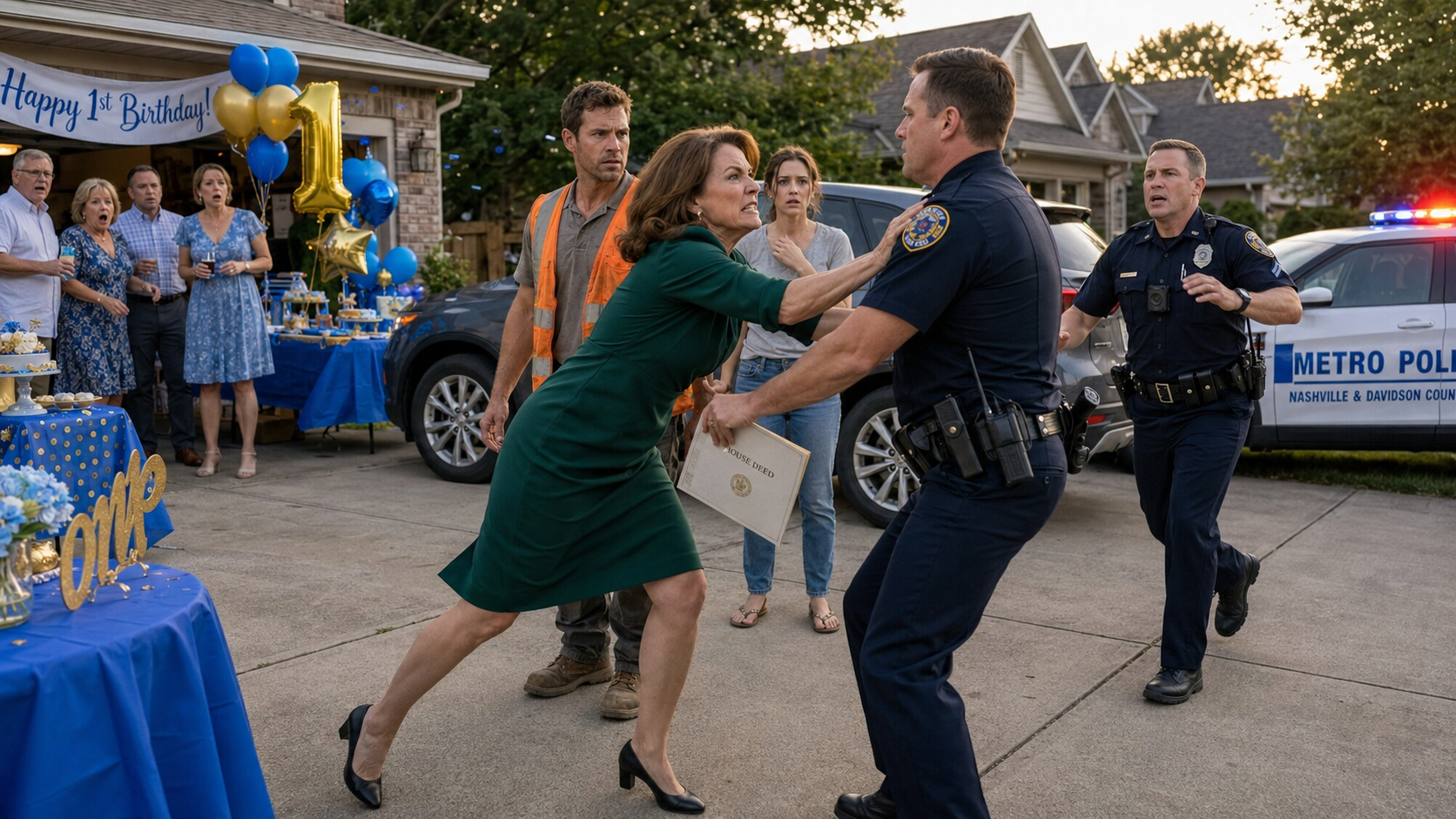
    There were folding tables covered in white cloths, trays of shrimp and crab legs, expensive bottles of whiskey, wine, balloons, flowers, and a giant gold banner stretched across the fence.

    HAPPY FIRST BIRTHDAY, FREDERICK.

    My son’s name sparkled in the sunlight.

    For one stupid second, I almost smiled.

    Then I noticed the rest.

    The catering trays.

    The liquor.

    The new patio decorations.

    A stack of wrapped gifts sitting beside an enormous rented backdrop.

    And my mother, Teresa Bradley, standing in the middle of everything in a new emerald-green dress I had never seen before, holding a wineglass and soaking up everyone’s attention.

    I had not approved any of it.

    I had not even known there was going to be a party this large.

    Amy and I had agreed on something small.

    Cake.

    A few balloons.

    Dinner with my mother.

    Maybe Betsy.

    Frederick had been restless all week, cutting teeth and running a low fever on and off, so Amy didn’t want a crowd.

    I had agreed immediately.

    “He’s one,” she had told me that morning. “He’s not going to remember whether twenty people came. I just want him comfortable.”

    I had kissed her before leaving for work.

    “Small party,” I promised.

    “Small party,” she repeated.

    I worked as a construction engineer for a commercial development company outside Nashville. Fridays were usually chaos, but I had spent the entire week pushing my crews ahead so I could leave early.

    I wanted to surprise her.

    That was why I was carrying the blue dress.

    Three weeks earlier, I had caught Amy looking at it online after Frederick went to sleep.

    She had stared at the picture longer than she probably realized.

    Then she closed the page.

    “Why didn’t you order it?” I asked.

    She shrugged.

    “It’s pretty, but it’s not necessary.”

    That had become Amy’s favorite phrase after Frederick was born.

    Not necessary.

    New shoes?

    Not necessary.

    Getting her hair done?

    Not necessary.

    A better chair for the nursery?

    Not necessary.

    She had become so focused on our son that somewhere along the way, she stopped buying anything for herself.

    So I ordered the dress.

    I also bought her a delicate silver pendant with a tiny letter F.

    And because I felt guilty for missing breakfast with them that morning, I picked up a cake from the bakery she liked.

    I pictured myself walking in early.

    I pictured Amy smiling.

    I pictured Frederick smashing frosting into his hair.

    Instead, I stood outside my own home while my mother insulted my wife.

    “My son understands responsibility,” Teresa continued.

    Through the glass, I watched her lift her drink.

    “He works hard because somebody in this family has to think about the future. That’s why he gives me the money.”

    My stomach tightened.

    Betsy leaned toward one of my cousins.

    “How much is it now?”

    My mother smiled.

    “Three thousand a month.”

    Several people reacted.

    A whistle.

    A laugh.

    Someone said, “Must be nice.”

    My grip tightened around the cake box.

    For the past eight months, I had sent my mother three thousand dollars every month.

    Not because she was poor.

    Not because she couldn’t survive without it.

    Because she told me she was helping Amy.

    When Frederick was born, I was in the middle of one of the most brutal projects of my career. A hospital expansion had fallen months behind schedule, and I was spending ten to twelve hours a day dealing with subcontractors, inspections, change orders, and delays.

    I hated leaving Amy alone so much.

    My mother volunteered to help.

    At first, it felt like a blessing.

    She would call me and say, “Don’t worry about groceries. I’ve got it.”

    Or, “The baby needed diapers, so I picked them up.”

    Or, “Amy looked tired, so I took care of dinner.”

    Then came the money conversations.

    “You know groceries have gone up.”

    “Formula is expensive.”

    “The electric bill was higher because Amy keeps the house too cold for the baby.”

    “Your wife doesn’t understand how quickly household expenses add up.”

    I trusted her.

    She was my mother.

    So instead of asking Amy about every small expense and making her feel like she needed permission to buy things, I started transferring money directly to Teresa.

    Three thousand dollars.

    Every month.

    I told myself I was helping my wife.

    Now my mother was standing in my yard bragging about it.

    “My son trusts me to take care of this family,” she said.

    Someone asked, “Where is Amy?”

    Betsy answered before my mother could.

    “In the kitchen.”

    Laughter.

    “I told her to prepare everything,” Betsy said. “A woman who is financially supported should earn her place.”

    My ears started ringing.

    Financially supported?

    Amy was my wife.

    The mother of my child.

    She had left her job six months into her pregnancy because the pregnancy became difficult and her doctor wanted her off her feet.

    We made that decision together.

    There had never been any question about whether our money was hers too.

    I pushed open the back door.

    Nobody noticed me at first.

    Music was playing.

    People were talking over one another.

    My mother had her back to me.

    I stepped inside slowly.

    The air conditioning hit my face.

    So did the smell.

    Butter.

    Garlic.

    Fried food.

    Coffee.

    Alcohol.

    The entire house smelled like a restaurant after closing.

    I walked past the dining room.

    There were plates everywhere.

    Empty glasses.

    Discarded napkins.

    Food dropped on the floor.

    Someone had moved family photographs off the sideboard to make room for bottles.

    One of my cousins was using Frederick’s high chair as a place to stack handbags.

    That small detail did something to me.

    I don’t know why.

    Maybe because it was so careless.

    So entitled.

    They weren’t visiting our home.

    They had taken it over.

    Then I heard water running in the kitchen.

    I walked toward it.

    What I saw there has never left me.

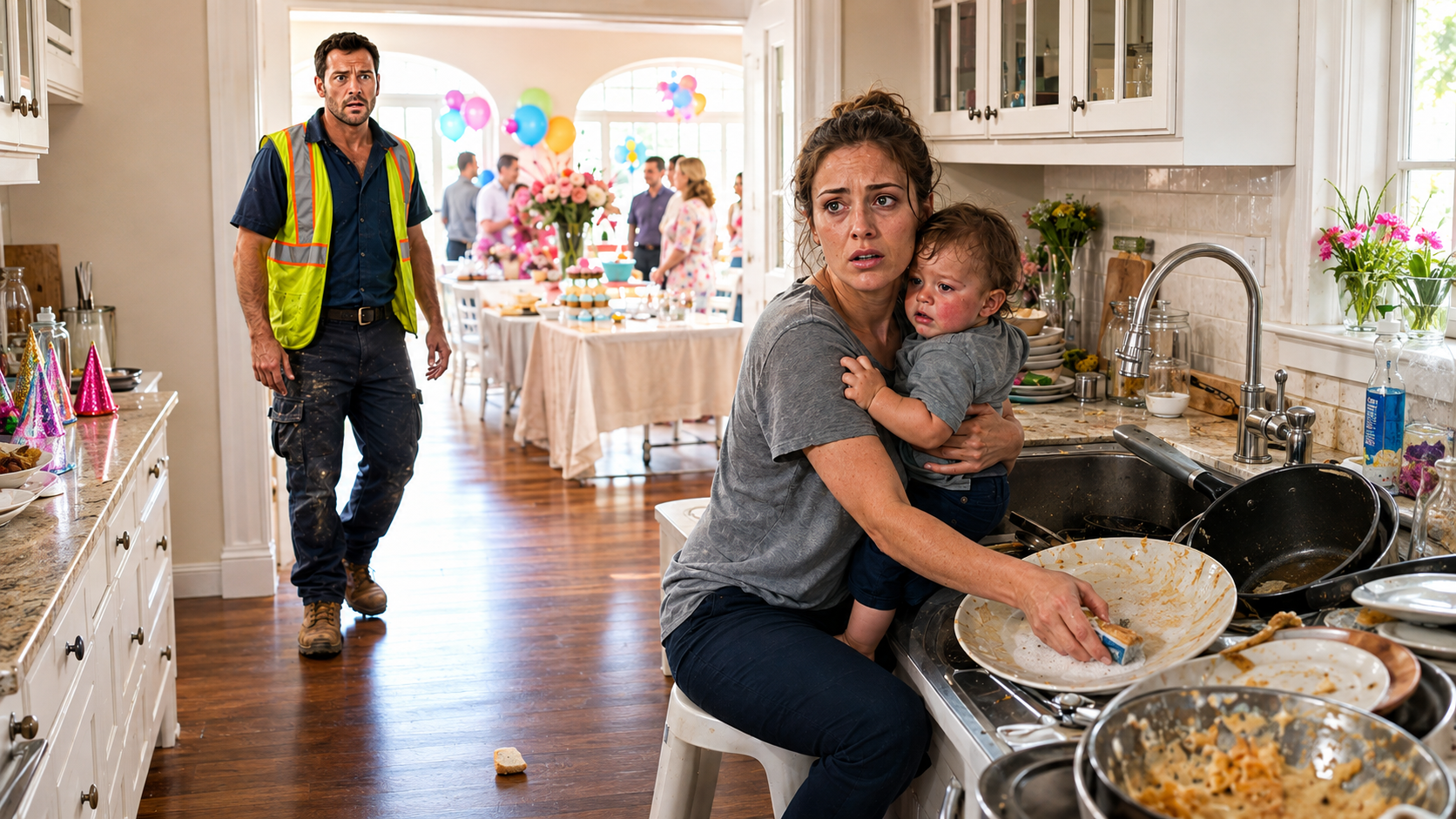
    Amy was sitting on a cheap plastic stool beside the sink.

    I had never seen the stool before.

    Her hair was pulled back messily.

    Her face was pale.

    There were damp strands stuck to her forehead.

    She wore the same soft gray shirt she had slept in the night before.

    There was a grease stain near her shoulder.

    Her hands were red from hot water.

    Dirty dishes were stacked on both sides of her.

    Pans.

    Serving trays.

    Bowls.

    Glasses.

    Half the kitchen looked like it had been turned into a commercial prep station.

    And in her left arm, pressed against her chest, was Frederick.

    Our son.

    He was flushed.

    Restless.

    Whimpering softly.

    Amy was holding him while trying to scrub a serving dish with her free hand.

    A piece of bread was in her mouth.

    Not a sandwich.

    Not a plate of food.

    A dry piece of bread.

    She saw me.

    The bread fell from her lips.

    Her eyes widened.

    “Connor?”

    I set the cake down so fast the box slid across the counter.

    “What happened?”

    She looked toward the backyard.

    Not at me.

    Toward the backyard.

    Toward my mother.

    That was the moment I knew something was worse than I understood.

    “Your mother said I couldn’t stop yet,” she whispered. “I still have to serve the coffee.”

    I stared at her.

    “What?”

    “She said everyone’s waiting.”

    I crossed the kitchen and took Frederick from her.

    The second my palm touched his forehead, fear shot through me.

    He was burning hot.

    “Amy, he’s got a fever.”

    “I know.”

    “How long?”

    “Since this afternoon. It got worse.”

    “Why didn’t you call me?”

    Her eyes filled.

    “I tried.”

    My pulse jumped.

    “What do you mean, you tried?”

    “She said you were busy.”

    I looked at her.

    “Who said that?”

    “Your mother.”

    A cold feeling moved through me.

    Amy lowered her voice.

    “She said you knew about the party. She said you paid for it. She told me not to embarrass you in front of the family.”

    I could barely process the words.

    “I didn’t know about this.”

    Her face changed.

    Just slightly.

    Confusion first.

    Then realization.

    Then something that looked frighteningly close to relief.

    “You didn’t?”

    “No.”

    Behind us, laughter exploded from the backyard.

    Amy flinched.

    Actually flinched.

    I saw it.

    And when I did, the anger I had been trying to control became something heavier.

    Not loud.

    Not wild.

    Cold.

    “We’re leaving,” I said.

    Amy glanced toward the door.

    “Connor—”

    “We’re taking Frederick to get checked.”

    “Your mother’s going to be angry.”

    Those words hurt me more than anything Teresa had said outside.

    My wife was afraid of making my mother angry.

    Inside our house.

    While holding our sick son.

    I crouched in front of her.

    “Amy.”

    She looked at me.

    “This is your home.”

    Her lips trembled.

    “I know.”

    “No. I don’t think you do anymore.”

    Her eyes dropped.

    That terrified me.

    “What has been happening when I’m at work?”

    She didn’t answer.

    “Has she been treating you like this?”

    Still nothing.

    “Amy.”

    “She was helping,” she whispered.

    “That’s not what I asked.”

    “She said you wanted her to manage things.”

    I stared at her.

    “What things?”

    “The house.”

    My stomach sank.

    “The money.”

    I felt something inside me crack.

    “And me,” Amy finished.

    I stood.

    That was enough.

    I took Frederick upstairs, changed him into lighter clothes, packed a small diaper bag, then came back down.

    Amy had washed her face.

    She was standing near the kitchen door with her purse clutched against her body.

    She looked guilty.

    Guilty for leaving.

    I hated that.

    We moved toward the front door.

    Then Teresa appeared.

    “Where are you going?”

    The room around us quieted.

    Amy stopped immediately.

    I didn’t.

    “To get my son medical attention.”

    My mother frowned.

    “He’s teething.”

    “He has a fever.”

    “All babies get fevers.”

    I kept walking.

    She stepped in front of me.

    “Connor, don’t be dramatic. We haven’t cut the cake.”

    I looked past her at the crowd.

    At the food.

    At the bottles.

    At the decorations.

    At the people watching my wife like she was the one creating a problem.

    Then I looked back at my mother.

    “Who gave you permission to do any of this?”

    Her expression hardened.

    “Permission?”

    “Yes.”

    “This is a family celebration.”

    “In my house.”

    She smiled.

    But there was no warmth in it.

    “Your house?”

    Something about the way she said it made me stop.

    Not because I doubted ownership.

    The mortgage was in my name.

    The deed was in my name.

    Amy and I had moved in four years earlier.

    But my mother looked amused.

    Almost insulted.

    Then she said quietly, “Don’t embarrass yourself in front of everybody.”

    I felt Frederick move against my chest.

    That decided it.

    “I’m taking my family out of here.”

    Teresa turned toward Amy.

    “This is what happens when a woman poisons a man against his mother.”

    Amy’s face went white.

    I stepped between them.

    “Do not speak to my wife again.”

    My mother’s expression changed.

    For the first time that day, she looked genuinely shocked.

    “Connor.”

    “I mean it.”

    “You’re choosing her over your own mother?”

    “I’m choosing my sick child over a party I never approved.”

    I opened the front door.

    Then I looked back at the room.

    “Nobody touches anything else.”

    A few relatives shifted awkwardly.

    My cousin Mason looked away.

    I noticed that.

    I didn’t know why it mattered yet.

    But it did.

    Then I noticed something else.

    A brown leather folder tucked under his arm.

    He moved it behind his body when he realized I was looking.

    I stared at him for half a second.

    He stared back.

    Then my mother stepped into my line of sight.

    “Go calm down,” she said. “We’ll discuss this later.”

    I walked out.

    But I already knew there was going to be no calm discussion later.

    Because by the time I reached my truck, I had realized something simple.

    My mother had lied to Amy about me.

    She had lied to me about Amy.

    And people do not work that hard to keep two people from talking unless there is something they are terrified those two people will discover.

    I buckled Frederick into his car seat.

    Then I took out my phone.

    I called 911.

    And for the first time in my life, I prepared to have the police remove my own mother from my home.


    PART 2: THE THINGS MY WIFE HAD BEEN TOO ASHAMED TO TELL ME

    The dispatcher asked whether anyone was in immediate physical danger.

    I looked through the windshield at Amy sitting beside Frederick in the back seat.

    She had one hand on his leg.

    Her other hand was shaking.

    “I don’t know,” I said. “My relatives are inside my home without my permission. My wife was pressured into serving them while caring for our sick baby, and I believe documents may have been taken from the house.”

    That last part came out before I had fully decided I believed it.

    But I kept seeing Mason.

    The folder.

    The way he had hidden it.

    The dispatcher told me officers were on the way.

    Then Amy spoke.

    “Documents?”

    I turned around.

    “Did my mother go into my office?”

    Amy stared at me.

    “I don’t know.”

    “Has she been in there before?”

    A long pause.

    “Yes.”

    My chest tightened.

    “When?”

    “She has a key.”

    “No, she doesn’t.”

    Amy looked confused.

    “She does.”

    I felt cold.

    I kept the office locked because it contained project files, tax documents, property records, insurance records, and personal financial paperwork.

    There were no state secrets in there.

    But there was private information.

    “I never gave her a key.”

    Amy swallowed.

    “She told me you did.”

    There it was again.

    You told her.

    She told me.

    You wanted this.

    You agreed to that.

    Suddenly the past eight months rearranged themselves in my head.

    All those moments when Amy seemed distant after my mother visited.

    All those times she said she was tired.

    All those evenings when I asked if something was wrong and she said, “Nothing.”

    I had assumed postpartum exhaustion.

    I had assumed new-parent stress.

    I had assumed we were both struggling through the hardest year of our lives.

    I hadn’t considered that someone was deliberately standing between us.

    I looked at her.

    “Tell me everything.”

    “Connor—”

    “Please.”

    She looked toward the house.

    “Not here.”

    That told me how bad it was.

    The first police cruiser pulled into the driveway less than ten minutes later.

    Then a second.

    Two officers approached me while another went toward the front entrance.

    I explained that I was the homeowner.

    I showed them my ID.

    I explained the party had happened without my knowledge.

    I told them my wife had been made to work for the guests while our child had a fever.

    I mentioned the folder.

    Then we heard shouting from inside.

    My mother.

    Of course.

    “You cannot come in here without permission!”

    One of the officers looked at me.

    “Is that your mother?”

    “Yes.”

    “Does she live here?”

    “No.”

    That mattered.

    The officer nodded and went inside.

    What happened next unfolded so quickly that I barely had time to think.

    My mother came storming toward the front door.

    “This is ridiculous!” she shouted. “Connor, tell them to leave!”

    “I called them.”

    Silence.

    Her face changed.

    Not embarrassment.

    Rage.

    “You what?”

    “This party is over.”

    “You called the police on your own family?”

    “I called the police because you are refusing to leave my house.”

    “It’s not just your house!”

    There it was again.

    I stared at her.

    “What does that mean?”

    She stopped.

    For half a second, she looked like she had said too much.

    Then Betsy appeared behind her.

    “This is disgraceful,” my aunt snapped.

    “Then go home.”

    “Teresa has done everything for you.”

    “No. She claimed she was doing everything for Amy.”

    My mother’s eyes flicked toward my wife.

    That look told me more than words could have.

    Amy lowered her gaze automatically.

    I saw it happen.

    So did one of the officers.

    He stepped between my mother and the doorway.

    “Ma’am, the homeowner is asking guests to leave.”

    Teresa folded her arms.

    “I am his mother.”

    “That doesn’t give you a legal right to remain in the residence.”

    She laughed.

    “You don’t understand.”

    “Then explain it.”

    “I helped him get this house.”

    My anger sharpened.

    “No, you didn’t.”

    Her head snapped toward me.

    “I raised you.”

    “That isn’t the same thing.”

    “You think she would have any of this without you?”

    She pointed at Amy.

    “Your wife came into this family with nothing.”

    Amy’s face tightened.

    I stepped closer.

    “Stop.”

    “What? Everybody knows it.”

    “Stop talking.”

    “She traps you with a baby, stays home all day, spends your money—”

    “My money?”

    I almost laughed.

    Not because it was funny.

    Because I finally understood how much poison she had been feeding herself.

    “Yes,” I said. “My money. The money I earn for my family. Amy is my family.”

    My mother slapped my chest with the flat of her hand.

    The officer moved instantly.

    “Ma’am, do not touch him.”

    She shoved his arm away.

    That was the moment everything changed.

    The officers took hold of her.

    She screamed.

    Betsy screamed.

    Several relatives started shouting over one another.

    Amy covered Frederick’s ears.

    Then I saw Mason.

    He slipped from the dining room toward the hallway.

    The folder was still under his arm.

    “Mason.”

    He kept walking.

    “Mason!”

    He ran.

    Not far.

    He made it through the side door and almost reached the gate before one of the officers intercepted him.

    “What’s in the folder?” the officer asked.

    “Nothing.”

    “It doesn’t belong to you,” I said.

    Mason looked at my mother.

    That was his mistake.

    Everyone saw it.

    My mother screamed, “Don’t give them anything!”

    The backyard went silent.

    The officer took the folder.

    Mason didn’t fight him.

    He just looked terrified.

    I walked closer.

    The officer opened it.

    The first document was my original property deed.

    For a moment, I couldn’t make sense of what I was seeing.

    It was a document I knew well.

    I had signed it at closing.

    It had been in the locked fireproof cabinet in my office ever since.

    “What is that doing there?” I asked.

    Nobody answered.

    Beneath it were copies of my property tax records.

    A copy of my driver’s license.

    Mortgage statements.

    Banking information.

    And several pages of handwritten notes.

    One line had my full legal name.

    Another had the property address.

    Another listed the estimated market value of the home.

    Then I saw something that made my heartbeat slow.

    Not speed up.

    Slow.

    Because my brain was trying to protect me from what it meant.

    A photocopy of my signature.

    Repeated several times on one sheet.

    Mason looked at the ground.

    My mother began shouting again.

    “He’s my son! I was helping him organize his finances!”

    One of the officers looked at me.

    “Did you authorize any of this?”

    “No.”

    “Did you give them permission to access your office?”

    “No.”

    My mother screamed, “He gave me a key!”

    “I did not.”

    “You don’t remember everything you tell me!”

    “I remember who has keys to my house.”

    Amy spoke from behind me.

    “She told me Connor gave it to her.”

    Teresa turned on her.

    “Shut your mouth.”

    I moved before I even thought about it.

    Not toward my mother.

    Between her and Amy.

    “Do not speak to her.”

    My mother laughed bitterly.

    “Look at you.”

    One officer guided her toward the cruiser.

    “You’re throwing away your mother because of that woman.”

    That woman.

    My wife.

    The mother of my son.

    The person sitting in a kitchen full of dirty dishes while my relatives ate food purchased with money I thought was helping her.

    Something inside me settled.

    I no longer felt confused.

    I felt done.

    The officers took statements.

    Several relatives left quickly.

    Some avoided looking at me.

    Others whispered to each other.

    Betsy called me ungrateful before driving away.

    Mason was taken aside for questioning because of the documents.

    My mother was taken in after the altercation with the officer and her refusal to leave.

    I didn’t care about the exact charges in that moment.

    I cared about Frederick.

    We took him to urgent care.

    His fever was high enough to worry us but not dangerous once treated. The doctor believed he had a viral infection and told us to keep him hydrated, monitor his temperature, and bring him back if his condition worsened.

    By the time we got home, it was dark.

    The party was gone.

    But the damage remained.

    Trash everywhere.

    Half-eaten food.

    Alcohol bottles.

    Broken decorations.

    Sticky floors.

    A stained tablecloth.

    And silence.

    I carried Frederick upstairs and laid him in his crib.

    Amy stood in the doorway watching me.

    “He’ll be okay,” I said.

    She nodded.

    Then she started crying.

    Quietly.

    Like she was ashamed of the sound.

    I went to her.

    She whispered, “I’m sorry.”

    I stared at her.

    “For what?”

    “For today.”

    “No.”

    “For embarrassing you.”

    “No.”

    “For the police.”

    “No.”

    Her face crumpled.

    “I should have handled it better.”

    “Amy, stop.”

    She covered her face.

    That broke something in me.

    I took her wrists gently and lowered her hands.

    “You have nothing to apologize for.”

    “She said you were tired of coming home to a mess.”

    I went still.

    “What?”

    “She said you complained that I wasn’t doing enough.”

    “I never said that.”

    “I know that now.”

    “What else?”

    Amy looked away.

    “No more protecting me from it.”

    Her eyes returned to mine.

    “I wasn’t protecting you.”

    “Then why didn’t you tell me?”

    “Because she kept making it sound like you already knew.”

    I sat on the edge of the bed.

    Amy sat beside me.

    Then, piece by piece, she told me what had been happening.

    My mother came over three or four days a week.

    Sometimes more.

    She criticized how Amy cleaned.

    How she fed Frederick.

    How often she held him.

    How much laundry she did.

    What she cooked.

    What she wore.

    How much she spent.

    She told Amy I was under enormous financial pressure.

    She told her I had complained privately about the grocery bills.

    She said I wanted Amy to be “more grateful.”

    She said I believed staying home with Frederick was easier than working.

    I felt sick.

    “I never said any of that.”

    “I know.”

    “No. I need you to understand. I never said anything close to that.”

    “I believe you.”

    “She told me she was helping you.”

    “She told me she was helping you.”

    We stared at each other.

    That sentence hung between us like a door opening.

    My mother had built two different stories.

    For me, she was the selfless grandmother carrying the burden of helping an overwhelmed new mother.

    For Amy, she was my representative.

    My voice.

    My authority.

    “Did she buy groceries?” I asked.

    “Sometimes.”

    “How much?”

    “I don’t know. Fifty dollars. Maybe a hundred.”

    “Bills?”

    “She paid the electric bill twice.”

    “Anything else?”

    Amy shook her head.

    “What about the three thousand?”

    She looked confused.

    “What three thousand?”

    I felt my stomach drop again.

    “I sent her three thousand dollars every month.”

    Amy stared at me.

    “Every month?”

    “For you. For the house. For Frederick.”

    Her mouth opened.

    No words came out.

    “For how long?” she finally whispered.

    “Eight months.”

    Her face drained.

    “Connor, she told me you were cutting back.”

    I stood.

    “What?”

    “She said money was tight.”

    I walked across the room and back.

    Twenty-four thousand dollars.

    I had sent my mother twenty-four thousand dollars.

    And my wife had been rationing household spending because Teresa told her we were struggling.

    Suddenly I remembered the blue dress downstairs.

    Amy had wanted a ninety-dollar dress and refused to buy it because it was “not necessary.”

    My mother had been wearing a new dress that probably cost three times that while serving liquor at a party she hadn’t paid for with her own money.

    “How long have you been worried about money?” I asked.

    “Months.”

    “You never told me.”

    “I thought you were already worried.”

    I sat again.

    We had been living in the same house.

    Sleeping in the same bed.

    Raising the same child.

    And my mother had somehow created an invisible wall between us.

    Amy wiped her eyes.

    “There’s more.”

    I didn’t want there to be.

    But I nodded.

    “She asked me to sign something last week.”

    Every muscle in my body tightened.

    “What?”

    “I didn’t sign it.”

    “What was it?”

    “She said it was insurance paperwork.”

    “Where is it?”

    “I don’t know.”

    “What did it say?”

    “I only saw the first page. There was something about property.”

    My heartbeat started pounding.

    “Why didn’t you sign?”

    “She got angry when I tried to read it.”

    That one sentence was enough.

    “What did she say?”

    Amy swallowed.

    “She said I had no legal claim to the house anyway, so it shouldn’t matter.”

    I stared at her.

    The copied signature sheet flashed through my mind.

    The deed.

    The tax records.

    The estimate of the home’s value.

    Mason running toward the gate.

    “What did you say?”

    “I told her I wanted to ask you first.”

    “And?”

    “She said if I bothered you at work over every little decision, eventually you’d get tired of me.”

    My hands curled into fists.

    Amy touched my arm.

    “Connor.”

    I looked at her.

    “We need to know what she was trying to do.”

    She was right.

    And for the first time that day, beneath the anger, beneath the guilt, beneath the humiliation, I felt something else.

    Fear.

    Because cruelty was one thing.

    Stealing twenty-four thousand dollars was another.

    But my mother had been collecting documents tied to my home.

    She had wanted Amy’s signature.

    And whatever she was planning, she believed she was close enough to success to celebrate inside my house before she had even finished.


    PART 3: THE PARTY HAD NEVER BEEN FOR FREDERICK

    We barely slept.

    Frederick woke twice with a fever, and each time Amy and I took turns holding him, checking his temperature, and giving him water.

    Sometime after three in the morning, I found Amy sitting in the nursery chair in the dark.

    Frederick was asleep against her chest.

    She was staring at the wall.

    I sat beside her.

    “You should rest.”

    “So should you.”

    Neither of us moved.

    After a while, she said, “I kept thinking she would eventually like me.”

    I looked at her.

    “She acted like she did.”

    “At first.”

    I remembered.

    When Amy and I got engaged, Teresa had been charming.

    Overly charming, maybe.

    She helped plan the rehearsal dinner.

    Bought Amy a bracelet.

    Called her “the daughter I never had.”

    I had believed every second of it.

    Then our wedding happened.

    Then the house.

    Then Frederick.

    Each time Amy became more permanent in my life, my mother became more critical.

    I had noticed tension.

    I had not understood its shape.

    “She never wanted to like you,” I said quietly.

    Amy looked down at our son.

    “She wanted me to be grateful for permission to be here.”

    The words were painful because they were true.

    By morning, I started going through our finances.

    I pulled bank statements.

    Transfer records.

    Credit activity.

    I checked every account.

    Amy made coffee while I sat at the dining room table surrounded by paperwork.

    At first, the damage looked limited.

    Twenty-four thousand dollars transferred to Teresa over eight months.

    Still enormous.

    Still infuriating.

    But traceable.

    Then I found unusual inquiries related to the property.

    Not successful transactions.

    Nothing had been transferred.

    But there had been requests for information I had not made.

    I called the mortgage company.

    Then the county property office.

    Then a lawyer I had used years earlier during a contract dispute.

    By noon, I understood enough to know my mother’s plan had not been imaginary.

    It also had not yet succeeded.

    That mattered.

    My lawyer, Daniel, arrived at the house that afternoon.

    I handed him copies of everything the police had released back to me.

    The deed.

    The notes.

    The copied signatures.

    The documents from my office.

    He examined them quietly.

    Amy sat beside me with Frederick asleep against her.

    Finally, Daniel looked up.

    “Connor, did you ever discuss adding your mother to the deed?”

    “No.”

    “Giving her a financial interest in the house?”

    “No.”

    “Borrowing against the property with her involved?”

    “No.”

    “Transferring ownership into any kind of family arrangement?”

    “No.”

    He tapped one page.

    “This language suggests somebody was exploring a transfer.”

    Amy stiffened.

    “What kind?”

    “Potentially an ownership transfer or a document that would make it appear Teresa had a legal interest. I can’t tell from these pages alone how far they got.”

    My mouth went dry.

    “Could they have taken the house?”

    “Not easily. And not legally without valid authorization.”

    “Could they have forged it?”

    Daniel paused.

    “That appears to be the risk we’re looking at.”

    Amy tightened her arms around Frederick.

    I stared at the photocopies of my signature.

    “Why would Mason have them?”

    “I don’t know.”

    I did.

    Or at least I had a theory.

    Mason had worked for a title-processing company years earlier.

    Not as a lawyer.

    Not as anyone important.

    But he knew paperwork.

    He knew what documents looked like.

    He knew how property filings worked better than the average person.

    And he had always been desperate for money.

    He changed jobs constantly.

    Borrowed from relatives.

    Bet on sports.

    Bought things he couldn’t afford.

    The more I thought about it, the worse the picture became.

    My mother had money.

    My documents.

    Mason had knowledge.

    And Amy had been pressured to sign something she was told not to read.

    Daniel looked at me.

    “There’s something else.”

    He pointed at the handwritten estimate of our home’s value.

    “Whoever wrote this was not only interested in ownership. They were interested in equity.”

    I understood immediately.

    Our house had increased significantly in value since we bought it.

    We had also paid down enough of the mortgage to build substantial equity.

    “How much could someone get?”

    “Depends on the method.”

    Amy whispered, “So she wanted the house.”

    Daniel shook his head.

    “Maybe not the physical house.”

    I looked at him.

    “The money.”

    He nodded.

    That fit my mother better.

    Not a dramatic plan to throw us onto the street.

    Something she could justify to herself.

    A loan.

    A transfer.

    A financial arrangement.

    A way to reach money she believed she deserved because I was her son.

    Then I remembered what she had said.

    It’s not just your house.

    Not yet, I thought.

    But she thought it would be.

    Daniel advised us to lock down everything.

    New passwords.

    Credit freezes.

    Fraud alerts.

    Notification requirements on property records.

    New locks on the house.

    No verbal arrangements.

    No private meetings.

    Everything documented.

    I did all of it.

    Then I opened the cabinet where the original deed had been stored.

    The lock had scratches around it.

    I stood there looking at them.

    Amy came up behind me.

    “I never noticed that.”

    “I should have.”

    “You weren’t looking for it.”

    That didn’t make me feel better.

    I found a small ring of spare keys in another drawer.

    One was missing.

    The office key.

    I sat down.

    My mother had stolen a key to my office.

    Or copied one.

    Either way, this had not started on Frederick’s birthday.

    It had been developing for months.

    That evening, my phone started filling with messages.

    Betsy:

    Your mother spent the night in jail because of you.

    Another aunt:

    Whatever happened today should have stayed inside the family.

    My uncle:

    You need to apologize before this becomes something you can’t take back.

    A cousin:

    Amy has changed you.

    I read that one twice.

    Then I laughed.

    Amy was beside me on the couch.

    “What?”

    “They think you changed me.”

    She gave me a tired smile.

    “Did I?”

    “Yes.”

    Her smile disappeared.

    I took her hand.

    “You taught me that being married means I don’t get to ignore something just because dealing with it is uncomfortable.”

    She looked at our hands.

    “I should have told you sooner.”

    “I should have seen it sooner.”

    We both carried guilt.

    But guilt was useful only if it changed what happened next.

    My mother called from an unknown number around eight.

    I almost didn’t answer.

    Then I did.

    “Connor.”

    Her voice was cold.

    Not crying.

    Not apologetic.

    Cold.

    “You’ve made a serious mistake.”

    “I don’t think so.”

    “You had me arrested.”

    “You shoved a police officer.”

    “Because he grabbed me in my own son’s house.”

    “My house.”

    “Everything you have came from this family.”

    I closed my eyes.

    There it was.

    The belief underneath everything.

    Not love.

    Ownership.

    “You mean everything I have belongs to you.”

    “I sacrificed for you.”

    “I never said you didn’t.”

    “You think sacrifice is free?”

    The question shocked me.

    Maybe because she finally said it clearly.

    I had always known my mother kept score.

    Every gift.

    Every favor.

    Every hardship.

    But hearing her reduce motherhood to a debt ledger made something inside me go quiet.

    “What were you planning to do with my house?”

    She laughed.

    “You’ve been talking to lawyers now?”

    “What did you want Amy to sign?”

    “She’s lying.”

    “She described paperwork before I told her what the police found.”

    Silence.

    My hand tightened around the phone.

    “You told me the money I sent was helping Amy.”

    “It was helping the family.”

    “You spent it on yourself.”

    “You don’t know that.”

    “You threw a party with food I didn’t order, liquor I didn’t buy, decorations I didn’t approve, and you were wearing a brand-new dress while Amy ate bread over the sink.”

    “That woman always plays the victim.”

    My jaw tightened.

    “Her name is Amy.”

    “She has turned you against me.”

    “No. You did that.”

    Her voice sharpened.

    “You will regret humiliating me.”

    “No, Mom. You humiliated yourself.”

    Then she said something that confirmed every fear I had.

    “You have no idea how much trouble you’re about to cause yourself if you keep digging.”

    I stopped breathing for half a second.

    “What trouble?”

    She hung up.

    Amy had heard enough of the conversation from beside me.

    “What did she mean?”

    “I don’t know.”

    But I did know one thing.

    My mother was scared.

    People don’t threaten you for searching unless they know there is something to find.

    The next morning, Mason called.

    I answered immediately.

    He sounded exhausted.

    “I need to talk to you.”

    “You can talk.”

    “Not on the phone.”

    “Then I’m not interested.”

    “Connor, please.”

    I looked at Amy.

    She heard the desperation in his voice.

    “What do you want?”

    “To tell you what Teresa was doing.”

    My pulse jumped.

    “Start talking.”

    He hesitated.

    Then he said, “That party wasn’t supposed to happen before the paperwork was finished.”

    I went completely still.

    “What paperwork?”

    Mason exhaled.

    “She thought Amy signed it.”

    I looked at my wife.

    Amy’s face changed.

    “What did she think Amy signed?” I asked.

    Mason lowered his voice.

    “A quitclaim deed.”

    The room seemed to tilt.

    Amy whispered, “What?”

    Mason heard her.

    “Teresa told me Amy agreed.”

    “She didn’t.”

    “I know that now.”

    “What exactly did my mother ask you to do?”

    Another hesitation.

    Then Mason said the sentence that finally exposed the heart of it.

    “She wanted your house positioned so she could borrow against the equity.”

    Frederick made a small sound from his playpen.

    Amy covered her mouth.

    I stared at the wall.

    Twenty-four thousand dollars had not been enough.

    My mother wanted access to the biggest asset I owned.

    And somehow, in her mind, my son’s first birthday had become the perfect day to celebrate before we even knew what she believed she had taken from us.


    PART 4: MY MOTHER HAD BEEN BUILDING HER OWN VERSION OF MY LIFE

    I made Mason repeat everything.

    Slowly.

    He said Teresa had approached him two months earlier.

    At first, she claimed I wanted advice about putting property into a “family structure.”

    Mason thought it sounded strange, but my mother insisted I was too busy to handle the details personally.

    That excuse worked because everyone knew how much I worked.

    My schedule had become part of her plan.

    She knew I was difficult to reach during the day.

    She knew Amy didn’t want to interrupt me.

    She had spent months telling both of us that the other wanted her involved.

    Then she used our trust as proof.

    Mason said she brought copies of property records and asked how transfers worked.

    He explained basic information.

    Then she started asking more specific questions.

    Could a spouse sign away an interest?

    Could someone be added?

    Could equity be accessed later?

    Could documents be filed without everyone physically appearing together?

    At that point, he said, he became uncomfortable.

    I almost laughed when he said that.

    “You were uncomfortable?”

    “Yes.”

    “But you kept helping.”

    “I didn’t know she was lying.”

    “You ran out of my house carrying my deed.”

    Silence.

    “What were you doing with it?”

    “She told me to get it out.”

    “Why?”

    “Because when you showed up early, she knew something was wrong.”

    I rubbed my forehead.

    “So you knew enough to hide evidence.”

    “I panicked.”

    “You were part of it.”

    “I wasn’t going to file anything without talking to you.”

    “But you had my signature copied.”

    He went quiet again.

    “Mason.”

    “She gave me the copies.”

    “And what did you think they were for?”

    “I thought she was comparing signatures.”

    “That is the stupidest thing you’ve said so far.”

    “I know.”

    I paced through the living room.

    Amy sat at the dining table taking notes.

    That surprised me.

    Not because she wasn’t capable.

    Because two days earlier, she had been afraid to leave a kitchen without Teresa’s permission.

    Now she was writing down dates.

    Questions.

    Names.

    I saw the change happening in real time.

    Not revenge.

    Not rage.

    Clarity.

    She was done being confused.

    “So what was supposed to happen?” I asked.

    Mason sighed.

    “Teresa believed Amy had signed the quitclaim deed.”

    “She hadn’t.”

    “She told me she had.”

    “What would that have done?”

    “Depending on how it was prepared and filed, it could have changed Amy’s recorded interest. Teresa’s idea was to create documentation that gave her leverage to be added later.”

    “Leverage how?”

    “She thought if Amy was out of the ownership picture, she could convince you to add her.”

    I almost shouted.

    “She knows I would never do that.”

    “She said you wouldn’t notice at first.”

    That chilled me.

    Not convince me.

    Not ask me.

    I wouldn’t notice.

    “So she planned to forge my authorization.”

    “I don’t know.”

    “Mason.”

    “I don’t know exactly.”

    “You had copies of my signature.”

    “I know.”

    “Why?”

    “She told me you signed some documents already and she wanted everything to match.”

    My stomach turned.

    Amy stopped writing.

    Mason continued quickly.

    “I didn’t file anything. I swear.”

    Daniel later confirmed that no fraudulent ownership transfer had been successfully recorded.

    That fact probably saved my sanity.

    My mother’s plan had been reckless and incomplete.

    She had overestimated how easily documents could be manipulated.

    But the intention mattered.

    The preparation mattered.

    The stolen deed mattered.

    The lies mattered.

    Mason said Teresa had become obsessed with the equity after learning how much the property had increased in value.

    “What did she want the money for?” I asked.

    “I don’t know.”

    “You expect me to believe that?”

    “She talked about investments. Paying off debts. Helping family.”

    “What debts?”

    “I don’t know.”

    The answer came later.

    Through records.

    Messages.

    And one person I never expected to help us.

    Aunt Betsy.

    Three days after the party, she called Amy.

    Not me.

    Amy almost didn’t answer.

    Then she did.

    Betsy sounded different.

    No arrogance.

    No lectures.

    She said, “I think Teresa lied to me.”

    Amy put the call on speaker.

    I listened from across the kitchen.

    “About what?” Amy asked.

    “The party.”

    Amy’s eyes met mine.

    Betsy continued.

    “She told us Connor planned it.”

    I closed my eyes.

    Of course.

    “She said he wanted a big family celebration but didn’t want you involved because you were overwhelmed.”

    Amy’s voice tightened.

    “So you thought Connor wanted me cooking for everyone?”

    A pause.

    “No.”

    “But you told me I should earn my place.”

    “I was angry.”

    “At me.”

    “Yes.”

    “Why?”

    Another pause.

    “Because Teresa said Connor had been paying all your expenses, plus sending money to help your parents.”

    Amy looked at me in disbelief.

    I shook my head.

    We had never sent money to her parents.

    They didn’t need it.

    Betsy’s voice softened.

    “She made it sound like you were draining him.”

    Amy leaned against the counter.

    “And you believed her.”

    “Yes.”

    I could see how much that answer hurt.

    Not because Betsy mattered deeply to Amy.

    Because it proved how far my mother had spread the story.

    Amy had not merely been mistreated privately.

    Teresa had built a reputation for her.

    Lazy.

    Dependent.

    Wasteful.

    Ungrateful.

    A burden.

    Each lie made the next cruelty seem reasonable to people who wanted to believe it.

    Betsy said my mother had been telling relatives I was preparing to “restructure family assets.”

    There was that phrase again.

    Family assets.

    As if my house had become communal property because my mother had decided it should be.

    Then Betsy said something more important.

    “Teresa owes people money.”

    I stepped closer.

    Amy asked, “Who?”

    “Family.”

    “How much?”

    “I don’t know exactly.”

    “Why?”

    Betsy sounded embarrassed.

    “She’s been borrowing.”

    “For what?”

    “She said investments.”

    Mason had used the same word.

    Investments.

    Over the next week, the picture became clearer.

    Teresa had made several bad financial decisions.

    Not one dramatic disaster.

    A series of smaller ones.

    She put money into a business opportunity promoted by someone she knew.

    It failed.

    She borrowed to cover losses.

    Then borrowed again to repay the first loans.

    She used some of the money I sent her to keep herself afloat.

    Then she began spending more, not less, because maintaining the appearance of success mattered to her.

    New clothes.

    Meals.

    Gifts.

    Money handed to relatives.

    She wanted people to believe she was still the powerful center of the family.

    The woman who could fix everything.

    The woman whose successful son trusted her with money.

    The three thousand dollars I sent every month became part of that image.

    She bragged about it.

    Maybe at first she told herself it was temporary.

    Maybe she thought she would repay it.

    Maybe she convinced herself that because I was doing well, I would never miss it.

    But by the time she learned how much equity was in the house, necessity had mixed with entitlement.

    She stopped seeing it as my property.

    She saw it as money available to the family.

    Which meant available to her.

    And Amy stood in the way.

    Because Amy was the person most likely to notice.

    So my mother spent months weakening her.

    Making her doubt her own judgment.

    Making her afraid to talk to me.

    Making her feel like a guest in her own home.

    The birthday party was supposed to be the victory lap.

    That was the part I could barely understand.

    “Why that day?” I asked Daniel.

    He gave me the simplest answer.

    “Because she believed she had already won.”

    The idea made me sick.

    My mother had thought Amy had signed the document.

    She thought I wouldn’t find out until later.

    She believed the money arrangement was moving forward.

    So she threw a huge celebration using money she had taken from me.

    Not to celebrate Frederick.

    To perform ownership.

    Her relatives in my house.

    Her food.

    Her decorations.

    Her rules.

    My wife in the kitchen.

    My mother at the center of the yard.

    Every detail was symbolic.

    She wanted Amy to see what the new hierarchy looked like.

    That realization turned my anger into something almost clinical.

    I stopped responding emotionally to Teresa’s messages.

    I saved them.

    Documented them.

    Forwarded relevant ones to Daniel.

    Changed every lock.

    Installed cameras.

    Moved important documents to a secure off-site location.

    Separated all access she had ever been given.

    Then Amy did something I will never forget.

    She printed every message Teresa had sent her for the past eight months.

    Dozens.

    Maybe hundreds.

    We laid them across the dining table.

    At first, each one looked small.

    Connor likes the house quieter when he gets home.

    Don’t buy that. Money is tighter than he admits.

    He doesn’t want you bothering him at work.

    You should be grateful he lets you stay home.

    I’ll manage the bills. Connor trusts me.

    I know my son better than you do.

    Don’t make him choose.

    He’s under enough pressure because of you.

    Then came the messages from the week before the party.

    Sign the insurance paperwork when I bring it.

    There is nothing in it you need to worry about.

    Connor already understands the arrangement.

    Stop asking questions about things you don’t understand.

    Amy stared at that last message for a long time.

    “She was training me not to ask you.”

    I hated how accurate that was.

    I put my hand over hers.

    “She almost succeeded.”

    Amy looked at me.

    “Almost.”

    That word mattered.

    Because Teresa’s biggest mistake was not leaving the deed behind.

    It was not Mason running.

    It was not the party.

    Her biggest mistake was making Amy so afraid that when I walked into that kitchen, I finally saw the fear clearly.

    Once I saw it, I started asking questions.

    And once Amy and I started speaking directly to each other again, my mother’s entire system collapsed.

    Two weeks after Frederick’s birthday, Teresa asked to meet.

    Through her lawyer.

    Daniel advised me to go if I wanted answers.

    Amy wanted to come.

    At first, I said no.

    Then I caught myself.

    I was doing exactly what had allowed this mess to grow.

    Deciding for her.

    Protecting her by excluding her.

    So I asked.

    “Do you want to be there?”

    “Yes.”

    “Then you’re coming.”

    The meeting was scheduled in a conference room at Daniel’s office.

    My mother arrived ten minutes late.

    Perfect hair.

    Perfect makeup.

    Conservative navy dress.

    For a moment, she looked like the mother I remembered from childhood.

    Controlled.

    Capable.

    Untouchable.

    Then she saw Amy sitting beside me.

    Her face hardened.

    “This should be between my son and me.”

    Amy answered before I could.

    “You made it about me when you tried to get my signature.”

    My mother stared at her.

    And for the first time since this began, Amy did not look away.


    PART 5: “I RAISED YOU” WAS NOT A LICENSE TO OWN ME

    My mother sat across from us.

    Her attorney placed a folder on the table.

    Daniel sat beside me.

    Amy sat on my other side.

    Nobody spoke for several seconds.

    Then Teresa looked at me.

    “You look tired.”

    It was such a familiar sentence that it almost disarmed me.

    She had said versions of it my entire life.

    You look tired.

    You’re working too hard.

    You need your mother.

    For years, care had been the soft wrapping around control.

    “I am tired,” I said.

    “You didn’t need to turn this into a war.”

    “I didn’t.”

    Her mouth tightened.

    “You called the police.”

    “You refused to leave.”

    “I was celebrating my grandson.”

    “You were stealing documents.”

    “I was trying to protect family property.”

    I leaned back.

    “Family property.”

    “Yes.”

    “My house.”

    “Your father would be ashamed to hear you speak like this.”

    That was another familiar weapon.

    My father had died six years earlier.

    He had been quieter than my mother.

    More passive.

    He loved me, but he rarely challenged her.

    After he died, Teresa seemed to become convinced that family loyalty meant automatic obedience.

    “Leave Dad out of it.”

    “He believed family takes care of family.”

    “So do I.”

    She laughed.

    “No, you take care of her.”

    She looked at Amy.

    “I take care of my wife and son.”

    “You never had a problem helping me before she came along.”

    I stared at her.

    That was the real wound, wasn’t it?

    Not money.

    Not property.

    Replacement.

    When I was single, my mother had been the center of my personal life.

    I called her several times a week.

    Asked her advice.

    Helped with repairs.

    Paid for trips sometimes.

    Took her to dinner.

    Then Amy came.

    Then marriage.

    Then a house.

    Then Frederick.

    My priorities changed in the natural way adult priorities change.

    My mother experienced that as theft.

    “I didn’t stop loving you when I married Amy.”

    “You changed.”

    “I grew up.”

    Her eyes flashed.

    “I raised you.”

    “Yes.”

    “I sacrificed everything.”

    “I know.”

    “You would have nothing without me.”

    “That is not true.”

    Her voice rose.

    “You think you became successful by yourself?”

    “No. Lots of people helped me.”

    “I helped you.”

    “Yes.”

    “Then why should I have to beg you for anything?”

    There it was.

    I looked at Daniel.

    Then back at my mother.

    “You never had to beg.”

    “You gave me scraps.”

    “Three thousand dollars a month is not scraps.”

    Her face shifted slightly.

    Amy looked at me.

    My mother said, “You make more than enough.”

    “That doesn’t make it yours.”

    “You let her live in a house worth hundreds of thousands of dollars while your own mother worries about bills.”

    Amy’s jaw tightened.

    I spoke carefully.

    “Amy does not ‘live in my house.’ We built a life here together.”

    “She didn’t pay for it.”

    “That is none of your business.”

    “She didn’t earn it.”

    “She is my wife.”

    My mother turned toward Amy.

    “And what did you earn? A baby?”

    Amy inhaled slowly.

    Daniel started to speak, but Amy raised one hand.

    She wanted this.

    I let her.

    “I spent eight months listening to you tell me what Connor thought of me,” she said.

    Teresa rolled her eyes.

    “I was trying to help you understand reality.”

    “No. You were trying to isolate me.”

    My mother’s expression changed.

    “You told me he thought I spent too much money.”

    “You did.”

    “Connor never said that.”

    “You told me he was embarrassed that I wasn’t working.”

    “He should have been.”

    “You told me he didn’t want me calling him during the day.”

    “He has a demanding job.”

    “You told me he wanted you to manage our house.”

    “I was helping.”

    “You told me I had no legal right to question documents about the home where I raise our son.”

    Teresa looked toward her lawyer.

    Amy continued.

    “You gave me paperwork and told me it was insurance.”

    “I never—”

    “I kept the message.”

    Silence.

    My mother’s attorney looked at her.

    That was the first moment I saw uncertainty on his face.

    Amy pulled out a printed copy.

    She slid it across the table.

    Teresa didn’t touch it.

    Then Amy said, “You made me afraid to speak in my own home.”

    My mother laughed.

    “You’re an adult woman. If you were afraid of me, that’s your weakness.”

    I felt anger rise.

    But Amy squeezed my hand under the table.

    She didn’t need rescuing.

    Not now.

    She leaned forward.

    “No. That was your strategy.”

    My mother went quiet.

    Amy’s voice remained calm.

    “You thought if you made me ashamed enough, I would stop asking questions.”

    “That is ridiculous.”

    “You thought if you kept Connor busy enough and me insecure enough, we wouldn’t compare what you were telling us.”

    Teresa glanced at me.

    Amy saw it.

    “So that’s what you were afraid of.”

    My mother snapped, “I was not afraid of you.”

    “No. You were afraid of us talking to each other.”

    That landed.

    I could see it.

    My mother looked away.

    Daniel then went through the facts.

    The unauthorized documents.

    The copied signatures.

    The office access.

    Mason’s statement.

    The attempted pressure on Amy.

    The money transfers.

    The evidence that Teresa had misrepresented the purpose of the money.

    He did not dramatize anything.

    He didn’t need to.

    Each fact was ugly enough on its own.

    When he finished, Teresa’s lawyer asked to speak privately with her.

    They stepped out.

    Amy exhaled.

    My hands were shaking.

    Not from fear.

    From the effort of holding back years of emotions that suddenly had names.

    Guilt.

    Obligation.

    Loyalty.

    Resentment.

    Love.

    Anger.

    Grief.

    That was the part nobody warns you about.

    You can discover that someone has done something terrible and still love who you thought they were.

    Both can exist at once.

    I did not want my mother destroyed.

    I wanted the woman who raised me to somehow walk back into the room and tell me none of this was real.

    But that woman had never fully existed.

    She was partly real.

    Partly who I needed her to be.

    Teresa returned ten minutes later.

    She sat down.

    Her lawyer spoke first.

    “My client is willing to discuss repayment of certain funds and provide assurances regarding any future access to the property.”

    I almost smiled.

    “Certain funds?”

    Teresa looked at me.

    “I used some of that money for family expenses.”

    “Show me receipts.”

    “I don’t have receipts for everything.”

    “Then repay it.”

    Her jaw tightened.

    “I don’t have twenty-four thousand dollars.”

    “I know.”

    That was why she wanted the house.

    She looked at me for a long time.

    Then her face changed.

    Not much.

    But enough.

    The performance softened.

    “I got in too deep.”

    The room became still.

    I said nothing.

    “I made investments,” she continued. “They didn’t work out.”

    “I know.”

    “I thought I could fix it.”

    “With my money.”

    “With help.”

    “Without telling me.”

    “You would have said no.”

    “Yes.”

    She swallowed.

    “I was embarrassed.”

    For the first time, I heard something that sounded like truth.

    Not enough to erase what she had done.

    But truth.

    “I had always been the one people came to,” she said. “Then suddenly I was borrowing from everyone.”

    “So you used me.”

    “I thought I could pay it back.”

    “You lied to my wife.”

    “She was making things difficult.”

    Amy stiffened.

    I said, “No.”

    Teresa looked at me.

    “That is where you still don’t understand what you did.”

    “I was under pressure.”

    “Pressure explains panic. It doesn’t explain humiliating Amy.”

    “She challenged me constantly.”

    “She asked questions.”

    “She didn’t respect me.”

    “She didn’t obey you.”

    My mother went silent.

    I leaned forward.

    “You didn’t want respect. You wanted authority.”

    Her eyes filled with tears.

    It was the first time I had seen her cry since the party.

    And even then, I couldn’t tell whether the tears were for us or for herself.

    Maybe both.

    “I’m your mother.”

    “I know.”

    “You only get one mother.”

    “I know.”

    “You would really do this to me?”

    That sentence almost pulled me backward.

    Almost.

    Then I remembered Amy on the stool.

    Frederick burning with fever.

    Bread falling from Amy’s mouth because she was so startled to see me.

    I remembered her words.

    She’s going to be angry.

    I remembered Mason running with my deed.

    I remembered the signature copies.

    I remembered the blue dress still sitting in its gift bag while Amy washed dishes for people who believed she was a burden.

    So I answered.

    “I am not doing this to you.”

    Her tears spilled over.

    “You did this to us.”

    My mother covered her mouth.

    For a moment, nobody spoke.

    Then I gave her the terms we had prepared.

    She would repay what could be documented as misappropriated funds through an agreed schedule.

    She would have no access to our home.

    No key.

    No financial role.

    No authority over household bills.

    No unsupervised access to Frederick until Amy and I both agreed.

    No contact with Amy unless Amy wanted it.

    No involvement in our property.

    No documents.

    No “help” arranged behind our backs.

    Any communication about money would be written.

    Any violation would end contact.

    My mother stared at the paper.

    “This is punishment.”

    “No.”

    “What would you call it?”

    “Boundaries.”

    She laughed through her tears.

    “That woman taught you that word.”

    I looked at Amy.

    Then back at Teresa.

    “No. You did.”

    My mother signed.

    Not because she had suddenly changed.

    Because she had run out of room.

    Legal pressure.

    Financial records.

    Witnesses.

    Messages.

    Documents.

    Mason’s statement.

    My willingness to stop protecting her from consequences.

    For the first time in my life, being my mother was not enough to end the conversation.

    When it was over, she stood.

    At the door, she looked back at me.

    “I hope she’s worth losing your family.”

    I stood too.

    “Amy and Frederick are my family.”

    Her face broke.

    Maybe that was cruel.

    Maybe necessary.

    I don’t know.

    But it was true.

    She left.

    And when the door closed, I sat down and felt something strange.

    Not victory.

    Grief.

    Amy wrapped her arms around me.

    I held her.

    Neither of us spoke.

    Justice does not always feel good.

    Sometimes it simply feels like the moment you stop allowing something wrong to continue.


    PART 6: THE BIRTHDAY WE CHOSE TO REMEMBER

    For weeks, our house felt different.

    Not because of the locks.

    Not because of the cameras.

    Not because my mother no longer came through the door without knocking.

    It felt different because Amy stopped listening for Teresa’s footsteps.

    I didn’t realize she had been doing that until she stopped.

    Small things changed.

    Amy left her coffee cup on the counter without apologizing.

    She bought groceries without asking if the total was too high.

    She called me at work when Frederick refused to eat one afternoon.

    The first time my phone rang and I saw her name, I answered immediately.

    “What happened?”

    She laughed.

    “Nothing terrible. I just wanted to ask whether you think we should call the pediatrician.”

    I leaned back in my office chair.

    “You can call me anytime.”

    “I know.”

    That sentence almost made me cry.

    I know.

    Not, “Your mother said.”

    Not, “I thought you wanted.”

    Not, “I didn’t want to bother you.”

    I know.

    It took time to repair what had happened between us.

    My mother had created the division.

    But Amy and I had both helped maintain it by avoiding hard conversations.

    I had been working too much.

    Amy had been protecting me from stress.

    I had assumed silence meant everything was okay.

    She had assumed my mother had access to opinions I had never actually expressed.

    So we changed the way we communicated.

    Every Sunday night, after Frederick went to sleep, we sat together.

    Money.

    Schedules.

    Household stress.

    Work.

    Family.

    Anything uncomfortable.

    Especially the uncomfortable things.

    We agreed that nobody would ever again become a messenger between us.

    Not my mother.

    Not her parents.

    Not friends.

    Not relatives.

    If someone said, “Connor wants this,” Amy would ask me.

    If someone said, “Amy said that,” I would ask her.

    Simple.

    Almost embarrassingly simple.

    And powerful enough that my mother had spent months preventing it.

    Mason eventually cooperated fully.

    His involvement damaged several family relationships.

    He insisted he never intended to forge my name himself.

    Maybe that was true.

    Maybe it wasn’t.

    What mattered to me was that he had gone far enough to know he was doing something wrong.

    We were not close afterward.

    Betsy apologized to Amy.

    A real apology.

    Not “I’m sorry you were hurt.”

    Not “I’m sorry things got out of hand.”

    She said, “I treated you badly because I believed a story that made it easy to judge you. I should have asked questions.”

    Amy accepted the apology.

    She did not pretend the relationship went back to normal.

    That distinction mattered too.

    Forgiveness was not the same as access.

    My mother’s financial situation took longer to untangle.

    She sold things.

    Cut expenses.

    Repayment happened slowly.

    I never recovered every dollar quickly, but getting all of it back stopped being the most important part.

    The money had already bought me a lesson I never wanted.

    Love without boundaries can become permission.

    Trust without communication can become vulnerability.

    And family loyalty can be twisted into a weapon when one person believes blood gives them ownership over everyone else.

    The hardest part was deciding what relationship Teresa would have with Frederick.

    For a while, none.

    Not because I wanted revenge.

    Because I needed to know she understood that being a grandmother did not give her the right to undermine his parents.

    Months passed.

    Then she sent a letter.

    Not to me.

    To Amy.

    Amy handed it to me unopened.

    “You decide.”

    I pushed it back.

    “It’s addressed to you.”

    She read it alone.

    Later, she told me my mother had apologized.

    Not perfectly.

    There were still excuses.

    Still sentences about stress.

    Still references to feeling abandoned.

    But there were also admissions.

    She admitted she lied.

    She admitted she had used my work schedule to keep us apart.

    She admitted she had made Amy feel inferior because she resented how important Amy had become to me.

    That was the closest she came to naming the real wound.

    Control disguised as love.

    Amy did not answer immediately.

    When she finally did, she wrote only a few lines.

    She told Teresa that forgiveness might be possible.

    Trust would take longer.

    Access to Frederick would depend on behavior, not promises.

    My mother did not like that.

    But for once, she accepted it.

    There were supervised visits months later.

    Short ones.

    A park.

    Coffee.

    A holiday lunch.

    Teresa was quieter.

    I didn’t know whether the change was permanent.

    I still don’t.

    People can behave differently when consequences are fresh.

    Real change takes time.

    So we watched actions.

    Not tears.

    Not speeches.

    Not guilt.

    Actions.

    The blue dress sat in our closet for almost three months before Amy wore it.

    One Saturday evening, I came downstairs and found her standing near the front door.

    Frederick was on her hip.

    She wore the dress.

    The same blue dress I had carried home on his birthday.

    For a second, neither of us spoke.

    Then she smiled.

    “How does it look?”

    I stared at her.

    “Like I should have bought it sooner.”

    She rolled her eyes.

    “You did buy it sooner.”

    “You know what I mean.”

    She looked down at the fabric.

    “I almost returned it.”

    “Why?”

    “It reminded me of that day.”

    I understood.

    “What changed?”

    She looked at Frederick.

    Then at me.

    “I decided she doesn’t get the dress too.”

    That sentence stayed with me.

    She doesn’t get the dress too.

    My mother had already taken enough from that day.

    The celebration.

    The peace.

    Amy’s dignity.

    My trust.

    She didn’t get to take every memory attached to it.

    So we decided to redo Frederick’s birthday.

    Not officially.

    His actual birthday had passed.

    But one year and one month after he was born, we held what Amy called his “real first birthday.”

    There were six people.

    Us.

    Amy’s parents.

    Two close friends.

    No expensive seafood.

    No liquor table.

    No rented decorations.

    I grilled burgers.

    Amy made a salad.

    We ordered a small cake.

    Frederick wore a little blue shirt and spent most of the afternoon trying to pull balloons down from the kitchen chairs.

    Nobody made Amy serve them.

    Actually, she barely entered the kitchen.

    I handled the food.

    Her father washed dishes.

    Her mother chased Frederick around the living room.

    At sunset, we brought out the cake.

    I placed one candle in the middle.

    Frederick stared at the flame with complete suspicion.

    Everyone laughed.

    Amy stood beside me wearing the silver pendant with the tiny F.

    The one I had almost forgotten in the chaos of that terrible day.

    She had found it weeks later in the gift bag.

    I looked at her.

    She looked at me.

    No words were necessary.

    We sang.

    Frederick slapped both hands into the frosting before we finished.

    Amy laughed so hard she had tears in her eyes.

    This time they were good tears.

    I took a picture.

    In it, Frederick’s face is covered in icing.

    Amy is laughing.

    My shirt has frosting on the sleeve.

    The house behind us is messy.

    Normal messy.

    Toys.

    Plates.

    Balloons.

    Life.

    Not the staged perfection my mother had tried to create.

    I keep that photograph on my desk now.

    People sometimes ask why the date written on the back isn’t Frederick’s actual birthday.

    I usually tell them we celebrated late.

    That is true.

    But not the whole truth.

    The whole truth is that my son’s first birthday taught me who my family really was.

    Not the loudest person in the room.

    Not the person who demanded loyalty.

    Not the relative who used sacrifice as a debt.

    Family was the woman who had been quietly breaking while trying to protect me from stress.

    Family was the little boy who needed me to notice his fever more than he needed a perfect party.

    Family was the home Amy and I had built together—not because a deed had our names on it, but because inside those walls we were supposed to be safe.

    My mother had mistaken my trust for weakness.

    She thought because I sent money without demanding receipts, I would never ask where it went.

    She thought because I worked long hours, I would never notice what happened when I was gone.

    She thought because Amy was gentle, she could be controlled.

    She thought because she had raised me, she owned some permanent share of my life.

    And most of all, she thought Amy and I would never compare stories.

    That was her biggest mistake.

    The plan did not collapse because the police found my deed.

    It did not collapse because Mason ran.

    It did not collapse because lawyers became involved.

    Those things exposed it.

    But the plan truly collapsed in the kitchen when I looked at my wife holding our sick son and asked one simple question.

    “What has been happening when I’m at work?”

    That was the moment my mother lost control.

    Because Amy answered.

    And I finally listened.

    Sometimes I still think about what would have happened if I had worked until six that Friday.

    If I had come home after the guests were gone.

    If Amy had cleaned the kitchen.

    If Frederick’s fever had come down.

    If Mason had returned the deed to my office.

    If my mother had smiled and told me the party was wonderful.

    Maybe I would have thanked her.

    Maybe I would have transferred another three thousand dollars the next month.

    Maybe Amy would have kept shrinking inside our own home because she thought that was what I expected.

    Maybe the next document would have been signed.

    Maybe the next lie would have worked.

    I hate thinking about that version of our lives.

    But I keep one part of it with me.

    A reminder.

    Never let another person become the interpreter of someone you love.

    Ask.

    Listen.

    Look.

    Especially when something feels wrong.

    Especially when silence seems easier.

    Especially when the person telling you not to ask questions claims they are only trying to help.

    My mother thought my son’s first birthday would be the day she proved she controlled my home.

    Instead, it became the day I finally took it back.

    Not the building.

    Not the deed.

    My family.

    My marriage.

    My voice.

    And Amy’s.

    That was what she had really been trying to steal.

    And that was the one thing I would never let anyone take from us again.

  • MY MOTHER SAID SHE MADE THE RULES IN MY HOUSE. THEN I WALKED THROUGH THE BACK DOOR

    MY MOTHER SAID SHE MADE THE RULES IN MY HOUSE. THEN I WALKED THROUGH THE BACK DOOR

    PART 1: THE BACK DOOR

    The sentence that changed my family forever came through my own open kitchen window.

    “In this house, I make the rules.”

    I stopped so suddenly the birthday cake in my hands tilted against the side of the box.

    For a second, I thought I had misunderstood.

    Then my mother laughed.

    Not the warm laugh I remembered from childhood.

    Not the laugh she used when she was teasing someone.

    This one was sharp.

    Satisfied.

    Cruel.

    “Your wife is only good for giving birth and washing dishes,” she said.

    Several people laughed with her.

    I stood on the stone path behind my house in Nashville and felt something inside me turn cold.

    My name is Connor Bradley.

    I’m a construction engineer.

    I spend most of my life looking at structures—load-bearing walls, foundations, stress points, tiny fractures that can eventually bring down an entire building.

    And somehow, I had failed to see the fractures inside my own family.

    That Friday was my son Frederick’s first birthday.

    I had left work almost three hours early because I wanted to surprise my wife, Amy.

    I had planned the whole thing during my lunch break.

    A chocolate cake from the bakery she liked.

    A small silver pendant with the letter F engraved on it.

    And a blue dress she had shown me online two months earlier.

    She had stared at that dress for almost a minute before closing the page.

    When I asked why she didn’t buy it, she smiled and said, “We have diapers to buy.”

    I remembered.

    So I bought it for her.

    I pictured walking through the door and seeing her face light up.

    I pictured Frederick in his little birthday shirt, probably covered in frosting before we even finished singing.

    I pictured my mother taking photographs.

    My aunts arguing over who got to hold the baby.

    My cousins being too loud.

    Normal family chaos.

    Instead, I was standing outside my own house listening to my mother insult my wife.

    There were at least six cars parked along the curb.

    Two more were squeezed into my driveway.

    I could hear music from the backyard.

    Voices.

    Glasses clinking.

    Someone shouting about shrimp.

    That confused me almost as much as what I had just heard.

    Amy and I had discussed Frederick’s birthday.

    We wanted something small.

    Family.

    Cake.

    A few decorations.

    Maybe barbecue.

    Nothing elaborate, especially because Frederick had been irritable the night before and seemed to be coming down with something.

    Yet through the gap beside the back fence, I could see white tablecloths.

    Silver serving trays.

    Balloons.

    Bottles of liquor.

    A seafood spread that looked like it belonged at a wedding reception.

    And at the center of everything stood my mother, Teresa Bradley, wearing a new burgundy dress I had never seen before.

    She held a wineglass in one hand like she was hosting a charity gala.

    I stayed where I was.

    I don’t know why.

    Maybe some part of me understood that if I walked in immediately, everyone would change their behavior.

    People do that when the person they’re talking about enters a room.

    Masks go back on.

    Voices soften.

    Cruelty turns into a misunderstanding.

    So I listened.

    A man I recognized as my mother’s cousin Raymond raised his glass.

    “This must have cost a fortune, Teresa.”

    My mother waved the comment away.

    “My son works hard.”

    She said it proudly.

    Then she added, “He gives me the money because he trusts me to take care of this family.”

    Something tightened in my chest.

    That part was true.

    For almost a year, I had been transferring my mother three thousand dollars every month.

    The arrangement had started after Frederick was born.

    Amy had gone through a difficult delivery.

    For the first few weeks, she barely slept.

    I had just been assigned to a major project and was working long hours.

    My mother came to me one afternoon and said, “You can’t expect that poor girl to manage a newborn, groceries, appointments, and the house by herself. Let me help.”

    I had been grateful.

    Embarrassingly grateful.

    She said she could handle groceries, occasional childcare, household supplies, and whatever Amy needed while I was at work.

    Three thousand dollars sounded like a lot.

    But I was earning well, and I thought the extra support would give Amy room to breathe.

    Every month, I transferred the money.

    Every month, my mother thanked me.

    Every month, she told me everything was being handled.

    I believed her.

    Why wouldn’t I?

    She was my mother.

    Then Aunt Betsy’s voice came from somewhere near the patio table.

    “Where is Amy, anyway?”

    My mother took a sip of wine.

    “In the kitchen.”

    Aunt Betsy laughed.

    “I told her to prepare everything.”

    “She tried complaining that the baby wasn’t feeling well,” my mother continued. “But honestly, she has become far too comfortable.”

    My fingers tightened around the cake box.

    Someone asked, “Isn’t this her house too?”

    There was a pause.

    Then my mother laughed again.

    “This is my son’s house.”

    Another voice murmured something I couldn’t hear.

    My mother answered louder.

    “A woman who is financially supported should earn her place.”

    A few people chuckled.

    My face started burning.

    She continued.

    “Connor is the one who pays for everything. And I’m the one who makes sure his money is used properly. Amy should be grateful. She married into a good family.”

    I looked down at the shopping bag hanging from my wrist.

    Inside was Amy’s blue dress.

    For the first time, I wondered what my wife would say if I asked her how much help my mother actually provided.

    The thought seemed absurd.

    Of course she helped.

    I sent three thousand dollars a month.

    I had seen groceries in the refrigerator.

    My mother occasionally sent pictures of herself holding Frederick.

    She would text me things like:

    Don’t worry about home. I have everything under control.

    And I believed her.

    Then Aunt Betsy said something that made the blood drain from my face.

    “She still hasn’t served the coffee.”

    My mother sighed.

    “I know. I’ll deal with her.”

    I put the cake down on the outdoor bench.

    I left the gifts beside it.

    Then I walked toward the back door.

    The door wasn’t locked.

    Why would it be?

    It was my house.

    The smell hit me first.

    Butter.

    Garlic.

    Fried food.

    Coffee.

    Seafood.

    Underneath it all was the sour smell of dirty dishwater.

    I stepped into the kitchen.

    And stopped.

    For several seconds, I couldn’t process what I was seeing.

    Every counter was covered.

    Greasy pans.

    Serving trays.

    Dirty plates.

    Wineglasses.

    Bowls streaked with sauces.

    A roasting pan sat half-submerged in the sink.

    The dishwasher was open.

    A garbage bag overflowed near the pantry.

    And right in the middle of it all, sitting on a cheap plastic stool that normally stayed in the garage, was my wife.

    Amy had our son in one arm.

    With her other hand, she was scrubbing a plate.

    Her hair was tied up messily.

    There were dark circles under her eyes.

    Her shirt had a wet stain across the shoulder where Frederick had apparently spit up.

    She looked pale.

    Exhausted.

    Hungry.

    There was a piece of bread between her lips.

    Just plain bread.

    No plate.

    No sandwich.

    A piece of bread she had apparently grabbed because she didn’t have time to sit down and eat.

    The second she saw me, her eyes widened.

    The bread fell from her mouth.

    “Connor.”

    I couldn’t speak.

    She looked toward the doorway leading to the backyard.

    Then back at me.

    Her voice dropped to a whisper.

    “You’re home early.”

    I looked at Frederick.

    His cheeks were bright red.

    He whimpered against her chest.

    “Amy.”

    My voice sounded strange to me.

    “What happened?”

    She stared at me.

    For one second, I saw relief.

    Then fear replaced it.

    “Your mother said I couldn’t stop yet.”

    I looked at the mountain of dishes.

    “What?”

    “I still have to serve the coffee.”

    I don’t remember putting my hand against the counter.

    I just remember needing something solid.

    Something that wasn’t moving beneath me.

    I walked toward her.

    Frederick made another weak sound.

    I touched his forehead.

    He was burning.

    Not warm.

    Hot.

    “Jesus.”

    I immediately took him from Amy.

    “How long has he been like this?”

    “Since this morning. I gave him what the pediatrician told us to give him, but he got hotter around noon.”

    “Why didn’t you call me?”

    Her face changed.

    That was the moment I knew something was deeply wrong.

    Not because she had failed to call.

    Because she looked ashamed.

    “I wanted to.”

    “So why didn’t you?”

    She looked toward the backyard again.

    “Your mother said you were working.”

    “Amy.”

    “She said you told her not to bother you unless it was an emergency.”

    I stared at her.

    “I never said that.”

    Her lips parted.

    The only sound in the kitchen was the faint music from outside.

    Then she whispered, “She told me you did.”

    I felt sick.

    “How long has she been telling you things like that?”

    Amy’s eyes filled with tears, but she blinked them away.

    “Connor, can we not do this right now?”

    I touched Frederick’s neck.

    He was still burning.

    She immediately stood.

    “I need to finish before—”

    “No.”

    She froze.

    I had never spoken to her like that.

    I softened my voice.

    “No more dishes.”

    “Your mother is going to be angry.”

    Those words hit me harder than the insults I had heard outside.

    My wife.

    In our home.

    Was afraid my mother would be angry because she wanted to stop washing dishes long enough to care for our sick son.

    I looked around that kitchen again.

    And suddenly I saw every dirty plate differently.

    Not as a mess.

    As evidence.

    Evidence of how completely I had failed to understand what was happening in my own house.

    I reached for Amy’s hand.

    “We’re leaving.”

    She looked confused.

    “What about the party?”

    “I don’t care about the party.”

    “Connor—”

    “Get your purse.”

    Something in my face must have convinced her.

    She didn’t argue again.

    I carried Frederick toward the garage.

    Amy followed.

    We had almost reached the door when my mother came into the kitchen.

    “There you are.”

    Her smile disappeared when she saw me.

    “Connor?”

    I turned.

    Behind her, Aunt Betsy appeared.

    Then my cousin Mason.

    Then two more relatives.

    My mother recovered quickly.

    “What are you doing home already?”

    I looked at her.

    Not the woman I thought she was.

    The woman standing in front of me.

    “What am I doing home?”

    She laughed nervously.

    “We were going to surprise you.”

    I looked at Amy.

    Then at the dishes.

    Then at my feverish son.

    “Who did all this?”

    My mother’s mouth tightened.

    “What do you mean?”

    “The food.”

    She lifted her chin.

    “I organized it.”

    “With whose money?”

    Her expression changed.

    Only slightly.

    But I caught it.

    “With family money.”

    “What family money?”

    She took a breath.

    “Connor, don’t start this in front of everyone.”

    Behind her, people had begun gathering.

    Apparently public humiliation was acceptable when Amy was the target.

    But questioning my mother publicly was suddenly inappropriate.

    I looked at her.

    “I’m taking my wife and son to get medical attention.”

    She stepped sideways, almost blocking the garage door.

    “That’s ridiculous. He has a small fever.”

    I stared at her.

    “You are not his doctor.”

    “He’s a baby. Babies get fevers.”

    Amy squeezed my hand.

    My mother noticed.

    Her face hardened.

    Then she looked directly at Amy.

    “You really had to make a scene the second he came home?”

    That was it.

    Something inside me snapped into place.

    Not rage.

    Clarity.

    I moved between them.

    “Don’t speak to her.”

    “Excuse me?”

    “I said don’t speak to my wife.”

    My mother stared at me as though I had slapped her.

    “Connor, I am your mother.”

    “And she is my wife.”

    The kitchen went completely silent.

    I opened the garage door.

    My mother called after me.

    “You are embarrassing me in front of this entire family.”

    I looked back.

    “You should be embarrassed.”

    Then I got Amy and Frederick into the car.

    I turned on the engine.

    But I didn’t drive away.

    Not yet.

    Because as I sat there, one thought kept repeating in my mind.

    With family money.

    The party.

    The dress.

    The liquor.

    The seafood.

    Three thousand dollars every month.

    My mother claiming she controlled my finances.

    My wife saying she had been told not to contact me.

    And then I remembered something else.

    Three weeks earlier, I had opened the small fireproof box in my home office looking for an insurance document.

    The original deed to the house hadn’t been where I remembered putting it.

    I had assumed I had moved it.

    At the time, it hadn’t seemed important.

    Now I looked through the windshield at my house.

    People were moving around inside.

    Too quickly.

    I took out my phone.

    Amy looked at me.

    “Connor?”

    I called 911.

    I told the dispatcher there were people inside my home who no longer had my permission to be there.

    I explained that my wife had been pressured into serving them while caring for our sick child.

    Then I said the part that made my own voice shake.

    “I also believe someone may have taken property or documents from my house.”

    Amy turned toward me.

    “What documents?”

    I looked back at the house.

    “My deed.”

    And for the first time that day, fear replaced my anger.

    Because I suddenly understood that what I had walked into might be much bigger than a birthday party.


    PART 2: THE FOLDER

    The first patrol car arrived within minutes.

    Then another.

    I stayed beside Amy in the driveway while one officer spoke to me and the other approached the house.

    Frederick was restless in Amy’s arms.

    I wanted to take him straight to urgent care.

    Every instinct in my body told me to leave.

    But another instinct told me that if I drove away without securing the house, whatever was happening inside might disappear before I returned.

    I explained everything as calmly as I could.

    The officer listened without interrupting.

    “Who lives at the residence?” he asked.

    “My wife, my son, and me.”

    “Your mother?”

    “No.”

    “Does she have permission to be there?”

    “She did for the birthday party. She doesn’t anymore.”

    “And you believe documents are missing?”

    “My house deed. I noticed it a few weeks ago, but I thought I misplaced it.”

    He nodded.

    “Anything else?”

    “I don’t know.”

    That was the worst answer I could give.

    Because it was true.

    I didn’t know.

    I didn’t know what my mother had been telling Amy.

    I didn’t know what she had been telling my relatives.

    I didn’t know where the thirty-six thousand dollars I had sent her over the previous year had gone.

    I didn’t know why my cousin Mason had been standing in my kitchen looking like he wanted to disappear.

    The officer went toward the house.

    The moment my mother saw the uniform, everything exploded.

    I could hear her from the driveway.

    “This is my family’s property!”

    The officer said something I couldn’t make out.

    My mother’s voice rose.

    “My son invited us!”

    Then I heard the front door open.

    She came outside with half the family behind her.

    Her face was red.

    She pointed at me.

    “Tell them.”

    I stared at her.

    “Tell them what?”

    “That we’re allowed to be here.”

    “You were.”

    Her expression changed.

    “You aren’t anymore.”

    Gasps moved through the relatives behind her.

    My mother laughed as though I had made a joke.

    “You’re throwing your own mother out of your house?”

    “I’m asking everyone to leave.”

    “Because of her?”

    She pointed at Amy.

    I stepped closer.

    “Do not point at my wife.”

    My mother’s eyes narrowed.

    “You have no idea what that woman has been saying about me.”

    Amy whispered, “I haven’t said anything.”

    My mother ignored her.

    She turned to the officer.

    “This is ridiculous. My son is upset. His wife has manipulated him.”

    The officer kept his voice calm.

    “Ma’am, the homeowner has asked the guests to leave.”

    “The house belongs to this family.”

    “It belongs to me,” I said.

    She turned on me.

    For one strange second, I saw panic.

    Not anger.

    Panic.

    Then it disappeared.

    “You think because your name is on a piece of paper, you can humiliate me?”

    A piece of paper.

    The words landed differently than she intended.

    “What paper?”

    She realized her mistake.

    Her lips pressed together.

    I stepped toward her.

    “What paper, Mom?”

    She looked away.

    The officer repeated that everyone needed to collect their belongings and leave.

    Most of my relatives obeyed.

    Some avoided looking at me.

    Some looked irritated.

    Aunt Betsy stared at Amy with open contempt.

    “This family was perfectly fine before she came along.”

    I almost laughed.

    Perfectly fine.

    As though this entire nightmare had materialized because Amy had walked into our lives.

    I turned to Betsy.

    “Did you tell my wife she had to cook for everyone?”

    Her expression stiffened.

    “She was hosting.”

    “She was caring for a sick baby.”

    “We all raised children.”

    “Did you tell her she had to cook?”

    She folded her arms.

    “I told her people were hungry.”

    My stomach turned.

    “And when did she eat?”

    Silence.

    “Did anyone bring her a plate?”

    No one answered.

    That answer told me enough.

    I looked around at them.

    Twenty relatives.

    Twenty adults.

    And not one had thought it strange that the mother of the birthday boy was sitting in the kitchen scrubbing their dishes while her feverish baby cried in her arms.

    Maybe some of them had noticed.

    Maybe some were uncomfortable.

    Maybe some told themselves it wasn’t their business.

    But silence can become permission when cruelty is happening in front of you.

    The officers continued clearing the house.

    My mother refused.

    “This is insane,” she kept saying.

    Then she moved back toward the front door.

    One officer stepped in front of her.

    “Ma’am, you need to remain outside.”

    She tried to push past him.

    He blocked her again.

    And my mother shoved him.

    Everything changed immediately.

    The officer caught her wrist.

    She screamed.

    People started shouting.

    Aunt Betsy yelled that they were hurting her.

    My mother twisted and cursed.

    Amy grabbed my arm.

    Frederick started crying.

    And in the middle of that chaos, I noticed Mason.

    He was moving in the opposite direction from everyone else.

    Not toward my mother.

    Not toward the cars.

    Toward the side gate.

    He held something underneath his jacket.

    A folder.

    Dark brown.

    Thick.

    I recognized it.

    It came from the filing cabinet in my office.

    “Mason.”

    He froze.

    I started toward him.

    “Mason, what are you carrying?”

    He ran.

    He actually ran.

    Not far.

    One of the officers near the side yard saw him and stepped into his path.

    Mason stopped.

    “I’m leaving.”

    The officer looked at the folder.

    “What’s that?”

    “Nothing.”

    “That came from my office,” I said.

    Mason’s face went pale.

    My mother stopped shouting.

    That scared me more than anything.

    The officer asked Mason to hand over the folder.

    He hesitated.

    My heart pounded.

    Then he surrendered it.

    I watched the officer open it.

    Paper.

    Several sheets.

    Then he pulled out one document.

    Even from ten feet away, I knew what it was.

    The original deed to my house.

    Nobody spoke.

    My mouth went dry.

    I looked at Mason.

    Then my mother.

    She wouldn’t look at me.

    “Why does he have my deed?”

    My mother said nothing.

    “Mason.”

    He swallowed.

    “Aunt Teresa gave me the folder.”

    My mother immediately shouted, “Shut up.”

    Every head turned toward her.

    Mason flinched.

    I barely recognized my own voice.

    “She gave it to you?”

    He nodded.

    “To do what?”

    “I don’t know.”

    “Don’t lie to me.”

    “I swear.”

    My mother started struggling again.

    “He stole it. I had nothing to do with that.”

    Mason stared at her.

    The betrayal on his face was almost childish.

    “You told me to get it.”

    “Mason!”

    “You said it was yours anyway!”

    My skin went cold.

    The officer looked between them.

    “What exactly were you told to get?”

    Mason swallowed.

    “The deed.”

    “From where?”

    “Connor’s office.”

    My hands curled into fists.

    “When?”

    He looked at me.

    “Today.”

    I stared at him.

    He shook his head quickly.

    “I didn’t break anything. The office was unlocked.”

    Of course it was.

    Why would I lock my home office during my son’s birthday?

    My mother had filled my house with relatives.

    She had kept Amy trapped in the kitchen.

    And while everyone was distracted, Mason had gone upstairs to retrieve the one document I had recently noticed missing.

    But he said he got it today.

    Meaning someone had already removed it from the fireproof box and placed it somewhere else.

    Someone who knew exactly what they were looking for.

    I turned to my mother.

    “Where did you get the deed?”

    She said nothing.

    “Mom.”

    Her face had gone rigid.

    “I was protecting you.”

    The words almost made me laugh.

    “From what?”

    She looked at Amy.

    “From making the biggest mistake of your life.”

    Amy went completely still.

    I stepped between them again.

    “My wife is not a mistake.”

    “You don’t understand what marriage does to men like you.”

    “What does that even mean?”

    “You work. You provide. You sacrifice. And she gets half.”

    Amy whispered, “Teresa…”

    My mother snapped, “Don’t speak.”

    I saw Amy recoil.

    And suddenly I understood how many times that tone must have been used when I wasn’t around.

    I moved closer to my mother.

    “You will never speak to her that way again.”

    She laughed.

    “You think she loves you because you’re special?”

    I didn’t answer.

    “She loves this.”

    My mother gestured toward the house.

    “The house. The salary. The comfortable life.”

    I stared at her.

    Then at the deed.

    And for the first time, I saw the shape of the story my mother had been telling herself.

    My home wasn’t mine.

    My money wasn’t mine.

    My marriage wasn’t mine.

    Everything I built belonged, somehow, to the woman who raised me.

    Because she believed raising me had purchased permanent ownership of my life.

    The officer guided my mother toward the patrol car after the confrontation turned physical.

    She kept shouting.

    At me.

    At Amy.

    At the officers.

    At Mason.

    “You’ll regret this!”

    Then she looked directly at my wife.

    “This is what you wanted, isn’t it?”

    Amy’s face crumpled.

    I stepped forward.

    “No.”

    My mother looked at me.

    “This is what I wanted.”

    That finally silenced her.

    Only for a second.

    Then she began screaming again as the officer placed her in the car.

    I barely heard her.

    I was looking at the deed in the other officer’s hands.

    The missing deed.

    The monthly transfers.

    The expensive party.

    My mother publicly presenting herself as the person who controlled my money.

    Amy believing she needed permission to call me.

    Mason trying to escape.

    One thought kept repeating in my head.

    This party had never really been for Frederick.

    My son’s birthday had simply given my mother a reason to gather everyone inside my home and prove something.

    To Amy.

    To our relatives.

    Maybe even to herself.

    That she was in charge.

    But I still didn’t understand how far it went.

    I wouldn’t understand that until later that night, when Amy finally told me what had been happening for months.


    PART 3: WHAT MY WIFE NEVER TOLD ME

    Frederick’s fever was the first thing that mattered.

    Nothing else came before that.

    Not my mother.

    Not the deed.

    Not the money.

    Not the relatives blowing up my phone.

    We took him to urgent care.

    By the time we arrived, Amy was trembling.

    She kept apologizing.

    That was what frightened me.

    Not the fever.

    The apologies.

    “I should have called you.”

    “I should have left the party.”

    “I should have checked his temperature again.”

    “I should have—”

    “Stop.”

    She went quiet.

    I immediately regretted how sharp I sounded.

    I reached across the waiting-room chairs and took her hand.

    “No. I don’t mean stop talking. I mean stop blaming yourself.”

    She stared at our joined hands.

    “I let it get out of control.”

    “So did I.”

    She looked up.

    “What?”

    “I should have seen it.”

    “You weren’t there.”

    “That’s the problem.”

    She shook her head.

    “You were working.”

    “That doesn’t mean I stop being your husband.”

    Her eyes filled.

    I had spent the entire drive replaying every conversation from the previous year.

    Every time my mother told me Amy was tired.

    Every time she said Amy needed “guidance.”

    Every time she joked that new mothers could become lazy if people spoiled them.

    Every time Amy tried to say something about my mother and then changed the subject.

    I remembered one night six months earlier.

    Amy had asked, “Do you think your mom needs to come over every day?”

    I had been answering work emails.

    I barely looked up.

    “She’s helping you.”

    “I know, but—”

    “Just let her help, Ames. You need it.”

    I had smiled when I said it.

    I thought I was reassuring her.

    Now the memory made me nauseous.

    The doctor examined Frederick.

    His fever was concerning but manageable.

    We were given instructions, told what symptoms to watch for, and advised to keep him hydrated and rested.

    Nothing dramatic.

    Nothing catastrophic.

    But sitting in that little examination room while our son whimpered against Amy’s chest, I kept thinking about what could have happened if I hadn’t come home early.

    Would my mother have let Amy leave?

    Would Amy have been too afraid to challenge her?

    Would everyone have continued eating and drinking while Frederick’s fever climbed?

    I hated the answers my mind supplied.

    When we finally returned to the car, I didn’t start the engine.

    Amy sat beside me with Frederick sleeping in his car seat behind us.

    Her face looked drained.

    I said quietly, “Tell me everything.”

    She stared through the windshield.

    “Connor…”

    “Please.”

    A long silence followed.

    Then she asked, “What exactly do you want to know?”

    “How long have you been afraid of my mother?”

    Her eyes closed.

    That answer was enough.

    But eventually she spoke.

    “It wasn’t like this at first.”

    I waited.

    “When Frederick was born, she really did help. Or I thought she did.”

    “What do you mean?”

    “She brought groceries. She cooked a few times. She held him so I could shower.”

    That sounded like the mother I knew.

    “Then what changed?”

    Amy rubbed her hands together.

    “She started making comments.”

    “What kind of comments?”

    “That I spent too much.”

    I frowned.

    “On what?”

    “Anything.”

    She gave a humorless laugh.

    “Diapers. Formula when I needed it. Laundry detergent. Groceries. She told me I bought the expensive bread once.”

    I stared at her.

    “Bread?”

    “She said you worked too hard for me to waste your money.”

    My jaw tightened.

    “What did you say?”

    “At first? I laughed. I thought she was joking.”

    “But she wasn’t.”

    “No.”

    Amy looked back at Frederick.

    “She started telling me what I was allowed to buy when she was helping with groceries.”

    “Allowed?”

    “She said you wanted her to manage the household money.”

    My entire body went still.

    “I never told her that.”

    “I know that now.”

    “Amy, I never told her anything even close to that.”

    She nodded quickly.

    “I know.”

    “No. I need you to understand. I sent her money to help you. Not control you.”

    Amy turned slowly.

    “You sent her money?”

    That was the moment everything broke open.

    I stared at her.

    “Yes.”

    “How much?”

    My stomach dropped.

    “You don’t know?”

    She shook her head.

    I could barely get the words out.

    “Three thousand a month.”

    Amy stopped breathing for a second.

    Then she whispered, “What?”

    “Every month.”

    Her face changed.

    Shock.

    Confusion.

    Then something that looked almost like humiliation.

    “Connor, she told me you were giving her a few hundred dollars sometimes because she was buying groceries.”

    I felt physically sick.

    “She told you that?”

    “Yes.”

    “How much did she spend here?”

    “I don’t know. Maybe a couple hundred. Sometimes she brought groceries. Sometimes cleaning supplies. She bought Frederick clothes twice.”

    Three thousand dollars.

    Every month.

    For nearly a year.

    I gripped the steering wheel.

    “What about the rest?”

    “I thought you knew.”

    “I thought you knew.”

    We stared at each other.

    And suddenly the design of it became clear.

    My mother had placed herself between us.

    I gave her money because I believed she was supporting Amy.

    Amy accepted her control because she believed I had asked my mother to manage our spending.

    My mother told me everything was fine.

    She told Amy I agreed with whatever rules she imposed.

    And because Amy didn’t want to create conflict between me and my mother, she stayed quiet.

    Because I trusted my mother, I never asked the right questions.

    She didn’t need to build a wall between us.

    She only needed to stand in the doorway long enough that we stopped seeing each other clearly.

    I looked at Amy.

    “What else?”

    She shook her head.

    “That’s enough for tonight.”

    “No.”

    My voice cracked.

    “I need to know.”

    She looked exhausted.

    I hated asking.

    But I knew if we stopped there, both of us would spend the night imagining the missing pieces.

    Finally, she spoke.

    “Your mom would come over when you were at work. Sometimes without calling.”

    I nodded.

    “She said you wanted her checking on me.”

    I closed my eyes.

    Of course she did.

    “If Frederick was crying, she’d tell me I was making him too dependent.”

    Amy swallowed.

    “If I held him, she said I was spoiling him. If I put him down, she said I was neglecting him.”

    I said nothing.

    “She checked the refrigerator.”

    “What?”

    “She checked what food I bought.”

    I looked at her.

    “She would open cabinets. She asked why I used certain cleaning products. She once took a receipt out of the trash and asked why I spent seventeen dollars at a pharmacy.”

    “Why didn’t you tell me?”

    The second the question left my mouth, I wished I could take it back.

    Amy’s face hardened.

    Not with anger.

    With hurt.

    “I tried.”

    I remembered immediately.

    Fragments.

    Half-conversations.

    Mom was a little intense today.

    Your mother thinks I’m spending too much.

    Do you think she needs a key?

    Could we maybe have a weekend just to ourselves?

    Each time, I had treated the problem as personality friction.

    My wife and my mother learning how to coexist.

    Normal family tension.

    I had been so determined not to “take sides” that I had failed to notice only one person was being attacked.

    “I’m sorry,” I whispered.

    Amy looked away.

    “I knew you loved her.”

    “I love you.”

    “I know.”

    “No.”

    I turned toward her.

    “I don’t think I’ve acted like I know.”

    That finally made her look at me.

    I continued.

    “I thought staying neutral kept the peace.”

    A tear slipped down her cheek.

    “There wasn’t any peace, Connor.”

    I nodded.

    “I know.”

    She wiped her face.

    “Today was worse.”

    I didn’t want to hear it.

    I needed to.

    “What happened?”

    “She came at eight.”

    “Eight this morning?”

    Amy nodded.

    “She had people delivering food. Decorations. Tables.”

    “You didn’t know?”

    “No.”

    “She didn’t ask you?”

    “She said you approved everything.”

    My stomach turned again.

    “She told me you wanted a big party because Frederick only turns one once.”

    “I never—”

    “I know.”

    Amy looked down at her hands.

    “I told her he was sick and that we should cancel.”

    “What did she say?”

    “She said I was dramatic.”

    I clenched my jaw.

    “Then people started arriving.”

    “What time?”

    “Around eleven.”

    “And she made you cook?”

    “She said the caterer only delivered some of the dishes and I needed to finish the rest.”

    I stared at her.

    “She hired catering?”

    “I think so.”

    “With my money.”

    She gave me a tired look.

    “Probably.”

    “What about Betsy?”

    “She told me the kitchen looked disgusting.”

    I looked away.

    “She said guests shouldn’t see dirty dishes.”

    “So she ordered you to wash them.”

    Amy nodded.

    “And my mother?”

    “She said she agreed.”

    My hands started shaking.

    Amy noticed.

    “Connor.”

    “I’m okay.”

    “No, you’re not.”

    “I’m not supposed to be.”

    I stared through the windshield.

    “I came home carrying a dress for you.”

    She looked confused.

    “What?”

    “And a necklace.”

    My voice broke.

    “And a stupid cake.”

    “It’s not stupid.”

    “I thought I was surprising you.”

    Her face softened.

    “You did.”

    I laughed once.

    It sounded terrible.

    “Not how I wanted.”

    “No.”

    We sat there quietly.

    Then Amy said something I would remember for the rest of my life.

    “I kept thinking that if I could just finish the dishes before you came home, you wouldn’t have to choose.”

    I turned toward her.

    “Choose what?”

    “Between us.”

    My throat closed.

    “Amy.”

    “She kept saying you would always choose your family.”

    I reached for her hand.

    “You are my family.”

    She started crying then.

    Not loudly.

    That made it worse.

    She covered her face with one hand and tried not to wake Frederick.

    I pulled her toward me.

    For the first time in months, maybe longer, neither of us protected my mother.

    Neither of us softened what she had done.

    Neither of us called it stress.

    Or misunderstanding.

    Or different personalities.

    I held my wife while she cried in a hospital parking lot on our son’s first birthday.

    And inside me, guilt slowly became something else.

    Resolve.

    My phone had been vibrating constantly.

    I finally looked.

    Thirty-one missed calls.

    Messages from relatives.

    Most blamed Amy.

    A few asked what happened.

    Three demanded that I apologize to my mother.

    Then I saw a message from Mason.

    Connor, I need to explain.

    I stared at it.

    Then another appeared.

    Your mom told me the deed belonged with family documents. She said you were going to put her name on the house and Amy was stopping it.

    I read it twice.

    Then a third message arrived.

    I shouldn’t have taken it. I’m sorry.

    Amy watched my face.

    “What?”

    I handed her the phone.

    She read the messages.

    Her expression went blank.

    “She wanted her name on our house?”

    “I don’t know.”

    But another memory had already surfaced.

    My mother asking what our mortgage balance was.

    My mother asking whether Amy was on the title.

    My mother asking whether we had updated our estate documents after Frederick was born.

    I had assumed she was being nosy.

    Now every question felt different.

    I typed one sentence to Mason.

    Tell me everything she told you.

    His answer took less than a minute.

    And when I read it, I finally understood what my mother had been trying to do.

    Not legally steal my house overnight.

    Not forge some magical piece of paper.

    Something more believable.

    More personal.

    She wanted to convince everyone—including me—that she had earned a claim over everything I owned.

    And she had been using my own money to build that claim.


    PART 4: MY MOTHER’S VERSION OF THE TRUTH

    Mason called instead of texting.

    I put him on speaker.

    Amy sat beside me.

    “Tell me from the beginning,” I said.

    He sounded terrified.

    “Your mom started talking about the house months ago.”

    “How many months?”

    “I don’t know. Six? Maybe more.”

    I looked at Amy.

    She looked as stunned as I felt.

    “What did she say?”

    “That you were letting Amy control everything.”

    I almost laughed.

    Amy had to ask permission to buy bread.

    My mother had somehow transformed that into Amy controlling me.

    Mason continued.

    “She said you were sending her money because you understood she had sacrificed for you.”

    “I sent her money for Amy and Frederick.”

    “I know that now.”

    “What did she tell everyone?”

    “That you wanted her involved in the household finances.”

    There it was again.

    The same lie told in two directions.

    To me: I’m helping Amy.

    To Amy: Connor put me in charge.

    To the family: Connor trusts me with his money.

    Three different versions.

    One purpose.

    Control.

    “What about the deed?”

    Mason hesitated.

    “Connor…”

    “What about it?”

    “She said she needed it.”

    “For what?”

    “She said she wanted to show you that Amy couldn’t push her out of the family.”

    “That doesn’t make sense.”

    “I know.”

    “No, tell me what she actually said.”

    Silence.

    Then Mason sighed.

    “She said you were going to eventually put her name on the house because she had contributed financially.”

    For a moment, I couldn’t speak.

    “Contributed?”

    “She said the money moving through her account proved she was helping maintain the household.”

    I stared straight ahead.

    The audacity of it was so enormous that my brain almost rejected it.

    The money “moving through her account” was mine.

    I had earned it.

    I had transferred it to her because she said she would use it to help my wife and child.

    And now she had apparently been telling people those transfers represented her contribution to my household.

    Amy whispered, “Oh my God.”

    I asked, “Did she say she owned the house?”

    “Sometimes.”

    My jaw tightened.

    “What do you mean, sometimes?”

    “When she was mad, yeah. She’d say things like, ‘That house exists because I raised Connor.’ Or, ‘Everything he has started with me.’”

    That sounded exactly like my mother.

    Not legally precise.

    Emotionally absolute.

    She didn’t need a court to tell her she owned me.

    She already believed it.

    “Why did you take the deed?”

    Mason’s voice became smaller.

    “She said it had been moved out of the fire box already.”

    My skin went cold.

    “So she took it before today.”

    “I guess.”

    “Where was it?”

    “She told me it was in the bottom drawer of your desk.”

    I remembered my mother coming to my house several weeks earlier while I was fixing shelves in the garage.

    She had been inside for maybe twenty minutes.

    At some point she had said she needed the bathroom.

    My office was down the hall.

    “How did she know where I kept it?”

    “I don’t know.”

    I did.

    I had shown her the fireproof box years earlier.

    Not because I thought she needed access.

    Because she was my mother.

    Because I trusted her.

    “Why did she want you to get it today?”

    “She said people were there, you were supposed to come home late, and it was the easiest time.”

    Amy made a soft sound beside me.

    A chill ran down my spine.

    The party.

    Twenty relatives.

    Catering.

    Noise.

    People moving everywhere.

    Amy trapped in the kitchen.

    My mother occupying the backyard.

    Mason sent upstairs.

    A perfect distraction.

    “What were you supposed to do with it?”

    “Bring it to her place.”

    “And then?”

    “I swear I don’t know.”

    I believed him.

    Mason wasn’t some criminal mastermind.

    He was twenty-four, easily influenced, and had spent his whole life treating my mother like the authority in our extended family.

    That didn’t excuse what he did.

    But I could understand how she used him.

    “Why did you run?”

    “Because when the cops came, I realized how bad it looked.”

    “It looked bad because it was bad.”

    “I know.”

    “Did you believe the house belonged to her?”

    A long pause.

    “Kind of.”

    I closed my eyes.

    There it was.

    My mother’s real success.

    She had repeated her version of reality so often that people had begun accepting it.

    I worked.

    She took credit.

    I bought a house.

    She called it family property.

    I sent her money to care for my wife.

    She called it proof of her financial contribution.

    Amy raised my son.

    My mother called her dependent.

    And because nobody challenged Teresa Bradley when she spoke with enough confidence, her story became truth.

    After the call, Amy and I sat in silence.

    Then she said, “What are you going to do?”

    “First?”

    I looked toward the urgent-care entrance.

    “Take you and Frederick somewhere safe for the night.”

    “You think she’ll come to the house?”

    “I don’t know.”

    And I was done pretending I knew what my mother would or wouldn’t do.

    We stayed at a hotel.

    It felt ridiculous.

    I owned a four-bedroom house ten miles away.

    Yet my wife and child didn’t feel safe sleeping there.

    That fact burned.

    I spent half the night changing passwords.

    Banking.

    Email.

    Utilities.

    Anything my mother might have known.

    I canceled the automatic monthly transfer.

    Then I went through the previous twelve months of bank statements.

    Three thousand dollars.

    Every month.

    Thirty-six thousand dollars in total.

    I showed Amy the transfers.

    She showed me what she could remember receiving.

    Groceries.

    Some baby supplies.

    A few meals.

    Nowhere close.

    Not remotely close.

    I didn’t know exactly where every dollar had gone.

    I didn’t need to know that night.

    The important truth was already clear.

    The money had not been used the way I was told it was being used.

    I sent one message to my mother.

    Do not come to my house. Do not contact Amy. I will contact you when I’m ready.

    She answered immediately.

    After everything I have done for you?

    Then:

    That woman has poisoned you.

    Then:

    You humiliated me in front of the entire family.

    Then:

    You owe me an apology.

    Not one word about Frederick.

    Not one question about his fever.

    Not one apology to Amy.

    I stared at the screen until another message appeared.

    You will understand when she takes everything from you.

    I typed:

    You took my deed.

    The typing bubble appeared.

    Disappeared.

    Appeared again.

    Then finally:

    I was protecting what belongs to this family.

    I took a screenshot.

    Amy sat beside me on the bed.

    “What did she say?”

    I showed her.

    She read it silently.

    Then handed my phone back.

    “She really believes it.”

    “Yes.”

    That realization was strangely worse than discovering a calculated scheme.

    If my mother had simply wanted money, I could understand greed.

    If she had wanted my house, I could understand theft.

    But Teresa believed she was entitled to control me.

    She believed motherhood had created a permanent debt I could never repay.

    Any boundary became betrayal.

    Any independence became disrespect.

    Any love I gave Amy was somehow stolen from her.

    And she had spent months trying to make my wife feel like an intruder in the life Amy and I built together.

    I barely slept.

    The next morning, I returned to the house alone.

    The party was gone.

    The silence felt enormous.

    Balloons still floated against the ceiling.

    A banner hung crookedly over the living room.

    HAPPY 1ST BIRTHDAY FREDERICK

    The sight made me stop.

    My son’s name.

    Used as decoration for a day that had almost nothing to do with him.

    I walked into the kitchen.

    Someone had cleaned part of it before leaving.

    But the plastic stool was still there.

    I stared at it for a long time.

    Then I went upstairs.

    My office drawer was open.

    The fireproof box sat inside the closet.

    I checked everything.

    Tax records.

    Insurance paperwork.

    Birth certificates.

    Marriage certificate.

    Everything else appeared untouched.

    I sat at my desk and put my head in my hands.

    That was when I noticed an envelope under the keyboard.

    It was one of my mother’s.

    Not secret evidence.

    Not some elaborate criminal document.

    Just a grocery receipt she had apparently left behind weeks earlier.

    I remembered seeing her write numbers on envelopes like that.

    I turned it over.

    On the back, in my mother’s handwriting, were several household expenses.

    Groceries.

    Decorations.

    Wine.

    Seafood.

    Dress.

    At the bottom she had written:

    Connor – 3000

    Then underneath:

    Family contribution.

    I stared at those words.

    Family contribution.

    My money.

    My mother’s handwriting.

    Her story.

    That was how she saw it.

    I took a picture.

    Then I sat in my empty office and made the hardest phone call of my life.

    Not to the police.

    Not to a lawyer.

    To Aunt Betsy.

    She answered immediately.

    “I hope you’re calling to apologize.”

    “I’m calling because I want to ask you one question.”

    She sighed dramatically.

    “What?”

    “Did my mother tell you she was paying for my house?”

    Silence.

    Then, “She helps you.”

    “With what money?”

    “She has always helped you.”

    “With what money, Betsy?”

    Another silence.

    “She said she contributes.”

    “I send her three thousand dollars every month.”

    Betsy didn’t answer.

    “I sent it because she told me she was using it to help Amy and the baby.”

    Still nothing.

    “She told Amy I asked her to control our household spending.”

    “That doesn’t sound—”

    “She told Mason the transfers proved she contributed financially to my home.”

    Betsy’s breathing changed.

    I kept going.

    “She told all of you that Amy was financially supported and needed to earn her place. Did you know the money you thought came from my mother came from me?”

    No answer.

    “Did you?”

    Finally, she whispered, “No.”

    Something in me settled.

    Not because I had won.

    Because reality had finally entered the conversation.

    I said, “Yesterday you watched my wife wash your dishes with my sick son in her arms.”

    “Connor—”

    “You ate food bought with money I earned while telling my wife she should be grateful for being supported.”

    “I didn’t know.”

    “You didn’t ask.”

    “That’s not fair.”

    “No. What happened to Amy wasn’t fair.”

    She started crying.

    I didn’t yell.

    I didn’t need to.

    “For years,” I said, “Mom has decided what this family believes. Yesterday I finally saw what that costs.”

    Betsy whispered, “What are you going to do to her?”

    I looked around my empty house.

    “Nothing.”

    She sounded surprised.

    I continued.

    “I’m going to stop letting her do things to us.”

    And that difference changed everything.


    PART 5: THE BIRTHDAY WE CHOSE

    Three days later, my mother demanded to see me.

    I almost refused.

    Then I realized there were things I needed to say face-to-face.

    Not because she deserved closure.

    Because I did.

    Amy didn’t come.

    That was her choice.

    I supported it.

    Mason came because he wanted to apologize.

    Aunt Betsy came because, for once, she wanted to hear both sides.

    We met at my mother’s house.

    The moment I walked inside, Teresa looked at me as though I were the one who had betrayed her.

    She had always been good at that.

    Turning consequences into persecution.

    Her wrist was bruised from the incident with the officer.

    She made sure I noticed.

    “Are you happy now?”

    I remained standing.

    “No.”

    “I was arrested because of you.”

    “You shoved a police officer.”

    “Because he was treating me like a criminal in front of my family.”

    “You had Mason remove my deed from my house.”

    Her eyes flashed.

    “I told you. I was protecting you.”

    “From Amy?”

    “Yes.”

    I almost smiled.

    Not because anything was funny.

    Because I had finally stopped being confused.

    “Tell me exactly what Amy has done to me.”

    My mother opened her mouth.

    Then paused.

    “She changed you.”

    “How?”

    “You never spoke to me this way before.”

    “That isn’t something she did to me.”

    “You choose her over your mother.”

    “She is my wife.”

    “I gave you everything.”

    “And I am grateful for what you gave me.”

    She stared at me, suspicious of the sentence.

    I continued.

    “But gratitude is not ownership.”

    Her face went hard.

    “You think I want to own you?”

    “Yes.”

    Aunt Betsy shifted uncomfortably.

    My mother laughed.

    “You have lost your mind.”

    I pulled out my phone.

    “I sent you thirty-six thousand dollars over the last twelve months.”

    “That money was for family expenses.”

    “It was for Amy and Frederick.”

    “I bought groceries.”

    “Not thirty-six thousand dollars’ worth.”

    “I gave my time.”

    “I didn’t pay you a salary.”

    Her face reddened.

    “You think my time is worthless?”

    “No. I think you lied about what the money was for.”

    “I never lied.”

    “You told Amy I asked you to control her spending.”

    My mother looked at Amy’s empty chair as though she could attack her from across town.

    “She needed control.”

    “That wasn’t your decision.”

    “She was wasting money.”

    “On what?”

    My mother hesitated.

    “Things.”

    “What things?”

    “She buys whatever she wants.”

    “Name one thing.”

    She stared at me.

    I waited.

    Finally she said, “She buys expensive groceries.”

    I almost laughed.

    “You made my wife feel guilty over bread.”

    “She should understand the value of money.”

    “The money was mine.”

    That stopped her.

    I stepped closer.

    “Do you understand that?”

    She folded her arms.

    “I raised you to earn that money.”

    There it was.

    So simple.

    So honest.

    The entire disaster in one sentence.

    I looked at Betsy.

    Then Mason.

    Then back at my mother.

    “You raised me.”

    My voice remained calm.

    “You loved me. You fed me. You worked hard. You sacrificed.”

    Her eyes filled slightly.

    For one second, I saw the mother I remembered.

    Then I said, “But you did not buy shares in my adulthood.”

    Her face changed.

    “I am not your investment.”

    “Connor—”

    “My salary is not your salary.”

    She stared at me.

    “My house is not your house.”

    Her jaw tightened.

    “My marriage is not yours to manage.”

    “After what I sacrificed—”

    “And my wife is not your servant.”

    Silence.

    I let it stay there.

    My mother looked at Betsy, expecting support.

    Betsy lowered her eyes.

    Then Teresa looked at Mason.

    He didn’t move.

    For perhaps the first time in her adult life, my mother stood in a room with family members and nobody rushed to confirm her version of reality.

    She looked smaller.

    Not weak.

    Just suddenly unable to hide behind agreement.

    “You’ve turned them against me.”

    “No.”

    I shook my head.

    “I told them what happened.”

    “You showed them private bank information.”

    “I showed them my own transfers.”

    “To embarrass me.”

    “To correct a lie.”

    She stood.

    “What do you want, Connor?”

    That question surprised me.

    Because for months, everything had been about what she wanted.

    Control.

    Recognition.

    Authority.

    Now she finally had to ask what I wanted.

    I already knew.

    “Boundaries.”

    She laughed bitterly.

    “Of course.”

    “You are not coming to our house without permission.”

    Her expression hardened.

    “You will not have a key.”

    She opened her mouth.

    “You will not manage any of our finances.”

    She stared at me.

    “You will not contact Amy to criticize her spending, her parenting, her cooking, her house, or anything else.”

    “You cannot tell me—”

    “I can tell you what access to my family requires.”

    Her face went white.

    I continued.

    “You will not tell relatives that my property belongs to you.”

    Silence.

    “You will not ask anyone to retrieve documents from my home.”

    Mason looked down.

    “And you will not see Frederick until Amy and I both believe you can treat his mother with respect.”

    That was the blow.

    Everything else had angered her.

    That sentence frightened her.

    “You can’t keep my grandson from me.”

    “He is my son.”

    “I am his grandmother.”

    “Yes.”

    I looked directly into her eyes.

    “And if you want that relationship, you will stop treating his mother like something beneath you.”

    Her eyes filled.

    For a second I almost weakened.

    Old habits are powerful.

    When you grow up believing your mother’s pain is your responsibility, her tears can feel like an emergency.

    But then I remembered Amy on that plastic stool.

    Bread falling from her mouth.

    Frederick burning against her chest.

    Your mother is going to be angry.

    I stayed where I was.

    My mother wiped her cheek.

    “So that’s it?”

    “No.”

    Her eyes lifted.

    “There’s one more thing.”

    “What?”

    “You owe Amy an apology.”

    My mother laughed.

    I waited.

    When she realized I was serious, the laughter died.

    “I will not apologize to that woman for trying to protect my son.”

    “Then we have nothing else to talk about.”

    I turned toward the door.

    “Connor.”

    I stopped.

    Her voice changed.

    For the first time that day, it didn’t sound commanding.

    It sounded frightened.

    “If you walk out now, don’t expect me to come crawling back.”

    I looked over my shoulder.

    “I’m not asking you to crawl.”

    I opened the door.

    “I’m asking you to change.”

    Then I left.

    Mason followed me outside.

    He stood beside my truck with his hands in his pockets.

    “I’m sorry.”

    I looked at him.

    “For taking the deed?”

    “For all of it.”

    “You knew something was wrong.”

    He nodded.

    “Yeah.”

    “And you did it anyway.”

    Another nod.

    “I know.”

    I let the silence sit between us.

    Then I said, “Why?”

    He looked back at my mother’s house.

    “Because when Aunt Teresa tells you something long enough, you stop asking whether it’s true.”

    I understood that better than he knew.

    “That has to change.”

    “It will.”

    I didn’t forgive him immediately.

    Forgiveness isn’t a switch.

    But I believed he understood what he had done.

    That was a beginning.

    Aunt Betsy apologized to Amy two days later.

    A real apology.

    No excuses.

    No I’m sorry if you felt hurt.

    She told Amy she had seen what was happening in the kitchen and had chosen to interpret it in the way that protected Teresa.

    Amy thanked her for apologizing.

    That didn’t erase anything either.

    But it mattered.

    My mother took longer.

    Much longer.

    For weeks, her only communication came through other relatives.

    She told people Amy had isolated me.

    She said I had become ungrateful.

    She said parents deserved better after sacrificing their lives for children.

    I stopped arguing with every accusation.

    That was another thing I learned.

    You can spend your whole life defending yourself against someone committed to misunderstanding you.

    Or you can live differently and let reality speak over time.

    I changed the locks.

    I secured our documents.

    The automatic transfers ended permanently.

    Amy and I opened every financial conversation between us that we should have been having all along.

    No middleman.

    No assumptions.

    No “Mom said.”

    No “I thought you knew.”

    I started coming home earlier when I could.

    Not because Amy needed to be monitored.

    Because I had spent too much time treating work as the only way to care for my family.

    Providing mattered.

    So did presence.

    A week after Frederick’s birthday, I came home carrying the same cake box I had left outside during the disaster.

    Well, not the same cake.

    That one had been ruined.

    This was a fresh one.

    Smaller.

    Chocolate.

    Amy was sitting on the living-room floor with Frederick.

    He was healthy again.

    He had one sock on.

    The other was somehow underneath the coffee table.

    I held up the cake.

    Amy stared at me.

    “What is that?”

    “Frederick’s birthday cake.”

    She laughed.

    “His birthday was last week.”

    “No.”

    I put the box down.

    “That was my mother’s party.”

    Amy’s smile faded slightly.

    I sat beside her.

    “I want us to have his birthday.”

    She looked at me for several seconds.

    Then she smiled again.

    This time it reached her eyes.

    “Okay.”

    I went back to the hallway and brought out the shopping bag I had hidden in the closet.

    “The other surprises survived.”

    Amy pulled out the blue dress.

    Her mouth fell open.

    “Connor.”

    “You liked it.”

    “I told you not to buy this.”

    “You said diapers were more important.”

    “They are.”

    “We already bought diapers.”

    She laughed.

    Then she found the small jewelry box.

    Inside was the silver F pendant.

    She touched it with one finger.

    “For Frederick?”

    “For you.”

    Her eyes filled.

    I immediately felt awkward.

    “I know it’s small.”

    “It’s perfect.”

    Later, she changed into the blue dress.

    Frederick sat in his high chair between us.

    No relatives.

    No expensive seafood.

    No liquor.

    No performance.

    Just the three of us.

    We lit one candle.

    I took out my phone to record.

    Amy laughed because Frederick kept trying to grab the flame.

    We sang badly.

    He smashed one hand into the frosting before we finished the song.

    Chocolate ended up on his face.

    Then his hair.

    Then somehow my shirt.

    Amy laughed harder than I had heard her laugh in months.

    I looked at her.

    Really looked.

    At the woman I had promised to protect and somehow left alone inside a war I didn’t know was happening.

    I couldn’t undo that.

    Love doesn’t erase failure.

    But love can decide what happens next.

    After Frederick fell asleep, Amy and I sat on the back porch.

    The same backyard where I had heard my mother say she made the rules.

    The decorations were gone.

    The tables were gone.

    The relatives were gone.

    It was quiet.

    Amy touched the pendant around her neck.

    “Do you regret it?”

    I knew what she meant.

    Calling the police.

    Confronting my mother.

    Drawing the line.

    I thought about it.

    “No.”

    She nodded.

    Then I said, “I regret that it took me walking through that door to believe something was wrong.”

    She looked at me.

    “I should have told you more.”

    “I should have listened to what you did tell me.”

    We sat quietly.

    Eventually she leaned her head against my shoulder.

    “I was scared you’d hate me.”

    “For what?”

    “For causing trouble.”

    I turned toward her.

    “You didn’t cause it.”

    She looked at me.

    “My mother did.”

    Saying it aloud still hurt.

    But truth sometimes hurts before it heals.

    Months passed.

    My mother eventually wrote Amy a letter.

    Not perfect.

    Teresa was not suddenly transformed into a different person.

    She didn’t confess to every wrong or understand every wound.

    But she apologized for the birthday.

    She admitted she had overstepped.

    She admitted the money had created a sense of entitlement she had no right to claim.

    Most importantly, she acknowledged one sentence I had insisted on from the beginning:

    Our house belonged to Amy and me.

    Our marriage belonged to Amy and me.

    Our son belonged to neither grandmother nor extended family.

    He was our responsibility.

    Our joy.

    Our child.

    Amy decided when she was ready to allow limited contact again.

    I let that decision happen at her pace.

    Not my mother’s.

    Not mine.

    Amy’s.

    Because she was the person who had been humiliated.

    She deserved control over the door that had once been forced open.

    There were no dramatic reunions.

    No instant healing.

    Trust came back in inches.

    A supervised visit.

    A respectful conversation.

    A holiday meal where my mother asked before entering the kitchen.

    Small things.

    But real ones.

    And whenever Teresa slipped into old habits, I corrected her.

    Immediately.

    Not angrily.

    Not apologetically.

    Immediately.

    That became the difference.

    The old Connor waited until something became unbearable.

    The man I became learned that boundaries work best before the damage is complete.

    People sometimes ask me what shocked me most about that day.

    The stolen deed?

    No.

    The money?

    No.

    My mother being taken away in handcuffs?

    Not even that.

    The moment I remember most is still the kitchen.

    Amy on that plastic stool.

    My sick son in her arms.

    A dirty plate in her hand.

    A piece of bread falling from her mouth because she was so surprised to see me.

    And the fear in her eyes when she said:

    “Your mother is going to be angry.”

    That was when I understood what control really looks like.

    It doesn’t always begin with threats.

    Sometimes it begins with favors.

    With help.

    With money.

    With a key to the house.

    With someone saying, Don’t worry. I’ll handle everything.

    Then slowly, help becomes authority.

    Authority becomes entitlement.

    Entitlement becomes ownership.

    And one day, you discover someone standing in your home telling your wife she has to earn the right to exist there.

    My mother thought Frederick’s first birthday would prove she was the center of our family.

    Instead, it showed me exactly what I was about to lose if I kept allowing her to stand between my wife and me.

    She tried to claim my house.

    My money.

    My decisions.

    My loyalty.

    But the one thing she never expected was that I would finally stop asking how to keep everyone happy.

    I started asking a different question.

    Who am I responsible for protecting?

    The answer had been in front of me the entire time.

    Amy.

    Frederick.

    The family I had chosen and built.

    The family living under my roof.

    The family that should never have been made to feel like guests inside its own home.

    That night, after our quiet birthday celebration, I stood at the back door before locking it.

    The yard was dark.

    The house was peaceful.

    Behind me, Amy was humming softly while she cleaned frosting from Frederick’s high chair.

    I almost told her I would do it.

    Then I stopped.

    Not because she should clean.

    Because for the first time in a long time, she was doing something ordinary without fear.

    I walked over.

    Took the cloth from her hand.

    And smiled.

    “I’ve got this.”

    She raised an eyebrow.

    “You sure?”

    “Absolutely.”

    She leaned against the counter and watched me wipe chocolate from the tray.

    Then she laughed.

    “You missed a spot.”

    “Construction engineer.”

    I pointed at myself.

    “Not professional high-chair cleaner.”

    “Clearly.”

    Frederick squealed from my arms.

    Amy kissed the top of his head.

    I looked at them both.

    And I understood something I should have understood long before that birthday.

    A house is not protected by a name on a deed.

    A family is not protected by money.

    And love is not proven by how much control someone is allowed to have over you.

    A home becomes safe because of what you refuse to let happen inside it.

    My mother had once stood in mine and said:

    “In this house, I make the rules.”

    She was wrong.

    Amy and I made them together.

    And from that day forward, the most important one was simple.

    No one—not even family—would ever make my wife feel afraid in her own home again.

  • MY MOTHER CALLED MY WIFE A SERVANT IN OUR OWN HOME—THEN I WALKED THROUGH THE BACK DOOR

    MY MOTHER CALLED MY WIFE A SERVANT IN OUR OWN HOME—THEN I WALKED THROUGH THE BACK DOOR

    PART 1: THE WORDS I WAS NEVER SUPPOSED TO HEAR

    The sentence that ended my relationship with my mother was spoken through my own kitchen window.

    “In this house, I make the rules. Your wife is only good for giving birth and washing dishes.”

    I stopped so suddenly that the cardboard cake box in my hands slid against my chest.

    For one stupid second, I thought I had misheard her.

    I stood outside the back gate of my house in Nashville, still wearing my work boots and reflective construction vest, with a birthday cake balanced in one arm and two shopping bags hanging from the other.

    Inside one bag was a small silver pendant engraved with the letter F.

    Frederick.

    My son.

    One year old that day.

    Inside the other was the blue dress Amy had stared at on her phone three different times over the past month before closing the page and saying, “It’s pretty, but I don’t need it.”

    Amy always said she didn’t need things.

    New shoes.

    A nicer diaper bag.

    Dinner somewhere that didn’t involve paper napkins and a high chair somebody had wiped down thirty seconds earlier.

    She had spent the past year putting Frederick first, me second, and herself somewhere so far down the list that sometimes I wondered if she remembered she was allowed to want anything at all.

    So I bought the dress.

    I had left the construction site almost three hours early without telling her because I wanted to surprise her.

    I pictured opening the door, hearing Frederick squeal, seeing Amy’s tired face brighten.

    Instead, I was standing in my own backyard listening to my mother tell a crowd of relatives that my wife was a servant.

    Laughter floated through the open kitchen window.

    Not uncomfortable laughter.

    Not the kind people make when somebody says something inappropriate and everyone is trying to pretend it was a joke.

    Real laughter.

    My grip tightened around the cake box.

    I stepped closer to the window.

    My mother’s voice carried easily.

    Teresa Bradley had never had trouble making sure a room heard her.

    “My son understands family,” she said. “Connor works hard because that is what a man is supposed to do. He provides. I organize. Everybody has a role.”

    Someone murmured agreement.

    Then my Aunt Betsy said, “Amy should be grateful. Most women would kill to have a husband paying for everything.”

    My mother laughed.

    “Exactly.”

    I felt something cold move through my chest.

    Paying for everything.

    For the past ten months, I had been sending my mother three thousand dollars every month.

    Thirty thousand dollars.

    The arrangement had started after Frederick was born.

    I worked long days as a construction engineer. Sometimes twelve hours. Occasionally weekends when we were behind schedule or dealing with inspections.

    Amy had left her office job near the end of her pregnancy, and after a difficult delivery, she needed help.

    At least that was what my mother told me.

    “You can’t expect her to heal, care for the baby, cook, clean, and handle every bill,” Teresa had said.

    I agreed.

    Of course I agreed.

    That was my wife.

    That was my son.

    My mother offered to help manage groceries, household expenses, errands, baby supplies, and whatever Amy needed during the week.

    Three thousand dollars sounded like a lot, but between formula, diapers, groceries, utilities, unexpected medical visits, and the occasional cleaning help my mother claimed she was arranging, I didn’t question it closely.

    I should have.

    God, I should have.

    Whenever I asked Amy how things were going, she usually said, “We’re okay.”

    Whenever I asked my mother, she said, “Expensive. Babies cost money.”

    I trusted both of them.

    But Amy’s “we’re okay” and my mother’s “babies cost money” suddenly sounded like two completely different stories.

    A burst of cheering came from the backyard patio.

    I leaned slightly around the side of the house.

    There had to be twenty people outside.

    Cousins.

    Aunts.

    Uncles.

    People I had not invited.

    People I hadn’t even known were coming.

    Long tables were covered with seafood trays, ribs, expensive cheese, desserts, bottles of whiskey, wine, and liquor. Blue-and-gold decorations hung from the fence. There was a balloon arch near the patio doors.

    A rented speaker blasted music beside the grill.

    I stared.

    Frederick’s first birthday party had been supposed to be small.

    That was what Amy and I had agreed on.

    My mother.

    Amy’s parents.

    A couple of close relatives.

    Cake.

    Pictures.

    Maybe barbecue if the weather held.

    That was it.

    Frederick had been fussy the previous night, and Amy had texted me that morning saying he felt warm.

    I had told her to cancel everything if he got worse.

    She sent back:

    Your mom says everyone is already expecting to come. I’ll manage.

    I had been in a meeting and barely thought about it.

    Now I wondered what “manage” had actually meant.

    My mother stood at the center of the patio wearing a deep green dress I had never seen before. New shoes too, unless I was mistaken.

    She had a glass in one hand.

    “This is what family looks like,” she announced.

    Betsy raised her glass.

    “To Teresa!”

    Several people joined her.

    “To Teresa!”

    My son’s name wasn’t mentioned.

    My mother smiled as if this were her birthday.

    Then one of my cousins asked, “Where’s Amy anyway?”

    Betsy answered before Teresa could.

    “She’s in the kitchen. I told her to prepare everything.”

    Another laugh.

    Then Betsy added, “A woman who is financially supported should earn her place.”

    My stomach dropped.

    I looked toward the patio doors.

    Through the glass, I could see movement in the kitchen.

    Someone bending.

    Standing.

    Bending again.

    Amy.

    I set the cake on the outdoor table so carefully that my hands shook.

    Then I walked toward the back door.

    I didn’t announce myself.

    Nobody noticed me.

    That became the first thing I was grateful for.

    Because I needed to see the truth before my mother had time to change it.

    The kitchen looked like a restaurant after closing.

    Every counter was covered.

    Greasy pans.

    Half-empty trays.

    Stacks of dishes.

    Used glasses.

    Serving spoons.

    Foil.

    Spilled sauce.

    Cake frosting smeared across a plate.

    The dishwasher was open and already full.

    And in the middle of it all, on a cheap white plastic stool I didn’t even recognize, sat my wife.

    Amy had Frederick in her left arm.

    With her right hand, she was scrubbing a roasting pan.

    Her hair was tied into a loose knot that had almost completely fallen apart. Dark strands stuck to her cheek. Her T-shirt had a wet patch on one shoulder where Frederick had apparently been crying against her.

    She looked pale.

    There were shadows beneath her eyes.

    And she was chewing a piece of plain bread.

    Not a sandwich.

    Not food from the party.

    A piece of bread.

    Like that was all she had been allowed time to grab.

    I stood there for several seconds before she saw me.

    When she did, her eyes widened.

    The bread fell from her mouth onto her lap.

    “Connor?”

    My wife looked at me like I had caught her doing something wrong.

    That destroyed something inside me.

    “What are you doing?”

    Her eyes immediately moved toward the patio.

    “Your mother said I couldn’t stop yet.”

    I stared at her.

    “What?”

    “I still have to serve the coffee.”

    Her voice was quiet.

    Too quiet.

    Frederick whimpered against her chest.

    Amy shifted him automatically, rubbing his back while reaching toward the sink again.

    I crossed the kitchen in three steps.

    “Amy. Stop.”

    Her hand froze.

    I took the pan from her.

    Then I reached for Frederick.

    The moment I touched his forehead, my anger disappeared beneath something worse.

    Fear.

    He was burning.

    I pressed the back of my fingers against his skin.

    “Jesus.”

    “I gave him infant medicine earlier,” Amy whispered. “His fever came back.”

    “How long has he been like this?”

    “Since around noon.”

    I looked at the clock.

    It was after four.

    “You’ve been working while holding him like this?”

    She swallowed.

    “Your mom said babies get fevers.”

    I stared at my wife.

    “Why didn’t you call me?”

    “I did.”

    “No, you didn’t.”

    Her face changed.

    Not much.

    Just enough.

    “I texted you.”

    I pulled out my phone.

    Nothing.

    Then she shook her head.

    “No. I mean… I tried to. Your mother told me you were in an important inspection and said she had already spoken to you.”

    My pulse began pounding in my ears.

    “She said what?”

    “She said you told her not to bother you unless Frederick got worse.”

    My mother had not spoken to me.

    Not once.

    All day.

    Amy looked toward the patio again.

    That small movement told me more than any explanation could have.

    She was checking whether Teresa was coming.

    She was afraid of being caught talking to me.

    In our house.

    I crouched in front of her.

    “Amy, look at me.”

    She did.

    “When was the last time you ate?”

    Her lips parted.

    She looked embarrassed.

    “I had some toast this morning.”

    “And the party food?”

    “There wasn’t time.”

    I closed my eyes.

    For maybe two seconds.

    Because if I had kept looking at the sink, the plastic stool, my sick baby, and my exhausted wife, I might have walked outside and done something I would regret.

    Instead I stood.

    “We’re leaving.”

    Amy’s face drained.

    “She’s going to be angry.”

    Those five words hurt more than hearing my mother call her a servant.

    I looked at the woman I had married.

    The woman who had labored for eighteen hours bringing our son into the world.

    The woman whose name was on this home with mine.

    And she was afraid my mother would be angry if she stopped washing dishes.

    Something had happened in my family while I was busy believing everything was fine.

    Something I had been too blind to see.

    I picked Frederick up.

    “Let her be angry.”

    “Connor—”

    “No.”

    My voice was calm, but I barely recognized it.

    “This stops now.”

    Amy stared at me.

    Then the back door opened.

    My mother stepped into the kitchen.

    Her smile vanished the moment she saw me.

    For the first time that afternoon, Teresa Bradley had nothing to say.

    And I knew immediately that she had not expected me home.


    PART 2: MY MOTHER’S HOUSE

    My mother recovered quickly.

    She always did.

    Shock lasted less than a second before indignation took its place.

    “Connor.” She looked at my work clothes, then at Frederick in my arms. “Why are you here already?”

    Already.

    Not I’m glad you’re home.

    Not Happy birthday to your son.

    Why are you here already?

    I heard Amy inhale sharply behind me.

    “I left work early.”

    My mother forced a smile.

    “Well, you should have called. We’re still setting things up.”

    I looked around the kitchen.

    “Setting things up?”

    “Yes.”

    “For what?”

    She blinked.

    “The party.”

    “Looks like the party started without me.”

    “It’s family. Nobody stands on ceremony.”

    My gaze moved to the dishes.

    Then Amy.

    Then Frederick.

    Then back to my mother.

    “Why is Amy washing dishes?”

    Teresa gave me the look she had used since I was a teenager whenever she thought I was being intentionally difficult.

    “Because dishes need washing.”

    “Why is she doing it while holding a sick baby?”

    “He isn’t that sick.”

    I took one step toward my mother.

    She stopped smiling.

    “You touched his forehead?”

    “Babies run warm.”

    “He has a fever.”

    “Amy gave him medicine.”

    “You knew?”

    “Of course I knew. I’ve raised children.”

    Behind her, someone laughed outside.

    The normality of it made me feel sick.

    Twenty relatives drinking in my backyard while my one-year-old son burned with fever in the kitchen.

    I turned to Amy.

    “Get your purse.”

    My mother’s voice hardened.

    “Where do you think you’re going?”

    “Away from here.”

    “You cannot leave your own guests.”

    “My guests?”

    Her jaw tightened.

    “Our family.”

    “I didn’t invite most of them.”

    “I did.”

    I looked at her.

    “My son’s birthday wasn’t yours to turn into a reunion.”

    Teresa folded her arms.

    “You’re welcome.”

    I almost laughed.

    Not because anything was funny.

    Because I was starting to understand how deep this went.

    She genuinely expected gratitude.

    I shifted Frederick against my chest.

    He made a soft miserable sound and pressed his face into my shoulder.

    That settled it.

    I looked at Amy.

    “Now.”

    She stood immediately.

    Too immediately.

    Like she had been waiting for permission.

    My mother stepped in front of her.

    “We have coffee to serve.”

    I stared at Teresa.

    “Move.”

    She looked at me as though I had insulted her.

    “Excuse me?”

    “Move away from my wife.”

    “Connor, don’t make a scene.”

    “You already made one.”

    Amy quietly picked up her purse from beside the pantry.

    My mother noticed.

    “Amy, put that down.”

    Amy froze.

    I watched it happen.

    Watched my wife’s shoulders tense at the sound of my mother’s voice.

    I looked at Amy.

    “Come here.”

    For a second she didn’t move.

    Then she crossed to me.

    My mother stared between us.

    “You have no idea what she’s been like while you’re gone.”

    Amy flinched.

    I saw it.

    “What does that mean?”

    “She’s lazy.”

    “Teresa,” Amy whispered.

    My mother pointed at her.

    “Don’t you start.”

    I moved between them.

    “Don’t point at my wife.”

    “You want the truth? Fine. She barely keeps this house together. She complains she’s tired. She acts helpless. If I didn’t come here, nothing would get done.”

    I looked at the kitchen.

    Then at Amy’s raw, reddened hands.

    “How often do you come here?”

    My mother hesitated.

    Amy answered.

    “Most days.”

    I turned.

    “You told me she came twice a week.”

    Amy’s eyes dropped.

    My mother interrupted.

    “She needs supervision.”

    My entire body went still.

    “Supervision?”

    “She’s young. She doesn’t understand how to run a family.”

    “She’s thirty.”

    “You know what I mean.”

    “No. I don’t.”

    My mother exhaled loudly, turning herself into the injured party with the ease of long practice.

    “Connor, I have spent months helping you. I shop. I organize. I make sure bills are handled. I make sure your son has what he needs. And this is how you speak to me?”

    That word caught me.

    Bills.

    “What bills?”

    Teresa stared.

    “What?”

    “What bills are you handling?”

    “The household bills.”

    “Which ones?”

    “This isn’t the time.”

    “No, I think this is exactly the time.”

    Her eyes sharpened.

    “You’re embarrassing me.”

    I looked toward the backyard.

    “Interesting.”

    “What is that supposed to mean?”

    “You can embarrass Amy in front of twenty people, but I ask you a question and suddenly public humiliation matters?”

    Her face turned red.

    “I have never humiliated that woman.”

    Behind me, Amy made the smallest sound.

    My mother heard it.

    “So now you’re going to cry?”

    I turned so fast Teresa stepped back.

    “Enough.”

    The kitchen went silent.

    Even the music outside seemed farther away.

    My mother stared at me.

    I had never spoken to her like that.

    Not once.

    Growing up, Teresa had been the fixed center of our family. My father had died when I was nineteen, and after that my mother’s authority hardened into something nobody questioned.

    She organized holidays.

    She decided who hosted Thanksgiving.

    She knew everybody’s finances.

    Everybody’s arguments.

    Everybody’s weaknesses.

    And because she had helped me through college after my father died, I had spent years thinking every intrusion was concern.

    Every criticism was love.

    Every demand was family obligation.

    I had mistaken control for care because it had always worn the same face.

    “Get out of my way,” I said.

    Her expression changed.

    “Your father would be ashamed of you.”

    There it was.

    Her favorite weapon.

    For years, those words could reduce me to silence.

    That afternoon, I felt nothing except tired.

    “My father would have picked up his sick grandson.”

    I walked past her.

    Amy followed.

    We made it through the patio doors before the first person noticed me.

    My cousin Rachel smiled.

    “Connor! Birthday dad finally made it!”

    A few people cheered.

    I kept walking.

    Then Aunt Betsy spotted Amy.

    “Where are you going?”

    “To take care of my son.”

    She rolled her eyes.

    “Oh, please. He’s fine.”

    I stopped.

    Amy’s fingers tightened around her purse.

    I looked directly at Betsy.

    “Were you the one who told Amy she needed to earn her place?”

    Silence spread across the patio.

    Betsy lowered her drink.

    “It was a joke.”

    “No, it wasn’t.”

    “Connor—”

    “Did you say it?”

    She glanced toward my mother.

    That was answer enough.

    My mother came through the doors behind us.

    “He is overreacting because Amy has been filling his head with nonsense.”

    I looked at Amy.

    Her face changed immediately.

    Fear.

    Not guilt.

    Fear.

    I had spent years reading structural drawings, calculating loads, identifying failures before they happened.

    And somehow I had failed to read my own home.

    I reached into my pocket and pulled out my phone.

    My mother watched me.

    “What are you doing?”

    “Calling for help.”

    “Don’t be ridiculous.”

    I dialed 911.

    That was when everyone stopped smiling.

    I told the dispatcher there were people inside my home who had gathered without my permission, that my wife had been pressured into serving them while caring for our sick child, and that I was concerned about the situation because people were refusing to leave.

    The dispatcher asked whether anyone had weapons.

    “No.”

    Whether anyone was threatening us physically.

    “Not at this moment.”

    Whether we were safe leaving the property.

    “Yes.”

    My mother stood ten feet away staring at me as if I had committed the betrayal.

    “You called the police on your family?”

    “I called the police because my wife is afraid in her own house.”

    Amy looked at me.

    Her eyes filled.

    Not dramatically.

    Quietly.

    That hurt worse.

    I took her hand.

    “We’re going to the car.”

    My mother followed.

    “Connor, if you leave, don’t expect me to clean this mess.”

    I turned around.

    “I don’t expect you to do anything in this house again.”

    Her face changed.

    Something flashed across it.

    Not hurt.

    Alarm.

    I noticed.

    I did not understand it yet.

    But I noticed.

    We had almost reached the driveway when my cousin Mason appeared near the side gate.

    Mason was Betsy’s son.

    Thirty-four.

    Always looking for the next business idea.

    The next investment.

    The next favor.

    He was holding something beneath his jacket.

    A folder.

    When he saw me looking, he stopped.

    Then he turned toward the gate.

    Not the party.

    The gate.

    Leaving.

    Fast.

    At that exact moment, the first police cruiser pulled up.

    And Mason started walking faster.


    PART 3: THE FOLDER

    There are moments when your brain understands danger before you do.

    I didn’t know what Mason was carrying.

    I didn’t know why he was trying to leave.

    But every instinct I had screamed that it mattered.

    “Officer,” I called.

    Mason looked back at me.

    His face went pale.

    Two officers had stepped from the cruiser. Another vehicle was arriving behind them.

    My mother rushed forward before I could say anything else.

    “This is completely unnecessary.”

    One officer held up a hand.

    “Ma’am, give us a moment.”

    “This is my family’s property.”

    I looked at her.

    “My property.”

    She ignored me.

    The officer asked, “Who called?”

    “I did.”

    I gave my name.

    Explained that I lived there with my wife and son.

    Then I nodded toward Mason, who had reached the gate.

    “He’s leaving with something from my house.”

    Mason stopped.

    “I’m not taking anything.”

    “What’s in the folder?”

    “Nothing.”

    The officer looked at him.

    “Sir, come back over here.”

    Mason hesitated.

    That hesitation was enough.

    My mother suddenly stepped toward the officer.

    “He does not have to show you anything.”

    The officer shifted slightly between her and Mason.

    “Ma’am, stay back.”

    “You are not going to search my nephew because my son is throwing a tantrum.”

    I had never seen Teresa lose control in front of strangers before.

    That frightened me more than if she had started shouting immediately.

    My mother cared deeply about appearances.

    She knew how to become soft-spoken around teachers, police officers, pastors, bank employees, doctors.

    Authority made Teresa charming.

    Usually.

    That afternoon, she was too scared to remember her own rules.

    Mason slowly pulled the folder from beneath his jacket.

    He tried to smile.

    “It’s paperwork.”

    “What paperwork?” I asked.

    “Family stuff.”

    My skin prickled.

    “What family stuff?”

    “It’s not a big deal.”

    The officer said, “Did the homeowner give you permission to remove it?”

    Mason glanced at my mother.

    I saw everything in that glance.

    He was waiting for instructions.

    My mother said, “Connor, stop this right now.”

    I looked at the folder.

    “Open it.”

    Mason shook his head.

    “It belongs to Teresa.”

    That made me laugh once.

    A short ugly sound.

    “If you got it from my house, open it.”

    “I didn’t—”

    Amy spoke behind me.

    “It came from the office.”

    Everyone looked at her.

    Amy stood beside our car, one hand pressed against Frederick’s back.

    Her face was exhausted, but something had changed.

    Maybe because I was there.

    Maybe because the police were there.

    Maybe because my mother no longer controlled the room.

    She pointed toward the house.

    “I saw Mason come out of Connor’s office about twenty minutes before Connor arrived.”

    My mother turned.

    “You don’t know what you saw.”

    Amy looked at her.

    For the first time that afternoon, she didn’t lower her eyes.

    “Yes, I do.”

    My mother’s mouth tightened.

    The officer looked at Mason again.

    “Sir.”

    Mason swore under his breath.

    Then he opened the folder.

    I saw the document before the officer fully unfolded it.

    Heavy paper.

    County seal.

    Our names.

    Connor Bradley.

    Amy Bradley.

    Property address.

    I stopped breathing.

    It was the original deed to our house.

    For a few seconds I simply stared at it.

    I remembered exactly where I had kept it.

    Fireproof document box.

    Bottom drawer of the office filing cabinet.

    Behind tax records and insurance papers.

    I had not opened that box in months.

    “What are you doing with my deed?”

    Mason looked at my mother.

    Again.

    Always my mother.

    She said, “I asked him to bring it to me.”

    The world seemed to narrow.

    “Why?”

    Teresa lifted her chin.

    “For safekeeping.”

    “Safekeeping.”

    “Yes.”

    “By hiding it under his jacket?”

    “Don’t be dramatic.”

    I stared at her.

    “You went into my office?”

    “It was unlocked.”

    “The document box wasn’t.”

    Her eyes flickered.

    That was the moment another memory surfaced.

    Three months earlier, my mother had asked me where I kept our important papers.

    At the time, she had claimed she was helping Amy organize insurance information.

    I had been replacing a belt on our garage door opener.

    I barely looked at her when I answered.

    “Fireproof box in the office.”

    “Combination?”

    “Why?”

    “In case of an emergency.”

    I had laughed.

    “Same four digits I’ve used forever.”

    My father’s birthday.

    My mother knew it.

    Of course she knew it.

    I felt sick.

    “How long have you been going through our documents?”

    “I haven’t.”

    “Mason has my deed.”

    “Because I told him to get it.”

    “That isn’t better.”

    People had begun drifting toward the driveway.

    The party was no longer a party.

    Nobody held drinks now.

    Betsy pushed forward.

    “This is getting ridiculous.”

    I looked at her son.

    “Why were you taking my deed?”

    Mason’s forehead glistened with sweat.

    “Ask Teresa.”

    “I’m asking you.”

    “I was doing her a favor.”

    “What favor?”

    My mother stepped toward me.

    “Connor, this house exists because of this family.”

    I almost didn’t understand the sentence.

    “What?”

    “You think you built your life by yourself?”

    “What does that have to do with my deed?”

    “I sacrificed for you.”

    The officer tried to interrupt, but Teresa kept going.

    “I paid for things when you were in school. I helped after your father died. I watched you struggle. And now you have a good salary, a beautiful house, a child, and suddenly I’m treated like some stranger?”

    I stared at her.

    There it was.

    Not an answer.

    A claim.

    “You think this house belongs to you because you helped me in college?”

    “I think family assets should stay protected.”

    “Protected from whom?”

    Her eyes moved toward Amy.

    It was only a glance.

    But I saw it.

    So did Amy.

    Amy’s hand tightened around the car door.

    I felt rage spread through me slowly this time.

    Cold instead of hot.

    “Say it.”

    My mother shook her head.

    “I’m not doing this.”

    “Protected from Amy?”

    “She doesn’t understand money.”

    Amy flinched.

    I stepped closer to my mother.

    “You’ve been telling me you use the money I send you to help Amy.”

    “I do.”

    I turned toward my wife.

    “Amy, how much money does my mother give you each month?”

    Amy stared at me.

    My mother immediately said, “This is private.”

    I ignored her.

    “Amy.”

    Her lips trembled.

    “She doesn’t give me money.”

    Everything stopped.

    I felt like the ground had shifted under my feet.

    “What?”

    “She buys some groceries.”

    “How much?”

    “I don’t know.”

    “Diapers?”

    “Sometimes.”

    “Formula?”

    “A few times.”

    “Utilities?”

    “No.”

    “Cleaning help?”

    Amy looked confused.

    “What cleaning help?”

    My heart began pounding.

    My mother had told me she was paying a woman twice a month to help Amy clean.

    There had never been a cleaner.

    I looked at Teresa.

    “Where is the three thousand dollars going?”

    Her eyes hardened.

    “Watch your tone.”

    “Thirty thousand dollars, Mom.”

    A murmur went through the relatives.

    Apparently that number was news to them too.

    Betsy’s mouth opened.

    “You gave her thirty thousand dollars?”

    “Over ten months.”

    Teresa’s face turned red.

    “For this family.”

    “What family?”

    “This family!”

    She gestured toward the relatives standing around the driveway.

    And suddenly the food made sense.

    The seafood.

    The liquor.

    Her new dress.

    The way people toasted her.

    The way she announced that I gave her money because I trusted her to care for everyone.

    My money had become proof of her importance.

    My home had become proof of her authority.

    My wife had become the person Teresa needed to keep small so nobody questioned why she was running our household.

    I looked back at Amy.

    She had started crying silently.

    “I thought you knew,” she whispered.

    Those words nearly broke me.

    “Knew what?”

    “That she kept it.”

    I stared.

    “She told me the money was for family expenses. I thought you agreed.”

    “Why didn’t you tell me?”

    Amy looked at my mother.

    And I understood before she answered.

    “She said you didn’t want me involved in finances because I wasn’t earning.”

    I closed my eyes.

    My mother spoke quickly.

    “That is not what I said.”

    Amy’s voice rose.

    “Yes, it is.”

    Teresa turned on her.

    “You ungrateful little liar.”

    One of the officers moved closer.

    “Ma’am.”

    But my mother was no longer listening.

    She stepped toward Amy.

    “You had nothing when you married him. Nothing. And now you live in this house, spend his money, sit home all day—”

    “Sit home?”

    My voice stopped her.

    I looked toward the kitchen window.

    “I just found her washing your dishes while holding my sick son.”

    “He is her child.”

    “He is my child too.”

    “You work.”

    “So?”

    “She is the mother.”

    “And I’m the father.”

    Teresa stared at me like the concept offended her.

    I shook my head.

    “No. This is done.”

    Her face changed again.

    “Connor.”

    “You are not coming into our house anymore.”

    “You don’t mean that.”

    “You will not have a key.”

    “Connor.”

    “You will not handle one dollar for us.”

    Her voice sharpened.

    “Think carefully.”

    “I am.”

    “You’ll regret humiliating your mother in front of the family.”

    I looked around.

    All those faces.

    People who had eaten my food.

    Drunk my liquor.

    Laughed while my wife worked.

    Maybe some hadn’t known.

    Maybe some had.

    At that moment, I didn’t care.

    “You should have thought about humiliation before you made my wife eat bread over the sink.”

    Teresa stepped toward me again.

    The officer raised his hand.

    “Ma’am, stay where you are.”

    She shoved him.

    Everything happened at once.

    The officer caught her wrist.

    Betsy screamed.

    Mason backed toward the gate.

    Someone knocked over a planter.

    My mother shouted that nobody had the right to touch her.

    A second officer stepped in.

    Within seconds, Teresa was in handcuffs.

    And even then she did not stop.

    She twisted around until she could see Amy.

    “This is because of you!”

    Amy recoiled.

    My mother shouted louder.

    “You turned him against his own mother!”

    I moved in front of Amy.

    “No.”

    Teresa stared at me.

    “This is because of you.”

    For the first time, my mother looked uncertain.

    I nodded toward the deed in the officer’s hand.

    “You came into my home. You took my documents. You lied about my money. You terrorized my wife.”

    “I helped you!”

    “You controlled us.”

    “I protected you.”

    “From what?”

    Her eyes filled with furious tears.

    “From losing everything you worked for.”

    I looked at the deed.

    Then at Amy.

    And suddenly the strangest thought came to me.

    That Teresa might actually believe what she was saying.

    She might genuinely believe the house, the money, even my marriage were things she had the right to manage because she had once sacrificed for me.

    That didn’t excuse her.

    It made her more dangerous.

    Because people who know they’re stealing sometimes stop when they’re caught.

    People who believe they are entitled to what they’re taking rarely do.

    The police escorted my mother toward the cruiser.

    Mason remained beside the gate, pale and silent.

    I looked at him.

    “What was supposed to happen to the deed?”

    His jaw tightened.

    “Mason.”

    He glanced at the police.

    Then at my mother.

    Finally, he said, “She said she needed it before you figured out where the money was going.”

    My blood went cold.

    Before I could ask anything else, one of the officers told him to stop talking and stepped between us.

    But I had heard enough.

    The birthday party had never been about Frederick.

    It had been noise.

    Distraction.

    Twenty relatives.

    Music.

    Food.

    Amy trapped in the kitchen.

    Me expected to remain at work until evening.

    And Mason inside my office.

    I looked toward my house.

    For the first time since buying it, it didn’t feel like home.

    It felt like a place someone had broken into while I was still living there.


    PART 4: THE THINGS AMY NEVER TOLD ME

    We took Frederick to urgent care before we did anything else.

    That mattered to me.

    Not the police statements.

    Not the ruined party.

    Not the relatives calling.

    Not the deed.

    My son.

    The doctor confirmed his fever was high but manageable. An infection was making him miserable, and we were given instructions, medication, and warning signs to watch for.

    Amy sat beside me in the examination room with both hands wrapped around a paper cup of water.

    She looked smaller than usual.

    Not physically.

    Somehow emotionally.

    Like she was trying not to occupy too much space.

    Frederick finally fell asleep against my chest.

    For several minutes, neither of us spoke.

    Then I said, “I’m sorry.”

    Amy looked at me.

    “You didn’t know.”

    “I should have.”

    “Connor—”

    “I should have.”

    My voice cracked.

    That embarrassed me.

    I looked down at Frederick.

    His tiny fingers were curled against my shirt.

    “I kept telling myself I was providing for you.”

    “You were.”

    “No.”

    I shook my head.

    “I was sending money and assuming that meant I was taking care of you. Those aren’t the same thing.”

    Amy looked away.

    I remembered every late night.

    Every Saturday inspection.

    Every time my mother told me, “Don’t worry. I’ve got things handled.”

    And every time I had felt relieved.

    I had accepted convenience instead of asking questions.

    “Tell me everything.”

    Amy was silent.

    “Please.”

    Her fingers tightened around the paper cup.

    “It didn’t start like today.”

    “I know.”

    “She was helpful at first.”

    That made sense.

    My mother was always helpful at first.

    “She brought groceries after Frederick was born. She made food. She held him so I could shower. She drove me to an appointment when you couldn’t leave work.”

    I nodded.

    “Then what?”

    Amy stared at the floor.

    “She started commenting on things.”

    “What things?”

    “The house. How I folded laundry. What I cooked. How much formula we used. How often I ordered groceries. What time Frederick slept.”

    I felt my jaw tighten.

    “She said I was wasting money because I bought the wrong brand of diapers.”

    “Why didn’t you tell me?”

    “I did. Kind of.”

    I searched my memory.

    Then it came back.

    One night Amy had said, “Your mom thinks I spend too much.”

    I had laughed and kissed her forehead.

    “She thinks everybody spends too much.”

    I remembered exactly.

    The shame hit hard.

    “You tried.”

    “I didn’t explain it right.”

    “You shouldn’t have needed a presentation for me to listen.”

    Amy looked at me then.

    There was sadness in her face, but not accusation.

    Somehow that made it worse.

    “She always had an explanation,” Amy said. “Whenever I pushed back, she said she was only trying to help because you were under pressure.”

    “What pressure?”

    “She said the mortgage was hurting us.”

    I stared.

    “Our mortgage is fine.”

    “I know that now.”

    “What did she tell you?”

    “That work had slowed down. That you were worried about money. That you didn’t want me asking questions because you were embarrassed.”

    I felt nauseated.

    “My work never slowed down.”

    “I didn’t know.”

    “You have access to our bank account.”

    Amy gave a tired laugh.

    “Technically.”

    “What does that mean?”

    “I stopped checking it.”

    “Why?”

    Her eyes dropped again.

    “Your mother said every time I logged in, you got an alert.”

    I stared at her.

    “That’s not true.”

    “I know.”

    “Why would she say that?”

    “Because she said you were tracking spending.”

    “Amy, I have never—”

    “I know.”

    Her voice broke.

    “I know now.”

    That sentence contained an entire year of damage.

    I reached for her hand.

    She let me take it.

    “What else?”

    “She said the money you sent her was because you didn’t trust me to manage household expenses.”

    I closed my eyes.

    “She said you wanted her to oversee things.”

    “I never said that.”

    “I know.”

    “She told you I didn’t trust you.”

    Amy nodded.

    “And what did she tell me?”

    She looked at me.

    “What?”

    “She must have been telling me something about you too.”

    Amy thought.

    Then her expression shifted.

    “She always asked whether I complained about you working.”

    I remembered those conversations.

    Teresa saying:

    Amy doesn’t understand how demanding your job is.

    She seems frustrated that you’re gone so much.

    Don’t let her make you feel guilty for providing.

    At the time, I thought my mother was defending me.

    Now I understood.

    She had been standing between us, carrying messages neither of us had sent.

    Keeping each of us slightly defensive.

    Slightly guilty.

    Slightly afraid to burden the other.

    I looked at Amy.

    “She told me you resented my schedule.”

    Amy’s mouth fell open.

    “I never said that.”

    “I know.”

    “She told me you thought I was lazy?”

    My silence answered.

    Amy looked away.

    I hated myself.

    “I didn’t believe her.”

    “Not completely.”

    That landed exactly where it needed to.

    Not completely.

    Because there had been moments.

    I would come home exhausted and see toys on the floor.

    Laundry unfolded.

    Dishes waiting.

    And some ugly little voice—my mother’s voice, I realized now—would whisper that Amy had been home all day.

    I never accused her.

    But maybe I sighed.

    Maybe my face showed something.

    Maybe she noticed.

    Of course she noticed.

    “I’m sorry.”

    Amy wiped her cheek.

    “She kept saying once Frederick was older, you’d start expecting more from me.”

    I squeezed her hand.

    “I expected you to survive the first year.”

    A weak smile touched her mouth.

    Then disappeared.

    “Today was worse because I told her no.”

    “To what?”

    “The party.”

    I stared at her.

    “This morning?”

    “Last night.”

    “What happened?”

    “She came over with decorations and said twenty-three people were coming. I told her Frederick was sick and we should cancel.”

    “Then?”

    “She said it was too late because she had already spent the money.”

    “Whose money?”

    Amy looked at me.

    We both knew.

    Mine.

    “She said if I embarrassed her by canceling, she would tell you I had wasted everything.”

    My throat tightened.

    “Why would I believe that?”

    Amy gave me a look I deserved.

    “Because I thought you believed her about the money.”

    The trap became visible all at once.

    My mother had built two versions of the same marriage.

    In mine, Amy was dependent, overwhelmed, maybe careless with money, but my mother was helping keep everything stable.

    In Amy’s, I was stressed, controlling finances, disappointed in her, and using my mother to supervise the household.

    Neither version was completely unbelievable because Teresa built each lie from something true.

    I did work too much.

    Amy was financially dependent while staying home with Frederick.

    My mother did sometimes help.

    We were tired.

    We communicated in rushed conversations between feedings, deadlines, laundry, and sleep.

    Teresa did not create the cracks.

    She used them.

    Amy leaned back in the chair.

    “I told her this morning I wasn’t cooking for that many people.”

    “What did she say?”

    “That you had already paid.”

    I stared.

    “She said the party was your gift to Frederick?”

    Amy nodded.

    “She said you wanted it done properly.”

    I looked down at our son.

    A one-year-old child who would have been perfectly happy with a cupcake and wrapping paper.

    “What happened when he got sick?”

    “She told me to give him medicine.”

    “And when the guests arrived?”

    “She said I couldn’t embarrass you.”

    Amy rubbed her forehead.

    “At first I was just putting food out. Then people wanted drinks. Then Betsy started telling me which dishes needed washing because there weren’t enough serving plates.”

    I swallowed.

    “Did anyone help you?”

    “Rachel tried.”

    I remembered my cousin Rachel.

    “She did?”

    “Your mom told her I preferred doing things myself.”

    I almost laughed at the cruelty of how simple it was.

    Not chains.

    Not threats.

    Just lies delivered confidently enough that nobody questioned them.

    “Amy, when my mother told you not to stop…”

    She went quiet.

    “Did she threaten you?”

    “Not physically.”

    “What did she say?”

    Amy stared at Frederick.

    “She said if I made a scene today, she’d make sure you finally understood what kind of wife you had married.”

    I felt my chest tighten.

    “And you believed her.”

    “I believed she could.”

    That answer stayed with me.

    Not because Amy was weak.

    Because my mother had spent months making herself the trusted translator between husband and wife.

    Teresa knew my schedule.

    My finances.

    My childhood.

    My guilt.

    She knew Amy was exhausted.

    She knew exactly how to pressure each of us without leaving fingerprints.

    And I had handed her the access.

    Literally.

    A key.

    Money.

    Information.

    Trust.

    We returned home after dark.

    Most of the relatives were gone.

    The police had cleared the house.

    The backyard looked like a storm had passed through.

    Half-deflated balloons moved in the night breeze.

    Plastic cups covered tables.

    A birthday banner hung crookedly over the patio.

    FREDERICK TURNS ONE!

    I stared at it.

    Amy stood beside me.

    “Do you want me to clean tomorrow?”

    I turned.

    Her question shocked me.

    “No.”

    She looked startled.

    “Amy, no.”

    “I just meant—”

    “I know what you meant.”

    I took her hand.

    “Nobody cleans tomorrow.”

    A small smile appeared.

    “Eventually somebody should.”

    I looked at the disaster.

    “Eventually.”

    She actually laughed.

    Quietly.

    It was the first sound all day that felt like home.

    Then my phone rang.

    Betsy.

    I declined it.

    It rang again.

    Declined.

    Then a text appeared.

    You have destroyed this family over a misunderstanding.

    Another.

    Your mother has done everything for you.

    Then another.

    Amy has always wanted Teresa gone.

    I turned the phone off.

    Amy watched.

    “You don’t have to stop talking to everyone because of me.”

    “I’m not.”

    “Connor.”

    “I’m stopping because of me.”

    She stared.

    “I don’t want another person explaining my marriage to me.”

    That made her cry again.

    This time I pulled her against me.

    We stood in the wreckage of our son’s first birthday with Frederick sleeping between us.

    Later, after Amy and the baby were asleep, I went into the office.

    The document box was open.

    Papers had been disturbed.

    Nothing else obvious was missing.

    But as I stood there looking at the drawer, I remembered something Mason had said.

    She needed it before you figured out where the money was going.

    I sat at my desk.

    Opened my laptop.

    And for the first time in ten months, I stopped trusting my mother and started checking.

    Thirty thousand dollars had left my account.

    Exactly as I remembered.

    Three thousand each month.

    My mother had always sent short messages afterward.

    Got it.

    Groceries handled.

    Paid the baby things.

    Don’t worry about home. Focus on work.

    I scrolled through them.

    Month after month.

    The same sentence hiding beneath every message.

    Don’t look.

    I’ve got it.

    Don’t look.

    I’ve got it.

    Don’t look.

    I’ve got it.

    Then I opened my texts with Amy.

    They told a different story.

    Do we have enough for diapers before Friday?

    I had replied:

    Mom has the household money. Ask her.

    Another.

    Your mom says we should delay the pediatrician bill until next week. Is that okay?

    I replied:

    If Mom says the timing is fine, it’s probably fine.

    Another.

    Can we talk about the household account tonight?

    My reply:

    Absolutely. Long day. Remind me when I’m home.

    She had.

    Frederick had started crying.

    We never finished the conversation.

    I sat there staring at my own words until they blurred.

    My mother had deceived us.

    But I had made deception easy by outsourcing attention.

    The hardest truth wasn’t that Teresa had betrayed me.

    It was that Amy had been asking me to look for months.

    I just hadn’t understood what I was seeing.


    PART 5: THE HOUSE BECAME OURS AGAIN

    Frederick’s real birthday celebration happened three days later.

    There were five people.

    Me.

    Amy.

    Frederick.

    Amy’s parents.

    And Rachel, the cousin who had tried to help in the kitchen before my mother sent her away.

    No seafood towers.

    No liquor.

    No rented speaker.

    No balloon arch.

    I grilled burgers in the backyard.

    Amy wore the blue dress I had bought her.

    When I gave it to her that morning, she held it against herself and stared at me.

    “You remembered?”

    “You looked at it three times.”

    She laughed.

    “You noticed that?”

    The question cut deeper than she intended.

    “I’m trying to notice more.”

    She looked at me for a long moment.

    Then she kissed me.

    Frederick smashed both hands into a small cake and somehow got blue frosting behind one ear.

    We took pictures.

    He cried when everyone sang.

    Then laughed thirty seconds later when my father-in-law made a napkin disappear behind his back.

    It was ordinary.

    It was perfect.

    And for the first time, I understood what had been wrong with the first party.

    It wasn’t simply that Teresa had been cruel.

    She had taken something that belonged to our little family and turned it into a performance of her authority.

    Our second celebration had no audience for power.

    It was just love.

    The consequences of that Friday continued long after the balloons were gone.

    My mother faced the results of shoving the officer and taking documents from my home.

    Mason tried to minimize his involvement, insisting he had only followed Teresa’s instructions.

    Maybe that was true.

    Maybe not.

    I stopped caring about excuses.

    What mattered to me was that he had entered my office and tried to leave with the original deed while my wife was distracted in the kitchen.

    I changed every lock.

    Changed the garage code.

    Changed passwords.

    Removed my mother from anything she had ever been authorized to access.

    I stopped the monthly transfers immediately.

    Then Amy and I sat down together and went through every account.

    Every bill.

    Every subscription.

    Every expense.

    Not because I wanted to supervise her.

    Because I never wanted either of us to be ignorant about our own life again.

    Some conversations were uncomfortable.

    I learned Amy had been putting purchases on a credit card in her own name because Teresa sometimes refused to release money for things Frederick needed.

    Diapers.

    Medicine.

    Baby food.

    Not huge amounts.

    But enough to make me ashamed.

    “Why didn’t you use our joint card?”

    “She said you were watching it.”

    I rubbed both hands over my face.

    “I hate that sentence.”

    “So do I.”

    I paid the balance that night.

    Then I handed Amy my phone.

    “What?”

    “Open the banking app.”

    She looked suspicious.

    “Connor.”

    “Open it.”

    She did.

    I showed her every account.

    Savings.

    Mortgage.

    Retirement.

    Emergency fund.

    Everything.

    “No more middleman,” I said.

    Her expression softened.

    “No more middleman.”

    Teresa called constantly during the first week.

    Then she started using relatives’ phones when I stopped answering hers.

    Some messages were angry.

    Some tearful.

    Some almost reasonable.

    I made mistakes, but everything I did was for you.

    That sentence came again and again.

    For you.

    I had heard it my entire life.

    She had sacrificed for me.

    Therefore she could question my choices.

    She had helped me.

    Therefore she could enter my home.

    She had given.

    Therefore she could take.

    For years I thought gratitude meant permanent surrender.

    It didn’t.

    One evening, two weeks after Frederick’s birthday, I finally answered.

    Not because I wanted reconciliation.

    Because I needed to say something without a crowd around us.

    “Connor.”

    My mother’s voice broke the moment I answered.

    I almost weakened.

    Old reflex.

    Old guilt.

    Then I remembered Amy on the plastic stool.

    “What do you want?”

    “I want my son.”

    “I’m here.”

    “No, you’re not.”

    I closed my eyes.

    “That’s the problem, Mom. You don’t want me. You want control over me.”

    “That woman has poisoned you.”

    “Her name is Amy.”

    “You know what I mean.”

    “Yes.”

    I did.

    Too well.

    “You humiliated her.”

    “I was teaching her responsibility.”

    “In her own house?”

    “She lives there because you pay for it.”

    “So do I.”

    “What?”

    “She’s my wife. It’s her home. Frederick’s home. Mine. Not yours.”

    “I never said it was mine.”

    I thought about the patio.

    In this house, I make the rules.

    “Yes, you did.”

    Silence.

    Then she said, “I was angry.”

    “You were comfortable.”

    “What?”

    “You weren’t angry when you said it. You were laughing.”

    She had no answer.

    I continued.

    “You thought I wouldn’t hear you.”

    “Connor—”

    “You thought I’d stay at work. You thought Amy wouldn’t tell me. You thought Mason would get out with the deed. You thought everything would keep going exactly as it had been going.”

    “You don’t understand what that paper was for.”

    “Then explain it.”

    Silence.

    “Why did you need my deed?”

    “I wanted it protected.”

    “From Amy?”

    “She could divorce you.”

    The words finally came.

    Not shouted.

    Not disguised.

    Simple.

    I leaned back in my chair.

    There it was.

    The fear she had used to justify everything.

    “Did Amy tell you she planned to divorce me?”

    “No.”

    “Did I tell you we were having problems?”

    “No.”

    “Then why?”

    “Because marriages fail.”

    “And stealing the deed prevents that?”

    “I was trying to make sure family property stayed with family.”

    I almost laughed.

    “Amy is family.”

    “She married into it.”

    “And Frederick?”

    “He is my grandson.”

    “My son.”

    My mother sighed.

    “You are determined to misunderstand me.”

    “No. For the first time, I understand you perfectly.”

    She began crying.

    I let her.

    That was difficult.

    More difficult than yelling.

    Teresa’s tears had moved me my whole life.

    They still did.

    Love does not disappear the instant somebody hurts you.

    Sometimes that is the cruelest part.

    I loved my mother.

    I remembered her working late after Dad died.

    I remembered her sitting beside me during college applications.

    I remembered her mailing me twenty dollars when she probably needed it more than I did.

    Those things were real.

    So was Amy on that stool.

    One truth did not erase the other.

    “Are you ever going to forgive me?” she whispered.

    I looked through the window.

    Amy was on the living-room floor playing with Frederick.

    He had discovered that throwing plastic blocks into a basket was apparently the funniest activity in human history.

    Every time one landed inside, Amy clapped.

    Frederick shrieked.

    I watched them.

    “I don’t know.”

    My mother cried harder.

    “But forgiveness wouldn’t mean giving you a key again.”

    She went quiet.

    “It wouldn’t mean giving you money.”

    Silence.

    “It wouldn’t mean letting you make decisions for us.”

    “Then what would it mean?”

    “I don’t know yet.”

    I swallowed.

    “But if you’re asking whether things can go back to how they were, no.”

    Her voice hardened slightly.

    “So Amy wins.”

    That sentence removed every doubt I had.

    “You still think this is a competition.”

    “It is.”

    “No, Mom.”

    I looked at my wife.

    “You’re the only one who made it one.”

    I ended the call.

    Months passed.

    Our home changed in small ways.

    Amy began working part-time from home once Frederick’s routine became easier, not because I demanded it and not because Teresa had called her dependent, but because Amy missed having something that belonged to her professional life.

    We hired a babysitter for a few afternoons each week.

    The first time Amy paid the sitter from our joint account without asking anybody, she sent me a screenshot with the message:

    Look at me recklessly destroying the family fortune.

    I laughed so loudly at work that the project manager asked what was wrong with me.

    I wrote back:

    Financial ruin. We may never recover from four hours of childcare.

    It became a joke between us.

    Some things took longer to heal.

    For months, whenever the back door opened unexpectedly, Amy’s shoulders tightened.

    Whenever somebody said, “Your mother told me…” I felt anger before the sentence even finished.

    We started having one rule about family problems.

    No messengers.

    If Betsy said Teresa believed something, I told Betsy Teresa could speak for herself.

    If somebody told Amy that I supposedly wanted something, Amy asked me directly.

    If somebody told me Amy had complained, I asked Amy.

    Simple.

    Embarrassingly simple.

    But it changed everything.

    Rachel apologized for not pushing harder that day.

    “I thought Amy wanted to handle the food,” she told me.

    “That’s what Mom said.”

    “I should have asked Amy.”

    “So should I.”

    We both carried our part.

    Other relatives were slower.

    Betsy never apologized.

    She insisted the comment about Amy “earning her place” had been a joke.

    I told her jokes were supposed to make the person they were about laugh.

    She stopped calling after that.

    I was okay with it.

    The strangest part was the deed.

    After the police returned it, I held that piece of paper for a long time.

    Before the birthday, it had been boring.

    A legal document.

    Something stored away.

    Afterward, it felt heavier.

    Not because the paper itself gave my mother ownership.

    It didn’t.

    But because of what she had believed it represented.

    The house.

    My salary.

    My father’s legacy.

    Her sacrifices.

    Amy’s dependence.

    My obligation.

    Everything Teresa had slowly convinced herself she had a right to control.

    I put the deed back into a new fireproof safe.

    Then I changed the combination.

    Amy stood beside me.

    “What did you use?”

    I smiled.

    “Our anniversary.”

    She smiled back.

    “That’s cheesy.”

    “Very.”

    “Good.”

    A year after the nightmare birthday, Frederick turned two.

    This time, we planned the party together.

    Twelve guests.

    Backyard.

    Hot dogs.

    Cupcakes.

    A ridiculous dinosaur sprinkler Frederick was terrified of for twenty minutes and then refused to leave for the rest of the afternoon.

    My mother was not there.

    That hurt.

    I won’t pretend it didn’t.

    Sometimes doing the right thing still leaves an empty chair.

    Sometimes boundaries do not feel powerful.

    Sometimes they just feel sad.

    Amy noticed me looking toward the gate.

    “You okay?”

    I nodded.

    Then changed my mind.

    “A little sad.”

    She slipped her hand into mine.

    “That’s allowed.”

    I looked at her.

    There had been a time when my mother’s opinion had filled every quiet space between us.

    Now there was room for honesty.

    “I wish she could have been different.”

    Amy squeezed my fingers.

    “Me too.”

    Not I’m glad she’s gone.

    Not I told you so.

    Me too.

    That was Amy.

    Frederick came charging toward us, soaked from head to toe, yelling something that sounded like “Dinosaur Daddy.”

    I caught him before he crashed into my knees.

    He smelled like sunscreen, grass, sugar, and hose water.

    He wrapped both wet arms around my neck.

    I laughed.

    Behind him, our friends and family were eating.

    Nobody was ordering Amy into the kitchen.

    Nobody was announcing who paid for what.

    Nobody was making speeches about sacrifice.

    Nobody was keeping score.

    Our home finally felt like ours.

    That night, after Frederick fell asleep, Amy and I sat on the patio under the string lights.

    Most of the decorations were still up.

    A plastic dinosaur lay on its side in the grass.

    She rested her head on my shoulder.

    “Do you ever think about his first birthday?”

    “More than I want to.”

    “Me too.”

    I looked through the kitchen window.

    For a second I could still see her there.

    Messy hair.

    Raw hands.

    Bread falling from her mouth because she was startled to see her own husband.

    That image would probably stay with me forever.

    Not because I wanted to punish myself.

    Because there are moments you should never allow yourself to forget.

    They teach you what neglect looks like.

    What manipulation looks like.

    What happens when trust becomes an excuse not to pay attention.

    “I thought providing meant making enough money,” I said.

    Amy lifted her head.

    “What?”

    “Back then.”

    I stared at the yard.

    “I thought if the mortgage was paid and the refrigerator was full and you had help, then I was doing my job.”

    “You were doing your best.”

    “My best was incomplete.”

    She watched me.

    I continued.

    “Providing is noticing.”

    Her expression softened.

    “Sometimes.”

    “Listening.”

    “Yes.”

    “Not letting your mother steal the deed.”

    Amy laughed.

    “That’s definitely in the husband handbook.”

    I smiled.

    Then she became serious.

    “You came home.”

    Three words.

    I looked at her.

    She touched my hand.

    “That day. You came home.”

    I knew she didn’t only mean physically.

    I had walked through the back door carrying a cake and gifts, believing my family was waiting for me.

    Instead, I walked into the truth.

    My mother had turned my son’s birthday into a display of power.

    She had humiliated my wife.

    She had taken my money while pretending to support her.

    She had used my trust to divide us.

    And while everyone celebrated outside, she sent Mason into my office for the deed to the house I had worked years to buy.

    I used to think betrayal always arrived loudly.

    A confession.

    A slammed door.

    A shocking discovery.

    Mine had arrived quietly.

    Three thousand dollars at a time.

    One small lie at a time.

    One insult disguised as advice.

    One conversation carried through the wrong person.

    One exhausted wife saying, “We’re okay,” because she believed telling me the truth would only make things worse.

    The birthday party was simply the day all those quiet betrayals finally became visible.

    And maybe that was the one thing my mother never planned for.

    She planned for me to keep working.

    She planned for Amy to stay frightened.

    She planned for our relatives to keep laughing.

    She planned for Mason to walk out the side gate with my deed hidden under his jacket.

    She planned for the party to end, the trash to be cleared, the dishes to be washed, and life to continue exactly as she had arranged it.

    But she never planned for me to walk through that back door.

    And once I did, I finally saw my own home clearly.

    The woman I loved was not a servant.

    The money I earned did not buy my mother authority.

    Gratitude was not obedience.

    Family was not ownership.

    And the house Teresa tried so hard to control was never truly protected by a deed locked inside a box.

    It was protected the moment Amy and I stopped letting anyone stand between us.

    I put my arm around my wife.

    Inside, our son slept safely in his room.

    The kitchen was messy from his birthday.

    There were cups in the sink.

    Frosting on the counter.

    Toys under the table.

    Nobody rushed to clean them.

    Nobody was afraid.

    I looked at the open back door.

    Then at Amy.

    “Want to leave the dishes until morning?”

    She smiled.

    “Absolutely.”

    So we did.

  • He Was Supposed to Come Home at 9 PM — But He Walked In at 8:55 Instead

    He Was Supposed to Come Home at 9 PM — But He Walked In at 8:55 Instead

    PART 1: FIVE MINUTES EARLY

    I was supposed to come home at nine.

    At 8:55, I walked through my own front door and discovered that five minutes could destroy a marriage.

    I remember the exact weight of the chocolate mousse box in my left hand.

    I remember the smell of rain clinging to my coat.

    I remember thinking Sofía would recognize the dessert before I even told her what it was.

    And I remember hearing my wife say, with a hatred I had never heard in her voice before,

    “Sometimes I wish you had gone with your mother.”

    Everything inside me stopped.

    I stood in the shadow of the entrance hall, one hand still resting on the door I had quietly closed behind me.

    For several seconds, I couldn’t understand what I had heard.

    Then my daughter began to cry.

    Not loudly.

    That was what terrified me.

    Sofía had learned to cry quietly.

    My seven-year-old daughter was sitting on the floor of our living room with her stuffed rabbit pressed against her chest. A glass lay on its side near her feet, water spreading across the polished marble.

    María was kneeling in front of her.

    And Vanessa stood over both of them with one hand raised.

    “Move,” Vanessa said.

    María didn’t.

    “Mrs. Salazar—”

    “I said move.”

    María’s shoulders were trembling, but she remained between Vanessa and Sofía.

    Sofía had both hands over her ears now.

    Her empty gaze was pointed somewhere toward the sound of Vanessa’s voice, but not directly at her.

    She couldn’t see Vanessa’s expression.

    I could.

    I saw the contempt.

    I saw the fury.

    I saw something worse than anger because anger can happen in a moment.

    This looked practiced.

    Comfortable.

    Vanessa was not losing control.

    She believed she had control.

    That distinction would haunt me more than anything else.

    “Please,” María whispered. “She didn’t mean to knock over the glass.”

    “She never means to do anything, does she?” Vanessa snapped. “Every broken glass is an accident. Every spilled plate is an accident. Every interruption is an accident. Every nightmare is an accident. Everything in this house revolves around her.”

    Sofía’s fingers tightened around the rabbit.

    “I’m sorry,” she said.

    Her voice was so small I almost didn’t recognize it.

    Vanessa turned toward her.

    “You are always sorry.”

    “I’ll clean it.”

    “You?”

    Vanessa laughed once.

    It was a cold little sound.

    “You can’t even see where you spilled it.”

    María flinched.

    So did I.

    Sofía lowered her head.

    “I can try.”

    Something broke inside me.

    Not loudly.

    Not dramatically.

    It was more like a cable snapping under too much tension.

    For years I had believed money could protect my daughter.

    I had reinforced gates.

    Hired security.

    Installed cameras outside the property.

    Paid specialists from three countries.

    Interviewed tutors personally.

    Investigated every driver who took Sofía anywhere.

    I had built walls around her so high that I convinced myself nothing cruel could ever get close enough to touch her again.

    And all that time, I had handed the key to Vanessa.

    My wife raised her hand higher.

    María closed her eyes.

    That was when I spoke.

    “Put your hand down.”

    Vanessa froze.

    María’s eyes opened.

    Sofía gasped.

    The room became so silent I could hear the grandfather clock in the hallway.

    Vanessa turned slowly.

    The transformation on her face was astonishing.

    For a fraction of a second, I still saw the woman who had been standing over my daughter.

    Then it vanished.

    Her eyes widened.

    Her mouth parted.

    Her shoulders relaxed.

    And in less than one heartbeat, Vanessa became my wife again.

    The elegant woman from charity photographs.

    The polished hostess.

    The woman who kissed me goodbye in the mornings and reminded me to take my blood-pressure medication.

    “Roberto.”

    I stepped into the room.

    Her raised hand dropped immediately.

    “What are you doing home?”

    I looked at her hand.

    Then at María.

    Then at my daughter.

    “Apparently,” I said, “coming home.”

    Vanessa glanced toward the clock.

    “But you said nine.”

    It was such a strange thing to say that I almost laughed.

    Not What did you hear?

    Not This isn’t what it looks like.

    Not even Let me explain.

    You said nine.

    As if the problem was my timing.

    I placed the dessert box carefully on a side table.

    My fingers were beginning to shake.

    I didn’t want them to.

    I had faced hostile acquisitions worth hundreds of millions of dollars without losing control of my hands.

    But I could barely look at my daughter without feeling something close to panic.

    “Sofía,” I said.

    Her face lifted instantly.

    “Daddy?”

    That one word almost brought me to my knees.

    “Yes.”

    She scrambled up.

    María tried to help her, but Sofía pushed forward too quickly, one hand reaching through empty space.

    I crossed the room before she could stumble.

    She hit my chest hard enough to make me take half a step back.

    Then she wrapped both arms around my waist.

    I held her.

    She was shaking.

    Not crying anymore.

    Just shaking.

    I looked over her head at Vanessa.

    My wife had gone pale.

    “Roberto, this is being completely misunderstood.”

    I said nothing.

    “It was a difficult evening.”

    Still nothing.

    “She knocked over a glass.”

    I looked at the water on the floor.

    Then I looked back at her.

    “You were going to hit her.”

    “I was not.”

    María inhaled sharply.

    Vanessa shot her a look.

    That look told me more than her denial did.

    “I saw your hand,” I said.

    “I was gesturing.”

    “You told María to move.”

    “Because she was being dramatic.”

    María stared at the floor.

    Vanessa moved toward me.

    I stepped back.

    Just one step.

    But she noticed.

    Her face changed again.

    “Roberto.”

    “Don’t.”

    “Please listen to me.”

    “I have been listening.”

    “You arrived in the middle of something.”

    “Yes.”

    “You don’t know what happened before you came in.”

    “No,” I said quietly. “I don’t.”

    Sofía’s grip tightened around me.

    And suddenly I understood that Vanessa had given me the most important answer without realizing it.

    I didn’t know what happened before.

    I didn’t know what happened yesterday.

    Or last Tuesday.

    Or three months ago.

    I didn’t know what happened every night I came home after Sofía was asleep.

    I didn’t know what happened when I was in New York.

    Or London.

    Or Singapore.

    I didn’t know what happened in my own house.

    The thought made me physically sick.

    I looked down at my daughter.

    “Sofía.”

    She pressed her cheek against my jacket.

    “Yes?”

    “Has Vanessa spoken to you like this before?”

    Vanessa’s voice came immediately.

    “Roberto, do not interrogate a child while she’s upset.”

    I lifted my eyes.

    “I wasn’t speaking to you.”

    The color drained from her face.

    Then I crouched in front of Sofía.

    I had learned years earlier not to grab her unexpectedly. Sudden movements still frightened her sometimes because of the accident.

    So I touched the back of her hand first.

    “I’m right here,” I said.

    She nodded.

    “Sweetheart, I need you to tell me the truth.”

    She hesitated.

    It was a tiny hesitation.

    But I felt it like a knife.

    “You will not be in trouble.”

    Another hesitation.

    “Is Vanessa mean to you when I’m not home?”

    Sofía’s mouth trembled.

    Behind her, Vanessa said, “This is ridiculous.”

    María whispered, “Ma’am, please.”

    “Stay out of this.”

    I looked at Vanessa so sharply that she stopped.

    Then I turned back to my daughter.

    “Sofía?”

    She whispered, “Sometimes.”

    One word.

    One word was enough to rearrange every memory I had of the last year.

    I swallowed.

    “What does sometimes mean?”

    She pressed the rabbit against her face.

    “Daddy…”

    “You don’t have to be afraid.”

    She went very still.

    Then she asked me something I will never forget.

    “Will you still love me if I tell?”

    I closed my eyes.

    For one second.

    Only one.

    Because if I kept them closed any longer, I was afraid I would lose control of myself completely.

    I took both of her hands.

    “There is nothing you can tell me that will ever make me stop loving you.”

    She breathed shakily.

    “Promise?”

    “I promise.”

    “Even if I make Vanessa mad?”

    “Especially then.”

    Her eyebrows drew together as if she were trying to understand whether I truly meant it.

    Then she leaned closer to me and whispered,

    “She says you’ll get tired of me too if I keep making everything difficult.”

    I stopped breathing.

    Behind us, Vanessa said, “That is not what I said.”

    Sofía flinched.

    I stood.

    “Go upstairs with María.”

    “No.”

    Sofía clutched my sleeve.

    I looked down.

    Her face had changed.

    There was fear in it.

    Not fear that I would leave.

    Fear of what might happen after she left the room.

    She was trying to protect me.

    Or perhaps María.

    Maybe even Vanessa.

    Children do strange things when adults teach them that peace is their responsibility.

    “I want to stay with you,” she said.

    I touched her hair.

    “I’m not going anywhere.”

    “What about María?”

    “María is coming with you.”

    Vanessa scoffed.

    “Oh, so now the maid is part of our family decisions?”

    María’s face flushed.

    I stared at Vanessa.

    “For tonight,” I said, “María is the only adult in this room I trust.”

    That hit her.

    I saw it.

    Good.

    Vanessa’s eyes hardened.

    “What exactly are you accusing me of?”

    “I don’t know yet.”

    “You saw one moment.”

    “I saw enough.”

    “No. You saw María interfering after Sofía made a mess and refused to listen.”

    Sofía whispered, “I did listen.”

    Vanessa turned toward her.

    “You see? She always—”

    “Do not speak to my daughter.”

    Silence.

    I had never spoken to Vanessa like that.

    Maybe that was part of the problem.

    Maybe I had been too willing to smooth every uncomfortable moment into something civilized.

    Too eager to assume the best.

    Too busy to examine what happened when the doors closed.

    Vanessa stared at me.

    Her eyes were wet now.

    Beautifully wet.

    Even crying, she knew how to look composed.

    “You think I’m some kind of monster.”

    “I think I came home five minutes earlier than you expected.”

    Her expression flickered.

    There it was again.

    That tiny crack.

    I saw fear behind the performance.

    Not heartbreak.

    Fear.

    I turned to María.

    “Take Sofía upstairs.”

    María nodded.

    But as she passed me, I caught her arm gently.

    She looked up.

    There were tears in her tired eyes.

    “Don’t leave the property tonight,” I said.

    Her face changed.

    Not surprise.

    Dread.

    That was when I realized María had something to tell me too.

    Something she had been carrying alone.

    “All right, sir,” she whispered.

    Vanessa heard it.

    And for the first time since I entered the room, I watched my wife become truly afraid.


    PART 2: THE THINGS I HAD EXPLAINED AWAY

    When Sofía was born, I thought fear was something a father could defeat with preparation.

    Then her mother died.

    And I learned fear could sit quietly inside your chest for years.

    Lucía was driving home from my parents’ house when the accident happened.

    Sofía was three.

    A truck crossed the center line in heavy rain.

    Lucía died before the ambulance arrived.

    Sofía survived.

    Her eyes did not.

    The doctors used careful language.

    Optic nerve trauma.

    Irreversible damage.

    Low probability of future restoration.

    Words designed to make devastation sound clinical.

    I remember sitting beside my daughter’s hospital bed while she kept asking why the lights were off.

    I remember telling her the lights were on.

    I remember the moment she understood.

    Sometimes I still dreamed about that scream.

    Afterward, I did what men like me often do when life presents us with something money cannot repair.

    I spent more money.

    Specialists.

    Mobility training.

    Therapy.

    Tutors.

    A bedroom redesigned so she could navigate it safely.

    Braille labels.

    Audio systems.

    Textured markers along the staircase.

    I learned the number of steps from her room to mine.

    Twenty-three.

    From her bed to her bathroom.

    Eleven.

    From the kitchen door to the breakfast table.

    Seventeen if the chairs were placed correctly.

    I knew these things because when I was home, I tried to be everything.

    But I was not always home.

    That truth had always bothered me.

    It became unbearable that night.

    Vanessa and I stood across from each other in my study after Sofía went upstairs.

    I did not sit behind my desk.

    I did not want a desk between us making this feel like a negotiation.

    This was not business.

    “I want to hear your explanation,” I said.

    Vanessa folded her arms.

    Her tears had disappeared.

    “You came home unexpectedly during an upsetting situation.”

    “You keep saying that as though it helps you.”

    “She spilled water.”

    “She is seven.”

    “She is careless.”

    “She is blind.”

    “I know she’s blind.”

    The sharpness of her answer stunned me.

    Vanessa immediately softened her voice.

    “I mean, of course I know. That’s exactly why I keep telling everyone not to leave things where she can knock them over.”

    “The glass was hers.”

    “She wasn’t supposed to carry it.”

    “So why was she carrying it?”

    Vanessa hesitated.

    “A child can ignore instructions.”

    “Did you hand it to her?”

    “No.”

    “Did María?”

    “I don’t know.”

    “Then what happened?”

    She sighed dramatically.

    “Roberto, I cannot reconstruct every second of an ordinary evening.”

    “It stopped being an ordinary evening when you raised your hand.”

    “I told you, I wasn’t going to hit her.”

    “And what did you mean when you said you wished she had gone with her mother?”

    Vanessa went silent.

    For the first time, she had no immediate answer.

    I waited.

    She looked away.

    “I was angry.”

    “Yes.”

    “I said something awful.”

    “Yes.”

    “I regret it.”

    “You regret that I heard it.”

    Her head snapped toward me.

    “That is unfair.”

    “Is it?”

    “You know how much pressure I’m under in this house.”

    I almost couldn’t believe the sentence.

    “What pressure?”

    She laughed bitterly.

    “Of course.”

    “What does that mean?”

    “It means you don’t see it.”

    “Then explain it.”

    “This entire house revolves around Sofía. Every meal. Every schedule. Every trip. Every piece of furniture. Every sound. Every decision.”

    “She’s a child.”

    “She is not an ordinary child.”

    “No. She’s my child.”

    “You know what I mean.”

    “I am beginning to.”

    Vanessa rubbed her forehead.

    “When we married, you told me you wanted a family.”

    “I have a family.”

    “You know that isn’t what I meant.”

    I stared at her.

    There had been moments.

    Small ones.

    Comments I had filed away because they were easier to excuse than examine.

    Vanessa complaining that Sofía’s mobility cane looked “clinical” in family photographs.

    Vanessa suggesting that Sofía stay upstairs with María during a dinner because one of my investors was bringing his children and she didn’t want Sofía to feel “overwhelmed.”

    Vanessa becoming irritated when Sofía interrupted a conversation because she heard a strange noise and got scared.

    Vanessa rolling her eyes once when she thought I wasn’t looking after Sofía asked me to describe the sunset.

    I had noticed.

    I had noticed everything.

    That was the part that made the shame worse.

    I just hadn’t assembled it.

    Human beings are frighteningly skilled at turning warning signs into separate harmless events.

    We do it because the alternative asks something difficult of us.

    A confrontation.

    A decision.

    An admission that we chose badly.

    I had told myself Vanessa needed time.

    She had never raised a disabled child.

    She was learning.

    She was adjusting.

    She loved us in her own way.

    How many times had I protected my own belief in my marriage at my daughter’s expense?

    “I thought you cared about her,” I said.

    Vanessa’s expression softened.

    “I do.”

    “No.”

    “Yes, Roberto.”

    “You tolerate her when I’m watching.”

    “That’s cruel.”

    “Is it false?”

    She stepped closer.

    “I have done everything you asked of me.”

    There it was.

    Not everything Sofía needed.

    Everything I asked.

    “You hosted her birthday.”

    “Yes.”

    “You attended her school recital.”

    “Yes.”

    “You went to two therapy appointments.”

    “I have tried.”

    “You did those things for me.”

    Vanessa looked offended.

    “Does motivation matter if I showed up?”

    “It matters when you tell my daughter I may get tired of her.”

    “I never said that.”

    “She says you did.”

    “She’s seven.”

    I stared at her.

    Vanessa seemed to hear herself only after the words left her mouth.

    She tried again.

    “She’s seven and traumatized, Roberto. Children misinterpret things.”

    “She asked whether I would stop loving her if she told me the truth.”

    “That doesn’t mean I taught her that.”

    I walked to the window.

    Rain traced silver lines down the glass.

    Outside, the garden lights shone over wet stone.

    From the street, our house probably looked beautiful.

    Safe.

    Untouchable.

    I hated it.

    “Why didn’t María tell me?” I asked.

    Vanessa gave a short laugh.

    “Because there was nothing to tell.”

    I turned.

    She lifted her chin.

    “María is too attached to Sofía. You know that. She undermines me constantly. If I establish a boundary, María comforts her. If I ask Sofía to be independent, María rushes to help. She wants Sofía dependent on her.”

    It was almost convincing.

    That frightened me too.

    Because Vanessa had always been excellent at explanations.

    She could turn selfishness into exhaustion.

    Contempt into concern.

    Exclusion into protection.

    And if I had arrived at 9:05 instead of 8:55, perhaps I would have believed her.

    Maybe María would have cleaned the water.

    Maybe Sofía would have gone upstairs.

    Maybe Vanessa would have kissed my cheek at the door.

    Maybe she would have taken the mousse from my hand and laughed about how spoiled my daughter was.

    Maybe I would have smiled.

    The thought made me cold.

    “I’m going upstairs,” I said.

    Vanessa’s face tightened.

    “To interrogate her again?”

    “To speak to my daughter.”

    “Roberto.”

    “What?”

    “You are about to damage our marriage over one moment.”

    I stared at her.

    “No.”

    My voice was quieter now.

    “You did that before I came home.”

    I left her in the study.

    Upstairs, the hallway lights were dim.

    Sofía’s bedroom door was partially open.

    I heard María speaking softly inside.

    “Your father is here. You’re safe.”

    My chest tightened.

    I knocked lightly against the doorframe.

    María stood immediately.

    “Sir.”

    “Please sit.”

    She hesitated.

    Then she sat beside Sofía.

    My daughter was in bed but not under the covers. The stuffed rabbit sat in her lap. Her fingers moved repeatedly over one ear.

    It was something she did when anxious.

    I sat on the opposite side of the bed.

    “Are you tired?”

    She shook her head.

    “Scared?”

    A pause.

    Then a nod.

    “Of me?”

    “No.”

    “Of Vanessa?”

    Longer pause.

    Then another nod.

    My throat closed.

    “How long?”

    She shrugged.

    Children measure suffering differently than adults.

    A week can feel like a year.

    A year can become a collection of disconnected moments.

    So I changed the question.

    “What happens when I’m at work?”

    She touched the rabbit’s ear.

    “Sometimes nothing.”

    “And sometimes?”

    “She gets mad.”

    “What makes her mad?”

    Another shrug.

    “Noise.”

    “What kind of noise?”

    “When I call María.”

    I looked at María.

    Her eyes filled.

    “When else?”

    “When I ask where something is.”

    “What else?”

    “If I wake up.”

    “From nightmares?”

    Sofía nodded.

    “What happens when you wake up?”

    “She says I’m too old.”

    “For nightmares?”

    “She says I know everybody comes running, so I do it for attention.”

    My vision blurred.

    I looked away before Sofía could hear anything in my breathing.

    She couldn’t see me cry.

    But that didn’t mean she couldn’t know.

    She knew people in ways I often forgot.

    “What else does she say?”

    Sofía became very still.

    “Sweetheart?”

    “She says you’re tired.”

    “Of what?”

    “Everything.”

    “Everything what?”

    “Me.”

    The word barely came out.

    I bent forward, elbows on my knees.

    For years, one of my greatest fears had been that Sofía would somehow believe she had caused the accident.

    Children can do that.

    They can take tragedy and turn it inward because guilt gives chaos a reason.

    Her therapist and I had spent years teaching her that she had done nothing wrong.

    And Vanessa had found another wound.

    A more subtle one.

    She had taught my daughter that being loved was expensive.

    That her blindness created debt.

    That patience could run out.

    That I might eventually calculate the cost of her and decide she wasn’t worth it.

    I wanted to destroy something.

    Instead, I took Sofía’s hand.

    “You listen to me.”

    She turned toward my voice.

    “I am tired sometimes.”

    Her fingers stiffened.

    “Because adults get tired. Work makes me tired. Flying makes me tired. Meetings make me tired. Sometimes I’m tired because I stay up too late reading boring reports.”

    A tiny smile touched her mouth.

    “But you have never made me tired of being your father.”

    Her chin trembled.

    “Never?”

    “Never.”

    “What if I spill things?”

    “We clean them.”

    “What if I wake up?”

    “I come to you.”

    “What if I need help?”

    “You ask.”

    “What if I always need help?”

    “Then you will always have it.”

    The first tear slipped down her cheek.

    I wiped it away with my thumb.

    “You are not a burden.”

    She began crying then.

    Not quietly.

    Not carefully.

    The way a seven-year-old should cry when her heart hurts.

    She threw herself against me.

    I held her so tightly I could feel her pulse against my chest.

    María turned her face away.

    I looked at her over Sofía’s shoulder.

    “María.”

    “Yes, sir?”

    “I need the truth.”

    She closed her eyes.

    That was when I knew the night was nowhere near over.


    PART 3: WHAT MARÍA HAD BEEN AFRAID TO SAY

    María had worked in my home for nine years.

    She had known Sofía before Sofía could walk.

    She had known Lucía.

    After the accident, while I was sleeping in hospital chairs and pretending not to fall apart, María had brought me clean shirts.

    When Sofía came home, María learned braille labels before I did.

    When I traveled, she sent me recordings of Sofía reading.

    Not because I asked.

    Because she knew I missed her.

    I trusted María.

    That fact made what came next harder.

    Because if she had known something was wrong, why hadn’t she told me?

    I asked her that directly.

    Sofía had finally fallen asleep.

    María and I stood in the small sitting area outside the bedroom.

    The hallway was quiet.

    “Why didn’t you tell me?”

    She stared at her hands.

    “Sir…”

    “Please don’t protect me.”

    “I wasn’t protecting you.”

    “Then who?”

    Her eyes lifted toward Sofía’s room.

    The answer was obvious.

    “Sofía?”

    María nodded.

    “From what?”

    “She was afraid.”

    “Of Vanessa?”

    “Yes.”

    “And you thought silence helped?”

    “No, sir.”

    The pain in her face stopped my anger from rising further.

    “Then tell me.”

    María twisted her fingers together.

    “The first times, I thought Mrs. Salazar was simply impatient.”

    “How long ago?”

    “Months.”

    My stomach turned.

    “What happened?”

    “She would correct Sofía harshly. Tell her not to touch things. Tell her to stop asking questions.”

    “Why didn’t you tell me?”

    “You were there for some of it.”

    That sentence landed harder than an accusation.

    I stared at her.

    María immediately looked frightened.

    “I’m sorry.”

    “No.”

    I swallowed.

    “Don’t apologize. You’re right.”

    There had been comments at dinner.

    Small humiliations wrapped in polite language.

    “Sofía, you must learn to be less dependent.”

    “Sofía, not everything can stop because you’re uncomfortable.”

    “Sofía, María has other work.”

    I had heard them.

    Sometimes I had even agreed with the idea behind them.

    I wanted my daughter independent.

    Her mobility specialists wanted that too.

    But there is a difference between independence and punishment.

    A difference between teaching a child to find her own shoes and making her ashamed for asking where someone moved them.

    I had heard the words.

    I had missed the intention.

    María continued.

    “When you were home, she was careful.”

    My jaw tightened.

    “And when I wasn’t?”

    “She changed.”

    “How?”

    “She would ignore Sofía when Sofía called.”

    “How long?”

    “Sometimes only a few minutes.”

    “And sometimes?”

    María’s face crumpled.

    “Longer.”

    I looked at the bedroom door.

    “What does longer mean?”

    “One night… almost forty minutes.”

    The air left my lungs.

    “Why?”

    “Sofía had a nightmare.”

    I closed my eyes.

    “What happened?”

    “I was downstairs finishing the kitchen. Mrs. Salazar told me not to go up.”

    “And you obeyed?”

    “For a few minutes.”

    Her voice broke.

    “Then I heard Sofía calling for her mother.”

    I turned away.

    There are words no parent should hear.

    I pressed my hand against my mouth.

    María began crying.

    “I went upstairs. Mrs. Salazar was angry with me. She said Sofía needed to learn that crying would not control the house.”

    “And after that?”

    “I started checking on her myself.”

    “Did Vanessa ever hit her?”

    María hesitated.

    My blood went cold.

    “María.”

    “I never saw her strike Sofía.”

    “Never?”

    “No.”

    “But?”

    “She grabbed her arm once.”

    “How hard?”

    “Hard enough that Sofía cried.”

    “When?”

    “About six weeks ago.”

    I began pacing.

    “Did she leave a mark?”

    “A little redness. It was gone later.”

    “Why did Vanessa grab her?”

    “Sofía walked into the dining room during one of Mrs. Salazar’s lunches.”

    I stopped.

    “What lunch?”

    “With the women from the foundation.”

    I remembered.

    Vanessa had hosted a planning lunch for a charity gala.

    She had told me afterward that everything went perfectly.

    “Sofía heard voices and came downstairs,” María said. “She thought you were home.”

    My chest tightened.

    “She asked for me?”

    “Yes.”

    “What happened?”

    “Mrs. Salazar took her into the hallway. She told her she had embarrassed her.”

    “By walking into a room?”

    “She said Sofía knew guests were there.”

    “She’s blind.”

    “I know, sir.”

    María did not say it accusingly.

    She didn’t have to.

    I sat down.

    For several seconds, neither of us spoke.

    Then I asked the question I had been avoiding.

    “Why didn’t you come to me after that?”

    María’s expression changed.

    Fear.

    Not of me.

    Of the memory.

    “Mrs. Salazar said she would fire me.”

    I almost laughed from disbelief.

    “Vanessa cannot fire you.”

    “She said you had given her authority over the household.”

    I remembered telling Vanessa she could handle staffing decisions because I was tired of being consulted about schedules and vendors.

    An ordinary delegation.

    A careless one.

    “She said if I filled your head with complaints, I would be gone.”

    “You’ve known me nine years.”

    “Yes.”

    “You believed I would fire you without listening?”

    “No.”

    “Then why?”

    María looked toward the bedroom again.

    “She said if I disappeared suddenly, Sofía would think I abandoned her.”

    I went still.

    “She said that?”

    “Yes.”

    “And she knew that would keep you quiet.”

    María nodded.

    I understood then.

    Vanessa had not simply threatened María’s job.

    She had threatened Sofía’s stability.

    María knew my daughter had already lost her mother.

    She knew how attached Sofía was to her.

    If Vanessa fired María while I was traveling, even temporarily, Sofía would experience another disappearance.

    And Vanessa knew it.

    That calculated cruelty frightened me more than the raised hand.

    “How many times did she threaten you?”

    “Three.”

    “Did you document any of this?”

    “No, sir.”

    Of course she hadn’t.

    María was not building a case.

    She was trying to survive inside my house without making things worse for a child.

    “Did Sofía ever ask you not to tell me?”

    María nodded.

    My heart sank.

    “Why?”

    “She thought you would be angry.”

    “At her?”

    “Yes.”

    I stood and walked into Sofía’s room.

    She was asleep on her side, rabbit tucked beneath her chin.

    There are few things more peaceful than a sleeping child.

    That night, it enraged me.

    Because peace should not have been something she found only after the person frightening her was removed from the room.

    I sat beside her.

    There was a memory I could no longer avoid.

    Two weeks earlier, I had returned from Chicago.

    I went upstairs to kiss Sofía goodnight.

    She was awake.

    I asked if everything was all right.

    She said yes.

    Then she asked me,

    “Daddy, if someone bothers you every day, do you stop loving them?”

    I had laughed gently.

    I thought she was asking about a story.

    I told her love didn’t work like that.

    She asked, “Even if they can’t help it?”

    I kissed her forehead and said, “Especially then.”

    Then Vanessa called me from downstairs because a guest was waiting on the phone.

    I left.

    I never asked why Sofía wanted to know.

    The clue had been handed to me.

    I had walked away from it.

    I bowed my head.

    Behind me, María said softly, “Sir?”

    “I failed her.”

    “No.”

    “Yes.”

    “You didn’t know.”

    “I knew enough to ask.”

    María said nothing.

    That silence was kinder than reassurance.

    I didn’t need anyone to tell me I was innocent.

    I needed to understand how I had missed it so I would never miss it again.

    I left Sofía sleeping and returned downstairs.

    Vanessa was sitting in the study.

    She had changed out of the red dress.

    Now she wore a cream sweater and soft trousers.

    Her makeup was gone.

    She looked smaller.

    More vulnerable.

    I wondered whether that was deliberate too.

    She stood when I entered.

    “Can we talk now?”

    “Yes.”

    Her eyes searched my face.

    “You spoke with María.”

    “I did.”

    “And?”

    “She told me about the nightmares.”

    Vanessa exhaled.

    “So now I’m cruel because I tried to help Sofía sleep independently?”

    “She told me about the charity lunch.”

    Vanessa stiffened.

    “She disrupted an important meeting.”

    “She walked into her own dining room.”

    “You don’t understand how these things happen.”

    “I’m beginning to understand very well.”

    Vanessa’s voice sharpened.

    “María has wanted me gone from the beginning.”

    “That isn’t true.”

    “How would you know?”

    Because I knew María.

    But that wasn’t enough.

    I wanted facts.

    I wanted Vanessa to explain herself.

    So I said nothing.

    The silence made her continue.

    “She acts like Sofía belongs to her.”

    “No. She acts like Sofía matters.”

    “And I don’t?”

    “This is not about whether you matter.”

    “It is always about Sofía!”

    Her voice echoed through the study.

    We both froze.

    Vanessa’s face changed as she realized what she had revealed.

    I stared at her.

    There it was.

    The center of it.

    Not exhaustion.

    Not discipline.

    Jealousy.

    “You resent her.”

    “That is absurd.”

    “You resent my daughter.”

    “I resent that there is no room in this marriage for anyone except your guilt.”

    The words hit me hard because part of them was true.

    I did carry guilt.

    I had carried it since Lucía’s death.

    Vanessa saw the effect and stepped closer.

    “I have spent years competing with a dead woman and a child you believe you have to protect from every uncomfortable feeling.”

    “Do not use Lucía to justify this.”

    “I am explaining what you refuse to see.”

    “What I refuse to see?”

    “You look at Sofía and see the accident.”

    My jaw tightened.

    “You look at her blindness and remember the wife you lost. You give her everything because you couldn’t save Lucía. You treat every request as sacred because saying no makes you feel guilty.”

    I stared at her.

    For the first time that evening, Vanessa had said something I had genuinely wondered about myself.

    Had I overprotected Sofía?

    Yes.

    Had guilt shaped my parenting?

    Absolutely.

    But none of that explained cruelty.

    None of it explained telling a seven-year-old that her father might stop loving her.

    “You may be right about my guilt,” I said.

    Vanessa’s shoulders relaxed slightly.

    “But that has nothing to do with what you did.”

    Her face hardened.

    “I was trying to make her stronger.”

    “No.”

    “You don’t know what it’s like being here every day.”

    “Then you should have told me you couldn’t handle it.”

    “I tried!”

    “No. You complained about inconvenience. You never told me you were frightening my daughter.”

    “I did not frighten her.”

    “She is afraid of you.”

    “She has anxiety.”

    “She is afraid of you.”

    “She has nightmares.”

    “She is afraid of you.”

    “Stop saying that.”

    “Why?”

    “Because it isn’t fair!”

    I stared at her.

    And suddenly I heard my daughter’s voice again.

    I’m sorry… I didn’t see it.

    She had apologized for being blind.

    For one terrible moment, I imagined how many times Vanessa had made her feel that way.

    My decision became clear.

    “You need to leave tonight.”

    Vanessa blinked.

    “What?”

    “You heard me.”

    “This is my home.”

    “It is Sofía’s home.”

    “I’m your wife.”

    “Yes.”

    Her chin lifted.

    “You cannot throw away our marriage because a maid has filled your head with stories.”

    “I am ending tonight because of what I saw with my own eyes.”

    “Ending?”

    “You will stay somewhere else while we deal with everything else formally.”

    Her face emptied.

    Then rage replaced shock.

    “You’re choosing María over me?”

    “No.”

    I took one step toward her.

    “I’m choosing my daughter.”

    Vanessa stared at me.

    And then she said the sentence that removed the final piece of doubt from my mind.

    “She is going to ruin every relationship you ever have.”

    I felt nothing after that.

    No confusion.

    No hope that I had misunderstood.

    Only clarity.

    I walked to the study door and opened it.

    “You should pack.”

    Vanessa didn’t move.

    “You’ll regret this.”

    “Maybe.”

    “You will come home to an empty house one day, Roberto, and realize you gave your entire life to a child who will grow up and leave you.”

    I looked at her.

    “My daughter growing up and building a life is what I want.”

    “You know what I mean.”

    “I do.”

    And I finally did.

    Vanessa saw Sofía’s needs as competition.

    I saw them as responsibility.

    There was no bridge between those two things.

    She walked past me.

    At the doorway, she stopped.

    “This is because you came home early.”

    I looked at the clock.

    8:55 had become 11:37.

    “No,” I said.

    “This is because I finally came home in time.”


    PART 4: THE MORNING AFTER

    Sofía woke at 6:12 the next morning.

    I knew because I had not slept.

    I sat in the chair beside her bed all night.

    At some point, María brought me coffee.

    At another point, rain stopped tapping against the windows.

    Vanessa left shortly after midnight with two suitcases.

    She did not say goodbye to Sofía.

    I was grateful for that.

    I had security remove her access to the property before sunrise.

    Not because I expected violence.

    Because uncertainty had already cost us enough.

    When Sofía moved beneath the blankets, I leaned forward.

    “Morning.”

    She startled.

    Then smiled.

    “You’re here.”

    “I’m here.”

    “You stayed?”

    “All night.”

    She sat up and touched her hair.

    “Did Vanessa leave?”

    Children always ask directly when adults most want to avoid direct answers.

    “Yes.”

    “Because of me?”

    “No.”

    She was silent.

    I knew immediately that saying no wasn’t enough.

    I moved to sit beside her.

    “Vanessa left because of choices Vanessa made.”

    “But if I didn’t spill the water…”

    “Then I might not have found out last night.”

    Her face tightened.

    I took her hand.

    “That doesn’t make the spill your fault.”

    She considered that.

    “What if she’s mad?”

    “She probably is.”

    “At me?”

    “She may be angry at many things. Her feelings are her responsibility.”

    Sofía rubbed her thumb against my knuckle.

    “Is she coming back?”

    “No.”

    The answer came more easily than I expected.

    Sofía stopped moving.

    “Ever?”

    “Not to live here.”

    She nodded slowly.

    I waited for relief.

    Instead, her face crumpled.

    “I’m sorry.”

    I stared at her.

    “For what?”

    “You loved her.”

    I almost broke.

    There are moments when children reveal how much they have been carrying by offering comfort when they should be receiving it.

    I pulled her into my arms.

    “Yes,” I said quietly. “I did.”

    “Now you’re sad.”

    “Yes.”

    “Because of me.”

    “No.”

    I leaned back so I could look at her face even though she could not look back.

    “I need you to understand something. Adults can love someone and still discover that person is not safe for their family. Losing that relationship hurts. But protecting you is not something I will ever regret.”

    She listened carefully.

    “I should have known sooner.”

    She shook her head.

    “I didn’t tell.”

    “That wasn’t your job.”

    “But María told me to.”

    I turned toward her.

    “What?”

    “She said I should tell you.”

    “When?”

    “A lot.”

    My heart sank.

    “Why didn’t you?”

    Sofía pulled the blanket higher.

    “Vanessa said if you knew how difficult I was, you would send María away because she made me spoiled.”

    The pieces fit.

    Vanessa had kept both of them quiet by making each believe speaking would hurt the other.

    I felt a slow, controlled anger rise in me.

    But Sofía didn’t need my anger.

    She needed certainty.

    “María is not going anywhere because you told the truth.”

    “Promise?”

    “Yes.”

    “And you?”

    “I’m not going anywhere either.”

    “You go to work.”

    Despite everything, I laughed.

    “I do.”

    Her mouth twitched.

    “But I come home.”

    “You came home early yesterday.”

    “Yes.”

    “Why?”

    I looked toward the untouched dessert box I had asked María to bring upstairs.

    It sat on the small table by the window.

    “Chocolate mousse.”

    Her face brightened.

    “You got mousse?”

    “I did.”

    “You came home early because of mousse?”

    “I came home early because I wanted to surprise you.”

    Sofía smiled.

    For the first time in twelve hours, something warm moved through my chest.

    “Can I have it for breakfast?”

    “No.”

    Her smile disappeared.

    “Daddy.”

    “I’m trying to be a responsible parent.”

    “You said I could ask for help.”

    “That has nothing to do with chocolate mousse at six in the morning.”

    “It could.”

    I laughed again.

    The sound felt strange.

    Necessary.

    Eventually we compromised.

    She ate eggs.

    Then mousse.

    I canceled every meeting for the day.

    That caused a minor earthquake in my office.

    My assistant called three times before finally asking if there was an emergency.

    “Yes,” I said.

    “Is everyone all right?”

    I looked toward the breakfast room, where Sofía was explaining to María that mousse tasted different in the morning.

    “We will be.”

    I ended the call.

    Later, I spoke to Sofía’s therapist.

    Then I spoke privately with María again.

    Not to gather ammunition against Vanessa.

    I already knew my marriage was over.

    I spoke with María because I needed to understand the environment my daughter had been living in.

    More things surfaced.

    None were dramatic enough to make headlines.

    That was precisely what made them disturbing.

    Vanessa sometimes moved Sofía’s belongings and then scolded her for being unable to find them.

    She complained when Sofía used her cane inside areas where guests might see it.

    She told Sofía not to mention nightmares because people found “sad children exhausting.”

    She had once taken the stuffed rabbit away for an afternoon after Sofía cried during a piano lesson.

    “She said it was childish,” María explained.

    Sofía had been six.

    Every incident could be minimized individually.

    That was Vanessa’s genius.

    A cruel sentence here.

    A humiliating correction there.

    A comfort removed.

    A request ignored.

    A fear reinforced.

    No single moment had looked like catastrophe.

    Together, they formed a system.

    That realization changed how I thought about harm.

    I had always imagined danger as something obvious.

    A stranger breaking a gate.

    A threat arriving by email.

    A car following Sofía’s driver.

    Something security cameras could capture.

    But some cruelty wears perfume.

    Some cruelty knows which charities you support.

    Some cruelty smiles across a dinner table.

    Some cruelty waits for the front door to close.

    That afternoon, Sofía asked to walk with me in the garden.

    It had stopped raining.

    The stone paths were still damp.

    She used her cane and held my arm lightly.

    I had always wanted to hold her hand tightly outside.

    Her mobility teacher kept reminding me not to.

    Let her navigate.

    Let her trust her skills.

    So I resisted the urge.

    At the rose garden, she stopped.

    “Daddy?”

    “Yes?”

    “Was Vanessa going to hit María?”

    I hesitated.

    “I don’t know.”

    “She hits the table sometimes.”

    “When she’s angry?”

    “Yes.”

    “Did she ever hit you?”

    “No.”

    The answer came quickly.

    Then Sofía added,

    “She almost did once.”

    I went still.

    “When?”

    “When I broke the blue bowl.”

    I remembered that bowl.

    Vanessa had told me María dropped it.

    I looked toward the house.

    “When did that happen?”

    “The day you went to Boston.”

    “What happened?”

    “I was trying to get cereal.”

    “By yourself?”

    She nodded.

    “I wanted to show her I could.”

    My chest tightened.

    “What happened?”

    “The bowl fell.”

    “And Vanessa?”

    “She yelled. She lifted her hand.”

    “Like yesterday?”

    “Yes.”

    “What stopped her?”

    “María came in.”

    The world narrowed.

    The truth had been there.

    A broken bowl blamed on María.

    My daughter suddenly refusing to eat cereal for weeks.

    Vanessa making a joke at dinner about how “certain people” needed to learn not to touch expensive things.

    Clues.

    Everywhere.

    “What happened after María came in?”

    “Vanessa told her to clean it.”

    “And you?”

    “She sent me upstairs.”

    “Did María speak to you later?”

    “She said accidents happen.”

    I closed my eyes.

    Of course she did.

    Sofía touched my sleeve.

    “Are you mad?”

    “At Vanessa.”

    “Not me?”

    “Never for breaking a bowl.”

    “What if it was expensive?”

    “It was.”

    She became worried.

    I smiled despite myself.

    “And it was still a bowl.”

    She thought about that.

    Then she said, “Vanessa really liked it.”

    “Yes.”

    “More than me?”

    I had no answer ready for that.

    So I gave her the truth.

    “She should not have made you feel like the answer could be yes.”

    Sofía leaned against my arm.

    We stood beside the roses for a long time.

    That evening, Vanessa called.

    I ignored the first call.

    And the second.

    On the third, I answered.

    “What?”

    Her voice was calm.

    Too calm.

    “I want to speak to Sofía.”

    “No.”

    “She deserves to hear my apology.”

    “Not tonight.”

    “You can’t prevent me from speaking to her.”

    “She’s seven.”

    “I am her stepmother.”

    “You terrified her.”

    “I made mistakes.”

    “You made choices.”

    “I lost my temper.”

    “Repeatedly.”

    Silence.

    So María had been right.

    Vanessa knew I knew.

    “Roberto, marriages survive worse things than this.”

    “Perhaps.”

    “We can go to counseling.”

    “No.”

    “You’re not even willing to try?”

    “No.”

    “Because you think you are morally perfect?”

    The question stung because I didn’t.

    “I failed too.”

    Vanessa went quiet.

    “I failed by not seeing what was happening. I failed by explaining away things that made me uncomfortable. I failed by being gone too much and assuming money could replace attention.”

    My voice tightened.

    “But I am not going to correct my failure by giving you another opportunity to hurt her.”

    “I never hurt her.”

    “She asked whether I would stop loving her.”

    “That is not abuse, Roberto.”

    I closed my eyes.

    The fact that she believed that told me everything.

    “You don’t understand what you did.”

    “I understand perfectly.”

    “No,” I said. “You understand what you may lose because of it.”

    Her breathing changed.

    Then her voice became cold.

    “You think María is some saint?”

    “This is not about María.”

    “She enjoys being needed.”

    “Maybe.”

    Vanessa seemed surprised by my answer.

    I continued.

    “Maybe María makes mistakes. Maybe I do. Maybe Sofía’s teachers do. We’re human. But when María saw a frightened child, she put herself between that child and your raised hand.”

    I paused.

    “You told her to move.”

    Vanessa said nothing.

    “She didn’t.”

    I ended the call.

    For several seconds, I stood alone in my study.

    Then I heard tapping in the doorway.

    Sofía’s cane.

    “Daddy?”

    I turned.

    “What are you doing out of bed?”

    “I heard you talking.”

    I walked toward her.

    She tilted her head.

    “Was it Vanessa?”

    “Yes.”

    “Was she mad?”

    “Yes.”

    Sofía’s shoulders tightened.

    I crouched.

    “Listen to me. Her anger does not control this house anymore.”

    She slowly relaxed.

    Then she reached for me.

    I took her hand.

    And that night, instead of returning to my office, I walked her back to bed.


    PART 5: WHO STAYED

    Three months later, the house sounded different.

    That is the strange thing about fear.

    You often notice it most clearly after it leaves.

    I had always thought our home was quiet.

    Now I understood that it had been careful.

    There is a difference.

    Quiet is peaceful.

    Careful means people are listening for footsteps.

    Sofía started singing again.

    Badly.

    Constantly.

    She sang while brushing her teeth.

    She sang while doing homework.

    She invented songs about María’s soup.

    She sang one particularly terrible song about my inability to braid hair.

    I deserved that one.

    One Saturday morning, she knocked over a glass of orange juice at breakfast.

    The glass hit the table, rolled, and shattered on the floor.

    Sofía froze.

    Every muscle in her body locked.

    María did too.

    I saw both reactions.

    And I hated how much they told me.

    I pushed my chair back.

    Sofía whispered immediately,

    “I’m sorry.”

    I walked toward her.

    “It’s juice.”

    “I broke the glass.”

    “Yes.”

    “I didn’t mean—”

    “I know.”

    Her breathing was fast.

    I touched her shoulder gently.

    “Are you hurt?”

    “No.”

    “Then stay where you are so you don’t step on glass.”

    She waited.

    María brought a broom.

    I cleaned the pieces myself.

    Not because we had no staff.

    Because I wanted Sofía to hear me doing it.

    The sweep of the broom.

    The pieces sliding together.

    The ordinary sound of an ordinary accident.

    When I finished, I returned to the table.

    “That’s it.”

    Sofía frowned.

    “That’s it?”

    “That’s it.”

    “You’re not mad?”

    “I’m annoyed that now I have to pour more juice.”

    She smiled.

    Then laughed.

    The sound filled the room.

    María turned away, pretending to organize the counter.

    I saw her wipe her eyes.

    We never made María into some grand hero after that night.

    She would have hated it.

    She remained who she had always been.

    She worked.

    She complained about my shoes being left in the hallway.

    She argued with the chef about garlic.

    She braided Sofía’s hair better than I ever would.

    But things changed.

    I changed her position officially so she was no longer vulnerable to household staffing decisions made without me.

    More importantly, I told her something I should have told her years earlier.

    “If you ever think Sofía is unsafe, you come to me. I don’t care where I am. I don’t care what meeting I’m in.”

    She nodded.

    “I will.”

    “And if the person making her unsafe is me?”

    That surprised her.

    “Sir?”

    “You tell me anyway.”

    Her eyes filled.

    “All right.”

    I changed my schedule too.

    Not because I could suddenly stop running my company.

    Life does not become simple just because you finally understand what matters.

    But I stopped treating my time at home as whatever remained after work took its share.

    Two nights a week became untouchable.

    No dinners.

    No late meetings unless there was a genuine crisis.

    I attended more therapy sessions.

    I learned when to help Sofía and when to let her struggle.

    That second part was harder.

    I had spent years confusing protection with intervention.

    Sometimes love meant catching her.

    Sometimes love meant standing close enough to catch her while allowing her to find the step herself.

    She became more confident.

    Not because anyone demanded it.

    Because fear stopped consuming so much of her attention.

    The divorce was ugly in the quiet way divorces between wealthy people often are.

    Lawyers spoke.

    Documents moved.

    Statements were made.

    Vanessa never publicly admitted what happened.

    I didn’t expect her to.

    She called it an “irreparable family conflict.”

    I let her call it whatever she needed.

    I wasn’t interested in humiliating her.

    I wasn’t interested in revenge.

    That surprised some people.

    One friend asked me over lunch whether I wanted to “destroy” her reputation.

    “No.”

    He looked confused.

    After everything that happened, anger had consumed me for weeks.

    But destruction would not heal my daughter.

    Public humiliation would not erase the things Vanessa whispered to her.

    The only justice that mattered was that Vanessa no longer had power over Sofía.

    My responsibility was not to win a war.

    It was to rebuild safety.

    There was only one conversation with Vanessa after our separation that stayed with me.

    We met in a private conference room with lawyers nearby.

    When the formal discussion ended, she asked if she could speak to me alone.

    I almost refused.

    Then I agreed.

    She sat across from me.

    For once, there was no perfect dress.

    No gala smile.

    No performance I recognized.

    She looked tired.

    “Does she hate me?”

    I knew who she meant.

    “No.”

    Vanessa looked surprised.

    “She doesn’t?”

    “She’s seven.”

    Her eyes dropped.

    “That almost makes it worse.”

    I said nothing.

    After a moment, she asked,

    “Does she ask about me?”

    “Sometimes.”

    “What does she say?”

    I hesitated.

    Then I decided the truth belonged here too.

    “She asks whether you were angry because she was blind.”

    Vanessa’s face changed.

    All the defenses disappeared.

    For one second, I saw the full consequence of what she had done reach her.

    “No.”

    Her voice cracked.

    “No, Roberto.”

    “That’s what she wonders.”

    “I never hated her for being blind.”

    “Maybe not.”

    “I didn’t.”

    “But you made her feel guilty for the things her blindness required.”

    Vanessa looked away.

    “I was overwhelmed.”

    “You could have left.”

    She covered her face briefly.

    “I know.”

    “You could have told me you couldn’t do it.”

    “I didn’t want to lose you.”

    I understood.

    That was the closest she ever came to explaining herself.

    Vanessa had wanted the marriage.

    The life.

    The house.

    The image.

    Maybe even me.

    And admitting she could not love the reality of my daughter would have threatened all of it.

    So instead of leaving, she tried to make Sofía smaller.

    Quieter.

    Easier.

    Less visible.

    Less needy.

    Less herself.

    “You were afraid of losing me,” I said.

    Vanessa nodded.

    “So you made my daughter afraid of losing me instead.”

    She began to cry.

    I did not comfort her.

    Not because I hated her.

    Because some grief belongs to the person who created it.

    “I’m sorry,” she whispered.

    I believed she was sorry.

    That did not mean I wanted her back.

    Forgiveness and access are not the same thing.

    Regret and repair are not the same thing.

    Love and safety are not always the same thing either.

    I stood.

    Vanessa wiped her face.

    “Roberto.”

    I paused.

    “If you had come home at nine…”

    The unfinished sentence hung between us.

    We both knew the answer.

    If I had come home at nine, I probably would have known nothing.

    At 8:55, the water was still on the floor.

    María was still kneeling.

    Sofía was still trembling.

    Vanessa’s hand was still raised.

    At nine, all of it might have disappeared.

    I looked at the woman I once intended to grow old with.

    “Eventually,” I said, “I hope someone would have told me.”

    Then I left.

    I don’t know whether that was true.

    That uncertainty still frightens me.

    But it also changed me.

    I stopped believing love was enough if it was not accompanied by attention.

    I stopped assuming a beautiful home was a safe one.

    I stopped believing people simply because their explanations were easier to live with than the alternative.

    And I started listening more carefully to my daughter.

    A year after that night, on the anniversary of Lucía’s death, Sofía and I went to the cemetery.

    She brought white roses.

    I guided her to the stone but let her kneel on her own.

    She traced her mother’s name with her fingers.

    For a while, neither of us spoke.

    Then Sofía said,

    “Daddy?”

    “Yes?”

    “Do you still miss Mommy?”

    “Every day.”

    “Does that make you sad?”

    “Sometimes.”

    She thought about that.

    “Do I make you think about the accident?”

    The question stunned me.

    I sat beside her on the grass.

    “Sometimes.”

    She lowered her head.

    I immediately understood where the thought was going.

    “But not because you are something bad that happened to me.”

    She turned toward my voice.

    “You are something beautiful that survived something terrible.”

    Her mouth trembled.

    I touched her cheek.

    “When I look at you, I don’t see what I lost.”

    That had not always been entirely true.

    And because I loved her, I owed her the truth.

    “I used to, sometimes. Especially after the accident. I looked at you and remembered that day because I was scared and hurt and I didn’t know how to carry all of it.”

    She listened.

    “But now?”

    “Now I see you.”

    “Just me?”

    “Just you.”

    She smiled.

    Then she leaned against me.

    We sat there beside Lucía for a long time.

    No fear.

    No hurry.

    No need to make the moment beautiful for anyone watching.

    That evening, we went home.

    María had made dinner.

    Sofía complained that there were too many vegetables.

    María told her she was spoiled.

    Sofía said, “Daddy says I’m allowed to ask questions.”

    María replied, “Then ask the broccoli why it is still on your plate.”

    I nearly choked laughing.

    Later, Sofía asked for the chocolate mousse we kept in the refrigerator on special occasions.

    “Why is mousse always involved in your negotiations?” I asked.

    “Because it works.”

    “Not always.”

    “Almost always.”

    I gave her half a portion.

    She accused me of corruption.

    I accused her of exaggeration.

    And after dinner, I walked her upstairs.

    Twenty-three steps from the bottom of the staircase to her room.

    I still counted them sometimes.

    Old habits.

    At her doorway, she stopped.

    “Daddy?”

    “Yes?”

    “You’re home early.”

    I looked at my watch.

    8:54.

    One minute earlier than that night.

    “I am.”

    “Why?”

    “No reason.”

    She smiled.

    “You always have a reason.”

    I thought about work waiting in my office.

    Emails.

    Contracts.

    Calls.

    The empire I had once believed needed every minute I could give it.

    Then I looked at my daughter standing in the doorway with her rabbit tucked beneath one arm.

    “You’re right,” I said.

    “What’s the reason?”

    I kissed the top of her head.

    “You are.”

    She groaned.

    “That’s very cheesy.”

    “I know.”

    “María says rich people say cheesy things because nobody tells them to stop.”

    “Go to bed.”

    She laughed and stepped into her room.

    I waited until she reached her bed.

    “Daddy?”

    “Yes?”

    “I love you.”

    “I love you too.”

    She climbed beneath the blankets.

    I turned off the light even though darkness meant nothing to her.

    It was simply part of the routine.

    Routines still mattered to me.

    But I no longer confused routine with safety.

    Safety was not a gate.

    It was not a camera.

    It was not a locked door or a trusted name or the assumption that the people inside your home could never become the danger.

    Safety was paying attention.

    Safety was asking twice when a child said she was fine too quickly.

    Safety was noticing when laughter disappeared.

    Safety was believing fear even when it arrived in a small voice.

    Safety was being willing to destroy the comfortable version of your life when the truth demanded it.

    That night, I walked downstairs before nine.

    The house was not silent.

    María was arguing with someone in the kitchen.

    Music played softly from a radio.

    One of the staff members laughed.

    The dishwasher hummed.

    Upstairs, Sofía began singing again.

    Terribly.

    Beautifully.

    I stood in the middle of the living room where, one year earlier, I had watched María place herself between my daughter and a raised hand.

    For a moment I could see it all again.

    The spilled water.

    The red silk dress.

    The terrified child.

    The woman kneeling in front of her.

    The dessert box shaking in my hand.

    Five minutes.

    That was all.

    Five minutes had separated the life I thought I had from the truth waiting inside it.

    For a long time, I hated myself for almost missing it.

    Eventually, I learned to be grateful that I hadn’t.

    I was supposed to come home at nine.

    Instead, I walked in at 8:55.

    And for the first time in far too long, I arrived exactly when my daughter needed me.

  • THE LITTLE GIRL CALLED ME DADDY—AND IN ONE SECOND, MY PERFECT LIFE BECAME A LIE

    THE LITTLE GIRL CALLED ME DADDY—AND IN ONE SECOND, MY PERFECT LIFE BECAME A LIE

    PART 1: THE WORD THAT BROKE MY WORLD

    I heard the crack before I opened the front door.

    A hard, ugly sound.

    Wood against something softer.

    Then a child screamed.

    I dropped my keys.

    For half a second, I simply stood there on the marble entryway of my own house, staring toward the kitchen as if my brain had refused to understand what my ears had already told me.

    Then I ran.

    “Grace?”

    Another cry came from the kitchen.

    Not Grace.

    A little girl.

    Lily.

    I rounded the corner and stopped so violently my shoulder struck the doorframe.

    Grace was on her knees on the cold kitchen tile.

    Her black-and-white uniform was twisted around her body. One sleeve had slipped down, exposing the beginning of a bruise spreading beneath the skin of her shoulder. She was bent forward, arms wrapped completely around four-year-old Lily, using her own body like a shield.

    And standing over them was the woman I was supposed to marry in fourteen days.

    Victoria Hart.

    My fiancée.

    She wore the white dress she had bought that morning for our rehearsal dinner.

    Not ivory.

    Not cream.

    White.

    Perfect, spotless, expensive white.

    In both hands, she held one of the old wooden hockey sticks I kept in the mudroom.

    She had it raised over her head.

    Ready to swing.

    My blood went cold.

    “Victoria.”

    My voice came out quieter than I expected.

    She froze.

    The hockey stick remained above her for one terrible second.

    Then she turned.

    Everything drained out of her face.

    “Nathan.”

    The stick slipped from her fingers.

    It hit the tile with a clatter.

    No one moved.

    Grace’s breathing was ragged.

    Lily was sobbing against her chest.

    Victoria stared at me, then at Grace, then back at me.

    “This isn’t what it looks like.”

    I looked at the hockey stick.

    Then at Grace’s shoulder.

    Then at the terrified child beneath her.

    “What,” I asked, “does it look like?”

    Victoria opened her mouth.

    Nothing came out.

    Grace tried to shift her weight and winced so badly I saw her teeth clamp together.

    I stepped toward her.

    Victoria moved into my path.

    “Nathan, wait.”

    I stared at her.

    “Move.”

    “You don’t understand.”

    “Move.”

    Something in my voice must have frightened her because she stepped aside.

    I knelt beside Grace.

    “Are you hurt?”

    She laughed once, but there was no humor in it.

    Her face was pale.

    Sweat shone at her temples.

    “I’ll live.”

    “What happened?”

    Her eyes flicked toward Victoria.

    Victoria immediately said, “She attacked me.”

    Grace went still.

    I looked at Victoria.

    “You’re holding the hockey stick.”

    “She tried to take something from my office.”

    “What?”

    Victoria hesitated.

    Grace tightened her arms around Lily.

    “She was trying to hit Lily.”

    Victoria’s expression changed.

    “Nathan, she’s lying.”

    Grace turned toward me then, and I saw something in her face that made the room feel suddenly smaller.

    Fear.

    Not ordinary fear.

    Not fear of losing a job.

    Not embarrassment.

    Not even fear of Victoria.

    It was the kind of fear I had seen only once or twice in my life—on people who believed something terrible had finally found them after years of running.

    Victoria stepped closer.

    “You need to call the police.”

    Grace flinched.

    That was when I knew something was very wrong.

    Not just in my kitchen.

    Not just between the two women.

    Something much older.

    Something that had started long before Grace became my housekeeper three months earlier.

    I looked down at Lily.

    She was small for four, with thick brown hair tangled around her face and tears running over her cheeks. I had seen her plenty of times before. Grace had been upfront when I hired her that she was a single mother and occasionally needed to bring her daughter with her when childcare fell through.

    I had never minded.

    Lily was quiet.

    Polite.

    Watchful.

    She liked the library more than the playroom.

    She drew pictures at the far end of my kitchen table while Grace worked.

    And for some reason I had never understood, she had always watched me.

    Whenever I entered a room, her eyes followed me.

    Whenever I spoke, she listened.

    Once, I had caught her staring at an old photograph of me as a child.

    She had looked embarrassed when I asked what she was doing.

    I had thought nothing of it.

    Now she slowly raised her face from Grace’s chest.

    Her eyes found mine.

    Large.

    Brown.

    Wet with tears.

    Something twisted painfully inside me.

    I knew those eyes.

    I had seen them every morning of my childhood whenever I looked into a mirror.

    Lily’s lower lip trembled.

    Then she whispered one word.

    “Daddy.”

    The entire room disappeared.

    I heard Victoria inhale sharply.

    Grace shut her eyes.

    I couldn’t breathe.

    “What did she say?”

    No one answered.

    I looked at Grace.

    She wouldn’t look at me.

    “Grace.”

    Her shoulders trembled.

    “Look at me.”

    Slowly, she did.

    There were tears in her eyes now.

    Not from the pain.

    From something worse.

    Defeat.

    Five years of it, maybe.

    “Why did she call me that?”

    Grace swallowed.

    Victoria took a step backward.

    I noticed.

    “Grace.”

    Her voice broke.

    “She’s your daughter, Nathan.”

    My heart stopped.

    I stared at her.

    Then at Lily.

    Then back at Grace.

    “No.”

    It was the first word I found.

    Not because I believed she was lying.

    Because some truths are so large that the mind tries to reject them before the heart can recognize them.

    Grace’s face crumpled.

    “I’m sorry.”

    “What did you say?”

    “Nathan—”

    “Say it again.”

    She looked at Lily.

    Then me.

    “Lily is yours.”

    I stood too quickly.

    The room tilted.

    Victoria reached for my arm.

    I tore it away.

    “Don’t touch me.”

    “Nathan, she’s manipulating you.”

    I turned on her.

    Grace was still on the floor.

    Victoria had been standing over her with a hockey stick.

    And somehow Victoria had already moved past explaining the violence and started attacking Grace’s credibility.

    Too quickly.

    Far too quickly.

    “What were you going to do?” I asked.

    Victoria blinked.

    “What?”

    “With the stick.”

    “She threatened me.”

    “With a four-year-old under her?”

    “You walked in at the worst possible moment.”

    “I walked in at exactly the right moment.”

    Victoria’s face hardened.

    Only slightly.

    But I saw it.

    A crack in the woman I thought I knew.

    Grace pulled Lily tighter.

    Victoria looked down at them.

    For one second, something ugly appeared in her eyes.

    Not panic.

    Not shame.

    Hatred.

    Then she looked back at me and replaced it with fear.

    “Nathan, please. She is dangerous.”

    Grace whispered, “That’s what your father said too.”

    I stopped.

    Victoria went completely still.

    I looked at Grace.

    “My father?”

    Grace’s lips parted.

    She seemed to realize she had said too much.

    But there was no taking it back.

    My father, Charles Cole, had been dead for eleven months.

    He had built Cole Industries from a regional logistics firm into a company worth hundreds of millions.

    He had also controlled every room he entered until the day cancer took him.

    I loved him.

    I feared him.

    For most of my adult life, I had confused the two.

    “What does my father have to do with this?”

    Grace stared at me for a long time.

    Then she said, “Everything.”

    Victoria’s phone was suddenly in her hand.

    I saw it.

    “Put it down.”

    “I’m calling security.”

    “No.”

    “Nathan—”

    “Put. It. Down.”

    Her fingers tightened around the phone.

    I walked over and took it from her.

    She stared at me in disbelief.

    “You can’t be serious.”

    “I just found you standing over a woman and a child with a weapon.”

    “She is not who you think she is.”

    I nearly laughed.

    “I don’t know who anyone is right now.”

    Victoria’s face changed again.

    And that was when Grace said something that would stay with me for the rest of my life.

    “She knows who Lily is.”

    I turned.

    Grace was staring directly at Victoria.

    “She knew before today.”

    Victoria’s lips went white.

    I looked between them.

    “How?”

    Grace’s eyes filled.

    “Because she was there the first time your family made me disappear.”

    Silence.

    My skin went cold.

    Victoria whispered, “You have no idea what you’re talking about.”

    Grace looked at her.

    “I remember your perfume.”

    Victoria froze.

    Grace’s voice became steadier.

    “I remember the car. I remember your father’s lawyer. I remember Charles sitting across from me. And I remember you standing outside the study door when he told me what would happen if I ever spoke to Nathan again.”

    I stared at Victoria.

    “No.”

    She shook her head.

    “She’s lying.”

    “You were there?”

    “No.”

    Grace said, “Ask her where your father’s old study had a crack in the lower window.”

    Victoria’s eyes snapped toward her.

    It was almost nothing.

    An instinctive reaction.

    But I saw it.

    Grace saw it too.

    So did Victoria.

    For the first time since I entered the room, Victoria looked genuinely afraid.

    I turned back to Grace.

    “What happened five years ago?”

    Grace looked at Lily.

    Lily had stopped crying.

    She was staring at me.

    Waiting.

    Grace touched her daughter’s hair.

    Then she looked into my eyes.

    “I was pregnant.”

    The past opened beneath my feet.

    And suddenly I remembered Grace not as the quiet woman I had hired three months earlier.

    I remembered her at twenty-four.

    Standing barefoot in my old apartment.

    Laughing because I had burned dinner.

    Sleeping with her cheek against my chest.

    Promising we would figure everything out.

    Then disappearing without a word.

    Five years ago, Grace Bennett had vanished from my life.

    No call.

    No letter.

    No explanation.

    And I had spent years believing she had chosen to leave me.

    I looked at the little girl hiding in her arms.

    Four years old.

    Almost five.

    My daughter.

    My knees nearly gave out.

    “Why?” I whispered.

    Grace’s tears finally fell.

    “Because your father told me if I stayed, he would take her from me.”

    Victoria backed toward the doorway.

    I pointed at her without looking away from Grace.

    “Don’t leave.”

    “Nathan—”

    “Don’t.”

    Grace inhaled shakily.

    “He said he would destroy me. He said he could make a judge believe I was unstable. He said he had people who would swear I stole from your company. He told me that if I contacted you, I would lose my baby before she was old enough to know my face.”

    My father.

    The man whose name was engraved above the entrance to my company.

    The man whose portrait hung in our boardroom.

    The man whose watch I was wearing.

    I looked at Victoria.

    “And her?”

    Grace’s voice became almost a whisper.

    “Her family was part of it.”

    Victoria shook her head.

    “Nathan, you need to listen to me.”

    I stared at her.

    “Why did you hit Grace?”

    She said nothing.

    Grace’s hand moved protectively over Lily’s head.

    I remembered the words I had heard just before I entered.

    I had not understood them then.

    Now they came back clearly.

    A woman’s voice.

    Victoria’s voice.

    Soft.

    Almost calm.

    Dead people keep secrets.

    I looked at my fiancée.

    “What secret were you trying to keep?”

    She stared at me.

    Then at Lily.

    And I knew.

    Not all of it.

    Not yet.

    But enough.

    Lily wasn’t simply a child Victoria hadn’t expected.

    She was a threat.

    And Victoria had been willing to hurt her to make that threat disappear.

    I took out my phone.

    Victoria’s face changed.

    “Who are you calling?”

    “An ambulance.”

    “For her?”

    “For Grace.”

    Then I added, “And after that, my attorney.”

    Victoria went pale.

    “You’re making a mistake.”

    “No.”

    I looked at Lily.

    My daughter.

    The word still felt impossible inside my head.

    Then I looked at the woman I had planned to marry.

    “I think I made the mistake five years ago when I believed everyone except the woman I loved.”

    And Victoria’s expression told me I had just declared war.


    PART 2: THE FIVE YEARS THEY STOLE

    The doctor said Grace’s shoulder was badly bruised but not broken.

    I stood outside the examination room while Lily sat beside me in a plastic chair far too large for her.

    Neither of us spoke.

    I had called my attorney, Daniel Ross, from the car.

    I had also canceled every meeting on my calendar.

    Then I had turned off my phone after the eleventh call from Victoria.

    For twenty minutes, Lily swung her feet beneath the hospital chair and stared at the floor.

    I didn’t know what to say to her.

    I could negotiate acquisitions.

    I could stand in front of three hundred shareholders while they tried to tear apart a quarterly report.

    I could walk into a room full of men twice my age and make them listen.

    But I had no idea how to speak to my own daughter.

    Because she knew who I was.

    And I knew nothing about her.

    Finally, I said, “Did your mom tell you about me?”

    Lily nodded.

    My throat tightened.

    “What did she tell you?”

    She looked at me carefully.

    “That you didn’t know.”

    I closed my eyes.

    Of course Grace had protected me even from the anger of my own child.

    “She said you weren’t bad.”

    I looked at her.

    Lily picked at the hem of her sweater.

    “She said bad people made you not know.”

    The simplicity of it broke something inside me.

    “Did she show you pictures?”

    Another nod.

    “One.”

    “What picture?”

    “You had blue balloons.”

    I knew exactly which one.

    My twenty-fifth birthday.

    Grace had taken the photograph on the balcony of my apartment.

    I had spent half the night trying to convince her the balloons made me look ridiculous.

    Five years later, my daughter knew me from that frozen moment.

    I rubbed a hand over my face.

    “I’m sorry.”

    Lily looked confused.

    “For what?”

    “For not knowing you.”

    She thought about that.

    Then she said, “Mommy said you would be sad if you knew.”

    I looked toward the examination-room door.

    Grace had carried the sadness for all of us.

    And she had done it alone.

    When she finally emerged, her arm was in a sling.

    Lily ran to her.

    I stood.

    “Grace.”

    She looked tired.

    Older than she had three hours earlier.

    “We need to talk.”

    “I know.”

    We went to a private consultation room Daniel had arranged through a doctor he knew.

    Grace sat with Lily curled beside her.

    I took the chair across from them.

    For the first time since the kitchen, there was no Victoria.

    No screaming.

    No hockey stick.

    Only the three of us.

    The family that had existed without my permission.

    I hated that thought the moment it entered my head.

    Without my permission.

    As if Grace had taken something from me.

    She hadn’t.

    Something had been taken from both of us.

    “Start from the beginning,” I said.

    Grace’s eyes lowered.

    “You remember the night before I disappeared?”

    I did.

    I remembered everything.

    We had been together for almost two years.

    I had asked her to move in permanently.

    She had laughed and said most of her clothes were already in my closet anyway.

    I had been twenty-seven and certain the world belonged to us.

    My father disliked her.

    He never said it plainly.

    Charles Cole rarely said cruel things plainly.

    He called Grace “unprepared for the life Nathan is building.”

    He said she would “struggle under scrutiny.”

    He talked about compatibility, upbringing, expectations.

    All elegant words for the same ugly belief.

    She wasn’t one of us.

    Grace nodded toward my face.

    “You remember.”

    “Yes.”

    “I was going to tell you that night.”

    “Tell me what?”

    She looked at Lily.

    “That I was pregnant.”

    The room seemed to tighten around my chest.

    “I had taken three tests. I had made an appointment. I was scared, but I was happy.”

    “Why didn’t you tell me?”

    “I tried.”

    Her voice broke.

    “You were called away.”

    I remembered.

    My father had summoned me to Chicago that night over what he called an emergency with one of our distribution contracts.

    I had taken a flight before midnight.

    The problem had turned out to be real but hardly urgent.

    At least that was what I had thought.

    “You left,” Grace continued. “The next morning, your father’s driver came to the apartment.”

    My jaw tightened.

    “He said Charles wanted to speak to me about you.”

    “And you went.”

    “I thought maybe he finally knew we were serious.”

    She gave me a tired smile.

    “I was stupid.”

    “No.”

    “I was.”

    “You trusted him.”

    “That was stupid.”

    I couldn’t argue.

    She described my father’s study.

    The dark shelves.

    The brass clock.

    The rain against the windows.

    I could see every inch of it.

    “He knew I was pregnant,” she said.

    My blood turned cold.

    “How?”

    “I don’t know. I had only told the clinic.”

    My father had people everywhere.

    Or perhaps he had simply had me watched.

    I found that I no longer wanted to know which possibility was worse.

    “He had papers on his desk,” Grace said. “Bank records. A copy of my lease. Information about my mother’s medical debt. My employment records. Everything.”

    I stared at her.

    “He told me that if I married into the Cole family, reporters would dig up my whole life. He said I would embarrass you.”

    “I would never have cared.”

    “I told him that.”

    Her eyes lifted to mine.

    “I told him you loved me.”

    Shame burned through me though I had done nothing in that room.

    “What did he say?”

    “He said love was temporary. Companies weren’t.”

    I looked away.

    That sounded exactly like my father.

    Grace continued.

    “He offered me money first.”

    “How much?”

    “Enough.”

    “You took it?”

    “No.”

    I hated myself for asking.

    Grace’s expression told me she had expected it.

    “No, Nathan. I didn’t take his money.”

    “I’m sorry.”

    “He expected me to refuse.”

    That made me look back.

    “He wanted to be able to say he had tried to be reasonable. Then he showed me the other folder.”

    My hands tightened.

    “What folder?”

    “He had prepared statements saying I had stolen confidential files from Cole Industries through you.”

    “That’s insane.”

    “I know.”

    “You never even worked for us.”

    “He said it didn’t matter. He had people willing to say I had.”

    I felt sick.

    “He said I could fight him if I wanted. He said maybe I would even win eventually. But by then I would have a criminal investigation, no job, no savings, and a baby he could petition to place in a safer home.”

    Lily leaned closer to her mother.

    Grace stroked her hair.

    “He said you would be told the baby wasn’t yours.”

    I stared at her.

    “And you believed him?”

    Grace’s eyes flashed for the first time.

    “I was twenty-four years old, Nathan. Your father had senators at his funeral. He had judges at his birthday parties. My mother was sick. I had six hundred dollars in my checking account. Yes. I believed him.”

    I had no answer.

    “I’m sorry.”

    “He gave me a choice. Leave before you came back, or stay and lose everything.”

    “You should have called me.”

    “I tried.”

    That stopped me.

    “What?”

    Her face softened with pain.

    “I called your phone twice from outside the house.”

    I remembered an old phone number.

    A phone I had lost in Chicago.

    At least that was what I had been told.

    My father’s assistant had handed me a new one the next morning.

    I had never questioned it.

    Grace said, “Your number stopped working.”

    A cold understanding moved through me.

    “My father had my phone.”

    “I think so.”

    I looked down.

    Another memory.

    When I returned home, Grace was gone.

    My father had arrived at my apartment before I did.

    He had placed a hand on my shoulder and told me he was sorry.

    He said some people ran when things became serious.

    I had demanded to know where Grace was.

    He said he didn’t know.

    Then, over the next weeks, friends told me she had moved out of state.

    My father claimed she had left debts behind.

    Someone sent me a photograph of Grace boarding a bus.

    Everything had pointed in one direction.

    She had chosen to leave.

    I had hated her for it.

    Because hatred was easier than admitting I was devastated.

    Grace looked at me.

    “You sent one message.”

    I frowned.

    “What message?”

    She recited it from memory.

    “Don’t contact me again. You made your choice.”

    I stared at her.

    “I never sent that.”

    “I know that now.”

    “Grace, I never—”

    “I know.”

    She wiped her face.

    “But I didn’t know then.”

    I stood and walked to the window.

    Five years.

    Five years of birthdays.

    First words.

    First steps.

    Fevers.

    Christmas mornings.

    I had missed all of it.

    Because someone had placed one sentence on a screen.

    I turned back.

    “Where does Victoria come into this?”

    Grace’s expression changed.

    “When I left the study, she was in the hallway.”

    “How old was she?”

    “Twenty-five, maybe.”

    Victoria and I had known each other since our teens.

    Our families vacationed in the same places.

    Went to the same charity dinners.

    We had never dated then.

    Not seriously.

    Our relationship began three years after Grace vanished.

    “She looked at me,” Grace said, “and told me I should take Charles’s offer.”

    I felt my stomach turn.

    “What offer?”

    “The money.”

    Grace’s mouth tightened.

    “She said women like me never understood when we were lucky.”

    I could hear Victoria saying it.

    I wished I couldn’t.

    “Her father came out of the study next.”

    “Richard Hart.”

    Grace nodded.

    Hart Capital had financed the most important expansion in Cole Industries history.

    My father and Richard Hart had been business partners for decades.

    I had never considered what else they might have planned together.

    “Richard told me there was a car waiting,” Grace said. “He said it would take me anywhere I wanted to go, as long as it was away from you.”

    I sat back down.

    “Did they know about Lily?”

    “Your father did.”

    “Victoria?”

    “She knew I was pregnant.”

    Lily looked at her mother.

    Grace immediately softened.

    “It’s okay, sweetheart.”

    “Did Victoria recognize you when you came to work for me?”

    “Yes.”

    The answer came without hesitation.

    “You knew?”

    “The first day she visited.”

    “And you stayed?”

    Grace looked at me.

    “I needed the job.”

    “That can’t be the whole reason.”

    “No.”

    “Then why?”

    She was silent.

    I waited.

    Finally she said, “Because Charles was dead.”

    The air left my lungs.

    “I spent five years being afraid of him. Then I saw his obituary.”

    Her eyes filled.

    “And I thought maybe fear was all I had left. I thought maybe if I came close enough, I could see whether you had become like him.”

    That hurt more than I expected.

    “What did you decide?”

    Grace looked at Lily.

    Then at me.

    “I hadn’t decided yet.”

    Fair.

    “What happened today?”

    She inhaled slowly.

    “Victoria came into the kitchen while Lily was drawing. She asked why I had brought her.”

    “I’ve seen Lily here before.”

    “She said today was different.”

    “Why?”

    “She asked Lily how old she was.”

    I felt ice move down my back.

    “Then?”

    “Lily said four.”

    Grace’s voice became quieter.

    “Victoria stared at her. Then she looked at me and asked when her birthday was.”

    I already knew what came next.

    “When is it?”

    “November third.”

    I calculated automatically.

    Five years earlier.

    Exactly where the dates needed to fall.

    Grace continued.

    “Victoria told Lily to go into the pantry and find cookies. Then she asked me if you knew.”

    “And you said no.”

    “I said it wasn’t her business.”

    Grace’s face tightened.

    “She told me it was absolutely her business.”

    Lily pressed her face into Grace’s side.

    “She said too many people had sacrificed too much for me to come back now.”

    My jaw locked.

    “What did she mean?”

    “I asked her.”

    “And?”

    “She said your father had understood what had to be protected.”

    “Protected.”

    Grace nodded.

    “Then she told me to take Lily and leave before you found out.”

    I could barely speak.

    “What did you say?”

    “I said no.”

    Despite everything, pride went through me.

    Grace had been terrified.

    But she had said no.

    “I told her I was done disappearing.”

    Victoria had always hated losing control.

    I knew that now.

    Grace looked at Lily.

    “She grabbed my phone.”

    “Why?”

    “I had started recording her.”

    My eyes widened.

    “Where is the phone?”

    “Victoria smashed it against the counter.”

    Of course.

    No miracle recording.

    No easy solution.

    “She told me nobody would believe a maid over Nathan Cole’s fiancée.”

    My hands curled into fists.

    “Then Lily came back.”

    Grace’s voice shook.

    “She heard Victoria shouting. She told Victoria to stop yelling at me.”

    Lily’s small hand tightened around her mother’s.

    “Victoria reached for her. I stepped between them.”

    Grace looked down at the sling around her arm.

    “She took the hockey stick from beside the mudroom door.”

    I remembered the sound from the hallway.

    Wood striking flesh.

    “She swung before I could pull Lily completely away.”

    I closed my eyes.

    “She hit you.”

    “Yes.”

    “And then?”

    Grace looked at me.

    “She said dead people keep secrets.”

    My stomach turned.

    “And then I came in.”

    “Yes.”

    Silence settled.

    Then my phone vibrated.

    I had turned it back on after Daniel texted that he was downstairs.

    A message from an unknown number appeared.

    I opened it.

    There was a photograph attached.

    Grace leaving my house three days earlier with Lily.

    Another photograph showed Grace standing outside a travel agency.

    A third showed an airline booking confirmation.

    Two tickets to Argentina.

    Grace Bennett.

    Lily Bennett.

    Departure: tomorrow night.

    Below the photographs was one sentence.

    Ask your maid why she’s kidnapping your daughter.

    I looked up slowly.

    Grace saw my face.

    “What?”

    I handed her the phone.

    She stared at the booking confirmation.

    Her skin went white.

    “I didn’t buy this.”

    I believed her instantly.

    But whoever had sent it wasn’t trying to convince me.

    They were preparing to convince someone else.

    A knock sounded at the consultation-room door.

    Daniel stepped inside.

    My attorney had represented my father for twenty years before becoming mine.

    He looked at Grace.

    At Lily.

    At me.

    Then at the phone in my hand.

    “Nathan,” he said carefully, “we have a problem.”

    “What kind of problem?”

    He closed the door.

    “The police are downstairs.”

    Grace went rigid.

    Daniel’s expression was grim.

    “They’ve received a complaint alleging that Grace Bennett is unstable, has been impersonating a domestic employee to gain access to your home, and intends to remove a child from the country without the father’s consent.”

    The room began to spin.

    Grace whispered, “No.”

    Daniel continued.

    “There are psychiatric records attached to the complaint.”

    Grace stared at him.

    “I’ve never been hospitalized.”

    “I know.”

    “There are no records.”

    “I know.”

    Lily started to cry.

    Grace pulled her close.

    I looked at Daniel.

    “Who filed the complaint?”

    “Anonymous.”

    Of course.

    “Can they arrest her?”

    “Not for being accused.”

    “But?”

    Daniel glanced toward Lily.

    “But if someone has manufactured enough evidence to make this appear credible, child services could become involved while they investigate.”

    Grace’s face emptied.

    That was the threat my father had used five years earlier.

    They were doing it again.

    Different people.

    Same weapon.

    Take the child.

    Break the mother.

    Control the truth.

    I looked at Grace.

    She was shaking.

    Not because she thought the lie would last forever.

    Because she knew a lie didn’t have to last forever to destroy a life.

    I stood.

    “This stops now.”

    Daniel studied me.

    “It may not be that simple.”

    “It is.”

    “Nathan, whoever prepared this knew what they were doing.”

    “So do I.”

    I looked through the narrow glass in the door.

    Two police officers were speaking to a hospital administrator down the hall.

    Behind them stood a man in a dark suit.

    I recognized him.

    Martin Vale.

    Richard Hart’s personal attorney.

    The same man who was scheduled to finalize the prenuptial agreement between Victoria and me in three days.

    He glanced toward the room.

    Our eyes met.

    He smiled.

    Barely.

    Then Daniel said quietly, “Nathan, I need to ask you something before you walk out there.”

    “What?”

    “Are you prepared to lose the company over this?”

    I looked at Lily.

    My daughter had both arms around Grace.

    Then I remembered the hockey stick rising over them.

    The fake ticket.

    The fabricated psychiatric records.

    My father’s voice telling me all my life that the company came first.

    I looked back at Daniel.

    “They already made me lose five years.”

    I opened the door.

    “They don’t get anything else.”


    PART 3: THE EMPIRE BENEATH THE LIE

    The police did not arrest Grace.

    Not that night.

    Daniel prevented that.

    He demanded the original sources of every document attached to the anonymous complaint and pointed out enough obvious irregularities that even the officers became uncomfortable treating Grace as an immediate threat.

    But the accusation had done what it was designed to do.

    It created doubt.

    It created paperwork.

    It created risk.

    And worst of all, it made Grace afraid that somebody could take Lily while lawyers argued over what was real.

    So I did the only thing I could think of.

    I took them home with me.

    Not as my employee.

    As my family.

    Grace resisted.

    “I’m not staying in that house.”

    “Victoria is gone.”

    “She has keys.”

    “I changed the locks.”

    “Nathan—”

    “I hired security.”

    Grace’s jaw tightened.

    “You think security stopped your father?”

    “No.”

    That silenced me.

    She wasn’t being difficult.

    She had learned the cost of believing powerful men when they promised protection.

    I lowered my voice.

    “Then tell me where you’ll feel safe.”

    She studied me.

    “The guesthouse.”

    It sat behind my main property, detached from the house and surrounded by old trees.

    “Done.”

    “And Lily stays with me.”

    “Of course.”

    “And you don’t tell the press anything about her.”

    “Not yet.”

    Her eyes narrowed.

    “Not ever unless we agree.”

    That one hurt.

    But she was right.

    “Agreed.”

    Only after she nodded did I realize how much my life had changed in a few hours.

    That morning I had been choosing wines for a wedding.

    By midnight, my wedding was effectively over, my fiancée had vanished into the protection of her family, and a little girl sleeping in my guesthouse had changed the meaning of my name.

    The next morning, I walked into Cole Industries and saw my father everywhere.

    His portrait in the lobby.

    His name on the charitable foundation wall.

    His initials carved into the conference table.

    For years those things had made me proud.

    Now they made me feel watched.

    Daniel was waiting in my office.

    He had three folders on the desk.

    “Tell me.”

    He didn’t soften it.

    “Victoria’s family has requested an emergency board meeting.”

    I laughed once.

    “Of course they have.”

    “Hart Capital controls enough preferred shares and debt covenants to make things uncomfortable.”

    “How uncomfortable?”

    “If Richard Hart believes the engagement is ending, he can trigger review clauses on two major financing agreements.”

    I stared at him.

    “What does my marriage have to do with financing agreements?”

    “Nothing directly.”

    That word mattered.

    “Indirectly?”

    Daniel hesitated.

    “I’m still looking.”

    I walked to the window.

    Forty-three floors below us, the city moved as if my life had not exploded.

    “What else?”

    “The documents attached to the complaint against Grace are sophisticated.”

    “Forged?”

    “The psychiatric records are fabricated. We confirmed the clinic listed on them didn’t exist when the records were supposedly created.”

    I turned.

    “So we can prove it.”

    “We can prove that piece is false.”

    “And the airline tickets?”

    “Purchased yesterday through a prepaid account under Grace’s name.”

    “The travel agency photo?”

    Daniel’s mouth tightened.

    “She went there.”

    I froze.

    “What?”

    “Three days ago.”

    The first real doubt hit me.

    Not because I thought Grace was kidnapping Lily.

    But because she hadn’t mentioned the travel agency.

    Daniel saw it.

    “She bought nothing. We confirmed that too.”

    “Then why was she there?”

    “I don’t know.”

    I left the office before Daniel could stop me.

    Grace was in the guesthouse kitchen when I returned.

    Lily sat on the floor arranging crayons by color.

    Grace looked up.

    “You’re home early.”

    “Why did you go to a travel agency three days ago?”

    Her face changed.

    Not guilt.

    Recognition.

    “You saw the photograph.”

    “Yes.”

    She looked away.

    I waited.

    Finally she said, “I was asking about leaving.”

    The words hit hard.

    “Leaving where?”

    “Anywhere.”

    My anger rose.

    “You told me Victoria was the one trying to force you out.”

    “She was.”

    “And you were already planning to go?”

    “I was thinking about it.”

    “With Lily.”

    “Obviously with Lily.”

    “Without telling me who she was?”

    Grace turned toward me.

    “You didn’t know she was yours.”

    “I know that.”

    “Do you?”

    Her voice sharpened.

    “Because for five years, every decision I made was based on keeping her safe from people with your last name.”

    “And now?”

    “I didn’t know what now was.”

    She touched the sling.

    “I still don’t.”

    I lowered my voice.

    “Why did you come back at all?”

    Her eyes met mine.

    “I told you.”

    “No. You told me Charles was dead. That explains why you thought you could come back. It doesn’t explain why you did.”

    Grace was silent.

    Lily continued sorting crayons.

    Finally Grace whispered, “Because Lily started asking about you.”

    Something in my chest softened.

    “She wanted to know why she didn’t have a father.”

    Grace swallowed.

    “I was tired of lying.”

    “You never told her I abandoned you.”

    “No.”

    “Why?”

    “Because I didn’t know if you had.”

    That answer was worse.

    She had carried uncertainty for five years.

    I sat across from her.

    “When I came back from Chicago, you were gone.”

    “I know.”

    “My father told me you left because you couldn’t handle my life.”

    “I know.”

    “He said you had asked him for money.”

    Grace’s face tightened.

    “I didn’t.”

    “I believe you.”

    She stared at me.

    “You believed him then.”

    “Yes.”

    I forced myself not to look away.

    “And that’s something I have to live with.”

    Grace’s eyes shone.

    “I was scared, Nathan.”

    “So was I.”

    “You had money. Lawyers. A family name.”

    “And I still let him decide what was true.”

    Silence.

    Lily picked up a blue crayon.

    Then she walked toward me.

    She held it out.

    “For you.”

    I took it.

    “Thank you.”

    She smiled.

    A tiny smile.

    Then returned to the floor.

    I stared at the crayon in my hand.

    Blue.

    The same color as the balloons in the photograph Grace had shown her.

    The same stupid birthday balloons I had complained about five years earlier.

    I looked at Grace.

    “What does Victoria gain if Lily disappears?”

    Grace’s expression changed.

    “I don’t know.”

    “Think.”

    “She gets you.”

    “She already had me.”

    “No.”

    Grace shook her head.

    “She had the wedding.”

    “That’s what I mean.”

    “No, Nathan.”

    Her eyes hardened.

    “She had the future she wanted.”

    Something clicked.

    “The inheritance.”

    Grace watched me.

    My father’s estate had been complicated.

    Most of my personal inheritance had already transferred.

    But his controlling interest in Cole Industries sat inside a family trust whose final distribution would occur on the first anniversary of his death.

    One month away.

    I had assumed it was tax planning.

    Suddenly I was no longer sure.

    I called Daniel.

    “Get me the trust documents.”

    “I already have them.”

    “Read every marriage clause.”

    “There aren’t any obvious—”

    “Not obvious. Read everything.”

    He was quiet.

    Then he said, “I’ll call you back.”

    He called twenty-eight minutes later.

    His voice was different.

    “Nathan.”

    “What?”

    “There’s a provision tied to voting control.”

    My chest tightened.

    “What provision?”

    “If the heir forms a legally recognized marital union with a person whose family holds a qualifying strategic interest in Cole Industries before final distribution, certain restricted shares convert to full voting shares.”

    I stared through the guesthouse window toward the main house.

    “Say that in English.”

    “If you marry Victoria before the trust distributes, your voting control increases.”

    “So?”

    “So does Hart Capital’s.”

    My stomach dropped.

    “How?”

    “Because of a side agreement your father signed six years ago.”

    “Six?”

    “Yes.”

    Before Grace disappeared.

    Before Lily was born.

    Before I ever dated Victoria.

    Daniel continued.

    “Hart Capital agreed to underwrite the expansion that made Cole Industries what it is now. In exchange, the Hart family received conversion rights tied to a future marriage alliance.”

    I almost laughed.

    “Marriage alliance?”

    “That’s the language.”

    “We’re not medieval kingdoms.”

    “Our fathers apparently disagreed.”

    I looked at Grace.

    She was watching me.

    “What happens if I have a child outside that marriage?”

    Daniel went silent.

    “Daniel.”

    “I don’t know yet.”

    “Find out.”

    I hung up.

    Grace whispered, “What is it?”

    I told her.

    She went pale.

    For the first time, Victoria’s violence made terrifying financial sense.

    Lily wasn’t just proof that Victoria had helped bury my past.

    She was my daughter.

    A legitimate descendant of the Cole family line.

    Depending on how my father’s trust had been written, her existence could affect control of everything.

    Not because Lily cared about money.

    She was four.

    She cared about crayons and whether her mother was safe.

    But Richard and Victoria Hart cared.

    And my father had cared.

    That afternoon, Daniel called again.

    “This is worse than I thought.”

    I put him on speaker.

    Grace sat across from me.

    “What did you find?”

    “The trust gives priority protection to direct descendants.”

    I closed my eyes.

    “Meaning?”

    “If you have a biological child before final distribution, portions of the controlling interest are automatically placed into a protected generational trust.”

    Grace stared at the phone.

    “For Lily?”

    “Yes.”

    “How much?”

    Daniel named a percentage.

    Grace’s face went blank.

    I didn’t care about the amount.

    I understood only what it meant.

    If Lily existed publicly, Victoria and her family would never obtain the level of control they expected through our marriage.

    Grace whispered, “That’s why.”

    “Yes.”

    Victoria hadn’t attacked Grace because of jealousy.

    Not only jealousy.

    She had attacked because Lily threatened a deal negotiated years before the child was born.

    A deal my father had protected by forcing Grace away.

    A deal Victoria had grown up expecting to inherit.

    My phone rang.

    Victoria.

    I stared at the screen.

    Grace said, “Answer it.”

    I looked at her.

    “Why?”

    “Because I want to know what she says when she thinks she can still convince you.”

    I answered.

    “Hello.”

    Victoria’s breath came through the phone.

    “Nathan, finally.”

    “What do you want?”

    “I want you to come home.”

    “I am home.”

    “You know what I mean.”

    I looked toward Grace.

    Victoria continued.

    “My father says things are getting out of control.”

    “Your father seems to know a great deal about my family.”

    “Nathan, please.”

    “Did you know about the trust?”

    Silence.

    There it was.

    “Victoria?”

    “You don’t understand the agreement.”

    “I understand enough.”

    “It protected both families.”

    “From what?”

    “Instability.”

    I laughed.

    “My daughter is instability?”

    Another silence.

    Then she said, “That child changes everything.”

    Grace’s face went cold.

    I said, “Her name is Lily.”

    “Nathan.”

    “Say her name.”

    “This is not about a child.”

    “You hit her mother while she was shielding her.”

    “I lost control.”

    “That may be the first true thing you’ve said.”

    Victoria began crying.

    I had seen her cry before.

    At funerals.

    During movies.

    Once when a charity gala had gone badly.

    I had always responded.

    This time I felt nothing.

    “My father promised me—”

    She stopped.

    I leaned forward.

    “What?”

    “Nathan, don’t do this.”

    “What did your father promise you?”

    Her breathing changed.

    Then the crying disappeared.

    Just like that.

    When she spoke again, her voice was calm.

    “He promised me the future our families built.”

    There she was.

    The woman from my kitchen.

    Cold.

    Certain.

    “You knew Grace was pregnant.”

    “Yes.”

    The word was so quiet I almost missed it.

    Grace closed her eyes.

    I gripped the phone.

    “You knew my father threatened her.”

    “Yes.”

    “You knew she was carrying my child.”

    “I knew there was a possibility.”

    “And you said nothing for five years.”

    “You weren’t with me then.”

    “That makes it worse.”

    “Nathan, your father knew what you didn’t. You would have thrown everything away for her.”

    I looked at Grace.

    She was crying silently.

    I said, “He was right.”

    Victoria inhaled.

    “You don’t mean that.”

    “I do.”

    “You will lose control of the company.”

    “Maybe.”

    “Hart Capital will pull support.”

    “Maybe.”

    “The board will turn on you.”

    “Maybe.”

    “You could lose hundreds of millions.”

    I looked at Lily’s crayons scattered across the floor.

    Blue.

    Red.

    Yellow.

    Green.

    Five years of drawings I had never seen.

    “I’ve already lost something worth more.”

    Victoria’s voice became very soft.

    “If you make Lily public, this cannot be undone.”

    I felt something in those words.

    Not just a warning.

    A threat.

    “What are you going to do?”

    She hung up.

    Twenty minutes later, Daniel called.

    “Nathan, turn on the news.”

    I did.

    Grace came to stand beside me.

    A photograph of her appeared on the screen.

    Then Lily.

    The headline underneath made my blood freeze.

    COLE HEIR TARGETED IN ALLEGED CUSTODY SCHEME

    Someone had leaked everything.

    The fake psychiatric records.

    The airline tickets.

    The anonymous accusations.

    A commentator was already asking whether a “disgruntled former lover” had infiltrated my home to claim her child belonged to me.

    Grace stepped backward.

    “Oh God.”

    I turned the television off.

    Too late.

    Her phone began ringing.

    Mine followed.

    Then the guesthouse gate intercom.

    Reporters were outside.

    Grace grabbed Lily.

    “I told you.”

    “Grace—”

    “I told you what they could do.”

    “This is different.”

    “It’s exactly the same!”

    Her voice cracked.

    “Your father told me he could make the world believe anything about me, and now look outside!”

    I went to the window.

    Camera vans were already gathering beyond the gates.

    Grace was shaking.

    “I need to go.”

    “No.”

    “I need to get Lily out.”

    “That’s what they want.”

    “I don’t care!”

    “I do.”

    She glared at me.

    “You don’t get to decide.”

    “I know.”

    I moved closer but didn’t touch her.

    “You’re right. I don’t get to decide where you go.”

    Her eyes filled.

    “But I’m asking you not to run because the last time they scared you into disappearing, they stole five years from all three of us.”

    Grace’s face crumpled.

    “I can’t lose her.”

    “You won’t.”

    “You can’t promise that.”

    “No.”

    I forced myself to say what she needed instead of what I wanted.

    “I can promise I won’t let you fight alone.”

    Before she could answer, headlights appeared beyond the trees.

    A black sedan drove through the security gate.

    Daniel stepped out.

    He carried a sealed envelope.

    Even through the glass, I recognized the handwriting across the front.

    My name.

    Written by my father.

    Daniel entered the guesthouse and shut the door behind him.

    His face looked almost gray.

    “Where did you get that?”

    “Your father’s private safe.”

    I stared at the envelope.

    “You told me everything had been inventoried.”

    “I thought it had.”

    “What is it?”

    Daniel handed it to me.

    Then he said four words.

    “Your father confessed everything.”


    PART 4: THE LETTER IN THE SAFE

    I couldn’t open the envelope.

    Not immediately.

    My father’s handwriting pulled me backward through thirty years.

    Birthday cards.

    Boarding-school letters.

    Notes left on my desk.

    Congratulations after my first acquisition.

    Criticism after almost everything else.

    He had signed all of them the same way.

    Dad.

    The envelope simply said:

    Nathan — if the Hart agreement survives me, read this before you marry.

    Grace stood across the room.

    Daniel waited.

    I broke the seal.

    Inside were twelve handwritten pages and a copy of an agreement bearing two signatures.

    Charles Cole.

    Richard Hart.

    I recognized my father’s signature immediately.

    The first line of his letter made my knees weak.

    I did something to you that I spent years calling necessary because I lacked the courage to call it cruel.

    I sat down.

    Grace did not move.

    I read.

    My father had written the letter six months before his death.

    He knew the cancer would win.

    He also knew Victoria and I were engaged.

    The confession was not noble.

    That was almost worse.

    He did not suddenly become a different man at the end.

    He explained.

    Defended.

    Justified.

    Then, page by page, the defenses began to collapse.

    Six years earlier, Cole Industries had been dangerously overextended.

    My father had pushed through an expansion that looked brilliant from the outside but left us dependent on refinancing.

    Hart Capital saved the company.

    Richard Hart demanded more than interest.

    He wanted permanent influence.

    The two men created the alliance.

    Their companies would intertwine.

    Their heirs would eventually marry if circumstances allowed.

    The Harts would receive protected access to voting power.

    The Coles would keep the company alive.

    I was never told.

    Victoria was.

    According to my father, she had known from the beginning that her future was expected to intersect with mine.

    Grace whispered, “Keep reading.”

    I did.

    My father wrote about the day he learned Grace was pregnant.

    He called it a threat to continuity.

    My hands began to shake.

    He admitted he had summoned her.

    He admitted preparing false accusations.

    He admitted taking my phone in Chicago.

    He admitted instructing people around me to reinforce the story that Grace had left willingly.

    Then I reached the paragraph that broke me.

    I believed that if you knew about the child, you would choose Grace. I knew this because you loved her in a way you never loved the life I built for you.

    I stopped.

    The words blurred.

    Grace turned away.

    I read them again.

    My father had known.

    He had known what I would choose.

    So he had stolen the choice.

    I continued.

    Richard Hart had helped arrange Grace’s departure.

    Not by physically forcing her into a car.

    They were too careful for that.

    They created pressure.

    Threats.

    Financial surveillance.

    Legal intimidation.

    Fear.

    And Victoria had known enough to understand why Grace disappeared.

    My father admitted that Victoria had later asked him whether Grace ever tried to contact me again.

    He assured her the matter had been handled.

    Handled.

    My daughter’s entire childhood had been “handled.”

    I reached the final two pages.

    My father’s tone changed.

    He wrote about seeing a photograph.

    Not of Lily.

    Of me.

    At a company Christmas party.

    Victoria beside me.

    I looked tired, he wrote.

    Successful.

    Controlled.

    Exactly what he had wanted me to become.

    And for the first time, he wondered what the victory had cost.

    He had begun investigating Grace privately.

    He learned she had a daughter.

    He calculated the dates.

    He knew.

    Lily.

    He knew she existed.

    He knew she was almost certainly mine.

    And still he never told me.

    Grace’s voice came quietly.

    “What does it say?”

    I looked at her.

    “He knew about Lily.”

    She closed her eyes.

    I kept reading.

    My father wrote that he had planned more than once to tell me.

    Each time, Richard Hart warned that exposing the truth could destroy the financial structure holding the companies together.

    My father chose the company again.

    Until the cancer became terminal.

    Then he wrote the letter.

    He included the original side agreement with Richard Hart and a signed statement admitting that the threats against Grace had been manufactured to force her away.

    The final paragraph was short.

    I cannot return the years I took. I cannot ask Grace to forgive me. I cannot ask you to forgive me. I can only leave you the truth and one choice I denied you before. If protecting my legacy requires you to become me, destroy the legacy.

    I stared at those words.

    Destroy the legacy.

    Grace spoke first.

    “Why didn’t he give it to you?”

    I looked at Daniel.

    Daniel’s expression tightened.

    “The safe had a conditional instruction.”

    “What condition?”

    “The letter was to be released if Nathan attempted to marry into the Hart family before final trust distribution.”

    I almost laughed.

    “So he built one last trapdoor.”

    “Or one last escape.”

    I looked at my father’s handwriting.

    “I don’t know which.”

    Daniel sat opposite me.

    “But the letter changes things.”

    “How much?”

    “Legally? A lot.”

    Grace took a step forward.

    “Enough to stop them from taking Lily?”

    Daniel looked at her.

    “Yes.”

    Her knees nearly gave out.

    I caught her good arm before she fell.

    She froze at my touch.

    So did I.

    For a moment neither of us moved.

    Then Lily came running from the bedroom.

    “Mommy?”

    Grace immediately straightened.

    “I’m okay, baby.”

    Lily looked at me.

    I let Grace go.

    Daniel placed the copied agreement on the table.

    “This confession undermines the credibility of any allegation built around Grace being unstable or deceptive. More importantly, Charles admits that similar accusations were fabricated before.”

    “And Victoria?”

    I asked.

    “This doesn’t prove she created the current evidence.”

    Grace said, “She admitted knowing.”

    “On the phone,” I said.

    Daniel looked at me sharply.

    “Was it recorded?”

    “No.”

    “Then it helps you understand the truth, but it may not prove it.”

    I nodded.

    “We don’t need to prove she forged every page tonight.”

    Daniel stared at me.

    “What are you thinking?”

    I looked at my father’s final sentence.

    Destroy the legacy.

    “They want a board meeting?”

    “Tomorrow morning.”

    “Good.”

    “Nathan.”

    “I’m going.”

    “With this?”

    “With everything.”

    Grace frowned.

    “What does that mean?”

    I stood.

    “It means I end the engagement publicly.”

    Daniel’s expression darkened.

    “That will almost certainly trigger Hart Capital’s withdrawal.”

    “I know.”

    “You could lose the board.”

    “I know.”

    “Your share price could collapse.”

    “I know.”

    Grace stared at me.

    “Nathan, don’t do this because of guilt.”

    I looked at her.

    “I’m not.”

    “Yes, you are.”

    “No.”

    “You missed five years. Your father lied to you. You’re angry. That doesn’t mean you destroy everything you built.”

    “My father built part of it on what he did to you.”

    “Not all of it.”

    “No.”

    I looked around the guesthouse.

    “My employees didn’t do this. Thousands of people didn’t do this. I’m not going to burn the company just to watch ashes fall.”

    “Then what are you saying?”

    “I’m saying I stop protecting the lie.”

    Daniel leaned back.

    “That could still burn the company.”

    “Then we rebuild what deserves to survive.”

    Grace stared at me.

    For the first time, something in her expression changed.

    Not forgiveness.

    Not trust.

    But perhaps the beginning of believing that I understood the choice.

    My phone buzzed.

    A message from Richard Hart.

    Come to my office tonight. Alone. We can still contain this.

    I showed Daniel.

    He shook his head.

    “Don’t go.”

    I looked at Grace.

    She read the message.

    “Go.”

    Daniel turned.

    “Grace.”

    “No.”

    She looked at me.

    “For five years, they made decisions in rooms I wasn’t allowed into.”

    Her voice became harder.

    “Go hear what he thinks your daughter is worth.”

    So I went.

    Richard Hart’s office was everything my father’s had been.

    Dark wood.

    Old money.

    Silence designed to make visitors feel small.

    Victoria was there.

    She stood beside the windows, wearing black now.

    Her engagement ring remained on her finger.

    I looked at it.

    Then at her.

    Richard stayed behind his desk.

    “Nathan.”

    “Richard.”

    He gestured toward a chair.

    I remained standing.

    Victoria spoke first.

    “You look terrible.”

    I almost smiled.

    “So does Grace.”

    Her face tightened.

    Richard said, “Enough.”

    That single word told me exactly how their household operated.

    Victoria fell silent.

    Richard leaned forward.

    “This situation has gone too far.”

    “I agree.”

    “Good.”

    He slid a folder across the desk.

    I didn’t touch it.

    “What is that?”

    “A resolution.”

    “Whose?”

    “Everyone’s.”

    I opened the folder.

    Inside was a settlement proposal.

    Grace would receive enough money to never work again.

    Lily would receive a private trust.

    Grace would sign a confidentiality agreement.

    I would acknowledge paternity privately but delay any formal declaration until after my marriage and the final estate distribution.

    I looked up.

    “You want me to hide my daughter for one month.”

    Richard’s expression didn’t change.

    “I want you to protect her from public attention.”

    Victoria added, “This is best for everyone.”

    I stared at her.

    “You hit her mother with a hockey stick.”

    She looked away.

    Richard exhaled.

    “Victoria made a serious error.”

    “A serious error.”

    “She panicked.”

    “She said dead people keep secrets.”

    Richard’s eyes flicked toward her.

    Interesting.

    He hadn’t known that part.

    Victoria said quickly, “I didn’t mean—”

    I held up a hand.

    “Don’t.”

    Richard studied me.

    “You are emotional.”

    “Yes.”

    “You are about to destroy billions in value over a private family matter.”

    “A private family matter you helped create.”

    His eyes hardened.

    “What did Grace tell you?”

    I took my father’s letter from inside my coat.

    For the first time, Richard Hart lost color.

    Victoria saw it.

    “Dad?”

    I placed the copy of their agreement on his desk.

    Richard stared at his signature.

    “He kept it,” he whispered.

    “He kept everything.”

    Victoria looked at the pages.

    “What is that?”

    Richard didn’t answer.

    I did.

    “The truth.”

    Victoria’s eyes met mine.

    “Nathan.”

    I took my engagement ring box from my pocket.

    Her expression changed.

    She stepped forward.

    “No.”

    I set the box on Richard’s desk.

    “The wedding is canceled.”

    “Nathan, please.”

    “I said no.”

    Her face twisted.

    “You’re choosing her?”

    “I’m choosing my daughter.”

    “You barely know that child!”

    The words exploded out of her.

    Silence followed.

    Richard closed his eyes.

    Victoria realized too late what she had said.

    I looked at her.

    “She’s four years old.”

    “I know.”

    “No. You don’t.”

    My voice shook.

    “You know what she costs you. You know what shares move into a trust. You know what your father promised. You know what happens to your voting control.”

    I stepped closer.

    “But you don’t know that she hates peas. You don’t know she sorts crayons by color. You don’t know she has nightmares when people shout. You don’t know she spent years looking at one photograph of me because it was the only father she had.”

    Victoria’s eyes filled with tears.

    “Do you love Grace?”

    The question surprised me.

    Not because it was irrelevant.

    Because for once it was real.

    “I don’t know what Grace feels about me anymore.”

    “That isn’t what I asked.”

    I stared at Victoria.

    Somewhere beneath the cruelty, fear, entitlement, and calculation, there was still a woman who had spent years believing I would be her husband.

    Maybe part of her had loved me.

    Maybe she had only loved the future attached to my name.

    Maybe even she didn’t know where one ended and the other began.

    “I loved Grace before you.”

    Victoria flinched.

    “And part of me never stopped wondering why she left.”

    “That doesn’t answer me.”

    “No.”

    I looked at the ring box.

    “But this does.”

    Richard stood.

    “If you walk out, Hart Capital withdraws support.”

    “I know.”

    “Your board will remove you.”

    “Maybe.”

    “Your employees will pay for your pride.”

    That landed.

    Because it was the one threat that mattered.

    Not my money.

    Not my house.

    Not my name.

    The people who had nothing to do with this.

    I looked at Richard.

    “That’s why tomorrow I’m telling the board exactly what you and my father did.”

    Victoria whispered, “You wouldn’t.”

    “I will.”

    “You’ll destroy your father’s reputation.”

    “Yes.”

    “Your own?”

    “If necessary.”

    Richard stared at me.

    “You think the public will applaud you? They’ll call you weak. They’ll say you were fooled by a maid. They’ll say she trapped you.”

    I remembered the headline.

    The photographs.

    The fake records.

    “They’re already saying it.”

    “And you think truth changes that?”

    “No.”

    I put my father’s confession back inside my coat.

    “But silence guarantees the lie wins.”

    I turned toward the door.

    Victoria called my name.

    I stopped.

    She was crying now.

    Real tears.

    “You could have everything.”

    I looked back.

    “For five years, I thought I did.”

    Then I left.


    PART 5: WHAT WAS LEFT AFTER THE FIRE

    The boardroom was full before I arrived.

    Richard Hart sat at one end of the table.

    Victoria was not there.

    Daniel walked beside me carrying copies of my father’s confession.

    Outside, reporters crowded the sidewalk.

    Our stock had already fallen twelve percent before the market opened.

    Every sensible instinct I had developed as a businessman told me to contain the damage.

    Delay.

    Investigate quietly.

    Protect the company.

    Protect the name.

    Protect the legacy.

    Then I remembered Lily asking me why I was sorry for not knowing her.

    I walked into the room.

    No one spoke.

    The chairman, a man who had been one of my father’s closest friends, folded his hands.

    “Nathan, before we begin, Richard has informed us that your personal situation has created a material threat to the company.”

    “My personal situation.”

    Richard said, “Don’t make this theatrical.”

    I looked at him.

    “You made my daughter a clause in a financial strategy before she was born. I think we’re past pretending this is ordinary governance.”

    Murmurs moved around the table.

    I placed my father’s letter in front of the chairman.

    “What is this?”

    “A confession.”

    Richard stood.

    “That document concerns privileged private matters.”

    “No.”

    Daniel spoke.

    “It concerns coercion directly tied to corporate financing arrangements.”

    The room changed.

    People leaned forward.

    I didn’t let Daniel do the rest.

    This was my family.

    My decision.

    My debt.

    I told them everything.

    I told them about Grace.

    About my father’s threats.

    About the false message sent from my phone.

    About Lily.

    About the trust.

    About the Hart agreement.

    About Victoria’s attack.

    About the fabricated police complaint.

    I did not accuse Victoria of creating documents I could not yet prove she created.

    I didn’t need to.

    The truth was bad enough without decoration.

    When I finished, the chairman looked twenty years older.

    “You intend to make this public?”

    “Yes.”

    Richard laughed bitterly.

    “Then you are unfit to lead this company.”

    I turned toward him.

    “Maybe.”

    Several directors stared at me.

    I continued.

    “If keeping this company requires me to hide a child, protect coercion, and allow an innocent woman to be publicly destroyed so our stock price stays comfortable, then maybe I am unfit to lead that version of it.”

    Richard slammed his palm against the table.

    “You self-righteous fool.”

    I looked at him.

    “You’re angry because for the first time the person you expected to control is saying no.”

    His face reddened.

    “You have no idea what happens next.”

    “You’re right.”

    I looked around the boardroom.

    “That’s the first honest thing anyone has said about my future in five years.”

    The vote to remove me did not happen that morning.

    Neither did the vote to keep me.

    Instead, the board ordered an independent investigation into the Hart financing agreements and the conduct surrounding my father’s trust.

    Hart Capital suspended further funding.

    Our stock fell again.

    I walked out of the building and faced the cameras.

    There were dozens.

    Maybe hundreds.

    Questions came from every direction.

    “Mr. Cole, is Grace Bennett your former lover?”

    “Is the child yours?”

    “Did Ms. Bennett attempt to leave the country?”

    “Has your wedding been canceled?”

    “Did your fiancée assault your employee?”

    I stepped to the microphones.

    Daniel stood behind me.

    I could have read the statement his crisis team prepared.

    I didn’t.

    “My name is Nathan Cole.”

    The crowd quieted.

    “For the past five years, a woman named Grace Bennett has been blamed for disappearing from my life.”

    Cameras flashed.

    “She did not disappear because she wanted money. She did not disappear because she was unstable. She did not disappear because she wanted to hurt me.”

    I inhaled.

    “She disappeared because my father threatened her while she was pregnant with my child.”

    The noise exploded.

    I kept speaking.

    “My father believed he was protecting this company and an agreement he had made with the Hart family. He was wrong.”

    Someone shouted a question.

    I ignored it.

    “Grace has spent five years raising our daughter alone because she was afraid that powerful people could take her child.”

    My voice nearly broke.

    “And in recent days, false evidence has appeared suggesting that Grace intended to abduct our daughter and flee the country.”

    I looked directly into the cameras.

    “That accusation is false.”

    More shouting.

    “The psychiatric documents circulated to authorities and the press contain demonstrable fabrication. My legal team is cooperating fully with investigators.”

    I took out my father’s letter.

    “My father left a signed statement admitting that similar accusations were threatened against Grace five years ago in order to force her away.”

    The crowd erupted again.

    I waited.

    Then I said the thing that mattered most.

    “I benefited from a system that made Grace powerless.”

    The words hurt.

    They were supposed to.

    “I did not know what my father had done. But I lived comfortably inside the result.”

    The cameras flashed.

    “So today, I am not asking anyone to protect my family’s reputation.”

    I looked up at the tower carrying my last name.

    “I am asking that the truth be judged without regard for that reputation.”

    I ended the statement.

    Questions followed me all the way to the car.

    By evening, the story was everywhere.

    Some people believed me.

    Some didn’t.

    Some called Grace a liar.

    Some called me a fool.

    Some called my father a monster.

    None of it changed the truth.

    But something else did.

    The police opened an investigation into the fabricated records.

    The clinic named in the documents formally denied ever treating Grace.

    The airline booking was traced to an account created only hours after Victoria’s confrontation with Grace.

    It did not immediately prove who had created it.

    But it destroyed the story that Grace had secretly planned a long escape.

    More importantly, child services reviewed my father’s confession, the hospital records documenting Grace’s injuries, and the timing of the accusations.

    No one took Lily.

    That mattered more than every headline.

    Three days later, Grace stood on the guesthouse porch while Lily chased fallen leaves across the lawn.

    I brought her coffee.

    She accepted it.

    That felt like progress.

    “How’s your shoulder?”

    “Better.”

    “Daniel says the temporary protective order against Victoria was approved.”

    Grace nodded.

    “I know.”

    “You don’t have to stay here.”

    “I know.”

    “But you can.”

    “I know that too.”

    I leaned against the porch railing.

    For a while we watched Lily.

    She crouched beside a leaf, examining it as if it contained the secrets of the universe.

    I said, “Why didn’t you tell me immediately when you came back?”

    Grace took a long breath.

    “I wanted to.”

    “Every day?”

    “Almost.”

    “What stopped you?”

    She looked at me.

    “You were engaged.”

    “That shouldn’t have mattered.”

    “It mattered to me.”

    I frowned.

    “I didn’t know whether you were happy. I didn’t know whether telling you would blow up your life. I didn’t know whether your father had told you something about me that made you hate me.”

    “He did.”

    Her face fell.

    “But I didn’t hate you.”

    “You thought I abandoned you.”

    “Yes.”

    “That’s close enough.”

    I looked away.

    “I was angry.”

    “I know.”

    “I should have looked harder.”

    “How?”

    “Anything.”

    “Nathan.”

    She turned toward me.

    “You were twenty-seven. Your father had controlled your world your entire life. He made sure every road led to the answer he wanted you to believe.”

    “That doesn’t make it okay.”

    “No.”

    Her voice softened.

    “But it makes it human.”

    I looked at her.

    Five years earlier, I would have reached for her without thinking.

    Now there was history between us that love alone could not erase.

    I asked the question I had been afraid to ask.

    “Do you hate me?”

    Grace’s eyes filled.

    “No.”

    Somehow that hurt more than yes.

    “Do you still love me?”

    She closed her eyes.

    “Nathan.”

    “You don’t have to answer.”

    “Yes.”

    My heart stopped.

    She looked at me.

    “Yes, I still love you. And sometimes I hate that I do.”

    I laughed softly despite myself.

    “That seems fair.”

    She almost smiled.

    “But love isn’t the problem.”

    “I know.”

    “Trust is.”

    I nodded.

    “And Lily.”

    “Yes.”

    We both looked toward our daughter.

    “I don’t want you coming into her life because you’re trying to make up for what you missed,” Grace said.

    “I understand.”

    “She doesn’t need a guilty father.”

    “No.”

    “She needs a reliable one.”

    “I know.”

    “She needs someone who keeps showing up after the headlines stop.”

    I met her eyes.

    “Then that’s what I’ll do.”

    Grace studied me.

    “You can’t buy five years back.”

    “I know.”

    “You can’t fix everything.”

    “I know.”

    “You keep saying that.”

    “Because for the first time in my life, I actually do.”

    That earned the smallest smile.

    It was enough.

    The following weeks were ugly.

    Hart Capital followed through on its threats.

    Financing agreements collapsed.

    The board forced restructuring.

    Two directors resigned.

    Our stock lost nearly a third of its value before stabilizing.

    The business pages called it the Cole-Hart implosion.

    My father’s reputation changed almost overnight.

    Buildings carrying his name quietly removed memorial plaques.

    The family foundation commissioned an independent review of past governance.

    I sold several personal assets to support liquidity during the restructuring.

    The estate distribution was frozen while lawyers reviewed the trust.

    People called it the destruction of an empire.

    They weren’t entirely wrong.

    But not everything burned.

    Thousands of employees kept their jobs.

    The core company survived.

    Smaller.

    Less powerful.

    No longer tied to Hart Capital.

    I remained CEO after a brutal board vote.

    Not because I was my father’s son.

    Maybe, for the first time, because I wasn’t.

    Victoria was questioned as part of the investigation into the fabricated documents.

    I did not celebrate.

    There was no satisfaction in watching someone I had once planned a future with walk into a courthouse surrounded by cameras.

    There was only sadness.

    She eventually admitted through her attorneys that she had confronted Grace and struck her.

    She denied intending to harm Lily.

    I never believed that part.

    As for the forged records, investigators found enough connections to people employed by Hart-controlled firms to destroy the credibility of the campaign against Grace.

    Whether Richard had ordered every detail or merely created a world where people knew what result he wanted became a question for lawyers.

    For me, the important part was simpler.

    Grace’s name was cleared.

    Lily was safe.

    The wedding date arrived anyway.

    Dates don’t care whether lives change.

    I woke that morning in an empty bedroom that had once been prepared for a bride.

    For several minutes I stared at the ceiling.

    Then my door opened.

    Small footsteps crossed the floor.

    Lily climbed onto the bed.

    She held something behind her back.

    “What are you doing here?”

    “Mommy said I can wake you up.”

    “Oh.”

    I sat up.

    “What do you have?”

    She revealed a folded piece of paper.

    A drawing.

    Three people.

    Grace.

    Lily.

    Me.

    My figure was much taller than necessary.

    I had blue scribbles above my head.

    “Are those balloons?”

    She grinned.

    “Yes.”

    My throat tightened.

    “Why?”

    “Because that’s how I knew you.”

    I stared at the picture.

    Then Lily pointed toward my drawn hand.

    Her crayon version of me was holding her hand.

    “And now?” I asked.

    She looked at me as if the answer were obvious.

    “Now I know you for real.”

    I couldn’t speak.

    She crawled closer.

    “Daddy?”

    The word still hit me every time.

    “Yes?”

    “Are you sad today?”

    Children notice what adults spend fortunes trying to hide.

    “A little.”

    “Because no wedding?”

    I smiled.

    “A little.”

    She thought about it.

    Then said, “Mommy says sad things can still be right things.”

    I laughed.

    “That sounds like your mother.”

    Lily nodded solemnly.

    Then she put both hands on my face.

    “You can come have pancakes.”

    “I think that will help.”

    “It has chocolate.”

    “That will definitely help.”

    She climbed off the bed and ran toward the door.

    Then she turned.

    “Daddy?”

    “Yes?”

    She smiled.

    “Hurry.”

    I followed.

    Grace was in the kitchen.

    Not wearing a maid’s uniform.

    Never again.

    She stood at the stove in jeans and a soft gray sweater, flipping pancakes while morning light filled the room.

    When she saw me, something quiet passed between us.

    Not the old life returning.

    That life was gone.

    Maybe it needed to be.

    What stood between us now was harder.

    More honest.

    A beginning made from wreckage.

    I walked to the counter.

    Grace placed a plate in front of me.

    “Chocolate chip.”

    “I’ve been informed.”

    Lily climbed into the chair beside mine.

    Grace looked at the drawing I still held.

    “She gave it to you.”

    “She did.”

    Grace smiled.

    I looked toward the windows.

    Beyond them stood the house my father had left me.

    Beyond that, offices carrying my family name.

    Trusts.

    Shares.

    Money.

    A legacy people had once convinced me was worth protecting at any cost.

    I understood it differently now.

    A legacy wasn’t what your name owned.

    It was what your choices did to the people who trusted you.

    My father had realized that too late.

    I almost did.

    Lily reached for my hand with sticky fingers.

    I let her take it.

    Grace sat across from us.

    There were still lawyers.

    Investigations.

    A company to rebuild.

    A relationship I had no right to rush.

    A daughter whose first four birthdays existed only in photographs I had not been there to take.

    There would always be things I could never recover.

    But for the first time, I stopped thinking about the years behind me.

    Lily squeezed my fingers.

    “Daddy?”

    I looked at her.

    “Yes?”

    “You’re staying, right?”

    The question was soft.

    Simple.

    But I knew where it came from.

    A childhood built around absence.

    A mother who had spent years afraid.

    A family whose powerful men had taught everyone that disappearing was easier than fighting them.

    I looked at Grace.

    Then back at my daughter.

    “Yes.”

    Lily studied my face.

    “Forever?”

    Grace immediately said, “Lily, sweetheart—”

    But I understood what she was really asking.

    Not whether I could promise the future.

    Whether I intended to run when things became difficult.

    I closed my hand gently around hers.

    “As long as you want me in your life, I’m staying.”

    Lily smiled.

    Grace looked down quickly, but not before I saw the tears in her eyes.

    Outside, my father’s empire was still burning around the edges.

    Some of it deserved to.

    Some of it would survive.

    And some things, I finally understood, were more valuable because they could never be replaced.

    I had inherited money.

    A company.

    A famous name.

    But the greatest thing my father left me was not written into any trust.

    It was the warning hidden inside his final confession.

    If protecting a legacy required me to become the man who destroyed my family, then the legacy was not worth saving.

    So I let the lie burn.

    I let the perfect future burn.

    I let the wedding, the alliance, the reputation, and every comfortable silence built around them burn.

    And from what remained, I chose something smaller.

    Messier.

    Real.

    A woman learning whether she could trust me again.

    A little girl with chocolate on her fingers.

    And one word I had lost nearly five years before I ever heard it.

    Daddy.

  • I Came Home Two Days Early—and Found Out What My Mother Had Been Doing to My Wife and Daughter

    I Came Home Two Days Early—and Found Out What My Mother Had Been Doing to My Wife and Daughter

    PART 1: THE FIVE-MINUTE WARNING

    “If your daughter doesn’t finish washing those dishes, neither of you is eating dinner tonight.”

    My mother said it with the same casual irritation someone might use to complain about a crooked picture frame.

    She had no idea I was standing less than thirty feet away.

    I had come home to Chicago two days early.

    The tech conference I was supposed to attend in Seattle had been canceled that morning because of a venue problem. My company offered to put us up for the extra two nights anyway, but I wanted home.

    I wanted Maya.

    I wanted Chloe.

    I wanted to see the look on my five-year-old daughter’s face when I walked through the door without warning.

    So I took the first flight I could get, landed at O’Hare, grabbed my duffel bag, and spent the ride downtown imagining Chloe throwing herself into my arms.

    Instead, when I unlocked my front door, I walked into something that made my entire life feel suddenly unfamiliar.

    The first thing I noticed was the smell.

    Roasted meat. Fried appetizers. Butter. Stale grease. Perfume so heavy it coated the back of my throat.

    Then the noise hit me.

    Laughter.

    Glasses clinking.

    Twenty conversations colliding with one another.

    Our entryway was covered with expensive shoes.

    Heels. Flats. Leather boots. Designer purses stacked against the wall.

    For one strange second, I wondered whether I had somehow walked into the wrong condo.

    Then I heard my mother.

    “My son bought me this designer dress, you know.”

    Her voice carried easily from the living room.

    “He told me, ‘Mom, now that I’m doing well, you deserve to look like royalty.’”

    A chorus of impressed noises followed.

    “And this condo,” she continued, “living here is like staying at a five-star resort.”

    I froze.

    I had never bought her a designer dress.

    I had never said that.

    My mother, Evelyn Vance, had moved in with us almost a year earlier.

    She was sixty-two, had chronic knee pain, and possessed an extraordinary ability to make guilt sound like love.

    When she first asked to stay with us, she had cried over the phone.

    She told me she was lonely in Ohio.

    She said the stairs in her house were getting difficult.

    She reminded me that she had raised me alone after my father left.

    “You’re all I have, Alex.”

    That sentence had followed me since childhood.

    Maya had been the one to say yes.

    Not reluctantly.

    Not sarcastically.

    She had taken my hand across the kitchen table and said, “She’s your mother. We’ll make it work.”

    For the first couple of months, it seemed like we had.

    Then little things changed.

    Maya lost weight.

    She started wearing long sleeves even during a brutal Chicago summer.

    She stopped inviting her sister over.

    She started apologizing for things that didn’t require apologies.

    Chloe changed too.

    My daughter had always been loud.

    Happy loud.

    Singing-to-herself loud.

    Running-through-the-hallway-in-socks loud.

    But eventually I noticed that whenever my mother’s bedroom door opened, Chloe became quiet.

    Not calmer.

    Quiet.

    Like an animal hearing something dangerous moving through the trees.

    I asked Maya about it more than once.

    Every time, my mother somehow appeared.

    “Your wife is tired.”

    “Maya’s sensitive.”

    “Chloe needs discipline.”

    “Alex, you work hard enough. Stop letting every little household mood become your problem.”

    And I let those explanations soothe me.

    Because they were convenient.

    Because I loved my mother.

    Because I loved my wife.

    And because admitting there was a serious problem between them would have forced me to choose a side.

    I told myself that refusing to choose was keeping the peace.

    Standing in that hallway, I began to understand what it had actually done.

    I moved silently toward the living room.

    There were nearly twenty women seated around two folding tables covered with plates, bottles, half-eaten food, napkins, and flowers.

    My mother sat at the head of the largest table.

    She was wearing a bright red dress I had never seen before.

    A wine glass gleamed in her hand.

    She looked healthy.

    Relaxed.

    Important.

    One woman leaned toward her.

    “And where is your daughter-in-law? I’ve heard so much about her.”

    My mother smiled.

    “In the kitchen, right where she belongs.”

    Several women chuckled.

    “And the little girl is helping her too,” Evelyn added. “You have to teach them discipline young or they grow up lazy.”

    More laughter.

    My hands went cold.

    I turned toward the kitchen.

    And that was when I heard her say it.

    “If your daughter doesn’t finish washing those dishes, neither of you is eating dinner tonight.”

    A weak voice answered.

    Maya.

    “She’s only five, Evelyn.”

    “And five is old enough to learn obedience.”

    I stepped into the kitchen doorway.

    Maya stood at our deep stainless-steel sink.

    Her hair was stuck to the sides of her face with sweat.

    Her shirt had dark patches under the arms and along her back.

    In front of her was a mountain of greasy serving trays, ceramic dishes, pans, glasses, knives, bowls, and platters.

    Then I saw Chloe.

    My daughter was standing on a plastic step stool.

    She was balanced on her toes.

    Both hands were wrapped around a ceramic serving platter almost as wide as her chest.

    Hot water ran over her fingers.

    Her skin was bright red.

    Wrinkled.

    Covered in soap.

    She wasn’t crying.

    That was worse.

    Chloe cried when her balloon popped.

    She cried when cartoon animals got lost.

    She cried once because Maya accidentally cut a pancake into squares instead of triangles.

    But now she stood there with burning red fingers and a platter that was too heavy for her, and she didn’t make a sound.

    A woman walked into the kitchen from the party.

    She put an empty glass beside Maya.

    “Another iced tea,” she said. “Extra ice. And cut some watermelon.”

    Maya lowered her eyes.

    “Yes. Right away.”

    She reached toward the counter.

    That was when I saw the bandages.

    Both of Maya’s hands were damaged.

    Her right thumb was wrapped in gauze.

    Two fingers on her left hand were bandaged.

    The dressing around her wrist was stained and damp.

    Above it, a blistered patch of skin disappeared beneath her sleeve.

    I stopped breathing.

    I dropped my duffel bag.

    The crash shook the room.

    Everything stopped.

    Conversation.

    Laughter.

    Silverware.

    My mother slowly turned.

    The color vanished from her face.

    Maya looked at me.

    For one second, I saw relief.

    Then terror replaced it.

    And Chloe—

    My little girl didn’t jump down.

    She didn’t run to me.

    She tightened her grip on the platter.

    Her lower lip trembled.

    “Daddy…”

    I crossed the kitchen in three steps.

    “Daddy, please hurry up and help us,” she whispered, “because if we don’t finish washing all these, Grandma said you’re going to be mad and Mommy and I won’t get any dinner.”

    Something inside me broke.

    Not loudly.

    There was no dramatic explosion.

    Just one clean fracture.

    I took the platter out of Chloe’s hands.

    Her fingers stayed curled even after I removed it.

    I shut off the water.

    Then I lifted her off the stool.

    She immediately buried her face against my neck.

    I could feel her shaking.

    “Alex,” my mother said behind me.

    I turned.

    She had come into the kitchen.

    Several of her friends hovered behind her.

    “What are you doing home?”

    I stared at her.

    Not because I didn’t know what to say.

    Because if I spoke too quickly, I was afraid of what I would say.

    “Alex,” she repeated, softer now, “this looks worse than it is.”

    I glanced at Maya.

    Her face went pale.

    That sentence told me everything.

    Not that I understood everything yet.

    But I understood enough.

    “What happened to your hands?” I asked Maya.

    She looked at my mother before answering me.

    That tiny movement made me sick.

    “Maya.”

    “I burned them.”

    “How?”

    Silence.

    My mother sighed.

    “Oh, for heaven’s sake. It was an accident.”

    I looked at her.

    “I asked my wife.”

    Evelyn’s eyebrows lifted.

    The room changed.

    My mother was accustomed to me smoothing things over.

    She was accustomed to me lowering my voice first.

    Apologizing first.

    Compromising first.

    She had never seen this version of me.

    Neither had I.

    Maya swallowed.

    “There was a pot.”

    “What pot?”

    She looked toward the stove.

    A huge stainless-steel stockpot sat on the back burner.

    My chest tightened.

    Before I could ask another question, my mother stepped closer.

    “Alex, your wife was careless. She was cooking yesterday, she grabbed something incorrectly, and she burned herself. That’s all. Now you’ve walked in exhausted from traveling and frightened yourself over nothing.”

    Chloe lifted her head from my shoulder.

    “No.”

    One word.

    Tiny.

    But the entire kitchen heard it.

    My mother stiffened.

    Chloe looked at me.

    “Grandma made Mommy hold it.”

    Evelyn’s expression changed.

    “Chloe.”

    My daughter flinched.

    Not metaphorically.

    Her whole body jerked in my arms.

    I turned toward my mother.

    The world went silent around me.

    “What did you just do?”

    Evelyn opened her mouth.

    I stepped past her into the living room.

    Twenty faces turned toward me.

    Some annoyed.

    Some confused.

    Some embarrassed.

    A few still holding forks.

    I put Chloe down beside Maya.

    Then I looked at every person in the room.

    “This party is over.”

    Nobody moved.

    One woman gave a nervous laugh.

    My mother followed me.

    “Alex, don’t embarrass me.”

    I looked at the clock above the fireplace.

    “You have five minutes.”

    A woman at the far table frowned.

    “Excuse me?”

    “You heard me. Everyone who does not live here has five minutes to get out of my home.”

    My mother’s voice rose.

    “You cannot throw my guests out like criminals.”

    “I can throw strangers out of my home whenever I want.”

    “They are my friends.”

    “Then they can meet you somewhere else.”

    “Alex!”

    “Four minutes.”

    The room erupted.

    Chairs scraped.

    Women muttered.

    A few stared at my mother, clearly expecting her to regain control.

    She tried.

    “Sit down, everyone. My son is tired. He doesn’t know what he’s saying.”

    Nobody sat.

    Because something in my face must have told them I knew exactly what I was saying.

    One woman quietly picked up her purse.

    Then another.

    Within seconds, everyone was moving.

    My mother stood in the center of the room, humiliated.

    I didn’t care.

    Three minutes later, the front door closed behind the last guest.

    The condo became so quiet I could hear Chloe sniffling in the kitchen.

    My mother stared at me.

    Her face trembled with fury.

    “You have no idea what I have done for this family while you were away.”

    I looked toward the kitchen.

    At my injured wife.

    At my terrified child.

    Then back at the woman who had raised me.

    “No,” I said.

    “I don’t.”

    I pulled out my phone.

    “But I’m going to find out.”

    And for the first time since I had come home, my mother looked afraid.

    PART 2: WHAT MY WIFE HAD BEEN HIDING

    “Tell me about the pot.”

    My mother laughed once.

    It was a sharp, humorless sound.

    “You are seriously going to interrogate me in my own home?”

    I stared at her.

    “This is not your home.”

    Her face changed.

    I had never said that before.

    Technically, the condo belonged to Maya and me.

    We had bought it four years earlier.

    But over the previous year, my mother had slowly transformed “the guest room” into “my room,” then “my side of the apartment,” and eventually, apparently, into her private resort.

    I had allowed the language to change because I thought it made her feel secure.

    Now I realized how much else I had allowed to change with it.

    “Mom,” I said, “go to your room.”

    She crossed her arms.

    “I am your mother.”

    “And Maya is my wife. Chloe is my daughter. Go.”

    “You’re taking her side without hearing mine.”

    Maya flinched again.

    I saw it.

    My mother saw me see it.

    That was when Evelyn finally stopped arguing.

    She turned and walked down the hall.

    But before closing her bedroom door, she looked back at Maya.

    It lasted half a second.

    A warning.

    Maya dropped her eyes.

    I felt sick.

    I locked the front door.

    Then I returned to the kitchen.

    Maya was cleaning.

    Still cleaning.

    After everything that had just happened, she had picked up a sponge.

    “Maya.”

    She froze.

    “Put it down.”

    “I just need to—”

    “Put the sponge down.”

    Her shoulders sagged.

    She placed it beside the sink.

    I crouched in front of Chloe.

    “Can Daddy look at your hands?”

    She hesitated.

    Then nodded.

    Her fingers were raw and pink, but I didn’t see blisters.

    I ran cool water over them while Maya stood silently beside me.

    “Does it hurt?”

    “A little.”

    “Did Grandma make you wash dishes before today?”

    Chloe looked at Maya.

    Maya immediately said, “You can tell Daddy the truth.”

    The fact that she needed permission nearly broke me again.

    Chloe nodded.

    “How often?”

    She shrugged.

    “When Grandma has friends.”

    “How often does Grandma have friends here?”

    Another shrug.

    “A lot.”

    I closed my eyes.

    I had been traveling more for work that year.

    Not constantly.

    But enough.

    Two days in Dallas.

    Three in Denver.

    A week in Atlanta.

    A conference in Seattle.

    Every trip, my mother sent cheerful texts.

    Don’t worry about us.

    I’ve got the girls.

    Enjoy your work.

    I had thanked her.

    God, I had thanked her.

    I asked Chloe to go sit on the couch with a cartoon.

    She didn’t want to leave Maya.

    So Maya sat with us.

    For several minutes, none of us spoke.

    Finally I touched the edge of Maya’s wrist bandage.

    “Can I see?”

    She stared at me.

    Not angry.

    That would have been easier.

    She looked ashamed.

    “You’re not going to like it.”

    “I already don’t like it.”

    Slowly, she unwrapped the gauze.

    The burn was worse than I had realized.

    Not catastrophic.

    Not life-threatening.

    But angry, blistered skin ran across the base of her thumb and along the inside of her wrist.

    My stomach twisted.

    “Have you seen a doctor?”

    “No.”

    “Why not?”

    “Your mom said it wasn’t serious.”

    I looked at her.

    “And what did you think?”

    Maya’s eyes filled.

    “I thought it hurt.”

    I sat back.

    She started crying.

    Not dramatically.

    Her face barely moved.

    Tears simply rolled down her cheeks as if her body had been waiting too long for permission.

    “I’m sorry,” I whispered.

    She shook her head.

    “No.”

    “I should have seen this.”

    “Alex—”

    “I should have seen it.”

    She wiped her cheek with the back of her wrist.

    “I tried to tell you.”

    That sentence hurt more than anything my mother could have said.

    “When?”

    “So many times.”

    I stared at her.

    Maya took a shaky breath.

    “Remember when I asked if we could look into senior apartments near us?”

    I remembered.

    My mother had burst into tears.

    She accused Maya of trying to throw her onto the street.

    I told Maya we could revisit the conversation later.

    We never did.

    “Remember when I asked you not to leave Chloe alone with your mom?”

    I remembered that too.

    I had asked why.

    Maya said Evelyn was too harsh with her.

    My mother called Chloe spoiled.

    I told them both we needed to compromise.

    “You told me she was difficult when I traveled,” I said.

    “I did.”

    “I thought you meant arguing.”

    “At first, that’s what it was.”

    “What happened?”

    Maya glanced toward the hallway.

    Her voice dropped instinctively.

    “After she moved in, she started correcting everything I did. How I cooked. How I folded laundry. How much money I spent. What I wore. How I raised Chloe.”

    “Why didn’t you just tell her to stop?”

    The words came out before I could catch them.

    Maya stared at me.

    I hated myself immediately.

    She laughed through tears.

    “I did, Alex.”

    I said nothing.

    “The first time I told her to stop criticizing me in front of Chloe, she called you at work and told you I was being disrespectful.”

    I remembered that call.

    I had phoned Maya afterward.

    I told her Mom was adjusting.

    I asked her to be patient.

    “The second time,” Maya continued, “she didn’t call you. She waited until your next trip.”

    My skin went cold.

    “What did she do?”

    “She told me this was your home because you paid for most of it.”

    “That’s not true.”

    “I know.”

    Maya had left her marketing job after Chloe was born.

    We had decided together that she would stay home for a few years.

    My salary covered more of our expenses.

    But it had never been my money and my home.

    It was ours.

    “She said you had already complained to her about me,” Maya whispered.

    “I never—”

    “I know that now.”

    “What did she say?”

    “That you were tired of coming home to clutter. That you thought I was lazy. That you were embarrassed Chloe wasn’t more disciplined.”

    My mouth went dry.

    “She said I was turning you against her. Then she started telling me I was turning Chloe against her. Every time I disagreed with her, she said she would tell you I was trying to destroy your relationship with your mother.”

    “Why would you believe I’d take her side?”

    Maya looked at me for a long time.

    Then she answered quietly.

    “Because you kept taking her side.”

    I had no defense.

    The silence did it for me.

    Chloe leaned against Maya.

    I reached for my daughter.

    She came to me, but slowly.

    Even that was new.

    “Tell me about yesterday,” I said.

    Maya went rigid.

    “The pot.”

    She stared at the floor.

    My mother’s bedroom door opened down the hall.

    Immediately, Maya stopped talking.

    I stood.

    “Stay here.”

    I walked into the hallway.

    My mother had changed out of the red dress.

    She now wore a cream sweater and soft pants, as if she were trying to look vulnerable.

    “Alex, I think we need to discuss this like adults.”

    “We will.”

    “I have spent a year helping your family.”

    “You have five minutes to pack medication, identification, and whatever you need for tonight.”

    She blinked.

    “What?”

    “You’re leaving.”

    Her face hardened.

    “You would throw your own mother out over a misunderstanding?”

    “I haven’t even reached the misunderstanding yet.”

    She stepped toward me.

    “You don’t know Maya like I do.”

    I laughed once.

    That made her angrier.

    “She lies,” Evelyn said.

    I looked at her.

    “About what?”

    “Everything. She exaggerates. She manipulates you. She has been trying to get rid of me for months.”

    Behind me, I heard Maya inhale.

    I didn’t turn around.

    “Did you make Chloe wash those dishes?”

    “She was helping.”

    “Did you threaten to withhold dinner?”

    “It is called discipline.”

    “She’s five.”

    “So were you once. I raised you without all this coddling, and look how successful you became.”

    There it was.

    The oldest weapon in her collection.

    I raised you.

    I sacrificed.

    You owe me.

    “Did you make Maya hold that pot?”

    My mother’s jaw tightened.

    “No.”

    “Chloe says you did.”

    “Chloe is a child.”

    “Children can tell the truth.”

    “They can also repeat whatever their mother tells them.”

    I stared at her.

    My mother stared back.

    Confident again.

    She thought she had found the opening.

    It was Maya’s word against hers.

    A frightened five-year-old’s memory against hers.

    And she knew something I was only beginning to understand.

    For a year, I had trained everyone in this house to expect me to doubt my wife before I doubted my mother.

    Evelyn folded her arms.

    “You want the truth? Maya burned herself because she is careless. Then she frightened Chloe. Now both of them are blaming me because your wife finally thinks she has a chance to get what she wants.”

    “What does she want?”

    “To separate us.”

    I stared at the woman who had raised me.

    Then I noticed something.

    Her eyes kept moving.

    Not toward Maya.

    Not toward Chloe.

    Toward the kitchen.

    Specifically, toward the counter beside the refrigerator.

    It was subtle.

    But once I saw it, I couldn’t stop seeing it.

    I followed her gaze.

    There, tucked behind the fruit bowl, was a small black rectangle.

    At first I thought it was a charger.

    Then Maya saw what I was looking at.

    Her face drained of color.

    My mother whispered, “Don’t.”

    I crossed the kitchen.

    The device was an old digital voice recorder.

    I picked it up.

    “Maya?”

    She looked terrified.

    “I bought it three months ago.”

    My mother stormed forward.

    “She has been secretly recording me in my own home!”

    I stepped between them.

    “Why?”

    Maya’s voice shook.

    “Because I started thinking I was losing my mind.”

    I looked down at the recorder.

    She continued.

    “Your mother would say something to me when you were gone, then deny it when you came home. She’d tell me you had said things you never said. She’d tell Chloe that you’d be angry with us. I needed to know I wasn’t imagining it.”

    “Does it work?”

    “Yes.”

    “How much is on it?”

    “I don’t know. I stopped checking.”

    “Why?”

    Her eyes met mine.

    “Because listening to it afterward made everything happen twice.”

    My throat tightened.

    My mother lunged for the recorder.

    I moved it out of reach.

    “Give that to me!”

    “No.”

    “She recorded me without permission!”

    “You can complain about that later.”

    “You have no right—”

    I pressed the playback button.

    Static crackled from the tiny speaker.

    Then I heard my mother’s voice.

    Clear.

    Cold.

    And completely different from the woman I thought I knew.

    “Maya, if you tell Alex what happens when he’s gone, I will make sure he thinks you are unstable.”

    Nobody moved.

    The recording continued.

    “And if you keep teaching Chloe to disrespect me, I’ll tell my son exactly what kind of mother you are.”

    Maya’s breathing became uneven.

    My mother went pale.

    Then another voice came through.

    Chloe.

    Crying.

    “Grandma, it’s hot.”

    My hand tightened around the recorder.

    My mother whispered, “Alex…”

    I pressed stop.

    Not because I had heard enough.

    Because I suddenly knew I hadn’t.

    And I wanted my mother out of the house before I discovered exactly how bad it was.

    “Pack,” I said.

    This time she did.

    PART 3: THE POT

    My mother left with one overnight bag.

    She did not leave quietly.

    She accused Maya of poisoning me against her.

    She accused me of betraying the woman who had sacrificed everything to raise me.

    She cried.

    Then she became furious when crying didn’t work.

    At the door, she turned to Chloe.

    “Sweetheart, Grandma loves you. You know that, don’t you?”

    Chloe hid behind my leg.

    That was the last thing my mother saw before I closed the door.

    I locked it.

    Then I removed the spare key Evelyn kept on her ring.

    She protested.

    I didn’t answer.

    When the elevator doors closed on her, my entire body started shaking.

    Maya leaned against the wall.

    “Where is she going?”

    “I booked her a hotel for tonight.”

    “You did?”

    “Yes.”

    “What about tomorrow?”

    “She is not coming back here.”

    Maya stared at me.

    I could see she wanted to believe it.

    I could also see that one sentence from me was not enough to undo a year.

    So I didn’t ask her to trust me.

    I started doing things.

    First, I took Maya to urgent care.

    The doctor cleaned and dressed the burns and told us they were consistent with a scald injury.

    He asked how it happened.

    Maya froze.

    I said, “Tell him.”

    She did.

    Not all of it.

    Only the pot.

    But that was enough to make the room feel different.

    On the way home, Chloe fell asleep in her car seat.

    Maya sat beside me in the passenger seat.

    The city moved past us in streaks of light.

    “I should have left,” she whispered.

    I gripped the steering wheel.

    “You shouldn’t have had to leave your own home.”

    “I thought about taking Chloe to my sister’s.”

    “Why didn’t you?”

    “Your mother told me if I took Chloe without telling you, she’d convince you I was trying to disappear with your daughter.”

    I looked at her.

    “She said that?”

    “She said you’d fight me for custody.”

    I nearly missed the light turning green.

    “She used me to threaten you.”

    Maya looked out the window.

    “Yes.”

    I wanted to tell her she should have known I would never do that.

    But again, the words died before I said them.

    Because she had not built that fear alone.

    My mother supplied the lies.

    But I had supplied credibility by refusing to listen.

    When we got home, I put Chloe to bed in our room.

    She didn’t want to sleep alone.

    Maya showered.

    I sat at the kitchen table with the recorder.

    It felt heavier than it was.

    There were dozens of files.

    Some were minutes long.

    Some almost an hour.

    I started three months back.

    The first recording sounded ordinary.

    Cabinet doors.

    Dishes.

    Chloe humming.

    Then my mother spoke.

    “You used too much detergent.”

    Maya answered, “It’s the amount on the bottle.”

    “I don’t care what the bottle says.”

    A pause.

    “You waste my son’s money like water.”

    Another recording.

    “You’re wearing that?”

    “Yes.”

    “You’ve gained weight.”

    “I haven’t.”

    “Well, something looks different. Alex notices things like that even if he’s too polite to say so.”

    Another.

    “Chloe, stop crying.”

    “I want Mommy.”

    “Your mother is busy because she refuses to manage her time properly.”

    Another.

    Maya’s voice.

    “Please stop telling her Alex will be angry.”

    My mother laughed.

    “He is angry. He just doesn’t tell you.”

    My stomach turned.

    File after file.

    The same pattern.

    Small cuts.

    Precise.

    Constant.

    The kind of cruelty that leaves no dramatic scar when described one sentence at a time.

    But stacked together, it formed a cage.

    Then I reached recordings from my work trips.

    My mother became worse whenever I was away.

    “Lunch comes after the laundry.”

    “No television.”

    “You don’t need to call Alex. He’s working.”

    “Stop bothering him.”

    “If Chloe refuses to eat what I serve, she can go hungry.”

    “You’re not teaching that child discipline.”

    “You contribute nothing here.”

    “You live off my son.”

    “You should be grateful he still wants you.”

    I listened until after midnight.

    At some point, Maya came into the kitchen.

    She wore one of my old sweatshirts.

    She sat across from me.

    I removed the headphones.

    “I believed her,” I said.

    Maya looked down.

    “Not completely.”

    “Enough.”

    She didn’t argue.

    I swallowed.

    “I kept telling myself you two just had different personalities.”

    “We do.”

    “That wasn’t the problem.”

    “No.”

    “I thought staying neutral was fair.”

    Maya’s eyes filled again.

    “You weren’t neutral, Alex.”

    I nodded.

    “I know.”

    I had finally understood the ugliest part.

    Whenever my mother hurt Maya, then I asked Maya to be more patient, I wasn’t avoiding the conflict.

    I was rewarding the person creating it.

    I put the headphones down.

    “What happened with the pot?”

    Maya stared at her bandaged hands.

    Then she told me.

    The previous afternoon, my mother had invited three friends over to help prepare food for the party.

    One of them wanted corn boiled for a salad.

    Maya filled the stockpot.

    When it was done, she started draining it.

    My mother told her she was doing it wrong.

    “She said I was moving too slowly,” Maya explained. “Then Chloe came into the kitchen.”

    I felt my body stiffen.

    “She wanted juice. Evelyn told her to wait.”

    “What happened?”

    “Chloe reached for a cup on the counter.”

    Maya’s voice cracked.

    “The pot was near the edge of the stove.”

    I knew where this was going before she finished.

    “My mother moved it?”

    “She grabbed the handle to show me how I should carry it.”

    “And?”

    “She swung around.”

    Maya closed her eyes.

    “The pot slipped.”

    I stopped breathing.

    “Toward Chloe?”

    Maya nodded.

    “I caught it.”

    “With your hands?”

    “I caught one handle and the side.”

    I looked at her bandages.

    Boiling water.

    A five-year-old standing below.

    My wife had grabbed a pot full of boiling water with bare skin because the alternative was letting it fall onto our daughter.

    “What did my mother do?”

    Maya gave a weak laugh that contained no humor.

    “She yelled at me for spilling water on the floor.”

    I stared at her.

    “She said her friends could have slipped.”

    I stood so fast the chair scraped backward.

    Maya grabbed my sleeve.

    “Alex.”

    “I’m going to that hotel.”

    “No.”

    “She could have burned Chloe.”

    “I know.”

    “She could have—”

    “I know.”

    Her grip tightened.

    “Don’t go there angry.”

    I looked at her.

    “Please.”

    That word stopped me.

    Even after everything my mother had done, Maya was still trying to prevent one more disaster.

    I sat down.

    For several minutes, neither of us moved.

    Then I remembered something.

    “The recorder.”

    Maya frowned.

    “What?”

    “Was it running yesterday?”

    Her face changed.

    “I don’t know.”

    “Where was it?”

    “Behind the fruit bowl. I usually turned it on before your mom had guests because she was worse when other people were around.”

    We both looked at the recorder.

    I scrolled through the files.

    There was one from yesterday.

    Forty-eight minutes.

    My hands trembled as I pressed play.

    For several minutes, we heard cooking.

    Voices.

    My mother laughing.

    Then Maya.

    “Evelyn, please don’t move that. It’s full.”

    My mother answered.

    “You are always so dramatic.”

    A metallic scrape.

    “Mommy!”

    Chloe screamed.

    Then came a crash.

    Water splashing.

    Maya cried out.

    Chloe began sobbing.

    For several seconds, there was chaos.

    Then my mother’s voice cut through it.

    Not worried.

    Not frightened.

    Angry.

    “Look at this floor!”

    Maya was gasping in pain.

    “Chloe, move back.”

    “You ruined the corn,” Evelyn snapped.

    One of her friends said, “Ev, her hand looks bad.”

    “She’s fine.”

    “No, I think she burned—”

    “She is fine.”

    Maya cried, “I need cold water.”

    Then my mother said something I will hear until the day I die.

    “Stop making such a scene. Alex isn’t here to perform for.”

    I reached over and stopped the recording.

    Maya covered her mouth.

    I stared at nothing.

    The pot had exposed what happened.

    The recording had exposed who my mother became after it happened.

    There was no misunderstanding.

    No generational difference.

    No personality conflict.

    No exaggeration.

    My mother had watched my wife burn herself protecting my daughter and responded with contempt because the floor was wet.

    I looked at Maya.

    “Why did you keep serving them today?”

    She cried harder.

    “Because she told me if the party didn’t happen, she’d tell you I deliberately ruined it to embarrass her.”

    “And you thought I would believe her.”

    Maya couldn’t look at me.

    That was answer enough.

    My phone buzzed.

    A text from my mother.

    I opened it.

    I hope you’re proud of yourself. Your wife finally got what she wanted. When you calm down, you’ll understand what she has done to this family.

    Then another message appeared.

    And those recordings prove nothing.

    I stared at that line.

    Maya stared too.

    My mother had just confirmed she knew exactly what was on them.

    I typed one response.

    Do not come back to the condo. I’ll arrange for the rest of your belongings to be packed.

    Three dots appeared instantly.

    I blocked her number before she could answer.

    Then I looked at my wife.

    “For the first time in a year,” I said, “she doesn’t get to control what happens next.”

    But I was wrong about one thing.

    My mother still had one move left.

    And she made it the next morning.

    PART 4: THE WOMAN EVERYONE THOUGHT THEY KNEW

    At 8:14 the next morning, my phone began exploding with messages.

    My aunt.

    Two cousins.

    An old family friend.

    Then another.

    Then another.

    What happened with your mother?

    She says Maya attacked her.

    Why would you throw a sixty-two-year-old woman out at night?

    Call me immediately.

    I stared at the screen.

    Maya was making toast for Chloe.

    She saw my face.

    “She called everyone.”

    “Looks like it.”

    Her shoulders tightened automatically.

    I set my phone facedown.

    “I’m not answering yet.”

    Maya blinked.

    A year earlier, I would have.

    I would have spent hours trying to explain.

    Trying to preserve everyone’s opinion of me.

    Trying to keep my mother from feeling embarrassed.

    That instinct was still there.

    But now it made me angry.

    At ten, the building concierge called upstairs.

    “Mr. Vance? Your mother is in the lobby.”

    Maya dropped a spoon.

    Chloe immediately looked toward the front door.

    I crouched beside her.

    “Grandma is not coming inside.”

    “Promise?”

    The word hit me in the chest.

    “I promise.”

    I went downstairs alone.

    My mother stood in the marble lobby wearing sunglasses and holding a large handbag.

    Beside her were my aunt Linda and one of my mother’s friends from the party.

    I recognized the friend.

    She was the woman who had told my mother Maya’s hand looked bad after the boiling water spilled.

    Her name, I learned, was Carol.

    My mother removed her sunglasses.

    “You blocked me.”

    “Yes.”

    “You have my belongings.”

    “I’ll send them.”

    “I live here.”

    “No, you don’t.”

    My aunt stepped forward.

    “Alex, whatever is happening, this is not how you treat your mother.”

    I looked at her.

    “What did she tell you?”

    “That Maya has been secretly recording her and manipulating Chloe against her.”

    My mother shook her head sadly.

    “She has been planning this for months.”

    Carol said nothing.

    I looked at her.

    “Were you in my kitchen when Maya burned her hands?”

    Carol’s expression tightened.

    My mother answered for her.

    “That was an accident.”

    “I asked Carol.”

    My mother’s jaw clenched.

    Carol glanced between us.

    “Yes.”

    “Did Maya grab the pot because it was falling toward Chloe?”

    Carol hesitated.

    My mother snapped, “You don’t know where it was falling.”

    Carol looked at her.

    “I saw it.”

    Silence.

    My mother stared.

    Carol continued carefully.

    “It slipped in Chloe’s direction.”

    My aunt looked at Evelyn.

    My mother’s voice rose.

    “It was an accident!”

    “I believe it was,” I said.

    Everyone looked at me.

    My mother blinked.

    I continued.

    “The pot slipping was an accident.”

    For one second, relief flashed across her face.

    Then I pulled out my phone.

    “What happened afterward wasn’t.”

    I had transferred the recording.

    I pressed play.

    My aunt listened.

    Carol looked at the floor.

    My mother went completely still.

    “Look at this floor!”

    The recording played.

    Maya’s cry of pain filled the lobby.

    Then Chloe sobbing.

    Then my mother.

    “You ruined the corn.”

    My aunt’s face changed.

    My mother reached toward my phone.

    I pulled it back.

    Then came the line.

    “Stop making such a scene. Alex isn’t here to perform for.”

    I stopped playback.

    Nobody spoke.

    The concierge behind the desk pretended not to be listening.

    My mother’s face had turned red.

    “She recorded me without permission.”

    My aunt looked at her.

    “Evelyn…”

    “You heard what she wanted you to hear.”

    “No,” I said. “I heard three months of what you said when you thought I couldn’t hear you.”

    Her eyes snapped toward me.

    “You invaded my privacy.”

    “In my home.”

    “You are my son.”

    “And that gave you access to me. It did not give you ownership of my family.”

    She laughed bitterly.

    “Your family? After everything I sacrificed for you?”

    There it was again.

    I raised my hand.

    “No.”

    She stopped.

    “You don’t get to use my childhood as a debt anymore.”

    Her face crumpled.

    “I gave you everything.”

    “You raised me.”

    “I raised you alone!”

    “Yes.”

    “You would have had nothing without me.”

    “I know what you did for me.”

    My voice shook, but I kept going.

    “And I am grateful for it. I will always be grateful for it. But gratitude does not mean I owe you my wife’s dignity or my daughter’s fear.”

    My aunt lowered her eyes.

    My mother stared at me as if I had slapped her.

    “You’re choosing Maya.”

    “I chose Maya when I married her. I just forgot to act like it.”

    Carol shifted beside my mother.

    Then she spoke.

    “I should say something.”

    Evelyn turned.

    “Carol.”

    Carol looked miserable.

    “I didn’t understand how bad it was.”

    “Carol, don’t.”

    “I thought you were joking at first.”

    My mother’s expression sharpened.

    Carol looked at me.

    “At the party yesterday, your mother told us Maya liked taking care of people. She said Maya insisted on serving because she didn’t like guests in her kitchen.”

    I stared.

    Carol swallowed.

    “When I asked for iced tea, I thought…”

    She looked ashamed.

    “I thought your wife was hosting.”

    Maya had kept her head down.

    “Yes, right away.”

    To a stranger, it had looked like hospitality.

    To me now, it looked like fear.

    Carol continued.

    “A few weeks ago, Evelyn said you thought Maya had gotten lazy since becoming a stay-at-home mother.”

    “I never said that.”

    Carol nodded slowly.

    “I believe you.”

    My mother stepped toward her.

    “You’re going to stand there and betray me too?”

    Carol recoiled.

    And I suddenly recognized the pattern.

    The instant someone stopped agreeing with my mother, they became disloyal.

    Ungrateful.

    Manipulated.

    Cruel.

    She had done it to Maya.

    Now she was doing it to Carol.

    She had done it to me my entire life.

    My aunt seemed to recognize it too.

    “Ev,” Linda said quietly, “did you make the child wash dishes?”

    My mother’s mouth tightened.

    “She was learning responsibility.”

    “She’s five.”

    “So?”

    Linda stared at her.

    My mother looked around the lobby and realized, perhaps for the first time, that nobody was rescuing her.

    Her expression hardened.

    “Fine.”

    That single word stripped away everything.

    The tears.

    The fragility.

    The abandoned mother.

    The victim.

    “Fine,” she repeated. “Yes, I expected standards. Somebody had to. Alex works himself to death while she stays home doing what? Laundry? School drop-off? Cooking? Women have done that forever without needing applause.”

    I stared at her.

    “And Chloe?”

    “She needs structure.”

    “You told her I would be angry if she didn’t obey you.”

    “Because she listens when she thinks there are consequences.”

    “You made my daughter afraid of me.”

    My voice broke on the last word.

    My mother seemed almost surprised that this hurt me.

    “She adores you.”

    “She thought I wanted her punished.”

    “I was keeping order.”

    “You were using me as a threat.”

    My mother said nothing.

    And that was when I finally understood what she had really stolen from me.

    It wasn’t only peace in my home.

    It wasn’t only trust with my wife.

    For months, Chloe had heard my name attached to fear.

    Daddy will be angry.

    Daddy won’t like that.

    Daddy will think Mommy is lazy.

    Daddy will agree with Grandma.

    While I was sitting in airports and conference rooms believing I was providing for my family, my name had become part of the machinery used to control them.

    That realization was almost unbearable.

    I stepped closer to my mother.

    “You will not contact Maya directly. You will not come to Chloe’s school. You will not come upstairs. You will not ask relatives to pressure us.”

    “You can’t keep my granddaughter from me.”

    “Watch me.”

    My aunt inhaled.

    My mother’s face twisted.

    “You’re making a terrible mistake.”

    “No.”

    I looked at her.

    “I made the terrible mistake a year ago.”

    Then I turned to Carol.

    “Thank you for telling the truth.”

    She nodded.

    I looked at my aunt.

    “If you want to know what happened, I will send you the recordings. If you only want to defend Mom because she’s your sister, don’t call me.”

    Then I walked toward the elevator.

    My mother called my name.

    I stopped but didn’t turn.

    Her voice changed.

    Suddenly she sounded small.

    “Alex.”

    I closed my eyes.

    For thirty-four years, that tone had controlled me.

    I could hear every version of it.

    Alex, don’t leave me.

    Alex, after everything I did.

    Alex, you’re all I have.

    My hand trembled.

    Then the elevator doors opened.

    I stepped inside.

    And for once, I let them close.

    PART 5: WHAT HOME MEANS NOW

    My mother never moved back in.

    That sentence sounds simple.

    Living through it wasn’t.

    The next several weeks were ugly.

    There were phone calls from relatives.

    Some apologized after hearing the recordings.

    Some didn’t.

    My mother stayed first in the hotel, then with my aunt.

    I arranged to have her belongings packed and delivered.

    Every box felt like evidence of how completely she had occupied our lives.

    Her clothes filled an entire closet.

    Her decorative plates had replaced Maya’s on the shelves.

    Her framed photographs covered the hallway.

    Even the kitchen had slowly become hers.

    Her spice jars.

    Her towels.

    Her preferred dishes placed where Maya’s used to be.

    I hadn’t noticed any of it happening.

    Or maybe I noticed and called each individual change too small to fight about.

    That became one of the hardest lessons.

    A home does not become unsafe all at once.

    Sometimes it happens one small surrender at a time.

    A comment you excuse.

    A boundary you postpone.

    A silence you call peace.

    A person you love says, “It’s nothing.”

    So you decide it is nothing.

    Until you come home two days early and find your five-year-old daughter standing over a sink with red hands.

    Maya and I began counseling.

    Not because she was unstable.

    Not because our marriage was doomed.

    Because I had broken something.

    I had trusted the wrong person’s version of reality.

    And Maya needed more than apologies.

    She needed consistency.

    So I stopped asking her to believe promises and started building proof.

    I changed the locks.

    I gave the building written instructions that my mother was not allowed upstairs without our consent.

    We spoke to Chloe’s school.

    We made sure my mother’s name was removed from every pickup authorization.

    I reduced my travel temporarily.

    And every evening, no matter how tired I was, I sat with Chloe.

    At first, she kept asking strange questions.

    “Daddy, are you mad when Mommy takes a nap?”

    “No.”

    “Are you mad if I don’t finish food?”

    “No.”

    “Are you mad when the house is messy?”

    “No.”

    “Does Grandma know when you’re mad?”

    That one almost destroyed me.

    I pulled her into my lap.

    “Listen to me, bug.”

    She looked up.

    “If Daddy is upset about something, Daddy will tell you. Nobody else gets to tell you what I’m thinking.”

    “Not Grandma?”

    “Not Grandma.”

    “What if she says you told her?”

    “Then you ask me.”

    Chloe considered that.

    “Can Mommy ask too?”

    I looked at Maya.

    She was standing in the kitchen doorway.

    “Yes,” I said.

    “Mommy can ask too.”

    Maya looked away quickly.

    But I saw the tears.

    A month later, Chloe began singing in the hallway again.

    The first time it happened, I was answering emails at the dining table.

    I heard a ridiculous made-up song about dinosaurs eating pancakes.

    I stopped typing.

    Maya looked up from the couch.

    Neither of us spoke.

    We just listened.

    It was the most beautiful sound I had ever heard.

    Her footsteps became loud again.

    Her toys started appearing everywhere.

    She complained about vegetables.

    She cried over a broken crayon.

    Ordinary childhood returned in pieces.

    Maya took longer.

    She still apologized too often.

    She still went tense when the doorbell rang unexpectedly.

    Sometimes she hid purchases from me even when they were normal household things because my mother had spent a year accusing her of wasting my money.

    One evening, I found a receipt for a forty-dollar pair of shoes folded into the bottom of a trash can.

    I carried it to Maya.

    She saw it and immediately said, “They were on sale.”

    I stared at her.

    “I needed them because my old ones—”

    “Maya.”

    She stopped.

    “You don’t have to justify forty-dollar shoes to me.”

    Her chin trembled.

    “I know.”

    But she didn’t.

    Not yet.

    So I sat beside her.

    “I’m sorry she made you feel like you had to.”

    Maya looked at me.

    Then she said the thing I had been afraid she would eventually say.

    “I’m still angry with you.”

    I nodded.

    “You should be.”

    “I know you’re trying.”

    “I am.”

    “I love you.”

    “I love you too.”

    “But sometimes I remember asking you to help me, and you telling me to be patient with her.”

    My throat tightened.

    “I remember too.”

    “I don’t know how long it’s going to take me to stop remembering.”

    “You don’t have to stop.”

    She stared at me.

    I continued.

    “I don’t want you to forget it just to make me comfortable.”

    For a moment she said nothing.

    Then she took my hand.

    It wasn’t forgiveness.

    Not completely.

    But it was a beginning.

    My mother wrote me three letters.

    I read the first.

    It was twelve pages long.

    She apologized for “being too strict.”

    Then she spent eleven pages explaining why Maya had provoked her.

    I didn’t answer.

    The second letter said she had been under stress.

    That living with a young family was difficult.

    That she felt ignored in my home.

    She said she had only wanted to feel useful.

    I believed part of that.

    I think my mother had been lonely.

    I think moving into our home made her feel important again.

    I think she was terrified of becoming irrelevant as she aged.

    I think Maya’s place in my life threatened something in her that she didn’t know how to face.

    Those things explained pressure.

    They did not excuse choices.

    Loneliness did not make her tell my wife she was worthless.

    Knee pain did not make her threaten a child with hunger.

    Fear of losing me did not make her use my name to frighten my daughter.

    And feeling unwanted did not force her to watch Maya burn her hands and complain about spilled water.

    The third letter was different.

    Only one page.

    She wrote:

    I understand now that I hurt people I claimed to love. I kept telling myself I was helping because admitting I wanted control was harder. I do not expect you to forgive me because I am your mother. I hope someday I can become someone you would choose to forgive.

    I read it twice.

    Then I put it in a drawer.

    I did not call her.

    Not yet.

    Maybe one day our relationship will be repaired.

    Maybe it won’t.

    I stopped treating reconciliation as a duty.

    Some relationships survive only after the person causing the harm learns that access is not guaranteed.

    Three months after I came home early, Maya asked if we could host dinner.

    I stared at her.

    “Here?”

    She laughed.

    “Yes, Alex. Here.”

    For a second, we both understood why I had asked.

    The last big dinner in our home had ended with twenty strangers leaving under a five-minute warning.

    “Who do you want to invite?”

    “My sister. Your cousin Daniel. Carol.”

    “Carol?”

    Maya smiled faintly.

    “She called me to apologize.”

    I nodded.

    “Okay.”

    “And maybe Linda.”

    “My aunt?”

    “She apologized too.”

    I smiled.

    “You’re more forgiving than I am.”

    “No.”

    Maya looked at me.

    “I’m just choosing who gets invited into my home.”

    My home.

    Not Evelyn’s.

    Not mine.

    Ours.

    Dinner was on a Saturday.

    Nothing fancy.

    Pasta.

    Bread.

    Salad.

    Too much dessert.

    At one point, I walked into the kitchen and found Chloe standing on the same plastic stool beside the sink.

    My entire body froze.

    Then I saw what she was doing.

    She was washing strawberries.

    Cold water ran over her hands.

    Maya stood beside her.

    Chloe looked up at me.

    “Daddy, look! I’m helping.”

    For one irrational second, my eyes burned.

    I walked over.

    “Is the water okay?”

    She nodded.

    “Mommy checked.”

    “Good.”

    She held out a strawberry.

    “This one is for you.”

    I ate it.

    She giggled.

    Then she reached for another.

    Maya and I looked at each other over her head.

    There was so much in that look.

    Pain.

    Anger.

    Guilt.

    Survival.

    Love.

    And something fragile that had started growing back.

    Trust.

    Later that night, after everyone left, I loaded the dishwasher.

    Maya leaned against the counter.

    “You know,” she said, “your mother would hate the way you load that.”

    I looked down.

    Plates crooked.

    Bowls facing the wrong direction.

    Forks mixed with spoons.

    I smiled.

    “I know.”

    Maya laughed.

    A real laugh.

    I hadn’t heard enough of those that year.

    Chloe ran into the kitchen wearing pajamas.

    “Do I have to finish cleaning before bed?”

    I turned.

    “No.”

    She looked suspicious.

    “No?”

    “Nope.”

    “Why?”

    “Because you’re five.”

    She smiled.

    “Grandma said five is old enough.”

    Maya went still.

    I crouched in front of my daughter.

    “Grandma was wrong about some things.”

    Chloe considered that with the serious expression only a five-year-old can manage.

    “Grown-ups can be wrong?”

    “All the time.”

    “Even you?”

    “Especially me.”

    She grinned.

    Then she wrapped her arms around my neck.

    I held her.

    And while I held my daughter in the same kitchen where I had once found her terrified over a sink, I finally understood something I should have learned much earlier.

    Protecting a family does not mean keeping everyone together at any cost.

    It does not mean avoiding arguments.

    It does not mean pretending cruelty is a misunderstanding because the truth is uncomfortable.

    Sometimes protecting your family means believing the fear on your daughter’s face.

    Sometimes it means listening when your wife says she is hurting.

    Sometimes it means telling someone you love that they cannot stay.

    And sometimes the most important thing a husband, a father, or a son can do is stop asking who will be angry with him and start asking who has been afraid of him because he refused to see the truth.

    I had come home two days early expecting to surprise my family.

    Instead, I discovered that my mother had turned my absence into a weapon.

    A pot of boiling water showed me what my wife had been willing to endure to protect our daughter.

    A hidden recording showed me what I had refused to hear.

    But Chloe’s first words when she saw me were what changed me most.

    Daddy, please hurry up and help us.

    I still think about those words.

    Not because I want to punish myself forever.

    Because I never want to become deaf to them again.

    That night, after Maya went to bed and Chloe fell asleep beside her, I stood alone in the quiet kitchen.

    No folding tables.

    No strangers.

    No orders.

    No fear.

    Just a few dishes in the sink and the low hum of the refrigerator.

    I turned off the light.

    For the first time in a long time, our home actually felt like home.

    And this time, I knew exactly who I was responsible for keeping safe.

  • I Came Home Early for My Son’s First Birthday—and Found My Mother Trying to Take Over My Family

    I Came Home Early for My Son’s First Birthday—and Found My Mother Trying to Take Over My Family

    PART 1: THE WORDS I HEARD THROUGH MY OWN BACK DOOR

    The sentence that destroyed everything I believed about my mother came through my own open back door.

    “In this house, I make the rules. Your wife is only good for giving birth and washing dishes.”

    I stopped so suddenly that the cardboard cake box in my hands tilted.

    For one stupid second, I thought I had misunderstood.

    Maybe the music was too loud.

    Maybe someone had said something similar.

    Maybe my brain had rearranged the words because I was tired.

    Then my mother laughed.

    That laugh erased every excuse.

    I was standing on the narrow concrete path beside my house in Nashville, still wearing my work boots and reflective construction vest. In one hand, I had a birthday cake with a crooked blue number one candle taped to the box. Under my arm was a shopping bag containing the blue dress my wife, Amy, had stared at online three different times without buying. In my jacket pocket was a small silver pendant engraved with the letter F.

    F for Frederick.

    Our son.

    Our baby.

    The reason I had left work three hours early that Friday.

    I had imagined Amy’s face when I surprised her.

    I had imagined Frederick smashing his hand into the frosting while she laughed.

    I had imagined taking pictures we would embarrass him with when he turned eighteen.

    Instead, I was standing outside my own home listening to my mother explain to a group of relatives why my wife apparently deserved to be treated like hired help.

    My name is Connor Bradley. I’m a construction engineer, and at thirty-four, I had spent most of my adult life believing that if I worked hard enough, planned carefully enough, and took care of the people I loved, I could build something stable.

    That belief made sense in my profession.

    Concrete carried weight because somebody calculated what it could hold.

    Steel beams stayed upright because somebody accounted for pressure before the pressure arrived.

    I had always assumed families worked somewhat the same way.

    I was wrong.

    Sometimes the person weakening the structure was the person you trusted enough not to inspect.

    I stayed where I was, just outside the half-open back door.

    My mother, Teresa, was holding court on the patio.

    I could hear the clink of glasses and bursts of laughter. Somebody had music playing. The smell of grilled shrimp and butter drifted toward me.

    This was already strange.

    Amy and I had planned Frederick’s first birthday carefully.

    Small.

    Simple.

    Immediate family.

    A homemade dinner.

    One cake.

    No giant party because Frederick had been fussy all week and Amy had texted me that morning to say he felt warm.

    I had told her I would try to come home early.

    She thought I meant maybe five instead of six-thirty.

    I had arranged for another engineer to cover the final site walk and left at three.

    Apparently, while I had been worrying about traffic, my mother had turned our house into something that looked like an expensive wedding reception.

    “My son works hard,” Teresa was saying. “That’s why he gives me the money. He trusts me to take care of this family.”

    Someone murmured approval.

    I gripped the cake box tighter.

    The money.

    For almost a year, I had been transferring three thousand dollars a month to my mother.

    Not because she needed support.

    At least, that wasn’t how it had started.

    After Frederick was born, Amy had struggled.

    The delivery had been difficult. Recovery took longer than expected, and I had returned to work sooner than either of us wanted because I was overseeing a major commercial project with deadlines that refused to care that I had just become a father.

    Teresa had stepped forward.

    “I’ll help,” she had said.

    She offered to grocery shop, run errands, sit with Frederick while Amy showered or slept, handle small bills if Amy felt overwhelmed.

    My mother had always been forceful.

    Organized.

    The kind of woman who walked into a room and immediately started deciding where everything belonged.

    Growing up, I had sometimes resented it.

    As an exhausted new father, I had been grateful for it.

    When she suggested that I send her household money directly so Amy wouldn’t have to worry about coordinating expenses during those first difficult months, it had sounded practical.

    Three thousand dollars covered groceries, baby supplies, occasional cleaning help, pharmacy trips, and whatever emergency came up while I was at work.

    “Let me handle it,” Teresa kept saying.

    So I did.

    Every month.

    Three thousand dollars.

    Thirty-six thousand dollars over a year.

    I had asked Amy occasionally if things were okay.

    She always said yes.

    Not happily.

    Not enthusiastically.

    Just yes.

    I had noticed she seemed tense whenever my mother visited, but I had explained it away as personality conflict.

    Amy was quiet.

    Teresa was not.

    Amy hated confrontation.

    Teresa treated confrontation like cardio.

    I thought I was keeping peace by not getting involved in every disagreement.

    Standing outside that door, I suddenly wondered how many times my wife had answered yes because she had learned that telling me the truth only created another argument she would have to survive.

    A woman’s voice rose above the music.

    “Where is Amy, anyway?”

    It was my cousin Rachel.

    My mother answered, but before she could finish, Aunt Betsy laughed.

    “She’s in the kitchen. I told her to prepare everything.”

    My heart started beating harder.

    Betsy continued.

    “A woman who is financially supported should earn her place.”

    Several people laughed.

    Not everyone.

    I could hear an uncomfortable cough.

    Someone said, “Betsy…”

    But nobody stopped her.

    My mother certainly didn’t.

    She said, “Exactly. Connor gives her everything. Beautiful house, no rent, no worries. What else does she have to do?”

    I stared at the back step.

    No rent.

    The house was ours.

    Mine and Amy’s.

    We had chosen it together.

    Amy had spent months saving inspirational photos before we bought it. She had picked the kitchen tile. I had built the shelves in Frederick’s room myself.

    She had contributed financially before taking maternity leave, and even if she had never earned a dollar in her life, the idea that living with her husband and raising our child made her some kind of dependent servant made my blood run hot.

    Then I heard something worse.

    My mother lowered her voice, but I was close enough to catch it.

    “She needs to understand who keeps this family together. Connor listens to me. He always has.”

    Betsy said, “He certainly sends you enough money.”

    My mother laughed again.

    “He knows I’m the responsible one.”

    My fingers went numb.

    A car passed on the street behind me.

    Somewhere in the yard, a child shrieked with laughter.

    For a few seconds, I stood there trying to reconcile the woman speaking with the mother I thought I knew.

    Teresa had raised me alone after my father left when I was eleven.

    She had worked two jobs.

    She had fought landlords, school administrators, insurance companies, and anyone else who got between us and what she thought we deserved.

    My entire childhood, she told me one thing.

    Family protects family.

    Maybe that was why it took me so long to recognize what her version of protection had become.

    Control.

    I placed the cake carefully on the patio table just outside the door.

    Then I stepped into my house.

    Nobody noticed me at first.

    There were nearly twenty people in my backyard and living room.

    Twenty.

    Not six.

    Not eight.

    Twenty.

    My uncle had a glass of bourbon in his hand.

    Two cousins were eating crab legs over plates balanced on their knees.

    There were bottles of liquor lined across the outdoor bar, trays of shrimp, steaks, expensive cheese, fruit arrangements, decorations, flowers, balloons.

    The kind of spread that cost hundreds of dollars.

    Possibly more.

    My mother stood at the center of it wearing a dark green dress I had never seen before, her hair freshly styled, a gold bracelet on one wrist.

    She looked radiant.

    Proud.

    Like the party belonged to her.

    Then Aunt Betsy saw me.

    Her smile collapsed first.

    “Connor?”

    Everything changed at once.

    Conversations stopped.

    Heads turned.

    My mother froze with her wineglass halfway to her mouth.

    I looked at her.

    She recovered quickly.

    Teresa always recovered quickly.

    “Connor!” she cried. “You’re early.”

    Early.

    In my own house.

    For my son’s birthday.

    “I left work,” I said.

    She smiled too widely.

    “What a wonderful surprise.”

    I didn’t return the smile.

    “Where’s Amy?”

    The silence that followed was small.

    But I noticed it.

    My mother gestured vaguely toward the kitchen.

    “She’s finishing up.”

    “Finishing what?”

    Teresa gave me a look I remembered from childhood.

    A warning look.

    Not now.

    Don’t embarrass me.

    “Connor, we have guests.”

    I stared at her.

    Then I walked past everyone.

    My house felt unfamiliar.

    There were coats thrown over our furniture.

    Dirty glasses on the tables.

    Wrapping paper on the floor.

    Someone had moved Frederick’s playpen.

    I crossed the living room and reached the kitchen.

    That was where I found my wife.

    Amy was sitting on a cheap white plastic stool beside the sink.

    I had no idea where the stool had even come from.

    Her hair was tied in a loose knot that was falling apart. There was a damp patch near the collar of her faded gray T-shirt. Her face looked pale and exhausted.

    Dirty dishes covered both sides of the sink.

    Greasy pans were stacked beside the stove.

    Half-empty serving trays crowded the counters.

    And Amy was holding Frederick against her chest with her left arm while scrubbing a serving plate with her right hand.

    Our son was whimpering.

    Not crying.

    Whimpering.

    That weak, tired sound babies make when they don’t have the energy for anything louder.

    Amy had a piece of bread between her lips.

    Just plain bread.

    She turned when my boots hit the tile.

    The bread fell from her mouth.

    “Connor.”

    I will remember the look on her face until the day I die.

    It wasn’t relief.

    Not at first.

    It was fear.

    Like she had been caught doing something wrong.

    Her eyes moved past me toward the doorway.

    Then back.

    “Your mother said I couldn’t stop yet,” she whispered. “I still have to serve the coffee.”

    Something inside me went very still.

    I crossed the kitchen.

    “Give me Frederick.”

    She hesitated.

    Not because she didn’t trust me.

    Because she was staring at the doorway again.

    “She said—”

    “Amy.”

    I softened my voice.

    “Give me our son.”

    She did.

    The moment Frederick’s body touched my chest, I knew something was wrong.

    He was burning.

    I pressed my palm to his forehead.

    Hot.

    Far too hot.

    “How long has he been like this?”

    Amy’s eyes filled.

    “Since noon. Maybe earlier. He was warm this morning, but it got worse.”

    “Why isn’t he in bed?”

    She swallowed.

    “I tried.”

    I looked at her.

    “Tried?”

    “Your mother said everyone had come for him and I was being rude.”

    For him.

    The sick one-year-old who wasn’t even outside at his own party.

    I pulled out my phone.

    Amy reached for my wrist.

    “What are you doing?”

    “We’re leaving.”

    Her eyes widened.

    Then came the sentence that hurt worse than everything I had heard outside.

    “She’s going to be angry.”

    I looked at my wife.

    Really looked at her.

    There was a faint red mark around one wrist where she had probably been carrying a tray.

    Her lips were dry.

    Her plate had no food on it.

    There was a single piece of bread on the floor.

    And she was afraid of my mother.

    Inside her own home.

    I finally understood that whatever had been happening did not begin that afternoon.

    That afternoon was only the first time I had walked in early enough to see it.

    I took Amy’s hand.

    “Let her.”

    Then I carried my feverish son through the kitchen doorway.

    My mother was waiting.

    And judging by the expression on her face, she already knew the version of me she had controlled for thirty-four years had just disappeared.

    PART 2: MY WIFE HAD BEEN AFRAID TO TELL ME THE TRUTH

    “Where are you taking him?”

    My mother stepped directly in front of me.

    Not asked.

    Stepped.

    As if blocking the hallway would be enough to stop me.

    “To get him checked.”

    Teresa looked at Frederick and waved a hand.

    “He’s tired. Babies get warm.”

    “He has a fever.”

    “It’s his birthday. Everyone came all this way.”

    I stared at her.

    “You invited them.”

    Her mouth tightened.

    “This is family.”

    “You invited twenty people into my house without asking me.”

    “Your house?”

    She gave a short, offended laugh.

    I felt Amy go still beside me.

    That laugh bothered me.

    Not because of the arrogance.

    Because of how quickly it came.

    Like the idea that I might call the house mine genuinely surprised her.

    I shifted Frederick against my chest.

    “Yes. My house.”

    Teresa’s eyes moved toward the relatives crowded behind her.

    She hated being challenged privately.

    Being challenged publicly was unforgivable.

    “I was trying to do something nice for my grandson,” she said.

    “By making his sick mother wash dishes?”

    Aunt Betsy appeared behind her.

    “Oh, Connor, don’t be dramatic.”

    I turned toward her.

    Betsy’s expression changed.

    I don’t think she had ever seen me look at her that way.

    She lifted both hands.

    “It’s a party. Everyone helps.”

    “Did you wash dishes?”

    Her mouth opened.

    I looked at my uncle.

    “Did you cook?”

    Then my cousins.

    “Did any of you serve coffee?”

    Nobody answered.

    My mother scoffed.

    “Amy is the hostess.”

    “She didn’t invite you.”

    “Connor.”

    “No.”

    The word came out harder than I intended.

    Frederick startled against me.

    I immediately lowered my voice and kissed the top of his hot head.

    My mother saw the movement.

    For half a second, something uncertain flickered across her face.

    Then she recovered.

    “She’s turned you against me.”

    Amy flinched beside me.

    I felt it.

    There it was.

    The oldest trick in the world.

    Make the person objecting to mistreatment responsible for the conflict.

    I looked at my mother.

    “Amy hasn’t said anything.”

    Teresa’s eyes shifted.

    That was my first real clue.

    Not what she said.

    What she didn’t.

    She knew Amy had things she could say.

    I turned to my wife.

    “Get your purse.”

    My mother took one step forward.

    “No one is leaving in the middle of Frederick’s party.”

    I almost laughed.

    Not because it was funny.

    Because the statement was so insane that my brain didn’t know what else to do.

    I looked at the balloons.

    The expensive food.

    The liquor.

    The relatives.

    Then at my sick son.

    “He’s not even at his party.”

    “He was fussy.”

    “So you left him in the kitchen?”

    “He wanted his mother.”

    “And you made his mother work.”

    Teresa’s face hardened.

    “I did not make anybody do anything.”

    Amy made a tiny sound beside me.

    My mother heard it.

    Her head snapped toward her.

    “You need to be careful right now.”

    There are moments when your entire understanding of a relationship changes because of one sentence.

    That was one of them.

    Not because my mother was threatening Amy physically.

    She didn’t need to.

    The threat was in the familiarity of the tone.

    Amy knew that tone.

    She had heard it before.

    I stepped between them.

    “Don’t talk to my wife like that.”

    Teresa stared at me.

    Then she laughed again, but this time it sounded brittle.

    “Your wife? I’m your mother.”

    As if the two roles were competing positions.

    As if loving Amy automatically meant betraying Teresa.

    I should have seen it years earlier.

    Maybe part of me had.

    Maybe that was why I had always kept certain details from my mother.

    My salary.

    The exact amount in our savings.

    The access codes to my work accounts.

    But I had still given her too much.

    Our spare house key.

    Household money.

    Trust.

    A place in our marriage she had gradually expanded until she apparently believed she stood above my wife inside our own family.

    I turned to Amy.

    “Get your things.”

    She ran upstairs.

    My mother followed her with her eyes.

    Then she looked at me.

    “You’re humiliating me.”

    I nearly choked on the words.

    “You’re worried about being humiliated?”

    “Everyone is watching.”

    “Good.”

    Her face changed.

    I had never said something like that to her.

    Not as a child.

    Not as an adult.

    Teresa had always been loud, but I had learned to become quiet.

    It was easier.

    She could argue for hours.

    I preferred ending conflict.

    Over time, I had mistaken surrender for maturity.

    Standing there with Frederick burning against my chest, I realized my silence had never ended anything.

    It had only pushed the consequences onto Amy.

    I took out my phone.

    My mother’s eyes narrowed.

    “Who are you calling?”

    I didn’t answer her.

    I called emergency services.

    I explained that my one-year-old son had a high fever and that I was taking him for medical care.

    Then I told the dispatcher there were multiple relatives inside my home who had not been invited by me, that my wife had been pressured into serving them while caring for our sick baby, and that my mother was refusing to respect my request for us to leave peacefully.

    The dispatcher asked whether anyone had threatened violence.

    “Not directly,” I said.

    My mother shouted from across the room, “Tell them this is my son’s house!”

    I closed my eyes briefly.

    Then I added, “My mother is claiming authority over the house that she doesn’t have, and I want officers here because I don’t know what’s happening.”

    That was the truth.

    By then, I genuinely didn’t.

    When I ended the call, my mother was furious.

    “You called the police on your own family?”

    “I called because you won’t leave.”

    “Nobody asked us to leave.”

    “I’m asking now.”

    The room became silent.

    I raised my voice.

    “Everyone needs to leave my house.”

    A few relatives immediately began collecting purses and jackets.

    Good people can behave badly in groups because they keep waiting for someone else to make the moral decision first.

    Once I made it clear, several suddenly looked embarrassed.

    My uncle put down his drink.

    Rachel whispered, “I’m sorry, Connor. I thought Amy knew about all this.”

    Aunt Betsy glared at her.

    “Don’t start.”

    I looked at Betsy.

    “Did Amy know?”

    Betsy crossed her arms.

    “Your mother said she did.”

    I turned back to Teresa.

    My mother said nothing.

    Footsteps sounded on the stairs.

    Amy came down carrying her purse, Frederick’s diaper bag, and his small blue blanket.

    She had changed nothing about herself.

    No clean shirt.

    No brushed hair.

    No coat.

    She had simply grabbed what our son needed.

    That hurt too.

    I walked toward her.

    Before I reached her, Teresa said, “Amy, if you walk out that door after what you’ve done today, don’t expect me to help you anymore.”

    Amy stopped.

    I saw the words hit her.

    Then I saw something else.

    Exhaustion becoming anger.

    Small.

    Fragile.

    But there.

    Amy turned.

    “What help?”

    My mother’s face went blank.

    Amy’s voice shook.

    “What help are you talking about?”

    “Amy,” I said softly.

    But she kept going.

    “You tell Connor you help me. You tell everyone you help me. You come here and criticize the groceries I buy. You tell me Frederick’s clothes cost too much. You tell me I’m lazy if I sit down while he naps.”

    My mother’s lips thinned.

    “That’s not—”

    “You make me send you pictures of receipts.”

    My stomach tightened.

    “What?”

    Amy looked at me.

    Immediately, she looked ashamed.

    That made no sense.

    She was telling me something my mother had done, and somehow Amy was the one who felt ashamed.

    “She said you wanted it that way.”

    My mother interrupted.

    “Because somebody has to control the spending.”

    I turned toward her.

    “You make Amy send you receipts?”

    “You gave me the household money.”

    “For groceries and help.”

    “Exactly.”

    “No. Not exactly.”

    Amy wiped her eyes.

    “She told me if I needed anything, I had to ask her first.”

    I stared at my mother.

    Three thousand dollars every month.

    “Amy, how much did she give you?”

    Silence.

    I already knew I was going to hate the answer.

    My wife looked at the floor.

    “Usually around eight hundred.”

    For a moment, I couldn’t understand the number.

    “Eight hundred?”

    “For groceries and Frederick.”

    My pulse began pounding in my ears.

    “What about the rest?”

    Amy looked at Teresa.

    My mother answered.

    “There are expenses you don’t understand.”

    I laughed once.

    It came out cold.

    “I’m an engineer managing multimillion-dollar construction budgets. Try me.”

    A few people looked down.

    Teresa’s face flushed.

    “I pay for things. I bring food. I use gas coming here. I organize this family. Today alone cost—”

    She stopped.

    Too late.

    I looked slowly around the room.

    The seafood.

    The steaks.

    The flowers.

    The alcohol.

    Her dress.

    I understood.

    “You used my money for this.”

    “It is Frederick’s birthday.”

    “You used the money I sent to help my wife and child to throw a party neither of us requested.”

    “You’re twisting things.”

    “How much?”

    “Connor.”

    “How much did today cost?”

    She refused to answer.

    That was an answer.

    Amy spoke quietly.

    “She bought the dress yesterday.”

    My mother turned on her.

    “You ungrateful little—”

    “Enough.”

    My voice cracked through the room.

    Frederick began crying.

    I held him closer.

    The front doorbell rang.

    Police.

    My mother looked toward the sound.

    Then toward me.

    For the first time that afternoon, I saw fear.

    Not anger.

    Fear.

    It vanished quickly, but I caught it.

    And when her eyes flicked toward the hallway leading to my office, I caught that too.

    I followed her gaze.

    My office door was slightly open.

    I always kept it closed.

    Suddenly, the party wasn’t the only thing I was worried about.

    I handed Frederick gently to Amy.

    “Stay here.”

    My mother stepped in front of me.

    “Where are you going?”

    That was all the confirmation I needed.

    “To my office.”

    She grabbed my arm.

    “Connor, don’t.”

    I looked down at her hand.

    Then back at her face.

    “Why?”

    Before she could answer, the front door opened.

    And at the same moment, my cousin Mason slipped out of the hallway carrying a thick brown folder pressed against his side.

    PART 3: THE FOLDER MY COUSIN TRIED TO HIDE

    Mason saw me.

    I saw the folder.

    Neither of us moved for one second.

    Mason was Teresa’s sister’s son, thirty years old, always between jobs, always talking about the next business idea that would finally make him rich.

    I had never disliked him.

    I had never trusted him much either.

    He was the kind of guy who borrowed money and acted insulted when you asked when he planned to return it.

    Normally, seeing him carrying a folder would have meant nothing.

    But he had come from my office.

    He was holding it too tightly.

    And the second he noticed me looking at it, he turned toward the side door.

    “Mason.”

    He kept walking.

    “Mason.”

    He moved faster.

    One of the two officers who had just entered saw it immediately.

    “Sir, hold on.”

    Mason pushed through the side door.

    The officer followed.

    Everything happened at once.

    My mother shouted, “He’s leaving! What is wrong with that?”

    I moved toward the door.

    The second officer held up one hand.

    “Sir, please stay here.”

    I stopped.

    Outside, Mason said something I couldn’t hear.

    Then the officer told him to put the folder down.

    My mother rushed toward them.

    “This is ridiculous!”

    The second officer stepped between her and the door.

    “Ma’am, stay back.”

    “This is my family!”

    “Stay back.”

    “You don’t understand. This is my son’s property.”

    I stared at her.

    My son’s property.

    Not my son’s house.

    Not Connor’s home.

    Property.

    The word sounded different now.

    The officer outside came back in with Mason.

    He was no longer carrying the folder.

    The officer was.

    “What’s in it?” I asked.

    Mason answered too fast.

    “Just papers.”

    The officer looked at me.

    “Do these belong to you?”

    He opened the folder.

    I recognized the first document immediately.

    The original deed to my house.

    Not a copy.

    The original.

    I knew because it was kept in a fireproof document case inside the locked cabinet in my office.

    For two seconds, I couldn’t breathe.

    The room disappeared.

    All I saw was the paper.

    The address.

    My name.

    Amy’s name.

    The document we had received after buying the home.

    I looked at Mason.

    “Why do you have my deed?”

    He said nothing.

    My mother stepped in.

    “He was putting things somewhere safe.”

    I slowly turned toward her.

    “Safe?”

    “With all these people here, your office was open.”

    “My office wasn’t open.”

    Silence.

    I walked toward the hallway.

    The officer told me to move slowly, and I nodded.

    When I reached my office, the first thing I saw was the desk drawer pulled out.

    Then the cabinet.

    The fireproof document case sat on the floor.

    Open.

    The small key I usually kept hidden in the top desk drawer was still inserted in its lock.

    Someone had searched my desk.

    I felt suddenly cold.

    The party noise behind me had stopped completely.

    No music.

    No laughter.

    Nothing.

    I turned.

    My mother was in the hallway now.

    I pointed at the cabinet.

    “Who opened this?”

    She crossed her arms.

    “No one stole anything.”

    “That wasn’t my question.”

    “Connor, stop making this into something ugly.”

    I almost couldn’t believe her.

    “Something ugly?”

    “You came home in a mood, you scared everyone, you called the police—”

    “I came home with a birthday cake.”

    That silenced her.

    I took one step closer.

    “I came home carrying a cake for my son and a dress for my wife.”

    Amy looked at me.

    Her eyes dropped to the shopping bag I had left near the kitchen.

    My throat tightened.

    “I was happy, Mom.”

    I rarely called her Mom when I was angry.

    I had no idea why I did then.

    Maybe because some part of me was saying goodbye.

    “I was happy,” I repeated. “I thought I was coming home to my family.”

    My mother’s face changed for half a second.

    Then the armor came back.

    “You are home with your family.”

    “No.”

    I looked at Amy holding Frederick.

    “That’s my family.”

    Teresa stared at me as if I had slapped her.

    Then her expression hardened into something almost unrecognizable.

    “There. That’s what she wanted.”

    Amy shook her head.

    “I didn’t—”

    “She has been waiting for this. Waiting to separate you from us.”

    “Stop blaming her.”

    “She wants your money.”

    I laughed in disbelief.

    “My money?”

    “Yes.”

    “The money I’ve been sending you?”

    My mother’s mouth tightened.

    The officer holding the folder looked between us.

    He asked me to explain who had permission to access my office.

    “No one,” I said. “My wife can, obviously. But she wouldn’t need to take the deed out, and she certainly didn’t give Mason permission.”

    Amy immediately shook her head.

    “I didn’t.”

    The officer looked at Mason.

    “Did he give you permission?”

    “No.”

    “Did his wife?”

    Mason glanced toward Teresa.

    That glance mattered.

    My mother saw me catch it.

    Her face went pale.

    The officer asked again.

    “Mason?”

    He swallowed.

    “Aunt Teresa said she needed it.”

    My mother exploded.

    “Don’t you put this on me!”

    Everybody turned.

    Mason looked stunned.

    “You told me—”

    “Shut up!”

    The officer raised his voice.

    “Ma’am.”

    Teresa pointed at Mason.

    “He misunderstood.”

    Mason’s face changed.

    Fear becoming resentment.

    I knew that expression.

    He had expected protection.

    Instead, my mother had sacrificed him before the police had even asked a second question.

    “You told me to get the house papers,” he said.

    My mother lunged toward him.

    The officer stepped in front of her.

    “Enough.”

    She shoved him.

    It was not a dramatic shove.

    Not enough to knock him down.

    But she put both hands against a police officer’s chest and pushed.

    The entire room froze.

    The officer caught her wrists.

    “Turn around.”

    My mother’s face went blank.

    Then she started screaming.

    “No! Get your hands off me! Connor!”

    I stood where I was.

    “Connor!”

    The officer moved her arms behind her.

    “This is your fault!” she shouted at Amy.

    Amy tightened her hold on Frederick.

    My mother kept screaming.

    “You did this! You poisoned my son!”

    “Teresa,” Aunt Betsy whispered.

    “Shut up!”

    The handcuffs clicked.

    I had never heard a sound so small change a room so completely.

    My mother looked at me.

    For the first time, there was no authority in her face.

    Only disbelief.

    “You’re going to let them do this to me?”

    I didn’t answer.

    Because the truth was, I had been letting her do things to other people for years.

    Letting her insult Amy and calling it personality.

    Letting her control money and calling it help.

    Letting her overstep and calling it love.

    Letting her make every boundary negotiable because saying no always came with punishment.

    Not anymore.

    The officer escorted Teresa toward the front of the house.

    She fought them verbally every step.

    “My son owns this house!”

    Then, strangely, she corrected herself.

    “This family owns this house!”

    The words made my skin crawl.

    Mason sat on a dining chair while the other officer spoke to him.

    Several relatives quietly left.

    Aunt Betsy tried to follow.

    I stopped her.

    “Did you know?”

    She looked at me.

    “Know what?”

    “The deed.”

    “No.”

    “Did you know my mother was taking most of the money I sent for Amy?”

    Betsy’s expression became defensive.

    “Your mother has expenses.”

    “That wasn’t my question.”

    “She does a lot for everyone.”

    “Did you know?”

    Her silence answered.

    I stepped aside.

    “Leave.”

    She picked up her purse.

    Before walking out, she looked at Amy.

    I expected an apology.

    Instead, she said, “Families don’t recover from things like this.”

    Amy looked at her.

    Then at me.

    I answered for both of us.

    “Maybe they shouldn’t.”

    Betsy left.

    The room emptied.

    For a while, all that remained were several relatives giving statements, two police officers, Mason, Amy, Frederick, and me.

    The birthday decorations suddenly looked grotesque.

    A HAPPY FIRST BIRTHDAY banner hung over the patio doors.

    Under it, a half-eaten lobster tail sat on someone’s abandoned plate.

    I looked at my son.

    He had fallen asleep against Amy.

    His cheeks were flushed.

    Everything else could wait.

    I walked over.

    “We’re going now.”

    Amy nodded.

    One officer told me they would need a list of anything missing once I had time to check the office carefully.

    He returned the deed after documenting what had happened.

    I held it in my hands.

    I remember staring at our names.

    Connor Bradley.

    Amy Bradley.

    Our house.

    Our life.

    A piece of paper didn’t create those things.

    But someone had gone into a locked cabinet and removed it.

    That mattered.

    Mason finally spoke while I was sliding the deed into the folder.

    “Connor.”

    I looked at him.

    He appeared smaller than usual.

    “I didn’t know she was going to do all this.”

    I waited.

    He rubbed both hands over his face.

    “She said you wanted her to organize your papers because you were thinking about changing how the house was handled.”

    My stomach tightened.

    “What does that mean?”

    “I don’t know.”

    “You went through my locked office without knowing why?”

    “She said you knew.”

    The same sentence Amy had used.

    She said you wanted it that way.

    The pattern hit me.

    My mother had been borrowing my authority.

    Using my name as permission.

    With Amy.

    With Mason.

    Probably with other relatives.

    I looked at him.

    “Why were you leaving through the side gate?”

    He looked down.

    That was all I needed.

    I walked away.

    In the car, Amy sat in the back with Frederick while I drove.

    Nobody spoke for the first few minutes.

    I could hear the soft sound of the baby monitor app on Amy’s phone as she kept checking his temperature.

    At a red light, I looked at them in the mirror.

    Amy was crying silently.

    I pulled into an empty parking lot.

    Put the car in park.

    Turned around.

    “Why didn’t you tell me?”

    The second the words left my mouth, I hated them.

    Amy’s face crumpled.

    “I tried.”

    My chest tightened.

    “When?”

    “Connor…”

    “When did you try?”

    She looked out the window.

    “Do you remember when I told you your mother was checking the refrigerator?”

    I did.

    Barely.

    A few months after Frederick was born.

    Amy had said Teresa kept criticizing what food she bought.

    I had laughed and said, “That’s Mom. She thinks everyone needs managing.”

    I closed my eyes.

    Amy continued.

    “When I told you she was taking my receipts?”

    I remembered that too.

    I had said Teresa was just being organized.

    “When I told you she came over without calling?”

    I remembered.

    “When I told you she said I wasn’t holding Frederick correctly?”

    Remembered.

    “When I said I didn’t want her having a key?”

    Remembered.

    Every warning.

    Every small plea.

    I had heard all of them individually.

    I had never put them together.

    And every time, I had asked Amy to be patient because Teresa meant well.

    I opened my eyes.

    “I didn’t listen.”

    Amy wiped her face.

    “I stopped wanting to make you choose.”

    “I should have chosen.”

    She looked at me.

    I shook my head.

    “Not between you and my mother. I should have chosen what was right.”

    Frederick stirred.

    Amy kissed his hair.

    Then she whispered, “She kept saying you agreed with her.”

    I felt sick.

    “About what?”

    “The money. The receipts. The key. The visits.”

    I gripped the steering wheel.

    “She said you thought I was irresponsible since I wasn’t working.”

    I stared at her.

    “I never said that.”

    “I know that now.”

    “Now?”

    Amy looked at me.

    There was no accusation in her face.

    That made it worse.

    “I didn’t know before.”

    That sentence followed me all the way to the emergency clinic.

    While we waited for Frederick to be examined, my phone began filling with calls.

    Teresa.

    Betsy.

    Unknown numbers.

    Cousins.

    Messages.

    You need to fix this.

    Your mother is devastated.

    This has gone too far.

    Amy exaggerated.

    Mason says it was a misunderstanding.

    Family business should stay private.

    Then one message came from my uncle.

    Connor, I’m sorry. I should have said something earlier. Your mother has been telling people for months that she is the one managing your household now.

    I read it twice.

    Then I looked through the glass at Amy rocking our son.

    My household.

    As if we were an account she had taken over.

    I silenced my phone.

    A doctor examined Frederick.

    His fever was high enough to need careful attention but, thankfully, there were no immediate signs of something more dangerous. We were given instructions, medication guidance, and specific symptoms to watch for.

    Relief hit me so hard my knees almost weakened.

    Only after Frederick finally slept more comfortably did I allow myself to think about anything else.

    Amy and I sat beside each other in the quiet clinic room.

    I took her hand.

    “No more money goes to my mother.”

    Amy said nothing.

    “No more key.”

    Her fingers tightened around mine.

    “No more coming into our house unless we both want her here.”

    A tear rolled down her cheek.

    I swallowed.

    “And I’m going through everything.”

    “What do you mean?”

    “Every transfer. Every bill. Every message. Everything I should have looked at before.”

    Amy looked frightened again.

    Not of Teresa this time.

    Of what we might discover.

    I understood.

    The party had been ugly.

    The deed made it something else.

    I had spent my career learning that when you find one structural failure, you don’t just paint over the crack.

    You trace it.

    You find out how deep it runs.

    That night, after we returned home, I opened my laptop.

    Thirty-six thousand dollars.

    That was the first number I wrote down.

    Then I started asking where it had gone.

    PART 4: EVERY SMALL LIE LED BACK TO THE SAME PERSON

    Our house smelled like old seafood.

    That was the first thing I noticed when we returned.

    The police and most relatives were gone.

    Someone had turned off the music.

    Half-deflated balloons floated near the ceiling.

    Dirty plates remained everywhere.

    Amy stood in the doorway holding Frederick and looked at the mess.

    Her shoulders dropped.

    I knew exactly what she was thinking.

    She had spent the entire day cleaning.

    She believed she would have to start again.

    “No.”

    She looked at me.

    “You’re not touching any of this.”

    “Connor, it’ll smell worse by morning.”

    “I know.”

    I took out my phone and called a cleaning service.

    Not my mother.

    Not a relative.

    A professional service.

    When they arrived, I paid them directly.

    That detail mattered more than it should have.

    For the first time in months, help came without humiliation attached.

    Amy bathed Frederick while I checked every lock and window.

    Then I went into my office.

    The desk had clearly been searched.

    Nothing dramatic.

    No overturned furniture.

    That almost made it worse.

    Drawers opened carefully.

    Files moved.

    Someone had tried not to make it obvious.

    I checked our financial records.

    Passports.

    Tax documents.

    Insurance.

    The deed had been the only major document I could immediately confirm had been removed.

    That was enough.

    I placed everything important in a new lockbox and arranged to move it outside the house the next morning.

    Then I sat at my desk.

    Thirty-six thousand dollars.

    I pulled up every transfer to my mother.

    Three thousand.

    Three thousand.

    Three thousand.

    Month after month.

    I opened our household checking account separately.

    Amy had been paying for more than I realized.

    Small grocery purchases.

    Pharmacy charges.

    Baby formula.

    Diapers.

    Things my mother had supposedly been covering.

    I found several months where Amy had used money from her personal savings.

    I walked upstairs.

    She was sitting beside Frederick’s crib.

    His fever had started coming down.

    I crouched next to her.

    “Did you use your savings for groceries?”

    Amy looked at me for a long time.

    “Yes.”

    “Why?”

    “Because your mother said I had reached my limit.”

    I closed my eyes.

    “What limit?”

    “She gave me an amount each week.”

    “With my money.”

    Amy nodded.

    “And if you needed more?”

    “I had to explain why.”

    The room felt too small.

    “What happened to the rest?”

    “She said she was saving it for household emergencies.”

    There it was again.

    My money.

    My name.

    My mother appointing herself manager of a family she did not belong at the center of.

    “Did you ever see that savings?”

    “No.”

    I stood and walked to the window because I didn’t want Amy to see how furious I was.

    She saw anyway.

    “Connor.”

    “I’m not angry at you.”

    “I know.”

    “No. I need you to understand. None of this is your fault.”

    She looked down.

    “I should have told you more clearly.”

    “You did tell me.”

    I turned around.

    “I just kept translating what you said into something easier for me to hear.”

    She blinked.

    I sat beside her.

    “You said, ‘Your mother makes me uncomfortable.’ I heard, ‘You two have different personalities.’ You said, ‘She controls the grocery money.’ I heard, ‘She’s helping us budget.’ You said, ‘I don’t want her coming over whenever she wants.’ I heard, ‘Amy needs more patience.’”

    My voice broke.

    “You told me. I kept editing the truth.”

    Amy began crying.

    I held her.

    For a long time, neither of us spoke.

    Later that night, after Frederick finally fell into a deeper sleep, Amy told me the rest.

    Not one huge event.

    That was important.

    People sometimes imagine abuse of power as one obvious explosion.

    Our situation had happened in inches.

    Teresa would come over and inspect the kitchen.

    “You bought this brand? Connor works too hard for you to waste money.”

    She would criticize the laundry.

    “You’re home all day. Why is there still a basket downstairs?”

    She would take Frederick without asking.

    “He needs his grandmother. Stop being possessive.”

    If Amy objected, Teresa would sigh and say, “Connor trusts me.”

    If Amy spent more than Teresa approved, she would ask for receipts.

    If Amy said she needed rest, Teresa would remind her that Connor was supporting her.

    If Amy threatened to tell me, Teresa would say, “Do you really want to stress him when he’s already working twelve-hour days?”

    That line hit hardest.

    Because it worked.

    Amy loved me.

    My mother had used that love as a gag.

    The birthday party had begun three days earlier.

    Teresa told Amy she had already discussed everything with me.

    “She said you wanted the whole family here,” Amy explained.

    “I didn’t.”

    “I know.”

    “What did you say?”

    “I said Frederick hadn’t been feeling well and we should keep it small.”

    “What did she say?”

    Amy gave a tired laugh with no humor in it.

    “That I wasn’t going to isolate her grandson from his family.”

    My jaw tightened.

    “And today?”

    “She arrived at nine with Betsy.”

    “Nine?”

    Amy nodded.

    “They brought food. Then more people came. She said since it was happening here, I needed to host.”

    “Why didn’t you call me?”

    “I did.”

    I grabbed my phone.

    No missed calls from Amy.

    She saw my confusion.

    “She made me feel stupid before I finished dialing.”

    My chest tightened.

    “What did she say?”

    “That you were working because somebody in this family needed to be responsible.”

    Amy looked away.

    “So I put the phone down.”

    That was the cruelty of it.

    My mother hadn’t locked Amy in a room.

    She hadn’t physically forced a plate into her hands.

    She had simply spent months teaching Amy that resistance would make her selfish, ungrateful, dramatic, lazy, disloyal, or responsible for ruining my relationship with my family.

    By the time the party happened, Amy was already trained to doubt her right to say no.

    I thought about the red mark on her wrist.

    “How long were you serving them?”

    “Most of the afternoon.”

    “And Frederick?”

    “I had him upstairs at first.”

    “What happened?”

    “He started crying. I went to him.”

    Amy’s face tightened.

    “Your mother came upstairs and said people were waiting for food.”

    I had to stand again.

    I walked into the hallway.

    Pressed both hands against the wall.

    Breathed.

    I wanted to break something.

    Instead, I went downstairs and threw Teresa’s spare key into a drawer so I could give it to the locksmith as proof of which lock needed changing.

    That was the first practical thing I did.

    The next morning, I changed every exterior lock.

    Then I changed the garage code.

    Then the alarm code.

    Then every password Teresa might possibly know.

    I stopped the automatic transfer.

    I called the bank to make sure she had no authority on any account.

    She didn’t.

    That was one of the few pieces of good news.

    The money I sent her had been voluntary transfers.

    She had not had direct access to our banking.

    I called the county office and confirmed the house title remained exactly as it should.

    Mine and Amy’s.

    Holding an original deed did not magically make Teresa the owner.

    That mattered.

    But it didn’t make what happened harmless.

    She had entered my private office, had someone remove an original legal document, and had been telling people the house was effectively under her authority.

    Whatever she imagined the next step would be, she wasn’t going to get one.

    I also spoke with the officer handling the report.

    Teresa had been detained after shoving the officer, and the situation involving the document and unauthorized access was being recorded as part of the incident.

    Mason had admitted that Teresa directed him to retrieve “the house papers.”

    He claimed she told him I knew about it.

    Maybe he was telling the truth.

    Maybe he was protecting himself.

    Either way, he had known enough to leave through the side gate when I came home.

    I stopped trying to decide whether he was stupid or dishonest.

    Sometimes a person can be both.

    That afternoon, my phone rang from an unfamiliar number.

    I almost ignored it.

    Something told me to answer.

    “Connor.”

    My mother.

    Her voice.

    I nearly hung up.

    Then she said, “We need to talk before your wife ruins this permanently.”

    I felt every muscle in my body tighten.

    “Amy didn’t do this.”

    “She called the police.”

    “I called the police.”

    Silence.

    “She told you to.”

    “No.”

    “She manipulated you.”

    “No.”

    “You have never spoken to me like this before.”

    “That might be the problem.”

    Her breathing changed.

    “After everything I sacrificed for you.”

    There it was.

    The debt.

    Teresa’s favorite currency.

    “I know what you did for me when I was growing up.”

    “Do you?”

    “Yes.”

    “Then how can you let strangers put me in handcuffs?”

    “You shoved a police officer.”

    “He grabbed me.”

    “After you ignored him.”

    “Because he was in our family business.”

    “Our family business?”

    “Yes!”

    Her voice rose.

    “I was protecting what you built.”

    I became very still.

    “By taking my deed?”

    Another silence.

    Then she sighed.

    Not guilty.

    Annoyed.

    As if I were being deliberately difficult.

    “Mason wasn’t stealing it.”

    “Then why was he leaving through the side gate?”

    “He panicked because you came in screaming.”

    “I never screamed.”

    “He thought you’d misunderstand.”

    “I understand perfectly.”

    “No, you don’t.”

    “Then explain it.”

    For the first time, she hesitated.

    I waited.

    Finally she said, “Amy is weak with money. She doesn’t understand assets. She doesn’t understand what it took for you to get where you are.”

    I looked across the room at Amy.

    She was on the floor with Frederick, helping him stack soft blocks.

    My wife had helped me survive graduate school.

    She had paid most of our rent during the year I finished my engineering certification.

    She had eaten cheap meals with me when we were saving for the down payment on our first place.

    My mother knew that.

    She simply found it inconvenient.

    “You don’t get to decide what Amy understands.”

    “You’re blinded because you love her.”

    “Yes,” I said. “I love my wife.”

    Teresa made a disgusted sound.

    I continued.

    “And that doesn’t make me blind. It makes me ashamed that I didn’t protect her from you sooner.”

    “Protect her?”

    My mother laughed bitterly.

    “From me?”

    “Yes.”

    The silence that followed felt enormous.

    I had finally said the thing neither of us could take back.

    Teresa’s voice dropped.

    “Be very careful, Connor.”

    A chill moved through me.

    “Is that a threat?”

    “It is advice.”

    “No. It’s the last time you speak to me that way.”

    “You think you can throw away your mother because of one bad afternoon?”

    “One afternoon?”

    I almost shouted.

    Instead, I lowered my voice.

    “This wasn’t one afternoon. The afternoon is just when I finally saw it.”

    She said nothing.

    I continued.

    “You took money I sent to help Amy and Frederick. You controlled what my wife was allowed to buy. You used my name to make her obey you. You invited people into our home. You made her work while our son was sick. You went into my office. You had Mason take the deed.”

    “I was keeping it safe.”

    “Stop lying.”

    She inhaled sharply.

    I had never said those words to her.

    Not once.

    “You are lying,” I repeated. “And I’m done helping you pretend otherwise.”

    Her voice became icy.

    “You will regret choosing her over your family.”

    I looked at Amy.

    Then at Frederick.

    “No.”

    I said it quietly.

    “I regret how long it took me to realize they are my family.”

    Then I ended the call.

    My hands were shaking.

    Amy had heard enough to understand.

    She walked over.

    “What did she say?”

    I looked at my wife.

    “She said I’ll regret choosing you.”

    Amy’s face fell.

    I reached for her hand.

    “I already made the wrong choice too many times.”

    She looked confused.

    I squeezed her fingers.

    “Every time I asked you to tolerate something you shouldn’t have had to tolerate, I chose avoiding conflict over you.”

    Her eyes filled.

    “I’m not doing that again.”

    For the first time since I had walked into that kitchen, Amy looked at me without fear behind her eyes.

    Then my phone buzzed.

    A message from Mason.

    I almost deleted it.

    Instead, I opened it.

    I’m sorry. Your mom told me you were going to put her in charge of the house paperwork because she said Amy couldn’t be trusted with it. She said everything you have needs to stay under family control. I should never have gone into your office.

    I read the final sentence twice.

    Everything you have needs to stay under family control.

    I handed the phone to Amy.

    She read it.

    Then whispered, “Connor…”

    I looked at the changed locks.

    The cleaned kitchen.

    Our son playing at our feet.

    And I finally understood my mother’s logic.

    She had never seen Amy as part of the family.

    She saw Amy as someone who had gained access to something Teresa believed still belonged to her.

    Me.

    My income.

    My house.

    My loyalty.

    My son.

    The deed was not the beginning of some sophisticated legal scheme.

    It was something more primitive.

    Possession.

    Control the money.

    Control the documents.

    Control the house.

    Control the wife.

    Control the son.

    And call all of it family.

    That was the structure she had been building around us.

    The only way to save my marriage was to tear it down completely.

    PART 5: THE BIRTHDAY WE CHOSE FOR OURSELVES

    For the next two weeks, I did something I should have done much earlier.

    I listened.

    Not only to Amy.

    To everyone.

    Relatives started calling once the shock wore off.

    The stories changed depending on who was speaking.

    Some apologized.

    Some defended Teresa.

    Some blamed Betsy.

    Some blamed Mason.

    A few blamed Amy, because apparently it was easier to accuse the quiet woman who had been washing dishes than the loud woman who ordered her to do it.

    I stopped arguing with people who had already decided the truth was inconvenient.

    One cousin said, “You know how Teresa is.”

    I replied, “Yes. I do now.”

    My uncle called me privately.

    He apologized for eating and drinking while Amy worked.

    “I should have gotten up,” he said.

    “Yes.”

    I didn’t make it easier for him.

    He sighed.

    “I thought your mother had arranged it.”

    “She did.”

    “I thought Amy agreed.”

    “She didn’t.”

    “I’m sorry.”

    This time, I believed him.

    Not because the apology fixed anything.

    Because he didn’t add a but.

    No excuse.

    No demand for forgiveness.

    Just responsibility.

    Rachel came by with a bag of groceries and stood outside because she knew we weren’t accepting surprise visitors anymore.

    Amy invited her in.

    That was Amy’s decision.

    Not mine.

    That difference became important.

    Our home had spent too long operating according to Teresa’s permission.

    Now Amy and I made choices together.

    Rachel apologized directly.

    “I thought you were upstairs with Frederick because you wanted to be,” she told Amy. “When Betsy said you were preparing everything, I should have checked.”

    Amy nodded.

    “I wish someone had.”

    Rachel cried.

    So did Amy.

    I made coffee.

    Nobody asked Amy to serve it.

    That should not have felt revolutionary.

    It did.

    The financial picture became clearer too.

    I never recovered the money I had voluntarily transferred to Teresa.

    I had sent it willingly, believing her explanation.

    But I stopped sending another dollar.

    That mattered more than getting the past back.

    Teresa had built part of her power on access.

    Access ended.

    She had no key.

    No household money.

    No password.

    No permission to enter.

    No authority to speak for me.

    When relatives called saying, “Your mother says you want—”

    I stopped them.

    “If it comes from me, I want it. If it comes from her, ask me.”

    That single rule exposed how often she had been using my name.

    It happened constantly.

    Your mother said you wanted everyone together next Sunday.

    No.

    Your mother said you were helping Mason financially.

    No.

    Your mother said Amy agreed Frederick could stay with her overnight.

    Absolutely not.

    Your mother said—

    No.

    No.

    No.

    The word became easier every time I used it.

    I had spent most of my life thinking boundaries were walls that hurt people.

    I learned they were doors.

    The point was not to lock everyone out.

    The point was deciding who had the right to walk in.

    The incident with the deed did not magically transfer ownership of our home, and I made sure Amy understood that immediately.

    Teresa had not succeeded in taking the house.

    But I no longer minimized what she tried to do simply because she failed.

    She had invaded my private office.

    She had told Mason to remove an original legal document.

    She had repeatedly referred to our home as if she possessed authority over it.

    She had controlled money meant for my wife and son.

    She had built a system where Amy believed Teresa’s orders came from me.

    That system was over.

    Mason sent two more messages.

    I answered only once.

    You knew the office was private. You knew the folder wasn’t yours. Whatever she told you, you made your own choice.

    He replied:

    I know.

    That was the end of our conversation.

    My mother tried every strategy she had.

    Anger.

    Silence.

    Guilt.

    Relatives.

    Apologies that were not really apologies.

    “I’m sorry you misunderstood.”

    “I’m sorry Amy is sensitive.”

    “I’m sorry the party got out of hand.”

    “I’m sorry you think I was trying to hurt you.”

    Never:

    I’m sorry I controlled your wife.

    I’m sorry I used your money dishonestly.

    I’m sorry I entered your office.

    I’m sorry I told Mason to take your deed.

    I’m sorry I treated your home like mine.

    I learned quickly that regret and accountability are not the same thing.

    Someone can regret losing access to you without regretting what they did with that access.

    A month after Frederick’s birthday, Teresa sent me a long message.

    I read it alone.

    She wrote about raising me.

    About working double shifts.

    About sitting beside me when I had pneumonia at thirteen.

    About helping me buy my first used truck.

    All of it was true.

    That was what made it painful.

    People who hurt us are not always monsters in every memory.

    My mother had loved me.

    I believe that.

    She had sacrificed for me.

    I believe that too.

    But somewhere along the way, she had decided sacrifice purchased ownership.

    She believed raising a son gave her permanent authority over the man he became.

    And when I built a life with Amy, Teresa did not experience it as growth.

    She experienced it as theft.

    My mother ended her message with:

    One day you will understand that nobody loves you like your mother.

    I stared at the sentence.

    Then I typed my answer.

    I love you. But love does not give you ownership of me, my wife, my child, my money, or my home. Until you can accept that and take responsibility for what happened, there will be distance between us.

    I read it three times.

    Then I sent it.

    She did not respond.

    For a long time, I sat in the dark living room.

    Amy came downstairs.

    She looked at me.

    “You okay?”

    “No.”

    She sat beside me.

    I leaned back and stared at the ceiling.

    “I thought setting a boundary would feel better.”

    “Doesn’t it?”

    “It feels terrible.”

    Amy thought about that.

    Then she said, “Maybe terrible and wrong aren’t always the same thing.”

    I turned toward her.

    She shrugged.

    “I spent a year doing things that felt terrible because your mother convinced me saying no would be wrong.”

    That was Amy.

    Quiet until she said the sentence that went straight through you.

    I took her hand.

    “You should’ve become the engineer.”

    She smiled.

    “Absolutely not.”

    It was the first joke we had made about anything in weeks.

    We both started laughing.

    Softly at first.

    Then harder.

    Not because anything was funny.

    Because we were exhausted.

    Because Frederick was asleep upstairs.

    Because the doors were locked.

    Because nobody could walk in without permission.

    Because we had survived the moment our family structure cracked open and discovered that what remained could still be rebuilt.

    Three weeks later, Amy found the unopened shopping bag from Frederick’s birthday tucked in the back of our bedroom closet.

    The blue dress was still inside.

    She held it up.

    “You bought this?”

    “I was going to surprise you.”

    Her expression changed.

    “When?”

    “That day.”

    She pressed the fabric against herself.

    Then she looked at me.

    “I was wearing a stained T-shirt and washing shrimp grease off plates.”

    “I know.”

    We stood there in silence.

    “I almost returned it,” I admitted.

    “Why?”

    “Because looking at it made me think about everything that happened.”

    Amy ran her fingers over the sleeve.

    Then she shook her head.

    “No.”

    “No?”

    “I’m wearing it.”

    “Where?”

    She looked at me.

    “For Frederick’s birthday.”

    I stared at her.

    “His birthday already happened.”

    “No.”

    Her face changed.

    Not angry.

    Certain.

    “That was your mother’s party.”

    The words landed perfectly.

    Amy continued.

    “Frederick deserves his birthday.”

    So we did it again.

    Not officially.

    Not for social media.

    Not for relatives.

    Just us.

    One Saturday afternoon, we bought another small cake.

    Nothing expensive.

    Vanilla with blue frosting.

    I cooked burgers in the backyard.

    Amy wore the blue dress.

    Frederick wore a tiny shirt with a number one on it even though he had already stained it once.

    We put the silver F pendant around Amy’s neck.

    She touched it and cried.

    I cried too.

    I had originally bought it as a gift from Frederick to his mother.

    Now it felt like something else.

    Proof that despite everything my mother had tried to turn him into—a symbol of her importance, the excuse for her party, another person she could claim—Frederick belonged to himself.

    And while he was too young to understand that, it was our job to protect it.

    No twenty relatives.

    No seafood towers.

    No expensive liquor.

    No woman ordering another woman into the kitchen.

    Just three people sitting at a patio table.

    Our patio table.

    Inside our house.

    Our house.

    That phrase still mattered to me.

    Not because I needed to possess something.

    Because Teresa had taught me the difference between ownership and belonging.

    Ownership says, “This is mine, so I control it.”

    Belonging says, “This is ours, so I protect it.”

    Amy lit the little blue candle.

    Frederick stared at the flame.

    I held him on my lap.

    “Ready?” Amy asked.

    He had no idea what she meant.

    We laughed.

    Together, we blew out the candle.

    Then Frederick slapped both hands into the cake.

    Frosting flew onto my shirt.

    Amy laughed so hard she bent over.

    I stared at the blue icing on my chest.

    “This was a good shirt.”

    “Financially supported men shouldn’t complain,” she said.

    I looked at her.

    She froze.

    For half a second, we both remembered.

    Then I started laughing.

    Amy did too.

    And just like that, one of Teresa’s cruelest ideas lost some of its power.

    Not all wounds heal because we forget the words.

    Sometimes they heal because one day we can hear the echo and realize the person who said them no longer controls the room.

    That evening, after Frederick fell asleep, Amy and I sat outside beneath the string lights.

    There were no balloons.

    No relatives.

    No argument.

    Just warm Nashville air and the soft hum of insects in the yard.

    Amy leaned against me.

    “Do you miss her?”

    I knew who she meant.

    “Yes.”

    Amy nodded.

    She didn’t judge me.

    That was another difference between love and control.

    Love leaves room for complicated truth.

    “I miss who I thought she was,” I said.

    Amy was quiet.

    Then I corrected myself.

    “No. That’s not fair. She was that person too.”

    “What do you mean?”

    “My mom worked hard for me. She protected me. She loved me.”

    I stared into the yard.

    “But somewhere along the way, protecting me turned into owning me.”

    Amy slipped her hand into mine.

    “I don’t want to hate her.”

    “You don’t have to.”

    “I also don’t want her back in this house.”

    “You don’t have to do that either.”

    She looked at me.

    “Even if she apologizes someday?”

    “If she truly changes someday, we decide together what happens next.”

    Together.

    The word felt right.

    Not me asking Teresa.

    Not Amy being told.

    Together.

    The police incident and everything around it continued through the proper channels, but I stopped measuring justice by whether my mother suffered enough.

    For a while, I had wanted her to feel what Amy felt.

    Humiliated.

    Powerless.

    Afraid.

    Then I realized that if I built my healing around Teresa’s punishment, she would still be controlling my life.

    My responsibility was simpler.

    Protect my wife.

    Protect my son.

    Tell the truth.

    Keep the boundaries.

    Accept the consequences.

    And never again confuse silence with peace.

    Months passed.

    Frederick started walking.

    Badly.

    He took three steps, fell onto his diaper, and looked personally betrayed by gravity.

    Amy returned to work part-time when she was ready.

    Not because Teresa had called her financially supported.

    Not because anyone demanded she prove herself.

    Because Amy wanted to.

    The first morning she left for work, she stood beside the car nervous and excited.

    “You’ve got him?”

    “I’m his father.”

    “That wasn’t an answer.”

    “Yes, I’ve got him.”

    “Lunch is—”

    “In the fridge.”

    “His bottle—”

    “Already prepared.”

    “His nap—”

    “Around one.”

    She narrowed her eyes.

    “You sound very confident.”

    “I manage construction sites.”

    “You called me last week because you couldn’t find his socks.”

    “They were in a highly illogical location.”

    “The sock drawer?”

    “That’s your interpretation.”

    She laughed.

    Then she kissed me.

    Frederick waved from my arms.

    As she drove away, I felt something I hadn’t expected.

    Pride.

    Not because Amy was going back to work.

    Because she was making choices again without asking whether Teresa would approve.

    So was I.

    Teresa’s name still appeared on my phone occasionally.

    Sometimes I answered.

    Usually I didn’t.

    There was no dramatic reconciliation.

    No sudden speech where she admitted everything and became a different person overnight.

    That would have been easy.

    Life was slower.

    Messier.

    She eventually stopped insisting she had done nothing wrong.

    That was progress.

    Then she shifted to saying she had “gone too far.”

    More progress.

    But she still avoided certain details.

    The money.

    The receipts.

    The deed.

    Amy and I agreed that partial accountability did not earn full access.

    So the distance remained.

    Maybe someday it would change.

    Maybe not.

    For the first time in my life, I understood that I did not have to know.

    My job was not to predict whether my mother would become the person I needed her to be.

    My job was to stop sacrificing the people who had already shown me who they were while waiting for Teresa to change.

    Almost a year later, I found the original blue number one candle in my office drawer.

    The one from the cake I carried home that terrible afternoon.

    I had forgotten about it.

    I stood there holding it, remembering the back door.

    My mother’s voice.

    Your wife is only good for giving birth and washing dishes.

    I remembered Amy on the plastic stool.

    The bread falling from her mouth.

    Frederick burning with fever.

    She’s going to be angry.

    That sentence still hurt most.

    Not the deed.

    Not the money.

    Not even the handcuffs.

    My wife had believed my mother’s anger was more important than her own safety inside our home.

    And I had helped create the conditions that made her believe that.

    That is the part I will carry.

    Not as endless guilt.

    As a warning.

    Because betrayal does not always arrive looking like an enemy.

    Sometimes it carries groceries.

    Sometimes it offers to help with the baby.

    Sometimes it says, “Let me handle everything.”

    Sometimes it uses love as proof that boundaries are unnecessary.

    And sometimes the most dangerous thing you can give someone is not money.

    It is unquestioned authority.

    I set the candle on my desk.

    I didn’t throw it away.

    I kept it because Frederick’s first birthday taught me something I never learned from engineering.

    A structure does not fail only because of one dramatic break.

    It fails because stress keeps being ignored.

    Small fractures spread.

    Weight shifts.

    Warnings get dismissed.

    Until one day, a door opens.

    And suddenly you can see the damage.

    That Friday, I walked through my back door carrying a cake, a dress, and a tiny silver pendant.

    I thought I was surprising my wife.

    Instead, I discovered my mother had spent months making Amy feel powerless in her own home while using my money, my name, and my trust to build authority she never had.

    She thought I would defend her.

    She was so certain of it that she humiliated my wife in front of twenty relatives.

    She was so certain of it that she turned my son’s birthday into her celebration.

    She was so certain of it that she let Mason walk into my office and carry out the deed to my house.

    What Teresa never expected was for me to come home early.

    She never expected me to hear her.

    She never expected Amy to finally speak.

    And she never expected the son who had spent his whole life avoiding conflict to look at the family he had built and understand exactly what he was willing to lose to protect it.

    The answer was simple.

    Not Amy.

    Not Frederick.

    Not our home.

    Not again.

    Never again.

  • THE NIGHT EVERYONE SAW WHAT MY HUSBAND REFUSED TO SEE

    THE NIGHT EVERYONE SAW WHAT MY HUSBAND REFUSED TO SEE

    PART 1: THE SOUND THAT STOPPED THE ROOM

    The sound was not especially loud.

    It was only the flat crack of one hand against a small face.

    Yet it seemed to pull every other sound out of Margaret Hale’s dining room.

    The soft jazz playing from the speaker disappeared.

    The clinking glasses stopped.

    Even the relatives watching Margaret’s sixty-second birthday dinner through Tessa’s phone seemed to fall silent.

    My two-year-old daughter, Maisie, turned sideways in Margaret’s grip.

    One of her yellow socks slipped beneath her heel.

    Her small hands opened in surprise.

    For one terrible second, she did not cry.

    She looked at me.

    Her eyes were wide and confused, as though she were waiting for me to explain why her grandmother had hurt her.

    She had been taught to call Margaret Nana.

    She had been taught to kiss her cheek.

    Thank her for gifts.

    Hold her hand near traffic.

    Now a red shape was forming across Maisie’s left cheek.

    Then she screamed.

    The sound tore through me.

    “Maybe you’ll stop throwing food now,” Margaret said.

    She was still gripping Maisie beneath the arms.

    Her birthday sash hung diagonally across her dark green dress, one glittering corner of it soaked in the mushroom soup Maisie had knocked from the table.

    The soup had spread across the white tablecloth before dripping onto Margaret’s ivory rug.

    That was what had caused the slap.

    Soup.

    An accident.

    Maisie had been tired. She had pushed at her bowl because she wanted down from the booster seat. Margaret had told her to stop fussing. Maisie had reached for me. Her elbow caught the bowl.

    Margaret had raised her voice.

    Maisie had startled.

    Her hand had knocked the spoon.

    More soup spilled.

    Then Margaret hit her.

    Around the table, six adults sat frozen.

    Margaret’s sister held her wineglass with both hands.

    Her neighbor stared at her plate.

    Tessa, my husband’s younger sister, held her phone above the centerpiece. She had been livestreaming the dinner for relatives who couldn’t attend.

    And my husband sat six feet from his daughter.

    Evan had seen everything.

    His fork remained in the air.

    A piece of steak balanced on the end.

    He looked at Margaret.

    Then at Maisie.

    Then down at his phone as though an urgent message had suddenly appeared there.

    He did not stand.

    He did not reach for our daughter.

    He did not tell his mother to let her go.

    “Evan,” I said.

    My voice was low.

    Everyone heard it.

    He slowly lowered his fork.

    “Mom lost her temper,” he said. “Let’s not make this worse.”

    Something inside me broke.

    Not loudly.

    Not dramatically.

    It simply stopped holding.

    I crossed the room.

    I slapped him once.

    His glasses flew from his face and landed in his soup bowl.

    He barely had time to turn toward me before I struck him a second time.

    Then a third.

    The third slap hurt my hand.

    The first two came from pure shock.

    The third came from every dinner at which Margaret had corrected me while Evan stared at his plate.

    Every unannounced visit to our home that ended with her rearranging something because I had apparently done it wrong.

    Every time she criticized how I dressed Maisie, fed Maisie, disciplined Maisie, soothed Maisie.

    Every night I had sat beside my husband in bed and asked why his mother was allowed to speak to me like that.

    Every time he had said, That’s just how she is.

    Every time he had promised, I’ll talk to her.

    Every time nothing changed.

    Evan held his cheek.

    For the first time that evening, he looked fully awake.

    “You hit me.”

    “You are thirty-four years old,” I said.

    My whole body was shaking.

    “You cannot wash your own dishes without being reminded. You cannot make a decision involving your mother without asking what she thinks. You cannot protect your wife. You cannot protect your daughter.”

    “Claire—”

    “According to the rules in this family, shouldn’t someone hit you every time you make a mistake?”

    Margaret gasped.

    Not when Maisie was slapped.

    Not when her granddaughter screamed.

    Now.

    Because I had insulted her son.

    “How dare you?”

    I turned.

    “Give me my daughter.”

    Margaret tightened her grip.

    That frightened me more than the slap.

    “Margaret.”

    “She needs to learn.”

    “She is two.”

    “And this is why she behaves like this,” Margaret snapped. “Because you rush in every time she cries.”

    Maisie was sobbing so hard she had begun hiccuping.

    Her arms reached toward me.

    “Mama.”

    One word.

    That was all.

    I moved.

    Margaret must have seen something in my face because she finally let go.

    I pulled Maisie against my chest.

    Her whole body trembled.

    I pressed my mouth against her hair.

    “I’ve got you.”

    Margaret gave a bitter laugh.

    “Oh, stop being theatrical. I tapped her.”

    The red mark across my child’s cheek was already darkening.

    “You slapped her.”

    “She threw food at me.”

    “She dropped a bowl.”

    “She is old enough to know better.”

    “She is two.”

    “She knows exactly what she’s doing. Children test boundaries.”

    I looked at Evan.

    He had retrieved his glasses.

    Soup ran down one lens.

    He cleaned them with his napkin.

    That was what he was doing.

    Cleaning his glasses.

    I stared at him until he looked up.

    “Say something.”

    His face was red where I had hit him.

    There was a moment—small enough that I almost missed it—when I thought he might finally stand beside me.

    Instead he said, “You just hit me three times.”

    The air left my lungs.

    Not because he was wrong.

    He wasn’t.

    I had hit him.

    Three times.

    I had done exactly what I was furious at Margaret for doing.

    There was no sentence I could create that would make those facts disappear.

    But our daughter was still crying in my arms.

    And he still had not asked if she was okay.

    “I know what I did,” I said.

    “Apparently you don’t.”

    “I lost control.”

    “Exactly.”

    “And I was wrong.”

    The room changed.

    Margaret had clearly expected me to defend myself.

    So had Evan.

    “I should not have hit you,” I continued. “Not once. Not three times. I was furious and I crossed a line.”

    Margaret folded her arms.

    “Well. At least we agree about something.”

    I turned toward her.

    “But you don’t get to use what I did afterward to erase what you did first.”

    Her mouth hardened.

    Tessa lowered her phone.

    I had almost forgotten about it.

    Almost.

    The little red livestream icon was still glowing on the screen.

    Margaret saw it too.

    “Tessa.”

    Her voice changed immediately.

    “Tessa, turn that off.”

    Tessa did.

    No one said anything.

    I grabbed Maisie’s coat from the chair by the wall.

    Evan followed me into the hallway.

    “Claire.”

    I kept moving.

    “You’re leaving?”

    “Yes.”

    “Because of this?”

    I stopped.

    Maisie had buried her face in the side of my neck.

    Her sobbing had softened to broken little breaths.

    I turned very carefully.

    “Because your mother hit our daughter and you asked me not to make it worse.”

    “I didn’t mean—”

    “I said your name.”

    “I know.”

    “I looked at you.”

    “I know.”

    “She was still holding Maisie.”

    “I know.”

    “And you looked at your phone.”

    His jaw tightened.

    “I froze.”

    That word mattered.

    I didn’t understand why yet.

    I only knew it sounded more honest than anything else he had said.

    But I was too angry to examine it.

    “You can explain why later.”

    I opened the front door.

    Cold air rushed in.

    Evan followed me to the porch.

    “You can’t just take Maisie.”

    “I am taking her away from the person who hit her.”

    “Mom won’t do it again.”

    I stared at him.

    “Did you think she would do it the first time?”

    He had no answer.

    Behind him, Margaret appeared in the hallway.

    “You assaulted my son in my house.”

    I looked past Evan at her.

    “Yes.”

    The word shocked her.

    Maybe she had expected denial.

    Excuses.

    A performance.

    I gave her none.

    “And you hit my daughter.”

    “You are not going to turn this around on me.”

    “I don’t need to.”

    I tightened Maisie’s coat around her.

    “Everyone saw you.”

    For the first time since the soup spilled, Margaret looked frightened.

    Not guilty.

    Frightened.

    Her eyes moved toward the dining room.

    Toward Tessa.

    Toward the phone.

    Evan saw it too.

    He glanced over his shoulder.

    And that was when I understood that the worst part of the evening might not have been what happened.

    It might be what this family was going to do next to convince me it hadn’t happened the way I knew it had.

    I carried my daughter to the car.

    And for the first time in seven years of loving Evan Hale, I drove away without waiting for him to follow.


    PART 2: THE VERSION THEY NEEDED ME TO BELIEVE

    Maisie stopped crying nine minutes after we left Margaret’s house.

    I know because I watched the dashboard clock.

    9:42.

    9:43.

    9:44.

    At 9:48, she was still sniffling.

    At 9:51, the car went quiet.

    I glanced into the rearview mirror.

    She was asleep.

    One cheek was pale.

    The other carried Margaret’s hand.

    I pulled into the first well-lit parking lot I saw and sat there with both hands locked around the steering wheel.

    I had nowhere planned to go.

    That was the first practical problem.

    The second was that I could barely breathe.

    The third was that my right palm still stung from hitting my husband.

    I looked at my hand.

    Then at Maisie.

    Shame arrived colder than anger.

    I had wanted to protect my daughter from violence.

    So I had responded with violence.

    The irony was ugly.

    I did not excuse myself because I had been angry.

    I did not tell myself Evan deserved it.

    I did not call what I had done discipline or justice or an understandable reaction.

    I had lost control.

    I had hit someone.

    And if I wanted Maisie to grow up believing that love did not give people permission to hurt each other, then I had to apply that rule to myself too.

    Even when I was furious.

    Especially then.

    My phone began vibrating in the cup holder.

    Evan.

    I let it ring.

    Then again.

    Then Margaret.

    Then Evan.

    Then Margaret.

    I turned the phone facedown.

    A minute later, Tessa’s name appeared.

    I answered.

    “Hey.”

    My voice sounded far away.

    “Where are you?”

    “Why?”

    “Because I’m leaving Mom’s and I want to make sure you’re okay.”

    I looked at Maisie.

    “She’s sleeping.”

    “I mean you.”

    “I don’t know.”

    There was silence.

    Then Tessa said, “I saved the livestream.”

    My fingers tightened around the phone.

    “What?”

    “I ended it after you left. The whole thing is still saved on my account, and I downloaded a copy.”

    “Why?”

    Another pause.

    “Because Mom told me to delete it.”

    Of course she had.

    Something exhausted inside me almost laughed.

    “Did everyone see?”

    “Enough people.”

    “How many?”

    “Twenty-three were watching when it happened.”

    I closed my eyes.

    Twenty-three.

    Twenty-three people had watched my mother-in-law slap my daughter.

    Twenty-three people had watched my husband remain seated.

    Twenty-three people had watched me cross the room and hit him.

    “That’s wonderful,” I whispered.

    “I know.”

    “No, I mean perfect. Now twenty-three relatives get to debate whether I’m insane.”

    “They’re not.”

    “You don’t know that.”

    “I do.”

    “How?”

    “Because the family chat is exploding.”

    I opened my eyes.

    Tessa continued.

    “Aunt Linda asked if Maisie is okay. Cousin Nate said Mom had no right to touch her. Uncle David said Evan should have gotten up immediately.”

    I swallowed.

    “And me?”

    Tessa was quiet too long.

    “What are they saying about me?”

    “That you shouldn’t have hit Evan.”

    I nodded.

    It hurt.

    But it was fair.

    “They’re right.”

    “Claire—”

    “They are.”

    “I know. But they’re also saying it didn’t come from nowhere.”

    “That doesn’t make it okay.”

    “No.”

    I heard a car door close on Tessa’s end.

    Then her voice dropped.

    “Mom keeps saying you attacked Evan because he disagreed with you.”

    I felt a pulse begin behind my eye.

    “What?”

    “She’s telling people you’ve always had a temper.”

    Of course.

    Within an hour, the story was already changing.

    Not enough to become unbelievable.

    Just enough to become useful.

    “She says the soup was hot and you were screaming at her and she instinctively swatted Maisie’s hand.”

    “That isn’t what happened.”

    “I know.”

    “She slapped her face.”

    “I know.”

    “She was holding her.”

    “I know.”

    “I wasn’t screaming before she did it.”

    “I know, Claire.”

    I stopped.

    Tessa sounded tired.

    Not surprised.

    Tired.

    A memory came back to me.

    Two Christmases earlier, Margaret had criticized the pie Tessa brought.

    Too much sugar.

    Crust too thick.

    Tessa had laughed it off.

    But later, when Margaret walked into the kitchen behind her, Tessa’s shoulders had risen instantly.

    A physical reaction.

    So fast I had nearly missed it.

    At the time I thought she was irritated.

    Now I wondered.

    “Tessa.”

    “Yeah?”

    “When Evan said he froze…”

    She didn’t answer.

    “Tessa?”

    “I don’t think tonight is the night for me to tell his story.”

    The pulse behind my eye sharpened.

    “What does that mean?”

    “It means he needs to tell you.”

    My anger surged again.

    “If there is something I should know about the man raising my daughter—”

    “There is nothing dangerous about Evan.”

    “He watched his mother hit Maisie.”

    “I know.”

    “He defended her.”

    “I know.”

    “And now you’re talking like there’s some explanation.”

    “There is an explanation.”

    “Then tell me.”

    “An explanation isn’t the same as an excuse.”

    That stopped me.

    Because those were almost exactly the words I had been using on myself.

    I looked at my sleeping daughter again.

    “Did Margaret hit him?”

    Tessa said nothing.

    That was enough.

    A sick feeling spread through my stomach.

    “Tessa.”

    “Talk to your husband.”

    “Did she hit you?”

    Another silence.

    Then, quietly:

    “Talk to Evan.”

    The line went dead a few seconds later.

    I sat alone in the parking lot.

    Suddenly I was remembering things I had never known I was collecting.

    Evan apologizing automatically whenever Margaret became annoyed.

    Evan becoming strangely quiet before family dinners.

    The way he could argue confidently with clients at work but turned cautious and soft-spoken when his mother entered the room.

    His obsession with keeping gatherings peaceful.

    Don’t make a thing of it.

    She didn’t mean it like that.

    It’s easier if we just let her have this one.

    Please don’t upset Mom tonight.

    I had interpreted all of it as weakness.

    Maybe some of it was fear.

    The thought did not make me forgive him.

    It made me angrier in a different way.

    Because if he knew what fear around Margaret felt like, then he should have recognized it on our daughter’s face.

    My phone vibrated again.

    A text from Evan.

    Where are you?

    Then another.

    Please answer me.

    Then:

    Mom is extremely upset.

    I stared at those four words until the screen dimmed.

    Not Is Maisie okay?

    Not How is her cheek?

    Not I’m sorry.

    Mom is extremely upset.

    I laughed once.

    There was no humor in it.

    Then a new message arrived.

    I know what she did was wrong.

    I waited.

    Another appeared.

    But what you did to me was wrong too.

    I typed back.

    Yes.

    The little typing bubble appeared immediately.

    Then vanished.

    Then appeared again.

    Finally:

    So come home and we can talk.

    I looked at Maisie.

    Not tonight.

    His reply came almost instantly.

    Claire, don’t do this.

    I stared at the words.

    There it was again.

    That phrase.

    The language of his family.

    The person reacting to the harm was always the one doing something.

    Margaret insulted me.

    If I objected, I was creating tension.

    Margaret ignored one of our parenting rules.

    If I protested, I was ruining the weekend.

    Margaret slapped my daughter.

    If I left, I was breaking the family apart.

    I am not doing anything to you, I typed. I am getting Maisie somewhere quiet and safe.

    Three dots.

    Then:

    Safe? Seriously? You’re acting like Mom is dangerous.

    I almost threw the phone.

    Instead I photographed Maisie’s cheek.

    Not for revenge.

    Not to send around.

    Because some part of me already understood how quickly certainty could be worn down when enough people insisted on a softer version.

    I booked a room at a small hotel twenty minutes away.

    When I carried Maisie inside, she woke enough to whisper, “Nana mad.”

    My heart stopped.

    I sat on the edge of the bed with her in my arms.

    “No, sweetheart.”

    Her fingers touched her cheek.

    “Nana mad.”

    I had no idea how much a two-year-old could understand about what had happened.

    But she understood that.

    Anger.

    Nana.

    Pain.

    I kissed the top of her head.

    “You didn’t do anything bad.”

    “Soup fall.”

    “It did.”

    “Sorry.”

    The word nearly destroyed me.

    “You never have to be sorry because someone hurt you.”

    She blinked sleepily.

    Then leaned against me.

    I held her until she fell asleep again.

    My phone vibrated on the nightstand sometime after midnight.

    It was not Evan.

    It was Tessa.

    One sentence.

    Mom is telling Evan he needs to choose whether he is your husband or your victim.

    I stared at the message.

    Then another came.

    And he is listening.

    That was when I knew the birthday dinner was over.

    But the real fight had only begun.


    PART 3: WHAT EVAN LEARNED BEFORE HE LEARNED TO CALL IT LOVE

    Evan came to the hotel the next morning.

    I had not told him where I was.

    Tessa had.

    I was angry at her for approximately thirty seconds.

    Then I looked through the peephole and saw him standing in the hallway alone.

    No Margaret.

    That mattered.

    I opened the door but kept the chain attached.

    His left cheek was faintly bruised near his jaw.

    Seeing it made something twist inside me.

    I had done that.

    “Can I come in?”

    “Is your mother with you?”

    “No.”

    “Does she know you’re here?”

    His mouth tightened.

    “That’s not relevant.”

    It was the most relevant thing he could have said.

    “She does.”

    He exhaled.

    “She knows.”

    “And?”

    “And she thinks I shouldn’t be here.”

    I studied him.

    “What do you think?”

    “I think my wife took our daughter to a hotel.”

    “After your mother hit her.”

    “I know.”

    “Do you?”

    “Yes.”

    “Because your first text to me last night was about how upset your mother was.”

    His eyes closed briefly.

    “I know.”

    “You still haven’t asked how Maisie is.”

    His eyes opened.

    Something in his face collapsed.

    “How is she?”

    “Now you’re asking because I pointed it out.”

    “I came here, Claire.”

    “Coming here is not the same as understanding why I left.”

    Behind me, Maisie stirred in bed.

    Evan immediately looked toward the sound.

    “Can I see her?”

    I hesitated.

    Then closed the door, removed the chain and reopened it.

    He entered quietly.

    Maisie was sitting up against the pillows, hair flattened on one side, clutching the stuffed rabbit I had bought at the hotel gift shop because I had forgotten her favorite bear at home.

    She saw Evan.

    “Daddy.”

    His face changed.

    For one moment he was simply her father.

    He crossed the room, then stopped before touching her.

    “Can Daddy have a hug?”

    Maisie reached for him.

    Evan picked her up.

    She pressed her face into his shoulder.

    The red mark had faded.

    Not disappeared.

    Faded.

    He touched one finger near her cheek.

    His hand started trembling.

    I saw it.

    So did he.

    He pulled his hand away.

    “I’m sorry, baby.”

    Maisie patted his glasses.

    He made a broken sound.

    I looked toward the window.

    I did not want to soften.

    Not yet.

    He was allowed to love her.

    That did not erase what had happened.

    Eventually Maisie became interested in the television.

    Evan and I sat near the small desk by the window.

    He spoke first.

    “I don’t know what you want me to say.”

    “The truth would be interesting.”

    “I told you the truth. I froze.”

    “Why?”

    His eyes dropped.

    There it was again.

    The movement from the dinner table.

    Away.

    Down.

    Anywhere except toward the person demanding something from him.

    “Evan.”

    “My mother had a temper when we were kids.”

    I waited.

    He rubbed his hands together.

    “She wasn’t…” He stopped.

    “Wasn’t what?”

    “Like that all the time.”

    I almost laughed.

    It was such a familiar defense.

    People never described cruelty as constant.

    As though harm had to fill every hour of every day before it counted.

    “She worked,” he continued. “She took care of us. Dad left when I was eleven. She did everything.”

    “I didn’t ask whether she paid the electric bill.”

    His jaw tightened.

    “That’s not fair.”

    “What did she do to you?”

    Silence.

    “What did she do?”

    “She slapped us sometimes.”

    The room became unnaturally still.

    “How often?”

    “I don’t know.”

    “How often, Evan?”

    “I said I don’t know.”

    He raised his voice.

    Maisie looked over.

    He lowered it immediately.

    “I don’t know.”

    I waited.

    He pressed his palms against his knees.

    “If we talked back. If we embarrassed her. If Tessa lied. If I got smart with her.”

    “If you spilled soup?”

    His eyes snapped toward me.

    Then away.

    There.

    The answer.

    “Did she ever hit you for spilling something?”

    “Claire.”

    “Did she?”

    “I don’t remember.”

    I believed him.

    That was almost worse.

    There had been enough moments that individual ones had blurred together.

    “What happened afterward?”

    “What do you mean?”

    “When she hit you.”

    “She calmed down.”

    “And?”

    “We apologized.”

    I stared at him.

    “You apologized.”

    “Usually we’d done something.”

    “You were children.”

    “We weren’t innocent angels.”

    “I didn’t ask if you were.”

    His face reddened.

    “You don’t understand what it was like.”

    “No. I don’t.”

    My voice softened despite myself.

    “But I understand what happened last night.”

    He looked at me.

    “When your mother hit Maisie, you didn’t look surprised.”

    His eyes filled.

    He tried to blink it away.

    “You looked scared.”

    He whispered, “I was.”

    “Of what?”

    For a long time, he did not answer.

    Finally he said, “Everything that comes after.”

    I understood.

    Not fully.

    But enough.

    The argument.

    The denial.

    The accusation that everyone was ungrateful.

    The revision of what had happened.

    The demand for an apology.

    The threat of withdrawal.

    The punishment of anyone who refused to restore peace on Margaret’s terms.

    Evan had not learned that hitting was acceptable.

    He had learned that resisting Margaret cost more than surrendering.

    And when she slapped his daughter, he had become a frightened child at his mother’s table again.

    Except he wasn’t a child.

    He was a father.

    That was the part he still had to face.

    “I’m sorry that happened to you,” I said.

    His eyes met mine.

    Then I continued.

    “But when your daughter needed you, you left her alone with the same person you were afraid of.”

    He flinched.

    “You think I don’t know that?”

    “I think you know it now.”

    His eyes filled again.

    I felt cruel.

    I also felt tired of protecting everyone from sentences that were true.

    He looked at my hands.

    “You hit me.”

    “Yes.”

    “Because you were angry.”

    “Yes.”

    “Three times.”

    “Yes.”

    “And you keep acting like what I did was worse.”

    “I’m not comparing us.”

    “It feels like you are.”

    “Then listen carefully.”

    I leaned toward him.

    “I was wrong.”

    He stared at me.

    “I was wrong the first time I hit you. I was wrong the second time. I was wrong the third time. If you tell someone what I did, I will not lie. If you tell your family, I will not deny it. If you need distance from me because of it, you get to take that distance.”

    His expression shifted.

    “What I will not do is stand beside you while you use my wrong to make your mother’s wrong disappear.”

    “I’m not.”

    “You already did.”

    “I was in shock.”

    “Then say that.”

    “I just did.”

    “No. Say the whole thing.”

    His forehead creased.

    “What whole thing?”

    I looked toward Maisie.

    She was making her stuffed rabbit bounce on the blanket.

    “Say, ‘My mother hit my daughter and I did nothing.’”

    He went pale.

    “Claire.”

    “Say it.”

    “I know what happened.”

    “Then say it.”

    His mouth opened.

    Closed.

    I watched him struggle with a sentence made of eleven ordinary words.

    It took nearly a minute.

    “My mother hit my daughter.”

    He swallowed.

    “And I did nothing.”

    Something passed across his face.

    Horror.

    Not at Margaret.

    At himself.

    He stood abruptly and walked to the window.

    “I hate you for making me say that.”

    “I know.”

    “No, you don’t.”

    “I think I do.”

    “I have spent my entire life trying not to become the kind of man who hurts people.”

    My anger returned.

    “You think the only way to fail someone is to be the person holding the hand?”

    He turned.

    “That’s not what I said.”

    “You didn’t have to hit Maisie to fail her.”

    He stared at me.

    “You just had to decide your mother’s feelings were more urgent than your daughter’s fear.”

    He sat down again.

    This time, he looked exhausted.

    “What happens now?”

    “I don’t know.”

    “You’re coming home?”

    “Maisie and I are.”

    Hope flickered across his face.

    “Okay.”

    “You are going somewhere else for a while.”

    The hope vanished.

    “This is my house too.”

    “I know.”

    “You hit me and I have to leave?”

    “If you want me to leave instead, I will.”

    He looked confused.

    “I’m not punishing you.”

    “Feels like it.”

    “I cannot stay in the same house with you right now and pretend everything is normal.”

    “I’m not asking you to pretend.”

    “Your mother has a key.”

    His face went still.

    “She won’t come over.”

    “Change the locks.”

    “What?”

    “Change them.”

    “She’s not going to—”

    I stood.

    “Then we have nothing else to discuss.”

    “Claire.”

    “I am not sleeping in a house where the person who hit my daughter can open the front door whenever she wants.”

    “That’s extreme.”

    There it was.

    The old Evan.

    The reflex.

    The word he used whenever my boundary inconvenienced Margaret.

    I nodded slowly.

    “All right.”

    “What?”

    “I’m glad you said it.”

    “Why?”

    “Because for five minutes, I almost convinced myself you understood.”

    His face fell.

    “Claire.”

    “No.”

    I picked up Maisie’s little shoes.

    “You don’t have to agree with me. But I am done negotiating whether Margaret gets unrestricted access to our child.”

    He stood.

    “She’s her grandmother.”

    “And I’m her mother.”

    “That doesn’t mean you get to make every decision.”

    “You’re right.”

    That surprised him.

    “When you are ready to make decisions based on what protects Maisie instead of what keeps Margaret calm, we can make them together.”

    I knelt to put on Maisie’s shoes.

    Evan was silent behind me.

    Then his phone began ringing.

    We both knew who it was.

    He took it from his pocket.

    MOM.

    The word glowed between us.

    He declined the call.

    I stopped.

    It rang again.

    He declined it again.

    A third time.

    Evan stared at the screen.

    Then powered the phone off.

    When he looked at me, he seemed almost surprised by what he had done.

    “I’ll change the locks,” he said.

    I wanted that sentence to fix something.

    It didn’t.

    But it was the first thing he had done since the slap that felt like a choice.

    Not a reaction.

    A choice.

    Then someone knocked on the hotel door.

    Three hard knocks.

    Evan and I looked at each other.

    A fourth came.

    And before either of us moved, Margaret’s voice sounded from the hallway.

    “Evan, I know you’re in there.”

    His face lost every bit of color.


    PART 4: THE FAMILY RULE

    Margaret did not knock again.

    She began pounding.

    “Evan.”

    Maisie looked toward the door.

    “Nana?”

    Every muscle in my body tightened.

    Evan stood still.

    I watched him.

    This time I did not say his name.

    I did not tell him what to do.

    I did not rescue him from the decision.

    His mother knocked again.

    “Open the door.”

    Evan walked toward it.

    For one terrible second, I thought he was going to obey.

    Instead he stopped several feet away.

    “Mom.”

    “I know Claire is in there.”

    “I know.”

    “Open the door.”

    “No.”

    Silence.

    I had never heard Evan tell Margaret no like that.

    Not without explanation.

    Not followed by an apology.

    Just no.

    The silence on the other side changed.

    “You cannot possibly be serious.”

    “I’ll talk to you later.”

    “You will talk to me now.”

    Maisie climbed into my lap.

    I held her close.

    Margaret’s voice grew louder.

    “That woman attacked you.”

    Evan closed his eyes.

    “Mom.”

    “She hit you in front of everyone.”

    “I know.”

    “She humiliated you.”

    “I know.”

    “And now you are standing in a hotel room taking orders from her?”

    “I’m not taking orders.”

    “Then open the door.”

    “No.”

    A longer silence.

    “You’re choosing her.”

    I saw Evan flinch.

    That sentence had history.

    I did not know the details.

    I didn’t need to.

    “You always do this,” he said quietly.

    “What?”

    “Make everything a choice between you and someone else.”

    Margaret laughed.

    “I have no idea what you’re talking about.”

    “Yes, you do.”

    “You’re upset.”

    “You hit Maisie.”

    “She spilled scalding soup all over me.”

    “It wasn’t scalding.”

    “She could have burned me.”

    “She is two.”

    “She needs discipline.”

    “She needed me.”

    The words came out cracked.

    I looked at him.

    He stared at the door.

    “You hit my daughter, and she looked at me, and I did nothing.”

    Margaret’s answer came immediately.

    “Oh, Evan, don’t let Claire fill your head with this nonsense.”

    His face changed.

    Only slightly.

    But I saw it.

    He had just confessed the worst thing he believed about himself.

    His mother dismissed it as something I had put into his head.

    “I saw it happen,” he said.

    “And you know I would never hurt Maisie.”

    “You did hurt her.”

    “It was a tap.”

    “It was a slap.”

    “She was out of control.”

    “You were.”

    Silence.

    This time, the silence belonged to Margaret.

    Evan seemed to realize it.

    He straightened.

    “You were out of control.”

    “What has gotten into you?”

    “Nothing.”

    “That woman hits you three times, and somehow I’m the villain?”

    “She was wrong.”

    I looked at him.

    He continued.

    “Claire was wrong to hit me.”

    Margaret seized on it.

    “Exactly.”

    “And you were wrong to hit Maisie.”

    “That is completely different.”

    “No.”

    One word.

    Quiet.

    Firm.

    “No, it isn’t.”

    My throat tightened.

    Margaret’s voice went cold.

    “You ungrateful little bastard.”

    Evan’s eyes shut.

    His face looked twenty years younger.

    I knew then that Tessa had been right.

    An explanation was not an excuse.

    But it mattered.

    The man standing near that door was not simply fighting with an overbearing mother.

    He was trying to break a rule he had learned before he was old enough to question it.

    The rule was simple.

    Margaret could lose control.

    Everyone else had to restore the peace.

    Margaret could shout.

    Everyone else had to lower their voices.

    Margaret could insult.

    Everyone else had to understand she was stressed.

    Margaret could strike.

    The person she struck had to apologize for provoking her.

    And if anyone refused?

    They became cruel.

    Disrespectful.

    Ungrateful.

    The problem.

    I had spent years thinking Evan was weak because he never confronted her.

    I was beginning to understand that he had been trained not to.

    But training could be unlearned.

    And if he refused to unlearn it, Maisie would be trained too.

    That I would not allow.

    Margaret spoke again.

    “When you come to your senses, call me.”

    Evan did not answer.

    “And do not expect me to apologize to that woman.”

    His eyes opened.

    “Her name is Claire.”

    The hallway went silent.

    Then we heard Margaret’s footsteps moving away.

    Evan remained where he was until the sound disappeared.

    His shoulders began shaking.

    I had never seen my husband cry like that.

    Not at his father’s funeral.

    Not when Maisie was born.

    Not once.

    He covered his face.

    “I knew she might.”

    I barely heard him.

    “What?”

    He lowered his hands.

    “I knew.”

    My stomach tightened.

    “Knew what?”

    “That she might hit her someday.”

    The room tilted.

    I stood so fast Maisie startled.

    “You knew?”

    “Not like—I didn’t know she was going to do it last night.”

    “But you knew she was capable of it.”

    “I told myself she’d changed.”

    “When?”

    “When Maisie was born.”

    “That’s not an answer.”

    “She was so good with her.”

    “Evan.”

    “She was.”

    He was crying harder.

    “She’d hold her for hours. She bought everything. She checked on us constantly.”

    “That is not proof that somebody changed.”

    “I know.”

    “Did she ever promise you she had?”

    “No.”

    “Did she ever admit hitting you was wrong?”

    Silence.

    “Did she ever apologize?”

    He looked away.

    And suddenly the whole terrible shape of it became clear.

    Evan had not believed Margaret changed because she took responsibility.

    He had believed she changed because time had passed.

    Because he grew up.

    Because no small child had been close enough to trigger the part of her she refused to examine.

    “You gambled with our daughter,” I whispered.

    “No.”

    “Yes.”

    “I didn’t think—”

    “That’s the problem.”

    “I thought I could manage her.”

    I stared at him.

    There it was.

    The truth underneath every argument we had ever had about Margaret.

    Evan did not think his mother’s behavior needed to stop.

    He thought he could manage it.

    Redirect it.

    Soften it.

    Absorb it.

    Keep everyone calm enough that nothing truly terrible happened.

    And for most of our marriage, that strategy had worked just well enough to convince him it was working.

    Until there was soup on an ivory rug.

    Until Margaret’s hand moved faster than his denial.

    Until our daughter looked at him and learned that Daddy could see danger and still stay seated.

    I sank onto the bed.

    Tessa called ten minutes later.

    Evan answered.

    I heard only his side at first.

    “Yeah.”

    “No.”

    “I know.”

    Then he frowned.

    “What?”

    He put the phone on speaker.

    Tessa’s voice filled the room.

    “Mom called me.”

    “I figured.”

    “She wants the video deleted.”

    Evan looked at me.

    “No.”

    Tessa went quiet.

    Then: “What?”

    “Don’t delete it.”

    “Are you sure?”

    “Yes.”

    Another pause.

    “She says if I keep it, I’m betraying her.”

    Evan laughed bitterly.

    “Of course she does.”

    “I told her it doesn’t work like that anymore.”

    “What doesn’t?”

    “The video.”

    Tessa sounded almost amused.

    “There were twenty-three people watching. Two of them screen-recorded it before I even downloaded mine.”

    Margaret could not erase it.

    The realization should have felt satisfying.

    It didn’t.

    It felt sad.

    Because evidence should not have been necessary.

    My daughter’s scream should have been enough.

    The mark on her face should have been enough.

    My eyes should have been enough.

    Evan’s eyes should have been enough.

    But in this family, memory had always belonged to the strongest personality in the room.

    Until now.

    “When I was eight,” Tessa said suddenly, “Mom slapped me because I knocked over a glass of grape juice at Aunt Linda’s.”

    Evan went still.

    I looked at him.

    “I forgot about that,” he whispered.

    “I didn’t.”

    Tessa’s voice cracked.

    “She made me stand in the bathroom until I stopped crying because she said I was embarrassing her.”

    Evan covered his mouth.

    “And do you know what she told everyone afterward?” Tessa asked.

    Neither of us answered.

    “She said I was crying because she wouldn’t let me have dessert.”

    I closed my eyes.

    There it was.

    Not a new pattern.

    The old one.

    Same accident.

    Same anger.

    Same strike.

    Same revised story.

    Only this time, a camera had been running.

    “I’m not deleting it,” Tessa said.

    Evan whispered, “Good.”

    “And I’m sending it to you.”

    “Why?”

    “Because you’re going to be tempted tomorrow to remember this differently.”

    He shut his eyes.

    Tessa continued.

    “You always do.”

    The call ended.

    For a while, nobody spoke.

    Then Evan sat beside me.

    Not touching.

    “I’m sorry.”

    I did not answer.

    “I’m sorry I knew enough to be afraid and still convinced myself she was safe.”

    I looked at him.

    “I believe you.”

    Hope moved across his face.

    I stopped it before it could become forgiveness.

    “That doesn’t mean we’re okay.”

    “I know.”

    “No, Evan. I need you to really know.”

    He nodded.

    I looked down at my hands.

    “I hit you.”

    “Yes.”

    “I can’t demand that you examine what you learned about violence without examining what I did.”

    His eyes met mine.

    “I was so angry at you that hurting you felt righteous for about five seconds.”

    I swallowed.

    “That scares me.”

    He said nothing.

    “I don’t want Maisie growing up in a family where people take turns deciding when hitting is justified.”

    His voice was barely audible.

    “Neither do I.”

    “Then this cannot become a story where your mother is the monster and we’re the good people.”

    His face tightened.

    “What is it, then?”

    I looked at our daughter.

    She had fallen asleep against the pillows again, rabbit beneath one arm.

    “It’s a story about what happens next.”


    PART 5: THE DOOR

    We went home that afternoon.

    The first thing Evan did was call a locksmith.

    Margaret’s key stopped working before dinner.

    The second thing he did was pack a bag.

    I did not ask him to.

    “I’m going to stay somewhere else for a few days,” he said.

    “You don’t have to.”

    “Yes.”

    He looked toward the living room where Maisie sat stacking blocks.

    “I think I do.”

    There was no drama in his voice.

    No punishment.

    No demand that I stop him.

    “I need to understand why I sat there.”

    “You know why.”

    “I know what happened to me.”

    He shook his head.

    “I don’t know why I let what happened to me become something I was willing to risk happening to her.”

    That was the first sentence Evan said that made me believe our marriage might survive.

    Not because it fixed anything.

    Because it did not ask me to fix it for him.

    The next weeks were quieter than I expected.

    Margaret did not apologize.

    She sent messages.

    Long ones.

    Some to Evan.

    Some to me.

    Some to both of us.

    At first they were angry.

    She said I had poisoned Evan against her.

    She said I had always resented their closeness.

    She said she had spent years welcoming me into the family only to be repaid with violence and humiliation on her birthday.

    She said nobody seemed interested in the fact that I had struck her son three times.

    On that point, she was right.

    So I answered once.

    I was wrong to hit Evan. I have apologized to him without excuse. You were wrong to hit Maisie. I will not discuss anything else until you can say that without explaining why you think she caused it.

    Margaret did not respond for two days.

    Then:

    I’m sorry everyone misunderstood what happened.

    I showed Evan.

    He stared at the message.

    Before that night, he might have said it was the best apology we were going to get.

    Instead he said, “That isn’t an apology.”

    I almost cried.

    Not because the sentence was profound.

    Because it was ordinary.

    And sometimes ordinary things feel miraculous when you have spent years being told they are impossible.

    Tessa stopped mediating.

    That mattered too.

    Whenever Margaret called her to complain about us, Tessa ended the conversation.

    Whenever relatives asked what had happened, she said, “You saw it.”

    She refused to explain Margaret into innocence.

    The saved livestream remained private.

    No one posted it publicly.

    No one needed to.

    The point was not to destroy Margaret.

    The point was that she could no longer destroy the truth.

    Evan and I stayed apart for three weeks.

    He came every evening to see Maisie.

    At first, I remained in the room.

    Not because I thought he would hurt her.

    Because trust had become something I needed to see rather than assume.

    He never complained.

    One evening Maisie knocked over a cup of milk.

    The plastic cup bounced from the table.

    Milk spread across the floor.

    Everything inside me stopped.

    It was ridiculous.

    It was milk.

    Our kitchen floor.

    A washable rug.

    But my body remembered mushroom soup.

    So did Evan’s.

    I saw it happen in his face.

    Maisie froze.

    Her eyes moved from the puddle to us.

    “Uh-oh.”

    Evan stared at the milk.

    Then crouched beside her.

    “Uh-oh,” he agreed.

    Her lower lip trembled.

    He picked up the cup.

    “Can you help Daddy get a towel?”

    She nodded.

    Together they cleaned it.

    That was all.

    No speech.

    No dramatic music.

    No revelation.

    A child spilled something.

    An adult cleaned it.

    The world did not end.

    Afterward Evan went into the bathroom and cried.

    I heard him.

    I did not follow immediately.

    When he came out, his eyes were red.

    “She looked scared of me.”

    “She looked scared because she remembered.”

    He nodded.

    “I did that.”

    “Margaret did.”

    “I helped teach her that nobody would stop Margaret.”

    I had no comforting lie for him.

    So I gave him the truth.

    “You can teach her something different now.”

    He looked at me.

    “Can I?”

    “Yes.”

    That night, after Maisie fell asleep, Evan and I sat across from each other at the kitchen table.

    The same table where Margaret had once criticized the placement of our chairs because, according to her, the room looked crowded.

    For years, the memory of her lived inside our house even when she wasn’t there.

    I could almost hear her opinions before making decisions.

    Which curtains.

    Which plates.

    What Maisie should wear.

    How long she should nap.

    What counted as rude.

    What counted as disrespect.

    What counted as family.

    We had let Margaret’s preferences become a third vote in a two-person marriage.

    “I don’t want to live like this anymore,” Evan said.

    “Neither do I.”

    “I don’t know if you can forgive me.”

    “I don’t know either.”

    He nodded.

    That surprised me too.

    Old Evan would have asked me to reassure him.

    To promise.

    To tell him things would be okay so he did not have to sit with uncertainty.

    This Evan let the uncertainty remain.

    “I forgive you for freezing,” I said eventually.

    His eyes lifted.

    “I don’t forgive you for everything that came before it.”

    He swallowed.

    “Okay.”

    “I forgive the scared part of you.”

    My eyes burned.

    “But you spent years asking me to accept things you knew were wrong because confronting your mother made you uncomfortable.”

    “I know.”

    “You made me feel crazy.”

    “I know.”

    “You acted like every boundary I asked for was some attack on her.”

    “I know.”

    “And then, when the worst thing finally happened, you did exactly what I was afraid you would do.”

    Tears filled his eyes.

    “I know.”

    There was no defense.

    Strangely, that was what allowed my anger to loosen.

    Not disappear.

    Loosen.

    “I’m sorry I hit you.”

    He nodded.

    “I know.”

    “No. I need to say the whole thing too.”

    He waited.

    “I was furious because you failed Maisie. But hurting you did not protect her. It only put more violence into a room where she had already seen too much.”

    He looked down.

    “I forgive you.”

    I cried then.

    Not from relief.

    From grief.

    We had both done things that night we could not undo.

    That was one of the hardest truths to accept.

    Healing did not turn the past into something better.

    It only changed what the past was allowed to become.

    Evan moved home gradually.

    For a while he slept in the guest room.

    We stopped talking about Margaret every night.

    Not because the problem had disappeared.

    Because she was no longer the center of our marriage.

    Maisie stopped saying “Nana mad.”

    The mark vanished from her cheek long before the memory stopped ambushing me.

    Sometimes, when she spilled something, I still watched her face.

    Sometimes Evan did too.

    We always reacted the same way.

    Accidents happen.

    Get a towel.

    Are you okay?

    No one gets hit.

    That became our rule.

    Simple enough for a toddler.

    Apparently harder for generations of adults.

    Margaret stayed away.

    For nearly two months.

    Then, on a rainy Sunday morning, someone knocked on our front door.

    Three firm knocks.

    I was in the kitchen pouring coffee.

    Evan was helping Maisie put stickers on a piece of cardboard.

    He froze.

    So did I.

    Three more knocks.

    Maisie looked up.

    “Door.”

    Evan stood.

    I knew before he checked.

    He looked through the peephole.

    His shoulders tightened.

    “Mom.”

    My stomach dropped.

    Margaret knocked again.

    “Evan.”

    The old command was still there.

    Open the door.

    Come fix this.

    Restore me.

    Make the family normal again.

    Evan looked at me.

    I said nothing.

    That mattered.

    I had spent years telling him what boundary I needed.

    Now I needed to know whether the boundary existed inside him too.

    He walked to the door.

    Maisie slid from her chair and toddled after him.

    I picked her up before she reached the hallway.

    “Daddy’s getting it.”

    Evan did not open the door.

    “Mom.”

    Margaret’s voice came through the wood.

    “I brought Maisie’s Christmas gifts.”

    Christmas was still weeks away.

    “I’ll leave them here.”

    “No.”

    “What?”

    “Take them with you.”

    Silence.

    “I bought them for my granddaughter.”

    “I know.”

    “I’m not asking to come in.”

    “Then please go.”

    “Evan.”

    His hand rested against the door.

    For half a second, I saw the boy in the hotel again.

    The one who had spent his life believing peace required surrender.

    Then his hand dropped.

    “You still haven’t apologized.”

    “I have apologized repeatedly.”

    “You said people misunderstood you.”

    “They did.”

    “You said Claire turned us against you.”

    “She has.”

    Evan glanced toward me.

    I held Maisie tighter.

    He turned back to the door.

    “No.”

    Margaret laughed bitterly.

    “There’s that word again.”

    “Yes.”

    “You think you’re very brave now.”

    Evan’s face tightened.

    “No.”

    His voice shook.

    “I think I should have been brave sooner.”

    The hallway went silent.

    Maisie rested her head on my shoulder.

    Margaret spoke one last time.

    “After everything I did for you.”

    Evan closed his eyes.

    When he answered, his voice was steady.

    “You did a lot for me.”

    A pause.

    “And you hurt me.”

    Another pause.

    “Both things can be true.”

    I felt tears sting my eyes.

    “You were my mother. I loved you. I still love you.”

    His voice broke.

    “But you do not get to teach my daughter to be afraid of you just because you taught me.”

    Margaret said nothing.

    A moment later, we heard her footsteps retreat.

    Then the elevator.

    Then silence.

    Evan remained by the door.

    Maisie reached toward him.

    “Daddy.”

    He turned.

    She stretched both arms toward him.

    He took her from me.

    She immediately put one hand on each side of his face and pushed his glasses crooked.

    He laughed.

    A real laugh.

    Then she pointed toward the kitchen.

    “Juice.”

    “Juice?”

    “Yes.”

    “You sure?”

    “Yes.”

    “Extremely sure?”

    She nodded solemnly.

    Evan looked at me.

    I smiled despite myself.

    “Better listen to her.”

    He carried her toward the kitchen.

    Halfway there, Maisie twisted around in his arms and pointed at the front door.

    “Nana?”

    Evan stopped.

    I watched his face.

    There were a hundred ways he could have answered.

    He could have said Margaret was bad.

    He could have pretended she did not exist.

    He could have told Maisie she would understand someday.

    Instead he kissed our daughter’s forehead.

    “Nana is having some time away from us.”

    “Why?”

    “Because Nana hurt you.”

    Maisie touched her cheek.

    The mark was long gone.

    Evan’s eyes filled.

    “And grown-ups have rules too,” he said.

    Maisie considered that.

    Then apparently decided juice was more important.

    “Apple.”

    Evan laughed softly.

    “Apple it is.”

    I watched them disappear into the kitchen.

    For years, I had believed protecting my family meant convincing Evan to stand up to Margaret.

    I was wrong.

    I could not make him do that.

    No speech could.

    No argument.

    Not even the sight of his daughter crying had done it immediately.

    Fear that old does not vanish just because someone points out that it is irrational.

    But fear does not remove responsibility either.

    That was what made everything so complicated.

    Margaret had hurt Evan.

    Evan had failed Maisie.

    I had hurt Evan.

    None of those truths canceled the others.

    We did not heal by deciding which one of us had suffered enough to be innocent.

    We healed by refusing to pass the pain forward.

    The birthday video still existed.

    I never watched it again.

    I did not need to.

    I remembered enough.

    The soup spreading across the tablecloth.

    Margaret’s hand.

    Maisie’s face.

    Evan staring down.

    My own hand rising.

    A room full of adults waiting for someone else to decide what was acceptable.

    But there was another image I chose to keep.

    A closed front door.

    My husband standing on one side.

    His mother on the other.

    And for once, he did not ask me what he should do.

    He did not look down.

    He did not reach for his phone.

    He did not apologize for keeping his daughter safe.

    The first time Margaret raised her hand against our child, Evan stayed seated.

    Months later, when she raised that same hand to knock on our door, he was the one who kept it closed.

    And this time, nobody asked me not to make things worse.

  • SHE SHAVED MY HEAD BEFORE MY SON’S WEDDING. BY THE TIME I RAISED MY GLASS, THE $120 MILLION WAS GONE

    SHE SHAVED MY HEAD BEFORE MY SON’S WEDDING. BY THE TIME I RAISED MY GLASS, THE $120 MILLION WAS GONE

    PART 1: THE MORNING I WOKE UP BALD

    I woke up bald on the morning of my only son’s wedding.

    For the first few seconds, I didn’t understand what my hand was touching.

    I had reached toward my hair out of habit, expecting the soft silver-gray waves I had worn almost the same way for twenty years. Instead, my fingertips slid over cold, naked skin.

    I froze.

    Then I touched my head again.

    Slowly.

    Carefully.

    Nothing.

    My heart slammed once against my ribs.

    I threw back the covers.

    The bedroom was still dark except for a thin gray line of dawn leaking through the curtains. My clock read 5:43 a.m. The house was unnaturally quiet.

    “Dear God.”

    I stumbled barefoot across the floor toward my dressing room.

    When I switched on the lights, I almost screamed.

    A stranger stared back at me from the mirror.

    My scalp had been shaved almost completely clean.

    There were angry red patches behind my ears and along the back of my head where the razor had scraped too close. Fine silver clippings still clung to the collar of my silk nightgown.

    For one irrational second, I thought I had become ill.

    That perhaps I had done something in my sleep.

    That I had forgotten some medical procedure.

    Anything was easier to believe than the truth.

    Then I saw the note.

    It had been placed neatly in the center of my vanity.

    Folded once.

    No envelope.

    No attempt to hide it.

    I knew the handwriting before I touched it.

    Victoria.

    My future daughter-in-law.

    Her letters were long and elegant, the kind of handwriting she once told me had been taught to her by a private tutor because “proper women shouldn’t scribble.”

    I unfolded the paper.

    There was one sentence.

    Now you finally look like what you really are: a pathetic, useless old woman taking up space.

    I read it twice.

    The second time hurt more.

    My knees weakened, and I caught the edge of the vanity.

    I had been humiliated before.

    I had been underestimated.

    Ignored.

    Dismissed.

    I had sat across conference tables from men who asked whether my husband would be joining us because they assumed a woman could not possibly understand a commercial development contract worth eight figures.

    I had buried my parents.

    I had buried friends.

    Four years earlier, I had buried my husband of forty-three years.

    But standing there beneath the harsh dressing-room lights, staring at my own shaved head, I felt something I had not felt in decades.

    Helpless.

    Not because of the hair.

    Hair grows.

    It was the intimacy of the violation.

    Someone had entered my bedroom while I slept.

    Someone had stood over me.

    Touched me.

    Dragged a razor across my head while I was unconscious.

    And that person had believed she could do it without consequence.

    I looked again at the note.

    Victoria had not merely insulted me.

    She had announced ownership.

    Of my house.

    Of my son.

    Of my place in the family.

    And, if everything went according to plan, by the following morning she would have access to a fortune large enough to make that ownership nearly permanent.

    One hundred twenty million dollars.

    That was the amount I was scheduled to transfer after the wedding.

    Arthur’s promise.

    My promise.

    Our son’s security.

    I sank onto the velvet stool before my vanity and closed my eyes.

    “Arthur,” I whispered.

    For one terrible moment, I wished he were still alive so desperately that I could almost feel his hand settle on my shoulder.

    Arthur Vance had not been born wealthy.

    Neither had I.

    When Julian was born, we lived in a two-bedroom apartment in Queens with a radiator that clanged all winter and a kitchen window that refused to close completely.

    Arthur worked construction management.

    I handled books for small contractors during the day and took business classes twice a week at night.

    We saved everything.

    Then we risked everything.

    Our first property was a nearly condemned warehouse nobody else wanted.

    Our second was a strip of commercial storefronts everyone told us would fail.

    By the time Julian was ten, Vance Development had become a real company.

    By the time he went to college, we had projects in five states.

    By the time Arthur died, the fortune we had built together had crossed a number neither of us would have believed possible during those early winters in Queens.

    But Arthur never worshipped money.

    Neither did I.

    To us, money was shelter.

    Choice.

    Security.

    A shield against the humiliations we had known when we were young.

    Three months before he died, Arthur had taken my hand in the hospital and said, “When Julian builds his own family, make sure he never has to live with fear over money.”

    I knew exactly what he meant.

    We had already discussed the trust.

    One hundred twenty million dollars, transferred after Julian married, structured for long-term security.

    Not a wedding gift in the childish sense.

    A legacy.

    A father’s final promise.

    Arthur had met Victoria only twice before his health declined sharply.

    He had found her charming.

    Most people did.

    I had tried.

    God knew I had tried.

    When Julian introduced her two years earlier, I wanted desperately to love her.

    She was beautiful without appearing to work at it. Tall, dark-haired, perfectly poised. She spoke softly. She remembered the names of waiters. She knew wine, art, opera, old European hotels.

    She told us her family had once been prominent in Boston but had lost most of its money through bad investments.

    “I grew up around beautiful things,” she said once, “just not security.”

    At the time, I felt sorry for her.

    Later, I would wonder whether that sentence had been the truest thing she ever said to me.

    She wanted security.

    But security, to Victoria, did not mean enough.

    It meant control.

    At first, her cruelty came in drops too small to collect.

    She would look at a dress I wore and smile.

    “That color is brave on a woman your age.”

    She once moved a chair at dinner because she said the lighting made my skin look “tired.”

    When I suggested using the family china for an engagement dinner, she laughed.

    “Oh, Eleanor. It’s charming that you’re sentimental.”

    Charming.

    Sentimental.

    Old-fashioned.

    Tired.

    Eventually, simply old.

    For the wedding, I had offered the Vance family pearls.

    They had belonged to Arthur’s grandmother.

    Victoria opened the velvet box, lifted the strand, then returned it.

    “They’re beautiful historically,” she said.

    “Historically?”

    “They look like something from a funeral home.”

    Julian laughed.

    Not cruelly.

    He thought she was joking.

    I laughed too.

    That became my great mistake.

    I kept laughing.

    I kept smoothing things over.

    I kept telling myself Julian was happy.

    When Victoria removed Arthur’s favorite braised short ribs from the reception menu because they “smelled like a cheap diner,” I said nothing.

    When she replaced my peonies with imported orchids, I said nothing.

    When she told the wedding planner not to consult me because I became “overwhelmed by too many decisions,” I said nothing.

    I was trying not to become the mother-in-law every bride fears.

    Victoria interpreted restraint as surrender.

    The night before the wedding, I finally understood how far it had gone.

    The rehearsal dinner had been held in a private dining room in Manhattan.

    Halfway through the evening, I went to the ladies’ room.

    I was inside one of the stalls when Victoria entered with three bridesmaids.

    They had been drinking.

    Not enough to slur.

    Enough to stop pretending.

    One of the women laughed and said, “Your mother-in-law looked furious when she saw the orchids.”

    Victoria replied, “She’ll survive.”

    “At least she’s paying for everything.”

    Then Victoria laughed.

    I had heard that laugh before.

    Never directed at me.

    “There are one hundred twenty million reasons to tolerate Eleanor for one more day.”

    My hand stopped halfway toward the stall latch.

    One bridesmaid said, “Is that actually happening?”

    “Monday morning.”

    “The entire amount?”

    “Into the trust. Once it clears, I can finally get Julian out of Connecticut.”

    Someone giggled.

    Victoria continued.

    “London first. Maybe permanently. Eleanor can stay in that mausoleum she calls a house with all her dusty antiques and stale memories.”

    I stopped breathing.

    “What if she freaks out?” another woman asked.

    Victoria made a bored sound.

    “Then we deal with it.”

    “How?”

    “If Eleanor starts becoming difficult, Julian already worries about her being alone. You find a doctor who understands the situation, document enough forgetfulness, call it cognitive decline. Rich families do this every day.”

    The women laughed again.

    “I’m serious,” Victoria said. “Eventually she won’t control anything.”

    I stood behind that stall door with my palm pressed against my mouth.

    Not because I feared Victoria.

    Because I feared what the truth would do to Julian.

    I could have walked out.

    I could have confronted her immediately.

    Instead, I waited until they left.

    Then I stared at myself in the mirror and committed the second great mistake of my relationship with Victoria.

    I decided to wait.

    One more day, I told myself.

    Let Julian have his wedding.

    Then I would speak to him privately.

    That patience cost me my hair.

    A soft knock sounded at my bedroom door.

    “Mrs. Vance?”

    Martha.

    She had worked for us for thirty years.

    “Martha, come in.”

    She entered carrying a breakfast tray, took three steps, and stopped.

    The tray rattled.

    Her face went white.

    “Oh my God.”

    I turned away instinctively.

    She set the tray down and hurried toward me.

    “Mrs. Vance, what happened?”

    “I was hoping you could tell me.”

    Her eyes filled immediately.

    I showed her the note.

    She covered her mouth.

    Then something changed in her expression.

    Fear.

    “Mrs. Vance…”

    “What?”

    “I saw Miss Victoria this morning.”

    My blood went cold.

    “What time?”

    “I don’t know exactly. A little after three, perhaps.”

    “Where?”

    “In this wing.”

    My fingers tightened around the paper.

    “She was leaving from this corridor?”

    Martha nodded.

    “I had gone downstairs because I heard something near the rear entrance. When I came back up, I saw her walking away from your rooms.”

    “And you didn’t stop her?”

    “I thought you had asked her to come.” Tears spilled down Martha’s face. “I’m so sorry.”

    I reached for her hand.

    “This is not your fault.”

    My voice sounded calmer than I felt.

    I crossed to the security panel.

    The estate system recorded guest access.

    At 3:12 a.m., the master security system had been disarmed.

    Guest pass.

    The same temporary pass issued to Victoria for the wedding weekend.

    I stared at the screen.

    3:12 a.m.

    My throat tightened.

    Then I remembered my gown.

    I rushed to the closet.

    The garment bag was open.

    Inside, the pearl-blue silk dress I had chosen for my son’s wedding hung in strips.

    Someone had taken a blade to it.

    My jewelry box was empty.

    The pearls.

    Arthur’s watch.

    My mother’s earrings.

    Everything I had planned to wear.

    Gone.

    Martha began crying harder.

    I didn’t.

    Not anymore.

    I walked back to the bedroom and picked up my phone.

    I called Julian.

    It rang.

    Once.

    Twice.

    Four times.

    No answer.

    I called again.

    Nothing.

    I sent a text.

    Julian, I need to see you immediately. Something terrible has happened.

    Less than a minute later, his phone replied.

    Do not bother him today. Today belongs to him. If you’re going to cause drama over your appearance, you had better stay home.

    I stared at the message.

    Then reread it.

    Not Mom.

    Not What happened?

    Not even I’m busy.

    “Do not bother him.”

    Victoria.

    She had his phone.

    And she thought she had mine too.

    My house.

    My dignity.

    My son.

    My money.

    For several minutes, I sat on the edge of my bed.

    I allowed myself exactly that long to break.

    I cried for Arthur.

    For the boy Julian had been.

    For the little hand that used to reach for mine crossing streets.

    For the teenager who once spent an entire night beside me in the hospital after I had emergency surgery.

    For the man who had apparently learned to look at his mother through someone else’s eyes.

    Then I washed my face.

    When I lifted my head, the woman in the mirror was still bald.

    But she no longer looked helpless.

    I called my younger sister.

    Sarah answered on the second ring.

    “What happened?”

    She knew me well enough to hear it in my breathing.

    “I need you.”

    There was a pause.

    “Where?”

    “My house.”

    “What do I bring?”

    I looked at the ruined dress.

    “A gown.”

    Another pause.

    “And a wig.”

    Sarah said nothing for three seconds.

    Then her voice changed.

    “Who did this?”

    “I’ll tell you when you get here.”

    My next call was to David Mercer, the lead attorney who had represented Vance Development for eighteen years.

    He answered despite the hour.

    “Eleanor?”

    “David, I need to know something.”

    “What?”

    “The transfer scheduled for Monday.”

    “Yes.”

    “It can still be stopped?”

    A pause.

    “Of course. Until funds are released, you retain full authority.”

    I closed my eyes.

    “I may need you at the Grand Plaza this afternoon.”

    “Is something wrong?”

    “Yes.”

    “How wrong?”

    I looked at Victoria’s note.

    “One hundred twenty million dollars wrong.”

    Two hours later, Sarah came through my bedroom door carrying three garment bags and a hatbox.

    She took one look at my head.

    Her entire face hardened.

    She did not gasp.

    She did not pity me.

    She put down the bags, walked over, and kissed my forehead.

    Then she picked up Victoria’s note and read it.

    When she finished, she said, “I will kill her.”

    “No.”

    “I’m sixty-four. They’ll give me a sympathetic jury.”

    Despite everything, I laughed.

    It came out broken.

    Sarah gripped my shoulders.

    “No crying today, Eleanor.”

    “I’ve already cried.”

    “Good. Then you’re finished.”

    She opened the hatbox.

    Inside was a beautifully styled silver wig.

    Almost my exact shade.

    “I called someone.”

    “You told them?”

    “I said it was an emergency.”

    Then she unzipped a garment bag.

    A navy silk gown.

    Simple.

    Elegant.

    Armor disguised as clothing.

    Sarah looked directly at me.

    “You are going to that wedding.”

    “I know.”

    “You are going to walk into that ballroom.”

    “I know.”

    “And you are going to look that woman straight in the eye when whatever she thinks she has built collapses around her.”

    I took a long breath.

    “Yes.”

    Because for the first time since waking, I knew exactly what I was going to do.

    Victoria wanted me humiliated.

    She wanted me frightened.

    She wanted me absent.

    Most of all, she needed me silent.

    So I would give her the one thing she had never prepared for.

    I would show up.

    And I would speak.


    PART 2: THE WOMAN UNDER THE SILVER WIG

    “If she comes wearing that ridiculous wig, I’m sitting her at the kids’ table myself.”

    I heard Victoria say those exact words in the corridor of the Grand Plaza Hotel two hours before she married my son.

    Sarah and I had arrived through a side entrance.

    I wore the navy gown, low diamond earrings borrowed from my sister, and the silver wig.

    From a distance, I looked almost exactly like myself.

    That was the strange thing.

    Everyone who glanced at me saw Eleanor Vance.

    Only I knew Eleanor Vance had changed.

    Sarah touched my elbow.

    “Keep walking.”

    Victoria was around the corner with two bridesmaids.

    Another woman laughed.

    “Maybe she won’t come.”

    “Oh, she’ll come,” Victoria said. “Women like Eleanor would crawl through broken glass before missing an opportunity to remind everyone they’re important.”

    My jaw tightened.

    Sarah leaned close.

    “Give me permission.”

    “No.”

    “Just one shoe.”

    “No.”

    We kept walking.

    I found Julian in a private suite near the ballroom.

    When I entered, he was standing in front of a mirror while a groomsman adjusted his cuff.

    For one awful second, I saw Arthur.

    Same height.

    Same dark hair.

    Same slight crease beside the mouth when concentrating.

    It nearly undid me.

    “Could I have a moment alone with my son?”

    The groomsman looked at Julian.

    Julian sighed.

    “Sure.”

    Once the door closed, I faced him.

    He seemed distracted.

    “Nervous?” I asked.

    He smiled faintly.

    “A little.”

    I swallowed.

    “Julian, something happened at the house.”

    His expression tightened.

    “Mom, Victoria told me you were upset about your hair.”

    Of course she had.

    “She told you?”

    “She said you had some kind of breakdown.”

    “A breakdown.”

    “She didn’t know exactly what happened.”

    I reached up.

    My fingers found the edge of the wig.

    “Look at me.”

    “Mom—”

    “Look.”

    I lifted it.

    Julian’s face drained of color.

    I exposed enough of my shaved scalp for him to see the razor burns.

    His mouth opened.

    “What the hell?”

    “Victoria did this.”

    Before he could respond, the bathroom door opened.

    Victoria stepped into the room wearing her wedding gown.

    For one absurd moment, I understood why strangers trusted her.

    She looked magnificent.

    The gown fell around her like liquid ivory. Diamonds glowed at her throat. Her dark hair had been gathered into an elegant twist beneath her veil.

    She looked like innocence painted by a master.

    Her eyes flicked toward my exposed scalp.

    Only for a fraction of a second.

    But I saw it.

    Satisfaction.

    Then concern flooded her features.

    “Oh my God.”

    I lowered the wig.

    Victoria moved closer.

    “Eleanor, what happened?”

    “You know exactly what happened.”

    Julian looked between us.

    “Victoria?”

    She blinked.

    “What?”

    “She says you shaved her head.”

    Victoria stared at me.

    Then she laughed once in disbelief.

    “That is insane.”

    “You entered my house at three twelve this morning.”

    Her expression barely shifted.

    “I came back because I left my grandmother’s bracelet in the guest room.”

    “You were seen leaving my wing.”

    “By whom?”

    “Martha.”

    Victoria gave a tiny sigh.

    “Martha is seventy.”

    “Sixty-three.”

    “She gets confused.”

    There it was.

    So small Julian almost missed it.

    I did not.

    “Careful,” I said softly.

    Victoria’s eyes hardened.

    “Excuse me?”

    “You have been remarkably interested in describing older women as confused lately.”

    Julian stepped between us.

    “Stop.”

    I turned to him.

    “Julian—”

    “Please.”

    The single word carried exhaustion rather than concern.

    “This is my wedding day.”

    “I am aware.”

    “No, Mom. I don’t think you are.”

    His voice lowered.

    “You and Victoria have been fighting for months.”

    “I have not been fighting with her.”

    “You criticize every decision.”

    “I questioned some decisions.”

    “You hated the flowers.”

    “I never said that.”

    “You complained about the menu.”

    “Your father’s favorite dish was removed.”

    “There.” He spread his hands. “That. Everything has to become about Dad.”

    The words hit me harder than he knew.

    I stared at him.

    He immediately looked guilty.

    But Victoria placed a hand on his arm.

    “I told you this would happen.”

    I turned toward her.

    “What exactly did you tell him?”

    “That you’ve been struggling.”

    “Struggling with what?”

    Victoria hesitated just enough.

    “Change.”

    I almost admired the precision.

    Not senility.

    Not yet.

    Something softer.

    Something deniable.

    Julian rubbed his forehead.

    “Mom, nobody is saying you did this yourself.”

    Victoria remained silent.

    I looked at him.

    “Then who did?”

    “I don’t know.”

    “I woke up drugged enough not to feel someone shave my head.”

    “You take sleeping medication sometimes.”

    “I did not take any last night.”

    Victoria spoke quietly.

    “Are you sure?”

    The room went still.

    That question.

    Those three words.

    Not an accusation.

    A suggestion.

    A seed.

    Are you sure?

    Julian looked at me with an expression I had never seen before.

    Doubt.

    I suddenly understood Victoria’s strategy completely.

    She didn’t need Julian to believe I was insane today.

    She only needed him to begin wondering.

    A misplaced object.

    A forgotten appointment.

    An emotional reaction.

    A suspicious story.

    One doubt would become ten.

    Ten would become concern.

    Concern would become intervention.

    And one day, perhaps, I would find strangers discussing my competence in a room where everyone claimed to be acting out of love.

    My fear vanished.

    “Julian,” I said, “last night I heard Victoria speaking in the ladies’ room.”

    Victoria’s eyes sharpened.

    I continued.

    “She said there were one hundred twenty million reasons to tolerate me for one more day.”

    Julian looked at her.

    Victoria’s expression softened immediately.

    “Oh, for God’s sake.”

    “She said after the transfer, she intended to move you to London.”

    “We’ve discussed London.”

    “Have you discussed having me declared mentally unfit?”

    Julian’s face changed.

    Victoria laughed.

    Too quickly.

    “This is grotesque.”

    “Did you say it?”

    “Absolutely not.”

    I stepped closer.

    “Look at me and say you did not discuss finding a physician to document my cognitive decline if I became difficult.”

    Victoria looked directly into my eyes.

    “I did not.”

    She was good.

    Better than good.

    No hesitation.

    No flicker.

    If I had not heard her myself, I might have doubted it.

    Julian exhaled.

    “Mom, this is enough.”

    I stared at my son.

    “Enough.”

    “The ceremony starts in ninety minutes.”

    “You think the ceremony is the important thing happening here?”

    His face hardened.

    “Yes. Today, yes.”

    That answer broke something inside me.

    Not my love for him.

    A mother’s love is infuriating that way.

    But trust cracked.

    Victoria looked away, perhaps hiding satisfaction.

    Julian stepped closer.

    “Mom, please. Don’t make yourself the center of attention today.”

    I felt the sentence land.

    The shaved head.

    The ruined dress.

    The missing jewelry.

    The note.

    The woman who wanted me declared incompetent.

    And I was making myself the center of attention.

    I looked at him for a long moment.

    Then I nodded.

    “All right.”

    He seemed relieved.

    “Thank you.”

    Victoria’s shoulders relaxed.

    I walked toward the door.

    “Mom?”

    I stopped.

    Julian looked almost like my boy again.

    “You are staying, right?”

    The question hurt more than anger would have.

    “Yes,” I said. “I’m staying.”

    Victoria smiled.

    “Good. I’m glad we can all be adults.”

    I looked at her.

    “So am I.”

    She had no idea what I meant.

    Outside, Sarah was waiting.

    “Well?”

    “He doesn’t believe me.”

    Sarah’s expression broke.

    “Oh, Eleanor.”

    I lifted a hand.

    “Not now.”

    “What do we do?”

    “We let the wedding happen.”

    Her eyebrows rose.

    “You’re serious?”

    “Yes.”

    “Why?”

    “Because if I try to stop him, she wins.”

    Sarah stared at me.

    Then slowly understood.

    I wasn’t going to drag Julian away from Victoria.

    I wasn’t going to scream.

    I wasn’t going to beg.

    He had to see her.

    And if he refused?

    Then I would protect myself anyway.

    An hour later, I sat in the front row beneath thousands of dollars’ worth of imported orchids.

    Arthur’s place beside me was empty.

    The string quartet began.

    Everyone stood.

    Victoria appeared at the end of the aisle.

    She was radiant.

    Julian looked at her as if heaven itself had entered the room.

    And I realized something painful.

    She did love something.

    Perhaps not him the way he believed.

    But she loved this.

    The chandeliers.

    The cameras.

    The old names filling the guest list.

    The money.

    The victory.

    When Julian took her hand, I saw Victoria glance toward me.

    Barely a glance.

    A half-second.

    Then she smiled.

    I knew that smile.

    It said she had won.

    The ceremony continued.

    Promises were made.

    Rings exchanged.

    Guests applauded.

    I applauded too.

    By the time my son kissed his bride, I was no longer trying to save the wedding.

    I was waiting for the reception.

    Because Victoria had spent months convincing everyone that I was a confused old woman.

    Before the night ended, I intended to show them exactly how clear my mind was.


    PART 3: ONE HUNDRED TWENTY MILLION REASONS

    During cocktail hour, I stood near the edge of the ballroom holding a glass of champagne I never drank.

    Guests approached me one after another.

    “You must be so proud.”

    “Beautiful ceremony.”

    “Victoria looked extraordinary.”

    “Julian is glowing.”

    I smiled.

    I thanked them.

    I played my part.

    The wig began itching against the razor burn behind my ears.

    Every few minutes, the pain reminded me of what waited beneath it.

    Sarah stayed close.

    David Mercer had arrived too, though I asked him to remain discreetly near the hotel library until I needed him.

    I had spoken with him before the ceremony.

    The transfer could be stopped immediately.

    No court.

    No waiting period.

    No permission from Julian.

    No permission from Victoria.

    Arthur and I had designed the arrangement intentionally. The money remained mine until I transferred it.

    David had asked me one final question.

    “Do you want to delay it or cancel it?”

    At the time, I had said, “Delay.”

    I was still a mother.

    Still hoping.

    Then I heard Victoria speaking behind me.

    I had stepped into the corridor outside the ballroom because the crowd had become suffocating.

    Victoria stood several yards away with two women I recognized from the rehearsal dinner and an older society columnist.

    They could not see me behind a large floral display.

    Someone asked whether Julian and I were close.

    Victoria gave a sympathetic little smile.

    “We were.”

    Were.

    “She’s had a hard time since Arthur died,” Victoria continued.

    I felt my stomach tighten.

    “That’s understandable,” the older woman said.

    “Of course. We’re all very sensitive to it.”

    Victoria lowered her voice.

    “Recently she’s been slipping.”

    The woman’s face filled with concern.

    “In what way?”

    “Memory. Judgment. Mood.”

    Every word had been chosen in advance.

    “She’s become unpredictable. Julian and I are going to look into professional care facilities after the honeymoon.”

    My hand went cold around the champagne glass.

    One bridesmaid murmured, “Victoria—”

    But Victoria continued.

    “We just want her somewhere safe.”

    Safe.

    The most dangerous lies often arrive wrapped in kind words.

    I stepped out from behind the flowers.

    Victoria saw me.

    For half a second, her face emptied.

    Then the smile returned.

    “Eleanor.”

    The older woman looked embarrassed.

    I walked toward them.

    “Professional care facilities?”

    Victoria reached for my arm.

    I moved before she could touch me.

    “Eleanor, please don’t misunderstand.”

    “I understand perfectly.”

    “You’ve had a stressful morning.”

    “So have you.”

    The bridesmaid looked away.

    Interesting.

    Victoria’s voice softened.

    “Why don’t you sit down?”

    I laughed.

    Not loudly.

    But the older woman heard it.

    “You see?” I said. “That is precisely how it works.”

    Victoria’s mouth tightened.

    “What works?”

    “You insult someone quietly. Then when she objects, you describe her objection as evidence of instability.”

    Her eyes flashed.

    “Not here.”

    “Where would you prefer?”

    “I’m trying to protect Julian.”

    “No. You’re trying to control the story before I tell mine.”

    She moved closer.

    Her smile remained fixed for anyone watching us.

    “You are embarrassing yourself.”

    I held her gaze.

    “That stopped bothering me around five forty-three this morning.”

    For the first time all day, Victoria looked uncertain.

    I turned and walked away.

    Sarah joined me near the elevators.

    “I heard enough.”

    “So did I.”

    “What now?”

    I took out my phone.

    Called David.

    He answered immediately.

    “Eleanor?”

    “Cancel it.”

    “The transfer?”

    “Yes.”

    “Not delay?”

    “No.”

    “You’re certain?”

    Across the ballroom entrance, Victoria was laughing with guests beneath a wall of white orchids.

    I remembered waking with hair clinging to my nightgown.

    I remembered her handwriting.

    I remembered Julian asking whether I was sure.

    I remembered her telling strangers I needed professional care.

    “I have never been more certain of anything in my life.”

    David’s voice became formal.

    “I’ll initiate the cancellation now and send written confirmation.”

    “Thank you.”

    I ended the call.

    Sarah stared at me.

    “One hundred twenty million?”

    I nodded.

    “Gone?”

    “Not gone.”

    I looked across the room.

    “Still mine.”

    Her mouth slowly curved into a smile.

    “Oh.”

    “Yes.”

    “Oh, Eleanor.”

    I almost smiled too.

    But there was no joy in me yet.

    Only clarity.

    I had stopped the money.

    That protected the fortune.

    It did not repair my son.

    The hardest thing remained.

    Dinner began.

    I sat at the family table.

    Victoria had placed me at the far end.

    Not quite the children’s table.

    Close enough to make the intention obvious.

    Sarah was beside me.

    Across the room, Julian and Victoria occupied a raised sweetheart table surrounded by flowers.

    During the first course, Victoria’s father gave a toast about family legacy.

    During the second, the best man told embarrassing college stories.

    Laughter moved through the ballroom.

    I watched Julian.

    He seemed happy.

    That hurt.

    Perhaps there are cruelties easier to survive when the person committing them looks cruel.

    Victoria looked like a bride in love.

    She touched Julian’s shoulder.

    Leaned against him.

    Whispered in his ear.

    He laughed.

    For a moment, doubt came for me.

    What if I ruined my son’s life?

    What if Victoria truly loved him despite everything else?

    What if money had poisoned her but marriage might soften her?

    Then I felt the paper inside my clutch.

    The note.

    Pathetic. Useless. Taking up space.

    People do not shave the heads of sleeping women because they have temporarily lost perspective.

    They do it because humiliation pleases them.

    The main course was served.

    Braised short ribs were not on the menu.

    Of course.

    I barely touched my food.

    Halfway through dinner, Julian approached me.

    “Mom.”

    I looked up.

    He crouched beside my chair.

    “You okay?”

    It was the first time he had asked all day.

    “I will be.”

    He glanced toward Sarah, who immediately stood.

    “I’m getting coffee.”

    She left us.

    Julian rubbed his hands together.

    “I’m sorry about earlier.”

    My chest tightened.

    “For what part?”

    He winced.

    “Mom.”

    “I’m asking.”

    “For snapping at you.”

    “Do you believe me?”

    His silence answered.

    I looked away.

    He exhaled.

    “I believe something happened to you.”

    “That is not what I asked.”

    “I don’t know what to believe.”

    “Do you believe I shaved my own head?”

    “No.”

    “Destroyed my own gown?”

    “No.”

    “Emptied my own jewelry box?”

    “Probably not.”

    I turned back sharply.

    “Probably?”

    “I didn’t mean it that way.”

    “Then what way did you mean it?”

    He lowered his voice.

    “I mean, you and Victoria have been at each other for months.”

    “No, Julian. Victoria has been at me for months. I have been absorbing it because I love you.”

    “She says the same thing.”

    I stared at him.

    “That she absorbs my abuse?”

    “She says you undermine her.”

    “By offering pearls?”

    “Mom.”

    “By asking for your father’s favorite food at the reception?”

    “She wanted the wedding to reflect us.”

    “Then why is my money required to finance it?”

    His face changed.

    There.

    The question neither of us had asked.

    I continued.

    “If everything that belonged to your father and me embarrasses her, Julian, why is our fortune the single family tradition she is willing to preserve?”

    He looked toward the sweetheart table.

    Victoria was watching us.

    Even from across the room, I could see the tension in her posture.

    Julian swallowed.

    “She doesn’t care about the money.”

    “Then tonight should be very easy for her.”

    His gaze snapped back to mine.

    “What does that mean?”

    Before I could answer, the master of ceremonies tapped the microphone.

    “Ladies and gentlemen, may I have your attention?”

    Conversation quieted.

    He smiled.

    “We have one final family toast before dessert. I would like to invite the mother of the groom, Mrs. Eleanor Vance, to say a few words.”

    A murmur of applause swept through the ballroom.

    Julian stared at me.

    “You’re giving a toast?”

    “Yes.”

    His face went pale.

    “Mom.”

    I stood.

    He caught my wrist gently.

    “Please don’t do anything.”

    The fear in his voice hurt.

    I looked at him.

    “I already did.”

    “What?”

    I pulled my hand free.

    Then I walked toward the stage.

    Every chandelier seemed brighter.

    Every step sounded louder.

    Hundreds of eyes followed me.

    Victoria raised her champagne glass.

    She was smiling.

    Still smiling.

    She believed I was going to congratulate them.

    Bless the marriage.

    Pretend.

    The same thing I had done for months.

    I reached the microphone.

    Looked across the ballroom.

    Then down at my son.

    “My husband Arthur used to say,” I began, “that money never changes people as much as it reveals them.”

    The room became very still.

    Victoria’s smile disappeared.

    And I knew she finally understood.

    The toast was not going to go the way she had planned.


    PART 4: THE TOAST

    “I had prepared something different for tonight,” I told the room.

    My hands were steady.

    That surprised me.

    “I had planned to speak about Julian as a child. About his father. About marriage. About the privilege of watching your only son find someone he believes he can build a life with.”

    Julian stared at me from his seat.

    Victoria had lowered her glass.

    “I had also intended to announce a wedding gift.”

    The atmosphere shifted instantly.

    Some guests already knew about the trust.

    Others did not.

    “One hundred twenty million dollars,” I said.

    A ripple moved through the ballroom.

    Victoria’s eyes locked onto mine.

    “There it is,” I thought.

    Not love.

    Not concern.

    Recognition.

    I continued.

    “My late husband and I built our business from nothing. When Julian was small, Arthur and I knew what it meant to count grocery money at the kitchen table. We knew what it meant to fear medical bills. Rent increases. Lost contracts.”

    The ballroom had gone silent.

    “We promised ourselves our son would never know that kind of fear.”

    I looked at Julian.

    “Arthur asked me before he died to provide that security when Julian formed a family of his own.”

    His eyes filled.

    Mine nearly did too.

    “The transfer was scheduled for Monday morning.”

    Victoria shifted.

    I let the past tense settle.

    “Was?” someone whispered.

    I took the folded note from my clutch.

    “This morning, I woke at five forty-three in my bedroom in Greenwich.”

    My heartbeat began pounding.

    “I reached for my hair.”

    I paused.

    Then lifted both hands.

    I removed the silver wig.

    A collective gasp tore through the ballroom.

    Cold air touched my bare scalp.

    The lights exposed everything.

    The red razor burns.

    The uneven patches.

    The violation.

    For several seconds, I could not speak.

    Neither could anyone else.

    Julian stood.

    “Mom.”

    Victoria went completely white.

    I placed the wig on the podium.

    “This is what I found.”

    I unfolded the note.

    “Beside my bed was a message.”

    Victoria stood abruptly.

    “Julian, stop her.”

    I looked at her.

    Not him.

    Her.

    Then I read.

    “Now you finally look like what you really are: a pathetic, useless old woman taking up space.”

    Shock moved through the room like wind through leaves.

    Victoria shook her head.

    “No.”

    I continued before she could recover.

    “The handwriting belongs to my new daughter-in-law.”

    “That is a lie!”

    There.

    Her softness cracked.

    People turned toward her.

    Victoria looked around and quickly lowered her voice.

    “She’s lying.”

    I faced the guests.

    “My gown for today was slashed. My jewelry box was emptied. The security system at my home was disarmed at three twelve this morning using a guest pass assigned to Victoria.”

    Victoria’s father stood.

    “This is outrageous.”

    “Yes,” I said. “It was.”

    He flushed.

    “That is not what I meant.”

    “I know.”

    Victoria grabbed Julian’s arm.

    “She’s doing exactly what I warned you about.”

    Julian looked at her.

    “What did you warn me about?”

    “That she would ruin today.”

    Her voice trembled now.

    “She hates me.”

    I almost laughed.

    “I have protected you for two years.”

    “You’ve judged me from the moment we met.”

    “No. I disliked how you treated me. There is a difference.”

    “You have no proof I wrote that note.”

    “I have your handwriting.”

    “Anyone could copy handwriting.”

    “You entered my house.”

    “I went for my bracelet.”

    “You were seen leaving my private wing.”

    “Martha is confused.”

    That did it.

    Not for me.

    For Julian.

    His face changed.

    Victoria realized it too late.

    He stared at her.

    “Why do you keep saying that?”

    She blinked.

    “What?”

    “That people are confused.”

    “Julian—”

    “This morning you said Mom was confused.”

    “I said she was upset.”

    “No. You asked whether she was sure she hadn’t taken sleeping medication.”

    “Because she uses it.”

    “I use medication occasionally,” I said. “I took none last night.”

    Victoria’s breathing changed.

    The entire ballroom had become irrelevant to her.

    She saw only Julian.

    “Baby, listen to me.”

    He stepped away from her hand.

    I hated seeing the pain in his face.

    I hated that part of me felt relief.

    “There is something else,” I said.

    Julian closed his eyes.

    “Mom.”

    “This matters.”

    Victoria looked toward the exit.

    I continued.

    “Last night, at the rehearsal dinner, I heard Victoria talking with her bridesmaids.”

    One of the women seated near Victoria suddenly stared into her champagne.

    I noticed.

    So did Julian.

    “I heard her say there were one hundred twenty million reasons to tolerate me for one more day.”

    The bridesmaid looked up sharply.

    Victoria pointed at me.

    “She misunderstood a joke.”

    Julian turned toward the bridesmaid.

    “Caroline.”

    The young woman stiffened.

    Victoria’s face transformed.

    “Do not.”

    One word.

    Quiet.

    Dangerous.

    Caroline looked at her.

    Then at Julian.

    I did not ask her anything.

    I didn’t need to.

    Her face had already answered.

    Julian saw it.

    “What did she say?”

    Caroline swallowed.

    “Julian, this isn’t—”

    “What did she say?”

    Victoria stepped toward her.

    “She was drunk.”

    “I had two glasses of wine,” Caroline said.

    “You were drunk.”

    “No, I wasn’t.”

    The room seemed to shrink around them.

    Caroline’s voice shook.

    “She said the money would clear Monday.”

    Julian stared at Victoria.

    Caroline continued, almost apologetically.

    “She said you two would probably move to London.”

    “We discussed London!” Victoria snapped.

    Caroline flinched.

    “And my mother?” Julian asked.

    Caroline fell silent.

    Victoria said, “Don’t.”

    Julian’s voice broke.

    “What did she say about my mother?”

    Caroline looked at me.

    I saw shame there.

    “She said if Eleanor became difficult, you could find a doctor.”

    Julian stopped breathing.

    Caroline’s eyes filled.

    “I’m sorry.”

    Victoria laughed.

    The sound was desperate now.

    “This is ridiculous. It was dark humor. Everyone says stupid things.”

    “Did you say it?” Julian asked.

    “I was joking.”

    “Did you say it?”

    “I did not mean it.”

    That was the moment.

    Not the note.

    Not the shaved head.

    Not even the money.

    The moment Victoria changed from I never said it to I didn’t mean it.

    Julian heard it.

    So did everyone else.

    He stared at his wife of less than two hours.

    “You told me she invented that conversation.”

    Victoria’s eyes darted toward me.

    “She’s manipulating you.”

    “No.”

    His voice was barely audible.

    “She told me exactly what you said.”

    “Julian—”

    “And you denied all of it.”

    “Because look at what she’s doing!”

    Victoria threw out one arm toward the ballroom.

    “She’s humiliating us in front of everyone!”

    I almost smiled.

    Finally.

    There it was.

    Not horror that someone had shaved my head.

    Not outrage that my home had been entered.

    Not grief that Julian was hurting.

    Humiliation.

    Hers.

    She turned toward me.

    “You couldn’t stand one day not being the most powerful woman in the room.”

    I looked at her across the ballroom.

    “No, Victoria. I could not stand one more day allowing you to mistake silence for weakness.”

    Applause started somewhere near the back.

    One person.

    Then stopped.

    No one knew whether applause was appropriate.

    I didn’t care.

    Victoria’s face was flushed now.

    “What do you want?”

    The question came out like an accusation.

    “I want nothing from you.”

    “Then why are you doing this?”

    “Because you planned to use my money to help erase me.”

    “You’re insane.”

    Julian recoiled.

    Victoria realized the word had escaped.

    Too late.

    She closed her eyes briefly.

    I nodded.

    “And there it is.”

    She looked at me with naked hatred.

    “You have spent all day telling people I am mentally unstable. You began before anyone could hear my side because you knew exactly how this morning would look if I accused you.”

    “That’s not true.”

    “It was clever.”

    “I said that because you need help.”

    “I need help because someone shaved my head while I slept?”

    “You’re twisting everything!”

    “No.”

    I folded the note carefully.

    “For months, you have been twisting everything.”

    I looked toward Julian.

    “I am sorry.”

    He seemed shattered.

    “For what?”

    “For what happens next.”

    Victoria’s eyes widened.

    I reached for my phone.

    At that moment, David Mercer entered from the side of the ballroom.

    He did not walk to the stage.

    He merely stopped where Victoria could see him.

    She knew who he was.

    Her face emptied.

    I spoke into the microphone.

    “The one hundred twenty million dollar transfer scheduled for Monday morning has been canceled.”

    Silence.

    Absolute silence.

    Then Victoria made a small sound.

    “What?”

    It was the first completely honest word I had ever heard from her.

    “The transfer has been canceled.”

    Her father sat down slowly.

    Someone near the dance floor whispered, “Oh my God.”

    Victoria stared at me.

    “You can’t.”

    I almost felt sorry for her.

    Almost.

    “I can.”

    “Arthur promised Julian that money.”

    “Arthur asked me to protect our son.”

    “You signed documents.”

    “I retained full control until funding.”

    Her eyes moved toward David.

    He gave one small nod.

    “It’s canceled,” I said.

    Victoria turned immediately toward Julian.

    “Say something.”

    Julian did not.

    “Julian.”

    He was staring at her.

    Not at me.

    At her.

    She took his hand.

    “We don’t care about the money.”

    He looked down at their joined hands.

    Then slowly pulled his away.

    Victoria’s face collapsed.

    “We don’t.”

    Julian finally spoke.

    “Then why are you shaking?”

    She stared at him.

    “I’m angry.”

    “About what?”

    “About what she’s doing to us.”

    “What is she doing?”

    “She’s stealing your future!”

    “No.”

    His voice cracked.

    “She canceled a gift.”

    “It was your father’s money!”

    “No,” he said. “It was theirs.”

    For the first time that day, my son saw the distinction.

    Victoria stepped back.

    “You said that trust was guaranteed.”

    Julian stared at her.

    “I said my parents had planned it.”

    “You said after we married—”

    “Why does that matter if you don’t care about the money?”

    She stopped.

    I watched the answer move behind her eyes.

    There was none.

    Julian whispered, “Oh my God.”

    She reached for him.

    He moved away again.

    “You actually did this.”

    Her face sharpened.

    “Did what?”

    “My mother.”

    “I did nothing to her.”

    “The note.”

    “She wrote it!”

    Someone gasped.

    Julian looked at me.

    Then at Victoria.

    “You think she shaved her own head, destroyed her dress, emptied her jewelry box, wrote herself a note in your handwriting, and timed the security system with your guest pass?”

    Victoria said nothing.

    Julian’s voice grew stronger.

    “Why?”

    “To stop the wedding!”

    “The wedding already happened.”

    That landed harder than anything else.

    Victoria went still.

    So did he.

    Because it had.

    They were married.

    The triumphant expression she had worn earlier vanished completely.

    “Julian,” she whispered.

    He looked as though he might be sick.

    I stepped away from the microphone.

    This was no longer my confrontation.

    It was theirs.

    But Victoria was not finished with me.

    She turned.

    “You vindictive old bitch.”

    A collective breath swept through the room.

    I looked at her.

    She seemed to realize what she had said only after it was too late.

    Years of polished manners had vanished in one sentence.

    I stepped down from the stage.

    Victoria’s breathing was ragged.

    “You hated me because I changed things.”

    “No.”

    “Because Julian chose me.”

    “No.”

    “Because you couldn’t control him.”

    “No, Victoria.”

    I stopped directly in front of her.

    “I feared you because you could hurt him.”

    For one instant, something vulnerable flickered in her face.

    Then rage swallowed it.

    “He was never going to stay attached to you forever.”

    “I never asked him to.”

    “You wanted him in Greenwich. You wanted Sunday dinners. You wanted him worshipping his dead father.”

    “I wanted him happy.”

    “He is happy.”

    Julian looked at her.

    “Stop speaking for me.”

    She turned.

    “Julian.”

    “Stop.”

    The single word silenced her.

    He removed his wedding ring.

    Not dramatically.

    Not with anger.

    Slowly.

    Like a man handling something hot.

    Victoria stared at it in his palm.

    “What are you doing?”

    “I don’t know yet.”

    “Put it back on.”

    “I said I don’t know.”

    “You are not leaving me because of this.”

    He laughed once.

    There was no humor in it.

    “Because of this?”

    She moved closer.

    “Your mother engineered this.”

    “My mother did not make you say those things.”

    “She provoked me.”

    “She did not make you lie to my face.”

    “Julian—”

    “She did not make you call her insane five seconds after you denied planning to call her mentally unstable.”

    Victoria’s mouth opened.

    Nothing came.

    He looked toward Caroline.

    “Did she go to the house last night?”

    Caroline looked terrified.

    “I don’t know.”

    “Did she leave the hotel?”

    A pause.

    “Yes.”

    Victoria closed her eyes.

    Julian’s shoulders sagged.

    Caroline continued quietly.

    “She said she needed to take care of something.”

    The room blurred.

    There was no new dramatic revelation in the sentence.

    Just confirmation.

    Enough.

    Julian turned toward me.

    “Mom.”

    I wanted to run to him.

    I wanted to hold him the way I had when he was eight and fell off his bicycle.

    But he was forty-one years old.

    Some pain cannot be carried by a mother.

    He had to stand inside this one himself.

    “I’m sorry,” he whispered.

    I swallowed.

    “So am I.”

    Victoria shook her head.

    “No.”

    She looked from him to me.

    “No. She doesn’t get to do this.”

    Her voice rose.

    “She doesn’t get to win.”

    That sentence told everyone the truth more clearly than I ever could.

    Win.

    That was what this had always been to her.

    I picked up my wig from the podium.

    “No, Victoria.”

    I placed it back over my bare scalp.

    “This was never a competition.”

    Then I looked around the ballroom.

    “The rest of you should enjoy dessert.”

    Sarah laughed somewhere behind me.

    And for the first time since waking that morning, I almost did too.


    PART 5: WHAT WAS LEFT AFTER THE MUSIC STOPPED

    The wedding reception ended early.

    There was no formal announcement.

    It simply collapsed.

    Some guests left quietly.

    Others remained because people are people, and catastrophe has its own gravity.

    The band stopped playing.

    Half the candles burned down beside untouched desserts.

    Victoria disappeared into a private room with her parents.

    Julian went outside.

    I found him forty minutes later on the hotel terrace.

    It had begun raining.

    Not hard.

    A thin Manhattan rain that turned the city lights soft around the edges.

    Julian stood beneath the awning with his bow tie undone.

    I approached slowly.

    He did not turn.

    “Did you know?” he asked.

    “Know what?”

    “That she was like this.”

    I thought carefully before answering.

    “I knew she was cruel to me.”

    He nodded.

    “Why didn’t you tell me?”

    “I tried.”

    “No. Before today.”

    I looked down.

    “Because you loved her.”

    “That’s not an answer.”

    “It is the only one I have.”

    He finally faced me.

    His eyes were red.

    “You thought I wouldn’t believe you.”

    “Yes.”

    The truth wounded him.

    I saw it.

    “And you were right.”

    I said nothing.

    He looked toward the city.

    “I saw things.”

    “Julian—”

    “No. Let me say it.”

    So I did.

    “She mocked you.”

    His voice was quiet.

    “I told myself it was humor. She complained that you called too often. You called once a week.”

    A bitter smile crossed his face.

    “She said you treated me like a child. I believed her.”

    I listened.

    “She didn’t like Greenwich because she said it made her feel trapped. She didn’t like Dad’s office. She didn’t like his paintings. She didn’t like the restaurants we went to when I was young.”

    He rubbed both hands over his face.

    “She kept calling them small.”

    I knew exactly what he meant.

    “I thought she wanted something bigger.”

    “She did.”

    He looked at me.

    “And I thought bigger meant better.”

    My chest hurt.

    “Your father and I worked very hard so you could choose your own life.”

    “I know.”

    “You were never obligated to live ours.”

    “I know.”

    “But choosing another life does not require hating where you came from.”

    His face crumpled.

    “I let her make me ashamed of it.”

    I moved toward him.

    This time, he let me hold him.

    He was taller than I was.

    He had been for decades.

    But when he leaned his forehead against my shoulder, I remembered the small boy I once carried sleeping from the car because he never woke easily.

    “I’m sorry, Mom.”

    I closed my eyes.

    “I know.”

    “She shaved your head.”

    “Yes.”

    His body tensed.

    “I can’t get past that.”

    “Neither can I.”

    “She was in your bedroom.”

    “Yes.”

    “While you were sleeping.”

    “Yes.”

    He pulled back.

    “What if she had hurt you?”

    The question hung between us.

    I had tried not to ask myself that.

    “I’m alive.”

    “That’s not enough.”

    “It is tonight.”

    He cried then.

    Quietly.

    No dramatic collapse.

    Just grief.

    For his marriage.

    For his father.

    For the mother he had doubted.

    For himself.

    I let him.

    After a while, he asked, “What happens with the money?”

    I almost smiled.

    Not because the question amused me.

    Because this time, it sounded different.

    Not entitlement.

    Fear.

    “I haven’t decided.”

    He nodded.

    “I don’t want it.”

    “You say that tonight.”

    “I mean it.”

    “You might still mean it tomorrow. But tonight is not the night for permanent decisions.”

    He stared at me.

    “You canceled it because of her.”

    “I canceled it because of what happened.”

    “Same thing.”

    “No.”

    I shook my head.

    “If I transferred one hundred twenty million dollars hours after discovering someone intended to use that security to isolate me and possibly attack my competence, I would be behaving foolishly.”

    He winced.

    “I let her convince me you were losing it.”

    “Yes.”

    “I hate myself for that.”

    “Don’t.”

    “How can you say that?”

    “Because shame is useful only if it teaches you something.”

    That sounded like Arthur.

    I heard it as soon as I said it.

    Julian did too.

    He smiled through tears.

    “Dad used to say that.”

    “Usually after you broke something.”

    “I broke a lot of things.”

    “Yes.”

    His smile disappeared.

    “I really broke something this time.”

    I reached for his hand.

    “Then decide what you repair.”

    He nodded.

    “What about Victoria?”

    “That is your decision.”

    “Would you hate me if I stayed?”

    The question shocked me.

    I stared at him.

    He looked frightened.

    Not that he wanted to stay.

    That he did not trust his own mind anymore.

    “No,” I said.

    His eyes lifted.

    “I would be afraid for you. I would disagree. I would protect myself completely. But I would not stop loving you.”

    His jaw trembled.

    “That makes today worse.”

    “I know.”

    He looked out at the rain.

    “I can’t go back to her.”

    I waited.

    “I don’t know what comes next legally,” he said. “I don’t even know what today counts as anymore.”

    “You have attorneys.”

    A broken laugh escaped him.

    “Of course we do.”

    “We are Vances.”

    That made him laugh for real.

    Only once.

    But it was enough.

    When we returned inside, Victoria was waiting.

    Her veil was gone.

    So was the softness.

    Her mother stood nearby crying silently.

    Her father looked furious.

    Victoria approached Julian.

    “We need to talk privately.”

    “No.”

    Her face tightened.

    “We are married.”

    “I know.”

    “You owe me a conversation.”

    “I’ll talk to you tomorrow with counsel involved.”

    She stared at him.

    “Counsel.”

    “Yes.”

    “You are humiliating me.”

    I watched Julian react to the phrase.

    Hours earlier, he might have apologized.

    Now he looked tired.

    “You shaved my mother’s head.”

    Victoria glanced around.

    “Lower your voice.”

    “No.”

    A few remaining guests looked over.

    Her eyes filled with tears.

    For the first time that day, I could not tell whether they were real.

    Perhaps they were.

    People can be cruel and still suffer.

    That does not erase the cruelty.

    “You promised you would always choose me,” she whispered.

    Julian looked at her.

    “I promised to be your husband. I did not promise to become blind.”

    “You’re believing her over me.”

    “No.”

    He shook his head.

    “I’m believing you.”

    Victoria went still.

    He continued.

    “I’m believing what you said tonight. What Caroline confirmed. What you admitted after denying it. What I’ve been seeing for months.”

    “I love you.”

    Maybe she did.

    In some way.

    Maybe she loved what he represented.

    Maybe she loved the version of him she believed she could build.

    Maybe part of her even loved the real man beneath all of that.

    But love without respect can become another form of possession.

    Julian’s face softened with pain.

    “I wish that were enough.”

    Victoria looked toward me.

    Hatred flared again.

    “This is what you wanted.”

    “No,” I said.

    She laughed bitterly.

    “You expect me to believe that?”

    “I wanted to dance with my son tonight.”

    That silenced her.

    “I wanted to hear your father-in-law’s name spoken warmly. I wanted to sit through a ridiculous number of speeches. I wanted to pretend not to cry when Julian cut the cake.”

    My voice wavered.

    “I wanted to go home exhausted and grateful.”

    Victoria said nothing.

    “I did not want this.”

    For the first time, she seemed to understand that victory had cost me something too.

    She looked away.

    Julian walked past her.

    I followed.

    Sarah met us at the elevator.

    “Well?” she asked.

    Julian glanced at her.

    “Aunt Sarah.”

    She slapped him.

    Not hard.

    But unmistakably.

    I gasped.

    “Sarah!”

    Julian touched his cheek.

    Sarah pointed at him.

    “That was for not believing your mother.”

    He nodded.

    “Fair.”

    Then Sarah threw both arms around him.

    “That is for figuring it out.”

    He laughed into her shoulder.

    I shook my head.

    “Your emotional range remains disturbing.”

    “Thank you,” she said.

    For the first time all day, I felt something loosen inside my chest.

    Not heal.

    Loosen.

    There is a difference.


    Three weeks later, my hair had begun growing back.

    It came in softer than before.

    White at the temples.

    Silver everywhere else.

    I stopped wearing the wig around the house.

    At first, I hated seeing myself in mirrors.

    The bare scalp reminded me of helplessness.

    Then the short growth reminded me of survival.

    Martha apologized to me almost every morning until I finally threatened to deduct five dollars from her Christmas bonus each time she said the words “I’m sorry.”

    She stopped.

    Mostly.

    The stolen jewelry was returned through Victoria’s attorney.

    My ruined gown could not be repaired.

    I kept one piece of the blue silk.

    I still don’t fully know why.

    Maybe because destruction deserves witnesses too.

    Victoria never admitted shaving my head.

    Not directly.

    She maintained through counsel that I had no conclusive proof of who physically used the razor.

    Perhaps that mattered legally.

    Emotionally, it did not.

    She had entered the house.

    Her pass had disarmed the system.

    Martha had seen her leaving my wing.

    Her note sat beside my bed.

    The gown was destroyed.

    The jewelry was taken.

    Every piece belonged to the same truth.

    Julian began the process of ending the marriage.

    I did not involve myself.

    That was important.

    I had exposed Victoria.

    I would not control what he did afterward.

    He moved temporarily into an apartment in Manhattan rather than returning to Greenwich.

    That pleased me more than I expected.

    He needed a life that belonged to him.

    Not Victoria.

    Not me.

    Him.

    We started having dinner once a week.

    At first, conversations were awkward.

    We had too much to repair.

    He apologized repeatedly.

    Eventually, I told him to stop apologizing and start showing me who he intended to become.

    So he did.

    He asked questions.

    He listened.

    Sometimes we fought.

    That was healing too.

    Real relationships survive disagreement.

    Control cannot.

    Months later, he finally asked me what I planned to do with the one hundred twenty million dollars.

    We were sitting in Arthur’s old study.

    I had reopened it after years of keeping the door closed.

    Dusty antiques and stale memories, Victoria had called them.

    I had once been ashamed that those words hurt.

    Now they seemed almost funny.

    Arthur’s desk still carried a dent Julian had made with a toy truck when he was six.

    Try buying that kind of memory.

    “What are you going to do with it?” Julian asked.

    I looked up from my tea.

    “The money?”

    He nodded.

    “Still deciding.”

    “I meant what I said. I don’t want it.”

    “You may not receive it.”

    He laughed.

    “Good.”

    “But I am not punishing you.”

    “I know.”

    “That matters.”

    “I know.”

    I studied him.

    “When your father asked me to protect you from financial fear, neither of us meant that you should never experience consequences.”

    Julian nodded slowly.

    “We confused security with certainty.”

    “What’s the difference?”

    “Security gives you the freedom to make choices. Certainty can make you believe choices don’t have a cost.”

    He thought about that.

    “I definitely learned about cost.”

    “Yes.”

    I smiled faintly.

    “You bought an extremely expensive lesson without receiving the money.”

    He groaned.

    “Too soon.”

    “It has been six months.”

    “Still too soon.”

    I laughed.

    Then Julian’s expression changed.

    “Mom.”

    “Yes?”

    “Were you scared?”

    I knew exactly what he meant.

    That morning.

    The mirror.

    My head.

    The note.

    “Yes.”

    He looked surprised.

    “You didn’t seem scared at the wedding.”

    “I was terrified.”

    “Of Victoria?”

    “No.”

    “Then what?”

    I took a long breath.

    “Of losing you.”

    His eyes filled.

    I continued before he could speak.

    “For most of that day, I thought exposing her might mean losing my son too. I knew you might decide I had ruined your wedding. I knew you might choose her.”

    “But you did it anyway.”

    “Yes.”

    “Because of the money?”

    “No.”

    I looked at Arthur’s photograph on the desk.

    “Because love that requires me to help someone destroy me is not love.”

    Julian lowered his head.

    After a moment, he reached across the desk and took my hand.

    We stayed like that quietly.

    No speeches.

    No dramatic promises.

    Just a mother and her son.

    Still here.

    Still imperfect.

    Still repairing.

    The following spring, I attended a charity dinner at the same Grand Plaza Hotel.

    I nearly declined the invitation.

    Then I decided I was tired of allowing one terrible day to own a building.

    Sarah came with me.

    My hair had grown into a short silver crop by then.

    No wig.

    No extensions.

    No attempt to recreate exactly what I had before.

    As we entered the ballroom, Sarah glanced at me.

    “You know, I like this haircut.”

    “So do I.”

    “Makes you look dangerous.”

    “I am sixty-nine.”

    “Exactly. Nobody expects it.”

    We laughed.

    For a moment, I looked toward the stage where I had stood on Julian’s wedding night.

    I could almost see myself again.

    Navy gown.

    Silver wig.

    Victoria’s note in my hand.

    Hundreds of people watching.

    I remembered the shame of removing that wig.

    The gasp.

    The cold air against my scalp.

    For months, I believed the most important moment of that night had been canceling the money.

    It wasn’t.

    Money was the easiest part.

    One phone call stopped the transfer.

    The real choice had been walking onto that stage when I still loved my son enough to fear what speaking might cost me.

    Victoria had shaved my head because she thought humiliation would make me hide.

    She believed age had made me weak.

    Widowhood had made me lonely.

    Love for Julian had made me obedient.

    Money had made everyone dependent on keeping me comfortable rather than taking me seriously.

    She was wrong about all of it.

    The morning of my son’s wedding, I looked into a mirror and saw exactly what Victoria wanted me to see.

    A frightened old woman.

    By midnight, I understood what she had failed to see.

    I was the woman who had built the house she invaded.

    I had built the company that created the fortune she wanted.

    I had survived the death of the man I loved.

    I had raised the son she tried to separate from his roots.

    And despite every reason to remain silent, I had stood beneath a chandelier in front of everyone who mattered to her and told the truth.

    Victoria thought she was shaving away my dignity.

    Instead, she stripped away the last reason I had to protect her.

    And by the time the wedding toast began, I was not the woman being humiliated anymore.

    I was the woman holding the microphone.

    The woman who remembered every word.

    The woman who still owned every dollar.

    And finally, the woman who refused to disappear.