Category: Entertainment

  • He Tried to Burn Me Out of My Father’s House. The Camera Remembered Everything

    He Tried to Burn Me Out of My Father’s House. The Camera Remembered Everything

    PART 1: THE ACCIDENT THEY PLANNED

    The scream that came out of me did not sound human.

    One second, I was standing beside the stove in the kitchen my father had built with his own hands, telling my husband for the third time that I would not sell the house.

    The next, Julian’s hands slammed into my back.

    I crashed against the stove.

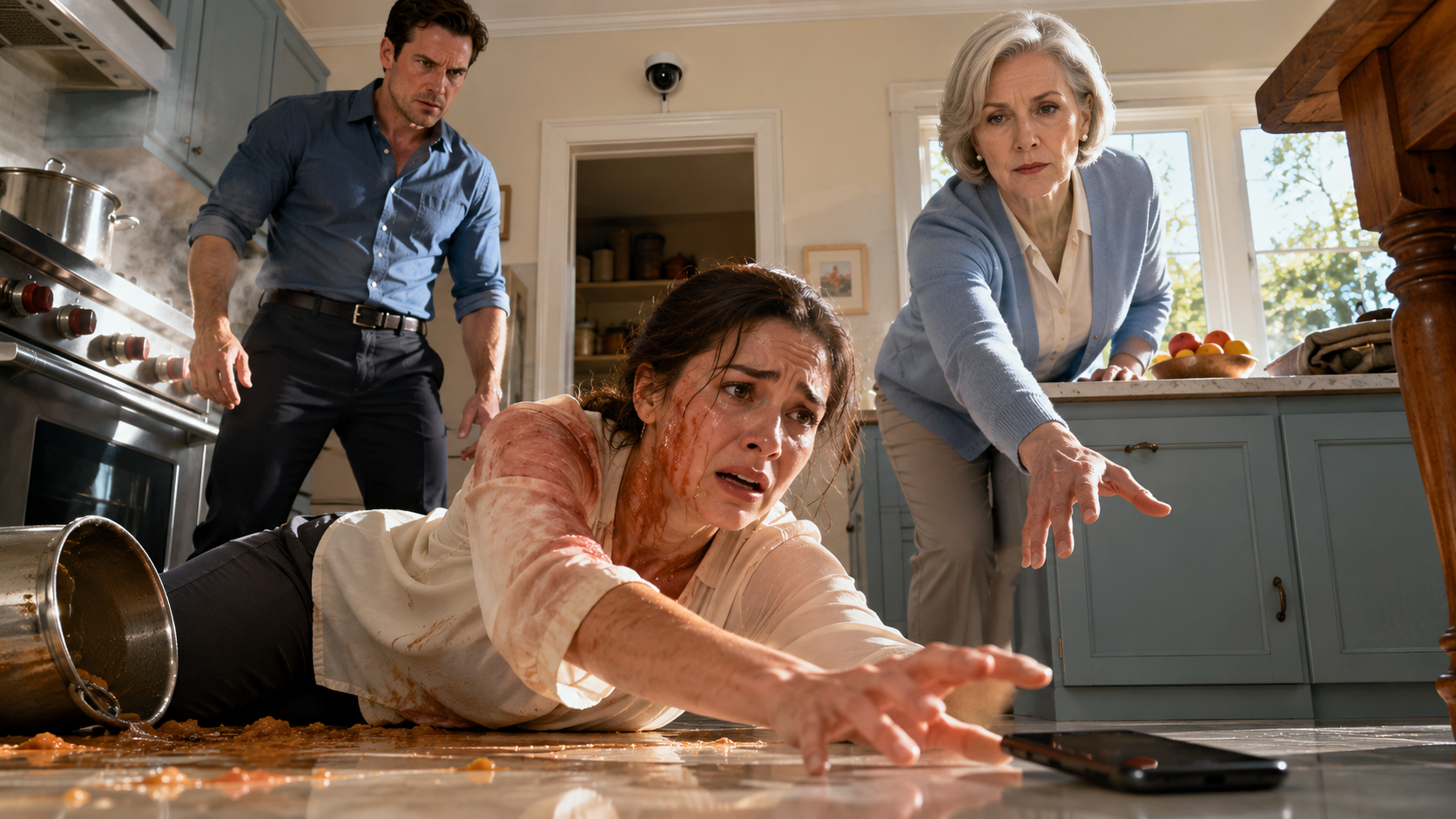
    The stockpot tipped.

    Boiling soup came down over me.

    For one impossible second, I didn’t understand what had happened. I only knew that something had exploded across the left side of my face, my neck, my shoulder, and my arm.

    Then the pain arrived.

    It was not heat.

    Heat was too small a word.

    It felt as if my skin had been peeled open and fire had been poured directly into me.

    I screamed and grabbed at my blouse, but the fabric was soaked through. Pulling it only dragged the burning material against my skin.

    I stumbled backward and fell.

    “Julian!”

    My voice broke on his name.

    He stood beside the stove, breathing hard.

    He wasn’t reaching for me.

    He wasn’t calling for help.

    He was staring at me.

    His face looked almost blank.

    That was what terrified me most.

    Across the kitchen, his mother sat at the breakfast table.

    Evelyn had watched the entire argument.

    She had watched Julian block the doorway when I tried to leave.

    She had heard him demand that I sign the papers Sarah had warned me not to sign.

    She had heard me say the house belonged to me because my father had left it to me before he died.

    She had heard Julian call me selfish.

    Now she watched me roll onto my side, sobbing, my burned arm held away from my body.

    And she said, very calmly, “Maybe now she’ll stop being selfish.”

    I stared at her.

    For a moment, the pain almost disappeared beneath the shock.

    “Call 911.”

    Neither of them moved.

    “Please.”

    I saw my phone near the fruit bowl.

    I tried to crawl toward it.

    Evelyn stood first.

    She picked up my phone.

    Not to call.

    To take it away.

    “Evelyn,” I gasped.

    She carried it to the other side of the counter.

    Then she took a dish towel and began wiping the counter.

    The soup had splashed everywhere. On the tile. On the cabinets. On the stove. On the floor.

    She wiped around me as if I were another mess she intended to clean.

    Julian lifted the stockpot upright.

    That was when I understood.

    Not fully.

    Not yet.

    But enough.

    They were changing the room.

    “Don’t,” I whispered.

    Julian looked down at me.

    His expression sharpened.

    “Don’t what?”

    “You pushed me.”

    His jaw tightened.

    “You slipped.”

    “No.”

    “You slipped, Elena.”

    I looked at his mother.

    Evelyn folded the towel.

    “You were upset,” she said. “You were waving your arms. You lost your balance.”

    I could barely breathe.

    “No.”

    Julian stepped closer.

    “You’re in shock.”

    “You pushed me.”

    His face changed then.

    Only slightly.

    But I saw it.

    Fear.

    Not fear for me.

    Fear of what I might say.

    He crouched beside me and grabbed my uninjured wrist.

    “Listen carefully.”

    I tried to pull away.

    His fingers tightened.

    “You slipped.”

    “Get away from me.”

    “Elena.”

    “Call an ambulance.”

    He looked toward his mother.

    Evelyn glanced at the floor.

    “She’s still talking,” she said.

    Still talking.

    As if they were waiting for me to stop.

    My stomach turned.

    The shaking started a few minutes later.

    Violent, uncontrollable trembling.

    I remember my teeth knocking together.

    I remember staring at the cabinet near the pantry because it was the only thing I could focus on.

    And above that pantry was the small black kitchen camera my father had installed eight months before his death.

    Julian knew about it.

    That thought came slowly through the pain.

    The camera.

    Dad.

    Then another thought.

    The garage.

    I stopped looking at the camera.

    Julian finally called 911.

    “My wife had an accident,” he told the dispatcher.

    His voice trembled perfectly.

    “She slipped near the stove. There was boiling soup. Please hurry.”

    I closed my eyes.

    For the first time since he pushed me, I stopped trying to argue.

    My father used to tell me that panic wasted the seconds in which truth could still be preserved.

    Frank Sterling had not been a suspicious man by nature.

    He had been patient. Methodical. Almost annoyingly calm.

    But he had noticed Julian long before I was willing to.

    Dad had lived in the house for thirty-seven years. He knew every scratch in the floorboards and every hinge that squeaked. After Julian and I married and moved in to help care for him during his final illness, things began breaking.

    A cabinet door cracked after an argument.

    A lamp shattered.

    The hallway thermostat was ripped loose.

    Once, a framed photograph of my mother fell from the wall the same night Julian accused me of choosing Dad over him.

    Julian always called those things accidents.

    Dad never did.

    One afternoon, he installed the kitchen camera above the pantry.

    “For security,” he said when Julian complained.

    I had been embarrassed.

    I told Dad Julian wasn’t dangerous.

    Dad only looked at me.

    “I hope you’re right.”

    What Julian did not know was that my father had never trusted a single recording device.

    He had connected the camera to a concealed recorder in the detached garage.

    “If something happens to the camera,” Dad had told me, “the copy matters more than the original.”

    I had forgotten those words.

    Until I was lying on the kitchen floor with my skin burning.

    The paramedics arrived.

    Julian became a husband again.

    He cried.

    He held my good hand.

    He told them I had been distraught because we were discussing finances.

    Evelyn said I had been rushing around the stove.

    Nobody mentioned the house.

    Nobody mentioned the papers.

    Nobody mentioned Julian blocking the door.

    At St. Matthew’s Hospital, the emergency room became a blur of voices, scissors, medication, bright lights, and pain.

    They cut away what was left of my blouse.

    I remember one nurse going silent when she saw my shoulder.

    I remember someone saying, “Deep partial thickness here.”

    Another voice answered, “Possible full thickness along the upper arm.”

    I stopped understanding words after that.

    Julian stayed near me until a nurse asked him to step outside.

    He kissed my forehead.

    “My poor wife,” he whispered.

    Then his hand closed around my uninjured fingers.

    Too hard.

    I opened my eyes.

    He smiled for the nurse.

    “You’re going to be okay.”

    His thumb pressed into my knuckles.

    The warning was clear.

    Later, a sheriff’s deputy came to ask questions.

    I heard Julian speak first.

    He had already built the story.

    I had been emotional.

    I had been arguing.

    I had turned too quickly.

    I had slipped.

    Evelyn repeated it almost word for word.

    “She’s been under tremendous stress since her father died,” she told the deputy. “She can be unstable when she gets overwhelmed.”

    Unstable.

    The word traveled through me like a second burn.

    For nine days, I said almost nothing.

    Julian thought the silence meant I was afraid.

    Evelyn thought medication had confused me.

    The deputy probably thought I couldn’t remember.

    They were all wrong.

    I was preserving what I could.

    The first night I was lucid enough to think clearly, I asked for the charge nurse.

    “My husband cannot have unrestricted access to my medical information.”

    She studied my face.

    “Do you feel unsafe?”

    I looked at the door.

    “Yes.”

    Everything changed after that.

    Not dramatically.

    No alarm sounded.

    No one rushed in.

    But the nurse pulled up a chair.

    Her voice became careful.

    “What do you need?”

    “Photographs.”

    “Of your injuries?”

    “Yes. Before they change.”

    She nodded.

    I swallowed.

    “And I need to make a private phone call.”

    “To the police?”

    “Not yet.”

    That surprised her.

    “To my father’s attorney.”

    Sarah Vance answered on the second ring.

    “Elena?”

    Her voice nearly broke me.

    I had known Sarah since I was seventeen. She had handled my father’s estate, his medical directives, and the deed transferring the house solely to me.

    She also knew how hard Julian had pushed after Dad died.

    I closed my eyes.

    “Sarah, listen to me. Do not contact Julian.”

    A pause.

    “All right.”

    “Do not warn him.”

    “Elena, what happened?”

    “He pushed me into boiling soup.”

    Silence.

    Then, very softly, “Are you safe right now?”

    “I’m in the hospital.”

    “I’m coming.”

    “No.”

    “Elena—”

    “First secure the house.”

    She understood.

    Of course she did.

    Dad had trusted her because she never wasted time pretending emotion and strategy were enemies.

    “What exactly do you want protected?”

    “The property. No sale. No mortgage. No transfer. Nothing Julian can sign, file, borrow against, or claim I agreed to.”

    “I’ll handle it.”

    “And Sarah?”

    “Yes?”

    “The garage.”

    Another pause.

    I lowered my voice.

    “Dad’s recorder.”

    Her breathing changed.

    “You think it caught something?”

    “I don’t know.”

    That was the truth.

    I remembered the camera.

    I remembered the backup.

    But I had no idea whether the system still worked.

    Julian had complained about it for years.

    He might have unplugged it.

    The recorder might have failed.

    The memory could have overwritten itself.

    And if he remembered the garage connection—

    I couldn’t let myself finish that thought.

    Sarah obtained an emergency order preventing any sale, mortgage, or transfer of the house.

    Julian received notice two days later.

    He came into my hospital room furious.

    He closed the door behind him.

    “What did you do?”

    I looked up from the bed.

    My left arm was wrapped from shoulder to wrist.

    Dressings covered my neck and part of my jaw.

    I had learned not to look at myself in the mirror yet.

    “What do you mean?”

    “The house.”

    His voice was low.

    “You had some emergency restriction filed.”

    “I’m protecting my property.”

    “Our property.”

    “My father left it to me.”

    “We are married.”

    “That doesn’t make everything mine yours.”

    His nostrils flared.

    “After everything I’ve done for you?”

    I almost laughed.

    Pain stopped me.

    “What exactly have you done for me, Julian?”

    He leaned closer.

    “You want to start this now?”

    “You came here.”

    His eyes traveled over my bandages.

    There was no guilt in them.

    Only irritation.

    That answer settled something inside me.

    For years, I had tried to interpret his anger as stress.

    His cruelty as frustration.

    His control as fear of losing me.

    Even after he pushed me, some tiny, humiliating part of me had searched for a reason that would make what happened less deliberate.

    There wasn’t one.

    He wanted the house.

    I had said no.

    He hurt me.

    Then he lied.

    It was that simple.

    He straightened.

    “You should be careful, Elena. You’re on a lot of medication. People might misunderstand the things you say.”

    I met his eyes.

    “I haven’t said anything.”

    His expression changed.

    Just for a second.

    That was the first time I realized silence could frighten him more than accusation.

    Three weeks later, he came to my rehabilitation room carrying divorce papers.

    He wore a navy suit.

    He had shaved.

    He looked like he was attending a business meeting.

    I was learning how to lift my left arm again without crying.

    He placed the papers on the small table beside my bed.

    “What are those?”

    “You know what they are.”

    I looked at the first page.

    Petition for dissolution.

    My throat tightened.

    I had imagined leaving him a hundred times since the kitchen.

    I had not imagined him arriving first.

    “I’m filing for divorce,” he said.

    I turned the page.

    His requests were listed in clean legal language.

    Division of marital assets.

    Allocation of debts.

    Sale of the residence.

    Financial support.

    I looked up.

    “You’re still asking for the house.”

    “It needs to be sold.”

    “It is not yours.”

    “We have debts.”

    “You have debts.”

    His mouth tightened.

    “I supported you.”

    “You lived in my father’s house.”

    “I renovated it.”

    “With whose money?”

    His eyes hardened.

    Then he looked at my bandaged arms.

    And smiled without warmth.

    “I didn’t marry a damaged woman.”

    The room went very still.

    I felt something inside me collapse.

    Not love.

    That had already died on the kitchen floor.

    Something older.

    The last instinct to protect the memory of the person I thought he had been.

    He continued.

    “You’re going to need years of treatment. Maybe more surgery. You can barely take care of yourself, let alone that property. Selling is the reasonable thing.”

    I looked down at the papers.

    He thought he was humiliating me.

    He did not understand that he was giving me clarity.

    I signed one page.

    He smiled.

    Then his smile faded.

    “What is that?”

    “Receipt.”

    “You didn’t sign the settlement.”

    “No.”

    “Elena.”

    “I acknowledged that you served me.”

    His jaw flexed.

    I slid the papers back toward him.

    “You should do whatever you think is best.”

    For the first time, uncertainty crossed his face.

    He had expected tears.

    Begging.

    Maybe anger.

    I gave him none of it.

    His confidence returned slowly.

    “You’ll change your mind.”

    “Maybe.”

    He left.

    That evening, Sarah called from a borrowed number.

    I sat on the edge of my rehabilitation bed and watched rain crawl down the window.

    “Elena,” she said, “we found the recorder.”

    My heart stopped.

    “Found it?”

    “Not exactly.”

    I gripped the phone.

    “What does that mean?”

    “The recorder itself is gone.”

    I closed my eyes.

    Julian remembered.

    “But,” Sarah continued, “your father had configured an off-site backup.”

    I opened my eyes.

    “What?”

    “He never told you?”

    “No.”

    “He told me he had redundancy. I assumed he meant the garage unit. Apparently he meant more than that.”

    My father.

    Even dead, he was still thinking three steps ahead.

    Sarah took a breath.

    “The cloud account logged motion from the garage the night after you were hospitalized. Julian entered with bolt cutters.”

    My fingers went cold.

    “He took the recorder.”

    “Yes.”

    I looked at the closed rehabilitation-room door.

    “Did he know about the backup?”

    “Apparently not.”

    “And the kitchen?”

    Sarah did not answer immediately.

    My heart began pounding.

    “Sarah?”

    “The camera recorded seventeen minutes.”

    I couldn’t speak.

    “It shows the argument,” she said. “It shows Julian blocking the doorway. It shows Evelyn moving your phone. It shows the pot.”

    My eyes filled.

    Not because I was relieved.

    Not yet.

    Because somewhere, in a file neither Julian nor Evelyn knew still existed, the truth had survived.

    “Elena,” Sarah said, her voice tight, “there’s something else.”

    “What?”

    “The audio begins before the assault.”

    I pressed the phone closer to my ear.

    “What did he say?”

    Sarah was quiet for so long that I could hear the rain against the glass.

    Then she told me.

    “Julian said, ‘If she won’t sign, Mom, we’ll make it look like an accident.’”

    And suddenly I knew exactly what kind of marriage I had survived.


    PART 2: I LET HIM THINK I WAS BROKEN

    I watched the footage for the first time in a private therapy room.

    Detective Marcus Miller sat beside Sarah.

    A laptop rested on the table between us.

    I had asked to see it.

    Sarah had warned me that I didn’t need to.

    Detective Miller had warned me twice.

    I insisted.

    “If they’re going to use it,” I said, “I need to know what it shows.”

    He looked at me for a long moment.

    “All right.”

    The video began with an empty kitchen.

    Morning light fell through the windows.

    The stockpot sat on the stove.

    Then Evelyn entered.

    She carried a folder.

    I remembered that folder.

    The sale documents.

    Julian appeared seconds later.

    He looked toward the hallway.

    Then he said, “She’s never going to agree while she thinks she can keep hiding behind Frank’s will.”

    My stomach tightened.

    Evelyn sat at the table.

    “You’ve been too soft.”

    “I’ve asked her.”

    “You’ve complained at her. That’s not the same thing.”

    Julian opened the folder.

    “She thinks because the deed is in her name, she has all the power.”

    “She has emotional attachment. That’s different.”

    I stared at Evelyn’s face on the screen.

    Calm.

    Patient.

    As if they were discussing a stubborn appliance.

    Then Julian spoke the sentence Sarah had quoted.

    “If she won’t sign, Mom, we’ll make it look like an accident.”

    The first time I heard it, I stopped breathing.

    Detective Miller paused the video.

    “Do you need a minute?”

    “No.”

    My voice sounded far away.

    “Keep going.”

    The recording resumed.

    Evelyn answered him.

    Not with shock.

    Not with confusion.

    She said, “Don’t be stupid.”

    For one second, a pathetic part of me hoped that was the moment she would stop him.

    Then she added, “If you frighten her, she might sign. You don’t need to ruin everything.”

    Julian laughed quietly.

    “She won’t listen.”

    Then I entered.

    Watching myself walk into that kitchen was worse than watching the assault.

    I looked normal.

    That was what hurt.

    My hair was tied back.

    I carried a mug.

    I had no idea I was walking into a room where my husband and his mother had already discussed making something look like an accident.

    On the video, I stopped when I saw the folder.

    “No.”

    Julian said, “You haven’t even read it.”

    “I read the last version.”

    “This one is different.”

    “I’m not selling Dad’s house.”

    Evelyn interrupted.

    “You mean your house.”

    I turned toward her.

    “Yes.”

    Her mouth tightened.

    “Marriage is supposed to be a partnership.”

    “So is assaulting someone into signing papers?”

    The word assault made my stomach twist because at the time I had meant his intimidation, his blocking doors, his slamming objects.

    I hadn’t known what was coming.

    Julian moved between me and the hallway.

    “You’re being dramatic.”

    “I’m leaving.”

    “We’re finishing this conversation.”

    “No.”

    “You always do this.”

    “Move.”

    “Sign the agreement.”

    “No.”

    “Then at least authorize Sarah to negotiate.”

    “No.”

    His voice rose.

    “What exactly are you saving this place for? Your father is dead.”

    On the recording, I went completely still.

    Even months later, those words hurt.

    I remembered saying, “Move away from me.”

    Julian did not.

    I stepped toward the stove because it was the only open path around him.

    Evelyn stood.

    “Stop acting like a victim.”

    Then Julian shoved me.

    There was no slip.

    No confusion.

    No accidental contact.

    Both hands went into my back.

    Hard.

    The stockpot tilted.

    The screen blurred for half a second as steam rose.

    My scream filled the room.

    I looked away.

    Detective Miller reached for the pause button.

    “Don’t.”

    My voice shook.

    “Let it play.”

    I forced myself to watch.

    I saw Evelyn take my phone.

    I saw Julian lift the pot.

    I saw myself crawling.

    I saw Evelyn wiping the counter.

    And I saw something I had not remembered.

    Julian stood over me and said, “You ruined everything.”

    Not “Are you okay?”

    Not “I’m sorry.”

    You ruined everything.

    The video ended after the paramedics arrived.

    No one spoke for several seconds.

    Detective Miller finally closed the laptop.

    “This is not an accident.”

    I stared at the black screen.

    “No.”

    “The garage video also shows attempted destruction or concealment of evidence. We’re documenting everything carefully. I don’t want you contacting either of them about the recordings.”

    “I won’t.”

    “They may contact you.”

    “They already do.”

    His expression sharpened.

    “How?”

    “Messages. Through Julian’s lawyer. Sometimes Evelyn calls and hangs up.”

    “Save everything.”

    “I have.”

    Sarah looked at me.

    “You’ve been doing more than recovering.”

    I almost smiled.

    “Dad taught me paperwork.”

    That was true.

    My father had believed that people revealed themselves in records.

    Dates.

    Receipts.

    Statements.

    What they claimed before they knew which facts would later matter.

    So while Julian told anyone who would listen that I had suffered some kind of breakdown, I began building a life around patience.

    I did not answer his public accusations.

    I did not argue with neighbors.

    I did not post photographs of my injuries.

    I learned how to dress wounds.

    I learned how to sleep without rolling onto my left shoulder.

    I learned which stretches made scar tissue feel as though it were tearing and which ones slowly returned movement to my arm.

    I learned that pain was loud but temporary.

    I also learned something Julian had never understood about me.

    Silence was not surrender.

    At home—because eventually I returned to my father’s house—I moved through rooms that no longer felt innocent.

    The kitchen was hardest.

    The first morning I stood in the doorway, I could not cross the threshold.

    The stove had been cleaned.

    The pot was gone.

    The tile shone.

    But my body remembered.

    My heart raced.

    My left hand began shaking.

    I smelled soup that wasn’t there.

    For several minutes, I simply stood.

    Then I turned around.

    That felt like defeat.

    So I stopped.

    I went back.

    One step.

    Then another.

    I made it to the kitchen table.

    I sat there for almost an hour.

    The next day, I stood beside the counter.

    A week later, I boiled water.

    When the kettle began to steam, I cried so hard I had to sit on the floor.

    But I did not leave.

    Recovery was not heroic.

    It was ugly and repetitive.

    Some days, I felt strong.

    Other days, a shirt collar touching my neck could reduce me to tears.

    What kept me moving was not revenge.

    At least not at first.

    It was the house.

    Dad had left it to me because it was the only place where my mother still seemed present in small ways.

    Her pencil marks remained inside a pantry door where she had measured my height as a child.

    Dad’s workbench was still in the garage.

    The roses he planted outside my bedroom window came back every spring.

    Julian had looked at all of that and seen money.

    That realization hurt almost as much as losing him.

    Our divorce case moved quickly because Julian wanted it to.

    He believed pressure favored him.

    He demanded half the value of the house.

    He claimed he had contributed to renovations.

    He claimed I had abandoned the marriage.

    He requested financial support.

    Then Sarah sent me a copy of one filing and said, “Read paragraph twenty-three.”

    I did.

    Julian had written, under oath, that he had been present in the kitchen at the moment of my injury and had immediately responded to what he called “an unfortunate domestic accident.”

    I read it twice.

    Then a third time.

    “What am I missing?”

    Sarah tapped the page.

    “He’s placing himself there.”

    “We already know he was there.”

    “Yes. But his defense attorney has been suggesting the video could have been assembled from different dates or manipulated. Julian just swore that he was in that exact kitchen during the incident.”

    I looked at her.

    “And?”

    “And he also references the home surveillance system.”

    My pulse changed.

    I read further.

    He claimed he had “previously expressed concerns” about my father recording private family discussions.

    Sarah leaned back.

    “He has just admitted he knew the camera existed.”

    “But not the backup.”

    “No.”

    I looked at the page again.

    Julian thought he was using the camera against me.

    Instead, he was authenticating the room around it.

    The criminal investigation continued quietly.

    Julian hired an expensive defense lawyer.

    Evelyn gave a statement claiming she had been in shock.

    Their story began changing around the edges.

    First, I had slipped.

    Then Julian had reached for me and accidentally made contact.

    Then the soup had spilled before he touched me.

    Then the camera angle was deceptive.

    Every adjustment created another contradiction.

    Detective Miller recovered the visible pantry camera from a trash bag behind Evelyn’s rental property.

    When he told me, I was sitting in Sarah’s office.

    “He threw it away there?”

    “We can’t yet prove which of them physically placed the bag,” he said. “But we have the device.”

    “Does it work?”

    “Partially.”

    My stomach dropped.

    “Partially?”

    “The internal memory is damaged, but not empty. More importantly, the internal clock data and fragment timestamps correspond with the concealed backup.”

    Sarah smiled for the first time that afternoon.

    “Their manipulation argument just became harder.”

    I looked at Detective Miller.

    “Will it be enough?”

    “I don’t promise outcomes.”

    I appreciated him for that.

    “But?”

    “But evidence doesn’t have to be dramatic to be strong. Sometimes consistency is stronger than spectacle.”

    That sounded like something Dad would have said.

    Six weeks before the criminal hearing, Evelyn called me.

    I almost ignored it.

    Then I remembered Detective Miller’s instructions.

    We had already arranged for certain future calls to be lawfully recorded through the investigation.

    I answered.

    “Hello?”

    “Elena.”

    Her voice was softer than usual.

    Almost maternal.

    That frightened me more than anger.

    “What do you want?”

    “I want this ugliness to stop.”

    I stared at the scar running down my forearm.

    “So do I.”

    “Then stop it.”

    “How?”

    “Drop the accusation.”

    I closed my eyes.

    “You mean tell the police I lied?”

    “I mean tell them you were confused.”

    “I wasn’t.”

    “You were in pain.”

    “I remember everything.”

    “No, you remember what you want to remember.”

    I heard Detective Miller’s earlier advice in my mind.

    Don’t lead her.

    Let her talk.

    So I asked, “What do you think I remember?”

    A pause.

    “You remember an argument.”

    “Yes.”

    “You remember Julian being angry.”

    “Yes.”

    “You remember the pot.”

    “Yes.”

    Her voice sharpened.

    “You forced him to lose his temper.”

    My hand clenched around the phone.

    I said nothing.

    She continued.

    “You kept humiliating him. That house became more important than your marriage.”

    “Forgive me for what, Evelyn?”

    She exhaled in irritation.

    “For forcing him to lose his temper. For pushing everything until something happened.”

    Something happened.

    As if weather had entered the kitchen.

    As if hands had not touched my back.

    “Would Julian forgive me?” I asked.

    “He might.”

    I looked toward the small device Detective Miller had arranged for the call.

    “For being burned?”

    “For what you did to this family.”

    My scarred skin pulled tight as I flexed my fingers.

    “What do you want me to do?”

    “Sign the house over.”

    My heartbeat slowed.

    “Why?”

    “Because then there’s nothing left to fight about.”

    “And the video?”

    Silence.

    Very short.

    But there.

    “What video?” she asked.

    I almost smiled.

    “You called me to talk about the accusation. I assumed you meant the camera.”

    “That camera misunderstood what happened.”

    A camera misunderstood.

    I closed my eyes.

    “What does that mean?”

    “Angles can make things look different.”

    “So Julian didn’t push me?”

    “He was angry.”

    “That isn’t what I asked.”

    “He put his hands out.”

    “Why?”

    “To stop you.”

    “From what?”

    She hesitated.

    “From storming off again.”

    The lie was becoming more complicated.

    I let her build it.

    “And after I fell?”

    “We panicked.”

    “You took my phone.”

    “You didn’t need it.”

    “I was begging you to call 911.”

    “We did call.”

    “After you wiped the counter.”

    Her breath stopped.

    For the first time, she understood she had said too much.

    “Elena.”

    “Yes?”

    “You are making a terrible mistake.”

    “No.”

    My voice was calm.

    “You did.”

    She hung up.

    I stared at the phone for a long time.

    Then Detective Miller stepped from the adjoining room.

    His expression was grim.

    “She just gave us quite a bit.”

    I looked at him.

    “Enough?”

    He did not answer directly.

    But Sarah did.

    “Enough to make their next lie very difficult.”

    And for the first time since the kitchen, I began to believe the truth might not merely survive.

    It might corner them.


    PART 3: THE WOMAN JULIAN THOUGHT HE HAD ERASED

    Julian underestimated scars because he thought they only showed damage.

    He never understood that scars also showed survival.

    By the fifth month, I could raise my left arm above my shoulder again.

    Not easily.

    Not without tightness.

    But I could do it.

    The doctors stopped wrapping most of my arm.

    The compression garments remained.

    The skin along my neck and shoulder was uneven and sensitive.

    Some days I hated mirrors.

    Other days I stood in front of one deliberately.

    I would look at the woman staring back and force myself not to search for who I had been before.

    That woman had loved Julian.

    This one knew him.

    There was value in that.

    The divorce became uglier as the criminal case moved closer to court.

    Julian’s lawyer sent letters demanding access to the property.

    He wanted inspections.

    Appraisals.

    Financial records.

    Sarah answered everything properly and gave nothing away.

    The house remained protected.

    Julian became more aggressive.

    One morning, I received a message from him.

    You are dragging this out because you want sympathy.

    I saved it.

    Another arrived.

    You think those burns make you untouchable. They don’t.

    I saved that one too.

    Then:

    Dad’s house is not a shrine. Grow up.

    That message made me cry.

    Not because it hurt.

    Because it reminded me of the last conversation I had with my father about Julian.

    Dad had been sitting in the sunroom under a blanket, thinner than I wanted to admit.

    “You don’t have to defend him to me,” he said.

    “I’m not defending him.”

    “You are.”

    I looked away.

    Dad’s hands were weak then, but his eyes were clear.

    “He gets angry,” I said. “He’s under pressure.”

    “Pressure reveals structure.”

    I frowned.

    “What does that mean?”

    “It means a bridge doesn’t collapse because wind exists. It collapses because something in it couldn’t bear the load.”

    “You always turn everything into engineering.”

    He smiled.

    “Occupational disease.”

    Then his smile disappeared.

    “Elena, I’m not asking whether Julian loves you when life is easy. I’m asking what he becomes when you tell him no.”

    At the time, I had resented him.

    After the kitchen, I finally understood.

    Julian had not become someone else when I refused to sell.

    He had become more fully himself.

    The day before the preliminary criminal hearing, I drove to the cemetery.

    I had not been there since before the assault.

    I stood in front of Dad’s grave with my coat pulled high around my neck.

    For several minutes, I said nothing.

    Then I whispered, “You were right.”

    I hated saying it.

    Not because Dad had been wrong to warn me.

    Because being right had not saved him the pain of watching me dismiss those warnings.

    “I’m sorry.”

    Wind moved through the grass.

    There was no answer.

    I sat on the damp bench nearby.

    “I kept thinking loving him meant I had to interpret everything in the kindest possible way.”

    My throat tightened.

    “I thought leaving room for an explanation made me fair.”

    I looked down at my hands.

    “It just made room for him.”

    I stayed until the cold reached my bones.

    When I stood, I touched two fingers to the name carved in stone.

    “I’m keeping the house.”

    The next morning, Julian tried to speak to me in the courthouse hallway.

    I saw him before he reached me.

    He had changed.

    Stress had carved lines around his mouth.

    His suit fit too loosely.

    But he still moved with the same confidence, as if every room belonged to him until someone proved otherwise.

    His lawyer walked a few steps behind.

    Evelyn stood near the courtroom doors.

    When she saw my face without bandages, her expression flickered.

    Not pity.

    Assessment.

    Julian stopped in front of me.

    “You look better.”

    I said nothing.

    His gaze moved to the compression sleeve beneath my jacket.

    “Can we talk?”

    Sarah stepped closer.

    “My client has nothing to discuss with you privately.”

    Julian ignored her.

    “Elena.”

    I finally looked at him.

    For months I had imagined this moment.

    I thought I would feel rage.

    Instead, I felt tired.

    “You served me divorce papers in rehabilitation.”

    His face tightened.

    “You know things were complicated.”

    “You told me you didn’t marry a damaged woman.”

    His lawyer murmured, “Julian.”

    But he kept staring at me.

    “I was angry.”

    “That seems to happen whenever I say no.”

    His mouth opened.

    Then he saw Detective Miller walking toward us.

    And behind Detective Miller was an evidence technician carrying a sealed equipment case.

    Julian’s face drained.

    He knew that case.

    Maybe not its contents.

    But he understood.

    The camera.

    For one second, the courthouse hallway disappeared.

    I was back on the kitchen floor.

    He was standing over me.

    I could hear Evelyn saying maybe now I would stop being selfish.

    Then I felt Sarah’s hand touch my elbow.

    Not pulling me.

    Just reminding me where I was.

    I looked at Julian again.

    He no longer seemed powerful.

    He seemed frightened.

    The hearing was not the final trial.

    I knew that.

    Sarah had prepared me not to expect a dramatic ending in one afternoon.

    But it was the first time the evidence was laid out in a formal setting where Julian could not interrupt it, explain over it, or rewrite it afterward.

    Detective Miller testified about the recovered systems.

    The prosecutor introduced the original visible camera.

    The backup recording was authenticated through its technical records.

    The garage footage showed Julian entering after my hospitalization.

    My medical photographs documented injuries consistent with the direction and location of the scalding liquid.

    Then the kitchen footage played.

    I did not look at Julian.

    I watched the judge.

    The courtroom heard his voice.

    “If she won’t sign, Mom, we’ll make it look like an accident.”

    No one moved.

    Then Evelyn’s voice.

    “Don’t be stupid.”

    Then the rest.

    Their argument.

    My refusal.

    Julian blocking me.

    The shove.

    My scream.

    Evelyn taking my phone.

    The wiping.

    The delay.

    For months, those seventeen minutes had lived in my head as fragments.

    In court, they became sequence.

    Cause.

    Effect.

    Choice.

    Julian’s defense lawyer argued that the conversation before the incident was ambiguous.

    That “make it look like an accident” referred to frightening me, not injuring me.

    That the shove had been an impulsive movement during an emotional marital dispute.

    The prosecutor answered with one question.

    “If the physical contact was accidental or impulsive, why did Mr. Hale enter a locked garage with bolt cutters after his wife was hospitalized and remove the recording equipment?”

    Julian’s lawyer objected.

    Legal arguments followed.

    I barely heard them.

    I was watching Evelyn.

    She sat behind Julian.

    Her hands were clasped tightly in her lap.

    She had spent months describing me as unstable.

    Now she was watching herself move my phone away while I screamed for help.

    At the end of the hearing, the case moved forward.

    There would be a trial unless a plea agreement intervened.

    Outside, reporters waited on the courthouse steps because the case had attracted local attention.

    I hated that.

    I did not want my burns turned into entertainment.

    Sarah asked if I wanted to use another exit.

    I almost said yes.

    Then Julian came through the doors behind us.

    A reporter called his name.

    Another called mine.

    I froze.

    Julian’s lawyer moved quickly to shield him.

    For years, Julian had loved controlling the version of our marriage other people saw.

    Good husband.

    Patient husband.

    Grieving husband.

    Victim of a difficult wife.

    I realized that walking away in silence would not protect me anymore.

    So when a reporter asked, “Elena, do you have anything to say about today’s evidence?” I stopped.

    Sarah looked at me.

    I looked directly at the cameras.

    “My husband told people I slipped.”

    My voice shook.

    I continued anyway.

    “His mother said I was unstable. They believed that if they repeated those things enough, what happened in my kitchen would become less real.”

    I felt every eye on me.

    “I’m not asking anyone to believe me because of my injuries. I’m asking that the evidence be heard.”

    Then I walked away.

    That evening, Julian called from a number I didn’t recognize.

    I almost declined it.

    Something made me answer.

    “What?”

    He was silent.

    Then he said, “You enjoyed that.”

    My stomach turned.

    “Enjoyed what?”

    “Humiliating me.”

    I stared at the dark windows of my living room.

    “You watched me burn.”

    “That isn’t what happened.”

    “I saw the video.”

    “So did I.”

    “Then why are you still lying?”

    His breathing grew heavier.

    “You destroyed my life over a house.”

    I closed my eyes.

    There it was.

    Even now.

    The house.

    “You pushed me into boiling liquid because I wouldn’t sell.”

    “You could have avoided all of this.”

    My hand tightened around the phone.

    “How?”

    “By acting like a wife.”

    I almost laughed.

    Instead I whispered, “Thank you.”

    He went silent.

    “For what?”

    “For reminding me there is nothing left to grieve.”

    I ended the call.

    Then I blocked the number.

    The trial date was set.

    The divorce remained unresolved.

    Julian still wanted money.

    Evelyn still claimed she had misunderstood what happened.

    And I still woke some nights with the sensation of boiling liquid running over my skin.

    But the fear had changed.

    I was no longer afraid they could erase the truth.

    Now I was afraid of what it would cost me to tell it.

    There was only one way through that fear.

    I had to tell it anyway.


    PART 4: EVERYTHING THEY SAID CAME BACK TO THEM

    The first question Julian’s attorney asked me at trial was whether I hated my husband.

    I sat in the witness chair and looked at him.

    “No.”

    He raised an eyebrow.

    “You don’t hate the man you accuse of deliberately injuring you?”

    “I’m afraid of what he is capable of.”

    “That wasn’t my question.”

    “No. I don’t hate him.”

    “Why not?”

    The prosecutor objected.

    The judge sustained it.

    But I had already answered the question for myself.

    Hatred would have required too much of me.

    Julian had already taken skin, sleep, trust, months of rehabilitation, and every uncomplicated memory of my kitchen.

    I would not give him the rest.

    His attorney approached the argument from every direction.

    Was I angry about the divorce?

    Yes.

    Was I grieving my father?

    Yes.

    Had Julian and I argued before?

    Yes.

    Had I threatened to leave him?

    Yes.

    Had I refused to sell the house?

    Yes.

    He paused after that.

    “So the house was a source of serious marital conflict.”

    “Yes.”

    “You valued that property more than your marriage.”

    “No.”

    “Yet you refused compromise.”

    “My father left the house to me.”

    “And your husband disagreed with your decision.”

    “He was allowed to disagree.”

    “But you wouldn’t change your mind.”

    “No.”

    His attorney turned slightly toward the jury.

    “And after this alleged assault, you immediately took legal action to ensure Mr. Hale could not access or transfer the property.”

    “Yes.”

    “So even from your hospital bed, your focus was the house.”

    That line was designed to make me look cold.

    Obsessed.

    Selfish.

    I knew it.

    For months, Evelyn had used that exact word.

    I looked toward Julian.

    He was watching me.

    Waiting.

    I turned back to the attorney.

    “My focus was preventing the person who had just hurt me over the house from gaining control of the house.”

    Silence.

    The attorney’s expression tightened.

    “No further question on that point.”

    When the prosecutor questioned me, she did not ask me to describe every second of pain.

    I was grateful.

    She asked what happened before the shove.

    I told the jury about the papers.

    The pressure.

    The blocked doorway.

    The refusal.

    Then she asked, “Why didn’t you immediately tell the responding deputy that Mr. Hale had pushed you?”

    I swallowed.

    “Because my husband was still with me.”

    “Were you afraid?”

    “Yes.”

    “Of what?”

    “That if the camera had failed, it would be my word against his and his mother’s.”

    The prosecutor glanced toward the jury.

    “And what did you do instead?”

    “I asked the hospital to document my injuries. I restricted my medical access. I contacted my father’s attorney. And I asked her to secure the house and locate the recording system.”

    “Why?”

    “Because my father taught me that if somebody is already changing the story, you protect what they cannot change.”

    I looked down.

    “My husband changed the room before the ambulance arrived. His mother wiped the counter. He lifted the pot. They moved my phone. Then they told the deputy I slipped.”

    I raised my eyes again.

    “I knew I needed something they couldn’t talk over.”

    The kitchen footage provided that.

    But it was Evelyn’s phone call that changed the atmosphere in the courtroom.

    Her attorney fought to keep it out.

    Arguments took place without the jury present.

    Eventually, the permitted portion was played.

    My voice came first.

    “Forgive me for what?”

    Then Evelyn.

    “For forcing him to lose his temper.”

    I saw Julian close his eyes.

    The recording continued.

    “Sign the house over, and we can all say the video misunderstood what happened.”

    The courtroom went completely silent.

    Julian’s defense had depended on ambiguity.

    A tragic marital accident.

    A confusing camera angle.

    An emotional argument.

    Evelyn’s own words collapsed those explanations.

    The video misunderstood what happened.

    Not that the video was fake.

    Not that the kitchen was wrong.

    Not that Julian had never touched me.

    Only that somehow the camera itself had interpreted their actions unfairly.

    When Evelyn testified, she tried to explain.

    She said she had been attempting to calm me.

    She said “forcing him to lose his temper” was a figure of speech.

    She said she wanted the family conflict resolved.

    She said asking me to sign over the house was not an admission of wrongdoing.

    The prosecutor asked, “Why did you move Elena’s phone?”

    “I was afraid she would drop it.”

    “While she was on the floor asking you to call emergency services?”

    “I was confused.”

    “Why did you wipe the counter?”

    “There was hot liquid everywhere.”

    “Why did you clean before calling for help?”

    “I wasn’t thinking.”

    “Why did you tell the responding officer Elena had slipped?”

    “I believed she had.”

    The prosecutor walked toward the screen.

    A still frame appeared.

    Julian’s hands were visible against my back.

    “Do you still believe she slipped?”

    Evelyn stared at the image.

    “I believe it was chaotic.”

    “That wasn’t my question.”

    Evelyn’s mouth tightened.

    “No.”

    It was the first honest answer I had heard from her.

    Julian did not testify.

    His lawyer attacked intent instead.

    He argued that the shove had happened in anger but was not intended to cause the burns.

    That Julian could not have known the exact movement of the stockpot.

    That the earlier sentence about making something look like an accident was ugly but not a literal plan to scald me.

    The prosecutor did not claim Julian had calculated every splash.

    She did not need to.

    She returned to the sequence.

    Pressure me to sign.

    Block my exit.

    Discuss an accident.

    Shove me beside boiling liquid.

    Delay help.

    Alter the scene.

    Lie.

    Destroy the recording equipment.

    Then demand the house again while I was still bandaged.

    When presented in order, the events did not look random.

    They looked like decisions.

    The jury deliberated for hours.

    I spent that time in a small room with Sarah.

    My left arm ached from tension.

    “You all right?” she asked.

    “No.”

    She smiled faintly.

    “Good answer.”

    I looked at the floor.

    “What happens if they don’t believe me?”

    Sarah was quiet.

    “The truth exists independently of a verdict.”

    “That sounds like something lawyers tell people when they might lose.”

    “It is.”

    I looked at her.

    She continued.

    “But listen to the rest. A verdict matters. Accountability matters. But what Julian did is not made real by twelve people agreeing with you, and it is not made unreal if they fail to understand it.”

    I rubbed the edge of my compression sleeve.

    “I want it to matter.”

    “I know.”

    “I want him to know he couldn’t do this and then walk away.”

    “I know.”

    A knock came at the door.

    We both stood.

    The jury had returned.

    I do not remember every legal word that followed.

    I remember the clerk.

    I remember Julian standing.

    I remember Evelyn behind him.

    I remember holding my breath.

    Then came the finding.

    Guilty on the principal assault charge.

    Guilty on the evidence-related charge the jury had been asked to consider.

    I closed my eyes.

    Sarah’s hand found mine.

    I did not smile.

    I did not feel triumphant.

    I cried.

    Quietly.

    The sound surprised me.

    It was grief leaving in a form I finally understood.

    Julian turned before he was taken from the courtroom.

    For one second, our eyes met.

    There was anger in his face.

    Shock.

    Disbelief.

    And beneath all of it, accusation.

    As if I had done this to him.

    As if truth itself were a betrayal.

    I did not look away.

    The sentencing would come later.

    Other proceedings involving Evelyn were still unresolved.

    The divorce still had to be finalized.

    There were more papers.

    More hearings.

    More mornings when I woke exhausted before anything had even happened.

    Justice did not arrive as one perfect moment.

    It came in pieces.

    A protected deed.

    A nurse’s photograph.

    A preserved file.

    A recovered camera.

    A recorded phone call.

    A sworn contradiction.

    A verdict.

    Each piece restored something small.

    But Julian still had one fight left.

    The house.

    And even after everything, he believed he could take part of it with him.


    PART 5: THE HOUSE HE COULD NOT TAKE

    Six months after Julian pushed me into the stockpot, I walked into family court wearing a sleeveless blouse beneath my jacket.

    It was the first time I had worn one in public since the burns.

    The scar along my arm was visible.

    So was the uneven skin near my shoulder.

    I had almost changed clothes before leaving home.

    Then I remembered what Julian had said in rehabilitation.

    I didn’t marry a damaged woman.

    For months, I had heard that sentence every time I looked in the mirror.

    That morning, I decided I was tired of dressing around his voice.

    Sarah met me outside the courtroom.

    Detective Miller was there too because certified evidence from the criminal case had been requested for the property dispute.

    He carried the same secured case containing the recovered kitchen camera and accompanying records.

    The sight of it no longer frightened me.

    It looked small.

    Almost ordinary.

    That seemed right.

    Truth often did.

    Julian appeared through a side entrance with his attorney.

    He was awaiting sentencing in the criminal matter under conditions I had been advised not to discuss publicly.

    The confidence he once carried had vanished.

    He looked at the camera case.

    Then at me.

    His eyes stopped on my bare arm.

    For a second, I saw the same expression he had worn in the rehabilitation room.

    Disgust.

    But it no longer reached me.

    The family-court issue was narrower than the criminal case.

    The judge was not there to punish Julian for what he had done to me.

    The questions involved property, marital finances, his claimed contributions, and whether the inherited house should be divided or sold.

    Julian’s filings had made enormous claims.

    He said he had funded renovations.

    Records showed otherwise.

    My father had paid for major repairs before his death.

    I had paid subsequent expenses from accounts tied to inherited funds and my earnings.

    Julian had contributed to ordinary household costs at times, but there was no documentation supporting the ownership interest he demanded.

    He also claimed selling the property had been a longstanding mutual plan.

    That argument fell apart under his own messages and the kitchen recording.

    A mutual plan did not require threats.

    A mutual plan did not require blocking a doorway.

    A mutual plan did not end with one spouse burned on the floor.

    Sarah did not dramatize.

    She did not need to.

    She placed the deed before the court.

    My father’s estate documents.

    Financial records.

    Julian’s sworn filings.

    Then the relevant portions of the criminal evidence.

    At one point, Julian’s attorney argued that the criminal case should not transform a property dispute into moral punishment.

    The judge agreed with the principle.

    “So let us not do that,” the judge said. “We will decide ownership based on the governing documents, contribution records, and applicable law.”

    My heart pounded.

    Sarah squeezed my hand beneath the table.

    Then the judge added, “But the court will also not pretend coercion is evidence of a mutual agreement to sell.”

    Julian stared straight ahead.

    The house remained mine.

    No forced sale.

    No ownership share based on unsupported renovation claims.

    No reward for demands he had tried to enforce through violence.

    There were still ordinary financial matters to resolve, but the central thing he had wanted from the beginning was gone.

    He could not take my father’s house.

    When the judge finished, I expected to feel victorious.

    Instead, I thought of Dad in the sunroom.

    Pressure reveals structure.

    I finally understood the whole meaning.

    Pressure had revealed Julian.

    But it had revealed me too.

    For years, I thought strength meant tolerating discomfort without complaining.

    Keeping peace.

    Giving people another chance.

    Trying to understand.

    Those things could be strengths.

    But in the wrong hands, they became doors people walked through.

    After court, Julian asked to speak to me.

    Sarah started to refuse.

    I stopped her.

    “Here,” I said. “With counsel present.”

    Julian glanced at the attorneys.

    His face tightened.

    “Fine.”

    We stood in an empty conference area near the courthouse hallway.

    For several seconds he said nothing.

    Then he asked, “Was it worth it?”

    I almost didn’t understand.

    “What?”

    “All of this.”

    His eyes moved toward Detective Miller and the evidence case farther down the hall.

    “The police. The trial. The publicity. Destroying my relationship with my mother. Ruining both our lives.”

    I stared at him.

    “You still think I did this.”

    “You could have handled things privately.”

    “You pushed me into boiling soup.”

    “I lost my temper.”

    “You discussed making it look like an accident before I entered the kitchen.”

    His jaw tightened.

    “That wasn’t what I meant.”

    “You removed the recorder.”

    “I panicked.”

    “You told the police I slipped.”

    “I was scared.”

    “You brought me divorce papers while I was still bandaged and asked for the house.”

    His face changed.

    For a moment, the anger disappeared.

    Something else came through.

    Not remorse.

    Need.

    “You were never going to give me anything.”

    I understood then.

    That was his wound.

    Not losing me.

    Not hurting me.

    Not even prison.

    He could not accept that something existed in my life that he could not control simply because he wanted it.

    “My father left me that house.”

    “And I was your husband.”

    “Yes.”

    “You were supposed to choose us.”

    “I did.”

    His expression flickered.

    “For years, I chose the marriage every time I explained your behavior away.”

    I stepped closer.

    “I chose us when you broke things and called it stress. I chose us when you insulted my father because he questioned you. I chose us when you pressured me about the property. I kept choosing a version of our marriage where your anger always had an explanation.”

    My voice trembled.

    “But the day you put both hands on my back, you made the choice for me.”

    He looked at my scars.

    Then away.

    His voice dropped.

    “I never meant for it to be that bad.”

    There it was.

    The closest thing to admission I would ever receive.

    Not I’m sorry.

    Not I shouldn’t have touched you.

    Not I was wrong.

    Only that bad.

    As though a smaller burn would have been acceptable.

    As though fear without permanent scars would have been forgivable.

    I nodded slowly.

    “I believe you.”

    He looked surprised.

    “You do?”

    “Yes.”

    I held his gaze.

    “I don’t think you cared how badly I was hurt. I think you cared whether I signed.”

    His face went white.

    For once, he had no answer.

    I turned away.

    “Elena.”

    I stopped.

    His voice was smaller.

    “What am I supposed to do now?”

    For years, that question would have controlled me.

    I would have tried to comfort him.

    Solve something.

    Carry part of the consequences so he did not have to carry all of them.

    I looked back.

    “That’s not mine to figure out anymore.”

    Then I walked away.

    Outside, afternoon light covered the courthouse steps.

    Sarah joined me.

    “So,” she said, “what happens to the house now?”

    I looked at her.

    “What do you mean?”

    “You fought to keep it. I’m asking what you’re going to do with it.”

    For months, the house had existed only as the center of a conflict.

    Something Julian wanted.

    Something I defended.

    Something Dad had left.

    I had never asked what came after defending it.

    “I’m going home,” I said.

    Sarah smiled.

    “That sounds like a start.”

    The kitchen waited for me when I returned.

    I stood in the doorway.

    The camera above the pantry was gone, held as evidence.

    A lighter rectangle remained on the wall where it had been mounted.

    For months, I had considered renovating the entire room.

    New stove.

    New counters.

    New flooring.

    Anything that might separate the place from what happened.

    But I kept delaying.

    That evening, I understood why.

    I did not want Julian’s final mark on the house to be that he had made one room impossible for me to live in.

    So I opened the pantry.

    Inside the door were my mother’s pencil marks.

    Elena — age 7.

    Elena — age 10.

    Elena — almost taller than Mom.

    I ran my fingers over them.

    Then I found the lowest mark my father had added years later as a joke.

    Elena — age 30. Still stubborn.

    I laughed.

    The sound surprised me.

    Then I cried.

    Not violently.

    Not the way I had cried in rehabilitation.

    Just enough.

    Afterward, I filled a kettle with water.

    My left hand shook when I placed it on the stove.

    I turned the burner on.

    The faint blue flame appeared.

    My heart began racing.

    I stayed.

    The water heated.

    Steam rose.

    My breathing became shallow.

    I pressed both hands against the counter.

    “I’m here,” I whispered.

    It was something a therapist had taught me.

    Name the room.

    Name the date.

    Name what is happening now.

    Not then.

    Now.

    “My kitchen.”

    I looked toward the pantry.

    “My house.”

    The kettle clicked.

    I turned off the burner.

    Then I poured the water into a mug.

    Nothing happened.

    No one blocked the doorway.

    No one demanded a signature.

    No one stood behind me.

    I carried the tea to the breakfast table where Evelyn had once sat and watched me scream.

    The chair across from me was empty.

    I left it that way.

    Months later, the criminal case finally ended completely.

    Julian was sentenced.

    The remaining legal consequences involving the destruction of evidence and Evelyn’s conduct were handled through the courts in ways Sarah explained to me carefully and repeatedly.

    I attended what I needed to attend.

    I stayed away from what I did not.

    I stopped measuring healing by their punishment.

    That was harder than I expected.

    For a while, I thought justice would mean waking one morning and no longer remembering the kitchen.

    It didn’t.

    I remembered.

    Sometimes I still do.

    A pot boiling too loudly can tighten my throat.

    The smell of certain soups can make my skin prickle.

    There are days when scar tissue aches before rain.

    And there are photographs of me before the assault that I still cannot look at for long.

    But memory is not the same thing as captivity.

    Julian believed that when he pushed me, he had changed the balance of power.

    He believed pain would make me easier to control.

    Evelyn believed humiliation would make me surrender.

    Then, when the burns became permanent, Julian believed he could discard me and take the thing he had hurt me for.

    They were wrong every time.

    The house remained standing.

    So did I.

    A year after the assault, Sarah came over for dinner.

    I cooked.

    Not soup.

    I was not interested in symbolism that obvious.

    We ate chicken, roasted vegetables, and bread at the old kitchen table.

    At one point, Sarah looked toward the pantry wall.

    “You ever going to put another camera there?”

    I followed her gaze.

    The rectangle where Dad’s camera had been was still faintly visible.

    “No.”

    She raised an eyebrow.

    “Really?”

    “I put security outside.”

    “Probably smarter.”

    I smiled.

    “But I’m leaving that spot empty.”

    “Why?”

    I thought about Dad.

    About the recorder hidden in the garage.

    About seventeen minutes Julian thought he had erased.

    About walking into court with my scars uncovered while Detective Miller carried the camera Julian had thrown away.

    “The old one already did its job.”

    Sarah lifted her glass.

    “To Frank.”

    I lifted mine.

    “To Frank.”

    Then, after a moment, I added, “And to backups.”

    She laughed.

    So did I.

    It was a real laugh.

    Easy.

    Unforced.

    The kind I had once believed Julian had taken from me.

    Later, after Sarah left, I locked the front door and walked through the quiet house.

    The hallway.

    The sunroom.

    Dad’s old office.

    The kitchen.

    I switched off the lights one by one.

    At the stove, I paused.

    For a second, I could still see the morning everything changed.

    Julian’s hands.

    The falling pot.

    Evelyn’s face.

    My own body on the floor.

    But another memory lived there now too.

    Steam rising from a kettle.

    My hand steadying against the counter.

    My voice saying:

    My kitchen.

    My house.

    I touched the scar along my arm.

    Julian had once looked at those scars and called me damaged.

    He had been wrong about that too.

    Damage was what he had done.

    Survival was what I had done afterward.

    There was a difference.

    I turned off the final light.

    The kitchen disappeared into darkness behind me.

    And for the first time since my father died, I understood exactly why he had left the house to me.

    Not because he expected me to preserve every wall forever.

    Not because he wanted me trapped by memory.

    He left it to me because he wanted me to have one place in this world that no one could force me out of simply because they were stronger, louder, angrier, or more entitled.

    Julian had tried.

    His mother had helped him.

    They had lied.

    They had cleaned the room.

    They had taken the recorder.

    They had called me unstable.

    They had called me selfish.

    Julian had looked at my bandaged body and decided I was no longer worth keeping.

    Then he demanded the house as if cruelty had earned him a share of it.

    But my father had prepared for men who thought destroying evidence was the same thing as destroying truth.

    The camera remembered.

    The hospital remembered.

    The records remembered.

    The court remembered.

    And eventually, I allowed myself to remember without being afraid of what the memory meant.

    I was not the woman Julian shoved toward that stove.

    Not anymore.

    I was the woman who got back up.

    And the house was still mine.
  • THEY THOUGHT MY SILENCE MEANT SURRENDER

    THEY THOUGHT MY SILENCE MEANT SURRENDER

    The Vance Family Said My Rank Didn’t Scare Them. They Should Have Been Afraid of What I Did Without It.

    PART 1: FIVE WORDS

    The phone call was still echoing in my head when I left Fort Liberty that evening.

    “Mom… please come get me.”

    Five words.

    That was all Maya managed before the line went dead.

    I had heard men call for medics while bleeding into desert sand. I had listened to young officers try to keep their voices steady while reporting casualties. I had sat across from parents and spouses and delivered news that changed their lives forever.

    Nothing had ever frightened me the way my daughter’s voice frightened me that night.

    I was still wearing my Army dress uniform.

    I had been leaving a formal command event when Maya called, and I never even went back to my office to change. Every ribbon on my chest caught the dying sunlight as I drove toward Charlotte, the city blurring around me.

    My knuckles were white on the steering wheel.

    I called her back.

    No answer.

    Again.

    Nothing.

    I tried a third time.

    Straight to voicemail.

    “Maya, it’s Mom. I’m coming. Whatever happened, I’m coming.”

    I forced myself to put the phone down.

    Panic was useless.

    Panic made people miss details.

    And something in Maya’s voice had told me that details were going to matter.

    For almost three years, I had watched my daughter become smaller inside her marriage.

    Not physically.

    Maya had always been slight, graceful, the kind of woman who could make a simple white dress look expensive.

    No.

    She had become smaller in ways that were harder to name.

    She stopped laughing as loudly.

    Stopped calling me for no reason.

    Stopped disagreeing with people in public.

    When Julian interrupted her, she let him.

    When his mother, Evelyn, corrected the way Maya held a wineglass or pronounced the name of some European resort, Maya smiled instead of rolling her eyes like the daughter I knew.

    I had asked her about it.

    More than once.

    “Everything okay?”

    “Fine.”

    “You sure?”

    “Julian’s under a lot of pressure.”

    “Maya.”

    “Mom, please.”

    That please had always stopped me.

    I told myself she was an adult.

    I told myself respect meant knowing when not to interfere.

    I told myself marriage changed people.

    I told myself many things that tasted bitter in my mouth now.

    By the time I reached St. Bernard Hospital, darkness had settled over Charlotte.

    I parked badly.

    I do not park badly.

    That night I left the SUV crooked across two lines and ran.

    The automatic doors opened.

    Cold hospital air hit me first.

    Then fluorescent light.

    Then disinfectant.

    Then noise.

    A nurse behind the desk looked up as I approached.

    “Ma’am, can I help you?”

    “My daughter. Maya Vance.”

    She typed quickly.

    “Are you immediate family?”

    “I’m her mother.”

    “Okay. She’s in observation, but—”

    “Where?”

    The nurse hesitated.

    I realized what I must have looked like.

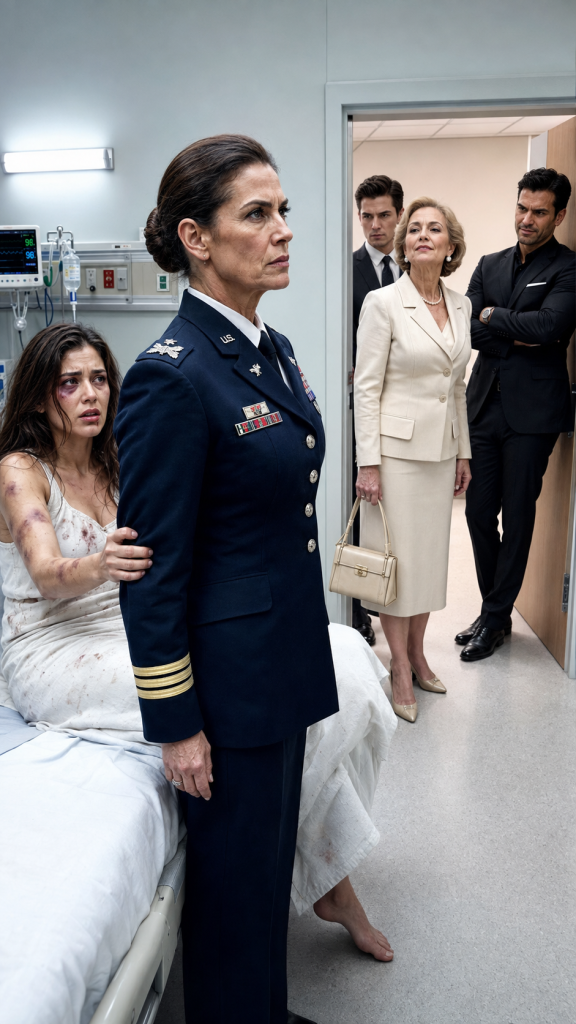
    Dress blues.

    Silver eagle insignia.

    A face that had probably frightened several captains into rewriting reports over the years.

    I lowered my voice.

    “Please.”

    Something in my expression changed hers.

    “Second hallway. Room twelve.”

    I had made it halfway there when another nurse stepped in front of me.

    “Ma’am, you can’t go back there without—”

    “My daughter is Maya Vance.”

    She stopped.

    Her eyes flicked to my uniform and then back to my face.

    “I’m Colonel Vance,” I said. “But right now I’m just her mother.”

    The nurse stared at me for half a second.

    Then she moved aside.

    “Room twelve.”

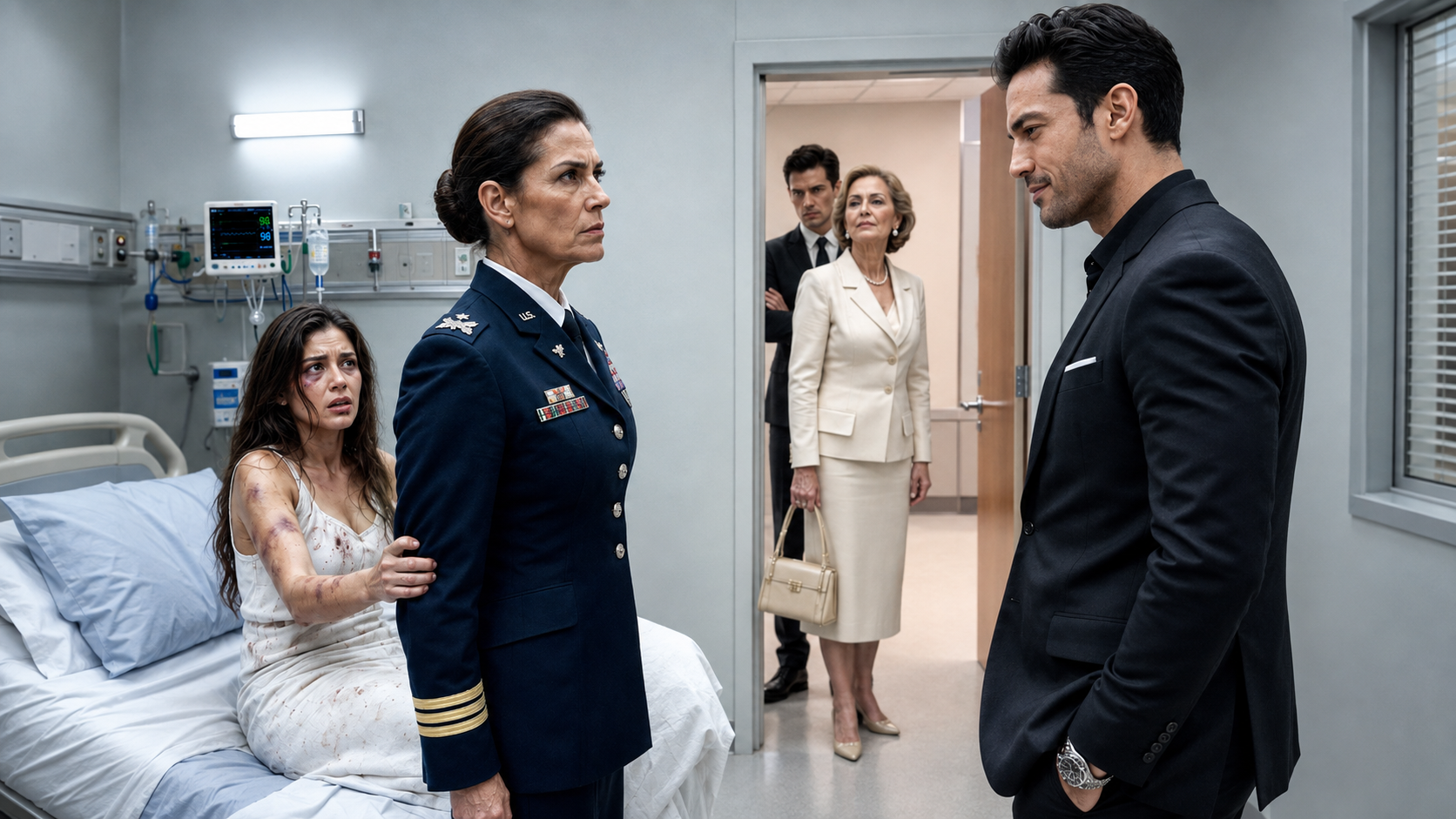
    I pushed open the door.

    And the sight nearly stopped my heart.

    Maya was curled beneath a thin hospital blanket.

    One eye was swollen completely shut.

    Her lower lip was split.

    Purple bruises circled both upper arms.

    Not random bruises.

    Finger-shaped bruises.

    The kind left by hands.

    Her expensive white dress—the one she had sent me a picture of that morning because Evelyn was hosting some family dinner—hung in torn, stained pieces around her shoulders.

    There was dried blood near the collar.

    Her bare feet were dirty.

    She looked so small.

    For one terrible second, I didn’t see a thirty-one-year-old woman.

    I saw the little girl who had once mailed handmade Christmas cards to deployed soldiers because she was worried they would feel lonely.

    I saw her standing at the front window every time I returned from deployment.

    I saw the child who used to launch herself into my arms before I had both boots inside the house.

    Then she opened her good eye.

    “Mom.”

    I crossed the room.

    There are moments when discipline leaves you.

    Rank leaves you.

    Training leaves you.

    All that remains is love and fear.

    I sat on the edge of the bed and wrapped my arms around her.

    Maya began shaking.

    Not crying.

    Shaking.

    That frightened me more.

    “I’m here,” I whispered.

    She gripped the front of my uniform.

    “I’m sorry.”

    I pulled back.

    “For what?”

    “I should’ve told you.”

    My throat tightened.

    “Told me what?”

    Her mouth opened.

    Then I heard laughter.

    Cold.

    Casual.

    Cruel.

    I turned.

    Julian stood in the doorway.

    His mother, Evelyn, was beside him.

    Marcus, Julian’s older brother, leaned against the wall behind them.

    Tailored suits.

    Polished shoes.

    Expensive watches.

    Not a hair out of place.

    They looked as though they had arrived for cocktails instead of following a bruised woman to an emergency department.

    Evelyn smiled first.

    “Colonel Vance.”

    Maya’s fingers tightened around my sleeve.

    I felt it.

    Julian noticed.

    His jaw moved.

    Evelyn entered without being invited.

    “Your daughter has always been dramatic,” she said. “She became emotional tonight, lost her balance, and fell. No one laid a hand on her.”

    I looked at Maya’s arms.

    Then at Evelyn.

    I said nothing.

    Maya suddenly found enough strength to sit higher against the pillow.

    “No.”

    Julian’s face sharpened.

    “Maya.”

    “No.” Her voice shook, but she kept going. “They locked me in the guest house.”

    The room changed.

    Even the nurse standing near the door went still.

    Maya’s words came faster.

    “They took my phone. Julian said I wasn’t leaving until I calmed down. Marcus blocked the door. Evelyn said if I ever tried to leave Julian, they would destroy my name and make sure no one believed me.”

    Julian exhaled dramatically.

    “She’s twisting everything.”

    “You hit me.”

    “I tried to stop you from hurting yourself.”

    “You hit me.”

    “Maya, enough.”

    I stood.

    Not quickly.

    Quick movement would have pleased him.

    I wanted Julian to see exactly how controlled I was.

    Marcus folded his arms.

    “Some women marry into families they aren’t capable of handling.”

    I turned toward him.

    He smirked.

    Evelyn moved between us with a practiced look of sympathy.

    “Let’s not make this embarrassing.”

    I almost admired the performance.

    Almost.

    “Our family has judges, politicians, reporters,” she continued. “People who have known us for decades. People who owe us favors. Your military career doesn’t intimidate us.”

    Marcus laughed under his breath.

    “You should take your daughter home before we sue her for slander.”

    My daughter was trembling behind me.

    My instinct was primitive.

    Immediate.

    Every part of me wanted to cross the room and make Julian understand pain in a language he could never misunderstand again.

    But rage was exactly what they expected.

    Maybe even what they wanted.

    An angry Army colonel.

    A confrontation.

    Raised voices.

    Threats.

    Something they could point to later and say, See? That family is unstable.

    So I did the thing that unsettled arrogant people most.

    Nothing.

    I looked at Evelyn.

    Then Marcus.

    Then Julian.

    One by one.

    Long enough that each smile changed slightly.

    They mistook my silence for surrender.

    That was the biggest mistake they would ever make.

    I turned to the nurse.

    “I need the attending physician.”

    Evelyn blinked.

    “What?”

    “And the hospital’s domestic violence advocate, if one is available.”

    Julian stepped forward.

    “That’s unnecessary.”

    I did not look at him.

    I kept my eyes on the nurse.

    “I also want my daughter’s chart to reflect that she states she was forcibly confined and assaulted.”

    The nurse nodded.

    “I’ll get the doctor.”

    “Thank you.”

    Evelyn’s smile disappeared.

    “Colonel, I think you’re allowing emotion to—”

    I faced her.

    “My name in this room is her mother.”

    That finally silenced her.

    I bent beside Maya.

    “Do you want them here?”

    She looked frightened.

    Then she looked at Julian.

    I watched the fear move across her face.

    And watched something else follow it.

    Something I remembered.

    The Maya I knew.

    “No,” she whispered.

    I squeezed her hand.

    “Say it clearly.”

    Her breath trembled.

    “I don’t want them here.”

    The nurse stepped forward immediately.

    “You heard the patient.”

    Julian stared at Maya.

    “You’ll regret this.”

    The nurse’s expression hardened.

    “Sir.”

    Marcus pushed away from the wall.

    Evelyn touched Julian’s arm.

    For the first time since I had seen her, she looked uncertain.

    “Come,” she said quietly.

    Julian did not move.

    His eyes stayed on Maya.

    Then on me.

    “You don’t understand what you’re getting involved in.”

    I held his gaze.

    “I understand exactly what I’m involved in.”

    He smiled then.

    It was a bad smile.

    A man who had spent his whole life watching consequences bend around him.

    “Your rank doesn’t scare me.”

    “I know.”

    That answer confused him.

    I looked toward the door.

    “It should never have needed to.”

    They left.

    The sound of Marcus laughing followed them down the hallway.

    Maya collapsed against me the moment they disappeared.

    “Mom.”

    “I’m here.”

    “You don’t understand.”

    “I will.”

    “No.” She caught my wrist. “They really can do what she said.”

    I studied my daughter’s face.

    “What have they already done?”

    Her good eye filled with tears.

    That was when I understood that tonight had not been the beginning.

    It had been the first night she thought she might not survive the end.

    And Maya whispered, “This wasn’t the first time.”


    PART 2: WHAT MY DAUGHTER HAD STOPPED SAYING

    The attending physician arrived twenty minutes later.

    Dr. Patel was a compact woman with tired eyes and a voice that became gentler the more frightened Maya looked.

    She examined the bruising again.

    She asked Maya where she hurt.

    Everywhere, apparently.

    Shoulder.

    Ribs.

    Wrist.

    Lower back.

    Jaw.

    Dr. Patel explained what imaging she wanted and why. She spoke directly to Maya, not to me, which I respected immediately.

    Then the domestic violence advocate came in.

    Her name was Renee.

    She wore no uniform and carried no authority people could see, but she knew exactly how to ask questions without making Maya feel interrogated.

    “Do you feel safe returning home?”

    “No.”

    “Do you believe your husband may try to hurt you again?”

    Maya stared at the blanket.

    “Yes.”

    “Has he prevented you from leaving before?”

    A long silence.

    “Yes.”

    “How?”

    “He takes my keys.”

    I sat completely still.

    Renee continued.

    “Has he controlled your phone?”

    “Yes.”

    “Money?”

    Maya swallowed.

    “Yes.”

    “Who can access your accounts?”

    “Julian.”

    “Do you have a separate account?”

    Maya looked ashamed.

    “No.”

    That look hurt me almost as much as the bruises.

    I reached for her hand.

    “Look at me.”

    She did.

    “You have nothing to be ashamed of.”

    Her mouth trembled.

    “I’m thirty-one.”

    “I know.”

    “I should have known.”

    “Maya.”

    “I should have seen it happening.”

    I leaned closer.

    “You were living inside it. That makes things harder to see, not easier.”

    She looked away.

    Renee gave us a moment.

    Then she asked, “Maya, would you like law enforcement contacted?”

    Fear returned instantly.

    “They know people.”

    “I understand.”

    “No, you don’t.” Maya’s voice rose. “Julian’s uncle plays golf with half the county. Evelyn can get a newspaper editor on the phone in ten minutes. Marcus has friends in the prosecutor’s office.”

    Renee did not flinch.

    “None of that changes what you’re allowed to report.”

    Allowed.

    The word mattered.

    I watched Maya hear it.

    Then I said, “You decide.”

    She turned to me as if expecting an order.

    I gave none.

    “You decide,” I repeated. “Not me. Not Julian. Not Evelyn. You.”

    “What would you do?”

    “I’m not the one who has to live with the choice.”

    Her face crumpled.

    “That sounds like an officer answer.”

    “No. An officer would give you three courses of action and a risk assessment.”

    A tiny sound escaped her.

    Almost a laugh.

    The first one I had heard.

    I squeezed her fingers.

    “This is a mother answer. Whatever you choose, I stay.”

    She looked at Renee.

    “I want to report it.”

    “Okay.”

    “And I’m not going back.”

    “Okay.”

    Maya looked at me again.

    “I mean it.”

    “I know.”

    “No, Mom. I’m done.”

    Something in me eased.

    Not because anything was fixed.

    Nothing was fixed.

    But my daughter had made a decision.

    That mattered.

    Police arrived while Maya was getting scans.

    Two officers.

    A younger man and an older woman.

    The woman introduced herself as Detective Lena Ortiz after learning the allegation involved confinement as well as assault.

    I noticed the shift immediately.

    So did Maya.

    Julian had not merely been accused of striking his wife.

    Maya was saying three people prevented her from leaving a locked building and took away her ability to call for help.

    Ortiz asked if Maya could speak.

    Maya nodded.

    The statement lasted nearly an hour.

    I sat beside her and learned just how much my daughter had hidden.

    The first shove had happened fourteen months earlier.

    Julian apologized afterward.

    Flowers.

    A bracelet.

    Tears.

    Promises.

    The second time, he had grabbed her wrist hard enough to bruise because she wanted to leave a fundraiser before Evelyn was ready.

    The third time, he pinned her against a bathroom door.

    Then came apologies again.

    Then excuses.

    Then blame.

    Maya embarrassed him.

    Maya provoked him.

    Maya drank too much.

    Maya was too sensitive.

    Maya did not understand what pressure he was under.

    And each time, Evelyn helped explain it away.

    “Marriage takes endurance.”

    “Julian loves deeply.”

    “Men in important families carry extraordinary pressure.”

    “You need to learn when to stop pushing.”

    Marcus was less subtle.

    He simply laughed.

    Tonight, Maya had told Julian she was leaving.

    Not threatening to.

    Leaving.

    She had packed two suitcases while Julian was downstairs.

    He found them.

    They argued.

    Maya tried to walk out.

    Marcus arrived sometime during the argument.

    Maya still did not know whether Julian called him or whether he had already been on the property.

    Together, the brothers blocked the front doors.

    Evelyn came later.

    “She told me divorcing Julian would be a declaration of war,” Maya said.

    Ortiz took notes.

    “What happened after that?”

    “They took my phone.”

    “Who?”

    “Julian.”

    “Did you give it to him?”

    “No.”

    “How did he take it?”

    “He grabbed my wrist and pulled it out of my hand.”

    My stomach tightened.

    “And the guest house?”

    Maya stared at the wall.

    “Julian said I needed somewhere quiet to think.”

    “What did that mean?”

    “They walked me across the back courtyard.”

    “Did you go willingly?”

    “No.”

    “Tell me exactly what happened.”

    Maya’s breathing changed.

    I wanted to stop everything.

    Instead I waited.

    She had to own her story.

    “They dragged me.”

    The words came out barely audible.

    “Julian had one arm. Marcus had the other.”

    Ortiz nodded gently.

    “What happened to your face?”

    Maya shut her good eye.

    “I kicked Julian.”

    I looked at her.

    She noticed.

    “What?”

    Despite everything, pride flickered in me.

    “Nothing.”

    “I kicked him because he wouldn’t let go.”

    Ortiz’s mouth twitched, but she stayed professional.

    “And then?”

    “He slapped me.”

    My hand curled around the edge of the chair.

    “Once?”

    “Twice.”

    “Anything else?”

    “He shoved me into the wall.”

    Ortiz continued.

    “How did you leave the guest house?”

    That was the part I had not heard.

    Maya looked almost embarrassed.

    “I broke a bathroom window.”

    I stared.

    “You what?”

    “It was small.”

    “You climbed through broken glass?”

    “I was locked inside.”

    There was my daughter.

    She had not waited.

    She had not surrendered.

    She had wrapped a towel around her hand, smashed the small bathroom window with a decorative stool, cleared enough glass to climb through, torn her dress on the frame, and run barefoot toward the road.

    A landscaping crew leaving a neighboring property saw her.

    One of the workers called an ambulance.

    The Vances arrived at the hospital soon after.

    My mind moved automatically through the sequence.

    Broken window.

    Physical injuries.

    A third-party ambulance call.

    Hospital photographs.

    Medical assessment.

    Timing.

    None of it required my rank.

    None of it required favors.

    It required facts.

    That was when I understood how I was going to fight them.

    Not loudly.

    Carefully.

    Detective Ortiz closed her notebook.

    “Maya, we’re going to document everything we can. I also need to tell you something.”

    Maya tensed.

    “What?”

    “Your husband’s family has already contacted our department.”

    Of course they had.

    I felt Maya’s hand go cold inside mine.

    Ortiz continued.

    “They’re claiming you became intoxicated, damaged property, assaulted your husband, and then injured yourself while fleeing.”

    Maya stared at her.

    “I barely drank.”

    “I’m telling you what they said, not what I believe.”

    “They said I assaulted him?”

    “You said you kicked him.”

    “Because he was dragging me.”

    “That context matters.”

    Maya looked at me.

    “This is what they do.”

    I nodded.

    “I see it.”

    “No, Mom. This is exactly what Evelyn meant. Before I even finished getting scans, they already turned me into the problem.”

    Ortiz leaned forward.

    “Then we document faster than they distort.”

    I liked her immediately.

    After she left, I stepped into the hallway to make one call.

    Not to a general.

    Not to a congressman.

    Not to anybody who could be accused of leaning on a civilian investigation.

    I called the one person I needed professionally.

    My deputy.

    When he answered, I said, “I won’t be in tomorrow.”

    Silence.

    Then, “Everything all right, ma’am?”

    “No.”

    That was enough.

    “I’ll handle the schedule.”

    “Thank you.”

    I hung up.

    Then I called someone for Maya.

    A civilian attorney who specialized in protective orders and family law.

    I had met her years earlier through a military-family support program.

    I did not ask for favors.

    I asked for representation.

    By midnight, Maya had been discharged into my care.

    Dr. Patel had documented contusions on both arms, facial swelling, a split lip, wrist trauma, and bruising inconsistent with the simple fall the Vances had described.

    No fractures.

    That was the good news.

    The bad news was visible every time Maya moved.

    We left through a private exit because hospital security said Julian was still somewhere on the property.

    My SUV waited under a pale security light.

    Maya stopped before getting in.

    “What?”

    She was staring at my windshield.

    A white envelope had been tucked beneath the wiper blade.

    I looked around the parking lot.

    No one close.

    I removed it.

    Inside was one sheet of expensive cream-colored stationery.

    No signature.

    Only one sentence.

    Think carefully before you destroy your future.

    Maya went pale.

    I read it twice.

    Then I put it back inside the envelope without touching anything else.

    “Mom…”

    I took out my phone.

    Photographed where it had been placed.

    Photographed the envelope.

    Then called Detective Ortiz.

    Maya stared at me.

    “They’re trying to scare you.”

    “No.”

    I looked toward the dark hospital windows.

    “They’re trying to make a record of how scared they are.”

    And for the first time that night, I saw doubt replace fear in my daughter’s eyes.


    PART 3: THE WAR THEY THOUGHT THEY UNDERSTOOD

    By seven the next morning, the Vance family had already started destroying Maya’s name.

    Evelyn had not exaggerated about her contacts.

    She had simply mistaken access for control.

    The first article appeared online before Maya had finished half a cup of coffee.

    I found her sitting at my kitchen table in borrowed sweatpants, staring at her phone.

    Her own phone was still missing.

    I had given her an old spare.

    She slid it toward me.

    The headline was carefully worded.

    PROMINENT CHARLOTTE FAMILY FACES PRIVATE DOMESTIC DISPUTE

    Private.

    Domestic.

    Dispute.

    Three words chosen to make bruises sound like a disagreement over curtains.

    The article cited an unnamed source close to the family.

    Maya had allegedly become “emotionally volatile.”

    There had allegedly been alcohol involved.

    She had allegedly threatened to humiliate Julian.

    She had allegedly injured herself while damaging property.

    At the bottom, two sentences mentioned that Maya had sought medical treatment.

    No photographs.

    No mention of confinement.

    No mention of her missing phone.

    No mention of the ambulance.

    Maya stared at the screen.

    “They’re doing it.”

    “Yes.”

    “Everyone is going to believe them.”

    “Some people will.”

    She looked at me sharply.

    “That’s your answer?”

    “It’s the truth.”

    Her eyes filled.

    I softened my voice.

    “You cannot control everybody who sees the first version.”

    “What if the first version is the only one they care about?”

    “Then we make sure it isn’t the only version that exists.”

    She pushed away from the table.

    “You make everything sound simple.”

    “No. I make things sound sequential.”

    “What does that even mean?”

    “It means we do the next right thing before worrying about the tenth.”

    She stared at me.

    I had said versions of that sentence to soldiers for years.

    Under pressure, people tried to solve every problem simultaneously.

    You couldn’t.

    You solved the one directly in front of you.

    The next right thing was the attorney.

    Her name was Rebecca Hale.

    She arrived at my house at eight thirty with two coffees, a legal pad, and no interest in being impressed by anybody’s last name.

    She sat across from Maya for almost two hours.

    Protective order.

    Residence access.

    Financial records.

    Property retrieval.

    Communication restrictions.

    Documentation.

    Maya had to tell the story again.

    This time, I watched anger begin replacing humiliation.

    Not all at once.

    But enough.

    Rebecca asked, “Do you want reconciliation?”

    “No.”

    “Are you certain?”

    “Yes.”

    “Do you want to return to the marital home?”

    “Only for my things.”

    “Do you want to speak to Julian directly?”

    Maya’s answer came faster.

    “No.”

    “Good. Then don’t.”

    Maya blinked.

    “Just like that?”

    “Just like that.”

    Rebecca capped her pen.

    “You’re not required to negotiate your safety.”

    I watched Maya absorb those words.

    A few minutes later, Rebecca asked me to step into the hallway.

    When we were alone, she spoke quietly.

    “I need you to understand something.”

    “I do.”

    “I don’t think you do.”

    That got my attention.

    She looked at my uniform photograph hanging on the wall behind me.

    “Your daughter’s husband is going to try to make this about you.”

    I almost smiled.

    “He already has.”

    “He’ll say she ran to a powerful mother. That you used your rank. That you threatened them. That you influenced police.”

    “I haven’t.”

    “I know. Keep not doing it.”

    My smile disappeared.

    Rebecca continued.

    “No calls from military legal demanding action. No friends in government. No command influence. No uniform in court unless you’re coming from work and can’t avoid it.”

    “You think I don’t know that?”

    “I think you’re a mother who saw finger marks on her child’s arms.”

    That ended my irritation.

    She was right.

    Rebecca lowered her voice.

    “The strongest thing you can do for Maya is refuse to become the villain they need.”

    I nodded.

    “I understand.”

    That afternoon, Julian called.

    Not Maya.

    Me.

    I stared at his name on my screen.

    Rebecca had told Maya not to communicate with him.

    She had not told me the same.

    I answered.

    “Julian.”

    His voice was smooth.

    “Colonel.”

    “Do not call me that.”

    A pause.

    “Fine. I assume Maya is with you.”

    I said nothing.

    He continued.

    “She’s making a terrible mistake.”

    Still nothing.

    “Did she tell you she kicked me?”

    “Yes.”

    He had not expected that.

    “Well. Then you understand she was violent.”

    “I understand she says she kicked you while you and Marcus were dragging her toward a locked guest house.”

    His breathing changed slightly.

    “That isn’t what happened.”

    “What happened?”

    Another pause.

    I could almost hear him choosing words.

    “She was hysterical.”

    “That is not an action.”

    “She was impossible to reason with.”

    “Also not an action.”

    “She was trying to leave while intoxicated.”

    “So you physically stopped her.”

    “I kept my wife from making a dangerous decision.”

    “You took her phone.”

    “For her own good.”

    I closed my eyes.

    There it was.

    Not the truth.

    But the shape of it.

    He did not deny control.

    He justified it.

    I made no threat.

    No accusation.

    I let silence work.

    People like Julian hated empty space.

    They filled it.

    “You don’t know what she’s like when she gets emotional.”

    Silence.

    “She says things she doesn’t mean.”

    Silence.

    “We all tried to calm her down.”

    Silence.

    “She was not imprisoned.”

    I finally spoke.

    “Then why couldn’t she leave?”

    He stopped.

    Just for a fraction of a second.

    It was enough.

    “She could have.”

    “She broke a window.”

    “She overreacted.”

    “Where is her phone?”

    Longer silence.

    Then his voice hardened.

    “You’re very calm.”

    “Yes.”

    “You think that makes you intimidating?”

    “No.”

    “I know your type.”

    I almost laughed.

    He had no idea.

    He knew uniforms.

    He knew titles.

    He knew the version of authority his family respected: loud, visible, transactional.

    He knew favors.

    He knew influence.

    He knew important names spoken over expensive dinners.

    What he did not understand was procedure.

    “Julian,” I said, “do not contact Maya.”

    “You don’t get to give me orders.”

    “This isn’t an order. It’s advice.”

    “I don’t need your advice.”

    “Then don’t take it.”

    He laughed once.

    “You really think you can beat my family?”

    I looked through the kitchen doorway.

    Maya was asleep on my couch, one side of her face hidden beneath an ice pack.

    “I’m not fighting your family.”

    “What would you call this?”

    “Standing beside my daughter.”

    His voice dropped.

    “You should be careful.”

    “So should you.”

    The line went dead.

    I wrote down everything I could remember immediately afterward.

    Time.

    Duration.

    Exact phrases.

    Not because I thought my notes would magically decide the case.

    Because details blurred.

    Memory softened.

    And I had spent too many years learning that facts preserved early survived pressure better.

    By evening, the pressure intensified.

    Three of Maya’s acquaintances stopped answering her.

    A charity board sent an email stating that, in light of the “personal controversy,” Maya should temporarily step away from her volunteer position.

    A society photographer posted an old picture of Maya holding champagne at a gala.

    Comments followed.

    Drunk.

    Unstable.

    Gold digger.

    Attention seeker.

    I found Maya reading them.

    “Stop.”

    “I need to know what people are saying.”

    “No, you don’t.”

    “They think I’m crazy.”

    “Strangers think whatever entertains them for thirty seconds.”

    Her face twisted.

    “It isn’t only strangers.”

    She handed me the phone.

    A message from someone she had considered a close friend read:

    Julian told everyone you attacked him. I love you, Maya, but I can’t be involved.

    Maya whispered, “She was my bridesmaid.”

    I sat beside her.

    There are wounds a doctor cannot photograph.

    I knew that.

    I had spent years around people who carried them.

    “She chose comfort,” I said.

    Maya looked at me.

    “What?”

    “It was easier for her to believe the version that asks nothing from her.”

    “That doesn’t make it hurt less.”

    “No.”

    I put an arm around her.

    “It doesn’t.”

    She leaned into me carefully because of her ribs.

    After a while, she said, “I ignored things.”

    I waited.

    “Julian used to joke that I was lucky he found me before someone less patient did.”

    My jaw tightened.

    “Evelyn would tell me I had no idea how many women wanted my life.”

    Another pause.

    “Marcus once said divorce was expensive, but public humiliation was free.”

    I looked at her.

    “When?”

    “Christmas.”

    “You never told me.”

    “I thought he was joking.”

    “Maybe he wanted you to.”

    Maya stared across the room.

    “I kept waiting for one terrible thing to happen so I’d have permission to call it terrible.”

    That sentence stayed with me.

    Because that was how people survived the unbearable.

    They divided it.

    One insult.

    One apology.

    One bruise.

    One explanation.

    One locked door.

    Until somebody finally looked at the whole thing and understood they had been living inside a cage.

    The next morning, Detective Ortiz called.

    “We obtained the initial incident report from the property.”

    “Initial?”

    “The Vances called police before the ambulance reached the hospital.”

    Of course they did.

    “What did they report?”

    “Property damage and a domestic disturbance.”

    “Did they mention Maya was missing?”

    “No.”

    I went still.

    Ortiz continued.

    “According to their statement, she left voluntarily after becoming upset.”

    I looked at Maya.

    She was watching my face.

    “What else?”

    “Marcus said nobody touched her.”

    Maya whispered, “He held my arm.”

    Ortiz heard her.

    “That matters.”

    “And the guest house?” I asked.

    “We’re working on it.”

    Working.

    Not solved.

    Not dramatic.

    Not instant.

    Reality rarely moved at the speed of outrage.

    Before hanging up, Ortiz added, “There’s something else. Officers photographed the bathroom window when they responded to the property-damage complaint.”

    I looked at Maya.

    She went completely still.

    Ortiz continued.

    “The broken glass is primarily outside the structure.”

    I understood immediately.

    If Maya had smashed the window from outside, glass would mostly have fallen inward.

    But she had broken it from inside.

    A small thing.

    A physical thing.

    A thing that did not care whether Evelyn Vance knew judges.

    Ortiz said, “It doesn’t prove every allegation. But it supports your daughter’s account that she exited through that window.”

    After the call ended, Maya stared at me.

    “They photographed it because they wanted me charged with damaging it.”

    “Yes.”

    “And now it helps me.”

    “Yes.”

    A strange expression crossed her face.

    Almost disbelief.

    Then she laughed.

    It hurt her ribs, so the laugh became a gasp, and I reached for her.

    But she was still smiling.

    “They documented their own lie.”

    I nodded.

    “Arrogance has a habit of doing paperwork.”

    That was the first day Maya smiled without apologizing for it.

    It did not last.

    That afternoon, a courier delivered notice that Julian had filed for divorce.

    He alleged cruel treatment.

    Substance abuse.

    Physical aggression.

    And severe emotional instability.

    Maya read the filing twice.

    Then she looked at Rebecca.

    “He’s saying I abused him.”

    Rebecca’s jaw hardened.

    “Yes.”

    Maya turned to me.

    I waited for tears.

    They did not come.

    She folded the papers carefully.

    “Okay.”

    Something in her voice changed.

    Not cold.

    Clear.

    “What do we do next?”

    And that was the moment I knew Julian had made his second great mistake.

    He had expected Maya to break.

    Instead, he had finally given her an enemy she no longer needed to love.


    PART 4: THE THINGS THAT DIDN’T CHANGE THEIR STORY

    For the next three weeks, the Vances tried to win the way they had always won.

    By making resistance exhausting.

    Letters came from attorneys.

    Statements appeared in friendly media.

    A private investigator began parking near my neighborhood.

    Anonymous accounts posted stories about Maya drinking, screaming, spending Julian’s money, embarrassing him at events.

    Some of the stories contradicted one another.

    That did not matter online.

    Noise does not need consistency.

    It needs volume.

    But behind the noise, something else was happening.

    Maya was rebuilding the timeline.

    Not me.

    Maya.

    At first, I tried to do too much for her.

    I called Rebecca before Maya asked.

    I organized folders.

    I made lists.

    I began arranging every morning like a mission brief.

    Finally, one afternoon, Maya closed my laptop.

    “Stop.”

    I looked up.

    “What?”

    “You’re taking over.”

    “I’m helping.”

    “No. You’re commanding.”

    The accusation hit harder than I expected.

    “I’m trying to protect you.”

    “I know.”

    “Then what’s the problem?”

    She looked at me with one eye still faintly shadowed yellow from the healing bruise.

    “I need to know I can protect myself too.”

    That silenced me.

    Because she was right.

    I had nearly made the mistake Julian made in a different form.

    He controlled her because he believed his judgment mattered more than hers.

    My reason was love.

    His was power.

    But Maya had lived too long with other people deciding what was best for her.

    So I pushed the folder toward her.

    “You’re in charge.”

    She nodded.

    “I’ll ask when I need you.”

    “Okay.”

    “And Mom?”

    “Yes?”

    “Don’t make that face.”

    “What face?”

    “The face where you pretend letting go is easy.”

    Despite myself, I smiled.

    “Noted.”

    From then on, Maya led.

    She requested old account statements through her attorney.

    She listed dates she remembered.

    Not just assaults.

    Moments.

    Times Julian took her keys.

    Times he cancelled plans without asking her.

    Times Evelyn called immediately after Maya and Julian argued, proving how quickly private conflicts became family business.

    Times Marcus appeared at the house after disagreements.

    Nothing alone was the entire case.

    Together, they formed a pattern.

    Rebecca was careful with us.

    “Patterns matter,” she said, “but don’t start seeing proof where there isn’t proof. We use what we can establish.”

    That sentence became our rule.

    No exaggeration.

    No guessing.

    No matching the Vances lie for lie.

    If we did not know, we said we did not know.

    If Maya could not remember, she said she could not remember.

    If something was only suspicion, it stayed suspicion.

    Meanwhile, Detective Ortiz kept working the assault and confinement allegations.

    The landscaping employee who had called the ambulance confirmed finding Maya barefoot near the roadside, bleeding from one hand and asking him not to let “them” take her back.

    Hospital records documented her condition before I arrived.

    The property-damage report established the broken guest-house window.

    And Julian’s own statement confirmed that Maya had been taken to the guest house to “calm down,” though he insisted she was never held there against her will.

    Every fact narrowed the space where their story could hide.

    Then came the protective-order hearing.

    Rebecca told me not to wear my uniform.

    I wore a navy suit.

    Evelyn entered the courthouse in cream-colored wool and pearls.

    Marcus came behind her.

    Julian wore gray.

    No one smiled this time.

    Their attorney was a man named Charles Merritt, silver-haired, polished, and very expensive.

    He argued that Maya had weaponized a marital disagreement.

    He described Julian as a devoted husband trying to manage his wife’s “erratic behavior.”

    He pointed out that Maya had kicked Julian.

    He suggested her injuries could have occurred while climbing through the window.

    Then Maya testified.

    I sat behind her.

    I could see the back of her neck.

    For most of her childhood, Maya hated public speaking.

    At twelve, she once pretended to have a fever to avoid giving a science presentation.

    Now she raised her right hand.

    Swore to tell the truth.

    And told strangers exactly how her husband had hurt her.

    Her voice shook at first.

    Then it steadied.

    She described packing.

    Julian finding the suitcases.

    The argument.

    Marcus blocking the door.

    Her phone being taken.

    Evelyn arriving.

    The walk across the courtyard.

    Their hands on her arms.

    Her kick.

    Julian’s slap.

    The guest house.

    The locked door.

    The window.

    The road.

    The ambulance.

    Merritt stood for cross-examination.

    “Mrs. Vance, you admit you physically struck your husband.”

    “I kicked him.”

    “So you assaulted him.”

    “I kicked him while he and his brother were dragging me.”

    “Please answer only the question asked.”

    “I did.”

    A few people shifted in the courtroom.

    Merritt smiled thinly.

    “You had consumed alcohol that evening.”

    “A glass of wine with dinner.”

    “Only one?”

    “Yes.”

    “You expect the court to simply take your word for that?”

    “No.”

    Merritt paused.

    Maya continued.

    “The hospital drew blood.”

    I looked toward Julian.

    His eyes moved to his attorney.

    Merritt recovered.

    “You destroyed your husband’s family property.”

    “I broke a window.”

    “Intentionally.”

    “Yes.”

    “So you admit you were destructive.”

    “I was trying to get out of a locked building.”

    He changed direction.

    “Your mother is a senior Army officer.”

    “Yes.”

    “Accustomed to authority.”

    “My mother isn’t part of my marriage.”

    “Did you call her from the hospital?”

    “Yes.”

    “Because you knew she could exert pressure.”

    Maya looked directly at him.

    “No.”

    “Why, then?”

    Her voice softened.

    “Because I was scared, and I wanted my mother.”

    Something in the courtroom changed.

    Merritt felt it.

    He stepped closer.

    “Mrs. Vance, isn’t it true that you have repeatedly threatened to ruin Julian’s reputation?”

    “No.”

    “Never?”

    “No.”

    “Isn’t it true that you told him his family would regret the way they treated you?”

    Maya hesitated.

    Julian leaned forward.

    I felt the trap before I understood it.

    Maya looked at Rebecca.

    Then back at Merritt.

    “I said something like that once.”

    Merritt smiled.

    “So you did threaten them.”

    “No.”

    “You just admitted—”

    “I said they would regret treating people like possessions.”

    Silence.

    Merritt’s smile weakened.

    “When did you say that?”

    “After Marcus told me women like me were replaceable.”

    Behind Julian, Marcus shifted.

    Merritt changed direction again.

    But it was too late.

    The judge had been watching Maya closely.

    Not me.

    Not my insignia.

    Not Evelyn’s pearls.

    Maya.

    The temporary protective order was granted and extended.

    Julian was ordered not to contact her directly.

    The court did not decide the criminal allegations that day.

    No dramatic arrest occurred on the courthouse steps.

    No judge gave a speech about powerful families.

    Real justice rarely performs for an audience.

    But when we walked outside, Maya stopped on the stone steps.

    She closed her eyes.

    The cold air moved through her hair.

    “What?”

    She looked at me.

    “He can’t call me.”

    “No.”

    “He can’t just show up.”

    “No.”

    “And if he does?”

    “You call the police.”

    She exhaled.

    It sounded as though she had been holding that breath for fourteen months.

    Then Evelyn approached.

    Her attorney tried to stop her.

    She ignored him.

    “Colonel.”

    I looked at Maya.

    Not Evelyn.

    Maya straightened.

    That mattered.

    Evelyn came closer.

    “You think this piece of paper changes anything?”

    Maya answered before I could.

    “Yes.”

    Evelyn’s eyes narrowed.

    “You have no idea what you’re throwing away.”

    “I do.”

    “Julian gave you everything.”

    Maya’s face went very still.

    “He gave me things.”

    Evelyn laughed.

    “What’s the difference?”

    Maya stepped closer.

    “My mother gave me a home to come back to. Renee gave me choices. Detective Ortiz listened. Rebecca gave me information.”

    She looked directly at Evelyn.

    “Julian gave me fear.”

    Evelyn’s face hardened.

    “This isn’t finished.”

    Maya nodded.

    “I know.”

    Then she walked away.

    I followed.

    For the first time, I did not have to lead her.


    PART 5: THE SILENCE THEY NEVER EXPECTED

    The criminal investigation took months.

    That frustrated people who only saw stories as beginnings and endings.

    They wanted the bruised woman.

    Then the handcuffs.

    Then justice.

    Life lived in the middle.

    Maya had good days.

    Then terrible ones.

    She moved into an apartment three months after leaving my house because she needed a place that belonged only to her.

    The first night there, she called me at 2:17 a.m.

    “I heard something outside.”

    I was awake instantly.

    “Are you safe?”

    “Yes.”

    “Doors locked?”

    “Yes.”

    “Do you want me to come?”

    A long silence.

    “No.”

    I waited.

    Then she said, “Stay on the phone.”

    So I stayed.

    Ten minutes later, she laughed weakly.

    “It was the ice machine.”

    “That thing sounds hostile.”

    “Mom.”

    “I’m serious. Very suspicious appliance.”

    She laughed harder.

    And this time, there was no pain in it.

    Other nights were worse.

    She woke from dreams about the guest house.

    She panicked when someone stood too close behind her.

    Once, while shopping, a man reached past her for a jar on a high shelf and she dropped her basket and ran outside.

    Healing was not a straight line.

    Neither was the case.

    Julian’s attorneys fought everything.

    Marcus claimed he had only tried to de-escalate the argument.

    Evelyn claimed she arrived after Maya had already become violent.

    Julian maintained that Maya had been free to leave the guest house at any time.

    But facts kept returning.

    The ambulance caller.

    The medical records.

    The pattern of bruising.

    The condition of the window.

    The timing of the Vances’ police report.

    The missing phone.

    Julian’s own admission that he had taken it “for her own good.”

    And one detail Detective Ortiz kept coming back to.

    The guest house door.

    The Vances insisted it had never been locked.

    But when police photographed the property that first night because of the broken window, the exterior deadbolt was visible in the images.

    A deadbolt that could be engaged from outside.

    That did not prove who turned it.

    But it made their insistence that the room was designed to be freely entered and exited much harder to explain.

    Piece by piece.

    Not one miracle.

    Not one secret file.

    Not one powerful person swooping down to save us.

    Piece by piece.

    That was how the truth survived.

    The public story changed more slowly.

    One outlet corrected its original account after obtaining court records.

    Then another.

    The charity board that had pushed Maya aside quietly invited her back.

    She declined.

    Her former bridesmaid sent a long apology.

    Maya read it.

    Then deleted it.

    “You aren’t going to answer?”

    “No.”

    I raised an eyebrow.

    “She apologized.”

    “I know.”

    “Do you forgive her?”

    Maya considered that.

    “Maybe someday.”

    Then she looked at me.

    “But forgiveness doesn’t mean access.”

    I smiled.

    “What?”

    “Nothing.”

    “No, that was the proud-mom face.”

    “I don’t have a proud-mom face.”

    “You absolutely do.”

    I did not argue.

    Julian’s divorce strategy also began collapsing under its own weight.

    The claim that Maya had been intoxicated became difficult to maintain after her hospital toxicology results showed no level consistent with the drunken rampage his family had described.

    The claim that she had attacked Julian without provocation sat beside his acknowledgment that he had physically stopped her from leaving.

    The claim that she had fled impulsively sat beside two suitcases she had packed before the argument.

    She had been planning to leave.

    He simply had not believed she had the right.

    That, more than anything, became the emotional center of the case.

    Julian believed love meant possession.

    Evelyn believed family meant obedience.

    Marcus believed money meant consequence was something that happened to other people.

    And they had made the same mistake with Maya that they made with me.

    They thought restraint was weakness.

    The final major hearing in the criminal matter occurred almost eleven months after the night at St. Bernard.

    By then, Maya’s face had healed.

    Her life was different.

    She had cut her hair shorter.

    Started working again.

    Changed her number.

    Found a therapist she trusted.

    Stopped checking what strangers said about her online.

    Most importantly, she no longer apologized every time she needed something.

    The prosecutor had ultimately moved forward on charges related to assault and unlawful confinement against Julian, with Marcus facing his own exposure for participating in preventing Maya from leaving. Evelyn was not transformed into some secret criminal mastermind because she didn’t need to be.

    The harm she had done was simpler.

    She had taught her sons that family reputation mattered more than another person’s freedom.

    And when that belief finally had consequences, she treated herself as the victim.

    The courthouse hallway was crowded that morning.

    Reporters stood near the elevators.

    Evelyn arrived first.

    Then Marcus.

    Then Julian.

    I watched him see Maya.

    For the first time since the hospital, he looked uncertain.

    Maya wore a dark blue dress.

    No dramatic jewelry.

    No visible shaking.

    He walked toward her before his lawyer caught his arm.

    “Maya.”

    She did not answer.

    “Maya, please.”

    Her shoulders tightened.

    I moved instinctively.

    She lifted one hand slightly.

    Not toward Julian.

    Toward me.

    Stay.

    So I stayed.

    Julian looked at her.

    “You’re really going to do this?”

    Maya finally faced him.

    “I already did.”

    “You know what I mean.”

    “Yes.”

    His voice lowered.

    “We had a life.”

    “You had a life.”

    His expression cracked.

    “I loved you.”

    Maya looked at him for a long time.

    There had been months when I wondered what she would say if she ever heard those words again.

    Maybe part of her would break.

    Maybe she would rage.

    Maybe she would demand an apology.

    Instead, she said quietly, “You loved having me.”

    Julian went still.

    “That isn’t the same thing.”

    His attorney pulled him away.

    Evelyn stared at me from farther down the hallway.

    Our eyes met.

    Eleven months earlier, she had stood in a hospital room and told me my military career did not intimidate her.

    She had been right.

    It had never needed to.

    I had not used my rank to threaten her.

    Had not called political contacts.

    Had not demanded special treatment.

    Had not stood in front of cameras.

    I had simply refused to let her turn chaos into confusion.

    Every time she created noise, we returned to facts.

    Every time Julian blamed Maya, Maya returned to what happened.

    Every time Marcus laughed, the documents stayed exactly where they were.

    That was the silence they had never understood.

    Not surrender.

    Discipline.

    When proceedings concluded, the legal consequences were serious enough to destroy the illusion that the Vances were untouchable, but the moment I remember most happened outside.

    The reporters were waiting.

    Microphones rose.

    “Maya!”

    “Mrs. Vance!”

    “Do you have a statement?”

    “Do you feel vindicated?”

    “Colonel, did your military connections influence—”

    I stopped walking.

    Maya stopped beside me.

    Rebecca looked annoyed.

    I could have answered.

    Part of me wanted to.

    For almost a year, strangers had speculated about my role.

    I could have explained every boundary I had observed.

    Every temptation I had resisted.

    Every night I wanted to pick up a phone and make someone powerful listen.

    But this was not my story to finish.

    I looked at Maya.

    “Your choice.”

    She stared at the reporters.

    A year earlier, that crowd would have terrified her.

    Now she stepped forward.

    “My mother didn’t save me.”

    My heart stopped for an entirely different reason.

    The reporters quieted.

    Maya continued.

    “She came when I called. She believed me. She stood beside me. But she didn’t save me.”

    Her voice strengthened.

    “I climbed through the window.”

    Silence.

    “I told the hospital what happened. I gave the statement. I filed for protection. I testified. I kept showing up when people called me unstable, dishonest, greedy, dramatic, and worse.”

    She looked straight toward the cameras.

    “There are people living in situations like mine who think they need someone powerful to rescue them. I thought that too.”

    A reporter asked, “What would you tell them?”

    Maya took a breath.

    “That leaving can be terrifying. Reporting can be terrifying. Telling the truth doesn’t guarantee everyone will believe you.”

    She glanced toward me.

    “But one person believing you can help you remember how to believe yourself.”

    My vision blurred.

    I hated crying in public.

    Maya knew that.

    She smiled at me.

    Then she turned back to the cameras.

    “I’m not ashamed anymore.”

    That was her statement.

    Nothing about revenge.

    Nothing about wealth.

    Nothing about destroying the Vance name.

    She simply walked away from it.

    We reached my SUV in the courthouse garage.

    This time, there was no threatening envelope beneath the wiper.

    No Julian waiting.

    No Evelyn.

    No Marcus laughing.

    Just concrete pillars and the distant sound of traffic.

    Maya stopped before opening the passenger door.

    “Do you remember the hospital?”

    I looked at her.

    “I remember everything about the hospital.”

    “When they were laughing?”

    “Yes.”

    “You didn’t say anything.”

    “I said a few things.”

    “You know what I mean.”

    I did.

    She leaned against the car.

    “I thought you were scared.”

    That surprised me.

    “You did?”

    “You were so quiet.”

    I considered lying.

    Instead I said, “I was terrified.”

    Her eyes widened.

    “I wanted to drag Julian out of that room with my bare hands.”

    Maya laughed.

    “I would’ve paid to see that.”

    “I’m serious.”

    “I know.”

    “I was scared that if I let anger make the first decision, I’d become useful to them.”

    Her smile faded.

    “So that’s why you stayed quiet.”

    “Partly.”

    “What was the other part?”

    I looked at my daughter.

    At the woman standing where the frightened woman from the hospital had once been.

    “I was listening.”

    “To what?”

    “To them.”

    I remembered Evelyn bragging about judges and reporters.

    Marcus threatening slander.

    Julian calling Maya unstable.

    All of them speaking freely because they believed intimidation was the same thing as strength.

    “People reveal themselves when they think they’ve already won,” I said.

    Maya looked toward the garage exit.

    “Evelyn really thought they’d win.”

    “Yes.”

    “Did you?”

    The question took me back to that first night.

    Maya shaking beneath a hospital blanket.

    Her torn white dress.

    The fingerprints on her arms.

    The laughter.

    The rage.

    The fear.

    Did I know we would win?

    No.

    Life was never that generous.

    “I knew we could lose things,” I said.

    “Like what?”

    “Reputation. Time. Money. Friends. Sleep.”

    She nodded.

    “We did.”

    “Yes.”

    “Then what did you know?”

    I opened the driver’s door.

    “I knew I wasn’t leaving you there.”

    Maya stared at me.

    That was all.

    Not certainty.

    Not invincibility.

    Not some heroic promise that I could destroy anyone who hurt my daughter.

    Just presence.

    Sometimes that is the bravest promise you can honestly make.

    Maya walked around the SUV and got into the passenger seat.

    As I started the engine, she said, “Mom?”

    “Yes?”

    “Do you still have the white dress?”

    I looked at her.

    The hospital had bagged it with her belongings after documenting the damage.

    Months later, once it was no longer needed, Maya had asked me to store the bag because she could not stand to see it.

    “Yes.”

    “I want it.”

    “For what?”

    She looked out the window.

    “I don’t know yet.”

    I waited.

    Then she smiled.

    “Maybe I’ll throw it away.”

    “Good.”

    “Maybe I’ll burn it.”

    “Please check local ordinances first.”

    She groaned.

    “You are impossible.”

    “I’m a responsible citizen.”

    “You’re an Army colonel.”

    “Off duty.”

    She laughed.

    Then she became quiet again.

    “Maybe I’ll keep a piece of it.”

    I looked at her.

    “Why?”

    “So I remember.”

    My chest tightened.

    “The bad part?”

    She shook her head.

    “The window.”

    I understood.

    The torn dress had never only been evidence of what they did to her.

    It was evidence of what she did next.

    She climbed out.

    I pulled onto the street.

    Charlotte moved around us beneath a clear afternoon sky.

    People hurried along sidewalks.

    Cars stopped at lights.

    Somewhere, another family was laughing.

    Somewhere, someone was afraid.

    Somewhere, a woman was probably sitting in a room convincing herself that one more bruise, one more threat, one more locked door did not mean what she feared it meant.

    I could not save all of them.

    I had finally accepted that I had not even saved Maya.

    She saved herself.

    My job had been simpler.

    When she called, I came.

    When she spoke, I listened.

    When powerful people told her the truth would be buried beneath their money, influence, and reputation, I refused to help them bury it by losing control.

    They thought my rank was the dangerous thing about me.

    It wasn’t.

    They thought the eagle on my shoulders meant I could summon power.

    They laughed because they believed their own power was greater.

    But titles had nothing to do with what happened next.

    What mattered was that I had spent most of my adult life learning something the Vance family never had to learn:

    When everything around you becomes loud, confusing, frightening, and violent, you do not always win by becoming louder.

    Sometimes you become still.

    You identify what is true.

    You protect the person beside you.

    You take the next right action.

    Then the next.

    Then the next.

    Until the people who built their lives on intimidation discover that fear has limits.

    Until the lies contradict each other.

    Until the locked room has a broken window.

    Until the woman they called unstable stands before the world and tells the truth in her own voice.

    At the next red light, Maya reached over and took my hand.

    I squeezed hers.

    Neither of us said anything.

    We didn’t need to.

    The silence belonged to us now.

  • HE BURIED ME BEFORE I WAS DEAD

    HE BURIED ME BEFORE I WAS DEAD

    PART 1: THE DEAD WOMAN IN THE TREES

    “If I am truly dead, I want to see how long it takes my husband to rob me.”

    Those were the first words I remember saying after the helicopter went down.

    I was lying beneath a canopy of pine trees with blood dried along my temple, my left shoulder screaming every time I breathed, and smoke rising through the branches behind me in a black column.

    For several seconds, the man kneeling beside me simply stared.

    He was a hiker. Mid-fifties, gray beard, red windbreaker, terrified eyes.

    “Ma’am,” he said carefully, “you’ve been in an accident.”

    “I know.”

    “You need an ambulance.”

    “I need your phone.”

    He hesitated.

    The helicopter burned somewhere down the slope.

    Metal popped in the fire. Something exploded, small but sharp enough to send birds bursting from the trees.

    I should have been screaming.

    I should have been asking about the pilot.

    I should have been thinking about death.

    Instead, I thought about Daniel.

    My husband.

    Nine years of marriage.

    Nine years of believing charm could eventually mature into character if I loved a man long enough.

    “Please,” I said.

    The hiker handed me his phone.

    My fingers shook so badly that I almost dropped it.

    I dialed Marcus Cole from memory.

    He answered on the third ring.

    “Hello?”

    “Marcus.”

    Silence.

    Then, “Victoria?”

    “It’s me.”

    His voice changed instantly. “Where are you?”

    “I don’t know exactly. There’s been a crash.”

    “What crash?”

    “A helicopter.”

    Another silence, this one heavier.

    Then I heard movement on his end.

    “Are you hurt?”

    “Yes.”

    “Badly?”

    “I can stand.”

    “Call emergency services.”

    “The man with me already did.”

    “Good. Send me your location.”

    I looked at the hiker.

    He took the phone, found the coordinates, and read them out.

    Marcus repeated them.

    “I’m coming.”

    “Marcus.”

    “What?”

    I swallowed.

    Smoke burned my throat. My ribs felt as though someone had wrapped steel bands around them and was tightening them one notch at a time.

    “Tell no one I’m alive.”

    The hiker looked at me sharply.

    Marcus did not answer.

    “Did you hear me?”

    “I heard you.”

    “Tell no one. Especially Daniel.”

    “Victoria—”

    “Especially Daniel.”

    That time, he understood.

    “I’m on my way.”

    The call ended.

    The hiker stared at me as if the concussion had damaged something deeper than my skull.

    “Your husband thinks you’re on that helicopter.”

    “My husband knows I’m on that helicopter.”

    “And you don’t want him to know you survived?”

    “Not yet.”

    He opened his mouth.

    I closed my eyes.

    “Please.”

    Maybe it was the blood on my face. Maybe it was the shock in my voice. Maybe he had lived long enough to understand that there were some marriages in which survival and safety were not the same thing.

    He nodded.

    “I’ll tell the paramedics I found you farther up the trail.”

    “Thank you.”

    I leaned back against the rough trunk of the pine tree.

    Only then did I let myself remember the flight.

    It had been a Saturday morning.

    I had booked the scenic helicopter tour because I needed forty minutes in which no one could ask me about lease renewals, occupancy rates, construction delays, or why my husband had started carrying his phone into the shower.

    I was forty years old.

    For twelve years, I had built Sterling Property Management from one rented office, one assistant, and a stack of buildings no reputable firm wanted to touch.

    I had taken vacant storefronts and filled them.

    I had negotiated impossible leases.

    I had sat across from developers twice my age who called me sweetheart until they realized I knew their buildings better than they did.

    By the time I turned forty, my company managed commercial properties across Illinois, Wisconsin, and Indiana. We had thirty employees in our Loop headquarters and enough corporate clients that people who used to ignore my emails now invited me to charity dinners.

    Daniel liked those dinners.

    Daniel had entered my life nine years earlier with polished shoes, old family connections, and the kind of smile that convinced strangers they had already known him for years.

    At first, I had thought his ease with people balanced me.

    I was careful.

    Daniel was effortless.

    I counted risks.

    Daniel made everyone believe risks were opportunities.

    For a while, we worked.

    Then, sometime in the last year, effortless became absent.

    He took calls in hallways.

    He closed his laptop when I walked into the room.

    He went on “business trips” that never appeared on the shared calendar.

    And a woman named Rebecca started appearing at the edges of conversations.

    Rebecca knows someone at the club.

    Rebecca recommended the restaurant.

    Rebecca was at the investor dinner.

    Rebecca helped with the charity list.

    Rebecca had somehow become a person Daniel referred to often and explained never.

    I had never confronted him.

    Not because I was afraid of the answer.

    Because I wanted proof before I asked the question.

    That was how I had built my company.

    I did not walk into negotiations hoping someone would tell me the truth.

    I walked in already knowing which page they had lied on.

    So that Saturday, instead of confronting my husband, I had driven to a small airfield outside Chicago and climbed into a helicopter with a pilot and a woman named Julia Hayes.

    Julia was from Milwaukee.

    We had spoken for maybe ten minutes.

    She was close to my height, with dark hair tucked beneath a cap. She wore a black jacket almost identical to mine.

    I remembered her laughing when the pilot asked if either of us was nervous.

    “Not until you asked,” she had said.

    Forty minutes later, the weather changed.

    Not gradually.

    One moment we were flying beneath a heavy gray sky, and the next the aircraft lurched sideways so violently that my teeth slammed together.

    The pilot shouted something.

    The helicopter dropped.

    Julia screamed.

    The world became spinning glass, gray sky, treetops, metal, noise.

    Then impact.

    The side door tore away.

    I remember cold air hitting my face.

    I remember my seat belt snapping loose or tearing free.

    Then I was outside.

    Falling.

    Pine branches struck me hard enough to turn my vision white.

    One caught my jacket.

    Another broke beneath me.

    I dropped again.

    Then darkness.

    When I woke, the helicopter was burning.

    I did not know then that the pilot and Julia had died.

    I did not know that my purse, wallet, phone, and identification had remained inside the cabin.

    I did not know that the fire had made immediate identification almost impossible.

    I only knew one thing.

    Daniel believed I had died with them.

    And for reasons I could not yet explain even to myself, I wanted to know what he would do if he believed there was no chance I could ever walk through our front door again.

    Marcus reached me before the emergency vehicles reached the deepest part of the trail.

    He came in an SUV still wearing the dark sweater and jeans he wore on weekends.

    The hiker helped me down.

    Marcus took one look at my face and stopped.

    For five years, we had been business partners.

    He was forty-five, divorced, father to a twelve-year-old boy named Noah, and almost aggressively uninterested in impressing people.

    He was the opposite of Daniel in nearly every visible way.

    Daniel could make twenty people laugh at dinner.

    Marcus could sit beside you in silence for an hour and somehow make you feel less alone.

    “You look terrible,” he said.

    I almost laughed.

    My ribs objected.

    “You always know what to say.”

    His jaw tightened.

    He helped me into the passenger seat.

    By the time emergency vehicles began passing us in the opposite direction, I was lying low enough that nobody could see me through the window.

    Marcus drove.

    For ten minutes, neither of us spoke.

    Then he turned on the radio.

    I wished he had not.

    The news had already broken.

    “Authorities are responding to a fatal aviation accident west of the Chicago metropolitan area…”

    I stared through the windshield.

    Rain dotted the glass.

    “…three individuals are believed to have been aboard. Among the fatalities is believed to be prominent Chicago real estate executive Victoria Sterling, based on documents recovered at the site…”

    Marcus switched off the radio.

    The silence afterward was enormous.

    “They think I’m dead.”

    “Yes.”

    “My identification.”

    “Probably.”

    “Julia.”

    Marcus glanced at me.

    “What about her?”

    “She looked like me.”

    His hands tightened on the wheel.

    I saw the realization settle over him.

    “Victoria.”

    “I know.”

    “We have to tell them.”

    “Eventually.”

    “Her family could think—”

    “I know.”

    His voice sharpened. “Then what are we doing?”

    I turned my head toward the rain.

    “Buying one day.”

    “For what?”

    “For the truth.”

    He stared at me when we stopped at a light.

    “You’re injured. You’ve just survived a crash.”

    “And my first instinct was to hide from my husband.”

    “That concerns me more than you seem to realize.”

    “It concerns me too.”

    The light turned green.

    I continued quietly.

    “I need to know why that was my first instinct.”

    Marcus drove me to a private clinic outside the city limits owned by a physician he trusted.

    Dr. Patel examined me after hours.

    Mild concussion.

    Sprained shoulder.

    Hairline fracture to one rib.

    Severe bruising.

    A cut at my hairline that required six stitches.

    No internal bleeding.

    No life-threatening injuries.

    “You’re extremely lucky,” she said.

    Lucky.

    The word sat strangely inside me.

    Two people had died.

    I was hiding from my husband.

    And somewhere, strangers were probably calling my family with condolences.

    Yet my heart kept beating.

    By late afternoon, Marcus drove me to his country house in rural Illinois.

    Noah was with his mother for the weekend.

    The house stood far enough from the road that passing cars could not see the windows.

    Marcus gave me the guest room.

    Dr. Patel brought medication and strict instructions.

    Rest.

    No screens.

    No stress.

    I ignored two of the three.

    By early evening, news channels were showing my company logo.

    My professional headshot appeared beneath the words PRESUMED DEAD IN HELICOPTER CRASH.

    I watched myself become a past tense.

    Victoria Sterling founded Sterling Property Management twelve years ago.

    Victoria Sterling was known for revitalizing distressed commercial buildings.

    Victoria Sterling is survived by her husband, Daniel Vance.

    That sentence hurt more than the broken rib.

    Survived by.

    As if he had loved me enough to survive me.

    At 8:42 p.m., Marcus’s phone rang.

    He looked at the screen.

    “Office.”

    “Answer.”

    It was our head of operations.

    Marcus stepped into the kitchen.

    I heard enough.

    Daniel was devastated.

    Daniel was coordinating with authorities.

    Daniel had requested privacy.

    Daniel had asked that business matters be directed through him “as Victoria’s spouse” until legal representation could review the estate.

    I opened my eyes.

    Marcus returned slowly.

    “He’s already involving himself in the company?”

    “He told Carla he was trying to protect your interests.”

    “He owns no part of Sterling Property Management.”

    “I know.”

    “He has never owned any part.”

    “I know.”

    I stared at the blank television screen.

    Before we married, Daniel had signed a prenuptial agreement.

    My company remained separate property.

    He had no operating authority, no shares, no board seat.

    My personal estate plan allowed him substantial assets as my spouse, but the company itself was protected.

    Daniel knew that.

    Which meant if he was already presenting himself as the person through whom business decisions should flow, grief had not confused him.

    He was testing doors.

    At 11:06 p.m., Marcus’s phone vibrated again.

    A message from a contact at a funeral home.

    The remains believed to be mine would be released after preliminary processing.

    Due to their condition, the family had authorized a closed casket.

    My funeral was scheduled for Wednesday.

    I sat in Marcus’s dark living room, wearing one of his old sweatshirts over my bruised body, and read the message three times.

    “They’re going to bury someone under my name.”

    “For now,” he said.

    “Julia’s family.”

    “We fix that as soon as we can.”

    I nodded.

    That part mattered.

    Whatever I was doing to Daniel, Julia Hayes did not deserve to disappear beneath my identity.

    I gave myself one condition.

    Wednesday.

    No longer.

    I would reveal myself before the burial was completed.

    Until then, I would watch.

    I slept for maybe two hours.

    At dawn, pain woke me.

    The house was silent.

    I took my laptop from the bag Marcus had assembled for me from an emergency office kit.

    Daniel knew my primary passwords.

    At least, he knew old versions of them.

    But he did not know about one account.

    Years earlier, after my first major property deal, I had opened a small personal reserve account at a different bank.

    It was not secret because I was hiding money from my husband.

    It was secret because my father had once taught me never to have only one financial door in or out of a room.

    I logged in.

    At the top of the security page was a warning.

    UNAUTHORIZED LOGIN ATTEMPT.

    Time: 3:17 a.m.

    Device: Unknown.

    Location: Chicago.

    My skin went cold.

    I clicked the detail.

    Three failed password attempts.

    Then a password recovery request.

    The recovery process had been halted because the account used an authentication key stored in a safe deposit box Daniel did not know existed.

    Marcus came downstairs while I was staring at the screen.

    He saw my expression.

    “What happened?”

    I turned the laptop toward him.

    He read the warning.

    “Could be automated fraud.”

    “No.”

    “You don’t know that.”

    “I know Daniel.”

    He looked at me.

    I corrected myself.

    “No. Apparently I don’t.”

    My hands were very still now.

    That frightened Marcus more than if I had shouted.

    “He didn’t even wait one night,” I whispered.

    “Victoria.”

    “He thinks I died yesterday.”

    I looked at the clock.

    6:11 a.m.

    “He thinks my body is burned beyond recognition, and at three seventeen this morning, someone in Chicago tried to get into an account tied to my name.”

    “You need to report this.”

    “I will.”

    “When?”

    “After I know what else he touches.”

    Marcus dragged a hand down his face.

    “This is not one of your building audits.”

    “No.”

    “This is your life.”

    “That’s exactly why I need to know.”

    I pulled the laptop back toward me.

    “If I walk through the door now, Daniel cries, tells me he was confused, says some lawyer told him to secure our finances, and every questionable thing becomes a misunderstanding.”

    “What if it is?”

    “Then I will owe him an apology.”

    “And if it isn’t?”

    I looked toward the pale morning outside.

    “Then I want to know how long it takes my husband to rob a dead woman.”

    I did not have to wait long.

    At 7:03 a.m., someone tried to reset the password to my primary cloud account.

    At 7:16, an authentication request hit my business email.

    At 7:41, my personal credit monitoring service showed an inquiry from a lender I had never contacted.

    And at 8:09, Marcus received a call from Carla at the office.

    After listening for less than a minute, his face hardened.

    “What?”

    He covered the phone.

    “Daniel wants access to your executive files.”

    “Why?”

    “He says he needs them for the estate.”

    “What files?”

    Marcus listened.

    Then he looked at me.

    “Banking authorities. Property guarantees. Corporate seals.”

    For the first time since the crash, my fear became something colder.

    Not heartbreak.

    Not jealousy.

    Recognition.

    Those were not the files a grieving husband needed to arrange a funeral.

    Those were the files someone needed if he intended to move money.

    And suddenly, Rebecca no longer felt like the worst thing my husband had been hiding.

    She felt like the easiest thing to understand.


    PART 2: I ATTENDED MY OWN FUNERAL

    By Monday morning, Chicago had decided I was dead.

    There is something surreal about watching people mourn you while you are still alive.

    News articles appeared.

    Former clients posted photographs.

    Employees wrote messages about the first time I had interviewed them, promoted them, defended them.

    One broker I had publicly fought with twice called me “a visionary.”

    I almost smiled at that.

    Death apparently improved my personality.

    Daniel released a statement shortly after nine.

    Marcus read it aloud.

    “Victoria was the center of my world. Her brilliance, generosity, and fierce determination changed every person fortunate enough to know her. I ask for privacy as our family grieves an unimaginable loss.”

    I stared at him.

    Marcus stopped reading.

    “What?”

    “‘Center of my world.’”

    “Yes.”

    “He spent Thursday night in the guest room because I asked why he came home smelling like a perfume I don’t own.”

    Marcus put down the phone.

    “We don’t need to do this.”

    “Yes, we do.”

    “Watch him lie?”

    “Watch him choose.”

    There was a difference.

    That distinction became my anchor.

    I did not want to trap Daniel into becoming someone he was not.

    I wanted to remove the one thing I had always given him.

    My presence.

    No explanations.

    No arguments.

    No fear of being caught.

    What would he choose when he believed I could never object again?

    The answer came quickly.

    At 10:22 a.m., Carla forwarded Marcus a request Daniel had made through my personal attorney’s office.

    He wanted “temporary preservation access” to my business accounts.

    Denied.

    At 11:40, someone attempted to transfer eighty thousand dollars from a joint investment account into a newly linked external account.

    The bank flagged it.

    At 1:15, Daniel called my chief financial officer directly and asked which company accounts required only one signatory.

    That call changed everything.

    My CFO, Linda Park, was sixty-one and had spent thirty years distrusting enthusiasm.

    When Marcus told her privately that I was alive, she did not cry.

    She said, “I knew something smelled wrong.”

    Then she helped us watch.

    We did not give Daniel access.

    We simply stopped warning him when he reached for things he should not have known existed.

    That was how we discovered the first real contradiction.

    Daniel knew the internal nickname for our Lake Street redevelopment account.

    Nobody outside the company used it.

    Not even our accountants.

    “What does that mean?” Marcus asked.

    I stared at the email.

    “It means someone inside has been giving him information.”

    “Who?”

    “I don’t know.”

    Then Linda found something else.

    Six months earlier, copies of several corporate authorization templates had been downloaded from our internal document system.

    The employee account used to access them belonged to a junior executive assistant who had left the company two weeks later.

    Her name was Rebecca Shaw.

    I stopped breathing.

    Marcus noticed.

    “Rebecca?”

    I nodded.

    The same Rebecca Daniel kept mentioning.

    The same Rebecca who somehow knew people at his club.

    The same Rebecca who had started surfacing in his life shortly after a young executive assistant in my office resigned “for personal reasons.”

    I had known her only slightly.

    Twenty-nine.

    Smart.

    Polished.

    Efficient.

    She had assisted our legal and acquisitions teams for nine months.

    I remembered one thing clearly.

    When she resigned, Daniel had said, “Probably for the best. She always seemed a little unstable.”

    At the time, I had barely registered it.

    Now the sentence returned with perfect clarity.

    Why would my husband have had an opinion about a junior employee he supposedly hardly knew?

    By Monday evening, Linda found three more document downloads linked to Rebecca’s old credentials.

    My corporate signature specimen.

    A sample resolution.

    A list of properties for which I personally guaranteed portions of financing.

    Marcus stared at me across the kitchen table.

    “This started before the crash.”

    “Yes.”

    “So whatever they’re doing, they didn’t begin because they thought you died.”

    “No.”

    That was the moment my grief changed shape.

    Until then, part of me had been able to pretend Daniel was merely greedy.

    That he had seen sudden death and reacted badly.

    That maybe Rebecca was an affair and the financial scrambling was opportunism.

    Ugly.

    Cruel.

    But simple.

    Now I knew better.

    My death had not created the plan.

    It had accelerated it.

    “What were they preparing for?” Marcus asked.

    “I don’t know.”

    But I knew where to start.

    My phone.

    The police had recovered several personal effects from the crash site.

    Daniel, as my next of kin, had been given some of them after preliminary processing.

    My phone was among them.

    Badly scuffed.

    Heat damaged along one edge.

    But according to the inventory, intact.

    Daniel had it.

    That mattered because my phone contained authentication apps tied to several services.

    It could not open my corporate bank accounts by itself.

    But combined with information Rebecca had accessed months earlier, it could help them impersonate me.

    “Can you locate it?” Marcus asked.

    “Not without alerting whoever has it.”

    “Can you see if it’s active?”

    I tried.

    No response.

    Powered off.

    “Funeral is Wednesday,” I said.

    Marcus’s expression told me exactly what he thought of the next idea before I said it.

    “No.”

    “You don’t even know what I’m going to say.”

    “You want to go.”

    “I want to see him.”

    “Absolutely not.”

    “I’ll stay hidden.”

    “You have stitches in your head.”

    “I have a hat.”

    “You are legally dead in the eyes of half the city.”

    “All the more reason nobody will be looking for me.”

    He stood.

    “Victoria.”

    “I need to see who comes.”

    “For what?”

    “For Rebecca.”

    That stopped him.

    “If Daniel has been working with her, and if he believes he is finally free, she may not stay away.”

    Marcus paced once across the kitchen.

    “This is insane.”

    “Probably.”

    “You could be recognized.”

    “Then we end it early.”

    “You should end it early anyway.”

    I looked down at my hands.

    “You know what the worst part is?”

    He waited.

    “I keep hoping I’m wrong.”

    My voice cracked despite everything I did to stop it.

    “I keep hoping I go there and see Daniel shattered. I hope Rebecca doesn’t appear. I hope every login attempt has an explanation. I hope we discover he was panicking and stupid and someone advised him badly.”

    Marcus sat again.

    I continued.

    “I want to go because some part of me still wants my husband to prove that I’ve become cruel for doubting him.”

    “Have you?”

    “I don’t know.”

    He studied me.

    Then he said, “You stay in the back.”

    “I will.”

    “You wear glasses.”

    “Fine.”

    “You do exactly what I say if anyone looks twice.”

    “Fine.”

    “And if your doctor says no—”

    “I won’t ask her.”

    For the first time in two days, Marcus almost laughed.

    Almost.

    Wednesday arrived cold and gray.

    The funeral was held at a private chapel near the lake.

    Marcus parked two blocks away.

    I wore a black wool coat, dark glasses, a scarf, and a knit cap low over my forehead.

    My body still hurt.

    Every step pulled at my rib.

    But I walked.

    There were more people than I expected.

    Employees.

    Clients.

    Old friends.

    People Daniel knew.

    People I knew.

    People I had not seen in years.

    I stood across the street first, watching them enter.

    Then I saw Daniel.

    My husband looked beautiful in grief.

    I hated him for that.

    Black suit.

    White shirt.

    No tie.

    Eyes red enough to suggest either he had cried or knew exactly how to make it appear that he had.

    He stood beside my mother’s cousin and accepted condolences with one hand pressed occasionally to his chest.

    I remembered that hand on my back at our wedding.

    I remembered him making coffee barefoot in our first apartment.

    I remembered him holding my face after my father died and telling me I never had to be strong with him.

    Grief is strange.

    Even when someone betrays you, your body does not erase the version of them you loved.

    It keeps both.

    The man who kissed your forehead.

    The man trying to access your money before your body is buried.

    They occupy the same face.

    I entered through a side door Marcus had arranged access to through an old client.

    We stayed behind a decorative partition near the rear of the chapel.

    From there, I could see my coffin.

    Closed.

    Dark mahogany.

    Silver handles.

    There are sights the mind rejects even while the eyes are looking at them.

    My own name printed on the program.

    My photograph beside flowers.

    My husband standing next to a coffin containing another woman.

    I felt dizzy.

    Marcus touched my elbow.

    “You okay?”

    “No.”

    “Want to leave?”

    “No.”

    The service began.

    People spoke about me.

    Carla cried.

    Linda did not.

    One of my earliest employees told a story about the winter our heating failed and I personally brought space heaters to the office.

    I had forgotten that.

    Then Daniel stood.

    My entire body tightened.

    He walked to the front.

    He placed one hand on the coffin.

    And began to speak.

    “I don’t know how to say goodbye to the person who taught me what ambition looked like.”

    His voice broke.

    People cried.

    I nearly did too.

    That was the humiliation of it.

    For thirty seconds, I believed him.

    Not intellectually.

    But emotionally.

    The old reflex.

    The old marriage.

    He spoke about our first date.

    He remembered the blue dress I wore.

    He spoke about how I used to work until midnight and then insist on stopping for terrible diner pancakes.

    He spoke about my stubbornness.

    My laugh.

    My refusal to ask for help.

    Then he said, “I wish I had one more day to tell her all the things I assumed I would have years to say.”

    I closed my eyes.

    Beside me, Marcus remained silent.

    When I opened them again, I saw her.

    Rebecca.

    She stood near the side wall.

    Black dress.

    Hair pinned back.

    No obvious display of grief.

    Most people would have assumed she was a former employee.

    I watched Daniel notice her.

    His speech did not falter.

    But his eyes changed.

    Only for a second.

    Recognition.

    Then caution.

    She looked away.

    My stomach turned.

    After the service, people slowly left.

    Marcus and I moved into a narrow hallway that allowed us to see part of the chapel through a glass panel.

    Daniel remained.

    So did Rebecca.

    They waited.

    One group left.

    Then another.

    A funeral director spoke quietly to Daniel and stepped out.

    At last, the room emptied.

    My husband stood alone beside my closed coffin.

    For several seconds, he did nothing.

    Then Rebecca walked in from the side aisle.

    No one embraced.

    No one kissed.

    That almost made it worse.

    This was not impulsive.

    They were careful.

    Daniel reached inside his suit jacket.

    My breath stopped.

    He pulled out my phone.

    Even from twenty feet away, I recognized the case.

    Black leather.

    A thin silver scratch near the corner where I had dropped it in a parking garage months earlier.

    Rebecca held out her hand.

    Daniel placed my phone in it.

    “You know where to hide it,” he whispered.

    I could not hear every word through the glass.

    But I heard that.

    Clearly.

    Rebecca slipped the phone into her bag.

    “When?” she asked.

    “Tonight.”

    “And Marcus?”

    “Still a problem.”

    My hand gripped the doorframe.

    Daniel looked toward the chapel entrance.

    “He doesn’t have authority without her.”

    Rebecca lowered her voice.

    “But he knows the company.”

    “Then we move before he can stop anything.”

    She glanced at the coffin.

    “I told you we should’ve been ready for this.”

    Daniel’s face hardened.

    “We are ready.”

    She stared at him.

    “You weren’t ready to cry.”

    “Don’t.”

    “I’m just saying.”

    “Not here.”

    For one terrible moment, Rebecca smiled.

    Not broadly.

    Barely at all.

    Then she touched the coffin.

    “Goodbye, Victoria.”

    My fingernails dug into my palm.

    Marcus put one hand around my wrist.

    Not restraining me.

    Reminding me where I was.

    Alive.

    Hidden.

    Watching.

    Daniel said, “Take the phone.”

    Rebecca nodded.

    “And the files?” she asked.

    “I’ll get what I can from the house.”

    “Daniel, we need more than what you can get.”

    “I know what we need.”

    “Do you?”

    He turned toward her.

    Whatever Rebecca saw in his expression erased the hint of amusement.

    “Yes,” she said.

    Then she walked away.

    Marcus and I slipped back before she entered the hallway.

    I was shaking now.

    Not from pain.

    From rage.

    I had imagined infidelity.

    I had imagined greed.

    I had not imagined standing ten yards from my own coffin while my husband handed my phone to his mistress and discussed my company like the spoils of a war.

    We left through the side exit.

    In the car, Marcus locked the doors.

    Neither of us spoke for several blocks.

    Then I said, “Follow her.”

    He looked at me.

    “You’re injured.”

    “Follow her.”

    Rebecca’s car was still visible ahead.

    Marcus sighed and changed lanes.

    We followed at a distance through downtown traffic.

    She did not go to Daniel’s apartment.

    She did not go to a hotel.

    She drove to a private storage facility on the west side.

    She entered using a keypad.

    Twenty minutes later, she left without the bag she had carried into my funeral.

    My phone was inside.

    Marcus looked toward the gated facility.

    “You want to break in?”

    “No.”

    He seemed relieved.

    “I want a warrant.”

    “That requires admitting you’re alive.”

    “Soon.”

    I watched Rebecca’s car disappear.

    “First I want to know what else is in that unit.”

    That night, we got part of the answer without entering it.

    Linda called at 9:48.

    Her voice was different.

    “Victoria, I found something.”

    “What?”

    “A financing package.”

    “For what?”

    “I don’t know yet. It was never approved through us.”

    I sat forward.

    “Where?”

    “Archived email cache from Rebecca’s old account.”

    Marcus came closer.

    Linda continued.

    “There are draft documents using your name.”

    My blood turned cold.

    “What kind?”

    “Personal guarantees. A resolution. An authorization letter.”

    “Signed?”

    A pause.

    “Yes.”

    I closed my eyes.

    “Not by me.”

    “I assumed.”

    “How much?”

    “Victoria…”

    “How much?”

    “Potential exposure? If everything here is real?”

    She swallowed audibly.

    “Just over fourteen million dollars.”

    For a moment, all I could hear was the faint ticking of Marcus’s kitchen clock.

    Fourteen million.

    Not money sitting in an account.

    Worse.

    Obligations.

    Debt.

    Liability tied to my name and possibly to company-managed properties.

    “Who is the lender?”

    “A private capital group.”

    “Transaction date?”

    “Not completed.”

    “Then what is it?”

    “Prepared.”

    I stared at the floor.

    Prepared.

    Before the crash.

    Before my supposed death.

    Someone had been building a transaction around my identity.

    Daniel had not waited until I died to become dangerous.

    He had simply been waiting for a moment when I could no longer interfere.

    Linda spoke again.

    “There’s more.”

    “What?”

    “A draft cover email.”

    “From Rebecca?”

    “Yes.”

    “To whom?”

    “Daniel.”

    My heart stopped.

    “What does it say?”

    Linda hesitated.

    “Read it.”

    “Victoria—”

    “Read it.”

    Her voice became quiet.

    “‘Once V is no longer signing day to day, the existing samples should be enough. We only need a short window before Marcus or Linda realizes what changed.’”

    I looked at Marcus.

    He had heard.

    Neither of us moved.

    My phone had been only the beginning.

    They had studied my signature.

    My company.

    My internal procedures.

    The people most likely to stop them.

    And they had been preparing for a day when I was not signing things anymore.

    I whispered, “Send me everything.”

    Marcus crouched beside my chair.

    “You said the crash was accidental.”

    “It was.”

    “You’re sure?”

    I looked at him sharply.

    “Yes.”

    The weather had changed. The aircraft had failed. There was no reason to turn tragedy into something more.

    I would not accuse Daniel of a crime just because I had discovered others.

    But one fact remained.

    He had prepared to exploit my absence before he had any reason to believe that absence would happen.

    And now fate had handed him the opportunity.

    My supposed death had not created a monster.

    It had simply removed his need to pretend he wasn’t one.


    PART 3: WHAT MY HUSBAND HAD BEEN BUILDING BEHIND MY BACK

    The most dangerous lies are not the ones that appear overnight.

    They are the ones that have been living beside you for months, borrowing ordinary faces.

    By Thursday morning, I had a timeline.

    Rebecca had joined Sterling Property Management eleven months earlier.

    At first, she had been assigned to acquisitions.

    Three months later, she began assisting legal because another employee went on maternity leave.

    That gave her access to authorization templates, signature samples, financing records, and internal procedures.

    Six months before the crash, she downloaded my signature specimen.

    Five months before the crash, Daniel attended an industry charity event where Rebecca was also present.

    Four months before the crash, Rebecca began sending selected company documents to a personal email address.

    Three months before the crash, she resigned.

    Two weeks later, Daniel began taking unexplained “business trips.”

    One month later, a private lender received a preliminary inquiry involving several entities connected to properties Sterling managed.

    No transaction closed.

    But someone had been preparing.

    And that someone understood exactly where my company was vulnerable.

    The worst realization came when Linda discovered how the plan was supposed to work.

    “They weren’t stealing company money directly,” she told us over a secure call.

    Marcus and I sat at his dining room table surrounded by printed documents.

    “What were they doing?”

    “They were creating the appearance that you had authorized guarantees connected to a series of short-term bridge loans.”

    “For whose benefit?”

    “Entities controlled through intermediaries.”

    “Daniel?”

    “Possibly.”

    I hated that word.

    Possibly.

    Every fact I wanted was always hiding behind another door.

    Linda continued.

    “If they got the money and defaulted, the lender could come after the guarantor.”

    “Me.”

    “And potentially certain pledged interests.”

    “My company.”

    “Parts of it. Depends on whether the documents survived scrutiny.”

    I looked at one of the forged signature pages.

    My name stared back at me.

    Victoria Sterling.

    The imitation was good.

    Not perfect.

    I knew every hesitation in my own handwriting.

    The forged V was too rounded.

    The final g in Sterling leaned too far.

    But to a lender processing documents quickly?

    It might pass.

    “How much could they actually receive?” Marcus asked.

    “Initially? Several million.”

    “And then?”

    “If the structure expanded, more.”

    I stared at the pages.

    “So Daniel didn’t need to own Sterling.”

    Linda nodded.

    “He needed people to believe Victoria Sterling had pledged enough of herself to secure his transactions.”

    That was the part that made me feel physically ill.

    He had spent years telling people how proud he was of what I had built.

    At dinners, he introduced me as “the genius in the family.”

    He toasted my deals.

    He told friends he had never met anyone as disciplined as me.

    And all the while, he had been learning the exact value of the thing he praised.

    Not to protect it.

    To borrow against it.

    I rose too quickly.

    Pain shot through my ribs.

    Marcus stood.

    “Sit down.”

    “I’m fine.”

    “You’re not.”

    “I’m tired of people deciding what I am.”

    He went still.

    I immediately regretted it.

    “That wasn’t about you.”

    “I know.”

    I sat again.

    My anger had nowhere clean to go.

    That afternoon, we finally contacted the authorities through my attorney.

    Not publicly.

    My attorney, Evelyn Ross, arrived at Marcus’s house looking as if she had driven there prepared to sue God.

    She entered.

    Saw me.

    And stopped.

    “You have got to be kidding me.”

    “Hello, Evelyn.”

    “You are dead.”

    “Temporarily.”

    “You cannot be temporarily dead.”

    “Apparently I can.”

    She put both hands over her face.

    Then she crossed the room and hugged me with enough force to make me gasp.

    “Sorry.”

    “My rib.”

    “You deserve worse.”

    “I know.”

    Within an hour, Evelyn understood the financial evidence.

    Within two, she had contacted the appropriate investigators and begun correcting the identification disaster surrounding Julia Hayes.

    That part moved faster than I expected.

    Julia’s family was informed privately before any public announcement.

    I asked to speak with them.

    Evelyn advised against it initially.

    I insisted.

    Julia’s sister, Megan, came on the phone.

    I did not know what to say.

    “I’m sorry,” I began.

    My voice broke.

    “I am so sorry.”

    There was silence.

    Then a woman said, “You didn’t do this.”

    “I let them believe she was me for days.”

    “You were hurt.”

    “I knew.”

    “You were hurt.”

    Her voice cracked too.

    I closed my eyes.

    “I’m sorry.”

    “So are we.”

    I did not deserve her grace.

    But she gave it anyway.

    The funeral home halted the burial.

    The remains would be correctly identified and transferred to Julia’s family.

    Publicly, however, my death remained uncorrected for one more day at the request of investigators.

    That created our final window.

    The storage unit was searched Thursday evening.

    I did not go.

    I waited at Marcus’s house until Evelyn called.

    “They found your phone.”

    I exhaled.

    “What else?”

    “Copies of company documents.”

    “How many?”

    “A lot.”

    “Anything else?”

    She was silent.

    “Evelyn.”

    “Two laptops. An external drive. Printed financial records. A burner phone.”

    I shut my eyes.

    “And?”

    “Photographs.”

    “What photographs?”

    “Of your office.”

    I opened my eyes.

    “What?”

    “Your desk. Your filing cabinet. The keypad to the restricted records room.”

    Marcus heard.

    His face darkened.

    “Who took them?”

    “We don’t know yet.”

    “Rebecca had access when she worked there.”

    “That’s the assumption.”

    Assumption.

    Again that word.

    Then Evelyn said something worse.

    “There are photographs from your house too.”

    I stopped breathing.

    “My house?”

    “Your home office. Your safe.”

    My hands went numb.

    I knew immediately when they had been taken.

    Three months earlier, I had gone to Milwaukee for a two-day client meeting.

    Daniel had stayed home because he claimed he had the flu.

    When I returned, the rug in my office had been slightly crooked.

    I remembered noticing.

    I remembered straightening it.

    I had not thought about it again.

    Now I saw Daniel standing in that room.

    Opening drawers.

    Photographing documents.

    Studying my safe.

    Perhaps Rebecca had been beside him.

    Perhaps not.

    Either way, he had transformed my home into a crime scene while I was still living in it.

    “What were they looking for?”

    “Access.”

    “To what?”

    “We don’t know yet.”

    I laughed once.

    There was no humor in it.

    “They were married before I died.”

    Marcus frowned.

    “What?”

    “Daniel and Rebecca. Not legally.”

    I looked down at the photographs Evelyn had sent.

    “My husband was already building a life with her inside mine.”

    The affair almost stopped mattering.

    Almost.

    Because betrayal has layers.

    The money was frightening.

    The forged documents were dangerous.

    But the thought of Daniel bringing Rebecca into my home while I was gone hurt somewhere embarrassingly human.

    I pictured them in my office.

    Her hand on my desk.

    His voice telling her which drawer held what.

    Did they go upstairs afterward?

    Did she stand in front of my closet?

    Did she sleep in my bed?

    I hated myself for wondering.

    Then I stopped.

    No.

    I was done hating myself for his choices.

    That night, the investigators gave us one more piece.

    Messages recovered from the burner phone.

    Daniel and Rebecca had been careful.

    They rarely used names.

    They referred to me as V.

    Marcus was M.

    Linda was L.

    The company was “the house.”

    One message from Rebecca, dated six weeks before the crash, read:

    You keep saying we only need a window. What creates the window?

    Daniel responded:

    Life does eventually. Divorce, illness, absence. I don’t know. I’m not forcing it.

    Rebecca:

    I’m tired of waiting.

    Daniel:

    Then leave.

    Rebecca:

    You know I won’t.

    I read that exchange five times.

    Marcus watched me.

    “He said he wasn’t forcing it.”

    “Yes.”

    “That matters.”

    “Yes.”

    There was relief in knowing Daniel had not planned my death.

    I hated that I needed that relief.

    But I did.

    I would not turn my husband into a murderer because betrayal made it emotionally convenient.

    He was already guilty of enough.

    Another message appeared three days later.

    Rebecca:

    If she finds the lender packet, everything is over.

    Daniel:

    She won’t.

    Rebecca:

    How can you be sure?

    Daniel:

    Because Victoria only looks where she thinks there’s risk. She still thinks the risk is me cheating.

    I felt the words strike me one at a time.

    Marcus swore quietly.

    I said nothing.

    Daniel had known.

    He knew I suspected Rebecca.

    He had allowed me to focus on the affair because it distracted me from the larger betrayal.

    The erased texts.

    The suspicious trips.

    The perfume.

    Some of it had been carelessness.

    Maybe some had been deliberate.

    He had given me a smaller wound to investigate while hiding the knife behind it.

    My eyes burned.

    “He knew me.”

    Marcus said nothing.

    “That’s what hurts.”

    I pressed my fingers to my forehead.

    “He knew exactly how I thought.”

    “Victoria.”

    “He knew I would investigate the emotional betrayal first because it was personal. He knew I’d ask who Rebecca was before I asked why Rebecca had access to my signature.”

    My voice broke.

    “And I did.”

    There are people who betray your trust.

    Then there are people who use your trust as part of the betrayal.

    Daniel had done the second.

    By Friday morning, we knew enough.

    Authorities were ready to question Rebecca.

    The lender had been notified.

    The forged guarantees were frozen before they could be acted upon.

    My company was safe, at least from immediate financial damage.

    But Daniel still believed I was dead.

    And he was still moving.

    At 8:30 a.m., he entered Sterling Property Management headquarters carrying a leather portfolio.

    Carla alerted Marcus.

    “What does he want?”

    “To meet the senior team.”

    “Why?”

    “He says there are urgent estate instructions.”

    I stood.

    Marcus looked at me.

    “No.”

    “Yes.”

    “Investigators said not yet.”

    “They said they had what they needed from the storage unit.”

    “They’re questioning Rebecca today.”

    “Exactly.”

    “Victoria.”

    “He is walking into my company to tell my employees what my dead wishes supposedly were.”

    I picked up my coat.

    “This ends now.”

    “You can let the police handle him.”

    “No.”

    “You don’t have to prove anything.”

    “This isn’t about proving anything.”

    I looked at him.

    “For four days, I have listened to Daniel speak for me because he thought I had no voice.”

    I buttoned my coat slowly.

    “I want mine back.”


    PART 4: THE DAY I WALKED INTO MY OWN COMPANY

    The Loop looked exactly the same.

    That offended me.

    People hurried across sidewalks carrying coffee.

    Buses sighed at corners.

    The river moved beneath gray morning light.

    A woman laughed into her phone while waiting for a signal.

    I wanted to stop strangers and tell them I had died six days earlier.

    That my funeral had been held.

    That my husband had stood over someone else’s coffin pretending to mourn me.

    That I had spent the last week discovering my marriage had been converted into a financial strategy without my consent.

    Instead, I walked beside Marcus toward the building I had entered almost every weekday for twelve years.

    The lobby guard saw me.

    His mouth opened.

    I put one finger to my lips.

    Marcus had warned building security in advance.

    The guard nodded, pale.

    We took the private elevator.

    My heart hammered harder with every floor.

    “You can still change your mind,” Marcus said.

    “No.”

    “Thought I’d try.”

    The elevator chimed.

    Thirty-fourth floor.

    Sterling Property Management.

    My name was still on the glass.

    Inside, the office had gone quiet.

    Employees had been told to gather in the main conference room.

    Daniel was already there.

    Through the glass wall, I could see him standing at the head of the table.

    My chair.

    He wore a navy suit.

    A folder lay open in front of him.

    Linda sat on one side with her hands folded.

    Carla sat on the other.

    Neither looked at the hallway.

    They knew I was coming.

    Daniel did not.

    I stood outside for a moment.

    I could hear his voice faintly through the glass.

    “Victoria and I had many conversations about continuity…”

    I almost laughed.

    Of course.

    Continuity.

    He continued.

    “…and while I appreciate that there are formal structures in place, I think everyone here understands that my wife trusted me with her personal intentions.”

    Linda’s expression did not change.

    Someone asked, “Are those intentions in writing?”

    Daniel paused.

    “Certain documents are still being reviewed.”

    I opened the door.

    “Which documents?”

    Everything stopped.

    There are silences so complete they seem physical.

    Daniel turned.

    For one second, he did not recognize me.

    Maybe because dead women do not walk into conference rooms.

    Then all the blood left his face.

    The portfolio slipped from his hand.

    Someone screamed.

    Carla covered her mouth.

    A chair scraped backward.

    Daniel stared at me.

    “Victoria?”

    I stepped inside.

    My rib hurt.

    My shoulder hurt.

    My head still carried six stitches beneath my hair.

    I had never felt more alive.

    “Good morning.”

    He stumbled backward.

    “No.”

    “Yes.”

    “No, I—”

    “I know. You buried me on Wednesday.”

    His eyes moved frantically around the room.

    “This isn’t possible.”

    “I’ve been thinking that a lot lately.”

    He looked at Marcus.

    Understanding arrived.

    “You knew.”

    Marcus said, “Yes.”

    “You knew she was alive?”

    “Yes.”

    Daniel’s expression transformed.

    Shock became anger for one second.

    Then he remembered the audience.

    He rushed toward me.

    “Oh my God.”

    I raised one hand.

    “Don’t touch me.”

    He stopped.

    His face collapsed into something that looked like grief.

    “Victoria, I thought you were dead.”

    “I know.”

    “I thought I lost you.”

    “I know.”

    “You let me think—”

    “Yes.”

    His eyes sharpened.

    “How could you do that?”

    That question almost impressed me.

    How could I do that?

    I looked around at my employees.

    Then back at my husband.

    “I survived a helicopter crash, woke up in the woods, and learned the world thought I was dead.”

    My voice remained steady.

    “I had one strange thought.”

    Daniel stared.

    “I wondered what you would do if you believed I could no longer stop you.”

    His face changed again.

    Very slightly.

    That was all I needed.

    He knew.

    I continued.

    “At 3:17 the morning after the crash, someone tried to access one of my financial accounts.”

    “I was trying to secure our assets.”

    “You didn’t know that account existed.”

    Silence.

    Daniel swallowed.

    “You must have told me.”

    “I didn’t.”

    “Victoria, you had just died. I was panicking.”

    “At 7:41, a lender ran an inquiry using my information.”

    “I don’t know anything about that.”

    “You asked my CFO which company accounts required only one signatory.”

    “I was trying to understand the business.”

    “You have had nine years to understand my business.”

    His jaw tightened.

    I stepped closer.

    “You chose the night I died.”

    He looked toward Linda.

    “This is insane.”

    Linda finally spoke.

    “No, Daniel. The insane part is how badly you underestimated our document controls.”

    He went still.

    I saw real fear then.

    Not grief.

    Not confusion.

    Fear.

    I placed one hand on the conference table.

    “You remember Rebecca Shaw?”

    His lips parted.

    There it was.

    The smallest pause.

    The fatal one.

    “Of course. She worked here.”

    “Interesting.”

    “What?”

    “At home, you told me you barely knew her.”

    “I didn’t.”

    “You knew her well enough to attend my funeral with her.”

    Someone inhaled sharply.

    Daniel looked around the room.

    “Victoria.”

    “You knew her well enough to give her my phone after everyone left.”

    His face emptied.

    I continued.

    “You told her she knew where to hide it.”

    He stared at me.

    “How—”

    “I was there.”

    That broke him.

    Not completely.

    But enough.

    His eyes widened.

    “You were at the funeral?”

    “Yes.”

    “You watched me?”

    “Yes.”

    “You followed her?”

    “Yes.”

    Daniel shook his head.

    “You set me up.”

    “No.”

    My answer came so quickly it cut through him.

    “I died.”

    The room remained perfectly still.

    “You believed I died. I did not call you. I did not threaten you. I did not ask you to steal from me. I did not tell Rebecca to remove files from my company before the crash. I did not tell you to prepare forged guarantees under my signature.”

    His face went white.

    I leaned toward him.

    “I gave you nothing but freedom.”

    My voice dropped.

    “And you showed me what you wanted to do with it.”

    He stared at me.

    Then his eyes moved toward the door.

    Two investigators stood outside with Evelyn.

    Daniel saw them.

    His shoulders sagged almost imperceptibly.

    “Rebecca talked,” he said.

    It was not a question.

    “I don’t know.”

    He laughed under his breath.

    A broken, bitter sound.

    “Of course she did.”

    I studied him.

    “Is that what matters to you?”

    His eyes snapped back to mine.

    “You think you understand this?”

    “I understand enough.”

    “No, you understand documents.”

    “Then explain it.”

    “Not here.”

    “Here is exactly where you wanted to speak for me.”

    I gestured around the conference room.

    “You came into my company, sat in my chair, and told my employees you knew my final wishes.”

    Daniel looked at the faces around him.

    Something defensive hardened inside him.

    “I was your husband.”

    “You were.”

    The past tense hit.

    I saw it.

    He lowered his voice.

    “You built everything around you so tightly that there was never room for anyone else.”

    There it was.

    Not innocence.

    Justification.

    I had expected it eventually.

    Maybe every betrayal eventually creates a philosophy for itself.

    “You mean the company?”

    “I mean everything.”

    His voice rose.

    “Nine years, Victoria. Every dinner could be interrupted by a tenant. Every trip could be canceled for a closing. Every room you entered became about what needed to be fixed next.”

    I felt the words.

    Some were true.

    That was what made them dangerous.

    I had worked too much.

    I had canceled vacations.

    I had missed dinners.

    I had been distracted.

    Marriage does not become healthy simply because one person is guilty of something worse.

    Daniel continued.

    “You never needed me.”

    “That does not explain this.”

    “I’m telling you why.”

    “You are telling me why you were unhappy.”

    I pointed at the folder.

    “You are not telling me why you forged my signature.”

    His mouth closed.

    “You could have left.”

    Silence.

    “You could have divorced me.”

    His jaw flexed.

    “You knew what the prenup meant.”

    And finally, there it was.

    The center.

    He looked away.

    Not love.

    Not neglect.

    Not Rebecca.

    Money.

    “If you left me,” I said softly, “you left with what was yours.”

    He said nothing.

    “If I died, you inherited much more.”

    His eyes flashed.

    “I didn’t kill you.”

    “I know.”

    That startled him.

    “I have never accused you of causing the crash.”

    Rebecca’s messages had been clear enough.

    He had waited for a window.

    He had not created one.

    I would not lie simply because the truth already condemned him.

    “But when you thought fate had opened that window, you ran toward it.”

    Daniel’s expression twisted.

    “You have no idea what Rebecca pushed me into.”

    I almost pitied him then.

    Almost.

    “Of course.”

    “What does that mean?”

    “It means Rebecca is about to hear you say this too.”

    His face tightened.

    “She wanted everything immediately. I kept telling her the documents weren’t ready.”

    “You kept telling her?”

    “I was trying to control it.”

    “You were participating.”

    “I never intended for the company to be destroyed.”

    “That was generous.”

    “I mean it.”

    “So you only intended to expose me to millions in fraudulent obligations?”

    “I would have covered them.”

    “With what?”

    He said nothing.

    “My money?”

    His silence answered.

    I looked at him for a long moment.

    Then I asked the question I had avoided since the woods.

    “Did you love her?”

    Daniel’s expression changed.

    Everyone else disappeared for a second.

    The conference room.

    The investigators.

    My company.

    The forged documents.

    All of it faded.

    I was simply a wife asking her husband about another woman.

    He looked down.

    “I thought I did.”

    That hurt more than if he had said yes.

    I almost smiled from the cruelty of it.

    “You thought.”

    “Victoria—”

    “Did you love me?”

    His eyes returned to mine.

    “Yes.”

    I believed him.

    That was the final tragedy.

    I believed he had loved me.

    Maybe he still loved some version of me.

    People liked to imagine betrayal proved love had never existed.

    Sometimes that was easier.

    But I had known Daniel for nine years.

    Love had existed.

    So had envy.

    Resentment.

    Greed.

    Weakness.

    Desire.

    A person could contain all of them.

    Love was not a disinfectant.

    It did not erase what he chose.

    “I loved you too,” I said.

    His face crumpled.

    “Then don’t do this.”

    I stared at him.

    That sentence ended whatever remained.

    Not forgive me.

    Not I’m sorry.

    Don’t do this.

    Even now, consequence was something I was doing to him.

    I stepped back.

    “I didn’t.”

    The investigators entered.

    “You did.”

    They asked Daniel to come with them for questioning.

    He looked at Evelyn.

    At Marcus.

    At Linda.

    Then at me.

    “You planned this entire humiliation.”

    “No.”

    I shook my head.

    “I planned to find out who my husband was when he thought I was gone.”

    Daniel’s eyes filled.

    “And?”

    I held his gaze.

    “I found out.”

    He left between the investigators.

    No handcuffs.

    No dramatic struggle.

    No shouted confession.

    That would have been easier.

    Instead, he walked out of the company I had built while thirty employees watched him go.

    Quietly.

    Like a man who had finally run out of doors.


    PART 5: THE LIFE I CAME BACK TO

    Being alive again was more complicated than I expected.

    By Friday afternoon, the public announcement spread across every news outlet that had reported my death.

    VICTORIA STERLING SURVIVED HELICOPTER CRASH.

    MISIDENTIFICATION CORRECTED.

    BUSINESS EXECUTIVE FOUND ALIVE AFTER ACCIDENT.

    The official explanation focused on trauma, confusion at the crash site, damaged identification, and the delay required to verify circumstances.

    It did not explain everything I had done afterward.

    My attorneys made sure of that.

    Julia Hayes was finally returned to her own name.

    Her family held a private service the following week.

    I attended.

    I stood in the back.

    This time, I did not hide.

    Julia’s sister found me afterward.

    For a moment, neither of us spoke.

    Then she hugged me.

    I cried against the shoulder of a woman I had met only once before.

    “I keep remembering her joke,” I said.

    “What joke?”

    “When the pilot asked if we were nervous. She said she wasn’t until he asked.”

    Megan laughed through tears.

    “That sounds like her.”

    We stood there a long time.

    I learned that Julia had two nieces.

    That she hated olives.

    That she had been flying to Chicago because she wanted one weekend alone after ending a long relationship.

    Her story had almost been swallowed by mine.

    I never forgot that.

    Survival creates obligations.

    One is to remember who did not survive beside you.

    The financial investigation unfolded over months, not days.

    Real life rarely wraps itself neatly around a dramatic confrontation.

    The forged guarantees were never funded.

    That mattered.

    No lender lost millions.

    My company did not collapse.

    But the evidence established attempts to use falsified authorizations and misappropriated corporate documents.

    Rebecca cooperated early.

    Daniel did too, eventually.

    Their versions differed in all the predictable ways.

    Rebecca said Daniel designed the structure.

    Daniel said Rebecca understood document systems better and pushed it forward.

    Both claimed the other had become more aggressive.

    Both had messages proving the other was lying about something.

    Neither could escape the obvious truth.

    They had done it together.

    The affair had started seven months before the crash.

    Not eleven.

    Rebecca had first copied documents because Daniel asked casual questions about my company and she wanted to impress him.

    At least, that was her version.

    Later, casual questions became specific.

    What would happen to Sterling if I became incapacitated?

    Who could approve transactions?

    Which documents were routinely accepted electronically?

    What signatures did lenders keep on file?

    Rebecca knew enough to answer.

    Daniel knew enough about me to know which questions to ask.

    The scheme grew slowly.

    Not from one evil conversation.

    That disturbed me more.

    They crossed lines in inches.

    A copied file.

    A private email.

    A lie.

    A test document.

    A lender inquiry.

    A forged signature.

    Then another.

    Each step made the next one easier.

    By the time the helicopter crashed, they had prepared most of what they needed but lacked a safe moment to use it.

    My death gave them that moment.

    Daniel had genuinely grieved.

    I learned that from multiple people.

    He cried when the police called.

    He vomited after identifying my belongings.

    He sat awake through Saturday night.

    And at 3:17 Sunday morning, he tried to access the reserve account he had once seen mentioned in a tax file but had never been able to locate.

    Both things were true.

    Grief and greed.

    Pain and opportunity.

    That was Daniel.

    People wanted me to simplify him after everything became public.

    Monster.

    Con artist.

    Adulterer.

    Predator.

    Some descriptions fit better than others.

    But I resisted the simplest version.

    Not for him.

    For myself.

    If I turned him into a creature who had always been obviously evil, then I would have to rewrite nine years of my own life as stupidity.

    It had not been stupidity.

    He had been generous sometimes.

    He had been funny.

    He had cared for me after surgery.

    He had loved my father.

    He had stayed up all night helping me prepare a presentation during the hardest year of my company.

    He had also betrayed me.

    Both histories belonged to the same man.

    The lesson was not that every good memory had been false.

    The lesson was that good memories do not obligate you to tolerate present harm.

    I filed for divorce two weeks after I returned to public life.

    Daniel did not contest it.

    Our prenup held.

    The irony was almost too clean.

    Had he simply left me when he became unhappy, he would have walked away with dignity, his own assets, and whatever remained of my respect.

    Instead, he tried to take more.

    He left with less.

    Rebecca disappeared from Chicago business circles almost immediately.

    I never spoke to her privately.

    Once, through our attorneys, she sent a letter.

    I did not read it for three months.

    When I finally did, the first line was:

    I know there is no version of this where I deserve your forgiveness.

    I stopped there.

    Then, eventually, I finished.

    She apologized.

    She explained.

    She blamed herself.

    She blamed Daniel a little.

    She described how admiration became attraction, attraction became secrecy, and secrecy made every later betrayal easier to justify.

    There was one sentence I remembered.

    The first terrible thing we did didn’t feel like the worst thing we would ever do. It only made the next thing feel less impossible.

    I folded the letter.

    I never answered.

    Understanding is not the same as absolution.

    The company survived.

    For weeks, employees looked at me differently.

    Some with pity.

    Some with awe.

    Some as if I might disappear again.

    I hated all three.

    So on my first full Monday back, I called everyone into the same conference room where Daniel had tried to speak for me.

    I stood at the head of the table.

    My chair.

    This time, I sat in it.

    “I have one request,” I told them.

    Nobody moved.

    “Please stop looking at me like I’m a ghost.”

    A few people laughed nervously.

    I continued.

    “I survived an accident. Afterward, we discovered serious misconduct involving company information. We stopped it. We are strengthening controls. And then we are going back to work.”

    Carla raised her hand.

    I stared at her.

    “This isn’t school.”

    “I know. I just didn’t want to interrupt.”

    Everyone laughed.

    The tension broke.

    “What?” I asked.

    She smiled.

    “Are you actually going to work normal hours now?”

    The room went quiet again.

    I looked at Marcus.

    He lifted one eyebrow.

    Apparently my near-death experience had emboldened everyone.

    “Define normal.”

    “Leaving before nine.”

    “That sounds extreme.”

    More laughter.

    But the question stayed with me.

    Daniel had used my devotion to work as an excuse for his choices.

    That did not make his choices my fault.

    Still, I had survived a helicopter crash.

    I had watched my own funeral.

    I had stood in a room while people described what they loved about me as if I would never hear it.

    There are few experiences more clarifying than listening to your eulogy.

    Nobody mentioned revenue.

    Nobody mentioned square footage under management.

    Nobody praised my quarterly margins.

    They remembered space heaters.

    Pancakes.

    Phone calls I returned.

    Times I helped.

    Times I stayed.

    So I changed some things.

    Not because Daniel had been right.

    Because I had been given information few people receive while there is still time to use it.

    I hired another senior executive.

    I stopped approving every minor decision.

    I took Fridays off twice a month.

    The first Friday, I sat at home for three hours and nearly lost my mind.

    The second, I took a walk along the lake.

    By the fourth, I understood that rest did not mean the world had stopped needing me.

    It meant I had stopped demanding that I personally hold it up.

    Marcus and I became closer after the crash, though not in the way gossip columns desperately wanted.

    There was no secret romance.

    No revelation that the loyal business partner had been waiting all along.

    Life is not obligated to turn every trustworthy man into a replacement husband.

    Marcus was my friend.

    He had been when the helicopter fell.

    He remained one afterward.

    One evening several months later, we sat on the back porch of his country house while Noah threw a football against a tree.

    It was the first time I had returned since the week I was dead.

    Marcus handed me coffee.

    “You know,” he said, “there were easier ways to audit your marriage.”

    “I like thorough due diligence.”

    “That was not due diligence.”

    “No?”

    “That was insanity with spreadsheets.”

    I laughed.

    My rib had healed enough that laughter no longer hurt.

    I watched the field beyond the porch.

    Winter had stripped the trees bare.

    “You tried to stop me.”

    “I failed.”

    “You usually do.”

    “Professionally offensive.”

    We sat quietly.

    Then Marcus said, “Do you regret waiting?”

    “To reveal I was alive?”

    “Yes.”

    I thought about Julia’s family.

    The funeral.

    Daniel’s hand on my coffin.

    Rebecca carrying away my phone.

    The documents in the storage unit.

    My answer was not simple.

    “I regret the pain it caused people who loved me.”

    He nodded.

    “But?”

    I looked at the coffee in my hands.

    “If I had called Daniel from the woods, I would have spent the rest of my life wondering.”

    “Wondering what?”

    “Whether I had imagined it.”

    The deleted messages.

    The excuses.

    Rebecca’s name.

    The strange distance in my marriage.

    “I would have confronted him. He would have denied some things, admitted others, blamed stress. Maybe I would have found the affair.”

    “And the documents?”

    “Maybe not.”

    Marcus looked toward the field.

    “So you’re glad?”

    “No.”

    I shook my head.

    “I’m not glad any of it happened.”

    That was important.

    People often confuse accepting the value of a truth with being grateful for the pain that revealed it.

    I was not grateful for the crash.

    I was not grateful Julia died.

    I was not grateful Daniel betrayed me.

    I simply refused to waste what I had learned.

    A month later, I had to retrieve the last of my personal belongings from the house Daniel and I had shared.

    He was no longer living there.

    My attorney had arranged access.

    I walked through the rooms alone.

    The kitchen looked smaller.

    The dining room table still had a faint ring from a bottle of wine Daniel opened on our eighth anniversary.

    Upstairs, half the closet was empty.

    In my office, investigators had already finished.

    The safe stood open.

    The rug had been put back.

    I sat behind my desk.

    For a few minutes, I remembered the woman I had been before the helicopter.

    Suspicious.

    Tired.

    Still trying to decide whether an erased text message justified asking her husband a question.

    I wanted to reach backward through time and warn her.

    Not about Daniel.

    About herself.

    I wanted to tell her that evidence was important, but so was discomfort.

    That you did not need a courtroom standard of proof to acknowledge when trust had begun to rot.

    That asking a question did not make you paranoid.

    That love should not require you to become an investigator inside your own home.

    My old phone sat in an evidence bag on the desk.

    It had finally been returned.

    I picked it up.

    A small silver scratch ran across the corner.

    The battery had been removed during examination.

    It looked ordinary.

    That surprised me.

    For days, that phone had seemed like the key to everything.

    Daniel passed it to Rebecca beside my coffin.

    She hid it in a storage unit.

    They intended to use it to help authenticate transactions.

    Yet holding it now, I understood something.

    The phone had never been the dangerous part.

    The dangerous part was how much of my life they had quietly collected.

    My habits.

    My signatures.

    My passwords.

    My routines.

    My trust.

    Information becomes power when the person holding it no longer respects the person it belongs to.

    I placed the phone back on the desk.

    In the bottom drawer, I found a photograph.

    Daniel and me in Napa, six years earlier.

    He stood behind me with both arms around my waist.

    I was laughing at something outside the frame.

    For a moment, grief hit so hard I had to sit still.

    I missed that woman.

    Not because she had Daniel.

    Because she had certainty.

    She believed she knew the shape of her life.

    I turned the photograph over.

    On the back, Daniel had written:

    Still choosing you. Always.

    I closed my eyes.

    Then I put the photograph in my bag.

    Not because I wanted him back.

    Because I refused to let betrayal steal my past too.

    Some memories were real when they happened.

    They could stay real without controlling my future.

    Before leaving, I stood in the doorway of the office.

    The house was silent.

    Nine years of marriage had ended not with shouting, but with evidence.

    Not because my husband stopped loving me.

    Because he decided love entitled him to resent what he could not own.

    I locked the door behind me.

    Outside, the Chicago air was brutally cold.

    I stood on the sidewalk and breathed it in.

    Once.

    Twice.

    Then my phone—the new one—rang.

    Linda.

    I answered.

    “If this is about work, I’m hanging up.”

    She laughed.

    “It is absolutely about work.”

    “I’m serious.”

    “We got the Milwaukee renewal.”

    I stopped.

    “The entire portfolio?”

    “All six properties.”

    A smile spread across my face before I could stop it.

    “Terms?”

    “Victoria.”

    “What?”

    “You said you were hanging up.”

    I looked up at the city.

    Lights glowed in windows above me.

    Cars moved through the intersection.

    People passed without recognizing me.

    For once, that felt good.

    “Email me the summary,” I said.

    “I knew it.”

    “I’m not reading it until morning.”

    “Growth.”

    “Don’t push it.”

    I ended the call.

    Then I began walking.

    For months afterward, strangers occasionally asked me the same question.

    What was it like to attend your own funeral?

    I never knew how to answer.

    They wanted something dramatic.

    A revelation about mortality.

    A perfect sentence about second chances.

    But the truth was messier.

    I saw people cry for me.

    I saw people lie for me.

    I saw my husband touch my coffin with one hand while preparing to take from me with the other.

    And I learned that death did not reveal who everyone was.

    Freedom did.

    Daniel believed I was gone.

    He believed there would be no confrontation.

    No accusation.

    No consequence.

    For less than a week, he lived in a world without me.

    And in that world, he finally stopped pretending.

    That was what I had wanted to know beneath those pine trees.

    How long would it take my husband to rob me if he truly believed I was dead?

    The answer was less than twelve hours.

    But money turned out to be the least valuable thing he tried to take.

    He tried to take my authority.

    My name.

    My work.

    My right to decide what happened to the life I had built.

    He almost succeeded because he thought a dead woman could not object.

    He was wrong about one thing.

    I was not dead.

    And when I walked back into my company, I did not come back to save the marriage, punish the mistress, or prove that I had been smarter than them.

    I came back for my own name.

    The strange thing is, I think that is when my second life actually began.

    Not beneath the trees.

    Not when Marcus found me.

    Not even when I stepped through that conference-room door and watched my husband realize the woman he had buried was standing in front of him.

    It began later.

    On an ordinary cold afternoon.

    When I locked the door to the house where I had once trusted him, turned toward the city I had built my life in, and understood that survival was no longer the most important thing I had done.

    Leaving was.

    And this time, no one else would decide what happened next.

  • THE DAY I FINALLY SAW MY MOTHER CLEARLY

    THE DAY I FINALLY SAW MY MOTHER CLEARLY

    PART 1: SHE WAS EATING WHILE MY WIFE LAY UNCONSCIOUS

    I heard my son screaming before I even put the key into the lock.

    Not crying.

    Screaming.

    The sound came through the front door in sharp, desperate bursts—the kind of newborn cry that bypasses thought completely and reaches straight into your nervous system.

    My hand froze over the lock.

    I had come home almost three hours earlier than planned.

    Until that moment, I had considered it a lucky break.

    A meeting had been canceled. My supervisor had told me to finish the rest of the day from home. I had spent the drive imagining Maya’s reaction when I walked in unexpectedly. Maybe I could take the baby for a while and let her sleep. Maybe we could order dinner instead of worrying about cooking. Maybe, if our son cooperated, the three of us could sit together for ten quiet minutes and pretend we had figured out this terrifying new-parent thing.

    Then I heard that scream.

    I unlocked the door so quickly that the key scraped across the metal.

    “ Maya?”

    No answer.

    I pushed inside.

    Several smells hit me at once.

    Warm baby formula.

    Scorched rice.

    Vegetables that had been boiling far too long.

    Underneath it all was the faint sour smell of laundry that had sat wet for hours.

    The kitchen lights were on, painfully bright against the late-afternoon shadows.

    An overturned laundry basket lay in the middle of the living room, tiny baby clothes spilled across the floor. A grocery bag stood beside the back door, soaked through at the bottom and beginning to collapse. One carton of milk leaned against another, its condensation running into the paper.

    Three feeding bottles sat beside Maya’s hospital discharge papers.

    She had been discharged only two days earlier.

    The bright yellow instruction sheet was still on top.

    I remember reading the bold black print even though I already knew what it said.

    Seek immediate medical assistance if the patient experiences dizziness, confusion, fever, severe weakness, or difficulty remaining conscious.

    Then I saw my wife.

    Maya was sprawled across the couch.

    Her face was almost completely colorless.

    One arm hung over the cushion. Her fingers dangled limply, stopping only inches above the carpet.

    Our son, Noah, screamed from the bassinet beside her.

    His tiny face had turned bright red. His fists opened and closed frantically. Every few seconds he paused just long enough to drag in another breath before releasing another terrified cry.

    And my mother was sitting at our dining table.

    Eating dinner.

    For a few seconds, my brain refused to understand what my eyes were seeing.

    Her plate had been carefully arranged.

    Roasted chicken.

    Rice.

    Steamed vegetables.

    A folded cloth napkin rested beside her hand.

    This wasn’t takeout.

    It wasn’t leftovers she had heated herself.

    Someone had prepared the entire meal from scratch.

    That morning, before I left for work, Maya had needed to sit down halfway through making herself toast.

    She had laughed weakly about it because that was what Maya did when she was scared. She made jokes so the people around her wouldn’t worry.

    “Apparently bread is an endurance sport now,” she had said.

    I had crouched beside her chair.

    “Then don’t make toast.”

    “I need to eat.”

    “I’ll make it.”

    “You’ll be late.”

    “I don’t care.”

    My mother had been standing near the kitchen doorway when I said it.

    I remembered the look she gave me.

    Small.

    Almost amused.

    At the time, I ignored it.

    Now she lifted another bite of chicken toward her mouth and glanced toward my unconscious wife with the irritated expression of someone watching a badly performed play.

    “Drama queen,” she muttered.

    Something inside me went completely silent.

    Not calm.

    Not peace.

    Silence.

    The kind that comes when a structure you have trusted your entire life finally collapses and, for one awful second, all you can hear is the empty space it leaves behind.

    I didn’t yell.

    I didn’t grab her plate.

    I didn’t demand an explanation.

    I crossed the room and lifted my son from the bassinet.

    His onesie was damp.

    His little body was hot from crying.

    The second I pressed him against my chest, his fingers clenched around the fabric of my shirt.

    That nearly broke me.

    He was five days old.

    Five days.

    He couldn’t ask for food.

    He couldn’t tell anyone he was wet or frightened or hungry.

    All he could do was cry and trust that somebody would come.

    Apparently, he had been crying long enough to learn that nobody would.

    “It’s okay,” I whispered, although it obviously wasn’t. “Daddy’s here.”

    My hands were shaking.

    The phone records I later saved showed the time was exactly 5:47 p.m. when I knelt beside Maya.

    I held Noah securely in one arm and touched my wife’s cheek with my other hand.

    Her skin was terrifyingly cold.

    For a moment, the room tilted beneath me.

    “Maya.”

    Nothing.

    “Maya, sweetheart.”

    Her eyelids fluttered.

    I leaned closer.

    “Please open your eyes.”

    She took a shallow breath.

    Her lips moved.

    At first no sound came out.

    Then, barely louder than air, she whispered my name.

    “Evan…”

    “I’m here.”

    Behind me, my mother sighed.

    Actually sighed.

    As if I were inconveniencing her.

    “Stop rewarding this kind of behavior,” she said.

    I looked over my shoulder.

    She picked up her water glass.

    “Women give birth every day. I raised you without collapsing every time life became challenging.”

    Thirty-four years.

    For thirty-four years, I had called my mother strong.

    Strong when she insulted people and called it honesty.

    Strong when she controlled every room she entered.

    Strong when she made decisions for other adults because, according to her, somebody needed to be sensible.

    Strong when she could reduce me to tears as a child and then tell me that crying proved I was too sensitive.

    Strong when she humiliated me in front of relatives and later insisted she was preparing me for a difficult world.

    Strong when she punished silence as disrespect and disagreement as ingratitude.

    She presented control as wisdom.

    Humiliation became honesty.

    Cruelty became discipline.

    And because she could tear me apart at four in the afternoon and gently pull a blanket over me at ten that night, I had spent most of my life convincing myself that both things somehow counted as love.

    I looked at her sitting there while my newborn son whimpered against my chest and my wife struggled to remain conscious.

    For the first time, I understood something with absolute clarity.

    A compassionate person does not continue eating while a helpless baby screams a few feet away.

    A caring person does not watch a recently hospitalized woman collapse and complain about the state of the house.

    Love does not require someone else to suffer so you can feel powerful.

    “You made her cook this dinner?” I asked.

    My voice surprised me.

    It was quiet.

    My mother calmly wiped the corner of her mouth with the napkin.

    “She offered.”

    Maya’s freezing fingers moved beneath mine.

    Weakly, they tightened around my hand.

    “No,” she whispered.

    One word.

    That was all.

    It answered everything.

    I looked around again.

    The grocery bags beside the door.

    The wet cutting board.

    The vegetables.

    The pans stacked in the sink.

    The laundry.

    The unfinished bottle sitting inside a cup of cooling water.

    Maya had been trying to feed Noah.

    She had been cooking dinner.

    She had apparently gone shopping.

    She had attempted the laundry.

    All while still bleeding, barely sleeping, struggling to stand for more than a few minutes, and recovering from childbirth.

    Whatever had happened here had not been one request.

    It had been a campaign.

    My mother’s mouth tightened.

    “She needed to understand how to run a proper household,” she said. “You spoil her. The house is filthy, the baby cries constantly, and she behaves as though exhaustion excuses every failure.”

    Failure.

    I looked at Maya.

    Then at Noah.

    Then back at the woman who had taught me, for most of my life, that love had to be earned through obedience.

    For one furious second, I imagined knocking the plate out of her hands.

    I pictured chicken and rice scattering across the floor she apparently valued more than the human beings living on it.

    I wanted her frightened.

    I wanted her humiliated.

    I wanted her to feel one second of what she had made Maya feel.

    But I knew my mother.

    If I screamed, she would remember only the screaming.

    If I broke something, she would tell everyone about the broken object.

    If I called her cruel, she would spend the next ten years telling people how cruelly her son had spoken to her.

    She could build an entire alternate reality around one angry reaction.

    So I did the one thing she had never taught me how to do.

    I refused to participate.

    I took out my phone.

    Her expression changed slightly.

    “What are you doing?”

    “Calling an ambulance.”

    “Oh, for heaven’s sake.”

    I dialed emergency services.

    That was the first time she stopped eating.

    The dispatcher answered.

    I gave our address.

    “My wife gave birth five days ago,” I said. “She was discharged from the hospital two days ago. I found her unconscious. She’s barely responsive and extremely pale.”

    Maya’s eyes opened for half a second.

    Then closed again.

    My throat tightened.

    “Yes,” I told the dispatcher. “She’s breathing.”

    My mother stood.

    “You are making this ridiculous.”

    I didn’t look at her.

    The dispatcher asked questions.

    I answered each one.

    Then my mother said the sentence that ended whatever remained between us.

    “She was perfectly capable of shopping when I told her we needed groceries.”

    My head turned.

    Not when she went shopping.

    Not when she offered.

    When I told her.

    My mother realized what she had said a second too late.

    Her eyes narrowed.

    I stood slowly, Noah pressed against my shoulder.

    “You sent her grocery shopping?”

    “She needed fresh air.”

    “She could barely walk from the bedroom to the kitchen this morning.”

    “She’s recovering from childbirth, Evan. She isn’t dying.”

    I stared at her.

    Then I looked down at Maya.

    “I’m removing my wife and my child from this house,” I said.

    My mother gave a short, disbelieving laugh.

    “This is your house.”

    “I know.”

    Her smile returned.

    Smug.

    Certain.

    The smile of a woman who believed she understood exactly how this conversation would end because every serious disagreement between us had ended the same way since I was old enough to speak.

    I would become angry.

    She would become offended.

    I would feel guilty.

    Then I would apologize.

    She had no idea that pattern had just died.

    “What are you going to do?” she asked. “Throw your own mother into the street because your wife got tired?”

    “No.”

    I glanced toward the front window as sirens began approaching in the distance.

    “I’m going to make sure Maya gets medical treatment. I’m going to take care of my son. And while I’m gone, you’re going to pack your things.”

    Her smile disappeared.

    “You don’t mean that.”

    “I do.”

    “I came here to help you.”

    “You watched my wife lose consciousness while my newborn screamed beside her.”

    “She was being dramatic.”

    “No.”

    The sirens grew louder.

    I looked directly at my mother.

    “You don’t get to decide that anymore.”

    For the first time in my life, she had nothing ready to say.

    Then somebody pounded on the front door.

    And everything changed.

    PART 2: THE THINGS MAYA HAD BEEN TOO AFRAID TO TELL ME

    The paramedics moved quickly.

    One checked Maya’s blood pressure while another asked me questions about the delivery, her medications, her bleeding, whether she had eaten, whether she had been drinking enough fluids.

    I answered what I knew.

    Every answer made me feel worse.

    Had she eaten lunch?

    I didn’t know.

    How long had she been unconscious?

    I didn’t know.

    Had she complained of dizziness earlier?

    I didn’t know.

    Had she been exerting herself?

    That one I knew.

    I looked toward the kitchen.

    “Yes.”

    My mother stood behind the dining chair with her arms crossed.

    The plate remained on the table.

    Half eaten.

    One of the paramedics glanced around the room.

    His eyes paused on the grocery bags, then the pans, then Maya.

    “How much activity has she been doing today?”

    Before I could answer, Mom said, “Normal household things.”

    I felt heat rise behind my eyes.

    The paramedic looked at her.

    Then at me.

    “Shopping,” I said. “Cooking. Laundry. Taking care of the baby.”

    “Today?”

    “Yes.”

    He didn’t say anything judgmental.

    He didn’t have to.

    His expression was enough.

    They transferred Maya onto a stretcher.

    As they lifted her, she opened her eyes.

    “Baby?”

    “I have him.”

    Her gaze found Noah against my chest.

    The fear in her face eased slightly.

    Then she looked toward my mother.

    Immediately, her fingers tightened around the blanket covering her.

    It was small.

    Almost invisible.

    But I saw it.

    Fear.

    My wife was afraid of my mother.

    Not annoyed by her.

    Not frustrated.

    Afraid.

    And somehow I had brought that woman into our home and called it help.

    “I’m coming with you,” I told Maya.

    One of the paramedics explained what we needed to do about Noah and the ride. Everything after that became a blur of car-seat straps, paperwork, hospital corridors, fluorescent lights, and the unbearable sensation that I had failed both my wife and my son while congratulating myself for being responsible enough to return to work.

    Before leaving the house, I turned to my mother.

    She had followed me to the front hall.

    “Evan.”

    “I don’t have time.”

    “You’re emotional.”

    That almost made me laugh.

    She said it as though emotion were a temporary illness that would wear off and return me to obedience.

    “You’ll calm down at the hospital,” she continued. “Then we can discuss this like adults.”

    “No.”

    Her face hardened.

    “You cannot speak to me like this.”

    “I just did.”

    “After everything I’ve done for you?”

    There it was.

    The oldest weapon in her collection.

    Everything I’ve done for you.

    Every meal.

    Every school uniform.

    Every birthday cake.

    Every doctor’s appointment.

    Every sacrifice carefully recorded and preserved as a debt I could never fully repay.

    When I was twelve, she had screamed at me for nearly an hour because I forgot to bring home a permission slip. That night, after I cried myself sick, she brought warm milk to my room and stroked my hair.

    “You know I only get upset because I love you,” she had said.

    For years, that sentence lived inside me like a rule.

    Cruelty was love if the cruel person claimed good intentions afterward.

    Standing in my hallway with my son against my chest and paramedics carrying my unconscious wife toward an ambulance, I finally understood how dangerous that lesson had been.

    “You have until I get back from the hospital,” I said.

    “To do what?”

    “Pack.”

    Her face changed.

    Not dramatically.

    My mother rarely gave people the satisfaction of dramatic reactions.

    But the certainty disappeared from her eyes.

    “I’m your mother.”

    “Yes.”

    “You can’t throw me out like some stranger.”

    “This isn’t about what you are to me.”

    I looked toward the open door.

    “This is about what you did to them.”

    She stared at me.

    Then she said, very quietly, “She has turned you against me.”

    I almost answered.

    Then I realized there was nothing to answer.

    Because in my mother’s world, every boundary had to be somebody else’s manipulation.

    If I disagreed with her, someone had influenced me.

    If I resisted her, someone had poisoned me.

    If I loved somebody she couldn’t control, they had stolen me.

    She could imagine betrayal from everyone except herself.

    I left without another word.

    At the hospital, Noah finally stopped crying after I changed him and fed him.

    I sat in a plastic chair beside Maya’s bed with my son sleeping against my chest.

    A nurse had dimmed the lights.

    Maya had fluids running through an IV.

    Her blood pressure had been alarmingly low when we arrived. The doctor explained that childbirth had already left her body depleted, and the combination of blood loss, inadequate food and fluids, lack of sleep, and physical overexertion had pushed her far beyond what her body could handle.

    She needed monitoring.

    Rest.

    Hydration.

    Actual recovery.

    Things she had been supposed to receive at home.

    I listened while shame settled over me layer by layer.

    Finally, after the doctor left, I looked at Maya.

    Her eyes were closed.

    “I’m sorry.”

    She opened them.

    “For what?”

    The question made my chest hurt.

    “For bringing her into our house.”

    Maya looked away.

    “For not seeing it.”

    She swallowed.

    “You were trying to help.”

    “No. I was trying to make everything easier.”

    “That’s helping.”

    “Not if I make it easier for the wrong person.”

    Her eyes filled.

    I shifted Noah carefully and leaned closer.

    “What happened today?”

    She went very still.

    “You don’t have to protect me from it.”

    “I’m not.”

    “Maya.”

    Her lower lip trembled.

    That frightened me more than if she had started crying immediately.

    My wife was not someone who collapsed emotionally at the slightest pressure.

    She was patient almost to a fault.

    She apologized to furniture after bumping into it.

    She once spent forty minutes trying to rescue a moth from our bathroom without hurting it.

    If Maya had reached the point where she was afraid to speak, something had happened long before I opened that door.

    “She said you were exhausted because you work,” Maya whispered. “She said you shouldn’t have to come home to chaos.”

    I closed my eyes for one second.

    “What else?”

    “She said the laundry smelled.”

    I looked at the bassinet beside the hospital bed.

    Noah slept with his mouth slightly open.

    “And?”

    “She said a good mother knows how to keep a baby on a schedule.”

    “He’s five days old.”

    “I know.”

    Her voice cracked.

    “She said you were already doing too much. That if I kept expecting you to cook and clean, you’d eventually resent me.”

    I stared at her.

    “Did she say that I told her that?”

    Maya hesitated.

    That hesitation answered me.

    “She implied it.”

    My stomach turned.

    “How?”

    “She said she knew you better than I did.”

    Of course she did.

    My mother had always treated history like ownership.

    She had known me longer, therefore she knew me best.

    She had raised me, therefore no relationship could outrank hers.

    She had sacrificed for me, therefore every future version of me owed her access.

    “What happened this morning after I left?”

    Maya took a slow breath.

    “Noah started crying again. I’d only slept maybe forty minutes. Your mom came into the bedroom and said letting him cry like that was selfish.”

    “She didn’t pick him up?”

    “No.”

    “Why?”

    “She said he needed his mother.”

    The words struck me with physical force.

    Maya continued before I could interrupt.

    “I fed him. Then she said the kitchen was disgusting. I told her I’d clean it later.”

    Her fingers moved nervously over the hospital blanket.

    “She said later was how women lost control of their homes.”

    I could hear my mother saying it.

    That precise tone.

    Not shouting.

    Worse.

    Measured disappointment.

    The voice that made resistance feel childish.

    “So you cleaned.”

    Maya nodded.

    “Then the laundry?”

    Another nod.

    “And the groceries?”

    “She said she wanted to make chicken for dinner, but we didn’t have enough vegetables.”

    I stared at her.

    “Wait.”

    My voice came out sharper than I intended.

    I forced it down.

    “She said she wanted to make dinner?”

    “At first.”

    Maya looked embarrassed.

    As if somehow she had caused this.

    “She gave me a list. I said I didn’t think I could go to the store. She said walking was good after birth.”

    “You told her you couldn’t?”

    “I tried.”

    “What did she say?”

    Maya’s eyes filled completely this time.

    “She said if I was strong enough to have a baby, I was strong enough to buy groceries.”

    I turned my face away.

    I needed a second.

    Just one.

    Because rage was moving through me so violently that my hands had begun trembling again.

    Noah shifted against my chest.

    I looked down at him.

    My son.

    Her grandson.

    The baby she had supposedly come to help us care for.

    “What happened when you came back?”

    “I was dizzy.”

    “And you told her?”

    “Yes.”

    “What did she do?”

    “She told me to sit for five minutes.”

    Five minutes.

    Maya gave a broken little laugh.

    “She timed it.”

    I looked at her.

    “What?”

    “She actually looked at the clock.”

    Something cold spread through me.

    “Then she said dinner wasn’t going to make itself.”

    I stood abruptly and walked three steps toward the window.

    I couldn’t go farther because Noah was in my arms.

    Maybe that saved me from doing something stupid.

    My reflection stared back from the dark glass.

    For years, I had thought becoming a husband meant learning how not to repeat my father’s mistakes.

    Be present.

    Listen.

    Come home.

    Help.

    Say what you feel.

    I had never considered that one of my greatest responsibilities would be protecting my family from the damage I had normalized in my own childhood.

    “Maya.”

    She looked at me.

    “Why didn’t you call me?”

    The second the question left my mouth, I regretted the way it sounded.

    Her expression collapsed.

    “I tried.”

    My blood went cold.

    “What?”

    “I picked up my phone twice.”

    She wiped at her cheek.

    “She said not to bother you at work because you were under pressure. She said if I called you over basic household responsibilities, you’d think I couldn’t handle being a mother.”

    “I would never think that.”

    “I know.”

    “Do you?”

    She started crying then.

    Quietly.

    “I know now.”

    That was worse.

    I sat beside her again.

    “I’m so sorry.”

    “She made it sound like…”

    Maya struggled for breath.

    “Like what?”

    “Like you’d been complaining about me.”

    I stared at her.

    “No.”

    “I know.”

    “No, Maya. Listen to me.”

    I leaned toward her.

    “I have never complained to my mother that you’re lazy. I have never told her you’re failing. I have never said I resent taking care of you or Noah.”

    She nodded, crying harder.

    “I know.”

    “I am terrified that I’m not doing enough.”

    That got her attention.

    I laughed once, without humor.

    “Every time I walk out of this hospital room to get coffee, I feel guilty. I’ve spent five days wondering how you survived labor and then somehow still worry about whether I’m tired.”

    Her mouth shook.

    “I thought I was supposed to be better at this.”

    “Better at what? Nearly dying quietly?”

    She looked down.

    “I didn’t know I was that bad.”

    “Neither did I.”

    That truth hurt.

    I should have known.

    But regret could not undo the afternoon.

    I reached for her hand.

    “What did she do when you collapsed?”

    “I don’t know.”

    “You don’t remember?”

    “I remember putting the chicken down.”

    She frowned as though trying to reconstruct broken pieces of time.

    “Noah was crying. I thought I needed to make his bottle. I stood up and everything went gray.”

    Her fingers tightened around mine.

    “I remember your mom saying, ‘Don’t start this.’”

    My throat closed.

    “Then?”

    “Nothing.”

    Nothing.

    The next thing she remembered was my voice.

    I sat there listening to the monitor beep beside her while one thought repeated inside my head.

    My mother had watched her go down.

    Then sat back at the table.

    And ate the dinner Maya nearly collapsed preparing.

    That was when my phone began vibrating.

    Mom.

    I stared at the screen until the call stopped.

    A few seconds later, it rang again.

    Mom.

    Then again.

    On the fourth call, Maya whispered, “You can answer.”

    “No.”

    “What if—”

    “No.”

    I turned the phone face down.

    For the first time in thirty-four years, my mother was going to experience something she had never tolerated from me.

    Silence on my terms.

    But she wasn’t finished.

    A message appeared.

    You are making a serious mistake.

    Then another.

    When you are ready to behave rationally, call me.

    A third followed.

    I will not be blamed for Maya’s weakness.

    I read that final sentence twice.

    Then I saved it.

    Not because I needed proof of what had happened.

    I had already seen enough.

    I saved it because I knew myself.

    I knew the part of me my mother had trained carefully since childhood.

    The part that would eventually whisper:

    Maybe it wasn’t that bad.

    Maybe you misunderstood.

    Maybe she was only trying to help.

    Maybe you overreacted.

    So I kept the message for that future version of me.

    The one who might be tempted to forget.

    I turned off my phone.

    Then Maya asked the question I had been avoiding.

    “Is she still at the house?”

    I looked at her.

    “Not for long.”

    PART 3: THE VERSION OF MY MOTHER I HAD INVENTED

    Maya stayed overnight for observation.

    Noah and I stayed with her as much as the hospital allowed.

    I barely slept.

    Every time I closed my eyes, I saw the dining room.

    My mother cutting her chicken.

    Maya’s hand hanging over the couch.

    Noah screaming.

    “Drama queen.”

    The words became uglier every time they repeated.

    Around three in the morning, while Maya slept, I sat beneath a weak hallway light with a paper cup of coffee and finally allowed myself to remember things I had spent years editing.

    That was the strange part.

    Nothing about my mother’s behavior had appeared from nowhere.

    There had been no sudden transformation.

    No shocking personality change.

    The truth was that she had always been capable of making another person’s pain feel like an inconvenience.

    I just hadn’t called it cruelty when the person in pain was me.

    When I was eight, I fell from my bicycle and cut my knee badly enough that blood soaked through my sock.

    I ran home crying.

    My mother cleaned the wound.

    She bandaged it.

    Then she told me I had embarrassed her by “carrying on in the street.”

    For years, when I remembered that day, I focused on the bandage.

    Not the shame.

    At thirteen, I came home devastated after being mocked during a school presentation.

    She told me crying about it would only prove the other kids right.

    Then she made my favorite dinner.

    I remembered the dinner.

    Not the sentence.

    At seventeen, she read private messages between me and my first girlfriend because she believed I was “hiding something.”

    When I objected, she accused me of becoming secretive and disrespectful.

    Two days later, she bought me the jacket I had been saving for.

    I remembered the jacket.

    At twenty-six, when Maya and I had been dating for less than a year, Mom told me Maya was “pleasant but soft.”

    I laughed it off.

    At twenty-nine, when we got engaged, she said Maya relied on me too much.

    At thirty-one, after the wedding, she began making little comments about how often I cooked.

    “You’ve trained him well,” she would joke to Maya.

    Or:

    “My generation didn’t expect husbands to come home from work and start cleaning.”

    Maya usually smiled politely.

    I usually changed the subject.

    I thought that was keeping the peace.

    Now I understood what keeping the peace had actually meant.

    Maya absorbed the discomfort so I wouldn’t have to confront the person causing it.

    When we learned Maya was pregnant, my mother became intensely interested in everything.

    What Maya ate.

    How much weight she gained.

    Whether she planned to breastfeed.

    Which hospital we chose.

    Whether I would take leave.

    Every opinion arrived disguised as concern.

    I pushed back occasionally.

    But never hard enough.

    Then, after Noah was born, Mom offered to stay with us “for a few days.”

    Maya had looked uncertain.

    I had interpreted that uncertainty as new-mother anxiety.

    “She’ll help,” I told her.

    Those words haunted me now.

    She’ll help.

    I hadn’t asked Maya what help looked like.

    I had told her.

    Because somewhere deep inside me, I still believed my mother’s intentions mattered more than other people’s reactions to them.

    At 6:12 that morning, my phone came back on.

    Twenty-three messages arrived.

    I didn’t read all of them.

    I didn’t need to.

    The first few followed the pattern I knew perfectly.

    Anger.

    Then accusation.

    Then sacrifice.

    Then wounded motherhood.

    I cannot believe you humiliated me in front of strangers.

    The strangers were paramedics.

    I gave up years of my life for you.

    Maya has been waiting for an excuse to separate us.

    You will regret choosing a woman who manipulates you over the mother who raised you.

    Then, later:

    I barely slept because of what you said to me.

    I stared at that one.

    My wife was in a hospital bed.

    My mother wanted me to feel guilty because she had lost sleep.

    For some reason, that was the message that finally made me laugh.

    Not because anything was funny.

    Because the absurdity was complete.

    The door beside me opened.

    Maya’s nurse stepped out.

    “She’s awake.”

    I went back in.

    Maya looked better.

    Still pale.

    Still exhausted.

    But present.

    Her eyes immediately moved to Noah.

    “He okay?”

    “Perfectly.”

    “You?”

    “Less perfectly.”

    She smiled weakly.

    I sat beside her.

    For a while, neither of us spoke.

    Then I said, “I need to tell you something.”

    Her smile disappeared.

    “I should have protected you sooner.”

    “Evan—”

    “No. Please.”

    I needed to say it without letting her rescue me from my own guilt.

    “I knew my mother could be controlling. I knew she could be cruel with words. I knew she made you uncomfortable sometimes.”

    Maya watched me.

    “But I kept translating everything she did into a version I could tolerate.”

    I looked down at my hands.

    “If she insulted someone, I said she was blunt. If she crossed a boundary, I said she was trying to help. If she hurt me, I said she had a difficult life. If she hurt you, I told myself you two were just different.”

    Maya’s eyes filled again.

    “I made you live inside my excuses.”

    “You didn’t know this would happen.”

    “No.”

    I looked at her.

    “But I knew enough that it never should have gotten this far.”

    She was quiet.

    Then she asked, “What happens now?”

    It was the most important question anybody had asked me in years.

    And for once, I didn’t answer based on what would make my mother least angry.

    “She leaves.”

    Maya searched my face.

    “Today?”

    “Yes.”

    “And after that?”

    “She doesn’t come back unless we both decide she can.”

    Her eyebrows lifted slightly.

    “Both?”

    “Both.”

    I leaned forward.

    “You never have to be alone with her again. She doesn’t get access to Noah just because she’s his grandmother. She doesn’t come into our home without being invited. She doesn’t criticize you, pressure you, or use me to make you doubt yourself.”

    Maya wiped a tear from her cheek.

    “And if she blames me?”

    “She will.”

    I didn’t lie.

    “She’s already doing it.”

    Maya looked down.

    “What are you going to tell her?”

    “The truth.”

    “And if she doesn’t accept it?”

    I thought of every argument I had ever had with my mother.

    Every exhausting attempt to prove that my feelings were legitimate.

    Every conversation where the goal moved the moment I reached it.

    “That’s not required anymore.”

    Maya looked at me.

    I felt something shift inside myself as I said it.

    My whole life, I had treated my mother’s agreement as the final stage of every decision.

    I could choose something.

    But until she accepted the choice, the conflict remained open.

    Not anymore.

    “She doesn’t have to understand the boundary,” I said. “She only has to obey it.”

    Maya began crying again.

    This time, I understood why.

    Not because I had said something heroic.

    Because I had finally said something I should have said much earlier.

    The doctor discharged her late that morning with strict instructions.

    Rest.

    Fluids.

    Food.

    No unnecessary exertion.

    Call immediately if the symptoms returned.

    Before we left, Maya touched my wrist.

    “I don’t want to go home if she’s there.”

    “She won’t be.”

    “How do you know?”

    Because for most of my life, I had been afraid of my mother’s anger.

    But fear changes shape when someone you love is lying unconscious because you were too afraid to create conflict.

    “I’m going first.”

    Maya’s fingers tightened.

    “Don’t fight with her.”

    “I won’t.”

    “Promise.”

    I thought of the plate.

    “I promise.”

    I kissed her forehead.

    “I’m done fighting with her.”

    And I meant it in a way Maya did not yet understand.

    I wasn’t going home to convince my mother.

    I wasn’t going home to make her apologize.

    I wasn’t going home to win an argument.

    I was going home to end one.

    PART 4: THE LAST TIME SHE TRIED TO MAKE ME FEEL LIKE A BAD SON

    When I pulled into the driveway, my mother’s car was still there.

    For a few seconds, I sat behind the wheel.

    Our house looked normal.

    That bothered me.

    The same front windows.

    The same flowerpot Maya had bought in spring.

    The same ridiculous welcome mat she had ordered online because it said, COME IN, WE’RE PROBABLY TIRED.

    Nothing outside suggested that the meaning of the house had changed completely the day before.

    I unlocked the door.

    The living room had been cleaned.

    Of course it had.

    The laundry was gone.

    The groceries had been put away.

    The pans had been washed.

    The dining table was spotless.

    There was no plate.

    No evidence of the meal.

    Maya’s hospital papers had been stacked neatly on the counter.

    My mother was sitting on the couch with her handbag beside her.

    Two suitcases stood near the stairs.

    For one dangerous second, the cleaned room made me doubt myself.

    That was how powerful old conditioning could be.

    I saw order and almost interpreted it as innocence.

    Then I remembered Maya whispering:

    No.

    My mother stood.

    “I assume you’re ready to talk now.”

    “I came for your things.”

    Her jaw tightened.

    “I packed because I refuse to remain where I’m not wanted.”

    “Okay.”

    She blinked.

    She had expected resistance.

    Maybe reassurance.

    Maybe the old dance.

    You know I didn’t mean it.

    Please stay.

    Let’s calm down.

    Instead, I picked up one suitcase.

    Her face hardened.

    “How is she?”

    “Recovering.”

    “From exhaustion?”

    “From being pushed far beyond what her body could handle days after childbirth.”

    “I did not push her.”

    “You sent her shopping.”

    “She agreed.”

    “She told you she didn’t feel able to go.”

    “She complains about everything.”

    I put down the suitcase.

    “Stop.”

    My mother stared at me.

    “No.”

    The word came from somewhere deeper than anger.

    “You don’t get to insult her while talking to me anymore.”

    Her expression changed.

    “You sound rehearsed.”

    “I’m not.”

    “Then this is Maya speaking through you.”

    “No.”

    I stepped closer.

    “This is the problem. You think any version of me that you can’t control belongs to somebody else.”

    Her mouth opened.

    I continued.

    “When I agreed with you, I was your son. When I disagreed, I was confused. When I chose something you disliked, someone had influenced me. When I defended Maya, she had manipulated me.”

    “That is not what I said.”

    “You said she turned me against you.”

    “Because she has.”

    “No.”

    I held her gaze.

    “You did that yourself.”

    Silence.

    My mother went pale.

    Not with regret.

    With offense.

    “How dare you.”

    There was a time those three words could have made me apologize before I even knew what I had supposedly done.

    Not anymore.

    “You watched her collapse.”

    “I did not know she was unconscious.”

    “She was unresponsive on the couch.”

    “I thought she was sleeping.”

    “Noah was screaming beside her.”

    “Babies cry.”

    “You ignored him.”

    “He was fed.”

    “His onesie was soaked.”

    Her nostrils flared.

    “You are exaggerating every detail because you want to justify what you are doing.”

    “I don’t need to justify it.”

    That stopped her.

    I saw genuine confusion pass across her face.

    My mother understood arguments.

    She understood guilt.

    She understood how to keep talking until the other person became exhausted enough to surrender.

    What she did not understand was a decision she could not appeal.

    “You forced a woman five days after childbirth to shop, clean, cook, and do laundry.”

    “I did not force anyone.”

    “She told you she was dizzy.”

    “She is an adult.”

    “And when she collapsed?”

    My voice finally shook.

    “What did you do?”

    Mom looked away.

    That tiny movement told me more than any confession could have.

    “What did you do?” I repeated.

    “She was lying down.”

    “No.”

    I felt my heartbeat in my throat.

    “She remembers you telling her, ‘Don’t start this.’”

    My mother’s eyes snapped back to mine.

    For one second, I saw something.

    Not guilt.

    Calculation.

    She was trying to decide which version of the story could still survive.

    “I thought she was being dramatic.”

    “So you knew something was wrong.”

    “That is not what I said.”

    “You thought she was pretending to collapse.”

    “I thought she was making a scene because she didn’t want to finish what she started.”

    I stared at her.

    There it was.

    Not a misunderstanding.

    Not ignorance.

    Not an accident.

    She had seen Maya go down and decided that teaching her a lesson mattered more than finding out whether she was medically okay.

    “You sat down and ate.”

    My mother crossed her arms.

    “The food was getting cold.”

    I actually felt something inside me detach.

    Maybe it was hope.

    Some part of me had still been waiting for her to say she was sorry.

    That she panicked.

    That she misunderstood.

    That she checked Maya’s breathing.

    That she had almost called for help.

    Anything.

    Instead:

    The food was getting cold.

    I nodded slowly.

    “Thank you.”

    Her forehead creased.

    “For what?”

    “For making this easy.”

    Her face sharpened.

    “Evan.”

    I picked up the suitcase again.

    “You’re leaving.”

    “So that’s it?”

    “Yes.”

    “Thirty-four years, and you throw me away because your wife got dizzy?”

    “No.”

    I carried the suitcase toward the door.

    “I’m asking you to leave because you are dangerous to my family.”

    She followed me.

    “Dangerous?”

    Her voice rose for the first time.

    “I cooked for you when you were sick! I sat beside your bed all night when you had pneumonia! I worked two jobs when your father left! I gave you everything!”

    I opened the front door.

    Every one of those things might have been true.

    That was what had trapped me for so long.

    Cruel people are not cruel every second of every day.

    Controlling people can make sacrifices.

    They can provide.

    They can care for you when you are sick.

    They can love you in the only way they know how.

    And still hurt you.

    And still become unsafe.

    I finally understood that gratitude did not require surrender.

    “You did a lot for me,” I said.

    She froze, perhaps hearing the old opening she recognized.

    I continued.

    “And I will always know that.”

    Her shoulders lowered slightly.

    “But none of it purchases the right to mistreat my wife.”

    The softness vanished.

    “You ungrateful—”

    “No.”

    I pointed toward the second suitcase.

    “Get your bag.”

    She stared at me.

    “I am not finished.”

    “I am.”

    Her mouth opened.

    Nothing came out.

    I had never seen that before.

    So many childhood arguments returned to me at once.

    Me standing in the kitchen.

    Me sitting in the passenger seat.

    Me trapped at the dining table.

    Always waiting for permission to leave the conversation.

    Always believing walking away was disrespect.

    Always forced to remain until she decided the discussion was complete.

    That afternoon, at thirty-four years old, I finally learned that an argument requires two participants.

    I picked up the second suitcase.

    She followed me outside.

    At her car, she turned.

    “You will come crawling back when she turns Noah against you too.”

    I put the suitcase beside the trunk.

    “Do not contact Maya.”

    Her eyes narrowed.

    “Excuse me?”

    “Do not call her. Do not text her. Do not come here without permission.”

    “He is my grandson.”

    “Yes.”

    “You cannot keep him from me.”

    “I can decide who is safe around my child.”

    “I would never hurt that baby.”

    “You listened to him scream and did nothing.”

    “He was fine.”

    “He was five days old.”

    Her face flushed.

    “I knew you would come home.”

    That sentence stopped me cold.

    I stared at her.

    “What?”

    She seemed to realize she had gone too far.

    But it was too late.

    “What do you mean you knew I would come home?”

    “You come home every evening.”

    My stomach turned.

    “You were willing to let him cry until I got back?”

    “He needed to learn that crying doesn’t make everyone jump.”

    For several seconds, I could not speak.

    Then I thought of Noah’s tiny fingers gripping my shirt.

    Five days old.

    She had interpreted an infant’s only method of communication as manipulation.

    Exactly the way she had interpreted Maya’s collapse.

    Exactly the way she had interpreted my childhood tears.

    Need was weakness.

    Pain was performance.

    Vulnerability was a challenge to authority.

    Suddenly, my entire childhood made sense in one terrible line.

    I stepped backward.

    “You will never be alone with my son.”

    Her face changed.

    This time there was no smugness.

    No superiority.

    No patient expression of a mother waiting for her foolish child to come to his senses.

    Fear entered her eyes.

    Not fear of me.

    Fear of consequence.

    “Evan.”

    “I mean it.”

    “You’re angry.”

    “I’m certain.”

    “You cannot decide something like that in anger.”

    “I decided it in the hospital at three this morning.”

    “You will regret this.”

    “Maybe.”

    That answer surprised her.

    I had spent my whole life trying to guarantee that no decision could ever be used against me.

    Now I understood that boundaries did not need to come with certainty about the future.

    Only certainty about what I would tolerate today.

    “Maybe I’ll regret things,” I said. “But I will never regret protecting them.”

    She looked toward the house.

    Then back at me.

    “So she wins.”

    I almost pitied her.

    Almost.

    Because even now she could only understand love as a competition.

    Maya had to win.

    Mom had to lose.

    There was no world in which my wife could simply deserve safety.

    “This isn’t about winning.”

    “It always is.”

    “For you, maybe.”

    I opened her car door.

    “Not for me anymore.”

    She stood there for several seconds.

    Then she got inside.

    She slammed the door hard enough to shake the car.

    I watched her reverse out of the driveway.

    She stopped at the curb.

    For one irrational moment, I expected her to get out.

    To come back.

    To find one final sentence sharp enough to reopen thirty-four years of conditioning.

    Instead, she drove away.

    I stood there until her car disappeared.

    Then I went back inside.

    The house was silent.

    I walked to the dining room.

    The table was clean.

    But I could still see the plate.

    I could still hear Noah screaming.

    I could still see Maya’s hand hanging over the couch.

    I put both hands on the back of a chair and lowered my head.

    Then I cried.

    Not because I wanted my mother back.

    Because I finally understood how much of my life I had spent defending a version of her that had never completely existed.

    PART 5: THE FAMILY I CHOSE TO PROTECT

    I changed the locks before bringing Maya home.

    It might have seemed excessive to someone who had never known my mother.

    To me, it was necessary.

    Not because I expected her to break in.

    Because I needed the act itself.

    A physical boundary.

    A door that could no longer be opened by history alone.

    When I picked Maya up from the hospital, she noticed the new keys immediately.

    “You changed them?”

    “Yes.”

    She looked at me for a long time.

    Then she started crying.

    I panicked.

    “Is that bad? I should’ve asked you first.”

    She shook her head quickly.

    “No.”

    “Then what?”

    “I didn’t realize how scared I was to go home.”

    That sentence nearly destroyed me.

    I put my arms around her carefully.

    “I’m sorry.”

    She pressed her face into my chest.

    For a while, we stood beside the car with Noah sleeping in his seat.

    “I need you to promise me something,” she whispered.

    “Anything.”

    “Don’t make me responsible for what happens between you and your mom.”

    I understood immediately.

    “You’re not.”

    “She’ll say I did this.”

    “I know.”

    “And maybe other people will believe her.”

    “Probably.”

    Maya pulled back.

    “What if your family blames me?”

    I thought about that.

    Then I answered honestly.

    “They can.”

    Her eyebrows drew together.

    “I don’t mean I don’t care whether it hurts you.”

    I squeezed her hand.

    “I mean we are done making our decisions based on which version of the story keeps everyone else comfortable.”

    She looked down at our hands.

    “I don’t want you to lose your mother.”

    “I don’t want to lose her either.”

    That was true.

    It would have been easier if I suddenly hated her.

    I didn’t.

    I hated what she had done.

    I hated what she refused to see.

    I hated what I had allowed myself to excuse.

    But the part of me that remembered warm milk after nightmares still existed.

    The boy who had once believed his mother could fix anything still lived somewhere inside me.

    Setting a boundary did not kill that boy.

    It simply stopped letting him make adult decisions.

    “I love her,” I said.

    Maya looked up.

    “But love is not permission.”

    We went home.

    For the next week, our world became very small.

    Feedings.

    Diapers.

    Medication schedules.

    Water bottles.

    Short naps.

    Laundry when it absolutely needed doing.

    Everything else waited.

    The house was messy.

    Sometimes there were bottles on the coffee table.

    Sometimes clean clothes stayed in a basket for two days.

    Once, we ate cereal for dinner because Noah refused to settle and neither of us had the energy to cook.

    Every time I noticed the disorder, I heard my mother’s voice.

    A proper household.

    Failure.

    Lazy.

    Spoiled.

    Then I would look at Maya sleeping safely on the couch with Noah against my chest.

    And the voice became quieter.

    On the fourth night, Maya woke around two in the morning and found me sitting in the nursery.

    Noah had finally fallen asleep.

    She leaned against the doorway.

    “You okay?”

    “Yeah.”

    “You’re a terrible liar.”

    I smiled.

    “So are you.”

    She came in and sat beside me.

    For a few minutes we watched our son sleep.

    Then I said, “Do you know what scares me most?”

    “What?”

    “That I’ll become like her.”

    Maya turned toward me.

    “You’re not.”

    “You can’t know that.”

    “Yes, I can.”

    “How?”

    “Because you’re asking.”

    I looked at her.

    “She never wondered whether she was hurting someone,” Maya said. “She only wondered whether they were obeying.”

    The words settled between us.

    I looked at Noah.

    “What if I get controlling?”

    “I’ll tell you.”

    “What if I don’t listen?”

    “I’ll tell you louder.”

    I laughed.

    She smiled.

    Then her expression softened.

    “And you’ll listen.”

    I hoped she was right.

    My mother continued contacting me.

    At first, constantly.

    Then every few days.

    The messages changed tone but not meaning.

    Some were angry.

    Some were grieving.

    Some sounded almost reasonable.

    She said she wanted to clear up the misunderstanding.

    There had been no misunderstanding.

    She said motherhood was stressful and perhaps everyone had overreacted.

    Maya had been unconscious.

    She said families should forgive.

    I believed that.

    I simply no longer believed forgiveness meant immediate access.

    She said Noah needed his grandmother.

    Noah needed adults who responded when he cried.

    Finally, almost three weeks after that afternoon, I answered one call.

    Not because the guilt had won.

    Because I had something to say.

    “Hello?”

    For a moment, my mother didn’t respond.

    Then:

    “Evan.”

    Her voice sounded smaller than I remembered.

    “I’m listening.”

    “I miss you.”

    I closed my eyes.

    “I miss parts of this too.”

    She inhaled sharply.

    “I don’t understand what happened to you.”

    “I do.”

    Silence.

    Then she said, “Are you really going to punish me forever?”

    “This isn’t punishment.”

    “You won’t let me see my grandson.”

    “Right now, no.”

    “Then what would you call that?”

    “A consequence.”

    Her breathing changed.

    “Of one mistake?”

    I looked through the living-room doorway.

    Maya sat on the couch feeding Noah.

    She looked stronger.

    Color had returned to her face.

    Her hair was tied in a loose knot, and there was a burp cloth over her shoulder.

    The room around her was a mess.

    It was the safest our home had felt in years.

    “It wasn’t one mistake,” I said.

    “What does that mean?”

    “It means the problem wasn’t only what happened that afternoon.”

    “So now we’re rewriting your childhood too?”

    That almost made me smile.

    She knew.

    Maybe not consciously.

    But she knew exactly where this was going.

    “No,” I said. “I’m finally not rewriting it.”

    She went silent.

    I continued before fear could stop me.

    “You loved me.”

    Her breath caught.

    “I know you did.”

    “Then how can you—”

    “But you also hurt me.”

    She made a sound of disbelief.

    “You had everything.”

    “That isn’t what I said.”

    “I worked constantly for you.”

    “I know.”

    “I sacrificed my entire life.”

    “I know.”

    “You never went hungry. You never went without clothes. I drove you everywhere. I paid for school activities I couldn’t afford.”

    “I know.”

    “Then what exactly was so terrible?”

    There it was.

    As if pain could only exist in the absence of food or shelter.

    I sat down.

    “You taught me that having needs made me weak.”

    “That is ridiculous.”

    “You taught me that crying was manipulation.”

    “I taught you resilience.”

    “You taught me that boundaries were disrespect.”

    “I taught you to respect your mother.”

    “You taught me that your feelings mattered more than everyone else’s.”

    “You are twisting everything.”

    Maybe I was.

    That was the old fear.

    Maybe I remembered wrong.

    Maybe I was unfair.

    Then I looked at Maya.

    And I remembered my five-day-old son screaming beside an unconscious woman while my mother ate chicken.

    Some truths do not need perfect childhood analysis.

    Some truths stand on their own.

    “This is exactly why nothing changes,” I said.

    “What?”

    “You’re more interested in proving you were right than understanding why I’m hurt.”

    “Oh, Evan.”

    Her voice softened.

    Dangerously.

    The voice from my childhood bedroom.

    The voice that came after the damage.

    “I’m your mother.”

    “I know.”

    “I love you.”

    My eyes burned.

    “I know.”

    “Then come see me.”

    “No.”

    Silence.

    I surprised both of us.

    “Not yet.”

    “What more do you want?”

    “I want you to understand that what happened to Maya was unacceptable.”

    “I have said I’m sorry she became unwell.”

    “That is not the same thing.”

    “What do you expect me to say?”

    “The truth.”

    She became quiet.

    I waited.

    Finally, she whispered, “I was trying to help.”

    I looked down.

    There it was again.

    Intentions.

    Always intentions.

    Never consequences.

    “Then we’re not ready.”

    “Evan—”

    “I have to go.”

    “If you hang up—”

    I almost smiled.

    Another old command.

    If you hang up.

    The unfinished threat of guilt.

    “I’m not twelve anymore, Mom.”

    The words came out gently.

    That was the strangest thing.

    I wasn’t angry.

    Not in that moment.

    Just tired.

    “I love you,” I said. “But you don’t get to hurt my family to prove you matter.”

    Then I ended the call.

    My hand shook afterward.

    Maya had heard only my side.

    She looked at me.

    “You okay?”

    I considered lying.

    Then I sat beside her.

    “No.”

    She shifted carefully and rested her head against my shoulder.

    I looked down at Noah.

    His eyes were open.

    Dark and unfocused.

    One tiny hand escaped his blanket and wrapped around my finger.

    That familiar pressure hit my chest again.

    This time, I understood what it meant.

    He needed me.

    Not a perfect father.

    Not a fearless one.

    Not a man who always knew the right answer.

    He needed a father willing to believe that his needs mattered.

    A father who would come when he cried.

    A father who did not confuse obedience with love.

    A father who could say no to someone he loved when saying yes would hurt the people depending on him.

    Months passed.

    Maya recovered.

    Slowly at first.

    Then completely.

    The first time she carried a full laundry basket across the hallway without getting exhausted, she stopped and looked at me.

    “Look at me.”

    I laughed.

    “You want a medal?”

    “Yes.”

    So I made her one from a paper plate.

    She kept it.

    The first time Noah laughed, we both cried.

    Our house stayed imperfect.

    Some evenings the dishes piled up.

    Some mornings nobody made the bed.

    We ordered food more often than my mother would have approved of.

    Noah ignored every schedule we tried to create for him.

    He cried when he was hungry.

    He cried when he was tired.

    Sometimes he cried for reasons known only to babies.

    And every time he cried, one of us went to him.

    Not because we believed children should control a household.

    Because babies do not manipulate.

    They communicate.

    Pain communicates.

    Exhaustion communicates.

    Fear communicates.

    I had learned that far too late.

    But not too late for him.

    My relationship with my mother remained distant.

    There was no dramatic reconciliation.

    No miraculous apology.

    No single conversation where she suddenly understood everything.

    That would have belonged to another story.

    In mine, change came through repetition.

    Every time she insulted Maya, the conversation ended.

    Every time she blamed Maya for my boundaries, I corrected her once and refused to argue.

    Every time she demanded access to Noah as though family title alone entitled her to it, the answer remained no.

    Eventually, her calls became less frequent.

    I don’t know whether she changed.

    I know I did.

    Sometimes I still missed her.

    Sometimes guilt arrived unexpectedly.

    On birthdays.

    On holidays.

    When I cooked something she taught me to make.

    When Noah reached a milestone I knew she would have wanted to see.

    Love does not disappear just because you finally recognize the damage attached to it.

    But guilt stopped controlling what I did next.

    That was the difference.

    One evening, almost a year after the day everything changed, I came home earlier than expected again.

    For one second, as I put my key into the lock, my body remembered.

    The screaming.

    The scorched rice.

    The bright kitchen.

    Maya’s pale face.

    My mother’s plate.

    My hand stopped.

    Then I opened the door.

    Noah was sitting on the living-room rug, furiously banging two plastic blocks together.

    Maya was stretched across the couch.

    She looked at me and smiled.

    “You’re early.”

    Noah turned.

    His entire face changed when he saw me.

    He dropped one block and lifted both arms.

    “Da!”

    My heart nearly exploded.

    I crossed the room and picked him up.

    He grabbed my face with both hands.

    Maya laughed.

    “There goes your nose.”

    I kissed his forehead.

    Then I looked at the dining table.

    There were unopened takeout containers sitting on it.

    The laundry basket was overflowing.

    A bottle waited in the sink.

    Nothing was perfect.

    Nobody was afraid.

    I sat beside my wife.

    She leaned into me.

    Noah began trying to climb over both of us.

    And I thought about the afternoon that had shattered my understanding of my mother.

    For years, I believed the worst thing that happened that day was finding Maya unconscious.

    It wasn’t.

    The worst thing was realizing how close I had come to teaching my own family the lesson I had spent my entire childhood learning:

    That keeping one powerful person happy was more important than protecting everyone else.

    What I did after finding Maya did not erase the past.

    It did not make me brave retroactively.

    It did not undo what she endured.

    I could only decide what happened next.

    So I chose my wife.

    I chose my son.

    I chose the messy house.

    The unanswered messages.

    The uncomfortable holidays.

    The guilt.

    The boundaries.

    The truth.

    And when my mother looked at me that afternoon with complete certainty that I would eventually surrender, she was relying on the boy she had raised.

    The boy who apologized to end arguments.

    The boy who mistook fear for respect.

    The boy who believed love meant enduring whatever the people closest to you decided to do.

    She never expected to meet the man standing in front of her.

    Neither did I.

    But when I looked at my unconscious wife and heard my newborn son screaming while his grandmother calmly finished the dinner she had forced Maya to prepare, that boy finally disappeared.

    And for the first time in my life, my mother was not the person I was most afraid to disappoint.

    I was.

  • THEY THOUGHT MY HUSBAND WAS HALFWAY TO TOKYO

    THEY THOUGHT MY HUSBAND WAS HALFWAY TO TOKYO

    My Mother-in-Law Attacked Me While His Sister Tried to Break Into Our Safe—Then the Police Found Proof It Had Been Planned for Months

    PART 1: THE NIGHT THEY STOPPED PRETENDING

    “Scream as loudly as you want. Alex is on a flight to Tokyo. Nobody is coming to rescue you.”

    My mother-in-law said it almost calmly.

    That was what terrified me most.

    Evelyn Carter had one hand twisted in my hair and the other braced against my shoulder as she forced me down onto the hardwood floor of my own bedroom.

    Three months pregnant, dizzy from morning sickness, barefoot and barely able to breathe, I wrapped both arms around my stomach and tried to turn my body away from her.

    Across the room, my husband’s younger sister swung a claw hammer into the electronic keypad of our wall safe.

    The sound cracked through the bedroom.

    Metal.

    Plastic.

    Another violent strike.

    “Stop!” I screamed.

    Chloe ignored me.

    She lifted the hammer again.

    Bang.

    Tiny pieces of the keypad scattered across the rug.

    “Chloe, please!”

    She looked over her shoulder at me with an expression I had never seen on her face before.

    Not guilt.

    Not panic.

    Annoyance.

    “Then give us the combination.”

    “I don’t know it.”

    Evelyn yanked my hair so hard that tears sprang to my eyes.

    “Don’t lie to me.”

    “I’m not lying.”

    “You expect me to believe Alex married you, put you in this house, gave you access to everything, and never told you how to open that safe?”

    “He never did.”

    That part was true.

    Alex had shown me where important paperwork was kept after we married, but there were certain financial documents he handled himself. I had never cared enough to ask about the safe hidden behind the paneled wall in our bedroom.

    Until that night, I had barely thought about it.

    Evelyn leaned closer.

    I smelled the floral perfume she wore every day, the same perfume that had filled my kitchen for nearly two months while she told everyone she had moved into our Greenwich home because she wanted to care for me during my pregnancy.

    “You were nobody before my son met you,” she whispered. “Do you understand me? Nobody.”

    My cheek throbbed where she had slapped me.

    My split lip tasted like blood.

    The left strap of my nightgown hung torn against my arm.

    And still, some small foolish part of me kept thinking this could not actually be happening.

    This was Evelyn.

    The woman who had hosted our engagement dinner.

    The woman who had stood beside me while I chose wedding flowers.

    The woman who had cried when Alex told her I was pregnant.

    She had hugged me for almost a full minute that night.

    “My first grandbaby,” she had whispered.

    Now she was kneeling over me while her daughter tried to steal from her own son.

    “Mom!” Chloe snapped. “We don’t have time for this.”

    She dropped the hammer for a moment and rushed toward the bed.

    An open black duffel bag lay across our white comforter.

    I had watched Chloe fill it.

    Stacks of cash from Alex’s office.

    Several property deeds.

    A velvet case containing gold bars Alex had inherited from his grandfather.

    Folders.

    Documents.

    Anything they thought they could carry.

    Chloe shoved another bundle into the bag.

    “We need those bearer bonds tonight.”

    Evelyn’s fingers tightened in my hair.

    “Last chance, Maya.”

    “I don’t know the combination.”

    Her face changed.

    The anger disappeared.

    Something colder replaced it.

    “You know what your problem is?”

    I stared at her.

    “You still think this is your house.”

    I felt a chill move through me that had nothing to do with the storm outside.

    Rain hammered the windows.

    Thunder shook the glass.

    Evelyn bent closer.

    “This house belonged to our family long before you started sleeping beside my son.”

    “No,” I whispered. “It belongs to Alex.”

    “And Alex belongs to us.”

    Those words hurt in a way the slap had not.

    Because suddenly, pieces of the past two months began fitting together.

    The comments.

    The questions.

    The small humiliations I had tried to ignore.

    Where did Alex keep his investment papers?

    Did I know which accounts were joint?

    Had he changed his will after our wedding?

    Was the River Road property held in a trust?

    What would happen to his assets if something happened while I was pregnant?

    Evelyn had always asked with a smile.

    I had always assumed she was intrusive.

    I had never realized she was gathering information.

    Chloe returned to the safe.

    “You should’ve just told us,” she said.

    “I can’t tell you something I don’t know.”

    She hit the keypad again.

    Bang.

    My entire body flinched.

    “You’re going to destroy it.”

    “That’s the idea.”

    “You’re stealing from your brother.”

    She laughed.

    Actually laughed.

    “No, Maya. We’re taking back what should never have been put under your control.”

    “It isn’t under my control.”

    “Not yet.”

    That word made me freeze.

    Not yet.

    Evelyn must have noticed.

    Her grip loosened for half a second.

    I looked at her.

    She looked back at me.

    And I knew.

    Whatever was happening that night had not started that night.

    “Why are you doing this?”

    “You really want to know?”

    “Yes.”

    Her mouth curved bitterly.

    “Because Alex changed after he married you.”

    “He grew up.”

    “He abandoned his family.”

    “He pays your mortgage.”

    “He bought me that house.”

    “He covers your medical insurance.”

    “He supports Chloe.”

    “That’s not the point.”

    “What is the point?”

    “The point,” Evelyn hissed, “is that before you came along, he trusted us.”

    I almost laughed despite the blood in my mouth.

    “No. Before I came along, he never told you no.”

    The slap came so fast I barely saw her hand move.

    My head snapped sideways.

    Pain exploded through my face.

    For a second, the room tilted.

    I curled around my stomach.

    My baby.

    That was all I could think.

    Not me.

    The baby.

    Please let the baby be okay.

    “Mom,” Chloe said sharply.

    Even she sounded startled.

    Evelyn stood over me, breathing hard.

    “Don’t ever speak to me like that.”

    I stared at the floor.

    A thin line of blood dripped from my lip onto the wood.

    I knew then that I needed to stop fighting with words.

    I needed to survive.

    Alex was supposed to be somewhere over the Pacific by then.

    His flight from Chicago to Tokyo had left late in the evening, or so I believed.

    He had kissed me that morning before leaving for a business meeting and crouched beside the bed to press his palm against my stomach.

    “Three days,” he had promised. “Then I’m home.”

    I had teased him for talking to a baby barely bigger than a lime.

    He had kissed me again.

    Three days.

    I only had to make it through three days with Evelyn and Chloe in the house.

    I had done it before.

    Or I thought I had.

    “Chloe,” Evelyn said, regaining control of herself. “Check his desk again.”

    “I already did.”

    “Then check the filing cabinet.”

    “I did.”

    “What about the lockbox in the office?”

    “Empty.”

    Evelyn looked down at me.

    “He moved them.”

    “I don’t know what you’re talking about.”

    “The bonds.”

    “I don’t know anything about bonds.”

    “You expect me to believe that?”

    “Yes.”

    Chloe slammed the hammer onto the bed.

    “Maybe she really doesn’t know.”

    Evelyn turned on her.

    “She knows.”

    “Or Alex never told her.”

    “He tells her everything.”

    The hatred in her voice stunned me.

    It was not hatred born that night.

    It had been growing quietly beneath every smile she had given me.

    I pushed myself onto one elbow.

    “You wanted him to tell you everything.”

    Evelyn looked at me.

    “And when he stopped…”

    I swallowed.

    “You blamed me.”

    Her eyes hardened.

    “You took my son.”

    “No. Alex chose a life.”

    “With you.”

    “Yes.”

    “You think that makes you special?”

    “No.”

    “You think being pregnant makes you permanent?”

    My breath stopped.

    Chloe turned around.

    “Mom.”

    There was a warning in her voice now.

    Evelyn ignored it.

    “You think because you’re carrying his child, he’ll choose you no matter what you do?”

    I stared at her.

    “What are you talking about?”

    Her expression shifted.

    Just slightly.

    But I saw it.

    A mistake.

    She had said too much.

    Before I could push her, Chloe suddenly moved toward the bedroom door.

    “Did you hear something?”

    We all went still.

    Rain.

    Thunder.

    The low hum of the heating system.

    Nothing else.

    Chloe stood in the doorway and looked into the dark hallway.

    After a moment, she came back.

    “Nothing.”

    My heart sank.

    For one irrational second, I had thought—

    No.

    Nobody was coming.

    Evelyn had made sure of that.

    She knew Alex’s itinerary better than I did.

    That realization frightened me almost as much as the hammer.

    “Try the safe again,” she ordered.

    Chloe grabbed the tool.

    I tried to rise.

    Evelyn shoved me back down.

    “Stay where you are.”

    “I need water.”

    “You need to give me six numbers.”

    “I don’t know them.”

    She crouched beside me.

    Then she smiled.

    “Fine.”

    The smile was worse than the slap.

    “Then when Alex comes home and asks why his property is missing, we’ll tell him you took it.”

    I stared at her.

    Chloe stopped swinging.

    Evelyn continued quietly.

    “You’ve been emotional lately. Sick. Overwhelmed. He knows that.”

    My skin went cold.

    “He won’t believe you.”

    “You assaulted me.”

    “Did I?”

    “My face—”

    “You fell.”

    “My nightgown—”

    “You grabbed Chloe.”

    “The safe?”

    “You tried to open it.”

    “The duffel bag?”

    She glanced toward it.

    “We found you packing.”

    I could barely speak.

    “That’s insane.”

    “No. It’s believable.”

    “No, it isn’t.”

    “Alex loves you,” she said. “That doesn’t mean he knows you.”

    For the first time that night, I understood their real plan.

    The theft was only part of it.

    They did not simply want to take what was inside the house.

    They wanted to leave me behind as the explanation.

    I started shaking.

    Not because I believed Alex would automatically accept their story.

    But because I suddenly remembered every strange thing Evelyn had done since moving in.

    Every moment she had walked into a room and stopped talking when I appeared.

    Every time one of Alex’s papers had been moved.

    Every question Chloe had asked about whether my name was on his accounts.

    Every time Evelyn had said, in front of Alex, “Poor Maya, she’s so overwhelmed lately.”

    She had been building something.

    A picture of me.

    Fragile.

    Unstable.

    Possibly dishonest.

    And I had helped her by staying quiet.

    I had not wanted to burden Alex.

    He worked long hours.

    His mother was difficult.

    His sister was dependent.

    I kept telling myself I could handle it.

    So when Evelyn criticized the way I managed the house, I said nothing.

    When she entered our bedroom without knocking, I said nothing.

    When she told Alex I had forgotten conversations that had never happened, I said nothing.

    When documents began moving from his study, I blamed my own pregnancy exhaustion.

    When Chloe asked whether I had ever signed Alex’s name for him, I thought she was joking.

    I had swallowed every warning because I wanted peace.

    Now I was bleeding on the floor.

    And Evelyn was right about one thing.

    If Alex had been in Japan, nobody would have been coming.

    Then a voice spoke from the hallway.

    A voice I knew better than my own.

    “My name is Alex Carter.”

    Every muscle in my body locked.

    Chloe’s hammer stopped in midair.

    Evelyn’s face drained of color.

    Alex continued, loud and perfectly controlled.

    “Two women are breaking into my home, assaulting my pregnant wife, and attempting to steal property from my safe at 424 River Road.”

    I stopped breathing.

    “Send police officers and an ambulance immediately.”

    The hammer slipped from Chloe’s hand.

    It landed on the rug with a soft thud.

    Evelyn turned toward the doorway.

    Alex stepped inside.

    His suit jacket was wet from the storm.

    His hair was damp.

    His face—

    I had never seen that expression on him before.

    Not rage exactly.

    Something worse.

    The kind of fury that had gone so cold it no longer needed to shout.

    “Alex?” Evelyn whispered.

    He looked at me.

    Everything inside me broke.

    “Alex…”

    That was all I managed.

    Relief hit me so hard that the room blurred.

    The last thing I remember was seeing him rush toward me.

    Then the floor disappeared.


    PART 2: THE STORY THEY HAD PREPARED FOR HIM

    I woke up in Alex’s arms.

    For several seconds, I did not understand where I was.

    My cheek was pressed against his shirt.

    One of his hands supported my back.

    The other was beneath my knees.

    I could hear his heart pounding.

    “Maya?”

    I opened my eyes.

    His face came into focus.

    “Stay with me.”

    “You’re here.”

    “I’m here.”

    “You’re supposed to…”

    “I know.”

    “Tokyo.”

    “My flight was grounded.”

    Behind him, Evelyn started crying.

    Not quiet tears.

    Performance tears.

    The kind she could produce instantly at funerals, family arguments, or anytime somebody refused to give her what she wanted.

    “Oh, thank God you came home!” she sobbed.

    Alex did not look at her.

    “Son, this isn’t what it looks like.”

    He kept his eyes on me.

    “Alex, listen to me. We caught Maya trying to empty your safe.”

    My stomach twisted.

    Evelyn stepped closer.

    “Chloe and I heard noises. We came upstairs and found her packing your things. She became hysterical when we confronted her.”

    I tried to sit up.

    Alex tightened his hold.

    “No.”

    “She’s lying.”

    “I know.”

    I stared at him.

    Evelyn stopped crying for half a second.

    Then she recovered.

    “What do you mean, you know?”

    Alex finally looked at her.

    His eyes moved slowly around the bedroom.

    The duffel bag.

    The hammer.

    The broken safe panel.

    The shattered drinking glass near the nightstand.

    Then back to his mother.

    “The police are already coming,” he said.

    Evelyn pressed one hand to her chest.

    “Alex, I am your mother.”

    His jaw tightened.

    “You have about five minutes to decide which version of your story you’re going to tell them.”

    Chloe began shaking.

    “Alex…”

    He looked at her.

    She could not finish.

    Outside, sirens cut through the storm.

    Closer.

    Closer.

    Evelyn’s fear became visible.

    “Son, please.”

    “Don’t call me that right now.”

    Her face crumpled.

    “After everything I’ve done for you?”

    Alex looked down at me.

    My bruised cheek was swelling.

    Blood had dried on my chin.

    Something inside him seemed to harden permanently.

    “Tonight,” he said, “the police aren’t coming here to escort my mother and sister out.”

    Evelyn stared at him.

    “They’re coming to arrest two people for assaulting my wife and trying to rob my home.”

    “Rob?”

    Chloe finally found her voice.

    “We weren’t robbing you!”

    Alex looked at the open bag on the bed.

    “You want to try that sentence again?”

    The doorbell rang downstairs.

    Then pounding.

    “Greenwich Police!”

    I flinched.

    Alex felt it.

    “You’re safe.”

    I wanted to believe him.

    But after two months of living under the same roof as Evelyn, the word safe no longer meant what it used to.

    Alex carefully carried me toward the hallway.

    Evelyn blocked his path.

    “Please don’t do this.”

    He stopped.

    For one second, she looked less like the woman who had attacked me and more like an aging mother terrified of losing her son.

    Then she said the wrong thing.

    “You know how sensitive Maya has been since she got pregnant.”

    I saw Alex’s expression change.

    It was subtle.

    But Evelyn saw it too.

    She stepped back.

    He walked past her without saying another word.

    Police flooded the house minutes later.

    Everything happened quickly after that.

    Officers separated us.

    An EMT checked my blood pressure and asked where I hurt.

    Another knelt in front of me and asked whether I had been struck in the abdomen.

    “No,” I said.

    “At any point?”

    “No. I protected my stomach.”

    “Any cramping?”

    “I don’t know. I’m shaking.”

    “We’re taking you to the hospital.”

    I looked for Alex.

    He stood ten feet away speaking to an officer.

    Evelyn was talking loudly over everyone.

    “My daughter-in-law attacked us!”

    Chloe was crying.

    “We were trying to help!”

    One officer told them both to stop talking.

    Then Alex took his phone from his pocket.

    “I have a recording.”

    The room went silent.

    I stared at him.

    “A recording?” Evelyn said.

    Alex looked at her.

    “I was standing in the hallway before I came in.”

    Every trace of color left her face.

    Chloe whispered, “Oh my God.”

    I understood then.

    Alex had not simply walked in and seen the aftermath.

    He had heard them.

    He had waited.

    Recorded them.

    For some reason, that hurt and comforted me at the same time.

    He had been there while Evelyn hit me.

    But he had made sure she could never rewrite what happened.

    The officer took the phone.

    “You recorded from outside the room?”

    “Yes.”

    “How long?”

    “Approximately three minutes.”

    Evelyn suddenly moved toward him.

    “Alex, delete that.”

    Two officers stepped between them.

    She stopped.

    That was the moment the situation became real for her.

    Not when he called 911.

    Not when the police arrived.

    When she realized her words existed outside her control.

    The EMT guided me toward the stairs.

    I glanced back once.

    Chloe was sitting on the edge of a chair with her hands visible, crying silently.

    Evelyn stood rigid near the bedroom wall.

    For months, she had controlled the atmosphere of our home with looks, sighs, carefully chosen sentences, private comments she could later deny.

    Now officers were photographing the hammer.

    The broken safe.

    The duffel bag.

    My blood on the floor.

    Reality had become evidence.

    At the hospital, Alex stayed beside me.

    The baby still had a heartbeat.

    When the doctor said those words, I burst into tears.

    I had been holding myself together until then.

    Alex lowered his forehead to my hand.

    Neither of us spoke for a while.

    The room was dim.

    Rain streaked the window.

    Machines beeped softly around us.

    Finally, he whispered, “I’m sorry.”

    I looked at him.

    “For what?”

    “For leaving you there with them.”

    “You didn’t know.”

    “I should have.”

    “How?”

    His eyes were red.

    “I should have seen something.”

    I looked away.

    There it was.

    The thing I had been dreading more than the police questions.

    The conversation I should have had weeks earlier.

    “Alex.”

    He waited.

    “This wasn’t the first bad night.”

    He became very still.

    I told him slowly.

    Not everything at once.

    I started with the smaller things because they were easier to admit.

    Evelyn going through our mail.

    Evelyn entering our bedroom.

    Chloe spending hours in Alex’s office when he was away.

    Questions about accounts.

    Comments about my pregnancy making me irrational.

    Items moved.

    A file drawer I had found unlocked after knowing Alex always locked it.

    A framed photograph that had been knocked from his desk the week before.

    Then the things I had never told him.

    How Evelyn spoke to me when we were alone.

    How she called me a temporary distraction.

    How she told me Alex would eventually realize he had married beneath him.

    How she asked me whether I had signed a prenuptial agreement, then smiled when I refused to answer.

    How she repeatedly suggested that pregnancy hormones could make women “imagine things.”

    Alex’s face changed with each sentence.

    “Why didn’t you tell me?”

    There was no accusation in his voice.

    That somehow made it worse.

    “Because she’s your mother.”

    “That isn’t an answer.”

    “I didn’t want to be the reason you stopped speaking to your family.”

    “You wouldn’t have been.”

    “I didn’t know that.”

    He looked hurt.

    I reached for his hand.

    “I knew you loved me. I just…”

    “What?”

    “I knew you loved them too.”

    He stared at our hands.

    “I thought I could manage it.”

    “Maya, she hit you.”

    “I know.”

    “She threatened you.”

    “I know.”

    “She and Chloe were stealing from us.”

    “I know.”

    His voice cracked.

    “And you thought you had to manage that alone?”

    I started crying again.

    “No. Not that. I didn’t know it was going to become that.”

    He moved closer and pressed my hand against his forehead.

    “I should have sent them out the first time you looked uncomfortable.”

    “You didn’t know.”

    “I invited them into our home.”

    “Because your mother said she wanted to help.”

    “She lied.”

    “Yes.”

    He closed his eyes.

    For a long moment, neither of us spoke.

    Then someone knocked.

    A police detective entered.

    Detective Lena Ortiz was in her forties, with rain-darkened hair pulled back and a calm way of speaking that made me trust her immediately.

    She asked if I felt well enough to answer questions.

    I said yes.

    Alex stayed beside me.

    She took my statement.

    She asked exactly what Evelyn had said.

    Exactly where Chloe stood.

    Which objects I had seen placed in the duffel bag.

    Whether I knew the safe combination.

    Whether I had touched the hammer.

    Whether I had packed anything.

    “No.”

    “Did either woman say why they wanted the contents?”

    “Chloe said they needed bearer bonds.”

    Alex looked at the detective.

    Ortiz noticed.

    “Mr. Carter?”

    “There are bearer bonds in that safe.”

    My mouth went dry.

    “How valuable?” she asked.

    He gave her a number.

    I stared at him.

    I had known we were comfortable.

    I had known Alex’s family had generational wealth.

    I had not understood the value of what Chloe had been trying to reach.

    Detective Ortiz wrote something down.

    “Did your mother know about them?”

    Alex’s expression tightened.

    “She shouldn’t have.”

    “Who did?”

    “My late grandfather. Me. My attorney. Possibly my father before he died.”

    “And your wife?”

    “No.”

    Ortiz looked at me.

    That supported what I had said.

    She closed her notebook.

    “There’s something else.”

    Alex sat straighter.

    “What?”

    “We’ve secured the bedroom and the office. Both women are in custody.”

    A breath left me.

    It was the first time I fully believed Evelyn would not walk back through the hospital door and tell me I had misunderstood everything.

    “But,” Ortiz continued, “while officers were checking the guest rooms for additional stolen property, they found something in your mother’s room.”

    Alex frowned.

    “What?”

    “A file box.”

    Something in her tone made my stomach tighten.

    “What kind of file box?”

    “She had documents relating to you, your wife, the property, travel schedules, financial records, and several handwritten notes.”

    Alex looked at me.

    I stopped breathing.

    Detective Ortiz’s expression turned grave.

    “I don’t think what happened tonight was spontaneous.”

    And suddenly, the hammer was no longer the most frightening thing in our house.


    PART 3: THE BOX UNDER HER BED

    I was discharged shortly after sunrise.

    The doctor wanted me resting.

    Detective Ortiz wanted me away from the house while investigators finished processing it.

    Alex wanted me somewhere Evelyn had never entered.

    So we went to a hotel in Stamford under a reservation made by his assistant while the sky was still gray from the storm.

    I slept for three hours.

    When I woke, Alex was sitting beside the window with his laptop closed in front of him.

    He had not slept.

    “You should rest,” I whispered.

    He turned immediately.

    “How do you feel?”

    “Like I got hit by a truck.”

    His mouth tightened.

    “That was a bad joke.”

    “I know.”

    He crossed the room and sat beside me.

    For a moment, he looked like he wanted to say something but could not find a safe place to begin.

    “What?”

    “The detective called.”

    My pulse jumped.

    “And?”

    “She wants us to come in later.”

    “For the box?”

    “Yes.”

    I sat up slowly.

    My cheek hurt.

    My entire neck ached from where Evelyn had pulled my hair.

    “What was in it?”

    “She wouldn’t tell me everything over the phone.”

    “Alex.”

    “She said enough.”

    I waited.

    He looked down.

    “My travel itineraries.”

    I frowned.

    “Your mother always knows where you are.”

    “Not like this.”

    “What do you mean?”

    “Printed copies. Flight numbers. Departure times. Hotel reservations.”

    I remembered Evelyn saying, Alex is on a flight to Tokyo.

    Not supposed to be.

    Not probably.

    She had known.

    “What else?”

    “Copies of financial documents from my office.”

    My stomach dropped.

    “Copies?”

    “Bank statements. Trust information. Property records.”

    “Did you give them to her?”

    “No.”

    Of course he had not.

    I already knew that.

    “What else?”

    He hesitated.

    “Notes about you.”

    I stared at him.

    “What kind of notes?”

    “I don’t know yet.”

    “Alex.”

    “I don’t know yet.”

    I looked away.

    He reached for my hand.

    “I should never have let them move in.”

    “Stop saying that.”

    “Why?”

    “Because you’re trying to turn this into one bad decision you made.”

    He looked at me.

    “It isn’t.”

    “What do you mean?”

    “I mean Evelyn wanted me quiet. She wanted you trusting her. Chloe wanted access to the house. They worked on both of us.”

    He said nothing.

    “I made decisions too,” I continued. “Every time your mother said something cruel and I kept it to myself, I made it easier for her.”

    “That does not make you responsible.”

    “I didn’t say responsible.”

    I took a breath.

    “I said I understand now how she did it.”

    That mattered to me.

    Because helplessness was becoming unbearable.

    I could survive the bruises.

    What I could not survive was believing I had simply been stupid while everybody else played a game I had never known existed.

    So I started reconstructing the previous months.

    Not emotionally.

    Chronologically.

    The way Detective Ortiz had questioned me.

    Evelyn moved in six weeks after we learned I was pregnant.

    Chloe began visiting almost daily two weeks later.

    The first week, Evelyn focused almost entirely on me.

    Food.

    Rest.

    Medication schedules.

    Appointments.

    At first, it felt suffocating but caring.

    Then she began inserting herself between Alex and me.

    If I told Alex I had been sick all day, Evelyn would say, “She exaggerates when she’s tired.”

    If I said I had slept badly, Evelyn would say, “She slept until noon.”

    If I misplaced something, Evelyn would joke, “Pregnancy brain.”

    Always smiling.

    Always gentle enough that protesting would have made me seem oversensitive.

    The second week, documents started moving.

    The third week, Chloe asked about the safe.

    I had forgotten that.

    She had been standing in our bedroom looking at the paneled wall.

    “What’s behind there?”

    “What?”

    “That seam.”

    “I think the safe.”

    Her head turned.

    “You think?”

    “I’ve never opened it.”

    She laughed.

    “You’re married to my brother and you don’t know his safe combination?”

    “No.”

    “That’s strange.”

    I had shrugged.

    Now, lying in a hotel bed with bruises on my face, I remembered exactly how long she had stared at that wall.

    Then another memory surfaced.

    A week later.

    Evelyn asking where Alex kept “the old family papers.”

    I had said I did not know.

    She had smiled.

    “You really don’t involve yourself in his finances, do you?”

    I had thought she was judging me.

    Maybe she had been confirming something.

    That I did not know enough to notice what disappeared.

    By the time we arrived at the police station that afternoon, I felt sick for a reason that had nothing to do with pregnancy.

    Detective Ortiz led us into a small interview room.

    A thick folder sat on the table.

    She did not hand it to us immediately.

    “Before we start,” she said, “I want to be clear about something. The investigation is ongoing. Some of what we found may become evidence.”

    Alex nodded.

    “I understand.”

    She looked at me.

    “Mrs. Carter?”

    “Yes.”

    She opened the folder.

    The first photograph showed a plastic storage box recovered from beneath the bed in Evelyn’s guest room.

    Inside were folders labeled in black marker.

    ALEX—TRAVEL.

    HOUSE.

    SAFE.

    MAYA.

    My name.

    Seeing it written there made my hands go cold.

    Ortiz turned the page.

    The next photograph showed printed copies of Alex’s itineraries covering nearly four months.

    Several dates were circled.

    Trips.

    Overnight meetings.

    Times he would be away from home.

    The Tokyo trip had been highlighted in yellow.

    Beside it, in Evelyn’s handwriting:

    LONG WINDOW.

    I stared until the words blurred.

    “She planned it for tonight,” I whispered.

    “Yes,” Ortiz said.

    Alex’s hand closed around mine.

    The next pages were photographs of bank records.

    Property documents.

    Copies of statements.

    Nothing I immediately understood.

    Alex did.

    His face became rigid.

    “That came from my locked office.”

    “You’re certain?”

    “Yes.”

    “You didn’t give copies to either woman?”

    “No.”

    Ortiz nodded.

    “We also found photographs on Ms. Chloe Carter’s phone showing drawers in your office, the wall safe, and the safe keypad.”

    “When?” Alex asked.

    “Metadata indicates some were taken several weeks ago.”

    Several weeks.

    Before the hammer.

    Before the bruises.

    Before I understood any of it.

    Then Ortiz showed us handwritten notes.

    Most were short.

    ASK IF SHE KNOWS COMBINATION.

    CHECK OFFICE WHEN A. TAKES M. TO APPOINTMENT.

    M. DOES NOT KNOW ACCOUNT DETAILS.

    A. CHANGED STUDY LOCK?

    I stopped on one line.

    M. EMOTIONAL IN MORNINGS. USE THAT.

    I read it twice.

    “What does that mean?”

    Nobody answered.

    I already knew.

    Every time Evelyn had told Alex I was emotional…

    Every time she had spoken about my morning sickness as if it affected my judgment…

    She had not merely been cruel.

    She had been creating a story.

    Detective Ortiz turned another page.

    This one contained phrases.

    Not a letter.

    Not a finished plan.

    Fragments.

    FOUND HER WITH BAG.

    SHE PANICKED.

    SAID SHE NEEDED MONEY.

    TRIED TO HIT C.

    FELL NEAR BED.

    I stopped breathing.

    Alex rose from his chair so suddenly it scraped backward.

    “What the hell is that?”

    Ortiz remained calm.

    “We believe those notes may have been intended to establish a version of events after the property was removed.”

    Alex paced once across the tiny room.

    “They were going to frame her.”

    “We’re investigating that possibility.”

    “There’s no possibility.”

    “Alex,” I whispered.

    He stopped.

    I stared at the paper.

    Found her with bag.

    She panicked.

    Tried to hit C.

    Fell near bed.

    Evelyn had told him almost the exact same story after he walked into the room.

    She had not invented it under pressure.

    She had rehearsed it.

    That was the moment I truly understood what had happened to me.

    The assault was not just rage.

    The duffel bag was not just greed.

    The lies were not improvised.

    I had been standing inside a plan.

    “How long?” I asked.

    Ortiz looked at me.

    “How long had they been doing this?”

    “We can only prove what we have evidence for.”

    “How long?”

    “The earliest relevant notes we found are dated approximately seven weeks ago.”

    Seven weeks.

    Almost exactly when Evelyn moved in.

    I felt something inside me go numb.

    Alex sat beside me again.

    Ortiz continued.

    “We also recovered a small notebook with entries about routines in the house. When Mr. Carter usually left for work. When household staff were absent. When you attended medical appointments.”

    I looked up sharply.

    “My appointments?”

    “Yes.”

    “Why?”

    “We don’t know yet.”

    I thought of all the days Evelyn had insisted she stay home while Alex drove me to my obstetrician.

    All the times Chloe had “happened” to visit while we were gone.

    The office.

    The safe.

    The documents.

    The answer was suddenly obvious.

    “They used my appointments to search the house.”

    Ortiz did not confirm it.

    She did not have to.

    Alex stared at the table.

    “I gave them access.”

    I turned toward him.

    “No.”

    “I gave my mother a key.”

    “She was living with us.”

    “I disabled the guest alarm code because she complained about forgetting it.”

    “You trusted your mother.”

    “I was wrong.”

    “You were manipulated.”

    His eyes met mine.

    It was the first time I had said the words out loud.

    Not just about me.

    About him.

    Evelyn had manipulated both of us differently.

    With me, she used shame.

    With Alex, she used obligation.

    For years, he had been the person who fixed things for his family.

    His father had died when Alex was twenty-six.

    After that, Alex handled bills, repairs, investments, insurance, emergencies.

    Evelyn praised him for being dependable.

    Chloe called whenever she needed money.

    He never questioned it.

    Responsibility had become the language they used to keep him available.

    Then I entered his life.

    Then we married.

    Then he started making decisions that did not revolve around them.

    That was the betrayal Evelyn could not forgive.

    Not that I had stolen Alex.

    That he had discovered he was allowed to belong to himself.

    Detective Ortiz closed the folder.

    “There’s one more thing.”

    I braced myself.

    “Your husband’s recording captured a statement from Ms. Evelyn Carter that may be especially important.”

    I looked at Alex.

    He looked confused.

    Ortiz read from her notes.

    “You think being pregnant makes you permanent.”

    The room went silent.

    I remembered the line.

    The way Evelyn had looked at me.

    The bitterness.

    The implication.

    “Why is that especially important?” I asked.

    Ortiz leaned forward.

    “Because in the notes recovered from the room, there are multiple references to your pregnancy as a deadline.”

    My blood went cold.

    “A deadline for what?”

    “We don’t know for certain.”

    She opened one final evidence photograph.

    A page from Evelyn’s notebook.

    Three lines.

    BEFORE BABY.

    BEFORE A. CHANGES EVERYTHING.

    TOKYO BEST CHANCE.

    I stared at them.

    Alex covered his mouth with one hand.

    And for the first time since the attack, I felt something stronger than fear.

    Anger.

    Clean.

    Sharp.

    Clarifying.

    They had not thought of me as family.

    They had thought of me as a clock running down.

    And the baby inside me had made them desperate.


    PART 4: WHAT THEY WERE REALLY AFRAID OF

    The next two days changed my marriage.

    Not because I blamed Alex.

    Because for the first time, we stopped protecting each other from unpleasant truths.

    He told me things he had never admitted about Evelyn and Chloe.

    How his mother had reacted when he proposed to me.

    “She asked whether I was sure you understood the lifestyle.”

    I stared at him across the hotel room.

    “The lifestyle?”

    “I told her never to speak about you that way again.”

    “You never told me.”

    “I didn’t want you to feel unwelcome.”

    “I was unwelcome.”

    “I know.”

    He looked ashamed.

    “What else?”

    He exhaled.

    “Chloe asked whether I planned to change my estate documents after we married.”

    “When?”

    “Two weeks before the wedding.”

    I closed my eyes.

    “Alex.”

    “I thought she was being nosy.”

    “She was.”

    “I thought that was all.”

    “What did you tell her?”

    “That it was none of her business.”

    That answer gave me some comfort.

    Not much.

    “What changed after I got pregnant?”

    He hesitated.

    “My attorney called me.”

    “About what?”

    “Updating the estate plan.”

    There it was.

    The line in Evelyn’s notebook.

    Before A. changes everything.

    “When?”

    “About two months ago.”

    “Did your mother know?”

    “I never told her.”

    “But she could have heard?”

    “Possibly.”

    “Did you take the call at home?”

    He thought.

    Then his face changed.

    “Yes.”

    “When?”

    “One Saturday morning.”

    I remembered that Saturday.

    Evelyn had been in the kitchen.

    Chloe had arrived around noon.

    Three days later, Evelyn began asking whether Alex had “made sure the baby would be protected if anything happened.”

    At the time, I had thought it was morbid.

    Now I understood.

    She had probably heard enough of the conversation to know he was making changes.

    Not the details.

    Just the threat.

    I asked him what the changes were.

    He looked uncomfortable.

    “You don’t have to tell me.”

    “No. I should have.”

    “You don’t owe me an accounting of everything you own.”

    “It isn’t about money.”

    “Then what?”

    He sat beside me.

    “My old estate documents left certain family assets in structures that benefited my mother and Chloe if I died without children.”

    I stared at him.

    “And now?”

    “Now I have a wife and a child.”

    My hand moved instinctively to my stomach.

    “So the plan changed.”

    “It was going to.”

    “Going to?”

    “I hadn’t signed the final documents yet.”

    I understood.

    Before baby.

    Before A. changes everything.

    Tokyo best chance.

    Evelyn had not been trying to steal because she suddenly needed cash.

    She believed time was running out.

    Not because she was entitled to Alex’s money.

    Because she had spent years thinking of his resources as family property.

    Our marriage changed the boundaries.

    The baby made those boundaries permanent.

    “I don’t think she ever believed you would tell her no,” I said.

    Alex stared at the wall.

    “Neither did I.”

    That was the saddest thing he had said.

    The police investigation continued.

    Chloe talked first.

    We learned that through our attorney, not directly.

    She did not confess to everything, and I never expected her to.

    But faced with Alex’s recording, photographs, the destroyed safe, stolen property, and the notes from Evelyn’s room, she began distancing herself from her mother.

    Evelyn had told her the assets in our house were “family property.”

    Evelyn had convinced her Alex was planning to cut both of them off.

    Evelyn had insisted that I was controlling him.

    I believed some of that.

    Not all.

    Chloe was not a child.

    She was thirty-two years old.

    She had swung the hammer.

    She had packed the bag.

    She had yelled for Evelyn to “make me talk.”

    Whatever story she told herself, she had chosen to be there.

    That mattered.

    But it also fit what I had seen all along.

    Evelyn did not simply want obedience.

    She wanted allies.

    People who accepted her version of reality.

    For years, Chloe had.

    Alex had too, in quieter ways.

    So had I.

    Until reality became too loud to deny.

    Three days after the attack, Detective Ortiz asked me to return to the house with an officer present to identify several personal items.

    I did not want to go.

    Then I realized that was exactly why I needed to.

    It was my home.

    I refused to let my last memory of the bedroom be Evelyn standing over me.

    The house felt different when I stepped through the front door.

    Quiet.

    Almost embarrassed.

    The broken glass had been cleaned.

    Evidence markers were gone.

    But faint scratches remained near the wall safe.

    I stood in the bedroom doorway.

    For one second, my body remembered everything before my mind did.

    My scalp hurt.

    My cheek burned.

    My heart raced.

    Alex reached for my hand.

    I took it.

    Then I walked inside.

    That was important.

    I walked.

    Nobody carried me.

    I stood beside the bed and looked at the space where the duffel bag had been.

    “It looks smaller,” I said.

    “What?”

    “The room.”

    Alex looked around.

    “I know what you mean.”

    Detective Ortiz entered behind us carrying a sealed property inventory.

    “We recovered several items from the guest room that appear to belong to you.”

    She showed us photographs.

    A spare key to Alex’s office.

    Not the original.

    A copy.

    He stared at it.

    “I never made that.”

    “Neither did I,” I said.

    More photographs.

    Printed travel records.

    Copies of mail.

    A photograph of the safe keypad taken before it was damaged.

    Then one image stopped me.

    It showed a small silver picture frame.

    My ultrasound photo.

    I turned toward the dresser.

    The frame was gone.

    “Why was that in her room?”

    Ortiz looked at her notes.

    “It was inside the file box.”

    My skin prickled.

    “With the financial papers?”

    “Yes.”

    I stared at the photograph.

    My baby.

    Inside a box labeled with plans.

    Deadlines.

    Routes.

    Lies.

    For some reason, that was the thing that finally made me cry.

    Not the money.

    Not the notes.

    My ultrasound.

    Evelyn had taken it from our room.

    Maybe to study the date printed on it.

    Maybe because she wanted to calculate how quickly our child would change everything.

    Maybe simply because, in her mind, even that belonged inside the problem she was trying to solve.

    Alex wrapped his arms around me.

    I let him.

    But only for a moment.

    Then I wiped my face.

    “No.”

    He looked at me.

    “I’m done crying in this room.”

    Ortiz pretended not to hear.

    I crossed to the wall.

    The safe door was still closed, its keypad destroyed.

    Alex stood beside me.

    “What?”

    I looked at him.

    “You never told me the combination.”

    Despite everything, a tiny smile appeared at the corner of his mouth.

    “No.”

    “Do I get to know now?”

    His smile disappeared.

    “If you want.”

    I thought about it.

    Then shook my head.

    “Not today.”

    He laughed once.

    A broken little sound.

    And for the first time since the attack, I laughed too.

    It hurt my lip.

    I did it anyway.

    Later, downstairs, Detective Ortiz asked whether I remembered one particular conversation from several weeks earlier.

    Evelyn had written:

    M. WON’T SIGN.

    I frowned.

    “Sign what?”

    “That’s what we’re trying to determine.”

    I thought back.

    Then I remembered.

    A delivery.

    An envelope Evelyn had handed me one afternoon.

    She told me Alex needed my signature on a household insurance form.

    I had looked at the first page and noticed it was not from our insurance company.

    I told her I would wait for Alex.

    She became irritated.

    Not openly.

    Just enough for me to remember.

    “She tried to get me to sign something.”

    Alex’s face sharpened.

    “What?”

    “I don’t know. She said insurance.”

    “When?”

    “About a month ago.”

    “Where is it?”

    “I gave it back to her.”

    Ortiz wrote quickly.

    “Did you read any part of it?”

    “No. I saw legal language and told her I never sign anything without reading it.”

    Alex looked at me.

    “What?”

    “Nothing.”

    “What?”

    “I’m very glad you’re stubborn.”

    “I’m not stubborn.”

    He raised an eyebrow.

    “Not the time.”

    Ortiz almost smiled.

    The original document was never found in the house.

    Maybe Evelyn had destroyed it.

    Maybe she had removed it.

    We never learned exactly what it was.

    And I was strangely grateful for that.

    Not every unanswered question needed a new nightmare attached to it.

    What mattered was the pattern.

    Evelyn had been testing boundaries.

    Gathering information.

    Learning the house.

    Tracking Alex’s absences.

    Watching me.

    Creating a narrative in which I was unstable.

    Waiting for a long enough window.

    Tokyo gave her one.

    The storm ruined it.

    Or saved me.

    Depending on how I chose to remember that night.


    PART 5: THE VERSION THAT SURVIVED

    People think the worst moment in a betrayal is when you discover what someone has done.

    It isn’t.

    The worst moment comes later, when you understand how long you were standing beside the truth without recognizing it.

    For weeks after the attack, memories returned to me in pieces.

    Evelyn watching Alex enter the office code.

    Chloe asking whether the security cameras covered the upstairs hallway.

    Evelyn complaining that household staff made her “feel watched.”

    Chloe joking that rich people were foolish to keep valuables at home.

    Evelyn telling me, more than once, that Alex had always been “too generous for his own good.”

    None of those things had seemed dangerous by itself.

    Together, they formed a map.

    The truth really had been there from the beginning.

    I just had not known what I was looking at.

    The criminal case moved forward.

    Our attorneys warned us not to discuss details publicly.

    I was happy not to.

    I had no interest in revenge through humiliation.

    I wanted something simpler.

    Distance.

    Safety.

    Truth that could not be rewritten.

    Alex ended all financial support that was not legally required.

    He changed every lock.

    Every alarm code.

    Every access authorization.

    The household staff received clear instructions that neither Evelyn nor Chloe was ever to be admitted.

    His attorney completed the estate changes.

    Not because of the attack.

    Because Alex said he should have done it when we married.

    “You and the baby are my family,” he told me.

    I shook my head.

    “They’re still your family.”

    His face tightened.

    “Biologically.”

    “That isn’t what I mean.”

    He waited.

    “If you tell yourself they were never your family, you’ll make this easier than it really is.”

    He looked at me for a long time.

    “What do you want me to say?”

    “The truth.”

    He sat beside me.

    I took his hand.

    “The truth is you loved them.”

    His eyes lowered.

    “Yes.”

    “You trusted them.”

    “Yes.”

    “You helped them.”

    “Yes.”

    “And they used that.”

    He swallowed.

    “Yes.”

    “That’s what you have to grieve.”

    He looked at me.

    “And you?”

    I knew exactly what he meant.

    “What do you have to grieve?”

    I thought about Evelyn smiling at my wedding.

    Her hand on my stomach after we announced the pregnancy.

    Her telling me she would take care of me.

    Her calling me daughter.

    “I have to grieve the person I thought she was.”

    That was harder than hating her.

    Hatred would have been simple.

    Grief was not.

    A few weeks later, through counsel, Evelyn asked Alex to visit her.

    He refused.

    Then she asked to speak to him by phone.

    He refused again.

    Then a letter arrived.

    He left it unopened on the kitchen counter for two days.

    Finally, he asked me what I thought he should do.

    “I can’t answer that for you.”

    “I don’t want to read it.”

    “Then don’t.”

    “What if she says something I need to know?”

    “Then give it to your lawyer.”

    He studied the envelope.

    “She’ll say you’re controlling me.”

    I almost smiled.

    “She was going to say that no matter what.”

    He laughed quietly.

    Then he handed the letter to his attorney without opening it.

    That was the first time I understood that Alex’s real fight was not with Evelyn.

    It was with the part of himself she had trained to respond whenever she pulled on guilt.

    He was learning not to answer.

    I was learning something too.

    Silence is not peace when you are the only person paying for it.

    I had spent months protecting Alex from conflict with his mother.

    All I had really done was protect Evelyn from consequences.

    That realization changed me.

    I stopped apologizing when I needed something.

    I stopped telling people “it’s fine” when it was not.

    When my doctor told me stress was making my nausea worse, I canceled every social obligation for two weeks without guilt.

    When family acquaintances called to “hear both sides,” I told them there were police reports and evidence, and I would not debate my own assault.

    When one distant relative said, “But Evelyn loves her son,” I answered, “Love doesn’t give you permission to destroy the person your son loves.”

    Then I hung up.

    Three months later, my bruises were gone.

    The safe had been repaired.

    The scratches in the wall were covered.

    But Alex left one small dent in the hardwood floor untouched.

    The hammer had made it when Chloe dropped it.

    I asked once why he had not repaired it.

    He stared at the mark.

    “I don’t want to pretend it didn’t happen.”

    I understood.

    Our son was born in early spring.

    Healthy.

    Loud.

    Furious about being cold.

    Alex cried before I did.

    He stood beside me in the hospital room, holding our baby with both hands as if the entire world had suddenly become very small and very fragile.

    I watched him and remembered Evelyn’s notebook.

    BEFORE BABY.

    She had been right about one thing.

    The baby changed everything.

    Just not the way she intended.

    Our son did not make Alex easier to control.

    He made him understand what protecting a family actually meant.

    It did not mean giving endlessly to anyone who shared your blood.

    It meant creating safety.

    Holding boundaries.

    Believing the person beside you when they were hurt.

    And making sure love was never used as a debt.

    Months after the arrest, Detective Ortiz called me one last time.

    The prosecutor had finished reviewing the evidence recovered from the house.

    She could not discuss everything.

    But she wanted me to know something.

    “The recording your husband made was important,” she said.

    “I know.”

    “It wasn’t the only thing.”

    I looked out the window at our backyard.

    Alex was outside pushing the stroller along the garden path.

    “What mattered most?”

    “The pattern.”

    I said nothing.

    “The notes. The travel schedules. The copied documents. The photographs. The statements recorded that night. The fact that some of the explanations given afterward matched language written down beforehand.”

    I closed my eyes.

    The rehearsed story.

    Found her with bag.

    She panicked.

    Tried to hit C.

    Fell near bed.

    “They planned what they were going to say about me.”

    “It appears they prepared for that possibility.”

    Possibility.

    Detectives liked careful words.

    I had learned that.

    “Thank you,” I said.

    “For what?”

    “For believing what was in front of you.”

    Ortiz was quiet for a moment.

    “Evidence makes that easier.”

    After we hung up, I stayed by the window.

    Alex noticed me and lifted one hand.

    I waved back.

    For months after the attack, people called his early return a miracle.

    A canceled flight.

    A thunderstorm.

    Perfect timing.

    Maybe it was.

    But sometimes I wonder what would have happened if the weather had been clear.

    If Alex’s plane had taken off.

    If Evelyn and Chloe had opened the safe.

    If they had carried the duffel bag out.

    If they had left me bruised on the bedroom floor and told him they had caught me stealing.

    Would he have believed them?

    No.

    I know that now.

    Maybe not immediately.

    Maybe not perfectly.

    But the truth would have had other traces.

    The broken safe.

    My injuries.

    The files.

    The photographs.

    Their contradictions.

    Plans create evidence.

    Lies leave structure behind.

    Still, I am grateful I never had to find out.

    Because at 1:47 that morning, while Evelyn had her hand twisted in my hair and Chloe raised a hammer over the safe, they believed they controlled everything.

    The house.

    The story.

    The timing.

    Me.

    They believed Alex was thousands of miles away.

    They believed my bruises could be explained.

    They believed the stolen property could be blamed on me.

    They believed months of quiet manipulation had prepared the perfect ending.

    They had even prepared the words.

    What they had not prepared for was a thunderstorm over Chicago.

    They had not prepared for Alex opening the front door.

    They had not prepared for him hearing Evelyn say that nobody was coming to save me.

    And they had definitely not prepared for him standing silently in the hallway with his phone recording every word.

    For a long time, I thought that recording was what saved me.

    It wasn’t.

    It proved what happened.

    There is a difference.

    What saved me was what came after.

    Speaking.

    Remembering.

    Refusing to minimize.

    Looking at every ugly piece of the truth and choosing not to turn away because it belonged to someone we loved.

    Evelyn had spent months trying to make me look weak, unstable, temporary.

    But when the truth finally came out, the only thing temporary was her control over us.

    The last time I stood in our bedroom and looked at the repaired safe, Alex came up behind me.

    “You okay?”

    I nodded.

    Then I looked at the faint mark in the floor where the hammer had fallen.

    “I think so.”

    He wrapped his arms gently around my waist.

    Our son was asleep downstairs.

    The house was quiet.

    Not the dangerous kind of quiet I had once mistaken for peace.

    Real quiet.

    Safe quiet.

    The kind that did not require me to swallow fear so everyone else could stay comfortable.

    Alex rested his chin against my shoulder.

    “I still think about that night.”

    “So do I.”

    “What part?”

    I thought for a moment.

    Not Evelyn’s hand in my hair.

    Not Chloe’s hammer.

    Not the blood.

    Not even the sirens.

    “The second you spoke from the hallway.”

    His arms tightened around me.

    “I thought I imagined your voice.”

    “I almost came in sooner.”

    “I know.”

    “I wanted to.”

    “I know.”

    “I hated standing there.”

    I turned in his arms.

    “You made sure they couldn’t lie their way out.”

    His expression darkened.

    “They still tried.”

    “Yes.”

    I touched his face.

    “But this time, we didn’t let them decide what was true.”

    That was the real ending.

    Not the arrests.

    Not the evidence box.

    Not the repaired safe.

    Not even the baby Evelyn had once treated like a deadline.

    The ending was that.

    Our home.

    Our marriage.

    Our story.

    And nobody else holding the pen.

  • THE MORNING AFTER MY WEDDING, MY HUSBAND CHARGED ME $3,000 RENT. SO I WENT HOME TO MY $35 MILLION ESTATE

    THE MORNING AFTER MY WEDDING, MY HUSBAND CHARGED ME $3,000 RENT. SO I WENT HOME TO MY $35 MILLION ESTATE

    PART 1: THE PRICE OF BEING HIS WIFE

    Less than twenty-four hours after my wedding, my mother-in-law put a price on my marriage.

    Three thousand dollars a month.

    “Read it carefully,” Eleanor said.

    She slid a sheet of paper across the tempered-glass breakfast table with two perfectly manicured fingers, as if she were presenting me with a contract for a hostile acquisition instead of terms for living with my new husband.

    I looked down.

    Across the top, in bold black letters, were the words:

    FINANCIAL RESPONSIBILITY AGREEMENT

    For one absurd second, I thought it had to be a joke.

    The sunlight pouring through the enormous windows of Julian’s family home made everything look beautiful—the imported marble floors, the sculpted gardens beyond the terrace, the silver tea service arranged beside Eleanor’s elbow.

    Twenty-four hours earlier, those same gardens had been filled with white roses and champagne.

    I had walked down an aisle toward Julian wearing a simple silk gown while he looked at me as though I were the only woman in the world.

    He had held my hands in front of nearly a hundred guests.

    “I choose you,” he had whispered.

    I remembered the warmth in his eyes when he said it.

    I remembered believing him.

    Now Eleanor tapped one fingernail against the paper.

    “This family isn’t a charity,” she said.

    I slowly raised my eyes.

    She was still wearing her ivory morning robe, her silver-blonde hair pinned neatly at the back of her head. Even at breakfast, Eleanor looked prepared for a photograph.

    “My son earns his money through blood and sweat,” she continued. “You, on the other hand, are a low-level corporate employee.”

    “Public relations assistant,” I corrected softly.

    Her mouth curled.

    “Exactly.”

    Across the table, Julian lifted his cup of Earl Grey.

    He didn’t look at me.

    That hurt more than Eleanor’s contempt.

    For almost two years, Julian had known me as Sienna Parker, a moderately paid PR assistant who lived carefully, checked restaurant prices before ordering and sometimes complained about rent.

    That woman existed.

    At least on paper.

    I had created her.

    I had created the cheap apartment.

    The modest wardrobe.

    The debit card I deliberately allowed to decline once when Julian suggested an expensive weekend in Napa.

    I had created the story about my retired-teacher parents.

    I had hidden the black Centurion card I normally carried beneath grocery receipts and loyalty cards.

    I had traded chauffeured cars for rideshares, couture for outlet dresses and a gated estate overlooking the Pacific for a one-bedroom apartment where the upstairs neighbor played drums at midnight.

    Why?

    Because I had grown up surrounded by people who could smell wealth before they knew my last name.

    My real name carried weight in financial circles.

    My family had built Apex Capital Partners from a regional investment firm into an international private-equity powerhouse, and after my father stepped back, the largest voting block belonged to me.

    People laughed harder when I entered rooms.

    Men suddenly discovered we had “amazing chemistry.”

    Women I barely knew wanted to become my closest friend.

    Entrepreneurs proposed partnerships after two drinks.

    Relatives I hadn’t heard from in ten years remembered my birthday.

    I had spent half my adult life wondering where affection ended and access began.

    So when I met Julian, I did something I had promised myself I would never do.

    I lied.

    Not about my personality.

    Not about what I wanted.

    Not about loving him.

    Only about the size of the world waiting behind me.

    At first, Julian had seemed different.

    He picked me up from my supposedly cheap apartment without complaining about the neighborhood.

    He ate takeout with me on the floor when I told him my imaginary dining table had broken.

    When I refused expensive gifts, he said he respected my independence.

    He told me he admired that I worked.

    He said his family believed character mattered more than money.

    I wanted desperately for that to be true.

    Eleanor pushed the agreement closer.

    “Three thousand dollars,” she said. “Every month. Rent and living expenses.”

    I glanced at the number.

    To the real me, three thousand dollars was insignificant.

    I had once paid more than that for a bottle of Burgundy at a fundraising dinner because an eighty-year-old vintner had made me laugh.

    But this wasn’t about the money.

    It was about what the money represented.

    Eleanor leaned back.

    “Living in this neighborhood is a privilege. Julian’s house is worth more than four million dollars.”

    “Your house,” I said.

    Her eyebrows lifted.

    “Excuse me?”

    “You called it Julian’s house.”

    I looked around.

    “But this is your house, Eleanor. Julian moved back here eight months ago.”

    Something flashed across her face.

    Julian finally set his cup down.

    “Sienna.”

    I turned toward him.

    He gave me the smile he used when he believed someone was being difficult in a business meeting.

    Smooth.

    Patient.

    Condescending.

    “Don’t start.”

    My stomach tightened.

    Eleanor crossed her arms.

    “The distinction is irrelevant. You benefit from living here.”

    “I’ve been here one night.”

    “You married into this family.”

    “Yes.”

    I looked at Julian.

    “That was my understanding.”

    His jaw tightened.

    Eleanor pushed a pen toward me.

    “You will pay three thousand dollars on the first of every month. You will also contribute to groceries, housekeeping and family events when appropriate.”

    I almost laughed at that.

    “Housekeeping?”

    Eleanor gave me a pointed look.

    “We dismissed one of the weekday cleaners. There is no reason to pay someone to perform tasks a younger woman living here can easily handle.”

    There it was.

    Rent.

    Living expenses.

    And unpaid labor.

    My honeymoon had lasted approximately eighteen hours.

    I leaned back in my chair.

    “Does Julian pay you three thousand dollars?”

    Eleanor’s eyes narrowed.

    “Julian is my son.”

    “And I’m his wife.”

    “You are new.”

    I stared at her.

    For the first time, I understood something I had been refusing to understand for months.

    Every little remark.

    Every test.

    Every time Eleanor had asked what my salary was.

    Every time she had made a face when I wore the same handbag twice.

    Every time she praised Julian for being “generous enough” to date a woman beneath his station.

    I had told myself she was protective.

    Traditional.

    Difficult.

    I had told myself Julian wasn’t responsible for his mother.

    But now he was sitting three feet away from me while she tried to turn our marriage into a tenancy agreement.

    And he was silent.

    I placed both palms on the table.

    “Julian.”

    He sighed.

    “What?”

    “We are husband and wife.”

    “Yes, Sienna. I’m aware.”

    “When you got down on one knee, you didn’t hand me a monthly price list.”

    His expression changed.

    Not much.

    Just enough.

    The tenderness disappeared.

    “Sienna, stop throwing a tantrum.”

    I went very still.

    Eleanor smiled.

    Julian continued, “My mother is right. Three thousand dollars a month to live in a four-million-dollar house is a steal.”

    “A steal.”

    “Yes.”

    He actually laughed.

    “Do you know what a place like this would cost you on the open market?”

    I stared at the man I had married.

    He had spent the previous evening removing pins from my hair and telling me he couldn’t believe I was finally his wife.

    Now his voice sounded like a landlord negotiating a lease.

    “Out there,” he said, gesturing vaguely toward the world beyond the glass doors, “you could work your entire pathetic life and never afford a corner of this living room.”

    The silence afterward was almost beautiful.

    Because something inside me broke so cleanly that it didn’t even hurt at first.

    It simply separated.

    Love on one side.

    Truth on the other.

    Julian pushed the pen closer.

    “Sign it so we can have peace.”

    I looked at the pen.

    Then at him.

    I thought about all the moments when I had almost told him who I was.

    The weekend in Carmel when he fell asleep with his head in my lap.

    The night my father had been hospitalized briefly for an arrhythmia and I almost called Julian from the private family wing.

    The morning Julian proposed.

    I had nearly confessed before saying yes.

    But fear had stopped me.

    Not fear that he would leave.

    Fear that he would stay for the wrong reason.

    Now I knew.

    I didn’t cry.

    I didn’t raise my voice.

    I simply stood.

    The movement was so calm that both of them looked confused.

    “Three thousand a month,” I said softly, “to walk on eggshells and be an unpaid maid?”

    Eleanor’s smile vanished.

    I picked up the agreement.

    For a moment Julian seemed to think I was finally going to sign it.

    Instead, I folded the paper once.

    Then again.

    I placed it beside his teacup.

    “I find that price a bit too cheap.”

    Julian shot to his feet.

    “What the hell are you talking about?”

    I picked up my purse from the chair beside me.

    His face reddened.

    “If you hadn’t clung to me, you’d still be living in that flooded studio apartment!”

    It hadn’t actually flooded.

    I had invented a leaking ceiling once after Eleanor mocked my neighborhood.

    But listening to Julian throw that lie back at me as proof of my inferiority was almost fascinating.

    “Don’t push your luck, Sienna,” he snapped.

    I looked at him.

    Really looked at him.

    And suddenly his expensive robe, his polished watch and his beautifully cultivated arrogance seemed almost small.

    “You vastly overestimate your worth, Julian.”

    His mouth fell open.

    “You used three thousand dollars to price my worth as a bride,” I continued. “So let me return the favor.”

    I glanced around the room.

    “This four-million-dollar house of yours is far too cramped and pathetic for me.”

    Eleanor made a choking sound.

    I slipped my sunglasses from my purse.

    “I think I’ll go home.”

    Julian barked out a laugh.

    “Home?”

    “Yes.”

    “To where?”

    “My estate.”

    His laughter became louder.

    I put on my sunglasses.

    “My thirty-five-million-dollar estate, actually. It’s much more spacious.”

    Eleanor stared.

    Then she laughed too.

    It was sharper than Julian’s.

    “Have you lost your mind?”

    “Possibly. I did marry into this family.”

    Julian slapped one palm against the table.

    “Your parents are retired teachers!”

    “That is what I told you.”

    The laughter stopped.

    Only for a second.

    Then Julian shook his head.

    “No.”

    I walked toward the mahogany doors.

    Behind me Eleanor said, “She’s bluffing.”

    Julian recovered quickly.

    “Obviously.”

    I reached the door.

    For two years, I had kept my real life folded into locked rooms.

    No security detail around Julian.

    No family photographs where he could see them.

    No society pages.

    No meetings with Apex executives in public.

    My closest staff knew the arrangement and hated it, but they had respected my decision.

    I had wanted one relationship untouched by my surname.

    Instead, I had discovered something worse than a man attracted to money.

    I had found a man who measured human worth by it.

    “Worthless things shouldn’t be kept in the house,” I said.

    Eleanor’s face hardened.

    I turned toward Julian.

    “As for who is actually worthless…”

    I smiled.

    “Time will tell.”

    He scoffed.

    “Fine. Go have your little tantrum. When you calm down, we’ll discuss an apology.”

    “There won’t be an apology.”

    My fingers closed around the doorknob.

    “And don’t bother calling your lawyer, Julian.”

    That finally changed his expression.

    I lowered my sunglasses just enough to meet his eyes.

    “My legal team will deliver the divorce papers to your office this afternoon.”

    His face went blank.

    Eleanor whispered, “Divorce?”

    “Yes.”

    “You can’t be serious,” Julian said.

    “I have never been more serious.”

    “You’re ending a marriage over three thousand dollars?”

    “No.”

    I opened the door.

    “I’m ending a marriage because you finally told me what you think I’m worth.”

    Then I walked out.

    They thought I was heading toward a dead end.

    They had no idea that a black sedan was already turning through the gates.

    And they had absolutely no idea who was waiting inside it.


    PART 2: THE WOMAN THEY THOUGHT DIDN’T EXIST

    The rear door of the sedan opened before I reached the curb.

    “Mrs.—”

    My chief of staff stopped herself.

    Her eyes flicked toward the house behind me.

    “Ms. Parker,” she corrected.

    “Thank you, Mara.”

    She studied my face.

    Mara Bennett had worked with my family for twelve years and with me personally for six. She had watched me manage acquisitions worth billions without blinking.

    She had also watched me spend two years pretending a forty-dollar dinner was a financial decision.

    She hated Julian.

    Not because she knew he was cruel.

    Because she thought my experiment was dangerous.

    “You’re carrying your purse,” she said.

    “Yes.”

    “You’re wearing yesterday’s wedding shoes.”

    I looked down.

    I was.

    “And,” Mara added carefully, “you appear to have left your suitcase inside.”

    “I did.”

    She opened the door wider.

    “I assume we’re not retrieving it?”

    “No.”

    That earned the smallest smile.

    I climbed into the car.

    Only after the door shut did I realize my hands were shaking.

    Mara noticed.

    She didn’t mention it.

    “Home?” she asked.

    I looked through the tinted glass at Eleanor’s four-million-dollar house.

    Julian stood in the doorway now.

    Even from the car, I could see his expression.

    Annoyed.

    Not frightened.

    Not heartbroken.

    Annoyed.

    He still believed I would come back.

    “Yes,” I said.

    “Home.”

    The gates disappeared behind us.

    For ten minutes I said nothing.

    The city moved around me in fragments—traffic lights, pedestrians, sunlight flashing against glass towers.

    My phone buzzed.

    Julian.

    I declined the call.

    It rang again.

    Declined.

    A text arrived.

    Stop being dramatic and come back.

    Then another.

    My mother is willing to discuss lowering the amount.

    I actually laughed.

    Mara looked over.

    I handed her the phone.

    She read the messages and slowly returned it.

    “Remarkable.”

    “That’s one word.”

    Another message appeared.

    $2,000. Final offer.

    I stared at it.

    Then I turned my phone off.

    Mara was silent for a moment.

    “What happened?”

    I told her.

    The agreement.

    The rent.

    The housekeeping.

    Julian calling my life pathetic.

    By the time I finished, Mara’s mouth had become a straight line.

    “Would you like me to contact Mr. Reyes?”

    Daniel Reyes was my lead personal attorney.

    “I already emailed him from the driveway.”

    Mara blinked.

    “You work quickly.”

    “I married badly. I don’t intend to divorce slowly.”

    That made her smile.

    Then the smile faded.

    “Sienna…”

    I looked toward the window.

    “I loved him.”

    “I know.”

    That was when the pain arrived.

    Not at the breakfast table.

    Not when Eleanor slid the contract toward me.

    Not even when Julian called my life pathetic.

    It came inside that quiet car, surrounded by people who finally knew exactly who I was.

    I had loved him.

    That was the humiliation.

    My hidden wealth didn’t protect me from that.

    Thirty-five million dollars in property did not make my chest hurt less.

    Majority ownership in Apex did not erase the memory of Julian crying when I said yes to his proposal.

    I leaned my head against the seat.

    “What if I created this?”

    Mara frowned.

    “What?”

    “What if hiding everything made him resent me? What if—”

    “No.”

    The sharpness in her voice startled me.

    Mara rarely interrupted.

    “You concealed your wealth,” she said. “You did not make him insult your work. You did not make him let his mother charge his bride rent the morning after the wedding.”

    I closed my eyes.

    “He thought I had less.”

    “Exactly.”

    Her voice softened.

    “And look what he did with that belief.”

    I didn’t answer.

    Because that was the truth I couldn’t escape.

    Had Julian believed I was wealthy, he might have been kind.

    He might have defended me.

    He might have told Eleanor to tear up the agreement.

    But kindness that appears only in the presence of power is not kindness.

    It is calculation.

    Forty minutes later, the sedan turned onto a private coastal road.

    Then through the first security gate.

    Then the second.

    The stone walls opened.

    Home rose beyond them.

    The house was not merely large.

    It sat along a bluff above the Pacific, designed in warm limestone and glass, with terraces descending toward gardens and an infinity pool that seemed to spill directly into the ocean.

    Thirty-five million dollars had been the most recent conservative appraisal.

    Julian would have mocked the number if I told him.

    He had mocked it.

    As the car curved around the fountain, the front doors opened.

    Several members of the household staff stepped outside.

    Seven full-time housekeepers rotated across the estate, just as I had jokingly told Julian before leaving.

    There were groundskeepers, security personnel, kitchen staff and maintenance workers as well, but none of them treated me the way Eleanor apparently thought household employees should be treated.

    Because they were employees.

    Not family members whose dignity was exchanged for shelter.

    Mrs. Alvarez, who managed the household, met me on the steps.

    Her eyes went directly to my wedding dress shoes.

    Then to my empty hands.

    “Oh,” she said.

    That one syllable nearly destroyed me.

    I hugged her.

    Mrs. Alvarez had known me since I was sixteen.

    She hugged me back without asking a single question.

    When she finally released me, she touched my cheek.

    “I’ll have tea brought upstairs.”

    “Something stronger.”

    Her brows rose.

    “Before noon?”

    “I’ve had a complicated morning.”

    “Champagne, then.”

    “Perfect.”

    I walked into the foyer.

    For two years, I had deliberately stayed away from this place whenever Julian might notice.

    I told him my company occasionally sent me traveling.

    I spent nights here while claiming to be visiting my parents.

    I kept two wardrobes.

    Two phones.

    Two versions of myself.

    Standing beneath the enormous modern chandelier, I suddenly wondered why I had worked so hard to make myself smaller for someone who enjoyed believing I was small.

    Mara followed me into the library.

    Daniel was already waiting by video call on the screen.

    He was in his fifties, silver-haired and nearly impossible to surprise.

    When he saw me, he removed his glasses.

    “I was told you had a memorable first breakfast as a married woman.”

    “You could say that.”

    “Do you want out?”

    “Yes.”

    No hesitation.

    Daniel studied me.

    “Completely?”

    “Completely.”

    “Then we proceed.”

    He didn’t ask whether I wanted time.

    That was why I trusted him.

    He explained the immediate steps.

    Our marriage was less than a day old. Our finances had never been combined. We owned no property together. There were no children, no shared accounts, no joint investments and no business interests intertwining us.

    Ending it would still require process.

    But Julian had nothing financial to claim from the life I had built before meeting him simply because he had worn a wedding ring for one night.

    “Serve him at his office,” I said.

    Daniel paused.

    “Today?”

    “Yes.”

    “Publicly?”

    “No theatrics.”

    I thought of Julian humiliating me across Eleanor’s breakfast table.

    “I don’t want a spectacle. I want finality.”

    “Understood.”

    The screen went dark a few minutes later.

    I poured myself a glass of champagne.

    Mara remained beside the shelves.

    “There is one complication,” she said.

    I looked over.

    “With Apex?”

    She nodded.

    I already knew.

    Julian’s company, Valeon Systems, had spent most of the previous year searching for major expansion funding.

    He had talked about it constantly.

    The company had grown quickly in its first few years, then stalled.

    Costs were rising.

    Several projected contracts had been delayed.

    Julian refused to call the situation a crisis.

    He preferred phrases like temporary liquidity pressure and aggressive expansion cycle.

    Apex Capital Partners was one of the firms considering a substantial investment package.

    Julian didn’t know I was connected to Apex.

    He certainly didn’t know I controlled more voting shares than any other individual shareholder.

    I had deliberately stayed away from every stage of Valeon’s preliminary review.

    I had told Apex’s investment committee that I knew Julian socially and did not want personal feelings influencing the process.

    No one knew he was my fiancé except a handful of senior people bound by confidentiality.

    Julian, meanwhile, had bragged to me about the deal repeatedly.

    “Apex is interested,” he had said one night while we ate noodles in my little apartment.

    “If this closes, Valeon enters another league.”

    I had smiled and asked, “What if it doesn’t?”

    He had looked almost offended.

    “It will.”

    Now Mara said, “Their final management presentation is Thursday.”

    Three days away.

    “I remember.”

    “The committee expected you to remain absent.”

    “I should.”

    Mara watched me.

    “They’re also presenting the recommendation to the majority ownership group afterward.”

    Meaning me.

    I took a sip of champagne.

    “Has the analysis changed?”

    “No.”

    “Any personal information included?”

    “None.”

    “Then let the team do its work.”

    Mara nodded.

    That was important.

    I could leave Julian.

    I could refuse to rescue him.

    I could refuse to allow my private assets to become his reward for treating me like dirt.

    But I would not corrupt Apex’s process to punish an ex-husband.

    If Valeon was a good investment, the committee would say so.

    If it wasn’t, they would say that too.

    Julian’s fate would be determined by the business he had actually built.

    Not by my anger.

    My phone turned on when I connected it to the charger.

    Thirty-two missed calls.

    Most from Julian.

    Seven from Eleanor.

    Two from numbers I didn’t recognize.

    Then a message came through.

    Sienna, enough. Come home. We can forget this happened.

    I read it twice.

    Not I’m sorry.

    Not I love you.

    Not I was wrong.

    We can forget this happened.

    Another message followed.

    My lawyer says you have no grounds to take anything from me.

    I laughed quietly.

    Then typed the first response I had sent since leaving.

    I don’t want anything from you.

    Three dots appeared immediately.

    Then stop this nonsense.

    I stared at the screen.

    For two years, I had wondered whether Julian loved me without money.

    I finally had my answer.

    He didn’t even respect me without it.

    I placed the phone facedown.

    At 2:17 that afternoon, Daniel called.

    “The papers have been delivered.”

    I closed my eyes.

    “How did he react?”

    “Would you like the diplomatic version?”

    “No.”

    “He called them fraudulent.”

    I smiled despite myself.

    “And then?”

    “Then he called me.”

    “Did you answer?”

    “Yes.”

    “What did he say?”

    Daniel paused.

    “He asked what kind of attorney represents a PR assistant.”

    I looked toward the ocean.

    “And what did you tell him?”

    “I told him my hourly rate.”

    I laughed.

    Really laughed this time.

    It felt good.

    Then Daniel added, “He became very quiet.”

    My phone began ringing again.

    Julian.

    I let it ring.

    It stopped.

    Then a message arrived.

    Who the hell are you?

    I looked at those five words for a long time.

    Finally, I typed:

    Your wife. For a few more weeks.

    I sent it.

    And somewhere across the city, the first crack appeared in Julian Vale’s certainty.


    PART 3: THE NAME BEHIND THE DOOR

    Julian discovered my address the next morning.

    I still don’t know which part shocked him more—the security gates, the oceanfront property or the fact that the guards refused to let him through.

    At 8:06 a.m., security called my bedroom.

    “Ms. Parker, there’s a Mr. Julian Vale at the main gate.”

    I was standing barefoot beside my windows with coffee in my hand.

    “What does he want?”

    “He says he’s your husband.”

    The word twisted something inside me.

    “Technically true.”

    “He is demanding entry.”

    “Technically irrelevant.”

    The security officer hesitated.

    “Would you like us to ask him to leave?”

    “Yes.”

    Five minutes later my phone rang.

    I answered this time.

    “Sienna.”

    Julian sounded breathless.

    Not angry.

    Not yet.

    “What?”

    “What is this place?”

    “My home.”

    “Stop playing games.”

    “I stopped yesterday.”

    “Whose house is this?”

    “Mine.”

    Silence.

    Then a disbelieving laugh.

    “No.”

    “Yes.”

    “I looked it up.”

    Of course he had.

    Once he had the address, the shell companies and trusts holding different layers of ownership wouldn’t conceal the obvious forever.

    The estate had appeared in architecture magazines years earlier.

    My family name had been kept out of most lifestyle coverage, but people in finance knew.

    “You expect me to believe you own a thirty-five-million-dollar property?”

    “I don’t particularly care what you believe anymore.”

    “Sienna, open the gate.”

    “No.”

    “I’m your husband.”

    “And yesterday I was your tenant.”

    His breathing changed.

    “That’s not fair.”

    I almost admired the audacity.

    “Not fair?”

    “My mother handled it badly.”

    “Your mother handled it exactly how she wanted.”

    “I should’ve explained.”

    “You explained plenty.”

    “I was under pressure.”

    There it was.

    The first excuse.

    I set my coffee down.

    “From what?”

    He hesitated.

    “Valeon is in the middle of major financing discussions. I have responsibilities. Mother has expenses. The house costs money. You moved in—”

    “I moved in because we got married.”

    “I know that.”

    “Do you?”

    His voice softened.

    “Sienna, I said things I shouldn’t have.”

    It was the closest he had come to an apology.

    But then he ruined it.

    “If I’d known…”

    He stopped.

    I stared at the ocean.

    “If you’d known what?”

    Nothing.

    “Finish the sentence, Julian.”

    He didn’t.

    He didn’t need to.

    If I’d known you were rich.

    If I’d known this house was yours.

    If I’d known you mattered.

    My throat tightened.

    “Goodbye, Julian.”

    “Wait.”

    I ended the call.

    At nine thirty, Eleanor arrived.

    Security called again.

    This time I almost laughed.

    “She says she is your mother-in-law.”

    “Tell her I’m aware.”

    “She has flowers.”

    That did make me laugh.

    “Of course she does.”

    I could have refused.

    I should have.

    Instead, curiosity won.

    “Bring her to the garden terrace. A guard stays nearby.”

    Twenty minutes later Eleanor walked into my home.

    For the first time since I met her, she had nothing to say.

    Her eyes moved from the limestone foyer to the floating staircase, the paintings, the glass wall opening toward the ocean.

    Mrs. Alvarez greeted her politely.

    Another member of staff crossed the hall carrying fresh linens.

    Two housekeepers were arranging flowers in the dining room.

    Eleanor noticed everything.

    Including the staff.

    Especially the staff.

    “You weren’t joking,” she murmured.

    “No.”

    We sat outside.

    She placed an enormous bouquet of white roses between us.

    The exact flowers from my wedding.

    “How much is this property actually worth?”

    I looked at her.

    “That is your first question?”

    Her mouth tightened.

    “I was curious.”

    “Thirty-five million at the last conservative valuation.”

    She inhaled.

    “And this is yours?”

    “Yes.”

    “Not your parents’?”

    “Mine.”

    Her eyes changed.

    It happened so quickly another person might have missed it.

    Contempt rearranged itself into calculation.

    Suddenly her posture softened.

    “Sienna.”

    I almost preferred the sneer.

    She reached toward my hand.

    I moved mine.

    “We’ve had a terrible misunderstanding.”

    “No.”

    Her smile trembled.

    “Families fight.”

    “This wasn’t a fight.”

    “My generation believes people should contribute.”

    “You told me I should pay rent and replace your dismissed cleaner.”

    She flushed.

    “That came out harshly.”

    “You put it in writing.”

    For once, Eleanor had no immediate answer.

    She glanced toward the house again.

    “Why would you hide this?”

    “Because I wanted to know how people treated me when they believed I couldn’t help them.”

    A flicker of irritation crossed her face.

    “So you tested us.”

    “I protected myself.”

    “You lied.”

    “Yes.”

    I did not avoid responsibility.

    “I lied about my wealth.”

    She seized on it.

    “Then how can you blame Julian for reacting badly when the entire marriage was built on deception?”

    “Because my lie did not require him to be kind to me.”

    She blinked.

    “He thought I was ordinary,” I continued. “That was all. He thought I worked for a salary. He thought my parents were teachers. He thought my apartment was small.”

    I leaned forward.

    “And because he believed those things, he decided I deserved less respect.”

    “That isn’t what happened.”

    “It is exactly what happened.”

    Eleanor’s voice sharpened.

    “You humiliated him.”

    “No. I refused to be humiliated by him.”

    “He loves you.”

    I studied her.

    “If this house disappeared tomorrow, would you still be here?”

    Her face answered before her mouth did.

    I stood.

    The meeting was over.

    Eleanor stood too.

    “You can’t throw away a marriage after one argument.”

    “I can end a marriage after discovering what it actually is.”

    “Julian will apologize.”

    “He should apologize for himself. Not to save access to me.”

    Her expression hardened.

    Then she said the sentence that erased the last of my doubt.

    “Do you have any idea what a union between your resources and Julian’s talent could become?”

    There.

    Not our love.

    Not our marriage.

    Our resources.

    His talent.

    I smiled sadly.

    “Thank you, Eleanor.”

    “For what?”

    “For being consistent.”

    I walked inside.

    She followed me.

    “Sienna.”

    I stopped.

    “You should leave.”

    Her face flushed bright red.

    “No one has ever spoken to me this way.”

    “I can believe that.”

    Mrs. Alvarez appeared quietly near the hall.

    Eleanor noticed her.

    For a strange second, we both remembered the breakfast table.

    Housekeeping.

    Unpaid labor.

    Three thousand dollars.

    “Mrs. Alvarez,” I said, “would you please show Mrs. Vale out?”

    “With pleasure.”

    Eleanor stared at me.

    I almost smiled.

    Then my phone buzzed.

    Mara.

    Valeon moved the Apex presentation to tomorrow. Julian requested attendance from senior ownership.

    I read it twice.

    Eleanor was still watching me.

    “What is it?”

    “Business.”

    Her eyes sharpened.

    “Anything involving Julian?”

    I looked up.

    For nearly two years, Julian had been trying to get inside the doors of Apex Capital Partners.

    He had no idea those doors had always belonged to the woman he mocked for living in a cheap apartment.

    “Possibly.”

    That evening I reviewed the Valeon materials for the first time.

    Not as a wife.

    As an investor.

    I sat in my library while the Pacific darkened beyond the windows and worked through hundreds of pages.

    Revenue.

    Debt.

    Margins.

    Customer concentration.

    Projected expansion.

    Cash position.

    Management assumptions.

    Julian wasn’t a fraud.

    That would almost have been easier.

    He was intelligent.

    Ambitious.

    Persuasive.

    And dangerously convinced that confidence could substitute for caution.

    Valeon had grown rapidly because Julian knew how to sell a vision.

    But the numbers beneath that vision were strained.

    His projections depended on contracts that were not guaranteed.

    His cost assumptions were optimistic.

    His proposed expansion would increase risk at exactly the moment the company needed stability.

    The investment team had already raised those concerns months earlier.

    Julian responded by promising aggressive growth.

    I remembered conversations at dinner.

    Complaints about “timid investors.”

    Mocking remarks about analysts who “couldn’t see the big picture.”

    At the time, I had listened as his girlfriend.

    Now I saw the pattern.

    Julian hated being questioned.

    Eleanor had taught him that disagreement was disrespect.

    Money was proof of worth.

    Authority was proof of correctness.

    And anyone with less money or authority could be dismissed.

    Including me.

    Around midnight, I reached the management-risk section.

    Mara had attached notes from the review team.

    One sentence had been underlined:

    Leadership response to financial pressure remains a material concern.

    I sat back.

    It wasn’t about our marriage.

    The professionals reviewing his company had independently noticed the same weakness I had seen at breakfast.

    When Julian felt pressure, he pushed it downward.

    He blamed.

    He demanded.

    He expected weaker people to absorb the cost.

    I closed the file.

    Tomorrow he would walk into Apex expecting to persuade powerful strangers to save his company.

    He had no idea his supposedly pathetic wife would be sitting on the other side of the table.


    PART 4: THE BOARDROOM

    Apex occupied the upper floors of a steel-and-glass tower downtown.

    I arrived at 8:15 the next morning through the private executive entrance.

    For two years, I had avoided letting Julian see me anywhere near the building.

    Now I wore a charcoal suit cut for me in Milan, a simple diamond watch and the black heels I normally reserved for board meetings.

    No disguise.

    No discounted blouse.

    No company badge identifying me as an assistant.

    Just me.

    Mara walked beside me.

    “You can still sit this meeting out,” she said.

    “I know.”

    “The committee’s recommendation is already substantially formed.”

    “I know.”

    “You also know he’s going to believe whatever decision happens today is personal.”

    “I know.”

    Mara sighed.

    “You’re unusually irritating this morning.”

    “I learned from marriage.”

    We entered the private elevator.

    My reflection stared back from the mirrored wall.

    For a moment, I saw two women.

    The Sienna who had rationed grocery money for show.

    And the Sienna who could move nine-figure capital allocations with a vote.

    Neither woman was false.

    That was what Julian never understood.

    Money had never created my character.

    Lack of visible money had simply revealed his.

    When we reached the board level, the investment team was already assembled.

    I addressed the conflict directly.

    “My personal relationship with Mr. Vale is ending,” I said. “That fact does not alter the underwriting standards. I will not direct the committee’s recommendation.”

    Several heads nodded.

    One senior partner, Thomas Reed, folded his hands.

    “Our recommendation was drafted before we were informed of your marriage.”

    “Good.”

    “It is not favorable.”

    I felt something tighten in my chest.

    Not satisfaction.

    Not exactly.

    “Why?”

    Thomas summarized what I had read.

    Overextension.

    Insufficient cushion.

    Aggressive assumptions.

    Leadership resistance to restructuring.

    Valeon wasn’t necessarily doomed.

    But Apex was not prepared to finance Julian’s expansion plan under current terms.

    “We offered alternatives twice,” Thomas said. “Slower expansion. Lower initial capital. Governance controls.”

    “And?”

    “Mr. Vale rejected them.”

    Of course he had.

    “He says accepting them would signal weakness.”

    I almost laughed.

    Instead I nodded.

    “Then proceed exactly as you would if I had never met him.”

    At ten, Valeon’s delegation arrived.

    I watched through the privacy glass of an adjoining office.

    Julian entered first.

    Navy suit.

    Perfect tie.

    Confidence restored.

    Beside him were his finance director and two senior executives.

    He shook hands.

    He smiled.

    He became the Julian I had fallen in love with.

    Magnetic.

    Focused.

    Brilliant when he wanted to be.

    For one painful moment, I remembered why I had believed in him.

    Then I remembered the agreement on Eleanor’s table.

    Thomas began the presentation.

    Julian made his case.

    For nearly an hour, I listened.

    He was good.

    Very good.

    He spoke about market opportunities and product strength and future demand.

    But each time someone asked about risk, his tone changed slightly.

    He dismissed.

    Deflected.

    Minimized.

    When one partner questioned his cost projections, Julian smiled.

    “With respect, we understand our business better than external analysts.”

    I closed my eyes briefly.

    There it was.

    Not cruelty.

    Something more dangerous in business.

    Arrogance disguised as certainty.

    Near the end, Thomas said, “Before we conclude, a member of our majority ownership group will join us.”

    Julian straightened.

    He had been requesting that for weeks.

    I knew because he had bragged about it at home.

    “If I can get in front of the people who actually control Apex,” he had once told me, “the analysts won’t matter.”

    I opened the door.

    The boardroom went silent.

    Julian looked toward me.

    At first, he didn’t understand.

    His eyes moved past me as if he expected someone important to follow.

    Then Thomas stood.

    “Ms. Parker.”

    Julian’s face changed.

    One of his executives stood as well.

    Then another.

    I walked to the empty chair at the far end of the table.

    Thomas gestured.

    “For those who have not met her formally, Sienna Parker represents the Parker family’s controlling position and currently holds the largest individual voting interest in Apex Capital Partners.”

    Julian stopped breathing.

    I could actually see it.

    His face emptied.

    Then color rushed back.

    “Sienna?”

    No one moved.

    His finance director looked from him to me.

    “You two know each other?”

    Julian opened his mouth.

    I answered.

    “We’re married.”

    Silence.

    I added, “Temporarily.”

    Thomas looked down.

    Someone coughed.

    Julian gripped the edge of the table.

    “This is a joke.”

    “No.”

    “You work in PR.”

    “I have worked in PR.”

    That part had always been true.

    Early in my career I had spent eighteen months inside one of Apex’s communications teams because my father insisted I understand operations before ownership.

    I simply hadn’t worked there in the way Julian assumed.

    “You told me—”

    “I told you I worked a corporate job.”

    “You said you were an assistant.”

    “I deliberately allowed you to believe I had very little money.”

    His eyes widened.

    The embarrassment was transforming into fury.

    “You manipulated me.”

    I kept my voice calm.

    “This isn’t the place.”

    “You’re sitting there judging my company after lying to me for two years?”

    Thomas intervened.

    “Mr. Vale, today’s review was conducted independently.”

    Julian ignored him.

    “You did this.”

    I stared at him.

    “Did what?”

    “You planned this.”

    “No.”

    “Valeon has been speaking with Apex for eleven months!”

    “Yes.”

    “And you never told me?”

    “No.”

    His laugh sounded broken.

    “Jesus Christ.”

    His finance director leaned toward him.

    “Julian.”

    He pushed the man’s hand away.

    “You sat in my apartment while I talked about this deal.”

    “My apartment?”

    Julian froze.

    I almost smiled.

    “Yes,” I said. “The apartment I supposedly could never escape without you.”

    The boardroom became painfully quiet again.

    I shouldn’t have said it.

    It was personal.

    So I pulled myself back.

    “Mr. Reed can finish the review.”

    Julian stared at me.

    “No. You tell me.”

    I hesitated.

    “Tell you what?”

    “Are you rejecting the investment?”

    Thomas spoke.

    “The committee’s recommendation—”

    “You.”

    Julian pointed at me.

    “I want to hear it from you.”

    I looked around the room.

    Then back at my husband.

    “The committee concluded that Valeon’s proposed expansion is too aggressive for its current financial position.”

    His jaw tightened.

    “They offered you alternative structures.”

    “I know.”

    “You rejected them.”

    “Because they cripple the company.”

    “They reduce risk.”

    “They reduce control.”

    And there it was again.

    Control.

    I folded my hands.

    “Apex will not finance the expansion under your proposed structure.”

    His eyes burned.

    “Because I asked you for rent?”

    “No.”

    My voice was quiet.

    “Because your numbers don’t support your confidence.”

    He flinched.

    “And because when people challenge you, you don’t listen. Your own executives have documented that problem. The investment committee documented it months before I left you.”

    Julian looked toward Thomas.

    Thomas did not contradict me.

    I continued.

    “This decision does not belong to an angry wife. It belongs to professionals you repeatedly refused to hear.”

    Julian’s voice dropped.

    “You could override them.”

    “Yes.”

    The room became still.

    That was the truth.

    With enough pressure, enough calls, enough political capital within Apex, I could almost certainly force a different discussion.

    His eyes changed when he realized it.

    Hope.

    Tiny.

    Immediate.

    “Sienna.”

    I hated that hope.

    Because suddenly his voice sounded like the man who had proposed to me.

    “You know what I’ve built.”

    “I do.”

    “You know what Valeon means to me.”

    “I do.”

    “Then help me.”

    I looked at him.

    The words were simple.

    But I heard everything beneath them.

    Save me.

    Prove you love me.

    Use what you have.

    Give me what I refused to give you.

    Grace.

    I thought about the breakfast table.

    Three thousand dollars.

    Sign it so we can have peace.

    I leaned back.

    “You had alternatives.”

    “They’re bad alternatives.”

    “They’re less profitable alternatives.”

    “They weaken my position.”

    “They protect the company.”

    Julian clenched his jaw.

    “You don’t understand.”

    I almost smiled.

    “That sentence is exactly why Apex won’t hand you the money.”

    He stared at me.

    For once, Julian had nothing to say.

    Thomas closed the folder in front of him.

    “The committee remains willing to discuss a smaller facility under revised governance and spending conditions.”

    Julian looked toward him.

    So this was not destruction.

    It was not revenge.

    It was a door.

    Just not the door Julian wanted.

    He looked back at me.

    “You expect me to accept conditions after this?”

    “I don’t expect you to do anything.”

    My voice softened.

    “But if you care about your company more than your pride, you’ll consider them.”

    His face twisted.

    “I loved you.”

    The words hit harder than I expected.

    I breathed in slowly.

    “I loved you too.”

    “Then how can you sit there?”

    “Because love is not the same thing as obedience.”

    I stood.

    “And because yesterday morning, when you believed I had nothing you needed, you showed me exactly how much love you thought I deserved.”

    Julian’s eyes dropped.

    Just briefly.

    Then he gathered his papers.

    The meeting ended.

    But before he left, he stopped beside my chair.

    His voice was barely audible.

    “Was any of it real?”

    I looked at him.

    “The apartment?”

    His face tightened.

    “No. Us.”

    That was the cruelest question he had asked.

    Because the answer was simple.

    “Yes.”

    I swallowed.

    “That’s why this hurts.”

    For the first time since breakfast, Julian looked wounded rather than angry.

    Then he walked out.


    PART 5: WHAT THREE THOUSAND DOLLARS REALLY COST

    The flowers began arriving that afternoon.

    Roses.

    Peonies.

    Orchids.

    One arrangement so large it required two people to carry it.

    I sent all of them to a nearby hospital.

    Then came the messages.

    I was angry.

    I was stressed.

    My mother pushed me.

    I shouldn’t have said those things.

    Then finally:

    I’m sorry.

    I stared at that one for a long time.

    Two days earlier, it might have saved us.

    Now it felt like a receipt printed after the store had burned down.

    I didn’t answer.

    Julian accepted Apex’s revised terms three weeks later.

    Not happily.

    Not gracefully.

    But he accepted them.

    The financing was smaller.

    Expansion slowed.

    The company agreed to tighter financial controls and outside oversight.

    Valeon survived.

    That mattered to me more than I expected.

    I never wanted to destroy Julian.

    I wanted him to face reality without using me as a cushion.

    There was a difference.

    Eleanor stopped calling after I refused her fourth invitation to “discuss things like adults.”

    Then one evening she appeared at the estate again.

    This time she came without flowers.

    I agreed to see her.

    She looked different.

    Not poorer.

    Not broken.

    Just tired.

    We sat in the same garden where she had first tried to repair our relationship after discovering my wealth.

    For several minutes, neither of us spoke.

    Finally she said, “Julian is moving out.”

    “Of your house?”

    She nodded.

    “He says he needs his own place.”

    I almost smiled.

    “That might be healthy.”

    Her mouth tightened.

    “He blames me.”

    “I doubt he blames only you.”

    “No.”

    She stared toward the ocean.

    “He blames himself too.”

    That surprised me.

    Eleanor rubbed her hands together.

    “I thought I was protecting him.”

    “From what?”

    She laughed bitterly.

    “Women who wanted his money.”

    The irony was almost unbearable.

    She saw my expression.

    “Yes,” she said. “I understand how ridiculous that sounds now.”

    I waited.

    “My husband died when Julian was twenty,” she continued. “He left debts I didn’t know existed. For years I was terrified of losing everything.”

    That explained something.

    It did not excuse it.

    “I taught Julian that money meant safety,” she said. “Perhaps too well.”

    “You taught him money meant value.”

    She flinched.

    “Yes.”

    For the first time, Eleanor didn’t argue.

    “We assumed you were with him because you wanted a better life.”

    “I wanted a life with him.”

    “I know that now.”

    I looked at her.

    “Would knowing it now have changed anything then?”

    She was silent.

    I appreciated the honesty.

    Eventually she whispered, “Maybe not.”

    That answer gave me more closure than any apology.

    Eleanor stood to leave.

    At the doors, she turned.

    “Do you hate us?”

    I thought about it.

    “No.”

    She seemed surprised.

    “Hate takes energy.”

    I looked back toward the ocean.

    “I’d rather spend mine elsewhere.”

    The divorce process remained painfully ordinary.

    Forms.

    Calls.

    Signatures.

    Lawyers.

    People expect dramatic endings to arrive with shattered glasses and screaming matches.

    Sometimes they arrive in conference rooms beneath fluorescent lights.

    Sometimes love ends with a signature.

    Julian requested one private conversation before everything became final.

    I almost refused.

    Then I decided I wanted one too.

    We met at a quiet restaurant where we had eaten on our third date.

    Back then, I had ordered the cheapest entrée because I was still learning how to pretend money mattered to me.

    Julian had noticed.

    “You can order whatever you want,” he’d said.

    I had smiled.

    “I know.”

    That memory stayed with me as he entered the restaurant now.

    He looked older.

    Only a few months had passed.

    But arrogance wears badly when reality begins scraping it away.

    He sat across from me.

    For several seconds, we simply looked at each other.

    Then he said, “You look different.”

    “I’m not.”

    He smiled faintly.

    “I suppose that’s the point.”

    The waiter came.

    I ordered wine without looking at the price.

    Julian noticed.

    Of course he did.

    When we were alone, he said, “I accepted Apex’s terms.”

    “I heard.”

    “They were right.”

    I raised my eyebrows.

    “That must have hurt.”

    He actually laughed.

    “Yes.”

    For a moment, I saw the man I used to love.

    Then his expression sobered.

    “We were burning too much cash. I kept thinking one big expansion would fix everything.”

    “I know.”

    “I didn’t want anyone telling me to slow down.”

    “I know that too.”

    He looked at his hands.

    “My mother always said if people think you’re weak, they take from you.”

    “And so you made sure you took first.”

    He winced.

    “I deserve that.”

    Silence.

    Then he said, “Why did you really do it?”

    “Hide my money?”

    “Yes.”

    I took a breath.

    “Because I’ve spent my entire life meeting people who changed the second they knew.”

    “And you thought I would.”

    “I hoped you wouldn’t.”

    His face tightened.

    “Was I ever close to passing your test?”

    The question hurt.

    “This wasn’t a test with a score, Julian.”

    “It feels like one.”

    “I didn’t create situations to trap you.”

    I leaned forward.

    “I lived as a woman with an ordinary salary. That’s all. I wanted to know whether someone could love me without access to everything behind me.”

    “I did love you.”

    “I believe you.”

    His eyes lifted sharply.

    That surprised him.

    “You do?”

    “Yes.”

    I had thought about it for weeks.

    Love was not always pure.

    People could love and still be selfish.

    Love and still be cruel.

    Love and still choose pride.

    Julian had loved me.

    But he had also believed my lower financial status gave him permission to stand above me.

    And eventually, that would have poisoned everything.

    “You loved me,” I said. “But you didn’t respect the version of me you thought was poor.”

    He looked away.

    That landed.

    “I keep replaying breakfast,” he murmured.

    “So do I.”

    “When I said your whole life couldn’t buy a corner of that room…”

    His voice faded.

    “You meant it.”

    “Yes.”

    That was more painful than if he’d lied.

    He rubbed one hand across his face.

    “Do you know what the worst part is?”

    I waited.

    “When you told me you had a thirty-five-million-dollar estate, I thought you were insane.”

    Despite myself, I laughed.

    He did too.

    Quietly.

    Then he looked at me.

    “And twenty minutes later, after you left, I was still angry because I thought you’d come crawling back by dinner.”

    My smile disappeared.

    “I know.”

    “How?”

    “Your texts.”

    He closed his eyes.

    “Right.”

    “Two thousand dollars. Final offer.”

    He groaned.

    “Please don’t remind me.”

    “I saved that one.”

    “You didn’t.”

    “I absolutely did.”

    For a few seconds, something almost gentle passed between us.

    Then reality returned.

    Julian reached into his jacket.

    He placed a folded sheet of paper on the table.

    My chest tightened.

    He slid it toward me.

    I opened it.

    It was the Financial Responsibility Agreement.

    The original.

    Eleanor’s bold header.

    The three-thousand-dollar amount.

    My nonexistent housekeeping obligations.

    Across the bottom, Julian had written one sentence by hand.

    The most expensive $3,000 I ever asked for.

    I stared at it.

    He said, “I kept it because I didn’t want to forget.”

    Something burned behind my eyes.

    “You don’t need to punish yourself forever.”

    “I’m not.”

    He looked at me.

    “I just don’t want to become that man again.”

    I folded the paper.

    “That part is up to you.”

    He nodded.

    Then came the question I had known was coming.

    “Is there any chance?”

    I looked at him.

    He didn’t need to explain.

    Any chance we stopped the divorce.

    Any chance love could overcome the ugliness.

    Any chance the man I married could become the man I thought I married.

    I wished I could say yes.

    That was the final wound.

    Because a small part of me still remembered his hands shaking when he proposed.

    His laugh in my little apartment.

    The way he once stayed awake beside me all night when I had the flu.

    People are rarely only monsters or heroes.

    Sometimes the person who breaks your heart is also the person who once held it carefully.

    But I had learned something I could not unlearn.

    “No,” I said.

    Julian closed his eyes.

    I reached across the table.

    For the last time, I took his hand.

    “I hope you become someone who never makes another woman prove her worth to you.”

    His fingers tightened around mine.

    “I’m sorry.”

    “I know.”

    This time, I believed him.

    It just wasn’t enough to rebuild what had been destroyed.

    A week later, the divorce was finalized.

    I returned home before sunset.

    The estate was quiet.

    Golden light stretched across the terrace while the Pacific rolled beneath the cliffs.

    Mrs. Alvarez found me standing in the kitchen.

    “Dinner at seven?”

    “Yes.”

    “Dining room?”

    I looked toward the formal room.

    Then I shook my head.

    “Kitchen.”

    She smiled.

    “You own a dining room that seats twenty-four.”

    “I know.”

    “And you want to eat here?”

    “Yes.”

    She laughed.

    “As you wish.”

    The rest of the staff drifted in and out while dinner was prepared.

    People talking.

    Someone laughing.

    A house feeling like a home rather than evidence of status.

    I thought about Eleanor’s breakfast table.

    Four million dollars.

    Three thousand dollars a month.

    A son who was apparently priceless.

    A bride who needed to pay her share before she had earned the right to belong.

    For most of my life, I had believed wealth made it difficult to know who people really were.

    I had been wrong.

    Money did not hide character.

    Power did.

    The moment people believed I had none, they showed me exactly how they wanted to treat someone beneath them.

    Julian had seen a woman with an ordinary salary.

    A woman with cheap luggage.

    A woman whose parents were supposedly retired teachers.

    A woman who couldn’t compete with his house, his watch, his company or his family name.

    And instead of protecting that woman, he tried to make her grateful for the privilege of paying to remain beside him.

    He did not know she could walk away.

    That was his mistake.

    Not because I had thirty-five million dollars in real estate.

    Not because seven housekeepers worked under my roof.

    Not because my legal team could serve divorce papers before lunch.

    Not because I held the largest individual voting position in the investment firm his company desperately wanted.

    His mistake was believing a woman needed those things before she was allowed to have dignity.

    Months later, I found Eleanor’s agreement in a drawer.

    I had brought it home from my final dinner with Julian without thinking.

    I unfolded it.

    The paper was creased now.

    His handwritten sentence remained at the bottom.

    The most expensive $3,000 I ever asked for.

    I stood beside the fireplace for a moment.

    Then I fed the agreement into the flames.

    The edges curled first.

    Then Eleanor’s signature disappeared.

    Then Julian’s handwriting.

    Then the number.

    $3,000.

    Gone.

    I watched until there was nothing left but ash.

    Mara came into the room carrying a folder.

    She noticed the fire.

    “Something important?”

    “No.”

    I smiled.

    “Something overpriced.”

    She gave me a suspicious look but didn’t ask.

    I walked toward the terrace.

    Outside, the evening air smelled of salt and jasmine.

    For two years, I had hidden my world because I wanted someone to choose me without it.

    In the end, I learned something better.

    I didn’t need to shrink myself to discover whether someone loved me.

    I only needed to pay attention to how they treated people they believed had less power.

    That morning after my wedding, Eleanor thought she was giving me two choices.

    Pay three thousand dollars every month.

    Or pack my cheap bags and leave.

    She never imagined there was a third choice.

    I could walk out of her four-million-dollar house, return to my thirty-five-million-dollar home, divorce her son and never ask either of them for anything.

    So that was exactly what I did.

    Because Julian had been right about one thing.

    Worthless things shouldn’t be kept in the house.

    He just never realized I wasn’t talking about me.

  • I Mocked My Ex-Wife in a Soup Line—Then I Saw the Little Girl Waiting for Her

    I Mocked My Ex-Wife in a Soup Line—Then I Saw the Little Girl Waiting for Her

    PART 1: THE GIRL WITH MY EYES

    “What’s the matter, Maya? Did the rich guy you cheated on me with finally kick you to the curb?”

    The words came out before I could stop them.

    Maybe that was a lie.

    The truth was, I had been waiting four years to say something like that.

    I stood behind a folding table outside the soup kitchen near Union Station, gripping a metal ladle over a pot of steaming beef stew. The wind cut through downtown Chicago hard enough to make my eyes water, and people in the line hunched inside their coats as if trying to disappear into themselves.

    Then Maya stepped in front of me.

    My ex-wife.

    For one second, I thought I had imagined her.

    She looked smaller than I remembered.

    Maya had always carried herself straight, even when she was tired. She used to walk into a room like she had somewhere important to be, chin up, shoulders back, dark hair pinned neatly behind her ears.

    The woman standing across from me wore a faded denim jacket much too thin for November.

    Her hair was damp.

    Her cheeks were hollow.

    There were shadows beneath her eyes.

    Her lips were pale and cracked.

    And when she recognized me, I saw something flicker across her face.

    Not guilt.

    Not anger.

    Not even surprise.

    Just exhaustion.

    That should have stopped me.

    It didn’t.

    I let my mouth twist into the bitter smile I had practiced in my imagination for years.

    “Guess money doesn’t last forever, huh?”

    The volunteer beside me glanced over.

    Maya lowered her eyes.

    I expected a defense.

    I expected her to tell me to go to hell.

    I expected her to say the man she had chosen over me was still richer than I would ever be.

    Instead she held out both hands for the bowl.

    I dropped a ladleful of stew into it.

    She whispered, “Thank you.”

    Then she walked away.

    That was it.

    No argument.

    No insult.

    No explanation.

    For four years, I had replayed the night our marriage ended until the memory had worn grooves into me.

    I had imagined Maya laughing somewhere in a penthouse while I slept alone.

    I had imagined expensive restaurants, European vacations, diamonds, all paid for by the older man in the photograph my mother had shown me.

    Whenever anger cooled enough for doubt to creep in, I remembered our missing house fund.

    Forty-two thousand dollars.

    Gone the morning after Maya left.

    My mother had looked me in the eyes and told me Maya had emptied the account.

    So I hated her.

    It was easier than wondering.

    But there had been nothing victorious in Maya’s face when she took that bowl from me.

    She looked hungry.

    Actually hungry.

    I watched her move down the sidewalk.

    Something tightened in my chest.

    “Victor?”

    The volunteer beside me touched my arm.

    “You okay?”

    I barely heard her.

    Maya was almost at the end of the block.

    I put the ladle down.

    “I’ll be back.”

    Then I followed my ex-wife.

    I kept twenty yards between us at first.

    I didn’t know what I was doing.

    Maybe I wanted to see where she lived.

    Maybe I wanted proof that this was an act.

    Maybe I wanted to catch sight of the expensive sedan from that old photograph pulling around the corner.

    Instead, Maya crossed beneath the elevated tracks and stopped beside a narrow alley between a laundromat and a closed pharmacy.

    She crouched.

    That was when I saw the little girl.

    She had been sitting on a milk crate behind a stack of cardboard boxes, wrapped in a red blanket.

    She couldn’t have been more than four.

    Maybe four and a half.

    She wore a knitted purple hat and a puffy coat with a broken zipper. Her small hands were tucked beneath her arms for warmth.

    The moment Maya approached, the girl’s face lit up.

    “Mommy.”

    Maya’s entire expression changed.

    The exhaustion stayed.

    But tenderness moved through it.

    She knelt in front of the child.

    “I got something warm, sweetheart.”

    “You eat too.”

    “I will.”

    “You promise?”

    Maya smiled.

    “I promise.”

    She peeled back the plastic lid and blew gently across the stew.

    Then the little girl turned her head.

    And looked directly at me.

    My body stopped working.

    The sidewalk seemed to tilt underneath my feet.

    She had Maya’s dark hair.

    Maya’s mouth.

    Maya’s delicate chin.

    But her eyes—

    My eyes.

    Gray-green.

    The exact strange shade that had come from my father.

    The exact eyes my mother used to tell me made me look permanently suspicious of the world.

    The little girl stared at me with those eyes.

    I heard myself whisper, “No.”

    Maya looked over her shoulder.

    The second she saw me, all warmth disappeared from her face.

    She stood.

    Slowly.

    Her body moved between me and the child.

    “Why did you follow me?”

    I couldn’t answer.

    My eyes kept slipping toward the girl.

    She had a small freckle near her left eyebrow.

    I had one in almost the same place.

    “Maya…”

    “Go back.”

    “How old is she?”

    Her jaw tightened.

    “Go back to your soup kitchen, Victor.”

    “How old is she?”

    The girl looked between us.

    “Mommy?”

    Maya lowered her voice.

    “It’s okay, sweetheart.”

    Then she faced me again.

    “Leave.”

    My pulse roared in my ears.

    The math had already started without my permission.

    Four years.

    The divorce.

    The photograph.

    Maya pressing a hand over her stomach.

    I remembered something I had buried beneath rage.

    Her voice shaking.

    I’m pregnant, Victor.

    At the time, I had thought it was manipulation.

    One last desperate attempt to keep me from throwing her out.

    I stared at the child.

    “Maya.”

    She didn’t move.

    “Is she mine?”

    Her face changed.

    Not dramatically.

    Just enough.

    Her eyes filled with something I couldn’t name at first.

    Then I recognized it.

    Pain that had grown old.

    Pain that had stopped expecting justice.

    She said quietly, “You knew I was pregnant.”

    The answer hit harder than any scream could have.

    I stepped back.

    “No.”

    “Yes.”

    “I thought…”

    “I know what you thought.”

    “I thought you were lying.”

    “I know.”

    “Maya, is she my daughter?”

    The girl pressed closer to Maya’s side.

    Maya put one arm around her.

    I saw her hesitation.

    Then she looked me directly in the eyes for the first time that morning.

    “Yes.”

    Everything inside me went silent.

    Cars passed.

    A train rattled somewhere overhead.

    A horn blasted at the intersection.

    But inside me, nothing moved.

    I had a daughter.

    For four years, somewhere in this city, I had a daughter.

    While I had been congratulating myself for surviving betrayal, Maya had been raising my child.

    I looked at the little girl again.

    She had started eating the stew carefully from the edge of the bowl.

    My stomach turned.

    “What’s her name?”

    Maya hesitated.

    “Ellie.”

    My daughter’s name was Ellie.

    I had missed her first word.

    Her first step.

    Her first birthday.

    Her second.

    Her third.

    Her fourth.

    I didn’t even know what color she liked.

    I didn’t know whether she slept with a night-light.

    I didn’t know if she was afraid of thunderstorms.

    I didn’t know her favorite food.

    I had known she existed for less than sixty seconds.

    And already the emptiness of those four years felt unbearable.

    I swallowed hard.

    “Why didn’t you tell me?”

    Maya actually laughed.

    It was a quiet sound.

    There was no humor in it.

    “I did.”

    “I mean afterward.”

    “I told you before you threw me out.”

    “Maya—”

    “I begged you to listen.”

    “I was angry.”

    “You called me a liar.”

    “My mother showed me that picture.”

    “And I told you what it was.”

    “She said—”

    Maya’s expression hardened.

    “Your mother said many things.”

    I looked away.

    The forty-two thousand dollars flashed into my mind again.

    “You took the house money.”

    That made Maya go completely still.

    “What?”

    “The savings account. You emptied it the morning after you left.”

    Her face turned white.

    Not guilty white.

    Confused white.

    “What are you talking about?”

    “Forty-two thousand dollars.”

    “I never touched that account.”

    “Maya—”

    “I never had administrative access to it.”

    I opened my mouth.

    Nothing came.

    She took one step toward me.

    “You know that.”

    I did know that.

    Or I should have.

    My mother had always handled the account.

    I hated online banking. Passwords annoyed me. Auto-pay was easier. Mom had helped me “organize everything” after college and somehow never stopped.

    Maya had hated it.

    “You’re thirty-two years old,” she had once said. “Why does your mother have more access to our finances than I do?”

    I had laughed.

    “She’s good with money.”

    Now the memory made me cold.

    Maya stared at me.

    “Did you ever look at the transaction?”

    I couldn’t answer.

    Her eyes widened.

    “Oh my God.”

    “I trusted—”

    “You never looked.”

    My shame arrived before the truth did.

    “Maya…”

    “You accused me of stealing forty-two thousand dollars, and you never even checked?”

    “She told me you transferred it.”

    “Who?”

    I knew the answer before she said it.

    But I still flinched.

    “Evelyn.”

    I felt sick.

    Maya shook her head slowly.

    “Of course.”

    “No. My mother wouldn’t—”

    “Stop.”

    Her voice wasn’t loud.

    It didn’t need to be.

    “Please don’t stand here after four years and tell me what your mother would or wouldn’t do.”

    Ellie tugged at her sleeve.

    “Mommy, I’m cold.”

    Maya’s anger vanished immediately.

    She crouched.

    “I know, baby.”

    She wrapped the blanket tighter around Ellie’s shoulders.

    I stared at the broken zipper on the little coat.

    My daughter was cold.

    My daughter was eating donated stew behind a laundromat.

    And for the first time in four years, the story I had built my life around began to crack.

    I reached for my wallet.

    Maya saw the movement.

    “No.”

    “Please.”

    “No.”

    “I have cash.”

    “And I said no.”

    “For Ellie.”

    Her eyes flashed.

    “Don’t use her name like that.”

    The words stopped me.

    “You don’t get to see her for two minutes and make yourself useful with money.”

    I let my hand fall.

    “What do you want me to do?”

    Maya stared at me as though the question offended her.

    “Nothing.”

    “I need to understand.”

    “I needed you to understand four years ago.”

    She gathered the empty bowl, wiped Ellie’s mouth with a napkin, and took her hand.

    “Maya, wait.”

    She stopped but didn’t turn.

    I said the only thing I could think of.

    “The envelope.”

    Her shoulders stiffened.

    “What?”

    “You left an envelope.”

    For the first time since I followed her, she looked genuinely shocked.

    “You remember that?”

    “You put it under the keys.”

    Her eyes narrowed.

    “Did you read it?”

    My mouth went dry.

    “No.”

    Maya’s face slowly emptied.

    Not anger.

    Something worse.

    “You didn’t read it.”

    “I couldn’t find it afterward.”

    She stared at me for several seconds.

    Then she looked away.

    “I see.”

    “What was in it?”

    She took Ellie’s hand tighter.

    “Everything.”

    Then she walked away.

    I stood there until they disappeared around the corner.

    That night, I drove to my mother’s house.

    And for the first time in my life, I didn’t call before going inside.


    Four years earlier, I had thought I was the victim.

    Maya and I had been married for five years.

    We weren’t rich, but we were building something.

    At least Maya was.

    The condo belonged to my mother, Evelyn, and she charged us low rent so we could save toward a house.

    Maya treated that house fund like sacred money.

    She packed lunches.

    Skipped vacations.

    Worked late.

    She was an operations coordinator at a logistics company where managers twice her age called her whenever shipments went wrong.

    I used to pretend I was proud of her.

    Sometimes I was.

    Other times I hated how competent she seemed.

    I was a mid-level buyer at a distribution company where nobody called me after five.

    Nobody needed me to fix crises.

    Nobody trusted me with million-dollar shipments.

    Instead of admitting that bothered me, I complained that Maya worked too much.

    My mother noticed.

    She always noticed weakness.

    Then she pressed it.

    “A wife shouldn’t make her husband feel second place.”

    Or:

    “A home needs a woman in it, not a business executive.”

    Or:

    “You seem stressed, Victor. I suppose Maya is working late again.”

    Maya would look at me, waiting.

    I never defended her.

    My favorite response was always the same.

    “She’s my mother. What do you want me to do?”

    Now, driving toward Evelyn’s house, I heard that sentence differently.

    It sounded like cowardice.

    I pulled into the driveway.

    The porch light was on.

    Through the curtains, I could see my mother moving inside.

    I didn’t knock.

    I still had a key.

    When I walked into the kitchen, she looked up from a mug of tea.

    “Victor? You should’ve called.”

    “Where’s the envelope?”

    Her hand stopped halfway to the mug.

    That was all.

    A tiny pause.

    But after seeing Ellie’s eyes that morning, I had become hungry for tiny things.

    “What envelope?”

    “The one Maya left when she moved out.”

    My mother smiled too quickly.

    “That was four years ago.”

    “Where is it?”

    “How would I know?”

    “You were there.”

    “So were you.”

    I stared at her.

    Something in my face must have frightened her, because she placed the mug down carefully.

    “What happened?”

    “I saw Maya today.”

    The kitchen became very quiet.

    Mom’s eyes narrowed.

    “Where?”

    “At a soup kitchen.”

    A small expression crossed her face.

    Satisfaction.

    Barely visible.

    But I saw it.

    “I suppose life catches up with people,” she said.

    My stomach twisted.

    “She has a daughter.”

    This time, my mother couldn’t hide it.

    Her fingers tightened around the mug.

    She knew.

    I saw it immediately.

    “You knew.”

    “Victor—”

    “You knew.”

    “She said she was pregnant before she left.”

    “You told me she was lying.”

    “I said she might be lying.”

    “You told me not to let her manipulate me.”

    “Because you were vulnerable.”

    “How old is Ellie?”

    Mom blinked.

    The name had slipped out of me deliberately.

    I wanted to see whether she reacted.

    She did.

    Only slightly.

    But enough.

    “You know her name.”

    My mother’s face changed.

    “Victor.”

    My blood went cold.

    “How do you know my daughter’s name?”

    She stood.

    “Sit down.”

    “No.”

    “This is complicated.”

    “Where is the envelope?”

    “Lower your voice.”

    “WHERE IS IT?”

    She flinched.

    I had never shouted at my mother like that.

    Not when I was twelve.

    Not when I was twenty.

    Not when I was thirty-six.

    She looked toward the hallway.

    Then back at me.

    “It may still be upstairs.”

    I couldn’t breathe.

    “Where?”

    She didn’t answer quickly enough.

    I pushed past her.

    “Victor!”

    I took the stairs two at a time.

    My mother’s bedroom looked exactly as it always had.

    Cream curtains.

    Floral bedspread.

    Vanity against the wall.

    And suddenly I remembered something.

    The morning Maya left, I had stood at the window watching her walk toward the bus stop with a duffel bag over her shoulder.

    Behind me, my mother had been cleaning the entry table.

    The envelope had disappeared.

    I crossed the bedroom.

    Pulled open the vanity drawers.

    Jewelry.

    Receipts.

    Old photographs.

    Hand lotion.

    Nothing.

    The bottom drawer stuck.

    I yanked harder.

    It opened.

    At the very back, beneath a stack of scarves, lay a yellowed manila envelope.

    My name was written across the front.

    Victor.

    In Maya’s handwriting.

    My hands began shaking.

    Behind me, my mother whispered, “You don’t understand.”

    I turned.

    The woman who had controlled nearly every important decision in my adult life stood in the doorway.

    For the first time, she looked small.

    I tore the envelope open.

    An ultrasound photograph slid into my hand.

    Below it was a clinic document.

    A due date.

    Maya’s name.

    A letter on legal-office stationery.

    And three handwritten pages.

    The first sentence destroyed what remained of my old life.

    Victor, if you read nothing else, please read this: the baby is yours, and I have never cheated on you.

    I had to sit down.

    PART 2: THE ENVELOPE I NEVER READ

    I read Maya’s letter three times.

    The first time, I barely understood it.

    The second time, I started shaking.

    The third time, I cried.

    Not loudly.

    There was no dramatic collapse.

    I just sat on the edge of my mother’s bed holding four-year-old paper while tears ran down my face.

    Maya had written the letter the night I threw her out.

    She explained everything.

    The pregnancy.

    The nausea.

    The dizzy spells.

    The clinic.

    Thomas Vance.

    The legal aid organization.

    She had gone there because she was afraid of the way our finances were structured.

    Not because I had hit her.

    Not because she planned to divorce me.

    Because she had realized that if something happened between us, she had no independent access to the money she had spent years helping us save.

    That part hurt.

    Because she had been right.

    The letter said Thomas was a retired civil rights attorney volunteering with a legal defense program.

    He had driven her home because she nearly fainted after a consultation.

    She begged me to call the number on his letterhead.

    She begged me to call the clinic.

    She begged me to look at the uncropped photograph if my mother still had the original.

    Then I reached the final page.

    I don’t know whether you will believe me. I don’t know whether you want this baby. But I won’t beg you forever to trust your own wife.

    I love you, Victor. That is what makes this unbearable.

    If you decide you want to talk without your mother in the room, call me.

    If you don’t, I will understand your silence as your answer.

    I stared at the last line for a long time.

    My silence had been her answer.

    Not because I chose silence.

    Because I never saw the letter.

    I looked up.

    My mother was still standing near the doorway.

    “How could you?”

    Her mouth tightened.

    “I was protecting you.”

    “From what?”

    “From her.”

    I laughed.

    It sounded ugly.

    “From my pregnant wife?”

    “She was already talking to attorneys behind your back.”

    “Because you controlled our money.”

    “I helped you manage it.”

    “You controlled it.”

    “You were never good with details.”

    “I was a grown man.”

    “You needed help.”

    I stood.

    “And you stole the envelope.”

    “I removed something written by a woman who had already deceived you.”

    “She didn’t deceive me.”

    “You don’t know that.”

    I held up the attorney’s letter.

    “Yes, I do.”

    Mom’s face hardened.

    “Paper can say anything.”

    “Did you crop the picture?”

    Her eyes flicked away.

    My heart sank.

    “Did you?”

    “I removed irrelevant background.”

    For several seconds, I simply stared at her.

    “You removed the clinic.”

    “It would have confused the issue.”

    “You removed the prenatal banner.”

    “I wanted you to focus on what mattered.”

    “What mattered?”

    “The man.”

    “He was her lawyer.”

    “He was an older man driving an expensive car.”

    “That isn’t an affair.”

    “She was getting into his car.”

    “Because she was sick!”

    Mom’s voice sharpened.

    “You didn’t see how she treated you.”

    “How did she treat me?”

    “She made you feel inferior.”

    I almost answered automatically.

    Then I stopped.

    That old poison.

    That was the center of it.

    Not adultery.

    Not money.

    Not concern.

    My mother had seen my insecurity and fed it until I mistook it for evidence.

    “She never said I was inferior.”

    “She didn’t have to.”

    “No. You said it.”

    Her face tightened.

    I felt something inside me shift.

    For years, every argument with Maya had eventually included my mother.

    Every disagreement ended with me defending Evelyn.

    Every time Maya asked for boundaries, I accused her of trying to separate me from my family.

    I remembered one evening when Maya had come home at ten thirty after solving a shipment crisis.

    Mom had been sitting in our kitchen.

    My kitchen.

    Eating cake.

    She had looked at the clock and said, “Some wives would be embarrassed.”

    Maya had stared at me.

    I had stared at the television.

    That had been my contribution to my marriage.

    Volume up.

    Head down.

    Cowardice disguised as peacekeeping.

    I suddenly remembered why Maya had gone to legal aid.

    Not to escape me.

    To understand whether the money she contributed was actually safe.

    “The forty-two thousand,” I said.

    Mom’s expression changed again.

    My chest tightened.

    “You told me Maya transferred it.”

    “She did.”

    “I’m checking.”

    “You don’t need to.”

    “I haven’t checked in four years.”

    “You trusted me.”

    “I did.”

    She stepped closer.

    “Victor, you’re emotional.”

    That phrase.

    She had used it my entire life.

    Whenever I disagreed with her, I was emotional.

    Whenever I resisted her, I was confused.

    Whenever I wanted something she didn’t approve of, I was being manipulated.

    I took out my phone.

    My banking app was still installed.

    I couldn’t remember the password.

    Mom started speaking.

    “You should go home.”

    I ignored her.

    Reset password.

    Security code.

    New login.

    The account history didn’t go back far enough.

    I called the bank.

    It took forty minutes.

    My mother sat in silence.

    I requested archived statements.

    The representative emailed me a secure document.

    February.

    Four years earlier.

    I opened it.

    My vision blurred.

    February 11.

    Electronic transfer.

    $42,000.

    Destination account ending in 8803.

    I knew those numbers.

    My mother’s savings account.

    I looked up.

    She didn’t even try to deny it.

    “How much is left?”

    “Victor—”

    “How much?”

    “I used some.”

    “For what?”

    “Expenses.”

    “Whose?”

    “Ours.”

    “There is no ours.”

    “Don’t speak to me that way.”

    I almost laughed again.

    There it was.

    Even now.

    Even after stealing my wife’s letter.

    Cropping evidence.

    Moving our money.

    Keeping me from my daughter.

    She still believed the greatest offense in the room was my tone.

    “You told me Maya stole it.”

    “I was trying to help you move on.”

    “You stole from me.”

    “I moved money I had access to.”

    “You told me my wife took it.”

    “She was gone.”

    “Because I threw her out.”

    “She would’ve left eventually.”

    “You don’t know that.”

    “I know women like her.”

    “What does that even mean?”

    “Ambitious. Proud. Never satisfied.”

    My hands curled into fists.

    Maya had worked fifty-hour weeks to build a future with me.

    She had tolerated my mother’s insults.

    She had lived in a condo Mom owned because I insisted it was practical.

    She had placed money into a savings account she couldn’t fully control because I told her to trust my family.

    Then, when she became pregnant and tried to protect herself, we used that attempt as proof against her.

    I pressed my palm against my forehead.

    “You knew about Ellie.”

    Mom stayed silent.

    “How?”

    “Someone mentioned seeing Maya with a child.”

    “Who?”

    “It doesn’t matter.”

    “Did you see her?”

    She looked away.

    That was answer enough.

    “When?”

    “A few years ago.”

    My chest tightened until I could barely inhale.

    “You saw my daughter.”

    “I saw a child.”

    “You knew the timeline.”

    “I didn’t know anything for certain.”

    “You could have told me.”

    “And done what? Let Maya drag you back into chaos?”

    I stared at my mother.

    Then I understood the most terrifying part.

    She still believed she had done the right thing.

    This hadn’t been one panicked decision.

    It had been years of decisions.

    One lie protecting another.

    One theft protecting the lie.

    One silence protecting the theft.

    “Give me the money.”

    Her head snapped up.

    “What?”

    “Whatever is left.”

    “Victor, don’t be ridiculous.”

    “It wasn’t yours.”

    “It was in an account I helped manage.”

    “It was mine and Maya’s.”

    “You two were married. There is no hers and yours.”

    “There apparently was when you blamed her for taking it.”

    She said nothing.

    I folded Maya’s letter and returned it to the envelope.

    I kept the ultrasound in my hand.

    My daughter looked like a grainy shadow.

    A life I had refused before I ever saw her face.

    At the bedroom door, I turned back.

    “If you contact Maya or Ellie, I will consider it harassment.”

    My mother looked offended.

    “I am her grandmother.”

    “No.”

    The word came out instantly.

    “You are my mother. That does not give you rights to a child you helped keep from me.”

    Her face went pale.

    “You can’t punish me forever for one mistake.”

    “One mistake?”

    I held up the envelope.

    “This took four years.”

    Then I left.


    I didn’t sleep.

    At three in the morning, I sat at my kitchen table with every archived bank statement I could download.

    The truth became uglier with numbers.

    Maya had not taken a cent.

    The transfer had gone directly into my mother’s savings account.

    There was no mystery.

    No complicated fraud.

    No secret lover.

    Just a transaction I had been too lazy and too angry to verify.

    I remembered the morning after Maya left.

    Mom had made eggs.

    I hadn’t eaten.

    She had sat across from me and said, “I checked the account.”

    Then she told me the money was gone.

    I had put my face in my hands.

    She had rubbed my back.

    My mother had comforted me over a theft she committed.

    I ran to the bathroom and vomited.

    When I returned, the ultrasound photograph was still on the table.

    I picked it up.

    I wondered whether Maya had gone to those appointments alone.

    Whether she had been afraid.

    Whether she had listened to our daughter’s heartbeat without me.

    Whether she had hoped I might still call.

    Every question had the same answer.

    I hadn’t been there.

    At eight, I drove back to Union Station.

    Maya wasn’t in the soup line.

    I checked the laundromat.

    The alley.

    The pharmacy.

    Nothing.

    I went inside the soup kitchen and asked the coordinator if she knew Maya.

    She studied me cautiously.

    “We don’t give out information about guests.”

    “I’m her ex-husband.”

    “That does not make me more comfortable giving out information.”

    Fair.

    I took a breath.

    “She has a little girl named Ellie.”

    The woman’s expression sharpened.

    I held up both hands.

    “I am not trying to take the child. I’m not trying to cause trouble.”

    “What do you want?”

    “To apologize.”

    She stared at me.

    “I know that sounds useless.”

    “It does.”

    “I also need to make sure they have somewhere warm.”

    “You can donate to the shelter.”

    “I will.”

    “Then donate.”

    I almost turned away.

    Then I took out the manila envelope.

    “Maya left this for me four years ago. My mother hid it.”

    The coordinator’s expression softened slightly.

    Only slightly.

    “I found out yesterday that Ellie is my daughter.”

    She looked at me for several seconds.

    Then she said, “Come back at four.”

    “Will she be here?”

    “I didn’t say that.”

    At four, I returned.

    At four twenty, Maya appeared.

    Alone.

    She stopped when she saw me.

    “I told you to leave us alone.”

    “I found the envelope.”

    Every muscle in her face froze.

    I held it out.

    She didn’t take it.

    “You read it?”

    “All of it.”

    Maya looked toward the street.

    For a second, I thought she would walk away.

    Instead she said, “And?”

    There were a thousand things I wanted to tell her.

    That I was sorry.

    That I had been manipulated.

    That my mother had lied.

    That I loved her once.

    That maybe some part of me still did.

    Every one of those things sounded selfish.

    So I started with the only fact that mattered.

    “You didn’t take the money.”

    Maya’s eyes narrowed.

    “No.”

    “My mother did.”

    She closed her eyes.

    For one second.

    Then opened them again.

    “I suspected.”

    I stared at her.

    “You did?”

    “Who else had access?”

    The simplicity of that question humiliated me.

    “She transferred all forty-two thousand the morning after you left.”

    Maya looked down.

    I watched the knowledge settle into her.

    That money had represented years of work for her.

    Cancelled dinners.

    Secondhand furniture.

    Overtime shifts.

    Every sacrifice she had made for a house she never got.

    “She told me you stole it,” I said.

    Maya gave me a tired look.

    “And you believed her.”

    “Yes.”

    “Without checking.”

    “Yes.”

    “And now?”

    “I know.”

    “No, Victor.”

    Her voice hardened.

    “You know facts. That isn’t the same thing.”

    I swallowed.

    “What do you want me to say?”

    “Nothing.”

    “I owe you—”

    “You owe Ellie.”

    “Yes.”

    The word came quickly.

    Whatever else she denied me, I wouldn’t argue with that.

    “I want to help.”

    “You want to erase your guilt.”

    “Maybe.”

    She seemed surprised by the answer.

    I forced myself to continue.

    “Maybe part of me does. But guilt is mine to deal with. Ellie shouldn’t have to pay for it.”

    Maya looked at me carefully.

    “Where is she?”

    “Safe.”

    “Are you staying in a shelter?”

    Her jaw tightened.

    “I’m not discussing our situation with you today.”

    “Okay.”

    “You don’t get to follow us.”

    “I won’t.”

    “You don’t show up where she sleeps.”

    “I won’t.”

    “You don’t tell your mother where we are.”

    “I already told her not to contact either of you.”

    That got a reaction.

    Maya looked directly at me.

    “What happened?”

    “I found the envelope in her vanity.”

    Her mouth parted slightly.

    “She kept it?”

    “Four years.”

    Maya looked away.

    I could see tears gathering in her eyes.

    She hated that I noticed.

    “She knew what was in it?”

    “I don’t know if she read it.”

    “She knew enough.”

    “Yes.”

    “And the picture?”

    “She admitted cropping it.”

    That broke something.

    Maya covered her mouth with one hand.

    I stepped forward automatically.

    She stepped back.

    I stopped.

    Her tears came silently.

    Not because she still loved me.

    Not because she wanted me back.

    Because four years of being called a liar had finally received confirmation.

    It had happened.

    Someone had done it deliberately.

    And the husband who was supposed to know her best had helped.

    “I kept asking myself,” Maya whispered, “what I had done to make you believe her so quickly.”

    I closed my eyes.

    “Maya—”

    “I thought maybe I had missed something. Maybe I had become too focused on work. Maybe I had stopped showing you I loved you. Maybe I had talked down to you without realizing it.”

    “You didn’t.”

    “You have no idea what I thought.”

    “I know.”

    “No, you don’t.”

    She wiped her face roughly.

    “You got to be angry. I got to question my own sanity.”

    The words cut cleanly.

    “I am sorry.”

    She laughed once.

    “Four years late.”

    “Yes.”

    She looked at me.

    I didn’t defend myself.

    Didn’t explain my insecurity.

    Didn’t mention how persuasive my mother was.

    Didn’t tell her I had been hurting too.

    For once, I let the truth remain exactly where it belonged.

    “I failed you.”

    Her eyes filled again.

    “Yes.”

    “And I failed Ellie.”

    “Yes.”

    “I can’t undo that.”

    “No.”

    “But if you’ll let me, I want to start doing what I should have done.”

    Maya folded her arms.

    “And what exactly is that?”

    “Listen.”

    Her face changed slightly.

    I continued.

    “Then whatever comes after that.”

    For the first time, she didn’t immediately tell me to go away.

    PART 3: THE COST OF BELIEVING THE WRONG PERSON

    Maya agreed to meet me three days later.

    Public place.

    No Ellie.

    No mother.

    Her rules.

    I arrived twenty minutes early.

    The diner was almost empty.

    When Maya came in, she chose the booth with the clearest view of the front door.

    I noticed.

    Four years earlier, I wouldn’t have.

    She ordered coffee.

    Nothing else.

    I ordered the same.

    For a long time, neither of us spoke.

    Finally she asked, “What do you want to know?”

    I almost said everything.

    But I had learned that wanting information did not automatically entitle me to it.

    So I asked the most important question first.

    “Is Ellie healthy?”

    Maya’s shoulders loosened slightly.

    “Yes.”

    “Any medical issues?”

    “No.”

    “She’s in preschool?”

    A pause.

    “Not right now.”

    I didn’t ask why.

    Not yet.

    “What does she like?”

    That question seemed to catch Maya off guard.

    “What?”

    “Ellie. What does she like?”

    Maya looked down at her coffee.

    “Dinosaurs.”

    I smiled before I could stop myself.

    “Dinosaurs?”

    “Specifically triceratops.”

    “Why?”

    “Because she says T. rex gets too much attention.”

    A laugh escaped me.

    It hurt.

    Because the sentence sounded so much like something I might have said.

    Maya noticed.

    Her mouth trembled.

    “She likes purple,” she continued. “She hates peas. She loves grilled cheese. She makes up songs when she’s nervous. She thinks every dog wants to be her friend.”

    My chest tightened.

    “Does she know about me?”

    “Yes.”

    I looked up sharply.

    “What does she know?”

    “That she has a father.”

    “And?”

    “That we don’t live together.”

    “Does she know my name?”

    “Yes.”

    The diner blurred for a second.

    “What did you tell her?”

    “The truth she was old enough to understand.”

    “Which was?”

    “That her father and I had a very bad disagreement before she was born, and that sometimes adults make mistakes that hurt people.”

    “You made it sound like both of us.”

    “I wasn’t going to teach my child to hate half of herself.”

    I looked down.

    That was Maya.

    Even after everything, she had protected Ellie from my failure.

    “Why didn’t you contact me?”

    She was quiet for a long time.

    Then she said, “I almost did.”

    My pulse jumped.

    “After she was born?”

    “Several times.”

    “What stopped you?”

    “You.”

    I frowned.

    Maya stared at me.

    “The last time I saw you, I was standing in the doorway telling you I was pregnant, and you told me to stop manipulating you.”

    I remembered.

    Every word.

    “Your mother took my keys. She took the debit card. You stood there.”

    My throat tightened.

    “I know.”

    “I left you the envelope because I thought once you calmed down, you’d read it.”

    “I didn’t know she took it.”

    “You never called.”

    “I thought you were with Thomas.”

    “I know.”

    “I thought you took the money.”

    “I know.”

    She rubbed both palms around the coffee mug for warmth.

    “Then Ellie was born, and every time I considered contacting you, I remembered that room.”

    Her voice softened.

    “I had a newborn. I was exhausted. I had no savings. I was trying to figure out where we were going to live. I could not bring Evelyn back into my life.”

    “I would’ve protected you.”

    Maya looked at me.

    I stopped.

    The sentence died of embarrassment between us.

    “No,” I said quietly. “I wouldn’t have.”

    “At that time?”

    “No.”

    She nodded.

    “That was the problem.”

    I forced myself to ask.

    “What happened after you left?”

    Maya’s eyes drifted toward the window.

    For several moments, she said nothing.

    Then the years began coming out.

    Not as one tragic speech.

    Piece by piece.

    She spent the first weeks sleeping on the couch of a coworker.

    Her morning sickness worsened.

    She used every dollar in her personal checking account for medical costs, transportation, food, and eventually a rented room.

    She kept working as long as she could.

    But stress and pregnancy complications reduced her hours.

    After Ellie was born, childcare swallowed most of what she earned.

    She took operations contracts when she could.

    Administrative work.

    Temporary logistics assignments.

    Overnight inventory scheduling.

    Anything that allowed her to keep Ellie near enough that she could get back quickly.

    Sometimes she was stable.

    Sometimes she wasn’t.

    The soup kitchen wasn’t where she ate every day.

    But during bad weeks, it kept groceries from becoming a choice between her dinner and Ellie’s.

    “Why didn’t Thomas help?”

    “He did.”

    I hated the defensive edge in my voice.

    Not because Thomas had done anything wrong.

    Because some disgusting part of me was still comparing myself to the man I had imagined replacing me.

    Maya heard it.

    “Thomas helped me understand my rights. He helped me find temporary housing resources. He did not become my rich lover.”

    Shame burned my face.

    “I know.”

    “Do you?”

    “Yes.”

    “He was seventy-one years old, Victor.”

    I blinked.

    Maya almost smiled.

    It was the first hint of the woman I remembered.

    “Your mother made him sound like some silver-haired playboy.”

    “I know.”

    “He volunteered three days a week and argued with nurses about parking validation.”

    Despite everything, I laughed.

    So did Maya.

    For two seconds, we were us.

    Then the moment passed.

    I looked down at my hands.

    “I don’t expect you to forgive me.”

    “Good.”

    “I do want to support Ellie.”

    “That isn’t optional now that you know.”

    “I agree.”

    “I want a paternity test.”

    My head lifted.

    Maya’s expression stayed calm.

    “Not because I doubt anything,” she said. “Because if you’re going to enter her life, I want everything documented. No questions later. No Evelyn whispering in your ear six months from now.”

    My stomach turned.

    “She won’t.”

    “You said that about a lot of things.”

    Fair.

    “Okay.”

    “I also want formal child support.”

    “Okay.”

    “And I want introductions to be slow.”

    “Okay.”

    “You’re agreeing quickly.”

    “I spent four years refusing to listen. I’m trying something different.”

    She studied me.

    “Don’t make promises because you’re ashamed.”

    “I’m not.”

    “You don’t know what raising a child means.”

    “No.”

    “You don’t know what she needs.”

    “No.”

    “You don’t know her.”

    That one hurt.

    “No.”

    Maya’s eyes softened for half a second.

    I continued.

    “But I want to.”


    The paternity test came back two weeks later.

    99.99 percent.

    I already knew.

    Still, seeing the result nearly brought me to my knees.

    I sat in my car outside the clinic and stared at one line until the words blurred.

    Biological father.

    Me.

    There was no undoing it now.

    No uncertainty to hide behind.

    I called Maya.

    She answered on the fourth ring.

    “Hello?”

    “I got it.”

    “I know.”

    “I…”

    My voice broke.

    I pressed my forehead against the steering wheel.

    “I don’t know what to say.”

    “Then don’t say anything.”

    I laughed weakly.

    “Right.”

    Silence.

    Then I heard a small voice in the background.

    “Mommy?”

    Every muscle in my body tightened.

    Maya covered the phone.

    I couldn’t make out her answer.

    When she came back, I asked, “Can I see her?”

    A long pause.

    “Saturday.”

    I closed my eyes.

    “Thank you.”

    “Two hours.”

    “Okay.”

    “I’m there the whole time.”

    “Of course.”

    “Don’t bring gifts.”

    I had already bought six.

    I looked at the bags on the passenger floor.

    “Okay.”

    “Victor.”

    “Yes?”

    “Don’t tell her you’re going to be there forever.”

    The sentence cut deeper than she intended.

    Or exactly as deep.

    “Why would I?”

    “Because adults say things when they’re emotional.”

    “I won’t.”

    “She needs consistency, not speeches.”

    I stared at the paternity test.

    “I understand.”

    “Saturday at eleven.”

    She hung up.

    I returned every gift except one.

    A small plastic triceratops.

    I kept it in the glove box.

    Just in case.


    I met my daughter in a public library.

    Maya chose the children’s section.

    Ellie sat at a little table coloring a picture of a dragon when I arrived.

    She looked up.

    I stopped.

    Seeing her from twenty feet away had been one thing.

    Seeing her knowing she was mine was something else entirely.

    She wore yellow sneakers.

    Purple leggings.

    Her dark hair was tied into two uneven ponytails.

    She held a green crayon in her left hand.

    Left-handed.

    Like me.

    Maya stood.

    “Ellie.”

    The child looked from her mother to me.

    “This is Victor.”

    I wasn’t ready for the fact that my own daughter would meet me by my first name.

    I deserved it.

    “Hi,” I said.

    Ellie stared.

    Then she asked, “Are you my dad?”

    Maya’s eyes snapped toward her.

    Apparently that wasn’t the planned introduction.

    I crouched so I wasn’t towering over her.

    “Yes.”

    Ellie considered this.

    “Mommy said maybe.”

    I looked at Maya.

    She shrugged faintly.

    “We were waiting for the test.”

    Fair again.

    Ellie studied my face.

    Then she leaned closer.

    “You have my eyes.”

    My throat closed.

    “I was going to say you have mine.”

    She frowned.

    “I had them first.”

    Maya made a choking sound that might have been a laugh.

    I smiled.

    “You know what? You’re right.”

    Ellie nodded, satisfied.

    Then she returned to her coloring.

    That was how my daughter accepted the biggest revelation of my life.

    Apparently dragons were more urgent.

    I sat across from her.

    For twenty minutes, she mostly ignored me.

    Then she asked me to sharpen a crayon.

    Then she showed me the dragon’s wings.

    Then she asked if I knew anything about dinosaurs.

    I said, “A little.”

    This was a mistake.

    For the next forty minutes, I was tested with the seriousness of a doctoral examination.

    Eventually she asked, “What’s your favorite?”

    I remembered the plastic figure in my car.

    “Triceratops.”

    Her head shot up.

    “Mine too!”

    Maya gave me a suspicious look.

    I lifted both hands.

    “I’ve done research.”

    Ellie laughed.

    The sound hit a place in me I didn’t know existed.

    When the two hours ended, I didn’t want to leave.

    I left anyway.

    Consistency, not speeches.

    At the library door, Ellie waved.

    “Bye, Victor.”

    I waved back.

    “Bye, Ellie.”

    I made it to my car before crying.


    That evening, my mother called seventeen times.

    I ignored sixteen.

    On the seventeenth, I answered.

    “What?”

    “Have you seen the child?”

    “My daughter has a name.”

    “I don’t appreciate being shut out.”

    I almost laughed.

    “You shut me out of her entire existence.”

    “That is not fair.”

    “Fair?”

    “I made decisions based on what I believed was best.”

    “You cropped the photograph.”

    Silence.

    “You hid the letter.”

    Silence.

    “You stole the money.”

    “I did not steal it.”

    “You moved it and lied about where it went.”

    “I kept it safe.”

    “How much is left?”

    She refused to answer.

    I already knew what I had to do.

    “Maya gets all of it back.”

    “Absolutely not.”

    “It was our house fund.”

    “You were married.”

    “Yes.”

    “Then half was yours.”

    “And you took one hundred percent.”

    “I used some to help you.”

    “With what?”

    “Property taxes. Repairs. Family expenses.”

    “My family was Maya.”

    Mom went silent.

    I had never said it that way before.

    “My family was my wife and unborn daughter,” I continued. “And you helped me throw them out.”

    “She would’ve taken you away from me.”

    There it was.

    Finally.

    Not morality.

    Not protection.

    Fear.

    “You were my only child,” Mom said. “After your father died, it was always you and me. Then Maya came, and suddenly everything I did was wrong.”

    “She asked for boundaries.”

    “She wanted control.”

    “She wanted me to grow up.”

    My mother inhaled sharply.

    I surprised myself by saying it.

    But it was true.

    Maya hadn’t been trying to steal me.

    She had been asking me to become a husband.

    I had refused.

    Mom’s voice went cold.

    “If you choose that woman over your own mother after everything I’ve done—”

    “This isn’t a choice between you and Maya.”

    “It always was.”

    “No.”

    For the first time, I understood exactly why our marriage had failed.

    “It was only a choice because you made it one.”

    Then I hung up.

    PART 4: WHAT I OWED THEM

    Getting the money back was easier than repairing the damage it represented.

    My mother had spent nearly twelve thousand dollars.

    Thirty thousand remained.

    She resisted for another week.

    Then I told her I had copies of the original transfer records and that I intended to speak to an attorney about recovering the full amount.

    The next morning, the remaining money returned to my account.

    I added twelve thousand from my own savings.

    Then I transferred all forty-two thousand into a separate account that I could not casually touch.

    I met Maya at the same diner.

    I slid the statement across the table.

    She looked at it.

    Then at me.

    “What is this?”

    “The house fund.”

    Her face hardened.

    “I don’t want your money.”

    “It isn’t mine.”

    “Victor—”

    “You contributed to that account for years.”

    “So did you.”

    “And I let my mother take it, then blamed you.”

    “That doesn’t make all of it mine.”

    “No. But it makes the decision about what happens to it yours.”

    Maya pushed the statement back.

    “I don’t want guilt money.”

    “It isn’t guilt money.”

    “It feels like it.”

    “Then use it for Ellie.”

    Her eyes flicked toward the number again.

    “College. Housing. Whatever you think is right.”

    “You don’t get to buy your way into her life.”

    “I know.”

    I held her gaze.

    “That’s why this isn’t connected to whether you let me see her.”

    Maya went quiet.

    “You can tell me tomorrow that you don’t want contact outside formal support arrangements. The money is still yours.”

    Something changed in her expression.

    Not forgiveness.

    Trust was too large a word.

    Maybe the first inch of ground between us.

    “What happened to Evelyn?”

    “I don’t know.”

    “You don’t know?”

    “I haven’t seen her.”

    Maya stared.

    “You cut her off?”

    “I set boundaries.”

    Her mouth almost twisted into a smile.

    “That phrase finally entered your vocabulary?”

    “Painfully.”

    A real laugh escaped her this time.

    I smiled.

    Then she became serious again.

    “Victor.”

    “Yes?”

    “Don’t do this because you think we’re going back to what we were.”

    “I don’t.”

    It hurt to say.

    But it was true.

    What we were had been broken long before the photograph.

    I had loved Maya.

    But love without loyalty had turned out to be a word I used for myself.

    “I don’t expect you to come back,” I said.

    She watched me carefully.

    “I want to be Ellie’s father. Whatever happens between you and me beyond that has to be your choice too.”

    “And if my choice is nothing?”

    “Then I learn to live with it.”

    She looked down at the statement.

    For a long time.

    Then she whispered, “I used to picture our house.”

    My chest tightened.

    “So did I.”

    “No.”

    She shook her head.

    “I really pictured it.”

    A sad smile touched her mouth.

    “Yellow kitchen. Small backyard. Window over the sink.”

    I remembered.

    She had shown me listings with kitchens like that.

    I had teased her about the sink window.

    “You said you wanted to watch the kids play outside while you washed dishes.”

    “Then I got mad at myself for saying it because I hate washing dishes.”

    I laughed.

    Maya did too.

    Then tears filled her eyes.

    “I put almost every bonus I earned into that fund.”

    “I know.”

    “I skipped seeing my sister one Christmas because flights were expensive.”

    “I know.”

    “I thought we were building something.”

    I couldn’t say we were.

    Because clearly we hadn’t been.

    She wiped her cheek.

    “I’ll use it for Ellie.”

    “Good.”

    “Not all of it.”

    “Whatever you want.”

    “And you will still pay regular child support.”

    “Yes.”

    “And childcare.”

    “Yes.”

    “And medical expenses.”

    “Yes.”

    She narrowed her eyes.

    “You’re making this very hard to argue with.”

    “That’s new for me too.”


    Weeks became months.

    I learned fatherhood in small humiliations.

    The first time I tried to put Ellie’s hair into a ponytail, she studied herself in the mirror and said, “I look worried.”

    She was right.

    The ponytail leaned sideways like it was trying to escape.

    I learned she refused to eat toast if it was cut into squares but happily ate the same toast cut into triangles.

    I learned that “five more minutes” at bedtime could somehow become forty-three minutes.

    I learned that children ask questions while you’re driving that can dismantle you at sixty miles an hour.

    “Why weren’t you there when I was a baby?”

    My hands tightened on the steering wheel.

    Maya and I had discussed this.

    No lies.

    No blaming Evelyn in a way that burdened Ellie.

    No making a four-year-old responsible for adult pain.

    So I said, “Your mom and I had a serious problem, and I made a bad decision.”

    “What decision?”

    “I didn’t listen when I should have.”

    “To Mommy?”

    “Yes.”

    Ellie considered this.

    “Mommy says listening ears are important.”

    “She is correct.”

    “Did you get a time-out?”

    I almost laughed.

    “In a way.”

    “How long?”

    “Four years.”

    Ellie gasped.

    “That is too long.”

    “Yes.”

    I looked at her in the rearview mirror.

    “It was.”

    She thought about this.

    Then she asked, “Can we get pancakes?”

    Children are merciful without trying.


    Maya found a more stable logistics position after a former colleague recommended her for a permanent operations role.

    I didn’t get her the job.

    I didn’t arrange anything behind her back.

    I was learning that helping someone did not mean taking control of their life.

    The first thing she did with the restored money was secure a modest apartment in a safer neighborhood.

    Two bedrooms.

    Nothing luxurious.

    But warm.

    When I helped carry boxes upstairs, Ellie grabbed my hand and dragged me toward the kitchen.

    “Look!”

    There was a window over the sink.

    I stopped.

    Maya stood behind me holding a box.

    Neither of us spoke.

    The kitchen was small.

    The cabinets were old.

    The refrigerator hummed too loudly.

    But sunlight came through that window and fell across the floor.

    Maya looked away first.

    “Coincidence.”

    “Of course.”

    Ellie spun in a circle.

    “We have a yellow curtain!”

    I smiled.

    The curtain was yellow.

    Something twisted inside me.

    This was not the house Maya and I had saved for.

    It was not the future we planned.

    But after four years of uncertainty, she and Ellie had a place that was theirs.

    No Evelyn with a spare key.

    No one monitoring their spending.

    No one deciding who belonged.

    I carried the next box in without saying anything.


    My mother showed up two weeks later.

    I had not given her the address.

    I still don’t know how she found it.

    She stood in the hallway carrying a pink gift bag.

    Maya opened the door.

    I was inside assembling a bookshelf with Ellie.

    The second I heard my mother’s voice, every muscle in my body tightened.

    “I only want to meet my granddaughter.”

    Maya’s face went blank.

    Ellie looked up from the floor.

    “Who’s that?”

    I stood.

    My mother saw me.

    “Victor.”

    I crossed the apartment and stepped into the hallway.

    “Leave.”

    Her expression hardened.

    “I brought her a present.”

    “I said leave.”

    “She’s my family too.”

    “No.”

    “You cannot erase me.”

    “No one is erasing you.”

    Maya stepped beside me.

    Her voice was calm.

    “You made choices. Choices have consequences.”

    Mom looked at her.

    For four years, I had imagined Maya confronting my mother.

    In those fantasies, I was always caught in the middle.

    Now I understood how insulting that idea had been.

    There was no middle.

    There was right.

    There was wrong.

    And there was responsibility.

    My mother raised her chin.

    “I was trying to protect my son.”

    Maya’s eyes hardened.

    “You protected his dependence on you.”

    “You always thought you were better than him.”

    “No.”

    Maya glanced at me.

    Then back at Evelyn.

    “I thought he was better than the man you encouraged him to be.”

    The words landed quietly.

    My mother turned toward me.

    “Are you going to let her speak to me like that?”

    Four years earlier, that sentence would have activated me instantly.

    I would have told Maya to calm down.

    I would have accused her of disrespect.

    I would have restored the balance my mother preferred.

    This time I said, “She’s right.”

    Mom’s face collapsed.

    Not because Maya insulted her.

    Because I refused to correct Maya.

    “Victor.”

    “You lied to me.”

    “I explained—”

    “You hid proof that my wife was pregnant.”

    “I thought—”

    “You stole our money.”

    “I returned it.”

    “After I threatened legal action.”

    She went silent.

    I continued.

    “You saw Ellie before I did.”

    My mother’s eyes flicked toward the apartment.

    “That wasn’t my fault.”

    “You knew she might be mine.”

    “I didn’t know.”

    “You knew enough to stay quiet.”

    I stepped between her and the doorway.

    “You don’t get access to Ellie because you share DNA with her. You earn access by being safe.”

    “I am safe.”

    “No.”

    My voice shook.

    “You weren’t safe for my marriage. You weren’t safe for Maya. And you weren’t safe for me.”

    For the first time, my mother looked genuinely wounded.

    Part of me wanted to comfort her.

    That instinct had been trained into me for decades.

    Her sadness had always become my responsibility.

    But I stayed where I was.

    She whispered, “So this is it?”

    “No.”

    I took a breath.

    “This is a boundary.”

    Maya looked at me.

    I almost smiled.

    My mother didn’t.

    “I won’t let you speak to me until you can acknowledge what you did without calling it protection.”

    She stared at me.

    “And if I can’t?”

    “Then you don’t.”

    Her face hardened.

    She set the gift bag on the floor.

    Then walked away.

    I picked it up.

    I didn’t give it to Ellie.

    That mattered.

    Not because the toy inside was dangerous.

    Because access to a child was not something my mother could purchase around the edges of a boundary.

    Four years earlier, I would’ve called that cruel.

    Now I called it parenting.

    PART 5: THE THINGS THAT CANNOT BE GIVEN BACK

    A year after I saw Maya in the soup line, Ellie turned five.

    Her birthday party was in a small neighborhood park.

    Purple balloons.

    A dinosaur cake.

    A paper triceratops centerpiece that kept falling over in the wind.

    There were twelve children, three exhausted parents, one preschool teacher, two spilled juice boxes, and enough frosting to damage an entire city block.

    I loved every second.

    Maya stood beneath a maple tree watching Ellie chase another child across the grass.

    I walked over carrying two cups of coffee.

    She accepted one.

    “Thanks.”

    We stood together.

    Not touching.

    A comfortable distance.

    A distance I had learned not to fear.

    Ellie fell dramatically near the slide, got up before either of us could move, and shouted, “I’m okay!”

    Maya smiled.

    “She gets that from you.”

    “What?”

    “The dramatic announcement.”

    “I am a reserved person.”

    Maya nearly spit out her coffee.

    I grinned.

    That sound—her laughter—still did something to me.

    But I no longer treated every soft moment as proof that she would come back.

    Some things healed.

    Some things changed shape.

    Some things remained scars.

    My mother had written three letters during that year.

    I returned the first unopened.

    Read the second.

    Answered the third.

    She was in counseling.

    She finally used the words I lied.

    Not I protected you badly.

    Not I made a mistake because I loved you.

    I lied.

    She admitted cropping the photograph because she knew the full image would weaken her accusation.

    She admitted moving the money because she feared I might discover the truth and use the savings to go after Maya.

    She admitted seeing Maya and Ellie outside a grocery store when Ellie was a toddler.

    She had watched from her car.

    She recognized my eyes.

    She drove away.

    That was the hardest admission to forgive.

    I had not forgiven it yet.

    Maybe I never would completely.

    But I no longer confused forgiveness with pretending something hadn’t happened.

    Mom had not met Ellie.

    Maya said she might consider it someday if my mother’s actions remained consistent.

    Someday was enough.

    It had to be.

    I looked toward my daughter.

    She wore a cardboard dinosaur tail tied around her waist.

    “Victor?”

    Maya’s voice pulled me back.

    “Yeah?”

    “Do you remember the first thing you said to me when you saw me last year?”

    I winced.

    “I try not to.”

    “I do.”

    I looked down.

    “I’m sorry.”

    “I know.”

    “No. I mean…”

    I sighed.

    “There are apologies that feel too small no matter how many times you say them.”

    Maya watched Ellie.

    “Yes.”

    “I mocked you for being hungry.”

    “Yes.”

    “I thought seeing you suffer would make me feel better.”

    She turned toward me.

    I forced myself to keep going.

    “I had built this picture of you in my head. Rich. Happy. Laughing at me. I wanted the universe to punish you for what I thought you did.”

    Maya looked back at the children.

    “And when you saw me?”

    “I felt satisfied for about three seconds.”

    “That long?”

    “Maybe two.”

    A faint smile.

    “Then you said thank you.”

    She grew quiet.

    “I remember thinking you weren’t supposed to say that.”

    “What was I supposed to say?”

    “I don’t know. Something cruel.”

    “I didn’t have the energy.”

    “I know that now.”

    I watched Ellie climb the slide backward despite repeated instructions from three adults.

    “I followed you because I thought I’d see Thomas.”

    Maya covered her face.

    “Oh my God.”

    “I know.”

    “You thought a seventy-five-year-old retired lawyer was going to sweep around the corner in a Bentley?”

    “He had a nice sedan.”

    “He bought it used.”

    “I know that now.”

    She shook her head, laughing.

    Then slowly the laughter faded.

    “You know what the strange part is?”

    “What?”

    “I used to fantasize about you finding out.”

    My chest tightened.

    “What did you imagine?”

    “Different versions.”

    She stared into her coffee.

    “Sometimes your mother confessed. Sometimes you found the bank statement. Sometimes Thomas walked into your office and handed you the original clinic record.”

    “What happened after?”

    “In the fantasies?”

    “Yes.”

    “You came running.”

    I swallowed.

    “And?”

    “And I slammed the door in your face.”

    I nodded.

    “Reasonable.”

    “Sometimes.”

    She smiled sadly.

    “Other times I let you in.”

    My heart stumbled.

    I said nothing.

    Maya looked at me.

    “I hated myself for that version.”

    “Why?”

    “Because after everything, part of me still wanted my husband to believe me.”

    The word husband hurt more than it should have.

    “I should have.”

    “Yes.”

    “I knew you.”

    “Yes.”

    “That is what makes it worse.”

    Maya’s eyes filled.

    I continued before I lost the courage.

    “My mother gave me a lie I wanted to believe.”

    She frowned slightly.

    “I don’t understand.”

    “I was jealous of you.”

    Her expression changed.

    “You worked harder. People trusted you. You had plans. You kept moving forward.”

    “Victor—”

    “I complained about your hours because admitting I felt insecure would have meant dealing with myself.”

    I rubbed my hands together.

    “So when Mom showed me that photograph, it gave all my resentment a story.”

    Maya was silent.

    “I didn’t believe her because the evidence was strong. I believed her because the lie made me feel less ashamed of myself.”

    That was the ugliest truth I had learned.

    Evelyn had manipulated me.

    Yes.

    She had lied.

    Yes.

    She had stolen.

    Yes.

    But I had been ready to believe her.

    That part belonged to me.

    Maya wiped one tear from her cheek.

    “I spent years wondering why.”

    “There isn’t a good why.”

    “No.”

    “Just the true one.”

    She nodded.

    Across the park, Ellie screamed, “DAD!”

    My body reacted before my mind did.

    I turned.

    She was standing near the cake table, holding up the collapsed paper triceratops.

    “You have to fix Mr. Horns!”

    I smiled.

    “Emergency.”

    Maya laughed.

    “Go.”

    I started toward Ellie.

    Then Maya touched my wrist.

    I stopped.

    Her fingers remained there for only a second.

    “Victor.”

    “Yeah?”

    “You’re a good dad.”

    I couldn’t speak.

    Of every kind thing she could have said to me, that was the one I had never allowed myself to hope for.

    My eyes burned.

    “I’m trying.”

    “I know.”

    She released my wrist.

    I fixed Mr. Horns with three pieces of tape.


    Later that evening, after the party ended, I carried a sleeping Ellie upstairs to Maya’s apartment.

    Her head rested on my shoulder.

    One cardboard dinosaur claw was still taped to her hand.

    Maya unlocked the door.

    I carried Ellie to bed.

    Purple blanket.

    Stuffed triceratops.

    Night-light shaped like a moon.

    Things I knew now.

    I knew she hated the sound of the vacuum.

    I knew she asked for water exactly three minutes after bedtime.

    I knew she sang when she was nervous.

    I knew she loved pancakes with strawberries but not blueberries.

    I knew she believed pigeons had meetings.

    I knew her favorite book.

    Her shoe size.

    Her pediatrician’s name.

    The way she scrunched her nose when lying.

    The way she whispered “Mommy?” when she had nightmares.

    I had missed four years.

    I would never get them back.

    But absence was no longer the only thing connecting me to my daughter.

    I tucked the blanket beneath her chin.

    Her eyes fluttered.

    “Dad?”

    It still stopped my heart every time.

    “Yeah, bug?”

    “Did you fix Mr. Horns?”

    “Absolutely.”

    “Good.”

    She fell asleep again.

    I stood there staring at her.

    Maya waited in the doorway.

    When I stepped into the hall, she closed Ellie’s door halfway.

    “Coffee?”

    It was almost nine.

    I looked at her.

    “You want coffee?”

    She shrugged.

    “Decaf.”

    I smiled.

    “Okay.”

    We sat in the kitchen.

    The yellow curtain moved slightly above the sink.

    For a while, we talked about nothing important.

    Ellie’s school.

    A problem at Maya’s office.

    My new position at work.

    The neighbor downstairs who complained about everything.

    It felt ordinary.

    Once, ordinary had bored me.

    Now it felt miraculous.

    At some point, Maya became quiet.

    “Victor?”

    “Yeah?”

    “I don’t know if I can ever be your wife again.”

    I had known this conversation would come someday.

    Still, the words hurt.

    I put my coffee down.

    “You don’t have to.”

    “I need you to understand.”

    “I do.”

    “No, let me finish.”

    I nodded.

    She folded her hands.

    “I trust you with Ellie now.”

    I breathed slowly.

    “That means more than you know.”

    “I know you’ve changed.”

    She looked toward the hallway.

    “I’ve watched you show up when it’s inconvenient. I’ve watched you respect no when you wanted yes. I’ve watched you stop making excuses for Evelyn.”

    I waited.

    “But when I imagine being married to you again, part of me is still standing in that doorway with a duffel bag.”

    I closed my eyes.

    “I understand.”

    “I loved you.”

    “I know.”

    “I think…”

    She stopped.

    “What?”

    Maya looked at me.

    “I think some part of me still does.”

    Hope rose so violently that I had to fight it.

    Not because hope was wrong.

    Because I had learned not to turn Maya’s feelings into demands.

    She continued.

    “But love doesn’t erase fear.”

    “No.”

    “And I don’t want you waiting around as if being good long enough earns me back.”

    “You’re not a prize.”

    “Exactly.”

    I smiled faintly.

    “I’m learning.”

    She smiled too.

    “So what happens?”

    I looked at the yellow curtain.

    The small apartment.

    The hallway where our daughter slept.

    Then back at the woman I had once failed because I was more afraid of disappointing my mother than losing my wife.

    “We have coffee.”

    Maya blinked.

    “What?”

    “Tonight, we have coffee.”

    A small smile appeared.

    “And tomorrow?”

    “I pick Ellie up from school.”

    “And after that?”

    “I don’t know.”

    She studied me.

    For once, not knowing didn’t scare me.

    I had spent most of my life trying to force certainty by letting other people tell me what was true.

    Who was right.

    Who was wrong.

    Who loved me.

    Who betrayed me.

    Who I should trust.

    I finally understood that some things had to be built without guarantees.

    Slowly.

    Honestly.

    One choice at a time.

    So I said, “After that, we see.”

    Maya’s eyes softened.

    “That’s surprisingly mature.”

    “Don’t sound so shocked.”

    “I knew you before.”

    “Ouch.”

    She laughed.

    I did too.

    Then the apartment became quiet again.

    Not uncomfortable.

    Just quiet.

    Through the kitchen window, I could see snow beginning to fall.

    Small white flakes caught in the streetlights.

    I thought about the morning one year earlier when Maya had stood in front of me in a soup line.

    How easily I had mocked her.

    How certain I had been.

    That certainty frightened me now.

    Because I had learned the hardest truth of my life:

    A lie does not need to be perfect.

    Sometimes it only needs to tell us what our pride already wants to hear.

    My mother had given me the lie.

    But I had opened the door for it.

    Maya had paid the price.

    Ellie had paid the price.

    And remorse, no matter how sincere, could not return the years I had lost.

    It could only tell me what to do with the years still ahead.

    So I stopped asking whether I deserved another chance with Maya.

    I stopped dreaming about repairing the exact marriage we had lost.

    Instead, I tried to deserve the life I had been allowed to enter now.

    I showed up.

    I listened.

    I checked the facts before believing what I wanted to believe.

    I learned that boundaries were not betrayal.

    I learned that love without courage could still destroy people.

    And I learned that being a father had nothing to do with blood tests and everything to do with what happened after the results arrived.

    Before I left that night, Maya walked me to the door.

    “Victor.”

    I turned.

    She hesitated.

    Then said, “Saturday, there’s a winter festival near the lake.”

    “With Ellie?”

    “Obviously.”

    I smiled.

    “Right.”

    She rolled her eyes.

    Then she added, “You could come with us.”

    My chest tightened.

    “Yeah.”

    I didn’t make it bigger than it was.

    I didn’t call it forgiveness.

    I didn’t call it reconciliation.

    I didn’t call it fate giving me back what I had lost.

    I simply said, “I’d like that.”

    Maya nodded.

    “Ten o’clock.”

    “I’ll be there.”

    “I know.”

    Those two words almost broke me.

    Not I hope so.

    Not don’t be late.

    I know.

    A year earlier, I had been a man standing behind a soup pot, mocking a woman whose suffering I thought proved me right.

    Now I understood how wrong a person could be while feeling completely certain.

    I stepped into the hall.

    Maya started closing the door.

    Then a sleepy voice came from inside.

    “Dad?”

    The door opened again.

    Ellie shuffled toward us in dinosaur pajamas, rubbing one eye.

    I crouched.

    “What happened?”

    “You forgot.”

    “What?”

    She lifted both arms.

    “Hug.”

    I couldn’t breathe for a second.

    Then I wrapped my arms around my daughter.

    She squeezed my neck.

    “Okay,” she murmured.

    “Okay what?”

    “You can go now.”

    Maya laughed behind her.

    I held Ellie one second longer.

    Just one.

    Then I let go.

    Because that was another thing I had learned.

    Love was not holding on as tightly as possible.

    Love was becoming someone people felt safe coming back to.

    I stood.

    “Good night, bug.”

    “Night, Dad.”

    Maya took Ellie’s hand.

    Our eyes met.

    “Saturday,” she said.

    “Saturday.”

    The door closed softly.

    I stood in the hallway listening to their footsteps disappear into the apartment.

    Then I walked downstairs into the snow.

    Four years ago, Maya had walked away from me carrying one duffel bag, our unborn daughter, and the truth.

    I had let her go because a lie was easier to believe than my wife.

    I could never change that morning.

    I could never give Maya back the nights she spent afraid.

    I could never hold Ellie as a newborn or hear her first word the first time she said it.

    Some losses remain losses.

    Justice does not erase them.

    Love does not erase them.

    Forgiveness, if it comes, does not erase them either.

    But the future is not the past.

    And for the first time in my life, I understood that redemption wasn’t being declared innocent.

    It was accepting that I wasn’t.

    Then choosing, every day afterward, to become better than the man who had caused the damage.

    At the bottom of the stairs, my phone vibrated.

    A message from Maya.

    A photograph.

    Ellie was already back in bed, hugging her stuffed triceratops.

    Underneath it, Maya had written:

    She says don’t be late Saturday.

    I stared at the picture until my vision blurred.

    Then I typed back:

    I won’t be.

    This time, when someone I loved was waiting for me, I intended to show up.

  • THE WRONG NUMBER AT 2:07 A.M.I Thought a Dying Billionaire Needed Company. She Needed a Witness

    THE WRONG NUMBER AT 2:07 A.M.I Thought a Dying Billionaire Needed Company. She Needed a Witness

    PART 1: THE WOMAN IN ROOM 608

    “I’m not Marcus,” I told the dying woman on the phone. “But if you’re really scared, I’ll come.”

    The words were out before common sense had a chance to stop them.

    It was 2:07 in the morning.

    I was sitting on the faded gray sofa in my apartment in South Boston, still wearing the work boots I’d been too tired to take off. There was grease under my fingernails from twelve hours inside an aging manufacturing plant in Everett, and my shoulders felt like someone had bolted steel plates to them.

    The city outside my window had gone quiet.

    My ten-year-old daughter, Lily, was sleeping at her best friend’s house.

    And some terrified stranger had just begged me not to let her die alone.

    “Marcus?” she whispered again.

    Her voice was thin and breathless.

    “No. My name is Daniel.”

    Silence.

    Then a small sound came through the phone.

    Not crying exactly.

    The kind of broken breath people make when they’ve been trying not to cry for so long that their body finally decides for them.

    “Oh God,” she whispered. “I’m sorry. I have the wrong number.”

    “You’re at Mass General?”

    Another pause.

    “Room 608.”

    “What’s happening?”

    “My fever went up.”

    I heard movement on her end. A machine beeping. The faint rush of hospital air. Someone speaking far away in a hallway.

    “I shouldn’t have called,” she said. “Forget it.”

    I should have.

    I didn’t know her.

    For all I knew, the entire thing was some bizarre scam.

    But fear has a sound.

    After four years, I still knew it.

    My wife, Sarah, had made that same sound one night when the doctors stopped saying words like treatment and started saying words like comfort.

    She’d been thirty-four.

    Too young to die.

    Too proud to admit she was afraid until the room was dark and the nurses were gone.

    She had reached across the bed, found my hand and whispered, “Don’t go to sleep yet.”

    I hadn’t.

    Not that night.

    Not the next.

    Not until there were no more nights left to stay awake for.

    So when the stranger said, “I don’t want to be alone,” something inside me reacted before logic did.

    I stood.

    “Listen to me,” I said, grabbing my jacket. “I’m not Marcus. But I can come.”

    “You don’t have to.”

    “I know.”

    “Why would you?”

    I stopped with my hand on the doorknob.

    “Because once somebody asked me not to leave.”

    She didn’t answer.

    Twenty minutes later, I was driving down Storrow Drive asking myself what kind of idiot drove across Boston in the middle of the night because a stranger had pressed the wrong number.

    The answer, apparently, was me.

    The hospital nearly turned me around.

    I had not stepped inside one since Sarah died.

    The automatic doors opened and the smell hit me first.

    Disinfectant.

    Plastic.

    Coffee that had been sitting too long.

    And underneath all of it, something no one else probably noticed.

    Memory.

    I nearly froze.

    For one terrible second I wasn’t forty-one years old anymore.

    I was thirty-seven, standing beside Sarah’s bed while a doctor refused to meet my eyes.

    Then I heard the woman’s voice in my head.

    I don’t want to be alone.

    I walked to the elevator.

    Room 608 was dim when I entered.

    The woman in the bed looked even younger than she had sounded.

    Maybe thirty-two.

    Thirty-three at most.

    Her skin was almost colorless against the pillow. A soft blue scarf covered most of her head. There were IV lines running into her arm and monitors beside her bed, their green numbers glowing in the darkness.

    Her eyes moved toward me.

    Even exhausted, they were sharp.

    “You’re not Marcus.”

    I held up both hands.

    “Told you.”

    To my surprise, she laughed.

    It was barely more than air.

    “Then I am officially the most pathetic woman in Boston.”

    “Boston’s competitive. I wouldn’t give yourself the title that easily.”

    That earned me another weak laugh.

    Then she coughed, winced and closed her eyes until it passed.

    When she looked at me again, she said, “Renee Sterling.”

    I stared.

    She noticed.

    “Unfortunately, yes. That Sterling.”

    Sterling Global Technologies.

    Even people who didn’t follow business news knew the name.

    Defense communications.

    Satellite networks.

    Emergency infrastructure.

    Secure navigation systems.

    The kind of company that had buildings with no signs and government contracts no one discussed.

    Her father, Arthur Sterling, had built the company from a small electronics laboratory into one of the largest communications firms in the country before dying five years earlier.

    Renee was his only child.

    And, if the newspapers were right, one of the richest women in America.

    I looked around the hospital room again.

    No assistants.

    No family.

    No security.

    No billionaire accessories.

    Just a sick woman with a blanket pulled to her chest.

    “Marcus was my boyfriend,” she said.

    Was.

    She stared toward the dark window.

    “We broke up a month ago.”

    I pulled the visitor chair closer, though I still wasn’t sure what I was doing there.

    “He leave because you got sick?”

    Her mouth tightened.

    “Two weeks after the diagnosis.”

    I said nothing.

    There are moments when saying what you think would only make someone hurt worse.

    I knew what I thought of Marcus.

    I didn’t need to say it.

    A doctor came in about twenty minutes later.

    Dr. Elena Vance was probably in her late forties, calm in a way that told me she had seen plenty of nights worse than this one.

    She checked Renee’s chart, examined the monitors, then looked at me.

    “Mr…?”

    “Hayes. Daniel Hayes.”

    Renee lifted a hand weakly.

    “He’s with me.”

    The words sounded ridiculous considering we’d met less than half an hour earlier.

    Dr. Vance gave me the slightest questioning look, then asked if she could speak to me outside.

    The second the door shut behind us, I said, “We’re strangers. She called me by accident.”

    The doctor’s eyebrows rose.

    “By accident?”

    “Wrong number.”

    Dr. Vance absorbed that for a moment.

    Then she looked through the narrow window in the door at Renee.

    “She asked you to stay?”

    “I think she just didn’t want to be alone.”

    The doctor nodded slowly.

    Then she explained.

    Severe aplastic anemia.

    Renee’s bone marrow was barely producing blood cells. Her counts had dropped dangerously low. The treatment they had been trying wasn’t working well enough.

    She needed a stem cell transplant.

    And that night, an opportunistic infection had sent her fever climbing.

    “With her immune system this compromised,” Dr. Vance said quietly, “what would be routine for someone else can become dangerous very quickly.”

    “Is she dying?”

    Doctors never answer that question the way normal people do.

    Dr. Vance didn’t lie.

    “She is very ill.”

    I looked through the glass.

    Renee had turned her face toward the window.

    “What should I do?”

    “For tonight?”

    The doctor studied me.

    “Stay, if you’re willing.”

    So I did.

    At first we talked because silence felt worse.

    She asked what I did.

    “Industrial electrician.”

    “Do you enjoy it?”

    “Some days.”

    “What happens on the other days?”

    “I get paid.”

    That made her smile.

    I told her about Lily.

    How she was ten and had apparently inherited a mechanical curiosity from somewhere because her favorite hobby was dismantling things I still needed.

    “She took apart our toaster last month,” I said.

    “Did she put it back together?”

    “Technically.”

    “Did it work?”

    “It launches bread about three feet now.”

    Renee laughed hard enough that she had to stop and catch her breath.

    Later, when the fever medication began working, she told me about Sterling Global.

    Not the version from financial magazines.

    The real version.

    Three thousand eight hundred employees.

    Families attached to those employees.

    Engineers who had been there since her father was alive.

    Factories in three states.

    A research division her father used to call the soul of the company.

    And a board that had started circling the moment her illness became serious.

    “They say they’re protecting the company,” she murmured.

    “From what?”

    “Me.”

    I frowned.

    “They’re trying to remove you?”

    “They call it temporary executive continuity.”

    “That sounds expensive.”

    Her lips curved without humor.

    “Everything sounds less violent when lawyers name it.”

    I liked that line.

    I remembered it.

    She looked toward me.

    “They think I’m too sick to make decisions.”

    “Are you?”

    “No.”

    The answer came fast.

    Then, after a second, quieter:

    “Not yet.”

    I understood the distinction.

    She turned her hand palm-up on the blanket.

    “Do you know what happens when people discover you might die?”

    I waited.

    “They start speaking about you as though you’ve already left the room.”

    I looked down at the floor.

    “Yeah.”

    Her eyes moved to mine.

    “You know.”

    “My wife had cancer.”

    Something changed in Renee’s face.

    Not pity.

    Thank God.

    I hated pity.

    “How long ago?”

    “Four years.”

    “I’m sorry.”

    “So am I.”

    We sat quietly after that.

    Around four in the morning, her fever started climbing again.

    Nurses came in.

    Medication changed.

    More blood was drawn.

    For several minutes, she shook so hard her teeth clicked.

    I stood beside the bed because I didn’t know where else to stand.

    Her fingers suddenly closed around my wrist.

    Hard.

    “Daniel.”

    “I’m here.”

    Her eyes were glassy with fever.

    “Don’t leave.”

    “I’m not leaving.”

    “Promise.”

    The word hit me somewhere deep.

    I looked at her hand around my wrist and remembered Sarah.

    “I promise.”

    By sunrise, the fever had begun to fall.

    Dr. Vance called it a good sign.

    I called it the first full breath I’d taken all night.

    Renee finally slept.

    I left my number on a piece of hospital stationery because she had asked for it before drifting off.

    Then I went home, showered, picked Lily up from her friend’s house, burned two eggs and spent most of Sunday convincing myself the entire night had been a strange emotional accident caused by exhaustion.

    Three days later, a black Lincoln Navigator stopped in front of Hayes Industrial Electrical while I was arguing with a supplier over a box of faulty breakers.

    A man in a dark suit walked inside.

    “Daniel Hayes?”

    “That depends.”

    He handed me a thick cream envelope.

    Inside was a card embossed with the Sterling crest and a handwritten message.

    Daniel,

    I owe you a conversation.

    Please come tomorrow at three.

    Renee

    An address followed.

    Beacon Hill.

    I almost didn’t go.

    Then Lily read the card over my shoulder.

    “You helped a billionaire?”

    “I helped a sick woman.”

    “Same woman?”

    “Apparently.”

    She looked impressed.

    Then suspicious.

    “Are we rich now?”

    “No.”

    “Can you ask her for a dog?”

    “No.”

    The next afternoon, I stood inside a house worth more than every building I’d ever lived in combined.

    Renee was sitting in a sunlit drawing room overlooking the Public Garden.

    She looked better than she had at the hospital, but not well.

    There was color in her face, though she still wore a scarf and moved carefully.

    “You came.”

    “You sent a man who looked like he could arrest me.”

    “He’s a driver.”

    “He disappointed me.”

    She smiled.

    Tea sat untouched between us.

    Then she got serious.

    “I want to hire you.”

    “For electrical work?”

    “No.”

    “What kind?”

    “For six months, I want you to pretend to be my partner.”

    I stared at her.

    Then I laughed.

    Renee didn’t.

    “I’m serious.”

    “That somehow makes it worse.”

    “I’ll pay you twelve million dollars.”

    The laugh died in my throat.

    I looked at her for several seconds.

    “Twelve million.”

    “Yes.”

    “For pretending to be your boyfriend.”

    “Partner. Publicly.”

    “Those are very expensive photographs.”

    “It isn’t about photographs.”

    She reached for a folder on the table.

    “My board intends to vote on an emergency resolution in nineteen days. If it passes, I lose executive authority indefinitely.”

    “Because you’re sick.”

    “Because they claim my illness has left me isolated, unstable and unable to maintain continuity in my personal or professional life.”

    I leaned back.

    “That sounds like a lot for a fake boyfriend to fix.”

    “It won’t fix it.”

    “Then what am I doing?”

    Her eyes held mine.

    “Giving me something they cannot manufacture.”

    “What?”

    “Someone outside their system.”

    I frowned.

    She continued.

    “Every person around me is connected to Sterling. My attorneys. My assistants. My security staff. My executives. Even most of my friends have financial relationships with the company.”

    “And Marcus?”

    Her expression changed so quickly I almost missed it.

    “He had relationships too.”

    There was something in the way she said it.

    Not heartbreak.

    Something colder.

    I remembered the hospital.

    The wrong number.

    The fear in her voice.

    “Why me?”

    “Because you came.”

    “That’s not worth twelve million dollars.”

    “No.”

    Renee placed one hand over the folder.

    “But what happened after you came might be.”

    I looked at the folder.

    She didn’t open it.

    “Renee.”

    “Yes?”

    “What aren’t you telling me?”

    For the first time since I’d arrived, she looked afraid.

    Not hospital afraid.

    Different.

    Controlled.

    Intelligent.

    The fear of someone who had finally realized the knife wasn’t outside the house.

    It was already in the room.

    She slid the folder toward me.

    On the front were four words.

    EMERGENCY SUCCESSION AND CONTROL.

    And underneath them was a signature.

    Renee Sterling.

    She stared at it.

    “I never signed that document.”

    PART 2: TWELVE MILLION DOLLARS TO LIE

    I didn’t touch the folder.

    “Then call the police.”

    “If it were that simple, I would have.”

    “Someone forged your signature.”

    “Possibly.”

    “Possibly?”

    Renee opened the folder.

    Inside were copies of board resolutions, medical declarations and pages of legal language dense enough to make my head hurt.

    She pointed to one page.

    The signature was hers.

    Or looked like hers.

    Above it, the document stated that in the event Renee became medically unable to perform her duties, temporary voting authority attached to her controlling founder shares could be exercised through a designated continuity proxy.

    The name printed below it was Marcus Vale.

    I looked up.

    “Your ex-boyfriend.”

    “Yes.”

    “You gave him control of your company?”

    “No.”

    “The paper says you did.”

    “The paper is lying.”

    I studied her.

    “When was this supposedly signed?”

    “Six weeks ago.”

    “And when were you diagnosed?”

    “Eight weeks ago.”

    That lined up too neatly.

    I felt my stomach tighten.

    “Who benefits if they prove this is real?”

    “Marcus controls my voting rights during incapacity. The board gets the votes it needs to replace me. Once I’m removed, they can restructure the research division and license several of our core technologies under terms I refused last year.”

    “How much are they worth?”

    She hesitated.

    “Billions.”

    That was the first moment I truly understood the world I had walked into.

    Twelve million dollars was not the game.

    It was pocket change sitting on the corner of the board.

    I flipped through the pages.

    “You think Marcus forged this.”

    “I think Marcus knew about it.”

    “That’s not the same thing.”

    “No.”

    “Did you ask him?”

    Silence.

    There it was again.

    The same hesitation I’d noticed earlier.

    “Renee.”

    Her fingers tightened around the arm of her chair.

    “I tried.”

    “When?”

    She looked directly at me.

    “The night I called you.”

    Something cold moved down my back.

    I sat forward.

    “You told me you called because you were scared.”

    “I was scared.”

    “You told me you meant to call Marcus.”

    “I did.”

    “Why?”

    She looked toward the tall windows.

    For several seconds, she said nothing.

    Then she shut the folder.

    “Because that night was the first time I saw this document.”

    I stared at her.

    “At two in the morning?”

    “My corporate counsel sent an encrypted packet to my private account at 1:41. Someone had quietly added the continuity resolution to the agenda for an emergency committee meeting.”

    “So you called Marcus.”

    “Yes.”

    “To ask whether he forged your signature.”

    “To ask what he knew.”

    “And instead you got me.”

    Her eyes returned to mine.

    “My fever was over a hundred and three. I had deleted his contact after he left. I was dialing from memory.”

    I thought of her shaking voice.

    Marcus, please.

    I’m at Massachusetts General.

    I don’t want to be alone.

    “You weren’t only asking him to come back.”

    “No.”

    The admission was almost inaudible.

    “You were trying to confront him.”

    “Yes.”

    “And you never told me.”

    “I’d known you for thirty seconds.”

    “Fair.”

    That took some of the tension out of the room.

    Not much.

    I pushed the folder back.

    “And now you want to hire the random electrician who answered.”

    “Yes.”

    “Still sounds insane.”

    “Probably.”

    “Why pretend we’re together?”

    “Because Marcus is still presenting himself to certain directors as the person who understands my wishes best. He was my partner for two years. He had access to my home, my schedule and private meetings. He attended company dinners. He knew my father before he died.”

    That surprised me.

    “You didn’t mention that.”

    “I didn’t mention most things that night.”

    “What else?”

    Her mouth tightened.

    “I’m getting there.”

    I stood.

    “No.”

    She blinked.

    “No?”

    “If you want me in this, you don’t get to ‘get there.’ I have a daughter. I’m not bringing twelve million dollars’ worth of people with private drivers and secret contracts into Lily’s life while you feed me the truth one spoon at a time.”

    Something flared in her eyes.

    Anger, maybe.

    Then respect.

    She looked down.

    “Marcus served as an outside strategic adviser to Sterling before we became involved. After my father died, he helped me navigate several board battles. I trusted him.”

    “And now?”

    “Now I don’t know whether he left because I got sick or because staying had stopped being useful.”

    That hurt her to say.

    I could hear it.

    I remembered Sarah once telling me the worst part of cancer wasn’t pain.

    It was discovering which people only knew how to love a healthy version of you.

    Renee continued.

    “The board wants to establish a narrative before the emergency vote. That I am abandoned. Emotionally unstable. Desperate. Dependent on Marcus despite our separation. If Marcus is then presented as my continuity proxy, it looks reasonable.”

    “And if you suddenly have someone else?”

    “It weakens his claim that he’s still my closest personal adviser. More importantly, your presence gives me an outside witness to my behavior and decisions.”

    “A witness.”

    “Yes.”

    The word landed harder than partner.

    I walked toward the fireplace, then back.

    “Twelve million for six months.”

    “Placed in escrow. Half guaranteed the moment you sign. The remainder regardless of whether I remain CEO.”

    “What do I actually have to do?”

    “Stay at the house when necessary. Attend public events if my health allows. Sit in certain meetings as my guest. Accompany me to medical appointments when I request it.”

    “You already have doctors.”

    “I need someone who doesn’t work for me.”

    I stopped.

    There was the real reason.

    Maybe not all of it.

    But more than before.

    “And Lily?”

    “Protected.”

    “Don’t use that word casually.”

    “I don’t.”

    “She doesn’t become a prop.”

    “Agreed.”

    “She doesn’t get photographed without my permission.”

    “Agreed.”

    “No one lies to her about what this is.”

    Renee looked at me carefully.

    “What would you tell her?”

    “That I’m helping someone who helped me financially in return.”

    “You’d tell your ten-year-old I’m paying you twelve million dollars?”

    “I’d probably leave out the number.”

    A faint smile.

    “Reasonable.”

    I should have said no.

    Twelve million dollars sounds like freedom until you ask what kind of danger requires someone to pay that much for six months of your time.

    But then I thought about Lily.

    College.

    A house.

    Never worrying about whether one broken boiler would wipe out the emergency fund.

    Never working three extra weekends because school tuition had gone up again.

    And, shamefully, I thought about Sarah.

    All the things money hadn’t been able to save.

    Maybe that was why the idea of money finally saving something felt so powerful.

    I signed two days later.

    My first official appearance as Renee Sterling’s new partner happened at a private reception for Sterling Global’s senior leadership.

    It took place in a glass-walled event space on the top floor of the company’s Boston headquarters.

    I owned one suit.

    Renee’s assistant took one look at it and quietly arranged another.

    I refused the shoes.

    A man has to keep some dignity.

    When Renee walked into the room on my arm, conversations stopped.

    She wore a black dress, simple jewelry and no head scarf.

    Her hair had started thinning badly from treatment, but she had refused a wig.

    “If they’re going to use the fact that I’m sick,” she had told me before we entered, “they can at least look at it.”

    That was Renee.

    Fragile body.

    Steel where most people kept excuses.

    The first person to approach us was Grant Mercer, Sterling Global’s board chairman.

    He was in his sixties, silver-haired and smooth enough to make every sentence sound preapproved by counsel.

    “Renee,” he said warmly. “Wonderful to see you.”

    “You saw me yesterday, Grant.”

    His smile barely moved.

    Then his eyes landed on me.

    “And you must be Daniel.”

    “Apparently word travels.”

    “Sterling is a family.”

    Renee’s hand tightened slightly around my arm.

    I understood the message.

    Family was not a comforting word in that building.

    Mercer offered his hand.

    I shook it.

    “I hear you’re an electrician.”

    “Industrial.”

    “How fascinating.”

    He said it the way rich people sometimes say fascinating when they mean irrelevant.

    Then another voice came from behind him.

    “Daniel Hayes.”

    Renee went rigid.

    I turned.

    Marcus Vale was taller than me, maybe thirty-eight, dark-haired, tailored suit, no tie.

    Handsome in a precise kind of way.

    Not movie-star handsome.

    Investment-brochure handsome.

    Everything about him looked expensive without appearing flashy.

    His eyes went from me to Renee.

    He smiled.

    “You move quickly.”

    Renee’s face showed nothing.

    “You left quickly.”

    That wiped away half his smile.

    He looked back at me.

    “So you’re the famous wrong number.”

    My pulse changed.

    Renee hadn’t told me Marcus knew.

    I felt her fingers press into my sleeve.

    “Famous?” I asked.

    Marcus took a glass from a passing server.

    “Renee mentioned you.”

    “Did she?”

    “To someone, apparently.”

    His eyes slid toward Grant Mercer.

    A tiny glance.

    Maybe nothing.

    Maybe not.

    I remembered something Renee had told me.

    Only six people knew about that call.

    Renee.

    Me.

    Dr. Vance.

    Her private attorney.

    Her assistant.

    And the driver who picked me up.

    Marcus should not have been one of them.

    “Funny,” I said.

    “What is?”

    “I don’t remember giving interviews.”

    Marcus smiled.

    “Welcome to Sterling.”

    He walked away.

    I watched him join two directors near the windows.

    Renee whispered, “Don’t react.”

    “I’m not.”

    “You are.”

    “How?”

    “Your jaw.”

    I unclenched it.

    “Did you tell him about the call?”

    “No.”

    “Your lawyer?”

    “No.”

    “Assistant?”

    “I don’t believe so.”

    “Then how did he know?”

    “I don’t know.”

    That night I started understanding why Renee had wanted someone outside Sterling.

    Everybody inside knew things they shouldn’t.

    Three days later, I was at Renee’s Beacon Hill house when Marcus appeared without an appointment.

    Security stopped him in the foyer.

    Renee told them to let him through.

    I stayed because she asked me to.

    Marcus entered the library carrying nothing.

    He ignored me.

    “Withdraw the objection to the continuity resolution,” he told Renee.

    She was sitting on a sofa beneath a blanket, exhausted after treatment.

    “Why would I do that?”

    “Because fighting this publicly will destroy your credibility.”

    “My forged signature seems more relevant to my credibility.”

    His expression flickered.

    Just once.

    But I saw it.

    “I never forged anything.”

    “I didn’t say you did.”

    Marcus looked at her.

    She looked back.

    There was history between them.

    Not romance anymore.

    Wounds.

    “Renee,” he said quietly, “you’re sick.”

    “I noticed.”

    “You need to survive this.”

    “And giving you my voting rights helps my blood counts?”

    His jaw tightened.

    “This company cannot drift while you disappear into treatment for months.”

    “Then the board can appoint an acting operating officer.”

    “They don’t trust your judgment anymore.”

    “Do you?”

    Something changed.

    For a second Marcus looked almost sad.

    “I did.”

    Past tense.

    Renee went white.

    Not from illness this time.

    I stood.

    “That’s enough.”

    Marcus finally looked at me.

    “This has nothing to do with you.”

    “You came into the house where I’m staying and started telling a sick woman she can’t trust herself. Right now, it has something to do with me.”

    His eyes hardened.

    “You think she hired you because you’re special?”

    “No.”

    “Good.”

    He stepped closer.

    “Then understand what you actually are.”

    Renee said his name sharply.

    Marcus kept looking at me.

    “You’re camouflage.”

    I didn’t move.

    He lowered his voice.

    “She doesn’t trust you, Daniel. She can’t afford to trust anybody.”

    Then he turned toward Renee.

    “And sooner or later he’ll learn why.”

    He walked out.

    The front door shut.

    I looked at Renee.

    She wouldn’t meet my eyes.

    “What did he mean?”

    “Marcus likes manipulation.”

    “That wasn’t my question.”

    She slowly pulled the blanket tighter around herself.

    “I don’t know.”

    For the first time, I didn’t believe her.

    Later that evening, Renee went upstairs to rest.

    I remained in the library going through briefing papers she’d given me so I wouldn’t look completely lost at upcoming meetings.

    Around nine, I noticed something beneath a stack of board materials.

    A hospital envelope.

    Massachusetts General.

    I shouldn’t have opened it.

    I knew that.

    But my name was handwritten across the front.

    DANIEL HAYES.

    Inside was a printed sheet showing Renee’s phone activity from the night we met.

    My call was there.

    2:07 a.m.

    But there was another call six minutes earlier.

    2:01 a.m.

    Marcus Vale.

    Connected.

    Eleven seconds.

    I stared at the page.

    Renee had not tried to call Marcus once that night.

    She had reached him.

    Then, six minutes later, she called me.

    And whatever happened during those eleven seconds was something she had never told me.

    PART 3: THE ELEVEN-SECOND CALL

    I found Renee in the upstairs sitting room.

    She was awake, staring through the window at Boston under a cold rain.

    I dropped the phone record on the table beside her.

    “You reached Marcus.”

    She didn’t look down.

    “I know.”

    “Eleven seconds.”

    “Yes.”

    “You told me you misdialed him.”

    “I did.”

    “After you already talked to him.”

    Her eyes closed.

    That was answer enough.

    I felt something hot rise in my chest.

    Not because she owed me the details of her private life.

    Because she had hired me to walk into a fight where everybody else knew more than I did.

    “You said no more spoonfuls.”

    “I know.”

    “You said you wanted an outside witness.”

    “I do.”

    “You don’t get a witness by keeping him blind.”

    She turned toward me.

    “I was afraid if I told you everything, you’d leave.”

    “That’s my choice.”

    “Yes.”

    “Not yours.”

    She looked away.

    For a moment she seemed very small inside that enormous room.

    Then she said, “Marcus answered.”

    I waited.

    “I told him I had seen the continuity document.”

    “What did he say?”

    “Nothing at first.”

    “And then?”

    Her voice changed.

    “He said, ‘Renee, don’t make this worse.’”

    I felt my stomach turn.

    “That was it?”

    “No.”

    She swallowed.

    “I asked whether he knew my signature was on it.”

    “And?”

    “He said, ‘You’re too sick to understand what’s happening.’”

    I said nothing.

    “He had said versions of that before. Since the diagnosis. You’re tired. You’re emotional. Let me handle it. Trust me.”

    Her mouth twisted.

    “I thought he was protecting me.”

    “What happened next?”

    “I asked him to come to the hospital.”

    “He refused?”

    “He hung up.”

    That explained the eleven seconds.

    “And then you called again.”

    “I tried.”

    “Why manually dial if you just called him?”

    “He blocked me.”

    I stared.

    “Within six minutes?”

    “I called from the hospital phone first. After he hung up, I used my cell. My contact wouldn’t connect. I assumed he’d blocked the number. I knew his number by memory, or thought I did.”

    “And you dialed mine.”

    “One digit wrong.”

    She finally looked at me.

    “I wasn’t planning anything, Daniel. I wasn’t searching for a witness. I wasn’t testing strangers. I was sick, terrified and humiliated.”

    Her eyes filled.

    “I had just realized the man I loved might be helping people take my company while I was dying, and the stupidest part was that I still wanted him to walk through that hospital door and tell me I had misunderstood everything.”

    That was the first time I understood the call.

    Really understood it.

    She had not called Marcus because she trusted him.

    She had called because she desperately wanted to be wrong about him.

    The eleven-second call had killed that hope.

    Then my number happened.

    “And when I showed up?” I asked.

    “You weren’t supposed to.”

    “But I did.”

    “Yes.”

    “Then you saw an opportunity.”

    Pain crossed her face.

    “Eventually.”

    “So Marcus was right. Camouflage.”

    “At first?”

    She hesitated.

    “Yes.”

    I nodded.

    That hurt more than I expected.

    I turned toward the door.

    “Daniel.”

    “I need air.”

    “Please don’t leave like this.”

    I stopped.

    That word again.

    Please.

    It should not have had power over me.

    It did.

    I faced her.

    “I’m not Marcus.”

    “I know.”

    “Then stop punishing me for what he did.”

    She stared.

    The sentence hit her.

    I could see it.

    I left the room anyway.

    I didn’t leave the house.

    Maybe that distinction mattered.

    Maybe I was already too involved.

    The next morning Lily visited.

    Renee had insisted she was welcome whenever I was there, and Lily had been asking increasingly aggressive questions about “Dad’s mysterious rich friend.”

    Within fifteen minutes, she and Renee were sitting at the kitchen island examining one of Lily’s drawings of a city powered entirely by rooftop wind turbines.

    “It would be horribly inefficient,” Renee said seriously.

    Lily narrowed her eyes.

    “Why?”

    “Wind conditions between buildings are unstable.”

    “Solar too?”

    “Better.”

    I leaned against the doorway.

    “Don’t encourage her.”

    Renee glanced at me.

    “She’s ten.”

    “She once wired three batteries together because she wanted her flashlight brighter.”

    “It worked.”

    “It melted.”

    Lily grinned.

    Renee laughed.

    For a second, watching them, I forgot the board, Marcus, the money and the forged signature.

    Then Renee suddenly stopped smiling.

    Her hand went to her mouth.

    I knew before she said anything.

    “Daniel.”

    She was bleeding from her nose.

    Within minutes, the kitchen became controlled chaos.

    Her platelet count had crashed.

    Dr. Vance ordered her back to the hospital.

    I rode with her.

    At Mass General, while doctors stabilized her, I sat beside Lily in a waiting area and tried not to let her see how badly my hands were shaking.

    She noticed anyway.

    “Is Miss Sterling going to die?”

    Ten-year-olds don’t waste time protecting adults from questions.

    “I don’t know.”

    She looked down at her sneakers.

    “Mom died there.”

    “Yeah.”

    “You hate hospitals.”

    “Yeah.”

    “Then why do you keep coming here?”

    I looked through the glass doors toward the treatment area.

    “I’m trying to figure that out.”

    Lily leaned against me.

    “Maybe because she needs somebody.”

    Kids say obvious things adults spend weeks avoiding.

    Renee stayed in the hospital.

    Two days later, while she slept after a transfusion, I sat across from Dr. Vance in a consultation room.

    “Her transplant search?” I asked.

    “We have several preliminary donor matches.”

    “How good?”

    “One looks promising. Additional testing is underway.”

    “Does the board know?”

    “Her medical information isn’t theirs unless she authorizes disclosure.”

    I thought about the continuity resolution.

    “Could someone use her condition to claim she’s mentally incapable?”

    Dr. Vance’s expression sharpened.

    “Physical illness is not mental incapacity.”

    “Could medication make her confused?”

    “Temporarily, yes. High fever can as well. But during every significant decision-making assessment I have performed, Renee has been oriented and capable.”

    “Would you put that in writing?”

    “I already have.”

    That mattered.

    I didn’t know how yet.

    But it mattered.

    That afternoon Renee’s private attorney, Maya Chen, arrived with bad news.

    The board vote had been moved forward.

    Not nineteen days.

    Five.

    “They’re accelerating because the transplant may happen soon,” Maya explained.

    “If Renee enters isolation, they’ll argue continuity requires immediate action.”

    Renee sat upright in bed despite looking exhausted.

    “Who proposed moving the vote?”

    Maya hesitated.

    “Mercer.”

    “Supported by?”

    “Marcus submitted the continuity proxy this morning.”

    The room went silent.

    Renee looked at me.

    I saw the pain before she hid it.

    There was no more room for hope.

    Marcus was not adjacent to the coup.

    He was part of it.

    Maya opened her briefcase.

    “There’s more.”

    She removed another document.

    The board intended, immediately after removing Renee’s authority, to approve a licensing and restructuring plan covering Sterling’s secure-orbit communications portfolio.

    Renee took the pages.

    As she read, her face changed.

    “This valuation is impossible.”

    “What?” I asked.

    She handed me the summary.

    The numbers meant almost nothing to me.

    “What am I looking at?”

    “Technology my father spent twenty years building.”

    “How much?”

    “The portfolio has internal valuations above nine billion dollars.”

    I looked back at the paper.

    “And this deal?”

    “Values it at less than three.”

    “Why would your board agree to that?”

    Renee looked toward Maya.

    Maya said nothing.

    That silence told me enough.

    “Who benefits?”

    “We don’t know yet,” Maya said.

    “Then find out.”

    “We’re trying.”

    I looked at Renee.

    “You refused this deal before?”

    “A version of it.”

    “When?”

    “Last year.”

    “Marcus was advising you?”

    “Yes.”

    “Did he support it?”

    Renee went still.

    Then slowly:

    “Yes.”

    There it was.

    Another clue.

    Not proof.

    But a line.

    I started walking the line.

    “What happened after you refused?”

    “Marcus and I argued.”

    “How badly?”

    “Badly.”

    “Then?”

    “He apologized.”

    “When did he start pushing you to create a continuity plan?”

    Renee looked at Maya.

    Maya looked back.

    Neither spoke.

    I felt my pulse rise.

    “Renee.”

    “Three months ago.”

    “Before your diagnosis.”

    “Yes.”

    “Did he know you were sick?”

    “I didn’t.”

    “Were you already having symptoms?”

    She thought.

    “Fatigue. Bruising.”

    “When did Marcus first tell you to see a doctor?”

    Her eyes widened slightly.

    “About three months ago.”

    Maya straightened.

    I kept going.

    “I’m not saying he caused anything. I’m asking whether he knew something was wrong before you understood how serious it was.”

    Renee stared down at the blanket.

    “He noticed bruises on my arm.”

    “And after that he started talking about continuity.”

    “Yes.”

    The chronology was ugly.

    But still not enough.

    That evening I went back to Beacon Hill to get clothes for Renee.

    I found an old cardboard file box in the study labeled PERSONAL—A.S.

    Arthur Sterling.

    I had no intention of touching it until I noticed a familiar name on a folder sitting half an inch above the others.

    MARCUS VALE.

    I called Renee immediately.

    “There’s a file here with Marcus’s name.”

    Silence.

    “Where?”

    “Your father’s personal archive.”

    “My father kept background files on senior advisers.”

    “Can I open it?”

    A long pause.

    “Yes.”

    Inside were old correspondence, due-diligence reports and handwritten notes from Arthur Sterling.

    Marcus had indeed advised Sterling before Arthur died.

    But one memo stood out.

    It concerned the secure-orbit portfolio now being targeted by the board.

    Arthur had rejected a proposal to separate those patents from Sterling Global.

    At the bottom, written by hand, was one sentence.

    NEVER ALLOW CONTROL OF CORE IP TO PASS THROUGH PERSONAL PROXIES.

    Below it:

    M. VALE PUSHING TOO HARD. FIND OUT WHO HE REPRESENTS.

    I read the words twice.

    Then I noticed the date.

    Six years earlier.

    One year before Arthur Sterling died.

    Marcus had not begun pushing for the deal after falling in love with Renee.

    He had been pushing before they ever became a couple.

    I took a photograph and sent it to her.

    My phone rang almost immediately.

    Renee didn’t say hello.

    “He knew my father distrusted him.”

    “Yes.”

    “He told me they were close.”

    “Maybe they were.”

    “No.”

    Her voice cracked.

    “My father warned me about almost everyone. Never Marcus.”

    I looked again at the file.

    Then I saw another document tucked behind the memo.

    A copy of an internal ethics disclosure.

    Marcus Vale.

    Outside financial interests.

    One line had been blacked out.

    Not by marker.

    By a strip of correction tape on the original copy.

    I held it toward the lamp.

    There was faint text underneath.

    I could make out only three words.

    …beneficial ownership through…

    Then initials.

    G.M.

    Grant Mercer.

    My skin went cold.

    I called Maya.

    “Whoever blacked this out,” I said, “didn’t expect an electrician to spend his life reading labels through dirty control panels.”

    “What are you talking about?”

    “I think Arthur Sterling already knew Marcus and Mercer had a financial relationship.”

    The board vote was in four days.

    And suddenly the fake boyfriend wasn’t the strangest part of this story anymore.

    PART 4: WHAT MARCUS REALLY WANTED

    Maya had the Arthur Sterling files moved to a secure office before midnight.

    By morning, she had found enough to make everyone nervous and not enough to stop the vote.

    That was the problem with suspicions.

    They could be devastating and still be legally useless.

    The old disclosure suggested Marcus and Grant Mercer had once held interests through the same private investment vehicle, but the structure had been dissolved years earlier.

    Nothing on its face proved they currently stood to profit from the licensing deal.

    Nothing proved Marcus forged Renee’s signature.

    And nothing proved the board wasn’t simply making an aggressive business decision during a CEO’s medical crisis.

    “We need something current,” Maya said.

    Renee was furious.

    “Then subpoena them.”

    “After litigation begins, perhaps. We have seventy-two hours.”

    I stood at the hospital window.

    “What about the original continuity document?”

    Maya shook her head.

    “Marcus submitted a notarized electronic copy.”

    “Where’s the original?”

    “He claims Renee retained it.”

    Renee stared at her.

    “I’ve never seen it.”

    “Exactly.”

    Something bothered me.

    I had spent my career troubleshooting equipment.

    The thing everyone misunderstands about electrical work is that most failures aren’t solved by staring at the component that’s obviously broken.

    You trace backward.

    Where did the signal begin?

    Where was it supposed to go?

    Where did it change?

    So I stopped staring at the forged signature.

    I traced backward.

    “Who prepared the document?”

    Maya answered.

    “Sterling’s outside corporate counsel.”

    “Who requested it?”

    “According to their records, Renee.”

    “I didn’t,” Renee said.

    “How was the request made?”

    Maya frowned.

    “Email, I assume.”

    “Assume less.”

    She stared at me for a second, then pulled out her laptop.

    Two hours later, we had an answer.

    The request had come from Renee’s executive email account six weeks earlier.

    At 11:48 p.m.

    Renee had been hospitalized that night for her first intensive treatment cycle.

    “Could you have sent it?” I asked.

    “No.”

    “Phone?”

    “Confiscated for several hours while I was moved for imaging.”

    Maya began typing.

    “Who had access to your devices?”

    “Security. My assistant.”

    Renee suddenly stopped.

    “And Marcus.”

    We looked at her.

    “He came that night.”

    “You told me he left two weeks after diagnosis.”

    “He did.”

    “Six weeks ago is approximately then.”

    “Yes.”

    “What happened that night?”

    She closed her eyes.

    “He brought me dinner. I couldn’t eat. I was angry because he’d missed an appointment earlier. We argued.”

    “Did he touch your phone?”

    “I don’t remember.”

    “Laptop?”

    “He used it.”

    Maya stopped typing.

    “For what?”

    “He said one of his accounts wasn’t loading properly and he needed to send something.”

    I looked at her.

    “You gave him your password?”

    “He knew it.”

    The shame in her voice made me angry.

    Not at her.

    At the fact that betrayal makes the betrayed person feel stupid for having trusted.

    “Don’t do that,” I said.

    She looked at me.

    “What?”

    “Blame yourself for believing somebody who worked hard to be believed.”

    Her expression softened.

    Then Maya’s phone rang.

    She stepped into the hallway.

    Renee looked at me.

    “You learned that from Sarah?”

    “Some of it.”

    “Did anyone betray her?”

    “No.”

    I sat beside the bed.

    “Cancer did enough.”

    We were quiet.

    Then she said, “I was using you.”

    “You were.”

    “I hate that you say things so plainly.”

    “Occupational hazard.”

    “I thought if people saw you beside me, Marcus would lose the ability to claim he still understood my intentions.”

    “That part worked.”

    “I also thought he’d react.”

    I looked at her.

    “There it is.”

    She swallowed.

    “The rest.”

    “You expected Marcus to come after me.”

    “Not physically.”

    “Comforting.”

    “I believed seeing another man publicly beside me might force him to expose how invested he was in controlling my affairs.”

    “And it did.”

    “Yes.”

    “You hired me as bait.”

    She looked miserable.

    “Partly.”

    I leaned back.

    “That’s why twelve million.”

    “Partly.”

    I laughed once without humor.

    “You could have mentioned the target painted on the check.”

    “I should have.”

    “Yes.”

    “Are you leaving?”

    The question was quiet.

    I thought about the first night.

    Then about Lily.

    Then about twelve million dollars that no longer seemed like the point.

    “No.”

    Renee blinked.

    “Why not?”

    “Because Marcus told me exactly what he thinks people do when you stop being useful.”

    She stared at me.

    “And?”

    “I want him to be wrong.”

    Her eyes filled, but she looked away before tears fell.

    Maya returned.

    “We have a problem.”

    “Another one?” I asked.

    “The board has submitted a physician statement questioning whether Renee possessed full decision-making capacity during portions of her treatment.”

    Renee went still.

    “Whose statement?”

    Maya looked furious.

    “Not Dr. Vance’s.”

    “Then whose?”

    “A consulting physician retained by the company.”

    I laughed because if I didn’t, I was going to throw something.

    “He never treated her.”

    “He reviewed records.”

    “Can he do that?”

    “He can offer an opinion. Whether it survives challenge is different.”

    Renee’s voice became cold.

    “They’re building the incapacity case backward.”

    Exactly.

    First the proxy.

    Then the justification.

    I thought of Dr. Vance.

    “She documented Renee’s capacity.”

    Maya nodded.

    “Yes.”

    “Use it.”

    “We will.”

    “But that only defends Renee. It doesn’t prove Marcus stole anything.”

    “No.”

    I looked toward the phone record again.

    2:01.

    Eleven seconds.

    2:07.

    Me.

    The call had always been the center.

    I just hadn’t known why.

    “Renee, when you confronted Marcus that night, exactly what did you say?”

    “I told you.”

    “Word for word.”

    She thought.

    “I said, ‘I saw the continuity document.’”

    “Then?”

    “He said, ‘Don’t make this worse.’”

    “Then?”

    “I asked, ‘Did you put my name on that?’”

    “And?”

    “He said I was too sick to understand.”

    “What were his exact last words?”

    She frowned.

    “Daniel, I don’t—”

    “Try.”

    She closed her eyes.

    A long silence.

    Then they opened.

    “He said, ‘You already agreed to all of it.’”

    My skin prickled.

    “All of what?”

    “I assumed he meant the proxy.”

    “Did you ever discuss more than the proxy with him?”

    “The licensing deal.”

    “When?”

    “Months earlier.”

    “Did you agree?”

    “No.”

    “Did you ever tell him you might reconsider?”

    “Absolutely not.”

    I stood.

    “Then he wasn’t talking about one document.”

    Maya understood before Renee did.

    “The proxy and the transaction.”

    I nodded.

    “He thought the papers were already complete.”

    Maya grabbed her phone.

    “We need every document created from Renee’s account during that period.”

    That search changed everything.

    Not immediately.

    For hours, it produced nothing.

    Then, just after midnight, Maya’s cybersecurity team recovered a deleted draft from Renee’s corporate cloud archive.

    It had never been sent.

    It contained attachments.

    Three of them.

    One was the continuity proxy.

    One was the licensing authorization.

    The third was a written consent granting Grant Mercer authority to negotiate final terms without further approval from Renee.

    All three carried digital copies of Renee’s signature.

    And all three had been created during the same ninety-minute window when Renee was undergoing treatment and her laptop had been used by Marcus.

    Still not enough.

    Because metadata could be challenged.

    Access could be explained.

    Then the team found the detail Marcus had missed.

    The laptop had connected to the hospital network under Renee’s credentials.

    But the files had also been synchronized through Marcus’s personal mobile hotspot.

    Same timestamp.

    Same room.

    Same device.

    Maya stared at the screen.

    “That places his phone and Renee’s laptop together when the documents were created.”

    “Can he say she created them while he sat there?”

    “Yes.”

    Renee was furious.

    “I was sedated.”

    “Medical records establish when medication was administered,” I said.

    Maya looked at me.

    We all went quiet.

    That was it.

    Not one piece.

    A chain.

    Medication records.

    Device records.

    The original email request.

    The files.

    Marcus’s hotspot.

    Renee’s explicit rejection of the licensing plan months earlier.

    Arthur Sterling’s warning.

    And Marcus’s own eleven-second statement.

    You already agreed to all of it.

    “We still need motive,” Maya said.

    “Mercer,” I replied.

    She nodded slowly.

    Her team went back through the licensing documents.

    The answer had been there from the beginning.

    Buried in schedules Renee had not personally reviewed because the board had pushed them through during her treatment.

    A transaction fee.

    Not unusual by itself.

    Except part of that fee flowed through an advisory entity whose ownership disclosures led to a trust.

    The trust’s beneficiary was Marcus Vale.

    Estimated payout if the deal closed:

    $186 million.

    Grant Mercer had a separate compensation agreement triggered by the same transaction.

    $74 million.

    Renee stared at the figures.

    Two hundred sixty million dollars between them.

    And control over technology worth billions.

    The room felt very quiet.

    Marcus hadn’t left Renee because he was afraid she would die.

    He had left because by then he believed he had already gotten what he needed.

    Her signatures.

    Her proxy.

    Her company.

    Her illness hadn’t driven him away.

    It had given him cover.

    Renee read the documents once.

    Then again.

    Her face became completely still.

    I had learned enough about her to know that was worse than crying.

    “I loved him,” she said.

    Nobody answered.

    “I defended him to my father.”

    Her voice broke.

    “I told my father Marcus wasn’t using me.”

    I moved closer.

    She looked at me.

    “And my father knew.”

    “He suspected.”

    “I thought Marcus loved me before I had the company.”

    “He knew who you were.”

    “I know.”

    That sentence was barely sound.

    There are betrayals involving money.

    And there are betrayals where money is just the receipt.

    Marcus had spent years making Renee question the difference between being loved and being valuable.

    Now she had the answer.

    It nearly destroyed her.

    Nearly.

    Then Renee Sterling did something I will never forget.

    She wiped her face.

    She asked Maya for the board packet.

    And she said, “Move me to the conference room tomorrow.”

    Maya blinked.

    “You’re scheduled for transplant conditioning.”

    “Then the meeting happens before.”

    “Renee—”

    “No.”

    Her voice was weak.

    Her decision wasn’t.

    “They wanted to vote on whether I’m capable of running my company.”

    She looked at the documents Marcus had created while she lay sick in a hospital bed.

    “Let them look me in the eye when they do it.”

    PART 5: THE WRONG NUMBER THAT SAVED EVERYTHING

    The emergency board meeting took place the next morning at Sterling Global headquarters.

    Renee’s doctors gave her a narrow window.

    She wore a mask until we entered the executive floor.

    I had never seen anyone look simultaneously so physically fragile and completely impossible to intimidate.

    Maya walked on her left.

    I walked on her right.

    “You don’t have to hold my arm,” Renee whispered.

    “You almost fell in the elevator.”

    “I adjusted.”

    “You fell elegantly.”

    “That matters.”

    “Obviously.”

    She smiled behind the mask.

    Then the conference room doors opened.

    Marcus was already inside.

    So was Grant Mercer.

    Nine directors sat around the long table.

    Screens along one wall showed two more attending remotely.

    When Renee entered, conversations stopped.

    Grant stood.

    “Renee, your doctors advised—”

    “My doctor advised me.”

    She took her seat.

    I sat behind her as her personal guest.

    Marcus looked at me once.

    No smile this time.

    Grant began with corporate language.

    Fiduciary responsibility.

    Continuity risk.

    Executive stability.

    Shareholder protection.

    Medical uncertainty.

    Words designed to make theft sound responsible.

    Then Marcus spoke.

    “I wish none of this were necessary.”

    Renee looked at him.

    I saw her fingers tighten around a pen.

    Marcus continued.

    “My relationship with Renee is personal, and I regret that private matters have become relevant. But she gave me continuity authority voluntarily when her condition began deteriorating.”

    He slid a document across the table.

    “I accepted that responsibility because she asked me to.”

    Renee said, “I never asked you.”

    His face remained calm.

    “You don’t remember several conversations from that period.”

    “I remember enough.”

    “That’s precisely the concern.”

    There it was.

    The trap.

    If she argued emotionally, she was unstable.

    If she admitted illness affected her memory, the proxy became plausible.

    If she remained silent, they won.

    So Renee did neither.

    She looked at Maya.

    Maya connected her laptop to the main display.

    The first document appeared.

    Dr. Vance’s contemporaneous capacity assessments.

    Date.

    Time.

    Clinical notes.

    Renee had been medically competent.

    Grant objected.

    “Physical competency at isolated moments doesn’t establish—”

    Maya clicked.

    Medication timeline.

    Renee’s laptop access.

    The request for proxy documents.

    The time the signature files were created.

    The room changed.

    Marcus did not.

    Not yet.

    Maya displayed the network records.

    Renee’s device.

    Hospital Wi-Fi.

    Marcus Vale’s mobile hotspot.

    Same time.

    Same location.

    Marcus leaned forward.

    “I was visiting her. That’s hardly secret.”

    “No,” Maya said. “It isn’t.”

    Another click.

    The deleted cloud draft appeared.

    Three documents.

    Not one.

    The proxy.

    The licensing authorization.

    Mercer’s negotiation authority.

    Grant stopped moving.

    One of the directors asked, “Where did these come from?”

    “Ms. Sterling’s recovered corporate archive.”

    Marcus’s expression hardened.

    “This proves nothing. Renee could have prepared them.”

    “While sedated?”

    Maya displayed the medical record.

    Time medication administered.

    Time Renee was moved for imaging.

    Time the files were created.

    Twenty-seven minutes after sedation.

    I watched Marcus.

    That’s the thing about people who live by controlling the room.

    They rarely know what to do when the room stops believing them.

    Renee finally spoke.

    “You told me I had agreed to all of it.”

    Marcus looked at her.

    “When?”

    “Two-oh-one in the morning.”

    His eyes flickered.

    Just once.

    Maya placed the phone record on screen.

    “The night Ms. Sterling first discovered the proxy, she called Mr. Vale.”

    Marcus leaned back.

    “What exactly are you suggesting?”

    Renee answered.

    “That when I confronted you about one document, you told me I’d already agreed to all of it.”

    Her voice shook.

    She kept going.

    “At that moment I only knew about the proxy. You knew about the other two.”

    Marcus’s mouth opened.

    Then shut.

    One of the directors turned toward him.

    Grant interrupted.

    “This is speculative.”

    “Then let’s discuss something less speculative,” Maya said.

    She clicked again.

    $186,000,000.

    Marcus’s contingent advisory interest.

    The room exploded.

    Questions.

    Voices.

    Someone swore.

    Another director demanded the source.

    Grant stood.

    “This meeting is becoming improper.”

    Renee looked at him.

    “Sit down, Grant.”

    “You do not have the authority—”

    “I said sit down.”

    Maybe it was the numbers.

    Maybe the recovered files.

    Maybe Arthur Sterling’s old ethics record, which appeared next.

    Whatever it was, Grant sat.

    Maya explained the ownership chain.

    The advisory entity.

    The trust.

    Marcus’s financial interest.

    Then Mercer’s compensation arrangement.

    Seventy-four million dollars.

    A director across from him stared in disbelief.

    “You told the transaction committee you had no contingent compensation.”

    Grant said nothing.

    Marcus finally looked at Renee.

    Not at the board.

    At her.

    “This isn’t what you think.”

    The sentence was so ordinary I almost laughed.

    Renee didn’t.

    “What should I think?”

    “I was protecting the company.”

    “You forged my authorization.”

    “You were dying.”

    Silence.

    Absolute silence.

    Marcus realized his mistake half a second too late.

    Renee’s face changed.

    Not pain.

    Clarity.

    “You thought I was dying.”

    “Renee—”

    “So you decided that made everything mine available.”

    “I was trying to prevent chaos.”

    “You were trying to make one hundred eighty-six million dollars.”

    “That compensation was for work already—”

    “Did you love me?”

    Nobody moved.

    Marcus stared at her.

    That was the only question in the room that frightened him.

    Not fraud.

    Not money.

    Not removal.

    Love.

    “Renee, this isn’t the place.”

    Her laugh was soft.

    “You made my hospital bed a boardroom. Don’t lecture me about place.”

    He looked away.

    That was his answer.

    I watched the woman beside me absorb it.

    Years.

    Memories.

    Meals.

    Promises.

    Hands held in private.

    Her father’s funeral.

    Birthdays.

    Arguments followed by apologies.

    All of it passing through her face without a single word.

    Then she took a breath.

    “We will adjourn for twenty minutes,” one director said.

    “No,” Renee replied.

    Everyone looked at her.

    She straightened in her chair.

    “We’re already here to vote.”

    Grant said, “On the continuity resolution.”

    “Correct.”

    She looked around the table.

    “Vote.”

    Marcus stared at her.

    “Renee.”

    She never looked at him.

    The vote took less than five minutes.

    The continuity resolution failed.

    Ten to one.

    Grant Mercer was the single vote in favor.

    Immediately afterward, the independent directors voted to suspend Mercer pending investigation.

    Marcus’s proxy was referred for forensic examination.

    The licensing transaction was frozen.

    Sterling’s outside counsel contacted federal authorities and securities regulators before noon.

    I don’t know every detail of what followed.

    Lawyers took over.

    Auditors took over.

    Investigators took over.

    Marcus left the building escorted by security.

    Before he entered the elevator, he stopped in front of me.

    “You think you saved her?”

    I looked at him.

    “No.”

    He almost smiled.

    “Then what exactly do you think you did?”

    I glanced through the conference-room glass.

    Renee was sitting beside Maya, exhausted but still speaking to the directors.

    “I answered the phone.”

    Marcus’s expression changed.

    I continued.

    “She did the rest.”

    The elevator doors closed between us.

    I wish I could tell you that was the hard part.

    It wasn’t.

    The hard part came afterward.

    Renee went straight from Sterling headquarters back to Massachusetts General.

    Her transplant conditioning began that evening.

    Three days later, doctors confirmed the donor match.

    Excellent compatibility.

    No guarantees.

    Dr. Vance made that very clear.

    Nothing about Renee’s disease came with guarantees.

    The transplant happened twelve days after the board vote.

    I sat with Lily in the waiting area.

    Again.

    Different floor.

    Same smell.

    Same fear.

    Lily drew while we waited.

    After an hour, she handed me the paper.

    It showed three stick figures.

    One was her.

    One was me.

    One was Renee, drawn with an enormous crown.

    “Why does she have a crown?”

    “She’s a billionaire.”

    “That’s not how billionaires work.”

    “It should be.”

    Weeks passed.

    Recovery wasn’t cinematic.

    There was no moment where Renee woke up cured and sunlight poured through the windows.

    There were fevers.

    Nausea.

    Isolation.

    Numbers rising and falling.

    Days when she couldn’t speak for more than a few minutes.

    Days when she told me to go home.

    Days when I did.

    Days when I didn’t.

    The twelve-million-dollar contract became almost embarrassing.

    At some point, I stopped remembering which visits were required.

    At some point, Renee stopped asking whether I was staying because I was being paid.

    One night, nearly two months after the transplant, I sat beside her while she slept.

    The room was dark.

    Machines hummed softly.

    I realized I had fallen asleep in the same visitor chair where I’d spent our first night.

    Renee woke me.

    “Daniel.”

    I opened my eyes.

    “What?”

    “You snore.”

    “I do not.”

    “You absolutely do.”

    “Call a nurse. Hallucinations can be serious.”

    She smiled.

    There was more color in her face now.

    New hair had started growing in, soft and dark.

    Her blood counts were improving.

    Slowly.

    Carefully.

    But improving.

    She looked toward the window.

    “Do you ever think about that phone call?”

    “Every time my phone rings after midnight.”

    “I still remember the number I meant to dial.”

    “That’s encouraging.”

    “I remember yours too.”

    “Less encouraging.”

    She was quiet.

    Then she said, “I used to think that call was the worst mistake I’d ever made.”

    I looked at her.

    “And now?”

    “Now I think it was the first honest thing that happened to me in a long time.”

    I didn’t answer.

    She turned toward me.

    “I called Marcus because I wanted the man I loved to tell me I was wrong about him.”

    I nodded.

    “And instead I got you.”

    “Bad luck.”

    “Terrible.”

    She smiled.

    Then it faded.

    “I lied to you.”

    “At first.”

    “I used you.”

    “At first.”

    “I put you in danger without telling you everything.”

    “That one still annoys me.”

    “I know.”

    She looked at her hands.

    “I’m sorry.”

    I believed her.

    That mattered.

    “I forgive you.”

    Her eyes lifted.

    “Just like that?”

    “No. I’ve been working on it for eight weeks.”

    A small laugh.

    Then silence again.

    Finally she said, “Your contract ends in three months.”

    “I know.”

    “I asked Maya to prepare the remaining payment.”

    “Okay.”

    “Twelve million dollars.”

    “I remember the number.”

    “You could quit working.”

    “I’d go insane.”

    “You could buy your company.”

    “Maybe.”

    “You could buy several.”

    “Now you’re showing off.”

    She looked at me for a long moment.

    “Daniel.”

    “Yeah?”

    “What happens after the contract?”

    There are questions whose meaning lives in everything except the words.

    I thought about Sarah.

    For years I had believed loving her meant a part of me had been buried with her.

    Maybe that was why I kept my life small after she died.

    Work.

    Lily.

    Home.

    Repeat.

    Nothing dangerous.

    Nothing that might disappear.

    Then one wrong number dragged me into a hospital at two in the morning.

    I met a woman who was terrified of dying.

    Then I watched her discover that the man she loved had betrayed her.

    I watched her fight for a company while her own body fought for blood.

    I watched her be cruel when she was afraid, brave when she was exhausted and vulnerable when she hated being seen that way.

    And somewhere inside all that chaos, I had stopped seeing Renee Sterling, billionaire CEO.

    I saw Renee.

    The woman who hated weak tea.

    Who cheated at cards with Lily.

    Who pretended not to be frightened before blood tests.

    Who had once offered me twelve million dollars because trusting a stranger somehow felt safer than trusting the people who knew her best.

    “I don’t know what happens,” I said.

    Her face fell slightly.

    I reached for her hand.

    “But I know I don’t need the contract to answer the phone.”

    She stared at our hands.

    Then smiled.

    Six months after the night in Room 608, my contract officially expired.

    The remaining money went into the account.

    I used part of it to buy the electrical company I had worked for.

    I created education funds for Lily.

    I bought a house with a yard.

    She finally got the dog.

    Renee claimed no responsibility for that catastrophe.

    She was lying.

    Sterling Global survived its internal investigation.

    Grant Mercer resigned before he could be formally removed.

    Marcus’s forged proxy and financial disclosures became part of a much larger legal case.

    I won’t pretend justice moved quickly.

    It didn’t.

    It moved through court filings, hearings, depositions and negotiations.

    But it moved.

    More importantly, the licensing deal never happened.

    The technology Arthur Sterling had spent decades protecting remained inside the company.

    Renee returned to work gradually.

    Three mornings a week at first.

    Then four.

    She appointed an operating president so Sterling would never again depend entirely on one person’s health.

    She also changed the company bylaws so no executive illness could be exploited through the kind of personal proxy Marcus had tried to use.

    When reporters eventually learned parts of the story, they became obsessed with the twelve million dollars.

    Headlines called me the most expensive fake boyfriend in America.

    Lily printed one and taped it to our refrigerator.

    I threatened to disinherit her.

    She reminded me she now had her own trust.

    Renee laughed for five straight minutes.

    A year after the call, we went back to Massachusetts General.

    Not because Renee was sick.

    Dr. Vance had invited her to speak privately with several transplant patients who were struggling with isolation during treatment.

    When we passed Room 608, Renee stopped.

    The room was empty.

    The door stood open.

    She looked inside for a long time.

    “Two-oh-seven,” she said.

    “What?”

    “That was the time.”

    “I know.”

    “You remember?”

    “I remember everything about that night.”

    She leaned against the doorway.

    “So do I.”

    Then she looked at me.

    “What would have happened if you hadn’t answered?”

    I didn’t like the question.

    “Somebody else would’ve.”

    “You don’t know that.”

    “No.”

    She walked into the room.

    The visitor chair had changed.

    The monitors were newer.

    But the window was the same.

    She stood exactly where her bed had been.

    “I thought Marcus abandoning me was the betrayal,” she said.

    I waited.

    “But that wasn’t the worst part.”

    “No.”

    “The worst part was realizing he’d been preparing to profit from losing me before I was even gone.”

    I looked at her.

    “And the money wasn’t the worst thing he took.”

    She smiled sadly.

    “No.”

    Trust was.

    Time was.

    The right to know which memories had been real was.

    There isn’t a balance sheet for things like that.

    Renee reached for my hand.

    “You know what still bothers me?”

    “What?”

    “I spent months believing I was pathetic for making that call.”

    “You were running a high fever.”

    “I begged a complete stranger to come to a hospital.”

    “Still true.”

    She elbowed me.

    I laughed.

    Then I squeezed her hand.

    “You were scared.”

    “Yes.”

    “That’s allowed.”

    She looked at me.

    “And you came.”

    “I said I would.”

    “Why?”

    I could have given her the answer I’d given the first night.

    Because somebody once asked me not to leave.

    That was true then.

    It wasn’t the whole truth anymore.

    “Because I knew what it sounded like when someone thought they were alone.”

    Her eyes softened.

    “And now?”

    “Now you aren’t.”

    For a moment neither of us spoke.

    Some stories begin with a choice.

    Some with a betrayal.

    Some with someone entering the wrong room at exactly the right time.

    Ours began with one wrong digit.

    Renee thought she was calling the man who had promised to love her.

    Instead, she called a widower with grease on his hands who had spent four years believing the most important part of his life was already behind him.

    Marcus thought her illness had made her weak enough to steal from.

    The board thought money and paperwork could turn betrayal into procedure.

    And I thought twelve million dollars was the reason I had stepped into her world.

    We were all wrong.

    The most valuable thing hidden inside that two-in-the-morning phone call had never been money.

    It was the one thing Marcus had spent years destroying.

    Trust.

    Renee had called the wrong man because the man she trusted had betrayed her.

    I answered because once, long before I knew her, I had learned what it cost to leave someone alone when they were afraid.

    The first night I met Renee Sterling, she asked me for one promise.

    Don’t leave.

    A year later, standing beside her in the hospital room where it had all begun, I realized I had finally stopped thinking of it as a promise I was keeping for her.

    It was a choice I was making for myself.

    So when Renee slipped her hand into mine and asked, almost teasingly, “Still here, wrong number?”

    I looked at her.

    “Still here.”

    And this time, neither of us was pretending.

  • HE TOOK HIS MISTRESS TO THE GALA AND LEFT ME WASHING DISHES. BY MIDNIGHT, HE LEARNED I OWNED HIS COMPANY

    HE TOOK HIS MISTRESS TO THE GALA AND LEFT ME WASHING DISHES. BY MIDNIGHT, HE LEARNED I OWNED HIS COMPANY

    PART 1: THE WOMAN HE LEFT IN THE KITCHEN

    “Stay home and finish the dishes, Clara. Tonight I need to look like a successful man, not someone saddled with a wife who doesn’t know how to measure up.”

    My husband’s words cut through the kitchen at almost the same moment the crystal glass slipped from my wet fingers.

    It struck the marble floor beside my heels and shattered.

    For one second, nobody moved.

    I stood in front of the sink with warm water running over my hands, staring at a thin red line where a shard had sliced the side of my index finger.

    Behind me, the dining table looked perfect.

    Prime rib.

    Herb-crusted salmon.

    Imported wine breathing in a crystal decanter.

    Silverware aligned precisely enough to satisfy my mother-in-law’s obsession with appearances.

    The white roses Evelyn had ordered that morning filled the room with their expensive perfume.

    Everything in our Greenwich estate smelled polished, tasteful, and quietly cruel.

    Evelyn appeared in the kitchen doorway wearing a glittering gold gown.

    She looked at the broken glass.

    Then she looked at me.

    “You can’t even serve dinner without causing a disaster,” she said. “Eight years living among decent people and you still have the manners of a neighborhood temp.”

    A neighborhood temp.

    That was one of her favorites.

    Sometimes it was waitress.

    Sometimes shop girl.

    Sometimes Julian’s charity case.

    The first time she had called me that, I had been married three weeks.

    Eight years later, I no longer bothered correcting her.

    I reached for a cloth.

    “Leave it,” Julian said.

    I looked toward the hallway.

    He stood near the front entrance in a tailored black tuxedo, adjusting the platinum watch on his wrist.

    I had given him that watch five years earlier when Vance Enterprises signed the largest contract in its history.

    He had kissed me that night.

    He had wrapped both arms around me in our bedroom and told me I was the only person who had believed in him when nobody else did.

    Three months later, a business magazine photographed him wearing the watch.

    In the interview accompanying the photograph, he said he had bought it for himself after “building Vance Enterprises from nothing.”

    I never corrected that either.

    There had been so many things I never corrected.

    I dried my hands slowly.

    “I thought I was going with you tonight.”

    Julian’s fingers stopped on his cuff link.

    He glanced at me as though I had asked something embarrassing.

    “The gala?”

    “Yes.”

    “The Heart of the Nation Gala,” I said. “You told me last month we were attending together.”

    The event was one of the most important philanthropic gatherings in New York.

    Children’s hospitals, women’s shelters, educational programs, and medical research foundations depended on the money raised there.

    CEOs competed for tables.

    Politicians rearranged schedules to attend.

    News networks waited outside.

    People who usually charged thousands of dollars for fifteen minutes of their time spent entire evenings shaking hands and pretending they cared about one another’s charitable priorities.

    This year, however, most of the interest centered on one guest.

    The president of Sterling Investment Group.

    Sterling was private, disciplined, and almost obsessively discreet. It had investments in medicine, infrastructure, technology, education, logistics, and more than a dozen major corporations.

    Including Vance Enterprises.

    Very few photographs existed of Sterling’s president.

    Almost nobody outside the organization’s highest levels had met her personally.

    That mystery had become part of Sterling’s mythology.

    And tonight, according to the gala committee, its president would finally appear publicly.

    Julian checked his reflection in the hallway mirror.

    “There will be cameras tonight.”

    “I know.”

    “There will be serious people there, Clara.”

    I stared at him.

    He continued.

    “Investors. Governors. Journalists. People who matter.”

    There was something almost impressive about the ease with which he said it.

    People who matter.

    As if human value could be measured by invitations, press mentions, and the number of zeros on a balance sheet.

    “I can speak to investors,” I said.

    Evelyn laughed.

    It was not loud.

    It did not need to be.

    “About what?” she asked. “How to remove wine stains?”

    I felt the sting in my cut finger again.

    Julian exhaled impatiently.

    “Please don’t turn this into one of your wounded-wife performances.”

    “My performances?”

    “You know what I mean.”

    “No,” I said. “Explain it.”

    His eyes sharpened.

    He hated when I made him explain his cruelty.

    Cruelty sounded ugly when spoken slowly.

    It was easier for Julian when everything happened quickly enough to be dismissed later.

    A joke.

    A misunderstanding.

    Stress.

    Something I was too sensitive to handle.

    Before he could answer, his sister Chloe appeared at the end of the hallway with her phone raised in front of her face.

    She was filming herself.

    “Gala night,” she announced to her followers, turning so the camera caught the sweep of the staircase behind her. “The Vances are about to take Manhattan.”

    Then she noticed me.

    Her smile widened.

    “Not all the Vances.”

    “Chloe,” I said.

    “What?” She tilted the phone toward me. “Don’t get your hopes up, sister-in-law. My brother already has a date.”

    I thought I had stopped being surprised by that family.

    Then the front door opened.

    Victoria Sterling walked inside.

    I knew the dress before I fully registered the woman wearing it.

    Wine-red silk.

    A plunging neckline.

    Diamond earrings.

    Hair swept away from her face.

    Victoria was head of public relations for Vance Enterprises.

    She was also the woman who texted my husband at two in the morning.

    The woman who somehow needed to accompany him on every Miami trip.

    The woman whose hand repeatedly appeared on his shoulder in photographs before those photographs mysteriously disappeared from the company intranet.

    For six months, I had noticed.

    For four months, I had questioned.

    For three months, Julian had told me I was paranoid.

    Victoria walked directly toward my husband.

    Not toward me.

    Not toward Evelyn.

    Toward Julian.

    She reached up and adjusted his bow tie.

    “The driver is waiting.”

    Her fingers lingered against his collar.

    Something inside me went very still.

    I looked at her hand.

    Then at him.

    “You’re taking her as your date?”

    Julian’s jaw tightened.

    “Don’t start, Clara.”

    “I asked you a question.”

    “And I answered it.”

    “No. You told me not to start.”

    Victoria lowered her hand.

    For the first time, she looked uncomfortable.

    That surprised me.

    Evelyn did not.

    “Julian needs someone capable of representing the company,” she said.

    I looked back at my husband.

    “What exactly am I supposed to be representing here at home?”

    He stepped toward me.

    “Lower your voice.”

    “My voice is already low.”

    “Then lower the attitude.”

    I almost laughed.

    Instead I looked at Victoria.

    “Did he tell you I knew?”

    She said nothing.

    Julian moved between us.

    “That’s enough.”

    “No,” I said. “I don’t think it is.”

    His expression changed.

    I recognized the look immediately.

    It was the expression Julian used when he believed a subordinate had forgotten his place.

    He leaned closer.

    “Before you met me,” he whispered, “you were living above a cramped print shop, wearing thrift-store clothes, and driving a rust-bucket sedan.”

    Chloe had stopped filming herself.

    Now she was filming us.

    Julian continued.

    “Everything you have exists because of me.”

    The strange thing was, I didn’t feel angry.

    Not yet.

    I felt tired.

    So tired that I could suddenly see the entire marriage as though I were standing outside it.

    Every dinner where I had allowed Evelyn to treat me like hired help because answering back would embarrass Julian.

    Every corporate event I had skipped because Julian claimed people might ask uncomfortable questions about my background.

    Every interview where he described himself as self-made.

    Every time I listened to him complain about the controlling institutional shareholder at Vance Enterprises while I stood six feet away making his coffee.

    Every time I could have told him.

    Every time I chose not to.

    I studied his face.

    “Do you truly believe that?”

    He smiled.

    “I know it.”

    Victoria touched his arm.

    “We’re going to be late.”

    That was it.

    No apology.

    No hesitation.

    No final look over his shoulder.

    Minutes later, I stood near the front window and watched Julian place his hand against the small of Victoria’s back.

    He kissed her cheek.

    Not accidentally.

    Not professionally.

    He kissed her.

    Evelyn climbed into the SUV behind them.

    Chloe followed.

    The heavy iron gates opened.

    The black vehicle disappeared into the evening fog.

    I remained at the window until I could no longer see the taillights.

    For eight years, I had mistaken endurance for love.

    I had believed patience was strength.

    I had believed protecting Julian’s pride was the same thing as protecting my marriage.

    I had believed that if I remained gentle long enough, eventually he would remember the man he had been before success taught him that kindness was something only powerless people needed.

    I had been wrong.

    Behind me, water continued running into the sink.

    I walked back and turned it off.

    The kitchen became silent.

    A drop of blood from my finger landed on a white cloth napkin.

    Bright red.

    Impossible to ignore.

    I stared at it.

    Then I peeled off the rubber gloves.

    I left the dishes exactly where they were.

    For the first time in eight years, I let someone else’s mess remain unfinished.

    I walked down the corridor toward the wine cellar.

    At the back of the room stood a rack of old bottles Julian never touched because he preferred labels people recognized.

    I moved an antique bottle of tequila aside and pressed my thumb against a section of polished wood.

    There was a soft mechanical click.

    Part of the wall opened.

    Behind it was a private elevator.

    Julian had lived in that house for six years.

    He had never known it existed.

    I stepped inside.

    There was one illuminated button.

    I pressed it.

    The doors closed.

    As the elevator descended, I looked at my reflection in the mirrored wall.

    Bare feet.

    Simple black house dress.

    Wet hair pulled into a loose knot.

    Small cut on my finger.

    No jewelry except my wedding ring.

    Mrs. Julian Vance.

    The ordinary wife.

    The woman who apparently could not hold a conversation with governors.

    The elevator stopped.

    The doors opened.

    White lights came alive automatically.

    My private office occupied almost the entire underground level.

    Three encrypted workstations.

    A secure conference room.

    Shelves containing financial reports from companies on four continents.

    A wardrobe.

    A private entrance to the garage.

    And on the far wall, etched into brushed steel, were four words Julian had never seen.

    STERLING INVESTMENT GROUP
    OFFICE OF THE PRESIDENT

    I stepped inside.

    My phone connected automatically to the secure network.

    Thirty-two unread messages appeared.

    One mattered immediately.

    It was from Lena Price, Sterling’s general counsel.

    Gala committee confirmed everything. Press hold until your arrival. Board members are expecting you at 8:40. Call when ready.

    I stared at the message.

    For months, the board had urged me to become more visible.

    Sterling had grown too large for complete anonymity.

    The gala was supposed to be my first public appearance as president.

    Julian had known the president of Sterling would attend.

    He simply had not known he had slept beside her for eight years.

    That was not entirely his fault.

    The privacy had begun long before our marriage.

    Sterling Investment Group had never been built around personalities. Its executives avoided celebrity profiles. Its investments were made through committees and designated representatives. My name rarely appeared outside internal documents, and my voting control sat behind privately held entities that reporters had spent years unsuccessfully trying to map.

    Julian dealt with Sterling through board representatives.

    He never dealt with me.

    I had made sure of that.

    At first, I did it because I wanted our marriage to remain separate from business.

    Later, I did it because I wanted to know whether the man I married could become successful without knowing the woman beside him controlled the capital that made his expansion possible.

    Sterling had not created Vance Enterprises.

    Julian had.

    I had never denied him that.

    He was brilliant when he was hungry.

    He had designed the original logistics platform himself.

    He had worked eighteen-hour days.

    He had convinced clients to trust software built from a rented room with two employees and an unstable server.

    But brilliance was not the same as invincibility.

    Five years into our marriage, Vance Enterprises had nearly collapsed under the weight of an expansion Julian had pushed too aggressively.

    Banks refused additional credit.

    Two investors withdrew.

    Payroll was six weeks from becoming a problem.

    Then Sterling Investment Group stepped in.

    We supplied the capital.

    We provided access to three strategic partners.

    We restructured the debt.

    In exchange, Sterling received fifty-eight percent voting control.

    Julian knew that part.

    What he did not know was who had approved the deal when most of Sterling’s investment committee wanted to walk away.

    Me.

    I had believed in him.

    Not blindly.

    Not because he was my husband.

    Because I had studied the numbers and believed the company could recover if someone forced Julian to slow down.

    Sterling saved Vance Enterprises.

    Julian turned the rescue into a legend about his own genius.

    I let him.

    I had been letting him do many things.

    I removed my wedding ring.

    For several seconds, I held it in my palm.

    Then I placed it on the desk.

    My secure phone rang.

    Lena.

    I answered.

    “Tell me you’re on your way,” she said.

    “I will be.”

    She paused.

    She knew my voice too well.

    “What happened?”

    I looked at the ring.

    “Julian took Victoria Sterling to the gala.”

    Silence.

    Then, “As his PR director?”

    “As his date.”

    Another silence.

    Longer this time.

    “Does he know you’re attending?”

    “No.”

    “Clara.”

    “I know.”

    “Do you want me to change the program?”

    “No.”

    “Cancel your introduction?”

    “No.”

    “Then what do you want?”

    I turned toward the wardrobe.

    For years, I had chosen restraint because I believed restraint made me different from people like Julian.

    That night, I understood something I should have learned much earlier.

    Restraint had value only when it was chosen freely.

    Silence forced by humiliation was not grace.

    It was surrender.

    “Keep the program exactly as planned,” I said.

    Lena inhaled.

    “All right.”

    “And Lena?”

    “Yes?”

    “Ask Robert and the other Sterling-appointed directors to remain after the gala.”

    Her voice became sharper.

    “Why?”

    “Because tomorrow morning, I want a formal review of executive leadership at Vance Enterprises.”

    This time, she did not pause.

    “I’ll arrange it.”

    I ended the call.

    Then I opened the wardrobe.

    Inside hung the gown I had intended to wear before Julian informed me I was not good enough to stand beside him.

    Midnight blue.

    Clean lines.

    No glitter.

    No enormous logo sewn into the fabric.

    Nothing desperate for attention.

    Beside it sat a diamond necklace that had belonged to my grandmother.

    I picked up the dress.

    And for the first time that evening, I smiled.

    Julian wanted a woman with presence beside him.

    He had chosen one.

    He was about to discover what presence actually meant.


    PART 2: THE GUEST HE DIDN’T EXPECT

    By the time my car crossed into Manhattan, my anger had cooled.

    That frightened me more than rage would have.

    Anger could make people reckless.

    Clarity made them dangerous.

    I sat in the rear seat while the city sharpened beyond the glass.

    Headlights moved across wet pavement.

    Pedestrians hurried beneath umbrellas.

    The skyline rose like illuminated steel beyond the river.

    I had attended hundreds of meetings in Manhattan.

    I had negotiated acquisitions in rooms where nobody raised their voice because billions of dollars made shouting unnecessary.

    I had watched men twice my age attempt to intimidate me until they discovered I had already read every footnote they hoped I would overlook.

    None of that made my hands shake.

    My husband taking another woman to a gala did.

    Not because Victoria was more beautiful than I was.

    Not because I feared losing Julian.

    Somewhere between the broken crystal and the hidden elevator, I had realized I already had.

    What hurt was simpler.

    He had wanted me to feel small.

    The affair was betrayal.

    But leaving me in that kitchen had been deliberate humiliation.

    That distinction mattered.

    My phone buzzed.

    A message from Chloe.

    A photograph.

    Julian and Victoria on the gala carpet.

    His arm around her waist.

    Her body angled toward him.

    The caption Chloe had added made my stomach tighten.

    Power couple energy.

    She had sent it directly to me.

    Whether she intended cruelty or merely lacked the imagination to understand the effect, I couldn’t tell anymore.

    I saved the photograph.

    Then I put the phone away.

    The car slowed outside the historic Manhattan venue.

    Floodlights illuminated the stone façade.

    Black vehicles lined the entrance.

    Guests moved beneath a canopy while photographers called names.

    My driver, Nathan, glanced at me through the mirror.

    “Front entrance?”

    I almost told him to use the private entrance.

    Then I thought of Julian.

    I thought of his hand on Victoria’s waist.

    “Front.”

    Nathan nodded.

    A staff member opened my door.

    Noise rushed in immediately.

    Cameras.

    Voices.

    Car doors.

    Music from inside the building.

    I stepped out.

    For half a second, nobody reacted.

    That was expected.

    The press had no confirmed photograph of Sterling’s president.

    Then one of the gala coordinators saw me.

    Her face changed instantly.

    She hurried forward.

    “Ms. Vance.”

    I shook her hand.

    “Good evening, Amanda.”

    “We’re honored you came.”

    “Thank you for keeping the arrangements discreet.”

    “Of course.”

    A few photographers turned.

    Someone called, “Who is she?”

    Another reporter raised a camera.

    Amanda leaned toward me.

    “Would you prefer we take you directly inside?”

    I glanced toward the carpet.

    “No.”

    I had hidden long enough.

    We began walking.

    Questions started almost immediately.

    “Ma’am, can we get your name?”

    “Are you with one of the foundations?”

    “Ma’am, over here.”

    I stopped beneath the lights.

    The instinct to retreat hit me harder than I expected.

    For years, anonymity had protected something valuable.

    My freedom.

    I could shop for groceries without being photographed.

    Sit in a diner.

    Walk through airports.

    Listen while people talked openly in front of me.

    Most importantly, I could come home and simply be Clara.

    Except home had stopped being safe long before I admitted it.

    I turned toward the cameras.

    “My name is Clara Vance.”

    Several people wrote it down.

    One reporter frowned as though the name seemed familiar.

    Then Amanda guided me inside before anyone could ask the question that mattered.

    Who are you?

    The ballroom was already crowded.

    Crystal chandeliers hung above hundreds of guests.

    A string ensemble played near the staircase.

    Waiters moved between groups carrying champagne.

    The room glittered with wealth disguised as philanthropy.

    I saw senators.

    Surgeons.

    Executives.

    University presidents.

    People who had been names on briefing documents for years.

    Some recognized me.

    Most did not.

    That was exactly how it had always been.

    “Clara.”

    I turned.

    Robert Keller, Sterling’s longest-serving board representative at Vance Enterprises, approached me.

    He was seventy, silver-haired, formal, and almost impossible to surprise.

    That night, even he looked concerned.

    “I heard.”

    “Lena told you?”

    “Only that there is a leadership review tomorrow.”

    His eyes dropped briefly to my left hand.

    The missing wedding ring answered the rest.

    “I see.”

    “I want the review conducted properly,” I said.

    “It will be.”

    “No favors because of me.”

    “You have my word.”

    “And no punishment based solely on the state of my marriage.”

    Robert nodded once.

    “That is also my preference.”

    I trusted him because Robert had once voted against me in my own boardroom and then stayed afterward to explain why.

    People who were willing to disagree with you privately were more valuable than people who applauded you publicly.

    A movement near the center of the ballroom caught my attention.

    Julian.

    He stood in a circle of investors with Victoria beside him.

    She was laughing.

    His hand rested lightly against her back.

    Again.

    I watched him lean toward a venture capitalist whose firm had spent the previous year attempting to get Sterling into a joint infrastructure fund.

    Julian looked comfortable.

    Important.

    Exactly what he had wanted to look like.

    Then Victoria noticed me.

    Her smile disappeared.

    She stared.

    Julian followed her gaze.

    For several seconds, he simply looked confused.

    Then furious.

    He excused himself from the group.

    Victoria came with him.

    I stayed where I was.

    Robert murmured, “Would you like me to remain?”

    “No.”

    He stepped away.

    Julian reached me.

    “What the hell are you doing here?”

    No greeting.

    No concern.

    No surprise that the wife he had left washing dishes had somehow entered one of the most restricted galas in the city.

    Only anger.

    “I was invited.”

    “By who?”

    “The gala committee.”

    “Don’t be ridiculous.”

    Victoria looked between us.

    “Julian—”

    He ignored her.

    “How did you get in?”

    “With my invitation.”

    “You expect me to believe you received an invitation?”

    “Yes.”

    His nostrils flared.

    I almost felt sorry for him.

    He had constructed such a complete image of me that reality itself now offended him.

    “You need to leave.”

    “No.”

    “Clara.”

    “No.”

    “Do not embarrass me tonight.”

    That nearly made me laugh.

    “Embarrass you?”

    He moved closer.

    “People are watching.”

    I looked around.

    He was right.

    People were.

    Victoria touched his sleeve.

    “Maybe we should discuss this somewhere private.”

    Julian glanced at her.

    Then back at me.

    “You were told to stay home.”

    “I’m your wife, Julian. Not your employee.”

    His expression hardened.

    “Right now, you are creating a scene at a professional event you do not belong at.”

    Before I could answer, a man approached from my left.

    “Ms. Vance.”

    Julian stopped.

    I turned.

    Dr. Andrew Chen, chief executive of one of the children’s hospital networks funded by Sterling, extended his hand warmly.

    “I hoped I’d get a moment before dinner.”

    “It’s good to see you again, Andrew.”

    “Your expansion grant changed everything for our pediatric trauma program.”

    “I read the latest numbers. Your team deserves the credit.”

    “We wouldn’t have had the team without the funding.”

    Julian stared at us.

    Andrew finally seemed to notice him.

    “Julian. Good evening.”

    “Andrew.”

    Andrew nodded to Victoria as well.

    Then he looked back at me.

    “I won’t monopolize you. The governor’s office has been trying to find you.”

    “I’ll speak with them shortly.”

    “Thank you again.”

    He left.

    Silence.

    Julian’s expression had changed.

    Not much.

    Just enough.

    “What grant?” he asked.

    I took a glass of sparkling water from a passing tray.

    “A hospital grant.”

    “I heard that.”

    “Then why did you ask?”

    His eyes narrowed.

    “How do you know Andrew Chen?”

    “Professionally.”

    “Professionally how?”

    Victoria was staring at me differently now.

    Her job was public relations.

    She knew powerful people.

    More importantly, she knew who those powerful people knew.

    A second guest passed us.

    “Clara, wonderful to finally have you here.”

    Then a third.

    “Ms. Vance, Lena said you’d arrived.”

    With each greeting, Julian became quieter.

    I saw the first fracture appear in his certainty.

    Victoria saw it too.

    “Clara,” she said carefully, “what exactly do you do?”

    Before I could answer, a young gala assistant hurried toward me.

    “Ms. Vance, I’m sorry to interrupt. They need you backstage in ten minutes.”

    Julian’s mouth opened.

    “Why?”

    The assistant looked confused.

    “I’m sorry?”

    “Why does she need to go backstage?”

    The young woman glanced at me, uncertain whether she was allowed to answer.

    I spared her the decision.

    “I’m speaking tonight.”

    Julian gave a short laugh.

    “No, you aren’t.”

    I looked at him.

    He genuinely believed it.

    Something inside me finally broke free.

    Not my anger.

    My fear.

    For years, some part of me had been afraid that revealing the truth would destroy our marriage.

    Standing there, I understood how backward that fear had been.

    The truth was not destroying anything.

    It was simply turning on the lights.

    “I’ll see you during the program,” I said.

    Julian caught my wrist.

    Not painfully.

    But firmly enough.

    “Clara, stop.”

    I looked down at his hand.

    He released me immediately.

    “Whatever game you’re playing,” he whispered, “this is not the place.”

    “It’s not a game.”

    “You’re making yourself look foolish.”

    “Am I?”

    “You have no idea how these rooms work.”

    I met his eyes.

    For one heartbeat, I almost told him.

    I almost ended his confusion privately.

    Then Victoria said something behind him.

    Something very soft.

    But I heard it.

    “Julian, I think you need to ask her who invited her.”

    He turned toward her.

    Victoria had gone pale.

    She was looking past me.

    Robert Keller stood across the ballroom speaking to two Sterling directors.

    And every few seconds, one of them glanced toward me.

    Victoria knew the board.

    Of course she did.

    She was head of public relations for a company Sterling controlled.

    She looked at me again.

    Then she noticed the small black-and-silver pin attached near my waist.

    Sterling’s internal insignia.

    Not the public logo.

    The executive insignia.

    Her breathing changed.

    “Clara,” she whispered.

    Before she could continue, the gala assistant returned.

    “They’re ready for you.”

    I nodded.

    Then I looked at my husband.

    “Enjoy dinner, Julian.”

    I walked away.

    Behind me, I heard him say my name.

    This time, it didn’t sound angry.

    It sounded afraid.


    PART 3: THE NAME ON THE SCREEN

    Backstage, I could hear the ballroom through the curtains.

    Applause rose and faded.

    The host announced scholarship totals.

    A physician spoke about pediatric cancer research.

    A survivor from one of the women’s shelters told a story that made me forget Julian entirely for several minutes.

    That mattered.

    Because the gala was not supposed to be about my marriage.

    Whatever happened between Julian and me, there were people in that room who had come because hospitals needed equipment and children needed scholarships.

    I refused to turn their work into a stage for revenge.

    Lena joined me near the curtain.

    She wore a dark suit and the expression of someone preparing for litigation.

    “How bad?”

    I knew what she meant.

    “The affair?”

    She nodded.

    “I saw enough.”

    “Do you want security informed?”

    “No.”

    “Clara.”

    “He won’t hurt me.”

    “That isn’t the only reason security exists.”

    I glanced through the curtain.

    Julian and Victoria had returned to their table.

    Evelyn sat on Julian’s other side.

    Chloe sat beside her with her phone face-down for once.

    Their table had an excellent view of the stage.

    I wondered what Julian had told them.

    Probably that I had somehow manipulated my way inside.

    Maybe that I knew a donor.

    Maybe that I was trying to embarrass him.

    The truth was so far outside the boundaries of the Clara he had created in his mind that I doubted he could reach it without help.

    Lena handed me a tablet.

    “The final slide deck.”

    I reviewed it.

    The hospital numbers.

    Shelter expansion.

    Education fund.

    The new scholarship commitment.

    Then the closing slide.

    My name.

    CLARA VANCE
    PRESIDENT & CONTROLLING PRINCIPAL
    STERLING INVESTMENT GROUP

    I stared at it.

    Lena followed my gaze.

    “You can still remove the title slide.”

    “No.”

    “Once it’s public, anonymity is gone.”

    “I know.”

    “You spent fifteen years protecting it.”

    “I know.”

    “Then I have to ask.”

    She lowered her voice.

    “Are you doing this because of him?”

    That was why Lena was good at her job.

    She asked questions other people were too frightened to ask.

    “No,” I said.

    She studied me.

    “Not entirely.”

    I looked toward the ballroom.

    “The board has wanted public leadership for three years. I kept refusing because I liked having one part of my life untouched.”

    “And now?”

    “I don’t have that part anymore.”

    Lena’s expression softened.

    I continued.

    “I’m tired of hiding my competence so my husband can feel taller.”

    She nodded.

    “Then go introduce yourself.”

    The host stepped onto the stage again.

    “Ladies and gentlemen, our next guest has been extremely difficult to persuade into a public appearance.”

    Laughter moved through the ballroom.

    My heartbeat quickened.

    “Under her leadership, Sterling Investment Group has become one of the most influential private investment organizations in the country, while maintaining an unusual commitment to long-term philanthropy.”

    The ballroom became quieter.

    I closed my eyes for one second.

    In the kitchen, Julian’s voice returned to me.

    I need a woman with real presence by my side tonight.

    Then Evelyn.

    Someone who can hold a conversation with governors.

    Then Julian again.

    Everything you have exists because of me.

    I opened my eyes.

    The host continued.

    “Sterling currently oversees strategic holdings across health care, infrastructure, technology, education, and industrial services. Among those holdings is a controlling voting interest in Vance Enterprises.”

    There was movement in the room.

    I could almost feel Julian sitting straighter.

    “And tonight, for the first time in several years, Sterling’s president has agreed to appear publicly.”

    The screen behind the stage changed.

    My name appeared.

    A photograph taken earlier that afternoon appeared beside it.

    For perhaps two seconds, the ballroom remained completely silent.

    Then I heard a glass hit a table.

    I stepped through the curtain.

    The applause started.

    At first scattered.

    Then stronger.

    I walked toward the lectern.

    I did not look at Julian immediately.

    That was deliberate.

    I looked at the doctors.

    The shelter directors.

    The teachers.

    The donors.

    The people Sterling had worked with for years.

    Then, only after I reached the microphone, I let myself find my husband.

    He was staring at the screen.

    Then at me.

    Then back at the screen.

    Victoria sat perfectly still beside him.

    Evelyn had one hand pressed against her chest.

    Chloe’s mouth was open.

    For eight years, I had wondered what it would feel like if the Vances ever learned the truth.

    I expected satisfaction.

    Instead, I felt strangely calm.

    “Good evening,” I said.

    The room quieted.

    “For those of you wondering whether there has been a mistake on the screen behind me…”

    A ripple of laughter moved through the room.

    “There has not.”

    More laughter.

    I smiled slightly.

    “My name is Clara Vance, and I have served as president of Sterling Investment Group for the past eleven years.”

    Julian closed his eyes.

    Only briefly.

    But I saw it.

    I continued.

    “I have spent much of that time avoiding microphones like this one.”

    The audience laughed again.

    “My colleagues have repeatedly informed me that anonymity becomes less charming as an organization grows.”

    Robert smiled from his table.

    “And unfortunately, they were right.”

    I spoke for twelve minutes.

    Not about Julian.

    Not about Victoria.

    Not about my marriage.

    I spoke about the reason we were there.

    I talked about what money was supposed to do when it was separated from ego.

    I talked about children who should not have to hope their parents could afford treatment.

    Women who should not have to choose between danger and homelessness.

    Students whose futures should not be determined entirely by the ZIP code written on their birth certificate.

    Then I said something I had not written in advance.

    “We talk often about success as though it belongs to one person.”

    My eyes found Julian.

    He did not move.

    “The founder.”

    “The CEO.”

    “The name on the building.”

    A few executives shifted in their seats.

    “But I have spent most of my career studying companies closely enough to know that success is almost never solitary.”

    I let the silence settle.

    “It is built by people whose names do not appear in interviews. Assistants. Engineers. Nurses. Spouses. Teachers. Analysts. Employees who stay late. Families who make sacrifices. Investors who take risks. Communities that create the conditions in which businesses are allowed to thrive.”

    Julian’s face had lost all color.

    “No serious leader should mistake visibility for ownership.”

    I could have stopped there.

    I almost did.

    Then I remembered the kitchen.

    The rubber gloves.

    The broken glass.

    The word saddled.

    “And no one becomes taller by forcing someone else to kneel.”

    Silence.

    Not even a cough.

    I looked away from Julian.

    “That principle is personal to me tonight. But I suspect it is familiar to more people in this room than we realize.”

    Then I returned to the speech.

    I announced Sterling’s new commitment to the children’s hospitals.

    A scholarship expansion.

    Long-term funding for three shelters.

    The room eventually relaxed.

    By the time I finished, the applause was loud enough that I had to stand at the lectern for several seconds before I could leave.

    I walked offstage.

    Lena met me immediately.

    “That last line was not in the draft.”

    “No.”

    “I noticed.”

    “Too much?”

    “Ask me tomorrow.”

    I laughed softly.

    Then a voice came from behind us.

    “Clara.”

    I turned.

    Julian stood at the edge of the backstage corridor.

    He had managed to follow me without Evelyn or Chloe.

    Victoria was nowhere in sight.

    His face was controlled again.

    He was trying to become the CEO.

    That version of Julian was much more dangerous than the angry husband.

    “We need to talk.”

    “Yes.”

    “Now.”

    Lena stepped between us slightly.

    I touched her arm.

    “It’s fine.”

    She looked at Julian.

    “I’ll be twenty feet away.”

    He waited until she left.

    Then he stared at me.

    Not like a husband seeing his wife.

    Like a businessman discovering an unknown term in a contract he had already signed.

    “You’re Sterling’s president.”

    “Yes.”

    “How long?”

    “Eleven years.”

    “We’ve been married eight.”

    “I’m aware.”

    “Why didn’t you tell me?”

    I almost admired the question.

    After everything he had done that evening, he had somehow found a way to cast himself as the betrayed party.

    “I intended to.”

    “When?”

    “Early in our marriage.”

    “And?”

    “You started telling people I was embarrassed by my old finance job.”

    His eyes flickered.

    “I never said that.”

    “You told your mother I had done clerical work.”

    “I didn’t know what you did.”

    “You never asked.”

    “That’s not true.”

    “Julian, you asked what my salary had been.”

    He stopped.

    I remembered the conversation perfectly.

    It had happened during our first year of marriage.

    He had asked what I earned before leaving full-time office work.

    I told him I didn’t draw a traditional salary.

    He laughed and interpreted that as almost nothing.

    I never corrected him.

    At the time, I found it revealing.

    Later, I found it convenient.

    Then I found it painful.

    Finally, I found it pathetic.

    “You let me believe you had nothing.”

    “I let you believe exactly what you wanted to believe.”

    His voice dropped.

    “Sterling owns fifty-eight percent of Vance.”

    “Yes.”

    “So you…”

    He could not finish.

    “I control Sterling’s voting interest.”

    “You own my company.”

    There it was.

    Not technically perfect.

    Emotionally exact.

    “Sterling owns the controlling stake.”

    “And Sterling is you.”

    “Sterling is thousands of employees, directors, analysts, and partners.”

    “Don’t play semantics with me.”

    “I’m not. That distinction matters. It is the same distinction you forgot when you started referring to Vance Enterprises as if you built every part of it alone.”

    His eyes flashed.

    “I did build it.”

    “You founded it.”

    “I built it.”

    “You created the platform. You won the first clients. You took the first risk. Nobody can take that away from you.”

    His shoulders loosened slightly.

    Then I finished.

    “But when Vance Enterprises was six weeks from a cash crisis, Sterling recapitalized it.”

    He stared at me.

    “You?”

    “I approved the investment.”

    His mouth opened.

    I kept going.

    “When your expansion debt almost crushed the company, Sterling negotiated the restructuring.”

    “You?”

    “I chaired the committee.”

    “The Northeast acquisition?”

    “We arranged the financing.”

    His voice became barely audible.

    “The federal logistics contract.”

    “We made the introduction.”

    He stepped backward.

    For the first time all night, I saw something other than anger in him.

    Shame.

    Not because he had cheated on me.

    Because his mythology was collapsing.

    “I earned that contract.”

    “Yes, you did.”

    He looked almost startled.

    “I have never said you were incompetent, Julian.”

    “Then what are you saying?”

    “That you were never as alone as you pretended to be.”

    His jaw worked.

    “Why?”

    I knew what he meant.

    Why had I helped?

    Why had I stayed hidden?

    Why had I allowed him to believe he was greater than he was?

    “Because I loved you.”

    The answer seemed to hurt him.

    I continued.

    “And because once, you were worth believing in.”

    His face tightened.

    “Once?”

    “Yes.”

    He stepped closer.

    “So what happens now?”

    “Tomorrow morning, the board begins a formal leadership review.”

    His expression froze.

    “You called a board review?”

    “Yes.”

    “Because I brought Victoria?”

    “No.”

    “Don’t lie to me.”

    “I’m not.”

    “Then why?”

    “Because tonight clarified something I have been refusing to acknowledge.”

    He folded his arms.

    “What?”

    “You think power means nobody is allowed to challenge you.”

    “I run the company.”

    “You run it on behalf of the shareholders.”

    “I am Vance Enterprises.”

    “No.”

    I looked directly into his eyes.

    “You are its CEO.”

    For a man like Julian, the difference was devastating.

    His lips parted.

    Then a cold smile appeared.

    “You can’t remove me because our marriage is having problems.”

    “I know.”

    “Good.”

    “I would never ask the board to do that.”

    His smile weakened.

    “The review will consider your leadership independently, including whether an undisclosed relationship exists between the chief executive and a direct-report senior officer.”

    That hit.

    He looked toward the ballroom.

    “Victoria reports to me because everyone reports to me.”

    “Not directly.”

    His silence answered.

    “Julian.”

    “It isn’t what you think.”

    I stared at him.

    “You kissed her outside our home.”

    He stopped.

    “You brought her here as your date.”

    His eyes lowered.

    “You told your wife to stay home and wash dishes because you needed another woman beside you to look successful.”

    “Clara—”

    “No.”

    My voice was quiet.

    “That is one insult you do not get to rewrite.”

    For several seconds, neither of us spoke.

    Then footsteps approached.

    Victoria.

    She stopped when she saw us.

    “Julian.”

    He turned sharply.

    “Not now.”

    She flinched.

    I saw it.

    And suddenly I understood something else.

    He had been lying to both of us.

    Not equally.

    Not innocently.

    But repeatedly.

    Victoria looked at me.

    “I didn’t know.”

    I almost laughed.

    “That he was married?”

    Her face reddened.

    “That you were…”

    She gestured vaguely.

    Sterling’s president.

    The owner.

    A person who mattered.

    The irony was so ugly that I couldn’t enjoy it.

    “No,” I said. “You knew exactly the part that should have mattered.”

    She dropped her eyes.

    Julian stepped toward her.

    “Victoria, go back inside.”

    She looked at him.

    “You told me you were separating.”

    His entire body went still.

    My stomach tightened despite everything.

    “When?” I asked.

    Neither answered.

    I looked at Victoria.

    “When did he tell you that?”

    “Three months ago.”

    Three months.

    The same month Julian told me we should renew our vows for our tenth anniversary.

    I nodded slowly.

    Victoria’s voice shook.

    “He said the marriage was finished.”

    “It was news to me.”

    “I know that now.”

    Julian turned on her.

    “This is not helping.”

    She stared at him.

    Something in her expression changed.

    For the first time, I saw her not as the elegant mistress in the red dress but as another person who had believed one of Julian’s convenient stories.

    She had still crossed a line knowingly.

    But Julian had drawn different maps for both of us.

    “You said she depended on you,” Victoria whispered.

    Julian looked furious.

    “You said she didn’t understand the business.”

    “Victoria.”

    “You said she would never leave because she had nowhere else to go.”

    I felt that one.

    Not because I believed it.

    Because he had.

    Julian looked at me.

    I did not cry.

    I did not slap him.

    I did not scream.

    I simply reached inside my clutch.

    I took out my wedding ring.

    I had brought it with me without knowing why.

    Now I knew.

    I held it toward him.

    He looked at it.

    “Clara.”

    “Take it.”

    “Not here.”

    “You were comfortable ending our marriage here when you arrived with her.”

    His face hardened.

    “You’re being dramatic.”

    I smiled.

    There he was.

    The man I finally understood.

    “Take the ring, Julian.”

    He did not move.

    So I placed it on a small table beside him.

    The platinum band made a tiny sound against the wood.

    Almost nothing.

    Eight years of marriage should have sounded louder when it ended.

    “Tomorrow,” I said, “the board will discuss the company.”

    I looked at the ring.

    “Tonight, I’m discussing us.”

    He swallowed.

    “And?”

    “We’re done.”

    For the first time since I had known him, Julian Vance had no answer.


    PART 4: HIS NAME WAS ON THE DOOR

    Word traveled through the gala faster than champagne.

    By the time I returned to the ballroom, nobody openly mentioned my marriage.

    They did not need to.

    Executives were professional gossipers.

    They simply used better vocabulary.

    Expressions changed when I passed.

    People who had ignored me twenty minutes earlier suddenly wanted introductions.

    I hated that almost as much as I had hated Evelyn’s contempt.

    Power did not make people kinder.

    Sometimes it only changed who received the kindness.

    I had just finished speaking with a hospital administrator when Evelyn intercepted me.

    “Clara.”

    She said my name differently now.

    That was the first thing I noticed.

    No irritation.

    No condescension.

    Almost reverence.

    I turned.

    “Evelyn.”

    She looked from my gown to the people surrounding us.

    “I think we should talk privately.”

    “About what?”

    “About this misunderstanding.”

    I nearly smiled.

    “Which one?”

    She lowered her voice.

    “Julian had no idea.”

    “That I was Sterling’s president?”

    “Yes.”

    “Neither did you.”

    Her cheeks flushed.

    “That isn’t the point.”

    “It seems very much like the point.”

    She moved closer.

    “I treated you as I did because you never explained who you were.”

    For several seconds, I genuinely could not speak.

    Then I laughed.

    Quietly.

    Evelyn looked offended.

    “You’re blaming me?”

    “I’m wondering why knowing my financial position should have been necessary for you to treat me decently.”

    “That’s not what I said.”

    “It is exactly what you said.”

    “I believed my son was supporting you.”

    “And that made it acceptable to humiliate me?”

    “I was trying to encourage you to improve yourself.”

    I stared at her.

    “Do you know what I find fascinating?”

    She stiffened.

    “For eight years, you called me unsophisticated because you believed I had no money. Now that you know I control more money than your son may ever see, you’re suddenly interested in correcting misunderstandings.”

    Her eyes narrowed.

    “Julian loves you.”

    “No.”

    “He does.”

    “No, Evelyn. Julian loved being needed.”

    “That’s ridiculous.”

    “He liked believing I was beneath him because it made every kindness feel like charity.”

    Her face changed.

    I had finally said aloud what I had spent years avoiding.

    Behind Evelyn, Chloe approached slowly.

    Her phone was not raised this time.

    “Clara.”

    I looked at her.

    She appeared younger without the performance.

    “I deleted the video.”

    “What video?”

    “The one from the house.”

    Of course.

    The argument.

    Julian telling me everything I had existed because of him.

    Victoria entering.

    Chloe had captured it all.

    “I didn’t post it,” she said quickly.

    “Good.”

    “I almost did.”

    “I assumed.”

    She swallowed.

    “I’m sorry.”

    Evelyn looked at her sharply.

    “Chloe.”

    “No, Mom.”

    That surprised all of us.

    Chloe stared at me.

    “I thought it was funny.”

    “It wasn’t.”

    “I know.”

    I believed that she knew now.

    Whether she would have known without the title beside my name was another question.

    But unlike her mother, Chloe at least looked ashamed.

    “I’m sorry,” she repeated.

    “Thank you.”

    She nodded.

    Then Evelyn took her arm.

    “This family does not need a public spectacle.”

    I looked at her.

    “The public spectacle began when your son walked down a red carpet with his mistress.”

    “Alleged mistress.”

    Chloe closed her eyes.

    “Mom.”

    Evelyn ignored her.

    “We can settle this privately.”

    “I intend to.”

    “Good.”

    Her shoulders relaxed.

    Then I added, “Through attorneys.”

    The relief disappeared.

    “Clara.”

    “My marriage is over.”

    “You can’t make a decision like that in one evening.”

    “I didn’t.”

    She frowned.

    “I spent years making it. Tonight I simply stopped pretending otherwise.”

    Evelyn’s mouth tightened.

    “You’re angry.”

    “Yes.”

    “And angry people make regrettable decisions.”

    “So do arrogant people.”

    She stared at me.

    For once, she had nothing useful to say.

    I left her standing beneath the chandeliers.

    The gala ended shortly before midnight.

    Outside, cameras had multiplied.

    My name was already moving across financial news alerts.

    Photographs of me leaving the stage were online.

    The anonymous president of Sterling Investment Group was anonymous no longer.

    And beside almost every early article was another name.

    Vance Enterprises.

    By the time I reached the car, Julian was waiting.

    He stood alone beneath the stone archway.

    No Victoria.

    No Evelyn.

    No Chloe.

    “Clara.”

    Nathan opened my door.

    I held up one hand.

    “Give me a moment.”

    He stepped away.

    Julian walked toward me.

    The confidence he had worn earlier was gone.

    Not completely.

    A man like Julian did not lose that in a few hours.

    But it was cracked.

    “Come home.”

    “No.”

    “We need to talk.”

    “We did.”

    “That was not a conversation.”

    “It was the first honest conversation we’ve had in years.”

    He glanced toward the cameras.

    “Can we please not do this outside?”

    “I’m not doing anything.”

    “I need to know what you’re planning.”

    There it was.

    Not Are you okay?

    Not Can we save our marriage?

    What are you planning?

    I looked at him.

    “The board meets at eight.”

    “I know.”

    “Be there.”

    “I’m asking about us.”

    “So am I.”

    He rubbed his forehead.

    “Clara, I made a mistake.”

    “One?”

    “You know what I mean.”

    “No. Tell me.”

    His eyes moved toward the street.

    “I shouldn’t have brought Victoria.”

    “Because I found out?”

    “No.”

    “Because people found out?”

    “No.”

    “Because Sterling owns the company?”

    His jaw clenched.

    “Stop doing that.”

    “Doing what?”

    “Making everything sound ugly.”

    I stared at him.

    “I’m only repeating what happened.”

    He stepped closer.

    “Victoria was easier.”

    The words surprised me.

    “What?”

    He looked exhausted now.

    “She was easier.”

    “Explain.”

    “With her, I didn’t feel judged.”

    “I barely challenged you anymore.”

    “That was part of it.”

    I frowned.

    He laughed bitterly.

    “You think I didn’t notice?”

    “Notice what?”

    “That you always seemed like you were waiting for me to figure something out.”

    My heart shifted.

    He continued.

    “Every time I talked about the board, you asked questions that were too specific. Every time I complained about Sterling, you never reacted like someone who didn’t understand finance. When I talked about acquisitions, you knew things I hadn’t told you.”

    “You could have asked why.”

    “I did ask.”

    “No. You accused me of reading your emails.”

    His eyes dropped.

    That was true.

    He had.

    “Maybe I knew you were hiding something.”

    “And instead of becoming curious about your wife, you decided she was spying on you.”

    He shook his head.

    “You made me look like an idiot tonight.”

    I stared at him in disbelief.

    “No, Julian.”

    “You stood on that stage knowing what this would do.”

    “Yes.”

    “You could have warned me.”

    “You could have come home with your wife.”

    “That has nothing to do with business.”

    “Then why did you tell me I wasn’t impressive enough to accompany you to a business event?”

    He looked away.

    I stepped closer.

    “You don’t get to separate the personal from the professional only when it benefits you.”

    He said nothing.

    I lowered my voice.

    “You wanted me small at home so you could feel large outside it.”

    “That isn’t fair.”

    “It is the fairest thing I have said to you in years.”

    His face hardened.

    “If the board removes me tomorrow, everyone will know why.”

    “If the board removes you, it will be because the directors no longer trust your leadership.”

    “And you control the vote.”

    “Yes.”

    “So it’s already decided.”

    “No.”

    He laughed once.

    “You expect me to believe that?”

    “Yes.”

    “Why?”

    “Because I built Sterling by refusing to turn governance into personal revenge.”

    He stared at me.

    “I will disclose our separation. I will disclose the conflict. Then I will recuse myself from the portions of the review where my personal interest could compromise the process.”

    That silenced him.

    I continued.

    “Robert will chair it.”

    “You could still stop it.”

    “Yes.”

    “Will you?”

    “No.”

    His expression darkened.

    “After everything I built.”

    I felt a surprising sadness.

    “There it is again.”

    “What?”

    “I never said you built nothing. I said you didn’t build it alone.”

    The anger left his face.

    For a moment, I saw the Julian I had married.

    Younger.

    Tired.

    Terrified of failure.

    Determined to become somebody because he had spent his childhood watching his mother measure every person by status.

    I had loved that man.

    Maybe some part of me always would.

    But love was not an obligation to remain where respect had died.

    “I believed in you before the company mattered,” I said.

    He swallowed.

    “I know.”

    “No, Julian. I don’t think you do.”

    I opened the car door.

    He reached for it.

    “Clara.”

    I stopped.

    “What if I end it with Victoria?”

    A laugh escaped me before I could stop it.

    His face tightened.

    “You think this is funny?”

    “No.”

    I shook my head.

    “It’s tragic.”

    “I’m trying to fix this.”

    “You think Victoria is the problem.”

    “She is part of it.”

    “She’s the proof.”

    “Of what?”

    “That somewhere along the way, you decided my love was valuable only as long as you believed I needed you more than you needed me.”

    He looked stunned.

    I got into the car.

    Before Nathan closed the door, Julian spoke one last time.

    “Where are you going?”

    I looked at the man who had left me washing dishes three hours earlier.

    “Home.”

    His eyes flickered toward the direction of Greenwich.

    I shook my head.

    “No, Julian.”

    The door closed.

    For the first time, he understood that I no longer meant the same place he did.


    PART 5: WHAT WAS ACTUALLY MINE

    The Vance Enterprises board met at eight the next morning.

    I arrived at seven forty-five.

    No midnight-blue gown.

    No diamonds.

    No photographers.

    I wore a navy suit, tied my hair back, and carried a legal pad I had owned for six years.

    Robert chaired the meeting.

    Lena attended as Sterling’s counsel.

    Two independent directors joined by video.

    Julian sat across from me.

    Victoria sat farther down the table with outside counsel representing her interests.

    Nobody mentioned the gala at first.

    That was the strange thing about institutions.

    A marriage could explode publicly one night, and the next morning somebody still had to approve the minutes.

    Robert began with disclosures.

    I formally disclosed my marital relationship with Julian and requested that the independent directors handle any conclusions involving his position.

    Julian watched me while I spoke.

    He seemed almost disappointed.

    Perhaps he had expected me to walk into the room like a rejected wife seeking blood.

    I didn’t.

    I wanted something more permanent than revenge.

    I wanted the truth to survive scrutiny.

    The review centered on leadership judgment, disclosure obligations, and the relationship between Julian and Victoria.

    Neither denied the relationship anymore.

    Victoria admitted it had begun months earlier.

    Julian admitted he had not disclosed it to the board.

    The problem was not merely adultery.

    Boards did not exist to police marriages.

    The problem was that Victoria was one of the company’s senior communications executives and reported into Julian’s leadership structure. She had accompanied him to investor events while their relationship remained undisclosed.

    Even without any allegation of financial misconduct, the conflict was obvious.

    The directors asked questions.

    Julian answered defensively at first.

    Then angrily.

    Then carefully.

    I watched him move through the same sequence I had watched at home for years.

    Denial.

    Offense.

    Control.

    Negotiation.

    The difference was that nobody in that room loved him enough to confuse those things with strength.

    Two hours into the meeting, Robert called a recess.

    Julian followed me into an empty conference room.

    “You planned this.”

    I turned.

    “What?”

    “All of it.”

    “No.”

    “The gala. The reveal. This review.”

    “The gala appearance was planned months ago.”

    “You never told me.”

    “I stopped telling you important things after you stopped listening.”

    His face tightened.

    “You really believe I’m some kind of monster now?”

    “No.”

    That answer surprised him.

    “I think that would be easier.”

    “What does that mean?”

    “Monsters are simple. You aren’t.”

    I set my notebook on the table.

    “You were kind once.”

    He looked away.

    “You were ambitious without being cruel. You were proud without needing everyone else to feel inferior. You used to thank waiters by name. You used to call your employees on their birthdays.”

    His jaw tightened.

    “People change.”

    “Yes.”

    “So did you.”

    “I did.”

    “You hid an entire company from me.”

    “I hid my role in it.”

    “That’s not better.”

    “No.”

    That was the first time I said it without defending myself.

    His eyes lifted.

    “I should have told you.”

    He blinked.

    “But,” I continued, “my secrecy did not make you cheat.”

    He looked away.

    “It did not make you belittle me.”

    Silence.

    “It did not make you tell your mother it was acceptable to treat me like a servant.”

    “I never told her that.”

    “You never stopped her.”

    He exhaled.

    “I was under pressure.”

    “So was I.”

    “You don’t understand.”

    I almost smiled.

    “Still?”

    His face reddened.

    Then he saw the absurdity too.

    His shoulders dropped.

    “I suppose that sounds ridiculous now.”

    “It always did.”

    For a few seconds, neither of us spoke.

    Then Julian pulled out a chair and sat.

    He suddenly looked exhausted.

    “I was terrified of losing it.”

    “The company?”

    “Everything.”

    He stared at the floor.

    “My father spent his whole life taking orders from people he hated. My mother never let him forget that he didn’t make enough money. When I started Vance, I swore nobody would ever look down on me again.”

    There was the motive beneath so much of it.

    Not an excuse.

    A wound.

    I sat across from him.

    “And eventually you started making sure you always had someone beneath you.”

    His eyes closed.

    He knew.

    Maybe he had known for years.

    “I didn’t think of it that way.”

    “I know.”

    “You should have told me who you were.”

    “Yes.”

    The admission hung between us.

    I continued.

    “I was wrong to let the secret continue as long as it did.”

    He looked at me.

    “But I also know why I did.”

    “Why?”

    “Because every year, I became more afraid of what would happen when you discovered your ordinary wife was more powerful than you thought.”

    His expression changed.

    “You thought I couldn’t handle it?”

    “Could you have?”

    He opened his mouth.

    Nothing came out.

    That was answer enough.

    I looked down at my hands.

    “I kept telling myself I was protecting your pride. Really, I was protecting the version of our marriage that existed only if I made myself smaller.”

    He leaned back.

    “Did you ever respect me?”

    The question hurt more than I expected.

    “Yes.”

    “Ever?”

    “I respected you when you had three employees and no money.”

    His eyes flickered.

    “I respected you when you drove across Connecticut in a borrowed van because a client’s server failed and you refused to leave until it worked.”

    I smiled faintly at the memory.

    “I respected you when your first employee’s wife got sick and you paid him for six weeks even though you couldn’t afford it.”

    Julian stared at me.

    “That was who I invested in.”

    Not the company.

    Him.

    That realization landed visibly.

    “What happened to me?” he asked.

    I could have said greed.

    Ego.

    Victoria.

    Evelyn.

    Success.

    But none would have been entirely true.

    “I don’t know.”

    He nodded slowly.

    “That’s probably worse.”

    Robert appeared at the glass door.

    “The directors are ready.”

    Julian stood.

    Before he left the room, he looked back at me.

    “Did you love me yesterday?”

    My throat tightened.

    “Yes.”

    “And today?”

    I thought before answering.

    “Yes.”

    His eyes filled with something dangerously close to hope.

    I ended it.

    “But love is not enough anymore.”

    The hope disappeared.

    We returned to the boardroom.

    Twenty minutes later, the independent directors announced their decision.

    Julian would step down as chief executive immediately.

    The company would begin a search for new leadership.

    He would retain the personal equity he had legitimately earned as founder, subject to the existing shareholder agreements.

    His name would remain part of the company’s history.

    But he would no longer control its future.

    Victoria was placed on leave pending the conclusion of a separate employment review.

    She resigned two days later.

    I did not fight her resignation.

    I never spoke to her again.

    Julian did not argue when the board announced the decision.

    That surprised everyone.

    He simply removed his access badge and placed it on the table.

    Then he looked at me.

    For a second, neither of us was president or CEO.

    We were only two people who had once loved each other before ambition, secrecy, pride, and cowardice turned our home into something neither of us recognized.

    He walked out.

    I did not follow.

    Three weeks later, I filed for divorce.

    Evelyn called me seven times in one day.

    I answered the eighth.

    “Clara,” she said, “surely there is still a way to handle this as a family.”

    “We are handling it.”

    “You’re destroying Julian.”

    “No.”

    I looked out my office window.

    “He is experiencing consequences.”

    “You took his company.”

    “I did not.”

    “You removed him.”

    “The independent directors removed him.”

    “Because you wanted them to.”

    “Because he gave them reasons to question whether he should remain.”

    She went silent.

    Then she said something I never expected.

    “He worshipped you when you first married.”

    I closed my eyes.

    “I know.”

    “What happened?”

    “I think he started worshipping himself.”

    Evelyn inhaled sharply.

    Normally, she would have fought.

    That day, she didn’t.

    “Will you ever forgive him?”

    “I already hope I will.”

    “Then come back.”

    “Forgiveness and reconciliation are not the same thing.”

    She had no answer for that.

    Neither had I, once.

    I learned.

    The divorce took seven months.

    It was quieter than people expected.

    Julian did not challenge every term.

    He did not try to seize Sterling assets because legally he could not.

    My ownership interests had been structured long before our marriage and were protected accordingly.

    He kept his legitimate personal holdings.

    I kept mine.

    The Greenwich estate was sold.

    That surprised Evelyn more than anything.

    “You could keep it,” she told me.

    “I don’t want it.”

    That house held too many rooms where I had slowly disappeared.

    I wanted walls that had never heard me apologize for taking up space.

    Chloe visited me once before the sale closed.

    She found me in the kitchen.

    Ironically, I was washing a coffee cup.

    She looked at the sink and laughed nervously.

    “Of course.”

    I smiled.

    “This one is mine.”

    She leaned against the counter.

    “I really am sorry.”

    “I know.”

    “I think I was awful to you.”

    “Sometimes.”

    “Why didn’t you tell us?”

    I put the cup on the drying rack.

    “Would it have made you kinder?”

    She looked down.

    “That question has been ruining my sleep.”

    “Good.”

    Her eyes shot up.

    I laughed.

    She did too.

    Then she became serious.

    “I don’t want to be like Mom.”

    “Then don’t be.”

    “Is it that simple?”

    “No.”

    I dried my hands.

    “But it starts with noticing when cruelty is entertaining you.”

    She nodded.

    Before leaving, she hugged me.

    It was the first sincere hug she had ever given me.

    I hugged her back.

    Julian and I spoke only through attorneys for several months.

    Then one evening, after the divorce became final, he called.

    I almost let it go to voicemail.

    Almost.

    “Hello?”

    “Clara.”

    His voice sounded different.

    Quieter.

    “Hi.”

    “I saw the hospital announcement.”

    Sterling had just funded the final stage of the pediatric trauma expansion.

    “It opened yesterday.”

    “I know.”

    Silence.

    Then he said, “Congratulations.”

    “Thank you.”

    Another silence.

    “I’m consulting now.”

    “I heard.”

    He laughed softly.

    “Of course you did.”

    “It’s a small industry.”

    “I’m working with early-stage founders.”

    “That sounds appropriate.”

    “Why?”

    “Because you remember what that stage feels like.”

    “I’m trying to.”

    I walked toward my apartment window.

    The city spread beneath me.

    Not as large a home as Greenwich.

    Not as impressive.

    I loved it.

    Julian cleared his throat.

    “I owe you an apology that doesn’t ask for anything.”

    I said nothing.

    “I’m sorry.”

    My eyes closed.

    “For Victoria. For the gala. For every time I let my mother disrespect you. For making you feel like your value depended on what I believed you needed from me.”

    He breathed in.

    “And for telling people I built everything alone.”

    The old version of me might have rushed to comfort him.

    I didn’t.

    “Thank you.”

    “I spent years wanting everyone to think I was powerful.”

    “I know.”

    “And the whole time, I was terrified.”

    “I know that too.”

    He laughed once.

    “You always knew too much.”

    “No.”

    I smiled faintly.

    “I just watched.”

    “That might be worse.”

    We were silent again.

    Then he asked, “Are you happy?”

    I considered the question.

    “Sometimes.”

    “Sometimes?”

    “I think that’s probably what real happiness is.”

    He was quiet.

    “I’m glad.”

    “Are you?”

    “Not yet.”

    I appreciated the answer because it was honest.

    “But I think I might be someday.”

    “I hope you are.”

    He inhaled.

    “Clara?”

    “Yes?”

    “If I had known who you were when we met…”

    I waited.

    “I probably would have tried to impress you.”

    “You did impress me.”

    He went silent.

    “That’s the part I still don’t understand,” he said.

    “What?”

    “You knew everything. You had everything. Why did you choose me?”

    I looked down at my bare left hand.

    “Because when I met you, you didn’t have to be the most important person in the room.”

    His breath caught.

    “You were funny. You were hungry. You cared about people. You made me feel seen.”

    I let the truth settle between us.

    “Then you became successful and started believing everyone else existed to see you.”

    He did not defend himself.

    That was how I knew he had finally changed at least a little.

    “I’m sorry,” he said again.

    “I know.”

    We ended the call soon afterward.

    I never went back to him.

    Some things can be understood without being repaired.

    Some apologies can be genuine without becoming invitations.

    And some love stories end not because love disappears, but because self-respect finally becomes louder.

    A year after the gala, I attended the Heart of the Nation event again.

    This time there was no mystery surrounding my arrival.

    Photographers knew my name.

    Reporters asked about Sterling.

    Young women from our scholarship program came over to introduce themselves.

    One of them was studying finance.

    She looked terrified when she approached me.

    “Ms. Vance?”

    “Clara.”

    She smiled nervously.

    “I saw your speech last year.”

    I had heard that hundreds of times.

    Usually people meant the business portion.

    Sometimes they meant the sentence about kneeling.

    The young woman hesitated.

    “Can I ask you something?”

    “Of course.”

    “How do you know when being patient has turned into letting people disrespect you?”

    The question caught me completely unprepared.

    Around us, the ballroom glittered exactly as it had the year before.

    Same chandeliers.

    Same expensive dresses.

    Same polished silver.

    For a moment, I was back in the Greenwich kitchen.

    Water running.

    Finger bleeding.

    Julian telling me to stay home.

    I looked at the young woman.

    “I think you know before you admit you know.”

    She frowned slightly.

    I smiled.

    “Usually, the hardest part isn’t recognizing disrespect. It’s accepting what recognizing it will require you to do.”

    Her expression changed.

    She nodded slowly.

    “Thank you.”

    After she walked away, I stood alone for a moment.

    Then Robert appeared beside me carrying two glasses of sparkling water.

    He handed me one.

    “You realize people quote that speech now.”

    “I try not to think about it.”

    “You should.”

    “Why?”

    “Because it was good.”

    I laughed.

    “You told me the line wasn’t in the draft.”

    “It still wasn’t.”

    Across the ballroom, screens displayed photographs from the charities Sterling supported.

    Children leaving hospitals.

    Scholarship students at universities.

    Women moving into permanent housing.

    That was what I wanted my name attached to.

    Not Julian’s humiliation.

    Not the affair.

    Not the headlines.

    The gala had taught me something strange about power.

    For years, I thought my strength was my ability to remain hidden.

    Then I thought it was my ability to reveal myself.

    Eventually, I realized both ideas were incomplete.

    Power was not anonymity.

    It was not money.

    It was not controlling shares.

    It was not a title on a screen.

    Real power was the ability to choose what happened next.

    And to accept the cost of that choice.

    Later that night, I returned to my apartment alone.

    I removed my earrings.

    Changed into an old sweatshirt.

    Walked barefoot into the kitchen.

    There was one coffee mug in the sink.

    For a moment, I simply stared at it.

    Then I started laughing.

    Not bitterly.

    Not sadly.

    I rolled up my sleeves.

    I washed the mug.

    I dried it.

    I put it away.

    Nobody stood behind me telling me I belonged there.

    Nobody was waiting in the hallway with another woman.

    Nobody was measuring my worth by whether the plates shined.

    The kitchen was silent.

    My life was mine.

    And that, more than Sterling Investment Group, more than the controlling shares, more than the headlines or the people who finally knew my name, was what Julian had never understood.

    He had believed everything I possessed existed because of him.

    In the end, losing him taught me the opposite.

    The company was mine.

    The money was mine.

    The future was mine.

    But the most important thing I finally reclaimed was the one thing I should never have handed over in the first place.

    Myself.

  • THE SAFE HELD NO MONEY

    THE SAFE HELD NO MONEY

    My Brother Hit Me at Our Father’s Funeral for an Inheritance He Had Already Stolen
    PART 1: THE KEY AROUND MY NECK

    My brother punched me before the final prayer over our father was finished.

    One second, I was standing beside Dad’s coffin with my hands clasped tightly enough to hurt, listening to the minister speak about mercy and remembrance.

    The next, Julian’s fist struck the left side of my mouth.

    My head snapped back.

    I tasted blood before I felt pain.

    Someone screamed. A chair scraped against the church floor. My aunt Margaret grabbed my arm as I stumbled into the end of a pew, and three bright drops of blood fell onto the front of the black dress I had spent twenty minutes choosing that morning because Dad had once told me I looked strong in black.

    “Give me the key!” Julian shouted.

    Two of our cousins caught him before he could reach me again.

    He fought them like a man being robbed in front of his own eyes.

    “She’s stealing my inheritance!” he screamed. “Ask her! Ask Elena what she did with Dad’s money!”

    Every face in the church turned toward me.

    That was Julian’s gift.

    He could make a room believe the loudest emotion belonged to the most injured person.

    Even when he was the one who had thrown the punch.

    I pressed Aunt Margaret’s handkerchief to my split lip and looked at him across the aisle.

    His tie had come loose. His expensive dark suit pulled tight across his shoulders as he struggled against our cousins. His eyes were red, but I knew my brother well enough to know the difference between grief and rage.

    This was rage.

    Not because our father was dead.

    Because Julian wanted something.

    The small brass key hanging beneath my dress felt suddenly hot against my skin.

    “Give it to me!” he shouted again.

    I didn’t move.

    The minister stood frozen beside Dad’s coffin.

    Julian’s wife, Serena, was three rows back. One hand covered her mouth, though I noticed her eyes had gone straight to my throat when Julian demanded the key.

    Of course they had.

    They both knew about the safe.

    Almost everyone in our family did.

    Dad’s old steel safe had been in his study for as long as I could remember. When Julian and I were children, he told us it held “things more dangerous than money.”

    We thought that meant a gun.

    When we were teenagers, Julian decided it meant cash.

    By the time we were adults, the story had grown.

    There were supposedly bearer bonds.

    Property deeds.

    Gold certificates.

    Emergency money.

    Jewelry that had belonged to our mother.

    Two million dollars in cash, according to Julian.

    Dad never corrected him.

    That should have warned me.

    Dad corrected almost everything.

    He corrected newspaper grammar with a red pen. He corrected television anchors when they mispronounced foreign cities. He corrected waiters who brought him decaf instead of regular coffee.

    But whenever Julian talked about the fortune in the safe, Dad only smiled.

    Now I finally understood why.

    “Elena,” Julian said, lowering his voice.

    Our cousins still held his arms.

    He stared at the blood on my mouth without one flicker of shame.

    “Give me Dad’s key.”

    “No.”

    His face twisted again.

    “That belongs to the family.”

    “I am family.”

    “You know what I mean.”

    I did.

    Julian had always used the word family when he meant himself.

    Dad pays for family.

    Family should help me with the business.

    Family doesn’t keep records.

    Family doesn’t ask when I’ll repay it.

    Family doesn’t embarrass family by saying no.

    For almost forty years, our father had forgiven him.

    For most of those years, so had I.

    That ended six weeks before Dad died.

    The minister cleared his throat carefully. “Perhaps this is not the place—”

    “It’s exactly the place,” Julian snapped. “She’s been controlling Dad for months.”

    A murmur passed through the mourners.

    That hurt more than the punch.

    Not because I believed him.

    Because I knew some of them might.

    I had been the one taking Dad to his cardiologist appointments.

    I had picked up prescriptions at midnight.

    I had argued with insurance representatives.

    I had learned how to help him stand without making him feel weak.

    During his last week, I slept in the chair beside his hospital bed because he became frightened when he woke in darkness and didn’t recognize the room.

    Julian visited twice.

    Both times he asked Dad about finances.

    But I was the unmarried daughter.

    The quiet one.

    The one who had moved back into Dad’s house temporarily when his condition worsened.

    To people who preferred simple explanations, that could be turned into a story.

    Julian knew it.

    He always knew where other people’s doubts lived.

    I removed the bloodstained handkerchief from my lip.

    “The safe will be opened at the house,” I said.

    Julian stopped struggling.

    “In front of everyone.”

    He stared at me.

    “And before anything inside is touched,” I continued, “Dad’s attorney will be present.”

    Julian barked out a laugh.

    “Dad’s attorney?”

    “Yes.”

    “You mean your attorney now?”

    “No. I mean Samuel Price.”

    The name had an effect.

    Julian’s smile weakened.

    Samuel had handled Dad’s legal affairs for more than twenty years.

    Julian knew him.

    More importantly, Julian knew Samuel was not easy to intimidate.

    Our uncle Raymond stepped into the aisle.

    He was Dad’s younger brother, though grief had made him look older that morning.

    “Elena,” he said, “why do you have the key at all?”

    I met his eyes.

    “Dad gave it to me.”

    “When?”

    “Before he died.”

    Raymond’s mouth tightened.

    “Your father would never choose you over his son.”

    The church became so quiet I could hear the faint hum of the air-conditioning.

    I looked toward the coffin.

    Dad had spent half his life fighting that exact assumption.

    Not publicly.

    Not dramatically.

    Just in a hundred exhausting little ways.

    Julian gets the business because he’s the son.

    Julian should have the house because he’ll carry the name.

    Julian deserves another chance because men make mistakes.

    Elena is responsible, so Elena can manage.

    Elena doesn’t need help.

    Elena will understand.

    I had understood until understanding became another word for surrender.

    “He didn’t choose me over Julian,” I said quietly. “He chose someone he trusted.”

    For once, Julian had no immediate answer.

    Then he pointed at me.

    “You hear that? She admits it.”

    “No,” Aunt Margaret said sharply. “She said your father trusted her.”

    Julian rounded on her.

    “And you think that makes sense?”

    My aunt looked from my bleeding mouth to his clenched fists.

    “At the moment,” she said, “it makes excellent sense.”

    Nobody laughed.

    But Julian heard the judgment anyway.

    His cheeks darkened.

    I should have been shaking.

    Instead, something in me became cold and clear.

    Six weeks earlier, Dad had warned me this moment would come.

    Not the punch.

    He had not predicted that.

    But the accusation.

    The relatives.

    The performance.

    The certainty with which Julian would demand what he believed was his.

    Dad had been lying in his bed at home when he called me into the study for what turned out to be the last time.

    He looked smaller than the man who had once carried me on his shoulders through a flooded street because I refused to ruin my new shoes.

    His hands trembled when he took the brass key from his pocket.

    “Elena.”

    I had knelt beside his chair.

    “You need to rest.”

    “I’ve rested enough.”

    “Dad—”

    “Listen.”

    That word had stopped me.

    He closed my fingers around the key.

    “When I die, Julian will ask for this.”

    My stomach tightened.

    “Why?”

    “You know why.”

    I had.

    I just didn’t want to say it.

    Dad’s voice had become thin with illness, but his eyes were still sharp.

    “Do not give it to him.”

    “What’s in the safe?”

    “Not what he thinks.”

    I stared at him.

    “Then tell me.”

    “No.”

    I nearly laughed from frustration.

    Even dying, my father could turn a conversation into a test.

    “Dad.”

    “You know enough already.”

    That frightened me.

    I had known something was wrong with his accounts.

    Not everything.

    Just fragments.

    A transfer Dad swore he hadn’t approved.

    A statement that disappeared from the mail.

    A bank representative who called twice asking whether Dad had authorized changes to his online access.

    Julian had explanations for all of it.

    Dad had asked him to help.

    Dad was confused because of medication.

    It was only temporary.

    He would straighten everything out.

    Dad had believed some of those explanations.

    Or pretended to.

    Then one afternoon I found him sitting alone at the kitchen table with a bank statement in front of him and tears in his eyes.

    My father had buried his wife.

    He had survived surgery.

    He had watched the business he built from nothing nearly collapse during a recession.

    I had never seen him cry over money.

    That day he folded the statement before I could read it.

    “Don’t ask me yet,” he said.

    At the time, I obeyed.

    Now, standing inside the church with blood on my dress, I wished I hadn’t.

    Dad had squeezed my hand around the key that afternoon in his study.

    “Promise me,” he said.

    “Promise you what?”

    “That you’ll wait.”

    “For what?”

    “For him to become certain.”

    I understood he meant Julian.

    “Certain of what?”

    “That he has already won.”

    I looked at Dad, disturbed by the bitterness in his voice.

    “Why would you want that?”

    His expression changed.

    Not anger.

    Pain.

    “Because your brother has spent his whole life escaping consequences through doubt. There is always doubt. Maybe he misunderstood. Maybe someone misheard him. Maybe there’s another explanation.”

    Dad leaned back, exhausted.

    “This time, there can’t be.”

    I wanted to ask more.

    He wouldn’t tell me.

    He only made me promise three things.

    Keep the key.

    Do not open the safe alone.

    Call Samuel before the family gathered at the house after the funeral.

    I did all three.

    Now Julian was walking straight into whatever Dad had prepared.

    And from the way he kept staring at the chain beneath my collar, he had no idea.

    We left the church under a gray afternoon sky.

    People spoke softly around me as if volume itself might trigger another disaster.

    Julian was driven separately to Dad’s house by Serena.

    I rode with Aunt Margaret.

    She kept glancing at me.

    “Do you need the hospital?”

    “No.”

    “That lip may need stitches.”

    “It doesn’t.”

    “You’re sure?”

    “I’m sure.”

    She sighed.

    “You always say you’re fine before you decide whether you actually are.”

    That was something Dad might have said.

    I turned toward the window so she wouldn’t see my eyes fill.

    The house came into view twenty minutes later.

    Dad’s house.

    Not Julian’s.

    Not mine.

    Dad’s.

    A redbrick colonial with white shutters, a maple tree that dropped leaves into the gutters every October, and one loose stone on the front walkway Dad had promised to repair for three years.

    There were already cars lining the street.

    The funeral reception had become something else.

    A gathering.

    A tribunal.

    Maybe an audience.

    Inside, people barely touched the food Aunt Margaret’s church friends had arranged.

    Everyone seemed to drift toward the study.

    Julian was already there.

    He stood near Dad’s desk with a glass of whiskey.

    I almost told him not to use Dad’s good crystal.

    Then I realized how absurd that thought was.

    Serena leaned against the fireplace.

    She wore a black designer dress and a diamond bracelet that caught the light whenever she moved her wrist.

    Three months earlier, Julian had told me he couldn’t afford to contribute to Dad’s home nurse.

    I stared at the bracelet.

    Serena noticed.

    Her fingers covered it.

    Interesting.

    Julian raised his glass toward me.

    “Finally.”

    “You’ve been here six minutes.”

    “Long enough.”

    He looked around the study as though mentally placing price tags on everything.

    Dad’s books.

    Dad’s desk.

    Dad’s leather chair.

    The framed photograph of Mom.

    “Let’s get this over with,” he said.

    Uncle Raymond stood beside him.

    Several relatives remained in the doorway.

    Nobody wanted to admit they were watching.

    Nobody left.

    Julian gestured toward the steel safe set into the lower cabinetry behind Dad’s desk.

    “Open it.”

    “We wait for Samuel.”

    “I’m not waiting for your little legal performance.”

    “It was Dad’s instruction.”

    “Dad could barely remember what day it was.”

    Something in me snapped taut.

    I looked straight at him.

    “He remembered enough.”

    Julian’s mouth curled.

    “Enough to suddenly make you executor?”

    “Yes.”

    That was the first time I had said it in the house.

    A few relatives exchanged looks.

    Julian laughed.

    “You?”

    “Yes.”

    “Dad made you executor?”

    “He did.”

    “He told me I’d handle the estate.”

    “When?”

    Julian hesitated.

    “Plenty of times.”

    “Before or after you stopped visiting unless you needed something?”

    “Elena,” Raymond warned.

    “No,” I said, without looking away from Julian. “If we’re going to do this in front of everyone, then we’re going to do it honestly.”

    Julian set down his glass hard enough to splash whiskey across Dad’s desk.

    “He told me there was at least two million in that safe.”

    Serena shifted near the fireplace.

    There it was.

    The number.

    Not Dad’s number.

    Julian’s.

    He had repeated it so many times that he seemed to believe our father had actually promised it to him.

    “Cash,” Julian continued. “Bonds. Deeds. Mom’s jewelry.”

    I stared at him.

    “Mom’s jewelry?”

    “Don’t start.”

    “She didn’t have two million dollars in jewelry.”

    “That’s not the point.”

    “What is the point?”

    “The point is that what’s inside belongs to the family.”

    Again.

    Family.

    Meaning Julian.

    His voice rose.

    “You’re not taking it.”

    “I haven’t taken anything.”

    “You took the key.”

    “Dad gave me the key.”

    “You took control of his accounts.”

    “No. I didn’t.”

    “You isolated him.”

    “I cared for him.”

    “You made him change his will.”

    “I didn’t ask him to change anything.”

    Julian stepped closer.

    The cousins who had restrained him at the church immediately shifted as well.

    He noticed and gave a humorless smile.

    Then he leaned toward me.

    “Open it,” he whispered. “Then get out of my house.”

    I looked at him for a long moment.

    “It isn’t your house.”

    His eyes hardened.

    “Everything Dad owned is mine.”

    The room seemed to contract around those words.

    I felt the key against my chest.

    Dad’s warning came back to me.

    Wait for him to become certain.

    He was certain now.

    So certain he was willing to say it in front of witnesses.

    I reached beneath my collar and lifted the chain over my head.

    The little brass key swung from my fingers.

    Julian stared at it.

    Greed is an ugly word.

    People imagine greed looks wild.

    Hungry.

    Desperate.

    Julian’s didn’t.

    His expression softened.

    For the first time all day, he looked almost peaceful.

    He thought the fight was over.

    He thought I was about to open a steel door and hand his future back to him.

    I knelt in front of the safe.

    My hands shook once.

    Then stopped.

    I inserted the key.

    Behind me, someone held their breath.

    I turned it.

    The lock clicked.

    I pulled open the heavy door.

    There were no bundles of cash.

    No velvet boxes.

    No gold certificates.

    No bearer bonds.

    No glittering inheritance.

    Only six thick sealed folders stacked neatly on one shelf.

    A flash drive.

    And a white envelope with my name written across the front in Dad’s unmistakable handwriting.

    For several seconds, nobody spoke.

    Then Julian said, “What the hell is this?”

    I didn’t answer.

    His face had changed.

    Not disappointment.

    Fear.

    It was small at first.

    Just a tightening around his eyes.

    But I saw it.

    I lifted the envelope.

    Julian moved instantly.

    “Give me that.”

    I stood.

    “No.”

    He took one step toward me.

    Our cousin Daniel blocked him.

    “What are those folders?” Raymond demanded.

    “I don’t know yet.”

    “You opened the safe.”

    “I haven’t opened the documents.”

    Julian gave a sharp laugh.

    “You expect anyone to believe that?”

    “Yes.”

    “Why?”

    “Because Dad told me not to.”

    I turned the envelope over.

    The flap was sealed.

    “Before anyone touches these documents,” I said, “Dad asked that his attorney be present.”

    A calm voice came from the hallway.

    “I’m already here.”

    Everyone turned.

    Samuel Price stepped into the study carrying a leather case.

    He was in his early sixties, silver-haired, compact, and so controlled that even his sympathy had always sounded carefully notarized.

    But he was not alone.

    A woman in a navy suit entered behind him.

    Then a man carrying a slim black portfolio.

    Julian stopped breathing for half a second.

    I had never seen either of them before.

    Samuel looked first at my mouth.

    His expression darkened.

    “What happened?”

    “Julian hit her at the church,” Aunt Margaret said.

    Samuel turned his eyes toward my brother.

    Julian lifted both hands.

    “Oh, come on. It got out of control.”

    The woman in the navy suit observed him without expression.

    Samuel looked back at me.

    “Elena, are you all right to continue?”

    “Yes.”

    He nodded.

    Then he indicated the two people beside him.

    “This is Dana Walsh and Michael Trent. They’re bank investigators who have been reviewing irregularities connected to several of your father’s accounts.”

    The room went silent.

    Serena lowered her hand from her bracelet.

    Julian’s whiskey glass slipped slightly in his fingers.

    Samuel walked toward the safe.

    “Mr. Mercer asked them to be present when these materials were opened.”

    Dad.

    Even dead, he had arranged the room.

    The witnesses.

    The order.

    The timing.

    I looked at Julian.

    For the first time that day, my brother was no longer looking at me as the weak sister he could frighten.

    He was looking at me as something else.

    A witness.

    And suddenly I understood the last thing Dad had told me about him.

    Grief makes greedy people careless.

    I just hadn’t understood that Dad was counting on it.


    PART 2: WHAT DAD HAD BEEN HIDING

    Samuel did not allow anyone to touch the folders.

    That infuriated Julian.

    “These are family documents,” he said.

    “They are estate documents,” Samuel replied.

    “Same thing.”

    “No.”

    The single word landed harder than a speech.

    Samuel placed his case on Dad’s desk and opened it.

    “I’ll also remind everyone that Elena Mercer is the duly appointed executor under the most recent valid will.”

    Julian stared at him.

    “You knew about that?”

    “Yes.”

    “And you didn’t tell me?”

    “I represented your father.”

    “I’m his son.”

    “Yes.”

    Samuel said it without emphasis.

    That somehow made it worse.

    Julian turned on me.

    “You’ve been planning this together.”

    “No.”

    “You expect me to believe Dad secretly rewrote his will and filled a safe with accusations without you knowing?”

    “I knew he changed the executor.”

    “What else?”

    “Nothing.”

    “That’s a lie.”

    I almost answered.

    Then I remembered Dad’s face.

    There is always doubt.

    Maybe he misunderstood.

    Maybe someone misheard him.

    Maybe there’s another explanation.

    So instead of arguing, I looked at Samuel.

    “Can we open them?”

    He nodded.

    “Yes.”

    Dad had labeled the six folders by month.

    November.

    December.

    January.

    February.

    March.

    April.

    His last six months.

    My chest tightened.

    He had been sick through all of them.

    Samuel opened the November folder first.

    Inside were bank statements, copies of transfer authorizations, handwritten notes, and printed emails.

    The room blurred around me for a moment.

    I recognized Dad’s handwriting.

    Every page contained small comments in the margins.

    DID NOT AUTHORIZE.

    ASKED J. 11/19.

    CLAIMS TEMPORARY.

    CALL BANK.

    PASSWORD CHANGED AGAIN.

    I sat down in Dad’s chair because my knees suddenly felt unreliable.

    Dana Walsh, the bank investigator, moved closer to the desk.

    She examined one page.

    Then another.

    Julian stood near the fireplace now.

    He had stopped demanding the key.

    That was the first clue that mattered.

    If he truly believed I had stolen his inheritance, he should have been furious that the safe was empty.

    Instead, he was watching the paperwork.

    He knew what it was.

    Samuel opened December.

    More statements.

    More transfers.

    Some small.

    Some not.

    Twenty-five thousand.

    Forty thousand.

    Seventy-five thousand.

    A hundred and twenty thousand.

    The money moved through accounts I didn’t recognize.

    I looked at Julian.

    His jaw flexed.

    Serena sat down.

    I remembered Christmas.

    Dad had been exhausted that year.

    He fell asleep in his chair while the rest of us were eating dessert.

    Julian had complained because Dad refused to invest another hundred thousand dollars in one of his ventures.

    “You act like you’re poor,” he had said.

    Dad woke enough to answer.

    “I’m beginning to understand the value of pretending.”

    At the time, I thought he meant Julian’s business requests.

    Now the memory chilled me.

    He already knew.

    Maybe not everything.

    But enough.

    Samuel opened January.

    My father’s physical decline was visible even in his handwriting.

    The early notes were square and careful.

    By January, the letters leaned.

    By March, some lines shook.

    Yet the records became more detailed.

    Dates.

    Times.

    Names of bank employees.

    Printed screenshots.

    Copies of text messages.

    And again, Julian’s name.

    JULIAN SAYS I APPROVED THIS.

    I DID NOT.

    ASKED WHY ONLINE ACCESS LOCKED.

    JULIAN SAYS SECURITY UPDATE.

    I stared at the sentence until the words stopped looking real.

    A memory surfaced.

    Dad handing me his tablet.

    “Elena, does this website look different?”

    I had checked.

    “No.”

    “My password doesn’t work.”

    “Did you change it?”

    “No.”

    I reset it for him.

    Two days later, it stopped working again.

    Julian told me Dad had probably forgotten the new password.

    I believed him.

    Why wouldn’t I?

    Dad was on strong medication by then.

    He mixed up appointment times occasionally.

    Once he called me by Mom’s name.

    Julian used that uncertainty like camouflage.

    My stomach turned.

    Samuel opened the fourth folder.

    February.

    This one contained a notarized statement.

    Samuel looked at me before reading.

    “Your father dictated this to me in my office on February eighteenth.”

    Julian spoke immediately.

    “He was medicated.”

    Samuel didn’t look at him.

    “He was examined that morning by his physician, who provided a written opinion regarding his mental capacity.”

    He removed another document.

    “The opinion is attached.”

    Julian’s face tightened.

    I heard Serena whisper, “Julian.”

    He ignored her.

    Samuel began reading Dad’s statement aloud.

    He did not dramatize it.

    He didn’t need to.

    Dad described noticing withdrawals he did not remember approving.

    He described asking Julian for assistance with online banking during his illness.

    He described giving Julian temporary access for the limited purpose of paying certain expenses.

    He described discovering that money had moved beyond those expenses.

    He described confronting him.

    Julian had said the transfers were temporary.

    Investments.

    Short-term placements.

    Funds that would be returned.

    Dad had waited.

    The money did not come back.

    I closed my eyes.

    I could hear my brother’s voice from dozens of family dinners.

    It’s temporary.

    You worry too much.

    Dad knows.

    I already talked to Dad.

    Why are you always making everything dramatic, Elena?

    I opened my eyes again.

    Julian was staring at Samuel as though hatred alone might stop him.

    It didn’t.

    The statement continued.

    Dad had instructed Julian in writing to stop making transfers.

    The transfers continued.

    Dad changed his passwords.

    His access was altered again.

    Dad contacted Samuel.

    Samuel contacted the bank.

    The investigation began quietly.

    Julian laughed suddenly.

    It was too loud.

    “You’re all acting like this proves something.”

    Dana looked at him.

    “It documents Mr. Mercer’s complaint.”

    “It documents an old man being confused.”

    My chair scraped backward as I stood.

    “He wasn’t confused.”

    Julian pointed at me.

    “You don’t get to decide that.”

    “No. His doctor did.”

    His eyes flashed.

    “You think sitting beside his bed made you an expert?”

    “No.”

    “Then stop pretending you knew what was happening inside his head.”

    I almost shouted.

    Instead I looked at the papers again.

    Dad had known Julian would attack his mind first.

    So he had documented it.

    Medical assessments.

    Dates.

    Witnesses.

    I felt a surge of grief so sharp I had to grip the desk.

    He had spent part of his final months proving he was still himself.

    Because his own son had made confusion useful.

    “How much?” Raymond asked.

    Nobody answered.

    He looked at Dana.

    “How much money are we talking about?”

    Dana exchanged a glance with Samuel.

    Samuel opened the March folder.

    “This was the preliminary reconciliation as of March thirty-first.”

    He placed a summary sheet on the desk.

    I read the total twice.

    Then a third time.

    $1,842,600.

    The room seemed to tilt.

    Aunt Margaret sat down abruptly.

    Raymond whispered, “Jesus.”

    I stared at the figure.

    Almost one million eight hundred fifty thousand dollars.

    Gone.

    Transferred or withdrawn over several months.

    Julian’s famous two million.

    That was why he believed the number.

    He hadn’t imagined it.

    He had seen it.

    He had touched most of it.

    My eyes went to Serena’s bracelet.

    She folded her arms over it.

    “Julian,” I said.

    He shook his head.

    “No.”

    “Almost two million dollars?”

    “It wasn’t like that.”

    “What was it like?”

    “They were investments.”

    “Whose?”

    “Dad knew.”

    I looked at Samuel.

    Samuel said nothing.

    He didn’t need to.

    Dad’s written statement sat between us.

    DID NOT AUTHORIZE.

    I turned back to Julian.

    “Did you move this money?”

    His nostrils flared.

    “Some of it.”

    A collective sound passed through the room.

    Not quite a gasp.

    Something uglier.

    Recognition.

    Julian heard it.

    He immediately corrected himself.

    “With permission.”

    “How much?”

    “That’s none of your business.”

    “I’m executor.”

    “You love saying that.”

    “How much, Julian?”

    “You think that makes you powerful?”

    “No.”

    I touched my swollen lip.

    “But this makes me tired of being afraid of you.”

    He stared at me.

    For once, I stared back.

    Dana spoke.

    “Mr. Mercer, I would advise you to be careful about characterizing any disputed transactions in front of this many witnesses.”

    Julian turned toward her.

    “Who exactly are you?”

    “I told you,” Samuel said.

    “A bank investigator,” Julian mocked. “What does that mean? You’re a cop now?”

    “No,” Dana said. “It means your father disputed a pattern of transactions, and I was assigned to investigate.”

    “I had authorization.”

    “Then the records will establish that.”

    “They will.”

    She nodded.

    “Good.”

    Her calmness made him more agitated.

    Julian had always done best against people who matched his emotion.

    Fight him, and he became the victim.

    Accuse him, and he demanded proof.

    Raise your voice, and he called you unstable.

    Dana gave him nothing.

    She simply turned back to the documents.

    Samuel opened April.

    Dad died on April twenty-sixth.

    The folder contained records through April twenty-second.

    Four days before his death.

    The final pages were the most painful.

    Not because of the amounts.

    Because Dad’s handwriting had become almost illegible.

    One sentence was underlined twice.

    HE THINKS I DON’T KNOW.

    Another:

    DO NOT CONFRONT UNTIL RECORDS COMPLETE.

    And finally:

    ELENA MUST NOT BE LEFT TO FIGHT HIM WITHOUT PROOF.

    I stopped breathing.

    The room disappeared.

    I touched the line with one fingertip.

    Dad had known.

    Not only what Julian had done.

    He had known what would happen after he was gone.

    That Julian would come for me.

    That he would accuse me.

    That he would use volume, shame, tradition, and family pressure to make me surrender.

    My eyes filled so fast I couldn’t hide it.

    All morning I had held myself together.

    Through the coffin.

    Through the burial prayers.

    Through Julian’s fist.

    Through the blood.

    Those few crooked words broke me.

    Elena must not be left to fight him without proof.

    I covered my mouth and turned away.

    Aunt Margaret put her hand on my shoulder.

    Nobody spoke.

    Even Julian was silent.

    For a moment, I was six years old again, standing at the bottom of the stairs during a thunderstorm, waiting for Dad to come down because he had promised I would never have to be afraid alone.

    He had kept that promise longer than I knew.

    Samuel gave me several seconds.

    Then he said gently, “There’s one more item.”

    The flash drive.

    Julian’s attention snapped toward it.

    “What’s on that?”

    “I don’t know,” I said.

    Samuel did.

    I could tell.

    Dad had arranged everything with him.

    Samuel took a laptop from his bag and inserted the drive.

    “There are several recordings,” he said.

    Julian became very still.

    “Recordings of what?”

    “Conversations.”

    My heart began pounding.

    “With who?”

    Samuel looked at him.

    “With you.”

    Serena stood so quickly her chair scraped across the floor.

    “Julian.”

    He turned toward her.

    “What?”

    “What did you say?”

    His face changed again.

    Not guilt.

    Calculation.

    He was trying to remember.

    Every conversation.

    Every promise.

    Every lie.

    Dad had spent months pretending to be weaker than he was.

    And Julian, believing himself safe, had kept talking.

    Samuel clicked the first audio file.

    Dad’s voice filled the study.

    Weak.

    Breathless.

    But unmistakably clear.

    “Julian, I’m asking you again. Where did the money go?”

    My brother’s recorded voice answered almost immediately.

    “Dad, stop worrying about it. You’re going to get yourself worked up.”

    “I asked where it went.”

    “I moved it.”

    “Why?”

    “Because sitting in your accounts was stupid.”

    “Did I tell you to move it?”

    A pause.

    Then Julian laughed on the recording.

    “You told me to handle things.”

    “I told you to pay expenses.”

    “You’re splitting hairs.”

    “I am asking you to put it back.”

    “Fine.”

    “When?”

    “I said fine.”

    “Julian.”

    “What?”

    “When will you put it back?”

    Another pause.

    Then the sentence that changed the room.

    “Why does it matter? Eventually it’s mine anyway.”

    Nobody moved.

    The recording continued.

    Dad’s voice was quieter.

    “Why would you think that?”

    “Because I’m your son.”

    “You have a sister.”

    “Elena doesn’t care about money.”

    My throat tightened.

    Dad answered, “That does not mean she is entitled to less.”

    Julian sighed loudly on the recording.

    “Oh, for God’s sake. She has her little career. She doesn’t have kids. What does she need all this for?”

    Serena looked down.

    The recording ended.

    The silence afterward was absolute.

    I stared at my brother.

    He stared at the laptop.

    All my life, Julian had said things about me as jokes.

    Elena doesn’t need much.

    Elena likes being independent.

    Elena’s not interested in the business.

    Elena would rather read than live.

    Elena doesn’t care about money.

    Each sentence sounded harmless by itself.

    Together they had become permission.

    Permission to take my share.

    Permission to decide what I needed.

    Permission to treat Dad’s estate as something already owned.

    Samuel reached for the second file.

    Julian suddenly stepped forward.

    “That’s enough.”

    “No,” I said.

    His eyes moved to me.

    I wiped the last trace of blood from my mouth.

    “For once, Julian, we’re going to hear all of it.”

    Samuel pressed play.

    And my dead father asked my living brother a question I had never been brave enough to ask.

    “How much of my money have you already spent?”

    Julian’s recorded answer came after a long silence.

    “Enough that you’re going to have to trust me.”


    PART 3: THE SON WHO WAS ALWAYS FORGIVEN

    There is a strange cruelty in hearing the past become evidence.

    Memories had always been soft things to me.

    Imperfect.

    Personal.

    A sentence remembered one way by me and another way by Julian.

    An argument Dad claimed never happened exactly as I described it.

    A promise that changed depending on who repeated it.

    The recordings took that softness away.

    Dad had captured dates.

    Numbers.

    Admissions.

    Not dramatic confessions.

    Something worse.

    Casual certainty.

    Julian sounded annoyed by the idea that Dad wanted his own money back.

    On one recording, he complained that reversing a transfer would “wreck everything.”

    On another, he insisted he could restore the funds after a business deal closed.

    Dad repeatedly asked what business deal.

    Julian never gave a clear answer.

    That was not surprising.

    My brother had spent fifteen years attaching the word business to whatever he needed people to stop questioning.

    A restaurant partnership that never opened.

    An online retail company that vanished after eighteen months.

    Property renovations that somehow required money before there was any property.

    Consulting.

    Development.

    Importing.

    Private financing.

    He was always one successful quarter away from paying everyone back.

    Dad believed him longer than I did.

    Maybe because fathers want to believe sons eventually become the men they keep promising to be.

    Maybe because Julian reminded Dad of himself when he was younger—confident, restless, willing to risk everything.

    The difference was that Dad risked his own money.

    Julian preferred ours.

    Samuel played another recording.

    Dad sounded tired.

    “Your sister asked me about the missing statement.”

    Julian responded instantly.

    “What did you tell her?”

    “That I would handle it.”

    “Good.”

    “Why is that good?”

    “Because Elena panics.”

    I almost laughed.

    I had spent my whole life being told I was too cautious.

    Now apparently caution had become panic.

    Dad said, “Your sister does not panic.”

    “She’ll make this into some enormous family issue.”

    “You made it a family issue when you moved family money.”

    “I moved your money.”

    “Exactly.”

    A pause.

    Then Julian said, “You’re really going to do this now? With your health?”

    Dad’s breathing became audible.

    Julian continued.

    “You need to focus on getting better, not bank statements.”

    It sounded caring.

    That was what made it vicious.

    He had turned Dad’s illness into a reason Dad shouldn’t question him.

    I glanced at my brother.

    He would not meet my eyes.

    I remembered January.

    Dad had asked me to drive him to the bank one morning.

    Julian arrived at the house before we left.

    He said the roads were icy.

    They weren’t.

    He said Dad looked exhausted.

    He did.

    He said he would handle whatever Dad needed.

    Dad canceled the trip.

    That evening, Julian told me, “You need to stop dragging him around. He’s sick.”

    I felt guilty for days.

    Now I wondered whether that trip had been about the accounts.

    How many times had Julian used my concern for Dad to keep us apart?

    How many times had I helped him without knowing?

    The thought made me sick.

    “I should have seen it,” I whispered.

    Aunt Margaret heard.

    “No.”

    “I was there.”

    “So was everybody else.”

    “But I was there every day.”

    She squeezed my shoulder.

    “And your father hid it because he was ashamed.”

    I looked at her.

    She nodded toward the documents.

    “He was protecting you too, sweetheart. Maybe not in the best way. But that’s what he was doing.”

    Dad had always hated asking for help.

    Julian knew that.

    So did I.

    The difference was Julian had used it.

    Samuel stopped the recording.

    “There’s no benefit to playing every file in front of the family,” he said.

    Julian seized on that.

    “Exactly.”

    Samuel looked at him.

    “I said in front of the family.”

    Julian’s relief vanished.

    “Copies have already been preserved.”

    I saw Serena close her eyes.

    Samuel continued.

    “The originals, the statements, Mr. Mercer’s written declaration, his physician’s capacity assessment, and related account records were duplicated before his death.”

    Julian stared at the safe.

    Understanding arrived slowly.

    The safe had never been the only copy.

    Dad had expected Julian might get the key.

    Or destroy the contents.

    Or pressure me into handing them over.

    The documents inside the safe were not the evidence itself.

    They were the reveal.

    The trap was bigger than the box.

    I almost smiled.

    That was Dad.

    Always have a backup.

    He kept spare batteries in every drawer.

    Emergency cash in the freezer.

    Duplicate keys hidden in places none of us discovered until we moved furniture.

    Of course he would never put the only proof inside one metal box.

    Julian looked at Samuel.

    “So what? What happens now?”

    “That depends partly on the findings.”

    “You keep saying investigation as if I’m some criminal.”

    Nobody answered.

    His voice grew louder.

    “I had authority to manage Dad’s finances.”

    Dana finally looked up.

    “Limited authority.”

    “He told me to handle things.”

    “Certain household and business expenses.”

    “You weren’t there.”

    “No. Which is why we use records.”

    He laughed bitterly.

    “Records.”

    “Yes.”

    “You people love paper.”

    “I do,” Samuel said.

    Despite everything, Aunt Margaret made a small sound that might have been a laugh.

    Julian glared at her.

    Then he turned toward Uncle Raymond.

    “Tell them.”

    Raymond looked startled.

    “Tell them what?”

    “Dad said I would handle the estate.”

    Raymond rubbed one hand over his mouth.

    “He said years ago that you’d probably take over the family assets.”

    “There.”

    Samuel spoke.

    “Years ago is not the operative date.”

    Julian ignored him.

    “He always said it.”

    Raymond’s eyes moved toward me.

    Then back to Julian.

    “He also said you had to stop asking him for money.”

    Julian stiffened.

    “I’m not doing this.”

    “You asked me to tell them.”

    “That’s not what I meant.”

    “What did you mean?”

    “I meant tell them Dad trusted me.”

    Raymond looked at him for a long time.

    Then his eyes dropped to the documents.

    “I thought he did.”

    Something passed across Julian’s face.

    That hurt him.

    I could tell.

    For all his arrogance, he needed people to believe in the version of him he sold.

    Dad’s successful son.

    The future of the family.

    The man who took risks others were too timid to take.

    Raymond had believed that version.

    Maybe that was why he challenged me in the church.

    Now he looked old.

    Embarrassed.

    “I thought Elena had gotten into his head,” Raymond said.

    I felt the words like a bruise.

    He looked at me.

    “I’m sorry.”

    I wanted to say it was fine.

    That was my habit.

    Make other people comfortable before I understood my own pain.

    Instead I said, “You should be.”

    He nodded.

    “I should.”

    It was strangely easier to forgive him after that.

    Julian could not tolerate the silence that followed.

    “So now what?” he demanded. “You all stand around judging me?”

    I looked at him.

    “You hit me at Dad’s funeral because you thought I had stolen from you.”

    He flinched.

    Barely.

    I continued.

    “But you had already taken almost two million dollars from him.”

    “It wasn’t stolen.”

    “Then why were you afraid of those folders?”

    “I wasn’t.”

    “You stopped asking where the money in the safe was.”

    “I was trying to understand what Dad did.”

    “No. You knew.”

    “Elena—”

    “You knew what the papers might say.”

    “You don’t know anything.”

    “Then tell me.”

    He stared at me.

    “What?”

    “Tell me where it went.”

    His jaw tightened.

    “You want to humiliate me.”

    “No.”

    “Yes, you do. This whole thing is your revenge.”

    “For what?”

    “For being invisible your whole life.”

    The cruelty of it was so precise I knew he had carried the sentence for years.

    I felt it enter me.

    Then something unexpected happened.

    It didn’t stay.

    Maybe grief had changed the shape of me.

    Maybe his fist had.

    Maybe Dad’s note had.

    But Julian could no longer tell me who I was and have me automatically believe him.

    “You’re wrong,” I said.

    He scoffed.

    “You always hated that Dad listened to me.”

    “No. I hated cleaning up after you.”

    His face went still.

    I continued.

    “I hated lying to Mom about why Dad was upset after you borrowed money again. I hated telling creditors you were out of town. I hated watching Dad pretend your failures didn’t scare him.”

    “Shut up.”

    “I hated being told to understand.”

    “Elena.”

    “Because you were under pressure.”

    His face darkened.

    “Stop.”

    “Because your deal was almost done.”

    “Stop.”

    “Because this time would be different.”

    He slammed his hand against the desk.

    “STOP!”

    Several relatives jumped.

    I did not.

    The room went silent.

    Julian was breathing hard.

    For one brief second, the charming mask was gone.

    All that remained was a frightened man who had built his identity on never being forced to finish a consequence.

    I lowered my voice.

    “Where did the money go?”

    Serena answered.

    “Some of it is gone.”

    Julian turned.

    “Serena.”

    Her eyes were wet.

    “You need to stop.”

    “Don’t.”

    “This is already bad.”

    “Be quiet.”

    “No.”

    It was the first time I had ever heard her refuse him in front of us.

    She removed the diamond bracelet from her wrist.

    Slowly.

    She placed it on Dad’s desk.

    “I didn’t know where all of it came from,” she said.

    Julian laughed in disbelief.

    “Are you serious?”

    “I knew you were using money from your father.”

    “You knew he agreed.”

    “You told me he agreed.”

    “He did.”

    Serena looked toward the documents.

    “Apparently not.”

    Julian stared at her as if betrayal were something only other people could commit against him.

    I studied Serena.

    I did not suddenly trust her.

    The jewelry.

    The vacations.

    The new car.

    She had enjoyed money Julian could not explain.

    But I also recognized something in her face.

    The same thing I had seen in my own mirror after years of Julian telling me reality was whatever he needed it to be.

    Maybe she had chosen not to ask.

    Maybe that was its own kind of guilt.

    But she was not going to save him now.

    “How much is gone?” I asked again.

    Julian looked at the ceiling.

    Then at the safe.

    Then at Samuel.

    His shoulders dropped.

    “I don’t know.”

    Dana spoke.

    “Our preliminary tracing suggests a substantial portion was used to cover existing obligations.”

    “What obligations?” I asked.

    Julian said, “Business.”

    I almost laughed.

    Of course.

    “What business?”

    “You wouldn’t understand.”

    There it was.

    The old weapon.

    I felt no pain this time.

    “Try me.”

    He glared at me.

    “A development deal stalled.”

    “So you took Dad’s money.”

    “I used liquidity.”

    “Dad’s liquidity.”

    “I was protecting the investment.”

    “What investment?”

    “My company.”

    “Dad didn’t own your company.”

    “He helped start it.”

    “That doesn’t mean you could empty his account.”

    “I didn’t empty it.”

    “Almost two million dollars.”

    “He had more.”

    The words escaped before Julian could stop them.

    The entire room seemed to hear the ugliness at once.

    He had more.

    As if the amount Dad retained made the amount Julian took irrelevant.

    Julian saw our faces.

    “Oh, don’t look at me like that.”

    Nobody spoke.

    “You all took from him,” he said. “Every one of you.”

    Raymond frowned.

    “What are you talking about?”

    “Birthday checks. Loans. Trips. College. Weddings.”

    “Those were gifts,” Aunt Margaret said.

    “So was the money he gave me.”

    Dad’s voice came from the laptop again.

    Samuel had not intentionally started another file.

    The audio player had advanced automatically.

    My father’s voice, weak but clear, filled the room.

    “A gift is something I choose to give you.”

    Julian went white.

    On the recording, his own voice answered.

    “You’re really going to hold this over my head?”

    “I am going to ask you to return what you took.”

    “You won’t need it.”

    “That is not your decision.”

    “You’re dying.”

    A sound moved through the room.

    Serena covered her mouth.

    I could not breathe.

    Julian lunged toward the laptop.

    Daniel caught him.

    “Turn it off!” Julian shouted.

    Samuel closed the computer.

    But it was too late.

    The sentence remained.

    You’re dying.

    I looked at my brother.

    Not the man who hit me.

    Not the man accused of draining Dad’s accounts.

    My brother.

    The boy Dad had taught to ride a bicycle.

    The teenager Dad waited up for.

    The adult Dad bailed out again and again because love kept making room where judgment should have stood.

    “You said that to him?” I whispered.

    Julian’s eyes filled.

    For the first time all day, real tears.

    “He was.”

    I recoiled.

    He shook his head.

    “No, I don’t mean—Elena, that’s not what I meant.”

    “What did you mean?”

    “I was angry.”

    “Dad was dying.”

    “I know!”

    “And you told him he wouldn’t need his own money because he was dying.”

    “I said something horrible.”

    “You said what you believed.”

    “No.”

    “Yes.”

    His voice broke.

    “You think I don’t know that?”

    The anger left me for one confused second.

    Because there was shame in his face now.

    Actual shame.

    And somehow that made it harder.

    If he had been completely heartless, I could have hated him cleanly.

    But people are rarely kind enough to become monsters without leftovers of humanity.

    Julian looked toward Dad’s photograph.

    “I was going to put it back.”

    Samuel said nothing.

    Julian laughed once, miserably.

    “I know how that sounds.”

    “It sounds familiar,” I said.

    He looked at me.

    “I had a deal closing.”

    “Another deal.”

    “Yes.”

    “Like the others.”

    “This one was real.”

    “They’re always real until they fail.”

    “You think I wanted any of this?”

    “You made choices.”

    “I was under pressure.”

    There it was again.

    The family excuse.

    I almost smiled from exhaustion.

    “You were always under pressure, Julian.”

    He stared at me.

    “And somehow Dad always had to pay for it.”

    His face crumpled for half a second.

    Then hardened again.

    “You have no idea what he expected from me.”

    That stopped me.

    Because it was true.

    Not completely.

    But enough.

    Dad had expected more from Julian.

    Not because he loved him more.

    Because Julian encouraged it.

    He wanted the praise that came with being the son who would continue everything.

    He wanted the authority.

    The status.

    The confidence.

    Maybe he had been afraid of failing Dad long before he started stealing from him.

    But fear was not innocence.

    Pressure was not permission.

    “You could have told him you were failing,” I said.

    Julian looked away.

    “I couldn’t.”

    “Why?”

    “You wouldn’t understand.”

    “Then explain it.”

    His eyes returned to mine.

    “Because you were allowed to be ordinary.”

    The insult surprised me.

    So did the pain behind it.

    He gestured around Dad’s study.

    “You got to choose your life. Dad never looked at you and saw the next version of himself.”

    I swallowed.

    “No. He looked at me and saw the person who would stay when everybody else left.”

    Julian flinched.

    Neither role had been fair.

    But only one of us had used unfairness to justify theft.

    I stepped closer to him.

    “You were afraid to disappoint Dad.”

    His mouth tightened.

    “So you robbed him instead.”

    He looked at the floor.

    And that was when I knew.

    Not just suspected.

    Not just believed.

    Knew.

    He had done it.

    He had taken the money.

    He had planned to restore it.

    His plans had failed.

    Then Dad had discovered him.

    And rather than confess, Julian had kept moving money, kept buying time, kept telling himself the estate would eventually make the numbers meaningless.

    All morning he thought the safe contained enough wealth to rescue him.

    That was why he wanted the key so badly.

    He wasn’t only fighting for an inheritance.

    He was fighting for the money he needed to cover the money he had already taken.

    Dad understood that.

    Which meant the empty safe was not merely a revelation.

    It was the last door closing.

    Samuel reached for the envelope with my name.

    “Elena,” he said, “your father directed that this be given to you after the financial records were reviewed.”

    My hands trembled as I took it.

    Julian looked at the envelope.

    For the first time, he did not ask for it.

    I broke the seal.

    Inside was a single handwritten letter.

    My father’s handwriting shook across the page.

    I began to read.

    Then stopped when I reached the second paragraph.

    Samuel asked quietly, “Do you want privacy?”

    I looked at Julian.

    “No.”

    Because Dad had written one line I knew my brother needed to hear.

    I read it aloud.

    “Julian will say I stopped loving him.”

    My brother’s head lifted.

    I continued.

    “He will be wrong.”

    My voice almost failed.

    I forced it steady.

    “I love my son. That is why I can no longer protect him from what he has done.”

    Julian shut his eyes.

    And Dad’s final lesson moved from the dead into the living.


    PART 4: WHAT LOVE DOES NOT EXCUSE

    I did not read the rest of Dad’s letter aloud.

    Some things still belonged to me.

    That surprised Julian.

    I could see it in his face.

    He had spent the day accusing me of wanting an audience, of planning humiliation, of turning Dad’s death into revenge.

    If revenge had been what I wanted, I could have read every private disappointment Dad had written.

    Instead, I folded the letter.

    Julian watched.

    “That’s it?”

    “That’s what?”

    “You’re not going to read the rest?”

    “No.”

    “Why?”

    “Because it’s addressed to me.”

    His laugh was bitter.

    “Convenient.”

    I slid the letter back into its envelope.

    “Believe whatever helps you get through the next five minutes.”

    His eyes narrowed.

    That line sounded like him.

    Maybe that was why it worked.

    Samuel began organizing the folders.

    “The family gathering should end.”

    Julian stared at him.

    “You don’t get to throw me out of my father’s house.”

    “Elena is the executor.”

    Julian looked at me.

    There it was.

    The next test.

    All day he had expected me to behave like the version of myself he knew.

    Avoid the scene.

    Protect Dad’s memory.

    Protect him from embarrassment.

    Keep peace.

    Say we could discuss it tomorrow.

    I looked around Dad’s study.

    At the half-full whiskey glass.

    At Mom’s photograph.

    At Dad’s handwriting spread across the desk like a final act of defiance.

    Then at the dried blood on my dress.

    “You need to leave,” I said.

    Julian laughed.

    “Elena.”

    “You hit me at Dad’s funeral.”

    “You want me to apologize?”

    “No.”

    That startled him.

    “I want you to leave.”

    “You’re my sister.”

    “Yes.”

    “You can’t just—”

    “Leave.”

    Something in my voice must have convinced him.

    He stared at me for several seconds.

    Then he grabbed his jacket from the back of a chair.

    Serena did not move.

    He looked at her.

    “Are you coming?”

    She stared at the bracelet on Dad’s desk.

    Then slowly nodded.

    She picked it up.

    I thought she would put it back on.

    Instead she placed it in her purse without looking at anyone.

    Julian saw.

    “What are you doing?”

    “We’re going home.”

    “No. What are you doing?”

    She looked at him.

    “I don’t know yet.”

    He understood the answer.

    So did I.

    Their marriage was not my story to solve.

    I felt no satisfaction watching fear enter his face.

    Only exhaustion.

    At the door, Julian stopped.

    He looked back at me.

    “So this is what you wanted.”

    I shook my head.

    “I wanted to bury Dad.”

    That was the truth.

    It silenced him.

    Then he left.

    The house emptied slowly afterward.

    Some relatives hugged me.

    Some avoided my eyes.

    Several apologized for believing Julian’s accusations.

    I accepted none of the apologies quickly.

    Not because I wanted to punish them.

    Because I finally understood that forgiveness given automatically is often just another way of refusing to admit something hurt.

    Uncle Raymond stayed.

    He stood by Dad’s bookshelves after everyone else had gone.

    “I owe you more than an apology,” he said.

    I sat behind Dad’s desk.

    My lip had started throbbing again.

    “What do you owe me?”

    “The truth.”

    I looked up.

    He rubbed his palms together.

    “Julian asked me about the safe three weeks ago.”

    My stomach tightened.

    “What did he say?”

    “He asked whether your father had ever told me the combination.”

    “It uses a key.”

    “I know. I told him that.”

    “What else?”

    “He asked whether I thought your father kept cash in there.”

    Of course.

    “What did you say?”

    “That I thought so.”

    “Why?”

    Raymond looked embarrassed.

    “Because years ago your father joked about keeping enough money in there to survive the end of civilization.”

    Despite myself, I smiled.

    “That sounds like him.”

    “I didn’t know Julian was serious.”

    “What did Julian say?”

    “He said your father had promised him what was inside.”

    My smile vanished.

    Raymond continued.

    “I believed him.”

    “Why?”

    The question came out harder than I intended.

    He accepted it.

    “Because your brother speaks like a man who has already been agreed with.”

    That sentence explained half my childhood.

    Raymond sat across from me.

    “He said you were preventing him from seeing financial documents.”

    “I wasn’t.”

    “I know that now.”

    “You could have asked me.”

    “I should have.”

    “Why didn’t you?”

    He looked toward Dad’s photograph.

    “Because I thought I knew the family.”

    I understood.

    That was the danger.

    Not strangers.

    People who already had a story about us.

    Julian was the son.

    I was the dependable daughter.

    Dad was the strong father.

    Serena was the glamorous wife.

    Raymond was the loyal brother.

    We had all become roles.

    And when reality changed, people kept trusting the roles longer than the evidence.

    Raymond left after promising to provide Samuel with a written account of Julian’s questions about the safe.

    I did not ask him to.

    That mattered to me.

    For once, somebody else had decided to step forward without making me drag them.

    By evening, only Samuel and the investigators remained.

    Dana reviewed the folders at the dining-room table.

    Michael worked quietly beside her.

    Samuel brought me ice wrapped in a dish towel.

    I held it against my lip.

    “Dad knew Julian would come for the safe,” I said.

    “Yes.”

    “How much did he tell you?”

    “Enough.”

    “That isn’t an answer.”

    “No.”

    I gave him a look.

    He almost smiled.

    “You sound like your father.”

    “Today, everybody keeps saying things like that.”

    “Take it as a warning.”

    That made me laugh.

    It hurt my lip.

    I winced.

    Samuel became serious again.

    “Your father initially wanted to confront Julian privately.”

    “What changed?”

    “The transfers continued.”

    I looked toward the dining room.

    “Even after Dad told him to stop.”

    “Yes.”

    “Why didn’t Dad report him immediately?”

    Samuel took his time answering.

    “Because Julian was his son.”

    I looked down.

    “And because your father hoped the money would be returned before formal action became necessary.”

    “So Dad gave him another chance.”

    “Yes.”

    “Of course he did.”

    “Elena.”

    “I’m not blaming Dad.”

    But part of me was.

    That was the terrible truth.

    I loved my father.

    I missed him so much I sometimes forgot to inhale.

    And I was angry with him.

    Angry that he had forgiven Julian so many times that consequences became something the rest of us carried.

    Angry that he had hidden the truth from me until his death.

    Angry that even his protection arrived as another responsibility placed in my hands.

    The key.

    The safe.

    The estate.

    The evidence.

    Dad had left me the job of finishing what he could not.

    Samuel must have seen something in my face.

    “He regretted it.”

    “What?”

    “Waiting.”

    I looked at him.

    “He told me he had spent years confusing mercy with rescue.”

    That sounded exactly like Dad.

    I pressed the ice harder against my lip.

    “Did he say anything about me?”

    Samuel hesitated.

    I hated that hesitation.

    “Say it.”

    “He regretted relying on you so much.”

    My throat tightened.

    “He said you became responsible because the family rewarded your brother for being irresponsible.”

    I looked away.

    “That’s dramatic.”

    “He was dying. Dying people sometimes become efficient.”

    I laughed once.

    Then cried.

    It happened without warning.

    No graceful tears.

    No cinematic silence.

    I bent forward and covered my face.

    “I’m so angry at him.”

    “I know.”

    “He should have told me.”

    “Yes.”

    “He should have stopped Julian years ago.”

    “Yes.”

    “He should still be here.”

    Samuel did not answer that.

    There was nothing to say.

    I cried for several minutes.

    Then I wiped my face and went to wash the blood from my dress.

    Some stains lighten before they disappear.

    Others only spread when you rub them.

    I ran cold water over the fabric and watched pink swirl into the sink.

    I thought of Julian as a boy.

    He used to check under my bed for monsters.

    He broke a neighbor’s window once because two older boys made me cry.

    When Mom died, he slept on the floor outside my bedroom because I had nightmares.

    People asked afterward how a brother like that becomes a man who can punch his sister at their father’s funeral.

    But that question was too easy.

    Cruel people are not cruel every minute of their lives.

    That is why we stay.

    That is why we forgive.

    That is why betrayal is betrayal.

    Julian had loved me.

    He had also learned that my love could be used.

    Both things were true.

    By the time I returned downstairs, Dana had finished a preliminary review.

    She explained the situation carefully.

    Some funds appeared recoverable.

    Some transfers led to accounts still under review.

    Some money had apparently gone toward debts and purchases that could not simply be reversed.

    Nothing would be solved in one afternoon.

    Dad’s estate would have to make formal claims.

    The bank would continue its review.

    Samuel would handle the legal process connected to the estate.

    There could be additional consequences for Julian depending on what the records established.

    I listened without asking for revenge.

    I wanted something simpler.

    “What happens to Dad’s will?”

    Samuel looked at me.

    “The will stands unless successfully challenged.”

    “Will Julian challenge it?”

    “Yes.”

    He answered too quickly.

    I sighed.

    “Of course.”

    “Your father anticipated that.”

    “Of course he did.”

    Samuel removed another document from his case.

    “This is not from the safe.”

    I stared at him.

    “What is it?”

    “A letter your father instructed me to provide only if Julian disputed his testamentary capacity or accused you of manipulation.”

    I almost laughed from disbelief.

    Dad had built contingencies inside contingencies.

    “What does it say?”

    “It documents why he appointed you executor.”

    I looked at the sealed letter.

    “Do I want to know?”

    “That depends.”

    “On?”

    “How much of your father’s mind you want to carry tonight.”

    I thought about the key.

    The safe.

    The recordings.

    The sentence in Dad’s letter.

    I love my son. That is why I can no longer protect him from what he has done.

    “Not tonight.”

    Samuel nodded.

    He placed it back in his case.

    For the first time all day, I made a decision that had nothing to do with protecting Julian, preserving appearances, or completing one of Dad’s instructions.

    I was tired.

    So I stopped.

    That night, I slept in Dad’s house alone.

    I thought I would be frightened.

    Instead, the silence felt honest.

    At two in the morning, I went into his study and sat on the floor in front of the open safe.

    The six folders had been removed as evidence.

    The shelf was empty.

    I stared into it.

    For years, Julian believed that little steel box contained the family fortune.

    But Dad had turned it into something else.

    A mirror.

    Julian opened it expecting wealth.

    What he found was himself.

    My phone buzzed.

    A message from Julian.

    I stared at his name for a long time before opening it.

    Dad set me up.

    That was all.

    I typed three different replies.

    Deleted all of them.

    Then I wrote:

    Dad asked you to stop. You didn’t.

    Three dots appeared immediately.

    Then vanished.

    Returned.

    Vanished again.

    Finally:

    You don’t know everything.

    I looked toward the empty safe.

    For most of my life, that sentence would have worked.

    It would have kept me awake.

    Made me question.

    Made me wonder whether I had been unfair.

    Not this time.

    I placed the phone facedown.

    The next morning, Julian filed to challenge Dad’s will.

    And in doing so, he triggered the final thing our father had prepared.


    PART 5: THE INHERITANCE HE COULDN’T TAKE

    Julian’s challenge was exactly what Samuel expected.

    He claimed Dad lacked mental capacity when the final will was executed.

    He claimed I had isolated Dad.

    He claimed I had influenced him.

    He claimed the financial investigation had been manufactured because Dad was confused and I was suspicious of Julian.

    If I had heard those accusations six months earlier, I might have fallen apart.

    Instead, I read them in Samuel’s office with my hands flat on the table.

    “He’s saying I manipulated Dad because I lived with him.”

    “Yes,” Samuel said.

    “He asked me to move in.”

    “I know.”

    “He’s saying I restricted visits.”

    “Did you?”

    “No.”

    “Then we answer that.”

    “He barely visited.”

    “Then records will reflect that.”

    “He’s saying Dad was incompetent.”

    “Your father expected that.”

    Samuel placed the sealed letter from his case between us.

    The contingency letter.

    I stared at it.

    “Now?”

    “Now.”

    He opened it.

    Dad had written it three weeks before he died.

    Unlike the notes in the April folder, this letter had been dictated and typed.

    His signature was weak at the bottom.

    The first paragraph was clinical.

    He named his physicians.

    He confirmed he understood the nature of his estate.

    He confirmed he understood the identity of his children.

    He confirmed the purpose of the document.

    Then Dad stopped sounding like a legal client and started sounding like my father.

    He explained that he had appointed me executor not because he loved Julian less, but because I had demonstrated judgment when Julian had demonstrated entitlement.

    He described my years of managing household expenses without using Dad’s money as my own.

    He described my refusal to take payment for caring for him beyond reimbursement of expenses.

    He described a conversation I had forgotten.

    Two years earlier, Dad offered to pay the remaining balance on my mortgage.

    I refused.

    Not because I didn’t want the money.

    I did.

    I refused because he had already given me enough, and I knew Julian was asking him for another business loan at the same time.

    Dad remembered.

    I had not realized it mattered.

    Then came the sentence that made me stop reading.

    Elena has sometimes mistaken self-erasure for loyalty. I contributed to that mistake.

    I stared at the page.

    Samuel waited.

    I read it again.

    Self-erasure.

    Such a severe phrase.

    I wanted to reject it.

    Then I thought about the funeral.

    About standing there bleeding and still worrying that telling Julian to leave might upset the family.

    Dad knew me too well.

    The letter continued.

    He wrote that he had spent years assuming I needed less because I asked for less.

    That he had treated my competence as proof I required less support.

    That this had been unfair.

    I cried silently.

    Not because he had finally seen me.

    Because he had seen me before he died and I had not known.

    Dad also addressed Julian.

    He acknowledged placing expectations on him.

    He acknowledged praising risk when Julian was young.

    He acknowledged rescuing him from financial mistakes too often.

    But he refused to accept those failures as excuses for what came later.

    A parent can help create a weakness without becoming responsible for every choice the adult child makes because of it.

    I folded the letter.

    “That’s enough.”

    Samuel nodded.

    The will challenge did not last long.

    Dad had been too careful.

    Medical assessments supported his capacity.

    Samuel had contemporaneous notes.

    Other witnesses confirmed Dad understood his decisions.

    The bank records supported the timeline.

    The recordings destroyed the claim that Dad had imagined unauthorized transfers.

    And Julian’s own conduct at the funeral became difficult to explain.

    He had loudly accused me of stealing an inheritance from a safe he seemed unusually desperate to open.

    Several relatives provided statements.

    Including Uncle Raymond.

    Including Aunt Margaret.

    Including Daniel.

    Serena did not testify against him about conversations inside their marriage.

    But she did confirm something simpler.

    Julian had expected the safe to contain enough money to solve what he called “the situation.”

    That phrase mattered.

    Not because it proved everything.

    Because it matched everything else.

    The truth had been there all along.

    In his urgency.

    In the number he kept repeating.

    In the expensive purchases.

    In the missing statements.

    In his insistence that Dad was confused.

    In his certainty that money eventually belonging to him was almost the same as money already belonging to him.

    The challenge failed.

    But the financial investigation continued.

    Weeks became months.

    Grief changed shape.

    At first, Dad’s absence was everywhere.

    His coffee mug.

    His reading glasses beside the bed.

    A grocery list in his handwriting.

    A voicemail I could not delete.

    Eventually, the house began to feel less like the place where he had died and more like the place where he had lived.

    I repaired the loose stone on the front walkway.

    It cost eighty-three dollars.

    Dad would have been furious he waited three years.

    I laughed when the contractor handed me the invoice.

    Some funds were recovered.

    Not all.

    Accounts connected to Julian still held assets purchased with Dad’s money.

    Other money was gone into debts and failed ventures.

    The estate pursued what could reasonably be traced.

    I did not demand that Samuel destroy Julian financially just to satisfy me.

    I also did not ask Samuel to protect him.

    That distinction became important.

    For the first time in our family, consequences were allowed to arrive without someone rushing to soften them.

    Julian sold several assets.

    His company collapsed.

    The large house he and Serena rented disappeared from the family Christmas card because there was no family Christmas card that year.

    They separated.

    I heard about it from Aunt Margaret, not from Julian.

    I did not celebrate.

    There was nothing joyful about watching a brother’s life break apart, even when he had loosened the screws himself.

    But I also stopped calling tragedy what was really consequence.

    Those are not always the same thing.

    As for the punch at the funeral, I reported it.

    That decision divided the family more than the stolen money did.

    Money can be complicated.

    Violence is embarrassingly simple.

    Some relatives told me Julian had “lost control for one second.”

    Some reminded me his father had just died.

    Some said involving authorities would make reconciliation impossible.

    I listened.

    Then I asked one question.

    “If he had hit Serena in front of all of us, would you tell her not to report it?”

    Nobody gave me a useful answer.

    So I stopped asking for permission.

    Julian eventually sent me an apology.

    Not a good one.

    The first version arrived by text.

    I’m sorry things got out of hand.

    I did not reply.

    A week later:

    I shouldn’t have hit you.

    Better.

    Still no reply.

    Then, three months after the funeral, he called.

    I watched his name light up my phone.

    For a long time, I considered letting it ring out.

    Then I answered.

    “Elena.”

    His voice sounded different.

    Smaller.

    “Julian.”

    Silence.

    Neither of us knew how to speak without our old roles.

    Finally he said, “I know you hate me.”

    I looked out the kitchen window at Dad’s maple tree.

    “I don’t.”

    He breathed out.

    “That almost makes it worse.”

    “I’m not responsible for making this easier.”

    “I know.”

    That was new.

    I waited.

    He said, “I kept thinking I could fix it.”

    “The money?”

    “Everything.”

    I said nothing.

    “The first transfer wasn’t supposed to stay out,” he continued. “I had a payment due. If I missed it, the deal collapsed. Dad had plenty sitting there. I thought I’d move it for two weeks.”

    “Dad told you to stop.”

    “I know.”

    “But you kept going.”

    “Yes.”

    “Why?”

    His voice roughened.

    “Because after the first hole, the only thing I could think about was filling it.”

    “So you dug another one.”

    “Yes.”

    It was the first simple answer he had given me in years.

    No explanation.

    No insult.

    No business language.

    Just yes.

    He continued.

    “I thought the development deal would pay everything back. Then that started failing, and I had other debts, and Serena thought things were going well, and Dad kept asking questions.”

    “Serena’s expectations didn’t make you steal.”

    “I know.”

    Another new sentence.

    I leaned against the counter.

    “Why did you hit me?”

    A long silence.

    “Because I thought you were about to take the last thing that could save me.”

    “The safe.”

    “Yes.”

    “You really believed there was two million dollars inside?”

    “Something close.”

    “Why?”

    “Dad told me years ago he kept enough in there that none of us would ever need to panic.”

    I almost smiled.

    Dad’s jokes.

    Julian had heard a promise inside one.

    “And when he gave you the key,” Julian said, “I thought he’d chosen you.”

    “He did choose me.”

    Julian went silent.

    “To execute the estate,” I added. “Not to replace you.”

    “That’s not what it felt like.”

    “I know.”

    He breathed.

    “I spent my whole life thinking everything was a competition with you.”

    “I didn’t.”

    “I know that now.”

    Another silence.

    Then he said, “That might be the worst part.”

    I understood what he meant.

    I had never been competing.

    Which meant Julian had spent years winning races I was not running.

    “What do you want from me?” I asked.

    “I don’t know.”

    “Then why did you call?”

    His answer came quietly.

    “Because Dad said you’d be the one person I couldn’t charm after he was gone.”

    Despite everything, I laughed.

    A real laugh.

    Julian did too.

    For half a second, we sounded like brother and sister again.

    Then the past returned between us.

    “I’m sorry,” he said.

    Not for things getting out of hand.

    Not for how I felt.

    Not for the situation.

    “I stole from Dad. I lied to you. I made people think you were manipulating him. And I hit you.”

    I closed my eyes.

    There it was.

    Not redemption.

    Truth.

    They are not the same thing.

    “I hear you,” I said.

    He swallowed audibly.

    “Do you forgive me?”

    I opened my eyes.

    Once, I would have said yes because he sounded broken.

    Once, I would have believed forgiveness was something a good sister should provide on demand.

    Dad’s letter had taught me otherwise.

    “I don’t know yet.”

    Julian was quiet.

    Then he said, “Okay.”

    That was the first consequence he accepted from me without argument.

    We ended the call.

    I stood alone in Dad’s kitchen afterward.

    My hands were shaking.

    But I did not feel weak.

    I felt sad.

    There is a difference.

    Almost a year after the funeral, the estate was finally settled enough for me to close the house.

    Dad had not disinherited Julian completely.

    That surprised everyone.

    It did not surprise Samuel.

    “He loved him,” Samuel said.

    Dad’s plan was painfully precise.

    Any valid amount Julian owed the estate would be accounted for before further distribution to him.

    What remained after debts, recoveries, taxes, and expenses would be divided according to the will.

    Dad had not tried to erase his son.

    He had refused to let Julian profit from what he took.

    That was all.

    Justice, stripped of drama.

    The safe remained in the study until the last week.

    I almost left it for whoever bought the house.

    Instead, I opened it one final time.

    The steel door groaned.

    The shelf was empty.

    No money had ever been waiting for us there.

    No secret fortune.

    No miracle inheritance.

    Only proof.

    I thought about how differently Julian and I had understood wealth.

    He believed wealth was the thing inside the safe.

    The amount.

    The property.

    The number that proved he had won.

    Dad, in the last months of his life, had filled the safe with something money could not buy back once lost.

    Trust.

    Or, more accurately, the record of where trust had died.

    I reached into my pocket and removed the brass key.

    For months, I had kept it on the same chain around my neck.

    At first because Dad told me to.

    Later because I couldn’t bear to put it down.

    I held it in my palm.

    That tiny piece of metal had caused a punch.

    A public accusation.

    A family rupture.

    But the key itself had never been powerful.

    The power was in what we believed it opened.

    Julian believed it opened a fortune.

    I believed it opened Dad’s last secret.

    In the end, it opened the truth.

    I placed the key inside the empty safe.

    Then I closed the door.

    I didn’t lock it.

    There was nothing left to protect.

    As I walked out of the study, I noticed Dad’s photograph sitting on the desk.

    Mom had taken it years earlier.

    Dad was standing beside the maple tree, sleeves rolled up, looking irritated because she had interrupted him while he was cleaning the gutters.

    I picked up the frame.

    That one I kept.

    Outside, the late afternoon sun stretched across the front lawn.

    The repaired stone on the walkway no longer moved beneath my foot.

    I stopped at the curb and looked back at the house.

    For months, people had asked me what I inherited.

    They meant money.

    Property.

    Accounts.

    They wanted a number.

    I never gave them one.

    What Dad left me could not be written on a check.

    He left me proof that love does not require blindness.

    That forgiveness does not cancel consequence.

    That being the reliable person in a family does not mean becoming the place where everyone else dumps the weight they refuse to carry.

    And he left me one final apology, hidden inside a sentence I almost couldn’t bear to read.

    Elena has sometimes mistaken self-erasure for loyalty. I contributed to that mistake.

    I had spent years disappearing so the people I loved could remain comfortable.

    Julian’s anger.

    Dad’s expectations.

    Raymond’s assumptions.

    The family peace.

    I had called it patience.

    I had called it loyalty.

    I had called it love.

    At Dad’s funeral, Julian struck me because I refused to surrender a key.

    But the real thing I refused to surrender that day was much larger.

    My right to know what had happened.

    My right to say no.

    My right to stop protecting a man who had hurt us simply because he was my brother.

    The blood washed out of my black dress eventually.

    A faint shadow remained if I held the fabric under bright light.

    I kept the dress.

    Not because I wanted to remember the punch.

    Because I wanted to remember what happened afterward.

    Julian screamed that I was stealing his inheritance.

    Then I opened the safe in front of everyone.

    There was no money inside.

    Only six folders, a flash drive, and the truth our father had spent his final months making impossible to deny.

    My brother had been so desperate to inherit Dad’s fortune that he never realized he had already taken it.

    And Dad had been wise enough to leave behind the one thing Julian could not spend.

    The evidence.