Category: Entertainment

  • I Humiliated the Maid at My Wedding—Then My Groom Called Her Mom

    I Humiliated the Maid at My Wedding—Then My Groom Called Her Mom

    PART 1: THE WOMAN ON HER KNEES

    The first time I saw Lenora Voss on my wedding day, she was carrying a tray of champagne.

    For one strange second, I thought I had imagined her.

    She stood near the terrace doors in a black maid’s uniform, her silver-streaked hair pinned neatly at the back of her head, her face carefully blank as she offered crystal glasses to people who had no idea who she was.

    No one stared.

    No one whispered.

    No one knew.

    But I did.

    I knew exactly whose hands were holding that tray.

    Those hands had once touched my father.

    Those lips had once told him things he should only have heard from my mother.

    That woman had helped destroy my family.

    And now she was serving drinks at my wedding.

    I had arranged it that way.

    “Are you all right?”

    I turned.

    Julian stood beside me in his tuxedo, looking so handsome that the sight of him almost hurt.

    My husband.

    Or at least, he would officially become my husband after the reception ended and the last of the legal documents were signed.

    We had already exchanged vows beneath an arch of white roses overlooking the pool. Guests were drinking champagne. Music drifted over the terrace. My bridesmaids were taking photographs near the garden.

    Everything was exactly as I had planned it.

    Including Lenora.

    “I’m fine,” I told Julian.

    His eyes moved toward the serving staff.

    “Something bothering you?”

    “No.”

    He smiled and touched my waist.

    “You look like you’re about to fire somebody.”

    “Maybe I am.”

    He laughed.

    I didn’t.

    Julian kissed my temple and was pulled away by his best man before he could ask anything else.

    I watched him go.

    Then I looked back at Lenora.

    She was already watching me.

    Our eyes met across the terrace.

    Her face barely changed.

    Mine probably didn’t either.

    That had been one of the rules.

    No scenes unless I wanted them.

    No explanations.

    No telling anyone who she was.

    She would work as temporary staff from morning until the reception ended. She would follow instructions. She would serve my guests.

    And afterward, I would sign away my right to challenge a valuable claim involving property and business interests tied to my father.

    That was our agreement.

    Her dignity for one day.

    My signature afterward.

    When I first offered it to her, Lenora had stared at me for a long time.

    “You want me to work at your wedding?”

    “Yes.”

    “As a maid.”

    “Yes.”

    She had known what I was doing.

    I hadn’t tried to hide it.

    Years earlier, my father, Richard Bellamy, had become involved with her while he was still married to my mother.

    Lenora had known he had a wife.

    She had known he had a daughter.

    She had known there was a family waiting at home.

    And she had still taken his calls.

    Still met him.

    Still believed whatever promises he made.

    My mother had found out.

    I was eleven when the Bellamy house stopped feeling like a home.

    I remembered plates going cold because my mother had forgotten to eat.

    I remembered standing outside her bedroom and hearing her cry into a pillow because she didn’t want me to hear.

    I remembered my father lowering his voice behind closed doors.

    I remembered the word mistake.

    I remembered my mother saying, “A mistake happens once, Richard.”

    Then silence.

    Then another door closing.

    My mother eventually left.

    I went with her.

    For a while, we stayed with my maternal grandparents. Eventually, I stayed there more than I stayed anywhere else.

    My father’s money kept arriving.

    My father himself did not.

    My mother never became the same woman again.

    She recovered enough to function. Enough to smile sometimes. Enough to make sure I never missed school and always had birthdays and Christmas mornings and everything a child was supposed to have.

    But there had always been a tiredness in her after that.

    A quiet humiliation.

    Years later, when I was old enough to understand, I learned Lenora had known all along.

    That was the part I could never forgive.

    Richard had betrayed his vows.

    Lenora had helped him do it.

    I hated them both.

    My father had money, lawyers, influence, and the Bellamy name.

    Lenora had disappeared.

    Until she contacted me six months before my wedding.

    She wanted my cooperation with an old financial arrangement my father had created during their relationship.

    The structure was complicated, but the meaning was simple.

    There was a valuable claim attached to a trust connected to one of my father’s properties and part of his business interests.

    After my mother’s death, I inherited the right to contest it.

    Lenora wanted me to withdraw that challenge.

    She needed my signature.

    I had laughed when she asked.

    Then I had invited her to meet me.

    And I had offered her a deal.

    One day.

    One uniform.

    One wedding.

    One day of being treated as invisible by the kind of people she had once imagined joining.

    One day of following my instructions.

    Then I would sign.

    She should have walked away.

    She didn’t.

    That should have told me how badly she needed what was waiting behind my signature.

    Instead, I saw her acceptance as permission to punish her.

    That was my first mistake.

    My second was believing I would know when to stop.

    By the beginning of the reception, I had already sent her back twice for drinks that had been perfectly fine.

    I had made her replace flowers that did not need replacing.

    I had told her the napkins at my table were crooked.

    Once, while she was adjusting them, I said quietly enough that only she could hear, “You were always good at cleaning up after other women’s husbands, weren’t you?”

    Her hands stopped.

    Only for a second.

    Then she continued arranging the napkins.

    “You agreed to follow instructions,” I reminded her.

    “I remember.”

    I wanted anger.

    I wanted a sharp answer.

    I wanted her to defend herself so I could tear the defense apart.

    Instead, she endured it.

    That made me angrier.

    Because my mother had endured too.

    And in my mind, those two things became tangled together until I could no longer tell the difference between justice and cruelty.

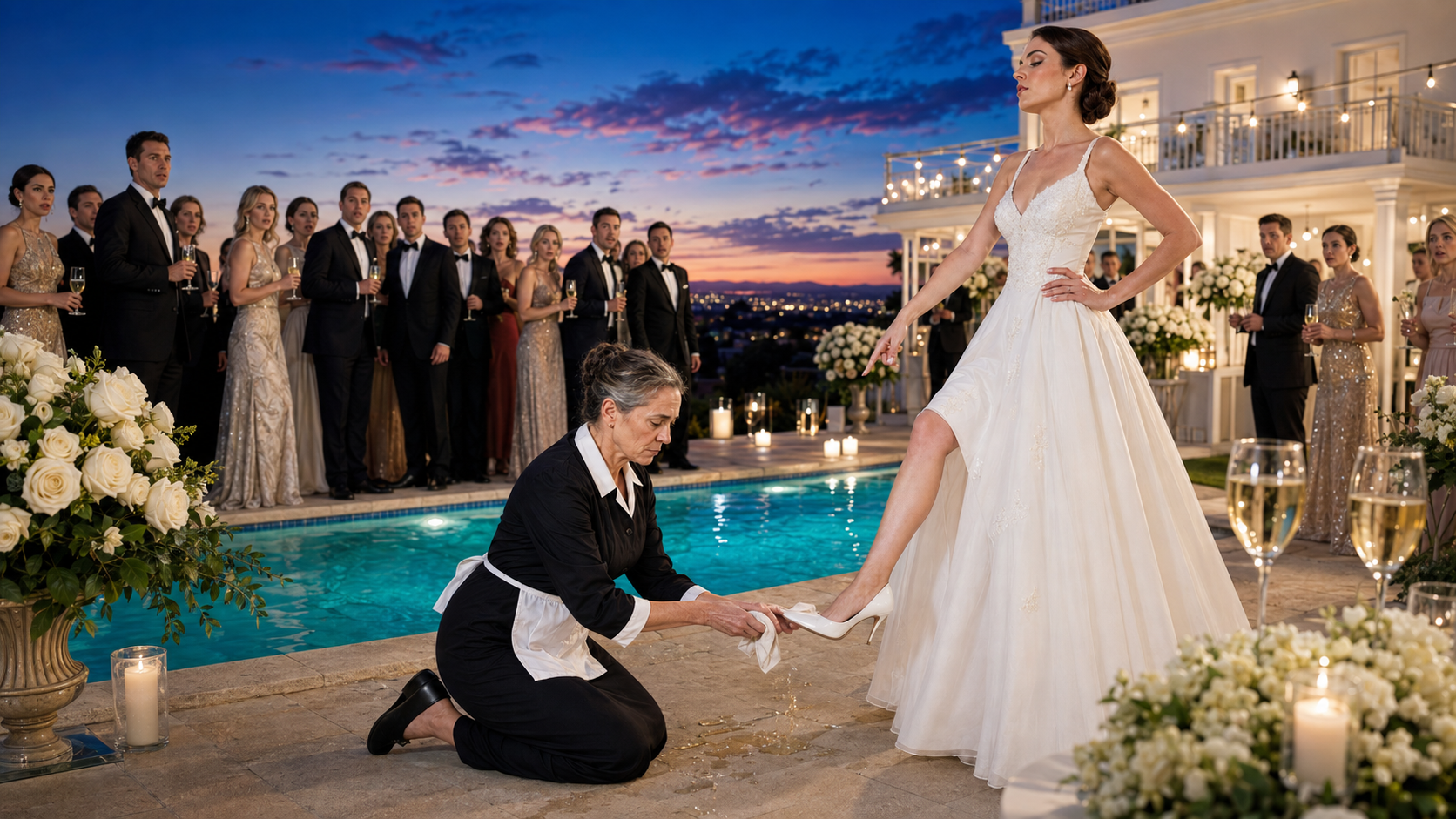
    The champagne incident happened just after sunset.

    I was standing with two bridesmaids when Lenora approached with a tray.

    One of the glasses shifted as another guest turned too quickly.

    Champagne splashed over the edge.

    A few drops landed on my white heel.

    Lenora immediately lowered the tray.

    “I’m sorry.”

    She reached for a cloth.

    I looked at the wet mark on my shoe.

    Then at her.

    “Clean it.”

    She bent slightly.

    I pulled my foot back.

    “On your knees.”

    The bridesmaid beside me stopped smiling.

    Lenora looked up.

    The conversations around us continued for another few seconds before people began noticing the silence forming at our table.

    Her face went pale.

    “Audrey,” one of my friends murmured.

    I ignored her.

    Lenora’s eyes stayed on mine.

    We both knew what this moment was really about.

    Not champagne.

    Not shoes.

    Not a wedding.

    Eleven years old.

    My mother crying behind a locked bedroom door.

    My father saying, It didn’t mean anything.

    A woman I had never met taking up space in every room of my childhood.

    “On your knees,” I repeated.

    Lenora slowly lowered herself.

    First one knee.

    Then the other.

    Somebody laughed nervously.

    A few guests turned fully toward us.

    I extended my foot.

    Lenora began wiping the champagne from my shoe.

    My heart was pounding.

    I should have felt satisfied.

    Instead, I felt something uglier.

    Power.

    “That’s what you’re paid for,” I said.

    Her hand stopped.

    Then continued.

    She finished wiping my heel and started to rise.

    That was when I saw her expression.

    Not anger.

    Not shame.

    Pity.

    She pitied me.

    I don’t know if that was what she truly felt.

    Maybe I only saw what my rage wanted to see.

    But something in me broke open.

    “Don’t look at me like that.”

    Lenora straightened.

    “I didn’t say anything.”

    “You didn’t have to.”

    “Audrey.”

    It was one of my bridesmaids again.

    I heard her.

    I ignored her.

    Lenora started to step away.

    I caught her wrist.

    She looked down at my hand.

    “Let go.”

    “You don’t get to walk away from me.”

    Her eyes lifted.

    For the first time all day, steel entered her voice.

    “I already told you. I am sorry for what happened to your mother. But you cannot punish me enough to change the past.”

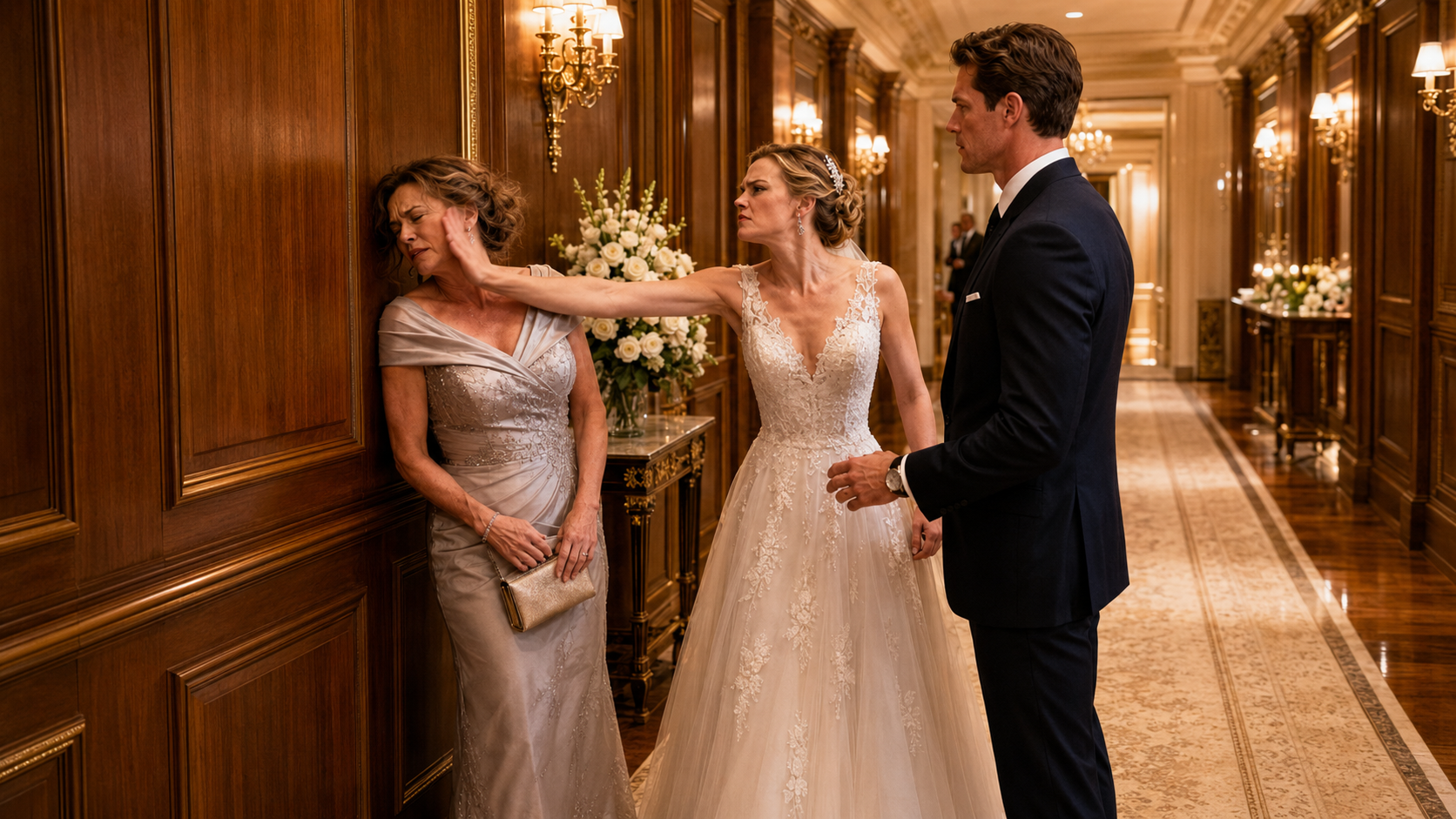
    My palm struck her face before I even fully understood what I was doing.

    The sound cracked across the terrace.

    The music seemed to disappear.

    Lenora stumbled.

    Someone gasped.

    I stared at my own hand.

    A red mark appeared across her cheek.

    I knew immediately I had crossed a line.

    But shame can do strange things when pride is standing in front of an audience.

    Instead of apologizing, I hardened.

    Lenora turned away.

    I reached for her again.

    She jerked her arm from my grip.

    We were too close to the pool.

    “Don’t touch me.”

    “You agreed to—”

    “I agreed to work for you. I did not agree to be attacked.”

    She tried to move past me.

    I shoved her.

    I wish I could say it was an accident.

    It wasn’t.

    Maybe I didn’t mean to send her into the pool.

    But I meant to push her.

    That distinction did not matter when her heel slipped against the wet stone.

    Lenora fell backward.

    There was a splash.

    Screams erupted around me.

    For a second, I stood frozen.

    Then Lenora surfaced, coughing violently.

    Her black uniform clung to her body.

    She reached for the edge.

    Someone shouted for help.

    I looked down at her.

    My anger was already draining away.

    In its place came horror.

    Not horror at her.

    At myself.

    Then I heard Julian.

    “What the hell are you doing?”

    The crowd separated.

    He came running toward us.

    His face was white with rage.

    I turned toward him, humiliated and defensive and still too proud to admit what everyone had just seen.

    “Relax,” I said.

    “She’s just the maid.”

    Julian stopped.

    He looked past me.

    Down into the pool.

    His entire face changed.

    Not slowly.

    Instantly.

    Like somebody had struck him.

    “Mom?”

    I stopped breathing.

    Lenora stopped moving.

    Julian’s voice broke.

    “Mom?”

    The word hit harder the second time.

    I looked at Lenora.

    She stared at Julian.

    “No,” she whispered.

    I looked between them.

    Julian Mercer.

    Lenora Voss.

    I had known Julian’s mother had kept her maiden name after his parents separated when he was young.

    He rarely spoke about her.

    They had a complicated relationship, he once told me.

    She lived quietly.

    She hated social events.

    She had declined every invitation connected to our wedding, including the ceremony itself.

    I had never met her.

    I had seen one old photograph of Julian with his parents when he was a child, but the woman had been younger, blonde, smiling, half hidden behind him.

    It had never occurred to me.

    Not once.

    Lenora’s lips were trembling.

    “You’re marrying Audrey Bellamy?”

    Julian looked at her as if she had lost her mind.

    “You know who she is?”

    Lenora closed her eyes.

    Everything inside me went cold.

    Julian dropped to one knee and reached into the water.

    “Give me your hand.”

    He pulled his mother out.

    She collapsed against him, coughing.

    He removed his tuxedo jacket and wrapped it around her shoulders.

    Then he stood.

    He turned toward me.

    I had never seen him look at me that way.

    Not even during our worst argument.

    “What did you do?”

    I swallowed.

    “Julian, I can explain.”

    “You hit my mother.”

    I glanced around.

    Every face was turned toward us.

    “I didn’t know she was your mother.”

    He stared at me.

    As soon as the words left my mouth, I understood how terrible they sounded.

    As though humiliating her would have been acceptable if she belonged to no one I loved.

    Julian understood it too.

    “So that makes it all right?”

    “No.”

    “You made her get on her knees.”

    “There’s something you don’t understand.”

    “Then explain it.”

    Lenora grabbed his arm.

    “Julian, don’t.”

    He looked down at her.

    “Why are you dressed like this?”

    She said nothing.

    “Mom?”

    Still nothing.

    That was the moment everything should have come out.

    The affair.

    My father.

    The agreement.

    The property claim.

    All of it.

    Instead, Lenora whispered, “Please take me home.”

    Julian looked at me once more.

    Then his hand moved.

    The slap happened so quickly I barely saw it.

    My face snapped sideways.

    The terrace erupted in gasps.

    I tasted blood where my teeth caught the inside of my cheek.

    Julian looked almost shocked by what he had done.

    For one second, neither of us moved.

    His violence did not erase mine.

    Mine did not justify his.

    We had managed to turn our wedding into something neither of us could take back.

    Julian pulled his wedding ring from his finger.

    “I can’t marry someone like you.”

    He threw it down.

    The ring struck the wet stone once and spun.

    Then it fell flat.

    No music.

    No talking.

    No laughter.

    Just the sound of Lenora breathing behind him.

    Julian guided his mother through the crowd.

    Nobody stopped him.

    I didn’t either.

    I stood there in my wedding dress, my cheek burning, watching the man I loved walk away with the woman I had spent half my life hating.

    For everyone else, the story was finished.

    A cruel rich bride had humiliated an older maid.

    The maid’s son had discovered the truth.

    The groom had chosen his mother.

    Wedding over.

    Justice delivered.

    But I wasn’t looking at Julian.

    I was looking at Lenora.

    Just before she disappeared through the doors, she looked back at me.

    She should have looked relieved.

    Instead, she looked terrified.

    And suddenly I knew why.

    The papers.

    Our agreement.

    She had endured everything for my signature.

    The signature she had not received.

    Julian had saved her from me.

    But by destroying our marriage before the agreement was completed, he had also destroyed the only reason she had agreed to be there.

    Lenora Voss had just suffered the worst humiliation of her life.

    And unless I chose otherwise, she would walk away with nothing.

    Julian had no idea.

    More importantly, he still had no idea why his mother had been willing to kneel in front of me in the first place.

    That truth was waiting for him at home.

    And once he heard it, I suspected my broken engagement was going to become much more complicated.

    I was right.


    PART 2: WHAT JULIAN LEARNED THAT NIGHT

    I left my wedding alone.

    My grandparents’ driver took me back to the apartment I had owned before Julian and I moved in together.

    I was still wearing my dress.

    I remember staring at my reflection in the elevator.

    My veil was gone.

    My lipstick had faded.

    My left cheek was red from Julian’s hand.

    There was a faint smear of mascara beneath one eye.

    I looked less like a bride than a woman who had survived an accident.

    Except I had caused the accident.

    That was the hardest part.

    I could hate Lenora and still know what I had done was wrong.

    Both things could exist at once.

    My phone kept vibrating.

    Friends.

    Relatives.

    My wedding planner.

    Julian’s best man.

    People asking whether I was safe.

    People asking what had happened.

    People pretending not to ask what had happened while clearly desperate to know what had happened.

    I turned the phone off.

    Then I sat on the floor beside my bed in a wedding dress that had cost more than my mother once earned in a year.

    And I cried.

    Not because Julian had left.

    Not only because Julian had left.

    I cried because somewhere between wanting Lenora to understand my mother’s humiliation and wanting to hurt her, I had become the ugliest person on that terrace.

    I thought about my mother.

    For years, I had imagined defending her.

    Avenging her.

    Making the people who broke her feel small.

    But my mother had never been cruel.

    Not even after what happened.

    She had once told me, when I was old enough to ask whether she hated Lenora, “Your father made promises to me. She didn’t.”

    I had argued.

    “She knew about us.”

    “Yes.”

    “So she’s just as bad.”

    “No, Audrey. She is responsible for her choices. Your father is responsible for his.”

    At seventeen, I thought my mother was being weak.

    Sitting there in my ruined wedding dress, I finally understood she had been trying to teach me something.

    Pain did not become justice simply because the right person was hurting.

    My phone lit up again after I switched it back on.

    This time the name on the screen was my attorney.

    I almost ignored it.

    Then I answered.

    “Ms. Bellamy?”

    “Yes.”

    “I’m sorry to call tonight.”

    I closed my eyes.

    “You heard.”

    “I heard enough.”

    Of course he had.

    Half the people at the reception had phones.

    “What do you need?”

    “The Voss waiver.”

    My eyes opened.

    “What about it?”

    “You instructed us not to release the completed documents until after the reception.”

    “Yes.”

    “So nothing has been executed.”

    I looked toward the dark window.

    “That means my challenge remains active.”

    “Yes.”

    “And Lenora gets nothing.”

    “Legally, nothing has changed.”

    I thanked him and ended the call.

    For several minutes, I sat completely still.

    Then I laughed once.

    It wasn’t funny.

    I had built the entire day around forcing Lenora to endure humiliation in exchange for something she desperately wanted.

    Now the humiliation had happened.

    The payment had not.

    Even by my own cruel rules, that felt wrong.

    But before I decided what to do, I needed to know why that claim mattered so much to her.

    Not because I planned to reopen the past.

    Because Julian was now connected to it.

    The following afternoon, he called.

    I watched his name ring until it stopped.

    Then he called again.

    And again.

    On the fourth attempt, I answered.

    “What?”

    Silence.

    Then his voice.

    “I know.”

    My grip tightened around the phone.

    “Know what?”

    “Who my mother was to your father.”

    I said nothing.

    He continued.

    “She told me everything.”

    “I doubt that.”

    “Audrey.”

    “Did she tell you she knew he was married?”

    “Yes.”

    “Did she tell you she knew about me?”

    A pause.

    “Yes.”

    “Did she tell you why she was at the wedding?”

    Another pause.

    That one was longer.

    “Yes.”

    There it was.

    The change.

    I heard it before I could see it.

    The night before, Julian had been furious.

    Now his voice was controlled.

    Careful.

    “What exactly did she tell you?” I asked.

    “That you offered to withdraw your claim if she worked the wedding.”

    “That’s the short version.”

    “You made her agree to be humiliated.”

    “No. I made her agree to work. The humiliation was my choice.”

    He was quiet.

    I forced myself to continue.

    “I hit her. I pushed her. That wasn’t part of anything she agreed to.”

    “No.”

    “And you hit me.”

    Silence.

    When he spoke again, his voice was lower.

    “I shouldn’t have.”

    “No.”

    “I’m sorry.”

    I wasn’t ready to forgive him.

    I wasn’t even sure forgiveness was the correct question.

    “Is that why you called?”

    “No.”

    Of course it wasn’t.

    I stood and walked toward the window.

    “Then why?”

    “I want to understand.”

    “You already understand.”

    “I understand what she did. I understand what you did. I’m trying to understand the agreement.”

    Something inside me shifted.

    Barely.

    But enough.

    “The agreement?”

    “My mother said the claim is worth a lot.”

    I smiled without humor.

    There it was.

    Less than twenty-four hours.

    “How much did she tell you?”

    “That depends on what happens with your father’s holdings.”

    “My father’s holdings have nothing to do with our marriage.”

    “They might have something to do with your future.”

    “I told you before we got engaged that I didn’t want Bellamy money.”

    “I know.”

    “Then why are we discussing it?”

    He exhaled.

    “We’re not. I’m asking.”

    “No, Julian. You called me the day after ending our marriage in front of two hundred people, and one of your first questions is about a financial claim tied to my father.”

    “That isn’t fair.”

    I almost laughed.

    “Fair?”

    “I called because I’m worried about you too.”

    “Are you?”

    “Yes.”

    “How worried?”

    “What does that mean?”

    “Worried enough to ask whether my face still hurts? Worried enough to ask whether I’ve slept? Worried enough to ask whether your mother is okay?”

    “She is.”

    “I’m glad.”

    And I meant it.

    That surprised me.

    Julian was quiet again.

    Then he said, “Your father is sick, isn’t he?”

    I froze.

    The question was not completely unreasonable.

    Richard’s health had been unstable for months. It was not exactly a secret in Bellamy circles.

    But I had never discussed details with Julian.

    “Why?”

    “My mother mentioned it.”

    Of course she had.

    “She said some of the trust arrangements change if he dies.”

    My skin went cold.

    “Julian.”

    “I’m trying to understand what you’re dealing with.”

    “No. You’re trying to understand what I might inherit.”

    “That isn’t what I said.”

    “It didn’t need to be.”

    He became defensive.

    “Jesus, Audrey. We were supposed to be married yesterday.”

    “You threw your ring at me.”

    “After I watched you push my mother into a pool.”

    “Yes.”

    “Do you think I was supposed to stand there calmly?”

    “No. But apparently today you’re calm enough to discuss estate planning.”

    He stopped talking.

    That silence told me more than anything else could have.

    I ended the call.

    Three days later, flowers arrived.

    White roses.

    The same flowers from our wedding.

    The card contained only four words.

    We need to talk.

    I threw them away.

    The next morning, Julian came to my apartment.

    I almost didn’t open the door.

    When I did, he looked exhausted.

    There were shadows beneath his eyes.

    No ring.

    No suit.

    Just jeans and the dark sweater he wore when he wanted to seem less like the ambitious consultant who could charm a room and more like the man who used to cook pasta with me at midnight.

    For one dangerous second, I remembered loving him.

    Then I remembered him asking how sick my father was.

    “What do you want?”

    “To apologize.”

    “You already did.”

    “Not properly.”

    I let him inside because part of me still needed answers.

    Julian stood in my living room and looked around.

    “You came back here.”

    “Where else would I go?”

    “Our place.”

    “It stopped being ours when you left the wedding.”

    His jaw tightened.

    “I shouldn’t have hit you.”

    “No.”

    “What I saw—”

    “Doesn’t matter.”

    “I know.”

    He rubbed his face.

    “I saw my mother in the pool, Audrey. I lost control.”

    “So did I.”

    “Yes.”

    Neither of us had anywhere to hide from that.

    He looked at me.

    “I loved you.”

    Past tense.

    I heard it.

    So did he.

    He corrected himself.

    “I love you.”

    “Which one?”

    “What?”

    “Loved or love?”

    His expression changed.

    “Audrey, come on.”

    “No. You came here to talk. Talk.”

    He moved closer.

    “I don’t know what happened to us.”

    “I do.”

    “You hated my mother before you knew she was my mother.”

    “I still hate what she did.”

    “I know.”

    “And I regret what I did to her.”

    He studied me.

    “Would you have regretted it if you hadn’t found out?”

    That question hurt because I didn’t know the answer.

    “I hope so.”

    He looked away.

    For a moment, I thought the conversation might remain honest.

    Then he said, “What are you going to do about the agreement?”

    There it was again.

    I stared at him.

    “My mother thinks you’ll keep the claim open now.”

    “What do you think?”

    “I think you were angry when you made that deal.”

    “That wasn’t my question.”

    He hesitated.

    “I think giving away something worth that much because you feel guilty would be a mistake.”

    I almost smiled.

    “Interesting.”

    “What?”

    “You seemed very concerned about your mother’s suffering three days ago.”

    “I am.”

    “But not concerned enough to want her to receive what she endured it for.”

    “That isn’t what I mean.”

    “What do you mean?”

    He stepped closer.

    “If we ever fix this—”

    My heartbeat slowed.

    “If?”

    He looked directly at me.

    “That money doesn’t affect only you anymore.”

    I felt something inside my chest go still.

    “We aren’t married.”

    “We almost were.”

    “Almost doesn’t create joint ownership.”

    “That’s not what I’m saying.”

    “Then say what you are saying.”

    His voice sharpened.

    “You shouldn’t destroy your future because you’re angry at your father.”

    My father.

    Not Lenora.

    Not the wedding.

    My future.

    I suddenly remembered little moments from the last year.

    Julian asking why I refused to take a board seat in one of Richard’s companies.

    Julian joking that most people would kill to have my problems.

    Julian telling me that walking away from Bellamy money might feel noble at thirty but stupid at fifty.

    None of those things had seemed sinister then.

    Maybe they still weren’t.

    That was the problem.

    I didn’t know.

    I didn’t know whether grief and shock were making me suspicious of everything.

    Maybe Julian genuinely loved me.

    Maybe he was asking about money because Lenora had explained how much was involved.

    Maybe my father’s illness had simply made the future feel suddenly real.

    Or maybe I had spent years watching one man betray my mother and had somehow fallen in love with another man who saw the Bellamy name before he saw me.

    I needed to know.

    So I gave Julian a reason to come closer.

    A reason stronger than guilt.

    Stronger than pride.

    Maybe even stronger than money.

    I looked down.

    Then I placed one hand lightly over my stomach.

    “Julian.”

    His expression changed.

    “What?”

    I forced my voice to tremble.

    “There’s something else.”

    His eyes dropped to my hand.

    Then lifted back to my face.

    I let the silence stretch.

    “I’m late.”

    He stopped breathing.

    “Audrey…”

    “I haven’t seen a doctor yet.”

    His face lost all color.

    “Are you saying—”

    “I’m saying I might be pregnant.”

    Everything in Julian changed.

    Everything.

    And as he stared at me, I understood that my real test had just begun.

    There was only one problem.

    I wasn’t pregnant.

    I had never been pregnant.

    And if Julian came back to me now, I was going to find out exactly what he was coming back for.


    PART 3: THE MAN WHO CAME BACK

    Julian returned the next morning with breakfast.

    The man who had ignored three of my messages during the week before our wedding because he was “buried in work” suddenly remembered exactly how I liked my coffee.

    He brought fruit.

    Toast.

    The cinnamon pastries from the bakery six blocks away.

    He stood outside my apartment holding two paper bags like we were a normal couple having a normal Sunday morning.

    “I thought you might be hungry.”

    I stared at him.

    “You hate waiting in line at that bakery.”

    He gave me a weak smile.

    “You like it.”

    Three days earlier he had thrown away his wedding ring.

    Now he was buying my favorite pastries.

    Pregnancy was powerful.

    Even fake pregnancy.

    I hated how easily the lie came to me after that.

    I told myself it was temporary.

    I told myself I was investigating.

    I told myself Julian had earned my suspicion.

    But lies always sound reasonable to the person telling them.

    My father had probably told himself the same thing once.

    That thought stayed with me.

    I let Julian inside.

    He put the food on the kitchen counter.

    “When can you take a test?”

    “I already did.”

    His eyes widened.

    I had anticipated that.

    “It was unclear.”

    “A test can be unclear?”

    “Apparently.”

    I hated every word.

    “Then we should get another.”

    “I will.”

    “I can go.”

    “No.”

    “Audrey—”

    “I said no.”

    He stopped.

    I took a breath.

    “If this is real, I need time.”

    His face softened.

    “Of course.”

    That was the Julian I remembered.

    Gentle.

    Patient.

    The man who rubbed circles across the back of my hand when I was anxious.

    The man who once drove four hours through a storm because my grandfather had been hospitalized and I told him I didn’t want to be alone.

    Those things had happened.

    They were real.

    That complicated everything.

    Julian sat across from me.

    “I’ve been thinking about the wedding.”

    “So have I.”

    “I should never have hit you.”

    “You’ve said that.”

    “I know, but I need you to hear me.”

    “I hear you.”

    He looked down.

    “I don’t know what happens with us.”

    “Neither do I.”

    “But if there’s a baby…”

    There it was.

    Not if we still love each other.

    Not if we can forgive each other.

    A baby.

    He reached across the table.

    I didn’t give him my hand.

    “If there’s a baby,” he continued, “we have to figure this out.”

    “We have to figure out how to be parents.”

    “And us.”

    “Maybe.”

    His eyes sharpened.

    “Maybe?”

    “You ended our relationship.”

    “I was angry.”

    “You removed your ring.”

    “You had just pushed my mother into a pool.”

    “And now?”

    “Now I know there was history.”

    I stared at him.

    “Does history make what I did better?”

    “No.”

    “Then why does knowing about it suddenly make you willing to reconsider me?”

    He didn’t answer immediately.

    I waited.

    Finally he said, “Because I understand you weren’t just humiliating a random woman.”

    That answer should have comforted me.

    It didn’t.

    “So if she had been random, I would be unforgivable.”

    “That isn’t what I said.”

    “It’s close.”

    Julian leaned back.

    “You’re trying to make me fail some test.”

    My pulse jumped.

    He had no idea how correct he was.

    “I’m trying to understand why you’re here.”

    “Because you might be carrying my child.”

    “Only because of that?”

    His eyes moved away.

    “I still love you.”

    Still.

    I wanted to believe him.

    That was the dangerous part.

    Over the next two weeks, Julian became almost painfully attentive.

    He texted every morning.

    Called every night.

    He asked how I felt.

    Whether I was tired.

    Whether I had eaten.

    Whether I had cramps.

    I told him I didn’t want to discuss medical details until I had confirmation.

    He respected that.

    Mostly.

    Then the other questions started.

    “Have you spoken to your father?”

    “No.”

    “Does he know we separated?”

    “I’m sure someone told him.”

    “Would he change anything because of the baby?”

    I looked up from my coffee.

    “What would he change?”

    “His estate.”

    I stared.

    Julian immediately shook his head.

    “That came out wrong.”

    “Did it?”

    “I mean because you’re his only child. If he had a grandchild—”

    “He doesn’t know about the possible baby.”

    “But eventually.”

    “Eventually what?”

    “It could matter.”

    I put my cup down.

    “To whom?”

    He looked irritated.

    “Why do you keep making money sound dirty?”

    “Why do you keep bringing it up?”

    “Because pretending money doesn’t matter is something only people with money get to do.”

    That line stayed with me.

    Because it wasn’t entirely wrong.

    Julian had grown up differently from me.

    His mother had struggled at times.

    He had worked through college.

    He had student debt.

    He had built his career without a family name opening doors.

    I knew that.

    Maybe his interest was practical.

    Maybe I was judging him from the safety of inherited privilege.

    Then he asked about Lenora’s claim again.

    “What happens if you withdraw the challenge?”

    “She gets what she was promised.”

    “By your father.”

    “Yes.”

    “How much?”

    “I don’t know the exact current value.”

    That was technically true.

    “Millions?”

    I watched his face.

    “Why?”

    “I’m asking.”

    “You seem to ask a lot.”

    He sighed.

    “Audrey.”

    “No. Tell me why you need the number.”

    “Because my mother humiliated herself for it.”

    “You mean because I humiliated her.”

    His jaw tightened.

    “Yes.”

    “Then shouldn’t she get it?”

    Julian looked away.

    “That’s between you and her.”

    “No. You’ve made it between us.”

    He stood and walked toward the window.

    Finally he said, “If you withdraw your challenge, does that affect what you inherit later?”

    There it was.

    Again.

    I felt almost calm.

    “Not directly.”

    His shoulders loosened.

    A tiny movement.

    Almost invisible.

    But I saw it.

    “What does that mean?” he asked.

    “It means the Voss claim is separate from most of my father’s estate.”

    “Oh.”

    One syllable.

    But there was relief inside it.

    That was when my suspicion became something colder.

    I needed one final test.

    So I called my attorney.

    Not to discuss Julian.

    To discuss Lenora.

    “I want to honor the original agreement,” I said.

    He was silent.

    “Are you certain?”

    “No.”

    “That’s encouraging.”

    Despite myself, I smiled.

    “But I’m doing it anyway.”

    “Because of what happened at the wedding?”

    “Partly.”

    “That may not be the best basis for a financial decision.”

    “I made the agreement before the wedding. She completed what she agreed to do.”

    “Technically, the reception ended early.”

    “Because my fiancé discovered she was his mother after I pushed her into a swimming pool. I’m not going to use that as a contractual defense.”

    He exhaled.

    “Understood.”

    “I also want the documents to make clear that this ends the dispute.”

    “That was always the intention.”

    “Then prepare them.”

    Two days later, Lenora called me.

    I hadn’t spoken to her since the wedding.

    Seeing her name on my screen made my stomach tighten.

    I answered.

    “Hello.”

    For several seconds, neither of us spoke.

    Then she said, “Your attorney contacted mine.”

    “Yes.”

    “He said you’re proceeding.”

    “Yes.”

    “Why?”

    I looked out the window.

    “Because we had an agreement.”

    “You don’t owe me anything after what happened.”

    “That sentence makes no sense.”

    “It does to me.”

    “You worked the wedding.”

    “I also hid something from you.”

    I frowned.

    “What?”

    “My son.”

    “You didn’t know.”

    “No.”

    “Then you didn’t hide him.”

    “I should have known more about the man you were marrying.”

    “Why?”

    “Because I knew who you were.”

    I thought about that.

    “You thought I was just Richard Bellamy’s daughter.”

    “Yes.”

    “And Julian never told you my last name?”

    Her silence answered me.

    Their relationship truly had been complicated.

    “How much does Julian know now?” I asked.

    “Too much.”

    Something in her voice made me sit straighter.

    “What does that mean?”

    “He asks questions.”

    My grip tightened around the phone.

    “What kind?”

    “About Richard. About the trust. About what happens to you when Richard dies.”

    The room seemed to narrow around me.

    “Why are you telling me?”

    “Because I recognize hunger when I hear it.”

    That was a strange sentence coming from her.

    I said nothing.

    Lenora continued.

    “I was younger than your father. Not young enough to be innocent. But young enough to believe that because a powerful man wanted me, I had somehow become powerful too.”

    Her voice shook slightly.

    “I told myself his marriage was already dead. I told myself your mother didn’t understand him. I told myself every lie that made it easier to look in the mirror.”

    I closed my eyes.

    “I don’t need a confession.”

    “Maybe I do.”

    “That’s not my responsibility.”

    “I know.”

    For the first time, I believed her when she said it.

    She continued.

    “Richard promised me security. Most of what he promised disappeared when the affair ended. This claim is one of the few things that remained documented well enough to matter.”

    “And you were willing to work my wedding for it.”

    “Yes.”

    “Even knowing what I wanted.”

    “Yes.”

    “Why?”

    A long silence.

    Then she said, “Because getting older without security is frightening.”

    Simple.

    Not noble.

    Not dramatic.

    Just human.

    I thought about Julian saying people without money did not have the luxury of pretending it didn’t matter.

    Maybe he had learned that from her.

    “Does Julian know the value?”

    “Yes.”

    My stomach dropped.

    “How much?”

    “He asked my attorney.”

    “Did the attorney tell him?”

    “I told him.”

    Of course she had.

    “He’s your son.”

    “Yes.”

    “He defended you.”

    “Yes.”

    Her voice became quieter.

    “And then he began asking what you were worth.”

    I closed my eyes.

    There it was.

    Not proof.

    But close.

    “Lenora.”

    “Yes?”

    “Did you tell him I might be pregnant?”

    Silence.

    “No.”

    I opened my eyes.

    “He told you?”

    “No.”

    “Good.”

    She sounded confused.

    “Why?”

    “Because I wanted to know whether he would.”

    Audrey, I imagined my mother saying.

    Be careful what kind of person pain turns you into.

    I almost stopped.

    Almost told Lenora the truth.

    Instead I said, “If Julian asks you anything else about my father’s estate, don’t lie to him.”

    “What?”

    “Tell him whatever you genuinely know.”

    “Why would I do that?”

    “Because I need to see how far he goes.”

    Lenora understood before I finished speaking.

    “You’re testing him.”

    “I’m protecting myself.”

    “Those are not always the same thing.”

    “I know.”

    She had no right to sound like my mother.

    That angered me.

    But not enough to make her wrong.

    Before we ended the call, Lenora said something I did not expect.

    “Audrey.”

    “What?”

    “I am sorry.”

    “For the wedding?”

    “No.”

    My throat tightened.

    “For your mother.”

    I didn’t forgive her.

    Not then.

    Maybe not ever.

    But I finally heard the apology without being eleven years old again.

    That was something.

    The following night, Julian came over with takeout.

    Halfway through dinner, he smiled at me.

    A real smile.

    One I recognized.

    “I’ve missed this.”

    “What?”

    “Us.”

    I looked at him.

    “There is no us right now.”

    “There could be.”

    “Because I might be pregnant?”

    “Because maybe throwing everything away in one night was a mistake.”

    I almost laughed.

    “Interesting timing.”

    He reached for my hand.

    This time I let him take it.

    Not because I trusted him.

    Because I needed him close.

    “How would you feel,” I asked slowly, “if I walked away from all of it?”

    His thumb stopped moving against my skin.

    “All of what?”

    “The Bellamy money.”

    He frowned.

    “You’ve said that before.”

    “I mean permanently.”

    He released my hand.

    “What happened?”

    “Nothing.”

    “Then why are we talking about this?”

    “Answer the question.”

    He leaned back.

    “If there’s a child, you can’t make decisions like that only for yourself.”

    My heart began beating harder.

    “There isn’t a confirmed child.”

    “You said—”

    “I said I might be pregnant.”

    He stared at me.

    I continued.

    “But suppose I am.”

    “Okay.”

    “Suppose I tell my father I don’t want his companies. I don’t want his properties. I don’t want his money.”

    “That’s insane.”

    The word came instantly.

    No hesitation.

    No gentle concern.

    No philosophical argument.

    Insane.

    I smiled faintly.

    “There you are.”

    “What does that mean?”

    “Nothing.”

    “Audrey, your father is worth—”

    He stopped.

    I waited.

    “Worth what?”

    He looked away.

    I felt something break.

    Not loudly.

    Quietly.

    That was worse.

    Because Julian knew.

    Maybe not the exact number.

    But enough.

    The next morning, I signed Lenora’s waiver.

    And that evening, I invited Julian to dinner.

    There was one final question I needed answered.

    Not whether he cared about money.

    I already knew he did.

    I needed to know whether he cared about me more.


    PART 4: THE PRICE OF COMING BACK

    Julian arrived wearing the blue shirt I once told him made his eyes look brighter.

    That hurt more than it should have.

    There is something cruel about seeing a familiar man inside someone you no longer recognize.

    He kissed my cheek.

    I let him.

    “You look tired,” he said.

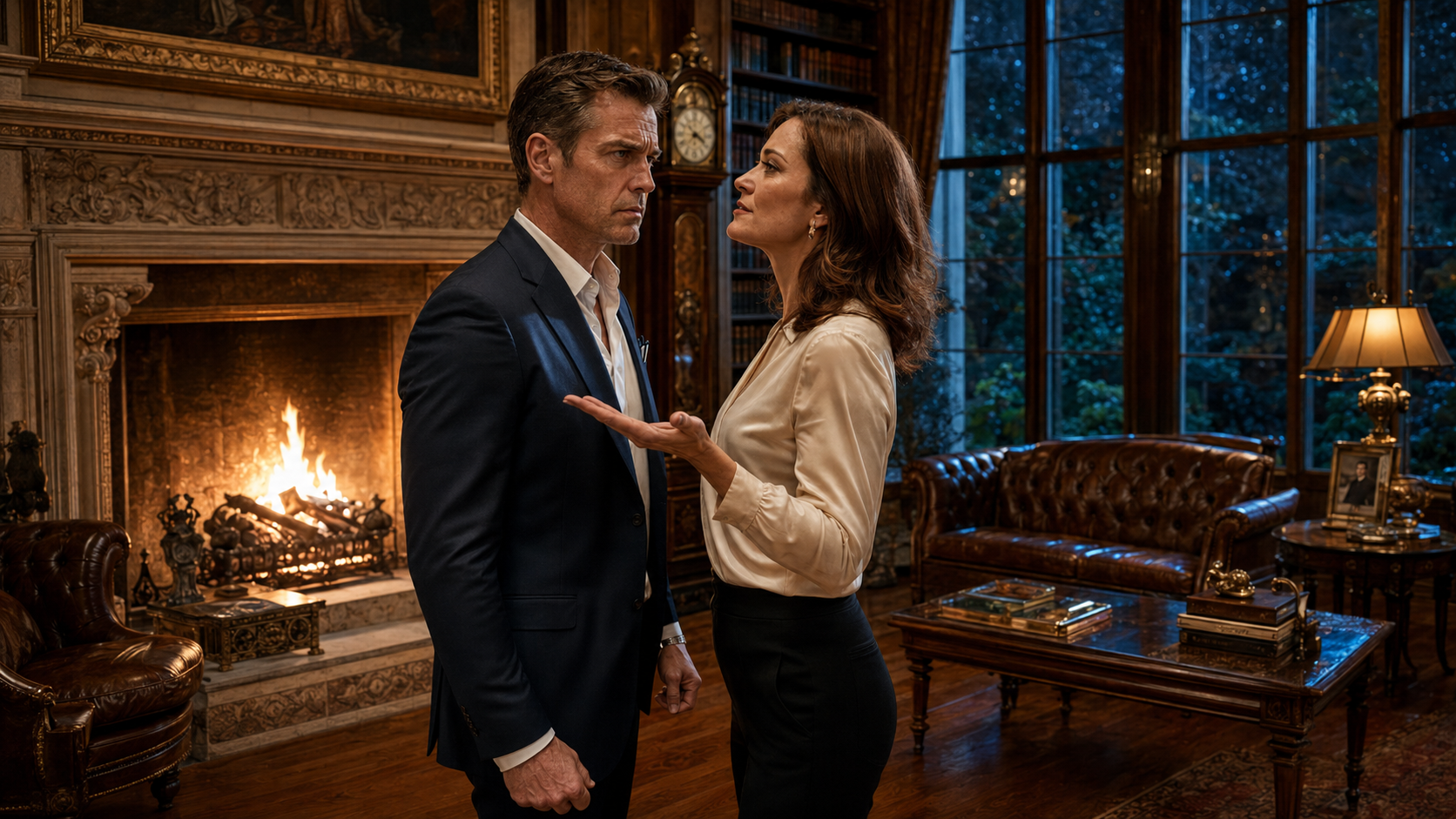
    “I’ve been thinking.”

    “About the baby?”

    “About everything.”

    He followed me into the living room.

    I had placed a folder on the coffee table.

    He noticed it immediately.

    “What’s that?”

    “Something I signed today.”

    His eyes remained on the folder.

    I sat.

    Julian sat across from me.

    “What did you sign?”

    “The waiver.”

    His expression emptied.

    “What waiver?”

    He knew.

    I made him say it anyway.

    “Lenora’s claim.”

    He stared at me.

    “You signed it?”

    “Yes.”

    “You withdrew your challenge?”

    “Yes.”

    “Without talking to me?”

    A strange calm settled over me.

    “Why would I need to talk to you?”

    His face flushed.

    “Because we’re trying to fix this.”

    “Are we?”

    “You know we are.”

    “No. I know you’ve been coming here every day since I told you I might be pregnant.”

    “That’s not fair.”

    “You keep saying that.”

    He stood.

    “How much did you just give away?”

    “I didn’t give anything away. I stopped contesting something my father promised your mother years ago.”

    “That’s semantics.”

    “Is it?”

    “Yes.”

    I watched him pace.

    There was no concern for Lenora in his face now.

    No anger over what I had done to her.

    No relief that the agreement she had suffered for would finally be completed.

    Only frustration.

    “How much was it worth?” he demanded.

    “I thought you knew.”

    He stopped.

    That landed.

    “I know what my mother said.”

    “What did she say?”

    “That it could be several million depending on the valuation.”

    There.

    Out loud.

    The number he had claimed not to care about.

    I folded my hands in my lap.

    “And?”

    “And what?”

    “Why does it upset you?”

    “Because that money could have protected our child.”

    “Our child who does not currently exist outside a possibility.”

    His eyes narrowed.

    “What is going on with you?”

    I stood.

    “Tell me something.”

    “What?”

    “If my father died tomorrow and left me nothing, would you still want me back?”

    His expression changed.

    “Yes.”

    Too fast.

    “If I signed away every Bellamy interest I could legally refuse, would you still want me?”

    “Yes.”

    “If I went back to living the way I did before my grandparents helped me? No estate. No family companies. No properties. Just my own income.”

    “Yes.”

    “Then why are you angry?”

    “Because throwing away wealth to prove some moral point is irresponsible.”

    “What moral point?”

    “That you’re better than your father.”

    “This isn’t about being better than him.”

    “Then what is it about?”

    “Knowing who would remain if Bellamy disappeared from my name.”

    He went silent.

    The words hung between us.

    Julian looked at me for a long time.

    Then his face softened.

    “Audrey.”

    I hated that tone.

    Gentle.

    Reasonable.

    The tone people use when they want to convince you that your instincts are symptoms.

    “You’ve been through something traumatic.”

    “So have you.”

    “Yes.”

    “You watched me attack your mother.”

    “Yes.”

    “And yet here you are.”

    “Because I love you.”

    “You walked away when you thought I was simply cruel.”

    His jaw tightened.

    “You were cruel.”

    “I was.”

    “And then I learned what she had done to your family.”

    “That doesn’t undo my cruelty.”

    “No.”

    “Then what changed?”

    He opened his mouth.

    Closed it.

    I stepped closer.

    “What changed, Julian?”

    “You might be carrying my child.”

    “That’s part of it.”

    “All right.”

    “What else?”

    He looked away.

    That was my answer.

    But I wanted to hear him say it.

    “What else?”

    “Audrey, stop.”

    “No.”

    “You’re turning this into something ugly.”

    “It became ugly at the wedding.”

    “You’re obsessed with making everyone confess something.”

    I flinched.

    Because that was true.

    Lenora.

    My father.

    Now Julian.

    Maybe I had spent my whole life waiting for guilty people to say the sentence that would finally make pain feel reasonable.

    It never worked.

    But this time, I needed the truth for a different reason.

    I needed to know whether I was about to make the same mistake my mother had made.

    Trusting a man after he had already shown me who he could become.

    “What did my name mean to you before Lenora explained the trust?” I asked.

    Julian stared at me.

    “What?”

    “Before the wedding.”

    “You were Audrey.”

    “Only Audrey?”

    “You know you weren’t.”

    There.

    I swallowed.

    “Explain.”

    He exhaled sharply.

    “You were Richard Bellamy’s daughter. Of course I knew that.”

    “Did it matter?”

    “Yes.”

    Pain tightened around my ribs.

    He continued quickly.

    “Not the way you think.”

    “How?”

    “It intimidated me.”

    I waited.

    “You came from a world I didn’t. Your grandparents had money. Your father had more. You could walk into rooms where people spent their entire careers trying to be invited.”

    “That doesn’t answer me.”

    “I loved you before I knew the details of your father’s estate.”

    I searched his face.

    He looked sincere.

    That was almost worse.

    “Then when did the details start mattering?”

    Julian said nothing.

    I knew.

    “After your mother told you.”

    He sat again, elbows on his knees.

    “I had just watched the woman I loved assault my mother.”

    I said nothing.

    “I went home furious. I thought I would never speak to you again.”

    His voice became quieter.

    “Then Mom told me who you were to her. What your father had done. What she had done. What you had offered.”

    He rubbed both hands over his face.

    “And then?”

    “And then she told me about the claim.”

    I waited.

    “She told me what Richard had promised her. She told me how Bellamy trusts worked. She told me what might eventually come to you.”

    My chest tightened.

    “And you changed your mind.”

    “It wasn’t that simple.”

    “It never is.”

    Julian looked up.

    “I realized everything was more complicated.”

    “No. You realized I might be much richer than you thought.”

    “That isn’t fair.”

    “Stop saying that and answer me.”

    His voice rose.

    “Fine.”

    The room went silent.

    He stood.

    “Fine. Yes. I thought about it.”

    The truth finally entered the room.

    “I thought about what your future could look like. Our future. A child’s future.”

    “There was no child then.”

    “No.”

    “So ours.”

    “Yes.”

    “You thought about the money.”

    “Yes.”

    The word barely came out.

    I felt tears burning behind my eyes.

    Not because Julian had admitted caring about money.

    Because he had also admitted something harder.

    He had loved me.

    I could hear it in the way he spoke.

    He had loved me before the trust.

    Before the estate.

    Before Lenora explained any of it.

    The beginning had not been entirely false.

    That would have been easier.

    A villain is simple.

    A man who loves you and then discovers a price attached to losing you is much more dangerous.

    Because part of him can still believe he is doing it for love.

    Julian stepped toward me.

    “Audrey, I didn’t come back only because of money.”

    “Only.”

    “No.”

    “But it mattered.”

    “Yes.”

    “How much?”

    “I don’t know.”

    “That’s the first honest thing you’ve said tonight.”

    His eyes filled with anger.

    “What do you want from me?”

    “The truth.”

    “You think you’ve never cared about money?”

    “I have.”

    “You think your mother didn’t?”

    “She cared about stability after my father betrayed her.”

    “You think my mother didn’t care about stability?”

    I stopped.

    That hit exactly where he meant it to.

    Julian continued.

    “She humiliated herself because she was scared of getting older with nothing. You humiliated her because you had enough money to turn a financial dispute into revenge. But somehow I’m evil because I don’t think you should throw millions away?”

    “I never called you evil.”

    “You don’t have to.”

    “I called you back because you might be choosing me for the wrong reason.”

    “And you chose to lie to me.”

    My blood went cold.

    For one terrifying second, I thought he knew.

    Then he continued.

    “You’ve been pretending this is about responsibility when you’ve been testing me the whole time.”

    He was right.

    But not completely.

    Not yet.

    I walked toward the window.

    The city lights blurred.

    “Do you remember what you asked me the day after our wedding?”

    Julian didn’t answer.

    “You asked about my father’s health.”

    “I was trying to understand.”

    “You asked whether the trust changed when he died.”

    “My mother brought it up.”

    “You asked whether Lenora’s claim affected my inheritance.”

    “I was concerned.”

    “You asked whether I would still walk away from the Bellamy fortune.”

    “Yes.”

    I turned.

    “And every time I answered in a way that meant less money, you became more afraid.”

    “For our future.”

    “We don’t have a future.”

    His face changed.

    The sentence landed harder than I expected.

    “Audrey.”

    “I signed Lenora’s waiver because I promised I would.”

    “You don’t owe her.”

    “I owed myself.”

    “What does that mean?”

    “It means I refuse to become my father.”

    He frowned.

    “My father made promises when they were convenient and abandoned them when they became expensive. I made a promise too.”

    “You made it to punish her.”

    “Yes.”

    I swallowed.

    “And I am ashamed of that. But she kept her side. I’m keeping mine.”

    Julian stared at me.

    “What about the rest?”

    “The rest of what?”

    “Your father’s estate.”

    There it was again.

    Even now.

    I almost laughed.

    “Still asking.”

    He looked furious.

    “Because if you’re pregnant, this isn’t just about you.”

    I reached for the folder on the table.

    My fingers rested on it.

    “Julian.”

    “What?”

    “There is no baby.”

    He stared at me.

    I don’t think he understood at first.

    “What?”

    “I’m not pregnant.”

    His face went completely blank.

    “I never was.”

    Silence.

    The kind of silence that changes a room.

    Julian’s lips parted.

    No sound came out.

    Then he whispered, “You lied.”

    “Yes.”

    His eyes darkened.

    “You let me believe—”

    “Yes.”

    “For two weeks?”

    “Yes.”

    “You let me think I was going to be a father.”

    Every word struck me.

    I didn’t defend myself.

    Because there was no clean defense.

    “I did.”

    His face twisted.

    “You’re sick.”

    “Maybe what I did was.”

    “Maybe?”

    “I wanted to know why you came back.”

    “So you invented my child?”

    “I said I might be pregnant.”

    “You knew exactly what I was supposed to think!”

    “Yes.”

    He turned away from me and slammed one hand against the back of a chair.

    I flinched.

    For a second, the wedding came back.

    The slap.

    The pool.

    The sound of his ring hitting stone.

    Julian saw me flinch.

    His hand fell.

    We stared at each other.

    “You’re afraid of me now?” he asked.

    “I’m afraid of what both of us became around each other.”

    His anger faltered.

    I continued before I lost the courage.

    “The pregnancy was wrong.”

    “Yes.”

    “I know.”

    “You manipulated me.”

    “Yes.”

    “You wanted me to fail.”

    “No.”

    That was the truth.

    His eyes narrowed.

    “I wanted you to prove me wrong.”

    My voice broke.

    “I wanted you to come back and never ask about the money again.”

    Julian said nothing.

    “I wanted you to tell me you didn’t care if my father left me nothing. I wanted you to tell me you came back because losing me hurt more than discovering what marrying me could be worth.”

    Tears finally slipped down my face.

    “But you kept asking.”

    His anger drained.

    Not completely.

    Enough.

    “I did love you,” he said.

    “I know.”

    He looked surprised.

    “That’s what makes this worse.”

    I wiped my cheek.

    “If you had been using me from the first day, I could hate you and be done.”

    “Audrey—”

    “But you weren’t.”

    He closed his eyes.

    “You loved me.”

    “Yes.”

    “And then my mother became your mother.”

    “Yes.”

    “And her secret became my money.”

    His eyes opened.

    “Yes.”

    “And something changed.”

    Julian looked down.

    When he answered, his voice was barely audible.

    “Yes.”

    That was the answer I had brought him back to find.

    Not that our whole relationship had been a con.

    Not that every kiss had been calculated.

    Not that Julian had proposed because he had secretly researched my inheritance.

    The truth was less dramatic.

    And more painful.

    He had loved me.

    Then he discovered exactly what losing me might cost.

    And love was no longer the only reason he wanted to come back.

    Once I knew that, there was no wedding left to save.


    PART 5: WHAT WE INHERIT

    Lenora came to my apartment three days later.

    I almost refused to see her.

    But there were things between us that could no longer remain hidden behind lawyers, dead marriages, or men named Bellamy and Mercer.

    When I opened the door, she looked smaller than I remembered.

    Not weak.

    Just tired.

    There was no maid’s uniform.

    No expensive dress either.

    Dark slacks.

    A gray coat.

    Her hair loose around her shoulders.

    For the first time, I saw her as a person instead of a memory.

    That did not erase what she had done.

    But it changed the shape of my anger.

    She looked at my face.

    “Julian told me.”

    “Everything?”

    “That there is no baby.”

    I stepped aside.

    She entered.

    We sat across from each other in the same room where I had confronted her son.

    For several seconds, neither of us spoke.

    Then Lenora said, “That was cruel.”

    I almost laughed.

    “You’re comfortable saying that to me now.”

    “I should have said more at the wedding.”

    “You did.”

    “Not enough.”

    “I shouldn’t have hit you.”

    “No.”

    “I shouldn’t have pushed you.”

    “No.”

    “I shouldn’t have made you kneel.”

    She looked at me.

    “No.”

    Each answer hurt.

    I needed them to.

    “I’m sorry.”

    Lenora’s expression changed.

    It was the first apology I had ever given her.

    She nodded once.

    “I accept that you mean it.”

    Not I forgive you.

    I respected her more for that.

    After a moment, she said, “I am sorry too.”

    “I know.”

    “No. I don’t think you do.”

    She took a breath.

    “Your father told me his marriage was finished.”

    I felt my body tense.

    “Don’t.”

    “I’m not making excuses.”

    “Good.”

    “I believed him because I wanted to.”

    That quieted me.

    “He told me he stayed because of you. He told me your mother had stopped loving him. He told me things were complicated.”

    Lenora looked down at her hands.

    “All the usual things married men say when they want two lives at once.”

    My throat tightened.

    “When did you learn he was lying?”

    “Almost immediately.”

    “And you stayed.”

    “Yes.”

    There it was.

    No excuse.

    No attempt to make herself innocent.

    “Why?”

    She looked at me.

    “Because by then I wanted him.”

    Simple.

    Ugly.

    True.

    “And because part of me thought if he chose me, it would prove I mattered.”

    I looked away.

    Lenora continued.

    “He never truly chose anyone. Not your mother. Not me. He chose himself.”

    I thought of my mother alone in that bedroom.

    I thought of Lenora kneeling in front of me.

    I thought of Julian asking about inheritance.

    So many people rearranging their lives around Richard Bellamy’s desires and money.

    My father had not even been at my wedding.

    Yet somehow he had been everywhere.

    “I hated you more than I hated him for a long time,” I admitted.

    “I know.”

    “Because you were easier.”

    “I know that too.”

    “He was my father.”

    “Yes.”

    “If I hated him completely, I had to admit he had chosen to hurt us.”

    “Yes.”

    “But if I hated you…”

    “Then maybe he had been stolen.”

    My eyes burned.

    “Yes.”

    Lenora nodded.

    “My son did something similar.”

    I looked at her.

    “What?”

    “He came home furious with you. Then I told him what Richard’s arrangements might mean.”

    Her mouth tightened.

    “And I watched his anger change.”

    I said nothing.

    “He still hated what you had done to me. But suddenly he wanted explanations. Context. Possibilities.”

    “That’s what I saw too.”

    “I should never have told him the numbers.”

    “He would have found out eventually.”

    “Maybe.”

    She looked toward the window.

    “He grew up watching me worry about money. I probably taught him more fear than I realized.”

    “That doesn’t make his choices yours.”

    A sad smile touched her mouth.

    “That sounds like something your mother might have said.”

    I stiffened.

    Then, despite myself, I smiled too.

    “Probably.”

    We sat quietly.

    Finally Lenora touched the folder I had placed on the table.

    “My attorney says the waiver is complete.”

    “It is.”

    “You could reverse course before everything finishes processing.”

    “I won’t.”

    “Why?”

    “Because I said I wouldn’t.”

    She looked at me for a long time.

    “Your mother would have been proud of that.”

    My chest tightened.

    “Don’t use her to make me feel better.”

    “I’m not.”

    Good.

    I believed her.

    When Lenora stood to leave, I asked the question I had been avoiding.

    “What happens with Julian?”

    She stopped.

    “That depends on Julian.”

    “He’s angry with you?”

    “Yes.”

    “Why?”

    “Because I told him he was becoming the kind of person he claimed to hate.”

    I almost smiled.

    “What did he say?”

    “That I had no right to judge anyone after what I did to your family.”

    “That was effective.”

    “It was.”

    She gave me a tired look.

    “He wasn’t wrong.”

    “No.”

    Lenora reached for the door.

    Then she stopped.

    “He did love you.”

    “I know.”

    “He still does.”

    I swallowed.

    “That isn’t enough.”

    “No.”

    She opened the door.

    Before leaving, she turned back.

    “For what it’s worth, I don’t think he knew what he wanted until he thought he could lose it.”

    Then she left.

    I stood there for a long time.

    That sentence stayed with me.

    Maybe it was true of all of us.

    My mother had lost her marriage and discovered how much of herself she had given to it.

    Lenora had lost my father and discovered how little his promises were worth.

    Julian had lost me and discovered how much my name might be worth.

    And I had nearly lost myself trying to make another woman pay for a wound she had helped create but did not create alone.

    A week later, Julian asked to see me one last time.

    I agreed.

    We met at a small coffee shop where nobody knew our names.

    No Bellamy estate.

    No wedding guests.

    No lawyers.

    No pool.

    Just two people sitting across from each other.

    Julian looked different.

    Not physically.

    Something in the way he held himself.

    Less certain.

    “I’m still angry,” he said.

    “You should be.”

    “What you did with the pregnancy was terrible.”

    “I know.”

    “I don’t forgive it yet.”

    “I’m not asking you to.”

    He studied me.

    “You’re not asking for anything.”

    “No.”

    He looked down at his coffee.

    “I’ve been trying to figure out when it happened.”

    “When what happened?”

    “When I started thinking about the money.”

    I waited.

    “I knew your family had money before we started dating.”

    “Yes.”

    “But it was abstract.”

    I nodded.

    “I didn’t know numbers. I didn’t know trusts. I didn’t know what might come to you.”

    “Okay.”

    “I wanted you anyway.”

    My eyes burned.

    “I know.”

    “After the wedding, Mom told me everything. And I remember sitting in her kitchen thinking that I had just walked away from you.”

    He laughed once, bitterly.

    “And then I thought about what else I had walked away from.”

    There it was.

    The truth without force.

    No test.

    No trap.

    No argument.

    Just truth.

    “I hated myself for thinking it.”

    “But you kept thinking it.”

    “Yes.”

    “Why?”

    “Because once I knew, I couldn’t unknow it.”

    I nodded slowly.

    Julian looked at me.

    “Then you said you might be pregnant.”

    “And suddenly leaving became impossible.”

    “Yes.”

    “Because of the baby?”

    “Mostly.”

    I held his gaze.

    He forced himself to continue.

    “And because I started imagining a life.”

    “What kind?”

    “One where our child never worried about anything. Where my mother was secure. Where we were secure.”

    “Where you were rich.”

    “Yes.”

    The honesty hurt.

    But it also released something.

    “I’m sorry,” he said.

    “For wanting security?”

    “For letting it become part of why I wanted you.”

    I looked down.

    “I’m sorry for making you believe there was a child.”

    His jaw tightened.

    “I know.”

    “I wanted an answer badly enough that I justified hurting you.”

    “Sounds familiar.”

    I looked up.

    Neither of us smiled.

    Because it was true.

    I had punished Lenora to answer an old wound.

    Then I had manipulated Julian to answer a new fear.

    Pain had started becoming my favorite excuse.

    I could not keep living that way.

    Julian reached into his pocket.

    For one terrible second, I thought he had brought another ring.

    He hadn’t.

    He placed a small object on the table.

    My wedding ring.

    The one I had removed after coming home.

    I had left it at our apartment.

    “I found it in the bathroom drawer,” he said.

    I stared at it.

    “You kept it?”

    “I didn’t know what else to do with it.”

    Neither did I.

    He pushed it toward me.

    I picked it up.

    The diamond caught the light.

    Once, that ring had represented a future.

    Then humiliation.

    Then betrayal.

    Now it was simply an object.

    Beautiful.

    Expensive.

    And powerless unless I gave it meaning.

    I closed my fingers around it.

    “I’m not coming back,” I said.

    Julian shut his eyes.

    “I know.”

    “No second wedding.”

    “I know.”

    “No engagement.”

    “I know.”

    His voice cracked on the last word.

    I hated that part of me wanted to comfort him.

    I still loved him.

    Love does not disappear just because trust becomes impossible.

    Sometimes that is what makes leaving so painful.

    He opened his eyes.

    “What will you do?”

    “With my father?”

    “With everything.”

    I thought about it.

    “I don’t know yet.”

    He nodded.

    “But whatever I do with the Bellamy estate will be my decision.”

    “Yes.”

    “And Lenora’s claim stays hers.”

    He gave a small, tired laugh.

    “She told me.”

    “How did you react?”

    “Badly.”

    “I assumed.”

    “She asked whether I had rescued her from the pool because I loved her or because I thought she might eventually be worth several million dollars.”

    Despite myself, I laughed.

    “What did you say?”

    “That I didn’t know about the money then.”

    “And?”

    “She said that was exactly her point.”

    My laughter faded.

    Lenora Voss had understood the lesson before either of us.

    Julian had chosen his mother at the wedding when he believed she was simply a humiliated maid.

    That choice had been pure.

    Then money entered the room.

    And every decision afterward became harder to trust.

    I stood.

    Julian stood too.

    For a moment, we faced each other.

    The same two people who had stood beneath white roses and promised forever.

    Except we knew more now.

    About each other.

    About ourselves.

    Maybe too much.

    “I hope you forgive me someday,” he said.

    “For hitting me?”

    “For all of it.”

    “I hope you forgive me too.”

    “For all of it?”

    “Yes.”

    He nodded.

    Then he surprised me.

    He didn’t try to kiss me.

    Didn’t ask for another chance.

    Didn’t promise he would change.

    He simply said, “Goodbye, Audrey.”

    “Goodbye, Julian.”

    I walked out first.

    Months later, people still occasionally talked about the wedding.

    Some remembered only the video.

    The rich bride.

    The maid.

    The slap.

    The pool.

    The groom throwing away his ring.

    People like simple stories.

    Victim.

    Villain.

    Hero.

    Justice.

    The truth was messier.

    Lenora had knowingly helped a married man betray his family.

    My father had been the one who broke his vows.

    I had turned years of pain into deliberate humiliation.

    Julian had defended his mother when he believed she had nothing.

    Then he learned what marrying me might bring him, and his reasons became contaminated by possibility.

    None of us left that story innocent.

    But innocence was never what I needed.

    I needed clarity.

    I eventually stopped contesting Lenora’s claim completely.

    What she did with it was her business.

    I kept my distance from my father.

    When people asked what I planned to do about the Bellamy fortune someday, I stopped answering.

    For the first time in my life, I understood that refusing money simply to prove it could not control me was another way of allowing it to control me.

    I would make that decision when the time came.

    Not for Julian.

    Not for Lenora.

    Not against my father.

    For myself.

    As for the wedding ring, I never sold it.

    I never wore it either.

    I kept it in a small box in the back of a drawer.

    Not because I hoped Julian would return.

    Because I wanted to remember something.

    The worst lies in my life had rarely begun as lies.

    My father probably loved my mother once.

    Lenora probably believed some of the things Richard told her.

    Julian truly loved me before he understood what my name could give him.

    And I truly believed I wanted justice before I made an older woman kneel in front of two hundred guests.

    People do not always become monsters in one dramatic moment.

    Sometimes they become worse one reasonable decision at a time.

    One excuse.

    One humiliation.

    One secret.

    One question about money that should not matter but suddenly does.

    I spent years believing Lenora Voss had destroyed my family.

    Then I spent one wedding day trying to destroy her dignity.

    And when Julian came back to me, I nearly destroyed what remained of my own.

    The strangest part was that the person who finally forced me to see it was the woman I had hated most.

    On my wedding day, Lenora had knelt at my feet because I believed making her small would make my mother’s pain smaller too.

    It didn’t.

    Nothing could.

    But when I finally stopped trying to punish the past, I discovered something my mother had understood years before I did.

    You cannot choose what other people betray.

    You cannot choose what they value more than you.

    You cannot control whether love survives fear, pride, or money.

    You can only decide what you will become after the truth comes out.

    And the day Julian asked me whether I would still walk away from the Bellamy fortune, I thought I was testing him.

    In the end, I was testing myself.

    This time, I knew when to walk away.
  • My Mother-in-Law Took My Wedding Bed. By Dawn, I Knew My Marriage Was Already Over.

    My Mother-in-Law Took My Wedding Bed. By Dawn, I Knew My Marriage Was Already Over.

    PART 1: The Woman in My Wedding Bed

    My marriage lasted less than twenty-four hours before I understood that I had never really married one man.

    I had married him and his mother.

    And on our wedding night, she made sure I understood which one of us came first.

    By the time the last guests began leaving the reception hall, my cheeks hurt from smiling.

    I had spent fourteen hours standing in heels, greeting relatives whose names I could barely remember, posing for photographs, checking on elderly guests, making sure children had somewhere to sit, answering questions from the caterer, and listening to people tell me how lucky I was.

    Lucky.

    That word followed me all day.

    “You’re so lucky, Claire.”

    “Daniel is such a good man.”

    “You’re lucky to be marrying into such a respectable family.”

    And every time someone said it, I smiled.

    Because I believed them.

    Daniel and I had dated for almost three years. He was calm where I was restless, practical where I was emotional. When my mind ran in ten directions at once, he had a way of putting his hand on the back of my neck and saying, “One thing at a time.”

    It always calmed me.

    His mother, Patricia, did not.

    Patricia had disliked me almost from the beginning.

    She never openly insulted me. That would have been too crude for her.

    Instead, she corrected me.

    The way I set a table.

    The way I pronounced the name of a wine.

    The color I wore to her birthday dinner.

    How often I called my own mother.

    How much salt I used.

    Whether I folded Daniel’s shirts “properly.”

    Once, when I laughed loudly at a family barbecue, she looked at me over the rim of her glass and said, “Women in our family tend to be a little more composed.”

    Daniel squeezed my knee beneath the table.

    “Don’t mind her,” he whispered later. “That’s just Mom.”

    That sentence became the background music of our relationship.

    That’s just Mom.

    When she criticized the neighborhood where I grew up.

    That’s just Mom.

    When she changed our restaurant reservation without asking.

    That’s just Mom.

    When she insisted Daniel spend every Sunday at her house even after we moved forty minutes away.

    That’s just Mom.

    When she gave me a list of wedding traditions that “our family expects brides to follow.”

    That’s just Mom.

    I had convinced myself marriage would change things.

    Not Patricia.

    I wasn’t that naive.

    I thought marriage would change Daniel.

    I thought there would finally be a line.

    His mother on one side.

    His wife on the other.

    I thought our wedding night would be the beginning of that new boundary.

    Instead, it became the night I discovered there had never been a boundary at all.

    Our reception was held at a restored inn outside the city. The bridal suite occupied the top floor, away from the ballroom and the guest rooms.

    When I finally escaped upstairs, it was nearly one in the morning.

    My feet were throbbing.

    My hair felt like it had been pinned directly into my skull.

    I kicked off my shoes, sat in front of the mirror, and began pulling pins from my hair one by one.

    For the first time that day, there was silence.

    Beautiful, blessed silence.

    My bouquet lay on the dresser. My wedding dress hung over the back of a chair.

    I looked at myself in the mirror without the veil, without the photographers, without sixty people watching me.

    Mrs. Claire Mercer.

    The thought made me smile.

    Daniel was still downstairs helping his best man gather gifts and making sure his older uncle got safely into a cab.

    I washed the makeup from my face, changed into a soft robe, and turned down the bed.

    I remember touching the white sheet with my palm.

    Fresh.

    Cool.

    Ours.

    I imagined Daniel coming through the door, wrapping his arms around me, both of us finally laughing about everything that had gone wrong that day.

    The florist had delivered the wrong shade of roses.

    My little cousin had stepped on my train.

    Daniel had nearly dropped the ring.

    His mother had changed the seating arrangement twenty minutes before dinner.

    That last one hadn’t been funny at the time.

    Maybe, I thought, we would laugh about it now.

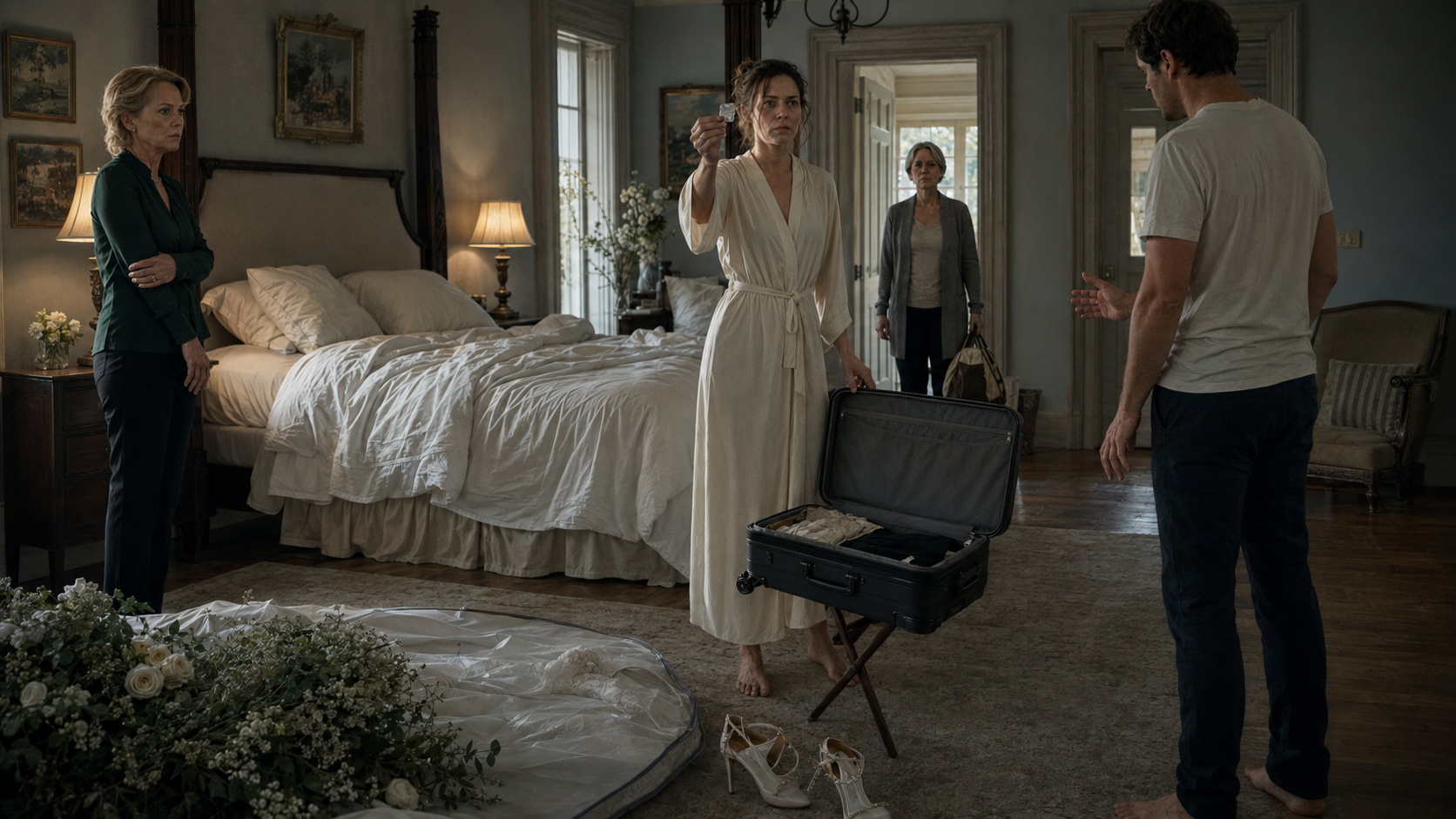
    Then the door opened.

    Daniel came in first.

    Patricia came behind him.

    She was hugging one of the hallway pillows against her chest.

    Her face was flushed.

    Her blouse had fallen slightly off one shoulder, and her carefully styled hair had loosened around her face.

    The smell reached me almost immediately.

    Whiskey.

    Strong enough to fill the room.

    “Mom’s too drunk,” Daniel said.

    I stared at him.

    “What?”

    Patricia gave a breathy little laugh.

    “Oh, don’t fuss over me.”

    Her words were slightly slurred.

    She swayed.

    Daniel caught her elbow.

    “She had too much,” he said. “It’s really noisy downstairs, and Aunt Helen is still using Mom’s room because of the mix-up with the bookings. I told her she could lie down here for a while.”

    I thought I had misunderstood him.

    “Here?”

    “Just for a little while.”

    I looked at the bed.

    Then at Patricia.

    Then at my husband.

    “Our bed?”

    His expression changed.

    Not anger exactly.

    Annoyance.

    Like I was creating a complication he had expected me to avoid.

    “Claire.”

    That single word carried a warning.

    I lowered my voice.

    “Daniel, it’s our wedding night.”

    “I know that.”

    “Then take her to the sitting room.”

    “There are people everywhere.”

    “The sofa downstairs?”

    “She’s drunk.”

    Patricia sank onto the edge of the mattress with a sigh.

    “I knew this would be a problem,” she murmured.

    I looked at her.

    She wasn’t looking at me.

    She was looking at Daniel.

    He immediately turned toward me.

    “Can we not do this tonight?”

    Something inside me tightened.

    “Do what?”

    “Turn everything into an issue with my mother.”

    I almost laughed.

    It was our wedding night.

    His mother was sitting on our bed.

    And somehow I was the one turning something into an issue.

    “Daniel, I’m not asking you to throw her outside.”

    “I know.”

    “I’m asking you not to give her our bed.”

    “One night, Claire.”

    His voice became softer, but somehow that made it worse.

    “One night. That’s all.”

    I stared at him.

    Exactly, I thought.

    One night.

    Our wedding night.

    The one night that was supposed to belong to us without debate.

    I should have said no.

    For years afterward—although there weren’t many things about that marriage to remember—I would sometimes think about that exact moment.

    I should have said no.

    But I could already hear Patricia telling the family that her new daughter-in-law had thrown a sick, intoxicated woman out of bed.

    I imagined Daniel becoming cold with me.

    I imagined whispers at breakfast.

    I imagined becoming the difficult bride before the wedding cake had even been cleared away.

    So I did what I had trained myself to do around his family.

    I swallowed it.

    “Fine.”

    I picked up my pillow.

    Daniel exhaled with relief.

    Not gratitude.

    Relief.

    As if I had passed something.

    Patricia finally looked at me.

    For half a second, the drunken fog disappeared from her eyes.

    There was something sharp underneath.

    Something almost satisfied.

    Then she smiled weakly.

    “You’re very understanding.”

    I didn’t answer.

    There was a narrow sofa in a private lounge one floor below the bridal suite. I took a blanket from the closet and left.

    Daniel followed me into the hall.

    “Hey.”

    I kept walking.

    He caught my hand.

    “Don’t be mad.”

    “I’m tired.”

    “It’s one night.”

    “You keep saying that.”

    “Because it is.”

    I turned toward him.

    “You’re staying with me, right?”

    He hesitated.

    Only for a second.

    But I felt it.

    “I’ll make sure she settles down first.”

    “Daniel.”

    “She might be sick.”

    “She can sleep. You can check on her later.”

    He rubbed his forehead.

    “Can we please not fight tonight?”

    That sentence hit me harder than anything else.

    Because once again, what he meant was:

    Can you please surrender before my mother gets upset?

    I pulled my hand away.

    “I’ll be downstairs.”

    He kissed my forehead.

    “Thank you.”

    I watched him go back into our room.

    The door closed.

    And for the first time since saying I do, I felt completely alone.

    I lay on the little sofa downstairs, staring into darkness.

    The inn had old wooden floors, and every movement upstairs traveled through the ceiling.

    At first, I heard footsteps.

    Back and forth.

    Back and forth.

    A board creaked.

    Then another.

    Once, I thought I heard voices.

    Low.

    Too low to understand.

    Then silence.

    I checked my phone.

    2:17 a.m.

    At 2:46, I heard footsteps again.

    At 3:10, a door closed.

    At some point the footsteps stopped completely.

    I told myself Daniel had gone to another room.

    I told myself he had probably found a chair.

    I told myself not to be childish.

    I told myself his mother was drunk.

    I told myself I was exhausted and imagining problems because the day had overwhelmed me.

    But one thought kept returning.

    Patricia had looked unsteady when she walked into the room.

    Yet when she crossed from the door to the bed, she had never once bumped into anything.

    Not the chair.

    Not the dresser.

    Not the luggage.

    Nothing.

    And Daniel had said she had “too much.”

    Too much of what?

    I had been moving around the reception all evening.

    I could remember seeing Patricia holding a glass several times.

    But I couldn’t remember ever seeing her actually drink from it.

    It was almost dawn when exhaustion finally pulled me under.

    When I opened my eyes again, gray morning light had filled the lounge.

    My neck ached.

    My wedding ring felt strange on my hand.

    For a few seconds, I forgot where I was.

    Then everything came back.

    I checked the time.

    5:53 a.m.

    Some relatives were leaving early. I had promised my mother I would say goodbye before their cars departed.

    I folded the blanket, smoothed my hair with my fingers, and went upstairs.

    The hallway was silent.

    I reached our room and slowly opened the door.

    Then I stopped.

    Daniel was asleep on his back.

    He was still wearing the white undershirt he had put on beneath his tuxedo shirt.

    Patricia was beside him.

    Much too close for the enormous bed.

    She was lying on her side, facing him.

    Both were fully clothed, but the sight still made my stomach twist.

    There was an entire empty half of the mattress.

    Yet she had chosen the space beside her son.

    I stood there for several seconds.

    I wanted to wake him.

    I wanted to demand an explanation.

    Instead, I walked closer.

    That was when I saw it.

    Something small was stuck to the white sheet near Patricia’s hip.

    Silver foil.

    At first I thought it was part of a candy wrapper.

    I reached down and peeled it free.

    A torn bottle seal.

    Metallic silver on one side.

    White on the other.

    There were black letters printed across it.

    I turned it toward the window.

    Three characters were still perfectly visible.

    0.0%

    I stared at them.

    Below that, in smaller letters, was part of a brand name I recognized.

    Because I had seen the bottle the night before.

    Daniel had brought it to the reception himself.

    A zero-proof bourbon substitute.

    Alcohol-free.

    He had ordered several bottles for one of his cousins who had stopped drinking.

    And suddenly I remembered something else.

    Patricia standing near the bar.

    Daniel pouring amber liquid into her glass from a bottle beneath the counter.

    Not from the bartender’s whiskey bottle.

    His own.

    My fingers went cold.

    Patricia shifted in her sleep.

    The smell of whiskey was still strong around her.

    But now I knew what I was smelling.

    Not drunkenness.

    A performance.

    I looked at my husband.

    Then at the woman beside him.

    Then back at the little silver seal in my hand.

    And a terrible question formed in my mind.

    If Patricia hadn’t been drunk—

    why had Daniel brought her into our bedroom?

    PART 2: “You Were Supposed to Throw That Away”

    I didn’t scream.

    I didn’t shake either of them awake.

    Something colder than anger settled over me.

    I put the silver seal into the pocket of my robe and stepped backward.

    For years, Patricia had accused me of being emotional.

    Sensitive.

    Impulsive.

    She said I “reacted before understanding.”

    So that morning, standing beside my wedding bed while my husband slept next to the woman he had chosen over me, I decided I would understand everything before I reacted.

    I went downstairs.

    The reception room looked completely different in daylight.

    The candles had burned out.

    Half-empty glasses covered the tables.

    Flowers drooped inside tall centerpieces.

    The dance floor where I had stood in Daniel’s arms only hours earlier was scattered with petals and napkins.

    One of the hotel employees was clearing bottles from the bar.

    I walked toward him.

    “Excuse me.”

    He looked up.

    Then recognized me.

    “Oh. Congratulations.”

    The word almost made me flinch.

    “Thank you. I have a strange question.”

    “Sure.”

    “Do you remember what my mother-in-law was drinking last night?”

    He frowned, thinking.

    “The lady in the dark green dress?”

    “Yes.”

    “Mr. Mercer asked me to serve her from a bottle he brought.”

    My heart began beating harder.

    “Do you remember what it was?”

    He bent beneath the bar and searched through a recycling crate.

    After a moment, he lifted an empty bottle.

    My mouth went dry.

    Same brand.

    Zero-proof.

    Alcohol-free.

    He set it on the counter.

    “She wanted it in a whiskey glass,” he said. “Your husband said not to mention it because she didn’t want people asking why she wasn’t drinking.”

    “Did she have anything alcoholic later?”

    “Not from us.”

    “How many glasses did she have?”

    “Maybe three.”

    Three glasses of something incapable of making her drunk.

    I thanked him.

    Then I turned away before he could see my face.

    The hallway to the stairs suddenly seemed very long.

    I didn’t understand the reason yet.

    But I knew two things.

    Patricia had lied.

    And Daniel had helped her.

    I was halfway upstairs when I heard his voice behind me.

    “Claire?”

    I turned.

    Daniel stood at the top of the staircase.

    His hair was messy. His shirt was wrinkled.

    He looked like an ordinary exhausted groom.

    For one painful second, my mind tried to return to the version of him I had loved.

    The man who brought me soup when I was sick.

    The man who stood beside me at my grandmother’s funeral.

    The man who once drove two hours because my car battery died in a parking lot.

    That man had existed.

    Which made what came next harder, not easier.

    “You disappeared,” he said.

    I almost smiled at the absurdity.

    “I disappeared?”

    “I woke up and you weren’t downstairs.”

    “Where’s your mother?”

    “Still sleeping.”

    “Of course.”

    His eyebrows pulled together.

    “What does that mean?”

    I took the silver seal from my pocket.

    The instant Daniel saw it, his expression changed.

    Not confusion.

    Recognition.

    Then fear.

    He reached toward it automatically.

    “Where did you get that?”

    I moved my hand away.

    “From our bed.”

    He stared at me.

    Neither of us spoke.

    Then he muttered, almost under his breath—

    “Mom was supposed to throw that away.”

    The world seemed to become very quiet.

    Daniel froze.

    He had heard himself.

    I had heard him.

    There was no taking it back.

    I looked at him.

    “Throw what away?”

    “Claire—”

    “No. Say it.”

    His jaw tightened.

    “It isn’t what you think.”

    “What do I think?”

    “I don’t know.”

    “Then explain it.”

    People sometimes imagine betrayal as a dramatic moment.

    A scream.

    A slap.

    A door slammed hard enough to shake the walls.

    Mine began with my husband looking at the carpet because he couldn’t look at his wife.

    “She wasn’t really drunk,” he said.

    I waited.

    “Obviously.”

    “She was upset.”

    “So you pretended she was drunk?”

    “It wasn’t exactly pretending.”

    I laughed once.

    A short, ugly sound.

    “Zero-percent alcohol seems pretty close to pretending.”

    “She was emotional.”

    “She could have been emotional in her own room.”

    “There wasn’t a room available.”

    “There were sofas.”

    “I know.”

    “There were chairs.”

    “I know.”

    “There were other relatives she could stay with.”

    He pressed both hands to his face.

    “I know.”

    “Then why was she in our bed?”

    He lowered his hands.

    For the first time, I saw shame.

    But underneath it was something else.

    Resentment.

    As if he hated being forced to explain something he had hoped I would simply accept.

    “Mom wanted to see how you would handle it.”

    I stared at him.

    “How I would handle what?”

    “An uncomfortable family situation.”

    “What?”

    “She’s worried about us.”

    “About us?”

    “She thinks you resent how close we are.”

    I could hardly process the sentence.

    “So she pretended to be drunk and took my bed on my wedding night to see if I would complain?”

    “Don’t say it like that.”

    “How should I say it?”

    “Claire—”

    “Give me the version that makes it sound normal.”

    He said nothing.

    My hands had started trembling.

    Not because I was frightened.

    Because the full humiliation was arriving piece by piece.

    The glance Patricia had given me.

    The way Daniel had repeated one night.

    His visible relief when I agreed.

    Her saying, You’re very understanding.

    I had thought they were reacting to an unexpected problem.

    There had never been a problem.

    There had been a test.

    And I had been the only person in the room who didn’t know I was taking it.

    “She wanted to know,” Daniel said carefully, “whether you could put family before your own preferences.”

    “My own preferences?”

    “It was one night.”

    “Our wedding night.”

    “That’s exactly why she picked it.”

    He stopped.

    My chest tightened.

    “What did you just say?”

    Daniel closed his eyes.

    I whispered, “She picked it?”

    He didn’t answer.

    “She planned this.”

    “Not for long.”

    I almost couldn’t breathe.

    “How long?”

    “She mentioned it a couple weeks ago.”

    A couple weeks.

    Two weeks.

    While I was choosing table linens.

    While I was writing vows.

    While I was confirming honeymoon reservations.

    My future husband and his mother had been discussing how to test whether I deserved to join their family.

    “Did you agree immediately?” I asked.

    “No.”

    “But you agreed.”

    He sighed.

    “I thought if you handled it well, she would stop worrying.”

    I stepped back from him.

    “Did I pass?”

    “Claire.”

    “I want to know.”

    “This is ridiculous.”

    “Did I pass your mother’s test?”

    His silence answered me.

    Then a voice came from behind him.

    “She did, until this morning.”

    Patricia stood in the doorway of the bridal suite.

    Gone was the stumbling woman from the night before.

    Her hair was brushed.

    Her blouse was buttoned.

    Her eyes were clear.

    Completely clear.

    She looked at me calmly.

    Almost disappointed.

    “Patricia,” Daniel said.

    “What?” she replied. “There’s no point pretending now.”

    I looked at her.

    “You weren’t drunk.”

    “No.”

    “You lied to me.”

    “I created a situation.”

    “You lied.”

    “If you insist.”

    I could feel something changing inside me.

    The old fear of being called rude was disappearing.

    Maybe humiliation burns away politeness.

    Maybe there comes a moment when a person has crossed so far beyond ordinary decency that you stop worrying whether your response will offend them.

    “Why?” I asked.

    Patricia folded her arms.

    “Because marriage changes women.”

    I stared at her.

    “I wanted to know whether you understood what becoming Daniel’s wife actually requires.”

    “And what does it require?”

    “Flexibility.”

    Daniel said, “Mom, stop.”

    “No,” I said.

    My eyes never left hers.

    “Let her finish.”

    Patricia did.

    “Daniel has responsibilities to this family. He always has. I have watched women come into families and immediately start separating sons from their parents. Suddenly holidays are divided. Traditions become negotiations. Mothers become inconveniences.”

    “So you decided to see whether I would give you my wedding bed.”

    “It was symbolic.”

    I almost laughed.

    To her, apparently, that made it better.

    “And Daniel sleeping beside you?”

    Her expression flickered.

    For the first time, she looked uncomfortable.

    “He was making sure I was all right.”

    “You weren’t sick.”

    “He came upstairs later.”

    “And climbed into the bed.”

    “He was tired,” she said.

    There it was again.

    A perfectly reasonable explanation for every individual act.

    Only when you placed them together did the picture become monstrous.

    A mother pretended to be drunk.

    A son helped her.

    They removed a bride from her own wedding bed.

    Then slept there while she spent the night on a sofa.

    All to find out whether she knew her place.

    I turned toward Daniel.

    “What did you expect to happen this morning?”

    He looked miserable.

    “I expected Mom to get up early. You’d come upstairs. She’d thank you. We’d move on.”

    “And you would never tell me.”

    “It wasn’t meant to hurt you.”

    That sentence broke something.

    Not because it was cruel.

    Because he believed it.

    He genuinely believed intention erased betrayal.

    “You planned to let me spend the rest of my life thinking your mother was drunk.”

    “It was harmless.”

    “No.”

    My voice came out surprisingly steady.

    “It was successful.”

    He frowned.

    “What?”

    “Your test.”

    Patricia’s expression softened slightly.

    For one absurd second, I think she thought I meant I accepted the lesson.

    I looked directly at her.

    “You wanted to know what kind of wife I would be.”

    Then I looked at Daniel.

    “And I needed to know what kind of husband you would be.”

    Neither spoke.

    “Now we all know.”

    I turned toward the room.

    My suitcase was still beside the dresser.

    I walked in.

    Patricia followed me.

    “What exactly are you doing?”

    I began folding my clothes.

    “Leaving.”

    Daniel rushed inside.

    “Claire, come on.”

    I didn’t stop.

    “Don’t make a decision because you’re angry.”

    “I’m not angry.”

    That was when I realized it was true.

    Anger would come later.

    What I felt then was clarity.

    Daniel reached for my arm.

    I pulled away.

    “Don’t.”

    He dropped his hand.

    “Claire, we got married yesterday.”

    “I know.”

    “You’re going to walk away from a marriage over one stupid mistake?”

    I looked at him.

    “No.”

    I placed my folded dress inside the suitcase.

    “I’m walking away because it wasn’t a mistake.”

    And behind him, Patricia went very still.

    Because she knew exactly what I meant.

    A mistake happens accidentally.

    They had planned this.

    PART 3: The Rules I Had Never Been Told

    Daniel followed me from one side of the room to the other as I packed.

    “This is insane.”

    I put my shoes into the suitcase.

    “We can talk.”

    “You had two weeks to talk.”

    “I mean really talk.”

    “You had three years.”

    Patricia remained near the door.

    She had stopped trying to look sympathetic.

    Now she looked offended.

    “You’re humiliating my son.”

    I turned.

    The nerve of that statement was almost impressive.

    “I slept on a sofa on my wedding night because the two of you wanted to evaluate my obedience.”

    Patricia’s mouth tightened.

    “No one used that word.”

    “You didn’t need to.”

    Daniel said, “Mom, please go downstairs.”

    She ignored him.

    “Marriage requires sacrifice, Claire.”

    “Yes.”

    “Then perhaps you’re not mature enough for it.”

    I zipped one side of my suitcase.

    “Sacrifice is something you choose to give for someone you love. What you demanded was submission.”

    Her eyes hardened.

    “You’ve always had a problem with me.”

    “No.”

    I stood.

    “I had a problem with certain things you did. Daniel kept telling me they were small. And every time he said that, I made myself smaller so your behavior could stay the same.”

    Daniel looked away.

    I started counting them.

    I hadn’t planned to.

    They simply came.

    “You changed our engagement dinner because you disliked the restaurant I chose.”

    “That restaurant was inappropriate.”

    “You invited fifteen people to my bridal shower after I said the venue had a limit.”

    “They were family.”

    “You changed the wedding seating chart.”

    “Your arrangement separated elderly relatives.”

    “You told Daniel my wedding dress was too revealing.”

    “I said it was modern.”

    “You told him we should spend our honeymoon somewhere closer because you might need him.”

    “I had surgery scheduled.”

    “Six months later.”

    Patricia’s face changed.

    Daniel looked at me.

    “You knew about that?”

    “She told me.”

    He turned toward his mother.

    “You said the doctor hadn’t given you a date.”

    Patricia shrugged.

    “That was my understanding then.”

    There.

    A tiny crack.

    Perhaps Daniel finally saw it.

    But if he did, it was too late.

    Because he immediately turned back to me and said, “See? This is why we need to sit down.”

    Not I’m sorry.

    Not I can’t believe she lied.

    Not What have I allowed?

    We need to sit down.

    Together.

    The three of us.

    Always the three of us.

    My phone buzzed.

    My mother.

    Leaving around seven. Are you awake? Want breakfast before we go?

    I stared at the message.

    My mother had spent most of my childhood working two jobs after my father died. She had never told me whom to date. Never told me which career to choose. Never demanded holidays.

    When Daniel proposed, she asked me only one question.

    “Do you feel safe being yourself around him?”

    At the time, I had said yes.

    Now I wondered why the answer had taken me so long to understand.

    I typed:

    Please don’t leave yet. I need you.

    Her response came less than ten seconds later.

    Where are you?

    No questions.

    No judgment.

    Just where.

    I nearly cried.

    Daniel saw my face.

    “You’re calling your mother?”

    “I texted her.”

    His expression became frustrated.

    “Why are you involving everyone?”

    For a second I could only stare.

    “You involved yours before we got married.”

    “That’s different.”

    “Why?”

    “It just is.”

    I laughed softly.

    There are sentences that end arguments because they reveal there is no argument worth continuing.

    It just is was one of them.

    In Daniel’s world, his mother’s involvement was family.

    Mine was interference.

    His mother’s demands were tradition.

    My boundaries were disrespect.

    His mother’s discomfort required action.

    Mine required patience.

    The rules had always existed.

    I had simply never been allowed to read them.

    I closed my suitcase.

    Daniel stepped in front of the door.

    “Please.”

    I looked at him.

    He looked tired.

    Frightened now.

    For the first time that morning, he seemed to understand I was actually leaving.

    “I love you.”

    My heart hurt.

    Because I believed him.

    That was the tragedy.

    Daniel did love me.

    But love was not the highest authority in his life.

    His mother’s approval was.

    And when love and approval came into conflict, he had already shown me which one he would protect.

    “I love you too,” I said.

    His face softened immediately.

    I continued.

    “But I don’t trust you.”

    The softness vanished.

    “Claire—”

    “You lied to me.”

    “I made a bad judgment.”

    “You conspired with your mother to manipulate me.”

    “That sounds so dramatic.”

    “Because it is.”

    “No one got hurt.”

    I looked toward the sofa visible through the open hallway beyond him.

    “I did.”

    He had no answer.

    Patricia did.

    “You allowed yourself to be hurt.”

    I turned slowly.

    She continued.

    “No one forced you downstairs. You chose to give me the bed.”

    There it was.

    The trap inside the test.

    If I refused, I was selfish.

    If I agreed, it proved I had chosen freely.

    I walked toward her.

    She was taller than me in heels, though she wasn’t wearing them now.

    For three years, I had been intimidated by that woman.

    That morning, she looked smaller.

    Not physically.

    Morally.

    “You’re right,” I said.

    She seemed surprised.

    “I did choose.”

    Daniel watched us.

    “I chose to avoid conflict. I chose to trust my husband when he told me you needed help. I chose kindness because I believed the situation was real.”

    I took the silver seal from my pocket and placed it on the dresser between us.

    “You used my kindness as evidence that I could be controlled.”

    Patricia’s face tightened.

    I continued.

    “That will not happen twice.”

    Someone knocked.

    Daniel stiffened.

    “Claire?”

    My mother’s voice.

    I went to the door.

    Daniel moved reluctantly aside.

    The moment Mom saw my face, hers changed.

    She didn’t rush toward me.

    She didn’t create a scene.

    She looked at the suitcase.

    Then at Daniel.

    Then at Patricia.

    “What happened?”

    Daniel immediately said, “There’s been a misunderstanding.”

    I almost admired the speed of it.

    Mom looked at me.

    Not him.

    Me.

    “Claire?”

    “My mother-in-law pretended to be drunk last night.”

    Silence.

    Mom’s eyes shifted toward Patricia.

    I continued.

    “She and Daniel planned it before the wedding. She wanted our bed. They wanted to see whether I would object.”

    Mom blinked.

    Once.

    Then she looked at Daniel.

    “Is that true?”

    Daniel rubbed his neck.

    “It’s more complicated.”

    My mother had always been a patient woman.

    That morning she produced the coldest sentence I had ever heard her say.

    “If you need more than yes or no, then it’s probably yes.”

    Patricia stepped forward.

    “This is a private marital issue.”

    Mom looked at her.

    “Then perhaps you shouldn’t have placed yourself in their marital bed.”

    Nobody said anything.

    I nearly laughed.

    Patricia’s cheeks reddened.

    “I was testing whether Claire could accommodate Daniel’s family.”

    Mom stared at her for several seconds.

    “And you thought the night he married her was the appropriate moment?”

    “You don’t understand our family.”

    “No,” Mom said. “I’m beginning to.”

    Daniel stepped toward her.

    “Mrs. Bennett, I love Claire. I made a mistake.”

    My mother did not answer him.

    She turned to me.

    “Do you want to leave?”

    “Yes.”

    That was all she needed.

    She picked up my smaller bag.

    Daniel stared at both of us.

    “That’s it?”

    Mom looked at me again.

    “Is there anything else you need from this room?”

    “My dress.”

    I lifted the garment bag.

    Daniel’s voice rose.

    “Claire!”

    I stopped at the doorway.

    He looked desperate.

    “What am I supposed to tell everyone?”

    And there it was.

    Not How do I fix this?

    Not What do you need?

    Not even Please don’t go.

    What am I supposed to tell everyone?

    The truth would embarrass him.

    That was now his emergency.

    I held his gaze.

    “Tell them your mother wanted my place.”

    He flinched.

    “And you gave it to her.”

    Then I walked out.

    PART 4: The Bride Who Walked Out

    Leaving your own wedding venue the morning after your wedding is a strangely public form of heartbreak.

    There were relatives in the lobby.

    Cousins carrying suit bags.

    Children eating pastries from paper napkins.

    My aunt was arguing with someone about luggage.

    Daniel’s best man was drinking coffee near the entrance.

    The instant people saw my suitcase, conversations changed.

    Not stopped.

    Changed.

    Voices became quieter.

    Eyes followed me.

    I could practically feel questions multiplying.

    Mom walked beside me.

    “You don’t owe anyone an explanation right now,” she whispered.

    I nodded.

    Then Patricia came down the stairs.

    “Claire.”

    I kept walking.

    “Claire, stop.”

    People turned.

    Of course they did.

    Patricia had never understood how to make a request without turning it into an announcement.

    I stopped near the front doors.

    She approached with Daniel behind her.

    Her face wore the expression I knew well.

    Controlled concern.

    The face she used when she wanted an audience to believe she was the reasonable person.

    “Whatever disagreement we’ve had,” she said quietly, “surely we can discuss it privately instead of creating a spectacle.”

    A few relatives pretended not to listen.

    Everyone was listening.

    I looked at her.

    “You followed me into the lobby.”

    “I’m trying to stop you from making a rash decision.”

    Daniel reached us.

    “Claire, please come upstairs.”

    “No.”

    “You’re exhausted.”

    “Yes.”

    “We’re all emotional.”

    “You weren’t emotional when you planned this.”

    His best man, Michael, looked over.

    “Planned what?”

    Daniel glared at him.

    “Nothing.”

    That one word made my decision for me.

    Nothing.

    He still wanted secrecy.

    He still wanted the story managed.

    I had spent three years protecting him from the consequences of his mother’s behavior by never describing it accurately.

    I was finished.

    I looked at Michael.

    “Daniel and Patricia planned a test for me last night.”

    “Claire,” Daniel warned.

    I ignored him.

    “Patricia pretended to be drunk so I would give her the bridal bed. Daniel knew she wasn’t drunk. They wanted to see whether I’d complain.”

    Michael stared at Daniel.

    “You’re joking.”

    Daniel said nothing.

    Michael’s expression changed.

    “Oh, man.”

    Patricia snapped, “This is none of your concern.”

    “It kind of became everybody’s concern when you did it at a wedding,” he replied.

    Several people looked away to hide their reactions.

    Patricia’s face darkened.

    Daniel grabbed my elbow.

    Not hard.

    But hard enough.

    “Enough.”

    I looked down at his hand.

    Then back at him.

    He released me immediately.

    “You’re making Mom look insane.”

    “I’m describing what she did.”

    “She was worried about losing me.”

    “To your wife.”

    Something moved across his face.

    I don’t know whether it was understanding or anger.

    Maybe both.

    I lowered my voice.

    “Daniel, when you proposed to me, did you believe I would become your family?”

    “You are my family.”

    “No. Answer me.”

    “You are.”

    “Then why did I have to audition for the position yesterday?”

    He opened his mouth.

    Nothing came out.

    Patricia said, “Because respect is earned.”

    I turned toward her.

    “Then you’ve taught me something useful.”

    She frowned.

    “What?”

    “So is access.”

    Her face stiffened.

    “You will not come into my home. You will not involve yourself in my decisions. And until I decide what happens with this marriage, you will not contact me.”

    “You cannot forbid me from speaking to my son.”

    “I didn’t.”

    I looked at Daniel.

    “He can speak to you as much as he wants.”

    Then I added the sentence that finally made him understand.

    “He just won’t be speaking to me.”

    His face went pale.

    “Claire.”

    I picked up my suitcase.

    My mother opened the door.

    Outside, the morning air was cool and damp.

    My wedding flowers were still attached to the railings.

    White roses.

    Everything looked painfully beautiful.

    Halfway to Mom’s car, Daniel caught up with me.

    “Please.”

    I turned.

    He was crying.

    I had seen Daniel cry only twice before.

    At his grandfather’s funeral.

    And when he proposed.

    My anger cracked just enough for grief to enter.

    “I was stupid,” he said.

    I swallowed.

    “Yes.”

    “I thought she’d finally accept you if you showed her she had nothing to worry about.”

    “Daniel, that’s the problem.”

    “What?”

    “You thought I had to prove something to her.”

    “She’s my mother.”

    “And I was supposed to be your wife.”

    “You are.”

    I shook my head.

    “No. Yesterday you made vows to me in front of everyone we love.”

    His eyes filled.

    “I meant them.”

    “Then a few hours later, your mother asked you to humiliate me, and you did it.”

    “I didn’t think of it that way.”

    “I know.”

    That was the worst part.

    “I know you didn’t.”

    He reached toward me.

    I stepped back.

    “If you’d understood it was cruel and done it anyway, maybe I could hate you.”

    His face broke.

    “But you thought it was reasonable.”

    “Claire—”

    “You thought asking your bride to sleep on a sofa while your mother occupied the wedding bed was a fair test.”

    “I was trying to keep peace.”

    “No.”

    I shook my head.

    “You weren’t keeping peace. You were transferring conflict.”

    He stared at me.

    “Every time your mother wanted something unreasonable, you gave it to her so she wouldn’t be angry. Then you asked me to absorb the cost.”

    He looked down.

    I had never said it so clearly before.

    Maybe because I had never understood it so clearly.

    “I was your solution to your mother.”

    Tears slipped down his face.

    “I can change.”

    “Maybe.”

    “I will.”

    “Maybe you will.”

    “Then don’t leave.”

    I looked back at the inn.

    At Patricia standing behind the glass doors.

    Watching.

    Waiting.

    Certain, perhaps, that eventually her son would convince his wife to return to the proper arrangement.

    I looked at Daniel again.

    “If I stay today, what happens the next time she tests me?”

    “There won’t be a next time.”

    “What if she demands Christmas?”

    “We’ll work it out.”

    “What if she wants a key to our house?”

    “She already—”

    He stopped.

    I stared.

    “She already what?”

    His face changed.

    That tiny hesitation told me everything.

    “Daniel.”

    He closed his eyes.

    “She has a spare.”

    My mouth opened.

    “When did you give her a key?”

    “It was for emergencies.”

    “When?”

    “A few months ago.”

    “Without telling me?”

    “I forgot.”

    “No.”

    The word came out almost gently.

    “You didn’t forget.”

    He looked at me.

    “You knew I would say no.”

    He couldn’t deny it.

    There it was.

    The wedding-night test had not created the problem.

    It had exposed it.

    I wondered how many other decisions had already been made around me.

    How many permissions granted.

    How many conversations held.

    How often had Daniel smiled, kissed my forehead, and said everything was fine while quietly arranging his life so his mother never had to hear the word no?

    I suddenly felt grateful for the silver scrap in my pocket.

    Without it, I might have spent years slowly doubting myself.

    I might have believed each incident was isolated.

    I might have become quieter.

    Smaller.

    More “flexible.”

    I might have woken up at forty wondering why nothing in my own home felt like mine.

    Daniel reached for my hand.

    This time I let him hold it.

    For a moment.

    “I do love you,” I whispered.

    “I love you too.”

    “But I need a husband who can protect a marriage from the people outside it.”

    “She isn’t outside it.”

    He said it automatically.

    Then his eyes widened.

    He knew.

    I knew.

    That was the answer.

    I gently pulled my hand free.

    “Yes,” I said.

    “That’s exactly the problem.”

    Then I got into my mother’s car.

    PART 5: What Was Stuck to the Sheet

    I spent the next three days in my old bedroom at Mom’s house.

    My wedding dress hung from the closet door.

    I couldn’t bring myself to put it away.

    The flowers from my bouquet dried on the dresser.

    My phone filled with messages.

    Some angry.

    Some concerned.

    Some so absurd I laughed despite myself.

    Patricia’s sister wrote that “marriage requires tolerance.”

    One of Daniel’s cousins sent:

    I don’t know what happened, but Aunt Patricia has always gone too far. Whatever you decide, don’t let anyone tell you you’re crazy.

    Michael sent only:

    He told me the whole thing. I’m sorry.

    Daniel called thirty-seven times the first day.

    I answered none.

    On the second day, he sent a message.

    I told Mom she was wrong.

    I read it twice.

    Then a third time.

    Something about the sentence bothered me.

    Eventually I understood.

    Even his apology was about Patricia.

    Not I was wrong.

    I told Mom she was wrong.

    As though the central problem had still been hers.

    As though he had merely failed to stop her.

    I responded for the first time.

    Did she force you to lie to me?

    Three dots appeared.

    Disappeared.

    Appeared again.

    Finally:

    No.

    I typed:

    Did she force you to give her our bed?

    No.

    Did she force you to hide the fact that she wasn’t drunk?

    A longer pause.

    No.

    I stared at the screen.

    Then I wrote:

    Then stop apologizing for your mother. Start understanding your own choices.

    He didn’t respond for two hours.

    When he did, the message was different.

    Longer.

    No excuses.

    You’re right. I kept telling myself I was managing her, but really I was teaching everyone around me that the easiest way to deal with her was to give her what she wanted. I made you pay for my fear of disappointing her. I don’t know why I couldn’t see that before.

    I cried when I read it.

    Not because it changed my decision.

    Because it was the first honest thing he had said since our wedding.

    He came to Mom’s house four days later.

    Alone.

    I agreed to speak with him on the porch.

    He looked terrible.

    Unshaven.

    Exhausted.

    For once, Patricia had not chosen his clothes, metaphorically or literally.

    We sat across from each other.

    He didn’t try to touch me.

    “I gave her the key back,” he said.

    I nodded.

    “I told her she can’t come to the apartment unless she’s invited.”

    I said nothing.

    “I also told her what we did was humiliating.”

    “What did she say?”

    “She said you’ve manipulated me against her.”

    I almost smiled.

    “Of course.”

    He looked toward the street.

    “She says you’ve been waiting for an excuse to separate me from the family.”

    “Do you believe her?”

    He took a long time to answer.

    “No.”

    That mattered.

    But not enough.

    He looked at me.

    “Is there any chance?”

    I knew what he was asking.

    I had been asking myself the same question every night.

    Love does not vanish when trust does.

    That would make leaving easier.

    I still missed him.

    I missed the way he hummed while making coffee.

    I missed his terrible jokes.

    I missed the warm weight of his arm around me at night.

    I missed the future we had planned.

    But I no longer trusted the foundation beneath that future.

    “I don’t know,” I said.

    He nodded.

    For the first time, he didn’t pressure me.

    After a while, I took something from my pocket.

    The silver bottle seal.

    I had kept it.

    He stared at it.

    “That stupid thing,” he whispered.

    “No.”

    I turned it between my fingers.

    “It isn’t stupid.”

    Without that scrap of foil, Patricia might have woken before me.

    She might have thrown it away as planned.

    She would have stumbled dramatically out of the room.

    She would have hugged me.

    She would have told everyone what a thoughtful daughter-in-law I was.

    Daniel would have kissed me.

    We would have gone on our honeymoon.

    And I would never have known.

    That thought frightened me more than the truth ever had.

    “You know what I keep thinking?” I asked.

    “What?”

    “If she had thrown this away, would you ever have told me?”

    His eyes dropped.

    I already knew the answer.

    “No,” he whispered.

    I nodded.

    “That’s why I can’t come home.”

    He cried then.

    Quietly.

    So did I.

    There was no screaming.

    No revenge.

    No dramatic destruction of wedding photographs.

    Just two people sitting on a porch, grieving a marriage that should have had decades ahead of it and had already been damaged beyond recognition before sunrise on its first day.

    We separated.

    Over the following weeks, Daniel asked me several times to reconsider.

    I told him not yet.

    Then eventually I told him no.

    Not because people cannot change.

    I believe they can.

    Daniel may have changed after losing me.

    I hope he did.

    But I finally understood that I wasn’t obligated to risk my life waiting for someone to become the partner he had promised to be before marrying me.

    Patricia never apologized.

    Her last message arrived about a month later.

    Someday you’ll understand that family requires compromise.

    I read it.

    Then deleted it.

    Because she still didn’t understand.

    I had compromised for three years.

    On dinners.

    Holidays.

    Opinions.

    Traditions.

    Comments.

    Plans.

    Visits.

    I had compromised because compromise means two people moving toward each other.

    What Patricia wanted was different.

    She wanted everyone else to move while she remained exactly where she was.

    And Daniel had spent his entire life arranging people around her.

    Our wedding night was simply the first time he expected his wife to join the arrangement.

    Months later, while packing away the last of the wedding things, I found the silver seal again.

    0.0%

    Three little characters.

    Nothing more.

    Something most people would have thrown away without looking twice.

    I sat on the edge of my bed holding it.

    For a long time, I had thought that scrap ruined my marriage.

    Then I realized the opposite was true.

    It had saved me from living inside a lie.

    Patricia had wanted to teach me a lesson that night.

    She wanted to prove that once I became Daniel’s wife, I would have to make room for her whenever she demanded it.

    She wanted me to understand that being loved by her son did not mean being chosen before her.

    In one sense, she succeeded.

    I learned exactly what she wanted me to learn.

    I learned that a marriage without boundaries becomes a house where everyone has a key except the person who is supposed to feel at home.

    I learned that kindness offered freely is love, but kindness demanded as proof of obedience is control.

    I learned that a person can love you sincerely and still be incapable of standing beside you when it matters.

    Most of all, I learned that the smallest things sometimes reveal the largest truths.

    A hesitation.

    A glance.

    A locked door.

    A sentence spoken too quickly.

    A silver scrap stuck to a white sheet.

    On my wedding night, I thought losing my bed for a few hours was the humiliation.

    It wasn’t.

    The humiliation would have been spending years begging my husband to give me a place in a marriage where his mother had already claimed the center.

    So when people later asked how long I had been married, I never knew exactly what to say.

    Technically, there was paperwork.

    There were photographs.

    There were vows.

    There was a ring.

    But in my heart, the marriage lasted from the moment Daniel said, “I do,” until the moment he looked at that silver seal and whispered:

    Mom was supposed to throw that away.

    Because those seven words told me everything the vows had failed to say.

    And by sunrise, I finally knew which promise he had truly intended to keep.

  • MY SON LEFT HIS MOTHER ON THE FLOOR AT HIS WEDDING. BY SUNRISE, HIS FUTURE HAD CHANGED.

    MY SON LEFT HIS MOTHER ON THE FLOOR AT HIS WEDDING. BY SUNRISE, HIS FUTURE HAD CHANGED.

    PART 1: THE LIE MY WIFE BROUGHT HOME

    For forty-eight hours, I believed my wife had been injured in some kind of accident at our son’s wedding.

    Then I watched my daughter-in-law slap her.

    I watched my son grab his own mother by the arm.

    And I watched him slam her into an oak-paneled wall hard enough to knock her to the floor.

    The security footage had no sound, but it didn’t need any.

    I knew my wife’s face.

    I knew the shape her mouth made when she was trying not to cry.

    I knew the way she curled inward when she was frightened.

    Most of all, I knew the way Michael looked down at her.

    There was no shock on my son’s face.

    No horror.

    No instinct to help.

    He simply stared at the woman who had raised him, turned around, and walked back toward his wedding reception with his new wife.

    I watched the footage twice.

    Then a third time.

    The estate manager stood behind me in silence.

    When the screen froze on the final frame, my wife was still on the floor.

    My son was already gone.

    I didn’t shout.

    I didn’t curse.

    I didn’t punch the desk.

    I only held out my hand.

    “I need a raw copy of that file on a flash drive. Now.”

    The manager swallowed.

    “Yes, Mr. Whitaker.”

    He probably thought my calm meant shock.

    Michael would later make the same mistake.

    He thought my silence meant I was devastated.

    He was half right.

    What my son didn’t know was that before the next sunrise, the locks on my home would be changed, his gate code would no longer work, the wedding gift he was counting on would disappear, his executive position would be under review, and the inheritance he had spoken about for years as though it were already his would be sitting on my attorney’s desk.

    But before any of that happened, my wife came home with a lie.

    And I nearly believed her.

    The wedding had been held on a private estate outside the city, the sort of place with stone terraces, old trees wrapped in lights, fountains imported from Italy, and employees who seemed trained to appear from thin air whenever a guest needed champagne.

    Cassandra had wanted perfection.

    That word had followed us for almost a year.

    Perfect flowers.

    Perfect lighting.

    Perfect table settings.

    Perfect photographs.

    Perfect guest list.

    Perfect dress code.

    Ellen had laughed about it in the beginning.

    “She only gets one wedding,” she had told me.

    I remembered looking across the kitchen island at my wife.

    “Hopefully.”

    Ellen had smacked my arm with a dish towel.

    “Robert.”

    “What?”

    “Don’t start.”

    I hadn’t started.

    For twelve months, I had done the opposite.

    I had stayed out of it.

    Whenever Michael called with another request, I wrote the check or told the accountant to handle it.

    Whenever Cassandra changed something that had already been paid for, Ellen told me not to complain.

    “They’re excited.”

    When the flower budget doubled, they were excited.

    When Cassandra decided the original photographer’s work wasn’t “editorial” enough and replaced him, they were excited.

    When Michael called to explain that the reception needed additional imported wine because Cassandra’s family had certain expectations, apparently that was excitement too.

    I knew what the wedding cost.

    I also knew Michael could not have paid for half of it himself.

    But I kept my mouth shut because Ellen wanted our son’s wedding to be a happy memory.

    That was the kind of woman she was.

    She had spent thirty-four years turning our house into a place Michael could always come back to.

    When he was eight and lost his first baseball championship, she sat on the kitchen floor with him because he refused to get up.

    When he was sixteen and wrecked his first car, she hugged him before I could finish asking whether he’d been drinking.

    When he graduated from college, she cried harder than he did.

    When he joined my company, she made me promise I wouldn’t treat him more harshly simply because he was my son.

    When he brought Cassandra home, Ellen was determined to love her because Michael loved her.

    That was Ellen.

    She made room.

    Even when people did not deserve the space.

    The night of the wedding, I left the reception before she did.

    A migraine had started behind my left eye sometime after the speeches. Ellen wanted to stay for the final dances, and she insisted I go home.

    “You’ve done your duty,” she whispered, adjusting my tie.

    “My duty?”

    “You didn’t argue with the band. You didn’t complain about the wine. You didn’t threaten Michael when he called me old during his toast.”

    “He said you haven’t aged.”

    “He said you’ve gotten older gracefully.”

    “Exactly. He called me old diplomatically.”

    She smiled.

    That smile stayed in my mind for the next two days.

    Because when Ellen came home shortly after midnight, she wasn’t smiling.

    I heard the front door.

    Then silence.

    Normally, she called my name the second she entered a room.

    That night, nothing.

    I went downstairs.

    She was standing in the foyer with one hand pressed against the small table near the door.

    Her dress was torn along the side seam.

    One shoe had a broken strap.

    Her hair, which had been pinned up when I left, was hanging partly across her face.

    And she was trembling.

    “Ellen?”

    She looked at me.

    Something in her expression made every protective instinct I had ignite at once.

    I crossed the foyer.

    “What happened?”

    “Nothing.”

    “That doesn’t look like nothing.”

    “I fell.”

    She tried to move past me.

    Her left leg buckled slightly.

    I caught her elbow.

    She gasped.

    I immediately released her.

    “I’m sorry.”

    Then I saw her arm.

    Four darkening marks curved around the flesh above her elbow.

    Fingerprints.

    I felt heat climb from my chest into my face.

    “Ellen.”

    She pulled her arm against her body.

    “It’s fine.”

    “Who did this?”

    “No one.”

    “Those are fingers.”

    “Robert—”

    “Who grabbed you?”

    “I told you. I fell.”

    “You fell and got grip marks on your arm?”

    She looked away.

    That was when I knew.

    Not what had happened.

    But that she was protecting someone.

    My first thought was that a drunk guest had cornered her.

    My second was worse.

    I took out my phone.

    “I’ll call Michael.”

    She moved so quickly she nearly fell again.

    Her hand closed around my sleeve.

    “Please.”

    I stared at her.

    “Please what?”

    “Don’t call him.”

    “Why?”

    “Don’t ruin his night.”

    The words struck me as strange even then.

    “What does Michael’s night have to do with someone hurting you?”

    “Nothing. I just—I don’t want a scene.”

    “Ellen, you’re bleeding.”

    It was only a small scrape near her knee.

    That didn’t matter.

    Someone had put hands on my wife.

    “Robert, please.”

    Her voice broke.

    That stopped me.

    Not because I agreed.

    Not because I believed her.

    Only because in thirty-seven years of marriage, Ellen had almost never begged me for anything.

    I put the phone down.

    “Fine.”

    Her shoulders loosened.

    “But you’re not going upstairs alone.”

    “I can walk.”

    “I didn’t ask.”

    Normally that would have earned me an eye roll.

    That night, she let me help her.

    I sat her on the edge of our bed and brought ice, antiseptic, pain medication, and an old towel.

    The bruise on her arm kept darkening.

    I said nothing about it.

    Neither did she.

    At one point, I knelt in front of her and wrapped ice around her swollen knee.

    Her fingers moved through my hair.

    “Don’t be angry,” she whispered.

    I looked up.

    “At you?”

    “At anyone.”

    That sentence bothered me more than the first lie.

    I took her hand.

    “What happened?”

    Her eyes filled.

    Then she smiled.

    It was an awful smile.

    Thin.

    Fragile.

    Designed to make me stop asking questions.

    “I slipped.”

    I stared at her for a long time.

    Finally, I nodded.

    “All right.”

    She kissed my forehead.

    “Thank you.”

    But I didn’t believe her.

    Not for a second.

    Ellen fell asleep sometime after three.

    I didn’t.

    I sat beside her in the dark, listening to her breathing.

    Every few minutes, I remembered those marks on her arm.

    Someone had grabbed her hard enough to bruise her.

    She was protecting whoever had done it.

    And somehow, she believed telling me the truth would ruin our son’s wedding night.

    There weren’t many explanations for that.

    None of them were good.

    At six in the morning, I checked my phone.

    Michael had sent a photograph to the family group chat.

    He and Cassandra were smiling beneath a tunnel of sparklers.

    His arm was around her waist.

    Her head was on his shoulder.

    The caption read:

    Perfect ending to a perfect night.

    I stared at the photograph.

    Then I looked at my sleeping wife.

    Her damaged shoe was still lying beside the bedroom door.

    And for the first time, I wondered if Michael knew exactly what had happened to his mother.

    Two days later, I learned the answer.

    My phone rang at 10:17 in the morning.

    “Mr. Whitaker?”

    “Yes.”

    “This is Daniel Mercer from Hawthorne Estate.”

    The venue manager.

    I remembered him from the wedding. Mid-fifties, careful, professional. The kind of man who didn’t waste words.

    “I hope I’m not disturbing you.”

    “What is it?”

    There was a pause.

    “Our technical contractor has been reviewing a problem we experienced with several of the corridor cameras Saturday evening.”

    I stood straighter.

    “What problem?”

    “Part of the system stopped recording properly. We believed some files were corrupted.”

    “And?”

    “One of those files was recovered this morning.”

    I said nothing.

    Neither did he for several seconds.

    Then he asked, “Mrs. Whitaker is all right?”

    My grip tightened around the phone.

    “Why are you asking me that?”

    Another pause.

    “Mr. Whitaker, I strongly advise you to come down here.”

    “I’ll bring my wife.”

    “No.”

    The word came too fast.

    Mercer immediately lowered his voice.

    “Please, sir. Come alone.”

    The house seemed to go silent around me.

    “What did you see?”

    “I would rather show you.”

    “Tell me now.”

    “I don’t think I should do that over the phone.”

    I looked toward the staircase.

    Ellen was upstairs.

    She still had a faint limp.

    “Does this involve my wife?”

    “Yes.”

    “Does it involve my son?”

    This time the pause was longer.

    “Yes.”

    That was the moment some part of me already knew.

    Not the details.

    Not how bad it would be.

    But enough.

    I picked up my keys.

    “I’m on my way.”

    And during the entire drive to Hawthorne Estate, one sentence kept repeating inside my head.

    Come alone.

    By the time I reached the property, I knew I was about to see something my wife had been willing to lie to protect me from.

    I simply didn’t know that the person she was protecting was our son.


    PART 2: THE CORRIDOR CAMERA

    Daniel Mercer was waiting near the entrance when I arrived.

    He didn’t offer his hand.

    That told me more than anything else could have.

    “Mr. Whitaker.”

    “Show me.”

    He nodded.

    No small talk.

    No coffee.

    No attempts to soften whatever he had called me there to see.

    He led me through a service hallway and into a small office behind the administrative wing.

    Then he shut the door.

    Locked it.

    Closed the blinds.

    I watched each movement.

    “You think someone is going to interrupt us?”

    “No.”

    “Then why lock the door?”

    His jaw tightened.

    “Because this concerns your family.”

    He sat behind the desk.

    I remained standing.

    There was a monitor on one side, paused on an empty corridor.

    I recognized it.

    The bridal wing.

    Ellen and I had walked through it earlier that afternoon when Cassandra wanted family photographs.

    Oak walls.

    Cream runner.

    Gold sconces.

    A decorative table with white roses at the far end.

    “What time?”

    “Approximately eleven forty-three.”

    I checked my memory.

    I had left shortly after ten-thirty.

    “Play it.”

    Mercer hesitated.

    “Mr. Whitaker—”

    “Play it.”

    He pressed the key.

    For several seconds, nothing happened.

    Then Ellen appeared from the left side of the screen.

    Even without sound, I could tell she was upset.

    She was holding her clutch with both hands in front of herself.

    She stopped near the wall.

    A few seconds later Cassandra entered.

    Michael was behind her.

    I felt my entire body harden.

    Cassandra moved toward Ellen quickly.

    Her hands were sharp, animated.

    She pointed toward the reception area, then toward Ellen’s dress.

    Ellen said something.

    Cassandra laughed.

    Not happily.

    I had seen that expression before.

    Contempt didn’t require sound.

    “What were they saying?” I asked.

    Mercer shifted.

    “One of our employees was nearby. She couldn’t hear everything.”

    “What did she hear?”

    He didn’t answer immediately.

    I turned toward him.

    “What did she hear?”

    He exhaled.

    “Mrs. Michael Whitaker was angry about photographs taken earlier. She apparently said Mrs. Whitaker was making the wedding look…”

    He stopped.

    “Say it.”

    “Cheap and tacky.”

    Something cold moved through me.

    On the screen, Ellen stepped backward.

    Cassandra followed.

    Michael stood two feet away.

    My son.

    Thirty-two years old.

    Six feet tall.

    Perfect suit.

    Expensive watch.

    Everything about him polished for the most photographed night of his life.

    His mother was being berated in front of him.

    And he did nothing.

    Ellen lifted one hand.

    I knew that gesture.

    She did it when she was trying to calm someone.

    I had watched her do it with Michael a hundred times when he was growing up.

    Easy.

    It’s all right.

    Let’s not fight.

    Then Cassandra slapped her.

    I stopped breathing.

    The blow turned Ellen’s head.

    Her body shifted sideways.

    My fingers dug into the back of the chair in front of me.

    Mercer reached for the keyboard.

    “Would you like me to—”

    “No.”

    My voice sounded unfamiliar.

    “Keep playing.”

    Ellen touched her cheek.

    Michael finally moved.

    For one foolish fraction of a second, I thought he was going to defend her.

    I actually thought that.

    I thought I was about to watch my son step between his wife and his mother.

    Instead, Michael grabbed Ellen.

    His hand wrapped around her upper arm.

    Exactly where the bruises were.

    I saw Ellen recoil.

    She tried to pull away.

    Michael’s other hand came up.

    I couldn’t hear him, but his mouth was moving.

    He was shouting at her.

    At his mother.

    Then he shoved her.

    Not a small push.

    Not an accidental movement.

    Not a reflex.

    He drove her backward.

    Ellen hit the oak wall shoulder-first.

    Her head snapped sideways.

    Then she fell.

    Her damaged shoe twisted beneath her.

    The strap broke.

    Her clutch slid across the floor.

    I heard the faint scrape of Mercer’s chair as he shifted behind me.

    On the screen, Cassandra stepped forward.

    For a moment, I thought she was going to help Ellen.

    Instead, she nudged the broken shoe away with her foot.

    Not hard.

    Almost casually.

    As if my wife were clutter.

    Michael looked down.

    He stood there for three seconds.

    Maybe four.

    I counted them later.

    Over and over.

    Long enough to see his mother wasn’t getting up.

    Long enough to make a choice.

    Then Cassandra said something.

    Michael turned.

    They walked away together.

    Neither looked back.

    The corridor was empty again.

    Ellen remained on the floor.

    I don’t know how long I stood there after the footage stopped.

    I remember the hum of the air conditioner.

    I remember the tiny green light beneath the monitor.

    I remember Mercer saying my name once.

    Maybe twice.

    Mostly, I remember looking at my son walking out of frame.

    There are moments in a parent’s life when the child in your memory and the adult in front of you separate forever.

    Until that second, somewhere inside me, Michael was still four years old with cereal on his shirt.

    Still eleven, running into our bedroom because thunder scared him.

    Still eighteen, trying not to cry when Ellen hugged him before college.

    Still twenty-five, standing in my office, nervous on his first day with the company.

    Then I watched him leave his mother on the floor.

    And the boy disappeared.

    “Mr. Whitaker?”

    I raised one hand.

    Mercer stopped.

    I needed to think.

    Anger is useful only if you control it.

    Uncontrolled anger turns you into the stupidest person in the room.

    So I did what I had spent forty years in business teaching younger men to do.

    I separated facts from emotion.

    Fact one: Cassandra struck Ellen.

    Fact two: Michael physically grabbed Ellen.

    Fact three: he shoved her against a wall.

    Fact four: she fell and was visibly injured.

    Fact five: he left.

    Fact six: Ellen lied to protect him.

    Fact seven: neither Michael nor Cassandra had contacted us in the forty-eight hours since.

    Not to check on her.

    Not to apologize.

    Not even to ask if she was all right.

    I pointed to the computer.

    “Is that the original file?”

    “The recovered file, yes.”

    “Has it been altered?”

    “No.”

    “Edited?”

    “No.”

    “Compressed?”

    “The playback software creates a viewing format, but the underlying recovered file has been preserved.”

    “Who has access?”

    “Myself, our technical contractor, and the owner.”

    “Anyone else?”

    “No.”

    “Good.”

    Mercer looked almost surprised.

    “Good?”

    “I don’t want this circulating.”

    His expression shifted.

    “I understand.”

    “I mean it. Not an employee’s phone. Not social media. Not gossip. Nothing.”

    “Of course.”

    I held out my hand.

    “I need a raw copy of that file on a flash drive. Now.”

    He nodded immediately.

    While he copied it, I kept staring at the frozen image.

    Ellen on the floor.

    The thing that hurt most wasn’t the shove.

    It wasn’t even Cassandra’s slap.

    It was Michael’s decision afterward.

    He could have lost his temper.

    People lose control.

    It doesn’t excuse what they do, but human beings can make ugly mistakes in seconds.

    What happened next was different.

    He had time.

    He looked down.

    He saw his mother hurt.

    And he decided the reception mattered more.

    The photographs mattered more.

    His bride’s anger mattered more.

    His mother’s pain could wait.

    Mercer handed me the flash drive.

    I took it.

    “Was anyone else in the corridor?”

    “Not during that section.”

    “And your employee who heard part of the argument?”

    “She was around the corner near the service station. By the time she looked back, Mrs. Whitaker was leaving.”

    “Ellen walked out herself?”

    “Yes.”

    Of course she did.

    She probably picked up her own purse too.

    Probably fixed her own hair.

    Probably limped through the parking area without asking anyone for help because she didn’t want a scene at Michael’s wedding.

    My throat tightened.

    Mercer stood.

    “Mr. Whitaker, I’m sorry.”

    I looked at him.

    “For what?”

    “That happened here.”

    “You didn’t do it.”

    “No.”

    He glanced at the monitor.

    “But I have a mother.”

    That nearly broke my composure.

    I nodded once.

    Then I left.

    I didn’t call Michael on the drive home.

    I wanted to.

    I imagined exactly what I would say.

    I imagined driving to his hotel.

    I imagined dragging him out of whatever honeymoon suite Ellen and I had helped pay for and making him watch the footage frame by frame.

    But rage wanted immediacy.

    I wanted something else.

    I wanted clarity.

    Michael had grown increasingly comfortable over the years.

    Too comfortable.

    He had begun speaking about things he did not own as though they had already been transferred to him.

    The company.

    Our vacation property.

    My investments.

    The wedding gift.

    The house he and Cassandra wanted.

    His inheritance.

    Once, during a family dinner, Cassandra had joked that she and Michael were “just waiting for Robert to admit he’s semi-retired so we can start making real decisions.”

    Everyone laughed.

    Including me.

    At the time.

    Now I remembered the way Michael had smiled.

    Not embarrassed.

    Pleased.

    He didn’t think he was dependent on us.

    He thought he was waiting for us to get out of the way.

    When I arrived home, Ellen was sitting at the kitchen table drinking tea.

    She looked at the flash drive in my hand.

    Then at my face.

    “Where were you?”

    “Hawthorne.”

    Her cup stopped halfway to her mouth.

    I saw it.

    That fraction of a second.

    Fear.

    “You went back to the venue?”

    “Yes.”

    “Why?”

    “They called.”

    Her hand tightened around the cup.

    “What did they want?”

    I looked at my wife.

    I could have told her.

    I could have put the drive on the table and said, I know.

    But she was still protecting Michael.

    And before I asked her to stop, I needed to understand how much protecting him had cost us.

    “I’ll tell you later.”

    “Robert.”

    “Later.”

    She watched me walk out of the room.

    For the first time in our marriage, I deliberately left her with a question unanswered.

    I went upstairs to my study.

    Closed the door.

    Opened the locked cabinet where I kept copies of our estate documents.

    Then I started making a list.

    Michael’s executive position?

    Mine to recommend, subject to the company’s governance process.

    His shares?

    Unvested.

    The vehicle he drove?

    Corporate lease.

    The vacation house he called “our lake place” when speaking to friends?

    Owned by a family trust I controlled.

    The down payment he and Cassandra expected us to provide after the wedding?

    Never transferred.

    The home address he still used on several personal and legal records?

    Ours.

    The gate access?

    Mine.

    The keys?

    Mine.

    The comfortable future he believed had already been promised to him?

    That was mine too.

    Or rather, it had been.

    I sat behind my desk and looked at the photograph across from me.

    Michael at six years old between Ellen and me.

    All three of us smiling.

    For years, I had believed giving my son security would make him confident.

    I hadn’t noticed when security became expectation.

    I hadn’t noticed when expectation became entitlement.

    Maybe that was my failure.

    If so, I was about to correct it.

    I picked up my phone.

    My first call was to my attorney.

    The second was to my accountant.

    The third was to the trust administrator.

    The fourth was to corporate counsel.

    Then I called our security company.

    “Mr. Whitaker,” the representative said, “what changes would you like made?”

    “All exterior access.”

    “Is there a security concern?”

    I looked down at the flash drive.

    “Yes.”

    “What access should remain active?”

    “Mine and my wife’s.”

    “And Mr. Michael Whitaker?”

    I didn’t hesitate.

    “Remove him.”

    That night, for the first time since our son was a teenager, Michael no longer had a key that could bring him home.


    PART 3: WHAT MY SON THOUGHT BELONGED TO HIM

    The next morning began quietly.

    That was what made it almost surreal.

    Sunlight came through the kitchen windows.

    The coffee machine hissed.

    Ellen stood at the counter in her robe, carefully favoring her knee.

    Somewhere in another part of the city, my son was probably waking beside his new wife believing his life was exactly the same as it had been the day before.

    It wasn’t.

    At eight-thirty, my attorney called.

    We discussed the estate plan.

    I did not disinherit Michael in a fit of anger.

    That would have been exactly the kind of impulsive decision I had avoided since leaving Hawthorne.

    Instead, I instructed my attorney to begin reviewing every provision involving him.

    Anything automatic would be reconsidered.

    Anything discretionary would remain discretionary.

    Any assumption Michael had made about immediate control after my death was no longer an assumption I intended to reward.

    At nine-fifteen, I spoke with the trust administrator.

    Michael’s access to the vacation property was suspended.

    It wasn’t his home.

    He had no ownership interest.

    He had simply been permitted to use it.

    Permission could end.

    At ten, I spoke with corporate counsel.

    That conversation lasted longer.

    My company employed nearly four hundred people.

    I was not going to treat it like a family toy simply because my son had.

    Michael’s position had always been legitimate on paper, but I had accelerated his rise.

    I had given him opportunities other people would have spent years earning.

    He wasn’t incompetent.

    That almost made it worse.

    He was capable enough to believe he had earned everything alone.

    So we reviewed his employment agreement, his unvested equity package, and the vehicle lease attached to his position.

    No theatrics.

    No illegal retaliation.

    No false accusations.

    Just boundaries.

    His future at the company would no longer be protected by me.

    If the board wanted to evaluate his leadership, it would evaluate him by the same standards as anyone else.

    If his position depended on my sponsorship, that sponsorship was over.

    His unvested shares would remain subject to their terms.

    His company vehicle would remain tied to his employment status.

    No more hidden safety net.

    No more father standing behind the curtain.

    At eleven, the locksmith finished.

    At eleven-twenty, the gate code changed.

    At noon, I cancelled the transfer of the wedding gift.

    That was the easiest.

    Michael and Cassandra had been planning to use it toward a house.

    A beautiful place.

    Too large for two people.

    Too expensive without help.

    Cassandra had sent Ellen photographs for months.

    She loved the marble kitchen.

    Michael loved the garage.

    They had spoken about our gift as though it were a closing document.

    It wasn’t.

    The money was still ours.

    I instructed the accountant not to transfer a dollar.

    Ellen found me in my study shortly afterward.

    She closed the door behind her.

    “You changed the gate code.”

    It wasn’t a question.

    “Yes.”

    “And the locks.”

    “Yes.”

    Her face paled.

    “Why?”

    I looked at her bruised arm.

    She followed my eyes.

    Then she understood.

    Not everything.

    Enough.

    “Robert.”

    “I saw it.”

    Silence.

    She lowered herself into the chair across from me.

    For several seconds, she looked at the carpet.

    “When?”

    “Yesterday.”

    “The venue?”

    “Yes.”

    Her eyes closed.

    I had been angry at her for lying.

    That anger vanished the moment I saw her sitting there.

    She didn’t look deceptive.

    She looked ashamed.

    And my wife had nothing to be ashamed of.

    “Why didn’t you tell me?” I asked.

    Her answer came quietly.

    “Because he’s our son.”

    “That isn’t an answer.”

    “It is to me.”

    “No. It’s a reason you were willing to protect him. It doesn’t tell me why you thought he deserved protection.”

    She looked at me.

    “I didn’t know what else to do.”

    “You tell me.”

    “And then what?”

    “I deal with it.”

    “Exactly.”

    I leaned back.

    “So you were protecting him from me.”

    “I was protecting everyone.”

    “Everyone except yourself.”

    Her mouth tightened.

    “Please don’t turn this into—”

    “Into what, Ellen?”

    “A war.”

    I stood.

    “This is not a war.”

    “You changed the locks.”

    “Our son put his hands on you.”

    “He lost his temper.”

    My voice dropped.

    “Don’t.”

    She flinched.

    I immediately regretted the sharpness.

    But I refused to let her reduce what happened.

    “Don’t do that for him.”

    “Robert—”

    “Cassandra slapped you.”

    Her eyes filled.

    “Michael grabbed you hard enough to leave fingerprints.”

    “I know.”

    “He shoved you into a wall.”

    “I know.”

    “He watched you fall.”

    She looked away.

    “And then he left you there.”

    That was the one.

    Her face broke.

    Not dramatically.

    Ellen rarely cried loudly.

    Her chin trembled.

    Her shoulders folded.

    And tears began sliding down her face.

    I came around the desk.

    She whispered, “I know.”

    I knelt beside her.

    For a long time, neither of us spoke.

    Finally, she said, “He looked right at me.”

    I closed my eyes.

    “I know.”

    “I kept thinking he’d come back.”

    That sentence hurt worse than the footage.

    “I sat there for maybe thirty seconds. Maybe a minute. I don’t know. I thought he would turn around.”

    I took her hand.

    “He didn’t.”

    “No.”

    “What happened before Cassandra slapped you?”

    Ellen wiped her face.

    “She was angry about the photographs.”

    “What photographs?”

    “The family pictures.”

    “What was wrong with them?”

    “Me, apparently.”

    I felt the familiar heat returning.

    Ellen shook her head.

    “Don’t.”

    “Tell me.”

    “She said I’d ruined the look she wanted. She said I didn’t fit the aesthetic of the photographs.”

    I stared at her.

    Ellen gave a small, miserable laugh.

    “I wish I could tell you exactly what that means.”

    I could.

    Cassandra had spent a year constructing a wedding designed to look effortless despite costing more than some houses.

    Every detail had to suggest wealth without admitting anyone cared about wealth.

    Ellen had never understood that performance.

    She wore what she liked.

    She spoke to servers the same way she spoke to executives.

    She carried safety pins in her handbag.

    She had spent part of the reception helping one of Cassandra’s young cousins fix a torn hem.

    Nothing about my wife was curated.

    That was why people trusted her.

    It was also probably why Cassandra couldn’t control how Ellen appeared.

    “She told me I made the wedding look cheap,” Ellen continued.

    “And tacky.”

    Her eyes lifted sharply.

    “You heard that?”

    “The manager told me.”

    She looked down.

    “I told her she was being ridiculous. That photographs were photographs. She said I had embarrassed her all day.”

    “How?”

    “She didn’t say anything that made sense.”

    “And Michael?”

    “He told me to stop arguing.”

    Of course.

    “Then Cassandra slapped you.”

    Ellen nodded.

    “What did Michael say?”

    Her silence answered before she did.

    “He told me I was causing a scene.”

    I stood slowly.

    “You were causing a scene.”

    “Robert.”

    “His wife hit you, and he thought you were the problem.”

    “He was upset.”

    “So was she. Apparently that gave both of them permission.”

    “I am not defending what he did.”

    “You have been defending what he did since you walked through our front door.”

    That hurt her.

    I saw it immediately.

    I softened my voice.

    “You lied to me because you thought telling the truth would hurt Michael.”

    “I thought you’d destroy his marriage.”

    “I didn’t marry Cassandra.”

    “You know what I mean.”

    “No. I know what you were afraid of. You were afraid I’d make him choose.”

    “Yes.”

    I sat on the edge of the desk.

    “Ellen, he already chose.”

    She stared at me.

    “At the wedding, he chose.”

    Her eyes closed again.

    I hated saying it.

    But some truths hurt because they are cruel.

    Others hurt because they are undeniable.

    “He didn’t have to divorce her,” I continued. “He didn’t have to scream. He didn’t have to ruin the reception. He had to do one thing.”

    “What?”

    “Help his mother off the floor.”

    Ellen covered her mouth.

    I let the silence sit between us.

    Then she looked toward the papers on my desk.

    “What have you done?”

    I told her.

    All of it.

    The locks.

    The gate.

    The gift.

    The trust access.

    The estate review.

    The company.

    By the time I finished, her expression had changed from sadness to alarm.

    “Robert, that’s his entire life.”

    “No.”

    “It practically is.”

    “Then we made a bigger mistake than I realized.”

    She stood.

    “He’s our son.”

    “And?”

    “You can’t erase him because of one terrible night.”

    “I haven’t erased him.”

    “You’re taking everything away.”

    I shook my head.

    “No. I’m taking back what still belongs to us.”

    She stared at me.

    “There’s a difference.”

    “Will it feel different to him?”

    “Probably not.”

    That was the point.

    Michael had spent years confusing access with ownership.

    Support with entitlement.

    Love with obligation.

    I walked to the window.

    “I am not taking his salary out of his bank account. I’m not taking his personal property. I’m not destroying his reputation. I’m not putting that video online. I’m not calling his clients. I’m not lying about him.”

    I turned back.

    “I am simply no longer guaranteeing that his life remains comfortable.”

    Ellen was quiet.

    “The wedding gift?” she asked.

    “Cancelled.”

    “They’ve already been talking to the realtor.”

    “Then they’ll have to adjust.”

    “The lake house?”

    “Access suspended.”

    “The company?”

    “I told counsel I will no longer protect his position. He’ll face a formal review.”

    “His shares?”

    “Unvested.”

    “And the inheritance?”

    “Under review.”

    She looked exhausted.

    I went to her.

    “If you want me to restore your access arrangements with him to this house, I will discuss it with you. This is your home too.”

    She looked at the bruises on her arm.

    “No.”

    That surprised me.

    “What?”

    “Not yet.”

    I waited.

    She took a long breath.

    “I don’t want him walking in here like nothing happened.”

    For the first time since I saw the footage, some of the pressure in my chest loosened.

    I nodded.

    “Neither do I.”

    Her phone rang.

    We both looked at it.

    Michael.

    Ellen froze.

    The phone rang again.

    Then stopped.

    A few seconds later, mine started.

    I looked at the screen.

    Michael.

    I let it ring.

    Ellen looked at me.

    “You’re not answering?”

    “No.”

    “He’ll know something’s wrong.”

    “Something is wrong.”

    The call ended.

    Thirty seconds later, he called again.

    Then again.

    On the fourth attempt, I answered.

    “Hello, Michael.”

    “Dad.”

    He sounded cheerful for exactly one syllable.

    Then his tone changed.

    “What happened to the gate code?”

    I looked at Ellen.

    She closed her eyes.

    I answered quietly.

    “It changed.”

    “Yeah, I figured that out. Why?”

    “Security update.”

    “Okay. What’s the new code?”

    There it was.

    No question about his mother.

    No apology.

    No hesitation.

    Just the assumption that whatever had changed would immediately be restored for him.

    “There isn’t one for you.”

    Silence.

    “What?”

    “You don’t have access right now.”

    “Dad, what are you talking about?”

    “You heard me.”

    Another silence.

    Longer.

    Then his voice lowered.

    “Is Mom there?”

    “Yes.”

    “Can I talk to her?”

    I looked at Ellen.

    She shook her head.

    “No.”

    “Why not?”

    “Because she doesn’t want to talk to you.”

    That landed.

    “What do you mean she doesn’t want to talk to me?”

    I almost laughed.

    Instead, I said nothing.

    Then Michael’s breathing changed.

    He knew.

    Maybe he didn’t know how.

    But he knew.

    “Dad.”

    “Yes?”

    “What did she tell you?”

    I looked at my wife.

    Her face went still.

    And that question told both of us everything we needed to know.

    Not “Is Mom okay?”

    Not “What happened?”

    Not “Why is she upset?”

    What did she tell you?

    I answered with the truth.

    “Nothing.”

    Michael went silent.

    Then I added, “That was the problem.”

    And I hung up.


    PART 4: THE THINGS HE LOST

    Michael called fourteen times that day.

    Cassandra called six.

    Neither left an apology.

    Their messages changed as the hours passed.

    At first, Michael sounded confused.

    Then irritated.

    Then concerned.

    Then angry.

    By late afternoon, panic had entered his voice.

    “Dad, I don’t know what’s going on, but my assistant says legal wants to meet with me Monday.”

    Another message:

    “Dad, call me. This is getting ridiculous.”

    Then:

    “I just got an email about the vehicle agreement. What the hell are you doing?”

    Cassandra’s messages were different.

    “Robert, I think there’s been some misunderstanding.”

    Then:

    “Ellen must have told you a very distorted version of what happened.”

    Then:

    “We should discuss this as adults before anyone makes emotional decisions.”

    That one almost impressed me.

    The woman who had slapped my wife wanted to warn me against emotional decisions.

    I saved every message.

    Not because I needed ammunition.

    Because anger can distort memory, and I wanted the record to remain clean in my own mind.

    That evening, Ellen and I ate dinner together.

    Neither of us had much appetite.

    Halfway through, she put down her fork.

    “Do you think he’ll come here?”

    “Yes.”

    “How?”

    “He can still drive to the gate.”

    She almost smiled.

    “I suppose he can.”

    “He’ll come.”

    “How do you know?”

    “Because until yesterday, every problem in Michael’s life could eventually be solved by coming home.”

    She looked at me for a long moment.

    “That sounds sad when you say it like that.”

    “It is sad.”

    At seven-thirty, the gate intercom rang.

    Michael.

    I looked at Ellen.

    “Do you want me to send him away?”

    She didn’t answer immediately.

    The intercom rang again.

    Finally, she stood.

    “No.”

    “No?”

    “Let him in.”

    I studied her face.

    “Are you sure?”

    “I don’t want to hide in my own house.”

    That was my wife.

    Gentle did not mean weak.

    Sometimes people confused the two because Ellen didn’t raise her voice.

    They never understood that softness could contain steel.

    I opened the gate remotely.

    Michael’s car appeared at the end of the drive.

    Cassandra was in the passenger seat.

    Of course she was.

    They walked to the front door together.

    Michael tried his key before he rang the bell.

    I heard the metal scrape uselessly inside the new lock.

    Then the bell rang.

    I opened the door.

    My son’s expression was something I had rarely seen.

    Uncertainty.

    “Dad.”

    “Michael.”

    Cassandra stood beside him in a cream coat, arms folded.

    “Can we come in?”

    I stepped aside.

    They entered the foyer.

    Michael looked toward the staircase.

    “Mom?”

    Ellen appeared from the living room.

    He saw the bruise on her arm.

    His eyes dropped.

    For the first time since the wedding, no one spoke.

    Cassandra broke the silence.

    “We need to clear this up.”

    I looked at her.

    “No.”

    She frowned.

    “No?”

    “You need to explain it. Clearing it up suggests there’s confusion.”

    “Robert, you weren’t there.”

    “No.”

    I reached into my pocket.

    “But the camera was.”

    Michael’s face drained of color.

    Cassandra stared at me.

    “What camera?”

    I said nothing.

    Michael did.

    “The corridor.”

    I turned toward him.

    His eyes met mine.

    So he knew there had been a camera.

    Interesting.

    Not evidence of a plan.

    Just one more indication that his first concern was consequences.

    I pointed toward my study.

    “In there.”

    Cassandra started talking before we reached the room.

    “Whatever you think you saw, there was context.”

    “Good.”

    I opened the door.

    “You can provide it afterward.”

    I had connected the file to the television mounted on the wall.

    I didn’t need to play it again.

    I’d seen enough.

    But Ellen hadn’t.

    She had lived it from inside her own fear.

    That was different.

    Before I touched the remote, I looked at her.

    “You don’t have to watch.”

    She hesitated.

    Then she sat.

    “Yes, I do.”

    Michael remained standing.

    Cassandra sat beside him.

    I pressed play.

    No one spoke as Ellen appeared in the corridor.

    I watched my son’s face instead of the screen.

    His jaw tightened when Cassandra confronted Ellen.

    His eyes dropped when the slap came.

    When the video showed him grabbing his mother’s arm, he looked away completely.

    “Watch,” I said.

    “Dad—”

    “Watch.”

    He forced himself to look.

    The shove came.

    On screen, Ellen hit the wall.

    Beside me, my real wife inhaled sharply.

    I reached for her hand.

    She squeezed mine.

    Then the worst moment arrived.

    Michael looked down at his mother.

    Turned.

    Walked away.

    The video ended.

    Silence filled the room.

    I shut off the television.

    “Context.”

    Cassandra spoke first.

    “Ellen was provoking me.”

    Ellen stared at her.

    I felt my hand tighten around the remote.

    But this was Ellen’s confrontation too.

    I stayed quiet.

    Cassandra continued.

    “I had been under pressure all day. There were problems with the photographs, the schedule was behind, my mother was upset, and Ellen kept dismissing everything I was trying to explain.”

    Ellen’s voice was soft.

    “You hit me.”

    “I shouldn’t have slapped you.”

    “That’s not an apology.”

    Cassandra blinked.

    I almost smiled.

    Ellen rarely demanded anything.

    When she did, people noticed.

    Cassandra straightened.

    “I’m sorry I slapped you.”

    Ellen waited.

    Then she turned toward Michael.

    He looked miserable.

    “Mom.”

    “Why did you grab me?”

    “I was trying to stop the argument.”

    “No.”

    “I was.”

    “You left marks.”

    “I didn’t mean to.”

    “You shoved me.”

    His mouth tightened.

    “I lost my temper.”

    “And then?”

    He didn’t answer.

    Ellen’s eyes filled, but her voice remained steady.

    “And then what did you do, Michael?”

    “Mom—”

    “Say it.”

    He looked at the floor.

    “I went back inside.”

    “You left me there.”

    “I thought you were okay.”

    “You watched me hit the wall.”

    “I wasn’t thinking.”

    “No.”

    Her voice cracked for the first time.

    “You weren’t.”

    Michael sat forward.

    “I am sorry.”

    Ellen looked at him.

    “I kept waiting for you to come back.”

    He covered his face for a moment.

    “Mom, I messed up.”

    “You did more than mess up.”

    “I know.”

    “Do you?”

    “Yes.”

    Cassandra shifted beside him.

    “This is becoming unnecessarily dramatic.”

    Michael turned.

    “Cass.”

    “No, I’m serious. What happened was wrong, but we’re talking about destroying our lives over a thirty-second argument.”

    I finally spoke.

    “Your life is being destroyed?”

    She looked at me.

    “Michael is being threatened at work. Our house plans are suddenly on hold. We’ve been locked out of a family property. You changed your own home security like we’re criminals.”

    “You’re not criminals.”

    The words came calmly.

    Cassandra seemed surprised.

    I continued.

    “And I haven’t accused either of you of being criminals. I haven’t called the police. I haven’t posted the footage. I haven’t sent it to your friends. I haven’t contacted your wedding guests. I haven’t done anything to publicly humiliate you.”

    “Then what exactly are you doing?”

    “Ending the subsidy.”

    She stared at me.

    Michael’s head lifted.

    “Dad.”

    I looked at my son.

    “Your mother and I have spent years making sure you never had to worry about certain things.”

    “I never asked for—”

    I laughed once.

    He stopped.

    “You didn’t ask for the company position?”

    “I earned my position.”

    “You contributed. You worked. But you were also given opportunities other people weren’t.”

    His jaw tightened.

    “That isn’t fair.”

    “No. It wasn’t.”

    That silenced him.

    I went to my desk and picked up a folder.

    “You want fair? Fine.”

    I opened it.

    “Your executive position will be reviewed under normal company procedures. I will not interfere on your behalf.”

    “Dad—”

    “Your equity remains governed by the vesting schedule you signed. Nothing more.”

    His face changed.

    “The shares?”

    “Are not yours yet.”

    He stared at me.

    I turned a page.

    “The vehicle is attached to your executive compensation package. Whatever happens there will follow the agreement.”

    “This is insane.”

    “The vacation property belongs to the trust. You have no ownership interest. Your access was a privilege.”

    “Dad.”

    “The house gift has been cancelled.”

    Cassandra stood.

    “You can’t do that.”

    I looked at her.

    “It’s my money.”

    “You promised us.”

    “We discussed giving you a gift.”

    “You know we’ve been planning around it.”

    “That was your mistake.”

    Her face flushed.

    “We have a deposit at risk.”

    “Then you’ll need to speak with your realtor.”

    Michael stood too.

    “Stop.”

    I looked at him.

    “Stop what?”

    “All of this.”

    “No.”

    “You’re punishing me.”

    “Yes.”

    He seemed stunned by the answer.

    I didn’t pretend otherwise.

    “Actions have consequences, Michael.”

    “So you’re taking my entire future because of one mistake?”

    “Your future?”

    I walked toward him.

    “You’re thirty-two years old. You have an education. You have professional experience. You have a salary. You have savings. You have a wife with her own career. You have more advantages than most people receive in a lifetime.”

    My voice remained quiet.

    “If removing my money destroys your future, then you never built one.”

    His face hardened.

    “You’ve always said everything you did was for family.”

    “It was.”

    “Then this is hypocrisy.”

    “No. This is the first time I’ve realized you believed family meant access.”

    “I don’t.”

    “Really?”

    I pointed toward the foyer.

    “What was the first thing you asked me yesterday?”

    He said nothing.

    “The gate code.”

    His face shifted.

    “Not how your mother was.”

    “I knew she was okay.”

    “How?”

    “She walked away.”

    I stared at him.

    There it was.

    The sentence he should never have said.

    Ellen stood slowly behind me.

    “She walked away.”

    Michael turned toward her.

    “Mom, that’s not what I meant.”

    “You watched me on the floor, and because I eventually walked away, you decided I was okay?”

    “No.”

    “You didn’t call me.”

    He froze.

    “You didn’t text me.”

    “Mom—”

    “You didn’t come home.”

    His eyes reddened.

    “You went back to the reception.”

    “I didn’t know what to do.”

    “You could have helped me stand.”

    He looked as though she had struck him.

    Good.

    Not because I enjoyed hurting my son.

    Because for the first time since I watched that footage, he seemed to understand that the deepest wound wasn’t physical.

    Ellen stepped closer.

    “I defended you to your father.”

    Michael’s expression collapsed.

    “I know.”

    “No, you don’t. I came home bruised, and I lied for you.”

    He stared at her.

    “I told him I fell.”

    Cassandra looked uncomfortable.

    Ellen continued.

    “I was afraid he’d ruin your wedding night. I was afraid he’d hate you. I was afraid he’d make everything worse.”

    Her voice trembled.

    “And do you know what I was most afraid of?”

    Michael shook his head.

    “That if I told the truth, I would have to admit to myself what you did.”

    The room went completely still.

    Michael whispered, “Mom.”

    “I can understand anger. I can understand panic. I can even understand making one terrible choice in a terrible moment.”

    She touched the fading bruise.

    “But you looked at me.”

    Tears slipped down her face.

    “You looked directly at me and walked away.”

    Michael cried then.

    Quietly.

    He sat back down and covered his mouth.

    Cassandra remained standing.

    I watched her expression change.

    Not to remorse.

    To frustration.

    She still believed this was something to manage.

    A bad scene.

    A financial complication.

    An obstacle between herself and the future she expected.

    “Ellen,” she said, “we have apologized. What else do you want?”

    My wife looked at her.

    “Nothing.”

    Cassandra blinked.

    “Nothing?”

    “I don’t want anything from you.”

    She took my hand.

    “And you’re not getting anything from me either.”

    That was the moment I knew Ellen understood what I had been trying to do.

    This wasn’t revenge for the sake of pain.

    It was the end of pretending love required us to finance disrespect.

    Michael looked at me.

    “What about the inheritance?”

    I almost couldn’t believe he asked.

    From the expression on his face, he regretted it the second the words left his mouth.

    Ellen closed her eyes.

    Cassandra looked sharply at him.

    I walked back to my desk.

    “It’s under review.”

    “Meaning?”

    “Meaning you should live your life assuming you’re responsible for it.”

    His voice was hoarse.

    “You’re cutting me out?”

    “I didn’t say that.”

    “Then what are you saying?”

    “That whatever happens after your mother and I die is no longer part of your financial plan.”

    “Dad—”

    “Build your own life.”

    I looked from him to Cassandra.

    “Pay for your own house. Drive a car you can afford. Take vacations you pay for. Earn whatever position your company believes you deserve. Save your own money.”

    Then I looked only at Michael.

    “If someday your mother forgives you, understand that forgiveness is not a financial instrument.”

    He stared at me.

    For once, my son had nothing to say.

    I opened the study door.

    The conversation was over.

    Michael stopped beside Ellen on his way out.

    “Mom.”

    She looked at him.

    “I’m sorry.”

    This time, his apology sounded different.

    Maybe because there was nothing left to gain from it.

    Maybe because he finally understood.

    Ellen nodded.

    “I hope you are.”

    He looked like he wanted to hug her.

    He didn’t try.

    That was at least one boundary he finally respected.

    Cassandra walked out without speaking to me.

    Michael followed her.

    I watched through the front window as they crossed the drive.

    Halfway to the car, Cassandra turned on him.

    Even through the glass, I could see her anger.

    Her hands moved sharply.

    Michael didn’t answer.

    He just kept walking.

    A minute later, they drove away.

    Ellen stood beside me.

    “Do you think we went too far?”

    I looked at the empty driveway.

    “No.”

    She was quiet.

    Then she leaned her head against my shoulder.

    Neither of us said what we were both thinking.

    For the first time in Michael’s adult life, he was leaving our house with only what actually belonged to him.


    PART 5: WHAT LOVE DOESN’T BUY

    The days after that were quieter than I expected.

    I had imagined fury.

    Threats.

    Family phone calls.

    Accusations.

    Instead, Michael disappeared into the consequences.

    The house purchase did not proceed on the terms he and Cassandra had planned.

    Without our contribution, they had to reconsider what they could afford.

    That wasn’t tragedy.

    It was arithmetic.

    His company review proceeded without me protecting him.

    Corporate counsel made certain I understood that distinction.

    I had built the company over decades.

    I would not damage it to hurt my son.

    Michael remained responsible for proving that his position was justified.

    For the first time since he’d joined the firm, his father’s name would neither push him upward nor catch him if he fell.

    His unvested shares remained exactly what they had always been.

    Conditional.

    The vehicle issue was handled according to his employment terms.

    No midnight tow truck.

    No humiliation.

    No theatrical repossession from a restaurant parking lot.

    I wasn’t interested in spectacle.

    I wanted separation.

    The vacation house remained inaccessible to him.

    The gate code remained changed.

    The new locks remained in place.

    And the wedding gift remained in our account.

    The most important change, however, happened inside our house.

    Ellen stopped saying she fell.

    The first time someone asked about her arm, she simply said, “There was an incident at the wedding.”

    No lie.

    No elaborate explanation.

    No protection purchased with her own dignity.

    One evening, about two weeks later, I found her sitting in the living room with one of Michael’s childhood photo albums.

    I stood in the doorway.

    “You all right?”

    She nodded.

    Then shook her head.

    Then laughed softly.

    “I don’t know.”

    I sat beside her.

    On the open page, Michael was seven.

    Front teeth missing.

    Holding a homemade birthday cake Ellen had decorated with far too much blue icing.

    “I keep trying to find the moment,” she said.

    “What moment?”

    “When he became someone who could do that.”

    I looked at the photograph.

    “I don’t think there was one moment.”

    “Then what did we miss?”

    I knew she had been asking herself that question every day.

    So had I.

    Maybe we had given too much.

    Maybe I had solved too many problems.

    Maybe Ellen had forgiven too quickly.

    Maybe Michael had gradually come to believe the world would soften every consequence before it reached him.

    Or maybe none of that explained what he had done.

    Parents can influence children.

    We cannot manufacture their character forever.

    At some point, they choose.

    “I don’t know what we missed,” I said.

    Ellen looked at me.

    “That isn’t very comforting.”

    “No.”

    “At least you’re honest.”

    “I try.”

    She closed the album.

    “Do you hate him?”

    The question surprised me.

    “No.”

    “You looked like you hated him when they left.”

    “I hated what he did.”

    “That’s different?”

    “It has to be.”

    She studied me.

    “I thought you said he had to live with consequences.”

    “He does.”

    “So do we.”

    That was Ellen.

    Even when she was hurt, she could see further than I could.

    She leaned back against the sofa.

    “I love him.”

    “I know.”

    “I don’t know if I want to see him yet.”

    “You don’t have to.”

    “I might forgive him eventually.”

    “You might.”

    She looked at me carefully.

    “You won’t.”

    I thought about it.

    “I didn’t say that.”

    “You didn’t have to.”

    I smiled faintly.

    “Ellen, you can forgive him tomorrow if that’s what you need.”

    “And you?”

    “I’ll decide what forgiveness means when I get there.”

    She reached for my hand.

    “What if I want the gate code restored someday?”

    “Then we discuss it.”

    “The lake house?”

    I looked at her.

    “That will be a harder discussion.”

    She laughed.

    It was the first real laugh I’d heard from her since the wedding.

    I squeezed her hand.

    Then she became serious again.

    “I don’t want money to be the only reason he comes back.”

    “Neither do I.”

    That was the heart of it.

    For years, we had been generous because we loved him.

    Now we needed to know whether he loved us when generosity was no longer guaranteed.

    Three weeks after the wedding, Michael asked to meet Ellen.

    Not me.

    Her.

    He sent a short message.

    No excuses.

    No mention of the house.

    No mention of the company.

    No mention of money.

    He asked if she would meet him for coffee.

    Ellen showed me the message.

    “What do you think?”

    “I think it’s your decision.”

    “You don’t want to come?”

    “No.”

    That surprised her.

    “You really don’t?”

    “This isn’t about me.”

    She looked down at the phone.

    For several seconds, she hesitated.

    Then she typed.

    “I’ll meet him.”

    I drove her there but stayed in the car.

    Not because she needed protection.

    Because her knee still bothered her on stairs, and because after nearly four decades of marriage, sometimes love is simply being nearby without intruding.

    She was inside for almost an hour.

    When she returned, her eyes were red.

    I waited until she buckled her seat belt.

    “How was it?”

    “He apologized.”

    “Properly?”

    She nodded.

    “He didn’t blame Cassandra.”

    That mattered.

    “He didn’t blame the wedding.”

    That mattered more.

    “He said he was angry at me because Cassandra was angry, and all he could think about was stopping the problem before anyone noticed.”

    I stared through the windshield.

    “And you became the problem.”

    “Yes.”

    I hated hearing it.

    Ellen continued.

    “He said the second he walked away, he knew he’d done something terrible.”

    “Then why didn’t he come back?”

    “He was ashamed.”

    I let out a humorless breath.

    “Convenient.”

    “I said the same thing.”

    I looked at her.

    “You did?”

    “Yes.”

    There was a little steel in her voice.

    Good.

    “What else?”

    “He said he kept telling himself he’d call the next morning. Then he saw the family chat, and because I didn’t say anything, he convinced himself I wanted to forget it.”

    “That sounds like Michael.”

    “Yes.”

    “Did you forgive him?”

    She looked out the passenger window.

    “Not yet.”

    I started the car.

    After a moment, she added, “But I believe he’s sorry.”

    I nodded.

    That was hers to believe.

    Not mine to take away.

    “And Cassandra?”

    Ellen’s expression changed.

    “He says they’re having problems.”

    I didn’t ask for details.

    Their marriage was not mine to manage.

    Cassandra had done what she had done.

    Michael had done what he had done.

    Whatever happened between them afterward belonged to them.

    “Did he ask about the money?” I asked.

    “No.”

    That surprised me.

    “Not once?”

    “Not once.”

    I pulled out of the parking lot.

    After several blocks, Ellen said, “Does that change anything for you?”

    “Not yet.”

    She nodded.

    “I didn’t think so.”

    The truth was, I was glad he hadn’t asked.

    Not because it earned him anything.

    Because perhaps, for the first time, he was beginning to understand that the money had never been the real issue.

    Months passed.

    The bruises disappeared.

    The torn dress remained in the back of Ellen’s closet for a while.

    One Saturday, I found her holding it.

    “You keeping it?”

    She looked at the ripped seam.

    “No.”

    “Want me to throw it out?”

    She shook her head.

    “I’ll do it.”

    She folded it carefully.

    Not because it deserved care.

    Because Ellen did everything carefully.

    Then she placed it in a donation bag.

    I watched her.

    “You sure?”

    “Yes.”

    She straightened.

    “It was just a dress.”

    I knew what she meant.

    The dress wasn’t the wound.

    The wall wasn’t the wound.

    The bruises weren’t even the deepest wound.

    The wound had been seeing her son choose comfort over her pain.

    Healing would take longer than skin.

    But it had started.

    My relationship with Michael changed too.

    For months, we spoke only when necessary.

    At work, I treated him as I would any other executive.

    Sometimes that was probably harder for him than anger would have been.

    He could no longer walk into my office and assume a private conversation would erase a professional problem.

    He had to prepare.

    He had to defend his decisions.

    He had to accept criticism without leaning on the fact that he was my son.

    And something unexpected happened.

    He began to improve.

    Not immediately.

    Not dramatically.

    But the excuses became less frequent.

    He stopped assuming I would intervene.

    When he made mistakes, he corrected them faster.

    When he succeeded, the success actually belonged to him.

    I never told him I was proud of that.

    Not then.

    Some lessons need room.

    The estate plan remained under review.

    The cancelled wedding gift remained cancelled.

    The vacation property remained restricted.

    I didn’t restore those things simply because Michael started behaving better.

    That would have taught exactly the wrong lesson.

    Consequences are not vending machines.

    You don’t insert three months of good behavior and get your privileges back.

    Trust returns slowly.

    If it returns at all.

    One evening nearly a year after the wedding, Ellen and I were sitting on the back terrace when the gate intercom rang.

    I checked the screen.

    Michael.

    Alone.

    Ellen looked at me.

    “Were you expecting him?”

    “No.”

    She watched the image for a moment.

    “Let him in.”

    I raised an eyebrow.

    “You sure?”

    “Yes.”

    I opened the gate.

    Michael parked near the house.

    He didn’t try the old key this time.

    He rang the bell.

    I opened the door.

    “Dad.”

    “Michael.”

    He held something in his hand.

    A small paper bag.

    “Mom home?”

    “In the back.”

    He nodded.

    “I brought her those lemon cookies she likes.”

    I almost smiled.

    He had remembered.

    Not expensive flowers.

    Not jewelry.

    Not some grand apology purchased with guilt.

    Six-dollar cookies from a bakery Ellen had loved for years.

    “You can come in,” I said.

    He paused.

    Maybe he understood what those words meant now.

    Not access.

    Permission.

    “Thanks.”

    He walked through the foyer.

    For a second, I remembered the boy who used to throw his backpack on that same floor.

    Then I remembered the man on the security footage.

    Both were Michael.

    That was the difficult truth.

    People are not only the best thing they have done.

    They are not only the worst thing either.

    But the worst thing still counts.

    Love doesn’t erase it.

    Money doesn’t erase it.

    Being family doesn’t erase it.

    Michael stepped toward the terrace.

    Then stopped.

    “Dad?”

    “Yes?”

    “I know you probably don’t believe me.”

    “About what?”

    “I am sorry.”

    I looked at him.

    A year earlier, I would have wanted that sentence.

    After the wedding, I thought hearing it would satisfy something inside me.

    It didn’t.

    But it mattered.

    “I know,” I said.

    He looked surprised.

    “That doesn’t mean everything goes back to the way it was.”

    “I know.”

    “Good.”

    He nodded.

    Then he went outside to see his mother.

    I stayed near the doorway.

    Ellen smiled when she saw the bag.

    Michael sat across from her.

    They began talking.

    Nothing dramatic happened.

    No music.

    No grand reconciliation.

    No instant restoration.

    Just a mother and son trying to understand what remained after trust had been broken.

    I could live with that.

    I never released the security footage publicly.

    I didn’t need strangers to hate Michael.

    I didn’t need Cassandra humiliated online.

    I didn’t need applause.

    Justice doesn’t always require an audience.

    Sometimes justice is much quieter.

    Sometimes it is a changed lock.

    A cancelled check.

    A privilege withdrawn.

    A father finally saying no.

    A mother finally refusing to lie.

    Michael had mistaken our love for an unconditional financial contract.

    Cassandra had mistaken Ellen’s gentleness for weakness.

    They had both believed the life around them was permanent because Ellen and I had spent decades making it comfortable.

    They were wrong.

    Ellen may forgive our son completely one day.

    I hope she can, if that gives her peace.

    Maybe I will too.

    But forgiveness and access are not the same thing.

    Forgiveness and trust are not the same thing.

    And forgiveness does not mean pretending the wall never happened.

    I still have the flash drive.

    It sits in a locked drawer in my study.

    I rarely think about it now.

    But I have never destroyed it.

    Not because I plan to use it.

    Because there was a time when my wife came home bruised and convinced herself that protecting our son mattered more than telling the truth.

    I will never allow that truth to disappear again.

    Michael has his own life now.

    His own bills.

    His own choices.

    His own consequences.

    He knows the gate no longer opens simply because he arrives.

    He knows the company is not his because he shares my last name.

    He knows our assets are not promises waiting for us to die.

    Most importantly, he knows his mother is not someone he can hurt and then leave on the floor while the rest of his life continues unchanged.

    That lesson cost him.

    It should have.

    As for Ellen, she still keeps too many safety pins in her handbag.

    She still forgives people faster than I do.

    She still tells me I’m too stubborn.

    And sometimes, when Michael visits, I hear her laugh with him from the kitchen.

    I’m glad.

    I never wanted to take her son away.

    I only wanted our son to understand that loving someone does not mean accepting whatever they do to you.

    And if there is one thing I learned from watching that terrible footage, it is this:

    A person shows you what they value when they believe there will be no consequences.

    My son showed me.

    Then I showed him there would be.

  • THE BOY WE SEARCHED THE WORLD FOR WAS HIDDEN AT HOME

    THE BOY WE SEARCHED THE WORLD FOR WAS HIDDEN AT HOME

    PART 1: THE QUESTION NOBODY ASKED

    For seven days, I searched half the country for my son while he was hidden inside my own house.

    That is the part I still cannot forgive myself for.

    Not the money I wasted.

    Not the federal agents I sent racing across state lines.

    Not the helicopters, the private investigators, the security teams tearing through abandoned warehouses at three in the morning.

    Not even the twenty-million-dollar reward that brought every liar, opportunist, and psychopath with a telephone crawling out of the dark.

    I can forgive all of that.

    What I cannot forgive is that Holland had been close enough to me that, on one of those nights, I might have walked above the room where he was imprisoned.

    And I never heard him.

    My son was eight years old when he vanished outside Blackthorne Academy.

    At 3:17 on a Monday afternoon, Holland left through the west gate with thirty-two other children.

    At 3:21, the camera overlooking the curb caught him walking beyond the line of waiting parents.

    At 3:23, another camera showed a dark SUV turning onto Hawthorne Avenue.

    Holland never appeared on camera again.

    By sunset, every law-enforcement agency that mattered knew his name.

    By midnight, so did the country.

    ASHFORD HEIR ABDUCTED.

    BILLIONAIRE OFFERS $20 MILLION REWARD FOR SON.

    CORPORATE REVENGE?

    That last theory spread fastest.

    I was Damian Ashford, chairman of Ashford Dynamics, and at the time my company was in the final stage of negotiations for a federal infrastructure contract worth almost twelve billion dollars.

    We had one serious competitor.

    They were ruthless.

    They had fought us through regulators, lobbyists, lawsuits, leaks, and congressional committees.

    So when Holland disappeared, everyone thought the same thing.

    Someone was using my son to force me to withdraw.

    I believed it too.

    I wanted to believe it.

    A corporate enemy was something I understood.

    Enemies had motives.

    Enemies had pressure points.

    Enemies could be found.

    And if someone had taken my son to make me surrender a contract, I would surrender every contract I had ever signed.

    I would burn Ashford Dynamics to the ground with my own hands if that was the price of bringing Holland home.

    What terrified me was that no demand came.

    No ransom call.

    No message.

    No photograph.

    Nothing.

    For seven days, silence was the only thing they gave me.

    Then Marta Ruiz found him.

    Marta had worked in Ashford Manor for nine years. She had been there before Holland learned to walk, before my wife Evelyn died, before Celeste became my wife, before our home became a fortress filled with cameras and men carrying concealed weapons.

    At 5:42 on Sunday morning, Marta entered an old service corridor behind the east guest wing because she heard something.

    Three faint knocks.

    Then silence.

    Then three more.

    She followed the sound to a linen closet that had not been used since renovations five years earlier.

    Behind a shelving unit was a narrow wooden panel.

    Behind that was a staircase.

    And at the bottom of the staircase, inside a sealed room that no longer appeared on the modern architectural plans of the estate, she found my son.

    Alive.

    Barely conscious.

    Dehydrated.

    Terrified.

    But alive.

    I was at the hospital before the ambulance finished unloading him.

    I remember running down the corridor and seeing his shoes first.

    One was missing a lace.

    For some reason, that nearly destroyed me.

    Not the IV.

    Not the bruising around his wrists.

    Not the hollow darkness beneath his eyes.

    The missing shoelace.

    I had tied those shoes for him the morning he disappeared.

    Holland had complained that I pulled the knot too tight.

    I had laughed and told him he would thank me when he didn’t trip during recess.

    A week later, one lace was gone.

    I sat beside his hospital bed and put my forehead against his hand.

    “I’m here,” I whispered.

    His fingers moved.

    “Dad?”

    One word.

    I broke.

    I had spent seven days speaking to agents, cabinet officials, police commissioners, senators, corporate security directors, and people whose names had never appeared in a government directory.

    I had threatened men.

    Begged men.

    Bought information.

    Promised fortunes.

    But the moment my son said Dad, I couldn’t speak.

    I just held his hand and cried.

    For several hours, Holland slept.

    When he woke again, doctors examined him.

    He answered simple questions.

    His name.

    His age.

    My name.

    His school.

    He remembered being outside Blackthorne.

    Then everything became less clear.

    Someone had approached him.

    He remembered getting into a vehicle.

    He remembered being sleepy.

    Then darkness.

    After that, flashes.

    A room.

    Water bottles.

    A blanket.

    Footsteps.

    A light beneath a door.

    Whenever the investigators asked who had taken him, Holland’s breathing changed.

    His eyes moved toward the door.

    “We don’t have to do this now,” I told them.

    The lead agent agreed.

    Everyone assumed trauma.

    Everyone except me.

    Because Holland wasn’t behaving like a boy afraid of strangers.

    He was behaving like a boy afraid of somebody who might walk into the room.

    I noticed it that evening.

    A nurse brought apple juice.

    Holland stared at the sealed bottle.

    “Open it,” he said.

    The nurse smiled. “Of course.”

    “No.”

    His voice sharpened.

    He pointed to me.

    “Dad opens it.”

    I opened the bottle.

    He watched the cap crack.

    Only then did he drink.

    Later, a doctor brought a mild pain medication.

    Holland refused it.

    “It’ll help you sleep,” I told him.

    His whole body went rigid.

    “No medicine.”

    “Holland—”

    “No.”

    He pushed the cup away so violently that water splashed across the blanket.

    The doctor immediately backed off.

    I didn’t.

    I looked at my son’s face.

    “What happened?”

    He stared at me.

    Then the hospital room door opened.

    Celeste walked in.

    My wife had spent the previous week beside me through almost every hour of the search.

    She had stood at the press conference when I announced the reward.

    She had held my arm when reporters screamed questions about corporate retaliation.

    She had personally coordinated meals for the agents stationed at the manor.

    She had cried when Holland was found.

    Now she crossed the hospital room carrying his favorite blue blanket from home.

    “Oh, sweetheart.”

    Holland stopped breathing.

    I felt his fingers clamp around mine.

    Celeste didn’t seem to notice.

    “I brought this for you.”

    She approached the bed.

    Holland pulled his knees toward his chest.

    “Don’t.”

    Celeste stopped.

    The room became very quiet.

    She gave me a wounded look.

    “He’s confused.”

    Maybe he was.

    That was what I told myself.

    “He’s been through something terrible,” Celeste continued softly. “We should give him time.”

    Holland stared at the blanket in her hands as if she were carrying a weapon.

    Celeste set it on a chair.

    “I’ll come back later.”

    The moment she left, Holland’s shoulders dropped.

    Not completely.

    But enough.

    I looked at my son.

    For the first time since we’d found him, I felt something colder than fear.

    Suspicion.

    That night I stayed beside Holland while Celeste returned to the manor.

    He slept in fragments.

    Every time someone entered, his eyes opened.

    At two in the morning, he whispered my name.

    “Dad?”

    “I’m here.”

    “Door.”

    I checked it.

    Locked.

    He nodded and closed his eyes again.

    At four, he woke screaming.

    I held him until the trembling stopped.

    I thought he had been dreaming about the room beneath the east wing.

    I was wrong.

    The next afternoon, investigators came to the hospital with news.

    They had found evidence.

    Not in the hidden room.

    In Marta’s bedroom.

    Thirty thousand dollars in cash.

    A prepaid burner phone.

    Printed copies of Holland’s school schedule.

    An old security badge giving access to Blackthorne Academy’s service entrance.

    Everything anyone needed to build a kidnapping case.

    Marta was detained before I even knew the search had happened.

    She screamed that she had been framed.

    Her daughter called my office begging me to help.

    The investigators were cautious, but the story was obvious.

    Too obvious.

    I sat beside Holland that evening while television stations outside the hospital announced that a household employee had become the primary suspect.

    Holland watched my face.

    I switched off the television.

    “Marta didn’t hurt me.”

    The words came so quietly I almost missed them.

    I turned.

    “What?”

    “Marta didn’t take me.”

    I felt something inside my chest tighten.

    “Do you know who did?”

    Silence.

    “Holland.”

    His eyes went toward the door.

    I locked it.

    Then I pulled my chair closer.

    “You’re safe.”

    He looked at me the way only children can look at adults when they desperately want to believe something but have learned that adults can be wrong.

    I lowered my voice.

    “You don’t have to protect me.”

    His lip trembled.

    “I’m not.”

    “Then who are you protecting?”

    He shook his head.

    I thought about the drinks.

    The medicine.

    The way he had reacted to Celeste.

    And finally, after seven days of searching every place except the one that mattered, I asked the question nobody else had thought to ask.

    “Why are you afraid of Celeste?”

    Holland did not answer immediately.

    He looked past me.

    Beyond the hospital window.

    Beyond the walls.

    Somewhere only he could see.

    Then his eyes shifted toward the doorway, almost as if he were looking at the staircase in our house.

    The staircase Evelyn used to climb every night before she died eighteen months earlier.

    His mother.

    My wife.

    Holland swallowed.

    “This started before they took me.”

    I stared at him.

    “What started?”

    His voice dropped to a whisper.

    “With Mom.”

    Something moved through me.

    Not understanding.

    Not yet.

    Just the instinctive horror of hearing a dead person’s name spoken in a room where it should not belong.

    “With your mother?”

    He nodded.

    “What about Mom?”

    Holland looked at me.

    Then he said the sentence that changed everything.

    “Mom knew Celeste was doing something.”

    And for the first time since my son disappeared, I realized his kidnapping might not have begun outside his school at all.

    It might have begun eighteen months earlier.

    With my wife’s death.


    PART 2: BEFORE THEY TOOK ME

    I did not call the investigators immediately.

    I should have.

    Instead, I sat beside my son and tried to convince myself I had misunderstood him.

    There are moments when the truth enters a room so quietly that the mind rejects it before the heart even understands it.

    This was one of those moments.

    Evelyn had died of sudden cardiac failure.

    That was what three doctors had told me.

    She had been thirty-seven.

    Healthy, or so I had believed.

    For several weeks before her death, she had complained of dizziness, nausea, insomnia, and strange episodes where her heart seemed to race.

    Doctors ran tests.

    Nothing conclusive appeared.

    Stress, they said.

    Exhaustion.

    Possible viral complications.

    Then one evening, she collapsed in our bedroom.

    By the time the ambulance arrived, she was barely conscious.

    She died before sunrise.

    I had spent eighteen months trying not to remember that night.

    Now Holland was asking me to remember everything.

    “Tell me what you mean,” I said.

    He rubbed his thumb against the edge of the blanket.

    “Mom didn’t like the drops.”

    “What drops?”

    “The ones Celeste gave her.”

    The room seemed to shrink.

    “Celeste wasn’t living with us when your mother died.”

    “I know.”

    That came quickly.

    Defensively.

    I regretted challenging him.

    Celeste had known Evelyn.

    That much was true.

    They had worked together for years through the Ashford-Mercer Foundation, the charitable organization Evelyn inherited from her parents.

    Celeste Vale had begun as an adviser.

    Then an administrator.

    Then, somehow, a friend.

    After Evelyn’s death, Celeste remained close to the family.

    Close to Holland.

    Close to me.

    Too close, many people had probably thought.

    I hadn’t cared.

    Grief makes you selfish.

    People like to imagine grief is pure sadness.

    It isn’t.

    Grief is exhaustion.

    Anger.

    Guilt.

    Desperation.

    And sometimes gratitude toward the first person who walks into your ruined house and knows which drawer holds the school forms, which nights your child has nightmares, and which relatives need to be kept away from you.

    Celeste knew.

    She helped.

    Nine months after Evelyn died, Celeste and I married quietly.

    I told myself Evelyn would have wanted Holland to have stability.

    Now my son was trembling while saying Celeste’s name.

    “What drops?” I asked again.

    “She put them in Mom’s tea.”

    “Did you see her?”

    He nodded.

    “How many times?”

    “I don’t know.”

    “Why didn’t you tell me?”

    His face changed.

    That question hurt him.

    I immediately hated myself for asking it.

    “I did.”

    I stopped.

    “When?”

    “Before Mom died.”

    A memory surfaced.

    Holland standing in the doorway of my study.

    Seven years old.

    Holding a toy dinosaur.

    Telling me, “Mom doesn’t like her medicine.”

    I had barely looked up from my computer.

    I remembered answering, “Then Mom needs to tell her doctor.”

    I closed my eyes.

    God.

    “Holland…”

    “You said grown-ups know what medicine they need.”

    The shame was so sharp I had to look away.

    “I remember.”

    “Then after Mom died, I told you Celeste gave it to her.”

    Another memory.

    The funeral.

    Hundreds of flowers.

    People moving through our house speaking in whispers.

    Holland crying because Evelyn’s bedroom smelled wrong after relatives had packed some of her clothes.

    He had said something about Celeste and tea.

    I had thought he meant Celeste had been helping his mother.

    I had kissed his forehead and told him not to worry.

    “How did you know your mother didn’t like it?”

    “They argued.”

    “About the medicine?”

    He shook his head.

    “About money.”

    That word brought me back.

    “Money?”

    “The Mercer money.”

    Evelyn’s family name.

    The Mercers had made their fortune in commercial real estate and medical technology long before Evelyn and I met. When her father died, Evelyn inherited assets valued at just over one billion dollars.

    Most of it sat outside Ashford Dynamics.

    After our marriage, she had insisted it remain separate.

    I had never objected.

    When she died, the majority passed into a trust for Holland.

    I was one of the trustees.

    The other was an independent fiduciary appointed by Evelyn years earlier.

    Celeste had no authority over it.

    At least, none I knew about.

    “What did you hear?” I asked.

    Holland’s brow tightened as he tried to remember.

    “Mom said, ‘You don’t touch Holland’s money.’”

    My stomach turned.

    “What did Celeste say?”

    “I don’t remember.”

    “Try.”

    His eyes filled.

    I stopped.

    “No. Forget that. You don’t have to.”

    “I remember Mom said she was going to tell you.”

    I went still.

    “Tell me what?”

    “I don’t know.”

    “Did she say when?”

    “After the dinner.”

    “What dinner?”

    “The one with the violin people.”

    The charity gala.

    Eleven days before Evelyn died.

    I remembered the night because Evelyn had left early.

    She’d claimed she felt ill.

    Celeste had stayed.

    I had spent the evening talking to donors while my wife went home alone.

    The next morning, Evelyn and I argued.

    I couldn’t remember what started it.

    Only that she accused me of never listening.

    At the time, I thought she meant I worked too much.

    Perhaps she had meant exactly what she said.

    “Holland, what happened before you disappeared?”

    His hands began to shake again.

    “You said this started before they took you.”

    “I found Mom’s notebook.”

    My pulse jumped.

    “What notebook?”

    “The brown one.”

    Evelyn kept dozens of notebooks.

    She hated digital calendars.

    Brown leather covers.

    Cream paper.

    She wrote everything by hand.

    Appointments.

    Ideas.

    Numbers.

    Private reminders.

    After her death, Celeste had helped organize Evelyn’s things.

    I hadn’t touched most of them.

    “Where did you find it?”

    “In Mom’s old window seat.”

    “What was inside?”

    “I couldn’t read everything.”

    “What did you read?”

    “One page said Celeste.”

    That alone meant nothing.

    But Holland continued.

    “There were numbers. And a word Mom circled.”

    “What word?”

    He looked at me.

    “Transfer.”

    My heartbeat became audible in my ears.

    “What did you do with the notebook?”

    “I put it back.”

    “When?”

    “Last month.”

    “Did you tell anyone?”

    He hesitated.

    There it was.

    The hesitation.

    “Holland.”

    “Celeste saw me.”

    My mouth went dry.

    “Where?”

    “In Mom’s room.”

    “What happened?”

    “She asked what I was doing.”

    “And?”

    “I said nothing.”

    “What did she say?”

    “She smiled.”

    He started crying.

    Not loudly.

    That was worse.

    “She said kids who go looking for scary things sometimes find them.”

    I stood so suddenly the chair scraped backward.

    Holland flinched.

    “Sorry.”

    I forced myself to sit again.

    “What happened after that?”

    “She started bringing me drinks.”

    The apple juice.

    The medicine.

    Every alarm in my body went off at once.

    “Did you drink them?”

    “Sometimes.”

    “How did they make you feel?”

    “Sleepy.”

    I pulled out my phone.

    This time I called the lead federal agent.

    Before I could press the final number, Holland grabbed my wrist.

    “Dad.”

    “What?”

    “She’ll know.”

    “Celeste?”

    He nodded.

    “She always knows.”

    I stared at him.

    “How?”

    He looked toward the ceiling.

    “The cameras.”

    Ashford Manor had more than one hundred security cameras.

    Some monitored halls.

    Some doors.

    Some gates.

    Some existed specifically because of threats against me.

    And Celeste had taken over much of the household security coordination after Evelyn’s death because I was rarely home.

    If she had access to those systems…

    I stopped.

    “Was there a camera where you were held?”

    Holland nodded.

    “Could you see it?”

    “A little red light.”

    My blood turned cold.

    The kidnappers had not merely hidden him inside my estate.

    Someone had been watching him there.

    I called the agent.

    “Do not arrest Marta,” I said.

    “Mr. Ashford—”

    “Do not arrest her.”

    “She was detained for questioning, not formally arrested.”

    “Good. Keep it that way. And don’t tell anyone why.”

    There was a pause.

    “What changed?”

    I looked at my son.

    “Everything.”

    I told him enough to make him understand.

    Not everything Holland had said.

    Only that the boy had identified a possible household suspect and that the evidence in Marta’s room might have been planted.

    The agent asked for a name.

    I gave it.

    Silence.

    “Your wife?”

    “Yes.”

    “Does she know Holland is talking?”

    “I don’t think so.”

    “Then don’t confront her.”

    Every part of me wanted to ignore that instruction.

    I wanted to drive home, drag Celeste into the foyer, and ask her what she had done to my son.

    To Evelyn.

    But Holland needed something more than my anger.

    He needed me to listen.

    For once.

    So I stayed.

    The next morning, investigators quietly tested the evidence found in Marta’s room.

    The cash was clean.

    Too clean.

    No fingerprints except Marta’s on the drawer where it had been hidden.

    The burner phone was more interesting.

    It had been activated two weeks before Holland disappeared.

    Almost all data had been wiped.

    Almost.

    One location record remained.

    The phone had connected briefly to a cellular tower covering the northern edge of our estate.

    Three days before the kidnapping.

    Marta had not been home that day.

    She had attended her sister’s funeral in New Jersey.

    Celeste had been at Ashford Manor.

    Then investigators found something else.

    The school schedules recovered from Marta’s room had been printed on heavy ivory office paper.

    I recognized it immediately.

    We used it in one place.

    My private study.

    The printer there required an access code.

    Only three people knew it.

    My executive assistant.

    Me.

    And Celeste.

    The agent slid the evidence photograph across the table.

    “Still want us to keep this quiet?”

    I stared at the paper.

    “Yes.”

    “Why?”

    Because if Celeste had planted evidence once, she had planned for discovery.

    Because if Holland was right about his mother, this was bigger than kidnapping.

    And because one question had begun circling through my head.

    If Evelyn had discovered something shortly before she died…

    Where was the notebook now?

    I returned to the manor after midnight.

    For the first time in my life, I entered my own home like an intruder.

    And went looking for a dead woman’s handwriting.


    PART 3: MY WIFE’S LAST WARNING

    Evelyn’s bedroom had remained almost untouched for six months after her death.

    Then I stopped going inside.

    Eventually, Celeste convinced me it wasn’t healthy to keep it preserved like a shrine.

    She had not been cruel about it.

    That was important.

    Nothing Celeste did was openly cruel.

    That was how she worked.

    She used concern.

    Reason.

    Soft voices.

    She made every choice sound like the choice a healthy person should make.

    Maybe we should move Evelyn’s clothes into storage.

    Maybe Holland shouldn’t sleep in her room after nightmares.

    Maybe the family photographs should be reorganized so he can move forward.

    Maybe I should stop blaming myself.

    Maybe I deserved another chance at life.

    I had mistaken gentleness for goodness.

    The room looked different now.

    The bed had been replaced.

    The curtains had changed.

    The perfume smell was gone.

    But the window seat remained beneath the western windows.

    I knelt.

    Opened the storage panel.

    Blankets.

    Two photograph albums.

    An old jewelry box.

    No notebook.

    I emptied everything.

    Nothing.

    Then I noticed scratches along the inside edge.

    A loose panel.

    I pulled it.

    Behind it was a narrow space.

    Empty.

    But not completely.

    A torn strip of brown leather remained caught on a nail.

    The cover.

    Someone had removed the notebook.

    My phone vibrated.

    For one insane second, I thought Celeste somehow knew exactly where I was.

    It was the lead agent.

    “We found something in your household security archive.”

    “What?”

    “Someone accessed the camera system from an internal administrator account during the week Holland was missing.”

    My throat tightened.

    “Which account?”

    “Your wife’s.”

    “Celeste?”

    “Yes.”

    “Can you prove she was using it?”

    “Not yet. But there’s more.”

    I waited.

    “Six cameras in the east wing were disabled for eleven minutes on the day Holland disappeared.”

    Eleven minutes.

    Enough time to move an unconscious child through the house.

    “What time?”

    “Four twenty-six.”

    Holland disappeared just after three twenty.

    The estate was less than forty minutes from Blackthorne without traffic.

    Someone could have taken him from school and brought him straight home.

    While hundreds of officers were preparing roadblocks beyond the county line.

    I sat on the floor beside Evelyn’s window seat.

    “You were right,” I whispered.

    I wasn’t sure whether I meant Holland.

    Or Evelyn.

    The next morning, I asked investigators to reconstruct Celeste’s movements on the day Holland vanished.

    Officially, she had been at a foundation meeting downtown until four.

    That gave her an alibi.

    Initially.

    But the building’s parking records showed her car leaving at 2:31.

    She had returned at 4:58.

    The meeting itself was hybrid.

    Celeste had joined through her phone.

    No one could confirm where she physically was.

    Then we checked Blackthorne.

    One security guard remembered something the cameras had missed.

    A woman standing near the western pedestrian gate.

    Dark coat.

    Baseball cap.

    Large sunglasses.

    He had assumed she was a parent.

    Holland had walked toward her willingly.

    “Would he have gone with Celeste?” the agent asked.

    Before this week, I would have answered immediately.

    Of course.

    She was his stepmother.

    She lived with him.

    She packed lunches when Marta was off.

    She attended school conferences.

    She knew his teachers.

    That was precisely why the kidnapping had been so easy.

    “She didn’t have to force him into a car,” I said.

    “No.”

    “She just had to tell him to come with her.”

    The agent nodded.

    “And once he was inside?”

    I thought of Holland refusing medicine.

    “Drug him.”

    We still needed proof.

    Not suspicion.

    Not fear.

    Proof.

    That came from Marta.

    Investigators released her quietly after confirming her funeral attendance.

    She refused to return to the manor.

    I didn’t blame her.

    I met her at her daughter’s apartment.

    The moment she saw me, she slapped me.

    My security man stepped forward.

    I raised a hand.

    “No.”

    Marta’s eyes were wet.

    “I gave your family nine years.”

    “I know.”

    “And they put handcuffs on me.”

    “I know.”

    “Because somebody put money in my bedroom.”

    “I know.”

    She lifted her hand again.

    This time she didn’t strike me.

    It simply fell.

    “You don’t know anything.”

    She was right.

    “I need your help.”

    Marta laughed bitterly.

    “With what?”

    “Evelyn.”

    Her face changed.

    That told me more than words.

    “You knew something.”

    “I knew she was afraid.”

    “Of Celeste?”

    Marta looked toward her daughter in the kitchen.

    Then back to me.

    “Mrs. Ashford told me not to trust anything Celeste gave her.”

    I felt sick.

    “When?”

    “Two weeks before she died.”

    “Why didn’t you tell me?”

    “I tried.”

    “No.”

    “You were in Washington.”

    “Call me.”

    “I did.”

    I stopped.

    Marta’s anger sharpened.

    “Your office said you were unavailable.”

    That was possible.

    More than possible.

    At the time, I was fighting an acquisition battle that had consumed every hour.

    “What exactly did Evelyn say?”

    Marta sat.

    “She said money was missing from one of the Mercer family accounts.”

    “How much?”

    “She didn’t tell me. She said Celeste had explanations for everything, but the explanations kept changing.”

    My mind went to the notebook.

    Transfers.

    “Did Evelyn accuse her?”

    “Yes.”

    “What happened?”

    “They fought.”

    “Holland heard?”

    “Some of it.”

    Marta nodded.

    “Mrs. Ashford told Celeste she was finished at the foundation. Said she was calling auditors.”

    “When?”

    “The Friday before the charity gala.”

    Eleven days before Evelyn died.

    My palms had gone cold.

    “What happened next?”

    Marta stared at me.

    “Celeste became very helpful.”

    I said nothing.

    “Tea every evening. Vitamins. Herbal drops for Mrs. Ashford’s stomach because she had been feeling sick.”

    My voice barely worked.

    “Did you see the drops?”

    “Yes.”

    “What bottle?”

    “Small. Brown glass. White label.”

    “Where did it come from?”

    “I don’t know.”

    “After Evelyn died?”

    “Gone.”

    Of course it was.

    “Why didn’t you say any of this when she died?”

    Marta’s expression changed from anger to pity.

    That hurt more.

    “Because the doctors said her heart stopped.”

    “So?”

    “So Celeste cried harder than anyone except you.”

    I looked away.

    “She organized the funeral,” Marta continued. “She stayed with Holland. She helped you. Everyone loved her for saving the family.”

    Saving us.

    That was exactly how I had thought of her.

    Marta leaned closer.

    “But Mrs. Ashford left something with me.”

    My head lifted.

    “What?”

    “She gave me an envelope.”

    “Where is it?”

    “I don’t have it.”

    My hope vanished.

    “She told me to send it to her lawyer if anything happened to her. I thought she meant if Celeste stole more money. Then Mrs. Ashford died.”

    “What did you do?”

    “I mailed it.”

    “When?”

    “The morning after the funeral.”

    “To which lawyer?”

    She gave me a name.

    I knew it.

    Evelyn’s private estate attorney.

    The man had retired six months after her death.

    I called from Marta’s kitchen.

    His former firm said he had moved to Vermont.

    The agents found him within an hour.

    By evening, we had the answer.

    Yes.

    He remembered the envelope.

    Yes.

    Evelyn had sent financial records.

    Yes.

    She had requested an independent review.

    No.

    He had never completed it.

    “Why?” I demanded over the phone.

    The old lawyer hesitated.

    “Mr. Ashford, three days after I received those documents, your office contacted me.”

    “My office?”

    “A woman identifying herself as your family representative said the matter had been resolved before Evelyn’s death.”

    I already knew.

    “What woman?”

    “Celeste Vale.”

    She hadn’t been my wife then.

    She had barely been anything to me.

    Yet she had spoken for my family.

    “Did you give her the envelope?”

    “No. Professional rules prevented that.”

    “Where is it?”

    “Archived with my former files.”

    A federal team retrieved it the next morning.

    Inside were copies of nine transfers from a Mercer charitable investment account.

    Individually, they looked legitimate.

    Consulting fees.

    Administrative costs.

    Property assessments.

    Together, they totaled nearly four million dollars.

    Each eventually led through layered companies to an investment vehicle connected to Celeste.

    Four million dollars was nothing beside Evelyn’s billion-dollar inheritance.

    That was what made it dangerous.

    Small enough to hide.

    Large enough to prove intent.

    And on the final page, written in Evelyn’s hand, were four words.

    CELESTE KNOWS I KNOW.

    The room went silent when I read them.

    But there was another line beneath it.

    A line that made my knees weak.

    HOLLAND SAW THE BOTTLE.

    For eighteen months, I had lived with the woman my dead wife had tried to warn me about.

    For months, my son had slept beneath the same roof.

    And now I understood why Celeste had taken him.

    Holland wasn’t leverage in a corporate war.

    He was a witness.

    The kidnapping had never been about my twelve-billion-dollar contract.

    It had been about an eight-year-old boy remembering something he was never supposed to remember.

    But there was still one problem.

    Holland had survived.

    If Celeste had wanted him dead, she had had seven days.

    Why keep him alive?

    The answer came from Holland himself.

    “She asked me where Mom’s notebook was.”

    I turned toward him.

    We were back at the hospital.

    “When?”

    “When I was in the room.”

    “How many times?”

    “A lot.”

    “What did you tell her?”

    “That I didn’t know.”

    “But you did.”

    He nodded.

    “Where is it?”

    His eyes moved toward me.

    “I gave it to someone.”

    My heart jumped.

    “Who?”

    “Marta.”

    I stared.

    “When?”

    “The morning I disappeared.”

    Suddenly, the planted evidence made perfect sense.

    Celeste hadn’t chosen Marta randomly.

    She believed Marta had Evelyn’s notebook.

    The money.

    The phone.

    The school schedule.

    They hadn’t merely been planted to produce a convenient kidnapper.

    They were meant to destroy the one person Celeste believed held the last piece of Evelyn’s evidence.

    I called Marta.

    “Did Holland give you a notebook?”

    Silence.

    “Marta.”

    “Yes.”

    “Where is it?”

    Another pause.

    “Somewhere Celeste will never look.”

    “Where?”

    Marta told me.

    And for the first time since this nightmare began, I knew we had something Celeste didn’t know we had.

    The truth.

    Written by my dead wife.


    PART 4: THE WOMAN I MARRIED

    Marta had hidden Evelyn’s notebook in the last place anyone searching Ashford Manor would think to look.

    She had taken it out of the house.

    Holland had slipped it into his backpack the morning he disappeared.

    He had been frightened after Celeste caught him in Evelyn’s bedroom, so when Marta helped him with breakfast, he gave it to her.

    “Please keep Mom’s book,” he had whispered.

    Marta hadn’t understood why.

    She took it anyway.

    Later that morning, before her shift ended, she carried it to the small Catholic church she attended and locked it in a cabinet used for records by a women’s aid group she volunteered with.

    Celeste could search Marta’s bedroom.

    She could search the manor.

    She could search Holland’s room.

    She would never find it there.

    The federal agents recovered the notebook.

    I read it alone.

    That was the hardest thing I had done since identifying Evelyn’s body.

    Her voice came back through every page.

    Not literally.

    Worse.

    In the small details.

    Holland dentist 4:30.

    Damian hates the new curtains.

    Call Mom Sunday.

    Remember lilies for gala.

    Then the handwriting changed.

    Shorter.

    Sharper.

    Celeste says transfer is administrative error.

    Need full statements.

    C. lied about Mercer account.

    Ask Damian after contract dinner.

    Three pages later:

    Dizzy again after tea.

    And later:

    Stop taking supplements C. brings.

    Then:

    Holland saw bottle. Told him not to touch it.

    My vision blurred.

    The final written entry was dated two days before she died.

    If something happens before I talk to Damian, check the transfers first.

    Underneath, Evelyn had drawn a line.

    Then written:

    I don’t think I’m sick.

    I closed the notebook.

    For several minutes, I could not move.

    There are mistakes you make because you lack information.

    Then there are mistakes you make because the information was standing directly in front of you and you were too busy to look.

    I had been too busy.

    Evelyn had said I didn’t listen.

    She had been right.

    My son had tried to tell me.

    I hadn’t listened to him either.

    That realization will follow me longer than anything Celeste ever did.

    The investigators moved quickly after that.

    Evelyn’s remains could not provide immediate answers without a court order and a new forensic examination, but the notebook, financial records, Holland’s testimony, Celeste’s security access, and the evidence planted against Marta gave them enough to build a case around the kidnapping.

    They wanted Celeste separated from the manor quietly.

    I wanted something else first.

    I wanted her to talk.

    The agents hated the idea.

    Eventually, we agreed on something controlled.

    I returned home.

    Celeste was in the library.

    She stood when I entered.

    “How is he?”

    Better actor than I had ever realized.

    “Sleeping.”

    “Did he ask for me?”

    “No.”

    Pain crossed her face.

    Maybe some of it was real.

    That was the most disturbing part.

    People like Celeste were easier to understand if you imagined them as empty.

    She wasn’t empty.

    She could care.

    She had simply decided her needs mattered more.

    She poured herself a glass of water.

    “You look terrible.”

    “I haven’t slept.”

    “Come here.”

    She reached for me.

    I stepped away.

    Her hand stopped.

    The smallest pause.

    Then the smile returned.

    “What’s wrong?”

    I looked at the woman I had married.

    The woman who had comforted Holland after his mother’s funeral.

    The woman who had slept beside me while agents searched for my missing son.

    “Why Marta?”

    Celeste blinked.

    “What?”

    “Why would Marta kidnap Holland?”

    Her expression remained calm.

    “We don’t know that she did.”

    “The evidence says she did.”

    “The evidence could be wrong.”

    That surprised me.

    She wasn’t rushing to condemn Marta.

    Too clever.

    “Thirty thousand dollars. Burner phone. School schedules.”

    “Yes.”

    “She’d have to be insane to leave all of it in her bedroom.”

    Celeste lowered the glass.

    “Criminals make mistakes.”

    “Do they?”

    Her eyes studied me.

    “What are you asking me?”

    “I don’t know.”

    I walked toward the fireplace.

    Hidden microphones were recording everything.

    Agents waited beyond the property.

    I could almost feel them telling me not to move too fast.

    So I didn’t.

    “I keep thinking about the room.”

    “What room?”

    “The one where they kept Holland.”

    Celeste’s face did not change.

    “The room under the east wing.”

    “I know.”

    “How did we not know it was there?”

    “This house is a hundred years old.”

    “One hundred and eleven.”

    She nodded.

    “You know what I mean.”

    “I checked the plans.”

    Something flashed in her eyes.

    Gone instantly.

    “The room isn’t on them,” I continued.

    “Old houses change.”

    “The shelving unit covering the entrance was installed four years ago.”

    “I wouldn’t know.”

    “You signed the renovation invoice.”

    Silence.

    There.

    A tiny crack.

    “I signed hundreds of invoices while you were in Singapore that year.”

    “That renovation happened before we were married.”

    Another crack.

    Her fingers tightened around the glass.

    She recovered quickly.

    “Evelyn asked me to help manage the foundation’s facilities program. You know that.”

    I did.

    And there it was again.

    Evelyn.

    Always Evelyn.

    “You knew the room existed.”

    “I may have seen the plans.”

    “Did you?”

    “I don’t remember.”

    “Holland remembers.”

    She froze.

    I wished I could forget the expression that appeared then.

    Not panic.

    Calculation.

    “What did he say?”

    Too fast.

    I almost smiled.

    Not because anything was funny.

    Because finally, after seven days of helplessness, Celeste had made a mistake.

    “I didn’t say he talked about you.”

    She put down the glass.

    “You didn’t need to.”

    “Why not?”

    “Because you’re interrogating me.”

    “I’m having a conversation with my wife.”

    “No. You’re performing for someone.”

    My blood went cold.

    She looked toward the ceiling.

    Toward the security camera.

    Then back at me.

    “She always knows,” Holland had said.

    Celeste smiled faintly.

    “Federal agents?”

    I said nothing.

    “How many?”

    “Enough.”

    Her shoulders lowered.

    She did not run.

    That frightened me more than if she had.

    “What did Holland tell you?” she asked.

    “That you gave Evelyn medicine.”

    Celeste closed her eyes.

    Only briefly.

    “Of course.”

    “Of course?”

    “He was seven.”

    “So?”

    “He misunderstood everything.”

    “Did he misunderstand the Mercer transfers?”

    That hit.

    She opened her eyes.

    “What transfers?”

    “Evelyn found them.”

    “I handled hundreds of foundation transactions.”

    “Four million dollars.”

    Her face lost color.

    Finally.

    I stepped closer.

    “Now we’re getting somewhere.”

    “You have no idea what you’re talking about.”

    “She kept copies.”

    “Evelyn was paranoid near the end.”

    My jaw tightened.

    “Careful.”

    “I’m not insulting her.”

    “You’re calling my dead wife paranoid.”

    “She was sick.”

    “She wrote that you were stealing from her.”

    “I was not stealing.”

    “Then why did you contact her lawyer after she died?”

    Celeste said nothing.

    “Why did you tell him the issue was resolved?”

    “I was protecting the foundation from scandal.”

    “Why?”

    “Because you were falling apart.”

    There it was.

    The old argument.

    I helped you.

    I protected you.

    I saved you.

    “You always need that to be true, don’t you?” I asked.

    “What?”

    “That everything you did was for me.”

    She laughed once.

    Quietly.

    “You think this family survived because of you after Evelyn died?”

    I stared at her.

    “You weren’t here, Damian. Not really. You worked. You traveled. You locked yourself in your office. Holland woke up screaming for his mother and I sat with him.”

    My hands curled.

    “Don’t use him.”

    “I fed him. I took him to school. I remembered his asthma medication. I knew what books he liked. You knew the quarterly projections.”

    Every word was designed to cut.

    Some of them were true.

    That made them effective.

    “You kidnapped him.”

    Her face hardened.

    “You don’t know that.”

    “I know you left the foundation meeting before he vanished.”

    Silence.

    “I know six security cameras went dark before he was moved into this house.”

    Another silence.

    “I know the burner phone found in Marta’s room connected to the cell tower outside this property.”

    Nothing.

    “I know Holland told Marta to hide Evelyn’s notebook.”

    That did it.

    Celeste stared at me.

    Not fear.

    Recognition.

    “Where is it?”

    The question came before she could stop herself.

    I felt something inside me break.

    Not because I had doubted Holland.

    Not anymore.

    But because a final surviving part of me had still been waiting for Celeste to deny it convincingly enough that reality could return to normal.

    Instead she had asked where the notebook was.

    I whispered, “You took him because you wanted it.”

    Celeste’s jaw tightened.

    “Where is the notebook?”

    “You drugged an eight-year-old child.”

    “I kept him alive.”

    My breath stopped.

    She heard herself.

    So did everyone listening.

    Celeste looked toward the ceiling again.

    Too late.

    “You kept him alive,” I repeated.

    She didn’t speak.

    “Say that again.”

    Her eyes came back to mine.

    “You don’t understand what happened.”

    “Then tell me.”

    For several seconds, the only sound in the library was the clock beside the fireplace.

    Then Celeste sat down.

    And the woman I had married disappeared.

    Not physically.

    The softness disappeared.

    The careful concern.

    The patient smile.

    What remained was tired.

    Cold.

    Almost relieved.

    “Evelyn was going to destroy everything.”

    “What did you do to her?”

    “She discovered the transfers.”

    “What did you do to her?”

    “She told me she was calling auditors.”

    “Celeste.”

    “She had no idea how exposed the foundation would become.”

    “I don’t care about the foundation.”

    “You should. Her family had terrible controls. I moved money to cover bad investments.”

    “To companies connected to you.”

    “I was going to replace it.”

    “You stole.”

    She looked away.

    “What did you give her?”

    Silence.

    “WHAT DID YOU GIVE MY WIFE?”

    My voice shook the windows.

    Celeste flinched.

    Good.

    “I gave her something that aggravated a condition she already had.”

    The world stopped.

    There are sentences that divide your life into before and after.

    That was mine.

    “You killed her.”

    “I didn’t know she would die that night.”

    “You gave it to her.”

    “She was going to expose me.”

    “You killed her.”

    “I panicked.”

    I moved toward her.

    Two agents came through the side doors immediately.

    I hadn’t even heard them enter the house.

    One stepped between us.

    “Mr. Ashford.”

    I could barely see him.

    Celeste stood.

    For the first time, true fear appeared in her face.

    Not because of the agents.

    Because she realized I would never belong to her again.

    “Damian.”

    I looked at her.

    “Why Holland?”

    Her face changed.

    “He found the notebook.”

    “So you kidnapped him?”

    “I needed to know what he’d read.”

    “You kept him in a sealed room for seven days.”

    “I gave him water.”

    I stared at her.

    She heard how monstrous that sounded.

    “I wasn’t going to hurt him.”

    “You drugged him.”

    “So he would sleep.”

    “He thought he was going to die.”

    “I never said that.”

    “He’s eight.”

    Her eyes filled with tears.

    I felt nothing.

    “He wouldn’t tell me where he’d put the notebook.”

    “So you framed Marta.”

    “She was the obvious person.”

    The obvious person.

    Nine years in my home.

    Nine years caring for my child.

    Reduced to a convenient suspect.

    I thought about Marta’s hand across my face.

    I deserved worse.

    “You planted the money.”

    “Yes.”

    “The phone.”

    “Yes.”

    “The schedules.”

    She looked down.

    “Yes.”

    “And the corporate theory?”

    “I knew you’d believe it.”

    That one hurt differently.

    “Why?”

    “Because it’s how you see the world.”

    She looked at me.

    “Competitors. Contracts. Rivals. Power. I knew if Holland disappeared during the federal negotiations, you’d look outward.”

    I could not answer.

    Because she was right.

    She had not defeated my security.

    She had used my assumptions.

    I had searched warehouses because I understood warehouses.

    I had searched airports because I understood escape routes.

    I had searched corporate enemies because I understood men who wanted contracts.

    Celeste had hidden my son inside my home because she understood something I didn’t.

    I trusted the walls around me more than I trusted my own instincts.

    An agent stepped forward.

    “Celeste Ashford, you’re being detained in connection with the abduction and unlawful confinement of Holland Ashford.”

    He began reading her rights.

    She barely listened.

    She watched me.

    “Damian.”

    I turned away.

    “Damian, listen to me.”

    I kept walking.

    “I loved you.”

    I stopped at the library door.

    For one second, I considered answering.

    Then I thought of Evelyn’s notebook.

    Holland’s missing shoelace.

    Marta in handcuffs.

    The apple juice my son would not drink until I opened it.

    I looked back.

    “You loved what happened to you when Evelyn died.”

    Celeste went pale.

    “You loved her place becoming empty.”

    Then I left her there.

    But I still had one person left to face.

    My son.

    And unlike Celeste, Holland deserved the truth from me.

    All of it.


    PART 5: HOME

    Evelyn’s death was reopened as a homicide investigation.

    I will not pretend that gave me peace.

    Justice and peace are not the same thing.

    The forensic examination supported what the investigators already suspected: medication had been introduced into Evelyn’s system in a way inconsistent with her prescriptions and consistent with the symptoms recorded in the weeks before she died.

    The financial records established motive.

    Her notebook established fear.

    Holland established opportunity.

    Celeste’s own words established the rest.

    The kidnapping case was simpler.

    Security logs.

    Cellular records.

    School footage.

    The hidden room.

    The planted evidence.

    Her recorded confession.

    Marta was publicly cleared.

    I wanted the announcement to happen immediately.

    She deserved that.

    But an announcement could not erase the photograph of her being led from my estate beneath television cameras.

    It could not erase what her daughter had read online.

    It could not erase strangers calling her a monster for finding the very child she was accused of taking.

    I visited her again.

    This time she didn’t slap me.

    I almost wished she had.

    “I came to apologize.”

    Marta folded her arms.

    “Then apologize.”

    So I did.

    No excuses.

    No lawyers.

    No public-relations language.

    “I failed you.”

    She watched me.

    “I let people who worked for me treat you as guilty before the facts were known. I didn’t protect you after you protected my family. I’m sorry.”

    Marta looked away.

    Then she asked the question I had been expecting.

    “How is Holland?”

    “Better.”

    “Talking?”

    “Sometimes.”

    “Eating?”

    “Yes.”

    “Sleeping?”

    “Not much.”

    She nodded.

    “He was always brave.”

    “He shouldn’t have needed to be.”

    “No child should.”

    Before I left, Marta took a small object from her pocket.

    Holland’s missing shoelace.

    “I found it on the service stairs.”

    I stared at it.

    “He tied it around the inside handle of the door,” she said. “That’s how I knew someone was down there. I saw blue fabric when I moved the shelves.”

    I took it.

    My throat closed.

    Even trapped.

    Drugged.

    Terrified.

    Holland had done something.

    He had left a sign.

    My son had not simply waited to be rescued.

    He had used the only thing he had.

    A shoelace.

    “He saved himself,” Marta said.

    I nodded.

    “Yes.”

    That night, I returned to the hospital.

    Holland was awake.

    He had a book open on his lap but wasn’t reading.

    I sat beside him.

    “I saw Marta.”

    “Is she mad?”

    “At me.”

    “Not me?”

    “Never you.”

    He nodded.

    We sat quietly.

    Then he looked at my hand.

    “What’s that?”

    I opened my fingers.

    The blue shoelace lay across my palm.

    His face changed.

    “You found it.”

    “Marta did.”

    “I couldn’t get the door open.”

    “I know.”

    “So I tied it there.”

    “Why?”

    “I thought maybe somebody would see it.”

    “They did.”

    For the first time in days, Holland smiled.

    Small.

    Barely there.

    But real.

    I wanted to hold him.

    I didn’t.

    I had learned something.

    Love did not always mean touching someone because you needed reassurance.

    Sometimes love meant waiting until they decided they wanted to be touched.

    A few seconds later, Holland moved closer.

    I put my arm around him.

    “Dad?”

    “Yes?”

    “Is Celeste coming back?”

    “No.”

    “Ever?”

    “No.”

    He was quiet.

    “Because she took me?”

    “Yes.”

    Another pause.

    “And Mom?”

    There it was.

    The question I had dreaded.

    I could have lied.

    I had lied to him before without realizing I was lying.

    Your mother was sick.

    The doctors did everything they could.

    Celeste is helping us.

    You’re safe here.

    Adults say things like that because certainty comforts children.

    But false certainty had nearly destroyed mine.

    So I gave him the truth in the only form an eight-year-old should have to carry.

    “We found out Celeste did something that made Mom very sick.”

    He stared at his hands.

    “Did she make her die?”

    I swallowed.

    “Yes.”

    Holland’s face crumpled.

    I held him.

    His grief came out differently than mine had.

    There was no dramatic scream.

    He simply pressed his face against my chest and cried until my shirt was wet.

    “I knew.”

    “No.”

    “I knew something was wrong.”

    “You knew Mom was scared.”

    “I should’ve told you better.”

    I pulled back.

    “No.”

    He looked at me.

    “I need you to hear me very carefully.”

    His eyes were red.

    “You told me.”

    He started shaking his head.

    “You told me and I didn’t listen.”

    “But—”

    “No.”

    I had spent my whole life believing responsibility belonged to the person with the most power.

    In business, I demanded it.

    From executives.

    Managers.

    Directors.

    Yet somehow, inside my own family, I had allowed an eight-year-old boy to believe he had failed because he couldn’t make his father understand.

    “That was my mistake,” I said. “Not yours.”

    He cried again.

    So did I.

    We cried for Evelyn.

    For the funeral we had attended without knowing the truth.

    For the eighteen months Celeste had lived inside our grief.

    For the nights Holland had been afraid without understanding why.

    And for seven days beneath our house while I searched the world.

    Holland came home twelve days after he was found.

    Not Ashford Manor.

    Not immediately.

    I could not take him back there.

    The east wing was sealed as a crime scene anyway, but that wasn’t the reason.

    A house is not safe merely because dangerous people have been removed from it.

    Sometimes the walls remember too much.

    We stayed at a smaller family property near the coast.

    No staff except Marta, after she eventually agreed to return.

    No press.

    No security officers inside the rooms.

    I opened Holland’s drinks in front of him whenever he asked.

    When doctors prescribed medication, I let him examine the packaging.

    Eventually, he stopped checking every bottle.

    Then most bottles.

    Then one evening, months later, I placed a glass of lemonade beside him while he was doing homework.

    He picked it up without looking at it.

    Took a drink.

    Kept writing.

    I walked into the kitchen and cried where he couldn’t see me.

    The federal contract went to another company.

    I withdrew Ashford Dynamics from the competition while Holland was missing.

    After he returned, several board members pushed me to reenter negotiations.

    I refused.

    Twelve billion dollars had once sounded like something worth losing sleep over.

    Now it sounded like a number.

    Nothing more.

    People asked whether Celeste had staged the kidnapping specifically because she knew the contract would distract me.

    Yes.

    She had.

    That was the most painful part of her plan.

    She understood me perfectly.

    She knew I would search for a corporate enemy before I searched my own home.

    She knew I trusted digital evidence more than my son’s discomfort.

    She knew I would interpret Holland’s disappearance through the world I understood instead of the world he had been trying to show me.

    And Evelyn had known that weakness too.

    You never listen.

    Those had been among the last angry words my wife ever said to me.

    For eighteen months, I remembered them as an accusation from a stressed woman during a bad marriage argument.

    Now I understand them as a warning.

    I keep her notebook locked in my desk.

    Not because it is evidence anymore.

    The investigators copied every page they needed.

    I keep it because of the final entry.

    I don’t think I’m sick.

    There are nights when I still open to that page.

    Sometimes I imagine what would have happened if Evelyn had survived one more day.

    If she had reached me.

    If I had answered my phone.

    If I had canceled one meeting.

    If I had listened when Holland stood in my office holding a plastic dinosaur and told me his mother didn’t like her medicine.

    Grief can build a prison out of if.

    I know that now.

    So I try not to live there.

    Holland is nine today.

    He still hates tight shoelaces.

    I no longer tie them for him.

    He says I do it wrong anyway.

    Marta made his birthday cake.

    He chose chocolate.

    For almost a year, he refused anything Celeste used to give him.

    Chocolate milk.

    Apple juice.

    Tea with honey.

    Medicine unless he saw the sealed package.

    Little by little, he reclaimed those things.

    That mattered more to me than any court proceeding.

    Because punishment belongs to the person who caused the harm.

    Healing belongs to the person who survived it.

    I cannot heal for Holland.

    I can only make sure he never has to fight to be believed again.

    The manor remains in the family, though we do not live there.

    The hidden room beneath the east wing has been opened permanently.

    The shelves are gone.

    The door is gone.

    Sunlight cannot reach that far underground, but I had electricians install enough light that there is not a shadow left inside it.

    People have asked why I didn’t simply seal it forever.

    Because hidden rooms are what caused this.

    Hidden accounts.

    Hidden medicine.

    Hidden fear.

    Hidden grief.

    Hidden evidence.

    Hidden warnings.

    Celeste survived because everything dangerous in our family was kept behind something else.

    A polite smile.

    A locked door.

    A professional explanation.

    A twelve-billion-dollar distraction.

    I will not build another wall over the truth.

    The night before Holland’s ninth birthday, we drove past Ashford Manor together.

    He asked to.

    That surprised me.

    We stopped outside the gates.

    For a while, neither of us spoke.

    The house stood beyond the trees.

    Beautiful.

    Massive.

    Dark windows reflecting the evening sky.

    Once, I thought money had made it safe.

    Walls.

    Cameras.

    Guards.

    Gates.

    Technology.

    Every protection wealth could buy.

    I had been wrong.

    Holland looked at me.

    “Do you miss it?”

    I considered lying.

    Then I remembered my promise.

    “Parts of it.”

    “Me too.”

    He looked back at the house.

    “I miss Mom’s stairs.”

    I knew what he meant.

    The main staircase curved beneath a tall window.

    Evelyn used to pause halfway up every night and call down to Holland if he had forgotten to brush his teeth.

    He remembered her there.

    So did I.

    “We can go back sometime,” I said.

    “Not live there.”

    “No.”

    “Just visit.”

    “Whenever you want.”

    He nodded.

    Then he asked, “Do you think Mom knew I’d find her notebook?”

    I looked at him.

    “I don’t know.”

    “She hid it where I used to sit.”

    That was true.

    When he was younger, Holland loved curling up in the window seat while Evelyn read beside him.

    Maybe the notebook had been hidden deliberately.

    Maybe not.

    I refused to turn coincidence into something magical simply because I wanted comfort.

    “I think your mom knew you paid attention,” I said.

    Holland considered that.

    “She always said I noticed everything.”

    “She was right.”

    He smiled.

    We drove away.

    In the mirror, Ashford Manor disappeared behind the trees.

    For seven days, the entire country had asked where my son had been taken.

    Across highways.

    Airports.

    Warehouses.

    Border crossings.

    Millions of people looked outward with me.

    The truth had been quieter.

    The woman responsible was inside my family.

    The room was inside my home.

    The warning had been inside my wife’s notebook.

    And the witness had been a frightened little boy I loved more than anything in the world but had failed to hear.

    I cannot change that.

    I cannot bring Evelyn back.

    I cannot give Holland those seven days back.

    I cannot erase the moment he learned that home could become the most dangerous place he knew.

    But I can do one thing.

    I can listen now.

    And when my son tells me something is wrong, I do not look toward the gates anymore.

    I look at him.

  • HE LEFT ME AT THE ALTAR FOR HIS MOTHER—THEN CAME BACK WHEN HE LEARNED WHAT I WAS WORTH

    HE LEFT ME AT THE ALTAR FOR HIS MOTHER—THEN CAME BACK WHEN HE LEARNED WHAT I WAS WORTH

    PART 1: THE MAID AT MY WEDDING

    I had spent fifteen years imagining what I would say to Lenora Voss if I ever saw her again.

    I never imagined I would make her kneel at my feet on my wedding day.

    The first time I saw her that morning, she was standing near the service entrance of the Bellamy estate with a silver tray balanced against one hip, wearing a plain gray maid’s uniform that made her look smaller than I remembered.

    Older, too.

    Her dark hair was streaked with silver now. Fine lines framed her mouth. Her shoulders had the tired stiffness of someone who had learned to keep moving even when she wanted to sit down.

    But I knew her immediately.

    Some faces are burned into you before you are old enough to understand why.

    Lenora had been one of those faces.

    She looked up when I entered the corridor.

    For a second, neither of us spoke.

    Behind me, I could hear the distant chaos of the wedding preparations—florists calling for more white roses, bridesmaids laughing upstairs, glasses clinking in the kitchen, someone testing the string quartet on the lawn.

    Everything around me was soft ivory and expensive perfume.

    Everything inside me went cold.

    “You came,” I said.

    Lenora’s fingers tightened around the tray.

    “You knew I would.”

    I smiled.

    “No. I knew you wanted what I offered.”

    Her expression barely changed.

    That irritated me more than anger would have.

    I had spent half my life hating this woman, and she stood in front of me looking almost calm.

    “Where do you want me?” she asked.

    The question was simple.

    But it carried history.

    I stepped closer.

    “You’ll serve the terrace first. Then the dining room. After dinner, you’ll help wherever the head staff tells you.”

    Lenora’s eyes flickered toward my dress.

    I wore silk that had taken four fittings to perfect. Tiny pearls had been sewn by hand along the bodice. My mother’s earrings hung from my ears.

    I had chosen those earrings deliberately.

    Lenora noticed them.

    I saw it.

    “You remember these?” I asked.

    Her face tightened.

    “Yes.”

    “My mother wore them almost every day.”

    “I remember.”

    “She stopped wearing jewelry toward the end.”

    Lenora lowered her gaze.

    There it was.

    The first crack.

    I wanted it wider.

    I had been twelve when my mother began disappearing inside herself.

    Before that, she had been loud in a graceful way. She played music while cooking. She sang badly and proudly. She used to open the windows even in winter because she said houses needed to breathe.

    Then my father started coming home late.

    Then he started taking calls outside.

    Then came the arguments behind closed doors.

    Then my mother stopped singing.

    I remembered untouched breakfast plates.

    Half-drunk cups of tea left cold on windowsills.

    I remembered finding her once in the upstairs sitting room staring into nothing, both hands pressed together so tightly her knuckles had gone white.

    I had asked what was wrong.

    She had smiled and told me she was tired.

    Children know when adults are lying.

    They just don’t always know the name of the lie.

    The name was Lenora Voss.

    My father, Richard Bellamy, had been sleeping with her while still married to my mother.

    And Lenora had known.

    I found that out years later, after my mother had left the Bellamy house and taken me with her to my grandparents.

    By then, the damage had already settled into everything.

    My mother never returned to my father.

    She never became the woman she had been before him either.

    Richard apologized often.

    Apologies had always been one of my father’s favorite currencies.

    He spent them freely because they cost him nothing.

    Lenora had disappeared from our lives.

    Until three months before my wedding.

    She had contacted me about an old financial claim involving my father.

    I could have refused to meet her.

    Instead, I invited her to coffee.

    She wanted me to surrender my right to challenge a claim tied to property and business interests Richard had once promised her.

    The details were complicated enough to require lawyers, but the emotional truth was simple.

    My father had created another mess.

    Lenora wanted something from it.

    And my signature mattered.

    So I had made her an offer.

    “One day,” I told her. “Work one day for me. Follow every instruction I give you. When the wedding is over, I’ll sign the waiver.”

    Lenora had stared at me across the café table.

    “You want me to work at your wedding?”

    “As a maid.”

    “You’re serious.”

    “Completely.”

    She could have walked away.

    She didn’t.

    That mattered to me at the time.

    I told myself that meant she deserved whatever happened next.

    Now, standing in the service corridor, she said quietly, “You promised the papers would be signed tonight.”

    “They will be.”

    “If I do what you asked.”

    I tilted my head.

    “If you do what I ask.”

    A voice called my name from the staircase.

    “Audrey!”

    It was my maid of honor.

    I stepped backward.

    Lenora moved to pass me.

    I caught her wrist.

    She looked at my hand.

    I lowered my voice.

    “One more thing.”

    “What?”

    “My fiancé knows nothing about this.”

    She looked almost offended.

    “I haven’t spoken to anyone about our arrangement.”

    “Good.”

    “And I don’t want your father involved.”

    I laughed once.

    “For once, we agree.”

    I released her.

    As she walked away, I felt something close to satisfaction.

    That feeling should have frightened me.

    It didn’t.

    Not yet.

    By four in the afternoon, I was married.

    Or at least I believed I was going to be.

    Julian Mercer stood across from me beneath an arch of white roses, sunlight catching in his dark hair, and when he looked at me I forgot Lenora for almost an entire minute.

    Julian had always been able to do that.

    He made the room smaller.

    Quieter.

    He was not from my father’s world. At least, that was what I had loved about him.

    He hated society parties. He complained about overpriced restaurants. He had once made me eat tacos on the hood of his car because the reservation I had booked felt “too much like a business merger.”

    When we met, I had already spent years trying not to be Richard Bellamy’s daughter.

    Julian seemed to understand that.

    “I don’t care about your father’s money,” he had told me early in our relationship.

    I believed him.

    Maybe because I needed to.

    I had told Julian that whatever I inherited from Richard one day, I intended to keep separate from the life we built together.

    He had shrugged.

    “Then keep it separate.”

    That answer had meant more to me than he knew.

    I thought I had chosen differently than my mother.

    I thought I had found a man who saw me instead of my name.

    After the ceremony, we moved to the terrace for champagne.

    Lenora was there.

    Serving.

    I watched her from across the crowd.

    She offered drinks to women who once would have invited her to charity lunches. Men who had probably known about my father’s affairs and never said a word took glasses from her tray without even looking at her face.

    I should have felt finished.

    I should have thought: Enough.

    Instead, each time I saw her, I remembered my mother sitting alone.

    Anger is strange that way.

    If you feed it long enough, it stops caring whether the person in front of you is the same person who hurt you years ago.

    It only cares that you finally have somewhere to put the pain.

    The champagne spilled less than an hour later.

    I still don’t know whether Lenora’s hand slipped or someone bumped her.

    A glass tilted.

    Cold champagne splashed across my white heel.

    Lenora immediately crouched.

    “I’m sorry.”

    She reached for the cloth tucked at her waist.

    I looked down at the wet shoe.

    Then at her.

    Something ugly opened inside me.

    “Clean it.”

    “I am.”

    She bent lower.

    I moved my foot back.

    “On your knees.”

    She stopped.

    The conversations nearest us softened.

    Not completely.

    Just enough.

    Lenora looked up.

    For one second, I thought she would refuse.

    Part of me wanted her to.

    I wanted a fight.

    I wanted her to tell everyone exactly who she was and exactly why she was there.

    Maybe I wanted an audience for fifteen years of grief.

    Instead, Lenora lowered herself onto both knees.

    Someone behind me laughed.

    One of my bridesmaids covered her smile with her hand.

    A few guests stared openly.

    Lenora began wiping the champagne from my shoe.

    Her hands shook.

    “That’s what you’re paid for,” I said.

    Her jaw tightened.

    She kept cleaning.

    I remember thinking my mother should have been there to see it.

    That thought is one of the things I am most ashamed of now.

    Because my mother would have hated what I was doing.

    Lenora finished and began to stand.

    Our eyes met.

    There was something in hers that I misunderstood.

    I thought it was defiance.

    Maybe it was grief.

    Maybe shame.

    Maybe pity for me.

    Whatever it was, it took me back to being twelve years old outside my parents’ bedroom, hearing my mother cry while my father whispered that he was sorry.

    My hand moved before my judgment did.

    The slap cracked across the terrace.

    Everything stopped.

    Lenora stumbled backward.

    Somebody said my name.

    I barely heard it.

    I caught Lenora’s arm.

    She jerked away.

    “You promised one day,” she hissed.

    “And you promised my mother nothing, didn’t you?”

    Her face changed.

    “Audrey—”

    “You knew he was married.”

    “Yes.”

    “You knew he had a child.”

    “Yes.”

    “And you did it anyway.”

    Her eyes filled with something, but I was too angry to care.

    “I have regretted it every day.”

    “Good.”

    She tried to walk away.

    I blocked her.

    “Audrey,” someone warned.

    I don’t remember who.

    Lenora stepped backward.

    We were too close to the pool.

    She said, “Your mother would not want this.”

    That sentence did it.

    I shoved her.

    The moment my hands left her shoulders, I knew.

    There was no taking it back.

    Lenora fell into the pool with a violent splash.

    Guests screamed.

    The tray hit stone.

    Glasses shattered.

    Lenora surfaced coughing, her gray uniform soaked dark, her hair plastered across her face.

    I stood frozen above her.

    Then someone tore through the crowd.

    “What the hell are you doing?”

    I turned.

    Julian.

    His face was white.

    I looked toward the pool, then back at him.

    For one stupid second, I still thought I could explain it later.

    “Relax,” I said. “She’s just the maid.”

    Julian stared at Lenora.

    His expression changed so fast that fear slid through me.

    “That’s my mother.”

    The world disappeared.

    Not literally.

    I could still see the guests.

    The flowers.

    The blue water.

    The glass glittering on the stone.

    But none of it made sense anymore.

    I looked at Lenora.

    She stared back at me.

    And I knew from her face that she was as shocked as I was.

    Julian jumped down and pulled her from the pool.

    “Mom.”

    His voice broke.

    Lenora clutched his arm.

    “Julian.”

    He stripped off his jacket and wrapped it around her shoulders.

    Then he turned toward me.

    I had never seen him look at me that way.

    Not angry.

    Disgusted.

    The slap came before I could speak.

    My face snapped sideways.

    Gasps went through the crowd.

    My cheek burned.

    Julian stared at me, breathing hard.

    “I can’t marry someone like you.”

    He pulled off his wedding ring.

    “Julian—”

    “No.”

    He threw the ring onto the wet stone.

    It bounced once.

    Then stopped near my shoe.

    For everyone watching, the story was simple.

    The spoiled rich bride had humiliated an older maid.

    The maid turned out to be the groom’s mother.

    The groom chose his mother.

    And the bride got exactly what she deserved.

    I didn’t try to stop him.

    I should have been looking at Julian.

    Instead, I was looking at Lenora.

    Because Julian had just ended my marriage in front of everyone.

    And Lenora did not look relieved.

    She looked terrified.

    Then I remembered the papers.

    The waiver.

    The agreement.

    She had endured the uniform.

    The insults.

    The kneeling.

    The slap.

    The pool.

    All because after the wedding, I was supposed to sign away my right to interfere with the claim tied to my father.

    But the wedding was over.

    The papers had not been signed.

    And Julian knew none of it.

    He didn’t know his mother had agreed to work for me.

    He didn’t know why.

    He didn’t know that she had once slept with my father.

    As Julian led her away, Lenora turned her head once.

    Our eyes met.

    And for the first time that day, I saw something stronger than humiliation in her face.

    Fear.

    Not of me.

    Of what her son was about to learn.


    PART 2: WHAT HIS MOTHER NEVER TOLD HIM

    I spent my wedding night alone in the bridal suite.

    The flowers were still there.

    That was the cruelest part.

    White roses covered the room in arrangements that had cost more than my first car. Champagne sat untouched in a silver bucket. Two glasses waited beside it.

    Someone had placed rose petals across the bed.

    I sat on the floor and stared at them until midnight.

    My cheek had swollen where Julian hit me.

    I touched it once.

    Then stopped.

    I had hit Lenora first.

    There was no moral equation that made me innocent.

    But guilt did not erase the other questions.

    How had I dated Julian for almost three years without knowing his mother was Lenora Voss?

    The answer was embarrassingly ordinary.

    He rarely called her Lenora.

    To him, she was Mom.

    After his parents separated when he was young, she had used her married surname for years. Julian had grown up mostly with his father and had complicated feelings about his mother. They spoke, but they were not close enough for me to have spent much time with her.

    Our wedding was supposed to be the first time our families properly met.

    Julian had told me she might not come.

    He had not shown me recent photographs.

    I had not pushed.

    And Lenora, apparently, had known her son was engaged to a woman named Audrey Bellamy without understanding exactly which Bellamy I was.

    My father’s name was famous in certain circles.

    Mine was not.

    I had made sure of that.

    I kept away from Bellamy Holdings whenever possible. I did not sit on the board. I avoided interviews. I built my own career and lived in a townhouse that did not belong to my father.

    Julian knew I was Richard Bellamy’s daughter.

    But he had never understood the full structure of my father’s holdings.

    I had preferred it that way.

    At one in the morning, my phone lit up.

    Not Julian.

    My father.

    I almost ignored it.

    Then I answered.

    “Audrey.”

    His voice was cautious.

    “I heard.”

    “Of course you did.”

    “Are you all right?”

    I laughed.

    “Which part are you asking about?”

    Silence.

    Then, “Lenora was there?”

    There was something in his voice.

    Old fear.

    Old guilt.

    “You knew she was Julian’s mother?”

    “No.”

    The answer came quickly enough that I believed him.

    I closed my eyes.

    “This entire family is diseased.”

    “Audrey—”

    “She contacted me about the claim.”

    My father exhaled slowly.

    “What did you do?”

    “I made an agreement.”

    “What kind of agreement?”

    I looked at the wedding dress pooled around me.

    Suddenly, hearing it out loud felt different.

    “I told her I’d sign the waiver if she worked my wedding.”

    My father was quiet for so long that I thought the call had dropped.

    Then he said, “Why?”

    “You know why.”

    “No.”

    His voice hardened.

    “I know why you hated her. That is not the same thing.”

    “She helped destroy Mom.”

    “I destroyed my marriage.”

    The sentence made me sit straighter.

    “You weren’t alone.”

    “No. But I was the one who made vows to your mother.”

    I hated him for saying it.

    Because he was right.

    Because it did not make Lenora innocent.

    Because it did not make me innocent either.

    “What happened today?” he asked.

    “You’ll read about it by morning.”

    “Audrey.”

    “I slapped her.”

    Silence.

    “I pushed her into the pool.”

    My father swore softly.

    “And Julian?”

    “He hit me.”

    “What?”

    “Don’t.”

    My voice sharpened.

    “Do not suddenly become protective. You lost that privilege a long time ago.”

    Another silence.

    Then he said, “Did you sign the waiver?”

    “No.”

    I heard him breathe out.

    I could almost see the calculations beginning in his head.

    That was what Richard Bellamy did.

    He turned emotion into contracts.

    Damage into settlements.

    Regret into numbers.

    “I want you to leave it alone tonight,” he said.

    “I wasn’t asking permission.”

    “Audrey, whatever Lenora tells Julian—”

    I sat very still.

    “What would she tell him?”

    My father went quiet again.

    That silence answered more than words.

    “What would she tell him?” I repeated.

    “There are things he may not know.”

    “About you?”

    “Yes.”

    “About the claim?”

    “Yes.”

    “About what I could inherit?”

    Another pause.

    “Yes.”

    My stomach tightened.

    “Good night, Dad.”

    “Audrey—”

    I ended the call.

    Julian did not contact me that night.

    Or the next morning.

    By noon, videos from the wedding had begun circulating among people who had attended.

    No one posted the full confrontation.

    Only pieces.

    Lenora kneeling.

    My hand striking her.

    Her falling into the pool.

    Julian pulling her out.

    Julian slapping me.

    His ring hitting the stone.

    Stripped of context, it looked even worse.

    The messages began.

    Some concerned.

    Some horrified.

    Some almost excited.

    Scandal is entertainment when it happens to people you know.

    I shut off my phone.

    For three days, nothing happened.

    Then Julian called.

    I stared at his name until the ringing stopped.

    He called again.

    I did not answer.

    On the fourth call, I did.

    “What?”

    His breathing changed slightly when he heard my voice.

    “Audrey.”

    I said nothing.

    “I want to talk.”

    “You did quite a lot of talking on the terrace.”

    “I was angry.”

    “So was I.”

    “That doesn’t excuse what you did.”

    “I know.”

    That stopped him.

    Maybe he had expected me to defend myself.

    “I know what I did,” I continued. “I know it was cruel.”

    “She told me.”

    My spine stiffened.

    “Told you what?”

    “Everything.”

    I walked toward the window.

    Rain streaked the glass.

    “Be specific.”

    “My mother and your father.”

    I said nothing.

    “The affair,” he continued. “Your mother. Why you hate her.”

    There was a strange softness in his voice now.

    Not forgiveness.

    Understanding, perhaps.

    Then he said, “She also told me about your agreement.”

    There it was.

    I leaned against the window.

    “And?”

    “I didn’t know.”

    “I assumed that.”

    “You made her work the wedding in exchange for the waiver?”

    “Yes.”

    “That’s insane.”

    “Yes.”

    “And she agreed.”

    “Yes.”

    He exhaled.

    Then came the question that changed everything.

    “What exactly are you giving up?”

    Not Why did you do it?

    Not Are you okay?

    Not even Why did my mother need it so badly?

    What exactly are you giving up?

    I stared at the rain.

    “Why?”

    “I’m trying to understand.”

    “Understand what?”

    “The situation.”

    “You ended our marriage.”

    “I know.”

    “In front of two hundred people.”

    “I know.”

    “You threw your ring at my feet.”

    “Audrey—”

    “And now you want to understand my financial agreement with your mother?”

    “That’s not what this is.”

    I let the silence stretch.

    He filled it.

    “My mother said the waiver affects your future interests in some of Richard’s holdings.”

    “My father has many holdings.”

    “She said some of them may eventually pass to you.”

    “Some.”

    “How much?”

    I closed my eyes.

    There it was again.

    Cleaner this time.

    “How much what?”

    “How much are we talking about?”

    I nearly laughed.

    Instead, I said, “You should ask your mother.”

    “Audrey.”

    “I have to go.”

    “Wait.”

    I waited.

    His voice softened.

    “I’m sorry I hit you.”

    I touched my cheek without thinking.

    “I’m sorry I hit her first.”

    “I shouldn’t have done it.”

    “No.”

    “You humiliated my mother.”

    “Yes.”

    “But I shouldn’t have hit you.”

    “No.”

    Another pause.

    Then he said quietly, “Maybe we both did things that day we can’t take back.”

    My heart hurt.

    Because that sounded like Julian.

    My Julian.

    The man who used to bring me coffee without asking how I wanted it because he already knew.

    The man who held my hand during my mother’s memorial service.

    The man who had once told me I was the only person he had ever wanted to come home to.

    For one dangerous second, I wanted to believe we were standing on the edge of forgiveness.

    Then he asked, “Have you signed anything yet?”

    I opened my eyes.

    “No.”

    “Don’t.”

    The word came too fast.

    “Why?”

    “Just don’t do anything until we talk.”

    The call ended five minutes later.

    I stood at the window long after that.

    Julian had spent years telling me he did not care what happened to the Bellamy money.

    Four days after our wedding collapsed, he suddenly cared very much.

    That night, Lenora called me.

    I almost declined.

    Then I answered.

    “Audrey.”

    Her voice sounded tired.

    “What?”

    “I’m sorry.”

    I laughed bitterly.

    “For which part?”

    “Several.”

    I didn’t respond.

    “Julian knows about your father and me.”

    “I assumed so.”

    “He was furious.”

    “At you?”

    “At everyone.”

    I pictured Julian pacing through Lenora’s house.

    “He asked about the property,” she said.

    My fingers tightened around the phone.

    “What did you tell him?”

    “The truth.”

    “Which truth?”

    “That Richard made promises years ago. That some were documented badly. That your signature could keep the matter from turning into another legal fight.”

    “And what else?”

    Silence.

    “Lenora.”

    “I told him Richard had reorganized portions of his estate.”

    My stomach dropped.

    “How much does he know?”

    “I don’t know.”

    “You told him I might inherit more than he thought.”

    “I answered his questions.”

    “Why?”

    “He’s my son.”

    “And?”

    Her voice sharpened.

    “And I had just been dragged out of a pool in front of two hundred people while he stood there trying to understand why his fiancée hated me.”

    I closed my eyes.

    She was right to be angry.

    But anger did not answer the question.

    “You endured the wedding because you wanted my signature,” I said.

    “Yes.”

    “Julian ended the marriage before you got it.”

    Silence.

    “Now he wants to talk to me again.”

    More silence.

    I felt the pieces begin to shift.

    “You want us back together.”

    “No.”

    The answer was immediate.

    Too immediate.

    “Then why did you tell him about my inheritance?”

    “Because he asked.”

    “And now he wants me not to sign your waiver.”

    Lenora went still on the other end of the line.

    “What?”

    “You didn’t know?”

    “No.”

    That sounded real.

    For the first time, I understood that whatever Julian was doing, his mother might not be directing it.

    “Interesting,” I whispered.

    “Audrey, what are you thinking?”

    I looked down at the wedding ring still sitting on my dresser.

    “I’m thinking Julian and I need to talk.”


    PART 3: THE MAN WHO CAME BACK

    Julian arrived at my townhouse two nights later.

    He brought no flowers.

    I was grateful for that.

    Flowers would have made me hate him.

    He stood outside in a dark coat, looking exhausted.

    For almost three years, I had known every version of his face.

    Amused.

    Irritated.

    Half-asleep.

    In love.

    I had never seen this one.

    Careful.

    I opened the door but did not invite him in immediately.

    “You wanted to talk.”

    “Yes.”

    His eyes moved over my face.

    The swelling was gone.

    A faint yellow bruise remained near my cheekbone.

    His jaw tightened when he saw it.

    “I’m sorry.”

    “So you said.”

    “I mean it.”

    I stepped aside.

    He entered.

    We sat across from each other in the living room.

    For a while, neither of us spoke.

    The silence felt almost domestic.

    That hurt more than shouting would have.

    Finally, Julian leaned forward.

    “My mother told me more about what happened with your parents.”

    I looked at him.

    “She didn’t excuse herself.”

    “Good.”

    “She said she knew your father was married.”

    “Yes.”

    “She said she was younger and stupid.”

    “She wasn’t nineteen, Julian.”

    “I know.”

    “She knew my mother existed.”

    “I know.”

    “She knew I existed.”

    His eyes lowered.

    “I know.”

    I hated how quickly tears pressed behind my eyes.

    I stood and walked to the window.

    “I spent years wondering why my mother wasn’t enough.”

    Julian said nothing.

    “I was a child. I thought maybe if I had been quieter, smarter, prettier, easier, my father would have wanted to come home.”

    “Audrey.”

    “I know now that children think stupid things.”

    “They’re not stupid.”

    I turned.

    “What I did to your mother was wrong.”

    He watched me.

    “I wanted her ashamed,” I said. “I wanted her small. I wanted one day where she had to feel what I thought she made my mother feel.”

    Julian swallowed.

    “And did it help?”

    “No.”

    That was the first completely honest thing I had said about the wedding.

    “It didn’t change anything.”

    His shoulders dropped slightly.

    Then he said, “I didn’t know what she had done.”

    “I believe you.”

    “I would never have let you go through with that arrangement if I knew.”

    “I know.”

    Another silence.

    There were a thousand ways the conversation could have gone from there.

    We could have cried.

    We could have apologized.

    We could have discussed whether something broken could be repaired.

    Instead, Julian asked, “What happens to the Bellamy estate if your father dies?”

    I stared at him.

    He must have seen the change in my face because he immediately added, “I’m asking because this is obviously connected.”

    “No,” I said. “It isn’t.”

    “Audrey.”

    “My father’s health has nothing to do with your mother’s waiver.”

    “He’s had heart issues.”

    My blood went cold.

    “How do you know that?”

    He hesitated.

    “Your father mentioned medication once.”

    “My father mentions nothing personal to you.”

    “He looked unwell at Christmas.”

    “You saw him for forty minutes.”

    Julian leaned back.

    “You’re making this sound sinister.”

    “I’m making it sound strange.”

    He rubbed a hand over his face.

    “All right. Fine. I asked my mother.”

    “About my father’s health?”

    “About the history. His age. What happens eventually.”

    I said nothing.

    He continued, “You told me for years that you didn’t want his fortune.”

    “I don’t.”

    “That’s easy to say when you don’t have to make the decision yet.”

    “What does that mean?”

    “It means you could be talking about an extraordinary amount of money.”

    I almost smiled.

    Not because anything was funny.

    Because I finally understood why his questions felt different.

    Before the wedding, when I talked about my father’s wealth, Julian treated it like bad weather.

    Something unpleasant in the distance.

    Now he leaned toward it.

    “What changed?” I asked.

    He looked confused.

    “For you.”

    “Nothing.”

    “Before the wedding, you told me you didn’t care if I inherited a dollar.”

    “I don’t.”

    “Then why are we discussing it?”

    “Because your agreement with my mother could affect you.”

    “I made that agreement before you learned what I might inherit.”

    His eyes narrowed.

    “What are you accusing me of?”

    “I’m asking a question.”

    “Well, ask it.”

    I looked straight at him.

    “If Richard Bellamy had no money, would you be sitting here?”

    His face went hard.

    “That’s insulting.”

    “Answer.”

    “I came here because I love you.”

    A part of me wanted to fall into those words.

    Another part noticed he still had not answered.

    I sat down.

    “Do you want to marry me?”

    His eyes flickered.

    “After everything?”

    “Yes.”

    He hesitated.

    Then said, “I don’t know.”

    It should have hurt.

    Instead, I felt something like relief.

    At least that answer sounded real.

    “I love you,” he said. “But what happened was horrible.”

    “I know.”

    “And I don’t know whether I can forget it.”

    “You shouldn’t.”

    His expression softened.

    I almost hated myself for what I did next.

    Because the idea had come to me the night before.

    Not fully formed.

    Just a possibility.

    A test.

    A lie strong enough to strip away every careful answer.

    I looked down at my hands.

    “My period is late.”

    Julian became completely still.

    “What?”

    I forced myself not to look at him immediately.

    “I’m late.”

    “How late?”

    “Enough.”

    His face lost color.

    “Are you saying—”

    “I don’t know.”

    He stood.

    “Did you take a test?”

    “Not yet.”

    “Why not?”

    “Because I was afraid.”

    That part, strangely, was true.

    Not of pregnancy.

    Of what I was about to learn.

    Julian paced once across the room.

    Then he turned.

    “You could be pregnant.”

    “Yes.”

    “With my child.”

    “Yes.”

    Everything about him changed.

    His uncertainty vanished.

    Not slowly.

    Instantly.

    He came closer.

    “Audrey.”

    I looked up.

    “We need to figure this out.”

    “We?”

    “Yes, we.”

    “You said two minutes ago you didn’t know if you could marry me.”

    “This changes things.”

    There it was.

    A small sentence.

    A huge door opening.

    “Why?”

    “Because we’d be a family.”

    “Would we?”

    “Of course.”

    “You threw your ring at me.”

    “I was in shock.”

    “You said you couldn’t marry someone like me.”

    “I was angry.”

    “You hit me.”

    He flinched.

    “I apologized.”

    I watched him carefully.

    He crouched in front of me.

    “Audrey, if you’re pregnant, none of this is just about us anymore.”

    His hands closed around mine.

    For a moment, I remembered how those hands had once rested on my waist while we danced in our kitchen.

    I wanted so badly for this to be love.

    Then he said, “You definitely shouldn’t sign anything with my mother until we know.”

    My stomach turned.

    I withdrew my hands.

    “Why does the baby affect that?”

    “Because your financial decisions affect our child.”

    Our child.

    He had already moved from maybe to our.

    “So now my father’s money matters?”

    “It matters if there’s a child.”

    “You told me money didn’t matter.”

    “There’s a difference between not caring about wealth and being irresponsible.”

    “And giving Lenora what I promised is irresponsible?”

    “You could be surrendering millions.”

    I stood.

    His eyes followed me.

    “How many millions?”

    “What?”

    “You said millions. How many?”

    “I don’t know.”

    “Then why say it?”

    He frowned.

    “Audrey, stop.”

    “No. I’m curious.”

    “I don’t know the details.”

    “But you’ve thought about them.”

    He stood too.

    “Anyone would.”

    I nodded slowly.

    “Yes.”

    Anyone would.

    That was what frightened me.

    Because greed did not always announce itself like greed.

    Sometimes it called itself responsibility.

    Sometimes protection.

    Sometimes concern for a child who did not exist.

    “I’ll take a test,” I said.

    “When?”

    “Soon.”

    “I want to be there.”

    “No.”

    “Audrey.”

    “No.”

    He looked frustrated.

    Then controlled it.

    “All right.”

    He stepped closer.

    “Call me when you know.”

    I nodded.

    He kissed my forehead before he left.

    Three weeks earlier, that gesture would have melted me.

    That night, it felt like a man placing a marker on property he thought might soon belong partly to him.

    I hated myself for thinking it.

    I hated him more for making the thought possible.

    The next morning, I texted him.

    Positive.

    He called within ten seconds.

    His first words were, “We’re getting married.”

    Not Are you okay?

    Not How do you feel?

    Not Are you sure?

    We’re getting married.

    I sat at my kitchen table, staring at the city through the windows.

    “Julian—”

    “We can do something small.”

    “You ended our marriage.”

    “We fix it.”

    “You were unsure yesterday.”

    “I’m not unsure anymore.”

    “Because of the baby?”

    “Because I know what matters now.”

    My pulse quickened.

    “And what matters?”

    “You. The baby. Our future.”

    Then, after half a breath, he added, “And making sure no one takes advantage of what belongs to you.”

    There it was.

    I closed my eyes.

    “What do you mean?”

    “Your mother’s agreement.”

    “Your mother.”

    “You know what I mean.”

    “No, I’d like to hear you say it.”

    He exhaled impatiently.

    “The waiver. Don’t sign it.”

    “I promised.”

    “You promised under ridiculous circumstances.”

    “She kept her part.”

    “She was humiliated.”

    “By me.”

    “Yes.”

    “Which means if anyone owes her anything, it’s me.”

    “You don’t owe her millions because you were angry.”

    I leaned back in my chair.

    “You seem very certain the claim is worth millions.”

    He went quiet.

    I opened my eyes.

    “Julian?”

    “My mother explained more last night.”

    Of course she had.

    “What did she explain?”

    “That the claim touches assets that could eventually be consolidated into your portion of the estate.”

    “And?”

    “If you waive your rights now, it could weaken your position later.”

    “My position.”

    “Our child’s position.”

    The nonexistent baby had become his favorite financial argument in less than twelve hours.

    I said quietly, “Maybe my father will put everything into trust for the baby.”

    Silence.

    I could almost hear his mind move.

    “Did he say that?”

    “No.”

    “But he might?”

    “He’s sentimental about legacy.”

    That was true enough.

    Julian’s voice softened.

    “Then we need to be careful.”

    I stared at my coffee.

    “What does careful mean?”

    “It means no signatures. No agreements. And we should probably get married before your father starts restructuring anything.”

    There.

    I had wanted proof.

    I had just found the first piece.


    PART 4: THE PREGNANCY THAT NEVER EXISTED

    For the next ten days, Julian became the man I had once planned to spend my life with.

    Almost.

    He called every morning.

    He brought food.

    He asked if I was tired.

    He touched my stomach carefully, even though there was nothing there to touch.

    That was the hardest part.

    Not maintaining the lie.

    Watching him become tender.

    I had expected greed to make him obvious.

    Greed rarely does.

    People are complicated enough to love you and still calculate what you are worth.

    That frightened me more than discovering he had never loved me at all.

    I began asking questions.

    Not interrogating.

    Listening.

    Julian wanted another wedding quickly.

    “Nothing like the first one,” he said.

    We were sitting in my living room.

    “No guests. Just us.”

    “And a marriage certificate.”

    He frowned.

    “That’s generally how weddings work.”

    “And what about a prenup?”

    His expression changed.

    Barely.

    But I saw it.

    “We already had one drafted.”

    The original agreement kept my Bellamy assets separate.

    He knew that.

    “I want to strengthen it,” I said.

    “Why?”

    “For the baby.”

    He stared at me.

    “You want to make it stronger now?”

    “Yes.”

    “You’re pregnant with my child.”

    “Exactly.”

    “That makes no sense.”

    “It makes perfect sense. I want financial boundaries clear.”

    His jaw tightened.

    “Audrey, I’m not trying to take your money.”

    “Then it shouldn’t matter.”

    He stood and walked toward the fireplace.

    “I just don’t understand why you’re treating me like a threat.”

    “Because two weeks ago, you ended our marriage in front of everyone.”

    “You pushed my mother into a pool.”

    “I know.”

    “You keep saying that like it erases what happened.”

    “It doesn’t.”

    “Then why am I the one being tested?”

    The word hit me.

    Tested.

    I kept my face still.

    “I didn’t say you were.”

    “You don’t have to.”

    He turned toward me.

    “If we’re having a child, I need to know we’re actually building a life.”

    “And building a life means access to my father’s estate?”

    “I never said access.”

    “No. You say stability. Protection. Responsibility. Family.”

    His face hardened.

    “You’re twisting everything.”

    “Am I?”

    He left angry.

    Then called an hour later to apologize.

    I began to see the pattern.

    Every time I moved money away from the center of our imagined future, Julian became nervous.

    Every time I suggested preserving it, he became loving.

    I told him I was thinking about reconciling with my father.

    Julian loved the idea.

    I told him Richard might name charitable foundations in his estate.

    Julian called that “emotionally impulsive.”

    I told him I still intended to sign Lenora’s waiver.

    He became furious.

    Then something happened I did not expect.

    Lenora came to see me.

    I almost did not open the door.

    She stood outside wearing a dark coat, no makeup, her hair pulled back.

    She looked nothing like the woman from the wedding.

    She also looked nothing like the woman from my childhood memories.

    Just tired.

    “Julian says you’re pregnant,” she said.

    Straight to it.

    I stepped aside.

    She entered.

    We stood in the living room without sitting.

    “I suppose congratulations are inappropriate,” she said.

    “You can say whatever you want.”

    Her eyes moved over me.

    Then she asked, “Are you?”

    My heart kicked.

    “Am I what?”

    “Pregnant.”

    “Yes.”

    She kept staring at me.

    I had the uncomfortable feeling she could see through skin.

    Then she said, “Julian wants you to marry him again.”

    “He does.”

    “Do you?”

    I did not answer.

    Lenora walked toward the window.

    “I told him he should leave you alone.”

    That surprised me.

    “You did?”

    “He’s angry with me.”

    “Why?”

    “Because I still want you to sign the waiver.”

    I almost laughed.

    “At least you’re consistent.”

    She turned.

    “You offered me something. I accepted. I did what you asked.”

    A wave of shame moved through me.

    “Yes.”

    “I did more than you asked.”

    “I know.”

    “I didn’t agree to be hit.”

    “I know.”

    “I didn’t agree to be pushed into a pool.”

    “I know.”

    My voice cracked on the last one.

    Lenora looked at me for a long moment.

    Then some of the hardness left her face.

    “I hurt your mother.”

    “Yes.”

    “I can’t change it.”

    “No.”

    “I knew Richard was married.”

    “Yes.”

    “I knew about you.”

    My throat tightened.

    “Yes.”

    “I told myself many things at the time. That his marriage was already failing. That he was going to leave. That your mother knew. That adults made complicated choices.”

    Her mouth twisted bitterly.

    “Those were excuses.”

    I said nothing.

    “I was selfish,” she continued. “Your father was selfish. Your mother paid for it. You paid for it.”

    I had waited years to hear her say those words.

    They did not feel like victory.

    They felt heavy.

    “I hated you,” I whispered.

    “I know.”

    “I wanted you to hurt.”

    “I know.”

    “I wanted to see you beneath me.”

    Her eyes shone.

    “And you did.”

    I looked away.

    “Did it help?”

    “No.”

    “That is usually the problem.”

    I almost laughed, but tears came instead.

    I wiped them angrily.

    Lenora waited.

    Then I asked, “Why do you want the property so badly?”

    She sighed.

    “Because I spent years believing Richard would keep one promise after breaking every other one.”

    “That doesn’t answer me.”

    “No.”

    She folded her arms.

    “The claim is security. Not luxury. I am not trying to become a Bellamy.”

    “You were involved with one.”

    “A mistake I have paid for in ways you don’t know.”

    “You had Julian.”

    Her face changed.

    “Julian was never a punishment.”

    “I didn’t mean—”

    “I know.”

    She looked down.

    “His father and I separated for reasons that had nothing to do with Richard. Julian spent years angry at me anyway. Some deserved. Some not.”

    I thought of Julian rushing to the pool.

    The terror on Lenora’s face when he found her there.

    “Why didn’t he know about my father?”

    “Because there are things mothers do not tell their sons.”

    I nodded.

    “Especially when those things make them look ugly.”

    Another silence.

    Then she said, “Julian has been asking me questions.”

    My body stiffened.

    “What kind?”

    “About Richard. The estate. The waiver.”

    “I know.”

    “He wants me to challenge more than I originally intended.”

    I stared at her.

    “More?”

    “He thinks I should demand what Richard verbally promised me in addition to what the documents support.”

    “Do you?”

    “No.”

    The answer surprised me again.

    “Why not?”

    “Because I know the difference between what I want and what I can justify.”

    I studied her face.

    “Julian thinks if you and I marry, he can negotiate between us,” I said.

    Lenora gave a short, humorless laugh.

    “He told me you would want to ‘keep everything in the family.’”

    My stomach tightened.

    “When?”

    “Yesterday.”

    I went cold.

    Everything in the family.

    He had already placed himself inside my family.

    Inside my father’s assets.

    Inside negotiations that existed before he knew their value.

    “What exactly did he say?”

    Lenora hesitated.

    Then repeated it.

    “He said once you were his wife again, and especially with a baby, you would stop making emotional decisions. He said he could make sure you didn’t surrender anything you would regret.”

    My mouth went dry.

    “And what did you say?”

    “That what you sign is your decision.”

    I sat down.

    Lenora watched me.

    “Audrey.”

    I pressed my fingers together.

    “Did Julian ask whether my father was dying?”

    She went still.

    “Yes.”

    The room seemed to tilt.

    “What did you tell him?”

    “That I didn’t know.”

    “He asked you directly?”

    “Yes.”

    “When?”

    “The night after the wedding.”

    Before his first call to me.

    Before the apology.

    Before the concern.

    Before the pregnancy lie.

    I felt something tear quietly inside me.

    Not dramatically.

    No scream.

    No collapse.

    Just a final thread snapping.

    Lenora stared at me.

    “What is it?”

    I lifted my eyes.

    “You asked if I’m pregnant.”

    “Yes.”

    “I’m not.”

    She said nothing.

    “I was never pregnant.”

    Her eyes widened.

    “Audrey.”

    “I needed to know why he came back.”

    “You lied to him about a child?”

    “Yes.”

    “That’s cruel.”

    “I know.”

    She stared at me with open disbelief.

    “You cannot keep using cruelty as an investigation method.”

    The words hit hard because they were true.

    “I know.”

    “Do you?”

    “Yes.”

    I stood.

    “That’s why I’m ending it.”

    “The lie?”

    “All of it.”

    Lenora watched me.

    “What are you going to do?”

    For the first time since the wedding, I felt calm.

    “Give Julian exactly what he wants.”

    Her brow furrowed.

    “What?”

    “A conversation about the future.”


    PART 5: WHAT JULIAN REALLY WANTED

    I asked Julian to meet me at the Bellamy house.

    Not the wedding terrace.

    I could not stand there again.

    Instead, I chose my father’s library.

    The room where Richard had conducted decades of business.

    Walnut shelves.

    Leather chairs.

    A long desk that made everyone sitting across from it feel smaller.

    As a child, I hated that room.

    As an adult, I finally understood why.

    Power had architecture.

    Julian arrived at seven.

    He looked hopeful.

    That hurt.

    I had loved this man.

    Some part of me still did.

    Love does not disappear the instant you discover something ugly.

    Sometimes it simply becomes something you can no longer safely touch.

    “I talked to my father,” I said.

    That was true.

    Julian sat across from me.

    “And?”

    “He knows about the pregnancy.”

    His expression brightened.

    “What did he say?”

    “That a grandchild changes things.”

    Again, true.

    Richard had said many things when I told him what I was doing.

    Most of them unprintable.

    He hated the pregnancy lie.

    He also admitted Julian’s sudden fascination with his health frightened him.

    “So what happens?” Julian asked.

    I folded my hands.

    “My father is considering restructuring part of the estate.”

    Julian leaned forward.

    “For the baby?”

    “Possibly.”

    “How much?”

    The question came almost immediately.

    I looked at him.

    He realized.

    “That sounded terrible.”

    “Yes.”

    “I’m just trying to understand.”

    “You keep saying that.”

    He sat back.

    “Audrey.”

    “Dad thinks I should keep my interests rather than sign Lenora’s waiver.”

    Relief flashed across his face.

    Fast.

    Unmistakable.

    “I agree.”

    “I thought you might.”

    “It’s the smart decision.”

    “And Lenora?”

    “My mother will be fine.”

    I studied him.

    “She endured my wedding because of that agreement.”

    “I know.”

    “She humiliated herself.”

    “You humiliated her.”

    “Yes.”

    “She shouldn’t be rewarded for that.”

    “Rewarded?”

    He sighed.

    “You know what I mean.”

    “No. Explain.”

    “She made choices. Years ago. With your father. Why should you be financially responsible for them?”

    I almost admired the hypocrisy.

    “Interesting.”

    “What?”

    “You ended our marriage because I mistreated your mother.”

    “I ended it because what you did was horrifying.”

    “But now that her interests conflict with yours, she becomes a woman who made bad choices.”

    His face hardened.

    “That’s unfair.”

    “Is it?”

    “I’m trying to protect our child.”

    I leaned back.

    “And if there were no child?”

    He frowned.

    “What?”

    “If I weren’t pregnant, would you still be here?”

    “Yes.”

    The answer came quickly.

    I held his gaze.

    “Would you still want to marry me?”

    “Yes.”

    “Even if my father left me nothing?”

    A pause.

    Small.

    But there.

    “Yes.”

    “What if I gave away every Bellamy interest tomorrow?”

    His jaw tightened.

    “That would be irresponsible.”

    “Why?”

    “Because you have a family now.”

    “And if I didn’t?”

    “What is this?”

    “A question.”

    He stood.

    “I’m tired of being interrogated.”

    “You came back four days after throwing your wedding ring away.”

    “Because I calmed down.”

    “You asked how much I was giving up before you asked if I wanted you back.”

    “I was trying to understand what my mother had agreed to.”

    “You asked whether my father was dying.”

    He stopped.

    Silence filled the room.

    I watched the blood drain slowly from his face.

    “Who told you that?”

    There it was.

    Not denial.

    Who told you?

    I almost smiled.

    “Does it matter?”

    “My mother.”

    He said it like an accusation.

    I stood.

    “She told me because she finally realized what you were doing.”

    “I wasn’t doing anything.”

    “You wanted to know when my father might die.”

    “That is not what happened.”

    “Then tell me what happened.”

    “I was in shock. She was explaining the affair, the property, your family. I asked questions.”

    “You asked about his health.”

    “Because the estate matters if he dies.”

    “To whom?”

    “To you.”

    “No. To you.”

    He stared at me.

    I felt strangely steady.

    “I spent years afraid of becoming my mother,” I said.

    His expression shifted.

    “What?”

    “She loved a man who made her question whether she mattered more than what he wanted.”

    “Audrey, I am nothing like your father.”

    “No. You aren’t.”

    I paused.

    “My father already had money.”

    Julian flinched.

    “That’s disgusting.”

    “Is it wrong?”

    “Yes.”

    “Then prove it.”

    “How?”

    “Tell me to sign Lenora’s waiver.”

    His mouth opened.

    Closed.

    I waited.

    “Tell me,” I repeated, “that you don’t care whether my father leaves me ten dollars or ten billion.”

    “I don’t.”

    “Then the waiver doesn’t matter.”

    “It does if it damages the estate.”

    “Tell me I should make peace with my father by giving up my claim.”

    “That would be stupid.”

    “Tell me our prenup stays exactly as written.”

    His expression hardened again.

    “A child changes financial planning.”

    “Tell me you’ll marry me even if every Bellamy asset remains solely mine.”

    “Audrey—”

    “Tell me.”

    He stared at me.

    Seconds passed.

    That was when I knew.

    Not because he shouted.

    Not because he confessed.

    Because a man who truly did not care about the money would have found that answer easy.

    Julian walked toward the desk.

    “You’re acting irrationally.”

    “Am I?”

    “You’re pregnant. You’re emotional. You’re angry at me. You’re angry at my mother. You’re angry at your father.”

    Every word lowered my remaining love for him into the ground.

    “You want to know what I think?” he said.

    “Yes.”

    “I think you spent years pretending not to care about money because you knew you would always have it.”

    I blinked.

    He continued.

    “You can talk about walking away from Bellamy wealth because you have never worried about rent. You’ve never wondered what happens if your career collapses. You’ve never had to choose between pride and security.”

    There was truth in that.

    Enough to make the rest more dangerous.

    “And that bothers you?” I asked.

    “It bothers me that you treat money like morality.”

    “I don’t.”

    “Yes, you do. Your father is rich, so you reject the money to prove you’re different from him. My mother wants security, so you make her kneel to prove she’s beneath you.”

    I swallowed.

    That landed.

    He saw it.

    And pushed harder.

    “And now there is a child involved. Our child. And you want me to pretend your decisions won’t affect us?”

    I looked down.

    For one terrible second, I wondered if I had been wrong about everything.

    Then he said, “If Richard transfers assets into a trust before the baby is born, we need to make sure the terms recognize me as the child’s father and guardian.”

    My head lifted slowly.

    There it was.

    Not love.

    Not family.

    Control.

    “You’ve thought about the trust terms?”

    “Obviously.”

    “No. Not obviously.”

    “You said your father might create one.”

    “Yesterday.”

    “So?”

    “And since yesterday, you have already considered how your name should appear in it.”

    His face changed.

    He knew.

    Finally, he knew that I knew.

    “Audrey.”

    “Do you love me?”

    “Yes.”

    “Do you love me enough to walk away from all of it?”

    He said nothing.

    I stepped closer.

    “No Bellamy money. No trust. No claim. No property. No board rights. No future inheritance.”

    His eyes narrowed.

    “You can’t just throw away—”

    “I asked whether you love me.”

    “I do.”

    “Then walk away with me.”

    Silence.

    “We’ll live on our salaries,” I said. “Sell this house. No Bellamy safety net. No inheritance.”

    “You’re being ridiculous.”

    “Why?”

    “Because no sane person throws away generational wealth.”

    “Maybe.”

    “You’re testing me.”

    I almost laughed.

    “Yes.”

    His eyes sharpened.

    The room changed.

    “What do you mean?”

    I took a breath.

    “I mean you’re right.”

    My heart began pounding.

    “I’ve been testing you.”

    Julian stared at me.

    I reached down and placed the wedding ring he had thrown beside the pool on my father’s desk.

    His eyes dropped to it.

    Then came back to me.

    “There is no baby,” I said.

    He did not move.

    “I’m not pregnant.”

    For several seconds, he looked as though he had forgotten how to understand language.

    Then his face transformed.

    Shock first.

    Then anger.

    “What?”

    “I was never pregnant.”

    “You lied.”

    “Yes.”

    “You lied to me about my child.”

    “There was no child.”

    “You let me believe—”

    “Yes.”

    His voice rose.

    “You are insane.”

    “Maybe.”

    “You think this proves something?”

    “Yes.”

    “It proves you’re manipulative.”

    “Yes.”

    That stopped him.

    I nodded.

    “It was wrong.”

    His mouth tightened.

    “I shouldn’t have done it.”

    “No, you shouldn’t have.”

    “But now I know.”

    “Know what?”

    I looked at the man I had almost married.

    “That you came back different.”

    His face twisted.

    “You think I came back for money?”

    “I think you came back because once your mother explained what my name might be worth, losing me became more expensive.”

    “That is not true.”

    “You wanted reconciliation before the pregnancy.”

    “Yes.”

    “But you weren’t sure about marriage.”

    “I had just watched you assault my mother.”

    “Then I said I might be pregnant.”

    “A baby changes things.”

    “Then I told you my father might create a trust.”

    “That would change things too.”

    “For our imaginary baby.”

    His jaw flexed.

    “Everything I said was reasonable.”

    “Individually.”

    I nodded.

    “That’s what made it hard.”

    He looked at me.

    “I kept waiting for greed to sound ugly. It didn’t. It sounded responsible. It sounded practical. It sounded like you cared about our future.”

    I swallowed.

    “But every road led back to my father’s money.”

    He shook his head.

    “You’re choosing the interpretation that lets you punish me.”

    “No.”

    I looked at the ring.

    “I’m choosing the interpretation that explains why you asked about my father’s death before you called to apologize.”

    His face went still.

    Nothing he said after that mattered as much.

    I had my answer.

    Julian looked at the ring too.

    Then he whispered, “Did you ever love me?”

    The question nearly broke me.

    “Yes.”

    My voice came out thin.

    “Yes. I loved you enough that I was prepared to spend the rest of my life with you.”

    “And now?”

    I looked at him.

    “Now I know love doesn’t make people safe.”

    He laughed bitterly.

    “You’re judging me after what you did to my mother?”

    “No.”

    I shook my head.

    “I’m judging both of us.”

    He stared at me.

    “What does that mean?”

    “It means what I did to Lenora was cruel. What you did after the wedding was something else. One doesn’t cancel the other.”

    “You lied about a baby.”

    “Yes.”

    “And you think you’re better than me?”

    “No.”

    That was the strangest freedom of all.

    I did not need to be better.

    I only needed to stop.

    “I think we’re bad for each other,” I said.

    Julian looked as though I had slapped him.

    Maybe that sentence hurt more.

    He reached for the ring.

    For a second, I thought he would take it.

    Instead, his hand stopped.

    He left it where it was.

    Then he walked out of the library.

    This time, I did not watch him go.

    I watched the ring.

    And understood that some endings do not feel like victory.

    They feel like finally putting down something too heavy to keep carrying.


    PART 6: THE DEBT I ACTUALLY OWED

    Three days later, I met Lenora in the same café where I had first offered her the bargain.

    She looked suspicious when she saw the folder in my hands.

    “You asked to see me.”

    “Yes.”

    I sat across from her.

    For a moment, neither of us spoke.

    Then I slid the folder across the table.

    Lenora stared at it.

    “What is this?”

    “The waiver.”

    Her eyes lifted sharply.

    “You signed it?”

    “Yes.”

    She opened the folder.

    Her hands began to tremble as she read.

    I watched her carefully.

    “The terms are the same as before,” I said. “No expansions. No additional demands. No changes.”

    She looked up.

    “Why?”

    The question hurt more than I expected.

    “Because I promised.”

    “The wedding didn’t finish.”

    “I know.”

    “Julian ended it.”

    “I know.”

    “You said afterward.”

    “I also said you had to work the day and follow my instructions.”

    A shadow passed through her face.

    “You did that.”

    More than that.

    I looked down.

    “I turned an agreement into permission to hurt you.”

    Lenora was silent.

    “I spent years telling myself you deserved humiliation because my mother had been humiliated.”

    My fingers tightened together.

    “But I wasn’t defending her.”

    I shook my head.

    “I was using her pain as an excuse for mine.”

    Lenora closed the folder.

    “Audrey.”

    “I’m not forgiving what happened.”

    “I didn’t ask you to.”

    “I may never forgive it.”

    “You don’t have to.”

    “But I am done trying to make you pay for it with your body.”

    Her eyes filled.

    Neither of us looked away.

    “I am sorry I slapped you,” I said.

    She swallowed.

    “I am sorry I pushed you into the pool.”

    Her voice was quiet.

    “Thank you.”

    “I am sorry I made you kneel.”

    That one almost would not come out.

    Lenora stared at me.

    Then she said, “Your mother would have been proud of that apology.”

    My breath caught.

    “Don’t.”

    “I mean it.”

    “Please don’t speak for her.”

    Lenora nodded.

    “You’re right.”

    The fact that she stopped immediately mattered.

    We sat in silence.

    Eventually, she touched the folder.

    “Julian won’t like this.”

    “I know.”

    “He thinks I should refuse it and challenge more.”

    “Will you?”

    “No.”

    That answer came without hesitation.

    “I wanted what Richard promised me. Not everything Richard owns.”

    I looked at her.

    “Then we’re finished.”

    “With the claim?”

    “With the war.”

    Something in her face broke.

    Not dramatically.

    Her shoulders simply lowered.

    Years seemed to settle onto her all at once.

    “I am sorry about your mother,” she said.

    I looked at the table.

    “I know.”

    “No. I need to say it.”

    I let her.

    “I knew he was married. I knew she would be hurt if she found out. I let myself believe that because Richard was unhappy, the marriage was already dead.”

    She wiped beneath one eye.

    “It was easier to think of her as an obstacle than a person.”

    I thought about Lenora on her knees.

    The awful symmetry of it made my chest ache.

    “I did the same thing to you,” I whispered.

    “Yes.”

    I nodded.

    Neither of us pretended that made us equal.

    It only made us understand something terrible about ourselves.

    Pain could be inherited without being deserved.

    Passed from person to person until someone decided not to hand it forward.

    I stood.

    Lenora stood too.

    At the door, she said, “Julian still loves you.”

    I closed my eyes briefly.

    “Maybe.”

    “He does.”

    “That isn’t enough.”

    “No.”

    She understood.

    That surprised me most.

    Outside, the air was cold.

    I walked three blocks before my phone rang.

    Julian.

    I almost ignored it.

    Then I answered.

    “I know what you did,” he said.

    His voice was tight.

    “You signed the waiver.”

    “Yes.”

    “Why?”

    “Because I promised her.”

    “You just weakened your position.”

    “Possibly.”

    “And my mother accepted it.”

    “Yes.”

    “She won’t challenge for more.”

    “That’s between you and her.”

    He was silent.

    Then he said, “So this is it?”

    I stopped at a crosswalk.

    Cars moved through the intersection.

    People passed me without knowing that the man on the phone had almost become my husband.

    “Yes.”

    “All because I asked questions about money?”

    “No.”

    “All because I cared about protecting a future?”

    “No.”

    “Then why?”

    The light changed.

    I did not move.

    “Because when I thought you had chosen your mother over me, I hated you.”

    He went quiet.

    “But later, I realized that was the one thing you did that day that I respected.”

    “What?”

    “You saw someone you loved being hurt and you acted.”

    “Audrey—”

    “You were wrong to hit me.”

    “I know.”

    “But you defended her before you knew about money. Before you knew about my father. Before you knew what I might inherit.”

    I looked up at the gray sky.

    “That was real.”

    Julian said nothing.

    “What came after wasn’t.”

    His breathing changed.

    “You don’t know that.”

    “I know enough.”

    “I did love you.”

    “I believe you.”

    That surprised him.

    I could hear it.

    “Then why can’t we fix this?”

    “Because you loved me, and you still started calculating.”

    Silence.

    “And I loved you,” I continued, “and I still lied about a baby to trap you.”

    My voice shook.

    “That isn’t a marriage I want.”

    For a long time, neither of us spoke.

    Then Julian asked, almost quietly, “Did you ever actually want the Bellamy money?”

    I thought about my father.

    My mother.

    The house.

    The estate.

    The promises and contracts and wounds tied to every dollar.

    “I don’t know yet,” I said.

    And for once, that was enough.

    I did not have to decide my entire life in reaction to Richard.

    Rejecting everything he owned would still mean he controlled me.

    Clinging to it would mean the same.

    I could decide later.

    For myself.

    “What are you going to do?” Julian asked.

    “About what?”

    “Your father.”

    I looked down the street.

    “Talk to him.”

    “About the estate?”

    “No.”

    I almost smiled.

    “About my mother.”

    After we hung up, I went to see Richard.

    Not as an heir.

    Not as a Bellamy.

    As his daughter.

    He was in the same library where I had ended things with Julian.

    When I entered, he looked older than he had at the wedding.

    For the first time, I allowed myself to see that.

    He stood.

    “Audrey.”

    I placed my mother’s earrings on his desk.

    He stared at them.

    “I wore these at the wedding.”

    “I know.”

    “I thought I was honoring her.”

    He said nothing.

    “I wasn’t.”

    Richard lowered his eyes.

    “I blamed Lenora for years because blaming you felt worse.”

    He swallowed.

    “I know.”

    “No. I don’t think you do.”

    My voice broke.

    “You were my father.”

    He closed his eyes.

    “I know.”

    “You were supposed to be the safe person.”

    “I know.”

    “I needed to believe another woman came into our house and destroyed it because the alternative was that you chose to destroy it yourself.”

    His face folded.

    No business expression.

    No careful language.

    Just an old man hearing what his daughter had carried because of him.

    “I did,” he whispered.

    The words hurt.

    But they were clean.

    For once, no excuse came after them.

    “I did that,” he said. “Not alone. But I did it.”

    I sat across from him.

    And for the first time in years, I did not feel twelve.

    I felt tired.

    I felt angry.

    I felt sad.

    But I also felt like an adult sitting across from another flawed adult, not a child waiting for someone to repair the past.

    We talked for hours.

    Not about inheritance.

    Not about property.

    About my mother.

    About regret.

    About the lies adults tell themselves when they want something badly enough.

    When I finally left, the house was dark.

    I walked past the terrace.

    The pool reflected the moon.

    For a moment, I saw everything again.

    Lenora on her knees.

    My hand across her face.

    Her body falling backward.

    Julian running.

    His ring hitting the stone.

    I used to think revenge would look like someone else finally feeling my pain.

    Now I understood how easily that could turn me into the person creating it.

    Julian had wanted something from me.

    Lenora had once wanted something from my father.

    My father had wanted whatever made him feel alive without caring who paid for it.

    And I had wanted revenge badly enough to call cruelty justice.

    Wanting something did not make us monsters.

    What we were willing to do for it was the part that mattered.

    Months later, I heard through Lenora that Julian had moved away.

    I did not ask where.

    She and I did not become friends.

    That would have been false.

    Some relationships do not need transformation.

    Sometimes peace is enough.

    She received what I had promised her.

    Nothing more.

    Nothing less.

    My father and I began speaking regularly.

    Slowly.

    Carefully.

    I did not absolve him.

    He did not ask me to.

    And I never told anyone publicly that the pregnancy had been a lie.

    Not because I wanted to protect myself.

    Because there was nothing noble in that part of the story.

    It had shown me the truth, yes.

    It had also shown me what I was becoming.

    I kept Julian’s ring for a year.

    Then one morning, I took it from the drawer and held it in my palm.

    It was beautiful.

    Cold.

    Small enough to hide in my fist.

    I remembered him placing it on my finger beneath the white roses.

    I remembered believing that being loved by someone different from my father meant I could never repeat my mother’s life.

    That had been another mistake.

    We do not escape the past by choosing people who look different from those who hurt us.

    We escape it by becoming honest enough to recognize the same wounds when they return wearing another face.

    I placed the ring in its box.

    Closed the lid.

    And finally understood something I had been too angry to understand on my wedding day.

    Lenora had not been the only person kneeling.

    For years, all of us had been kneeling before something.

    She had knelt before regret and money.

    Julian had knelt before ambition disguised as security.

    My father had knelt before appetite.

    And I had knelt before revenge.

    The difference was that, eventually, I stood up.

    This time, I did not need anyone else beneath me to do it.

  • He Called Us Trash at His Wedding. Then My Son Handed Him a Box.

    He Called Us Trash at His Wedding. Then My Son Handed Him a Box.

    PART 1: THE IVORY ENVELOPE

    The invitation came in a thick ivory envelope with gold lettering—the kind meant to make cruelty look sophisticated.

    I knew who it was from before I opened it.

    Julian Vance had always loved expensive paper.

    He loved anything that made an ordinary thing look important: heavy business cards, watches people noticed across conference tables, whiskey bottles displayed more than consumed, restaurants where the menu didn’t bother printing prices.

    Even when we were married, he had cared deeply about appearances.

    Especially appearances.

    So when I saw his name embossed above mine, I already knew the envelope would contain something beautiful.

    I just didn’t expect it to hurt.

    Mr. Julian Vance and Ms. Victoria Hale request the pleasure of your company…

    I stopped reading.

    For a few seconds, all I could hear was the refrigerator humming behind me.

    Then I laughed.

    It wasn’t a happy laugh.

    It was the kind of sound that escapes when something is so shameless your body doesn’t know what else to do.

    Julian was getting married again.

    Six months after our divorce became final.

    Eighteen months after he had walked out of our house.

    Eighteen months after I found out the late-night “client meetings” and weekend “strategy sessions” had a name.

    Victoria Hale.

    Senior associate at Julian’s firm.

    Twenty-nine years old then, elegant, ambitious, always perfectly composed in the photographs I eventually made the mistake of looking at online.

    Julian had spent three months denying the affair, two months insisting our marriage had already been “emotionally over,” and the rest of the divorce explaining to anyone who would listen that leaving me had been an act of courage.

    That was Julian’s greatest talent.

    He could take something ugly he had done and polish it until he saw himself as the victim.

    He hadn’t abandoned his family.

    He had chosen authenticity.

    He hadn’t betrayed me.

    He had found love.

    He hadn’t missed Noah’s school events.

    He was rebuilding his life.

    He hadn’t paid child support late four times in seven months.

    Payroll had made mistakes.

    He hadn’t stopped calling our son regularly.

    Things were complicated.

    And whenever I pushed him, the answer was always some variation of the same sentence.

    We should focus on moving forward.

    Moving forward.

    Julian used those words the way some people used bleach.

    Pour enough over the past and maybe nobody would see the stain.

    I read the invitation again.

    Then I walked to the trash can.

    My hand was already over the lid when I stopped.

    Not because I wanted to go.

    Because of Noah.

    Our ten-year-old son was still at school.

    He still had a photograph of Julian on the bookshelf in his room.

    He still checked the driveway some Saturdays even when Julian had already texted me that morning saying something had “come up.”

    He still pretended not to care when his father missed soccer games.

    He still answered every call.

    Every single one.

    I put the invitation on the kitchen counter instead.

    That afternoon, Noah found it.

    He had come home with his backpack hanging off one shoulder and a purple smudge of marker across the side of his hand. He dropped his shoes by the door, came into the kitchen looking for a snack, and stopped when he saw the envelope.

    I was rinsing strawberries.

    For a moment, he didn’t touch it.

    Then he read the names.

    His face changed so slightly most people wouldn’t have noticed.

    I did.

    Mothers notice.

    “Dad’s getting married?”

    I turned off the water.

    “Yes.”

    “To Victoria?”

    “Yes.”

    He nodded.

    It was the kind of nod adults make when they don’t want anyone to know something has hurt them.

    Then he picked up the invitation.

    “Are we really invited?”

    “I guess so.”

    “Both of us?”

    “Yes.”

    He looked at the gold foil lettering.

    I waited for him to laugh.

    Or get angry.

    Or throw it down.

    Instead he asked, “Are we going?”

    “That depends.”

    “On what?”

    “On whether you want to.”

    His eyes lifted to mine.

    I wish I could say I knew what was happening behind them.

    I didn’t.

    I still saw my little boy when I looked at him—the same child who used to fall asleep on my shoulder during movies and once cried because he stepped on a beetle by accident.

    But there were moments after Julian left when Noah’s eyes looked older than the rest of him.

    This was one of them.

    “I want to go,” he said.

    I stared at him.

    “Why?”

    He shrugged slightly.

    “I want to see.”

    “See what?”

    He looked back at the invitation.

    “If he acts different when we’re there.”

    My stomach tightened.

    “Different how?”

    Noah hesitated.

    Then he said quietly, “Like a real dad.”

    I didn’t speak.

    “If everybody’s watching,” he continued, “maybe he’ll act like he actually wants me there.”

    No ten-year-old should sound that old.

    I turned back toward the sink because I suddenly needed a second before he saw my face.

    “Noah…”

    “It’s okay.”

    “No, honey. It’s not.”

    “I know.”

    That was somehow worse.

    I dried my hands.

    “You understand we don’t have to go just because he invited us.”

    “I know.”

    “And we can leave whenever you want.”

    “I know.”

    “And if you change your mind—”

    “Mom.”

    I stopped.

    “I want to go.”

    Something in his voice told me pushing harder would turn his wish into a battle.

    So I nodded.

    “Okay.”

    He put the invitation back on the counter.

    Then, as he started toward the hallway, he stopped.

    “Do you still have my old phone?”

    I frowned.

    “The one with the cracked screen?”

    “Yeah.”

    “It’s in the drawer in my room, I think. Why?”

    He shoved his hands into his pockets.

    “There are pictures on it.”

    “What pictures?”

    “Just stuff.”

    Then he disappeared down the hallway.

    I should have asked more questions.

    I should have followed him.

    Instead I stood in the kitchen staring at Julian’s invitation and wondering what kind of father made his own child hope that an audience might improve him.

    That night, after Noah was asleep, I opened my phone and found the last message Julian had sent me.

    Make sure Noah has something appropriate to wear. Victoria’s family is formal.

    No hello.

    No question about school.

    No How is my son?

    Just instructions.

    I typed three different replies and deleted all of them.

    Finally, I sent:

    He has a navy blazer. We’ll be there.

    Three dots appeared almost immediately.

    Good. I think this could be healthy for everyone.

    I stared at the words until the screen dimmed.

    Healthy.

    I almost laughed again.

    Then another message came.

    We all need to show we’ve moved forward.

    I turned my phone facedown.

    For the first time since the invitation arrived, I wondered if Julian had invited us because he genuinely wanted Noah there.

    Or because he wanted us there to prove something.

    I didn’t yet understand that the answer was worse than either possibility.


    PART 2: THE PERFORMANCE

    The wedding was exactly what Julian had always wanted.

    Polished.

    Expensive.

    Photogenic.

    The country club sat outside Dallas behind iron gates and perfectly trimmed hedges, with limestone columns, a long circular drive, and attendants waiting to take keys before guests had fully stepped out of their cars.

    White roses covered everything.

    White roses on the tables.

    White roses along the aisle.

    White roses wrapped around the arch beneath which Julian would promise lifelong loyalty for the second time.

    A string quartet played near a fountain.

    Servers carried champagne on silver trays.

    The guests looked less like people attending a marriage and more like people preparing to appear in a magazine spread.

    I had chosen a simple dark blue dress.

    Nothing dramatic.

    Nothing that could be called bitter or desperate or attention-seeking.

    Divorced women learn quickly that people will assign meaning to everything they wear around an ex-husband.

    Too glamorous and you’re trying to win him back.

    Too plain and you’re devastated.

    Too bright and you’re making a scene.

    Too dark and you’re mourning.

    So I wore blue.

    Noah wore his navy blazer.

    He looked painfully grown-up.

    Before we left home, he had stood in front of my bedroom mirror while I fixed his collar.

    “You look handsome,” I told him.

    He made a face.

    “Do I have to wear the tie?”

    “Yes.”

    “For how long?”

    “Until dessert.”

    He considered this.

    “Deal.”

    Then I noticed the small package on my dresser.

    Plain brown paper.

    No ribbon.

    About the size of a hardcover book.

    “What’s that?”

    Noah glanced at it.

    “Dad’s gift.”

    “You bought him something?”

    “No.”

    “What is it?”

    He looked at me through the mirror.

    “You’ll see.”

    I smiled despite myself.

    “You know surprises usually make me nervous.”

    “It’s not for you.”

    “Very reassuring.”

    He almost smiled.

    Almost.

    I reached for the box.

    He moved faster.

    “Mom.”

    Something in his tone stopped me.

    “I just want to make sure it’s appropriate.”

    “It is.”

    “No pranks.”

    “It’s not a prank.”

    “No glitter.”

    “No glitter.”

    “No rubber spiders.”

    He gave me a look.

    “I’m ten, not six.”

    “Yesterday you put googly eyes on every carton in the refrigerator.”

    “That was funny.”

    “It was.”

    He slipped the package into his backpack.

    I let it go.

    That decision would return to me several hours later.

    When we arrived at the country club, Julian was nowhere to be seen.

    Victoria was inside somewhere with her bridesmaids.

    One of Julian’s cousins greeted us near the entrance with the careful smile people use when they know a divorce was ugly but aren’t sure how much they’re supposed to know.

    “Claire.”

    That was the first time anyone had said my name since we arrived.

    “You look wonderful.”

    “Thank you.”

    She looked at Noah.

    “Oh my gosh. You’re so tall.”

    Noah gave the required smile.

    “Thanks.”

    “Your dad’s going to be so happy you’re here.”

    His eyes shifted toward me for half a second.

    Then back to her.

    “Okay.”

    She seemed not to know what to do with that.

    Neither did I.

    We took our seats.

    Julian finally appeared fifteen minutes later.

    He came through a side door laughing with two men from his firm.

    He looked good.

    That hurt more than I wanted it to.

    He looked like the version of himself I had met thirteen years earlier: confident, attractive, perfectly fitted suit, hair recently cut, smile effortless from a distance.

    For one stupid second I remembered Sunday mornings.

    Coffee.

    Bare feet.

    Noah as a baby asleep against Julian’s chest.

    Then Julian saw us.

    And the memory vanished.

    His expression flickered.

    Not joy.

    Calculation.

    He excused himself from the men and crossed toward us.

    “Hey.”

    I nodded.

    “Julian.”

    He barely looked at me.

    His attention dropped to Noah.

    “There he is.”

    He opened his arms.

    Noah stood.

    Julian hugged him.

    It lasted maybe two seconds.

    Long enough for nearby people to see it.

    “Looking sharp, buddy.”

    “Thanks.”

    “You good?”

    “Yeah.”

    “School good?”

    “Yeah.”

    “Great.”

    That was it.

    A father who had not seen his son in three weeks managed to exhaust his questions in seven seconds.

    Then he looked at me.

    “Thanks for bringing him.”

    The words irritated me instantly.

    As if I were a driver.

    As if Noah had not specifically chosen to come.

    “I didn’t bring him for you,” I said quietly. “He wanted to be here.”

    Julian’s jaw tightened.

    But several guests stood nearby, so his smile remained in place.

    “Of course.”

    He crouched slightly toward Noah.

    “You’re going to love the cake. Victoria picked this crazy chocolate thing.”

    Noah nodded.

    “I brought you a present.”

    Julian looked pleasantly surprised.

    “You did?”

    “Yeah.”

    “Well, thank you.”

    Noah’s expression didn’t change.

    “You haven’t opened it yet.”

    Julian laughed.

    “Fair point.”

    Someone called his name.

    He looked over his shoulder.

    “I’ve got to go. Ceremony stuff.”

    He touched Noah’s shoulder.

    “Glad you came, buddy.”

    Then he disappeared.

    Noah sat down.

    I studied him.

    “What?”

    “Nothing.”

    “You’re staring.”

    “I’m your mother. It’s one of my hobbies.”

    He rolled his eyes.

    But his hand tightened around the strap of his backpack.

    The ceremony started twenty minutes later.

    Victoria walked down the aisle beneath a canopy of roses in a silk dress that probably cost more than my car was worth.

    She was beautiful.

    I didn’t hate her for that.

    I had tried to hate her.

    For months after discovering the affair, I had imagined her as some calculating predator who had entered my marriage with a knife between her teeth.

    The truth was less satisfying.

    Victoria had known Julian was married.

    She had made her choices.

    So had he.

    There was enough blame to go around.

    But sitting there, watching her smile at him beneath the flowers, I mostly felt tired.

    My anger had changed.

    It was no longer the wildfire it had been when I first found the hotel receipt.

    It had become something colder.

    Something more useful.

    Beside me, Noah watched his father.

    He didn’t fidget.

    He didn’t whisper.

    He didn’t ask how much longer.

    He simply watched.

    When Julian said his vows, Noah lowered his eyes.

    When everyone applauded, he clapped twice.

    During photographs afterward, the photographer called him forward.

    “Let’s get one with the groom and his son.”

    Julian immediately put his hand on Noah’s shoulder.

    Click.

    Smile.

    Click.

    “Closer together.”

    Julian pulled him nearer.

    Click.

    The second the photographer lowered the camera, Julian released him.

    “Thanks, buddy.”

    Then he turned to greet another guest.

    I saw Noah stare at the spot where his father’s hand had been.

    That was when I began to understand why he had wanted to come.

    He wasn’t here to watch his father marry Victoria.

    He was testing him.

    Every hug.

    Every question.

    Every look.

    Every moment when nobody had a camera pointed at them.

    He was comparing the public Julian to the private one.

    And the results were not going well.

    At the reception, our place cards were at table nineteen.

    The back corner.

    Near a service door.

    I almost admired the precision.

    Not close enough to look included.

    Not far enough to claim we had been excluded.

    We sat with two distant relatives from Julian’s mother’s side and three junior employees from the firm.

    Every person at that table knew exactly who I was.

    Nobody mentioned it.

    We discussed traffic.

    The flowers.

    The weather.

    One woman complimented my earrings.

    It was an impressive collective exercise in pretending there wasn’t an elephant wearing a wedding veil in the middle of the room.

    Noah barely ate.

    “You okay?” I asked.

    “Fine.”

    “You’ve moved one piece of chicken around for ten minutes.”

    “I’m not hungry.”

    “Cake?”

    “Later.”

    His backpack sat under his chair.

    The brown package was inside.

    I glanced down at it.

    Then at him.

    “What’s in the box?”

    He looked at me.

    “Dad’s present.”

    “I know that.”

    “Then why did you ask?”

    I narrowed my eyes.

    He finally smiled.

    A tiny one.

    Then he reached under the table and touched the backpack.

    “Remember when Dad gave me that old phone?”

    “Yes.”

    It had been Julian’s previous phone, wiped clean except for a few games, when Noah was eight.

    “Why?”

    “I found it.”

    “So that’s what you wanted it for?”

    “Partly.”

    Before I could ask anything else, the lights dimmed.

    The band stopped playing.

    A man near the dance floor tapped a microphone.

    “Ladies and gentlemen, if we can have your attention, we’re going to begin the speeches.”

    Applause rose around us.

    Noah’s smile disappeared.

    He sat straighter.

    And for the first time all evening, I saw him look nervous.


    PART 3: THE TOAST

    The first speech came from Victoria’s sister.

    It was sweet.

    A little long.

    She told childhood stories and cried halfway through.

    Victoria cried too.

    Julian held her hand.

    Everyone applauded.

    Then one of Julian’s law partners stood and told stories about work.

    Julian winning impossible cases.

    Julian charming difficult clients.

    Julian refusing to accept defeat.

    More laughter.

    More applause.

    Then Julian took the microphone.

    That should have been ordinary.

    It wasn’t.

    I knew him too well.

    The moment he stood, I saw the shift in his posture.

    Julian loved a room.

    He loved attention in a way he would never admit because he preferred calling it leadership.

    He picked up his champagne and looked around at more than a hundred people waiting to hear him speak.

    “Wow,” he began. “This is dangerous.”

    Laughter.

    “Giving a lawyer a microphone after three glasses of champagne should probably be illegal.”

    More laughter.

    He was good at this.

    He always had been.

    He thanked Victoria’s parents.

    He thanked friends who had traveled.

    He thanked the wedding planner.

    He made a joke about the cost of white roses.

    People laughed exactly where they were supposed to.

    Then he looked at Victoria.

    His expression softened.

    “When you reach a certain point in life,” he said, “you realize sometimes the road that gets you where you belong isn’t the road you expected.”

    Something tightened inside me.

    Noah looked at his plate.

    Julian continued.

    “Sometimes you have to admit something isn’t working.”

    Victoria squeezed his hand.

    “And sometimes,” he said, smiling, “you have to be brave enough to walk away from what’s wrong to make room for what’s right.”

    There were approving murmurs.

    My fingers closed around the stem of my water glass.

    I told myself not to react.

    Not here.

    Not in front of Noah.

    Julian took another drink.

    “I’ll be honest.”

    I knew that tone.

    I had heard it at dinner parties.

    At office events.

    During arguments.

    It was the tone Julian used when he was about to say something cruel and wanted to disguise it as humor.

    He looked across the room.

    Not directly at me at first.

    Then he did.

    “Walking away from that mess was the best decision of my life.”

    The room exploded with scattered laughter before people fully processed what he meant.

    My body understood immediately.

    Heat climbed from my chest into my face.

    A few people turned toward our table.

    Then more.

    Julian smiled wider.

    He had an audience.

    And he was enjoying himself.

    “I mean it,” he continued. “Sometimes you’ve got to clear out your past mistakes to make room for something better.”

    Victoria laughed.

    Not loudly.

    But she laughed.

    She leaned against his shoulder.

    My throat closed.

    Someone at a nearby table whispered.

    I heard another person say, “Jesus.”

    But most people did what crowds do when a powerful person tells them something is funny.

    They laughed because everyone else was laughing.

    Julian raised his glass toward Victoria.

    “Something worthy.”

    That was the word that broke something open inside me.

    Worthy.

    I could survive being called a mistake.

    I could survive being called a mess.

    I had survived worse.

    But our son was sitting ten feet from people laughing while his father described his old life as garbage that had needed clearing away.

    And Julian knew Noah was there.

    My chair scraped hard across the floor as I stood.

    The noise cut through the laughter.

    Several faces turned toward me.

    I had no plan.

    I only knew I was leaving.

    I was going to take my son, walk out of that room, and never again put him anywhere his father could use him as scenery.

    Then Noah touched my arm.

    His hand was cool.

    “It’s okay, Mom.”

    I looked down.

    “No. It isn’t.”

    “I know.”

    “Get your backpack.”

    He shook his head.

    “No.”

    I stared at him.

    His face was pale.

    But calm.

    Too calm.

    “Noah.”

    “Please.”

    He stood.

    “What are you doing?”

    He pulled his backpack from beneath the chair.

    Then he reached inside.

    Brown paper.

    Small box.

    My heart gave one hard beat.

    “Noah.”

    He looked at me.

    There was hurt in his eyes.

    And underneath it, something I had never seen there before.

    Decision.

    “I just want to give Dad his present.”

    He started walking.

    For one second I couldn’t move.

    Then I followed three steps behind him.

    The room changed as Noah crossed it.

    Conversations stopped.

    Forks lowered.

    People moved slightly in their chairs.

    Julian noticed.

    His grin returned.

    Not the cruel one.

    The public father grin.

    “Well,” he said into the microphone, “looks like my son has something to say.”

    A few guests gave small, nervous laughs.

    Noah reached the dance floor.

    I stopped near the edge.

    Julian looked down at him.

    “Hey, buddy.”

    Noah held out his hand.

    “Can I use the microphone, Dad?”

    There was something surreal about hearing him say Dad into a room that had just laughed at us.

    Julian handed it over immediately.

    “Absolutely.”

    He winked at the guests.

    “This should be good.”

    Noah took the microphone.

    For the first time, his hand trembled.

    Just slightly.

    Then he bent and placed the brown package on the table in front of Julian.

    “I brought you a special gift.”

    Julian laughed.

    “You didn’t have to get me anything.”

    “I know.”

    The room went quiet.

    Noah looked at the package.

    “Open it.”

    Julian glanced at me.

    Suspicion finally entered his face.

    I gave him nothing.

    Because I genuinely didn’t know what was inside.

    “Come on,” Noah said.

    Julian smiled for the crowd.

    “All right.”

    He tore the brown paper.

    Underneath was a black cardboard box.

    Nothing expensive.

    Nothing dramatic.

    Julian lifted the lid.

    His face changed instantly.

    Inside lay Noah’s old phone.

    The cracked one.

    Julian stared at it.

    “What is this?”

    Noah spoke into the microphone.

    “My old phone.”

    “I can see that.”

    “You gave it to me.”

    Julian forced a chuckle.

    “I remember.”

    “I found some things on it.”

    My pulse began pounding.

    Julian looked from the phone to Noah.

    “What things?”

    Noah reached into the box.

    He pressed the side button.

    The screen lit.

    Then he touched an icon.

    A recording began to play.

    And Julian’s voice filled the ballroom.


    PART 4: THE GIFT

    At first, I didn’t understand what I was hearing.

    Then I recognized the date.

    Noah’s ninth birthday.

    Julian’s voice came through the little phone speaker, thin but unmistakable.

    “Hey, buddy. I know I said I’d come by tonight, but something came up. We’ll do birthday stuff another day, okay? Be good for your mom.”

    The recording ended.

    Nobody moved.

    Julian stared at Noah.

    My heart sank.

    I remembered that night.

    I remembered Noah sitting beside the living-room window in his dinosaur pajamas long after the pizza had gone cold.

    I remembered telling him his father was probably stuck at work.

    I remembered lighting the candles twice because Noah wanted to wait.

    I remembered finally putting the cake in the refrigerator at nine thirty.

    Julian had been with Victoria.

    I discovered that months later.

    Noah pressed the screen again.

    Another message.

    Julian’s voice.

    “Buddy, I can’t make the game Saturday. I already explained this. You don’t need to keep calling me every time something changes with soccer. Have your mom text me.”

    My chest tightened.

    I had never heard that message.

    Noah had.

    Alone.

    Another.

    “Hey, Noah. Listen, I’m really busy right now. Unless it’s an emergency, don’t call the office, okay?”

    Another.

    “I told your mom I’d see what my schedule looked like. I never promised the science fair.”

    A murmur moved through the room.

    Julian stepped forward.

    “Okay. That’s enough.”

    Noah looked at him.

    “You said I could give you my present.”

    “Turn it off.”

    Noah touched the screen.

    Another recording started.

    This one was recent.

    Only three weeks old.

    I recognized it immediately because I had been standing in the hallway when Noah called him.

    Julian hadn’t known I could hear.

    His recorded voice filled the room.

    “Noah, I love you, but things are different now. You’re old enough to understand that. I have responsibilities here too. You and your mother need to stop making every missed weekend into some huge issue. Everybody has to move forward.”

    Silence.

    Absolute silence.

    The phrase hung in the air.

    Move forward.

    The same words he had sent me.

    The same words he used whenever responsibility became uncomfortable.

    Julian reached for the phone.

    Noah pulled it back.

    “Stop.”

    His voice was still calm.

    Julian’s wasn’t.

    “Turn that damn thing off.”

    Noah flinched.

    I stepped forward immediately.

    “Don’t speak to him like that.”

    Julian looked at me.

    The mask was gone.

    “You did this.”

    “No.”

    “You put him up to this.”

    “I didn’t even know what was in the box.”

    “Bullshit.”

    “Noah,” Victoria said softly.

    It was the first time she had spoken.

    He looked at her.

    Her face had lost all its color.

    “Noah, where did those come from?”

    “My phone.”

    “I know. I mean… why did you save them?”

    Noah looked down at the cracked screen.

    For a few seconds, he didn’t answer.

    Then he raised the microphone again.

    “Because I kept thinking maybe I remembered stuff wrong.”

    That sentence hit me harder than every insult Julian had made.

    My eyes burned.

    Noah continued.

    “Mom always said Dad was busy. She said grown-ups mess up. She said not to think he didn’t love me just because he missed stuff.”

    My throat closed.

    I had said every one of those things.

    Because I thought I was protecting him.

    Because I thought good divorced parents didn’t poison children against the other parent.

    Because even after everything Julian had done to me, I had refused to make Noah responsible for my anger.

    So I softened every disappointment.

    I translated Julian’s neglect into adult complications.

    I turned broken promises into scheduling problems.

    I had never lied because I wanted to deceive my son.

    I lied because I wanted him to keep believing his father loved him.

    Noah stared at the floor.

    “But then Dad kept saying things happened differently.”

    He looked at Julian.

    “He said he called me. Sometimes he didn’t.”

    Julian’s jaw tightened.

    “He said Mom made it hard for him to see me.”

    A few heads turned toward me.

    Noah continued.

    “But she didn’t.”

    Julian stepped closer.

    “That is enough.”

    “No.”

    The word came from me.

    Loud.

    Clear.

    Julian looked at me.

    And for the first time in eighteen months, I didn’t care who was watching.

    “No,” I repeated. “You wanted an audience tonight.”

    His eyes flashed.

    “Claire.”

    “You wanted everyone here to hear your version of our marriage.”

    “This is my wedding.”

    “And that is your son.”

    My voice shook once.

    Then steadied.

    “You invited him here.”

    Julian looked around.

    He had finally realized what had happened.

    The laughter was gone.

    No one looked entertained anymore.

    His law partners weren’t smiling.

    His relatives had stopped drinking.

    Victoria stood beside him, one hand still resting against the table, but she had moved several inches away.

    Julian pointed at the phone.

    “You have no idea how manipulative this is.”

    Noah went very still.

    I stepped between them.

    “Do not call him manipulative for playing your own words.”

    “He’s a child.”

    “Yes.”

    I stared at him.

    “That’s the point.”

    Something shifted across Julian’s face.

    For a fraction of a second, shame appeared.

    Then anger crushed it.

    He reached toward the phone again.

    Noah held it against his chest.

    “I have more.”

    Julian froze.

    The room somehow became even quieter.

    Noah looked at him.

    “I saved the texts too.”

    Julian’s face drained.

    “They’re not bad,” Noah said. “Most of them just say you can’t come.”

    He swallowed.

    “But there are a lot.”

    I pressed my lips together.

    Noah’s voice became smaller.

    “You said Mom and me were your past mistake.”

    “I did not say you.”

    “You said you had to clear out your past.”

    “I was talking about the marriage.”

    “You said ‘that mess.’”

    “Buddy—”

    “Was I part of the mess?”

    Julian opened his mouth.

    Nothing came out.

    I had spent a year and a half imagining moments when Julian would finally be forced to answer for what he had done.

    In those fantasies, I always had the perfect speech.

    I was eloquent.

    Cold.

    Devastating.

    I listed every lie.

    Every missed payment.

    Every canceled weekend.

    Every night I had sat on the bathroom floor crying quietly so Noah wouldn’t hear me.

    But standing there, none of that mattered.

    One question mattered.

    Was I part of the mess?

    Noah’s question.

    Julian’s silence.

    I saw people lowering their eyes.

    Victoria whispered, “Julian.”

    He looked at her.

    “Not now.”

    “No.”

    Her voice sharpened.

    She stared at him.

    “Answer him.”

    Julian looked trapped.

    Maybe for the first time in his life, he was.

    Not legally.

    Not professionally.

    Simply morally.

    There are questions money cannot dodge.

    Questions charm cannot bury.

    Questions a room full of people can hear clearly enough that silence becomes an answer.

    “Noah,” Julian finally said, “you know I love you.”

    Noah’s eyes filled.

    He didn’t cry.

    “That wasn’t my question.”

    Julian rubbed a hand over his face.

    “This is insane.”

    Then he grabbed the phone.

    Noah held on.

    “Julian!” I shouted.

    He yanked harder.

    The phone slipped free and hit the table.

    The speaker crackled.

    Another saved recording started playing accidentally.

    Julian’s voice filled the room again.

    This time angry.

    “Claire needs to stop using you to make me feel guilty. I have a new life now. You’re going to have to get used to that.”

    Julian stared at the phone.

    Then at the room.

    Then at me.

    “TURN IT OFF!”

    His scream tore through the ballroom.

    Victoria jumped.

    Someone dropped a glass.

    It shattered near one of the tables.

    And suddenly the entire room was silent.

    That was the scream.

    Not fear.

    Not pain.

    The sound of a man hearing himself when there was nowhere left to hide.

    Noah calmly picked up the phone.

    He stopped the recording.

    Then he placed it back inside the box.

    His hand shook harder now.

    He took a breath.

    “I made the recordings into one folder.”

    Julian stared at him.

    Noah folded the brown paper over the phone.

    “So you can keep them.”

    “Noah—”

    “That’s my gift.”

    Julian’s face twisted.

    “What is wrong with you?”

    I moved before I thought.

    I stepped directly between them.

    “Enough.”

    “Claire, get him out of here.”

    I laughed once.

    “You invited us.”

    “And I clearly made a mistake.”

    Behind him, Victoria closed her eyes.

    There it was again.

    Mistake.

    Noah lowered the microphone.

    I held out my hand.

    He gave it to me.

    For eighteen months, I had been careful.

    Careful in emails.

    Careful in court documents.

    Careful in front of Noah.

    Careful with Julian’s parents.

    Careful when mutual friends asked what happened.

    I said things like We grew apart.

    I said It became complicated.

    I said We’re trying to co-parent.

    I had protected Julian from the full ugliness of his own choices because I thought dignity required silence.

    Standing in that ballroom, I finally understood the difference between dignity and erasure.

    So I lifted the microphone.

    “I wasn’t going to say anything tonight.”

    Julian’s eyes narrowed.

    I continued.

    “I came because Noah asked me to.”

    I looked around the room.

    “He hoped his father might act differently if we were here.”

    Nobody moved.

    “He thought maybe if everyone was watching, Julian would remember he had a son.”

    Julian hissed my name.

    I ignored him.

    “For the last eighteen months, I have explained missed birthdays, canceled weekends, late child-support payments and empty seats at school events in the kindest way I could.”

    Victoria looked at Julian.

    I saw the question on her face at the words late child-support payments.

    Apparently there were parts of his new-life story he had edited for her too.

    “I did that,” I continued, “because Noah deserved a father more than I deserved revenge.”

    My voice broke.

    I took one breath.

    “But tonight, Julian stood in front of his son and called the life he left behind trash.”

    “I said mess.”

    A strange sound came from somewhere in the crowd.

    Not laughter.

    Disbelief.

    I turned toward him.

    “Thank you for the correction.”

    His mouth shut.

    I looked back at Noah.

    “He wanted to know if he was part of the mess.”

    My voice softened.

    “He wasn’t.”

    Noah looked at me.

    “Neither was I.”

    For the first time since Julian had left us, I believed those words completely.

    Not as something therapists say.

    Not as something friends tell you over wine while you cry about your marriage.

    I believed them in my bones.

    I had been betrayed.

    That did not make me disposable.

    Noah had been abandoned.

    That did not make him unwanted.

    Julian’s inability to value what he had did not determine its worth.

    I handed the microphone back to the stunned wedding coordinator.

    Then I took Noah’s hand.

    “Come on.”

    Julian stepped forward.

    “You’re not walking out after doing this.”

    I looked at him.

    “What are you going to do?”

    He had no answer.

    I nodded toward the room.

    “Tell them we’re trash again?”

    His face hardened.

    Noah picked up the brown box.

    Then we walked away.

    This time nobody laughed.


    PART 5: WHAT HE LEFT BEHIND

    We were halfway across the parking lot when Julian caught up with us.

    “Claire!”

    I kept walking.

    “Noah, get in the car.”

    “Claire!”

    I turned.

    Julian was coming down the club steps, jacket open, tie crooked, face red.

    Behind him, through the glass doors, I could see people watching.

    Even now.

    Especially now.

    “What the hell was that?”

    I laughed in disbelief.

    “That is what you came out here to ask?”

    “You humiliated me at my wedding.”

    I looked at him.

    “You humiliated yourself.”

    “No. You planned this.”

    “I didn’t.”

    “I don’t believe you.”

    “That stopped being my problem a long time ago.”

    His eyes shifted to Noah.

    “You recorded private conversations.”

    Noah was standing beside the passenger door.

    “They were messages you sent me.”

    “That doesn’t mean you play them in front of a hundred people.”

    Noah looked at him.

    “You talked about Mom in front of a hundred people.”

    Julian stopped.

    I almost smiled.

    Not because it was funny.

    Because it was so simple.

    Children are terrifying when adults have built complicated lies around simple truths.

    Julian rubbed his temples.

    “You don’t understand what you’ve done.”

    Noah’s chin lifted.

    “What did I do?”

    “You turned my wedding into a circus.”

    “No.”

    His voice was quiet.

    “You did that.”

    Julian stared at him.

    Noah held the brown box against his chest.

    “You said those things.”

    “Out of context.”

    “All of them?”

    Julian opened his mouth.

    Noah waited.

    There was no audience laughing now.

    No microphone.

    No music.

    Just a father and his son under the yellow light of a country-club parking lot.

    And once again, Julian had no answer.

    I unlocked the car.

    “Noah.”

    He opened the door.

    Julian moved closer.

    “Wait.”

    Noah paused.

    Something in Julian’s voice had changed.

    The anger was still there.

    But underneath it, finally, was fear.

    Not fear of losing me.

    That had happened long ago.

    Fear of losing the person he had assumed would always keep waiting.

    His son.

    “Buddy.”

    Noah looked at him.

    “I’m sorry about what I said in there.”

    I watched Noah’s face carefully.

    Julian continued.

    “I was making a joke.”

    “It wasn’t funny.”

    “I know.”

    “You laughed.”

    Julian lowered his eyes.

    “I know.”

    “And Victoria laughed.”

    Julian glanced back at the building.

    “She didn’t understand.”

    “Neither did everybody else.”

    “Noah—”

    “You always say people don’t understand.”

    That silenced him.

    Noah looked down at the box.

    “I used to listen to these when you didn’t come.”

    My heart cracked.

    I hadn’t known that.

    “I thought maybe if I listened again, I’d figure out what I did.”

    Julian’s face changed.

    “What you did?”

    “Why you didn’t want to come.”

    “Oh, buddy.”

    Julian stepped forward.

    Noah stepped back.

    It was tiny.

    One movement.

    Less than a foot.

    But Julian saw it.

    So did I.

    “I kept thinking maybe I called too much,” Noah said. “Or asked you to come to too many things.”

    “No.”

    “Or maybe I was annoying.”

    “Noah, no.”

    “Then why?”

    Julian swallowed.

    “I made mistakes.”

    “Why?”

    “Because grown-up relationships are complicated.”

    “I’m not asking about Mom.”

    Another direct hit.

    Noah’s eyes were wet now.

    “I’m asking about me.”

    Julian looked helpless.

    For years, he had made a career out of arguments.

    He could turn facts sideways.

    He could find ambiguities inside sentences that seemed perfectly clear.

    But there was no argument here.

    No technicality.

    No loophole.

    “I got selfish,” he said finally.

    I almost stopped breathing.

    It was the first truthful thing I had heard him say about our divorce.

    Noah stared at him.

    Julian continued.

    “I was… focused on my own life. On Victoria. On work. On starting over.”

    “And you forgot me?”

    “No.”

    “Then what’s the difference?”

    Julian had no answer.

    Noah wiped his cheek with the back of his hand.

    I wanted to pull him into my arms.

    But this was his moment.

    He had asked the question.

    He deserved the answer.

    Julian lowered his voice.

    “There isn’t one.”

    Noah nodded slowly.

    That hurt him.

    I saw it.

    Truth is not always healing when it first arrives.

    Sometimes it cuts cleaner than the lie.

    But a clean wound can finally close.

    Noah opened the car door.

    Julian reached toward him.

    “Can we talk tomorrow?”

    Noah looked at me.

    I didn’t answer for him.

    That mattered.

    He turned back to his father.

    “I don’t know.”

    Julian flinched.

    Not yes.

    Not of course.

    Not the automatic forgiveness he had grown used to receiving from a child desperate for his attention.

    Just the truth.

    I don’t know.

    Noah got into the car.

    I started to follow.

    “Claire.”

    I stopped.

    Julian looked exhausted now.

    The confidence was gone.

    From inside the ballroom came a burst of muffled music.

    Someone had restarted the reception.

    Life moving forward.

    Funny.

    “You could have stopped him.”

    I stared at Julian.

    “At the microphone?”

    “Yes.”

    “I could have.”

    “Why didn’t you?”

    I thought about it.

    Then I told him.

    “Because I have spent eighteen months stopping the truth before it reached him.”

    Julian frowned.

    “I kept telling Noah you were busy. That work was stressful. That divorce was hard. That you loved him even when you didn’t act like it.”

    “I do love him.”

    “Then love him in ways he doesn’t have to translate.”

    His face tightened.

    I stepped closer.

    “You know what I realized tonight?”

    He said nothing.

    “I thought protecting Noah meant protecting his image of you.”

    The night air felt cool against my face.

    “I was wrong.”

    I nodded toward the car.

    “Protecting him means making sure he knows your choices aren’t a measurement of his worth.”

    Julian looked through the window at Noah.

    “What do you want from me?”

    That question would once have made me angry.

    Now it just made me sad.

    “Nothing.”

    His eyes returned to mine.

    “I don’t want anything from you.”

    “That’s ridiculous.”

    “No. It’s freedom.”

    I opened my door.

    “What Noah wants from you is something you’re going to have to ask him.”

    I started to get in.

    “And Julian?”

    He looked at me.

    “The next child-support payment is already late.”

    His face changed.

    I continued.

    “I’m done sending reminder texts.”

    “Claire—”

    “I’m done covering for you.”

    I shut the door.

    Noah was silent as we drove away.

    For several miles, neither of us spoke.

    Dallas lights blurred beyond the windshield.

    I kept both hands on the steering wheel.

    Finally, Noah whispered, “Are you mad at me?”

    I nearly pulled over.

    “No.”

    “I didn’t tell you.”

    “No.”

    “I knew you’d probably say not to do it.”

    I considered lying.

    Then decided we had done enough of that.

    “I might have.”

    He looked out the window.

    “Sorry.”

    “I’m not.”

    He turned toward me.

    “I wish you hadn’t had to do it.”

    “That’s different.”

    He nodded.

    After a moment, I asked, “How long were you saving those messages?”

    “A while.”

    “Why didn’t you tell me?”

    He traced one finger along the seam of the brown box.

    “Because you always explained them.”

    The words were gentle.

    That made them hurt more.

    “I thought you wanted me to forgive him.”

    My eyes burned.

    “I wanted you not to hate him.”

    “I don’t hate him.”

    I glanced at him.

    “No?”

    He shook his head.

    “I’m mad.”

    “That makes sense.”

    “And I think he lies.”

    “That also makes sense.”

    “But I don’t hate him.”

    He thought for a moment.

    “I just don’t want to keep waiting all the time.”

    There it was.

    The real gift.

    Not the phone.

    Not the recordings.

    Not Julian’s public humiliation.

    A ten-year-old boy had finally stopped arranging his heart around a man who might or might not show up.

    I reached across the console.

    Noah took my hand.

    “You never have to earn somebody showing up for you,” I said.

    He squeezed my fingers.

    “Okay.”

    “And you didn’t make your dad miss those things.”

    “I know.”

    “Do you?”

    He was quiet.

    Then he said, “I think so.”

    That was enough for that night.

    Healing rarely arrives as certainty.

    Sometimes it begins with I think so.

    The fallout from the wedding spread quickly.

    Of course it did.

    Families talk.

    Law firms talk faster.

    Three people texted me before we reached home.

    I answered none of them.

    By morning, there were nine messages.

    One from Julian’s mother.

    Two from relatives I hadn’t heard from since the divorce.

    One from a woman at the reception asking if Noah was okay.

    I ignored most of them.

    The only message I cared about came at 10:12 a.m.

    From Julian.

    Can I see Noah today?

    I showed Noah.

    He read it.

    Then handed me back the phone.

    “Not today.”

    I typed exactly that.

    No explanation.

    No apology.

    No excuse.

    Julian called immediately.

    I declined the call.

    Then he texted again.

    I need to fix this.

    I stared at the words.

    A year earlier, I would have answered.

    I would have explained that Noah needed consistency.

    I would have outlined steps.

    I would have practically written the apology for him.

    Instead I typed:

    Then start fixing it.

    That was all.

    Over the next few weeks, Julian tried.

    Not perfectly.

    Not heroically.

    Real life rarely gives people overnight transformations just because they were publicly ashamed.

    He called more often.

    Noah sometimes answered.

    Sometimes he didn’t.

    Julian asked about soccer practice.

    Then actually came to one.

    He arrived fourteen minutes late.

    But he arrived.

    Noah noticed.

    I did too.

    I didn’t praise Julian for it.

    Parents do not deserve medals for attending their children’s lives.

    But I also didn’t sabotage it.

    This was no longer about my anger.

    It was about Noah deciding, slowly, what kind of relationship he wanted with his father.

    Victoria never contacted me.

    I didn’t expect her to.

    I heard through Julian’s mother that the wedding reception had continued after we left, although the mood never recovered.

    I also heard that Victoria and Julian had fought that night.

    I didn’t ask what about.

    That marriage belonged to them.

    I had no interest in becoming its audience.

    My life had spent too long revolving around Julian already.

    The child-support issue was simpler.

    I sent every record to the attorney handling our enforcement matter.

    No emotional emails.

    No threats.

    Dates.

    Amounts.

    Facts.

    A few months later, payments began arriving automatically.

    No reminders required.

    For the first time since the divorce, I didn’t have to wonder whether Julian would remember that raising a child cost money even on weeks when he was busy reinventing himself.

    As for the brown box, Noah kept it in his room for a while.

    One Saturday, I found him sitting on the floor beside his bed with the old phone plugged into a charger.

    I paused in the doorway.

    “You okay?”

    “Yeah.”

    He looked at the phone.

    “I think I’m going to delete some of these.”

    I sat beside him.

    “You sure?”

    He nodded.

    “I don’t need all of them.”

    I studied his face.

    “Why not?”

    He shrugged.

    “I know what happened.”

    That answer made me smile.

    Not because the memories were good.

    Because he no longer needed proof that they were real.

    He deleted the birthday message first.

    Then the soccer message.

    Then the science-fair message.

    He kept two.

    I didn’t ask which ones.

    Some things belonged to him.

    When he was finished, he placed the phone back in the box.

    “Can we throw this away?”

    “The phone?”

    “The box.”

    I looked at the plain brown paper.

    The torn edges.

    The ugly little package that had sat in the middle of one of the most expensive rooms I had ever entered.

    “Sure.”

    He carried it downstairs himself.

    We stood in the kitchen while he dropped it into the trash.

    For a second, neither of us moved.

    Then Noah opened the refrigerator.

    “Can I have ice cream?”

    I laughed.

    “It’s ten in the morning.”

    “So?”

    “So absolutely not.”

    He grinned.

    “Dad would let me.”

    “Nice try.”

    He grabbed an apple instead.

    And just like that, he was ten again.

    Not a witness.

    Not evidence in somebody else’s argument.

    Not the abandoned son at the back table of a wedding.

    Just my boy.

    I watched him walk toward the living room and thought about the words Julian had used during his speech.

    Walking away from that mess was the best decision of my life.

    For months after he left, I had wondered whether he was right.

    Not about me being trash.

    I never believed that.

    But about leaving.

    I wondered whether maybe Victoria understood him in ways I hadn’t.

    Whether I had been too tired, too practical, too consumed with school schedules and groceries and mortgages and parenting to remain the woman he wanted.

    Betrayal does that.

    Even when someone else breaks the promise, you inspect yourself for the defect.

    You replay conversations.

    Arguments.

    Silences.

    You take inventory of your face, your body, your patience, your ambition.

    You ask why you weren’t enough.

    It took me longer than I wish it had to understand the question was wrong.

    I had been enough.

    Noah had been enough.

    Our home had been enough.

    Julian had simply wanted something else badly enough to destroy what he already had.

    That was his choice.

    And eventually, his consequence.

    I never discovered whether the humiliation at his wedding truly changed him.

    Maybe it did.

    Maybe it only scared him.

    Maybe hearing his own voice echo through that ballroom forced him to see himself for five minutes, and five minutes was all he could manage.

    That wasn’t mine to control.

    What changed mattered more.

    Noah stopped waiting by the window.

    When Julian promised to come, Noah hoped he would.

    But he kept living either way.

    And I stopped cleaning up the emotional wreckage before Julian could see it.

    If he missed something, I no longer invented an excuse.

    If he was late, I said he was late.

    If he came, I acknowledged that he came.

    Facts became enough.

    Months later, Julian attended another soccer game.

    He arrived before kickoff.

    Noah saw him in the bleachers.

    Their eyes met.

    Julian raised one hand.

    Noah raised his.

    Then he ran onto the field.

    No dramatic reunion.

    No miraculous forgiveness.

    Just a father who had finally learned that showing up was a verb.

    And a son who had learned that love was not supposed to require begging.

    I sat alone in the front row of the bleachers and watched Noah chase the ball beneath the Texas sun.

    For the first time in a long time, I felt no anger toward Julian.

    Not forgiveness exactly.

    Something quieter.

    Distance.

    Freedom.

    I thought about the wedding.

    The white roses.

    The gold lettering.

    The laughter.

    The cracked phone.

    The scream.

    Julian had invited us because he wanted the people in that room to witness the beautiful new life he had built after throwing away the old one.

    Instead, Noah gave him a mirror.

    That was all.

    No secret affair.

    No hidden crime.

    No invented scandal.

    Just his own voice.

    His own promises.

    His own absence.

    His own words returned to him in a plain brown box.

    And when Julian screamed for someone to turn it off, everyone finally understood what he had spent eighteen months trying to hide.

    The truth had never been complicated.

    My son and I were never the trash Julian had escaped.

    We were simply the people who had loved him before he decided loving us was inconvenient.

    And the best decision of my life was not watching him get humiliated.

    It was the moment I stopped protecting him from the consequences of that choice.

  • THEY THREW ME OUT OF THE WEDDING I PAID FOR

    THEY THREW ME OUT OF THE WEDDING I PAID FOR

    They Forgot My Name Was on Every Contract.

    PART 1: GOODBYE, LOSER

    My brother threw me out of his wedding in front of twenty relatives after I paid more than $100,000 for it.

    He did it with a text.

    Julian: You’re not invited. Goodbye, loser.

    For three full seconds, I thought I had misunderstood what I was looking at.

    I was sitting on the forty-second floor of my company’s headquarters with twelve senior executives around a polished walnut conference table. Beyond the windows, the city looked small and silver beneath a late-afternoon sky. Inside the room, my supervisor, Martin Reeves, was discussing the restructuring of our division and the promotion I had spent almost two years positioning myself for.

    Normally, nothing could have pulled my attention away from that meeting.

    Not today.

    My phone vibrated again.

    The family group chat had exploded.

    My aunt Denise reacted to Julian’s message with a laughing face.

    My cousin Mark added a champagne emoji.

    Someone else posted, Uh-oh.

    Then my father liked Julian’s message.

    A tiny blue thumbs-up appeared beneath the words.

    You’re not invited. Goodbye, loser.

    Dad had approved it.

    That hurt more than the insult itself.

    My father had spent my childhood lecturing me about loyalty.

    Family comes first.

    Blood matters.

    You don’t embarrass family publicly.

    You don’t abandon people when they need you.

    Apparently, those rules applied only when I was the one being asked to sacrifice.

    Across the table, Martin was saying something about operational leadership.

    I forced myself to look up.

    “Claire?”

    My name snapped through the fog in my head.

    “Sorry,” I said calmly. “Yes.”

    He studied me for half a second.

    “Your assessment?”

    Twelve people looked at me.

    My throat felt tight enough to close.

    I turned my phone facedown.

    Then I answered his question.

    I don’t remember exactly what I said. Something about maintaining client continuity through the transition, redistributing workload, identifying critical accounts before personnel changes were announced.

    Whatever came out of my mouth must have sounded coherent because Martin nodded.

    “Exactly.”

    The discussion moved on.

    My phone buzzed again against the table.

    I ignored it for thirty seconds.

    Then a minute.

    Then another.

    Finally, while two executives debated staffing projections, I glanced down.

    My mother had entered the conversation.

    Mom: Claire, please don’t start anything. This is Julian’s special weekend.

    I stared at the words.

    I hadn’t said anything.

    Apparently my existence already counted as starting something.

    A new message appeared.

    Julian: I mean it. Don’t show up.

    Then:

    Julian: Chloe doesn’t want drama.

    I almost laughed.

    Not because anything was funny.

    Because the alternative was standing up in the middle of the boardroom and screaming.

    Chloe didn’t want drama.

    Chloe wanted Cedar Grove Estate.

    Chloe wanted imported white peonies even though they were out of season.

    Chloe wanted hand-calligraphed place cards with gold leaf.

    Chloe wanted twelve-foot floral arches.

    Chloe wanted a five-tier cake covered in sugar orchids.

    Chloe wanted a live band instead of the DJ Julian originally booked because, in her words, “a DJ makes it feel like a corporate Christmas party.”

    Chloe wanted a celebrity photographer whose deposit alone cost more than my first car.

    Chloe wanted crystal glassware because the venue’s standard stemware looked “cheap under flash photography.”

    And every time Chloe wanted something, Julian somehow found my phone number.

    I had paid for nearly all of it.

    Cedar Grove Estate.

    Catering.

    Florals.

    Rentals.

    Band.

    Photography.

    Cake.

    Transportation deposits.

    Lighting.

    The total had passed $110,000 two days earlier.

    I knew the exact number because I had stared at it in my banking app at two in the morning, unable to sleep.

    Julian’s credit cards were maxed out.

    He had personal loans in default.

    My parents claimed most of their savings were inaccessible because of “investment timing,” a phrase Dad repeated whenever someone asked for details.

    Chloe supposedly had family money, but according to her, the trust established by her grandmother could not be accessed until after the marriage.

    That left me.

    Claire Bennett.

    Older sister.

    Reliable one.

    The person everyone called when a deadline came with a dollar sign attached.

    When Julian and Chloe first announced their engagement, I had offered to help with part of the wedding.

    Part.

    I had imagined paying for the photographer.

    Maybe the flowers.

    I had been stupid enough to think generosity came with natural limits.

    Then the venue deposit came due.

    “Family helps family,” Mom had said.

    Then catering required a second payment.

    “You make good money,” Dad reminded me.

    Then Julian’s card was declined at the florist.

    “You’re single,” Dad said. “What else are you saving for?”

    That sentence had stayed with me.

    What else are you saving for?

    As though my future was an empty room because I wasn’t married.

    As though my retirement account was selfish.

    As though the down payment I wanted for a home didn’t count.

    As though thirty-six-year-old single women did not have dreams unless those dreams involved paying for somebody else’s centerpieces.

    I paid anyway.

    Again.

    And again.

    I told myself I was protecting Julian.

    I told myself weddings were stressful.

    I told myself Mom and Dad would remember what I had done.

    I told myself Julian would.

    That was the humiliating part.

    Not that they had used me.

    That I had worked so hard to pretend they weren’t.

    My phone vibrated.

    Dad: Your brother has made his decision. Respect it.

    My chest went cold.

    A memory surfaced before I could stop it.

    Julian at nineteen, calling me from a gas station because his car had broken down.

    Julian at twenty-two, asking me to cover part of his rent “just this once.”

    Julian after his first major breakup, sleeping on my couch for nine days because he couldn’t stand being alone in his apartment.

    Julian asking me to review job applications.

    Julian borrowing my car.

    Julian borrowing money.

    Julian promising to pay it back.

    Julian never paying it back.

    He was five years younger than me.

    Our parents called him sensitive.

    I was called capable.

    Those two words had shaped our entire family.

    Sensitive meant Julian needed protection.

    Capable meant I didn’t.

    Sensitive meant his mistakes deserved understanding.

    Capable meant mine were character flaws.

    Sensitive meant everyone should consider his feelings.

    Capable meant I could absorb whatever everyone else threw at me.

    Apparently even this.

    Martin concluded the meeting ten minutes later.

    Chairs slid back.

    Folders closed.

    People began filing out.

    “Claire,” Martin said.

    I stopped.

    He remained seated.

    My stomach tightened.

    I wondered if he had noticed my distraction. If I had just destroyed my chance at the promotion because my brother chose the exact wrong afternoon to publicly humiliate me.

    Martin tapped his pen against the folder in front of him.

    “You all right?”

    “I’m fine.”

    He raised an eyebrow.

    It was a lie, and both of us knew it.

    But Martin had spent eleven years in executive management. He knew the difference between somebody concealing a personal crisis and somebody unable to function through one.

    “You handled yourself well today,” he said. “That’s all.”

    “Thank you.”

    I walked out before my face could betray me.

    The hallway beyond the conference room was almost empty.

    I stepped into my office, closed the door, and finally picked up my phone.

    Twenty-three unread messages.

    Nobody had defended me.

    Not one person.

    My aunt had laughed.

    My cousin had toasted.

    Mom had warned me not to make trouble.

    Dad had publicly approved.

    And Julian had called me a loser while standing inside a wedding I had purchased for him piece by piece.

    I typed one word.

    Fine.

    Then I sent it.

    Almost immediately, Julian reacted with a heart.

    That was when something inside me changed.

    Not shattered.

    Changed.

    I had expected anger.

    Instead, I felt strangely calm.

    For months, every wedding crisis had arrived at my door disguised as an emergency.

    Claire, the venue needs the deposit tonight.

    Claire, the florist won’t hold the order.

    Claire, can you just cover this and we’ll sort it out later?

    Claire, Chloe is crying.

    Claire, Mom is upset.

    Claire, don’t ruin this for him.

    And every time, I had panicked on their behalf.

    I had rushed.

    Transferred.

    Signed.

    Fixed.

    Saved.

    But sitting alone in my office that afternoon, I suddenly understood something I should have understood months earlier.

    They weren’t afraid of losing me.

    They were afraid of losing what I provided.

    Those were not the same thing.

    I turned toward the filing cabinet beside my desk.

    The bottom drawer held a thick folder I had started bringing to work because there were too many wedding contracts to leave scattered around my apartment.

    I pulled it out.

    Cedar Grove Estate.

    Evergreen Catering.

    Maribel Floral Design.

    Northlight Photography.

    Sterling Sound & Events.

    Glasshouse Rentals.

    Every contract had been emailed to me.

    Every payment receipt carried my name.

    Every account listed my phone number.

    Because whenever Julian had been asked to sign something financial, he had said, “Claire handles that stuff.”

    I opened the Cedar Grove agreement.

    Client: Claire Bennett.

    I read it again.

    Then the next contract.

    Client: Claire Bennett.

    The next.

    Billing party: Claire Bennett.

    The next.

    Purchaser: Claire Bennett.

    I had spent months hating seeing my name on those documents.

    Now I stared at it differently.

    My brother thought my name was useful only when it appeared on a check.

    He had forgotten it was also on every contract.

    My phone rang.

    Mom.

    I watched it ring twice before answering.

    “Hello?”

    Her voice came fast and nervous.

    “Claire, thank God. Listen, I want to explain before you overreact.”

    I looked down at the Cedar Grove contract.

    “I typed one word.”

    “Well, yes, but you know how you get.”

    I almost asked her how I got.

    Instead I said, “Why am I not invited?”

    Silence.

    Not confusion.

    Not shock.

    Silence.

    That told me she already knew.

    “Your brother is under tremendous pressure,” she said.

    “So am I.”

    “This is his wedding.”

    “I know. I paid for it.”

    There was another pause.

    “Please don’t reduce everything to money.”

    I closed my eyes.

    That sentence was almost impressive.

    “Mom, I’ve paid one hundred and ten thousand dollars.”

    “And we appreciate that.”

    “You laughed when the florist called me during a client presentation because Julian hadn’t approved the final arrangement.”

    “That was unfortunate timing.”

    “Dad made me pay for the crystal rentals after I said no because Chloe was crying.”

    “No one made you.”

    I went very still.

    There it was.

    The rewrite had begun already.

    Nobody made you.

    Soon it would become: We never asked.

    Then: You offered.

    Then: Why are you holding a gift over our heads?

    I had seen my family revise history before, but never while I was still standing inside the original version.

    “Why am I not invited?” I repeated.

    Mom sighed.

    “Chloe feels judged by you.”

    “For what?”

    “You make comments.”

    “What comments?”

    “You asked Julian if they really needed the upgraded champagne.”

    “Because I was paying for it.”

    “You asked to see the revised catering invoice.”

    “Because I was paying for it.”

    “You told Chloe the floral increase was unreasonable.”

    “It was another nine thousand dollars.”

    “You see? This is what I mean. Everything comes back to money with you.”

    I laughed once.

    Quietly.

    Mom stopped talking.

    “What?” she asked.

    “Nothing.”

    “No. Say it.”

    I looked down at my banking app.

    The number in my checking account was lower than it had been since my late twenties.

    “You’re right,” I said. “It keeps coming back to money.”

    “Claire—”

    “So why did Julian call me a loser?”

    “Oh, he was angry.”

    “And Dad liked it.”

    “Your father is trying to support his son.”

    “I’m his daughter.”

    Her silence answered before she did.

    “Of course you are.”

    Not enough.

    Not anymore.

    I opened the cancellation section of the venue contract.

    “Does Julian know you’re calling me?”

    “Everyone just wants the weekend to go peacefully.”

    “That wasn’t my question.”

    “No.”

    Of course not.

    Mom wasn’t calling because my brother regretted anything.

    She was calling to manage me.

    To keep the machine running after kicking the operator out of the room.

    “Then I think we’re done,” I said.

    “Claire, please. Don’t make this bigger than it needs to be.”

    I read the cancellation clause again.

    Thirty-day penalty.

    Fourteen-day penalty.

    Seven-day penalty.

    We were three days from the wedding.

    I would lose money.

    A lot of money.

    But for the first time in months, that possibility didn’t frighten me as much as continuing did.

    “Mom?”

    “Yes?”

    “You said nobody made me pay.”

    “I didn’t mean—”

    “No. You’re right.”

    I pulled a yellow legal pad toward me.

    “So I’m going to stop.”

    Silence.

    “What does that mean?”

    I picked up my pen.

    “It means I respect Julian’s decision.”

    Then I ended the call.

    Three seconds later she called again.

    I let it ring.

    I wrote six names on the legal pad.

    Cedar Grove.

    Catering.

    Florist.

    Rentals.

    Band.

    Photographer.

    Underneath them, I wrote one sentence.

    No further authorization. Review cancellation rights.

    Then I looked at Julian’s message one last time.

    You’re not invited. Goodbye, loser.

    “Fine,” I whispered.

    This time, I smiled.


    PART 2: THE CLIENT

    I didn’t cancel anything immediately.

    That surprised even me.

    The angry version of Claire—the one my family apparently believed existed—would have started making calls before Mom’s first voicemail finished recording.

    Instead, I stayed in my office until nearly eight o’clock reviewing every page I had signed.

    I wanted to know exactly what I could do.

    Not what I wanted to do.

    Not what felt satisfying.

    What I was actually entitled to do.

    That distinction mattered.

    For years, my family had survived conflicts by making everything emotional.

    Julian yelled.

    Mom cried.

    Dad became offended.

    Then everyone rearranged reality around whoever had made the biggest scene.

    I worked in corporate operations.

    I lived in contracts, timelines, responsibilities, approval structures.

    Emotion mattered.

    Documentation mattered more.

    At 6:12 p.m., I emailed Cedar Grove Estate.

    I kept the message simple.

    I identified myself by contract number and asked for written clarification regarding cancellation, authorization, access, and outstanding charges.

    At 6:19, I emailed the caterer.

    Then the florist.

    Then the rental company.

    Then the band.

    Then the photographer.

    Then the cake designer.

    I didn’t tell any of them family drama.

    I didn’t call Julian names.

    I didn’t mention the group chat.

    I simply stated that I was the contracting and paying party and that no additional expenditures, upgrades, substitutions, or charges were authorized without my direct written approval.

    Then I turned off my phone.

    By the time I reached my apartment, there were sixteen missed calls.

    Nine from Mom.

    Four from Dad.

    Three from Julian.

    I poured myself a glass of water, took off my shoes, and sat at my kitchen island in silence.

    My apartment was modest by the standards of people who heard my salary and immediately imagined penthouses.

    Two bedrooms.

    Good building.

    Decent neighborhood.

    A mortgage I had paid aggressively for seven years.

    No marble foyer.

    No private elevator.

    No imported flowers.

    I had spent my adult life being careful.

    That was why my family assumed I had endless money.

    They mistook restraint for abundance.

    My phone buzzed again.

    Julian.

    This time, I answered.

    “What?”

    His breathing changed.

    I could hear music in the background and several voices.

    He was probably at his bachelor dinner.

    “What the hell are you doing?” he demanded.

    Interesting.

    No apology.

    No greeting.

    Straight to accusation.

    “I’m drinking water.”

    “Don’t play games with me.”

    “I’m not.”

    “Mom said you threatened to stop paying for stuff.”

    “I didn’t threaten anything.”

    “Claire.”

    “You removed me from the wedding.”

    “That has nothing to do with the money.”

    I stared at the wall across from me.

    It took me a second to process the arrogance of that sentence.

    “You’re right,” I said. “It doesn’t.”

    He hesitated.

    I think he had expected screaming.

    He knew how to fight with anger.

    Calm confused him.

    “So we’re good?”

    “No.”

    “What does that mean?”

    “It means you made your decision and I’m making mine.”

    “Oh my God.”

    He lowered his voice.

    “This is exactly why Chloe doesn’t want you there.”

    I felt something sharp under my ribs.

    There were a dozen responses I could have given him.

    I chose the simplest.

    “Why?”

    “Because you make everything transactional.”

    “I paid for your wedding.”

    “See?”

    I laughed.

    “Julian, that isn’t a personality flaw. That is a fact.”

    “You offered to help.”

    “I offered to help. I did not offer to become an unlimited line of credit.”

    “No one asked you to.”

    “You called me at eleven thirty at night when the venue deposit was due.”

    “Because we were stressed.”

    “Mom told me I was selfish when I hesitated over the catering.”

    “She was emotional.”

    “Dad asked me what else I had to spend money on because I’m single.”

    “He didn’t mean it like that.”

    “You asked me for eighteen thousand dollars last month.”

    “For the final venue balance.”

    “And I paid it.”

    “Well, yeah, because you said you would.”

    There it was again.

    In Julian’s mind, generosity became obligation the second he received it.

    “What happened today?” I asked. “What made you decide I shouldn’t be there?”

    He sighed dramatically.

    “You really want to do this?”

    “I want to understand.”

    “Chloe heard you talking to the planner.”

    “When?”

    “Yesterday.”

    I remembered the call.

    The planner had contacted me because Chloe had requested another lighting package and a change to the head table arrangement. The alteration added almost four thousand dollars.

    I had said no.

    Not rudely.

    Not angrily.

    Just no.

    “She was asking me to approve another charge.”

    “You embarrassed Chloe.”

    “I spoke privately to the planner.”

    “She found out.”

    “Because it was her request.”

    “You made her feel like a charity case.”

    I stared at my kitchen counter.

    The absurdity was so complete that for a moment I had nothing to say.

    Julian continued.

    “She feels like every time she wants something for her own wedding, she has to get permission from you.”

    “She does when I’m paying.”

    “That is exactly the problem.”

    “No,” I said quietly. “That is exactly the arrangement.”

    His breathing sharpened.

    “You always do this.”

    “Do what?”

    “Act superior because you make more money.”

    “I have never said I’m superior to you.”

    “You don’t have to say it.”

    “So you banned me.”

    “I decided I don’t want negative energy at my wedding.”

    “Your wedding that I paid for.”

    “Stop saying that!”

    His shout echoed through the phone.

    The background noise near him went quiet.

    People were listening.

    For some reason, that made me calmer.

    “You really hate hearing it,” I said.

    “Because you keep using it against me.”

    “I haven’t used anything against you.”

    “Then don’t.”

    I looked toward the folder I had brought home.

    “Julian, do you know whose name is on the Cedar Grove contract?”

    Silence.

    “What?”

    “The venue contract. Whose name is on it?”

    “I don’t know. Yours, probably. You handled the paperwork.”

    “The caterer?”

    “Claire—”

    “The florist?”

    “What are you trying to say?”

    “The rentals?”

    His voice changed.

    The anger remained, but something else entered underneath it.

    Fear.

    “Are you threatening to cancel my wedding?”

    “I’m asking whether you know who contracted the services.”

    “You wouldn’t.”

    I leaned back in my chair.

    It was remarkable how quickly I stopped being a loser once he thought he might need me.

    “Wouldn’t what?”

    “You know what.”

    “No. Say it.”

    He lowered his voice again.

    “You wouldn’t destroy my wedding three days before it happens.”

    I thought of Dad’s thumbs-up.

    Aunt Denise’s laughing reaction.

    Mom telling me not to make everything about money.

    Chloe feeling humiliated because the person paying for her luxury wedding had declined an additional four-thousand-dollar lighting package.

    “You told me not to come,” I said.

    “That doesn’t mean you get to sabotage everything.”

    “I’m not sabotaging anything.”

    “What do you call canceling vendors?”

    “I haven’t canceled anyone.”

    Another pause.

    He exhaled.

    “Good.”

    He sounded relieved.

    That relief told me everything.

    He believed the threat of my pain had passed.

    He thought my job was still to protect him.

    Then he made his mistake.

    “Just keep it that way.”

    I actually smiled.

    “Excuse me?”

    “You heard me. We can deal with the family stuff after the wedding. Don’t be dramatic now.”

    After the wedding.

    After my money had done its job.

    After the contracts had been fulfilled.

    After nothing I did could inconvenience him.

    Then, perhaps, I would be permitted to discuss being humiliated.

    I looked at the clock.

    8:47 p.m.

    “I have work tomorrow,” I said.

    “Claire—”

    “Enjoy your dinner.”

    I hung up.

    At 7:03 the next morning, Cedar Grove Estate called.

    I was already awake.

    I had barely slept.

    “This is Claire.”

    “Good morning, Ms. Bennett. This is Rebecca from Cedar Grove.”

    Her voice was professional.

    Careful.

    “I received your email.”

    “Thank you for calling.”

    “I’ve reviewed your agreement. You are the sole contracting client listed for the event.”

    My heart began beating harder.

    I had known that.

    Seeing it on paper was different from hearing someone else confirm it.

    “Okay.”

    “There are no co-signatories.”

    “Understood.”

    “You asked about authorization. As the client, you control modifications and cancellation under the contract terms.”

    I walked to the window.

    Morning sunlight cut between buildings.

    “And if I cancel?”

    Rebecca explained the financial penalties.

    They were ugly.

    I would forfeit a substantial portion of what I had paid.

    Not all of it.

    But enough that I felt slightly sick.

    Then she said, “Before we proceed, may I ask whether you are requesting cancellation?”

    I looked at my reflection in the glass.

    Tired eyes.

    Hair pulled back.

    A woman who had spent months saying yes because she was terrified of being called selfish.

    “No,” I said.

    Not yet.

    “I need clarification about access. If I am no longer attending the event, can the event proceed under my contract without me?”

    “It can, provided you continue authorizing the services and designate an on-site decision-maker.”

    “Have I done that?”

    There was a pause as she checked.

    “No. The planning notes list you as the financial decision-maker. Your brother and his fiancée are event principals, but not contractual clients.”

    I almost closed my eyes.

    “Thank you.”

    “Would you like to designate someone?”

    “No.”

    This time, I didn’t hesitate.

    “Please place a note on the account. No changes. No additions. No transfers of authority. Nothing without my written approval.”

    “Of course.”

    When the call ended, another came in almost immediately.

    The florist.

    Same basic answer.

    Then rentals.

    Then the band.

    By 9:30, I had confirmation from almost everyone.

    The structure was even more lopsided than I realized.

    Julian and Chloe had planned a fantasy.

    I had legally purchased the pieces.

    At 10:14, my father called my office.

    Not my cell.

    My office.

    That meant he wanted to force me to answer.

    My assistant transferred him.

    “Claire.”

    Dad’s voice had the formal quality he used when he believed somebody younger than him needed correcting.

    “Dad.”

    “What have you done?”

    “I’m working.”

    “Stop it.”

    I glanced through the glass wall of my office.

    Employees moved between desks outside.

    “Stop what?”

    “Your mother has been up all night.”

    “That sounds exhausting.”

    “This isn’t funny.”

    “I didn’t say it was.”

    “Julian told us you’re threatening vendors.”

    “He told you incorrectly.”

    “He says you mentioned the contracts.”

    “I asked him if he knew whose name was on them.”

    Dad breathed heavily.

    “You gave your brother that wedding.”

    “I paid for it.”

    “It was a gift.”

    I waited.

    There it was.

    Right on schedule.

    First: Nobody made you.

    Then: It was a gift.

    “You’re not supposed to take gifts back because your feelings got hurt.”

    My feelings got hurt.

    As though someone had forgotten to compliment my shoes.

    “Dad, your son told me I was not invited to the wedding.”

    “He’s your brother.”

    “And?”

    “And brothers and sisters fight.”

    “He called me a loser in front of the entire family.”

    “He was upset.”

    “You liked the message.”

    Silence.

    I heard him shift.

    “That was not an endorsement of the language.”

    I almost laughed.

    “Then what was it?”

    “I was supporting his right to make decisions about his wedding.”

    “Great.”

    “Claire.”

    “What?”

    “I need you to promise me you will not interfere with this weekend.”

    The old reflex rose immediately.

    Say yes.

    Keep peace.

    Make Dad happy.

    Be reasonable.

    Be capable.

    I swallowed it.

    “No.”

    His voice went hard.

    “What did you say?”

    “I said no.”

    “You are going to punish your brother because you didn’t get your way?”

    “My way was attending the wedding I financed.”

    “That money is already spent.”

    “Some of it.”

    “Do you hear yourself?”

    “Yes.”

    “You sound vindictive.”

    Something inside me finally snapped into clarity.

    “You liked the message.”

    Dad stopped.

    “I watched my younger brother tell me to disappear after I spent six figures helping him, and my father’s response was a thumbs-up.”

    “I already explained that.”

    “No. You excused it.”

    “Claire, this family has put up with your attitude for years.”

    There it was.

    The punishment for refusing to surrender quickly enough.

    My attitude.

    I had heard versions of it my whole life.

    Too rigid.

    Too serious.

    Too ambitious.

    Too obsessed with money.

    Too sensitive when insults were aimed at me.

    Too cold when I stopped reacting to them.

    I turned my chair toward the city.

    “What happens,” I asked, “if I don’t pay for anything else?”

    “This is not about money.”

    “Then you should be fine.”

    He said nothing.

    For the first time since the conversation began, I heard him understand the trap he had built for himself.

    If it wasn’t about money, losing mine should not matter.

    “Claire,” he said carefully, “don’t do something you can’t undo.”

    I looked at the wedding folder on my desk.

    “You should have told Julian that yesterday.”

    Then I hung up.

    At noon, an email arrived from Cedar Grove.

    Subject: Confirmation Required — Bennett Wedding Event

    Rebecca had attached a summary of cancellation terms and asked whether I wished to proceed with the event as scheduled.

    At the bottom were two options.

    Proceed under current contract.

    Cancel under Section 14.

    I stared at them for a long time.

    Then my phone buzzed.

    A family group message.

    Julian had written:

    For anyone worried, wedding is still on. Some people just need attention. See everyone Saturday.

    Aunt Denise reacted with a heart.

    Dad liked it.

    Again.

    I read the message twice.

    Then I opened the Cedar Grove email.

    My hands were completely steady.

    I clicked reply.


    PART 3: NO FURTHER AUTHORIZATION

    I did not cancel the wedding.

    Not then.

    I did something worse.

    I stopped rescuing it.

    That difference became very important.

    For months, Julian and Chloe had built their wedding on last-minute upgrades and emergency payments.

    A week before the ceremony, the final schedule still included pending items.

    Additional transportation.

    A late-night food station.

    Extra floral installation hours.

    A larger champagne order.

    Overtime for the band.

    Every one of those items required money or authorization.

    For the first time, I gave neither.

    My email to Cedar Grove said:

    Please proceed only with services already paid and contractually confirmed. I authorize no additional costs, extensions, substitutions, upgrades, or financial commitments. I have not designated an alternate financial decision-maker.

    I sent similar instructions to every vendor.

    No drama.

    No cancellation.

    No threats.

    Just a boundary.

    The effect was immediate.

    At 1:18 p.m., Chloe called me.

    She had never called me directly unless she needed money.

    I watched her name flash across my screen.

    Then I answered.

    “Hi, Chloe.”

    “What did you do?”

    No hello.

    Apparently the entire wedding party had abandoned greetings.

    “I’m at work.”

    “The planner says you froze everything.”

    “I declined additional charges.”

    “You canceled the champagne.”

    “I declined the upgraded quantity.”

    “We need it.”

    “You have champagne.”

    “Not enough for the toast package.”

    “You have enough for the guest count.”

    “It’s not the right brand.”

    I closed my eyes.

    Of course it wasn’t.

    “Then you can purchase the brand you want.”

    Silence.

    “With what?” she asked.

    The question slipped out before she could stop it.

    For one strange second, neither of us spoke.

    Then Chloe said, quieter, “Julian told me you agreed to cover the wedding.”

    “I agreed to help.”

    “He said everything was handled.”

    “It was. By me.”

    “This is supposed to be the happiest week of my life.”

    “I understand.”

    “No, you don’t.”

    Her voice began to shake.

    “You’ve been controlling everything for months.”

    “I haven’t controlled anything except what I’m willing to pay for.”

    “You ruined every planning meeting by asking what things cost.”

    “Because invoices came to me.”

    “You made me feel cheap.”

    That surprised me.

    Not because I believed it was fair.

    Because I finally heard the emotional truth beneath all the nonsense.

    Chloe did not merely want an expensive wedding.

    She wanted to feel like the kind of woman who could have one without thinking about cost.

    My presence destroyed the fantasy.

    Every time I asked for an invoice, I reminded her that the flowers had a price.

    The champagne had a price.

    The estate had a price.

    And someone else was paying it.

    “I never called you cheap,” I said.

    “You didn’t have to.”

    “Chloe, asking what something costs when I’m paying for it is not an insult.”

    “You always looked at me like I was irresponsible.”

    I thought about that.

    Maybe sometimes I had.

    It didn’t justify what they had done.

    But I was tired of pretending nobody in the room had any truth except me.

    “I thought some of the spending was irresponsible,” I admitted.

    She gave a bitter laugh.

    “See?”

    “That doesn’t mean I thought you were worthless.”

    “No. Just tacky.”

    “I never said that.”

    “You didn’t have to say anything. You walk into a room acting like you’re the only adult.”

    The insult landed because there was a grain of something real inside it.

    I had been the adult.

    For years.

    Not because I enjoyed it.

    Because somebody had to be.

    “Then maybe you should be relieved I won’t be there,” I said.

    She became very quiet.

    “That isn’t what I meant.”

    “Julian said you didn’t want me there.”

    “I didn’t want you criticizing everything on my wedding day.”

    “I wasn’t planning to.”

    “You always do.”

    “Then why did you accept my money?”

    Silence.

    I let it sit.

    “Why,” I repeated, “did you accept more than one hundred thousand dollars from someone you believed would ruin your wedding simply by attending it?”

    Her answer came softer.

    “Julian said you wanted to help.”

    “I did.”

    “Then why are you doing this now?”

    “Because your fiancé publicly told me I’m not family enough to attend.”

    “That isn’t what he said.”

    “He said, ‘You’re not invited. Goodbye, loser.’”

    “He was angry.”

    Everyone kept saying that as though anger transformed cruelty into weather.

    Something nobody could control.

    “Then he can apologize when he calms down.”

    Chloe exhaled.

    “You want an apology?”

    I looked at my computer screen.

    “No.”

    That surprised her.

    It surprised me, too.

    “What do you want?”

    “I wanted a brother who wouldn’t use me.”

    She said nothing.

    “I wanted parents who wouldn’t watch it happen.”

    Still nothing.

    “I wanted to attend the wedding I helped make possible without being treated like an embarrassment.”

    My throat tightened.

    I hated that my voice had begun to change.

    I forced it steady.

    “That was what I wanted. I don’t think you can give it to me now.”

    “Claire…”

    “If you and Julian want different champagne, buy it. If you want extra lights, buy them. If you want more flowers, buy them.”

    “You know we can’t.”

    “Then you can have the wedding that already exists.”

    I hung up.

    For the rest of the afternoon, I worked.

    That sounds impossible, but work became the safest place I had.

    Numbers did not call me selfish.

    Contracts did not rewrite conversations.

    Deadlines did not pretend insults were misunderstandings.

    At four, Martin stepped into my office.

    “Have a minute?”

    “Of course.”

    He shut the door behind him.

    My stomach dropped.

    The promotion.

    I had almost forgotten.

    He took the chair across from me.

    “The committee is finalizing the regional vice president role.”

    I sat straighter.

    “Okay.”

    “You’re still our leading internal candidate.”

    Still.

    The word struck me harder than it should have.

    Martin continued.

    “But there’s concern.”

    I knew it.

    “What kind?”

    “Your willingness to take on too much yourself.”

    I blinked.

    Of every criticism I had expected, that was not one of them.

    “You solve problems,” he said. “Which is valuable. But at the next level, solving everything personally becomes a liability.”

    I almost laughed at the timing.

    Martin mistook my expression.

    “I’m serious.”

    “I know.”

    “You’re one of the best operators I have. But sometimes leadership means deciding which problems are actually yours.”

    For a moment, the room seemed to change shape around me.

    Deciding which problems are actually yours.

    My phone sat beside my keyboard.

    Four new messages from Mom.

    Two from Dad.

    One from Julian.

    I looked back at Martin.

    “I understand.”

    “Do you?”

    “Yes.”

    And for perhaps the first time in my life, I really did.

    Martin nodded.

    “Good.”

    He stood.

    “We’ll talk Monday.”

    After he left, I stared at the closed door.

    Then my phone rang again.

    This time it was the wedding planner.

    “Claire?”

    “Hi.”

    “I’m sorry to bother you at work.”

    “It’s okay.”

    “There’s an issue with the rental order.”

    Of course there was.

    Chloe had apparently added eighty ghost chairs for the ceremony six weeks earlier, then changed the layout twice. The last revision had increased setup labor, and the rental company required an additional payment before delivery.

    “How much?”

    “Twenty-seven hundred.”

    Old Claire would have asked for the payment link before she finished the sentence.

    Instead I said, “That isn’t part of the existing paid agreement?”

    “No.”

    “Then I’m not authorizing it.”

    A pause.

    “The current layout can’t be completed without the additional labor.”

    “What happens if it isn’t?”

    “We revert to the layout included under the existing service level.”

    “Then do that.”

    The planner sounded stunned.

    “All right.”

    “Anything else?”

    “There may be some upset.”

    “I’m sure.”

    “I just wanted you to know.”

    “Thank you.”

    When the call ended, I felt something unfamiliar.

    Guilt.

    But beneath it, relief.

    The world had not ended because I said no.

    Nobody died.

    Nobody lost a home.

    Nobody went hungry.

    My brother’s wedding chairs would simply be arranged differently.

    That was the emergency I had been trained to fear.

    At 6:30, I left work.

    Dad was waiting outside my building.

    He stood beside the lobby doors in a navy blazer, arms folded.

    I stopped.

    For a second, I felt ten years old.

    Dad angry.

    Claire in trouble.

    My body remembered before my mind did.

    Then he said, “We need to talk.”

    And I remembered I was thirty-six.

    “No,” I said.

    He stared at me.

    “No?”

    “I’m going home.”

    “This family is falling apart.”

    “I’m sorry to hear that.”

    “Because of you.”

    People moved around us.

    Employees leaving for the evening.

    A courier entering.

    The security guard behind the desk glanced over.

    Dad stepped closer.

    “You froze the wedding.”

    “I stopped approving new expenses.”

    “Same thing.”

    “No.”

    “Chloe is hysterical. Your mother is sick with stress. Julian says the planner can’t finalize anything.”

    “That sounds like something Julian should handle.”

    “He doesn’t have the money.”

    There it was.

    Finally.

    The truth, spoken plainly.

    I looked at him.

    “Then why is he having a hundred-thousand-dollar wedding?”

    Dad’s jaw tightened.

    “Because you offered to help.”

    “I did help.”

    “You can’t pull the rug out now.”

    “I haven’t pulled anything.”

    “Don’t play semantics.”

    “I’m not. Everything I already paid for remains in place.”

    “Except the things they need.”

    “They want them.”

    “Claire.”

    “No.”

    His face changed.

    Not much.

    But enough.

    He wasn’t used to me interrupting him.

    “You’re enjoying this,” he said.

    That hurt.

    I wish it hadn’t.

    But it did.

    “No.”

    “Yes, you are. You’ve always resented your brother.”

    I felt the old urge to defend myself.

    To list everything I had done for Julian.

    Rent.

    Car repairs.

    Job applications.

    Flights home for Christmas when he was broke.

    The couch.

    The loans.

    The wedding.

    Then I realized I didn’t need to prove my love to someone committed to denying it.

    “I’m not discussing this in front of my office.”

    “Then come with me.”

    “No.”

    “I’m your father.”

    “And I’m going home.”

    He stared at me as though I had spoken in another language.

    Then he said the sentence I think he believed would break me.

    “If you do anything to ruin Saturday, I won’t forgive you.”

    The city noise seemed to fade.

    My father had just watched his son ban me from a wedding I had paid for.

    And somehow my place in the family still depended on what I gave next.

    I looked him directly in the eye.

    “You should save your forgiveness for Julian.”

    Then I walked away.

    I made it halfway down the block before my hands started shaking.


    PART 4: THE WEDDING THEY COULDN’T AFFORD

    Friday morning, one day before the wedding, Julian finally apologized.

    Almost.

    His message arrived at 8:06.

    Julian: This got out of hand.

    I read it while standing in line for coffee.

    Then:

    Julian: I shouldn’t have called you a loser.

    I waited.

    Nothing else came.

    No I’m sorry.

    No I shouldn’t have banned you.

    No Dad shouldn’t have liked it.

    No You didn’t deserve that.

    Just an observation.

    This got out of hand.

    As though humiliation had occurred naturally, like weeds.

    I put my phone away.

    At 8:19, another message came.

    Julian: You can come tomorrow if you want.

    I stared at it.

    If you want.

    Not I want you there.

    Not You’re my sister.

    A revoked punishment disguised as generosity.

    Then the final message arrived.

    Julian: But please don’t bring up money or make Chloe uncomfortable.

    I laughed so suddenly the woman in front of me turned around.

    “Sorry,” I said.

    I stepped out of line and typed:

    Me: No, thank you.

    Three dots appeared immediately.

    Julian: Seriously?

    Me: Seriously.

    Julian: So now you’re punishing us.

    I didn’t answer.

    At nine, the cake designer called.

    At nine thirty, the band manager emailed.

    At ten fifteen, Cedar Grove contacted me.

    That call changed everything.

    “Ms. Bennett,” Rebecca said, “we have a situation regarding tomorrow’s event.”

    I closed my office door.

    “What happened?”

    “Your brother contacted us directly this morning and attempted to add himself as an authorized client.”

    I sat down slowly.

    “Can he do that?”

    “Not without your written consent.”

    “I didn’t give it.”

    “I know. He also requested access to payment information and asked whether he could assume the remaining balance.”

    “Remaining balance?”

    “There are incidental and service charges due after the event, depending on actual usage.”

    My stomach tightened.

    “How much exposure?”

    She gave me a range.

    It was significant.

    Not another hundred thousand.

    But enough.

    “Can I prevent additional incidentals from being charged to me?”

    “Yes, but that affects event operations.”

    “How?”

    “We would need to cap services at prepaid levels and disable any additions requiring your billing authorization.”

    “Do it.”

    Rebecca paused.

    “Are you sure?”

    “Yes.”

    “I’ll send confirmation.”

    Ten minutes later, Julian called.

    I answered this time.

    “What?”

    “You blocked me from the venue account.”

    “No. You were never on it.”

    “You know what I mean.”

    “I really don’t.”

    “I’m trying to fix this.”

    “Fix what?”

    “The mess you made.”

    I almost admired the consistency.

    “Julian, I didn’t remove you from anything.”

    “They said I’m not the client.”

    “You aren’t.”

    “It’s my wedding.”

    “You told them I handled the paperwork.”

    “I didn’t know you were going to weaponize it.”

    “I’m not.”

    “You put a spending cap on my wedding.”

    “I refused to accept unlimited charges for an event I’m not attending.”

    “You can attend!”

    “Conditional on keeping quiet about the fact I financed it.”

    “Why do you have to keep saying that?”

    “Because you keep needing the money.”

    Silence.

    Then his voice dropped.

    “Claire, I need you to listen to me.”

    “I’m listening.”

    “Chloe’s family thinks Mom and Dad paid for most of this.”

    I closed my eyes.

    There it was.

    Not a new crime.

    Not a hidden scheme.

    Just the ugly emotional core I had suspected all along.

    Appearance.

    The wedding wasn’t only supposed to look expensive.

    It was supposed to look effortlessly expensive.

    Inherited wealth without the inheritance.

    Ease without sacrifice.

    Julian and Chloe had built an entire weekend around what people were supposed to believe about them.

    “And?” I asked.

    “If things start getting downgraded tomorrow, people are going to notice.”

    “That sounds embarrassing.”

    “Exactly.”

    “Then pay for the upgrades.”

    “I can’t.”

    “So you need me.”

    He went silent.

    I waited.

    Those three words sat between us.

    You need me.

    Not want.

    Not love.

    Not respect.

    Need.

    Julian exhaled.

    “Can we not do this?”

    “I’m not doing anything.”

    “You know what I’m saying.”

    “Yes.”

    “Just approve the original plan.”

    “No.”

    “Claire.”

    “No.”

    His breathing became rough.

    “You’re really going to humiliate me over one stupid text.”

    That sentence erased the last bit of doubt I had.

    Not because he was cruel.

    Because he still thought the humiliation belonged to him.

    His guests might see fewer flowers.

    His champagne label might change.

    His chair layout might be simpler.

    That was humiliation.

    Me being discarded in front of twenty relatives after spending six figures?

    One stupid text.

    “I hope you have a beautiful wedding,” I said.

    “What does that mean?”

    “It means I’m done talking.”

    Then I hung up.

    At noon, Mom sent me a photograph.

    My stomach turned when I opened it.

    The reception space at Cedar Grove was being assembled.

    Long tables.

    White linen.

    Glass candles.

    The flowers I had paid for.

    The rentals I had paid for.

    The room looked breathtaking.

    Beneath the photograph, Mom wrote:

    Look what you made possible. Don’t destroy it now.

    I stared at that message for almost a minute.

    Then another arrived.

    Your brother loves you.

    I wanted to believe her.

    That was the problem.

    Underneath all my anger, some ridiculous part of me still wanted someone to tell me that the last forty-eight hours had been a misunderstanding.

    That Julian would show up at my door.

    That Dad would admit the thumbs-up had been cruel.

    That Mom would stop managing appearances long enough to ask whether I was all right.

    Nobody did.

    At 2:40 p.m., Cedar Grove called again.

    This time Rebecca sounded genuinely uncomfortable.

    “Ms. Bennett, I need a final answer on an operational matter.”

    “What happened?”

    “Mr. Bennett has requested that we proceed with the full service plan and says he will resolve billing with you afterward.”

    I almost smiled.

    “No.”

    “Understood.”

    “Anything else?”

    “There is one more issue.”

    I waited.

    “His fiancée is requesting a change to tomorrow’s ceremony start time. That would trigger additional staffing costs.”

    “No.”

    “All right.”

    She hesitated.

    Then said, “Forgive me if this is beyond my role, but I want to make sure you understand that under Section Fourteen, you still retain the option to cancel the event entirely.”

    I went still.

    I had tried not to think about that option since our first conversation.

    “I understand.”

    “We’re now inside the final cancellation window.”

    “I know.”

    “If you cancel, certain funds are nonrefundable.”

    “I know.”

    “But some third-party charges would not be incurred.”

    I looked at the photograph Mom had sent.

    The tables.

    The flowers.

    The room.

    One hundred and ten thousand dollars.

    Some of it recoverable.

    Some gone forever.

    I thought about clicking a button and making the whole thing disappear.

    For five hot seconds, I wanted to.

    I wanted Julian to arrive tomorrow and find locked gates.

    I wanted Chloe to see an empty ballroom.

    I wanted Dad to understand what his thumbs-up had cost.

    Then I imagined becoming the story they were already telling about me.

    Claire destroyed the wedding.

    Claire was jealous.

    Claire was bitter.

    Claire used money to control everyone.

    And beneath that was something more important.

    I had paid for the wedding because, at the time, I loved my brother and wanted to help him.

    That decision had been foolish in scale.

    But it had been mine.

    I refused to let their cruelty rewrite my generosity into something ugly.

    “No,” I told Rebecca.

    “I’m not canceling.”

    “Understood.”

    “The services already paid for can proceed.”

    “Yes.”

    “But nothing else gets charged to me.”

    “Correct.”

    “Then that’s what I want.”

    I ended the call.

    For the first time all week, I felt certain.

    I would not destroy Julian’s wedding.

    But I would not save it again either.

    What existed could happen.

    What required more from me would not.

    That was the line.

    At 5:20 p.m., while I was packing my laptop, Martin appeared in my doorway.

    “Any plans this weekend?”

    The question was so ordinary that it almost broke me.

    “My brother is getting married.”

    Martin smiled.

    “Big weekend.”

    “Yes.”

    “You in the wedding?”

    I looked down at my bag.

    “No.”

    Something in my face must have warned him away from questions.

    “Well,” he said, “try to get some rest.”

    “I will.”

    He turned to leave.

    “Martin?”

    He looked back.

    “What you said yesterday.”

    “About delegation?”

    “About knowing which problems are mine.”

    He nodded.

    “Thank you.”

    His expression softened.

    “That lesson gets expensive if you learn it late.”

    I almost laughed.

    “You have no idea.”

    Saturday morning arrived bright and clear.

    Perfect wedding weather.

    I woke at six thirty out of habit.

    For months, I had imagined that morning differently.

    Hair appointment.

    Dress hanging on my closet door.

    Family photographs.

    Helping Mom.

    Making sure Julian ate.

    Fixing whatever last-minute crisis appeared.

    Instead, I made coffee.

    I wore jeans.

    I opened my laptop.

    At 8:03, the florist texted a delivery confirmation.

    At 8:17, rentals confirmed setup.

    At 8:41, the photographer’s office sent an automated event reminder because my email remained attached to the contract.

    Each notification felt like a ghost from a life I was no longer invited to enter.

    At 9:12, Dad called.

    I didn’t answer.

    At 9:14, Mom called.

    I didn’t answer.

    At 9:20, Julian called twice.

    I finally picked up.

    “What?”

    His voice was frantic.

    “The venue won’t release the bridal suite refreshments.”

    I closed my eyes.

    “Good morning to you too.”

    “Claire, please.”

    “What’s wrong?”

    “They say the upgraded package wasn’t prepaid.”

    “Then pay them.”

    “My card is maxed.”

    “Use another one.”

    “I don’t have another one.”

    “What about Chloe?”

    “She’s getting ready.”

    “That doesn’t answer the question.”

    “Claire, this is not the time.”

    I looked at the sunlight spilling across my living room floor.

    No.

    For once, it wasn’t.

    “I’m not paying for it.”

    “It’s four hundred dollars.”

    “Then somebody there can afford it.”

    “That’s not the point.”

    “It is exactly the point.”

    “Mom is crying.”

    “Mom has been crying since Thursday.”

    “Dad is furious.”

    “Dad has been furious since Thursday.”

    “Chloe is asking where the welcome setup is.”

    “Then tell her.”

    “Tell her what?”

    “That I stopped paying after you threw me out.”

    He became silent.

    I heard people moving around him.

    A door shut.

    Then his voice changed.

    “Claire.”

    For the first time, there was no anger in it.

    Just desperation.

    “Please don’t do this today.”

    I gripped my coffee mug.

    “I’m not doing anything today, Julian.”

    “You know what I mean.”

    “No. I’ve finally realized I don’t.”

    My voice shook, but I kept going.

    “For months, every time something went wrong, you called me. Every problem became mine because I could fix it. Every bill became mine because I could pay it. Every time I hesitated, you said family helps family.”

    “I know.”

    “But when your fiancée decided I made her uncomfortable, suddenly family didn’t matter.”

    “That wasn’t—”

    “When you called me a loser, family didn’t matter.”

    “I said I was sorry.”

    “No. You said you shouldn’t have called me that.”

    “Same thing.”

    “It isn’t.”

    He went quiet.

    I could hear something in the distance.

    Music, maybe.

    Someone calling his name.

    “You’re my sister,” he said finally.

    The words hurt so badly I had to sit down.

    “Yes.”

    “I want you here.”

    I closed my eyes.

    “Do you?”

    “Yes.”

    “Or do you want me to fix the problems?”

    Silence.

    That was the moment.

    Not Dad’s thumbs-up.

    Not the group chat.

    Not Chloe’s phone call.

    That silence.

    Because if Julian had truly wanted me, he could have answered immediately.

    I opened my eyes.

    “I hope today is beautiful,” I said.

    “Claire—”

    “And I hope someday you understand why I’m not there.”

    Then I hung up.

    At 11:06 a.m., my doorbell rang.

    I wasn’t expecting anyone.

    When I opened the door, Dad stood in the hallway.

    He was wearing his tuxedo.

    For a second, I barely recognized him.

    He looked older than he had on Thursday.

    Not physically.

    Just tired.

    “Dad.”

    “We need you.”

    Of course.

    Not I’m sorry.

    Not I came to get my daughter.

    We need you.

    I almost closed the door.

    Then I noticed his hands.

    They were shaking.

    “What happened?”

    “The venue is holding firm on the authorization restrictions. There are things Julian thought were included that aren’t. The transportation company wants an additional card. The band won’t approve overtime. There’s some problem with the ceremony labor.”

    “Those are not emergencies.”

    “They are today.”

    “To Julian.”

    “To the family.”

    There it was again.

    Family.

    The word everyone brought out when they wanted something from me.

    I crossed my arms.

    “Why are you here?”

    “I just told you.”

    “No. Why are you here instead of Julian?”

    Dad looked away.

    “Because he’s getting dressed.”

    “Of course.”

    “And because you’ll listen to me.”

    I almost laughed.

    “You mean I used to.”

    His face tightened.

    “Claire, your brother made a mistake.”

    “You liked it.”

    “I know.”

    The hallway went silent.

    I hadn’t expected that.

    Dad rubbed one hand across his mouth.

    “I shouldn’t have.”

    My anger shifted, not disappearing but losing its clean edge.

    He looked at me.

    “I was angry at you.”

    “For what?”

    “For always making Julian feel like he couldn’t measure up.”

    I stared.

    “I paid for his wedding.”

    “I know.”

    “Do you hear yourself?”

    “Yes.”

    He breathed out.

    “That’s part of the problem.”

    I shook my head.

    “No, Dad. That’s the story you tell yourselves because it’s easier.”

    His jaw tightened.

    I kept going.

    “Julian feels behind, so everyone makes me smaller. I can’t mention what I’ve accomplished because it’s bragging. I can’t say no because I’m selfish. I can’t talk about money while paying his bills because that embarrasses him.”

    “Claire—”

    “No.”

    For once, he stopped.

    “I have spent my entire adult life trying to prove that being capable doesn’t mean I don’t need anything from this family.”

    My throat tightened.

    “I needed you Thursday.”

    Dad looked down.

    “I needed one person to say, ‘Don’t speak to your sister like that.’”

    His eyes closed briefly.

    “You didn’t.”

    “No.”

    “You liked the message.”

    “Yes.”

    I had imagined hearing him admit it would feel triumphant.

    It didn’t.

    It just hurt.

    “I was wrong.”

    I swallowed.

    Then Dad looked toward my apartment.

    “The wedding starts in four hours.”

    And there it was.

    The apology tied to a deadline.

    Perhaps sincere.

    Perhaps not.

    But still attached to a need.

    “I’m glad you said that,” I told him.

    Hope appeared on his face.

    Then I finished.

    “But I’m still not paying for anything else.”

    The hope vanished.

    “Claire.”

    “No.”

    “Your brother may have to cut half the reception schedule.”

    “Then he cuts it.”

    “People will notice.”

    “Then they notice.”

    “Chloe will be devastated.”

    “I was devastated Thursday.”

    His face changed.

    I opened the door wider, not to invite him in, but because I wanted him to hear me clearly.

    “You all taught me that somebody being upset doesn’t create an obligation for everyone else to rescue them.”

    “I never taught you that.”

    “You did this week.”

    He stared at me.

    Then slowly, his shoulders dropped.

    For the first time, my father looked less angry than ashamed.

    “I don’t know how we got here,” he said.

    I did.

    One emergency at a time.

    One excuse at a time.

    One payment at a time.

    One insult everyone expected me to absorb.

    “I do,” I said.

    Dad looked toward the elevator.

    Then back at me.

    “Will you come?”

    My chest tightened.

    “To the wedding?”

    “Yes.”

    I almost said yes.

    That was the hardest part.

    Because despite everything, I had bought a dress.

    I had imagined seeing my little brother standing at the altar.

    I had loved him long before money became the language between us.

    But I knew why Dad had come.

    The wedding was wobbling.

    The family wanted the old Claire back.

    The fixer.

    The payer.

    The one who could be insulted at noon and still wire money by five.

    If I went now, before anything had actually changed, the lesson would disappear.

    So would I.

    “No,” I said.

    Dad’s eyes lowered.

    “All right.”

    He turned away.

    “Dad?”

    He looked back.

    “I hope the wedding is beautiful.”

    His face twisted with something I couldn’t name.

    Then he nodded.

    “So do I.”

    The elevator doors closed behind him.

    I stood alone in the hallway.

    And cried.

    Not because I regretted saying no.

    Because sometimes the right decision still breaks your heart.


    PART 5: MY NAME WAS NEVER JUST ON THE CHECK

    Julian got married at Cedar Grove Estate at 4:07 that afternoon.

    I know the exact time because the wedding planner sent the final event timeline to my email automatically.

    The ceremony happened.

    The flowers were there.

    The chairs were arranged.

    The band played.

    The photographer photographed.

    The cake stood under soft lights in the reception hall.

    All the major things I had already paid for remained.

    What disappeared were the extras.

    The extended cocktail service.

    The premium champagne upgrade.

    The additional floral installation.

    The late-night food station.

    The extra transportation window.

    Two hours of band overtime.

    Small things compared with the wedding itself.

    Huge things to people who had built the day around appearing as though nothing had limits.

    I spent the afternoon away from my phone.

    I went to the park.

    Then I walked farther than I intended.

    By five thirty, I had reached the river.

    People moved around me carrying grocery bags, pushing strollers, holding hands.

    Nobody knew that my brother was getting married without me ten miles away.

    Nobody knew I had paid for the flowers behind him when he said his vows.

    The world kept moving.

    That was strangely comforting.

    At 6:22, I checked my phone.

    Forty-three notifications.

    I braced myself.

    Most were from the family group.

    Photographs.

    Julian and Chloe at the altar.

    Mom crying.

    Dad beside Julian.

    The reception hall glowing with candles.

    For one dangerous second, grief swallowed everything else.

    I should have been there.

    Not because I had paid.

    Because he was my brother.

    Then I remembered that I had not chosen my absence first.

    He had.

    He had turned my presence into something conditional.

    I had merely refused the revised terms.

    I scrolled.

    Aunt Denise had written:

    Beautiful ceremony!

    Cousin Mark:

    Congrats!!

    Then, much later:

    Why did the band stop?

    Someone replied:

    Contract ended.

    Then:

    Where’s Claire?

    Aunt Denise:

    Long story.

    My finger hovered over the screen.

    I could have answered.

    I didn’t.

    At 8:11 p.m., Julian called.

    I let it go to voicemail.

    At 8:14, he called again.

    At 8:20, Chloe called.

    I ignored both.

    At 9:03, Mom texted.

    Wedding was beautiful.

    Then:

    It would have been better if you were here.

    I stared at the sentence.

    I believed her.

    That was what made it painful.

    At 9:25, another message came.

    I’m sorry.

    Two words.

    No excuse.

    No mention of Julian.

    No request.

    I didn’t answer that night.

    Some things deserved more than a reaction typed through tears.

    Monday morning, I returned to work.

    Martin called me into his office shortly after ten.

    The regional vice president role had been approved.

    He offered it to me.

    For a second I simply sat there.

    After months of wedding invoices, family pressure, interviews, presentations, and sleepless nights, the thing I had wanted was suddenly sitting quietly between us.

    Higher salary.

    Larger team.

    More responsibility.

    The kind of promotion Dad once would have announced proudly to anyone who listened.

    “Congratulations,” Martin said.

    I laughed softly.

    “Thank you.”

    He slid the paperwork toward me.

    “You earned it.”

    Those words almost undid me.

    Not because of the promotion.

    Because nobody had asked what I could give before saying them.

    I signed.

    My name on another contract.

    This time, it belonged entirely to me.

    The wedding invoices continued arriving for two more weeks.

    Final reconciliations.

    Refunds for unused services.

    Adjustments.

    Credits.

    The number still hurt.

    I lost money.

    A painful amount.

    Some deposits had been nonrefundable.

    Some prepaid services had been used.

    Some refundable extras came back.

    I didn’t magically recover $110,000.

    Life rarely gives refunds that clean.

    I considered the unrecoverable amount tuition.

    An expensive education in what happens when generosity has no boundary.

    Julian didn’t speak to me for eleven days.

    Then one evening, he showed up at my apartment.

    Alone.

    I almost didn’t let him in.

    But something about his face stopped me.

    The polished groom from the photographs was gone.

    He looked like my little brother again.

    Jeans.

    Wrinkled shirt.

    Hands buried in his pockets.

    “Can I come in?”

    I stepped aside.

    He sat at my kitchen island.

    The same place I had sat when he called me three nights before his wedding and told me not to interfere.

    I remained standing.

    “What do you want?”

    He flinched slightly.

    “I came to talk.”

    “Okay.”

    He stared at the counter.

    “The wedding was good.”

    “I heard.”

    “Chloe loved the ceremony.”

    “I’m glad.”

    “The reception got awkward near the end.”

    I said nothing.

    “The band left at ten.”

    “That was the contracted end time.”

    “I know.”

    “We originally planned midnight.”

    “You requested overtime. It wasn’t prepaid.”

    “I know.”

    He rubbed his hands together.

    “Dad had to put some things on a credit card.”

    I felt no pleasure hearing that.

    Only exhaustion.

    “Okay.”

    “Mom says I should apologize.”

    There it was.

    I almost smiled.

    “What do you say?”

    Julian looked at me.

    For once, he seemed to understand that there was no script available.

    “I was angry because Chloe was upset.”

    “I know.”

    “I felt like every time we wanted something, you were judging us.”

    “I know that too.”

    “And I hated that everybody knew you were paying.”

    I leaned against the opposite counter.

    “Why?”

    His mouth tightened.

    “Because I’m thirty-one.”

    I waited.

    “I’m thirty-one years old,” he continued. “I’m getting married. I’m supposed to have my life together.”

    The anger in me shifted.

    Not gone.

    But softened by understanding.

    Not forgiveness.

    Understanding.

    “And you thought pretending you paid for everything would make you feel like you had your life together?”

    “No.”

    He stared down at his hands.

    “Maybe.”

    I said nothing.

    “Chloe’s family has money,” he continued. “Not as much as everyone thinks, but enough. Her friends all have these weddings and houses and vacations. I didn’t want to look like…”

    He stopped.

    “Like what?”

    “Like a loser.”

    There it was.

    The word he had thrown at me.

    I felt the symmetry immediately.

    “You called me what you were afraid people thought about you.”

    His face tightened.

    “I guess.”

    “That doesn’t excuse it.”

    “I know.”

    “Do you?”

    “Yes.”

    He looked at me.

    “I spent the whole wedding waiting for you to fix something.”

    I laughed once, because that was so painfully honest.

    “Every time the planner came over, I thought, Claire will handle it.”

    I looked away.

    “And then I remembered you weren’t there.”

    “Because you told me not to come.”

    “I know.”

    “And you still expected me to handle it.”

    His eyes dropped.

    “Yes.”

    The answer hurt.

    But at least it was true.

    “I’m sorry,” he said.

    I waited.

    He swallowed.

    “I’m sorry I called you a loser.”

    Then:

    “I’m sorry I kicked you out of the wedding.”

    Then:

    “I’m sorry I took the money and acted like it didn’t matter where it came from.”

    My throat tightened.

    He kept going.

    “And I’m sorry I let everyone treat you like you were ruining things when you were the reason we had most of it.”

    For several seconds, neither of us spoke.

    There it was.

    The apology I had wanted before the wedding.

    Too late to put me in the photographs.

    Too late to erase Dad’s thumbs-up.

    Too late to return the money.

    But not necessarily too late for everything.

    “Thank you,” I said.

    Julian looked relieved.

    Then he asked the question that proved he still had work to do.

    “So… are we okay?”

    I almost smiled.

    “No.”

    His face fell.

    “But we can be.”

    He looked at me.

    “Those aren’t the same thing.”

    “I know.”

    “You don’t get to hurt someone for years and fix it with one apology.”

    “I know.”

    “I’m not paying your debts.”

    He blinked.

    “I wasn’t asking—”

    “I know. I’m telling you now.”

    “Okay.”

    “I’m not covering emergencies you created because you spent money you didn’t have.”

    “Okay.”

    “I’m not your backup credit card.”

    His jaw tightened.

    Then he nodded.

    “Okay.”

    “And if Mom or Dad asks me to help you financially, the answer is no.”

    “Understood.”

    I studied him.

    For the first time in years, my brother looked uncomfortable without trying to make his discomfort my responsibility.

    That was progress.

    Small.

    But real.

    He stood to leave.

    At the door, he stopped.

    “Claire?”

    “Yeah?”

    “I really did want you there.”

    I felt the old wound pull tight.

    “Eventually.”

    He closed his eyes.

    “Yeah.”

    “That was the problem.”

    He nodded.

    “I know.”

    Then he left.

    My parents took longer.

    Mom apologized first.

    Dad needed almost a month.

    When he finally did, he didn’t come with a wedding bill.

    He didn’t come with a family emergency.

    He simply asked to have lunch.

    Halfway through the meal, he placed his fork down.

    “I failed you that week.”

    I looked at him.

    The old Dad would have said we all made mistakes.

    The old Dad would have found a way to spread responsibility until nobody carried enough to feel guilty.

    He didn’t.

    “I was so focused on keeping Julian calm that I treated you as though you didn’t need protecting because you were stronger.”

    I said nothing.

    “That wasn’t fair.”

    “No.”

    “I thought you could take it.”

    “I could.”

    He looked confused.

    I continued.

    “That doesn’t mean I should have had to.”

    His eyes lowered.

    “No.”

    That became the closest thing to healing our family ever received.

    Not a dramatic reunion.

    Not everyone crying and promising never to hurt one another again.

    We were not that kind of family.

    We changed awkwardly.

    Unevenly.

    Julian stopped asking me for money.

    The first time he called after his car needed repairs, he didn’t ask me to pay.

    He just complained about the estimate.

    I listened.

    That was all.

    Strangely, the conversation felt more like a relationship than the thousands of dollars I had given him.

    Mom stopped telling me what else I had to spend money on.

    Dad never again referred to my being single as proof that my life cost less.

    Aunt Denise avoided mentioning her laughing reaction for months.

    When she finally tried to call it “a misunderstanding,” I reminded her there was nothing ambiguous about a laughing face under the sentence Goodbye, loser.

    She never brought it up again.

    My relationship with Chloe remained polite.

    Not close.

    Maybe it never would be.

    I could live with that.

    Three months after the wedding, she mailed me a handwritten card.

    It contained no excuse.

    Just one sentence I kept.

    I was so desperate to feel like I belonged in the life I imagined that I forgot to respect the person making that day possible.

    I never framed it.

    I never showed anyone.

    I put it inside the old wedding folder.

    That folder remained in the bottom drawer of my home office for almost a year.

    One rainy Sunday, I finally pulled it out.

    Cedar Grove Estate.

    Evergreen Catering.

    Maribel Floral Design.

    Northlight Photography.

    Sterling Sound & Events.

    Glasshouse Rentals.

    Receipts.

    Emails.

    Signatures.

    My name repeated again and again.

    For months, I had looked at those pages and seen proof that I had been stupid.

    Then I realized that wasn’t fair either.

    Generosity is not stupidity.

    Trust is not stupidity.

    Loving your family is not stupidity.

    The mistake was believing love required me to disappear inside what I gave.

    I had spent years confusing being needed with being valued.

    They are not the same.

    Being needed means someone notices when you stop providing.

    Being valued means they notice when you are gone.

    Julian learned the difference on his wedding day.

    So did I.

    I closed the folder and carried it to the shredder.

    Not because I wanted to erase what happened.

    Because I no longer needed the evidence to remind myself.

    The most important contract I had rewritten that year wasn’t with Cedar Grove.

    It was with my family.

    The old terms had been simple.

    Claire fixes it.

    Claire pays.

    Claire understands.

    Claire forgives.

    Claire doesn’t make a scene.

    Claire can take it.

    I canceled those terms.

    The new ones were simpler.

    I would help when I wanted to help.

    I would give what I could afford to give.

    I would not purchase love.

    I would not finance disrespect.

    And if someone decided I was not welcome in a life I was paying to build, I would believe them the first time.

    Months later, Julian and I were having coffee when he brought up the group chat.

    “I still can’t believe you only wrote ‘Fine,’” he said.

    I smiled.

    “What did you expect?”

    “A paragraph. Maybe twelve paragraphs.”

    “That would’ve been the old me.”

    He laughed.

    Then his expression changed.

    “When you wrote it, I thought I’d won.”

    I looked at him.

    He shook his head.

    “I thought you were backing down.”

    I remembered sitting on the forty-second floor.

    The boardroom.

    The city outside the windows.

    My father’s thumbs-up glowing beneath Julian’s insult.

    My wedding folder waiting in the bottom drawer.

    I remembered the exact feeling when my anger cooled and clarity took its place.

    “No,” I said.

    “I wasn’t backing down.”

    Julian looked at me.

    “What did it mean, then?”

    I took a sip of coffee.

    “It meant I finally understood.”

    “Understood what?”

    I set the cup down.

    “That if I wasn’t family enough to sit at your wedding, I wasn’t family enough to keep paying for it.”

    He winced.

    “That still hurts.”

    “It should.”

    He nodded.

    “Fair.”

    Then we sat there quietly.

    Not fixed.

    Not perfect.

    But real.

    And real was better than the expensive illusion we had all worked so hard to maintain.

    They had thought my name mattered only when it appeared on a check.

    They had forgotten it was on every contract.

    But the truth was, I had forgotten something too.

    My name belonged to me before it belonged to any contract.

    Before any payment.

    Before any family obligation.

    Before anyone decided whether I was useful enough to keep around.

    And once I remembered that, one word was enough.

    Fine.

  • THEY ERASED THEIR DAUGHTER—THEN THE ADMIRAL SALUTED HER

    THEY ERASED THEIR DAUGHTER—THEN THE ADMIRAL SALUTED HER

    PART 1: THE DAUGHTER THEY BURIED ALIVE

    My sister ripped my dress open in front of two hundred guests and laughed when she saw the scars covering my back.

    For one breathless second, the entire ballroom went silent.

    Not quiet.

    Silent.

    The kind of silence that comes when people know something unforgivable has just happened, but they haven’t decided yet whether they’re horrified enough to intervene.

    The torn black fabric hung from one shoulder.

    Cold air touched the ridged scars running from my left shoulder blade to the base of my spine.

    I could feel every eye in the room.

    My father’s.

    My brother’s.

    The board members of Vale Maritime Group.

    Politicians.

    Investors.

    Retired officers.

    Reporters who had been invited to photograph my father’s annual charity gala and repeat whatever version of the Vale family story he wanted printed the next morning.

    And standing directly in front of me, still holding the strip of fabric she’d torn from my dress, was my younger sister, Vanessa.

    Her expression changed for half a second when she saw the scars.

    Then she smiled.

    “Oh my God,” she said.

    Her voice carried farther than she probably intended.

    “What happened to you?”

    A few people shifted uncomfortably.

    Someone whispered behind me.

    I didn’t turn around.

    Vanessa looked me up and down as though I’d arrived with dirt on my shoes instead of old burns across my body.

    Then she gave a soft, disbelieving laugh.

    “Seriously, Evelyn. Where have you been living?”

    That was when my brother Grant leaned back against the champagne bar and smirked.

    “Don’t ask questions you don’t want answered.”

    A few nervous laughs came from the people closest to him.

    Grant enjoyed that.

    He always had.

    If a room was cruel enough to laugh with him, he took it as proof that he was right.

    I looked at him.

    Five years had changed him less than I expected.

    His hair was shorter. His suit was more expensive. His face had hardened into the same polished arrogance our father wore whenever someone said no to him.

    Otherwise, he was still the boy who used to stand outside my bedroom door while Dad screamed at me and then ask afterward whether I was finished embarrassing the family.

    Vanessa dropped the torn fabric at my feet.

    “Well?” she said. “Are you going to explain?”

    I could have covered myself.

    I didn’t.

    That seemed to bother her more than the scars.

    My father finally moved.

    Richard Vale didn’t rush toward me.

    He didn’t take off his jacket and place it over my shoulders.

    He didn’t tell Vanessa she’d gone too far.

    He stared.

    That was all.

    His eyes traveled across my scars with a look I remembered too well.

    Not concern.

    Not shock.

    Disgust.

    As if whatever had happened to me was one more piece of evidence that he had always been right about me.

    “You shouldn’t have come,” he said.

    His voice was low.

    But the people nearest us heard it.

    Of course they did.

    My father had spent thirty years learning how to control rooms. He could whisper and still make people listen.

    I met his eyes.

    “Hello, Dad.”

    His jaw tightened.

    Five years.

    Five years since I had stood in his study while he told me that if I walked through the front door, I would never be welcomed back through it.

    Five years since he had said a Vale didn’t turn her back on the family.

    Five years since I had answered that maybe I didn’t want to be the kind of Vale he had decided I should become.

    I had been twenty-six.

    Angry.

    Terrified.

    Completely alone.

    And stubborn enough to leave anyway.

    By the next morning, my name had disappeared from the family foundation website.

    Within the month, photographs of me had vanished from the hallways at Vale headquarters.

    By Christmas, people who had known me since childhood had begun repeating the story my father preferred.

    Evelyn had become unstable.

    Evelyn had abandoned her responsibilities.

    Evelyn had wasted every opportunity she’d been given.

    Evelyn had run away.

    Eventually the story became simpler.

    Evelyn Vale had failed.

    That version suited them.

    It protected the perfect family image attached to a company worth billions.

    Richard Vale, visionary founder.

    Grant Vale, brilliant son and successor.

    Vanessa Vale, elegant daughter and philanthropic face of the family.

    There was no room in the photograph for the daughter who had said no.

    So they erased me.

    And I let them.

    For five years, I never corrected a single article.

    Never called a reporter.

    Never showed up at a shareholder dinner.

    Never defended myself to family friends.

    I had other things to do.

    Things that mattered more.

    Things that happened thousands of miles from chandeliers and photographers.

    Things my family knew nothing about.

    Things I had been ordered not to discuss while they were happening and had no desire to discuss afterward.

    Vanessa folded her arms.

    “You disappear for years, then suddenly show up at Dad’s gala dressed like you’re attending a funeral?”

    Her eyes flicked toward my dress.

    “What did you expect?”

    I almost smiled.

    Because technically, I was attending a funeral.

    They just didn’t know whose.

    “Vanessa,” a man beside her murmured.

    She ignored him.

    She had always mistaken an audience for permission.

    “I mean, look at you.”

    She gestured at the scars.

    “You could at least have warned people.”

    That time nobody laughed.

    I noticed.

    So did she.

    Her confidence faltered.

    Only slightly.

    Then Grant stepped in.

    “Enough.”

    For one ridiculous second, I thought he meant enough cruelty.

    Then he looked at me.

    “Put something over yourself.”

    I stared at him.

    “I’m fine.”

    “You’re making a scene.”

    I almost laughed.

    Vanessa had just torn my clothes off in public, and somehow I was making the scene.

    Some things in the Vale family never changed.

    Dad took one step closer.

    “What do you want, Evelyn?”

    There it was.

    Not why had I come.

    Not where had I been.

    Not what had happened to my back.

    What did I want?

    Because in my father’s world, everyone wanted something.

    Money.

    Access.

    Approval.

    Influence.

    If someone came to Richard Vale, there had to be a price.

    “I received an invitation.”

    Vanessa scoffed. “That doesn’t mean you had to come.”

    “I know.”

    “Then why?”

    Before I could answer, Dad said, “Who sent it?”

    The question was sharp enough to make Grant straighten.

    My invitation had arrived three weeks earlier.

    Cream paper.

    Embossed lettering.

    The Vale Maritime Foundation Annual Service Gala.

    Honoring those who serve at sea.

    I had stared at those words for a long time.

    Honoring those who serve at sea.

    My father’s company had built its reputation around shipping, logistics, shipyards, and maritime infrastructure. As the company grew, he wrapped himself in flags and speeches about duty.

    Every year he donated enough money to naval charities to make headlines.

    Every year he posed beside veterans.

    Every year he talked about courage.

    And every year, apparently, he continued telling people that his oldest daughter had disgraced him by walking away from the family.

    I had almost thrown the invitation away.

    Then I saw the handwritten line at the bottom.

    I think it’s time. — R.

    Not Richard.

    Reed.

    Admiral Thomas Reed.

    The man who had been waiting on the other side of a military hospital door when I woke up unable to feel half my back.

    The man who had sat beside my bed and told me that thirty-one sailors were alive because I had refused to leave them.

    The man who had listened when I said I didn’t want reporters.

    No interviews.

    No family statement.

    No publicity.

    My crew knew.

    The Navy knew.

    That had been enough.

    Until three weeks ago.

    Dad was still staring at me.

    “Who sent the invitation?”

    I was about to answer when the ballroom doors opened behind him.

    The reaction moved through the room before I even turned.

    People straightened.

    Conversations died.

    A photographer hurried sideways for a better angle.

    My father’s expression changed instantly.

    The irritation disappeared.

    His shoulders shifted.

    The smile he reserved for powerful people appeared.

    I knew who had entered without looking.

    Admiral Reed.

    My father turned his back on me so fast it might have been funny under different circumstances.

    “Admiral.”

    He crossed the marble floor with both hands extended.

    “We’re honored.”

    I watched him become someone else.

    Warm.

    Respectful.

    Almost humble.

    Richard Vale had built a fortune, but he still recognized rank when rank entered a room.

    Admiral Reed shook his hand.

    “Mr. Vale.”

    “I hope everything has been arranged properly.”

    “I’m sure it has.”

    Dad smiled wider.

    “We’ve supported naval families for more than fifteen years. Service is deeply personal to this family.”

    Something cold moved through me.

    Service is deeply personal to this family.

    Grant glanced at me.

    He must have seen something in my face, because his smile returned.

    He thought I was angry.

    I wasn’t.

    Not yet.

    I was remembering black water.

    Smoke.

    The shriek of twisting steel.

    A nineteen-year-old sailor named Lopez crying for his mother because he thought he was going to die.

    The heat against my back.

    The smell of burned fabric.

    My hands slipping.

    Someone screaming at me to let go.

    Thirty-one people trapped behind me.

    Thirty-one reasons not to.

    The ballroom disappeared for a moment.

    I heard the ship again.

    “Commander!”

    The memory struck hard enough that my fingers curled.

    I forced them open.

    Not here.

    Not now.

    I was back beneath the chandeliers before anyone noticed.

    Admiral Reed was speaking with my father.

    Then his eyes moved past him.

    And found me.

    He stopped.

    My father followed his gaze.

    For the first time that evening, Admiral Reed saw the torn dress.

    Then the exposed scars.

    Something changed in his face.

    He didn’t look embarrassed for me.

    He didn’t look horrified.

    He looked furious.

    “Evelyn?”

    Dad turned toward me impatiently.

    “Do you know the admiral?”

    Vanessa laughed softly.

    “Of course she doesn’t.”

    Admiral Reed started walking.

    People moved aside for him.

    My father watched, confused.

    Grant’s smile disappeared.

    And I knew the next ten seconds were going to change everything.


    PART 2: BENEATH THE BLACK WATER

    Admiral Reed stopped three feet in front of me.

    His eyes moved once over my scars.

    “Who did this?”

    Vanessa blinked.

    “It was just a joke.”

    He looked at her.

    I had watched Thomas Reed brief men before dangerous missions.

    I had watched him deliver casualty news.

    I had watched senior officers twice my age fall silent when he used that particular expression.

    Vanessa lasted about three seconds.

    “I didn’t know,” she said.

    “No,” he replied. “You clearly didn’t.”

    My father stepped between them.

    “Admiral, I’m afraid this is a family matter.”

    Reed looked at him.

    Then at me.

    “A family matter?”

    His voice was so controlled that I almost felt sorry for Dad.

    Almost.

    I could have ended it there.

    I could have told Reed to leave it alone.

    For years, that had been my instinct.

    Protect everyone else from the ugliness.

    Contain it.

    Survive it.

    Move on.

    It was what I’d learned in the Vale house long before the Navy taught me anything about discipline.

    When Dad was angry, I learned to keep my voice level.

    When Grant mocked me, I learned not to react.

    When Vanessa copied him, I pretended it didn’t hurt.

    When my father said I was too emotional to have his judgment, I became quieter.

    When he said I lacked loyalty because I wanted a life outside the company, I worked harder.

    When he told me leaving would prove I was a failure, I left without crying where he could see me.

    Silence had kept me alive in that house.

    But silence was also how he’d erased me.

    I looked at Admiral Reed.

    “It’s all right, sir.”

    His eyebrows rose.

    “No,” he said. “It isn’t.”

    The word sir finally registered with Grant.

    His eyes narrowed.

    Dad noticed too.

    “Evelyn,” he said slowly, “why are you calling him sir?”

    I didn’t answer.

    Vanessa gave a small laugh.

    “Oh, please. She probably works for one of the charities.”

    Reed looked at her again.

    I closed my eyes for half a second.

    Vanessa had never known when to stop.

    “Admiral,” I said.

    He understood the warning.

    Not because he agreed with it.

    Because he understood me.

    He had spent almost a year trying to convince me that refusing recognition was not the same thing as humility.

    I had spent almost a year telling him I didn’t need strangers clapping for the worst night of my life.

    The first time he’d mentioned a public commendation ceremony, I’d nearly walked out of his office.

    “Those sailors went home,” I’d told him. “That’s enough.”

    He hadn’t argued.

    At least not then.

    That was Reed.

    He knew when pressure helped and when pressure only made a wound deeper.

    He had waited.

    Apparently he had decided five years was long enough.

    Dad glanced between us.

    “What is going on?”

    I looked at him.

    Five years earlier, I had wanted to explain myself so badly that it had physically hurt.

    I’d wanted him to understand that joining the Navy wasn’t rejection.

    That wanting to command something I’d earned rather than inherit something he’d built wasn’t betrayal.

    That I didn’t hate him.

    That I just couldn’t breathe in the life he’d designed for me.

    He had refused to hear any of it.

    He’d stood behind his desk and said, “If you leave, don’t come crawling back when you discover the world doesn’t care who you are.”

    I remembered answering, “That’s the point.”

    He hadn’t understood.

    Maybe he still didn’t.

    The world outside the Vale name hadn’t cared who I was.

    It had cared whether I could do my job.

    Whether I showed up.

    Whether I could think when everyone else panicked.

    Whether the person beside me could trust me when the lights went out.

    The first months had been brutal.

    And freeing.

    Nobody saluted my last name.

    Nobody cared about my father’s company.

    Nobody knew which prep school I’d attended.

    I failed inspections.

    I got yelled at.

    I learned.

    I got better.

    Then better again.

    I discovered I was good at things my father had never valued.

    Staying calm.

    Listening before speaking.

    Making decisions without needing credit for them.

    Knowing when people were afraid even when they said they weren’t.

    Taking responsibility.

    Especially when things went wrong.

    Years passed.

    Rank came slowly, then responsibility came faster.

    By the time my family was telling society reporters that I was “traveling abroad,” I was standing midnight watches under a sky so dark the ocean looked endless.

    By the time Grant became executive vice president at Vale Maritime, I had officers and sailors trusting me with their lives.

    By the time Vanessa became the face of the family foundation, I had stopped checking whether my name still appeared anywhere in my father’s world.

    Then came the South China Sea.

    The night that changed everything.

    We had been operating in heavy weather.

    The sea was violent, black, and cold enough that even looking at it made your body understand how quickly it could kill you.

    I remember the first alarm.

    Then the second.

    Then a concussion that threw me against steel.

    Lights flickered.

    Someone shouted.

    Smoke entered the passageway.

    Training makes emergencies look organized afterward.

    They never feel organized while you’re inside them.

    They’re noise.

    Heat.

    Incomplete information.

    People moving too fast and somehow not fast enough.

    Orders overlapping.

    Metal screaming.

    Fear disguised as procedure.

    A fire had spread through a damaged compartment faster than our first reports suggested.

    The blast had twisted part of the passage.

    A watertight door jammed.

    Men and women were trapped on the wrong side.

    The overhead lights failed.

    Emergency red flooded the corridor.

    I still dream in that color sometimes.

    We were trying to move the last sailors through when the damaged frame shifted.

    The door began closing.

    Not normally.

    It buckled sideways, grinding into its warped track.

    Someone yelled for everyone to clear out.

    I saw three sailors still on the other side.

    Then six.

    Then more shapes behind the smoke.

    I don’t remember deciding.

    That’s the part people always seem disappointed by.

    They want courage to feel like a speech.

    They want heroes to know they’re heroes while they’re doing something heroic.

    I didn’t.

    I saw the door moving.

    I saw my people trapped.

    I grabbed it.

    The metal was already hot.

    The first touch burned through my gloves.

    I put my shoulder into it anyway.

    “Move!”

    That’s what I remember screaming.

    “Move! Move! Move!”

    Someone tried to pull me away.

    I cursed at him.

    Another sailor wedged a tool beneath the frame, buying us seconds.

    Then the deck rolled.

    The tool slipped.

    The door slammed against my back.

    I smelled my uniform burning.

    I heard myself scream.

    Then Lopez crawled through.

    Petty Officer Harris came behind him dragging another sailor.

    Then two more.

    Then four.

    My vision started narrowing.

    The steel was crushing heat through fabric and skin.

    I wanted to let go.

    I need that understood.

    I wasn’t fearless.

    I wasn’t beyond pain.

    Every nerve in my body was begging me to move.

    There was a moment when I knew that if I stepped forward, the agony would stop.

    Then I looked through the smoke.

    One sailor remained.

    Seaman Cole.

    Barely conscious.

    Two others were dragging him.

    Ten feet away.

    Maybe less.

    It felt like a mile.

    “Come on,” I screamed.

    The metal shifted again.

    Something tore across my back.

    My knees nearly went out.

    Eight feet.

    Six.

    Four.

    Hands reached through.

    They pulled Cole clear.

    Someone shouted, “All through!”

    Only then did I let go.

    I don’t remember hitting the deck.

    I remember blackness.

    Then fluorescent hospital lights.

    Then Reed sitting beside my bed.

    Thirty-one sailors got out.

    That was the number.

    Thirty-one.

    When the ship’s damage report was reviewed, they told me the door had been less than half a minute from trapping that entire compartment.

    Twenty-eight seconds.

    My scars were built in twenty-eight seconds.

    My family had spent years calling them proof that I’d failed.

    They just hadn’t seen them until tonight.

    Dad was still waiting for an answer.

    “Do you know him?”

    I looked at Admiral Reed.

    He looked back at me.

    Then he made the decision for both of us.

    He stepped backward.

    Straightened.

    His heels came together.

    And in the center of my father’s ballroom, Admiral Thomas Reed raised his right hand and saluted me.

    Every sound vanished.

    My breath caught.

    I hadn’t expected it.

    Not like that.

    Not there.

    For one suspended moment, I was no longer looking at my family.

    I was seeing smoke.

    Red lights.

    Lopez crawling through that doorway.

    Harris shouting my name.

    Thirty-one faces.

    So I straightened too.

    My torn dress hung from one shoulder.

    My scars were exposed.

    I didn’t cover them.

    I raised my hand.

    And returned the salute.

    Only when Reed lowered his arm did I lower mine.

    My father’s crystal glass slipped from his fingers.

    It shattered across the marble floor.

    Vanessa went white.

    Grant stared at me.

    Reed turned toward them.

    His voice carried through the entire ballroom.

    “For those who haven’t had the privilege of meeting her properly, this is Commander Evelyn Vale.”

    A murmur swept across the room.

    Dad looked as if he’d been struck.

    Reed continued.

    “One of the finest officers I’ve ever served with.”

    I heard someone inhale sharply.

    “And unless Commander Vale objects, I think it’s time this room learned what those scars actually mean.”

    I looked at my father.

    For the first time in my life, Richard Vale looked afraid of my silence.

    I lowered my hand completely.

    “No objection, Admiral.”


    PART 3: THE STORY MY FATHER COULDN’T CONTROL

    My father tried to stop him.

    Of course he did.

    “Admiral, surely this isn’t the appropriate—”

    Reed didn’t even raise his voice.

    “Mr. Vale.”

    Dad stopped.

    There are different kinds of power.

    My father possessed the kind built from money.

    Employees stood when he entered.

    Boards listened.

    People returned his calls.

    Restaurants found tables that didn’t exist.

    Politicians remembered his birthday.

    My father had mistaken that kind of power for something permanent.

    But Reed’s authority came from a world money could visit without owning.

    Dad understood that immediately.

    The admiral looked around the ballroom.

    “I wasn’t scheduled to speak for another forty minutes.”

    A few people laughed nervously.

    Reed didn’t.

    “But circumstances have changed.”

    He turned toward me.

    I wanted to disappear.

    That sounds ridiculous considering why I’d come.

    But revenge in your imagination is clean.

    You picture the person who hurt you finally learning the truth.

    You picture their face.

    You imagine satisfaction.

    What you don’t picture is standing half undressed under chandeliers while two hundred strangers watch your most painful memory become public property.

    I looked toward the doors.

    For one second I considered leaving.

    Then Vanessa spoke behind me.

    “Commander?”

    She said it like a foreign word.

    I turned.

    Her face had lost all color.

    Grant looked worse.

    “You joined the Navy?” he asked.

    Five years of contempt.

    Five years of telling people I’d run away because I couldn’t handle responsibility.

    Five years.

    And that was his question.

    “Yes.”

    “When?”

    “After I left.”

    Grant stared.

    Dad found his voice.

    “You never told us.”

    Something inside me finally cracked.

    Not loudly.

    Not violently.

    Just enough.

    “I tried.”

    Dad went still.

    “You said I was throwing my life away.”

    His face tightened.

    “I didn’t know what you meant.”

    “You didn’t ask.”

    “Evelyn—”

    “You told me to leave.”

    “Because you were being irrational.”

    “I was twenty-six.”

    “You were abandoning everything we’d built for you.”

    “No.”

    My voice remained calm.

    That surprised him more than anger would have.

    “I was abandoning everything you’d chosen for me.”

    People were openly listening now.

    Dad glanced around.

    There.

    That small movement.

    That was the man who raised me.

    Even now, his first instinct was the room.

    Who was watching?

    What would they think?

    Could he control the story?

    I used to believe that meant he didn’t love me.

    As I grew older, I understood something worse.

    He did love me.

    He simply loved control more.

    Reed stepped beside me.

    “Commander Vale’s family situation is none of my concern.”

    Dad visibly relaxed.

    Too early.

    “But her service is.”

    Reed’s eyes passed over the room.

    “Several years ago, Commander Vale was serving during an emergency at sea. An explosion and fire compromised part of her ship. Thirty-one sailors were trapped behind a damaged steel door.”

    Vanessa looked at my back again.

    This time she didn’t smile.

    Reed continued.

    “Commander Vale held that passage open while they evacuated.”

    Nobody moved.

    “The door had been damaged. The frame was overheated. Her uniform caught fire.”

    A woman near Vanessa covered her mouth.

    “She remained in place until the last sailor cleared the compartment.”

    Grant looked away.

    “She was hospitalized afterward.”

    Reed paused.

    “When I asked her whether she wanted her actions publicly recognized, she refused.”

    My father looked at me.

    Something had changed in his eyes.

    Shock, yes.

    But beneath it I saw calculation beginning.

    And suddenly I knew what would happen next.

    Dad would adapt.

    Richard Vale hadn’t built an empire by refusing to adjust when the room changed.

    First he had erased me because I was inconvenient.

    Now that I was useful, he would reclaim me.

    I knew him well enough to see it before he did it.

    And I was right.

    “Evelyn.”

    His voice softened.

    He stepped toward me carefully.

    “I’m sorry.”

    Vanessa looked at him.

    Grant’s head snapped up.

    Dad didn’t look at either of them.

    Only me.

    “I didn’t know.”

    That part was true.

    It almost hurt more because it was true.

    He hadn’t known.

    But he hadn’t known because he had made a decision five years earlier not to know anything about me unless I came back on his terms.

    “I should have tried harder to find you.”

    A dozen phones were out now.

    He saw them.

    Of course he saw them.

    His apology became smoother.

    “Whatever happened between us, you’re still my daughter.”

    There it was.

    I felt a sad smile touch my mouth.

    Five minutes earlier, I’d been the embarrassment who shouldn’t have come.

    Now I was his daughter.

    Reed noticed the change too.

    He didn’t intervene.

    He knew this part was mine.

    Dad opened his arms slightly.

    “Come with me. We can talk privately.”

    I looked at him.

    Then at Vanessa.

    She was staring at the strip of my dress on the floor.

    Grant had stopped smirking.

    Behind them was the enormous stage set for the evening’s speeches.

    At its center stood a thirty-foot screen displaying Vale Maritime’s foundation motto.

    HONOR. DUTY. FAMILY.

    I almost laughed.

    Instead, I asked my father, “Do you remember what you told people after I left?”

    His eyes hardened slightly.

    “Tonight isn’t the time.”

    “I think tonight is exactly the time.”

    “Evelyn.”

    “What did you tell them?”

    “I never discussed private family matters publicly.”

    A reporter near the stage actually made a sound.

    Not quite a laugh.

    Dad heard it.

    So did I.

    I’d collected articles before coming.

    Not because I planned to expose him.

    At least that was what I’d told myself.

    I had simply wanted to know what version of me I was returning to.

    I knew the quotes almost by memory.

    Richard Vale confirms daughter has stepped away following personal difficulties.

    Sources close to the family describe growing concerns regarding Evelyn Vale’s judgment.

    Grant Vale assumes expanded responsibilities after older sister abandons corporate role.

    And the one that had hurt most:

    “Some people are simply not prepared for responsibility,” Richard Vale said when asked about changes in the family company.

    He hadn’t said my name.

    He hadn’t needed to.

    “You called me unstable.”

    “I did not.”

    “You let people believe it.”

    “Evelyn, you disappeared.”

    “I enlisted.”

    “Without telling us.”

    “I gave you the choice to listen.”

    He stepped closer.

    “Lower your voice.”

    The old command hit me like a physical thing.

    How many times had I heard it?

    Lower your voice.

    Sit down.

    Stop being dramatic.

    Don’t embarrass me.

    Think about the family.

    For years those words had worked.

    Not anymore.

    “My voice is already low.”

    Dad stared at me.

    A few guests looked away to hide smiles.

    I continued.

    “You removed me from the foundation.”

    “You resigned your role.”

    “You removed every reference to me from the company biography.”

    “You left the company.”

    “You told people I couldn’t handle responsibility.”

    “You were gone.”

    I nodded.

    “Yes.”

    My throat tightened.

    “I was gone.”

    The memories came faster than I wanted.

    My first night in a narrow military bunk.

    My first Christmas on duty.

    Birthdays celebrated with instant coffee.

    My mother’s anniversary spent alone because calling home felt impossible.

    The hospital.

    Skin grafts.

    Rehabilitation.

    The first time a nurse removed the bandages and I saw what the fire had done.

    I had thrown up.

    Then apologized for throwing up.

    The nurse had held my hand.

    A woman I’d known for four days had shown me more tenderness than my family had in years.

    I looked at Dad.

    “You were right about one thing.”

    He waited.

    “The world didn’t care that I was Richard Vale’s daughter.”

    A muscle moved in his jaw.

    “It was the best thing that ever happened to me.”

    Grant muttered, “Jesus Christ.”

    I turned to him.

    “What?”

    He shook his head.

    “This is insane. You come back after five years and suddenly we’re supposed to pretend you didn’t choose this?”

    “I did choose it.”

    “Exactly.”

    “I chose to leave.”

    “Then stop acting like Dad threw you away.”

    I studied my brother.

    There was real anger there.

    Not just cruelty.

    Pressure.

    Fear.

    Grant had spent five years becoming the son Dad needed after I left.

    He had inherited expectations I rejected.

    For the first time, I wondered how much it had cost him.

    It didn’t excuse him.

    But it explained something.

    “I’m not pretending I didn’t leave,” I said. “I’m saying leaving didn’t give you permission to turn me into a lie.”

    Grant’s expression changed.

    Dad cut in immediately.

    “Enough.”

    I looked at him.

    “No.”

    One word.

    Quiet.

    Simple.

    It landed harder than any scream could have.

    Dad’s face flushed.

    I had never told him no in front of a room like this.

    Not when I had something he couldn’t take away.

    “You’re emotional,” he said.

    There it was.

    Again.

    I almost smiled.

    Admiral Reed did.

    Barely.

    I reached down and picked up the piece of fabric Vanessa had torn from my dress.

    Then I handed it to her.

    She stared at it.

    “I think this belongs to you.”

    Her hands shook when she took it.

    “I didn’t know what the scars were.”

    “No.”

    “I thought—”

    “I know what you thought.”

    Her eyes filled.

    For a moment I saw my little sister instead of the woman who had humiliated me.

    The girl who used to crawl into my bed during thunderstorms.

    The girl who copied everything I wore until Grant taught her it was safer to laugh with him than risk being laughed at herself.

    I couldn’t hate her completely.

    That would have been easier.

    “I’m sorry,” she whispered.

    I believed she was sorry about the scars.

    I wasn’t sure yet whether she was sorry about me.

    Those were different things.

    Dad saw the room slipping away from him.

    So he did what he always did when emotion became dangerous.

    He turned the conversation toward business.

    “This gala exists to support families who serve,” he announced. “Perhaps tonight has become more meaningful than any of us expected.”

    I stared at him.

    He was doing it.

    Already.

    Turning my scars into part of his event.

    My service into his family’s redemption story.

    His shame into branding.

    He smiled toward the photographers.

    “I could not be more proud of my daughter.”

    A flash exploded across my vision.

    Then another.

    My hands went cold.

    Five minutes earlier: You shouldn’t have come.

    Now: I could not be more proud.

    That was when I understood why Admiral Reed had written those four words on my invitation.

    I think it’s time.

    Not time for revenge.

    Time to stop letting my father decide who I was.

    I turned toward the stage.

    “May I borrow your microphone?”

    Dad’s smile vanished.

    “Evelyn.”

    Reed answered for him.

    “Absolutely.”


    PART 4: THE EMPIRE BUILT ON A PERFECT FAMILY

    I walked onto the stage with my dress torn open.

    No jacket.

    No attempt to hide the scars.

    The ballroom looked different from above.

    Smaller.

    That surprised me.

    All my life, rooms controlled by my father had felt enormous.

    Courtrooms of judgment.

    Boardrooms where one wrong answer could become proof I wasn’t ready.

    Dinner tables where a glance from him could silence everyone.

    But from the stage, with two hundred faces turned toward me, the Vale empire suddenly looked like what it really was.

    People.

    Glass.

    Stone.

    Money.

    Stories.

    And stories only survived as long as enough people agreed to believe them.

    I took the microphone.

    My father stood beneath the stage.

    “Evelyn, think carefully.”

    I looked down at him.

    “I have.”

    The screen behind me still displayed the words:

    HONOR. DUTY. FAMILY.

    I turned and read them.

    Then I faced the room.

    “My father is right about one thing.”

    Every eye moved toward him.

    “This gala is supposed to honor service.”

    Dad looked confused.

    “So I want to start there.”

    I swallowed.

    Public speaking had never frightened me in uniform.

    This did.

    Because command came with structure.

    This was personal.

    I had spent years keeping the two worlds separate.

    Now they were colliding in front of me.

    “I did leave my family five years ago.”

    Grant folded his arms.

    “I wasn’t kidnapped. I wasn’t forced out of the country. Nobody physically stopped me from coming home.”

    Dad relaxed slightly.

    He thought I was helping him.

    “I left because my father and I wanted different lives for me.”

    The relaxation disappeared.

    “He believed my duty was here. I believed I needed to discover who I was without the Vale name.”

    I looked at Dad.

    “We were both angry.”

    That mattered.

    I wasn’t going to become him.

    I wasn’t going to rewrite history just because I finally controlled the microphone.

    “I said things I regret. I’m sure he did too.”

    Dad stared at me.

    “But afterward, something happened that was more damaging than the argument itself.”

    My voice steadied.

    “My family told a story about me.”

    The room remained silent.

    “They told people I had failed. That I couldn’t handle responsibility. That I had become an embarrassment.”

    I paused.

    “And because I didn’t come back to defend myself, the story became truth.”

    My father shook his head.

    “Evelyn—”

    I kept speaking.

    “I stayed silent because I thought silence made me stronger.”

    Reed watched from the side of the stage.

    “I was wrong.”

    That admission hurt.

    It was also freeing.

    “Silence doesn’t always protect you. Sometimes it protects the person who hurt you.”

    Several people shifted in their seats.

    I saw Dad’s board chair near the front.

    Two senior executives stood behind him.

    Vanessa was crying quietly now.

    Grant refused to look at me.

    “So tonight, I’m correcting one thing.”

    I took a breath.

    “I didn’t disappear because I was incapable of responsibility.”

    I looked toward Reed.

    “I disappeared because I found a responsibility larger than myself.”

    No applause.

    Not yet.

    I was grateful.

    I didn’t want applause.

    “I served.”

    My voice almost broke.

    “I failed sometimes. I learned. I worked. I earned command. And one night at sea, thirty-one people needed me not to move.”

    My hand tightened around the microphone.

    “I didn’t move.”

    The ballroom blurred.

    I forced it back into focus.

    “These scars aren’t evidence that my life fell apart.”

    I touched the edge of one raised burn near my shoulder.

    “They’re evidence that when everything around me was falling apart, I stayed.”

    This time the applause began.

    One person.

    Then ten.

    Then almost the entire room.

    I stood beneath it feeling strangely numb.

    Dad did not clap.

    Grant didn’t either.

    Vanessa did.

    So did Admiral Reed.

    I waited until the room quieted.

    Then I looked at my father.

    “And that’s why I’m not going to let you use this.”

    His face changed.

    The room sensed it.

    “Use what?” he asked.

    “Me.”

    “Evelyn, nobody is using you.”

    “You just told photographers you couldn’t be more proud of me.”

    “I am proud.”

    “You weren’t proud ten minutes ago.”

    A murmur moved through the crowd.

    “You wanted me gone.”

    “I was angry.”

    “You asked who invited me like you were looking for someone to punish.”

    Dad’s face darkened.

    “This is not the place.”

    “You made it the place when you let Vanessa humiliate me in front of two hundred people and said I shouldn’t have come.”

    Vanessa shut her eyes.

    Dad’s voice became a warning.

    “That’s enough.”

    I had heard those words from him thousands of times.

    For the first time, they had no effect at all.

    “No.”

    His expression went almost blank.

    I continued.

    “For five years, you protected the Vale name by making me the broken part of the family. Now you want to protect it by making me the heroic part.”

    I shook my head.

    “You don’t get both.”

    The room was completely still again.

    “Either I’m your daughter when I disappoint you too, or I’m not yours to claim when I make you proud.”

    Dad looked at me as if I’d slapped him.

    Maybe in another version of our lives, that would have been enough.

    But I hadn’t returned simply to make him feel bad.

    I had returned because the Vale story had consequences.

    My father was about to hand control of the company to Grant.

    That announcement was the unspoken purpose of the gala.

    Everyone knew it.

    The foundation event, the investors, the board members, the cameras—it was all part of the transition Richard Vale had spent years preparing.

    The perfect founder.

    The loyal son.

    The graceful daughter.

    The stable family.

    Continuity.

    Trust.

    A dynasty.

    And I was the missing piece they’d hidden behind the curtain.

    I hadn’t come to steal the company.

    I didn’t want it.

    That was the part Dad would never understand until I said it.

    “I know why you invited the board tonight,” I said.

    His eyes sharpened.

    Grant finally looked up.

    A few board members exchanged glances.

    I knew enough from public filings and announcements to understand what was happening.

    Grant’s elevation would be formally announced within days.

    Tonight was supposed to make it inevitable.

    I looked at my brother.

    “You want his job?”

    Grant’s face tightened.

    “Don’t do this.”

    “It’s a simple question.”

    “You gave up any right to judge what happens here.”

    “I’m not judging the company.”

    “Then what are you doing?”

    “I’m asking whether you want his life.”

    The anger left his face.

    For the first time all night, he looked genuinely unsettled.

    Dad stepped forward.

    “Grant has worked for this.”

    “I know.”

    “Unlike you.”

    There it was.

    One last blade.

    It should have hurt.

    Instead, something inside me became very calm.

    “Yes,” I said. “Unlike me.”

    Dad hadn’t expected agreement.

    “I left. Grant stayed.”

    My brother looked at me warily.

    “I know what Dad expected from me. I can guess what he expected from you after I was gone.”

    Grant’s mouth tightened.

    “Don’t pretend you know anything about my life.”

    “Then tell me I’m wrong.”

    He didn’t.

    Dad snapped, “This has nothing to do with—”

    “It has everything to do with it,” I said.

    I turned back to Grant.

    “You’ve spent five years proving you weren’t me.”

    His face drained.

    That was the wound.

    I’d guessed correctly.

    “You became the dependable one. The loyal one. The son who didn’t walk away.”

    “Stop.”

    “And every time Dad told someone I failed, you benefited.”

    Grant’s jaw clenched.

    “Stop.”

    “But every time he said it, you also learned what would happen if you disappointed him.”

    Grant looked at our father.

    Only for a second.

    But the entire room saw it.

    Dad saw it too.

    “Grant.”

    My brother laughed.

    It was a broken sound.

    Not amused.

    Not smug.

    Just tired.

    “Do you know how many times he’s compared me to you?”

    I froze.

    Dad said, “Enough.”

    Grant ignored him.

    “Not publicly. Never publicly.”

    He looked at me.

    “In private.”

    My throat tightened.

    Grant’s voice rose.

    “Every mistake. Every decision he didn’t like. Every time I questioned anything.”

    His eyes moved toward Dad.

    “‘Don’t become your sister.’”

    Dad’s face hardened.

    “Grant.”

    “‘Don’t throw away what I’ve built like Evelyn did.’”

    Vanessa was staring now.

    Grant looked back at me.

    “I hated you.”

    “I know.”

    “No.”

    His eyes shone.

    “You don’t.”

    The ballroom had disappeared for him too.

    “I hated you because you left me here.”

    That landed harder than anything else that night.

    I had been prepared for my father’s contempt.

    Vanessa’s cruelty.

    Grant’s arrogance.

    I had not been prepared for that.

    “I was your younger brother,” he said. “You walked out, and suddenly everything was mine to carry.”

    I couldn’t speak.

    “You got to become whoever you wanted.”

    His voice broke.

    “I had to become him.”

    Dad looked as though he’d been betrayed.

    Maybe he had.

    The difference was, Grant was finally betraying the silence.

    I stepped down from the stage.

    The microphone remained in my hand.

    I stopped in front of my brother.

    “I didn’t know.”

    He laughed bitterly.

    “Of course you didn’t.”

    “I’m sorry.”

    That surprised him.

    It surprised Dad more.

    Grant’s eyes searched mine.

    “For leaving you alone with it,” I said. “I’m sorry.”

    His face crumpled for half a second before he controlled it.

    Dad cut between us.

    “This is absurd. We are not turning a family disagreement into some public spectacle.”

    I looked around at the guests.

    “Too late.”

    Someone laughed.

    Not cruelly this time.

    Dad’s head snapped toward the sound.

    His control was slipping.

    I could see him realizing it.

    The board wasn’t watching Richard Vale, visionary founder anymore.

    They were watching a father who had built his succession around fear.

    The donors weren’t watching a philanthropist.

    They were watching the man who’d been ready to hide his daughter’s scars until an admiral gave those scars value.

    The room hadn’t turned against him because I’d accused him of crimes.

    I hadn’t.

    I didn’t need to invent anything.

    The truth was smaller than that.

    More ordinary.

    And in some ways uglier.

    My father had spent years selling honor as a brand while practicing conditional loyalty inside his own home.

    Now everyone could see the contradiction.

    Dad looked at Admiral Reed.

    “I assume you’ve enjoyed this.”

    Reed’s expression hardened.

    “No.”

    “Then perhaps you’d like to explain why you brought her here.”

    I turned toward Reed too.

    I had wondered the same thing.

    He looked at me first.

    “I didn’t bring Commander Vale anywhere.”

    Then he faced my father.

    “I sent her an invitation.”

    “Why?”

    “Because your gala invitation described this family as one defined by service.”

    He paused.

    “And because I was tired of watching one of the most honorable officers I know behave as though she had something to be ashamed of.”

    My throat closed.

    Reed looked at me again.

    “You don’t.”

    Simple words.

    They nearly broke me.

    He turned back to Dad.

    “What happened next was your family’s choice.”

    Dad’s face was stone.

    The board chairman approached quietly.

    “Richard.”

    Dad turned.

    “Not now.”

    “I think now.”

    That frightened him.

    I saw it.

    The chairman glanced at Grant.

    “Tomorrow’s transition announcement needs to be postponed.”

    Dad went perfectly still.

    “On what basis?”

    “On the basis that your son clearly has concerns we were not aware of.”

    “This is family drama.”

    “Your succession plan is based on family control.”

    The chairman’s answer was calm.

    “That makes family dynamics relevant.”

    Dad looked at me.

    And there it was.

    The hatred I’d been waiting for.

    Not because I had taken his money.

    Not because I’d accused him of anything illegal.

    Because I’d done the one thing he could never forgive.

    I had made the invisible visible.

    “You planned this,” he said.

    I considered lying.

    I didn’t.

    “Part of it.”

    Vanessa inhaled.

    Grant stared at me.

    Dad’s expression became almost triumphant.

    “So this was revenge.”

    “I knew the succession announcement was coming.”

    “How?”

    “Your company isn’t classified information, Dad.”

    A few people almost smiled.

    “I knew the board would be here. I knew the press would be here. I knew Admiral Reed had invited me.”

    I looked at Vanessa.

    “I did not know my sister was going to tear my clothes off.”

    Vanessa lowered her eyes.

    “I didn’t know the admiral would salute me.”

    I looked at Reed.

    He gave nothing away.

    “But yes.”

    I faced my father.

    “I came because I was finished letting you tell my story while I stayed silent.”

    Dad’s nostrils flared.

    “You think you can destroy me?”

    I walked toward him.

    “No.”

    He blinked.

    “I think you did most of that yourself.”

    Then I gave the microphone back.

    The board chairman turned to Grant.

    “We need to talk.”

    Grant looked at Dad.

    Dad said, “You don’t need to talk to anyone tonight.”

    Grant stared at him.

    Something passed between them.

    Years of obedience.

    Years of expectation.

    Years of fear.

    Then my brother did something I had failed to do until I was twenty-six.

    He said no.

    “I think I do.”

    Dad’s face went white.

    Grant walked away with the board chairman.

    One piece.

    Vanessa stood frozen for another moment.

    Then she unclipped the gold Vale Foundation pin from her dress.

    Dad saw her.

    “What are you doing?”

    She looked at the pin in her palm.

    “I think I’m done smiling for cameras tonight.”

    “Vanessa.”

    She placed it on the bar.

    Then she walked toward me.

    Her face was swollen from crying.

    “I’m sorry.”

    I studied her.

    She glanced at my scars.

    “Not just for the dress.”

    That mattered.

    Not enough to erase what she’d done.

    But enough to begin something.

    She followed Grant.

    Second piece.

    My father looked around the ballroom he had controlled an hour earlier.

    People were leaving.

    Not everyone.

    But enough.

    The party was over.

    Nobody had announced it.

    Nobody needed to.

    The enormous screen behind us still glowed.

    HONOR. DUTY. FAMILY.

    Dad looked at me.

    “You’ve humiliated me.”

    I felt something old and painful settle into place.

    “I know.”

    His voice shook.

    “Was that what you wanted?”

    Five years earlier, I might have said yes.

    Five minutes earlier, maybe.

    Now I looked at my father standing beneath the monument he’d built to himself, and revenge suddenly felt smaller than I’d expected.

    “I wanted you to see me.”

    His face changed.

    I continued.

    “Just once.”

    My voice cracked.

    “Not the daughter who left. Not the embarrassment. Not the officer. Not the scars. Me.”

    He looked away.

    That was my answer.

    And somehow, it hurt less than it used to.

    Because I no longer needed him to look.

    I turned toward the ballroom doors.

    Behind me, he said my name.

    Not Commander Vale.

    Not Evelyn in the warning tone.

    Just my name.

    “Evelyn.”

    I stopped.

    But I didn’t turn around.

    “You said you came here to dismantle what I’ve built.”

    I looked over my shoulder.

    “No.”

    His eyes narrowed.

    “You don’t understand yet.”

    I looked at the emptying room.

    At Grant speaking to directors without waiting for permission.

    At Vanessa sitting alone, staring at the foundation pin she’d removed.

    At reporters typing.

    At Admiral Reed waiting near the door.

    Then I looked at my father.

    “I’m dismantling what you built around us.”

    And I left him standing beneath his own motto.


    PART 5: WHAT REMAINED AFTER THE SALUTE

    The Vale empire didn’t collapse that night.

    I’m glad it didn’t.

    That isn’t how real power usually dies.

    Buildings don’t disappear.

    Bank accounts don’t vanish because someone finally tells the truth at a gala.

    Thousands of people worked for Vale Maritime who had nothing to do with my father and deserved to keep their jobs.

    Dockworkers.

    Engineers.

    Office staff.

    Crews.

    Managers.

    Families.

    I never wanted to destroy them.

    What I wanted to destroy was the system my father had built inside the company and inside our family—the one where his approval was treated like oxygen and everyone learned to survive by pretending he was always right.

    That began to break before midnight.

    The board postponed Grant’s appointment.

    Not because Grant was incapable.

    Because for the first time, Grant admitted he wasn’t sure he wanted the job under the conditions Dad had created.

    That distinction mattered.

    The board began planning a transition that didn’t require my father’s hand around everyone’s throat.

    Grant eventually stayed at Vale Maritime.

    But not as Dad’s obedient successor.

    He told the board he would accept leadership only if our father stepped back from day-to-day control and if the company stopped presenting the Vale family as a marketing product.

    When he told me that weeks later, I laughed.

    “What?”

    “We’re finally bad for branding.”

    Grant smiled.

    It was the first genuine smile I’d seen from him since we were kids.

    “Apparently.”

    Our relationship didn’t heal overnight.

    Some things shouldn’t.

    There were years between us.

    Words that couldn’t be pulled back.

    Cruelties we both remembered.

    But we started with honesty.

    It turned out honesty was much harder than hatred.

    And much more useful.

    Vanessa stepped away from the family foundation for almost a year.

    For the first few weeks, she called me constantly.

    I didn’t always answer.

    She had apologized, but forgiveness is not the same thing as pretending nothing happened.

    One afternoon, she left a voicemail.

    “I keep thinking about what I did to your dress.”

    I almost deleted it.

    Then I kept listening.

    “I was trying to make you small.”

    Her voice shook.

    “I think I’ve spent my whole life making people small before they could make me small.”

    That sounded like Vanessa.

    Not an excuse.

    A truth.

    We talked the next day.

    My father fought everything.

    Of course he did.

    First he blamed me.

    Then Reed.

    Then the board.

    Then the reporters.

    Then “modern corporate cowardice.”

    Then Grant.

    Then Vanessa.

    Anyone except himself.

    For months, he acted as though the gala had been an ambush engineered by enemies who had somehow forced him to say and do every terrible thing he’d said and done.

    But once a story breaks, you can’t always rebuild it.

    Especially when the truth is simpler.

    He had told people his daughter couldn’t handle responsibility.

    People now knew I commanded sailors.

    He had implied I ran from difficulty.

    My scars said otherwise.

    He had built a public identity around duty and loyalty.

    Everyone had watched him deny both to his own child until an admiral made her respectable in his eyes.

    There was no scandal for me to invent.

    No secret crime.

    No hidden villain waiting behind him.

    There was only my father.

    For once, that was enough.

    He stepped down as chief executive the following spring.

    Officially, it was part of a planned transition.

    Dad loved planned transitions.

    The company survived.

    Grant changed more than I expected.

    The foundation survived too.

    Vanessa eventually returned, but she stopped treating charity events like fashion campaigns and started spending more time with the people the foundation claimed to serve.

    I returned to duty.

    That surprised my father most.

    Three days after the gala, he called me.

    I was packing.

    He hadn’t called my personal number in five years.

    I stared at the screen until the ringing nearly stopped.

    Then I answered.

    “Hello?”

    Silence.

    Then, “Are you leaving again?”

    I looked at my half-packed bag.

    “Yes.”

    “For how long?”

    “I don’t know.”

    “Where?”

    “You know I can’t always tell you that.”

    He exhaled sharply.

    “Right.”

    Another silence.

    Then he said, “You could stay.”

    I sat on the edge of the bed.

    Five years earlier, those words would have destroyed me.

    You could stay.

    It was almost the apology I’d wanted.

    Almost.

    But I had learned not to mistake an invitation for understanding.

    “Why?”

    “You’re my daughter.”

    “I was your daughter when I left.”

    He didn’t answer.

    “I was your daughter when you removed my name.”

    Silence.

    “I was your daughter when you told people I couldn’t handle responsibility.”

    “Evelyn.”

    “I was your daughter when you saw the scars and looked disgusted.”

    His breathing changed.

    “I wasn’t disgusted.”

    “Then what were you?”

    That took him a long time.

    “I didn’t understand them.”

    “That’s not what I asked.”

    Another long silence.

    Then the man who always had an answer finally said, “I was ashamed.”

    I closed my eyes.

    “Of me?”

    “No.”

    The word came immediately.

    Then, quieter:

    “Of what you’d become without me.”

    I opened my eyes.

    That was the closest my father had ever come to understanding himself.

    He continued before I could speak.

    “I spent my entire life building something I thought I could give you.”

    His voice sounded old.

    Not weak.

    Just old.

    “When you left, I thought you were saying none of it mattered.”

    “I was saying it wasn’t mine.”

    “I know that now.”

    I almost laughed.

    “Do you?”

    “I saw the way that admiral looked at you.”

    My throat tightened.

    “He trusted you.”

    “Yes.”

    “Your people trusted you.”

    “Yes.”

    Another silence.

    “I don’t think anyone has ever trusted me that way.”

    There was no self-pity in his voice.

    That made it harder.

    I remembered the ballroom.

    The shattered glass.

    His face when Reed saluted.

    For weeks, I’d thought the shock came from realizing his disgraced daughter had become a commander.

    Now I understood something else.

    For the first time, my father had seen a kind of respect he couldn’t buy.

    He’d seen someone powerful honor me when the Vale name had nothing to do with it.

    Maybe that was what shattered him.

    Not that I had succeeded.

    That I had succeeded beyond his control.

    “I have to go back,” I said.

    “I know.”

    “I can’t stay to make this easier.”

    “I know.”

    “You and I aren’t fixed because we had one phone call.”

    “I know.”

    I smiled despite myself.

    “You’re saying that a lot.”

    “I’ve had practice lately.”

    That made me laugh.

    A real laugh.

    To my surprise, he did too.

    Small.

    Awkward.

    Gone almost immediately.

    Then Dad said, “I read the report.”

    My body went rigid.

    “What report?”

    “The public citation. The one about the fire.”

    I said nothing.

    “It doesn’t say much.”

    “It can’t.”

    “But it says enough.”

    I waited.

    His voice changed.

    “When your mother died, I thought losing control was the worst thing that could happen to a family.”

    I looked down at my hands.

    Our mother had been gone for years.

    After she died, Dad became harder.

    Schedules tighter.

    Expectations clearer.

    Love more organized.

    I had always known it.

    I had never heard him admit it.

    “So I controlled everything I could.”

    He paused.

    “The company. The house. You children.”

    I breathed slowly.

    “When you left, I thought if I made leaving painful enough, you’d come back.”

    My eyes burned.

    “But you didn’t.”

    “No.”

    “And instead of admitting I’d lost you, I told everyone you were the one who’d failed.”

    There it was.

    The truth.

    No ballroom.

    No photographers.

    No applause.

    Just a father and daughter on a phone line five years too late.

    “I’m sorry,” he said.

    I didn’t answer immediately.

    I needed him to feel the silence.

    Not as punishment.

    As weight.

    Finally I said, “Thank you.”

    He sounded almost disappointed.

    Maybe he expected forgiveness.

    Maybe he hoped for it.

    I wasn’t ready.

    “Will you call when you can?” he asked.

    “I’ll think about it.”

    Five years earlier, he would have demanded more.

    This time he said, “All right.”

    We ended the call.

    I sat there for several minutes afterward.

    Then I finished packing.

    Admiral Reed met me at the base two days later.

    He was carrying coffee.

    “You look terrible.”

    “Thank you, sir.”

    “You sleep?”

    “Some.”

    “That means no.”

    He handed me a cup.

    We walked toward the pier.

    For a while, neither of us mentioned the gala.

    Finally I said, “You planned the salute.”

    He looked innocent.

    “I salute officers all the time.”

    “Not like that.”

    “No?”

    “No.”

    He sipped his coffee.

    I waited.

    He gave up.

    “Fine.”

    I smiled.

    “Why?”

    He considered the question.

    “Because you were standing there trying not to cover your scars.”

    My smile faded.

    “And?”

    “And everyone else in that room was waiting to see whether you should be ashamed.”

    He looked out toward the water.

    “I thought they deserved an answer.”

    I looked at him.

    “Thank you.”

    He nodded once.

    Then his expression hardened.

    “That said, if you ever again try to convince me that getting trapped under burning steel is ‘not a big deal,’ I’m putting you in front of every camera I can find.”

    I laughed.

    “Understood.”

    We reached the end of the pier.

    The sea stretched beyond us.

    Gray that morning instead of black.

    Calm.

    For years, I’d believed the scars on my back divided my life into two versions of me.

    The woman before the fire.

    The woman after.

    But standing there, I realized the deeper division had happened years earlier.

    Before I ever touched that burning door.

    The night I walked out of my father’s house, I thought I was losing everything.

    My name.

    My family.

    My future.

    I had stood on the front steps with one suitcase while Dad watched through the window.

    I remember waiting.

    Even then.

    Waiting for the door to open.

    Waiting for him to come after me.

    He never did.

    So I left.

    For years I carried that moment like proof I hadn’t mattered enough.

    But I understood it differently now.

    That young woman had been terrified.

    She had no uniform.

    No command.

    No admiral standing behind her.

    No crew who trusted her.

    No scars proving what she could endure.

    She had only herself.

    And she walked away anyway.

    Maybe that had been the first act of courage.

    Not the steel door.

    Not the fire.

    The front door.

    Choosing uncertainty over a life where love had conditions.

    Choosing to become someone before I knew who that person would be.

    The Navy hadn’t made me strong.

    It had shown me where the strength was.

    I looked across the water.

    “You ready, Commander?”

    Reed asked.

    I nodded.

    “Yes, sir.”

    Months later, a photograph from the Vale gala still circulated online.

    Not the one my father would have chosen.

    Not the family portrait.

    Not Grant’s succession announcement.

    Not Vanessa beneath the foundation logo.

    It showed me with my dress torn.

    Scars uncovered.

    Admiral Reed’s hand raised in salute.

    Mine returning it.

    Behind us, my father stood frozen beside the broken crystal glittering across the marble floor.

    People gave the photograph different meanings.

    Some called it a story about military courage.

    Some called it a family scandal.

    Some called it the night Richard Vale lost control of his empire.

    They were all wrong in one small way.

    My father hadn’t lost his empire when the admiral saluted me.

    He lost it several minutes earlier.

    The moment Vanessa ripped open my dress and I chose not to cover myself.

    Because that was the moment I stopped protecting their version of me.

    I had spent five years believing my family erased me.

    They removed my photographs.

    Removed my title.

    Removed my name from their story.

    They told people I had run away.

    They laughed at what they didn’t understand.

    They treated my silence as proof of my failure.

    But they had never actually erased me.

    They had only erased the version of me they could control.

    The rest of me had been living the entire time.

    Learning.

    Serving.

    Failing.

    Standing up.

    Getting burned.

    Healing.

    Commanding.

    Becoming.

    And when I finally walked back into my father’s ballroom, I didn’t come home asking to be accepted.

    I came back knowing I no longer needed permission to exist.

    My father once told me the world wouldn’t care who I was without the Vale name.

    He was right.

    The ocean didn’t care.

    Fire didn’t care.

    Steel didn’t care.

    The sailors behind that door didn’t care.

    They only cared that I didn’t let go.

    And when thirty-one people needed me, I stayed.

    That was the truth my father could never erase.

    The truth my sister couldn’t laugh away.

    The truth my brother couldn’t inherit.

    The truth money couldn’t buy.

    So when Admiral Reed lifted his hand that night, the salute wasn’t what made me powerful.

    It simply forced my family to see the power that had been there all along.

    And by the time my father’s glass shattered against the marble, I was no longer the daughter who had run away.

    I was Commander Evelyn Vale.

    I had survived the fire.

    I had survived my family.

    And this time, when I walked through the door—

    I was the one who decided whether it stayed open.

  • My Daughter Sold My Lake House Behind My Back—Then My Attorney Put the Buyer’s Name on the Table

    My Daughter Sold My Lake House Behind My Back—Then My Attorney Put the Buyer’s Name on the Table

    PART 1: THE FOLDER ON MY KITCHEN ISLAND

    My daughter sold my lake house without telling me, then walked into my kitchen like she had done me a favor.

    “The buyers move in Friday, Mom,” Claire said, sliding a cream-colored folder across my island.

    Her beige coat was buttoned perfectly despite the warm morning. Her nails were pale pink. Her hair had been pulled into the smooth low knot she wore whenever she wanted to look calm enough for everyone else to seem unreasonable.

    Her husband, Brad, stood near the hallway with his phone in one hand and his car keys in the other.

    He already had the bored expression of a man who thought the difficult part was over.

    I didn’t touch the folder.

    I smiled.

    “You forgot something important.”

    Claire’s mouth tightened.

    That lake house was not an investment.

    It was not a line on a spreadsheet or a property-tax bill or one of those assets Brad liked to describe as “underperforming.”

    It was where my late husband, Thomas, taught Claire to back the aluminum boat away from the dock without scraping the posts.

    It was where she caught her first fish and screamed so loudly that Thomas nearly dropped the net.

    It was where my grandson Mason slept on the screened porch when he was nine because he wanted to prove he wasn’t afraid of the dark. He lasted until two in the morning, then appeared beside my bed wrapped in a quilt and whispered, “Grandma, the raccoons sound organized.”

    It smelled like cedar, lake mud, sunscreen, old coffee, and whatever Thomas happened to burn on the grill.

    There was a blue kitchen cabinet he had painted by hand because he believed mornings needed color.

    The brush marks were still visible if the sun hit the doors from the side.

    After he died, I could sometimes stand in that kitchen and know exactly where he would have been.

    Not imagine it.

    Know it.

    His hip against the counter.

    His coffee in the chipped green mug.

    His voice asking whether I had seen his glasses while they sat on top of his head.

    So when Claire told me the house had been sold, I didn’t gasp.

    I watched her put her iced latte on my counter without a coaster.

    Then I waited for her to explain how my life had become her paperwork.

    “It was a strong offer,” she said. “Honestly, it would’ve been irresponsible not to take it.”

    Brad cleared his throat.

    “The cleanout is scheduled for Wednesday. They’ll keep what’s usable and handle the rest.”

    Handle the rest.

    My husband’s fishing chair.

    My mother’s quilt.

    The brass key hanging from the anchor-shaped hook by the back door.

    Recipe cards above the stove with flour still caught in the corners.

    The pencil marks on the laundry-room door where Thomas measured Claire every summer from the time she was six until she was sixteen and refused to stand there anymore.

    I wrapped both hands around my coffee mug.

    Not because they were shaking.

    Because I needed something warm between me and the way they had turned my memories into a checklist.

    “You moved quickly,” I said.

    Claire gave me a thin smile.

    “Someone had to.”

    My phone lit up beside the sugar bowl.

    A message from my attorney flashed across the screen.

    MARTIN REEVES: Outside. I have the certified copy.

    Claire saw his name before I turned the phone facedown.

    Her entire posture changed.

    “You don’t need to call anyone,” she said. “Everything was reviewed.”

    Brad took a step closer.

    He used the smooth voice he saved for bank tellers, doctors, hotel clerks, and anyone else he believed could be managed by sounding reasonable.

    “We made sure it was clean, Evelyn. No loose ends.”

    I almost laughed.

    Loose ends were exactly what careless people missed.

    I dragged the folder closer with one finger.

    The metal fastener scraped softly against the stone.

    Claire watched me open it.

    Purchase agreement.

    Estimated closing statement.

    Transfer instructions.

    A limited seller disclosure.

    Authorization forms.

    My name typed in places I had never typed it.

    Initials in margins I had never marked.

    A signature that almost looked like mine.

    Almost.

    The first letter was too narrow.

    The final stroke leaned down instead of up.

    Thomas used to joke that my signature ended like it was trying to escape the page.

    This one looked tired.

    On a yellow sticky note, Brad had written four words in block letters:

    KEYS
    UTILITIES
    DOCK PERMIT
    STORAGE

    Like it was a rental cabin.

    Not the house Thomas and I had paid for month by month while Claire was still losing baby teeth.

    “Mom,” Claire said, crossing her arms, “please don’t make this harder than it needs to be.”

    That sentence carried years inside it.

    The pharmacy receipt in my name for something I never bought.

    Thanksgiving, when my chair was moved away from the center of the table because Claire said it would be “easier for you over here.”

    The afternoon Brad took my car keys from the bowl because I had forgotten where I parked at the grocery store once.

    The neighbors Claire told I got “mixed up sometimes,” even on days I remembered every detail she wished I would forget.

    Concern can be a soft blanket.

    It can also be folded over your mouth.

    “You authorized me months ago,” Claire said, tapping the folder. “When you were recovering. You told me I could handle things.”

    “I told you that you could handle repairs.”

    “You gave me authority.”

    “Small bills. Contractor access. The dock inspection.”

    Brad rubbed his thumb along the edge of his phone.

    “The wording allowed broader management.”

    I looked at him.

    “Did it?”

    His eyes shifted.

    Only slightly.

    But I saw it.

    Claire didn’t.

    She had always inherited Thomas’s impatience and none of his ability to recognize when a room had changed.

    “We are not doing this,” she said.

    “Doing what?”

    “Pretending you didn’t know what you signed.”

    The cruelty of that sentence was almost elegant.

    If I protested, I was confused.

    If I remembered, I was difficult.

    If I asked questions, I was paranoid.

    They had built a box where every answer became evidence against me.

    I closed the folder just hard enough for the metal clip to snap against the cover.

    Claire flinched.

    “You forgot something important,” I said again.

    Brad gave a short laugh.

    It didn’t reach his eyes.

    “The buyer is an LLC. We saw the documents.”

    “Yes,” I said.

    “You saw the documents.”

    Claire gripped the back of the kitchen chair.

    “If this is about being sentimental, we can save you a few boxes.”

    A few boxes.

    Then the doorbell rang.

    No one moved.

    Through the narrow pane of glass beside my front door, I saw a navy blazer sleeve and a manila envelope tucked under one arm.

    Martin Reeves had arrived exactly when he said he would.

    I set my coffee down.

    Claire stepped into my path.

    “Why is Martin here?”

    “To help with the loose ends.”

    Her face hardened.

    “Mom.”

    I walked around her.

    She didn’t try to stop me twice.

    Martin had been Thomas’s attorney before he was mine.

    He was sixty-three, silver-haired, careful with words, and almost impossible to rush.

    Thomas trusted him because Martin never told us what we wanted to hear simply because we were paying him.

    I trusted him for the same reason.

    When I opened the door, he looked past me once, taking in Claire and Brad without changing his expression.

    “Good morning, Evelyn.”

    “Morning.”

    “I brought the certified copy.”

    Behind me, Claire spoke too quickly.

    “Certified copy of what?”

    Martin entered.

    He did not answer her immediately.

    That made Brad straighten.

    Martin walked to the kitchen island and placed the manila envelope beside Claire’s cream-colored folder.

    There were two documents inside.

    I knew what they were.

    Claire did not.

    One was the complete power of attorney she had convinced herself gave her control over my property.

    The other had been prepared for the title company by the entity listed as purchaser.

    Martin removed the second document first.

    He turned it around.

    A bold line appeared near the top.

    BENEFICIAL OWNERSHIP CERTIFICATION.

    Below it was the legal name of the company Brad had just dismissed as an anonymous buyer.

    BLUE HERON LAKE HOLDINGS, LLC.

    And beneath that:

    SOLE MEMBER AND MANAGER: EVELYN MARGARET HALE.

    For three seconds, Claire didn’t breathe.

    Brad stopped rubbing his phone.

    Claire read my name once.

    Then again.

    Her face lost color slowly, beginning around her mouth.

    “You?” she whispered.

    I looked at my daughter across the kitchen island.

    “Yes.”

    Brad reached for the document.

    Martin placed two fingers on it before he could.

    “I’d prefer you not handle the certified copy.”

    Brad’s hand froze.

    “What is this?” Claire demanded.

    “The buyer’s ownership certification,” Martin said.

    Claire stared at me.

    “You bought your own house?”

    “No.”

    My voice came out quieter than hers.

    “I stopped you from selling it to somebody else.”

    She blinked.

    For the first time since she had walked into my kitchen, she looked confused.

    Genuinely confused.

    And that was when I knew I had been right to wait.

    Because fear reveals things arrogance keeps hidden.

    “What did you do?” she asked.

    I looked down at the forged signature in the folder.

    Then I looked back at her.

    “The better question, Claire, is what did you do?”

    Three weeks earlier, I had not known my lake house was for sale.

    I had been sitting on its dock with my feet six inches above the water, listening to a loose board knock softly beneath me.

    By the end of that afternoon, I knew someone had been inside my home.

    By the end of that week, I knew it was my daughter.

    And by the time Claire came into my kitchen carrying that folder, I knew exactly how far she was willing to go.

    She was only beginning to understand that I had been watching.

    PART 2: THE HOUSE I WAS SUPPOSED TO FORGET

    Three weeks before Claire announced the sale, I drove to the lake on a Tuesday morning.

    That alone would have annoyed her.

    She had started calling before every trip.

    “Are you sure you want to drive that far?”

    It was forty-three minutes.

    “Did you check the weather?”

    It was seventy-four degrees and sunny.

    “Maybe Mason can take you this weekend.”

    Mason was twenty-four years old and worked six days a week.

    I loved my grandson.

    I was not going to turn him into my chauffeur because his mother had decided I was old.

    The truth was that I had scared Claire the previous winter.

    I understood that.

    I slipped on ice outside the pharmacy, fractured my wrist, and spent six weeks unable to do several ordinary things without help.

    For the first two weeks, Claire was wonderful.

    She brought groceries.

    She changed my sheets.

    She drove me to appointments.

    She labeled containers in my refrigerator as if I had suddenly forgotten the existence of leftovers.

    When my wrist healed, most of the help should have stopped.

    Some of it didn’t.

    Claire had discovered that being needed gave her a kind of authority.

    I had discovered that taking authority back from someone you love can be much harder than giving it away.

    The document she kept calling my “authorization” had been signed during that recovery.

    Martin had drafted it after I complained that every plumber and contractor wanted to speak directly to me while I was juggling doctors’ appointments.

    It allowed Claire to pay routine household expenses from one designated checking account.

    It allowed her to speak with contractors.

    It allowed her to schedule maintenance at the lake house.

    It allowed her to obtain information regarding insurance and utilities.

    That was what I wanted.

    That was what Martin wrote.

    There were broader paragraphs in the standard form, but there was also an attached rider.

    I remembered signing it because Martin had placed his finger beside one sentence and said, “I want you to read this aloud before we continue.”

    I had rolled my eyes.

    He had waited.

    So I read it.

    “This appointment does not grant authority to sell, convey, mortgage, transfer, gift, or otherwise dispose of real property owned by the principal.”

    Martin nodded.

    “That sentence matters.”

    At the time, I had almost laughed.

    Of course it mattered.

    Of course Claire would never try to sell my property.

    She was my daughter.

    That is the danger with betrayal.

    The people close enough to hurt you rarely begin as enemies.

    They begin as people you have already decided you can trust.

    That Tuesday at the lake, the first thing I noticed was the doormat.

    It had been moved.

    Thomas bought that mat fifteen years earlier because it had a black lab on it that looked like a dog we once owned.

    It always caught under the screen door, so I kept it slightly crooked.

    Now it was square with the threshold.

    A small thing.

    Almost nothing.

    I unlocked the door.

    Inside, the house smelled wrong.

    Not bad.

    Clean.

    Too clean.

    The lemon oil I kept beneath the sink had been used on the dining table.

    The pillows on the couch were arranged in pairs.

    Thomas’s old fishing magazines had disappeared from the coffee table.

    The framed photograph of him holding Mason at the end of the dock had been moved from the mantel to the bookshelf.

    I stood in the center of the room.

    The silence pressed against me.

    Then I saw the blue cabinet.

    One door stood open.

    Inside, three shelves had been emptied.

    I heard a truck outside.

    My first thought was that Claire had hired someone to clean without telling me.

    My second was that I was being oversensitive.

    That second thought frightened me more.

    It sounded like her.

    I walked to the window.

    A woman I recognized from two houses down was crossing my yard.

    Susan Bell had lived on the lake longer than we had. She wore gardening gloves almost year-round and knew every piece of neighborhood gossip before the people involved knew it themselves.

    She saw me and stopped.

    Then her expression changed.

    “Oh,” she said when I opened the door. “You’re here.”

    “I usually am when my car is parked outside.”

    She smiled weakly.

    “Right.”

    “What happened?”

    “Nothing.”

    “Susan.”

    She pulled off one glove.

    “I wasn’t sure if I should say anything.”

    That sentence has never introduced good news.

    “Say it.”

    She looked past me into the house.

    “There were people here Saturday.”

    “What people?”

    “A photographer. A younger man carrying some kind of measuring device. And Claire.”

    My stomach tightened.

    “What were they measuring?”

    Susan hesitated.

    “The rooms, I think.”

    I waited.

    “And there was a sign.”

    “What kind of sign?”

    Her eyes met mine.

    “A real-estate sign.”

    For a moment, the world seemed to narrow until all I could hear was water bumping against the dock behind the house.

    “What?”

    “They didn’t leave it up. It was out front for maybe an hour. I thought maybe you were testing the market.”

    “No.”

    “I wondered.”

    “Did you talk to Claire?”

    Susan nodded.

    “What did she say?”

    Susan’s face showed exactly how much she regretted being involved.

    “She said you were simplifying.”

    The word landed strangely.

    “Simplifying.”

    “She said maintaining two properties was getting difficult for you.”

    I looked back into my lake house.

    The arranged pillows.

    The empty shelves.

    The missing magazines.

    The photograph moved out of sight.

    “What else?”

    “Evelyn—”

    “What else did she say?”

    Susan rubbed her bare thumb over the cuff of her glove.

    “She said you were having trouble keeping track of things.”

    There it was.

    Not dementia.

    Not memory loss.

    Nothing direct enough to challenge.

    Just soft little phrases.

    Trouble keeping track.

    Getting overwhelmed.

    Simplifying.

    The language of concern.

    The architecture of control.

    I thanked Susan.

    She touched my arm before leaving.

    “I’m sorry.”

    “So am I.”

    I shut the door.

    Then I stood still for a long time.

    My first impulse was to call Claire.

    My finger was already hovering over her name when I stopped.

    If I called and accused her, one of two things would happen.

    She would tell me I had misunderstood.

    Or she would tell me we had discussed it and I had forgotten.

    I knew because both had happened before.

    Nothing as serious as selling a house.

    But enough.

    Once, she canceled my dental appointment because it conflicted with a lunch she wanted me to attend.

    When I objected, she insisted I had asked her to reschedule it.

    I hadn’t.

    At Thanksgiving, she told Brad I had misplaced the same serving spoon three times.

    I had moved it once because she kept putting it in the wrong drawer.

    Each incident was small enough to sound ridiculous when repeated.

    Together, they had started forming a story about me.

    A story I had not written.

    I lowered my phone.

    Then I called Martin.

    He answered on the fourth ring.

    “Evelyn?”

    “Do you have ten minutes?”

    “For you, fifteen.”

    “I think Claire is trying to sell the lake house.”

    There was a pause.

    Not disbelief.

    Calculation.

    “What makes you think that?”

    I told him.

    He asked six questions.

    Had I signed a listing agreement?

    No.

    Had I discussed selling the property with Claire?

    No.

    Had I authorized anyone else?

    No.

    Did I have the copy of the power of attorney?

    At home.

    Had Claire ever asked for the original deed?

    Two months ago.

    She said she needed the parcel number for the dock inspection.

    Martin went quiet.

    “Don’t call her yet.”

    My heart began beating harder.

    “Why?”

    “Because if this is a misunderstanding, we can resolve it cleanly. If it isn’t, I want to know exactly what has been done before anyone has a chance to change the explanation.”

    The sentence chilled me.

    “All right.”

    “Can you come to my office?”

    “When?”

    “Today.”

    I looked around the lake house.

    Someone had removed Thomas’s green coffee mug from the drying rack.

    “Martin.”

    “Yes?”

    “What if she really did it?”

    His voice softened.

    “Then we deal with what she really did.”

    I spent another twenty minutes walking through the house.

    A yellow sticker had been placed beneath the kitchen table.

    Another beneath the guest-room dresser.

    Inventory markers.

    In the hall closet, three cardboard boxes sat folded against the wall.

    One had CLEANOUT CREW printed on the side.

    My anger arrived then.

    Not loudly.

    Not dramatically.

    It came as clarity.

    I opened every cabinet.

    Photographed every sticker.

    Photographed the boxes.

    Photographed the rooms.

    Then I took Thomas’s fishing chair, my mother’s quilt, his green coffee mug, the recipe-card box, our wedding photograph, and the brass lake-house key from the anchor hook.

    I loaded them into my car.

    Not because I believed Claire had the right to remove them.

    Because I was suddenly unwilling to gamble my memories on whether she believed she did.

    At Martin’s office, he read the power of attorney twice.

    Then he pointed to the rider.

    “She cannot sell the property under this.”

    “I know.”

    “She should know.”

    “Brad thinks he knows everything if there are enough words on a page.”

    Martin did not smile.

    “What worries me more is that someone may have signed documents in your name instead of signing as your agent.”

    I remembered the boxes.

    “Can we find out?”

    “Yes.”

    He turned toward his computer.

    That afternoon, we learned the property had been listed privately through a broker Claire knew.

    No public sign remained because she had requested what the broker described as a “quiet sale.”

    An offer had already been received.

    The buyer was an investment company.

    Closing was expected in less than a month.

    I stared at Martin.

    “She didn’t just think about it.”

    “No.”

    “She did it.”

    “She began doing it.”

    I looked at the screen.

    The listing photographs showed my house emptied of almost everything personal.

    Thomas’s picture was gone.

    My mother’s quilt was gone.

    The blue cabinet remained.

    Bright and lonely.

    “Stop it,” I said.

    “I can.”

    “No.”

    Martin looked up.

    I surprised myself with the word.

    “No?”

    “If we stop it now, she’ll say it was a misunderstanding.”

    “That is possible.”

    “She’ll say Brad read the document wrong. She’ll say the broker misunderstood. She’ll say she thought I wanted this.”

    Martin leaned back.

    “What are you suggesting?”

    I looked at the listing again.

    I had spent months being told I forgot things.

    Maybe it was time I let Claire believe I had forgotten one more.

    “I want to know how far she plans to go.”

    Martin’s expression sharpened.

    “That carries risk.”

    “So does letting my daughter learn that she can try this and blame it on confusion when she’s caught.”

    He was silent.

    I pointed to the screen.

    “Can that buyer be replaced?”

    “Potentially.”

    “With whom?”

    He understood before I finished asking.

    “No.”

    “Why not?”

    “Because you are angry.”

    “I’m furious.”

    “Exactly.”

    “Martin.”

    “You are asking me whether we can structure a transaction in which an entity you control becomes the purchaser, while Claire believes she is still dealing with an unrelated buyer.”

    “Yes.”

    “That would require careful disclosure to the title company and broker. I will not participate in deception toward them.”

    “I’m not asking you to.”

    “And I will not let you sign anything merely to frighten your daughter.”

    “I’m not asking for theater.”

    “What are you asking for?”

    I thought of the arranged pillows.

    The moved photograph.

    Susan repeating the phrase Claire had used.

    Trouble keeping track.

    “I’m asking for proof.”

    Martin studied me for several seconds.

    Then he said, “There may be a lawful way to do this.”

    That was how Blue Heron Lake Holdings, LLC, came into existence.

    Not as a trick.

    As a shield.

    The original investment buyer agreed to step away after concerns arose about the seller’s authority.

    My entity submitted a replacement offer through counsel.

    The broker knew the purchaser was represented by Martin.

    The title company knew the beneficial owner was me.

    Claire and Brad were not told because, according to the documents they had submitted, Claire was acting as my authorized representative.

    If that were legitimate, my identity as the beneficial owner of the purchasing entity should not have mattered.

    If it wasn’t legitimate, then what mattered was seeing what they did next.

    Three days later, Martin called me.

    “They sent the seller package back.”

    “And?”

    “There’s a signature purporting to be yours.”

    The room went cold.

    “Mine?”

    “Yes.”

    “Not Claire signing as my agent?”

    “No.”

    “Send it.”

    The email arrived thirty seconds later.

    I opened the attachment.

    My name appeared at the bottom.

    Evelyn M. Hale.

    It looked close.

    Too close.

    I stared at it for a full minute.

    Then I noticed the final stroke.

    Down instead of up.

    Whoever had copied my signature had copied the shape.

    They had not copied the habit.

    Thomas had always said I signed my name like I was leaving.

    This one stayed trapped on the line.

    “Martin?”

    “I’m here.”

    “That isn’t my signature.”

    “I know.”

    “How?”

    “Because the title company also has genuine samples from documents you executed in my office.”

    I sat at my kitchen table.

    My own home suddenly felt unfamiliar.

    “Who signed it?”

    “I cannot tell you that yet.”

    I looked at the screen.

    “But Claire sent it.”

    “Yes.”

    “What happens now?”

    “That depends on you.”

    I heard Thomas in my memory.

    Not as a ghost.

    Not as magic.

    Just the way thirty-eight years of marriage can leave a person’s voice inside your decision-making.

    Don’t act while you still want them to feel what you feel.

    Act when you know what needs to happen next.

    I closed the laptop.

    “Let them keep going.”

    Martin exhaled.

    “Evelyn.”

    “I want the transfer instructions.”

    “Why?”

    “Because if she thinks she’s selling my house, I want to know where she thinks my money is going.”

    That was the moment Martin stopped treating the situation like a family misunderstanding.

    “All right,” he said.

    Two days later, the transfer instructions arrived.

    And when I read them, I finally understood that the lake house was never the only thing Claire believed she had a right to control.

    PART 3: WHAT SHE PLANNED TO DO WITH MY MONEY

    The account listed in the transfer instructions had my name on it.

    That was the clever part.

    EVELYN HALE MANAGEMENT ACCOUNT.

    If anyone glanced quickly, it looked appropriate.

    Responsible, even.

    The proceeds from the lake house were supposed to go into an account for me.

    Only the account had been opened with Claire as joint owner.

    Not authorized signer.

    Not power of attorney.

    Joint owner.

    Martin read the paperwork beside me.

    “Did you open this account?”

    “No.”

    “Did you agree to be added to it?”

    “No.”

    He tapped one section.

    “They used your existing bank information to verify identity.”

    “Claire had access to that checking account for bills.”

    “Yes.”

    I sat back.

    “So that’s why.”

    “Possibly.”

    There was no suitcase full of stolen cash.

    No secret criminal empire.

    No mysterious stranger.

    Nothing dramatic enough to make the betrayal easier to understand.

    Just my daughter.

    Just entitlement wearing sensible shoes.

    Just a woman who had spent months gradually convincing herself that access meant ownership.

    I looked at Martin.

    “What happens if the proceeds enter that account?”

    “Legally? Several things could happen. Practically? Claire would have direct control alongside you.”

    “And if she said I was confused?”

    Martin’s eyes met mine.

    “That would complicate your ability to challenge transactions after the fact.”

    There it was.

    The whole machine.

    First, make me dependent.

    Then describe the dependence as incapacity.

    Then use the supposed incapacity to justify more control.

    Then point to the control as proof that I needed it.

    A perfect circle.

    I thought of Claire at nine years old, sitting cross-legged on the dock while Thomas untangled her fishing line.

    She had been impatient even then.

    “I can do it myself.”

    Thomas laughed.

    “Then why am I holding it?”

    “Because you won’t let go.”

    I had forgotten that conversation until that moment.

    Maybe Claire hadn’t changed as much as I wanted to believe.

    Maybe the difference was simply that the thing she wanted me to let go of was now my life.

    “I want the account frozen,” I said.

    Martin nodded.

    “We can notify the bank of disputed ownership and suspected unauthorized use of your information.”

    “Do it.”

    “And the power of attorney?”

    “Revoke it.”

    “I recommend that regardless.”

    “Today.”

    We signed the revocation that afternoon.

    Martin had it notarized, certified, and delivered to every institution where Claire might try to use the old authorization.

    But we did not send a copy directly to Claire.

    Not yet.

    She kept moving forward.

    That was her choice.

    The title company requested clarification on her authority to sell real estate.

    Claire responded by sending only the main pages of the power of attorney.

    Not the rider.

    Martin showed me the email.

    I read it twice.

    “She left the attachment out.”

    “Yes.”

    “On purpose?”

    “I can’t prove intention from an attachment.”

    “She knows it exists.”

    “Then you know more about her state of mind than I do.”

    I remembered signing the rider with her sitting beside me.

    She had been there.

    She had joked that Martin was treating her like a bank robber.

    He answered, “Good documents assume nobody in the room is a saint.”

    Claire had laughed.

    She remembered.

    I was certain of it.

    The next title-company request asked why my signature appeared on some documents while Claire claimed to be acting under power of attorney.

    Brad answered that one.

    He wrote that I sometimes signed documents independently but preferred Claire to “coordinate execution due to recent cognitive and physical limitations.”

    Cognitive.

    I stared at the word until it blurred.

    Not because I couldn’t read it.

    Because I could.

    My daughter had moved from telling neighbors I got mixed up to putting cognitive limitations in writing.

    Martin watched my face.

    “Evelyn.”

    “I’m fine.”

    “You don’t have to be fine.”

    “I know.”

    That was all I said.

    I went home.

    Then I cried.

    Not for the house.

    Not exactly.

    I cried because every family has a private language.

    Ours had always been teasing.

    Claire called me stubborn.

    I called her bossy.

    Thomas used to say the two women he loved most could turn loading a dishwasher into a constitutional crisis.

    After he died, Claire and I fought more often.

    Grief removes buffers.

    But there had always been a line.

    Or I thought there had.

    A line between being irritated with your mother and using her age against her.

    A line between helping and erasing.

    A line between saying, “Mom, I think you need support,” and telling strangers your mother’s mind could no longer be trusted.

    Claire had crossed it so gradually that I kept trying to explain each footprint.

    By that night, I was done explaining.

    The next morning she called.

    “Hey, Mom.”

    I put the phone on speaker while making toast.

    “Hello.”

    “What are you doing?”

    “Buttering bread.”

    There was a pause.

    “Okay.”

    I almost smiled.

    She was checking on me.

    Not because she cared what I was eating.

    Because she wanted to know whether anything had changed.

    “Why?”

    “No reason.”

    “How are things?”

    “Fine.”

    “The lake house okay?”

    The silence on her end was almost invisible.

    “I think so.”

    “You think so?”

    “I haven’t been up there.”

    A lie.

    She had been there four days earlier.

    I spread marmalade to the edges of my toast.

    “Oh.”

    “Why?”

    “I was just wondering about the dock.”

    “It’s handled.”

    That word again.

    Handled.

    “What would I do without you?”

    I asked it gently.

    Claire relaxed.

    I heard it happen in her voice.

    “Well, you’d manage.”

    Manage.

    Not live.

    Not decide.

    Manage.

    “I’m glad I can help,” she said.

    After we hung up, I stood in my kitchen staring at the phone.

    It is an ugly feeling to deliberately let your child underestimate you.

    It is worse to discover how comfortable they are doing it.

    Over the next week, I learned more.

    Claire scheduled movers.

    Brad asked the utility company about final meter readings.

    A cleanout company received photographs identifying furniture to be removed.

    The boat was marked for separate valuation.

    My mother’s quilt had been placed on a “keep” list.

    At least Claire had remembered that much.

    Thomas’s fishing chair was not.

    I asked Martin for every document.

    He sent them.

    I printed them and arranged them in chronological order across my dining table.

    The listing agreement.

    The offer.

    The seller forms.

    The copy of the power of attorney without the rider.

    The forged signature.

    The transfer instructions.

    Brad’s statement about my supposed cognitive limitations.

    For the first time, I saw the story they had built from beginning to end.

    It was smooth.

    That was the frightening part.

    No single document said:

    We are taking Evelyn’s house.

    No single email said:

    She does not know.

    No one wrote:

    Once the money is in the joint account, she won’t be able to stop us.

    Instead, every page contained reasonable words.

    Efficiency.

    Maintenance.

    Simplification.

    Care.

    Coordination.

    Authority.

    Safety.

    Someone reading only one page might have thought Claire was an exhausted daughter trying to manage a difficult parent.

    Only when the pages were placed side by side did the truth appear.

    She had created a paper version of me who needed everything she wanted to do.

    The next Sunday, Mason came over.

    He arrived carrying two coffees and a paper bag.

    “Mom says you’re mad at her.”

    I looked at him.

    Mason had Thomas’s eyes.

    That had been difficult after the funeral.

    Sometimes he would glance sideways at me and I would lose the next sentence.

    “What did she say I’m mad about?”

    “She didn’t say.”

    “Did you ask?”

    “She told me not to get involved.”

    “Wise advice.”

    He smiled.

    “I’ve never been good at that.”

    He handed me the bag.

    Cinnamon roll.

    My favorite.

    We sat on the back porch.

    I did not tell him about the sale.

    Not then.

    He was Claire’s son.

    He loved her.

    I was not going to make him choose sides before I knew what the sides would become.

    After a few minutes, he said, “She’s been weird lately.”

    I turned.

    “How?”

    “Controlling.”

    Despite everything, I laughed.

    “Mason, your mother organized your fifth birthday party with a printed schedule.”

    “No. More than normal.”

    He stared into his coffee.

    “She called me last week and asked whether I thought you should still be driving.”

    There was a hollow sensation behind my ribs.

    “What did you say?”

    “I said yes.”

    “Why?”

    “Because you drive better than she does.”

    I smiled.

    Then he became serious.

    “She asked if you’d ever seemed confused around me.”

    I looked toward the yard.

    “And?”

    “I asked what she meant.”

    “She probably hated that.”

    “She did.”

    “Then?”

    “She said you were having a hard time since Grandpa died.”

    Thomas had been gone two years.

    Grief does not obey calendars.

    Neither does manipulation.

    Mason continued.

    “I told her missing Grandpa wasn’t the same as losing your mind.”

    I swallowed.

    “Thank you.”

    He shrugged.

    “I wasn’t defending you.”

    “No?”

    “I was answering.”

    That sounded exactly like Thomas.

    I looked at my grandson and made a decision.

    Not to tell him everything.

    Just enough.

    “If your mother says anything about the lake house,” I said, “call me before you answer.”

    His brow furrowed.

    “Why?”

    “Because there are some things being discussed that I did not authorize.”

    He stared at me.

    “What things?”

    “I’m handling it.”

    He gave me a look.

    I laughed quietly.

    “I know. I hate that word too.”

    He did not laugh.

    “Grandma.”

    “I promise you I am safe.”

    “Is Mom?”

    The question hurt in a place I had not prepared.

    “I don’t know yet.”

    Three days later, Claire called to say she and Brad wanted to stop by Saturday morning.

    “We have some paperwork to go over.”

    “What paperwork?”

    “Nothing complicated.”

    Of course.

    “What time?”

    “Ten?”

    “That works.”

    Martin was in my kitchen at nine fifty-five.

    At ten-oh-three, Claire pulled into my driveway.

    By ten-ten, her cream-colored folder was on my island.

    And by ten-fifteen, she was staring at the certified ownership document for Blue Heron Lake Holdings, LLC.

    “You?” she whispered.

    “Yes.”

    She looked from me to Martin.

    Then to Brad.

    “What does this mean?”

    “It means,” I said, “that your buyer has known from the beginning that I never agreed to sell.”

    Brad recovered first.

    “This is insane.”

    Martin turned slightly.

    “I’d be careful.”

    “No. This is some kind of setup.”

    “A setup requires someone to be induced to do something they otherwise would not have done,” Martin said. “No one asked either of you to list the property, submit incomplete authority documents, execute Evelyn’s name, or create transfer instructions to an account she did not open.”

    Claire’s eyes snapped to mine.

    “You froze the account.”

    So she knew.

    Interesting.

    I said nothing.

    Her face changed the moment she realized her mistake.

    Brad looked at her.

    “What?”

    Claire swallowed.

    “The management account.”

    “You told me the bank was doing routine verification.”

    She didn’t answer him.

    I felt something inside me settle.

    For weeks, I had wondered whether Brad was directing Claire or Claire was following Brad.

    That single exchange answered part of the question.

    Not all of it.

    Enough.

    Brad looked at me.

    “You froze an account with your own name on it?”

    “An account I didn’t open.”

    “It was for your benefit.”

    “Then why were you both so concerned when I blocked access?”

    Claire slammed her palm against the island.

    “Because we have spent months cleaning up after you!”

    The room went still.

    There it was.

    Not concern.

    Not patience.

    Resentment.

    I looked at her.

    “Cleaning up what?”

    “Everything.”

    “Name one thing.”

    “Your appointments. Your bills. The house. The lake property. Insurance. Repairs.”

    “My appointments are current.”

    “Because I remind you.”

    “My bills have never been late.”

    “Because I check.”

    “The insurance was renewed before you called.”

    She opened her mouth.

    I continued.

    “The dock repair was scheduled by me. You changed the date. The roof inspection was already booked. You canceled it and hired someone else. My prescription was collected twice because you picked it up after I already had.”

    Claire stared at me.

    I had written every incident down.

    That was another thing Martin suggested.

    Not because I needed help remembering.

    Because people who alter reality depend on everyone else relying on memory alone.

    Brad stepped forward.

    “This is getting emotional.”

    “Yes,” I said. “It is.”

    “We were trying to protect you.”

    “From what?”

    “From making mistakes.”

    “Like selling someone else’s house?”

    His jaw tightened.

    Claire whispered, “It was going to be mine someday anyway.”

    Nobody moved.

    Not even Martin.

    Claire’s eyes widened.

    She had not meant to say it.

    That was the truth beneath all the paperwork.

    Not that she hated me.

    Not even that she wanted to rob me in the way strangers imagine robbery.

    She had simply begun treating my future death as a transfer already in progress.

    The house would be hers someday.

    The money would likely be hers someday.

    So using it now felt, to her, less like taking and more like advancing a schedule.

    I felt colder than I had when I saw the forged signature.

    “Someday,” I repeated.

    Claire’s eyes filled.

    “That’s not what I meant.”

    “It is exactly what you meant.”

    “Mom—”

    “No.”

    My voice did not rise.

    It didn’t need to.

    “You don’t get to put me in the past while I’m still standing in front of you.”

    Her face crumpled for half a second.

    Then anger rescued her from shame.

    “You don’t even use that house the way you used to!”

    “It is mine.”

    “It sits empty half the time.”

    “It is mine.”

    “It costs money.”

    “It is mine.”

    “We have to think realistically.”

    “It is mine.”

    She stared at me.

    Every argument she had prepared required me to debate whether selling was sensible.

    I refused to enter that debate.

    Because whether selling was sensible had never been the question.

    Consent was.

    Ownership was.

    Truth was.

    “You forged my signature,” I said.

    Her face went blank.

    Brad spoke quickly.

    “No one forged anything.”

    Martin opened Claire’s folder.

    He removed the page.

    “Then whose signature is this?”

    Brad looked at it.

    Claire didn’t.

    I watched my daughter.

    “Claire.”

    She whispered, “You signed papers.”

    “Not those.”

    “You sign things and forget.”

    There it was.

    Her final shelter.

    I had known she would reach for it.

    So had Martin.

    He opened the second certified document.

    The complete power of attorney.

    He turned to the rider.

    “This is the document Evelyn signed in my office. It expressly excludes authority to sell or convey real property.”

    Brad’s face hardened.

    “The general powers section—”

    “Does not override the rider.”

    “That’s a legal interpretation.”

    “Yes,” Martin said. “I’m a lawyer.”

    For the first time, Brad had nothing.

    Claire looked at the page.

    Her eyes stopped on the exclusion.

    I saw recognition.

    Not surprise.

    Recognition.

    “You remember it,” I said.

    She didn’t answer.

    “Martin made me read it aloud. You were sitting next to me.”

    “Mom.”

    “You joked that he treated you like a bank robber.”

    Her eyes closed.

    Only for a moment.

    When she opened them, I knew.

    She remembered every word.

    PART 4: THE THING I COULD NOT LET HER TAKE

    Claire sat down.

    It was the first time that morning she looked like my daughter instead of my manager.

    Brad remained standing.

    He seemed to believe sitting would mean losing.

    “Fine,” Claire said.

    Her voice was barely audible.

    “I remembered the rider.”

    Brad turned toward her.

    “Claire.”

    She ignored him.

    “I remembered it.”

    I waited.

    She rubbed both hands over her face.

    “I thought it was overly restrictive.”

    The sentence almost broke something in me.

    “You thought.”

    “Yes.”

    “So you decided it didn’t count?”

    “You weren’t making decisions.”

    “I was making decisions you didn’t like.”

    “That’s not the same thing.”

    “It became the same thing to you.”

    She pushed back from the island.

    “You have no idea what it has been like.”

    “What what has been like?”

    “Taking care of everything after Dad died.”

    My anger shifted.

    Not disappeared.

    Shifted.

    Thomas’s name always changed the room.

    Claire’s voice cracked.

    “You disappeared into yourself for a year.”

    “I grieved.”

    “So did I!”

    “I know.”

    “No, you don’t.”

    She stood again.

    “You got to grieve him as your husband. Everyone understood that. People brought food. People called. People sat with you. And I had to be the one who was functional.”

    I stared at her.

    This was not an excuse.

    But it was truth.

    At least part of it.

    She continued.

    “I handled the funeral home when you couldn’t talk. I called the insurance company. I cleared out his office because you couldn’t walk in there. I stayed with you for nine nights because you kept waking up.”

    “I remember.”

    “Then you fell last winter, and suddenly it was starting again.”

    “Starting what?”

    “Everything depending on me.”

    “I never asked you to take over my life.”

    “No. You just needed things.”

    Her words came faster now.

    “Then when I tried to help, you fought me on every little detail. Appointments. Repairs. The car. The lake house. You would rather exhaust yourself proving you can do something than let anyone help.”

    There were tears on her face.

    Brad watched her with an expression I could not read.

    I said, “Some of that may be true.”

    Claire stopped.

    She had expected denial.

    I continued.

    “I am stubborn.”

    Her mouth trembled.

    “I do hate asking for help.”

    Silence.

    “And after your father died, I leaned on you more than I should have.”

    She stared at me.

    “But none of that gave you my house.”

    Her face closed again.

    “Mom—”

    “No. Listen.”

    I stepped closer.

    “You were tired. You were grieving. You were angry with me. You thought I was making bad choices. You thought the lake house cost too much. You thought I might sell it eventually. Every one of those thoughts was yours to have.”

    My voice shook now.

    I let it.

    “But you took those feelings and turned them into permission.”

    Claire looked away.

    “You told people I was confused so they would stop asking me.”

    “I was worried about you.”

    “You told the title company I had cognitive limitations.”

    “You were forgetting things.”

    “Everyone forgets things.”

    “You left the stove on.”

    “Once. While Thomas was in the hospital.”

    She flinched.

    “You missed an appointment.”

    “It had been rescheduled without me.”

    “You lost your keys.”

    “They were in your purse.”

    That stopped her.

    I remembered the day clearly.

    She had driven me home from physical therapy.

    I put my keys in the bowl.

    Later, I couldn’t find them.

    Claire told me that was exactly the kind of thing that worried her.

    The next morning she found them in her purse and laughed.

    “Oh my God, Mom. I must’ve grabbed them by accident.”

    At the time, I laughed too.

    Now I wondered how many accidents had helped build her certainty.

    Claire saw the question in my face.

    “No.”

    I said nothing.

    “I did not take your keys on purpose.”

    “I didn’t accuse you.”

    “You were thinking it.”

    “Yes.”

    Her eyes filled again.

    “That’s what you’ve done now. You’ve turned everything into evidence.”

    “No.”

    I tapped the folder.

    “You did.”

    Brad stepped between us emotionally if not physically.

    “This has gone far enough. The sale can be canceled. We’ll dissolve the account issue. Everybody walks away.”

    Martin looked at him.

    “That may not be your decision.”

    Brad’s face reddened.

    “What is that supposed to mean?”

    “It means the title company has already documented discrepancies. The bank has been notified that Evelyn disputes opening the management account. The power of attorney has been revoked.”

    Claire jerked her head toward me.

    “You revoked it?”

    “Yes.”

    “When?”

    “Before you came here.”

    “You could’ve told me.”

    I almost laughed.

    “You could’ve told me you were selling my house.”

    That silenced her.

    Martin continued.

    “The brokerage has been instructed that Claire has no authority to act for Evelyn. The proposed transaction will not proceed under the existing contract.”

    Brad folded his arms.

    “So that’s it.”

    “No,” I said.

    He looked at me.

    “It isn’t.”

    Claire’s face tightened.

    “What else do you want?”

    The question hurt because it sounded as though I were demanding punishment.

    I didn’t want punishment.

    I wanted my life back.

    But I had learned something I could not unlearn.

    A revoked document was not enough.

    A canceled sale was not enough.

    If I restored everything to the way it had been, Claire would apologize, cry, call every day for two weeks, and slowly begin explaining to herself why what she had done had been understandable.

    Brad would call it a family matter.

    Eventually I might start softening the edges too.

    That was how serious things became small enough to repeat.

    “I want you out of every account,” I said.

    Claire stared at me.

    “I want every password you changed restored. Every key returned. Every document you took from this house brought back.”

    “Fine.”

    “I want you to contact every person you told I was cognitively impaired and correct it.”

    Her cheeks reddened.

    “That’s humiliating.”

    “Yes.”

    “You want me to call the neighbors and announce that I lied about my mother?”

    “If you lied to them, yes.”

    “I didn’t lie.”

    “Then tell them exactly what you knew.”

    She looked at Martin as if he might rescue her.

    He didn’t.

    “And,” I continued, “you will not enter the lake house without my permission.”

    Claire’s expression finally broke.

    “You’re banning me?”

    “I’m creating a boundary.”

    “It’s our family house.”

    “No.”

    I hated saying it.

    But I said it.

    “It is my house.”

    Her tears spilled over.

    “Dad would hate this.”

    The words went straight through me.

    For one second, I could not speak.

    She knew exactly where to put the knife.

    I looked down at the island.

    I saw Thomas’s hands there in memory.

    Not in that kitchen.

    At the lake.

    Sanding the cabinet doors before painting them blue.

    He had been wearing an old university T-shirt and complaining that the primer smelled terrible.

    I had asked why he was doing so much work for a cabinet we could replace.

    He said, “Because not everything old needs to be replaced because it takes effort.”

    I looked at Claire.

    “Your father would hate that we’re here.”

    She wiped her face.

    “Yes.”

    “But he would hate what you did too.”

    That landed.

    She sat down again.

    Brad’s phone vibrated.

    He looked at the screen.

    Then he turned it facedown.

    I noticed.

    “Who is it?”

    “No one.”

    “Brad.”

    He looked at me.

    “It’s the broker.”

    “Answer.”

    “This isn’t—”

    “Answer.”

    He gave a frustrated breath and picked up.

    “Hello?”

    We could hear only his side.

    “Yes.”

    Pause.

    “I understand.”

    Longer pause.

    “No, don’t contact her directly.”

    His eyes flicked toward me.

    “I said I understand.”

    He hung up.

    Claire whispered, “What?”

    “The cleanout company went to the lake.”

    My heart stopped.

    “What?”

    “They had the old schedule.”

    I grabbed my keys.

    Claire stood.

    “Mom, wait.”

    I was already moving.

    Martin followed.

    So did Claire.

    Brad remained behind for half a second before coming after us.

    I turned at the front door.

    “You two are not riding with me.”

    Claire stared.

    “I’m coming.”

    “Then drive yourself.”

    I got into my car.

    My hands were shaking this time.

    Not from age.

    Not confusion.

    Rage.

    Martin sat in the passenger seat.

    “You want me to drive?”

    “No.”

    He nodded once.

    We left.

    The trip that normally took forty-three minutes took forty-eight because I obeyed every speed limit.

    That mattered to me.

    I would not give Claire one more careless moment to hold up as evidence that she had been right.

    When I turned onto the lake road, a white box truck was parked beside the house.

    The back doors were open.

    A man carried one of my dining chairs across the yard.

    I stopped so fast Martin put a hand against the dashboard.

    I was out before he spoke.

    “Put that down.”

    The man froze.

    “Ma’am?”

    “That chair belongs inside my house.”

    A second worker appeared in the doorway.

    “We were told—”

    “I know what you were told.”

    The first man carefully set the chair down.

    A woman holding a clipboard came around the truck.

    “Mrs. Hale?”

    “Yes.”

    She looked relieved.

    “Thank God. We were trying to confirm.”

    Claire’s SUV pulled in behind us.

    The woman saw her.

    Confusion spread across her face.

    Claire got out.

    “I canceled this.”

    “No,” Brad said behind her. “I told them Wednesday.”

    “It is Wednesday,” I said.

    Brad looked at his phone.

    For the first time all day, I saw him genuinely embarrassed.

    All their speed.

    All their organization.

    All their confidence.

    And they had lost track of the date.

    I should not have enjoyed that.

    I did.

    The cleanout supervisor handed me the clipboard.

    “We haven’t removed anything from the property yet. We loaded three chairs from the porch and stopped when our office called.”

    I signed nothing.

    “I want everything returned exactly where you found it.”

    “Of course.”

    Claire stood near the driveway, arms wrapped around herself.

    I entered the house.

    The cleanout stickers remained.

    Yellow squares under tables.

    On shelves.

    Beneath Thomas’s chair.

    I walked to it.

    The brown leather was cracked along one arm.

    He used to sit there after dinner and fall asleep while insisting he was watching television.

    A yellow sticker had been pressed beneath the seat.

    REMOVE.

    I peeled it off.

    Claire stood behind me.

    “I was going to save some of his things.”

    I turned.

    “Which things?”

    She looked around.

    “The important ones.”

    “This chair wasn’t on your list.”

    She closed her eyes.

    “I forgot.”

    The words hung there.

    Neither of us moved.

    Finally, I said, “People forget things.”

    She opened her eyes.

    I did not say it cruelly.

    That made it hurt more.

    I walked into the kitchen.

    The blue cabinet gleamed in the afternoon light.

    One door still stood slightly crooked because Thomas had hung it himself and refused to admit the hinge was off.

    I opened it.

    Empty.

    Claire had removed the old dishes, the coffee tin, the plastic cups Mason used as a child.

    I put my hand against the blue wood.

    “This is what you didn’t understand.”

    Claire stood in the doorway.

    “What?”

    “I might sell this place someday.”

    She blinked.

    I continued.

    “I might wake up next spring and decide I’m tired of maintaining it. I might decide the taxes are stupid. I might decide I want an apartment somewhere warm and never want to see another dock again.”

    Her eyes filled.

    “Then why—”

    “Because I get to decide when my life becomes a memory.”

    She covered her mouth.

    I felt tears on my face now.

    I didn’t wipe them.

    “You tried to do it while I was still living it.”

    For once, Claire had no defense.

    Brad appeared behind her.

    “We should go.”

    She did not move.

    “Claire.”

    “I heard you.”

    He stepped away.

    After a moment, she looked at me.

    “What happens now?”

    “I don’t know.”

    That frightened her more than any threat could have.

    Because for months, Claire had decided what happened next.

    Now she had to wait for me.

    PART 5: WHAT I KEPT

    The sale never closed.

    Blue Heron Lake Holdings withdrew as purchaser after the title company formally rejected Claire’s authority to convey the property.

    The broker terminated the listing.

    The cleanout company refunded the deposit after Martin sent them documentation showing I had never authorized the removal.

    The bank closed the management account after reviewing the disputed application.

    No lake-house money ever entered it.

    There was no dramatic courtroom.

    No judge slamming a gavel.

    No police car in Claire’s driveway.

    Real life rarely arranges justice as neatly as television does.

    There were meetings instead.

    Statements.

    Certified letters.

    Bank investigators.

    A conversation with the title company’s fraud department that lasted nearly two hours.

    A report concerning the unauthorized signature.

    The brokerage opened its own review into how the listing had proceeded without direct confirmation from me.

    Martin gave me options.

    Some were severe.

    Some were practical.

    I chose carefully.

    I would not protect Claire from consequences.

    I also would not pursue pain merely because I had the power to create it.

    The forged signature was documented.

    The disputed account was documented.

    The attempted transfer was documented.

    Every institution involved received the truth in writing.

    Claire lost every form of financial access she had once held for me.

    That consequence was permanent.

    Brad never apologized.

    Not properly.

    He sent an email through Martin saying that he regretted “the breakdown in communication and resulting distress.”

    Martin read the sentence aloud.

    I laughed for nearly a minute.

    Then I said, “Tell him his distress is noted.”

    Martin did not send that.

    Probably wise.

    Claire was different.

    For the first week, she called every day.

    I did not answer.

    She left messages.

    Some angry.

    Some crying.

    Some accusing me of humiliating her.

    Some saying she had only wanted to help.

    On the eighth day, the message changed.

    “Mom, I keep trying to explain why I did it.”

    Her voice was quiet.

    “I think I need to stop doing that.”

    I listened to the rest twice.

    She said she had convinced herself the house was a burden because seeing it as a burden made taking control feel responsible.

    She said she resented how much I had needed her after Thomas died and then resented me again when I stopped needing her in the same way.

    She admitted that Brad had agreed selling made financial sense, but the decision to list it had been hers.

    She admitted opening the joint account.

    She admitted submitting the incomplete power of attorney.

    She admitted knowing the rider existed.

    She did not admit signing my name.

    Not then.

    That came later.

    Three weeks after the kitchen confrontation, a handwritten envelope arrived.

    Claire had always had ugly handwriting.

    As a child, teachers made her redo assignments because her letters climbed uphill.

    The note was seven pages long.

    On page five, she wrote:

    I signed your name.

    I stopped reading.

    I set the letter on my kitchen table.

    Then I walked outside.

    The air smelled like rain.

    I stood on my back steps, one hand against the railing.

    For weeks I had known.

    Knowing and hearing are different things.

    She had practiced my signature from old checks.

    She wrote that.

    The first attempts looked wrong.

    She wrote that too.

    She told herself it was not truly forgery because she believed she possessed legal authority to act for me anyway.

    By the time the title company asked for a direct signature, she had already gone so far that admitting she lacked authority would have collapsed the sale.

    So she signed.

    Cause and effect.

    One small justification making room for a larger one.

    By the end, she had become capable of something she would have sworn six months earlier she could never do.

    I went back inside.

    I finished the letter.

    The final paragraph said:

    I kept telling myself you would understand after it was done. I think what I really meant was that once it was done, you wouldn’t be able to stop me.

    That was the first sentence that felt like an apology.

    Not because it contained the word sorry.

    Because it contained the truth.

    I called her the next morning.

    She answered before the first ring had fully ended.

    “Mom?”

    “Hello, Claire.”

    She began crying immediately.

    I almost comforted her.

    Muscle memory.

    Motherhood teaches your hands to reach for a hurting child long before your mind decides whether reaching is wise.

    Instead, I sat at my kitchen table.

    “I got your letter.”

    “I’m sorry.”

    “I know.”

    “I mean it.”

    “I believe you mean it right now.”

    The silence that followed was painful.

    Fairly painful.

    “Are you ever going to forgive me?” she asked.

    “I don’t know.”

    She inhaled sharply.

    I continued before she could mistake uncertainty for punishment.

    “I hope I do.”

    She cried quietly.

    “But forgiveness cannot mean pretending this did not happen.”

    “I know.”

    “And I am not giving you back access to my finances.”

    “I know.”

    “You won’t manage my appointments.”

    “Okay.”

    “You won’t talk to doctors, banks, neighbors, contractors, or anyone else about my mental condition unless I ask you to.”

    “Okay.”

    “You will not use concern as authority.”

    Her breathing hitched.

    “Okay.”

    “And if you ever believe I am genuinely unsafe, you say it to my face.”

    “I will.”

    “Not Brad. Not Mason. Not Susan. Me.”

    “I will.”

    I closed my eyes.

    “Good.”

    “Mom?”

    “Yes?”

    “I’m sorry about Dad’s chair.”

    That was the moment I cried.

    Of all things.

    Not the house.

    Not the money.

    Not the signature.

    The chair.

    Because I knew she understood what it had represented only after she nearly let strangers carry it away.

    “I know,” I whispered.

    Summer moved on.

    I changed the locks at both houses.

    Not dramatically.

    I hired a locksmith.

    He arrived on a Thursday and charged too much.

    I changed my banking passwords.

    I added account alerts.

    Martin helped prepare documents stating who could speak for me if I became incapacitated in the future and, just as importantly, under what circumstances they could do so.

    Claire was not the person I chose.

    That hurt her.

    It needed to.

    Trust is not restored by declaring that it has been restored.

    Trust is a door rebuilt hinge by hinge.

    Mason began coming to the lake more often.

    The first time, he stood inside the front door and stared at the cleanout stickers I still had not removed.

    “What are those?”

    “Long story.”

    He looked at me.

    “Mom?”

    I nodded.

    His jaw tightened.

    “How much do I want to know?”

    “Enough not to repeat it.”

    So I told him.

    Not every detail.

    Enough.

    He sat at the kitchen table without interrupting.

    When I finished, he stared at the blue cabinet.

    “She really tried to sell it?”

    “Yes.”

    “And you were the buyer?”

    “Technically, my LLC was.”

    He slowly smiled.

    “Grandma.”

    “What?”

    “That is terrifying.”

    “I’ll take it as a compliment.”

    “It is.”

    His smile faded.

    “Are you going to cut her off?”

    “No.”

    “Why not?”

    “Because your mother did something terrible.”

    I looked out toward the water.

    “That is not the same thing as your mother being nothing but terrible.”

    Mason nodded slowly.

    It was important to me that he understood that.

    Anger has its own appetite.

    If you feed it everything, eventually it eats the truth too.

    Claire betrayed me.

    Claire loved me.

    Both things were true.

    One did not erase the other.

    And love did not erase consequence.

    In August, she finally came back to the lake.

    Not because she had a key.

    She didn’t.

    She called first.

    “Can I come?”

    I looked out at the dock.

    “Yes.”

    “Brad too?”

    “No.”

    A long pause.

    “Okay.”

    She arrived alone.

    No beige coat.

    No folder.

    No iced latte.

    Just Claire in jeans and an old gray T-shirt I remembered buying her years before.

    She stood on the porch.

    I opened the door.

    Neither of us knew whether to hug.

    So we didn’t.

    “Come in.”

    She stepped across the threshold.

    Her eyes immediately went to the blue cabinet.

    I had refilled it.

    The old cups.

    The chipped plates.

    The coffee tin.

    Thomas’s green mug.

    She looked around.

    “Everything looks the same.”

    “No.”

    I closed the door.

    “It doesn’t.”

    She nodded.

    We walked to the dock.

    The evening was warm, with barely enough wind to move the water.

    Thomas’s aluminum boat knocked gently against the posts.

    Claire sat near the edge.

    For a while, neither of us spoke.

    Then she pointed to one dock board.

    “That one’s loose.”

    “I know.”

    “I can fix it.”

    I looked at her.

    She caught herself.

    “I mean, if you want me to.”

    There it was.

    Small.

    Almost nothing.

    But important.

    “If I want you to,” I repeated.

    She smiled sadly.

    “Yes.”

    I looked at the board.

    “Not today.”

    “Okay.”

    We sat there until mosquitoes found us.

    As the sun dropped, Claire said, “Do you remember when Dad taught me to back the boat out?”

    “You hit the post.”

    “Twice.”

    “Three times.”

    She looked at me.

    “Twice.”

    “Three.”

    “Mom.”

    “The truth matters.”

    For one terrified second, I thought the joke had gone too far.

    Then she laughed.

    A real laugh.

    It cracked something open in both of us.

    I laughed too.

    Not because everything was repaired.

    It wasn’t.

    Maybe some things never return to what they were.

    Maybe that is the wrong goal.

    By September, Claire had corrected the story she told Susan and two other neighbors.

    She called my bank herself to confirm she no longer had authority.

    She sent the broker a written statement accepting responsibility for representing that I had agreed to sell.

    She did those things because I required them.

    Later, she began doing other things without being required.

    She stopped checking whether I remembered appointments.

    She started asking whether I wanted reminders.

    She stopped saying, “You shouldn’t drive.”

    She asked, “Do you want company?”

    Sometimes I said yes.

    Often I said no.

    Both answers began to be respected.

    Brad and I remained polite.

    That was the size of relationship I was willing to have with him.

    Claire stayed married to him.

    That was her life.

    I did not need to control her choices in order to reclaim my own.

    The lake house remained mine.

    Not Claire’s.

    Not Mason’s.

    Not Blue Heron Lake Holdings’.

    Mine.

    The LLC was dissolved once the attempted sale and title issues were resolved.

    Martin asked whether I wanted to place the property into a new trust.

    I told him we could discuss it later.

    He smiled.

    “You’re learning.”

    “No,” I said. “Everyone else is.”

    The following spring, I repainted the porch.

    The blue cabinet did not need repainting.

    I left Thomas’s brush marks exactly where they were.

    One Saturday morning, Claire arrived carrying coffee.

    She knocked.

    That mattered.

    I opened the door.

    She held up the cardboard tray.

    “Permission to enter?”

    “Granted.”

    She smiled.

    Mason came an hour later.

    We spent the day fixing the loose dock board.

    I let Claire use the drill.

    She stripped one screw.

    I said nothing.

    Then she looked at me.

    “Go ahead.”

    “What?”

    “Tell me Dad would’ve done it better.”

    “He would have.”

    She laughed.

    That evening we ate on the screened porch.

    The ceiling fan clicked overhead.

    Fireflies blinked above the reeds.

    Mason found the old quilt and stretched out on the porch swing.

    Claire sat across from me.

    For a moment, the years folded strangely.

    She was eight.

    Then eighteen.

    Then forty-seven.

    My little girl.

    My betrayer.

    My daughter.

    All of her.

    She looked toward the kitchen.

    “I still can’t believe you were the buyer.”

    “I knew you wouldn’t look behind the LLC.”

    “Brad did.”

    “Brad looks at paperwork to confirm what he already believes.”

    She winced.

    “That’s mean.”

    “It’s also accurate.”

    She considered it.

    “Fair.”

    Then she became quiet.

    “Mom?”

    “Yes?”

    “Were you really going to let the sale get that close?”

    I watched the lake turn orange beneath the setting sun.

    “No.”

    “But you did.”

    “I let you believe it was close.”

    “Why?”

    I thought about that.

    I could have told her it was to gather documents.

    To protect the house.

    To make sure the title company saw the inconsistency.

    All of that was true.

    But there had been another reason.

    “I needed to know whether you would stop yourself.”

    Her eyes lowered.

    “I didn’t.”

    “No.”

    “I wish I had.”

    “So do I.”

    She nodded.

    Then she looked at me.

    “But you stopped me.”

    “Yes.”

    There was no triumph in it anymore.

    There was relief.

    For months, Claire had mistaken my patience for weakness.

    She thought because I spoke softly, I could be moved.

    Because I accepted help, I could be managed.

    Because I was grieving, I could be rewritten.

    Because I was getting older, my life had begun becoming available to other people.

    She was wrong.

    Age had not made me disappear.

    Grief had not emptied me.

    Love had not canceled my right to say no.

    The house behind us still smelled like cedar and coffee.

    Thomas’s fishing chair remained beside the window.

    My mother’s quilt covered Mason’s legs.

    The brass key hung again from the anchor hook by the door.

    And the blue kitchen cabinet caught the last light of the day.

    I looked at my daughter.

    Then at the water.

    Then at the home I had nearly lost while I was still alive enough to defend it.

    Claire had walked into my kitchen believing the hard part was over.

    She thought the signatures mattered more than my voice.

    She thought paperwork could make a decision true simply because no one had stopped her yet.

    But she had forgotten something important.

    The house was never the thing I was fighting hardest to keep.

    It was my right to decide what happened to it.

    My right to decide what happened to my money.

    My memories.

    My name.

    My life.

    And this time, I made sure no one could mistake silence for permission again.

  • THE NIGHT THEY SENT ME TO THE RESTROOM

    THE NIGHT THEY SENT ME TO THE RESTROOM

    PART 1: THERE WAS NO CHAIR FOR ME

    “There’s no chair for you, Wilma. Go eat in the restroom. You’re used to being invisible.”

    My daughter-in-law said it loudly enough for the whole table to hear.

    Then she smiled.

    Not the awkward kind of smile people use when a joke lands wrong. Not the nervous little twitch of someone who realizes she has gone too far.

    This smile was polished.

    Deliberate.

    The smile of a woman who believed she owned the room, the evening, and my son.

    Twenty-four guests went quiet.

    Twenty-four people looked at me.

    No one said my name.

    For one strange second, all I could hear was the faint clink of ice against crystal and the muted jazz coming through the ceiling speakers.

    The private dining room glowed beneath brass chandeliers. White linen covered the long table. Imported flowers spilled from low glass arrangements. Burgundy wine rested in decanters that probably cost more than my first month’s rent after I got married.

    Everything looked warm.

    Beautiful.

    Expensive.

    And I had paid for every bit of it.

    The room.

    The flowers.

    The wine.

    The appetizers Tessa had added that afternoon.

    The special cake she had insisted needed edible gold along the edges because, in her words, “Reid has finally arrived.”

    Even the extra service charge the restaurant manager, Mr. Alvarez, had warned me about in a discreet phone call three days earlier.

    I had told him not to worry.

    My son had worked hard.

    I wanted him to have one beautiful night.

    After years of chasing promotions from executives who could never remember whether he had one child or none, Reid had finally been made regional director.

    He had called me the afternoon he found out.

    “Mom,” he had said, breathless, “I got it.”

    I had been standing in the kitchen with a grocery bag in one hand.

    For a second, I was not sixty-eight years old.

    I was thirty-two again, holding a six-year-old boy who had brought home his first perfect spelling test and was waiting for me to act as if he had won a Nobel Prize.

    “I knew you would,” I told him.

    That was a lie.

    I had not known.

    But mothers say certain lies because they are really another kind of truth.

    I knew he could.

    That was enough.

    Two days later, Tessa called.

    She wanted a dinner.

    Not just dinner.

    A celebration.

    A proper one.

    Her voice changed whenever money entered a conversation. It became softer, almost musical.

    “We don’t want to do anything tacky,” she said. “Reid needs to celebrate with the right people.”

    I should have paid more attention to that phrase.

    The right people.

    Executives.

    Clients.

    Friends from their neighborhood.

    Two couples from the country club.

    A former boss.

    A man Reid was trying to impress.

    Tessa’s sister.

    Tessa’s sister’s husband.

    A few people I had met only once.

    And me.

    I had assumed I was one of the right people because I was his mother.

    That was my mistake.

    I offered to cover the dinner before Reid could worry about the cost.

    I did it quietly.

    That was how I had done most things in his life.

    Quietly.

    When his first car broke down during his sophomore year of college, I paid the mechanic before Reid could find out the engine repair cost more than he had in his bank account.

    When he lost his first real job, he never knew the reason his rent did not bounce was because I transferred money to him for three months.

    When he wanted to propose to Tessa but complained the engagement ring she liked was outside his budget, I never bought the ring. I had enough sense not to do that.

    But I did pay off the last of his student loan.

    I told myself it was different.

    It always seemed different when I was doing it.

    That was how I softened his falls.

    Not because Reid was weak.

    Because I loved him.

    There is a dangerous line between helping someone stand and teaching them that the ground will always rise to catch them.

    I had crossed it so many times I could no longer see where it had been.

    And now my daughter-in-law stood behind the only empty chair at the table, one manicured hand pressed across its back like she was guarding royal property.

    “I’m serious,” Tessa said.

    She laughed.

    “You’ll be much more comfortable in there. It’s private.”

    A few people laughed with her.

    Not because it was funny.

    Because cruelty feels safer when it has an audience.

    I looked at Reid.

    My son.

    The boy I had held through fevers.

    The teenager who once called me from a gas station at two in the morning because he was too drunk to drive and knew I would come without yelling.

    The man who had hugged me so hard after his father’s funeral that I could feel him trembling through his suit jacket.

    He stared at his plate.

    His fork didn’t move.

    His mouth stayed shut.

    There were a hundred things he could have done.

    He could have said, “Tessa, stop.”

    He could have pulled out another chair.

    He could have stood and given me his.

    He could have laughed awkwardly and said she had gone too far.

    He could have looked at me.

    He did none of those things.

    His eyes stayed on the tablecloth.

    That was the moment something inside me became still.

    Tessa had humiliated me.

    But Reid had permitted it.

    And somehow, permission hurt worse than the insult.

    I had spent most of my life believing anger was loud.

    I had been wrong.

    Real anger can be extremely quiet.

    It is the silence that comes when a person finally stops negotiating with what hurts them.

    I reached for the top button of my coat.

    Tessa’s smile shifted slightly.

    She had expected something from me.

    Embarrassment, perhaps.

    Tears.

    An argument she could later retell as proof that I was emotional or difficult.

    I gave her none of it.

    I buttoned my coat.

    Then the second button.

    My hands were perfectly steady.

    “Enjoy your dinner,” I said.

    Reid finally looked up.

    “Mom—”

    But he stopped.

    Maybe he saw my face.

    Maybe he realized too late that the silence had lasted too long.

    I walked toward the door.

    No one stopped me.

    I felt every pair of eyes following me.

    Near the doorway, one of the servers moved aside and gave me a look I still remember.

    Not pity.

    Recognition.

    As if she had seen this sort of thing before.

    As if people who served expensive dinners learned very quickly that money could buy beautiful rooms but not beautiful behavior.

    I stepped into the hallway.

    Behind me, conversation began almost immediately.

    Low voices.

    Chairs moving.

    Someone laughing too loudly.

    The door shut.

    I stood there for several seconds.

    My chest hurt.

    That surprised me.

    I had survived losing my husband.

    I had survived years when my business account had less money in it than my electric bill.

    I had survived men twice my size laughing in my face when I told them I owned the trucks they were unloading.

    I had survived banks refusing to lend me money because they wanted to know whether my husband could guarantee the loan.

    I had survived strikes, fuel shortages, lawsuits, accidents, recessions, dishonest contractors, and one winter when three of my six trucks broke down in the same week.

    Yet there in that quiet restaurant hallway, after one stupid sentence about eating in a restroom, I felt something crack.

    Because humiliation from strangers bruises pride.

    Humiliation from family reaches bone.

    I walked outside.

    The night air felt clean.

    Sharp.

    Honest.

    I breathed it in.

    Then I started walking.

    I had no idea where I was going.

    I just knew I did not want to sit in my car yet.

    I passed restaurants full of people leaning over small tables. A couple argued near a taxi. Someone laughed from an open bar doorway. Cars swept through the intersection, headlights flashing over the wet pavement.

    Three blocks from the restaurant, I found a bench beneath a streetlamp.

    I sat.

    For the first time that night, there was no one watching me.

    My hands began to shake.

    I put them in my lap.

    I let them shake.

    Then I took my phone from my handbag.

    I had two calls to make.

    And by morning, my son’s life would not look quite the same.

    PART 2: THE TWO CALLS

    My attorney answered on the third ring.

    “Wilma?”

    Daniel Mercer had represented me for nineteen years, which meant he had learned to recognize the difference between my business voice and my personal one.

    That night, I was using both.

    “Are you at home?” I asked.

    “I am. What happened?”

    “Nothing you need to worry about.”

    That was another old habit.

    I had spent decades telling people not to worry while I quietly rearranged the world behind the scenes.

    There was a pause.

    “All right,” Daniel said carefully.

    “For eleven months, you’ve been telling me the offer is good.”

    Another pause.

    He knew exactly what I meant.

    Tate Freight.

    My company.

    My life’s work.

    Forty-two years earlier, it had been one leased delivery truck, a borrowed office chair, and a desk squeezed into the back room of a tire shop.

    I had been twenty-six.

    Reid’s father, Arthur, was still alive then.

    He worked construction and thought I had lost my mind.

    Not because he didn’t believe in me.

    Because he knew what I was risking.

    We had a mortgage.

    A baby.

    No savings worth mentioning.

    And I had decided I wanted to start a freight company in an industry where half the men I called asked whether they could speak to my boss.

    “I am the boss,” I would tell them.

    Some laughed.

    Some hung up.

    A few gave me a chance.

    One truck became three.

    Three became nine.

    Nine became twenty-seven.

    By the time Arthur died, Tate Freight had terminals in two states.

    By the time Reid graduated college, we were in three.

    Now we operated across four states.

    Warehouses.

    Contracts.

    A fleet I had stopped counting personally years ago.

    Hundreds of employees.

    A management team smarter than I was in areas I was proud to admit I no longer understood.

    And one buyer who had spent nearly a year trying to convince me to let it go.

    “One hundred sixty-five million,” Daniel said.

    His voice was cautious.

    Not because the number was new.

    Because my answer was.

    For months, I had refused.

    I always found another reason to delay.

    The timing.

    The tax structure.

    The employee agreements.

    The transition plan.

    The truth was simpler.

    I did not know who I was without the company.

    And a part of me had been holding it for Reid.

    Not legally.

    Not formally.

    I had never promised him the company.

    He had never worked there.

    Freight bored him.

    He had built his own career elsewhere, which I respected.

    But deep inside me was the foolish maternal thought that Tate Freight was a kind of fortress.

    Something solid.

    Something permanent.

    Something that would always be there if Reid ever fell hard enough.

    That night, sitting under a streetlamp after my son watched his wife tell me to eat in a restroom, I understood the truth.

    I had spent my entire life building safety nets for a grown man who had not even been willing to pull out a chair for me.

    “Are you sure?” Daniel asked.

    I looked back toward the distant glow of the restaurant windows.

    I could not see the private dining room from there.

    Only light.

    “Yes,” I said.

    “Wilma, once we accept, things move quickly.”

    “I know.”

    “You told me last month you wanted more time.”

    “I did.”

    “And now?”

    “Now I’m done waiting.”

    He was silent.

    Daniel never pried into my family, but he knew enough to hear what I was not saying.

    “You want me to accept the final offer?”

    “Yes.”

    “One hundred sixty-five million.”

    “Yes.”

    “Tonight?”

    “Tonight.”

    He exhaled slowly.

    “All right.”

    “Daniel?”

    “Yes?”

    “Make sure the employee protections stay exactly where we negotiated them.”

    “They will.”

    “I won’t sell without them.”

    “I know.”

    That mattered.

    Whatever had happened at dinner had nothing to do with the people who had spent years working beside me.

    My anger belonged to my family.

    I would not make strangers pay for it.

    “Accept the offer,” I said.

    “I’ll send the formal notice.”

    “Thank you.”

    I ended the call.

    For several seconds, I stared at my phone.

    I expected to feel grief.

    Instead, I felt light.

    Not happy.

    Not yet.

    Just lighter.

    As though I had been carrying something so long I had mistaken its weight for part of my body.

    Then I made my second call.

    Mr. Alvarez answered immediately.

    “Maison Laurent. This is Gabriel Alvarez.”

    “This is Mrs. Tate.”

    His tone changed.

    “Good evening, Mrs. Tate.”

    I could picture him straightening.

    He knew who had actually booked the room.

    Tessa did not.

    The guests did not.

    Reid only knew I had offered to “help with dinner.” I doubted he understood the full amount.

    I had asked Mr. Alvarez to keep my name off everything.

    No special acknowledgment.

    No toast.

    No mention on the printed menus.

    No fuss.

    I wanted Reid to feel celebrated.

    That had been enough for me.

    “Is everything satisfactory?” Mr. Alvarez asked.

    “No.”

    “I’m very sorry to hear that.”

    “I’ve left the dinner.”

    A small silence.

    Then, “I see.”

    “I need you to remove my card from the reservation.”

    This time the pause was longer.

    “Mrs. Tate, the party has already ordered dinner and several bottles from the reserve list.”

    “I understand.”

    “The total will likely be just under four thousand dollars, depending on additional orders.”

    “I understand that too.”

    “Would you like me to inform Mr. Tate?”

    “No.”

    “Mrs. Tate—”

    “Please wait until they ask for the check.”

    There was another silence.

    Professional.

    Careful.

    Then he said, “Of course.”

    “No scene,” I added. “No explanation. Simply tell them the payment method provided by the original host is no longer authorized.”

    “Yes, ma’am.”

    “And Gabriel?”

    “Yes?”

    “Please make sure your servers receive their gratuity tonight. If the party fails to cover it, call me tomorrow. I won’t punish your staff for something they didn’t do.”

    His voice softened.

    “I understand.”

    I ended the call.

    That was it.

    Two calls.

    Forty-two years of work changed direction with the first.

    One evening changed direction with the second.

    I stood from the bench.

    My knees were stiff.

    I walked back to my car and drove home.

    Home was not the house Reid and Tessa liked posting online.

    I owned a larger property outside the city. Reid called it “the estate,” which always made me laugh because Arthur and I had bought it when the roof leaked in three places and squirrels lived in the attic.

    Over the years, I renovated it.

    Then after Arthur died, it became too large.

    Too quiet.

    Too full of rooms I did not enter.

    So I bought a modest apartment on Sycamore Street near the center of town.

    Two bedrooms.

    One small balcony.

    A kitchen I could clean in fifteen minutes.

    No marble foyer.

    No gate.

    No staff.

    No one impressed by the size of it.

    Tessa hated the apartment.

    “Why would you live here when you don’t have to?” she once asked.

    Because I liked knowing what I needed.

    That was my answer.

    She never understood it.

    At home, I changed out of my dinner clothes.

    I hung my coat carefully.

    I made tea.

    Then I sat in the armchair beside the window.

    At 9:07, my phone rang.

    Reid.

    I watched it ring until it stopped.

    At 9:12, he called again.

    At 9:18, again.

    At 9:23, I answered.

    “Mom?”

    His voice was tight.

    Not frightened.

    Embarrassed.

    “There’s been a mistake.”

    “What kind?”

    “The restaurant says the payment method was removed.”

    “I see.”

    “The bill is almost four thousand dollars.”

    “How unfortunate.”

    “Mom.”

    “What?”

    “Everyone’s just sitting here.”

    I looked down at my tea.

    Steam curled above the cup.

    “Tessa is humiliated,” he said.

    I almost smiled.

    “Is she?”

    “Can you please fix this?”

    There it was.

    Not Are you okay?

    Not I’m sorry.

    Not I should have stopped her.

    Fix this.

    The old request.

    The familiar one.

    Mom, the car.

    Mom, the rent.

    Mom, I made a mistake.

    Mom, can you help?

    Mom, can you make the sharp thing soft?

    I let the silence stretch.

    Then I asked, “Do you remember what your wife said to me tonight?”

    Nothing.

    “Reid?”

    “Yes.”

    “And do you remember what you did when she said it?”

    The silence became heavier.

    In the background, I heard Tessa’s voice.

    “Ask her if she’s paying or not.”

    Still sharp.

    Still certain.

    Still convinced I was small.

    I closed my eyes.

    “Put me on speaker,” I said.

    “Mom—”

    “Now, Reid.”

    A click.

    Restaurant noise filled the phone.

    Then faded.

    Twenty-four people were listening again.

    This time, I had chosen the room.

    “I have an announcement,” I said calmly.

    “And every person at that table is going to hear it.”

    No one spoke.

    I could almost see them.

    The white linen.

    The crystal.

    Tessa standing there with her perfect hair and her hand wrapped around a wineglass.

    Reid staring at the table again.

    “First,” I said, “there has been no mistake with the bill.”

    I heard someone shift.

    “The card was removed because I removed it.”

    Tessa’s voice cut in immediately.

    “You can’t be serious.”

    “I’m not finished.”

    Maybe it was my tone.

    Maybe it was the fact that I had never spoken to her that way before.

    She went silent.

    “I reserved that room,” I continued. “I selected the dinner package. I approved the wine. I paid the deposit. I authorized the additions. I arranged the cake. I was the person who intended to pay for this evening.”

    Someone whispered, “Oh my God.”

    I continued.

    “I asked the restaurant not to mention my name because tonight was supposed to be about Reid.”

    “Mom,” Reid said quietly.

    “No. You had your chance to speak.”

    That ended it.

    I did not raise my voice.

    I did not need to.

    “For most of my son’s life, I have tried to make things easier for him. Sometimes he knew. Sometimes he didn’t. I did it because I loved him. I never kept a record because I never believed love should come with invoices.”

    My throat tightened.

    I stopped for one second.

    Then I continued.

    “But tonight, while his wife told me to take my dinner into a restroom because there was no chair for me, my son sat there and said nothing.”

    A terrible stillness came through the phone.

    “That silence taught me something I should have learned a long time ago.”

    Reid whispered, “Mom, please.”

    “It taught me that protecting someone from consequences can eventually make them believe consequences belong to other people.”

    No one interrupted.

    “So tonight, the bill belongs to the people who ate the dinner.”

    Tessa gave a short, disbelieving laugh.

    “This is insane.”

    “No,” I said. “What was insane was expecting me to pay four thousand dollars for the privilege of being told to eat beside a sink.”

    Someone at the table coughed.

    Another person muttered something I could not hear.

    Tessa said, “You’re doing this because of a joke?”

    “No.”

    I leaned back in my chair.

    “I’m doing this because of what happened after the joke.”

    Silence.

    I spoke directly to Reid.

    “You could have stopped it with three words.”

    I heard him breathing.

    “You could have said, ‘Don’t speak to her that way.’ You didn’t.”

    “Mom, I froze.”

    “Then remember what freezing costs.”

    That one hurt me to say.

    I said it anyway.

    “And there is one more thing.”

    The room went still again.

    “About twenty minutes ago, I instructed my attorney to accept the final offer for Tate Freight.”

    I heard Reid inhale.

    Tessa spoke before he could.

    “What offer?”

    I looked at the dark window across from me.

    “The company has been sold.”

    “What?”

    “For one hundred sixty-five million dollars.”

    This time, the reaction came from several people at once.

    A gasp.

    A chair scraping.

    Someone saying, “Jesus.”

    Tessa did not speak for several seconds.

    Then her voice changed.

    Completely.

    The sharpness disappeared.

    “Wilma.”

    It was almost tender.

    I had never hated a sound more.

    “Don’t,” I said.

    She stopped.

    Reid sounded stunned.

    “You sold the company tonight?”

    “I accepted the offer tonight.”

    “Because of dinner?”

    “No.”

    That was important.

    I wanted him to understand.

    “I sold it because tonight finally made me see how much of my life I have spent preparing to rescue people who do not respect the person doing the rescuing.”

    “Mom, I never asked you to sell anything.”

    “You’re right.”

    I took a breath.

    “This is not a punishment. Tate Freight is mine. I built it. I decided it was time.”

    No one said anything.

    “As for my money,” I continued, “nothing about tonight is anyone else’s business. Not Reid’s. Not Tessa’s. Not the people at that table.”

    Tessa spoke quietly.

    “Wilma, we should discuss this as a family.”

    “We just did.”

    I ended the call.

    For a moment, I sat perfectly still.

    Then my hands began shaking again.

    I put the phone facedown.

    And for the first time in forty-two years, I let someone else figure out how to pay the bill.

    PART 3: WHAT SILENCE COSTS

    Reid arrived at my apartment at 11:46 that night.

    I knew the exact time because I had been unable to sleep.

    His knock was soft.

    Three taps.

    Pause.

    Two more.

    The way he had knocked as a teenager when he came home late and hoped I was asleep.

    I stood in the hallway for several seconds before opening the door.

    He was alone.

    His tie was loose.

    His hair, usually neat, had been pushed back with his hands so many times it stood up along one side.

    “Can I come in?”

    I moved aside.

    He entered.

    His eyes flicked around the apartment as if he had never seen it before.

    Maybe he hadn’t.

    Not really.

    People rarely look closely at places they consider temporary.

    “Where’s Tessa?” I asked.

    “Home.”

    “How did dinner end?”

    His jaw tightened.

    “We paid.”

    “Good.”

    “Some people split the check.”

    “I’m sure the restaurant appreciated it.”

    “Mom.”

    I walked into the kitchen.

    He followed.

    I did not offer him tea.

    That sounds petty.

    Maybe it was.

    But I had spent my whole life offering something.

    Food.

    Money.

    Excuses.

    Comfort.

    That night, I wanted to see what happened if I simply stood still.

    Reid pulled out a chair at my kitchen table.

    He did not sit until I did.

    Interesting.

    “I’m sorry,” he said.

    I looked at him.

    “For what?”

    His eyes narrowed slightly.

    “You know what for.”

    “I want to hear you say it.”

    He exhaled.

    “For what Tessa said.”

    “That’s Tessa’s apology.”

    His expression changed.

    I had surprised him.

    “I’m sorry I didn’t stop her.”

    I waited.

    He looked down.

    “I should have.”

    “Yes.”

    “I was shocked.”

    “So was I.”

    “I didn’t know what to say.”

    “You’re forty-one years old, Reid.”

    “I know.”

    “You manage dozens of people.”

    “I know.”

    “You sit in meetings with vice presidents and tell them when they’re wrong.”

    “I know.”

    “But when your wife told your mother to eat in a restroom, words became difficult.”

    He winced.

    I did not enjoy hurting him.

    That was the worst part.

    Even angry, I still wanted to reach across the table and make it easier.

    I wrapped both hands around the edge of my chair instead.

    “She was angry before dinner,” he said.

    “At me?”

    “She thought you were judging her.”

    “For what?”

    “The seating.”

    I laughed once.

    Not because it was funny.

    “The seating?”

    “She said you kept asking questions about the guest list.”

    “I asked where I was sitting.”

    “I know.”

    “And?”

    He rubbed his forehead.

    “There was a mix-up.”

    “No.”

    I looked at him.

    “There was no mix-up.”

    He stared back.

    I remembered arriving that evening.

    Tessa had greeted me with a kiss that never touched my cheek.

    “Oh, you wore that,” she had said.

    I thought it was nothing.

    Then I saw the place cards.

    Twenty-four names.

    I looked twice.

    Mine was not there.

    I assumed the restaurant had made a mistake.

    When I quietly asked Tessa, she said, “We’ll figure it out.”

    Ten minutes later, there was still no place card.

    Then the guests entered.

    Then the last empty chair became the one Tessa stood behind.

    Not an accident.

    A choice.

    Other memories followed.

    Small ones.

    Tessa correcting me in front of people when I pronounced the name of a wine differently.

    Tessa once telling Reid, within earshot of me, that I “didn’t understand their world.”

    Tessa asking me to use the side entrance at one of their parties because the photographer was taking pictures in the foyer.

    At the time, she claimed she was joking.

    Always joking.

    Cruel people love jokes.

    Jokes give them a doorway to escape through when someone finally objects.

    I looked at Reid.

    “How long has she spoken about me that way when I’m not around?”

    His face answered before his mouth did.

    That hurt more than I expected.

    “Reid.”

    He looked away.

    “She thinks you look down on her.”

    “I don’t.”

    “I know.”

    “Does she?”

    He did not answer.

    I felt something cold move through me.

    “Tessa thinks I look down on her, so she decided to humiliate me?”

    “She feels like you never accepted her.”

    “I welcomed her into my home.”

    “I know.”

    “I paid for your wedding rehearsal dinner.”

    “I know.”

    “I was there when her mother was in the hospital.”

    “I know.”

    “I sat with Tessa for six hours because you were on a plane and she was frightened.”

    “I know.”

    His voice had become very quiet.

    “Then what did acceptance need to look like, Reid?”

    He had no answer.

    That was when I finally understood something about Tessa.

    Maybe she had always seen kindness as weakness because she could not imagine giving without gaining power.

    And maybe Reid had confused keeping peace with being a good husband.

    I knew that instinct.

    I had spent years keeping peace too.

    Peace is a lovely word.

    Sometimes it means compassion.

    Sometimes it means everyone agrees to let the cruelest person in the room remain comfortable.

    “Did you know I paid for tonight?” I asked.

    “I knew you were helping.”

    “Helping.”

    He nodded reluctantly.

    “I didn’t know it was everything.”

    “Why do you think Tessa believed she could order extra wine?”

    He frowned.

    “She told me the restaurant had included it.”

    “No.”

    His face changed.

    “She knew?”

    “She knew someone else was covering the bill.”

    I did not know how much Tessa understood, so I would not accuse her of knowing it was me.

    But Reid knew enough now.

    He leaned back.

    “God.”

    I studied my son.

    He looked tired.

    Older.

    For the first time that evening, I saw something beneath his embarrassment.

    Shame.

    Real shame.

    It did not make me feel better.

    But it mattered.

    “What happens now?” he asked.

    “With what?”

    “The company.”

    “The lawyers handle it.”

    “And you?”

    “I wake up tomorrow.”

    He almost smiled.

    It disappeared quickly.

    “I mean, are you really done?”

    “With Tate Freight?”

    He nodded.

    “I think so.”

    “What will you do?”

    That question had frightened me for almost a year.

    Now it did not.

    “I’ll find out.”

    He looked down at his hands.

    Then he said, “You weren’t going to leave me the company, were you?”

    I stared at him.

    There was something almost childlike in the question.

    Not greed.

    Fear.

    The fear of realizing a future had existed in your imagination without ever being promised.

    “I don’t know what I was going to do,” I said truthfully. “That was part of the problem.”

    He swallowed.

    “I think I assumed…”

    “Yes.”

    He stopped.

    “You assumed.”

    He nodded.

    I reached across the table then.

    Not to comfort him.

    To make sure he looked at me.

    I touched two fingers to his wrist.

    “Listen carefully. I am not disinheriting you. I am not trying to ruin your life. I am not playing a game with money.”

    His eyes lifted.

    “I am simply finished letting money serve as proof that I love you.”

    His eyes filled.

    That almost broke me.

    I continued before I could lose my nerve.

    “You will never have to earn my love. But access to my time, my help, my trust, my presence—those things require respect.”

    He blinked.

    “I do respect you.”

    “Then learn to make it visible when it costs you something.”

    A tear slid down his cheek.

    He wiped it away immediately.

    I let him.

    For years, I had mistaken removing pain for love.

    Maybe love sometimes means leaving the pain where it belongs long enough for someone to learn from it.

    He stood after midnight.

    At the door, he turned.

    “Tessa said you planned the whole thing to embarrass her.”

    I actually laughed.

    A real laugh this time.

    “Of course she did.”

    “I told her that didn’t make sense.”

    “No, it doesn’t.”

    “She says taking away the card was cruel.”

    I looked at him for a long moment.

    “Did you tell her sending me to the restroom was cruel?”

    His face went red.

    “Not clearly enough.”

    “Then perhaps you know what to do next.”

    He nodded.

    I opened the door.

    He stepped into the hallway.

    “Mom?”

    “Yes?”

    “I am sorry.”

    This time, there was no explanation after it.

    No but.

    No mention of shock.

    No defense of Tessa.

    Just the words.

    I believed him.

    I was not ready to forgive him.

    Those are different things.

    “I know,” I said.

    He left.

    I locked the door.

    Then I stood in my quiet apartment and cried.

    Not because of the money.

    Not because of the restaurant.

    Not even because of Tessa.

    I cried for every time I had made myself smaller so my son would never have to feel uncomfortable.

    For every rescue I had called love.

    For every silence I had excused because I did not want to make things worse.

    And I cried because I finally understood that the most painful thing I had lost that evening was not respect.

    It was an illusion.

    PART 4: THE TRUTH THAT HAD BEEN SITTING THERE

    The next morning, I woke at six out of habit.

    For forty-two years, my body had believed six o’clock belonged to Tate Freight.

    It did not know about the sale.

    I lay in bed staring at the ceiling.

    For several seconds, I felt panic.

    Then I remembered.

    The dinner.

    The bench.

    Daniel.

    The offer.

    Reid.

    My stomach dropped.

    I wanted to undo everything.

    That frightened me more than anything.

    Not because I regretted it.

    Because old habits are strongest when they feel like mercy.

    I could call Daniel.

    I could tell him I had been emotional.

    I could call Mr. Alvarez and reimburse Reid.

    I could text Tessa.

    I could apologize for the public announcement.

    I could smooth the whole thing flat.

    I could make everyone comfortable again.

    My phone was on the nightstand.

    I stared at it.

    Then I got up.

    I made coffee.

    I did not call anyone.

    At 7:14, Daniel emailed me confirmation.

    The buyer had accepted our final conditions.

    The sale was moving forward.

    Employee contracts would remain protected.

    Senior management would retain operational authority through the transition period.

    My role would shrink in stages.

    There it was.

    The end of an era reduced to paragraphs, signatures, dates, and attachments.

    I expected to feel hollow.

    Instead, I felt something I had not felt in years.

    Curiosity.

    What would I do with a Tuesday morning if no one needed me?

    I almost laughed.

    At 8:03, Tessa texted.

    We need to talk.

    I did not answer.

    At 8:17:

    Last night got out of control.

    At 8:26:

    You embarrassed Reid in front of important people.

    There it was.

    Not I embarrassed you.

    You embarrassed Reid.

    At 8:31:

    Please don’t make permanent financial decisions while you’re upset.

    I set the phone facedown.

    By ten, I had seven messages.

    At eleven, she called.

    At noon, she called again.

    I ignored both.

    Around one, Reid sent a single text.

    I told her to stop contacting you today. I meant what I said last night. I’m sorry.

    I read it twice.

    Then I put my phone away.

    For the next several weeks, the sale occupied me.

    There were meetings.

    Documents.

    Audits.

    Calls.

    Forty-two years does not disappear because a woman gets insulted at dinner.

    I still had work to finish.

    And doing it reminded me that my life had always been larger than the role my family had reduced me to.

    At Tate Freight, people called me Mrs. Tate.

    Some called me Wilma.

    A few of the drivers who had been with me for decades called me Boss even though I had asked them to stop years ago.

    They knew me as the woman who could read a fuel report and spot a problem before the accountants did.

    They knew I remembered the names of mechanics’ children.

    They knew I had slept on the office couch during storms.

    They knew I once drove six hours myself because a shipment of medical equipment could not wait and we were short a driver.

    I had allowed myself to become invisible in one room because I was loved in it.

    Or believed I was.

    That was the strange part.

    I had never been invisible.

    I had simply spent years around people who benefited from pretending I was.

    Three weeks after the dinner, Reid came to see me again.

    He brought no flowers.

    No gift.

    No expensive peace offering.

    I appreciated that.

    We sat on my balcony.

    The air had turned cooler.

    For several minutes, we talked about nothing important.

    Traffic.

    Work.

    A neighbor’s dog that barked every morning at exactly seven.

    Then he said, “Tessa and I are having problems.”

    I did not react.

    That sentence was dangerous.

    A mother hears it and wants to become judge, jury, rescuer, and army.

    I had retired from at least three of those jobs.

    “I’m sorry,” I said.

    “She thinks you’ve always hated her.”

    “I don’t hate her.”

    “I told her that.”

    “What did she say?”

    “That you act superior.”

    I looked at him.

    “Do you think I do?”

    “No.”

    “Then why did you let her believe it?”

    His jaw tightened.

    “I don’t know.”

    “Try.”

    He leaned back in the chair.

    For a long time, he looked out over the street.

    Then he said something I did not expect.

    “Because it was easier.”

    There it was.

    The truth.

    Plain.

    Ugly.

    Useful.

    “Tessa would complain after we saw you,” he said. “About something you said. Or didn’t say. Or your expression. Or the way you changed the subject.”

    “And what did you do?”

    “I told her she was probably right.”

    The words struck harder than I expected.

    He saw it.

    “I’m sorry.”

    “Why?”

    “Because if I told her she was being unfair, we fought.”

    “So you made me guilty because I wasn’t in the room to argue.”

    His face tightened.

    “Yes.”

    I looked away.

    Below us, a woman pushed a stroller across the street.

    Life continued with astonishing indifference.

    “I thought I was keeping peace,” he said.

    “No.”

    He nodded.

    “I know that now.”

    I turned back.

    “What changed?”

    “The dinner.”

    I said nothing.

    He rubbed his palms together.

    “When you left, Tessa acted like you were ridiculous. She kept making jokes. Then when the bill came, she got angry. Not embarrassed first. Angry.”

    I remembered her voice through the phone.

    Ask her if she’s paying or not.

    “She said you were manipulating us.”

    I almost responded.

    He raised a hand.

    “I know. Let me finish.”

    So I did.

    “She kept saying you had ruined my night. And I realized she never once said she was sorry for what she said to you.”

    My chest tightened.

    “I asked her if she understood why you left.”

    “And?”

    “She said you left because you wanted attention.”

    I laughed quietly.

    Reid looked miserable.

    “I heard it differently that time.”

    “How?”

    “I heard how she talks about you.”

    I waited.

    “She’s been doing it for years.”

    “Yes.”

    “I know.”

    He looked at me.

    “And I let her.”

    That was the part I had needed.

    Not because I wanted him to blame his wife.

    Because I wanted him to see his own place in it.

    Tessa was responsible for her behavior.

    Reid was responsible for his.

    I was responsible for mine.

    That is the only kind of accountability that changes anything.

    “What happened after that?” I asked.

    “We argued.”

    “I’m not asking for details.”

    “I know.”

    He looked down.

    “But I told her I’m not going to sit there anymore while she humiliates you.”

    “Good.”

    “She said I’m choosing you over her.”

    “Are you?”

    “No.”

    He looked at me quickly.

    “I told her I’m choosing what’s right over what’s easy.”

    For the first time in weeks, I felt warmth move through the ache.

    “That’s a better answer.”

    He nodded.

    Then he smiled faintly.

    “You always do that.”

    “Do what?”

    “Make me feel like I’m twelve and I just figured out long division.”

    “You were terrible at long division.”

    “I was eight.”

    “And terrible.”

    He laughed.

    I laughed too.

    It felt unfamiliar.

    Then his expression became serious.

    “Mom, I need to ask something.”

    “What?”

    “Were there other times?”

    I knew what he meant.

    “With Tessa?”

    He nodded.

    I thought about lying.

    Not to protect Tessa.

    To protect Reid.

    Then I remembered the entire reason we were sitting there.

    “Yes.”

    He closed his eyes.

    I told him about the side entrance.

    His face changed.

    I told him about the comments.

    The little ones.

    The remarks about my clothes.

    My apartment.

    My unwillingness to replace my old sedan with something more impressive.

    The time Tessa told a guest I was “old-school” because I did not understand expensive vacations.

    The time she asked whether I wanted help reading the wine list.

    None of them mattered alone.

    That is how contempt often works.

    It arrives as crumbs so no single one seems worth a confrontation.

    Only when you look backward do you see the trail.

    “Why didn’t you tell me?” Reid asked.

    I almost became angry.

    Then I stopped.

    Because the answer was mine.

    “Because I didn’t want to cause trouble in your marriage.”

    He stared at me.

    I stared back.

    Then we both understood it at the same time.

    He had kept silent to preserve peace.

    So had I.

    Different reasons.

    Same result.

    Tessa had been given a room with no walls.

    “I guess I taught you that,” I said quietly.

    “No.”

    “Yes.”

    I looked at my son.

    “I taught you that love means swallowing discomfort so other people don’t have to feel it.”

    His eyes filled.

    “So did I.”

    We sat there in silence.

    Not all silence is cowardice.

    Some silence is two people finally admitting the truth.

    Then he asked, “What do you want me to do?”

    I shook my head.

    “No.”

    “What?”

    “I am not telling you how to manage your marriage.”

    “I’m asking.”

    “And I’m saying no.”

    He looked frustrated.

    “I don’t want another life decision resting on me.”

    He became still.

    “You chose Tessa. You love her. You know your marriage better than I do. Decide what kind of husband you want to be and what kind of behavior you are willing to live beside.”

    “And you?”

    “I’ll decide what behavior I allow near me.”

    That answer seemed to settle something in him.

    He nodded.

    Before he left, he hugged me.

    Not the quick side hug he had given me at parties for years.

    A real one.

    I felt his cheek against my hair.

    “I’m sorry I made you feel invisible,” he whispered.

    My throat closed.

    I held him tighter.

    Then I said the hardest thing I had said since the dinner.

    “You didn’t make me invisible.”

    He pulled back.

    “I helped.”

    He frowned.

    “I kept showing up where I was being diminished and calling it family harmony.”

    He shook his head.

    “Mom—”

    “It matters that I know my part too.”

    He looked at me for a long time.

    Then he nodded.

    That night, after he left, I received one more text from Tessa.

    Not angry this time.

    I would like to apologize in person when you’re ready.

    I stared at it.

    I did not answer immediately.

    An apology was not a magic key.

    But perhaps it could be a door.

    If it was real.

    PART 5: MY OWN CHAIR

    I agreed to meet Tessa nine days later.

    Not at my apartment.

    Not at their house.

    Not at Maison Laurent.

    I chose a small café two blocks from my office.

    Neutral ground.

    I arrived first.

    Old habit.

    Tessa entered three minutes late.

    Also an old habit.

    She looked different.

    Not physically.

    Her hair was still perfect.

    Her coat was expensive.

    Her nails were immaculate.

    But she did not enter like someone expecting the room to rearrange itself around her.

    She sat across from me.

    For several seconds, neither of us spoke.

    Then she said, “Thank you for meeting me.”

    I nodded.

    She folded her hands.

    “I owe you an apology.”

    “Yes.”

    She blinked.

    Maybe she expected me to rescue her from the discomfort.

    I did not.

    “What I said at dinner was cruel.”

    “Yes.”

    “I was angry.”

    “That explains it. It does not excuse it.”

    “I know.”

    I watched her carefully.

    She swallowed.

    “I wanted to embarrass you.”

    That surprised me.

    Not because I did not know.

    Because she admitted it.

    “Why?”

    Her eyes dropped.

    “Because I thought you were embarrassing me.”

    “How?”

    She took a breath.

    “I felt like nothing I did was good enough around you.”

    “Tessa, I barely criticized you.”

    “That was worse.”

    I frowned.

    She laughed once, bitterly.

    “Do you know how insane that sounds?”

    “A little.”

    She almost smiled.

    Then her face tightened again.

    “You never cared about the things I cared about. The house. The parties. Where we traveled. Clothes. The people we knew.”

    “That’s true.”

    “I thought you were judging me.”

    “I wasn’t.”

    “I know that now.”

    “How?”

    “Because Reid finally told me what you paid for over the years.”

    I went still.

    “He should not have done that.”

    “No amounts,” she said quickly. “He didn’t give me details. He just told me how often you helped him and never told anyone.”

    I said nothing.

    Tessa looked at her hands.

    “I thought you were quiet because you believed you were better than me.”

    “And?”

    “Maybe you were just quiet.”

    “Yes.”

    She looked up.

    “I didn’t know what to do with someone who didn’t compete.”

    That sentence told me more about Tessa than anything she had ever said.

    “I was always competing,” she continued. “With other women. Other couples. Other houses. Other careers. Then I married Reid, and there you were.”

    I frowned.

    “I wasn’t competing with you.”

    “I know.”

    Her eyes filled.

    “That made it worse.”

    I understood then.

    Not everything.

    But enough.

    Tessa had not seen my lack of competition as peace.

    She had seen it as superiority.

    She had mistaken my indifference to status for silent judgment because status was the language she understood.

    That did not absolve her.

    But it made the cruelty less mysterious.

    “I kept trying to make you react,” she said.

    “The comments.”

    She nodded.

    “The jokes.”

    Another nod.

    “The seating?”

    Her face flushed.

    “Yes.”

    There it was.

    Confirmation.

    I had known.

    Hearing it still hurt.

    “You intentionally left me without a seat.”

    “Yes.”

    “Why?”

    She wiped beneath one eye before the tear could fall.

    “Because I wanted you to feel small.”

    I sat back.

    The café noises seemed to fade.

    Milk steaming.

    Cups clinking.

    Someone laughing near the front window.

    “I succeeded,” she said.

    “For about twenty minutes.”

    She looked at me.

    I let that sit between us.

    Then I said, “Do you know what the worst part was?”

    “The restroom comment.”

    “No.”

    Her face changed.

    “Reid’s silence.”

    She looked down.

    “I know.”

    “You wanted me small. He allowed it.”

    “I know.”

    “And afterward, when I removed my card, you still believed the real problem was the bill.”

    She shut her eyes.

    “Yes.”

    “Why?”

    “Because I was humiliated.”

    “So was I.”

    “I know.”

    “No.”

    My voice sharpened.

    “You know now.”

    Her eyes opened.

    I did not enjoy the pain in her face.

    But I would not soften the truth anymore.

    “There is a difference.”

    She nodded.

    “You’re right.”

    We sat quietly.

    Then she said, “I’m sorry.”

    I watched her.

    No explanation came after it.

    No accusation.

    No but.

    “I’m sorry I humiliated you. I’m sorry I used Reid’s promotion as an excuse to make myself look important. I’m sorry I let other people laugh at you. And I’m sorry I acted like your money mattered more than your dignity.”

    That last sentence reached somewhere deep.

    I looked away.

    Outside the window, people moved down the sidewalk under gray afternoon light.

    For years, I had imagined apologies as things that repaired the past.

    They do not.

    Nothing repairs the past.

    A real apology simply tells the truth about it.

    “What happens now?” Tessa asked.

    I smiled faintly.

    Reid had asked the same thing.

    Everyone wanted to know what happened next.

    I had spent a lifetime deciding for them.

    Not anymore.

    “That depends on what you do next.”

    “With us?”

    “With yourself.”

    She frowned.

    “I don’t understand.”

    “You don’t have to like me.”

    “I do like you.”

    “Tessa.”

    She stopped.

    “You don’t have to pretend. You don’t have to turn me into your mother. You don’t have to invite me everywhere. But if I am somewhere, you will treat me with basic dignity.”

    “I will.”

    “And if you don’t, I will leave.”

    Her face tightened.

    “I understand.”

    “I will not argue. I will not beg Reid to defend me. I will not explain myself. I will simply leave.”

    She nodded.

    “And my money will not be part of our relationship.”

    Her eyes flickered.

    Not greed.

    Awareness.

    “That means no gifts?” she asked.

    “It means gifts will be gifts. Not obligations. Not expectations. Not proof of love.”

    She nodded slowly.

    “I understand.”

    “I hope you do.”

    When we stood, Tessa hesitated.

    Then she held out her hand.

    It was strangely formal.

    I looked at it.

    Then I took it.

    We did not hug.

    Some beginnings do not need hugs.

    Sometimes respect is enough.

    The sale of Tate Freight closed two months later.

    The final number remained one hundred sixty-five million before taxes and fees.

    People assumed the money changed me.

    It did not.

    Money had never been the most important thing I owned.

    The sale changed something else.

    My time.

    For the first time since I was twenty-six, no truck was waiting for me.

    No warehouse alarm could wake me at two in the morning.

    No quarterly report sat on my desk like a threat.

    I stayed on through the transition long enough to keep my promises to employees.

    Then I left.

    On my final afternoon, I stood inside the main terminal while the management team gave speeches I begged them not to give.

    Someone brought a cake.

    Not edible gold.

    Just chocolate.

    Perfect.

    One of my oldest drivers, a man named Calvin who had been with us twenty-eight years, hugged me and said, “What are you going to do now, Boss?”

    I looked around.

    The building hummed around us.

    Forklifts.

    Radios.

    Engines.

    People calling across the loading floor.

    My whole adult life.

    “I have no idea,” I told him.

    He grinned.

    “About damn time.”

    That evening, Reid called.

    “Are you free?”

    “I am unemployed.”

    He laughed.

    “Dinner?”

    I hesitated.

    “With who?”

    “Me.”

    “Just you?”

    “Just me.”

    I agreed.

    He picked a small Italian restaurant near Sycamore Street.

    No private room.

    No chandeliers.

    No imported flowers.

    When I arrived, Reid was already there.

    And there were two chairs.

    I noticed immediately.

    Of course I did.

    He noticed me noticing.

    His face tightened for half a second.

    Then he stood and pulled one out.

    “For you,” he said.

    Three words.

    That was all.

    I sat.

    He sat across from me.

    We ordered pasta.

    Cheap wine.

    Bread with too much butter.

    Halfway through dinner, he told me he and Tessa were in counseling.

    I said I hoped it helped.

    He said things were difficult.

    I said difficult was not always bad.

    He told me she had changed in some ways.

    I said change takes time.

    He did not ask me to fix anything.

    I did not offer.

    That felt like progress.

    When the check arrived, Reid reached for it.

    “So,” he said, “I’ve been informed there can be severe consequences for allowing my mother to pay for dinner.”

    I laughed.

    The waiter looked confused.

    Reid handed him a card.

    “This one’s mine.”

    I raised an eyebrow.

    “You sure?”

    “Completely.”

    The waiter left.

    Reid looked at me.

    Then his smile faded.

    “I still think about that night.”

    “So do I.”

    “I wish I could go back.”

    “You can’t.”

    “I know.”

    He looked down.

    “I would stand up.”

    I studied him.

    “I know.”

    “How?”

    “Because you’re sitting differently now.”

    He looked confused.

    I smiled.

    “You finally understand that keeping your seat can sometimes cost more than giving it up.”

    His eyes filled.

    Mine did too.

    Neither of us mentioned it.

    Outside, the evening had turned cool.

    We walked slowly toward my apartment.

    At the corner, Reid hugged me goodbye.

    Then he stopped.

    “One question.”

    “What?”

    “What did you do with the restaurant money?”

    I stared at him.

    “What restaurant money?”

    “The four thousand dollars you didn’t spend that night.”

    I laughed so hard a woman walking past us turned around.

    “I kept it.”

    “That’s it?”

    “That’s it.”

    “No symbolic donation?”

    “No.”

    “No dramatic purchase?”

    “No.”

    “No lesson?”

    “I bought groceries the next morning.”

    He shook his head.

    “That is the most Mom answer possible.”

    “Good.”

    He kissed my forehead.

    Then he left.

    I walked the rest of the way home alone.

    My apartment was quiet when I entered.

    I turned on one lamp.

    Put my keys in the bowl by the door.

    Hung my coat.

    Ordinary things.

    Beautiful things.

    For decades, I thought love meant making sure the people I cared about never reached the edge of the table.

    I thought it meant pulling out chairs before they noticed they needed one.

    Paying bills before they felt the weight.

    Opening doors before they had to knock.

    I thought love was anticipating every fall.

    That night at Maison Laurent taught me something else.

    Love without boundaries can become permission.

    Silence can become agreement.

    Generosity can become expectation.

    And a person can disappear inside her own kindness if she is not careful.

    Tessa thought she had sent me to a restroom.

    She had not.

    She had sent me out a door I should have walked through years earlier.

    The restaurant bill was paid.

    The company was sold.

    My son learned to speak.

    My daughter-in-law learned that humiliation has consequences.

    And I learned something I should have understood long before I turned sixty-eight.

    A chair is a small thing.

    Wood.

    Fabric.

    Four legs.

    A place at a table.

    But sometimes a chair tells you everything.

    Who expects you.

    Who values you.

    Who believes you belong.

    And who assumes you will accept standing in the corner because you always have before.

    I do not stand in corners anymore.

    I do not pay for the privilege of being disrespected.

    I do not confuse being needed with being loved.

    And whenever I enter a room now, I never wonder whether there is a chair for me.

    If there isn’t, I leave.

    Because I finally understand that I spent forty-two years building something worth one hundred sixty-five million dollars.

    But the most valuable thing I ever learned to own was my place at the table.