PART 1: THE NIGHT HE RAISED HIS HAND
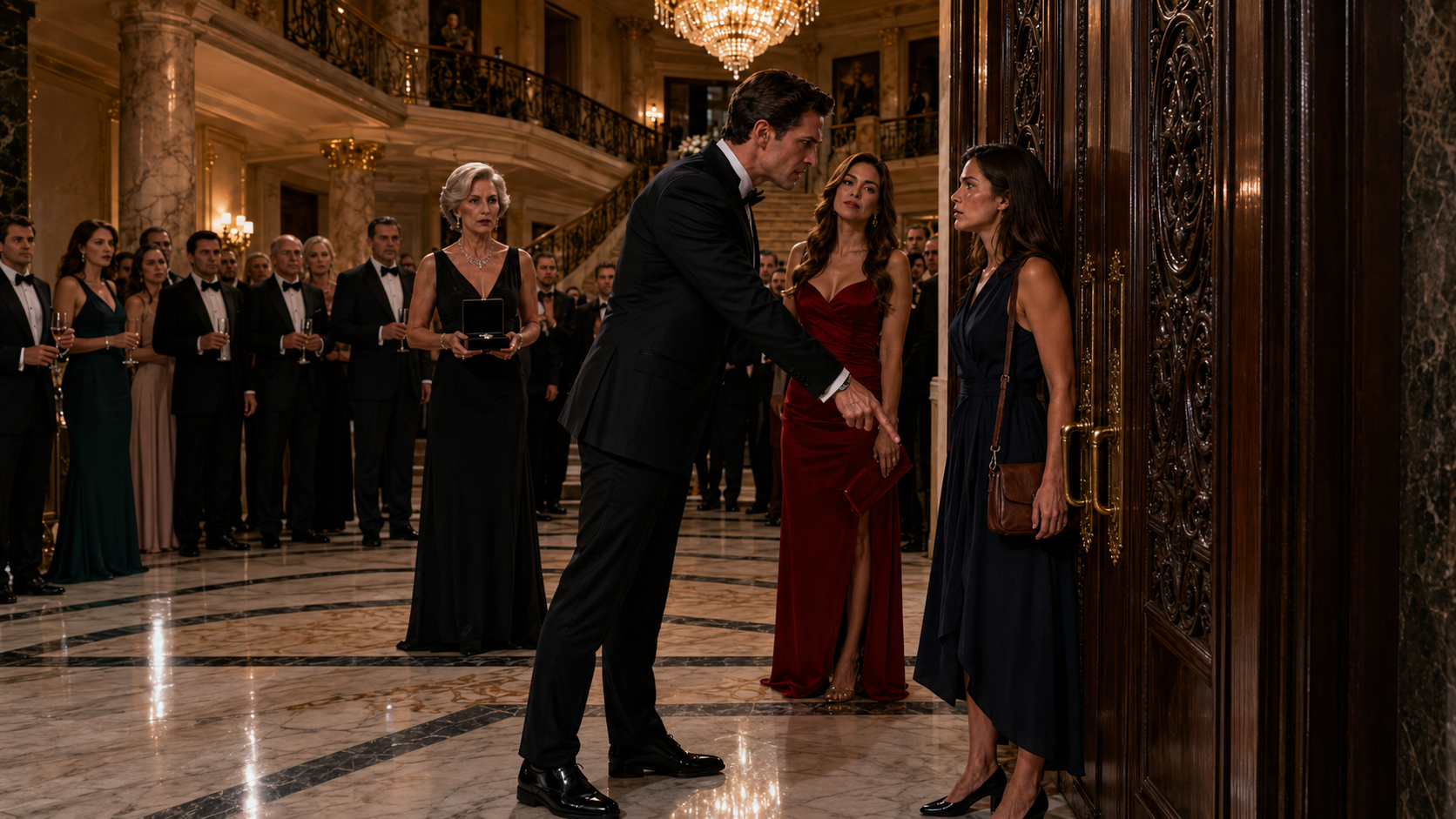
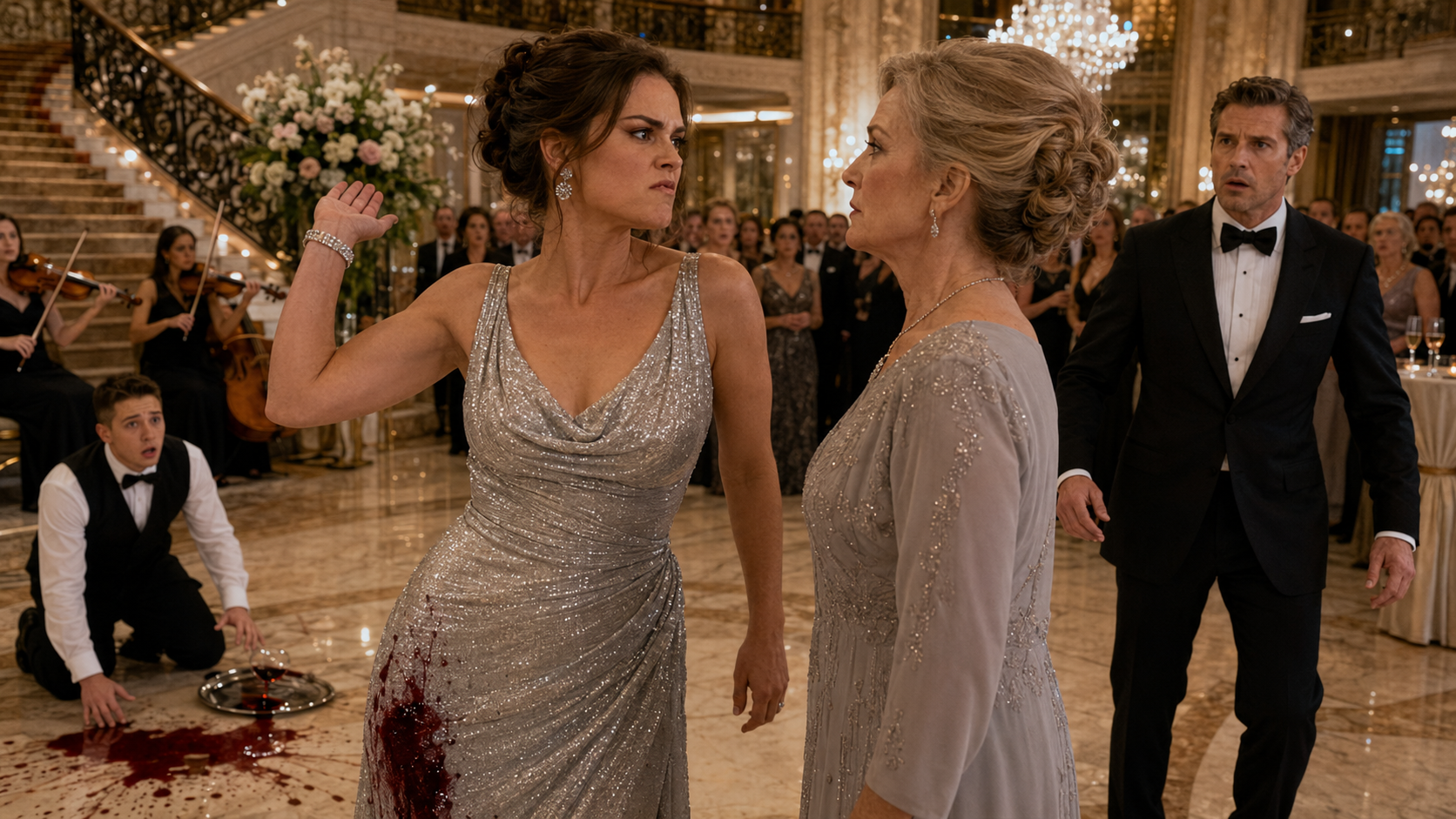
The sound of my husband’s palm striking my face reached the far end of the marble hall before the pain reached me.
For one strange second, I heard everything except myself.
A woman inhaling sharply.
Ice shifting inside a crystal glass.
The faint string music still playing through the hidden speakers.
Somewhere near the staircase, one of the housekeepers whispered my name and then immediately went silent.
My head snapped to the side.
The cut across my palm was already bleeding from where I had caught myself against the shattered edge of the coffee table. A thin line of red ran between my fingers and dropped onto the white marble floor.
I stared at it.
One drop.
Then another.
I remember thinking Margaret would probably complain about the stain.
That was the ridiculous thought that passed through my mind after my husband slapped me in front of thirty guests.
Not Andrew hit me.
Not My marriage is over.
Not even How could he?
I thought about the marble.
Because after four years inside that house, Margaret had trained me to worry about everything except myself.
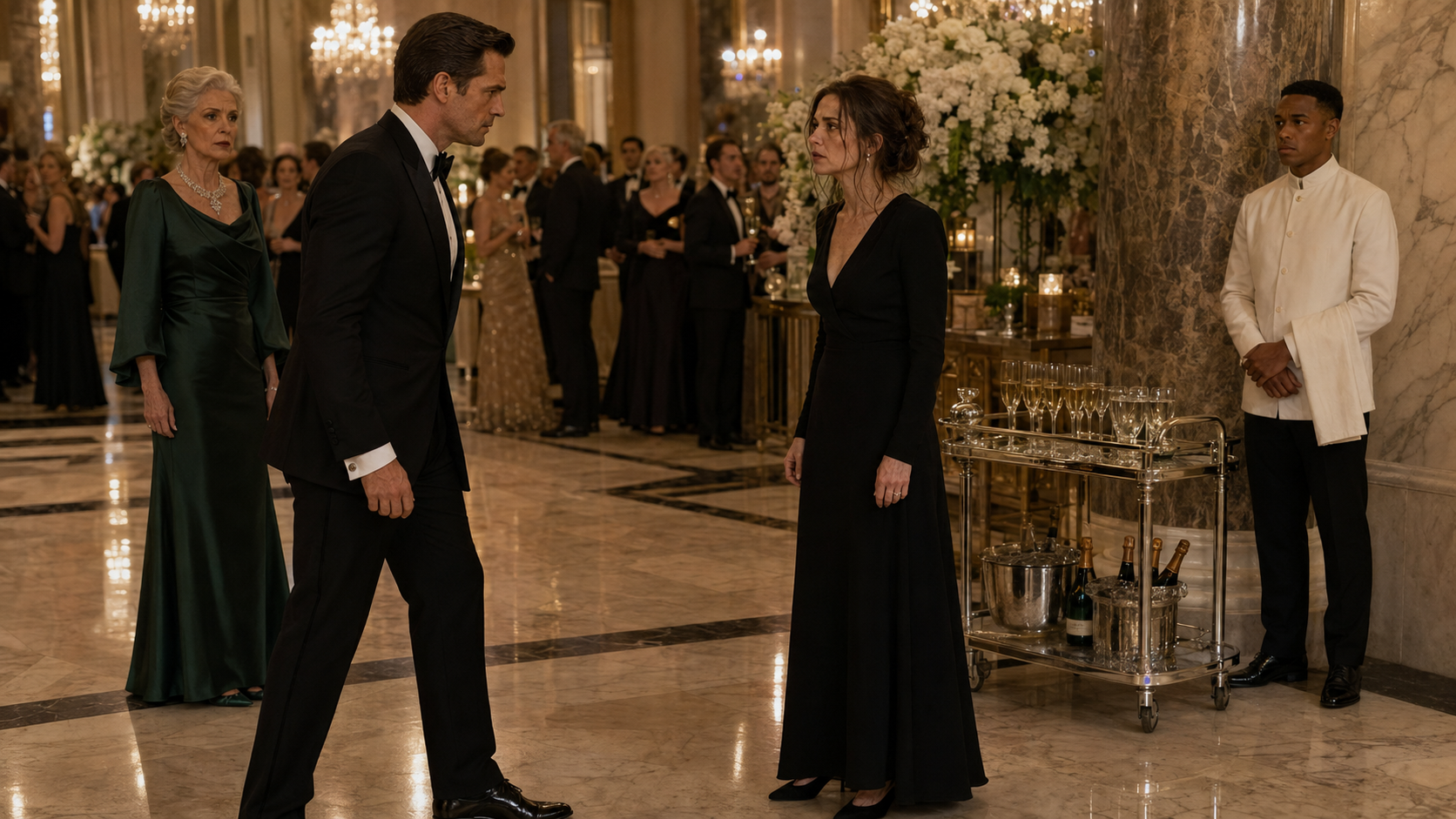
“Mariana.”
Andrew’s voice dragged my attention back to him.
I slowly lifted my face.
He stood less than three feet away.
His right hand was still half-raised.
There was no horror in his expression.
No regret.
No shock at what he had done.
Only anger.
And beneath the anger, something worse.
Satisfaction.
He had finally done what he had been threatening to do in smaller ways for years.
He had put me in my place.
Beside him stood Brenda.
His mistress.
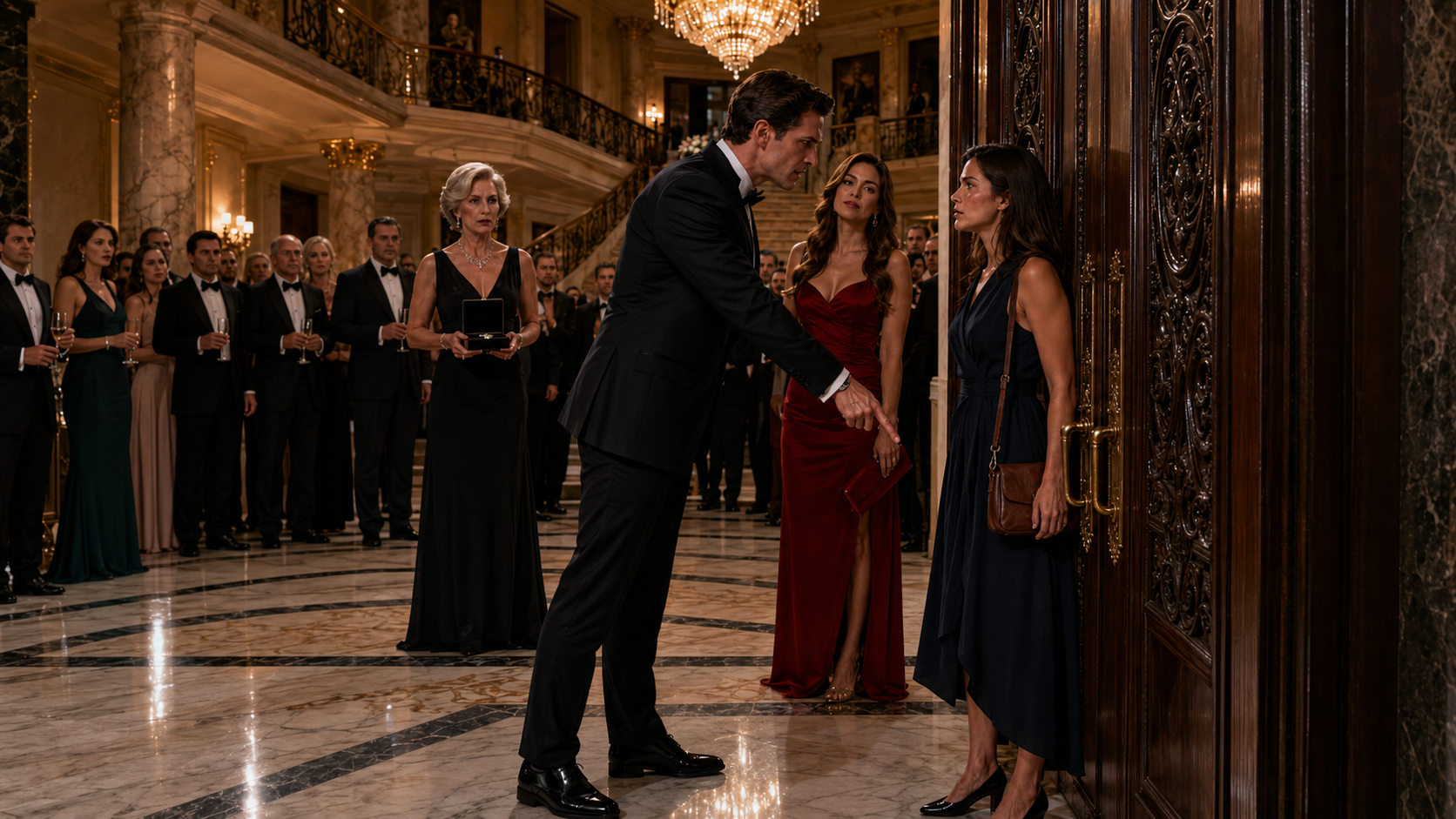
She wore a crimson evening dress that fit her like it had been painted onto her body. One hand rested against Andrew’s arm, perfectly manicured fingers curling around his sleeve as if she had every right to touch him in front of me.
She looked beautiful.
Delicate.
Concerned.
Victimized.
It was almost impressive.
“Andrew,” she murmured, “please don’t get upset because of me.”
Because of her.
I nearly laughed.
Across the room, my mother-in-law, Margaret, held an empty velvet jewelry box in both hands.
Her diamonds glittered against her throat as she looked at me with the same expression she had worn the first time Andrew brought me home.
Disappointment disguised as superiority.
“The emerald necklace belonged to my mother,” she said. “It has been in our family for sixty-three years.”
I pressed my injured hand against the side of my dress.
“I know.”
“And now it’s missing.”
“I know that too.”
Her lips tightened.
“You were upstairs.”
“So were twelve other people.”
“You entered my dressing room.”
“You asked me to bring down your shawl.”
A few guests shifted uncomfortably.
Margaret’s expression hardened.
She hadn’t expected me to answer.
For four years, I had learned that the easiest way to survive her was to remain calm while she cut me open.
She criticized my clothes, and I smiled.
She mocked the neighborhood where she believed I had grown up, and I smiled.
She asked Andrew once, during Christmas dinner, whether he was embarrassed when I mispronounced the name of a French wine.
I had pronounced it correctly.
Margaret had not.
I still smiled.
Tonight, I had run out of smiles.
“I did not take your necklace,” I said.
Andrew struck me again.
Harder.
My shoulder twisted with the force of it.
My wounded hand hit the edge of a console table.
Fresh pain shot through my palm.
The room blurred.
Someone gasped.
This time, even Brenda looked startled.
Only for half a second.
Then she lowered her eyes.
“Don’t you dare disrespect my mother,” Andrew said.
I turned my face back toward him.
My cheek burned.
“So saying I didn’t steal something is disrespect?”
His jaw tightened.
“Don’t make this worse.”
“How?”
I heard my own voice, quiet and strangely steady.
“By telling the truth?”
His face changed.
Andrew had always hated that tone.
Not because I shouted.
I almost never shouted.
He hated when I became calm.
He once told me that my silence made him feel judged.
What he never understood was that I became quiet when I was done trying to make someone understand me.
“We gave you everything,” he said.
The words came louder now, meant for the room.
“Our family name.”
I looked at him.
“Our home.”
My eyes moved briefly toward the chandelier above us.
“Our lifestyle.”
Brenda’s fingers tightened around his arm.
“And this is how you repay us?”
I tasted blood where my teeth had cut the inside of my cheek.
For years, those words had been the foundation of our marriage.
We gave you everything.
Margaret said it whenever she wanted me to feel grateful.
Andrew said it whenever he wanted me to stop questioning him.
Even Brenda had started saying versions of it after she became bold enough to attend our parties openly.
They believed Andrew had rescued me.
A quiet woman with an ordinary handbag and no interest in displaying wealth.
Someone who had arrived without an army of relatives, society photographs, or a famous surname anyone in Margaret’s social circle recognized.
To them, no visible wealth meant no wealth.
No boasting meant no power.
No resistance meant weakness.
Margaret stepped toward me.
“You should be ashamed.”
I met her eyes.
She lifted the velvet box.
“My mother wore this necklace at my wedding. I intended to give it to Andrew’s daughter someday.”
The insult was deliberate.
Andrew and I had no children.
Margaret had spent the previous year telling people that perhaps the family needed “a woman capable of continuing the line.”
Brenda looked down modestly.
I understood the message.
She wasn’t just Andrew’s mistress anymore.
They were auditioning her for my place.
Maybe they had been for months.
Maybe tonight was supposed to be the final humiliation.
I suddenly remembered seeing Brenda near the upstairs hallway earlier that evening.
She had been coming from the direction of Margaret’s bedroom.
When she saw me, she had stopped.
Only for an instant.
Then she smiled.
“Looking for the powder room,” she had said.
The powder room was downstairs.
I had thought about correcting her.
I hadn’t.
Now I wished I had.
Brenda stepped closer to Andrew.
“Don’t waste your evening on this,” she whispered.
Then she looked at me.
Her expression softened into false pity.
“Some people forget where they came from after they get a taste of luxury.”
A few people looked away.
Not because they disagreed.
Because cruelty becomes uncomfortable when someone says aloud what everyone has been expected to politely pretend they don’t see.
Margaret gave a satisfied little laugh.
“I warned Andrew from the beginning. You can put someone in designer clothes. You can teach them the proper people to know. You can bring them into respectable society.”
Her gaze traveled from my shoes to my face.
“But you can never change their blood.”
There it was.
Four years of contempt reduced to one sentence.
My blood.
My background.
The imaginary poverty they had constructed around me.
They had never asked many questions about my family because they had decided the answers in advance.
My father lived abroad frequently.
My mother had died years before I met Andrew.
I never spoke publicly about family money.
I carried the same brown leather purse for six years because my mother had given it to me.
Margaret called it cheap.
Andrew once offered to throw it away and buy me something “appropriate.”
I told him no.
He laughed.
He never asked why.
They never asked why I understood restructuring agreements better than Andrew’s executives.
Why investors who refused to return his calls somehow agreed to meet after I contacted them.
Why a lender extended a deadline hours after I disappeared into Andrew’s study and made three phone calls.
Why the construction loan on the mansion was suddenly refinanced when their family office had been rejected by two banks.
Why the board stopped discussing Andrew’s removal after I quietly attended a meeting as his “supportive wife.”
Andrew had explained each miracle the same way.
Luck.
His reputation.
His negotiating skills.
The strength of the family name.
I let him believe it.
That was my mistake.
Not helping him.
Loving him had not been a mistake either, although standing there with my face burning, I wanted to call it one.
My mistake had been protecting him from the consequences of believing he could never fall.
When Andrew’s company first began collapsing, I didn’t save it to control him.
I saved it because he was my husband.
When his biggest investor threatened to withdraw, I spent two nights building the restructuring plan that convinced them to stay.
When a failed expansion left the company buried in debt, I arranged the capital facility that kept three thousand people employed.
When Margaret’s properties were about to be seized as collateral, I moved them into a rescue structure that bought the family time.
When Andrew’s reputation suffered after an ugly executive scandal, I personally convinced two board members not to resign.
He never knew the full story.
He never wanted to.
As long as the problem disappeared, Andrew accepted whatever explanation preserved his pride.
And I had loved him enough to keep giving him those explanations.
Until tonight.
Something inside me became very still.
Not shattered.
Not defeated.
Finished.
I looked down and saw a small piece of broken glass near my shoe.
The coffee table had shattered ten minutes earlier when Margaret swept a champagne glass aside during the accusation and knocked a decorative sculpture into it.
Everyone had blamed me for that too.
Of course they had.
I bent carefully, picked up my brown leather purse from beside the sofa, and slipped it over my shoulder.
“Where do you think you’re going?”
Andrew laughed.
It was a big, ugly sound.
The kind of laugh a man uses when he wants everyone watching to understand that the person in front of him has no power.
I walked toward the front door.
“Mariana.”
I kept moving.
“Stop.”
I reached the entrance.
The massive carved doors towered above me.
Four years earlier, Andrew had carried me across that threshold after a charity gala, both of us laughing because he had spilled champagne on his jacket.
I remembered wrapping my arms around his neck.
I remembered believing I was safe.
“Tomorrow morning,” I said.
The room quieted.
I didn’t turn around.
“Every single one of you will be begging for my forgiveness.”
Silence.
Then Margaret laughed.
At first softly.
Then harder.
“Oh, dear God.”
She covered her mouth.
“She’s lost her mind.”
Several guests shifted.
One man gave an awkward smile.
Brenda smirked.
“How pathetic.”
Andrew’s footsteps crossed the marble behind me.
He stopped so close I could feel his breath near my ear.
“You want an apology?” he whispered.
I turned.
His face was inches from mine.
“Kneel.”
For a moment, I honestly thought I had misunderstood him.
“What?”
“Kneel.”
His eyes were cold.
“Admit you stole the necklace. Apologize to my mother. Apologize to Brenda for accusing her of turning this family against you.”
I stared at him.
He continued.
“Then crawl out of this house before I call the police.”
Something changed in the room after that.
Even Margaret’s smile faded slightly.
Maybe Andrew had finally crossed a line too ugly to disguise as family discipline.
Maybe people were beginning to realize that tomorrow they would have to remember they had watched this happen.
I studied my husband’s face.
The man I had once stayed awake beside when his company was six hours away from missing payroll.
The man whose shaking hands I had held during his father’s funeral.
The man who used to kiss the scar near my wrist and tell me I was the strongest person he knew.
The man who had spent the last year becoming someone else.
Or perhaps becoming more honestly himself.
Then I looked at Brenda.
The woman already picturing her clothes in my closet.
Her photographs in the hallway.
Her hand beside Andrew’s in every society page.
For the first time that evening, I smiled.
Andrew’s expression flickered.
It wasn’t a sad smile.
It wasn’t desperate.
It was the smile of someone who had finally stopped protecting the person standing in front of her.
“Remember everything you said tonight, Andrew.”
His eyes narrowed.
I looked around the mansion.
“This house.”
Margaret frowned.
“Your company.”
Andrew gave another short laugh.
“Your cars.”
Brenda glanced at him.
“Your investments.”
I paused.
“The fortune you think belongs to you.”
The room became quiet enough that I could hear the fountain outside.
“They all exist because of me.”
Andrew stared at me.
Then he laughed again.
“You actually expect anyone to believe that?”
“No.”
I opened the door.
“I expect you to read the documents you signed.”
His laughter stopped for half a beat.
Then I walked outside.
The night air touched my swollen cheek.
The gates stood beyond the long circular drive.
Behind me, laughter returned.
Smaller this time.
Less certain.
I walked past the fountain, past the imported stone planters Margaret had spent three weeks selecting, and through the gates.
A black SUV was already waiting at the curb.
For the first time that evening, I stopped.
The rear door opened.
A man in a dark tailored suit stepped out.
Daniel Reyes had worked for my father for nearly fifteen years.
He looked once at my face.
His expression changed.
He did not ask what happened.
He opened the door.
“Mrs. Mariana Escalante.”
Behind me, the mansion had gone strangely quiet.
“Your father is waiting at headquarters,” Daniel said. “The legal team has activated every clause you authorized.”
I heard someone behind the gates.
Andrew.
“Mariana?”
I didn’t turn around.
I got into the SUV.
Daniel closed the door.
My hands began shaking only after the lock clicked.
For several seconds, I sat in darkness.
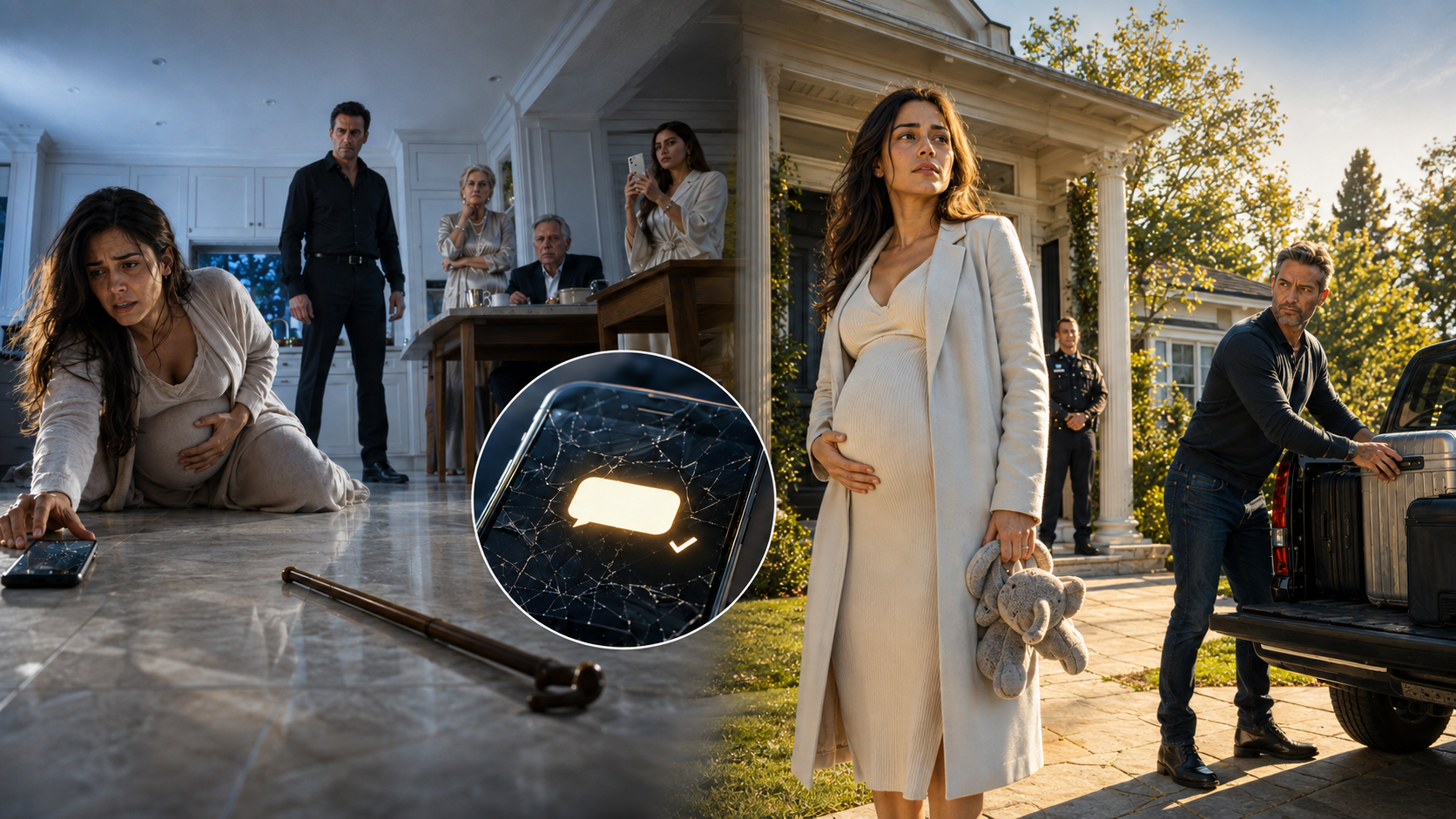
Then I took out my phone.
There were seventeen missed calls from my assistant.
Three from our general counsel.
One from my father.
I called the legal team.
The answer came immediately.
“Mariana?”
“Yes.”
“We’re ready.”
I closed my eyes.
My face hurt.
My hand hurt.
But neither pain mattered anymore.
“Freeze every account under our authority,” I said.
There was a pause.
“Tonight?”
“Tonight.”
“Corporate credit facilities?”
“Yes.”
“Discretionary family spending accounts?”
“Yes.”
“Real estate operating funds?”
“Yes.”
“The vehicle leases?”
“Everything.”
My voice did not shake.
“Effective immediately.”
“Understood.”
I ended the call.
The SUV moved forward.
Through the rear window, I watched the mansion shrink.
A palace of crystal, marble, imported wood and borrowed certainty.
They believed Andrew owned it.
Technically, he never had.
Neither did Margaret.
Not after the rescue agreement three years earlier.
The house belonged to a property company controlled by the investment structure that had saved Andrew’s business.
The vehicles were leased through another entity.
The family expense accounts were funded through distributions Andrew treated like personal income.
His company remained operational because of guarantees he had barely bothered to understand.
The wealth existed.
But not where he thought it did.
Andrew believed he had just thrown a powerless wife out of his home.
He believed he had humiliated a woman with nowhere else to go.
He believed my silence meant surrender.
He was wrong.
He hadn’t abandoned a helpless woman.
He had challenged the woman whose signature had kept his empire alive.
And by sunrise, he was going to learn what happened when that signature disappeared.
PART 2: THE FORTUNE HE NEVER UNDERSTOOD
My father was waiting in the top-floor conference room when I arrived.
It was almost midnight.
Escalante headquarters occupied forty-one floors of a glass tower downtown, but at that hour most of the building was dark.
The executive floor wasn’t.
Lawyers moved between conference rooms.
Analysts sat behind open laptops.
Two members of the restructuring team were speaking quietly beside a screen covered in company accounts and ownership charts.
Everyone stopped when I entered.
Not because I was Andrew’s wife.
Because here, I was not Andrew’s wife at all.
I was Mariana Escalante.
My father rose from the end of the conference table.
Gabriel Escalante was sixty-eight, silver-haired, disciplined, and almost impossible to surprise.
He saw my face.
For the first time in years, my father looked stunned.
“Who did that?”
I set my purse on the table.
“We have work to do.”
“Mariana.”
“Dad.”
His jaw tightened.
“Who?”
I looked at him.
“Andrew.”
The room became completely silent.
My father closed his eyes for one second.
When he opened them, whatever he felt had disappeared behind the expression that had terrified boardrooms for four decades.
“Everyone out.”
No one hesitated.
Within seconds, we were alone except for Elena Vasquez, our general counsel.
My father pointed to a chair.
“Sit.”
“I’m fine.”
“That wasn’t a question.”
Under any other circumstances, I might have smiled.
I sat.
Elena brought the medical kit from a cabinet.
“The hand first,” she said.
“It’s superficial.”
“You’re bleeding on a merger agreement.”
I looked down.
A drop of blood had landed on the corner of a document.
That made me laugh.
One small, exhausted sound escaped my throat.
Then, without warning, tears filled my eyes.
I hated them for coming.
Not because crying was weakness.
Because Andrew had already taken enough from me that night.
I didn’t want to give him tears too.
My father crouched in front of me.
He didn’t say, I told you so.
That made it worse.
Four years earlier, he had warned me about Andrew’s family.
Not because Andrew was poor.
He wasn’t.
The Whitmores had old social standing, valuable connections and the appearance of enormous wealth.
But much of what they displayed had been built on leverage.
Debt.
Reputation.
Constant expansion.
My father noticed that immediately.
I hadn’t cared.
I met Andrew when I was thirty, after spending most of my twenties watching men become interested in me only after discovering who my father was.
I was tired of being introduced as Gabriel Escalante’s daughter.
Tired of wondering whether someone loved me or what stood behind my name.
So when I met Andrew, I let him believe what he assumed.
I didn’t lie about my identity.
My name was Mariana Escalante.
But the Escalante name meant little in Andrew’s social world because my father’s investments were largely private, spread through holding companies with names that never appeared beside ours at galas.
I told Andrew my father worked in investments.
That was true.
I told him I worked in strategy and restructuring.
Also true.
I never told him that my father controlled one of the largest private investment groups in the country.
I never told him the investment portfolio held in trust for me had made me wealthier, on paper, than Andrew’s entire family.
He never asked.
At first, I found that beautiful.
Later, I understood he didn’t ask because he had already decided there was nothing worth knowing.
When we became engaged, my father requested a private meeting.
“You are making yourself smaller for this man,” he told me.
“I’m making sure he loves me.”
“If he loves you only when he thinks you have less power than he does, then he does not love you.”
I became angry.
We didn’t speak for almost two weeks.
Then my father came to the wedding.
He danced with me.
He kissed my forehead.
And he never again criticized my choice.
Not until Andrew’s company began to collapse.
That happened eighteen months into our marriage.
The official explanation was market pressure.
The real problem was ego.
Andrew expanded too quickly.
He bought two competitors at inflated valuations because he wanted to prove he could turn the family business into a national empire.
The debt became unmanageable.
Cash flow dried up.
Senior executives began leaving.
One Thursday night, I found Andrew sitting in his study with his head in his hands.
“We may miss payroll,” he said.
I had never seen him look frightened before.
“How bad?”
He laughed bitterly.
“Bad enough that your strategy degree isn’t going to fix it.”
I ignored the insult.
“Show me.”
For six hours, I read.
Debt schedules.
Loan covenants.
Acquisition agreements.
Cash projections.
By four in the morning, I understood the problem.
By six, I understood the solution.
By noon, I was sitting in my father’s office.
He listened without interrupting.
When I finished, he asked one question.
“Are you asking me to save your husband?”
“No.”
I slid my proposal across the table.
“I’m asking you to invest in a distressed company with recoverable assets, valuable contracts and incompetent capital management.”
My father almost smiled.
“You sound like me.”
“I learned from someone.”
He read the proposal.
Then he shook his head.
“I’ll approve it on one condition.”
“What?”
“The capital comes from your structure.”
I frowned.
My mother had left me a substantial investment trust. Over the years, I had expanded it through my own work inside the family group.
It was mine.
Entirely.
My father refused to let me pretend otherwise.
“If you believe in Andrew,” he said, “then you take the risk.”
I agreed.
That decision changed everything.
My investment vehicle acquired secured preferred shares.
It purchased distressed debt from a lender ready to force Andrew into insolvency.
It guaranteed an emergency operating facility.
Months later, when Margaret’s mansion faced foreclosure after being pledged against a disastrous development project, one of my real estate entities bought the debt and restructured the property.
Andrew signed every document.
His lawyers reviewed them.
Nothing was hidden.
But the entities were called Northstar Strategic Holdings, Westmere Property Group and several other names attached to the Escalante family office.
Andrew never asked who ultimately controlled them.
Why would he?
Money had appeared.
His crisis disappeared.
And I never stood in front of him demanding credit.
I told myself that marriage wasn’t a competition.
That saving the person you loved didn’t require applause.
The trouble was that every time I protected Andrew from collapse, he became more convinced he was incapable of falling.
Eventually, gratitude became entitlement.
Then entitlement became contempt.
Elena finished bandaging my hand.
My father stood at the window.
“He knows now?” he asked.
“Not yet.”
“You told him?”
“I told him the truth. He laughed.”
My father’s shoulders moved once.
That was his version of dark amusement.
Elena sat across from me.
“Before we proceed, I need you to understand exactly what tonight changes.”
“I do.”
“No, Mariana. I need to say it.”
She opened a folder.
“The capital agreements contain key-person and control provisions related to your strategic authority. After Andrew removed you from company operations six months ago, we reserved rights but chose not to enforce them at your request.”
I nodded.
Six months earlier, Brenda had begun appearing in Andrew’s life more openly.
Soon afterward, Andrew told me I was “too involved” in company affairs.
He said investors might think his wife was running the business.
I almost told him that his investors already knew I was the only reason several of them remained.
Instead, I stepped back.
That had been another mistake.
Elena continued.
“The operating facility is renewable monthly. We are not renewing it.”
“Good.”
“Westmere owns the mansion through the restructuring vehicle. The Whitmore family occupies it under a use agreement tied to Andrew’s executive status and payment obligations.”
My father turned.
“Which he has violated.”
Elena nodded.
“His discretionary distributions can be suspended. Corporate cards linked to Northstar-backed accounts are already locked.”
“And the company?”
“We are not shutting it down,” I said immediately.
My father studied me.
“Three thousand employees didn’t slap me.”
He nodded once.
That was the answer he wanted.
I turned to Elena.
“Payroll continues. Vendors continue. Essential operations continue. No employee suffers because of Andrew.”
“And Andrew?”
I looked at the ownership chart.
Northstar’s voting rights had expanded each time the company violated financing covenants.
Andrew never noticed how much control he had surrendered because I had never exercised it against him.
Until now.
“Emergency board meeting at nine.”
Elena wrote it down.
“I’ll call the directors.”
“Not Andrew.”
“He’ll be notified under the bylaws.”
“Fine.”
My father returned to the table.
“And the police?”
I looked at him.
“What police?”
“If his mother accused you of theft and Andrew threatened to call them.”
“He didn’t call.”
“Yet.”
Elena glanced at me.
“There may be something else.”
She rotated her laptop.
“Our security contractor still administers the mansion’s camera system because Westmere owns the property.”
My body went still.
Elena continued.
“After Daniel saw your face, I requested preservation of tonight’s footage.”
My father stared at the screen.
“So?”
“We haven’t reviewed all of it.”
I remembered Brenda coming downstairs from Margaret’s suite.
The powder room lie.
The satisfied look on her face when Margaret produced the empty box.
“Check the upstairs hallway between seven and eight.”
Elena looked at me sharply.
“Why?”
“Because Brenda was there.”
My father leaned forward.
“Did you see her enter Margaret’s room?”
“No.”
“Then we don’t assume.”
“I know.”
I stood.
“We verify.”
Elena sent the request.
While we waited, my phone began vibrating against the conference table.
ANDREW.
I watched it ring.
Then stop.
Ten seconds later, it rang again.
ANDREW.
Again.
Then a message appeared.
Come back before you embarrass yourself any further.
I stared at it.
Another arrived.
Mother is willing to forget tonight if you apologize.
Then:
You have thirty minutes.
I felt something cold settle inside me.
An hour earlier, I might have been devastated by the cruelty.
Now I could see the fear hidden underneath it.
He had watched Daniel open the SUV door for me.
He had heard my full name spoken with respect.
He had seen the car waiting before I called anyone.
Somewhere inside him, the first crack had appeared.
Another message.
Who was that man?
I turned the phone face down.
Elena’s computer chimed.
She opened a video file.
The image showed the upstairs corridor of the mansion.
Timestamp: 7:14 p.m.
We watched Brenda walk into frame.
She looked behind her.
Then entered Margaret’s bedroom.
My pulse slowed.
Three minutes passed.
Brenda emerged.
She was holding something small against her side.
She slipped it into her clutch.
Then walked toward the staircase.
Elena froze the frame.
My father’s expression became hard.
“That’s enough.”
I shook my head.
“No.”
“Mariana.”
“I want the rest.”
We advanced the footage.
At 8:02, Brenda returned upstairs with Margaret.
They entered the room together.
At 8:06, they emerged.
Margaret was holding the empty jewelry box.
Brenda touched her arm.
They spoke.
There was no audio.
But Brenda smiled.
My stomach tightened.
The accusation hadn’t been spontaneous.
Margaret had known.
Maybe not from the beginning.
But before she walked downstairs and accused me, she knew Brenda had been inside her room.
She chose me anyway.
Maybe because framing me was easier than admitting the woman she wanted as my replacement was a thief.
Or maybe because humiliating me had always been the point.
Elena looked at me.
“We don’t know what Brenda removed from the room.”
“Not yet.”
Another file appeared.
Downstairs foyer camera.
7:18.
Brenda walked through the hall.
She opened her clutch.
For less than two seconds, a green stone flashed beneath the chandelier.
Emerald.
Elena stopped the image.
No one spoke.
My phone vibrated again.
This time it was Margaret.
Return the necklace and we will avoid involving the authorities.
I laughed.
I couldn’t help it.
The sound was soft and empty.
My father looked at me.
“What do you want to do?”
I picked up my phone.
Andrew had ordered me to kneel.
Margaret had called my blood inferior.
Brenda had smiled while my husband hit me for a crime she appeared to have committed.
An hour earlier, I had promised them that by morning they would beg.
I had meant it as anger.
Now it was becoming a schedule.
I looked at Elena.
“Send preservation notices for every camera angle.”
She nodded.
“Do not release the footage.”
“Not yet?”
“Not yet.”
My father understood first.
“You want them at the board meeting.”
“Yes.”
“Why?”
I looked through the glass wall at the city lights below us.
“Because Andrew has spent four years believing I survive because he allows me to.”
I picked up my cheap brown purse.
“Tomorrow morning, I want him to understand exactly who was allowing whom.”
PART 3: SUNRISE
At 6:11 the next morning, Andrew’s first corporate card was declined.
I knew because the automated alert reached Elena’s system.
At 6:23, his driver tried to refuel one of the company vehicles.
Declined.
At 6:31, Margaret’s household manager attempted to pay an overdue floral invoice through the estate operating account.
Payment suspended.
At 6:44, Andrew’s chief financial officer called him.
I wasn’t there, but I later learned the conversation lasted nine minutes.
At 6:58, Andrew called me.
I was standing in my father’s guest suite, staring at the bruise darkening along my cheek.
I let the phone ring twice.
Then I answered.
“Good morning.”
“What did you do?”
No greeting.
No apology.
Not even surprise that I answered.
I walked toward the window.
“What are you talking about?”
“Don’t play games with me.”
His breathing was heavy.
“My cards are frozen. The company credit line is locked. Finance says Northstar suspended the facility.”
“Then perhaps you should call Northstar.”
“I did.”
I almost smiled.
“And?”
“They told me to attend a board meeting at nine.”
“Sounds important.”
“Mariana.”
There was a pause.
His voice changed.
Not softer.
More careful.
“Did you have something to do with this?”
I watched traffic moving through the streets below.
“You should get dressed.”
“What?”
“You don’t want to be late.”
He went silent.
Then he laughed.
But there was no confidence in it.
“Do you seriously think this is funny?”
“No.”
“Do you even understand what’s happening? This company supports everything we have.”
“I understand that better than you do.”
“Stop speaking to me like that.”
There he was.
The old Andrew.
Power slipping away, so he reached for tone.
I touched my bruised cheek.
“You hit me twice.”
He was silent.
“You ordered me to kneel.”
“Mariana, don’t start.”
“Don’t start?”
“Last night got out of control.”
I closed my eyes.
Three words.
That was the closest he had come to admitting anything.
Got out of control.
As though the evening were weather.
As though his hand had belonged to the storm.
“You accused my mother of lying,” he said.
“I said I didn’t steal the necklace.”
“You humiliated Brenda in front of everyone.”
“I barely spoke to Brenda.”
“She was trying to calm things down.”
I actually laughed.
Andrew stopped talking.
“What’s funny?”
“Nothing.”
“Tell me.”
“You still think Brenda was helping you.”
His voice sharpened.
“What is that supposed to mean?”
“You’ll find out at nine.”
“Mariana.”
I ended the call.
He called back immediately.
I turned the phone off.
By seven-thirty, I was dressed.
Not in anything dramatic.
No red revenge dress.
No diamonds.
No costume designed to tell the world I had money.
I wore a dark suit, simple earrings and my mother’s old leather purse.
When my father saw me in the hallway, his eyes dropped to the bag.
“Still carrying that thing?”
I looked at him.
“You sound like Margaret.”
He smiled.
“Your mother paid eighty dollars for it at a market in Florence and then told me it cost twenty because she thought I’d complain.”
My fingers tightened around the strap.
“I miss her.”
“So do I.”
He looked at my face.
“She would hate what happened to you.”
“I know.”
“She would also be proud you’re ending it.”
That hurt more than I expected.
I looked away.
My marriage had not become cruel overnight.
That was what people never understood about these things.
Andrew hadn’t slapped me on our first date.
He hadn’t insulted me on our honeymoon.
He had been charming.
Attentive.
Ambitious.
He loved that I challenged him then.
Or said he did.
The first change came after I helped save his company.
Success returned, and with it came Andrew’s need to believe success had always belonged to him.
When executives praised a strategy I developed, he interrupted to explain what we had decided.
When investors asked me direct questions, he answered for me.
When Margaret mocked my background, he told me she was from another generation.
Then Brenda joined the company as a luxury partnerships consultant.
She was everything Margaret thought I should have been.
Old family.
Expensive schools.
Perfect social connections.
She understood when to laugh at a senator’s joke and which fork Margaret wanted used at dinner.
At first, Andrew complained about Brenda.
Too dramatic.
Too ambitious.
Too interested in being seen.
Six months later, he started defending her.
A year later, he changed his phone password.
Three months ago, I saw them leaving a hotel together.
Andrew told me I had misunderstood.
I didn’t believe him.
But I didn’t leave.
That was the part I would have to forgive myself for.
Not because I was weak.
Because I remembered who he had been, and I kept hoping that man would return.
I had mistaken memory for evidence.
At 8:40, Daniel drove me to Whitmore Industries.
Employees were already gathering in the lobby.
Whispers followed me.
Some looked at the bruise on my face.
Others looked quickly away.
I recognized people I had worked beside during the crisis years.
Maya from operations.
Thomas from procurement.
A receptionist named Lucy whose maternity leave Andrew had once wanted to cut during the financial emergency until I stopped him.
Lucy saw me.
Her eyes widened.
“Mrs. Escalante?”
“Good morning, Lucy.”
“Are you all right?”
The question almost broke me.
Four years in Margaret’s mansion, and no one had asked me that last night.
I smiled faintly.
“I will be.”
The elevator took me to the executive floor.
Elena was waiting.
“They’re all here.”
“Andrew?”
“Arrived eight minutes ago.”
“Margaret?”
Elena hesitated.
“With Brenda.”
Of course.
I looked at my father.
“Did you invite them?”
“No.”
Elena almost smiled.
“Andrew did.”
That made perfect sense.
He still believed Brenda belonged beside him.
Even now.
Maybe especially now.
We walked toward the boardroom.
The doors were closed.
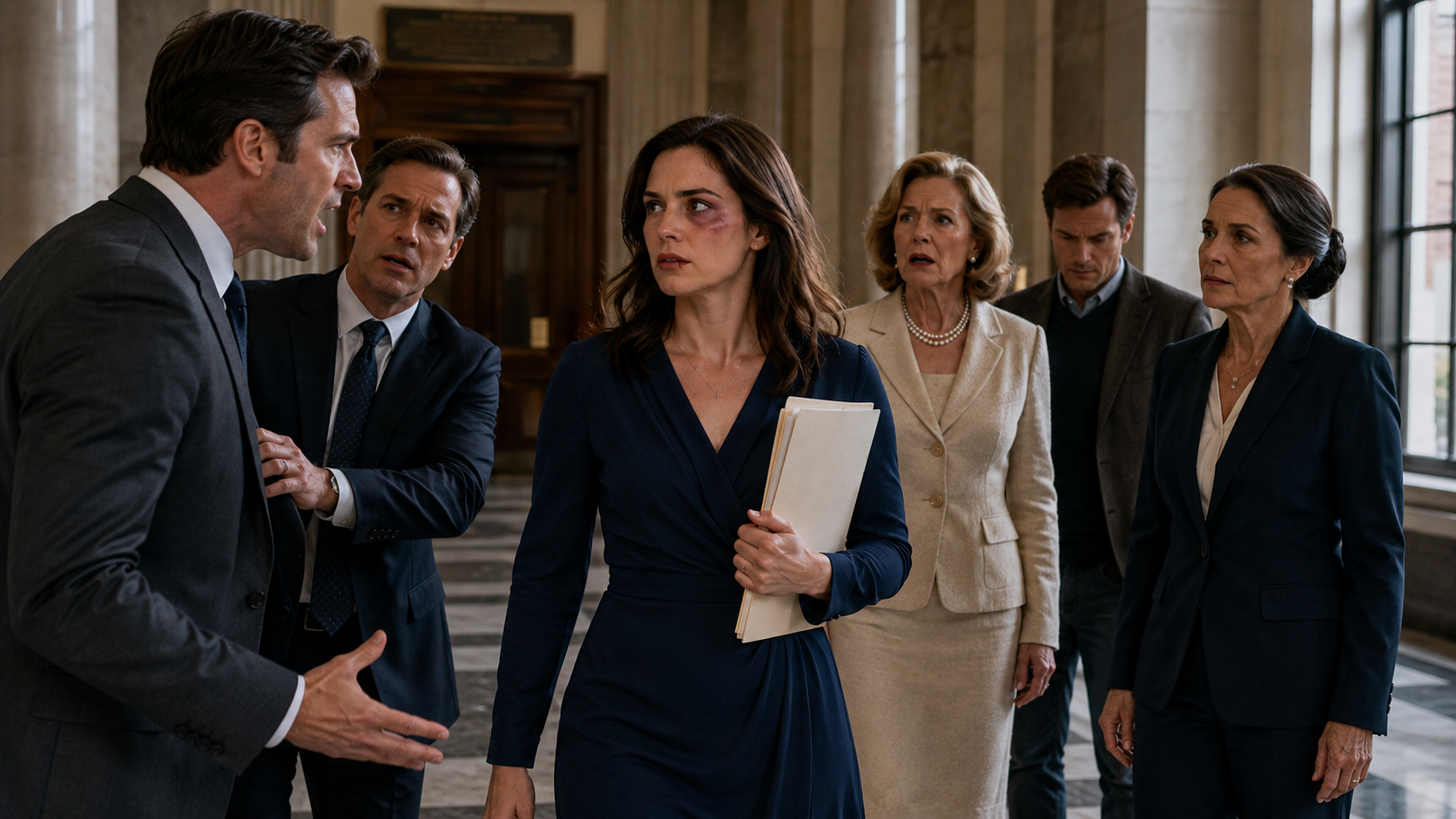
Through the glass wall, I could see Andrew pacing.
Margaret sat rigidly beside him.
Brenda was whispering something into his ear.
Six directors occupied the opposite side of the table.
The CEO seat at the head remained empty.
Andrew looked up.
Saw me.
Stopped moving.
His face changed when he saw my father beside me.
Not recognition.
Not immediately.
Then one of the directors rose.
“Mr. Escalante.”
Andrew turned toward him.
The director shook my father’s hand.
“Gabriel. Thank you for coming personally.”
All color left Andrew’s face.
He looked at my father.
Then at me.
Then back at my father.
“Gabriel… Escalante?”
My father didn’t answer.
He pulled out a chair for me.
Andrew stared.
“Your father?”
For four years, he had heard me say, My father is traveling.
My father has a meeting.
My father works in investments.
He had never once asked for more.
I sat at the head of the table.
Andrew remained standing.
“This is some kind of joke.”
One of the directors cleared his throat.
“No, Andrew.”
He looked around.
“Why is she sitting there?”
Elena placed a thick folder in front of him.
“Because Northstar Strategic Holdings requested the emergency meeting.”
Andrew looked at me.
“What does that have to do with Mariana?”
I opened my own copy of the documents.
“Sit down.”
His eyes widened.
“Excuse me?”
“You ordered me to kneel last night.”
My voice remained calm.
“Today I’m only asking you to sit.”
No one moved.
Then Margaret stood.
“I will not tolerate this melodrama.”
She pointed at my father.
“I don’t care who your father is. Andrew built this company.”
My father finally spoke.
“No.”
His voice was quiet.
“Andrew inherited this company.”
Margaret went pale.
“And my daughter saved it.”
Brenda’s eyes moved toward Andrew.
“What’s he talking about?”
Andrew slammed his hand against the table.
“Enough.”
I opened the first document.
“Three years ago, Whitmore Industries had forty-eight hours before violating its primary credit facility.”
Andrew stared at me.
“You knew that.”
“Yes.”
“You told me Northstar came in.”
“Correct.”
“Northstar invested in us.”
“Correct.”
“What does that have to do with you?”
I pushed a page across the table.
“Read the beneficial ownership disclosure.”
He didn’t touch it.
“Read it, Andrew.”
Finally, he looked down.
I watched his eyes move across the page.
Once.
Then again.
His mouth opened.
No sound came out.
Brenda leaned closer.
“What?”
Andrew didn’t answer.
Margaret snatched the document.
Her face changed.
“Escalante Family Investment Trust?”
I folded my hands.
“Northstar is controlled through my family’s investment office. The capital used for your rescue came from the portfolio assigned to me.”
Andrew looked at me.
“That’s impossible.”
“No.”
“You never told me.”
“You never asked.”
“I would have known.”
“You signed the documents.”
“You expect me to believe that all this time—”
“I wrote the restructuring proposal.”
Silence.
“I negotiated the lender settlement.”
His face hardened.
“I brought your largest investor back after he decided to leave.”
One of the directors nodded slowly.
Andrew noticed.
He turned.
“You knew?”
The director looked uncomfortable.
“We knew Mariana was involved.”
“Involved?”
Another director spoke.
“Andrew, everyone in this room knew she was the reason Northstar stayed.”
Andrew stared at them as if they had betrayed him.
I almost felt sorry for him.
Almost.
“Your operating line exists because of a guarantee under my control,” I said. “The preferred shares you issued carry voting conversion rights after covenant violations.”
Andrew looked down at the papers.
“No.”
“Your company triggered three.”
“No.”
“Two last quarter. One six months ago.”
His eyes lifted.
“You said those were resolved.”
“They were.”
“Then you can’t—”
“Resolved because I waived enforcement.”
The boardroom became completely still.
Andrew stared at me.
I watched understanding arrive in pieces.
Every crisis.
Every sudden extension.
Every unexplained lender concession.
Every investor who changed his mind.
He had built a mythology around himself because the alternative required him to admit that his supposedly ordinary wife had been standing between him and ruin.
Margaret’s voice came out thin.
“The house.”
I looked at her.
She knew.
Perhaps before Andrew did.
“The house,” she repeated.
“Westmere Property Group owns the secured title under the restructuring agreement.”
Her lips parted.
“You said the lender was paid.”
“It was.”
“Then the house belongs to us.”
“No.”
I pushed another document across.
“The debt was purchased. The property transferred into the rescue entity. You received occupancy rights.”
Margaret stared at the signature page.
Her own name was there.
She had signed it.
She had simply never cared who stood on the other side of the transaction.
“That is our family home.”
“I know.”
“You can’t take it.”
“I didn’t take it.”
I looked directly at her.
“You lost it three years ago.”
Brenda stepped away from Andrew.
Only half a step.
But I saw it.
So did he.
His eyes flicked toward her.
I continued.
“The cars are leased through corporate entities. The investment distributions supporting your household spending are discretionary. The company remains alive because the financing structure remains alive.”
Andrew finally sat.
“What do you want?”
There it was.
Not How could you hide this?
Not Why did you save us?
Not What have I done?
What do you want?
The language of a man who still believed everything could be negotiated.
“I want exactly what I told you last night.”
His jaw tightened.
“An apology?”
“Eventually.”
I leaned back.
“But first, I want you to understand the situation.”
I looked around the table.
“Whitmore Industries will continue operating. Payroll will be funded. Vendors will be paid. No employee will lose a job because of a private family dispute.”
Several directors visibly relaxed.
“However, Andrew is suspended from executive authority pending a governance review.”
He shot to his feet.
“You can’t do that.”
The chairman spoke before I could.
“The board can.”
Andrew looked at him.
“And the board just did.”
His face went white.
Brenda whispered, “Andrew…”
He ignored her.
“You planned this.”
I looked at my bandaged hand.
“No.”
Then I looked at him.
“I planned to stay married to you.”
That silenced him.
“I planned to help you rebuild.”
My throat tightened, but I didn’t let my voice break.
“I planned to grow old with you.”
He stared.
“You changed the plan.”
For the first time since I entered the room, something close to shame crossed his face.
Then Margaret ruined it.
“This is extortion.”
I turned toward her.
“No.”
“You are punishing us because of one argument.”
“One argument?”
Her eyes avoided my bruised face.
I let the silence sit between us.
Then I reached for Elena’s laptop.
“We should discuss the necklace.”
Brenda froze.
It was so small most people might have missed it.
I didn’t.
Neither did Elena.
Andrew frowned.
“What about it?”
I opened the first security clip.
Brenda appeared on-screen.
Walking upstairs.
Entering Margaret’s bedroom.
Andrew looked at the monitor.
His expression sharpened.
“Brenda?”
She forced a laugh.
“I told you. I was looking for the powder room.”
I switched to the next frame.
She emerged from the bedroom holding something against her side.
Another click.
Downstairs.
Her clutch opened.
A green stone flashed under the chandelier.
Margaret stopped breathing.
Andrew slowly turned toward Brenda.
She stepped backward.
“That’s not what it looks like.”
I said nothing.
Andrew looked at the screen again.
Then at her.
“What is in your purse?”
“Andrew—”
“What is in your purse?”
Her face crumpled.
Not dramatically this time.
Not beautifully.
Genuinely.
She clutched the crimson handbag against her body.
Margaret stood.
“Give it to me.”
“Margaret…”
“Give it to me!”
Brenda’s hands shook as she opened the clasp.
For one second, nothing happened.
Then she reached inside.
And placed Margaret’s emerald necklace on the boardroom table.
The sound it made was almost nothing.
A soft click against polished wood.
But it was louder to me than Andrew’s slap had been.
Because that tiny sound ended every lie at once.
Andrew stared at the necklace.
Then at Brenda.
Then at me.
I watched horror spread across his face.
He remembered.
The accusation.
The slap.
The second slap.
The order to kneel.
He had done all of it for a lie.
And he had done it eagerly.
“Mariana…”
I stood.
“No.”
He took a step toward me.
“Mariana, I didn’t know.”
“That’s the problem.”
He stopped.
“You didn’t know.”
My voice trembled now, but I didn’t care.
“You didn’t know, and you hit me anyway.”
His face collapsed.
“I thought—”
“You thought what?”
My eyes burned.
“That because your mother accused me, I deserved it?”
“No.”
“That because Brenda looked innocent, I deserved it?”
“No.”
“That because you believed I had nowhere else to go, you could make me kneel?”
“Mariana, please.”
Behind him, Brenda was crying.
Margaret stared at the necklace like it had become poisonous.
I picked up my purse.
Last night, Andrew had ordered me to crawl out of his house.
This morning, he finally understood.
It had never been his house.
And I had never been the powerless one.
PART 4: THE PRICE OF HUMILIATION
Andrew followed me into the hallway.
“Mariana.”
I kept walking.
“Please.”
That word stopped me.
Not because I wanted to hear it.
Because I had almost forgotten what it sounded like in his mouth.
I turned.
The boardroom doors closed behind him.
For the first time in four years, Andrew looked small.
Not physically.
Andrew was still tall, polished, handsome in the expensive way photographs loved.
But the certainty around him had disappeared.
He looked like a man who had stepped onto a staircase in the dark and discovered there was no next step.
“I was wrong,” he said.
I waited.
He swallowed.
“I shouldn’t have hit you.”
“No.”
“I lost control.”
“You made a choice.”
“Mariana—”
“Twice.”
His eyes dropped.
“I know.”
“And then you ordered me to kneel.”
He pressed both hands against his face.
“I know.”
“No, Andrew.”
I stepped closer.
“You know the words now. I’m not sure you understand them.”
He looked at me.
“You were standing beside the woman you were sleeping with. Your mother was calling me inferior. Your guests were watching. You believed I had stolen something, and instead of asking one question, you hit me.”
“I believed Brenda.”
“Exactly.”
He flinched.
“You believed everyone except your wife.”
He leaned against the wall.
For a moment neither of us spoke.
I remembered another hallway.
Another year.
Andrew coming out of a hospital room after his father died.
He had collapsed against me then.
I held him for almost an hour.
Grief had made him helpless.
Love had made me patient.
That memory rose so vividly that for one terrible second, I wanted to reach for him.
I curled my injured hand into a fist instead.
“Why didn’t you tell me?” he asked.
I almost couldn’t believe it.
“About the money?”
“About Northstar. Your father. All of it.”
“Would it have changed last night?”
He opened his mouth.
“Would you have hit me if you knew I controlled Northstar?”
His silence answered.
I felt something inside me finally break.
Not my heart.
The last excuse I had been making for him.
“That’s why I didn’t tell you.”
His face tightened.
“What does that mean?”
“When we met, I wanted someone to love me without caring about my family’s money.”
“I loved you.”
“I think you did.”
He looked wounded.
The strange thing was, I meant it.
Andrew had loved me once.
But love without respect rots.
Sometimes slowly enough that you don’t smell it until the whole house is poisoned.
“You loved me when you thought I needed you,” I continued. “You liked being the stronger one. The richer one. The one who opened doors for me.”
“That’s not true.”
“Isn’t it?”
I tilted my head.
“Every time I became useful to your business, you pushed me further away.”
“I was under pressure.”
“When investors praised me, you interrupted them.”
“Because I’m the CEO.”
“When your mother insulted me, you told me to be grateful.”
“She didn’t mean—”
“Stop.”
He went silent.
“No more explaining people to me.”
My voice lowered.
“I spent four years explaining you to myself.”
That hit him.
I saw it.
I turned to leave.
“Are you taking everything?”
His question followed me.
I stopped.
Behind it was fear.
The kind of fear I had seen in his study when the company nearly failed.
I faced him.
“I’m taking back control of what I own.”
“The house?”
“Westmere will terminate the family use agreement according to its terms.”
“My mother will have nowhere to go.”
“Your mother owns other property.”
“Not like that.”
“No.”
I glanced toward the conference room.
“Probably not with imported marble.”
His jaw clenched.
There was the old anger again.
It appeared whenever reality refused to respect his pride.
“You want to humiliate us.”
I stared at him.
“Don’t confuse consequences with humiliation.”
He flinched.
“I did not invite thirty people to watch this.”
My fingers touched my cheek.
“You did.”
The boardroom doors opened.
Margaret came out.
She looked ten years older.
Behind her, Brenda was nowhere to be seen.
Margaret stopped when she saw us.
“Mariana.”
I had heard her say my name thousands of times.
Never like that.
Carefully.
Almost respectfully.
I hated how much that proved.
She could have treated me this way all along.
She simply hadn’t believed she needed to.
“Where is Brenda?” Andrew asked.
Margaret’s face hardened.
“Gone.”
“With the necklace?”
“I have it.”
Andrew looked away.
Margaret turned to me.
“I owe you an apology.”
The words came stiffly.
I waited.
She clearly wanted me to rescue her from the discomfort.
I didn’t.
Her eyes flicked toward my bruise.
“I accused you without sufficient evidence.”
I almost smiled.
“That is your apology?”
Her lips tightened.
“I was upset.”
“There it is.”
“What?”
“The explanation.”
I moved closer.
“You people have explanations for everything.”
She looked offended.
“Mariana—”
“You insulted me for four years.”
Her eyes widened.
“You called me common. You mocked my clothes. My voice. My education.”
“I never mocked your education.”
“You told Brenda last Christmas that no degree can teach class.”
Margaret looked away.
I continued.
“You said my blood couldn’t be changed.”
“I was angry.”
“You told your son I wasn’t good enough to carry his children.”
Her face lost color.
Andrew stared at her.
“You said that?”
Margaret ignored him.
I could feel the anger rising now.
For years, I had swallowed it because I believed dignity required silence.
I understood something that morning.
Dignity did not mean silence.
Sometimes dignity meant saying every word they had trained you to bury.
“You didn’t hate me because I was poor,” I said.
Margaret’s chin lifted.
“You hated me because you thought I was.”
She went still.
“You thought kindness was something people bought with status. You thought I had to earn basic respect because you believed I came from nothing.”
“That is unfair.”
“No.”
My voice softened.
“Unfair was standing in your house bleeding while everyone watched your son hit me for something I didn’t do.”
She had no answer.
I looked at Andrew.
“Unfair was being told I owed you gratitude for a life I was financing.”
His eyes closed.
Margaret sat heavily on a bench near the elevators.
“What happens now?”
The question was barely audible.
“To the company?”
“To us.”
I took a breath.
“The board will appoint interim leadership. Andrew will receive whatever compensation he’s legally entitled to. Nothing more.”
Margaret’s hands tightened together.
“The house?”
“You’ll receive formal notice.”
“How long?”
“Enough time to move.”
Her eyes lifted.
For the first time, there was no superiority in them.
Only fear.
“Please.”
I heard it again.
That word.
Andrew last night:
Kneel.
Andrew this morning:
Please.
Margaret last night:
You can never change their blood.
Margaret this morning:
Please.
I had thought I would enjoy it.
I didn’t.
Justice felt cleaner in imagination.
In reality, it carried the weight of remembering that these were people I had once called family.
“I won’t put you on the street,” I said.
Margaret exhaled.
“But you will leave the mansion.”
Her relief vanished.
“The household staff will be offered employment elsewhere if they choose. Their wages will not be affected.”
Andrew stared at me.
“You’re protecting the staff?”
“Yes.”
“After what happened last night?”
“They didn’t hit me.”
“What about the guests?”
“They aren’t my concern.”
He lowered his head.
I had one more thing to say.
“Do not call me today.”
He looked up.
“Mariana.”
“Do not come to my father’s building. Do not come to wherever I’m staying. My attorney will contact you regarding separation.”
The word struck him.
“Separation?”
I looked at him.
“What did you think happened last night?”
His face twisted.
“I thought you’d come home.”
The honesty of it was almost unbearable.
He truly had.
He had believed I would return.
Apologize.
Accept the blame.
Sleep beside him.
Wake up the next morning and continue protecting the life he had built on top of me.
Something like pity moved through me.
Then disappeared.
“That’s the part you’ll have to live with, Andrew.”
“What?”
“You thought I would always come back.”
I walked toward the elevator.
He called after me once.
I didn’t turn.
The doors opened.
My father was inside.
He had clearly been waiting.
I stepped in beside him.
The doors began to close.
At the last moment, Andrew moved forward.
“Mariana!”
I met his eyes through the narrowing gap.
“I am sorry.”
For the first time, I believed he meant it.
That did not mean I owed him another chance.
The doors closed.
My father stood beside me in silence.
We descended three floors before he spoke.
“Do you feel better?”
“No.”
He nodded.
“Good.”
I looked at him.
He slipped his hands into his pockets.
“People confuse justice with feeling good. They’re not the same.”
I leaned my head against the mirrored elevator wall.
“I loved him.”
“I know.”
“I might still.”
“I know that too.”
I closed my eyes.
The worst part of betrayal isn’t discovering that the person you love can hurt you.
It’s discovering that love doesn’t disappear on command when they do.
My father touched my shoulder.
“But you can love someone and still leave.”
The elevator doors opened.
For once, I didn’t argue with him.
PART 5: WHAT I TOOK BACK
The Whitmore mansion looked different three weeks later.
Maybe because I approached it knowing exactly who owned the ground beneath my feet.
Maybe because Margaret had already removed half the paintings from the walls.
Maybe because a house stops looking like a palace the moment you no longer believe it can imprison you.
I returned for my personal belongings.
Elena offered to send movers.
I refused.
There were things I needed to collect myself.
Not jewelry.
Not designer clothes.
Memories.
My mother’s purse had already left with me.
That mattered most.
Andrew was waiting in the foyer.
He had lost weight.
His suit looked slightly too large.
For once, Brenda wasn’t beside him.
I had learned through company counsel that she had resigned the morning after the board meeting.
Margaret had declined to press charges over the necklace.
That was her decision.
I didn’t interfere.
Brenda had sent me a message two days later.
Six paragraphs.
Apologies.
Excuses.
Claims that she never expected Andrew to hit me.
Claims that she took the necklace because Margaret had made her feel she needed to prove something.
Claims that she panicked.
I deleted it without answering.
Brenda had betrayed me.
But Andrew had made his own choice.
I refused to let him hide behind her.
“Your things are upstairs,” Andrew said.
“Thank you.”
We stood facing each other.
Strangers with too many memories.
“The movers come tomorrow,” he said.
“I know.”
“Mother is staying with her sister.”
I nodded.
“The board confirmed David as interim CEO.”
“I know.”
“He is good.”
“He is.”
Andrew gave a humorless laugh.
“You recommended him two years ago.”
“I remember.”
“I rejected him.”
“I remember that too.”
He looked around the foyer.
For the first time since I had known him, the mansion was quiet.
No servants rushing.
No party preparations.
No Margaret directing flowers.
No Brenda laughing too loudly.
Just echoes.
“I spent my entire life believing this house meant something,” he said.
I didn’t answer.
“My grandfather bought the original property. My father rebuilt it. I thought…”
He shook his head.
“I thought it proved we were successful.”
“It proved your family knew how to spend money.”
To my surprise, he laughed.
A genuine laugh.
Small.
Sad.
“I deserved that.”
I walked toward the staircase.
“Mariana.”
I stopped.
“Can we talk before you leave?”
“We’re talking now.”
“You know what I mean.”
I turned.
His eyes went to my cheek.
The bruise had faded to yellow.
Soon it would disappear.
The memory would take longer.
“I’ve replayed that night every day,” he said.
“I haven’t.”
That surprised him.
“I don’t need to replay it. I remember.”
His gaze dropped.
“I don’t know why I did it.”
“Yes, you do.”
He looked up.
“Tell me.”
“You were angry.”
“That’s not enough.”
“No.”
I considered him.
“You were ashamed.”
His brow furrowed.
“Of what?”
“Me.”
His face tightened.
“That’s not true.”
“Not because of who I actually was.”
I leaned against the banister.
“You were ashamed of the person you thought I was.”
He said nothing.
“Every insult your mother made reminded you that you had married someone she considered beneath you. At first, you defended me.”
I swallowed.
“Then defending me became inconvenient.”
His eyes turned red.
“Brenda fit better.”
He whispered, “Yes.”
At least he finally said it.
“She understood your world.”
“Yes.”
“She impressed your mother.”
“Yes.”
“And she made you feel powerful.”
He looked at the floor.
“Yes.”
I nodded.
“That’s why you hit me.”
His head lifted sharply.
“You weren’t defending Margaret. You weren’t protecting Brenda. You were proving something.”
“To who?”
“Everyone.”
My voice softened.
“Mostly yourself.”
He stared at me.
“You wanted the room to know you controlled me.”
A tear slipped down his face.
Andrew wiped it away angrily.
“I hate the man I was that night.”
“That man didn’t appear that night.”
He closed his eyes.
“I know.”
“You became him slowly.”
“I know.”
“And I helped.”
He looked startled.
“What?”
“I kept fixing everything.”
“No, Mariana.”
“I did.”
I walked down one step.
“Every time your choices had consequences, I softened them. Every time your company nearly failed, I rescued it. Every time your mother insulted me, I told myself silence was maturity. Every time you dismissed my work, I decided I didn’t need recognition.”
“You were trying to save our marriage.”
“I was trying to save everything.”
I smiled sadly.
“That became the problem.”
Andrew wiped his face.
“I don’t want your money.”
I almost laughed.
“You never did.”
He looked confused.
“You wanted what the money created without knowing where it came from.”
He nodded slowly.
“Is there any chance…”
He couldn’t finish.
I knew the question anyway.
I had asked myself the same thing.
Late at night.
Alone.
After the anger faded.
After the legal meetings ended.
After the reporters stopped asking why Andrew had stepped away from executive duties.
After I changed the password on the streaming service because his profile kept appearing beside mine.
Was there any chance?
Could someone regret enough?
Could love survive violence?
Could respect return after contempt?
Maybe for some people, under different circumstances, there were answers I couldn’t know.
For me, there was only one.
“No.”
Andrew’s face crumpled.
I didn’t look away.
“I believe you’re sorry.”
He breathed in sharply.
“I believe you regret losing me.”
His hands curled at his sides.
“I believe you might spend the rest of your life wishing you could change that night.”
I stepped down to the foyer.
“But if I go back because you’re sorry, then I teach myself that my boundaries only matter until someone apologizes.”
He nodded with tears in his eyes.
“I understand.”
“No.”
I shook my head.
“You accept it.”
He looked at me.
“Understanding may take longer.”
We stood in silence.
Then Andrew whispered, “I did love you.”
“I know.”
“Do you believe that?”
“Yes.”
That seemed to hurt him more.
I continued.
“But love was never the only thing I needed from you.”
He looked toward the floor.
“I know that now.”
I went upstairs.
Our bedroom still smelled faintly of the perfume Margaret bought me every Christmas even though I had told her repeatedly I didn’t like it.
I packed slowly.
Books.
Photographs.
A scarf that belonged to my mother.
Letters Andrew wrote me during our first year together.
I sat on the edge of the bed holding them.
For several minutes, I considered leaving them behind.
Instead, I packed them.
Healing didn’t require pretending nothing good had existed.
The Andrew who wrote those letters had been real too.
That was part of the grief.
On my way downstairs, I passed Margaret’s former sitting room.
She was there.
I stopped.
I hadn’t expected her.
She stood near the empty fireplace.
Without the mansion arranged around her, Margaret looked different.
Smaller.
Human.
“Your father said I could collect the last of my things today,” she said.
“Of course.”
I continued toward the stairs.
“Mariana.”
I stopped.
She came closer.
There were no diamonds around her throat.
No velvet jewelry box.
Just an older woman wearing a gray sweater.
“I was cruel to you.”
The statement surprised me.
No explanation followed.
I waited.
She continued.
“I have spent three weeks trying to find a way to apologize without admitting what I actually did.”
Her voice shook.
“Every version sounded better for me.”
I said nothing.
“So I will say it plainly.”
She clasped her hands.
“I treated you as inferior because I believed your family had less than mine.”
I watched her carefully.
“I allowed Brenda into our lives because she came from people I respected.”
Her mouth twisted bitterly.
“And she stole from me.”
“The necklace is not the point.”
“I know.”
That surprised me more than anything else.
Margaret looked toward the staircase.
“My son hit his wife in my home, and I said nothing.”
Her eyes filled.
“Worse. I helped create the moment in which he believed it was acceptable.”
I could have comforted her.
The old version of me would have.
I didn’t.
“I’m sorry,” she whispered.
I nodded once.
“Thank you for saying it.”
“Can you forgive me?”
There it was.
The question everyone eventually wants forgiveness to answer.
Not What did I do?
Not How did it change you?
But Can I stop feeling guilty now?
“I don’t know.”
Margaret lowered her eyes.
For once, she didn’t argue.
“That’s fair.”
I walked past her.
At the front door, Andrew waited beside my boxes.
He helped Daniel carry one to the SUV.
Daniel looked ready to object.
I shook my head.
Let him.
Andrew placed the box carefully in the back.
Then he stepped away.
I stood beneath the same doorway I had crossed three weeks earlier with blood on my hand.
The same doorway where Andrew had told me to kneel.
He looked at me.
“I’m sorry.”
I believed him.
That was enough.
Not enough to stay.
Not enough to erase anything.
Just enough to leave without needing him to become a monster in my memory.
“Goodbye, Andrew.”
“Goodbye, Mariana.”
I got into the SUV.
This time, when we drove away, I looked back.
The mansion stood behind iron gates beneath the afternoon sun.
Still beautiful.
Still expensive.
Still only a building.
I felt no victory watching it disappear.
What I felt was lighter than victory.
Freedom.
Six months later, Whitmore Industries was profitable again.
Not spectacularly.
Not magically.
We cut unnecessary expansion, reduced executive spending and rebuilt supplier relationships.
The interim leadership team became permanent.
I accepted a formal position as chair of Northstar’s restructuring division, the role my father had been telling me to take for years.
I stopped hiding my surname.
Not because I wanted people to fear it.
Because I finally understood that making myself smaller had never protected me from being judged.
People determined to misunderstand you will do it at any size.
Margaret moved into a smaller townhouse she owned outright.
She sent me a handwritten note at Christmas.
No request for forgiveness.
No excuses.
Just three sentences wishing me peace.
I kept it.
Andrew left the company permanently after negotiating the sale of his remaining personal shares.
The fortune he thought he possessed became something more ordinary once the debts, obligations and ownership structures were finally separated from appearances.
He wasn’t poor.
But he was no longer the emperor he had imagined himself to be.
I heard that he began working with a smaller investment group.
He never remarried.
At least not during the years I knew anything about him.
Brenda disappeared from our social circles almost immediately.
The people who had welcomed her because Margaret approved of her stopped returning her calls once the scandal became impossible to hide.
I took no pleasure in that either.
People often imagine revenge as watching everyone who hurt you collapse.
Mine turned out to be much quieter.
I woke up without fear.
I made decisions without wondering whether Andrew would call me difficult.
I attended dinners without Margaret correcting the way I held my glass.
I carried my mother’s brown leather purse into rooms filled with people who knew exactly what it was worth to me.
No one laughed.
And if they had, I would not have cared.
A year after the night Andrew slapped me, I attended a charity gala at the same hotel where Brenda and Andrew had once been photographed together.
Halfway through the evening, an older businessman approached me.
We had met briefly during the Whitmore restructuring.
He smiled.
“Mrs. Escalante.”
“Ms. Escalante,” I corrected gently.
“My apologies.”
He glanced toward the people around us.
“Everyone talks about how you took the Whitmore empire away from Andrew.”
I smiled.
That story had become popular.
The humiliated wife.
The secret fortune.
The dramatic boardroom revenge.
People always preferred the simple version.
“I didn’t take his empire,” I said.
The man looked confused.
“But Northstar—”
“I know.”
I lifted my glass.
“The empire was never his.”
He laughed, assuming I was making a joke.
I wasn’t.
For years, Andrew thought wealth made him powerful.
Margaret thought status made her superior.
Brenda thought proximity to Andrew made her untouchable.
And I thought love required me to keep proving how much pain I could absorb without leaving.
We were all wrong about something.
The difference was that I finally admitted it.
Later that night, I stepped onto the hotel terrace.
The city stretched below me in thousands of lights.
My phone rang.
My father.
I answered.
“You’re still at the gala?” he asked.
“Unfortunately.”
“You hate galas.”
“I hate bad galas.”
“They’re all bad.”
I laughed.
He paused.
“You sound happy.”
I looked out over the city.
“I am.”
“Good.”
We were quiet for a moment.
Then he said, “Your mother would be proud.”
This time, the words didn’t hurt.
I touched the leather strap of her old purse against my shoulder.
“I think so too.”
After the call ended, I stayed outside for another minute.
A year earlier, I had walked away from a mansion with a bleeding hand, a bruised face and a husband laughing behind me.
He believed I had lost everything.
So did his mother.
So did his mistress.
They believed power was the house.
The cars.
The company.
The money.
The name.
They were wrong.
I could replace money.
I could rebuild companies.
I could buy another house.
I could make another fortune.
The thing I had almost lost was harder to recover.
My belief that I was allowed to leave.
That I was allowed to say enough.
That love did not require humiliation.
That patience did not mean surrender.
That forgiveness was not obedience.
That being quiet did not mean being weak.
Andrew discovered the truth about his fortune at sunrise.
I discovered something more important.
I had spent years protecting an empire that didn’t deserve me.
The night he ordered me to kneel, I finally stood up.
And I never knelt for him again.