Category: Entertainment

  • WHEN MY FATHER PULLED BACK THE BLANKET

    WHEN MY FATHER PULLED BACK THE BLANKET

    PART 1: THE TRUTH BENEATH THE BLANKET

    The first thing my father noticed wasn’t my face.

    It was the bruises.

    He had been standing beside my bed for less than thirty seconds when his eyes dropped to the edge of the blanket tucked too carefully beneath my arms.

    Julian had arranged it that way.

    He always arranged things.

    The curtains had been opened exactly halfway so the room looked bright but not cheerful. A glass of water sat untouched on my nightstand. My medication bottles had been lined up with their labels facing outward. Beatrice had even put a vase of white roses on the dresser.

    Everything looked peaceful.

    Everything looked cared for.

    Everything was a lie.

    My father reached for the blanket.

    Julian moved first.

    “She gets cold,” he said.

    His voice was light, almost amused.

    The kind of voice a patient husband used when explaining his difficult wife.

    My father paused.

    He looked at Julian.

    Then he looked at me.

    I don’t know what he saw in my face, but something changed in his expression.

    Not anger.

    Not yet.

    Recognition.

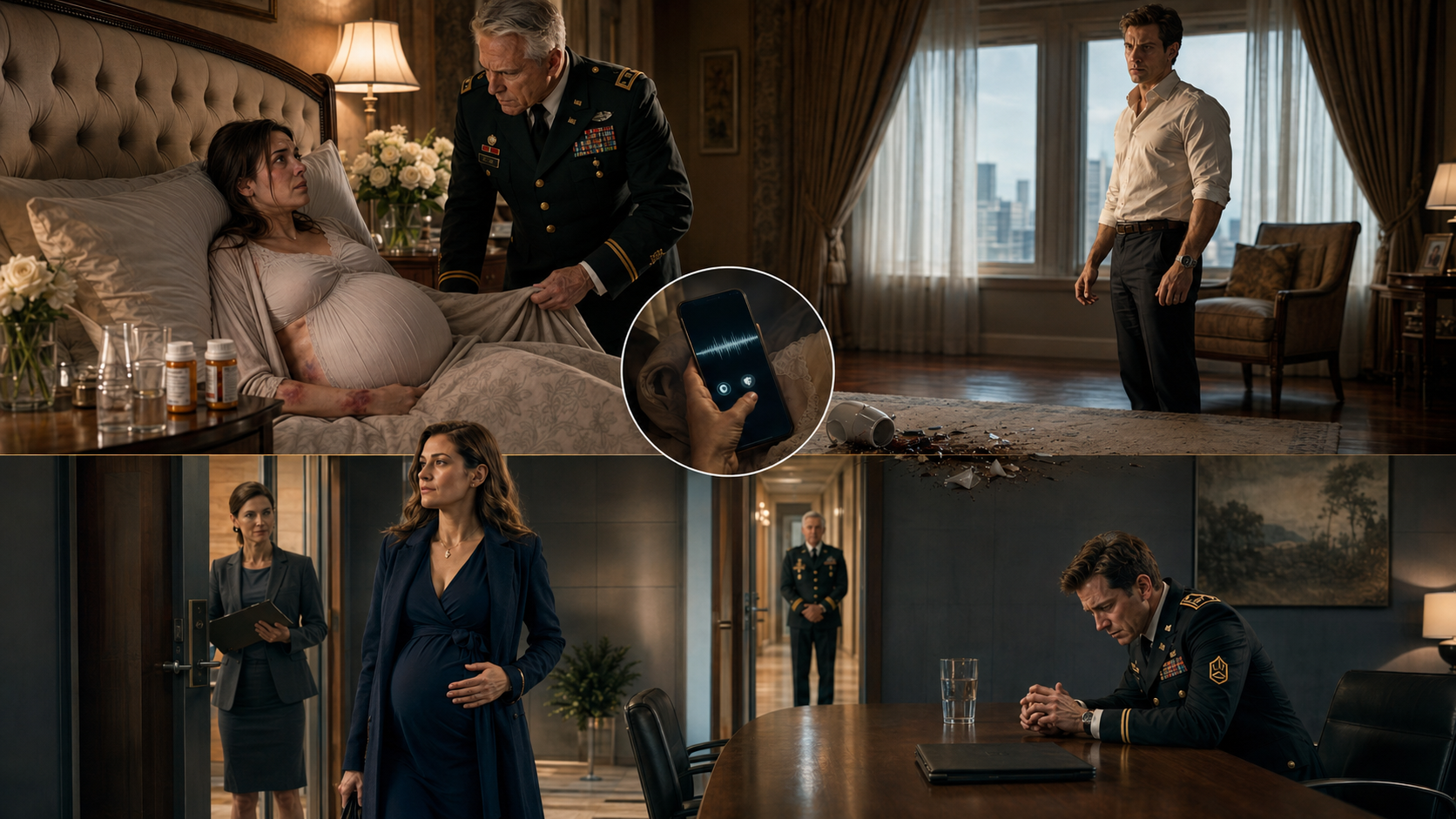
    He pulled the blanket down.

    The room went silent.

    Behind him, Julian’s coffee mug slipped from his hand.

    Porcelain exploded against the hardwood floor.

    Dark coffee spread across the pale rug while every pair of eyes fixed on my body.

    Purple fingerprints circled my ribs beneath my nightgown.

    My left wrist was swollen and yellowing at the edges where the bruising had started to fade.

    Higher on my arm were four oval marks from Beatrice’s fingers.

    And just above the curve of my seven-month pregnant stomach, half-hidden beneath the fabric, was a dark bruise that had frightened me every time I looked at it.

    My father stared at it.

    For one terrible second, I thought I saw him stop breathing.

    Then Colonel Arthur Sterling lifted his eyes to mine.

    “Who did this to you, Vivienne?”

    He didn’t raise his voice.

    That made it worse.

    Julian had seen my father angry before. Anyone could survive anger. Anger was loud. Anger made mistakes.

    This was different.

    My father’s voice was almost gentle.

    Controlled.

    Measured.

    The voice of a man who had already noticed ten things no one else had realized mattered.

    Julian stepped forward.

    “She slipped in the bathroom,” he said quickly. “The pregnancy has made her dizzy lately.”

    My father’s gaze didn’t move from me.

    Julian continued.

    “My wife keeps losing her balance.”

    From the doorway, Beatrice folded her arms.

    She was still wearing the cream cardigan she had chosen because my father was visiting.

    Soft colors.

    Pearl earrings.

    Concerned mother-in-law.

    “Vivienne has become extremely emotional,” she said. “We’ve been doing everything we can to protect her from herself.”

    My stomach tightened.

    Not from the baby.

    From fear.

    I knew that sentence.

    I knew what came next.

    They had been building the story for six months.

    It started so slowly I didn’t recognize it as a cage.

    At first, Julian only answered questions for me.

    If someone asked whether I wanted to go somewhere, he smiled and said I was tired.

    If a friend called, he told them I was sleeping.

    If my father asked why I looked pale during a video call, Julian laughed from just outside the camera.

    “Pregnancy is hitting her harder than she expected.”

    Then Beatrice joined in.

    Vivienne was anxious.

    Vivienne was overwhelmed.

    Vivienne was having trouble sleeping.

    Vivienne had become suspicious.

    Vivienne was overly sensitive.

    Vivienne wasn’t herself.

    The repetition did something terrible.

    It turned their lies into an atmosphere.

    Neighbors stopped asking why they hadn’t seen me.

    Friends accepted canceled lunches without arguing.

    Even my obstetrician had begun looking at Julian before answering questions about my own body.

    He attended every appointment.

    He carried my purse.

    He held my hand.

    He told everyone he was terrified something might happen to me.

    At home, that same hand closed around my wrist until I begged him to stop.

    The first time Julian shoved me, I told myself he hadn’t meant to.

    We had been arguing because I wanted to visit my father for a weekend.

    Julian said traveling was irresponsible.

    I told him my doctor hadn’t forbidden it.

    He said, “You always need someone to tell you what you want to hear.”

    I tried to leave the room.

    He grabbed my arm.

    I pulled away.

    His hands hit my shoulders.

    My back struck the wall.

    For several seconds, neither of us moved.

    Then he started apologizing.

    He cried.

    Actually cried.

    He pressed both hands against his face and said the pressure of becoming a father was changing him.

    I comforted him.

    That memory shamed me more than the bruise.

    The second time, he didn’t cry.

    The third time, Beatrice was in the house.

    She watched him grab me.

    Then she shut the kitchen door.

    A week later, she left marks of her own when I tried to retrieve my phone from the drawer where Julian had hidden it.

    “No one believes a hysterical pregnant woman,” she whispered into my ear.

    Julian heard her.

    He smiled.

    After that, the sentence became their private joke.

    Whenever I threatened to tell someone, Julian leaned close and said it.

    Whenever I refused to take whatever sedating medication he insisted would “help me rest,” Beatrice said it.

    Whenever I demanded my passport, my car keys, or my phone, they reminded me how the world saw me now.

    Fragile.

    Unstable.

    Confused.

    Hormonal.

    Eventually, there were moments when I almost believed them.

    I learned to cry without making a sound.

    I wore long sleeves during the hottest weeks of summer.

    During video calls with my father, Julian stood just beyond the camera’s view.

    Sometimes I could see his reflection in the black television screen.

    Watching.

    Waiting.

    If I answered too slowly, he would tap his finger against his wrist.

    If I sounded sad, he would silently mouth, Smile.

    So I smiled.

    And my father would ask, “You sure you’re all right, sweetheart?”

    And I would say, “Just tired.”

    Every time I said it, something inside me grew smaller.

    Until two weeks earlier.

    Two weeks earlier, Julian and Beatrice had gone downstairs after one of our arguments, and I had heard them talking through the heating vent.

    They thought I was asleep.

    Beatrice said, “Once the baby comes, she’ll be easier to manage.”

    Julian answered, “She won’t have a choice.”

    I remember lying there in the dark with one hand over my stomach.

    For the first time, I understood that surviving until the birth wasn’t enough.

    Whatever they were doing to me wasn’t temporary.

    The baby would become another reason I couldn’t leave.

    Another thing they could threaten me with.

    That night, fear finally became useful.

    I stopped begging.

    I stopped warning them.

    I started watching.

    And then I found the trust documents.

    I had been searching for my passport in Julian’s office while he was at work.

    He had changed the lock on one drawer, which told me immediately that I needed to open it.

    I found the spare key taped beneath the desk.

    Inside were my passport, my old phone, several pieces of mail addressed only to me—

    and a thick envelope from the law firm that had handled my mother’s estate.

    I sat on the floor and read every page.

    My mother had placed the house into a protected family trust before she died.

    The property had never belonged to Julian.

    His name wasn’t on the deed.

    His name wasn’t on the trust.

    His name wasn’t anywhere.

    The house I had spent months feeling imprisoned inside was legally mine.

    I almost laughed.

    Then I almost screamed.

    Instead, I put every paper back exactly where I had found it.

    And I made a decision.

    If Julian and Beatrice wanted everyone to believe I was irrational, I would give them no warning that I had stopped being afraid of their story.

    I found my old phone.

    I charged it only when they were asleep.

    I recorded everything I could.

    Threats.

    Arguments.

    Beatrice telling me I was lucky Julian still “put up with me.”

    Julian warning me that if I embarrassed him, he’d tell my doctor I had become a danger to myself.

    The sound of him slamming me against the bedroom door.

    His voice afterward, cold and unmistakable.

    “You make me do this when you refuse to listen.”

    I photographed every bruise.

    I emailed copies to an account Julian didn’t know existed.

    Then I waited.

    I was waiting for one person.

    My father.

    Julian believed Arthur Sterling was simply my widowed father who lived several states away and worried too much.

    He knew Dad had served in the Army.

    He didn’t know much else because my father never bragged about himself and Julian had never bothered asking questions that weren’t useful to him.

    He didn’t know Colonel Arthur Sterling was still on active duty.

    He didn’t know my father worked with the Army Inspector General’s office.

    He didn’t know the man he dismissed as an aging father had spent decades recognizing deception, coercion, intimidation, and fear.

    Julian had built his entire prison around one assumption.

    That no one would know what they were looking at.

    My father knelt beside my bed.

    He gently took my hand.

    “Look at me.”

    I did.

    “Did you fall?”

    Across the room, Julian gripped the bedpost so tightly the wood creaked.

    I looked at him.

    Then Beatrice.

    Then back at my father.

    There was no pity in his face.

    No disbelief.

    No hesitation.

    Only certainty.

    For the first time in months, I understood what safety felt like.

    “No,” I whispered.

    The room froze.

    Beatrice gave a nervous little laugh.

    “She’s confused.”

    My father’s expression didn’t change.

    “The medication is affecting her judgment,” Beatrice continued.

    Dad rose slowly.

    “Julian.”

    Julian straightened.

    “Step away from my daughter.”

    “This is my home, Colonel.”

    He emphasized the rank with a faint sneer, as if it were an honorary title belonging to an old man whose authority had expired.

    “You don’t have the authority to tell me what to do.”

    Before my father could answer, I heard my own voice.

    “No.”

    Both men turned toward me.

    My throat hurt.

    My heart hammered.

    But I said it again.

    Louder.

    “No.”

    Julian stared at me.

    “The house isn’t his,” I said.

    Beatrice’s arms dropped from her chest.

    I pushed myself higher against the pillows.

    “It’s mine.”

    Julian blinked.

    For once, he had no prepared answer.

    “My mother put it in a protected trust before she died.”

    His face changed.

    Not dramatically.

    That was what frightened me.

    His eyes sharpened.

    Calculating.

    Trying to understand how much I knew.

    “Vivienne,” he said carefully, “you don’t understand those documents.”

    “I understand my name.”

    “You’re upset.”

    “I understand yours isn’t on them.”

    Beatrice stepped forward.

    “This is ridiculous.”

    I looked at her.

    “You knew, didn’t you?”

    That stopped her.

    Only for half a second.

    But my father saw it.

    So did I.

    Julian turned toward his mother.

    And in that tiny movement, another lie cracked.

    Dad reached inside his jacket and removed a government-issued phone.

    Julian’s confidence finally slipped.

    “Who are you calling?”

    My father looked directly at him.

    “Local law enforcement.”

    Julian went still.

    “The Army Family Advocacy Program.”

    His jaw tightened.

    “And your commanding officer.”

    Every trace of color drained from Julian’s face.

    Because my husband wasn’t simply an abusive man with a respectable job.

    Captain Julian Mercer was an active-duty Army officer.

    His spotless reputation mattered to him more than almost anything.

    He had built his life around being seen as disciplined, dependable, honorable.

    At unit functions, he was the husband who brought me water before I asked.

    The officer who volunteered.

    The man who remembered birthdays.

    The future father who showed ultrasound pictures to anyone willing to look.

    And he had spent six months constructing a second version of me to protect the first version of himself.

    Unstable wife.

    Patient husband.

    But as my father started making calls, Julian realized something I had already learned.

    A lie can control a room for a long time.

    Until one person stops cooperating.

    And I was done cooperating.


    PART 2: THE STORY THEY BUILT AROUND ME

    Julian didn’t explode immediately.

    That was never his style when witnesses were present.

    Instead, he breathed in slowly and looked at my father with the expression he used when speaking to junior soldiers who had disappointed him.

    “Colonel, with respect, this is a family matter.”

    Dad finished giving the dispatcher the address.

    Then he ended the call.

    “No,” he said. “It stopped being a private family matter when my daughter became afraid to answer a question in her own bedroom.”

    Julian looked at me.

    That look had controlled me for months.

    There was no visible rage in it.

    Only a warning.

    Fix this.

    I felt my pulse jump automatically.

    My body still knew him better than my courage did.

    He saw the reaction.

    His eyes softened.

    “Viv,” he said.

    That was the voice.

    The loving voice.

    The one he used in public.

    “Baby, you’re overwhelmed. I know you’re scared. But this is getting out of control.”

    My father shifted slightly so he stood between us.

    Julian stopped.

    Beatrice rushed into the silence.

    “Arthur, you don’t understand what’s been happening.”

    Dad glanced at her.

    “Then explain it.”

    She seized the invitation.

    “Vivienne hasn’t been well for months. She gets confused. She accuses Julian of things and then forgets what happened. She refuses to rest. She becomes agitated. We’ve been terrified for the baby.”

    Every word sounded practiced because it was.

    She continued, gaining confidence.

    “There were nights she tried to leave the house in the middle of an argument. Julian had to stop her. Once, she almost fell on the stairs.”

    “I wasn’t going down the stairs,” I said.

    Beatrice faltered.

    I swallowed.

    My mouth had gone dry.

    “You dragged me away from the front door.”

    Her face hardened.

    Only for a second.

    Then concern returned.

    “See?” she whispered to my father. “That’s what I mean. She remembers things differently.”

    Something inside me went cold.

    For months, that sentence had been enough to end any argument.

    I remember it differently.

    I was mistaken.

    I was confused.

    But my father didn’t look at Beatrice.

    He looked at me.

    “What happened at the front door?”

    I closed my eyes.

    The memory came with sound first.

    My keys hitting the floor.

    Beatrice’s shoes scraping against the tile.

    Julian saying, “Don’t make this worse.”

    “I wanted to go to my doctor’s office alone,” I said.

    Julian exhaled sharply.

    “Vivienne—”

    Dad held up one hand.

    Julian stopped speaking.

    I continued.

    “Julian wouldn’t let me take the car. I said I’d call a rideshare. Beatrice took my phone. I tried to leave anyway.”

    My fingers curled into the blanket.

    “She grabbed me from behind. Julian blocked the door.”

    “Because you were hysterical,” Beatrice snapped.

    My father finally looked at her.

    “Was she free to leave?”

    Beatrice opened her mouth.

    Nothing came out.

    Dad repeated it.

    “Was my daughter free to leave the house?”

    “We were trying to keep her safe.”

    “That wasn’t my question.”

    Julian stepped in.

    “She could leave whenever she wanted.”

    I laughed.

    It came out broken.

    All three of them looked at me.

    I reached toward the nightstand.

    Julian took one step forward.

    Dad immediately moved.

    “Don’t.”

    Julian stopped.

    I opened the bottom drawer and pulled out the old phone.

    For the first time, Beatrice looked frightened.

    Julian didn’t.

    Not yet.

    “What is that?” he asked.

    I unlocked it.

    My hands were shaking so badly I entered the passcode wrong twice.

    Then I found the folder.

    Dates.

    Photos.

    Audio files.

    I had named every recording by day and time.

    I hadn’t known if I would ever be brave enough to use them.

    I pressed one.

    My own voice filled the room.

    Thin.

    Tired.

    “Give me my phone.”

    Then Beatrice.

    “You don’t need it.”

    “I want to call my father.”

    “Why? So you can upset him again?”

    “Please give it back.”

    A pause.

    Then Julian.

    “Vivienne, you’re not calling anyone while you’re like this.”

    “I am not like anything. Give me my phone.”

    A crash.

    My breath catching.

    Julian’s voice lowered.

    “Stop fighting me.”

    The recording ended.

    No one spoke.

    I played another.

    This one was newer.

    Julian’s voice came first.

    “If you tell your doctor I grabbed you, I’ll tell her exactly what you’ve been like at home.”

    “What have I been like?”

    “Paranoid. Unpredictable. Emotional.”

    “You hurt me.”

    “Because you wouldn’t calm down.”

    “You left bruises.”

    “You bruise easily.”

    Then Beatrice’s voice, from farther away.

    “No one believes a hysterical pregnant woman.”

    The recording ended.

    My father became frighteningly still.

    Julian looked at me as if I had transformed into someone he didn’t recognize.

    “You recorded us.”

    I finally looked directly at him.

    “Yes.”

    His mask slipped.

    “You recorded private conversations in my house?”

    “My house,” I said.

    The words hit harder the second time.

    His face tightened.

    Then headlights washed across the bedroom wall.

    A car door slammed outside.

    Another followed.

    Julian looked toward the window.

    Beatrice whispered his name.

    My father took the phone from my hand carefully.

    “Anything else?”

    I nodded.

    “Photos.”

    “Backed up?”

    “Yes.”

    Something like relief moved across his face.

    “Good.”

    Julian heard him.

    I saw the moment he understood this wasn’t going away when he took the phone.

    This wasn’t one frightened wife making one accusation.

    There was a record.

    A timeline.

    Proof created before my father entered the house.

    The doorbell rang.

    Julian moved toward the bedroom door.

    My father blocked him.

    “You’re not meeting them alone.”

    “This is still my residence.”

    “It’s her property.”

    Julian stared at him.

    Dad held his gaze.

    Then he said something so quietly I almost missed it.

    “And you’re done controlling the first version of the story people hear.”

    The doorbell rang again.

    Beatrice suddenly turned to me.

    “Do you understand what you’re doing?”

    I looked at her.

    Her voice trembled with anger.

    “You could destroy his career.”

    For one second, the old guilt rose in me.

    Julian’s career.

    His reputation.

    His future.

    Things I had been trained to protect.

    Then the baby shifted beneath my ribs.

    I placed one hand over my stomach.

    And I remembered the heating vent.

    Once the baby comes, she’ll be easier to manage.

    I looked at Beatrice.

    “No.”

    My voice was quiet.

    “He did that.”

    My father went downstairs to open the door.

    I heard voices.

    Two local police officers.

    Then more footsteps.

    Julian stayed near the bed, staring at me.

    The moment Dad disappeared from view, his expression changed completely.

    “Tell them you exaggerated.”

    My lungs tightened.

    “Julian—”

    “Tell them now.”

    Beatrice moved closer too.

    “We can still fix this.”

    There it was.

    Not Are you okay?

    Not We’re sorry.

    Not We didn’t mean to hurt you.

    We can still fix this.

    Meaning the story.

    Meaning me.

    Meaning whatever needed to be rearranged so Julian remained untouched.

    I stared at the man I had married.

    Once, I had loved the confidence in his face.

    I mistook certainty for strength.

    I mistook control for protection.

    I mistook being needed for being loved.

    Now I saw something else.

    Fear.

    Not fear for me.

    Fear of consequences.

    Footsteps approached the bedroom.

    Julian leaned closer.

    “If you do this, Vivienne, there is no coming back.”

    I felt tears burn behind my eyes.

    For months, he had used that kind of sentence to frighten me.

    This time, I understood it differently.

    There was no coming back.

    Thank God.

    Two officers entered with my father.

    A female officer came straight toward me.

    “Ma’am, can I speak with you privately?”

    Julian answered before I could.

    “Of course. My wife—”

    “I asked her.”

    The officer looked at me.

    “Can we speak privately?”

    My heart pounded.

    I looked at Julian.

    Then Beatrice.

    Then my father.

    He gave me the smallest nod.

    Not an order.

    Permission.

    Choice.

    Something I hadn’t been given in a long time.

    “Yes,” I said.

    “I want them out.”

    Julian’s face went blank.

    The officer turned.

    “Sir, ma’am, please step outside.”

    “This is absurd,” Beatrice said.

    Julian didn’t move.

    The second officer stepped closer.

    “Captain, let’s go.”

    That word changed something.

    Captain.

    Not husband.

    Not homeowner.

    Not victim.

    A rank attached to a man standing in a room where his pregnant wife had visible injuries.

    Julian finally walked out.

    Beatrice followed.

    At the doorway, she looked back at me.

    For the first time, she didn’t look superior.

    She looked betrayed.

    As if my silence had been something I owed them.

    The door closed behind her.

    And I began to tell the truth.

    Everything.


    PART 3: THE MOMENT I STOPPED PROTECTING HIM

    Telling the truth hurt more than I expected.

    I thought I would feel relief.

    Instead, I felt exposed.

    The officer sat in a chair beside my bed while my father waited across the room.

    He didn’t interrupt.

    He didn’t answer for me.

    That mattered.

    For months, people had spoken around me as if I were a patient who couldn’t be trusted with her own life.

    Now every question came to me.

    “When did he first hurt you?”

    “Did you ever fear he would seriously injure you?”

    “Did anyone prevent you from leaving?”

    “Who controlled your phone?”

    “Who gave you the medications?”

    “Were the medications prescribed?”

    That question made me pause.

    “They were prescribed,” I said. “But Julian always wanted me to take them more often than I wanted to.”

    “Did he force you?”

    “Sometimes he stood there until I swallowed them.”

    The officer wrote something down.

    Shame crawled over me.

    I hated how weak the facts sounded when I said them aloud.

    Why hadn’t I screamed?

    Why hadn’t I run?

    Why hadn’t I told my doctor?

    Why hadn’t I simply walked out?

    The questions attacked me from inside even though the officer never asked them.

    My father must have seen something in my face.

    “Vivienne.”

    I looked at him.

    He spoke carefully.

    “Answer what happened. You don’t have to explain why you survived it the way you did.”

    My throat closed.

    I nodded.

    So I kept talking.

    I told them about the first shove.

    The locked drawer.

    The missing keys.

    The way Julian stood behind the bathroom door while I called friends.

    The way Beatrice canceled appointments using my phone.

    The times she told people I was asleep while I stood upstairs listening.

    The night Julian squeezed my wrist until my fingers went numb because I had asked him why my passport was missing.

    I told them about my prenatal appointments.

    How Julian sat beside me.

    How he corrected me.

    How he laughed when I said I wasn’t sleeping because I was afraid.

    “She’s always been a worrier,” he told the doctor.

    The officer asked whether my obstetrician had ever examined the bruises.

    “No.”

    “Why?”

    “I hid them.”

    Saying it made me cry.

    Not because it was the worst thing that had happened.

    Because it was the clearest proof of how completely they had trained me.

    I had sat three feet from a doctor with bruises on my body and spent the entire appointment making sure no one saw them.

    My father looked away.

    That was the only moment his control cracked.

    He walked to the window and pressed one hand against the sill.

    I knew that posture.

    He was angry.

    Furious.

    But he wasn’t angry at me.

    That realization broke something open inside my chest.

    The female officer asked whether I wanted medical attention.

    “Yes.”

    The answer came instantly.

    I wanted someone to check the baby.

    I had wanted that for days.

    But Julian had refused to take me back to the hospital after the bruise appeared.

    He said the baby was moving, so everything was fine.

    Beatrice agreed.

    “Doctors make nervous mothers worse,” she said.

    Now an ambulance was called.

    Outside the bedroom, I heard Julian’s voice rise.

    “You have no reason to detain me.”

    Then my father’s.

    “I suggest you stop talking.”

    The officer glanced toward the door.

    I almost smiled.

    It was the first time anyone had ever told Julian that silence might be in his best interest.

    When the paramedics arrived, the room became busy.

    Questions.

    Blood pressure.

    Heart rate.

    A monitor.

    Hands moving around me without hurting me.

    Someone asked permission before touching my wrist.

    That nearly made me cry again.

    I had forgotten what it felt like for another person to ask.

    The baby’s heartbeat came through the portable monitor.

    Fast.

    Steady.

    Alive.

    I covered my face with both hands.

    My father turned away again, but not before I saw his eyes fill.

    “They need to take you in,” the paramedic said.

    I nodded.

    The female officer asked whether I felt safe with my father accompanying me.

    I looked at Dad.

    He stood there in the bedroom where I had spent months shrinking.

    “Yes.”

    More than safe.

    I felt visible.

    As they prepared to move me, Julian appeared in the hallway.

    One officer stood beside him.

    His posture was rigid.

    He looked less like my husband now and more like an officer struggling to maintain military bearing.

    “Vivienne.”

    The paramedics paused.

    I looked at him.

    He took one step closer.

    “I need to speak to my wife.”

    The officer blocked him.

    “No.”

    Julian ignored him.

    “Viv, look at me.”

    My whole body reacted.

    My shoulders tightened.

    My breathing shortened.

    My father noticed.

    So did the officer.

    Julian noticed too.

    He softened his voice immediately.

    “Tell them this is a misunderstanding.”

    I stared at him.

    “We can go to counseling.”

    I said nothing.

    “I’ll stay somewhere else tonight.”

    Still nothing.

    “I know I’ve been under pressure. I know I’ve lost my temper.”

    That was the closest he had ever come to admitting anything.

    Because he was afraid.

    Not sorry.

    Afraid.

    “Please,” he said.

    That word almost undid me.

    Julian never said please.

    I remembered the man from the beginning of our marriage.

    The one who cooked breakfast on Sundays.

    The one who rested his hand on the small of my back in crowded rooms.

    The man who cried when I showed him the positive pregnancy test.

    I had loved him.

    That truth didn’t disappear just because another truth was uglier.

    Part of me wanted him to become that man again.

    Part of me wanted him to say exactly the right thing and make the last six months dissolve.

    Then his eyes dropped to the old phone in the officer’s hand.

    And for one fraction of a second, his face changed.

    Calculation.

    Again.

    Always calculation.

    How much had I recorded?

    Who had copies?

    What had I said?

    What could he deny?

    My grief hardened.

    I had spent months loving his potential more than his behavior.

    I wasn’t going to do it anymore.

    “You told me no one would believe me,” I said.

    His jaw moved.

    I kept looking at him.

    “I believed you.”

    He didn’t answer.

    “For a while.”

    Beatrice appeared behind him.

    “Vivienne, don’t do this.”

    I turned toward her.

    She was crying now.

    Real tears.

    But even then, they were for him.

    “He’s worked his entire life for his career.”

    I felt something inside me finally settle.

    “And I was supposed to sacrifice mine?”

    She stared.

    “My life? My baby? My mind?”

    “That’s not what I meant.”

    “It is exactly what you meant.”

    My voice shook, but I didn’t stop.

    “You watched him hurt me.”

    “No.”

    “You helped him.”

    “I was trying to protect my son.”

    “From what?”

    She had no answer.

    “From consequences?”

    Her face crumpled.

    The paramedic touched my arm.

    “We should go.”

    I nodded.

    As they wheeled me toward the stairs, I saw Julian standing beneath the family photographs lining the hallway.

    Our wedding.

    Our first Christmas.

    An ultrasound picture framed beside a photograph of us smiling at a military banquet.

    It looked like someone else’s life.

    At the front door, two additional men were speaking with my father.

    One wore civilian clothes.

    The other I recognized from Julian’s unit.

    Major Daniel Ross, his executive officer.

    I had met him twice at formal events.

    The second Julian saw him, he stopped walking.

    Major Ross looked past the police officer toward me.

    His eyes moved to the bruises visible beneath the hospital blanket.

    Then back to Julian.

    “Captain Mercer,” he said.

    Julian’s face emptied.

    “Sir.”

    “I’ve been informed of the allegation.”

    “It’s not what it looks like.”

    Major Ross’s expression didn’t move.

    “You’ll have an opportunity to address that through the proper channels.”

    “Sir, my wife is experiencing—”

    My father cut in.

    “Careful.”

    One word.

    Julian looked at him.

    Dad stepped closer.

    “For six months, you benefited from describing her before she could describe herself.”

    His voice remained calm.

    “That ends now.”

    Major Ross turned toward Julian.

    “Do not contact her until you are given further guidance.”

    Julian looked at me.

    That was when I saw it.

    Not anger.

    Not love.

    Not even fear.

    Disbelief.

    He truly had never imagined losing control of the room.

    I was carried through the front door into warm evening air.

    The sun was setting.

    For the first time in weeks, I was outside without permission.

    I started crying before we reached the ambulance.

    My father climbed in beside me.

    He took my hand.

    “I’m sorry,” I whispered.

    His face tightened.

    “For what?”

    “I should’ve told you.”

    “No.”

    “I lied to you.”

    “You survived long enough to tell me now.”

    My mouth trembled.

    “I thought you’d think I was crazy.”

    His eyes closed briefly.

    When he opened them, there was pain there.

    “Vivienne, every time you told me you were tired, I knew something was wrong.”

    I stared at him.

    “Then why didn’t you—”

    “I didn’t know what.”

    His voice cracked for the first time.

    “And I was afraid if I pushed too hard, you’d stop taking my calls.”

    I thought of Julian standing outside the camera.

    The television reflecting him.

    Smile.

    “Why did you come?”

    Dad squeezed my hand.

    “Three nights ago, you told me you were fine.”

    I waited.

    “You said it four times in six minutes.”

    A tear slid down my cheek.

    “So?”

    “So your mother used to do that.”

    I stopped breathing.

    “When she was frightened,” he said. “She’d repeat the same reassurance until she could hear herself believing it.”

    He looked at me.

    “You sounded exactly like her.”

    The ambulance doors closed.

    And for the first time, I understood that Julian’s mistake hadn’t been underestimating my father’s rank.

    It had been underestimating how well my father knew me.


    PART 4: WHEN THE PERFECT STORY COLLAPSED

    The baby was fine.

    Those were the first words that mattered.

    The doctor repeated them because I made her.

    “The heartbeat is strong. The monitoring looks reassuring.”

    “You’re sure?”

    “Yes.”

    I cried so hard I couldn’t speak.

    My father sat beside the hospital bed.

    He didn’t tell me to calm down.

    He didn’t tell me everything was okay.

    He simply stayed.

    The rest was slower.

    My wrist wasn’t broken, but it was badly sprained.

    The bruises across my ribs were documented and photographed.

    So were the marks on my arms and stomach.

    Every injury became something outside my memory.

    Something visible.

    Recorded.

    Real.

    When the physician asked how I had been injured, I told her.

    Every time I said the words, they became easier.

    “My husband grabbed me.”

    “My mother-in-law restrained me.”

    “My husband shoved me.”

    I watched the medical staff write them down.

    No one rolled their eyes.

    No one called me emotional.

    No one asked Julian whether my version sounded accurate.

    Hours later, my obstetrician arrived.

    Dr. Elaine Patel looked exhausted and horrified.

    She stood near the foot of my bed holding my chart.

    “I didn’t know.”

    I believed that she hadn’t known.

    That wasn’t the same as saying nothing had gone wrong.

    “He told you I was paranoid,” I said.

    Her face changed.

    “Yes.”

    “And you believed him.”

    “I believed there was conflict at home and that your anxiety had increased.”

    “He answered questions for me.”

    Dr. Patel lowered her eyes.

    “He did.”

    “You let him.”

    Silence.

    My father shifted in his chair but didn’t intervene.

    This was mine.

    Dr. Patel looked at me again.

    “I did.”

    She swallowed.

    “I should have asked him to leave the room.”

    I felt angry.

    Not the explosive kind.

    Something heavier.

    “You should have asked me.”

    “Yes.”

    Her answer surprised me.

    No excuses.

    No speech about medical complexity.

    Just yes.

    “I am sorry, Vivienne.”

    I looked away.

    I wasn’t ready to forgive anyone for not seeing what I had worked so hard to hide.

    But I also understood the cruelty of what Julian had done.

    He had used my silence as evidence that he was telling the truth.

    And when my fear made me look nervous, he used the nervousness too.

    He had created the symptom and then pointed to it as proof.

    Late that night, my father handed me my old phone.

    “The files were copied.”

    I looked at him.

    “By who?”

    “The investigating officers have what you agreed to provide.”

    My stomach tightened.

    “What happens to Julian?”

    Dad’s expression became careful.

    “Several processes may happen at the same time.”

    I knew that tone.

    He was making sure I didn’t confuse his position with magic.

    He wasn’t going to promise me an outcome he couldn’t control.

    “The civilian authorities handle possible criminal conduct under their jurisdiction. His command handles military and administrative matters. Family Advocacy will assess the domestic abuse report and safety concerns.”

    “Will he lose his career?”

    “I don’t know.”

    I looked down.

    Part of me hated that answer.

    Then I realized it was the first honest answer anyone had given me in months.

    Dad continued.

    “But this won’t disappear because he outranks you in his own house.”

    I let out a breath.

    “And Beatrice?”

    “Her conduct is being documented too.”

    I closed my eyes.

    For months, I had imagined justice as something dramatic.

    Julian being dragged away.

    Beatrice exposed in front of everyone.

    People apologizing to me.

    Instead, justice began with paperwork.

    Statements.

    Photographs.

    Phone calls.

    A safety plan.

    An order that Julian stay away.

    Instructions about how I could return home.

    It was almost disappointingly ordinary.

    Then I realized ordinary was what made it powerful.

    Julian had controlled me through private moments.

    Private threats.

    Private bruises.

    Private stories.

    Now everything was leaving the private space where he could reshape it.

    By morning, word had reached his chain of command that something serious had happened.

    I learned that not because my father told me confidential details.

    He refused to.

    I learned it because my phone began filling with messages.

    People from Julian’s unit.

    Wives I knew from functions.

    Old friends.

    Neighbors.

    At first, I couldn’t read them.

    I assumed they would ask what I had done.

    Some did.

    One message said:

    I hope you two can work through this privately.

    I deleted it.

    Another said:

    Julian always spoke so highly of you. I can’t believe this.

    I deleted that too.

    Then there were different messages.

    I thought something was wrong the last time I saw you.

    I’m sorry I believed you didn’t want visitors.

    Beatrice told us you were too unstable for company.

    Julian canceled dinner with us twice and said you had panic attacks.

    Each message showed me how wide the story had spread.

    I hadn’t imagined it.

    They had been isolating me socially as carefully as they isolated me physically.

    One friend, Claire, sent a voicemail.

    Her voice shook.

    “Viv, I came by three weeks ago. Beatrice told me you were sleeping. I said I’d wait. She wouldn’t let me inside. I thought she was protecting you. I am so sorry.”

    I listened twice.

    Then I cried.

    Not because Claire had failed me.

    Because I remembered that day.

    I had been upstairs.

    Awake.

    I had heard voices at the front door.

    Beatrice came upstairs ten minutes later and said a package had been delivered.

    A contradiction.

    A clue.

    One of dozens I hadn’t understood at the time.

    My father sat beside me while I listened.

    “They made the lie social,” I said.

    He nodded.

    “They made it easier for everyone to participate without knowing.”

    I stared at the ceiling.

    “That’s why it worked.”

    “Partly.”

    “What’s the other part?”

    Dad looked at me.

    “You kept trying to prove you were reasonable to people committed to describing you as unreasonable.”

    I flinched.

    Not because it was cruel.

    Because it was true.

    Every time Julian said I was hysterical, I lowered my voice.

    Every time Beatrice said I was paranoid, I tried to appear trusting.

    Every time they called me unstable, I became more careful.

    They turned my desire to look sane into another leash.

    My father leaned forward.

    “You don’t have to perform calmness to deserve protection.”

    I started crying again.

    “I’m so tired.”

    “I know.”

    “I don’t want to fight him forever.”

    “You don’t have to decide forever tonight.”

    That became how I survived the next weeks.

    Not forever.

    Today.

    One statement.

    One medical appointment.

    One conversation with an advocate.

    One night of sleep.

    One morning without someone checking my phone.

    I stayed temporarily with my father in a furnished apartment arranged near my medical care.

    The house remained mine.

    That mattered more emotionally than I expected.

    Julian had spent months referring to it as my house.

    My rules.

    My office.

    My bedroom.

    My wife.

    Possession disguised as grammar.

    But the trust documents were clear.

    And because I was finally willing to assert what they said, Julian couldn’t use the property as leverage over me.

    His personal belongings were handled through proper arrangements.

    He did not get to return while I was there.

    Beatrice called from three different numbers before I blocked them.

    The first voicemail was furious.

    “You have humiliated this family.”

    The second was pleading.

    “Julian loves you. He made mistakes.”

    The third was cold.

    “When this child asks what happened to his father, remember that you chose this.”

    I listened to that one once.

    Then I saved it with the others.

    Not because it proved some new crime.

    Because it proved nothing had changed.

    She still saw the consequences as something I was doing to Julian.

    Never something Julian had done to himself.

    The military process moved with a formality that felt almost surreal.

    Julian’s image as the perfect officer did not vanish in one dramatic explosion.

    It cracked under accumulation.

    The recordings.

    The photographs.

    The medical documentation.

    The messages showing how he had described me to others.

    His own statements.

    The contradiction between the devoted husband he had presented publicly and the voice captured privately telling his pregnant wife no one would believe her.

    My father never interfered in the investigation.

    He made that painfully clear.

    “I am your father first,” he told me. “And in anything involving formal review, I stay out of lanes that aren’t mine.”

    At first, I was disappointed.

    Some small part of me wanted Colonel Sterling to destroy Captain Mercer with a phone call.

    That would have been easier.

    But it would also have given Julian another story.

    Powerful father ruins son-in-law’s career.

    Vindictive family.

    Influence.

    Bias.

    My father understood what I didn’t.

    The strongest case against Julian was the one Julian had built himself.

    So Dad did what he had done the moment he saw the bruises.

    He gave me space to speak.

    And the truth did the rest.

    The hardest day came when I had to listen to one of my own recordings again during an interview.

    Julian’s voice filled the small room.

    “If you embarrass me, I will make sure everyone understands exactly how unstable you’ve become.”

    Then my voice.

    “What if they believe me?”

    A pause.

    His laugh.

    “Who?”

    One word.

    I gripped the edge of the chair.

    The investigator stopped the recording.

    “Would you like a break?”

    I almost said yes.

    Then I thought of all the times Julian had asked Who?

    Who would believe me?

    Who would help me?

    Who would choose my version?

    I straightened.

    “No.”

    My voice shook.

    “Keep going.”

    So we did.

    And when I left the room, my father was waiting in the hallway.

    He stood when he saw me.

    “How’d it go?”

    I looked back at the closed door.

    “I didn’t stop it.”

    A small smile touched his face.

    “Good.”

    “No.”

    I shook my head.

    “I mean I didn’t stop myself.”

    He understood.

    That night, I slept six hours without waking.

    It was the longest I had slept in months.


    PART 5: WHAT WAS LEFT WHEN THE LIES WERE GONE

    Julian asked to speak to me one final time.

    Not alone.

    Never alone.

    By then, enough time had passed that my body had begun to change again.

    The bruises had faded.

    My wrist had healed.

    My stomach had grown heavier.

    The baby kicked constantly now.

    Every movement felt like an argument for the future.

    The meeting took place in a small conference room.

    An advocate sat near the door.

    My father waited outside because I asked him to.

    That surprised him.

    It surprised me too.

    But I needed one thing from Julian that no one else could give me.

    I needed to look at him without a bedroom wall behind me.

    Without Beatrice beside him.

    Without a locked door.

    Without needing permission to leave.

    He entered looking older.

    Not destroyed.

    Not transformed.

    Just stripped of polish.

    His uniform was immaculate.

    Of course it was.

    Julian would probably iron a shirt during an earthquake.

    He sat across from me.

    For several seconds, neither of us spoke.

    Then he looked at my stomach.

    “How’s the baby?”

    “Healthy.”

    His eyes closed briefly.

    “Good.”

    I had imagined this moment so many times.

    In some versions, I screamed at him.

    In others, he begged.

    In one, ridiculous version, he finally admitted everything with perfect clarity and gave me the apology I had been starving for.

    Reality was smaller.

    “Why did you want to see me?” I asked.

    He rubbed his hands together once.

    “I wanted you to hear from me that I never intended for any of this to happen.”

    I almost laughed.

    “What part?”

    He looked at me.

    “The way things got.”

    “The bruises?”

    He flinched.

    “The isolation?”

    “Viv—”

    “The threats?”

    “I lost control.”

    “No.”

    I felt strangely calm.

    “You controlled everything.”

    His mouth closed.

    “You controlled my phone. My keys. Who came into the house. What my friends heard. What the doctor heard. What your mother said. What I was allowed to say without paying for it later.”

    I leaned back.

    “You didn’t lose control, Julian.”

    For the first time, he looked ashamed.

    Maybe truly ashamed.

    I couldn’t tell anymore.

    “You used it.”

    He stared at the table.

    “My mother made things worse.”

    The old instinct in me reacted.

    There it was.

    An exit.

    A way to spread blame until his share became smaller.

    “She did,” I said.

    He looked up.

    “But she didn’t make you hurt me.”

    His eyes hardened slightly.

    I saw the reflex before he buried it.

    “I know.”

    “Do you?”

    “Yes.”

    “Then say it.”

    He frowned.

    “Say what?”

    I had not planned the question.

    It simply came.

    “Say what you did without explaining why.”

    Silence.

    He looked toward the advocate.

    Then at me.

    His face tightened.

    “I hurt you.”

    My throat burned.

    “How?”

    He exhaled.

    “I grabbed you.”

    I waited.

    “I shoved you.”

    Still I waited.

    “I kept your phone from you.”

    His voice lowered.

    “I tried to control who you spoke to.”

    The room seemed to shrink.

    “And?”

    Julian stared at me.

    I knew he knew.

    Finally, he said it.

    “I told people you were unstable so they wouldn’t believe you.”

    I closed my eyes.

    There.

    The truth.

    Not all of it.

    Not enough to repair anything.

    But the shape of it.

    For six months, I had needed someone else to name what was happening.

    My father.

    A doctor.

    An officer.

    An investigator.

    Now the man who had done it had finally said the words himself.

    I opened my eyes.

    “Thank you.”

    Hope flashed across his face.

    It was gone when I continued.

    “That’s all I needed.”

    “Vivienne.”

    I stood carefully.

    He stood too.

    The advocate immediately shifted in her chair.

    Julian noticed and froze.

    The humiliation on his face was almost painful to watch.

    Once, everyone moved when he entered a room.

    Now someone moved because he stood too quickly near me.

    “Is there any chance—”

    “No.”

    The word came easily.

    He swallowed.

    “You didn’t even let me finish.”

    “I know what you were asking.”

    “We’re having a child.”

    “Yes.”

    His voice broke.

    “Doesn’t that mean anything?”

    “It means everything.”

    I placed my hand over my stomach.

    “That’s why I’m leaving.”

    His eyes filled.

    For the first time, I felt no satisfaction.

    That surprised me.

    I had imagined revenge as a warm thing.

    It wasn’t.

    His pain didn’t heal mine.

    His fear didn’t erase my fear.

    Watching his life collapse did not rebuild the months he had taken from me.

    Justice was necessary.

    But revenge wasn’t the part that saved me.

    Choice was.

    The ability to stand.

    The ability to leave.

    The ability to decide what happened next.

    Julian sat down again.

    I reached the door.

    “Viv.”

    I stopped.

    He spoke without looking at me.

    “I did love you.”

    My eyes burned.

    I believed him.

    That was perhaps the saddest part.

    “I know.”

    He looked up.

    “Then how can you walk away like this?”

    I thought of the first shove.

    The apologies.

    The excuses.

    The long sleeves.

    The locked drawer.

    The heating vent.

    My father’s face when he pulled back the blanket.

    And my answer came with no anger at all.

    “Because love that requires me to disappear isn’t enough.”

    I walked out.

    My father was waiting in the hallway.

    He looked at my face.

    “Done?”

    “Done.”

    He offered me his arm.

    I shook my head.

    Then smiled.

    “I can walk.”

    Something in his expression softened.

    “I know you can.”

    He walked beside me anyway.

    Not ahead.

    Not behind.

    Beside me.

    Months later, when my baby was born, the first thing I noticed was the sound.

    That furious, outraged cry filled the delivery room, and I laughed while tears ran into my hair.

    “Strong lungs,” the nurse said.

    My father stood near the wall looking completely overwhelmed.

    I had never seen Colonel Arthur Sterling overwhelmed by anything.

    It was wonderful.

    When the nurse placed my baby against my chest, I looked down at that tiny face and felt a fear deeper than anything Julian had ever created in me.

    Not fear of danger.

    Fear of responsibility.

    Of loving someone this much.

    Of becoming responsible for making home mean something safe.

    I pressed my lips against a soft forehead.

    “You will never have to earn the right to be believed,” I whispered.

    My father heard me.

    He looked away quickly.

    The legal and military consequences surrounding Julian continued beyond that day.

    I learned not to measure my healing by each development.

    His career was no longer mine to protect.

    His reputation was no longer mine to manage.

    His explanations were no longer mine to correct.

    Beatrice eventually stopped calling.

    The silence she once used to isolate me became something else when I chose it for myself.

    Peace.

    I returned to the house after the birth.

    My house.

    At first, I hated being there.

    Every room contained a memory.

    The kitchen doorway where Julian once blocked me.

    The hallway where Beatrice grabbed my arm.

    The bedroom where I learned to cry silently.

    For two nights, I nearly left.

    Then, on the third morning, I carried a box downstairs.

    I removed the white roses Beatrice had dried and kept in a decorative jar.

    I packed away the military banquet photographs.

    I moved the chair Julian always sat in.

    Small things.

    Almost stupidly small.

    But each one changed the shape of the room.

    Claire came over one afternoon and helped me repaint the bedroom.

    My father complained that we were doing it wrong.

    We ignored him.

    He complained louder.

    Then he took the roller from me and finished one wall himself.

    For the first time in months, laughter filled that room.

    Real laughter.

    Not the careful sound I used to make when Julian was watching.

    One evening, after Dad left and the baby finally fell asleep, I sat alone on the edge of the bed.

    The same bed.

    The same window.

    The same floor where Julian’s coffee mug had shattered.

    The rug had been cleaned, but if the light hit it at the right angle, I could still see the faintest shadow of the stain.

    I thought about replacing it.

    Then I decided not to.

    Not yet.

    People like to say abuse leaves scars.

    I used to think that meant you remained damaged forever.

    Now I understood scars differently.

    A scar was not the wound.

    It was evidence that the wound had closed.

    I touched the place on my wrist where Julian’s fingers had once left dark marks.

    Nothing remained.

    But I remembered.

    And remembering no longer made me weak.

    It made me accurate.

    That was the thing Julian and Beatrice had tried hardest to take from me.

    Not my house.

    Not my phone.

    Not my friendships.

    My trust in my own perception.

    They taught me to question whether pain counted if someone else explained it away.

    Whether fear counted if the person frightening me claimed to love me.

    Whether a locked door was really a prison if the person holding the key said it was for my protection.

    My father didn’t rescue me by arriving with a rank.

    He rescued me first by asking a question and waiting for my answer.

    Did you fall?

    No.

    One word.

    That was the beginning.

    Everything that came after—the police, the medical records, the recordings, the trust documents, the military investigation—only mattered because I finally gave myself permission to say that word.

    No.

    No, I didn’t fall.

    No, I wasn’t confused.

    No, the house wasn’t his.

    No, he couldn’t explain my bruises away.

    No, Beatrice couldn’t call control protection.

    No, his career was not more valuable than my safety.

    No, loving him once did not obligate me to keep letting him hurt me.

    And no, I was not the woman they had spent six months describing.

    I was not hysterical.

    I was not helpless.

    I was not disappearing.

    One night, long after everything had changed, my father came by for dinner.

    He found me sitting on the porch with the baby asleep against my chest.

    The summer air was warm.

    Cicadas hummed in the trees.

    Dad sat beside me.

    For a while, neither of us spoke.

    Then he said, “You know, the day I came here, I thought I was prepared for anything.”

    I smiled faintly.

    “You usually do.”

    “I wasn’t.”

    I looked at him.

    His gaze remained on the dark yard.

    “I keep thinking about how close I came to believing you when you said you were fine.”

    My chest tightened.

    “Dad—”

    “I should have come sooner.”

    I knew that guilt.

    It sounded too much like mine.

    I adjusted the blanket around the baby.

    “You came when you understood.”

    He looked at me.

    “So did I.”

    His eyes filled.

    Neither of us said anything for a while.

    We didn’t need to.

    Inside the house, my phone buzzed on the table.

    Months earlier, that sound would have filled me with fear.

    Who was calling?

    Would Julian see it?

    Had I answered too slowly?

    Would Beatrice ask who it was?

    Now the phone buzzed again.

    I ignored it.

    Because I could.

    The baby stirred.

    I looked down.

    My father smiled.

    And in that ordinary moment, I finally understood what freedom looked like.

    It wasn’t dramatic.

    It wasn’t revenge.

    It wasn’t Julian losing everything.

    It wasn’t Beatrice being exposed.

    It wasn’t even the moment my father pulled back the blanket and every lie in the room began to collapse.

    Freedom was quieter than that.

    It was a door I could open whenever I wanted.

    A phone no one took from my hand.

    A doctor I could speak to alone.

    A house where no one needed permission to leave.

    A child who would grow up knowing that love did not sound like a threat.

    And a voice inside me that I trusted again.

    Julian had once told me no one would believe a hysterical pregnant woman.

    For months, those words had kept me silent.

    In the end, he had been wrong about the one person who mattered most.

    Me.

    I believed her.

  • When My Father Pulled Back the Blanket, Every Lie My Husband Had Built Finally Collapsed

    When My Father Pulled Back the Blanket, Every Lie My Husband Had Built Finally Collapsed

    PART 1: The Truth Beneath the Blanket

    The first thing my father noticed wasn’t my face.

    It was the bruises.

    He had been standing beside my bed for less than thirty seconds when his eyes dropped to the blanket pulled almost to my chin.

    I remember thinking that Julian had made one mistake.

    Just one.

    He had tucked the blanket too tightly around me.

    My father reached down as if he were simply making me more comfortable. His fingers caught the heavy fabric near my shoulder and folded it back.

    The sleeve of my nightgown had ridden halfway up my arm.

    Purple marks circled my wrist.

    Not random bruises.

    Finger marks.

    My father’s hand stopped.

    Behind him, Julian dropped his coffee mug.

    Porcelain exploded across the hardwood floor.

    The sound made me flinch so violently that pain shot through my ribs.

    That movement pulled the blanket lower.

    And then there was no hiding anything.

    My father’s gaze moved from my swollen wrist to the dark bruises spreading beneath my ribs, then lower to the fading marks just above the gentle curve of my seven-month pregnant stomach.

    No one spoke.

    Coffee spread across the pale rug.

    Beatrice stood in the doorway with one hand pressed against her chest.

    Julian looked at me.

    Not at my father.

    At me.

    His eyes gave the order his mouth couldn’t.

    Don’t say anything.

    My father looked back at my face.

    He didn’t shout.

    He didn’t demand an explanation.

    He didn’t even turn toward Julian.

    He simply asked, very quietly, “Who did this to you, Vivienne?”

    There was something in his calmness that made the entire room feel smaller.

    Julian recovered first.

    Of course he did.

    He had spent months recovering quickly.

    Recovering after slamming a door too hard when a neighbor was nearby.

    Recovering after grabbing me in the kitchen when Beatrice heard footsteps upstairs.

    Recovering after losing his temper and then answering a phone call in the smooth, measured voice of an officer everyone trusted.

    He stepped around the broken mug.

    “She slipped in the bathroom,” he said. “The pregnancy has made her dizzy lately.”

    My father didn’t look at him.

    Julian tried again.

    “My wife keeps losing her balance.”

    From the doorway, Beatrice let out the little sigh she always used when she wanted to sound exhausted by me.

    “Vivienne has become extremely emotional,” she said. “We’ve been doing everything we can to protect her from herself.”

    That sentence had worked before.

    On neighbors.

    On friends.

    On a nurse at my obstetrician’s office.

    On delivery drivers who wondered why I never came downstairs anymore.

    On nearly everyone except me.

    And after six months, even I had begun to wonder whether it was working on me too.

    My father lowered himself beside the bed.

    He took my hand carefully, avoiding my wrist.

    “Look at me.”

    I did.

    His eyes were gray, like mine.

    My mother used to joke that we could never lie to each other because our eyes betrayed us first.

    I had spent six months learning how to lie with mine.

    “I’m fine.”

    “I’m tired.”

    “Pregnancy is harder than I expected.”

    “Julian has been wonderful.”

    “Beatrice is helping so much.”

    Every video call with my family had happened with Julian standing just outside the camera’s view.

    Every smile had been supervised.

    Every word had been weighed.

    Whenever my voice trembled, Julian would tap one finger against the wall.

    Once.

    A warning.

    Twice.

    A promise.

    My father squeezed my fingers.

    “Did you fall?”

    Across the room, Julian gripped the bedpost.

    The polished wood creaked beneath his hand.

    I saw it.

    My father saw it too.

    That was the difference between him and everyone else.

    Other people heard explanations.

    My father watched reactions.

    He had spent decades doing it.

    Colonel Arthur Sterling.

    Active-duty United States Army.

    Assigned to the Army Inspector General’s office.

    A man who had investigated coercion, misconduct, intimidation, retaliation, deception, and abuse before Julian had ever received his first commission.

    Julian knew my father had served.

    He knew people called him Colonel sometimes.

    But Julian had never cared enough to understand what my father actually did.

    To Julian, my father was simply my widowed parent who lived several states away and occasionally asked inconvenient questions.

    He had mistaken distance for weakness.

    My father asked me again.

    “Vivienne. Did you fall?”

    Something inside me cracked.

    Not loudly.

    Not dramatically.

    It was smaller than that.

    The crack of a lock turning.

    For months, Julian and Beatrice had told me that no one would believe me.

    They said it so often that the sentence had stopped sounding like a threat and started sounding like a law of nature.

    No one believes a hysterical pregnant woman.

    No one believes a woman who cries too much.

    No one believes a wife when her husband has a spotless record.

    No one believes someone already described as unstable.

    I looked into my father’s face.

    There was no pity there.

    No embarrassment.

    No doubt.

    Only certainty.

    He already knew.

    He was simply giving me the chance to say it.

    “No,” I whispered.

    The room froze.

    Beatrice laughed.

    It was quick and brittle.

    “She’s confused.”

    My father stood.

    “She’s not.”

    “The medication affects her judgment,” Beatrice said. “We’ve discussed this with her doctor. Pregnancy hormones—”

    “What medication?”

    Beatrice stopped.

    It was the first time that morning anyone had asked a question she hadn’t rehearsed.

    Julian stepped forward.

    “Colonel, I think you’re upsetting her.”

    My father’s eyes finally moved to him.

    “Step away from my daughter.”

    Julian’s jaw tightened.

    “This is my home.”

    My heart began pounding.

    He shouldn’t have said that.

    Julian continued anyway.

    “You don’t have the authority to come into my house and issue orders.”

    I had been silent for so long that the sound of my own voice startled me.

    “No.”

    Both men looked at me.

    My mouth was dry.

    My ribs hurt when I breathed.

    But I forced myself to sit higher against the pillows.

    “The house isn’t his.”

    Julian’s face changed.

    Not much.

    Most people wouldn’t have noticed.

    My father did.

    So did I.

    I had spent years learning every expression Julian wore.

    His anger.

    His charm.

    His public smile.

    His private disgust.

    His disbelief when something slipped outside his control.

    That was the expression I saw then.

    “Vivienne,” he said quietly.

    It was a warning.

    I continued.

    “It’s mine.”

    Beatrice stared at me.

    “What are you talking about?”

    “My mother’s trust.”

    Julian went completely still.

    Two weeks earlier, while searching for my passport, I had found a locked document box shoved behind winter coats in the back of a closet Beatrice had told me not to use.

    I had been looking for a way out.

    Not forever.

    At that point, I wasn’t brave enough to think that far ahead.

    I had only wanted my passport because Julian had taken my driver’s license after accusing me of being “too emotional to drive.”

    I thought if I had identification, cash, and enough courage, I might be able to reach a hotel.

    Instead, I found copies of property documents.

    My mother’s name.

    My name.

    The family trust.

    The house had never belonged to Julian.

    My mother had placed it into a protected trust years before she died.

    After her death, I became the beneficiary.

    Julian had moved into it after our wedding.

    He decorated it.

    Controlled the accounts used for maintenance.

    Invited his mother to stay “for a few weeks” after I became pregnant.

    He spoke about renovations as if he owned the walls.

    But his name had never appeared on the deed.

    Not once.

    I had sat on the closet floor reading the pages over and over while my baby moved beneath my hands.

    And for the first time in months, I had understood something Julian had worked very hard to make me forget.

    I still owned something.

    Maybe more importantly, I still had something to lose that wasn’t already gone.

    That night I began recording.

    Not with my regular phone.

    Julian checked that.

    I used an old device I had found inside a box of my mother’s belongings.

    The battery barely lasted, but the recorder worked.

    I captured arguments.

    Threats.

    Beatrice telling me that people already believed I was unstable.

    Julian telling me that if I tried to leave, he would tell everyone I was endangering our child.

    His voice saying, very clearly, that all he needed was for me to behave until after the baby was born.

    I recorded the night he grabbed my wrist.

    The morning Beatrice blocked the bedroom door.

    The argument after Julian discovered I had tried to call an old friend.

    Every time they hurt me, I photographed what I could.

    Every time they lied, I tried to preserve the truth.

    I wasn’t planning revenge.

    I wasn’t even sure I believed I could escape.

    I was trying to leave proof behind.

    Proof that I had not imagined it.

    Proof that I had not done this to myself.

    Proof that if something happened to me, someone might eventually understand why.

    My father watched Julian carefully.

    “You knew about the trust?” he asked.

    Julian didn’t answer.

    That silence told me something too.

    Maybe he had known.

    Maybe that was why my passport had been hidden near those papers.

    Maybe he had simply discovered them before I did.

    I didn’t need the answer yet.

    My father reached inside his jacket.

    Julian’s eyes followed his hand.

    When my father pulled out a government-issued phone, Julian took a step toward him.

    “Who are you calling?”

    My father’s expression didn’t change.

    “Local law enforcement.”

    Julian stopped.

    “The Army Family Advocacy Program.”

    Beatrice’s face lost its color.

    “And your commanding officer.”

    That was when Julian truly understood what was happening.

    Not when I said the house was mine.

    Not when my father saw the bruises.

    Not even when I admitted I hadn’t fallen.

    It happened when my father said the words commanding officer.

    Because Captain Julian Mercer had built his entire life on reputation.

    He was disciplined.

    Dependable.

    Controlled.

    A promising officer with glowing evaluations and a spotless public image.

    He shook hands firmly.

    He remembered birthdays.

    He volunteered for difficult assignments.

    He wrote thoughtful messages to my father on Veterans Day.

    He kissed my forehead in public.

    He carried my purse when I became pregnant.

    He told people I was his whole world.

    And now my father was standing three feet away from him, holding a phone that could connect Julian’s private life to the institution where his reputation mattered most.

    Julian looked at me.

    For the first time since the abuse began, I saw fear.

    Not anger.

    Fear.

    “You recorded me,” he said.

    I hadn’t told him that.

    My father turned toward me.

    Julian realized his mistake immediately.

    I felt something inside me become very still.

    “Yes,” I said.

    His face hardened.

    “Vivienne.”

    I reached beneath my pillow.

    Beatrice moved.

    My father stepped between us before she could take a second step.

    I pulled out the old phone.

    Julian stared at it.

    Months of threats were trapped inside something small enough to fit in my palm.

    “I recorded you.”

    Beatrice whispered my name like I had betrayed them.

    I almost laughed.

    Instead, my eyes filled with tears.

    “You told me no one would believe me.”

    Julian’s face tightened.

    “You’re making a mistake.”

    “No.”

    I looked at my father.

    Then back at my husband.

    “For the first time in six months, I don’t think I am.”

    My father raised his phone.

    Julian’s voice changed instantly.

    “Arthur.”

    Not Colonel.

    Not sir.

    Arthur.

    A plea between men.

    “You know how situations like this can look.”

    My father pressed the screen.

    “I do.”

    “You know marriages are complicated.”

    “I do.”

    “Vivienne is pregnant. She’s been under tremendous stress.”

    My father looked at the bruises on my wrist.

    “Yes.”

    Julian swallowed.

    “Then don’t destroy a career over a misunderstanding.”

    My father’s eyes became colder than I had ever seen them.

    “I haven’t destroyed anything.”

    Then he looked at me.

    “Did you?”

    My hand curled around the old phone.

    “No.”

    My father nodded once.

    “Then we’re clear.”

    He placed the call.

    And Julian’s perfect life began to collapse.


    PART 2: The Story They Had Built Around Me

    While we waited for the police, no one moved.

    It was strange.

    For months, Julian had controlled every room he entered.

    If he was angry, the entire house changed temperature.

    If he wanted silence, silence happened.

    If Beatrice wanted me upstairs, I went upstairs.

    If Julian decided I was too tired to speak to someone, conversations ended.

    But after my father made that call, Julian seemed to understand that every movement mattered.

    He stayed near the foot of the bed.

    Beatrice stood in the doorway.

    My father remained between them and me.

    And I sat beneath the same blanket that had hidden everything.

    Only now there was nothing left to hide.

    My father lowered his voice.

    “Do you need medical attention?”

    Julian immediately answered.

    “She’s been receiving excellent prenatal care.”

    My father didn’t even turn.

    “I asked my daughter.”

    That sentence shouldn’t have meant as much as it did.

    I asked my daughter.

    Not my husband.

    Not the woman who had spent months speaking for me.

    Me.

    I swallowed.

    “My ribs hurt.”

    “Anything else?”

    “My wrist.”

    He waited.

    “My back sometimes.”

    His jaw tightened.

    “And the baby?”

    “I still feel her move.”

    My father’s eyes closed for half a second.

    It was the only moment he let me see fear.

    Julian saw it too.

    “Arthur, I would never hurt the baby.”

    My father turned then.

    “You don’t get credit for where you chose not to strike.”

    Julian’s mouth opened.

    Nothing came out.

    Beatrice stepped forward.

    “This is completely unfair.”

    My father faced her.

    She faltered but continued.

    “We have been taking care of Vivienne every day. You haven’t been here. You have no idea what we’ve dealt with.”

    That part hurt because it was designed to.

    You haven’t been here.

    My father looked at me.

    I saw the question in his eyes.

    Why didn’t you tell me?

    I looked away.

    Beatrice continued.

    “She became impossible after the pregnancy. Suspicious. Argumentative. Crying constantly. She accused Julian of controlling her simply because he wanted her to rest.”

    My stomach twisted.

    She had told the story so many times that she believed parts of it now.

    “She tried to leave the house alone when she was dizzy,” Beatrice said.

    “You took my keys.”

    “For your safety.”

    “You canceled my lunch with Claire.”

    “You were exhausted.”

    “You told my doctor I was paranoid.”

    “You were.”

    “You took my phone.”

    “Because you were calling people at two in the morning and frightening them.”

    I stared at her.

    “That happened once.”

    “Exactly.”

    “I called my father.”

    Beatrice’s expression flickered.

    My father noticed.

    “So she did try to contact me.”

    Beatrice folded her arms.

    “She was distressed.”

    “What happened?”

    No one answered.

    I remembered.

    It had been nearly three months earlier.

    Julian had fallen asleep downstairs after drinking.

    Beatrice had gone to bed.

    I found my phone inside Julian’s briefcase.

    My hands shook so badly I entered the passcode wrong twice.

    I called Dad.

    He answered on the third ring.

    “Viv?”

    Just hearing his voice made me cry.

    I had intended to tell him everything.

    Instead, I heard Julian’s footsteps in the hall.

    I whispered, “Dad, I—”

    The bedroom door opened.

    Julian took the phone out of my hand.

    My father heard him say, “What are you doing?”

    Then the call ended.

    The next morning, Julian called him back from my phone while I sat beside him.

    I told my father I’d had a nightmare.

    Julian rubbed slow circles across my back while I spoke.

    Afterward, he smiled.

    “You see? Easy.”

    My father remembered that call.

    I could see it.

    “You said it was a nightmare,” he murmured.

    “I lied.”

    His face tightened.

    “I’m sorry.”

    He squeezed my hand.

    “Don’t apologize to me.”

    Julian looked away.

    Outside, I heard tires.

    My heart slammed against my ribs.

    The police.

    Relief should have come first.

    Instead, panic did.

    Julian had prepared me for this moment without ever admitting he was preparing me.

    He told me police would think I was irrational.

    He reminded me that he was an officer with no history of misconduct.

    He said Beatrice would confirm I had injured myself.

    He said my doctor had notes about anxiety.

    He said if I made accusations I couldn’t prove, I might lose everything.

    Including my daughter after she was born.

    For months, the threat of not being believed had frightened me more than the bruises.

    My breathing changed.

    My father noticed.

    “Vivienne.”

    “I can’t.”

    “Yes, you can.”

    “What if they believe him?”

    He crouched closer.

    “Then you tell the truth anyway.”

    I shook my head.

    “You don’t understand what they’ve been telling people.”

    “I understand exactly what they’ve been doing.”

    I looked at him.

    He kept his voice low.

    “Isolation. Controlling communication. Creating a narrative about your mental stability before you can tell anyone what is happening. Explaining injuries in advance. Speaking for you. Undermining your confidence in your own memory.”

    Beatrice went pale.

    My father continued.

    “Those aren’t random choices.”

    Julian stared at him.

    My father looked back at me.

    “They built a version of you that would discredit the real one.”

    The words hit me harder than I expected.

    Because that was exactly what had happened.

    I had spent months wondering why each individual lie felt impossible to fight.

    Now I understood.

    They weren’t individual lies.

    They were a structure.

    Every canceled lunch.

    Every comment about my anxiety.

    Every joke about pregnancy hormones.

    Every call Julian answered for me.

    Every time Beatrice told someone I was sleeping.

    Every time Julian said, “She’s having a difficult pregnancy.”

    Piece by piece, they had built a cage before I ever tried to escape it.

    The doorbell rang.

    Beatrice flinched.

    Julian whispered, “Think carefully, Vivienne.”

    My father stood.

    “That’s enough.”

    But I wanted Julian to finish.

    Maybe because I needed to hear it once while someone else was listening.

    “What happens if I don’t?” I asked.

    Julian’s eyes narrowed.

    “What?”

    “If I don’t think carefully.”

    His breathing slowed.

    “You’re upset.”

    “What happens, Julian?”

    Beatrice whispered, “Don’t answer that.”

    He looked at her.

    Then at my father.

    Then at me.

    I saw him calculate.

    I had watched him make calculations my entire marriage.

    What expression to wear.

    What tone sounded concerned.

    What facts could be bent without becoming obvious lies.

    Finally he said, “I think you’ll regret tearing apart our family because you’re emotional.”

    My father opened the bedroom door.

    Two officers stood in the hallway.

    One was a woman.

    The other was an older man who looked from my father to Julian and then to me.

    My first instinct was to pull the blanket over my bruises.

    My father caught the edge before I could.

    He didn’t force my hand down.

    He only said, “You don’t have to hide them anymore.”

    I started crying.

    Not softly.

    Not silently.

    For months I had trained myself to cry without sound because Julian hated what he called scenes.

    This time I couldn’t stop.

    The female officer came toward me.

    “My name is Officer Reyes. Are you safe speaking with us here?”

    I looked at Julian.

    Then at Beatrice.

    “No.”

    That single word changed everything again.

    The officers separated us.

    Julian was taken downstairs.

    Beatrice argued until the second officer told her to remain in the kitchen.

    My father stayed only after Officer Reyes asked whether I wanted him there.

    I said yes.

    Not because I needed him to speak.

    Because I needed to know there was one person in the house who already believed me.

    Officer Reyes sat in the chair beside the bed.

    “Tell me what happened.”

    I stared at my hands.

    Where did I begin?

    The first shove?

    The first threat?

    The first time Beatrice intercepted a call?

    The day Julian locked my bank cards in his desk?

    The morning I realized everyone I loved thought I wanted to be left alone?

    I took a breath.

    And began with the first time Julian hurt me.

    It had happened four months into my pregnancy.

    We had argued about his mother.

    Beatrice had arrived after saying she would stay one week.

    By the fourth week, she had reorganized my kitchen, my closets, and my medication schedule.

    She criticized what I ate.

    She counted how long I slept.

    She told Julian I was “too sensitive” whenever I objected.

    That night I told him I wanted her to leave.

    He was changing out of his uniform.

    He didn’t even look angry at first.

    “She’s helping us.”

    “I didn’t ask for her help.”

    “You’re not thinking clearly.”

    “I know what I want.”

    He turned.

    “Do you?”

    I remember the contempt more clearly than the shove.

    It was a look I had never seen from him before.

    He caught my arm when I tried to walk past him and pushed me backward against the wall.

    Not hard enough to knock me down.

    Hard enough to shock me.

    We both froze.

    He released me immediately.

    Then he apologized.

    He cried.

    He said work stress had gotten to him.

    He said he was terrified about becoming a father.

    He held me for an hour.

    The next morning, he brought flowers.

    I believed that was the end.

    It was the beginning.

    The second time, he didn’t cry.

    The third time, he said I had provoked him.

    By the time the bruises became difficult to explain, Beatrice had already started telling people I was clumsy.

    Officer Reyes listened.

    She didn’t interrupt except to clarify dates.

    When I told her about the recordings, she asked where the device was.

    I handed it to her.

    My fingers didn’t want to release it.

    That little phone had become the only witness I trusted.

    She handled it carefully.

    “Are the photographs here too?”

    “Some.”

    “Anywhere else?”

    I hesitated.

    Then remembered something my father had taught me years ago, long before I ever imagined needing it.

    Never keep the only copy of something important in one place.

    “I sent some to an email account.”

    Julian didn’t know that account existed.

    I had created it from the browser on the old phone.

    Officer Reyes nodded.

    “Good.”

    My father turned his face away.

    Later, I would understand why.

    He was trying not to show how much it hurt him that his pregnant daughter had needed to learn evidence preservation to survive her own marriage.

    At that moment, I only felt exhausted.

    The interview lasted nearly an hour.

    By the end, my throat was raw.

    My father brought me water.

    Then Officer Reyes asked the question I had feared.

    “Do you want to leave the residence tonight?”

    I looked around my bedroom.

    My mother’s house.

    My room.

    My furniture.

    My life.

    For months Julian had acted as if I were the intruder.

    Now I remembered the papers in the closet.

    “No.”

    Everyone looked at me.

    I wiped my face.

    “I don’t want to leave my house.”

    My father nodded slowly.

    Officer Reyes glanced toward the hallway.

    “If ownership is as you’ve described, that can be addressed separately, but tonight our priority is immediate safety.”

    “I know.”

    I looked toward the door.

    “For six months, every time I was afraid, they told me this was Julian’s home and I should be grateful he tolerated me.”

    My voice shook.

    “I am not leaving because he hurt me.”

    My father looked at me with something I hadn’t seen since before my mother died.

    Pride.

    Not because I was strong.

    I didn’t feel strong.

    Because I had chosen.

    And after months of choices being taken away from me, choosing felt almost revolutionary.

    Downstairs, a man’s voice rose.

    Julian.

    Then another voice answered sharply.

    The house went quiet again.

    Officer Reyes stood.

    “We’re going to speak with him further.”

    My father rose with her.

    I caught his sleeve.

    “Dad.”

    He turned immediately.

    “Don’t leave.”

    “I won’t.”

    “No matter what he says.”

    My father’s expression softened.

    “Vivienne.”

    He sat back down.

    “I’m not going anywhere.”

    And for the first time in six months, I believed someone when they promised that.


    PART 3: Every Lie Had a Purpose

    Julian did not come back upstairs.

    For hours, I heard pieces of the life below me breaking apart.

    Voices.

    Footsteps.

    The front door opening and closing.

    Beatrice arguing.

    My father’s phone vibrating every few minutes.

    At some point, people from the military side of Julian’s world began calling.

    My father didn’t give me details.

    Not then.

    He understood something Julian never had.

    Information can become another kind of pressure when someone is already frightened.

    So he told me only what I needed.

    “His chain of command has been notified.”

    A little later: “Family Advocacy has been contacted.”

    Then: “You are not required to speak with anyone else tonight unless you want to.”

    I kept waiting for Julian to appear in the doorway.

    Even after I knew officers were downstairs.

    Even after my father checked the hallway.

    Even after I heard the front door close behind someone.

    My body had learned fear faster than my mind could unlearn it.

    At dusk, my father brought me soup.

    I stared at the bowl.

    “You haven’t eaten enough,” he said.

    I almost smiled.

    “You sound like Beatrice.”

    He went still.

    “I’m sorry.”

    “No.”

    I touched his hand.

    “You’re asking.”

    That was the difference.

    He sat beside me while I ate.

    Halfway through, I asked, “Why did you come?”

    He looked at me.

    “What?”

    “Why today?”

    My father leaned back slowly.

    I knew his habits.

    When he needed time to answer, he became very precise.

    He adjusted his cuff.

    Looked toward the window.

    Then said, “Because I stopped believing you.”

    That hurt.

    He saw it.

    “Not the way you think.”

    I waited.

    “For months, every time I called, you said you were fine.”

    “I lied.”

    “I know.”

    He looked toward my bruised wrist.

    “But you were never good at lying to me.”

    Despite everything, a weak laugh escaped me.

    “I thought I was.”

    “You became better.”

    He paused.

    “Too much better.”

    I frowned.

    He explained.

    Before my pregnancy, I called him while cooking dinner.

    While driving.

    While folding laundry.

    Sometimes from grocery store aisles because I couldn’t remember the brand of coffee my mother used to buy.

    After Julian began controlling me, every call became scheduled.

    Same room.

    Same chair.

    Same angle.

    I hadn’t noticed.

    My father had.

    “You stopped complaining,” he said.

    I blinked.

    “That made you suspicious?”

    “You complain about small things when you’re happy.”

    I stared at him.

    He shrugged slightly.

    “Traffic. Bad coffee. Your neighbor’s dog. Julian leaving wet towels on the floor.”

    A lump formed in my throat.

    “When something is truly wrong, you become careful.”

    He had known me better than I knew myself.

    “I kept thinking if I said something normal, you’d hear what I wasn’t saying.”

    “I did.”

    “Then why didn’t you come sooner?”

    The question came out sharper than I intended.

    My father absorbed it.

    He didn’t defend himself.

    “I should have.”

    I looked away.

    “I don’t know why I couldn’t tell you.”

    “I do.”

    I faced him.

    “Fear.”

    He said it without judgment.

    “Shame. Isolation. And because every time you considered speaking, someone was there to tell you what would happen if you did.”

    My eyes burned.

    “I thought you’d be disappointed.”

    His face changed.

    “In you?”

    I nodded.

    “For marrying him.”

    “Vivienne.”

    “For not leaving the first time.”

    He leaned forward.

    “For being fooled.”

    My voice broke on the last word.

    My father covered my hand with his.

    “You trusted your husband.”

    I cried harder.

    “That doesn’t feel very intelligent now.”

    “It isn’t a crime to believe someone who promised to love you.”

    He looked toward the door.

    “What he did with that trust is his responsibility.”

    That sentence stayed with me.

    Later, when I replayed every moment of my marriage looking for signs I should have recognized, I returned to it again and again.

    Trust had not injured me.

    Julian had.

    After dark, Officer Reyes returned upstairs.

    Julian had been removed from the house.

    She explained the immediate next steps carefully.

    There would be documentation.

    Interviews.

    Medical evaluation.

    A safety plan.

    Because Julian was active duty, his command and military support systems would be involved in ways I did not yet fully understand.

    Beatrice could not stay in the house if I didn’t want her there.

    That frightened me almost as much as Julian leaving.

    Beatrice had not hit me as often as he had.

    But she had become the keeper of the cage.

    She knew where my identification was.

    She screened calls.

    She told visitors I was sleeping.

    She stood between me and the front door more than once.

    She had helped transform Julian’s violence into a believable story about my instability.

    Officer Reyes asked, “Do you want her to remain tonight?”

    “No.”

    The answer came immediately.

    I surprised myself.

    My father didn’t.

    Downstairs, Beatrice reacted exactly as I knew she would.

    “This is unbelievable.”

    Her voice carried through the house.

    “I have done nothing but care for that girl.”

    I gripped the blanket.

    My father started toward the door.

    I stopped him.

    “No.”

    He turned.

    “I want to tell her.”

    My legs shook when I stood.

    I hadn’t been ordered to stay in bed by a doctor.

    That had been another distortion.

    My obstetrician had recommended that I reduce stress and avoid unnecessary exertion after I experienced cramping.

    Julian translated that into complete bed rest.

    Then isolation.

    Then permission to control everything.

    Standing now felt like breaking a rule.

    My father offered his arm.

    I took it.

    Slowly, painfully, I walked downstairs.

    Beatrice stood near the entryway with a suitcase.

    Officer Reyes remained several feet away.

    The second officer was near the door.

    Beatrice looked at me as if I had embarrassed her.

    Not hurt.

    Not ashamed.

    Embarrassed.

    “Are you satisfied?” she asked.

    I stopped halfway across the room.

    The old reflex rose instantly.

    Apologize.

    Make peace.

    Tell her I didn’t want things to go this far.

    Then my baby moved.

    A firm roll beneath my ribs.

    I placed one hand over my stomach.

    “No.”

    Beatrice blinked.

    “No, I’m not satisfied.”

    “Vivienne, you have no idea what you’ve done.”

    “I know exactly what you did.”

    Her face hardened.

    “We protected you.”

    “You isolated me.”

    “We kept you calm.”

    “You took my phone.”

    “You were irrational.”

    “You hid my identification.”

    Her eyes flickered.

    That was enough.

    “I knew you knew where it was.”

    “I don’t know what you’re talking about.”

    “I found the trust papers.”

    She said nothing.

    My father watched her.

    I continued.

    “They were with my passport.”

    Beatrice looked toward the officers.

    “They were Julian’s documents.”

    “No. They weren’t.”

    “You shouldn’t have been digging through private things.”

    I almost laughed.

    “It was my passport.”

    Silence.

    My father stepped slightly closer, but I raised a hand.

    I wanted to finish.

    Beatrice’s expression shifted.

    For months, she had spoken to me as if I were a child.

    Now she tried something softer.

    “Vivienne, marriages go through difficult seasons. Julian is under enormous pressure. The baby is coming. You have been anxious. We were trying to keep the family together.”

    “You watched him hurt me.”

    Her face tightened.

    “He never meant—”

    “You watched him hurt me.”

    “I intervened when necessary.”

    “No.”

    My voice strengthened.

    “You told me to stop provoking him.”

    Her lips parted.

    “You told me nobody would believe me.”

    “I was trying to make you understand how serious accusations could affect his career.”

    There it was.

    Not concern for me.

    Concern for Julian.

    The truth beneath all the careful language.

    His career.

    His reputation.

    His future.

    I had been expected to absorb the damage so he wouldn’t have to.

    Beatrice straightened.

    “After everything my son has worked for, you would throw it away?”

    Something changed in me.

    Maybe it was anger.

    Maybe it was clarity.

    “Why do both of you keep talking as if I did this to him?”

    She stared.

    “He put his hands on me.”

    My voice shook, but I didn’t lower it.

    “He threatened me. He kept me from my family. He used my pregnancy to convince people I couldn’t be trusted.”

    Beatrice’s mouth tightened.

    “And you helped him.”

    The female officer moved a little closer.

    Beatrice looked at my father.

    “Colonel Sterling, surely you understand what one allegation can do to an officer.”

    My father answered without hesitation.

    “Yes.”

    Relief flashed across her face.

    Then he continued.

    “Which is why officers are expected to understand the consequences of their conduct.”

    Her relief vanished.

    “Julian has served honorably.”

    My father looked at my wrist.

    “That is not the question in front of us.”

    Beatrice pulled the suitcase handle up.

    She looked at me one last time.

    “You’re going to regret this.”

    The old fear moved through me like cold water.

    Then my father spoke.

    “No threats.”

    Beatrice glanced at the officer.

    “I wasn’t threatening her.”

    I found my voice.

    “Maybe not.”

    She looked at me.

    “But that’s what you always say right before you want me afraid.”

    She had no answer.

    The door closed behind her.

    I stood in the foyer of my own house, listening to the silence.

    Then my knees buckled.

    My father caught me.

    “I’ve got you.”

    I started sobbing against his chest.

    Not because I wanted them back.

    Because they were finally gone.

    Because fear had been holding me upright.

    And now that the house was safe, my body no longer knew what to do with all the terror it had stored.

    My father lowered me carefully into a chair.

    “We need to get you checked.”

    This time, when he said it, I nodded.

    At the hospital, everything became painfully real.

    A nurse photographed injuries for my medical record after asking permission.

    My wrist was badly sprained but not broken.

    My ribs were bruised.

    The baby was monitored.

    I lay under white lights listening to her heartbeat race through the machine.

    Fast.

    Steady.

    Alive.

    I covered my face and cried.

    My father stood at the end of the bed.

    He looked as if someone had struck him.

    “She’s okay,” the nurse said gently.

    I laughed through tears.

    “She?”

    The nurse smiled.

    “Your daughter.”

    “I know.”

    I put my hand over my stomach.

    “I just needed to hear it.”

    The rhythmic heartbeat filled the room.

    For months, Julian had made me feel as if my fear endangered my child more than his violence did.

    As if my emotions were the problem.

    As if silence protected her.

    Listening to that heartbeat, I understood something differently.

    Silence hadn’t protected us.

    It had protected him.

    That night, while my father sat beside me in the hospital room, I gave Officer Reyes access to the recordings.

    The first one was only three minutes long.

    Julian’s voice.

    Mine.

    A door closing.

    Then his sentence.

    “If you tell your father anything, I will make sure everyone understands you’re unstable.”

    My father stared straight ahead.

    I wanted him to stop listening.

    He didn’t.

    The next recording played.

    Beatrice this time.

    “You need to understand that Julian has witnesses to your behavior. People already know you’ve been irrational.”

    Then my voice.

    “What witnesses?”

    “Everyone you’ve been frightening with these accusations.”

    A pause.

    Then Beatrice again.

    “No one believes a hysterical pregnant woman, Vivienne.”

    My father closed his eyes.

    The words echoed through the hospital room.

    The same words they had used to imprison me.

    Only now those words belonged to evidence.

    Not memory.

    Not accusation.

    Evidence.

    For the first time, the story they had built around me began turning against them.


    PART 4: The Man Behind the Uniform

    Julian tried to contact me the next morning.

    Not directly.

    He knew better than that.

    A message came through someone associated with his unit asking whether I would be willing to speak with him regarding personal belongings.

    I said no.

    Then another request came.

    Could he retrieve his uniforms?

    Again, I said no.

    Arrangements could be made without him entering the house.

    Every time I said no, my body reacted as if I had done something dangerous.

    My hands shook.

    My chest tightened.

    I waited for punishment.

    None came.

    That was when I began to understand how deeply fear had been trained into me.

    My father never told me what to decide.

    He only asked, “What do you want?”

    The question became almost unbearable.

    I had forgotten how often adults were supposed to hear it.

    What do you want?

    At breakfast.

    What do you want to eat?

    At the hospital.

    Do you want me in the room?

    When investigators called.

    Do you want to speak now or later?

    When the house felt too quiet.

    Do you want me to stay?

    Choice by choice, I started returning to myself.

    The recordings were reviewed.

    The photographs were documented.

    The medical findings were added to the growing record.

    My father kept a careful distance from the official processes.

    That surprised me.

    I assumed he would take control.

    Instead, he was almost rigid about not doing so.

    “I am your father here,” he told me.

    “But you’re an Inspector General officer.”

    “And that is exactly why I won’t interfere.”

    “But you called Julian’s command.”

    “I reported a serious situation involving an active-duty officer.”

    He met my eyes.

    “Now the appropriate people handle it.”

    That mattered.

    Julian couldn’t claim my father had manufactured the case.

    He couldn’t say Colonel Sterling had used influence to destroy him.

    The evidence did not need my father’s rank.

    It only needed someone to stop hiding it.

    And the more people listened, the harder Julian’s story became to maintain.

    He had described me as unstable.

    The recordings showed him deliberately discussing that description.

    He had claimed I was too weak to leave the house.

    Messages showed him canceling plans for me without asking.

    He said the injuries came from falls.

    The bruising patterns and my recordings told another story.

    He said he only wanted to protect the baby.

    His own voice threatened to use my pregnancy against me.

    The most painful recording was one I had almost deleted.

    It came from five nights before my father arrived.

    Julian had found me standing near the front door with my purse.

    I wasn’t actually leaving.

    I had spent twenty minutes gathering the courage to open the door.

    He came downstairs before I managed it.

    “What are you doing?”

    “Going for a walk.”

    “No.”

    “I need air.”

    “Go upstairs.”

    “I’m not asking.”

    Silence.

    Then footsteps.

    My voice, sharper.

    “Don’t touch me.”

    Julian’s voice dropped.

    “You are not going outside and creating a scene.”

    “There is no scene.”

    “You’re crying.”

    “Because I’m afraid of you.”

    A long pause.

    Then he said something I had replayed many times.

    “Then stop giving me reasons to manage you.”

    Manage.

    Not love.

    Not help.

    Manage.

    The recording continued.

    “You should be grateful I’m keeping this private. If people saw what you’re really like right now, they’d agree with me.”

    “What am I really like?”

    “Unstable.”

    Another pause.

    “I could have you evaluated tomorrow.”

    “You wouldn’t.”

    “Try me.”

    Then the sound of my purse hitting the floor.

    My frightened breath.

    The scrape of shoes.

    And Julian saying, “Go upstairs.”

    Listening to it in daylight, with my father beside me, I couldn’t understand why I had ever wondered whether it counted as abuse.

    Then I remembered.

    Because no one becomes trapped all at once.

    Julian had never begun by saying, I am going to isolate you.

    He started with concern.

    You look tired.

    I’ll drive.

    Mom can stay with us.

    You shouldn’t be stressing yourself.

    Let me handle the calls.

    Why are you going out when the doctor said rest?

    I’ll keep your cards so you don’t have to worry about bills.

    I’ll explain it to your father.

    I’ll talk to the nurse.

    I’ll take care of everything.

    By the time “I’ll take care of everything” became “You aren’t allowed to leave,” he had already taught me to mistake control for protection.

    Three days after my father arrived, I returned to the house.

    He came with me.

    I stood in the foyer for a long time.

    Nothing had changed.

    The broken coffee mug was gone.

    The stain on the rug remained.

    I stared at it.

    My father followed my gaze.

    “Replace it.”

    I shook my head.

    “No.”

    “You want to keep a coffee stain?”

    “For a little while.”

    He didn’t ask why.

    I knew.

    That stain marked the moment Julian’s control slipped.

    The moment my father saw.

    The moment I spoke.

    Upstairs, I opened the closet where I had found the trust papers.

    My passport was still there.

    I held it in both hands.

    Such an ordinary object.

    Blue cover.

    My name.

    My photograph.

    Something that had always belonged to me.

    I sat on the floor and started crying again.

    My father leaned against the doorframe.

    “He took this because he didn’t want me to leave.”

    “Yes.”

    “He knew about the house.”

    “Probably.”

    “I should have checked the documents years ago.”

    “Why?”

    “Because I lived here.”

    “So did he.”

    “I let him handle everything.”

    My father crouched.

    “Trusting a spouse to handle paperwork isn’t consent to be controlled.”

    There it was again.

    That line between what I had done and what had been done to me.

    I spent the afternoon organizing documents.

    Not because anyone ordered me to.

    Because I wanted to understand my own life.

    The trust.

    Utility accounts.

    Insurance.

    Household expenses.

    My identification.

    Everything Julian had gradually convinced me was too stressful to manage.

    The more I looked, the clearer the pattern became.

    He hadn’t stolen the house.

    He couldn’t.

    The trust prevented that.

    But he had behaved as though ownership didn’t matter if he controlled the person who owned it.

    That realization frightened me more than if he had simply wanted money.

    The house wasn’t the point.

    Control was.

    That evening, my father received a call.

    He stepped into the kitchen to answer.

    I heard only fragments.

    “Yes.”

    “I understand.”

    “No, she will speak for herself.”

    A pause.

    Then, “Send the request through the proper channel.”

    When he returned, I knew from his face it was about Julian.

    “What happened?”

    “There may be additional interviews.”

    “Is he denying everything?”

    My father took a seat.

    “He appears to be disputing the characterization of events.”

    Despite myself, I laughed.

    “The characterization?”

    “That’s the language I was given.”

    “He hit me.”

    “I know.”

    “He threatened me on recordings.”

    “I know.”

    “He still thinks he can explain it.”

    My father was silent.

    Then he said, “Men who depend on controlling a narrative often believe explanation is the same thing as truth.”

    That sounded like something he had learned professionally.

    But there was pain underneath it.

    “I married someone you would have investigated.”

    “You married someone who knew how to look respectable.”

    I stared at the table.

    “Did you ever dislike him?”

    My father considered the question.

    “I thought he cared too much about being impressive.”

    I looked up.

    “Why didn’t you tell me?”

    “Because wanting approval isn’t a crime.”

    “Was there anything else?”

    “He answered questions for you.”

    My stomach tightened.

    “When?”

    “Before the wedding sometimes. More often after.”

    I hadn’t noticed.

    My father had.

    “He’d say you liked something before you answered. Tell restaurants what you wanted. Explain why you couldn’t visit.”

    I pressed my palms against the table.

    “The clues were there.”

    “Some were.”

    “I missed them.”

    “So did I.”

    That surprised me.

    He continued.

    “Experience doesn’t make anyone omniscient.”

    His voice hardened slightly.

    “And abusive people rarely behave abusively in front of the person whose approval they need.”

    I thought of Julian standing beside my father at our wedding.

    Perfect uniform.

    Perfect posture.

    Perfect smile.

    My father had shaken his hand and said, Take care of her.

    Julian had answered, Always, sir.

    I used to love that memory.

    Now I wondered if Julian had loved the performance more than the promise.

    A week after the confrontation, I was asked whether I would provide a formal statement connected to the military process.

    My first response was terror.

    My second was anger at myself for being terrified.

    My father saw both.

    “You don’t have to prove courage by pretending you’re not afraid.”

    “What if I freeze?”

    “Then you breathe.”

    “What if I forget something?”

    “Then you say you don’t remember.”

    “What if they ask why I stayed?”

    My father looked directly at me.

    “You tell them the truth.”

    Which was?

    I hadn’t known for weeks.

    Maybe months.

    Why had I stayed?

    Because I was pregnant.

    Because I was ashamed.

    Because Julian apologized at first.

    Because Beatrice reinforced him.

    Because my communication was controlled.

    Because I thought leaving would make things worse.

    Because I believed I needed more proof.

    Because I feared losing my daughter.

    Because every person Julian convinced became another wall.

    Because by the time I understood what was happening, I no longer trusted my own judgment.

    All of those reasons were true.

    None of them meant I deserved what happened.

    During the interview, they asked.

    “Why didn’t you leave earlier?”

    I gripped the arms of the chair.

    For a moment, Julian’s voice filled my head.

    No one believes a hysterical pregnant woman.

    I looked at the person interviewing me.

    Then I answered.

    “Because he spent months convincing me that leaving would prove I was unstable.”

    No one laughed.

    No one rolled their eyes.

    So I continued.

    “He took away the things I would have needed to leave, then used the fact that I stayed as evidence that nothing was wrong.”

    Saying it aloud changed something.

    The trap suddenly looked obvious.

    Cruel.

    Deliberate.

    And survivable.

    I finished the interview.

    When I walked outside, my father was waiting.

    He stood when he saw me.

    “How did it go?”

    I put both hands over my stomach.

    “I told the truth.”

    He smiled.

    “Then it went the way it needed to.”

    That evening, my phone rang from an unfamiliar number.

    I nearly ignored it.

    Then I answered.

    Silence.

    “Hello?”

    A man’s voice said my name.

    Not Julian.

    Someone from his professional circle.

    He spoke carefully.

    There had been questions.

    Changes.

    Julian had been removed from normal duties while matters were reviewed.

    His command was taking the allegations seriously.

    I didn’t ask for details.

    I didn’t need them.

    After the call ended, I sat in my mother’s kitchen and stared at the dark window.

    For months Julian had told me one allegation from me could ruin him.

    That had been another manipulation.

    One allegation wasn’t ruining him.

    His actions were.

    His voice on the recordings.

    His hands on my body.

    His threats.

    His choices.

    For the first time, I stopped thinking of what was happening as something I had done.

    And began thinking of it as something he had finally failed to hide.


    PART 5: When the Truth No Longer Needed Permission

    The last time I saw Julian face-to-face, I almost didn’t recognize him.

    Not because he looked different.

    Because I did.

    Weeks had passed.

    My wrist had begun healing.

    The bruises faded from purple to yellow, then disappeared.

    My ribs stopped hurting every time I laughed or coughed.

    The baby remained healthy.

    The house slowly became mine again.

    Not legally.

    It had always been mine legally.

    Emotionally.

    That took longer.

    I moved the chair Julian used during my supervised video calls.

    I changed the bedroom locks.

    I opened curtains Beatrice had kept closed because she said bright light worsened my headaches.

    I put my phone on the kitchen counter and left it there without worrying that someone would search it.

    The first time I drove alone again, I sat in the car for almost ten minutes before starting the engine.

    No one stopped me.

    I laughed.

    Then I cried.

    Then I drove to a coffee shop, ordered something too sweet, and called my father from the parking lot simply because I could.

    He answered.

    “Everything okay?”

    “Yes.”

    A pause.

    “Then why are you crying?”

    “I bought coffee.”

    Another pause.

    “That bad?”

    I laughed so hard I had to wipe my eyes.

    That became part of healing too.

    Not dramatic breakthroughs.

    Small permissions.

    Opening doors.

    Answering my own phone.

    Choosing what to eat.

    Sleeping without listening for footsteps.

    Telling friends the truth.

    That last one was harder.

    Claire cried when I told her.

    “I thought you didn’t want to see me.”

    “I know.”

    “Julian said you were overwhelmed.”

    “I know.”

    “He canceled lunch three times.”

    “I know.”

    Her face crumpled.

    “I’m so sorry.”

    I reached for her hand.

    “So am I.”

    She looked confused.

    “For what?”

    “For disappearing.”

    “Vivienne.”

    “I should have found a way—”

    “No.”

    She squeezed my hand.

    “You don’t get to apologize because someone isolated you.”

    I looked down.

    Apparently my father wasn’t the only person willing to repeat that lesson until I believed it.

    Other people came back slowly.

    Some admitted they had noticed something.

    Some hadn’t.

    One neighbor remembered Beatrice always answering the door.

    A friend remembered Julian making jokes about my “pregnancy brain.”

    A relative remembered how oddly formal my messages had become.

    None of these details would have proved anything alone.

    Together, they showed how thoroughly my life had changed.

    I stopped being angry that nobody had rescued me sooner.

    Mostly.

    There were days I still wanted to scream.

    But I also understood why Julian’s strategy had worked.

    He didn’t need everyone to believe I was insane.

    He only needed them to believe there was a harmless explanation for my absence.

    She needs rest.

    She’s anxious.

    Pregnancy is difficult.

    Julian is protective.

    Beatrice is helping.

    Each sentence sounded reasonable.

    That was what made them dangerous.

    The confrontation with Julian happened because there were still practical matters to resolve.

    His belongings.

    Access to the house.

    Documents.

    Arrangements were made so I would not be alone.

    My father was there.

    So was an appropriate third party.

    Julian arrived in civilian clothes.

    That unsettled me more than seeing him in uniform would have.

    For years, the uniform had been part of him.

    A symbol of the man everyone respected.

    Now he looked smaller without it.

    Not weak.

    Just ordinary.

    He walked into the foyer and looked around.

    His gaze stopped on the coffee stain.

    I had kept the rug.

    His mouth tightened.

    “You’re still living here.”

    I almost smiled.

    “Yes.”

    He looked at my father.

    Then back at me.

    “I’d like to speak with my wife privately.”

    “No,” I said.

    Julian stared.

    I had once needed fifteen minutes of preparation to disagree with him over dinner.

    Now the word came easily.

    “No.”

    His jaw moved.

    “Vivienne, we need to discuss our family.”

    “We’re discussing what you came to collect.”

    “I’m talking about our daughter.”

    My hand moved instinctively to my stomach.

    “Don’t.”

    Something flashed in his eyes.

    The old Julian.

    The private one.

    Then he remembered the witnesses.

    His expression softened.

    “I’m her father.”

    “And I’m her mother.”

    “I never wanted to hurt either of you.”

    The room went silent.

    I studied him.

    There had been a time when those words would have destroyed me.

    Because I wanted desperately to believe intention mattered more than consequence.

    That if Julian said he loved me, the bruises somehow became mistakes.

    That if he said stress caused his temper, the fear became temporary.

    That if he promised it would never happen again, I owed him the chance to prove it.

    Now I knew better.

    “You threatened me.”

    He inhaled.

    “I said things I regret.”

    “You grabbed me.”

    “We were fighting.”

    “You shoved me.”

    “You were trying to leave in the middle of an argument.”

    My father didn’t move.

    Neither did I.

    Julian heard himself.

    He tried again.

    “I’m not justifying it.”

    “You just did.”

    His eyes narrowed.

    “You’re twisting everything.”

    There it was.

    I almost felt relief.

    The mask was exhausting.

    For both of us.

    “No, Julian.”

    I stepped closer.

    Not too close.

    Just enough that he had to look directly at me.

    “For months, you told me my memory was wrong.”

    His face hardened.

    “You told me I was emotional.”

    “Because you were.”

    “You told people I couldn’t be trusted.”

    “I was trying to protect our privacy.”

    “You took my identification.”

    “For safety.”

    “You kept me from leaving.”

    “You were pregnant.”

    “You hurt me.”

    Silence.

    He looked away first.

    I felt my baby move beneath my hand.

    Julian’s eyes dropped toward my stomach.

    For one dangerous second, grief cut through my anger.

    I had loved him.

    That was still true.

    Not the man standing in front of me.

    But the man I believed existed.

    The husband who brought me tea when I was sick.

    The officer who called my father sir.

    The man who cried when we first heard our daughter’s heartbeat.

    Maybe pieces of that man had been real.

    Maybe not.

    I would never know where performance ended and truth began.

    But I knew one thing.

    Love did not require me to keep stepping back into danger to prove it had once existed.

    Julian lowered his voice.

    “I can fix this.”

    I almost couldn’t believe him.

    “What?”

    “This.”

    He gestured between us.

    “My career. The investigation. Our marriage. Everything.”

    I stared at him.

    “You think those are the same problem.”

    He frowned.

    I understood suddenly.

    That was why he had never been able to stop.

    To him, everything was about management.

    His career.

    His image.

    My behavior.

    Our marriage.

    A problem appeared, and Julian controlled the variables until it looked solved.

    But I wasn’t a variable.

    I was a person.

    “You can’t fix this by controlling it harder,” I said.

    He looked at my father.

    “This is what you’ve told her?”

    My father answered calmly.

    “I didn’t tell her what to say.”

    Julian laughed bitterly.

    “Of course.”

    I felt anger rise.

    “Stop.”

    He looked at me.

    “This isn’t about my father.”

    “It became about your father the second you brought him into our marriage.”

    “I didn’t bring him into anything.”

    “He called my command.”

    “Because you abused me.”

    “I made mistakes.”

    “No.”

    My voice shook.

    This was the sentence I needed him to hear.

    Maybe more importantly, I needed to hear myself say it.

    “You made choices.”

    Julian went still.

    I continued.

    “The first time you shoved me, maybe you were shocked by yourself.”

    His eyes flickered.

    “The second time, you knew what it felt like.”

    I swallowed.

    “The third time, you knew I would stay.”

    He didn’t speak.

    “Then you started making sure nobody would believe me if I stopped staying.”

    His face changed.

    Not guilt.

    Not exactly.

    Recognition.

    Because I had finally described the part he never expected me to understand.

    The violence had been frightening.

    The system around it was worse.

    The story.

    The isolation.

    The groundwork.

    That was what had made him powerful.

    And now it was gone.

    Julian looked toward the stairs.

    “This was our home.”

    “No.”

    I shook my head.

    “It was my home.”

    His eyes returned to mine.

    “And I let you make me feel like a prisoner in it.”

    He exhaled.

    “What do you want from me?”

    For months, I had imagined answers.

    An apology.

    A confession.

    Regret.

    Punishment.

    I thought I needed him to admit everything.

    I didn’t.

    The recordings existed.

    The photographs existed.

    The medical records existed.

    My memories existed.

    I no longer needed Julian to validate what he had done.

    “I want you to leave.”

    His face went blank.

    “That’s it?”

    “That’s it.”

    He stared at me for several seconds.

    Then he looked at my father.

    My father said nothing.

    That seemed to anger Julian most.

    There would be no confrontation between soldiers.

    No shouting match.

    No dramatic threat.

    My father wasn’t there to defeat him.

    He was there because I had asked him to stand beside me.

    I was the one ending it.

    Julian collected what had been arranged.

    Before he walked out, he stopped at the door.

    He looked at me one last time.

    “Someday you’ll understand what you’ve cost me.”

    The old me would have folded under that sentence.

    I would have spent the night calculating his losses.

    His reputation.

    His advancement.

    His career.

    His mother’s humiliation.

    His future.

    This time I looked at him and understood exactly whose burden those things were.

    “No,” I said.

    “You’ll understand what you cost yourself.”

    He left.

    The door closed.

    And that was the last time Julian ever made me feel small in my mother’s house.

    The processes surrounding him continued after that.

    They did not move like movies.

    There was no single dramatic moment when someone announced that justice had arrived.

    There were interviews.

    Reviews.

    Restrictions.

    Administrative actions.

    Legal processes outside my control.

    Questions about his conduct and suitability for continued responsibility.

    People who had once known Julian only as the polished captain began learning about the man captured in the recordings.

    His spotless reputation did not survive contact with the truth.

    Neither did the story that I was simply unstable.

    The Army did not need my father to destroy Julian.

    Julian had already provided what mattered.

    His own conduct.

    My father had simply arrived in time to help me stop hiding it.

    Beatrice sent messages through other people for a while.

    Some were angry.

    Some insisted I had misunderstood her intentions.

    One said she hoped I would eventually think about what was best for the baby.

    I stopped responding.

    That was another lesson.

    Not every accusation deserved a defense.

    Not every lie required my participation.

    Sometimes the safest answer was silence chosen freely, not silence forced by fear.

    Months later, I stood in the nursery folding tiny clothes.

    My daughter would arrive soon.

    Sunlight came through the open curtains.

    The house was quiet.

    Not the terrible quiet I had lived in before.

    That quiet had been watchful.

    This one felt peaceful.

    My father stood in the doorway holding two cups of coffee.

    “Decaf,” he said.

    “I know.”

    “You always accuse me.”

    “Because you used to sneak me the real thing when Mom wasn’t looking.”

    He smiled.

    “Your mother had many unnecessary rules.”

    I laughed.

    He handed me the cup.

    For a moment neither of us spoke.

    Then he looked toward the crib.

    “Are you afraid?”

    I considered lying.

    Old habit.

    “Yes.”

    He nodded.

    “So am I.”

    I looked at him.

    “You?”

    “You’re my daughter.”

    He shrugged.

    “I’m allowed.”

    My throat tightened.

    “I keep thinking I should have told you sooner.”

    He didn’t answer immediately.

    I knew why.

    We had discussed it before.

    But some wounds demanded repetition.

    “I keep thinking I should have come sooner,” he said.

    I looked down at the tiny shirt in my hands.

    “So what do we do with that?”

    “Learn from it.”

    I smiled faintly.

    “Very Inspector General answer.”

    “Occupational hazard.”

    Then he became serious.

    “But we don’t build a home inside regret.”

    The baby moved.

    I rested a hand over her.

    “No.”

    I looked around the nursery.

    My mother’s old house.

    My house.

    My daughter’s first home.

    “No, we don’t.”

    Sometimes people ask me when I knew I would survive.

    They imagine it was when the police came.

    Or when the recordings were heard.

    Or when Julian was removed from the house.

    Those moments mattered.

    But survival didn’t happen all at once.

    It happened in pieces.

    The moment I whispered no when my father asked whether I had fallen.

    The moment I told Beatrice to leave.

    The moment I handed over the recordings.

    The moment I drove alone.

    The moment I told my friends the truth.

    The moment I looked Julian in the face and refused to accept his explanation.

    But if I had to choose the instant everything changed, I would always return to that morning.

    My father standing beside my bed.

    Julian’s coffee mug shattering.

    The blanket slipping away.

    The marks on my skin exposed to daylight.

    For months I had treated those bruises like evidence of my shame.

    My father looked at them and saw something entirely different.

    Evidence of what had been done to me.

    Evidence that the story surrounding me was false.

    Evidence that fear had been mistaken for instability.

    He didn’t rescue me by shouting louder than Julian.

    He didn’t solve everything because he was a colonel.

    He did something far more important.

    He saw me.

    Then he believed me long enough for me to begin believing myself again.

    Julian and Beatrice had spent months constructing their version of me.

    Emotional.

    Confused.

    Paranoid.

    Fragile.

    Hysterical.

    Unreliable.

    They had repeated those words until the walls seemed to whisper them.

    But their entire structure depended on one thing.

    My continued silence.

    The moment I spoke, the first crack appeared.

    The recordings widened it.

    The trust documents widened it further.

    The medical evidence broke through another wall.

    And when Julian’s own words were placed beside the story he had told everyone else, the whole thing collapsed under the weight of its contradictions.

    My father once told me that good investigators don’t begin by deciding what they want to believe.

    They follow what can be established.

    For a long time, I thought the most important evidence in my story was stored on an old phone.

    I was wrong.

    The first evidence was written across my body.

    The second was in the fear on my face.

    The third was in Julian’s reaction when someone finally asked me a question he couldn’t answer for me.

    Who did this to you?

    The truth had been there from the beginning.

    Julian simply believed he could keep everyone from looking beneath the blanket.

    He was wrong.

    And once the truth was uncovered, I never hid it again.

  • THE NIGHT THEY CALLED ME BROKEN

    THE NIGHT THEY CALLED ME BROKEN

    PART 1: THE RING IN MY LAP

    Vanessa ended our engagement by throwing the ring into my lap in front of nearly two hundred people.

    “You’re completely useless now, Gabriel!”

    Her voice cut through the ballroom louder than the string quartet.

    For half a second, no one moved.

    The violinist nearest the marble staircase dragged his bow across the strings and produced one long, wounded note before the music died completely.

    Vanessa kept walking toward me.

    Her red dress caught the light from the chandeliers with every step. I had watched her choose that dress three years earlier in Paris. She had laughed when I told her the color made everyone else in the room disappear.

    That night, I wished she would.

    Instead, every eye in the ballroom followed her.

    She stopped directly in front of my wheelchair.

    Her face was beautiful.

    It was also completely empty of tenderness.

    Six months earlier, I would have noticed the beauty first.

    That night, I noticed the emptiness.

    “You told everyone tonight was supposed to end the rumors,” she said.

    My fingers tightened beneath the plaid blanket covering my legs.

    “That was the idea.”

    “The idea?” she repeated. “Do you know what people are saying about me?”

    I almost laughed.

    About her.

    Of course.

    Not about the coastal road.

    Not about the crushed metal.

    Not about the surgeons cutting into my back while my family waited outside an operating room.

    Not about waking up unable to feel my left foot.

    Not about the first three months when moving from my bed to a chair felt like climbing a mountain with broken bones.

    People were apparently saying things about Vanessa.

    “How terrible for you,” I said.

    The room went colder.

    Vanessa’s mouth tightened.

    A few feet behind her stood Adrian.

    He had a champagne glass in one hand and the expression of a man who had arrived early for an execution.

    For the last several months, Adrian had been everywhere Vanessa was.

    At dinners I had been too exhausted to attend.

    At charity meetings she claimed I no longer had the strength for.

    At lunches.

    At parties.

    At my own house.

    He always had an explanation.

    He was keeping her company.

    Helping her through a difficult time.

    Protecting her from gossip.

    I had stopped asking questions because I had discovered something during my recovery.

    When people think you are helpless, they become careless.

    They speak too loudly.

    They exchange looks directly in front of you.

    They stop believing you are capable of understanding what is happening around you.

    Adrian lifted his glass slightly.

    “Don’t be bitter, Gabriel.”

    Vanessa glanced back at him.

    That glance told me more than any confession could have.

    She looked relieved when she looked at him.

    Then she looked back at me.

    She looked burdened.

    “I have given you six months,” she said.

    “Given me?”

    “Yes.”

    The word came out sharp.

    “I stayed while you recovered. I defended you. I told people the wedding was only postponed. I sat through dinners while everyone whispered that I was going to spend the rest of my life pushing my husband around in a chair.”

    A woman near the fireplace lowered her eyes.

    Someone else shifted uncomfortably.

    I could feel humiliation spreading through the room like heat.

    Vanessa leaned closer.

    “I am thirty years old, Gabriel. I want a life.”

    There had been a time when those words would have destroyed me.

    Three months earlier, probably.

    Maybe even six weeks earlier.

    That night, they only made something inside me become very quiet.

    “I never asked you not to have one.”

    Her face changed.

    She had expected pleading.

    That was when I understood it.

    This was not merely a breakup.

    She had wanted me to beg.

    She had wanted me to make my weakness public so that what she was about to do would somehow seem merciful.

    Instead, I sat there looking at her.

    My silence infuriated her.

    With one violent movement, Vanessa pulled the engagement ring from her finger.

    Gasps moved around the ballroom.

    She held it up between us.

    The diamond caught the chandelier light.

    I remembered placing that ring on her finger beside a lake at sunset.

    I remembered the way her hands had trembled.

    I remembered believing I had never been happier.

    Then she threw it.

    The ring hit the plaid blanket over my legs, bounced once, and settled near my knee.

    The sound was almost nothing.

    A tiny metallic click.

    Still, I heard it more clearly than anything else in the room.

    Adrian smiled.

    “A broken man belongs in the trash, sweetie.”

    Someone whispered his name in warning.

    He ignored them.

    Vanessa gave a short laugh.

    “Exactly.”

    There it was.

    Not fear.

    Not exhaustion.

    Not even selfishness.

    Contempt.

    That was what finally killed whatever remained of our engagement.

    Not the ring.

    Not Adrian.

    That laugh.

    I looked down at the diamond in my lap.

    For six months, I had imagined this night differently.

    I had imagined Vanessa crying when she saw me stand.

    I had imagined my mother covering her mouth.

    I had imagined applause.

    I had imagined taking three slow steps toward my fiancée and saying, The doctors were wrong to tell us what might never happen. Look at me now.

    My rehabilitation specialist had warned me not to expect miracles.

    My body had ignored him.

    Sensation had returned gradually.

    First pain.

    Then heat.

    Then pressure.

    Then the smallest movement in my toes.

    I had spent months behind closed doors learning to stand again.

    I had fallen so many times Maya stopped flinching when I hit the mat.

    At first, I could stand for three seconds.

    Then twelve.

    Then a minute.

    Then I took one step between parallel bars.

    Then another.

    Two weeks before the party, I had crossed the rehabilitation room without assistance.

    Maya had cried.

    I had laughed at her.

    Then I had cried too.

    I had kept my progress private.

    Partly because I wanted to be certain.

    Partly because I couldn’t endure watching hope turn to pity again if my body failed.

    And partly because by then I had begun seeing the people around me more clearly than I ever had while standing.

    Vanessa visited less often as I improved.

    She did not know that I improved.

    Adrian stopped speaking softly around me.

    Several acquaintances stopped calling altogether.

    But Maya?

    Maya was there every morning.

    Every bad afternoon.

    Every night when my legs shook with muscle spasms.

    Every humiliating moment when I hated needing help.

    She had been working in our household long before the accident, mostly assisting with guest rooms, meals, and the endless small tasks that kept the house moving.

    After I came home from the hospital, she volunteered to work my recovery schedule.

    I had tried to refuse.

    She had ignored me.

    The first time I attempted to stand at home, I collapsed against her so hard we both went down.

    I had cursed.

    She had sat on the floor beside me and said, “Are you finished?”

    I had stared at her.

    “Finished what?”

    “Feeling sorry for yourself.”

    I nearly fired her.

    Instead, I laughed for the first time since the accident.

    Now, in the ballroom, Maya stood near the wall behind me.

    I could feel her anger before I saw her move.

    Vanessa turned as Maya crossed the polished floor.

    “Maya,” I said quietly.

    She did not stop.

    She came straight to me, dropped to one knee, and took my cold hand between both of hers.

    Her fingers were trembling.

    “Sir Gabriel,” she said, and her voice almost broke. “Please don’t listen to them. You are so much more than what they see.”

    The ballroom disappeared.

    For one moment, all I saw was her.

    Maya’s dark hair had been pulled back simply for the evening. She wore a plain black dress because she had been helping coordinate the staff, and there was nothing dramatic about her except the emotion in her eyes.

    She looked furious on my behalf.

    Not embarrassed.

    Not pitying.

    Furious.

    Something inside me settled.

    “Thank you, Maya.”

    I squeezed her hand.

    Then I looked at Vanessa.

    She rolled her eyes.

    “Oh, please. This is pathetic.”

    Adrian chuckled.

    “Careful, Maya. He might promote you to saint.”

    I smiled.

    It was the first real smile I had given either of them all night.

    Adrian’s amusement faded.

    I reached for the edge of the plaid blanket.

    Vanessa frowned.

    “What are you doing?”

    I pulled it away.

    The blanket slid from my knees and pooled beside the chair.

    Several people leaned forward.

    Maya rose.

    She knew.

    Of course she knew.

    Her eyes met mine.

    I placed both feet against the floor.

    Adrian stared.

    Vanessa stopped breathing.

    I gripped the arms of the wheelchair.

    Then I pushed myself upward.

    My legs shook.

    They always shook during the first second.

    I straightened.

    Silence swallowed the ballroom.

    I stood.

    Vanessa’s hand flew toward Adrian’s arm.

    His champagne glass tilted enough for pale liquid to spill across his fingers.

    Someone screamed.

    Someone else whispered, “Oh my God.”

    I released the chair.

    Nothing held me except my own legs.

    I took one step.

    Then another.

    Slowly.

    Carefully.

    But upright.

    Vanessa looked as if I had risen from a coffin.

    “No,” she whispered.

    I almost laughed.

    “No?”

    “You—you can walk?”

    “I can.”

    “For how long?”

    “Long enough.”

    Her face drained of color.

    “You lied to me.”

    That was extraordinary.

    I had spent months fighting for every inch of my body while she had spent months deciding I was no longer worth loving, and somehow my recovery had become a betrayal of her.

    “You never asked how rehabilitation was going,” I said.

    “That isn’t true.”

    “When was my last appointment?”

    Her mouth opened.

    Nothing came out.

    I turned toward Adrian.

    “What exercises am I doing?”

    He stared at me.

    I looked back at Vanessa.

    “Which leg regained strength first?”

    Still nothing.

    My voice remained calm.

    “You didn’t know because you stopped caring.”

    Vanessa swallowed.

    “I was overwhelmed.”

    “No. You were finished with me.”

    “That isn’t fair.”

    “You threw your engagement ring at a man you believed would never walk again.”

    The room seemed to contract around her.

    “And you laughed.”

    I stepped toward the wheelchair.

    The movement hurt.

    I didn’t let it show.

    I picked up the ring.

    For a moment, I looked at it in my palm.

    Then I held it out to Vanessa.

    “Take it.”

    She stared.

    “Gabriel—”

    “You made your choice while you thought I was broken. You don’t get to make a different one because I stood up.”

    Her eyes filled.

    Whether with shame, anger, or calculation, I did not know.

    I did not care.

    When she refused the ring, I set it on a nearby table.

    Then I reached for Maya’s hand.

    She looked startled.

    I drew her gently to my side.

    “I don’t need this wheelchair anymore,” I said. “And when I did, Maya was the only one who stayed beside me without making me feel ashamed of needing it.”

    Maya’s fingers tightened around mine.

    Vanessa looked at our hands.

    Something ugly flashed across her face.

    Then a glass shattered near the back of the ballroom.

    Everyone turned.

    An elderly woman stood frozen beside one of the columns.

    I knew her only vaguely.

    Mrs. Evelyn Hart.

    She lived near the stretch of coastal road where my accident had happened. I had been told she was one of the first people to call for help that night.

    I had invited her because my mother insisted anyone connected to saving my life belonged in the room when I announced my recovery.

    Mrs. Hart was staring at Maya.

    Not at me.

    At Maya.

    The blood had vanished from her face.

    “Stayed?” she whispered.

    Maya went rigid beside me.

    Mrs. Hart pointed at her with a shaking hand.

    “That’s not all she did.”

    I looked at Maya.

    Her expression terrified me more than the old woman’s words.

    “Maya?”

    She released my hand.

    Mrs. Hart’s voice cracked.

    “She was in the car that night.”

    And suddenly, standing on my own legs no longer felt like the biggest revelation in the room.


    PART 2: THE WOMAN IN THE WRECK

    For several seconds, I thought I had heard Mrs. Hart incorrectly.

    I looked from her to Maya.

    Then back again.

    “What did you say?”

    Mrs. Hart seemed to realize the entire ballroom was staring at her.

    “I—I’m sorry.”

    She covered her mouth.

    Maya had gone pale.

    “Maya,” I said.

    She would not look at me.

    That was my first real answer.

    Vanessa recovered before I did.

    “What does she mean?”

    “Vanessa,” I warned.

    But she was already moving toward us.

    “You were in Gabriel’s car?”

    Maya’s hands were clenched at her sides.

    “I can explain.”

    Adrian let out a low laugh.

    “Can you?”

    My stomach tightened.

    A memory flashed through me.

    Rain hammering glass.

    Headlights.

    A scream.

    Then nothing.

    I had experienced fragments like that for months.

    My doctors called them trauma memories.

    Pieces without order.

    Sounds without faces.

    I could remember leaving the city that evening.

    I could remember driving.

    I could remember rain beginning somewhere along the coast.

    After that, the night existed in pieces.

    Metal screaming.

    Cold air.

    The smell of gasoline.

    A woman crying.

    I had always assumed the crying belonged to someone who found me afterward.

    Now I looked at Maya.

    She had begun working beside me almost immediately after I returned home from the hospital.

    I remembered asking her why.

    She had said, “Because you need someone who isn’t afraid of you when you’re angry.”

    At the time, I thought it was a joke.

    Now another detail came back.

    The scar.

    A pale, uneven mark crossed Maya’s left wrist and disappeared beneath her sleeve.

    I had seen it hundreds of times.

    Once, during a rehabilitation session, I asked where she got it.

    She told me, “A long time ago.”

    I had not asked again.

    “Maya.”

    She finally looked at me.

    Her eyes were wet.

    “Yes.”

    One word.

    It made the room tilt.

    “You were with me?”

    “Yes.”

    Vanessa made a sharp sound.

    “Oh my God.”

    “Be quiet,” I said.

    She stared at me.

    I had never spoken to her like that before.

    I didn’t care.

    My attention stayed on Maya.

    “Why don’t I remember that?”

    “You were injured.”

    “Why didn’t you tell me?”

    Her lips parted.

    No answer came.

    That hurt more than I expected.

    For months, she had helped me dress when my hands shook too badly from medication.

    She had sat beside me during physical therapy.

    She had argued with me when I wanted to stop.

    She had held my shoulders while I screamed through muscle spasms.

    She had been there the first time sensation returned to my foot.

    The first time I stood.

    The first time I fell after standing.

    The first time I crossed a room.

    I knew how she took her coffee.

    I knew she hated lilies because she said they smelled like funerals.

    I knew she hummed under her breath when she was nervous.

    I knew she called everyone else by their first names but insisted on calling me “Sir Gabriel” whenever she wanted to annoy me.

    I thought I knew her.

    Yet she had been inside the car on the night that divided my life into before and after.

    And she had never told me.

    Adrian stepped closer.

    “What exactly happened that night, Maya?”

    I turned toward him.

    “This is none of your business.”

    “If she caused—”

    “I said it is none of your business.”

    My voice echoed.

    He stopped.

    Vanessa folded her arms.

    “You defended her five minutes ago.”

    “I still do.”

    “Even after this?”

    I looked at Maya.

    “I don’t know what this is yet.”

    That was the truth.

    I had spent too many months being judged by people who only looked at a wheelchair.

    I wasn’t going to make the same mistake with Maya because of one sentence spoken in a ballroom.

    But something inside me had cracked.

    Trust is strange.

    It can survive anger.

    It can survive distance.

    Sometimes it can even survive betrayal.

    What it cannot survive easily is the sudden discovery that a part of your life you considered solid has a hidden door in it.

    Mrs. Hart stepped forward.

    “I didn’t mean to cause trouble.”

    “You recognized her?” I asked.

    “Yes.”

    “From the accident?”

    She nodded.

    Maya closed her eyes.

    “How?”

    Mrs. Hart looked at Maya with a strange mixture of pity and disbelief.

    “I saw her beside the car.”

    A noise moved through the guests.

    Vanessa whispered, “Beside it?”

    Mrs. Hart continued.

    “It was raining. The car had gone through the barrier and struck the lower rocks. I was coming home from my sister’s house when I saw the broken guardrail.”

    My pulse thudded.

    I had never asked for details.

    Everyone around me had learned quickly that descriptions of the accident could trigger nightmares.

    My mother avoided it.

    My doctors avoided it unless necessary.

    I avoided the entire road.

    Mrs. Hart swallowed.

    “I stopped and called emergency services. Then I heard someone screaming.”

    I looked at Maya.

    She stared at the floor.

    “A woman,” Mrs. Hart said. “She was down near the wreck. I could barely see her in the rain.”

    “What was she doing?”

    Mrs. Hart’s gaze shifted toward me.

    “Trying to get someone out.”

    The room changed again.

    Vanessa’s certainty faltered.

    Adrian frowned.

    Maya shook her head.

    “Mrs. Hart, please.”

    “No,” I said.

    Maya looked at me.

    I hated the fear in her eyes.

    But I needed the truth.

    “All of it.”

    Mrs. Hart’s voice softened.

    “I don’t know all of it. I only know what I saw.”

    She pointed toward Maya.

    “That young woman was bleeding. Her clothes were torn. One of her arms looked badly burned.”

    I looked at Maya’s scar.

    She instinctively covered her wrist.

    Mrs. Hart continued.

    “She kept going back toward the car.”

    My mouth went dry.

    “For me?”

    “Yes.”

    Maya whispered, “Stop.”

    Mrs. Hart did.

    I stared at Maya.

    “Why?”

    Her eyes met mine.

    “There were too many people here.”

    “Then we go somewhere without people.”

    Vanessa stepped toward me.

    “Gabriel, you can’t seriously—”

    I turned.

    Something in my face made her stop.

    “This evening is over.”

    “Gabriel.”

    “Leave.”

    She stared at me.

    “You’re throwing me out?”

    “You ended our engagement.”

    “I was upset.”

    “You humiliated me because you believed I was disabled forever.”

    “I didn’t mean—”

    “You meant every word until I stood.”

    Her face crumpled.

    For one dangerous second, the old instinct rose in me.

    Comfort her.

    Protect her.

    Tell her we could speak later.

    Then I remembered the ring striking my lap.

    A broken man belongs in the trash.

    “Goodbye, Vanessa.”

    Adrian put his hand on her shoulder.

    I saw the intimacy in the gesture.

    Maybe it had existed for months.

    Maybe I had simply refused to see it.

    Vanessa looked at Maya one final time.

    “This isn’t finished.”

    “No,” I said. “It is.”

    She left with Adrian.

    People followed slowly after that.

    Some tried to speak to me.

    I barely heard them.

    Within twenty minutes, the ballroom that had been full of music and whispers was nearly empty.

    Broken glass remained near the column where Mrs. Hart had stood.

    My wheelchair waited beside the table.

    The engagement ring still lay untouched next to a champagne flute.

    Maya stood near the windows.

    I walked toward her.

    My legs were beginning to ache.

    She noticed immediately.

    “Sit down.”

    Despite everything, irritation flashed through me.

    “Don’t.”

    “Your left leg is shaking.”

    “I know.”

    “You’ve been standing too long.”

    “Maya.”

    “Please.”

    I hated that she was right.

    I lowered myself into a chair.

    Not the wheelchair.

    A normal chair.

    She remained several feet away.

    For the first time since my recovery began, there seemed to be an impossible distance between us.

    I looked at her wrist.

    “Show me.”

    She knew what I meant.

    Slowly, she pulled back her sleeve.

    The scar covered more than I remembered.

    It started at her wrist, curled over the inside of her forearm, and disappeared near her elbow.

    A burn.

    My throat tightened.

    “That happened that night?”

    “Yes.”

    “How?”

    She looked away.

    “Maya.”

    “The car started smoking after the impact.”

    I stopped breathing.

    Another memory.

    Heat.

    A hand at my shoulder.

    Someone coughing.

    A woman shouting my name.

    My fingers dug into the chair.

    “I heard you.”

    She went still.

    “In my dreams,” I said. “I kept hearing a woman.”

    Her eyes filled.

    “It was me.”

    The room blurred.

    “How long were you in the car before the crash?”

    “From the house.”

    I stared.

    “You were with me the entire drive?”

    “Yes.”

    “Why?”

    She pressed her lips together.

    “You offered to take me home.”

    I almost laughed because the answer was so ordinary.

    “You were working?”

    “There had been a dinner here. Staff finished late. The buses had stopped because of the storm.”

    “And I offered you a ride.”

    “Yes.”

    I searched my mind.

    Nothing.

    Only rain.

    “You sat beside me.”

    “Yes.”

    “And after the crash?”

    Her voice became almost inaudible.

    “I woke up first.”

    “What happened?”

    She shook her head.

    “Not tonight.”

    Anger flashed through me.

    “You don’t get to decide that.”

    “I know.”

    “Six months, Maya.”

    “I know.”

    “You watched me wake up terrified because I couldn’t remember.”

    “I know.”

    “You watched me blame myself.”

    She flinched.

    That told me something.

    “What?”

    “Gabriel…”

    “What aren’t you telling me?”

    Her face broke.

    Not dramatically.

    Quietly.

    Like someone who had carried weight too long and finally lost the strength to pretend it wasn’t heavy.

    “I thought you would hate me.”

    I stared at her.

    “For being in the car?”

    “No.”

    My heart began pounding.

    “For what, then?”

    Maya wiped a tear from her cheek.

    She looked toward the dark windows.

    Then she whispered the sentence that followed me into every nightmare that night.

    “Because if I hadn’t been there, you never would have taken that road.”


    PART 3: THE ROAD I COULDN’T REMEMBER

    I did not sleep.

    At three in the morning, I gave up pretending I could.

    The house was silent.

    The ballroom had been cleaned.

    The broken glass was gone.

    The flowers still stood beneath the chandeliers as though nothing ugly had happened among them.

    I walked slowly down the corridor with one hand against the wall.

    Every step sent a dull ache through my left hip.

    Normally Maya would have appeared by then.

    She somehow knew whenever I pushed too hard.

    She would have said, “You are trying to prove something again.”

    And I would have told her to mind her own business.

    Then I would have sat because she was usually right.

    That night, she wasn’t there.

    She had gone to her room after speaking to me.

    I had let her.

    I didn’t know what else to do.

    Her final words kept repeating in my head.

    If I hadn’t been there, you never would have taken that road.

    What did that mean?

    Had I changed direction for her?

    Was the accident truly an accident?

    Had she distracted me?

    Had we argued?

    The worst possibilities grew naturally in darkness.

    By sunrise, I despised myself for imagining them.

    Then I despised her for giving me reasons to.

    Shortly after seven, I found Maya in the kitchen.

    She was sitting alone at the long wooden table with a cup of untouched coffee.

    There were shadows beneath her eyes.

    She stood when I entered.

    “You should be using the cane.”

    “I don’t want to discuss my cane.”

    “You’re limping.”

    “Maya.”

    She went quiet.

    I sat across from her.

    For several seconds, neither of us spoke.

    Finally, I said, “Tell me what happened before the crash.”

    Her hands tightened around the cup.

    “Everything?”

    “Everything you remember.”

    She inhaled slowly.

    “There had been a dinner at the house.”

    I nodded.

    That much I remembered.

    “Your guests left late. The storm was getting worse. Most of the staff had rides arranged, but mine didn’t come.”

    “Why?”

    “Road closures.”

    “And I offered to drive you.”

    “Yes.”

    “Was that unusual?”

    She almost smiled.

    “You complained first.”

    That sounded like me.

    “What did I say?”

    “You said if I slept in the staff room, I would probably complain about the mattress for three weeks.”

    A faint memory stirred.

    Not an image.

    A feeling.

    Warm kitchen light.

    Maya arguing.

    I pressed my fingers against my temple.

    “Go on.”

    “You were going into the city anyway.”

    “Why?”

    Her expression changed.

    “Vanessa called you.”

    I looked up.

    “She was at a dinner.”

    “With Adrian?”

    Maya hesitated.

    “I didn’t know then.”

    “But?”

    “She sounded upset. You said you were coming.”

    The room seemed to shrink.

    “Vanessa never told me that.”

    “I don’t know what she told you after the accident.”

    Apparently, not much.

    Maya continued.

    “You said you could drop me home on the way.”

    “Which meant the coastal road.”

    “Yes.”

    There it was.

    If Maya had not needed a ride, I might have taken the highway.

    But Vanessa’s call had been the reason I left the house at all.

    The accident sat at the intersection of ordinary choices.

    No conspiracy.

    No villain.

    Just rain, timing, and a road.

    “What happened in the car?”

    “At first? Nothing.”

    She looked down.

    “You were quiet.”

    “Were we arguing?”

    “No.”

    “Were you distracting me?”

    “No.”

    “Did you touch the wheel?”

    Her eyes snapped to mine.

    “No.”

    The strength of the answer surprised me.

    “Then why did you think I would hate you?”

    “Because I asked you to take the coast.”

    I frowned.

    “You asked?”

    “The highway was already backing up because of flooding. You wanted to wait. I told you the coastal road would be faster.”

    Guilt filled her voice.

    I leaned back.

    “Maya.”

    “I was wrong.”

    “You could not know we would crash.”

    “If I had kept my mouth shut—”

    “Then perhaps we would have been stranded somewhere else.”

    “You don’t know that.”

    “Neither do you.”

    Her jaw trembled.

    I recognized the expression.

    It was the same one I had worn for months while asking questions nobody could answer.

    What if I had left ten minutes later?

    What if I had driven slower?

    What if I had canceled?

    What if I had seen the danger sooner?

    Trauma feeds on imaginary roads.

    Every path except the one that happened begins to look safer.

    “What caused the crash?” I asked.

    Maya stared into her coffee.

    “The rain got heavier.”

    I waited.

    “We were approaching one of the bends.”

    My hands became cold.

    She noticed.

    “Do you want me to stop?”

    “No.”

    “There was water running across the road.”

    Images flashed.

    Wipers.

    Darkness.

    White lines disappearing beneath rain.

    “You slowed down,” she said. “You were driving carefully.”

    Something inside me loosened.

    I had always feared the opposite.

    That perhaps I had been careless.

    “You told me not to worry. You said we’d be through the worst part soon.”

    Her voice shook.

    “Then the rear tires lost traction.”

    I saw it.

    Not as memory exactly.

    As fragments.

    A violent sideways movement.

    My hands fighting the steering wheel.

    Maya shouting.

    “The car turned,” she continued. “You corrected it once.”

    I tasted metal.

    “Then?”

    “The tires caught again too suddenly.”

    My chest tightened.

    “We hit the barrier.”

    Her eyes closed.

    “The first impact broke it.”

    The kitchen vanished.

    I heard steel.

    I heard myself grunt.

    Then weightlessness.

    “The car went down the slope,” Maya said. “It struck rock on the driver’s side.”

    My left leg began trembling under the table.

    “And you?”

    “The airbag went off. I hit my head.”

    “You were unconscious.”

    “I think only briefly.”

    I swallowed.

    “What do you remember next?”

    “Smoke.”

    My eyes dropped to her arm.

    “Yes,” she said.

    I forced myself to ask.

    “What did you do?”

    “I tried my door. It wouldn’t open.”

    I could almost hear her breathing faster.

    “The windshield was cracked. Your window had shattered. You weren’t moving.”

    Her voice broke.

    “I thought you were dead.”

    I looked away.

    She continued because I had asked for everything.

    “I called your name.”

    The nightmare voice.

    Gabriel.

    Again.

    Gabriel, wake up.

    My heart hammered.

    “I remember that.”

    Maya froze.

    “I remember your voice.”

    Tears immediately filled her eyes.

    “I couldn’t wake you,” she said. “There was smoke coming from the front of the car. I found my phone, but it was broken. I didn’t know if anyone had seen us go over.”

    “How did you get out?”

    “I kicked at the passenger window.”

    Her hands had begun shaking.

    “It took several tries. I cut my leg climbing through.”

    I glanced beneath the table automatically.

    She noticed.

    “There’s a scar.”

    I said nothing.

    “I climbed back to your side. Your door was crushed.”

    My throat closed.

    “Maya—”

    “You asked.”

    She was right.

    I nodded.

    She continued.

    “I tried pulling you through the window.”

    “You couldn’t.”

    “No.”

    She gave a tiny, broken laugh.

    “You were heavier then.”

    Despite everything, I almost smiled.

    Almost.

    “The seat belt wouldn’t release,” she said. “I found a piece of broken glass and tried cutting it.”

    Her fingers moved unconsciously toward the scar on her wrist.

    “Something sparked under the dashboard.”

    I understood.

    “The burn.”

    She nodded.

    “I don’t remember feeling it at first.”

    “You kept trying?”

    “Yes.”

    “Why?”

    The question escaped me before I could stop it.

    Maya stared at me.

    “Because you were alive.”

    Simple.

    No speech.

    No dramatic declaration.

    Because I was alive.

    She looked down again.

    “I finally got the belt loose. I pulled you through the window and down into the rain.”

    “You pulled me out by yourself?”

    “Mostly dragged you.”

    I pictured Maya—smaller than me, bleeding, burned, terrified—trying to move my unconscious body down wet rocks.

    My anger did not disappear.

    But it changed shape.

    “Mrs. Hart found you then?”

    “Not immediately.”

    “What happened?”

    “I couldn’t move you far enough.”

    Her voice became thin.

    “I thought the car was going to catch fire.”

    My breathing stopped.

    “I kept pulling.”

    She wiped her cheek.

    “You started making a sound.”

    “What sound?”

    “Like you were trying to breathe but couldn’t.”

    Another memory hit.

    Rain against my face.

    Hands under my shoulders.

    A woman sobbing.

    Please.

    I gripped the edge of the table.

    “Maya.”

    She stood immediately.

    “Gabriel?”

    My vision darkened at the edges.

    She moved around the table but stopped herself before touching me.

    That hesitation hurt.

    I reached for her wrist.

    Her skin was warm.

    And then memory broke open.

    Not completely.

    Enough.

    I saw her face above mine in the rain.

    Blood running from her forehead.

    I heard her screaming toward the road.

    I remembered opening my eyes for one second.

    “Maya.”

    She stopped breathing.

    “I saw you.”

    Tears spilled down her face.

    “On the rocks.”

    She covered her mouth.

    “You were holding me.”

    “Yes.”

    “And you kept telling me not to sleep.”

    “Yes.”

    My eyes burned.

    “You said help was coming.”

    “Yes.”

    I looked at the scar beneath my fingers.

    “Why didn’t you tell me?”

    Her face folded.

    “Because when you woke up in the hospital, you didn’t remember.”

    “That wasn’t your decision to make.”

    “I know.”

    “Did my family know?”

    “That there had been a passenger, yes.”

    I stared.

    “They knew it was you?”

    “My name was in the report. Your mother knew.”

    Anger flared again.

    “Why did everyone hide this from me?”

    “They weren’t trying to hide me.”

    “Then what?”

    “Your doctors told them not to force the missing memories. You were having panic attacks whenever anyone talked about the accident.”

    That was true.

    For weeks, even the sound of heavy rain made me shake.

    “The doctors said memories might return naturally,” she said. “Your mother asked the staff not to discuss details unless you asked.”

    “And you?”

    “I should have told you later.”

    “Yes.”

    “I tried.”

    “When?”

    “Many times.”

    I thought back.

    Her strange silences.

    The way she sometimes went pale when rain hit the windows.

    The time I asked about her scar and she left the room a minute later.

    All clues I had noticed without understanding.

    “What stopped you?”

    Maya sank back into her chair.

    “You were learning to walk again.”

    “That isn’t an answer.”

    “You trusted me.”

    “That is exactly why you should have told me.”

    “I know.”

    Her voice cracked.

    “I was afraid that once you remembered the road, you would look at me and see the reason you were there.”

    I stared at her.

    “You think I would blame you because you suggested a route?”

    “I blamed myself.”

    “That’s not the same thing.”

    “It felt the same.”

    I understood that too well.

    For six months, I had blamed my own hands on the steering wheel.

    My own decision to leave home.

    My own body for failing to protect itself.

    Guilt does not need logic.

    It only needs somewhere to live.

    “Why did you stay?” I asked.

    She looked at me.

    “After I came home.”

    Her answer took a long time.

    “At first?”

    “Yes.”

    “Because I owed you.”

    The words hurt.

    She saw it.

    “Gabriel—”

    “So Vanessa was wrong about one thing and right about another.”

    “What?”

    “You weren’t beside me because I mattered. You were there because you felt guilty.”

    “At first,” she repeated.

    I released her wrist.

    She went pale.

    “And later?”

    Maya looked directly at me.

    “Later, I stayed because you mattered.”

    Neither of us moved.

    She continued quietly.

    “I stayed because you were furious at the world and pretending you weren’t afraid.”

    I swallowed.

    “I stayed because everyone celebrated when you moved your foot, but no one stayed with you afterward when you cried because moving one foot wasn’t the same as having your life back.”

    My eyes dropped.

    “I stayed because the first time you stood for five seconds, you apologized for falling.”

    A laugh escaped me.

    It hurt.

    “You yelled at me.”

    “You needed yelling at.”

    “I probably did.”

    “You definitely did.”

    For one moment, we were ourselves again.

    Then the truth settled between us.

    Maya’s expression became serious.

    “But I should have told you.”

    “Yes.”

    “I am sorry.”

    I nodded.

    Sorry mattered.

    It simply did not erase six months of silence.

    “What happens now?” she asked.

    I looked toward the rain-streaked windows.

    “I don’t know.”

    She stood slowly.

    “I’ll pack my things.”

    My head snapped toward her.

    “I didn’t tell you to leave.”

    “You shouldn’t have to.”

    “Maya.”

    She shook her head.

    “Everything is confused now. Vanessa. The party. The accident. Me.”

    “So your answer is disappearing?”

    “No.”

    “Sounds like it.”

    Her eyes flashed.

    “My answer is giving you room to decide whether you can ever trust me again without me standing beside you every hour making you feel obligated.”

    “I have never felt obligated to you.”

    “You might now.”

    She was right.

    I hated it.

    Maya walked toward the door.

    My chest tightened.

    “Where are you going?”

    “To give you the one thing I should have given you months ago.”

    “What?”

    “A choice made with the truth.”

    Then she left.

    And for the first time since the accident, I realized I had become terrified of recovering alone.


    PART 4: WHAT THE RAIN GAVE BACK

    Maya did not leave the house immediately.

    She moved out of the rooms near mine and returned to the small staff wing where she had lived before my accident.

    She stopped attending my rehabilitation sessions.

    I told myself that was what I wanted.

    Three days later, I nearly fell trying to walk down the eastern staircase.

    My therapist caught me.

    Maya would have mocked me for attempting stairs before my left knee was stable.

    Instead, the hallway remained painfully quiet.

    Vanessa called fourteen times.

    I answered none of them.

    Adrian sent one message.

    You made everyone look foolish.

    I deleted it.

    That sentence told me everything I needed to know about him.

    He was not sorry for what he had said.

    He was angry that I had stood.

    On the fourth day, Mrs. Hart visited.

    I almost refused to see her.

    Then I remembered Maya bleeding in the rain.

    I invited her into the library.

    Mrs. Hart carried a small handbag in both hands.

    “I owe you an apology.”

    “No.”

    “I caused a scene.”

    “The scene had already happened.”

    She smiled sadly.

    “I suppose that’s true.”

    I gestured toward the chair opposite mine.

    She sat.

    “You recognized Maya immediately?”

    “Yes.”

    “Why didn’t you say anything when you arrived?”

    “I wasn’t certain at first.”

    She looked embarrassed.

    “It was six months ago. Dark. Raining. She was covered in blood.”

    I nodded.

    “Then she knelt beside you.”

    Mrs. Hart’s expression softened.

    “I saw her profile.”

    She stared toward the window.

    “And suddenly I was back on that road.”

    I understood that.

    “Tell me what you remember.”

    She hesitated.

    “I don’t want to upset you.”

    “I spent six months avoiding being upset.”

    I leaned back.

    “It didn’t help.”

    So she told me.

    She told me about seeing my broken taillight below the barrier.

    About calling emergency services.

    About climbing partway down the slope before realizing the ground was too unstable for someone her age.

    She told me Maya had screamed until her voice went hoarse.

    “She kept trying to move you farther from the vehicle,” Mrs. Hart said.

    I looked at my hands.

    “Was there fire?”

    “Not the way you’re imagining. Smoke. Sparks. Then flames began near the engine after rescue crews arrived.”

    “So she believed it could burn.”

    “She had every reason to.”

    Mrs. Hart became quiet.

    “There is something else.”

    I looked up.

    “When the paramedics came, they tried to treat her first.”

    “Because she was conscious.”

    “Yes.”

    “She refused?”

    Mrs. Hart nodded.

    “She kept pointing at you.”

    My throat tightened.

    “She told them your name. She told them you had hit the driver’s side harder. She kept insisting they take you before her.”

    I stared toward the floor.

    “She collapsed shortly afterward.”

    “How badly was she hurt?”

    “Concussion. Burns. Cuts. Cracked ribs, if I remember.”

    I closed my eyes.

    During those same weeks, I had been waking up in a hospital asking why my legs would not move.

    Maya had been injured too.

    And when she recovered enough to work, she had come back.

    “Did she tell you she caused it?”

    Mrs. Hart looked startled.

    “No.”

    “She blamed herself for suggesting the coastal road.”

    The old woman sighed.

    “People who survive frightening things become very creative about finding reasons to punish themselves.”

    I looked at her.

    She smiled gently.

    “I speak from experience.”

    For the first time, I understood why Mrs. Hart had looked at Maya with pity rather than anger.

    “You didn’t think she was responsible.”

    “Responsible?”

    Mrs. Hart shook her head.

    “The police said the road surface and weather were enough to explain it. Your vehicle lost traction.”

    No hidden enemy.

    No secret attack.

    No mysterious driver.

    Just rain.

    A road.

    Bad luck.

    And two people who lived.

    I sat with that for a long time.

    Before Mrs. Hart left, she touched my shoulder.

    “That young woman should have told you.”

    I looked at her.

    “But those are two different questions, Mr. Gabriel.”

    “What are?”

    “Whether she was wrong to hide the truth.”

    She paused.

    “And whether she stayed because she cared.”

    After she left, I went upstairs.

    Slowly.

    With the cane this time.

    I found Maya packing.

    Her room looked smaller than I remembered.

    A suitcase sat open on the bed.

    She folded a sweater without looking at me.

    “You should knock.”

    “I did.”

    “No, you didn’t.”

    “I thought about knocking.”

    “That isn’t the same thing.”

    “I’ll improve.”

    She almost smiled.

    Then she saw my expression.

    Her hands stopped.

    “Mrs. Hart came.”

    Maya looked down.

    “She told me what happened after the crash.”

    Silence.

    “You didn’t owe me,” I said.

    Maya frowned.

    “You said you stayed because you owed me.”

    “I did.”

    “You had it backward.”

    She went still.

    “You pulled me out of a wreck.”

    “Gabriel—”

    “You got burned trying to free me.”

    “I was already outside.”

    “You went back.”

    She looked away.

    “You refused treatment until they reached me.”

    “Anyone would have.”

    “No.”

    The word came out sharper than I intended.

    “No, Maya. Not everyone would have.”

    Vanessa’s face flashed through my mind.

    Adrian’s smile.

    A broken man belongs in the trash.

    I looked at Maya.

    “Some people leave when staying becomes inconvenient.”

    Her eyes filled.

    “Don’t turn me into something better than I am.”

    “I’m not.”

    I stepped farther into the room.

    “You lied by omission for six months.”

    She flinched.

    “You let me trust you without knowing something you knew I would want to know.”

    “I know.”

    “I am still angry about that.”

    “You should be.”

    “But I understand it now.”

    Her eyes lifted.

    “You were ashamed.”

    “Yes.”

    “You thought the accident was your fault because you suggested the road.”

    “Yes.”

    “And the longer you stayed, the harder it became to tell me.”

    “Yes.”

    I nodded.

    “That was cowardly.”

    A tear slipped down her cheek.

    “I know.”

    “But it wasn’t cruel.”

    She stared at me.

    “There is a difference.”

    I walked toward the suitcase.

    I wasn’t steady enough to do it elegantly.

    I didn’t care.

    “What are you doing?” she asked.

    I removed the sweater she had just folded.

    “Gabriel.”

    I put it back in the drawer.

    “Stop.”

    I took out another shirt.

    She grabbed it from me.

    “You cannot unpack my things while I am packing.”

    “Apparently I can.”

    “Why?”

    Because the answer mattered, I did not say it quickly.

    “I don’t want you staying because you think you owe me.”

    Her expression tightened.

    “And I don’t want you leaving because you think I can’t separate your mistake from everything else you’ve done.”

    Her fingers loosened around the shirt.

    “I need you to understand something.”

    I waited.

    “When I came back after the hospital, it was guilt.”

    I nodded.

    “I would sit outside your room before every shift and tell myself I had to help fix what I had caused.”

    Her voice shook.

    “Then one morning you threw a water glass at the wall because you couldn’t stand without assistance.”

    “I remember.”

    “You were horrible.”

    “I remember that too.”

    “You told me to leave.”

    “Yes.”

    “I went home that night.”

    She swallowed.

    “And I realized I could leave.”

    I stared at her.

    “No one was forcing me to come back.”

    She pressed the shirt against her chest.

    “I wasn’t trapped here.”

    Her eyes met mine.

    “But the next morning, I came back.”

    “Why?”

    “You had made me laugh.”

    I blinked.

    “That was your reason?”

    “One of them.”

    “When?”

    “After you threw the glass.”

    I stared.

    “You said, ‘At least my aim still works.’”

    A laugh escaped me.

    “I did say that.”

    “You were unbearable.”

    “So I’ve heard.”

    She smiled through tears.

    “And stubborn.”

    “Yes.”

    “And angry.”

    “Yes.”

    “And terrified.”

    My smile disappeared.

    Maya continued softly.

    “And still yourself.”

    My throat tightened.

    “I stopped coming because of the accident.”

    She placed the shirt on the bed.

    “I came because I wanted to see you stand again.”

    I could not speak.

    “I wanted to be there when you stopped looking at the wheelchair as if it had stolen your name.”

    She wiped her cheek.

    “And when you finally stood, I thought maybe I had stayed long enough.”

    “That was why you were going to leave?”

    “Eventually.”

    “Without telling me?”

    “I didn’t know how.”

    I exhaled.

    “You have a serious problem with conversations.”

    She laughed unexpectedly.

    It broke something open between us.

    Not completely.

    But enough.

    I sat on the edge of the bed because my leg had begun trembling.

    Maya noticed.

    She didn’t tell me to rest.

    She waited.

    That small act mattered.

    After a moment, I said, “Vanessa called.”

    Maya’s expression closed.

    “I don’t want to talk about Vanessa.”

    “I do.”

    “Why?”

    “Because I finally understand what she did to me.”

    Maya sat in the chair opposite.

    I looked at the cane in my hand.

    “When I thought I might never walk again, I became desperate to be the version of myself everyone remembered.”

    She listened.

    “I tried to talk the same. Dress the same. Run things from bed. Pretend none of it frightened me.”

    My voice became quieter.

    “And every time Vanessa looked at me, I felt like she was measuring what had disappeared.”

    Maya said nothing.

    “The chair wasn’t what broke us.”

    “No.”

    “She believed it did.”

    I nodded.

    “But it only showed me what was already there.”

    I looked at Maya.

    “Maybe that’s what the accident did to everything.”

    “What do you mean?”

    “It didn’t create Adrian.”

    “No.”

    “It didn’t create Vanessa’s contempt.”

    “No.”

    “It didn’t create your guilt.”

    Her eyes lowered.

    “It just made all of us unable to hide forever.”

    For a while, we sat quietly.

    Then Maya glanced at the suitcase.

    “What do you want me to do?”

    I thought about it carefully.

    “Nothing because you owe me.”

    She nodded.

    “Nothing because you saved me.”

    Another nod.

    “And nothing because you feel sorry for me.”

    Her mouth twitched.

    “I have never felt sorry for you.”

    “I know. It’s one of your better qualities.”

    “Thank you.”

    “I want you to choose.”

    Her expression became uncertain.

    “Choose what?”

    “Whether you stay.”

    She stared at me.

    “As your employee?”

    That question had no easy answer.

    So I gave her the truthful one.

    “For now, as the person who has been standing beside me while I learned how to stand by myself.”

    Her eyes filled again.

    “And later?”

    I looked at her.

    “Later, we stop letting guilt decide things for us.”

    She said nothing.

    But she closed the suitcase.


    PART 5: THE PEOPLE WHO STAY

    Vanessa returned one week later.

    She did not call first.

    I was in the rehabilitation room when someone told me she was waiting downstairs.

    Maya stood beside the parallel bars with a stopwatch.

    “Do you want me to go?”

    “No.”

    “It might be easier.”

    “That has never been your preferred method.”

    She smiled faintly.

    “No.”

    “Then stay.”

    I completed another length between the bars.

    My gait was still uneven.

    My left foot dragged slightly when I became tired.

    I was learning that recovery did not happen in one dramatic moment.

    Standing in the ballroom had looked miraculous.

    Living afterward remained work.

    That distinction mattered to me now.

    I was no longer interested in performing recovery for anyone.

    When I entered the sitting room twenty minutes later, Vanessa was standing near the fireplace.

    Adrian was with her.

    Of course he was.

    Vanessa looked different.

    No red dress.

    No diamonds.

    She wore cream and looked deliberately fragile.

    Once, I would have responded to that.

    I sat in an armchair.

    Maya remained near the doorway.

    Vanessa noticed her.

    Her mouth tightened.

    “You brought her?”

    “She was already here.”

    Adrian laughed under his breath.

    I looked at him.

    “Why are you here?”

    His smile disappeared.

    Vanessa answered for him.

    “I didn’t want to come alone.”

    “You weren’t frightened of humiliating me alone.”

    “Gabriel, please.”

    She sat across from me.

    “We need to talk about what happened.”

    “No. You need to talk. I already understand what happened.”

    “You embarrassed me.”

    The sentence was almost identical to Adrian’s message.

    I felt nothing.

    “You ended our engagement publicly.”

    “Because I thought—”

    She stopped.

    “Say it.”

    Her eyes lowered.

    “I thought you were never going to recover.”

    There it was.

    Not regret.

    Calculation.

    “You thought I would remain disabled.”

    “Yes.”

    “And that made me useless.”

    “No.”

    “You said exactly that.”

    “I was angry.”

    “Why?”

    Her eyes flashed.

    “Because my entire life changed too!”

    For the first time, I saw something genuine.

    Not flattering.

    But genuine.

    “You weren’t the only person who lost something,” she said. “Our wedding disappeared. Our plans disappeared. Everything became hospitals and therapy and people asking me how you were doing.”

    “That must have been exhausting.”

    “Don’t mock me.”

    “I am not.”

    I leaned forward.

    “I wish you had told me you couldn’t handle it.”

    She blinked.

    “I wish you had walked into my room three months ago and said, ‘Gabriel, I cannot live this life.’”

    Her lips parted.

    “It would have hurt.”

    I nodded.

    “But I would have respected the truth.”

    Silence.

    “Instead, you stayed just long enough to resent me for needing you.”

    Her face tightened.

    “I tried.”

    “I believe you.”

    That surprised her.

    “So you understand?”

    “I understand.”

    Hope flickered in her eyes.

    Then I finished.

    “And I still don’t want you back.”

    The hope disappeared.

    Adrian shifted near the fireplace.

    Vanessa stared at me.

    “You hid that you could walk.”

    “I hid nothing from someone who was present.”

    “That isn’t fair.”

    “Maya knew.”

    Her eyes flashed toward the doorway.

    “Of course Maya knew.”

    “Yes.”

    “Because she made herself indispensable.”

    Maya stiffened.

    I lifted one hand before she could respond.

    Vanessa leaned closer.

    “Have you even considered that she manipulated you?”

    “Yes.”

    Maya looked at me in surprise.

    “I considered everything after Mrs. Hart spoke.”

    Vanessa seemed encouraged.

    “She lied to you for months.”

    “Yes.”

    “She was in the car.”

    “Yes.”

    “She admits the reason you took that road was because of her.”

    “Yes.”

    Vanessa smiled.

    “So how can you trust her?”

    I looked at Maya.

    Her face was pale.

    She was not asking me to defend her.

    That mattered.

    I turned back to Vanessa.

    “Because when the lie became exposed, Maya admitted it.”

    Vanessa’s smile faded.

    “She didn’t blame someone else.”

    I continued.

    “She didn’t change her story depending on what benefited her.”

    Adrian looked toward the window.

    “She told me something shameful about herself even though she believed I might ask her to leave.”

    Vanessa sat very still.

    “And then she gave me room to decide.”

    I watched understanding reach her.

    “You are comparing us.”

    “No.”

    I shook my head.

    “I stopped doing that.”

    That hurt her more.

    Vanessa stood.

    “I loved you.”

    “I think you did.”

    “Then why isn’t that enough?”

    Because once I would have asked the same question.

    I answered carefully.

    “Because love that survives only while someone is strong isn’t the kind of love I want.”

    Her face crumpled.

    For the first time that morning, I felt sorry for her.

    Not enough to take her back.

    Enough to stop being angry.

    She looked toward Maya again.

    “Are you in love with her?”

    The room became silent.

    Maya looked at me.

    I could have made a dramatic declaration.

    Months earlier, perhaps I would have.

    But I had learned something about dramatic declarations.

    They were easy.

    Staying was harder.

    “I don’t know what Maya and I will become.”

    Maya’s eyes widened slightly.

    I continued.

    “And I won’t turn gratitude into a romance because she saved my life.”

    Maya’s shoulders softened.

    “I won’t make her responsible for fixing what you broke either.”

    Vanessa swallowed.

    “But?”

    I looked at Maya.

    “But whatever comes next between us will begin with the truth.”

    Maya held my gaze.

    Vanessa understood.

    She picked up her handbag.

    At the doorway, she stopped.

    “I really was afraid, Gabriel.”

    I believed her.

    “I know.”

    “I didn’t know how to watch you become someone else.”

    I looked down at my legs.

    Then back at her.

    “That was the problem.”

    She frowned.

    “I didn’t become someone else.”

    My voice stayed quiet.

    “I was still me.”

    Vanessa lowered her eyes.

    A second later, she left.

    Adrian followed.

    He did not say goodbye.

    I never expected him to.

    The door closed.

    For a long time, Maya and I said nothing.

    Then she looked at me.

    “You handled that well.”

    “I was magnificent.”

    “You were tolerable.”

    “There she is.”

    She smiled.

    I pushed myself upright.

    My knee buckled slightly.

    Maya instinctively stepped forward.

    Then stopped.

    She waited for me to decide.

    I steadied myself.

    “I’m fine.”

    “I know.”

    Three weeks later, I asked the driver to take me to the coastal road.

    Maya came with me.

    We stopped near the repaired guardrail.

    The weather was clear.

    I had imagined returning there a thousand times.

    In every version, the place was monstrous.

    In reality, it was only a road.

    Gray pavement.

    Rock.

    Ocean.

    Wind.

    The guardrail was newer than the sections around it.

    That was the only obvious evidence anything had happened.

    I stepped from the car using my cane.

    Maya stood beside me.

    Neither of us spoke for a while.

    Below us, the water struck the rocks in slow white bursts.

    “I thought I’d remember everything when I came back,” I said.

    “Do you?”

    “No.”

    Some fragments had returned.

    Her voice.

    The impact.

    Rain.

    Her hand beneath my shoulder.

    Enough.

    Maybe the rest would come someday.

    Maybe it would not.

    For the first time, that possibility did not terrify me.

    Maya looked toward the bend in the road.

    “I’m sorry.”

    I sighed.

    “We are banning that sentence.”

    She looked at me.

    “What?”

    “You are no longer allowed to apologize for suggesting this road.”

    “I can apologize if I want.”

    “No.”

    “You are extremely controlling for someone who nearly fell putting on socks yesterday.”

    “That was a complicated situation.”

    “It was a sock.”

    “It was an aggressive sock.”

    She laughed.

    The sound carried into the wind.

    I stared at her.

    Months earlier, the scar on her wrist had been only an unexplained mark.

    Now I knew what it meant.

    Not perfection.

    Not sainthood.

    Not debt.

    A choice.

    She had been terrified and injured, and she had gone back toward the wreck anyway.

    Then, later, she had made another choice.

    She stayed.

    Imperfectly.

    Guiltily.

    Silently for too long.

    But she stayed.

    “I remember something else,” I said.

    Her smile faded.

    “What?”

    “After you pulled me out.”

    She became very still.

    “I remember opening my eyes.”

    Her throat moved.

    “You told me not to sleep.”

    “Yes.”

    “I asked you if you were hurt.”

    Maya blinked rapidly.

    “You remember that?”

    “Just now.”

    Her eyes filled.

    “What did I say?”

    “You lied.”

    A tear slipped down her cheek.

    “I said I was fine.”

    “You were bleeding everywhere.”

    “I didn’t want you to panic.”

    “You were terrible at lying.”

    She gave me a look.

    I smiled.

    Then another memory came.

    Small.

    Warm.

    Painful.

    I heard my own broken voice beneath the rain.

    Don’t leave.

    Maya had answered immediately.

    I won’t.

    My breath caught.

    She noticed.

    “What is it?”

    I looked at her.

    “You promised me something.”

    Her face changed.

    I knew she remembered.

    “You told me you wouldn’t leave.”

    Tears filled her eyes.

    “I thought you were unconscious.”

    “Apparently I was listening.”

    She looked toward the ocean.

    “I stayed until the ambulance came.”

    “No.”

    I stepped closer.

    “You stayed longer than that.”

    Neither of us spoke.

    The wind pushed a strand of hair across her cheek.

    Without thinking, I reached for her hand.

    She looked down at our fingers.

    Then at me.

    There was no ballroom.

    No audience.

    No Vanessa.

    No Adrian.

    No one waiting to applaud because I was standing.

    I did not need any of them.

    I only needed to know that when I reached for Maya, she was choosing to reach back.

    “I’m not asking for forever,” I said.

    She studied my face.

    “Good.”

    I laughed.

    “That would have been embarrassing.”

    “Very.”

    “I’m asking whether you want to walk with me.”

    Her gaze dropped deliberately to my cane.

    “That feels like a dangerous choice of words.”

    “You know what I mean.”

    She smiled.

    “Yes.”

    I waited.

    “Yes what?”

    “Yes, Gabriel.”

    I raised an eyebrow.

    “No ‘Sir Gabriel’?”

    “Absolutely not.”

    “Disrespectful.”

    “You’ll survive.”

    I looked down the coastal road.

    Six months earlier, I had believed everything important had been taken from me there.

    My legs.

    My future.

    My certainty.

    The life I expected to live.

    I had been wrong.

    The road had taken something.

    But not what I thought.

    It had taken away my ability to believe that standing made a person strong.

    Vanessa could stand perfectly and still abandon me.

    Adrian could walk into any room and still be small.

    Maya had crawled over broken glass.

    I had learned to cross a room one shaking step at a time.

    Strength had never been about whether your legs held you.

    It was about what you did when they didn’t.

    I took one step.

    Then another.

    Maya matched my pace without pulling me and without rushing ahead.

    Halfway toward the bend, my left leg began to ache.

    I stopped.

    Months earlier, I would have hidden it.

    “I need a minute.”

    Maya nodded.

    So we stood together beside the road.

    Not because I was helpless.

    Not because she owed me.

    Because neither of us was pretending anymore.

    When we started walking again, the ocean stretched bright and endless beside us.

    I did not know whether I would ever run.

    I did not know whether the pain would disappear completely.

    I did not know what Maya and I would call whatever was growing between us.

    For once, I did not need to know.

    I had spent months believing my life would begin again the day I rose from the wheelchair.

    I had been wrong about that too.

    My life began again the moment I understood that standing up was only the beginning.

    The harder thing was learning who deserved to stand beside me.

    And this time, when I reached for Maya’s hand, neither of us let go.

  • THE BOY WHO RECOGNIZED MY BROTHER’S TATTOO

    THE BOY WHO RECOGNIZED MY BROTHER’S TATTOO

    PART 1: THE TATTOO

    A five-year-old boy stopped me in the middle of my morning patrol, stared at the tattoo on my forearm, and said something that made the entire street disappear around me.

    “My dad has the exact same one.”

    For a second, I forgot how to breathe.

    Downtown was moving around us the way it did every weekday morning—delivery trucks coughing exhaust into the cool air, coffee shop doors swinging open and shut, shoes striking pavement as commuters hurried toward offices they were already late for.

    My radio hissed near my shoulder.

    A bus groaned at the intersection.

    Someone laughed across the street.

    But all of it seemed to move several miles away.

    I looked down at the boy.

    He couldn’t have been older than five. He had dark brown hair that had been combed at some point that morning but had already fallen over his forehead, sneakers with one lace threatening to come undone, and a small blue backpack hanging crookedly from his shoulders.

    There was nothing frightening about him.

    Nothing dangerous.

    Still, something cold had started moving through my chest.

    Because the boy wasn’t looking at my badge.

    Kids usually looked at the badge first.

    Sometimes the radio.

    Occasionally the handcuffs.

    This kid didn’t seem interested in any of it.

    His eyes remained locked on my right forearm, where my uniform sleeve ended just above the black tattoo wrapped around my skin.

    Two narrow lines crossed beneath a stylized compass. One line broke just before reaching the center, while the other curved around it and completed the circle. Beneath the compass were four tiny marks that looked meaningless unless you knew what they represented.

    Two brothers.

    Two birth dates.

    One promise.

    There were thousands of tattoos in the city.

    There was only one other tattoo exactly like mine.

    At least, there had been.

    I crouched until I was closer to the boy’s height.

    “What did you say?”

    He pointed.

    “My dad has that.”

    I stared at him.

    “The exact same tattoo?”

    He nodded with absolute confidence.

    “Right there.” He touched his own small forearm. “Except his is on this arm.”

    The correct arm.

    My heartbeat stumbled.

    I swallowed.

    “What’s your name?”

    “Eli.”

    “Okay, Eli. Where’s your mom?”

    He glanced behind him.

    I followed his gaze toward a bakery half a block away. People were moving in and out, and I saw a woman standing just inside the glass door, apparently speaking to someone behind the counter.

    “She’s getting our breakfast.”

    “You came out here by yourself?”

    His expression immediately became guilty.

    “I saw you.”

    That answer shouldn’t have affected me.

    It did.

    “You saw me?”

    He nodded again.

    “And I thought maybe…”

    He stopped.

    “Maybe what?”

    His fingers tightened around one of the straps of his backpack.

    “Maybe you knew my dad.”

    I heard my own pulse in my ears.

    “What’s your dad’s name?”

    The question came out quieter than I intended.

    Eli studied me as if he was deciding whether I could be trusted with the answer.

    Then he said, “Logan.”

    My knees almost gave out despite the fact that I was already crouching.

    There are moments when the mind protects itself by refusing to understand something all at once.

    That was one of them.

    Logan was a common enough name.

    A child could be mistaken about a tattoo.

    Patterns looked similar.

    Memories distorted themselves.

    Seven years was a long time.

    There were explanations.

    There had to be explanations.

    Then Eli reached for his backpack.

    “Wait.”

    My police instincts returned before the rest of me did.

    “What are you getting?”

    “A picture.”

    He unzipped the front pocket and pulled out a photograph that had been folded in half so many times a white line ran down the center.

    He opened it carefully.

    Three people stood in front of a lake.

    Eli was in the middle, younger by maybe a year, grinning with two missing front teeth. A woman had one arm around him.

    And beside her stood a man.

    My breath caught before I even touched the photograph.

    Seven years vanished.

    The gray appearing at his temples didn’t matter.

    Neither did the beard.

    Neither did the deeper lines beside his eyes or the extra weight on his shoulders.

    I knew that face.

    Of course I did.

    For the first twenty-five years of my life, I had seen a version of it every time I looked in a mirror.

    Logan.

    My twin brother.

    Alive.

    Smiling.

    Holding his son.

    My fingers shook as I took the photograph.

    I had imagined meeting Logan again more times than I would ever admit.

    Usually it happened at three in the morning, when sleep wouldn’t come and old memories became louder than common sense.

    Sometimes I imagined him walking into the station.

    Sometimes I imagined spotting him across a crowded restaurant.

    Sometimes I imagined a phone call.

    A knock at my apartment.

    A letter with his name on the return address.

    As the years passed, I imagined it less.

    Eventually I had taught myself not to imagine it at all.

    That was how I survived losing a brother who was still somewhere in the world.

    You convinced yourself he was gone.

    Not dead.

    Something stranger.

    Something harder.

    Gone by choice.

    I stared at the photograph.

    “When was this taken?”

    Eli leaned over it.

    “Last summer.”

    Last summer.

    Logan hadn’t disappeared into some distant past.

    He hadn’t become the frozen twenty-five-year-old version of himself I carried inside my head.

    He had been standing beside a lake less than a year ago.

    He had laughed.

    He had grown a beard.

    He had become a father.

    He had been living an entire life.

    Without me.

    “Officer?”

    Eli’s voice pulled me back.

    I realized I had been holding the picture too tightly.

    I loosened my grip.

    “Sorry.”

    “You know him?”

    I looked into Eli’s eyes.

    That was when I understood what had unsettled me about them.

    They were Logan’s.

    Not exactly.

    Nothing about children was ever that exact.

    But the shape was there.

    The slight upward tilt when he was curious.

    The way his brow tightened when he was waiting for an answer.

    I had seen that expression across bunk beds when we were eight years old.

    Across school desks at fifteen.

    Across a tattoo parlor at twenty-one.

    Across a hospital corridor at twenty-five.

    I looked back at the photograph.

    “Yeah,” I said.

    My voice barely worked.

    “I know him.”

    Eli’s face brightened.

    Before he could say anything else, a woman’s voice tore across the sidewalk.

    “Eli!”

    The woman from the photograph came running toward us.

    Her face was pale with panic.

    “Eli, what did I tell you about leaving without me?”

    She rushed forward, grabbed him by the shoulders, and pulled him against her.

    “I was right there,” he protested.

    “You were supposed to stay inside.”

    “I saw the police officer.”

    “That doesn’t mean—”

    She finally looked at me.

    Then she looked at my face.

    Her anger vanished.

    Not faded.

    Vanished.

    Her gaze dropped to the photograph in my hand.

    Then to my tattoo.

    Then back to my face.

    I stood slowly.

    She did not ask my name.

    That was the first thing I noticed.

    Instead she whispered, “Oh my God.”

    I felt every muscle in my body tighten.

    “You know who I am.”

    It wasn’t a question.

    She looked toward Eli as though suddenly realizing how much he could understand.

    “Sweetheart, can you go stand right beside the bakery door for me? Right where I can see you.”

    “But—”

    “Please.”

    Something in her voice made him obey.

    He shuffled toward the bakery, stopping beside the door.

    The woman waited until he was several yards away.

    Then she faced me again.

    Up close, I recognized her from the photograph.

    “My name is Emma,” she said.

    I held out the picture.

    “I figured.”

    She took it carefully.

    “I’m sorry. He carries that picture everywhere. He shouldn’t have walked away from me.”

    “He’s fine.”

    “I know, but—”

    “Where is Logan?”

    She stopped.

    It was remarkable how much fear could appear in someone’s face without them moving a single muscle.

    “Colin…”

    Hearing my name from a stranger nearly knocked the air out of me.

    I stepped closer.

    “Where is my brother?”

    Emma’s eyes filled.

    Not with fear now.

    With something worse.

    Sadness.

    “He’s here.”

    I looked around instinctively.

    “Here where?”

    “In the city.”

    My radio crackled again.

    I ignored it.

    “How long?”

    “Four days.”

    Four days.

    Logan had been in the same city as me for four days.

    “Does he know I work this district?”

    “Yes.”

    That answer hurt more than it should have.

    I gave a short, humorless laugh.

    “Of course he does.”

    “Colin—”

    “So he knows I’m here.”

    “Yes.”

    “He knows where to find me.”

    “Yes.”

    “And he hasn’t.”

    Emma’s shoulders lowered.

    “It’s not that simple.”

    “It looks pretty simple from where I’m standing.”

    She looked toward Eli.

    The boy was tracing something on the bakery glass with one finger.

    Then Emma lowered her voice.

    “He came back because of you.”

    I stared at her.

    “What?”

    “He came back to see you.”

    My anger collided with confusion.

    “Then where is he?”

    Emma hesitated.

    “He’s been trying to work up the courage.”

    I almost laughed again.

    The idea was absurd.

    Logan Carter had climbed onto the roof of our elementary school when we were eleven because some older kids said he wouldn’t.

    At sixteen he’d stood between me and three seniors after a football game without considering that all three were bigger than us.

    At twenty-one he’d walked into a tattoo shop first because I was pretending I wasn’t nervous about the needle.

    Logan had been reckless.

    Stubborn.

    Infuriating.

    Brave to the point of stupidity.

    “What does Logan need courage for?”

    Emma looked directly at me.

    “You.”

    That shut me up.

    She reached into her purse.

    “I think we need to talk.”

    I glanced at my watch, then at my radio.

    Duty was still duty, even when your dead past suddenly walked back into the city.

    I radioed my position and requested fifteen minutes.

    Then I followed Emma into the bakery.

    Eli was waiting for us at a corner table.

    He smiled when I approached.

    “I told Mom you know Dad.”

    Emma sat beside him.

    I took the chair across from them.

    “That’s true.”

    “How?”

    I looked at Emma.

    She gave the smallest nod.

    I returned my eyes to the boy.

    “Your dad is my brother.”

    Eli’s mouth fell open.

    I added, “My twin brother.”

    For three full seconds, he simply stared.

    Then his eyes grew huge.

    “You’re Uncle Colin?”

    Everything inside me stopped.

    Uncle Colin.

    Not Officer Carter.

    Not some brother his father never discussed.

    Not a stranger.

    Uncle Colin.

    I looked at Emma.

    She was watching me carefully.

    Eli leaned across the table.

    “Dad said you were really tall.”

    Despite everything, a laugh escaped me.

    “Your dad is the same height I am.”

    “He says he’s half an inch taller.”

    “He’s lying.”

    Eli grinned.

    It was Logan’s grin.

    Sudden and crooked.

    My chest hurt.

    Then Eli said something that hurt even more.

    “Dad said you don’t like him anymore.”

    Emma closed her eyes.

    “Eli.”

    “What?”

    I couldn’t answer.

    Because seven years earlier, in the worst moment of my life, I had said something very close to that.

    And apparently my brother had believed me.

    Emma put her hand on her son’s shoulder.

    “Finish your muffin for me.”

    Then she looked at me.

    “There’s something Logan never understood.”

    My jaw tightened.

    “And something I think you never understood either.”

    She reached into her purse again.

    This time, she removed a sealed envelope.

    My name was written across the front.

    Not typed.

    Written.

    I recognized the handwriting immediately.

    COLIN.

    Seven years could not erase that.

    I looked up.

    “What is this?”

    “Something he asked me to give you.”

    “When?”

    “This morning.”

    “Why?”

    Emma’s expression was almost apologetic.

    “In case he couldn’t make himself do it.”

    I stared at the envelope.

    Then at her.

    “Do what?”

    She answered quietly.

    “Face you.”

    And suddenly the question wasn’t whether my brother was alive.

    The photograph had already answered that.

    The real question was what had happened during the seven years between the last time I saw Logan Carter and the morning his son found me on a sidewalk.

    And whether either of us could survive hearing the answer.


    PART 2: THE YEARS WE LOST

    I didn’t open the letter immediately.

    That probably sounds strange.

    I had spent seven years pretending I didn’t want answers, and now one was sitting six inches from my hand.

    But wanting the truth and being ready for it are different things.

    I turned the envelope over.

    Still sealed.

    Emma watched me.

    “You don’t have to read it here.”

    “Where is Logan?”

    She exhaled.

    “He went walking.”

    “Walking where?”

    “He wouldn’t tell me.”

    I gave her a look.

    She almost smiled.

    “Apparently stubbornness runs in the family.”

    “You have no idea.”

    “I have six years of evidence.”

    Six years.

    They had known each other for six years.

    I did the math automatically.

    Eli was five.

    Logan had met Emma less than a year after leaving.

    There it was again.

    That quiet knife.

    A whole life.

    “You’re married?”

    I asked.

    Emma nodded.

    “Five years.”

    My twin brother had gotten married.

    I hadn’t known.

    “Where do you live?”

    “Outside Portland.”

    “Oregon?”

    “Yes.”

    I leaned back.

    There were more than two thousand miles between Oregon and this city.

    Logan hadn’t simply moved away.

    He had put a continent between us.

    Emma must have seen something change in my face.

    “He didn’t go there to get away from you.”

    “That’s generous.”

    “He went because an old friend offered him work.”

    “What kind?”

    “Finish carpentry. Then he started his own business.”

    That almost made me smile.

    Logan had always been better with his hands than I was.

    When we were kids, he could take apart anything mechanical and usually get it back together with only one mysterious screw left over.

    At nineteen he’d built our mother a dining table because she had admired one in a furniture store we couldn’t afford.

    I still had that table.

    I had spent seven years eating alone at something my brother had made.

    “What has he told you about me?”

    Emma glanced at Eli.

    “Enough.”

    “Meaning?”

    “That you were close.”

    “Were.”

    Her eyes returned to mine.

    “That you were closer than most brothers.”

    I said nothing.

    “He told me about the tattoo.”

    My fingers touched it without thinking.

    “He told me you got them on your twenty-first birthday.”

    “Twenty-second.”

    Emma smiled faintly.

    “He always says twenty-one.”

    “He’s terrible with dates.”

    “No. He remembers yours.”

    That landed harder than I wanted it to.

    Emma continued.

    “He told Eli the tattoo means that no matter how far two brothers go, they’re still connected.”

    I looked toward the window.

    Outside, ordinary people continued their ordinary mornings.

    I hated them for it for about half a second.

    Then I hated myself for caring.

    “That’s a nice story.”

    “It wasn’t a story to him.”

    I looked back.

    Emma didn’t flinch.

    “Then why didn’t he call?”

    There it was.

    The question I had asked myself until asking became unbearable.

    Why didn’t he call?

    Why didn’t he write?

    Why didn’t he appear at Christmas?

    Why didn’t he answer when I searched for the first address I found for him and discovered he’d already moved?

    Why wasn’t he there when I became an officer?

    Why wasn’t I there when he became a husband?

    A father?

    At first I had been angry.

    Then embarrassed.

    Then too proud to admit how badly I wanted my brother back.

    Eventually anger turned into habit.

    Habit became silence.

    And silence, given enough time, starts pretending it is peace.

    Emma folded her hands around her coffee.

    “You should ask Logan.”

    “I am asking you.”

    “I know.”

    “So answer.”

    Her expression hardened slightly.

    I recognized that look.

    It was the look of someone who loved my brother.

    For some reason, that made me trust her more.

    “Because he thought you meant what you said.”

    A familiar ache entered my chest.

    “Which part?”

    Emma held my gaze.

    “Don’t come back.”

    I looked down.

    Seven years disappeared.

    I was twenty-five again.

    Standing in our mother’s kitchen.

    Half the food from her funeral reception still covered the counters.

    People had finally left.

    The sympathy flowers were already beginning to smell too sweet.

    Logan and I hadn’t slept properly in four days.

    Our mother had spent eleven months dying from cancer, and somehow her death had still surprised us.

    For nearly a year, Logan and I had taken turns.

    Doctor visits.

    Medication.

    Meals.

    Laundry.

    Hospital chairs.

    Bad news followed by worse news followed by the cruel little bursts of hope that made the bad news hurt twice.

    I had just finished my probationary year with the police department.

    I worked constantly.

    Logan complained that I wasn’t around enough.

    I accused him of acting like he was the only one making sacrifices.

    Neither of us was completely wrong.

    Neither of us was fair.

    The night our mother died, I had been on duty.

    Logan called twice.

    The first time, I was dealing with a collision.

    The second time, I was already trying to get relieved.

    By the time I reached the hospital, she was gone.

    Logan was sitting beside her bed.

    He looked at me and said, “You missed her.”

    Three words.

    No accusation in his voice.

    That somehow made them worse.

    At the funeral, we avoided each other.

    Afterward, everything exploded.

    “You always choose that uniform,” Logan had said.

    “And you always need someone to blame.”

    “I needed my brother.”

    “I was there for eleven months.”

    “Not when it mattered.”

    Something in me had broken.

    “Don’t you dare.”

    “You think putting on that badge means you can save everyone, but you couldn’t even—”

    “Shut up.”

    “Mom kept asking if you were coming.”

    “I said shut up.”

    Then Logan said the sentence that changed everything.

    “Maybe this family stopped mattering to you a long time ago.”

    Grief can make cruelty feel like truth.

    I stared at him.

    “Then maybe you should leave.”

    He went silent.

    I kept going.

    “That’s what you want, isn’t it? To run somewhere and start over so you never have to look at this house again?”

    His face changed.

    I saw it.

    Even then.

    I saw the damage.

    And instead of stopping, I drove the knife deeper.

    “Go.”

    “Colin.”

    “Go wherever you want.”

    “You don’t mean that.”

    “I mean don’t expect me to chase you.”

    He stared at me for a long time.

    Then he whispered, “Fine.”

    The next morning, Logan was gone.

    I had expected him back by evening.

    Then by the weekend.

    Then by Christmas.

    He never came.

    Now, sitting across from his wife, I rubbed a hand over my mouth.

    “I didn’t tell him never to come back.”

    Emma’s answer was gentle.

    “You told him you wouldn’t chase him.”

    “That’s different.”

    “To you.”

    I looked at her.

    She didn’t back down.

    “He was grieving too, Colin.”

    “So was I.”

    “I know.”

    “He left.”

    “I know.”

    “He could have called.”

    “Yes.”

    “So could I, right? That’s what you’re going to say.”

    “No.”

    That surprised me.

    Emma shook her head.

    “I’m not here to decide which one of you failed more.”

    My jaw tightened.

    “Good.”

    “I’m here because both of you have spent seven years being absolutely certain the other one made the choice.”

    I stared at her.

    “What choice?”

    “To stop being brothers.”

    I had no answer.

    Eli was dismantling his muffin one crumb at a time, completely unaware that his mother had just placed a mirror in front of me I had spent years avoiding.

    Emma pushed the envelope closer.

    “Read it.”

    I looked down.

    The paper made a soft tearing sound when I opened it.

    Inside were two pages.

    Logan’s handwriting was rougher than I remembered.

    I read.

    Colin,

    I have started this letter more times than I can count. Emma says writing something you don’t send is just arguing with an empty room, and she’s probably right.

    That sounded like Logan.

    I kept reading.

    I don’t know what you remember about the last night we saw each other. I remember all of it. That’s part of the problem.

    For a long time I told myself you threw me out. Then I got older and had to admit that isn’t exactly what happened.

    My throat tightened.

    You told me to go.

    I went.

    Those are not the same thing.

    I stopped.

    Emma remained silent.

    I continued.

    I was angry at you because Mom died and you weren’t there, which wasn’t fair. I knew you were trying to get to the hospital. I knew you loved her. I knew you had spent months helping. None of that mattered to me that night because I needed someone to blame more than I needed the truth.

    Then you said you wouldn’t chase me.

    I wanted you to.

    I closed my eyes.

    For seven years, I had imagined Logan leaving without looking back.

    I had never imagined him waiting to be stopped.

    I forced myself to continue.

    I drove three hours the first day. I stopped at a gas station and sat there until midnight expecting my phone to ring.

    It hadn’t.

    Because I had been sitting in our mother’s empty kitchen doing the same thing.

    Waiting for him to call.

    After the first week, calling felt harder.

    After the first month, it felt humiliating.

    After the first year, I didn’t know how to explain the year.

    Then one year became two.

    I blinked hard.

    I met Emma. Then Eli came. Every good thing made calling you harder because every good thing was another thing I had failed to tell my brother.

    I glanced at the little boy.

    He had chocolate on one cheek.

    When Eli started asking whether I had brothers, I lied the first time.

    I told him no.

    My chest constricted.

    I hated myself immediately.

    So I told him about you.

    I breathed through my nose.

    I told him the good things first.

    The treehouse we built.

    The time you took the blame when I broke Dad’s windshield.

    The night we drove two hours because I said I had never seen the ocean at sunrise.

    The tattoo.

    My hand went to my forearm.

    I didn’t tell him the bad part until he asked why he had never met you.

    I told him his uncle and I had forgotten how to talk to each other.

    The final lines blurred.

    I blinked until they cleared.

    I’m in town now.

    I don’t know whether you want to see me.

    I don’t know whether you hate me.

    But I finally understand something I should have understood at twenty-five.

    If I walk away again without trying, that’s my choice.

    Not yours.

    Logan.

    I sat there holding the letter.

    Seven years.

    Seven years reduced to two sheets of paper and one devastating truth.

    Neither of us had been abandoned.

    We had both been waiting.

    I looked at Emma.

    “Where would he go?”

    She frowned.

    “What?”

    “When he’s trying to think. Where would he go here?”

    “I don’t know the city well enough.”

    I did.

    There had been a place when we were younger.

    A pedestrian bridge over the river on the north side.

    Our father used to take us fishing beneath it.

    After Dad died, Logan and I still went there.

    Whenever one of us was angry.

    Whenever one of us had a decision to make.

    Whenever home felt too small.

    I stood.

    Emma watched me.

    “You know?”

    “I might.”

    I took money from my wallet and put it on the table, even though no one had asked me to pay for anything.

    Then I looked at Eli.

    He looked up.

    “Are you going to see Dad?”

    I nodded.

    “I hope so.”

    He considered that.

    Then he said, “Don’t yell at him.”

    Emma covered her mouth to hide a smile.

    I almost smiled too.

    “No promises.”

    Eli frowned.

    I sighed.

    “Okay. I’ll try.”

    I turned toward the door.

    “Colin.”

    Emma stopped me.

    When I looked back, she said, “He drove past your precinct three times yesterday.”

    My anger stirred again.

    “He could’ve walked in.”

    “I know.”

    “He didn’t.”

    “No.”

    “Why tell me?”

    “Because every time he drove away, he looked like a man leaving a funeral.”

    That silenced me.

    Emma glanced at the letter in my hand.

    “He didn’t come here because he doesn’t care.”

    She looked toward the street.

    “He came because he never stopped.”

    I folded the letter carefully and slid it inside my uniform pocket.

    Then I stepped outside.

    This time, I wasn’t waiting for my brother to come back.

    I was going to find him.


    PART 3: THE BROTHER ON THE BRIDGE

    The bridge was twenty minutes away on foot.

    I made it in thirteen.

    The closer I got, the more ridiculous I felt.

    I was a police officer.

    I had been trained to walk into situations without knowing what waited on the other side.

    Domestic disputes.

    Accidents.

    People having the worst day of their lives.

    I knew how to slow my breathing.

    Read hands.

    Read faces.

    Control a scene.

    None of that prepared me for seeing my own brother.

    The river appeared between the buildings.

    Then the bridge.

    And there he was.

    Logan stood with his forearms resting against the railing, looking down at the water.

    For several seconds, I couldn’t move.

    He wore jeans, work boots, and a gray jacket.

    His hair was shorter than in Eli’s photograph.

    There was more gray in it than I wanted there to be.

    Then there was the posture.

    That was what nearly destroyed me.

    Some things survive time.

    Logan always leaned slightly more heavily onto his left leg.

    A football injury from high school.

    I’d forgotten.

    Or thought I’d forgotten.

    My radio crackled.

    Logan turned.

    His eyes found me.

    Neither of us moved.

    People talk about twins having some mystical connection.

    Logan and I never did.

    We couldn’t read each other’s thoughts.

    I never knew when he was hurt from hundreds of miles away.

    We were simply two brothers born seven minutes apart who had spent so much of our lives together that sometimes familiarity felt supernatural.

    Standing twenty feet away from him after seven years, I knew exactly what he was thinking.

    Run.

    I knew because I was thinking it too.

    Instead, I walked forward.

    Logan straightened.

    His eyes moved over my uniform.

    Then my face.

    Then my tattoo.

    Finally he said, “You got old.”

    My throat tightened.

    “You look terrible.”

    A tiny smile appeared.

    “You always were jealous.”

    “You’re still shorter.”

    “Half an inch taller.”

    “Still lying.”

    For one second, we were twenty-two again.

    Then the smile disappeared.

    Silence returned.

    I stopped several feet away.

    Logan looked toward the river.

    “I guess Emma found you.”

    “Eli did.”

    His head snapped back.

    “What?”

    “He walked out of a bakery and grabbed my pant leg.”

    Logan closed his eyes.

    “Oh, God.”

    “He showed me the picture.”

    “I’m going to kill Emma.”

    “She didn’t send him.”

    “I know.”

    “He saw the tattoo.”

    That made Logan look at my arm again.

    Something shifted in his expression.

    “I told him about it.”

    “I heard.”

    Another silence.

    Logan shoved his hands into his jacket pockets.

    “I was coming to see you.”

    “Apparently you’ve been coming to see me for four days.”

    His jaw tightened.

    “Emma told you that too?”

    “She likes me.”

    “She met you twenty minutes ago.”

    “Still likes me more.”

    That almost earned another smile.

    Almost.

    Then the anger surfaced.

    Mine first.

    “Seven years, Logan.”

    He looked away.

    “Yeah.”

    “That’s all you have?”

    “What do you want me to say?”

    “I don’t know. Maybe start with why the hell it took your five-year-old son to introduce us.”

    His eyes flashed.

    “I didn’t plan that.”

    “No kidding.”

    “I was going to find you.”

    “When?”

    “Today.”

    “You drove past my precinct three times yesterday.”

    His face hardened.

    “Emma talks too much.”

    “Stop blaming Emma.”

    “I wasn’t—”

    “She isn’t the problem.”

    “I know that.”

    “Then what is?”

    Logan stared at me.

    “You really want to do this on a bridge?”

    “I’ve had seven years to prepare.”

    “No. You’ve had seven years to decide I’m the bad guy.”

    The words struck cleanly.

    I stepped closer.

    “You left.”

    “You told me to.”

    “I told you to go because we were angry.”

    “You said you wouldn’t chase me.”

    “I wasn’t supposed to!”

    Logan laughed without humor.

    “There he is.”

    “What is that supposed to mean?”

    “The guy who’s always technically right.”

    I felt my hands close into fists.

    “And there’s the guy who runs the second life hurts.”

    His expression changed.

    Immediately, I wished I could take it back.

    Some habits age better than people.

    Logan looked at the river again.

    “Maybe this was a mistake.”

    Then he turned to leave.

    Something inside me broke open.

    Seven years earlier, I had watched my brother walk away.

    I had promised myself afterward that if I ever got another chance, I would say something different.

    Yet there he was.

    Walking away again.

    And there I was.

    Letting him.

    For three steps.

    “Logan.”

    He kept moving.

    I followed.

    “Logan.”

    He stopped.

    I caught up.

    “What?”

    “No.”

    He frowned.

    “No what?”

    “No, you’re not doing that.”

    “Doing what?”

    “Walking away.”

    His jaw flexed.

    “You don’t get to tell me—”

    “Then I’ll follow you.”

    That stopped him.

    I was breathing harder than the short walk justified.

    “You heard me.”

    Logan stared.

    “I told you seven years ago I wouldn’t chase you.”

    Something hot burned behind my eyes.

    “That might be the stupidest thing I’ve ever said.”

    His expression cracked slightly.

    “So if you’re leaving, fine.”

    I stepped closer.

    “But I’m chasing you this time.”

    Neither of us spoke.

    The river moved beneath us.

    A bicycle bell rang somewhere behind me.

    Logan looked down.

    When he finally spoke, his voice had lost its edge.

    “I came back once.”

    I froze.

    “What?”

    He rubbed a hand over his beard.

    “Two years after I left.”

    I stared at him.

    “You were here?”

    “For one day.”

    “When?”

    “Your academy ceremony.”

    My heart thudded.

    That ceremony.

    I remembered every detail.

    Standing in uniform.

    Our mother gone.

    Our father gone years before her.

    Seats filled with other people’s families.

    I’d told everyone I was fine.

    Afterward, I went home alone.

    “You were there?”

    “Outside.”

    “Outside where?”

    “The auditorium.”

    I couldn’t speak.

    “I saw you come out.”

    “With who?”

    “Some officers. Your captain. A woman.”

    “My training officer.”

    “I didn’t know that.”

    My anger flared.

    “So you saw me talking to somebody and decided I had a whole replacement family?”

    “I didn’t say it was rational.”

    “No, it was stupid.”

    “Yes.”

    “You came all that way and didn’t say anything?”

    “Yes.”

    “Why?”

    Logan looked at me.

    For the first time since I’d found him, he looked afraid.

    “Because you looked happy.”

    I stared.

    “And?”

    “And I thought maybe leaving had been the right thing.”

    “Based on what?”

    “You were laughing.”

    The absurdity was so enormous I nearly shouted.

    “I laughed, so you disappeared for another five years?”

    “I said it wasn’t rational.”

    “You don’t get points for recognizing that now.”

    His expression hardened again.

    “I was ashamed, Colin.”

    That shut me up.

    Logan swallowed.

    “I had already missed two years. What was I supposed to say? Congratulations on becoming a cop, sorry about vanishing after Mom’s funeral?”

    “Yes!”

    My voice echoed off the water.

    “Yes, Logan. Exactly that.”

    People farther down the bridge glanced toward us.

    I didn’t care.

    “You could have walked over and said anything.”

    “I know.”

    “You could have told me you were alive.”

    “I know.”

    “You could have told me you got married.”

    “I know.”

    “You could have told me I had a nephew!”

    “I know!”

    His voice cracked.

    We stared at each other.

    Logan looked away first.

    “I know.”

    Quieter now.

    “I know all of it.”

    His shoulders lowered.

    “I missed your graduation. You missed my wedding. I missed your promotions. You missed Eli being born.”

    Each sentence felt like an accounting of a life someone had stolen.

    Except no one had stolen it.

    We had thrown it away ourselves.

    Logan laughed bitterly.

    “Do you know what the worst part is?”

    I said nothing.

    “Every year made the next year harder.”

    I thought of the letter.

    He continued.

    “When Eli was born, I almost called you from the hospital.”

    My eyes burned.

    “I had your number on the screen.”

    “Why didn’t you?”

    “I didn’t know if it was still your number.”

    “You could’ve found out.”

    “I know.”

    “Stop saying that.”

    “What do you want me to say?”

    “I want you to explain why being scared mattered more than being my brother.”

    The second I said it, I understood the cruelty.

    Logan stared at me.

    Then he answered.

    “It didn’t.”

    My anger faltered.

    “It just felt easier.”

    He took a breath.

    “Every day, it felt easier to wait one more day.”

    That was the most honest thing either of us had said.

    Because I understood it.

    I had done exactly the same thing.

    Not with a phone call.

    With searching.

    The first year after Logan left, I tried.

    I called friends.

    I searched social media.

    I found an address from an old coworker and mailed a card.

    It came back because he’d moved.

    After that, I told myself I had done enough.

    I hadn’t.

    I had simply reached the point where trying and failing hurt more than pretending I didn’t care.

    “I looked for you,” I said.

    Logan blinked.

    “What?”

    “The first year.”

    His expression changed.

    “I didn’t know.”

    “You didn’t give me much opportunity to tell you.”

    “I thought you were done with me.”

    “I thought you were done with me.”

    We stood there staring at each other.

    Then Logan gave a hollow laugh.

    “That’s pathetic.”

    “Completely.”

    “Seven years.”

    “Yeah.”

    “Two grown men.”

    “Debatable.”

    That earned the first real smile.

    It vanished quickly.

    Logan’s eyes dropped to my tattoo.

    “Did you ever think about covering it?”

    The question surprised me.

    “No.”

    “Removing it?”

    “No.”

    “Why?”

    I looked at the ink.

    The lines had faded slightly with time.

    The meaning hadn’t.

    “I told myself it was because I liked the design.”

    Logan nodded.

    “Liar.”

    “Yeah.”

    He pulled up his jacket sleeve.

    There it was.

    The same compass.

    The same broken line.

    The same four marks.

    Older.

    Slightly faded.

    Still there.

    “I thought about covering mine,” he said.

    My stomach tightened.

    “But you didn’t.”

    “No.”

    “Why?”

    He looked at me.

    “Same reason.”

    For a moment, neither of us needed to explain.

    Then Logan reached into his jacket.

    He pulled out his phone.

    The screen lit.

    A photograph appeared.

    Eli sat on Logan’s shoulders.

    Emma stood beside them.

    All three were laughing.

    “My son knows you exist,” Logan said.

    I looked at him.

    “I know.”

    “He knows the tattoo.”

    “I know.”

    “He knows the story about the treehouse.”

    I smiled despite myself.

    “That thing nearly killed us.”

    “He thinks it was a castle.”

    “It was eight boards and a stolen tarp.”

    “We borrowed the tarp.”

    “From Mr. Donnelly.”

    “He never asked for it back.”

    “He filed a complaint with Dad.”

    Logan smiled.

    And suddenly there he was.

    My brother.

    Not the ghost.

    Not the wound.

    The person.

    The realization hurt worse than anger.

    I had missed him.

    God, I had missed him.

    Logan’s smile faded as if he were thinking the same thing.

    “You want to meet him properly?”

    My throat tightened.

    “I already met him.”

    “You know what I mean.”

    I looked back toward downtown.

    Then at Logan.

    “What did you tell him about me?”

    His expression became uncomfortable.

    “Mostly good stuff.”

    “Mostly?”

    “You did put gum in my hair when we were nine.”

    “You told your kid that?”

    “He needed to know the truth.”

    “You put a frog in my bed.”

    “You screamed.”

    “I was eight.”

    “You still screamed.”

    I shook my head.

    Then I asked the question that mattered.

    “Did you tell him I hated you?”

    Logan stopped smiling.

    “No.”

    “He said you told him I don’t like you anymore.”

    Logan stared at the river.

    “I said we weren’t friends.”

    “We’re brothers.”

    “I know.”

    “That’s not the same thing.”

    “No.”

    I watched him.

    “Do you hate me?”

    He looked genuinely startled.

    “No.”

    “Were you angry?”

    “Yes.”

    “Still?”

    Logan thought about it.

    “Some.”

    “Me too.”

    “Good.”

    “Good?”

    “I’d be worried if you weren’t.”

    I almost laughed.

    Then Logan’s face became serious.

    “Do you hate me?”

    I answered before pride could interfere.

    “No.”

    He blinked.

    “I hated what you did.”

    “That’s fair.”

    “I hated myself too.”

    He frowned.

    “For what?”

    “For letting you.”

    The air changed.

    Logan looked at me for a long time.

    “You weren’t supposed to save everything, Colin.”

    “I know.”

    “You definitely weren’t supposed to save me from being an idiot.”

    “That might have required federal resources.”

    He laughed.

    A real laugh.

    It sounded older.

    But it was his.

    I looked down at his phone again.

    “Where are Emma and Eli?”

    “The bakery, I assume.”

    “Eli was under strict instructions to keep eating a muffin.”

    “That won’t last.”

    “No.”

    Logan put his phone away.

    For several seconds, neither of us moved.

    Then I said, “Come on.”

    “Where?”

    “Breakfast.”

    He frowned.

    “Right now?”

    “You waited seven years. I’m not giving you another hour.”

    He stared at me.

    Then a faint smile appeared.

    “You’re still bossy.”

    “And you’re still shorter.”

    “Half an inch taller.”

    “Keep telling yourself that.”

    We started walking.

    Side by side.

    It felt wrong.

    Then familiar.

    Then wrong again.

    Healing, I would eventually learn, rarely feels graceful at the beginning.

    Sometimes it just feels strange.

    But we kept walking.

    And for the first time in seven years, neither one of us walked away.


    PART 4: WHAT THE TATTOO REALLY MEANT

    Eli saw us through the bakery window.

    His reaction was immediate.

    He jumped out of his chair so quickly it nearly tipped over.

    “Dad!”

    Logan opened the door.

    Eli launched himself at him.

    Logan caught him automatically.

    “Hey, trouble.”

    “I found Uncle Colin!”

    “I heard.”

    “You said I wasn’t supposed to leave Mom.”

    “That part I also heard.”

    Eli looked less enthusiastic.

    “Am I in trouble?”

    “Yes.”

    Then Logan glanced at me.

    “But apparently something good happened anyway.”

    Emma stood near the table.

    She looked from Logan to me as if trying to determine whether there had been bloodshed.

    “There are two of you.”

    I frowned.

    “You’ve seen photographs.”

    “That isn’t the same.”

    Logan set Eli down.

    Emma stepped closer to him.

    “You okay?”

    He nodded.

    Then, after a moment, he said, “No.”

    Emma touched his arm.

    “Better, though.”

    He looked at me.

    “Yeah.”

    “Better.”

    That single word carried more than I expected.

    We sat.

    I called my sergeant and explained enough to get my lunch break moved earlier.

    I did not explain that a five-year-old had detonated seven years of family damage before nine in the morning.

    Some things weren’t meant for radio traffic.

    At first, conversation came in fragments.

    Emma filled the spaces.

    Eli destroyed whatever seriousness remained.

    He wanted to know whether Logan and I had always looked the same.

    Whether we had switched places in school.

    Whether I had ever arrested his father.

    “No,” I told him.

    Logan leaned closer.

    “Not yet.”

    “Give me time.”

    Eli thought this was hilarious.

    Then he demanded to see both tattoos.

    Logan and I looked at each other.

    Slowly, we placed our right forearms on the table.

    Eli stared.

    His mouth opened.

    “They really are the same.”

    “That’s generally how matching tattoos work,” I said.

    He traced the air above mine without touching it.

    “What does this part mean?”

    I looked at Logan.

    He looked back.

    Neither of us had explained the design out loud in years.

    “The compass was Dad’s idea,” Logan said.

    “Our dad?” Eli asked.

    “Your grandpa.”

    “Why?”

    I answered.

    “He used to say you should always know how to find your way home.”

    Eli pointed to the two lines.

    “What are those?”

    “Us,” Logan said.

    “One is me. One is Uncle Colin.”

    “Which one?”

    I smiled.

    “We argued about that for twenty minutes at the tattoo shop.”

    “I’m obviously the straight one,” Logan said.

    “You’ve never done anything straight in your life.”

    Emma laughed.

    Eli pointed at the little marks beneath the compass.

    “And those?”

    “Our birthday,” I said.

    He studied both arms.

    “So the tattoo means you’re brothers?”

    “Yes.”

    “Even when you’re mad?”

    The question hit with frightening accuracy.

    Logan looked at me.

    I answered.

    “Especially then.”

    Eli nodded, satisfied.

    Children accept truths adults spend years complicating.

    He returned to his muffin.

    Emma caught my eye.

    She didn’t say anything.

    She didn’t need to.

    We stayed in the bakery for nearly an hour.

    I learned Logan had built a business with four employees.

    I learned Emma was a physical therapist.

    I learned Eli had broken his wrist the previous year after jumping off a swing because another child told him he couldn’t.

    “Genetic,” I said.

    Logan looked offended.

    “From your side.”

    “We have the same side.”

    “Exactly.”

    I learned about a small house with a cedar fence Logan had built himself.

    A dog named Rocket.

    A neighbor who apparently complained whenever Rocket barked.

    Christmas mornings.

    Preschool disasters.

    A camping trip ruined by rain.

    Six years of ordinary life.

    That was the part that hurt most.

    Not the dramatic things.

    Not the wedding I missed.

    Not even Eli’s birth.

    It was realizing there had been hundreds of normal Tuesdays I knew nothing about.

    Hundreds of dinners.

    Bedtime stories.

    Arguments over dishes.

    Trips to the hardware store.

    Birthdays.

    Sick days.

    Nothing important enough for anyone outside a family to remember.

    Everything important enough for family.

    At one point, Emma took Eli to wash chocolate off his hands.

    The moment they disappeared, Logan became quiet.

    I knew something was coming.

    “What?”

    He rubbed his thumb along the edge of his coffee cup.

    “We’re supposed to leave tomorrow.”

    The happiness inside me recoiled.

    “Tomorrow?”

    “Yeah.”

    “When were you planning to mention that?”

    “Now.”

    “Convenient.”

    “Colin.”

    “You come back after seven years and stay four days?”

    “We’ve been planning this trip for months.”

    “Then change the plan.”

    Logan stared at me.

    I heard how demanding I sounded.

    I didn’t care.

    “You have a business,” I continued. “You can take another day.”

    “I can.”

    “Then take it.”

    He looked down.

    I recognized the hesitation.

    The same reflex.

    Leave before leaving becomes difficult.

    I leaned forward.

    “If you’re going tomorrow because you have to, fine.”

    He said nothing.

    “If you’re going because this is uncomfortable, don’t.”

    His jaw tightened.

    “That’s not fair.”

    “Probably not.”

    “You think one conversation fixes everything?”

    “No.”

    “Good.”

    “I think one conversation proves another one is worth having.”

    That silenced him.

    I continued.

    “You want to be angry with me? Be angry.”

    “I am.”

    “You want to tell me every stupid thing I did? Make a list.”

    “It’ll be long.”

    “Use both sides of the paper.”

    He almost smiled.

    “But stop disappearing.”

    His expression changed.

    “I can’t do that again.”

    That was harder to admit than I expected.

    My voice dropped.

    “I won’t do it again either.”

    Logan stared at me.

    Then he nodded once.

    “Okay.”

    “Okay what?”

    “We’ll stay another day.”

    “Two.”

    He laughed.

    “One.”

    “Fine.”

    “We have to get back.”

    “I know.”

    A strange thought occurred to me.

    “Why did you come now?”

    Logan looked toward the restroom where Emma and Eli had disappeared.

    “I turned thirty-two.”

    “So?”

    “So I realized seven years had passed.”

    “You couldn’t do math before thirty-two?”

    He ignored me.

    “Eli started kindergarten paperwork a few months ago.”

    I waited.

    “There was a section asking for emergency family contacts.”

    His expression tightened.

    “I wrote Emma’s sister. Her parents.”

    He looked at me.

    “Then there was another blank.”

    I understood before he said it.

    “And I thought about you.”

    I looked down.

    “I didn’t even know your address anymore.”

    His voice roughened.

    “I couldn’t put my own brother’s phone number on a form.”

    That had been the moment.

    Not a medical emergency.

    Not some dramatic tragedy.

    A blank line on school paperwork.

    Sometimes life changes because of things that small.

    “I went home and told Emma I wanted to come back.”

    “And she agreed?”

    “She said she’d been waiting six years.”

    I smiled faintly.

    “I like her.”

    “Everybody does. It’s exhausting.”

    Emma returned with Eli.

    “I heard that.”

    Logan smiled.

    “Good.”

    Eli climbed into the chair beside me instead of beside his father.

    I noticed.

    So did Logan.

    There was something absurdly emotional about it.

    Eli leaned toward my arm again.

    “Can I ask something?”

    “Sure.”

    “Why don’t you have pictures of us?”

    I froze.

    Logan looked at Emma.

    Emma looked at me.

    Eli continued, unaware of the damage.

    “Dad has pictures of you.”

    I turned toward Logan.

    “What?”

    His face went red.

    “They’re old.”

    “How many?”

    “Don’t.”

    “How many?”

    “Some.”

    Emma sat down.

    “He has a box.”

    Logan gave her a betrayed look.

    “Emma.”

    “What? We’re doing honesty now.”

    I smiled despite myself.

    “A box?”

    “Shut up.”

    Eli was delighted.

    “There’s one where you’re wearing matching Halloween costumes.”

    “No.”

    “Yes,” Logan said immediately.

    “You burned that.”

    “I lied.”

    “What costumes?” Emma asked.

    “Nothing,” I said.

    “Cowboys,” Logan said.

    “We were six.”

    “Matching cowboy hats.”

    “I hate you.”

    Emma laughed.

    There it was.

    I hate you.

    A sentence that could mean completely different things depending on how safely it was spoken.

    Seven years ago, words like that had become weapons.

    Now, somehow, it sounded like family again.

    Eli looked at me.

    “You can have pictures of us.”

    I swallowed.

    “I’d like that.”

    “I’ll send you one.”

    “Your dad has my number.”

    Logan stared at me.

    I took out my phone.

    “Actually, he doesn’t.”

    For the first time that morning, Logan looked genuinely nervous.

    I slid the phone across the table.

    “Put yours in.”

    He picked it up.

    His fingers paused above the screen.

    Then he entered his number.

    My phone returned to me.

    A simple contact appeared.

    Logan Carter.

    Seven years earlier, I had deleted the old number after calling it for the hundredth time and hearing that it was disconnected.

    I’d told myself deleting it was closure.

    Now I stared at his name restored to my phone.

    I tapped the message icon.

    Logan’s phone buzzed.

    He checked it.

    My message contained two words.

    Don’t disappear.

    He read it.

    Then typed.

    My phone buzzed.

    You either.

    I looked at him.

    Neither of us smiled.

    We didn’t need to.

    Some promises were too important to make dramatically.

    Sometimes two words were enough.


    PART 5: FINDING THE WAY HOME

    Logan stayed two extra days.

    I won that argument.

    He will deny this if asked.

    The first evening, I took them to my apartment.

    Logan stopped in the doorway.

    I knew why immediately.

    The dining table.

    He had built it thirteen years earlier for Mom.

    Dark oak.

    Heavy legs.

    A faint burn mark near one corner from when she’d placed a hot pan directly on the wood and then blamed both of us.

    Logan walked toward it slowly.

    “You kept this.”

    “Of course I kept it.”

    His fingers ran over the edge.

    “I thought the house was sold with everything.”

    “Most of it.”

    “But not this.”

    “No.”

    He looked at me.

    I didn’t explain.

    Neither did he.

    Emma watched from the kitchen.

    Eli crawled beneath the table.

    “This is Dad’s?”

    “He built it.”

    Eli stared up at the underside as though expecting buried treasure.

    “Really?”

    Logan crouched.

    “Really.”

    “Can you build me one?”

    “You have a table.”

    “I want this table.”

    “You can’t have Uncle Colin’s table.”

    I glanced at Logan.

    “You said Uncle Colin.”

    He froze.

    Emma smiled.

    Logan rolled his eyes.

    “Don’t make it weird.”

    It was already weird.

    It was also wonderful.

    Over the next two days, we did nothing extraordinary.

    That mattered.

    We walked the neighborhood where Logan and I had grown up.

    Our old house belonged to another family now.

    The maple tree where we’d carved our initials was still standing.

    The convenience store had become a pharmacy.

    Our high school had a new athletic building.

    The tattoo shop was gone.

    In its place stood a nail salon.

    Logan stared through the window.

    “Think they do matching tattoos?”

    “Definitely.”

    “We could get another one.”

    “Absolutely not.”

    “Scared?”

    “Of you picking the design.”

    Eli insisted we recreate the old photograph of Logan and me standing beneath the river bridge.

    Emma took the picture.

    In the original, we were seventeen.

    Skinny.

    Smirking.

    Convinced life had not yet invented anything strong enough to separate us.

    In the new photograph, we stood with gray starting in our hair.

    Logan had one arm around Eli.

    I stood beside them.

    We weren’t touching at first.

    Then Logan looked at me.

    “For God’s sake, Colin.”

    “What?”

    “Get over here.”

    He grabbed my shoulder and pulled me closer.

    Emma took the picture.

    That night she sent it to me.

    I stared at it for a long time.

    The next morning, I made it my phone background.

    I didn’t tell Logan.

    Eli did.

    “Dad! Uncle Colin put us on his phone!”

    Traitor.

    On their final morning, I met them outside their hotel.

    Their bags were packed in the SUV.

    I hated seeing them there.

    Suitcases had become dangerous objects in my mind.

    Logan noticed me looking.

    “We’re not disappearing.”

    “You better not.”

    “You have my number.”

    “Numbers can change.”

    “You have Emma’s.”

    “Good.”

    “And the address.”

    “I checked it on the map.”

    He stared at me.

    “You checked our address?”

    “Occupational habit.”

    “Creepy.”

    “Professional.”

    Emma hugged me.

    That surprised me.

    I hugged her back.

    “Thank you,” I said quietly.

    “For what?”

    I looked toward Eli.

    “For raising a kid who wanders out of bakeries.”

    Emma laughed.

    “I’ll try not to encourage that.”

    Then her expression softened.

    “He was going to find you eventually, Colin.”

    I wasn’t sure whether she meant Eli or Logan.

    Maybe both.

    Eli demanded his own goodbye.

    He wrapped both arms around my waist.

    “When are you coming to our house?”

    The question caught me off guard.

    Logan leaned against the car.

    “Good question.”

    I looked at him.

    “Soon.”

    Eli pulled back.

    “How soon?”

    “Your dad can buy me a plane ticket.”

    Logan laughed.

    “Police officers don’t make their own travel arrangements?”

    “Not when visiting rich carpenters.”

    “I am not rich.”

    “Then start saving.”

    Eli looked between us.

    “Christmas?”

    The word hit me.

    Seven Christmases.

    Gone.

    I looked at Logan.

    He stopped smiling.

    For a second, I saw the same calculation happening in his head.

    Christmas used to mean Mom’s kitchen.

    Bad decorations.

    Arguments over music.

    Logan eating cookies before dinner.

    Me pretending to be annoyed.

    After she died, I worked Christmas whenever possible.

    It was easier than sitting alone.

    Logan cleared his throat.

    “We could come here.”

    I stared at him.

    “You would?”

    Emma answered first.

    “Yes.”

    Logan looked at her.

    She shrugged.

    “We’ll figure it out.”

    Eli bounced.

    “Christmas with Uncle Colin!”

    The words did something to me.

    I had spent years believing the punishment for what happened between Logan and me was permanent.

    You make one terrible choice.

    You say one terrible thing.

    You miss one phone call.

    Then another.

    And eventually the lost years become too large to cross.

    But I was beginning to understand something.

    You don’t cross seven lost years all at once.

    You cross one day.

    Then another.

    One phone call.

    One dinner.

    One Christmas.

    One ordinary Tuesday at a time.

    Logan loaded the final bag.

    Then he stood beside the driver’s door.

    Neither of us seemed to know how brothers were supposed to say goodbye after spending years afraid of goodbye.

    He finally stuck out his hand.

    I stared at it.

    “What is that?”

    “A handshake.”

    “I know what a handshake is.”

    “Then shake.”

    “No.”

    His face tightened.

    Then I stepped forward and hugged him.

    Logan went completely still.

    For half a second, I thought I’d made a mistake.

    Then his arms closed around me.

    Hard.

    Not polite.

    Not careful.

    Seven years disappeared inside that embrace.

    I remembered us at six, fighting over the top bunk.

    At fourteen, sneaking home after midnight.

    At twenty-two, sitting beside each other while a tattoo artist turned a stupid promise into permanent ink.

    At twenty-five, standing in our mother’s kitchen and destroying something neither of us understood how to repair.

    My eyes burned.

    Logan’s voice came quietly near my ear.

    “I’m sorry.”

    I closed my eyes.

    “Me too.”

    “I should’ve called.”

    “I should’ve chased you.”

    He laughed once.

    “You’d have caught me.”

    “Obviously.”

    We stepped apart.

    His eyes were wet.

    So were mine.

    Neither of us mentioned it.

    Twin privilege.

    Logan got into the vehicle.

    Emma waved.

    Eli pressed both palms against the rear window.

    I stood on the sidewalk until they turned the corner.

    For one terrifying instant, an old feeling returned.

    They’re leaving.

    Then my phone buzzed.

    I pulled it out.

    A message from Logan.

    Already miss me?

    I laughed.

    Typed back.

    Drive safely. You’re transporting my nephew.

    Three dots appeared.

    Your nephew?

    Then another message.

    Pretty sure he’s my son.

    I typed:

    Shared custody.

    His response came immediately.

    You get weekends.

    I stood there smiling like an idiot.

    Then my radio called me back to work.

    Life resumed.

    Traffic.

    Reports.

    Noise.

    Coffee getting cold before I could drink it.

    People needing directions.

    Someone complaining about a blocked driveway.

    The same streets.

    The same uniform.

    The same city.

    And somehow none of it felt quite the same.

    Three weeks later, I flew to Oregon.

    I met Rocket, the dog.

    I saw Logan’s workshop.

    Eli showed me his room before I had taken off my jacket.

    Emma made dinner.

    Logan burned the garlic bread and blamed the oven.

    We argued about it for ten minutes.

    It was the best argument I’d had in seven years.

    At Christmas, they came back.

    The dining table Logan had built for our mother held four plates instead of one.

    Eli taped a paper compass he’d drawn himself above my fireplace.

    The lines were crooked.

    The circle wasn’t complete.

    I considered correcting it.

    Then I decided it was perfect.

    Months became a year.

    The scar between Logan and me didn’t magically vanish.

    There were difficult conversations.

    Things we remembered differently.

    Things one of us apologized for that the other wasn’t ready to forgive immediately.

    There were moments when Logan became quiet and I worried he was pulling away.

    Moments when I became angry and he assumed I regretted letting him back in.

    We had to learn each other again.

    That surprised me.

    I had expected reconciliation to feel like restoring an old photograph.

    Instead, it felt like meeting someone familiar who had continued living while I wasn’t watching.

    Logan had changed.

    So had I.

    The goal wasn’t to become twenty-five again.

    Those men had been grieving and proud and stupid.

    We had to become brothers as the men we were now.

    One summer afternoon, nearly a year after Eli stopped me on the sidewalk, Logan and his family came to visit again.

    We returned to the river.

    Eli walked between us.

    He had grown enough that his hand no longer disappeared completely inside mine.

    We reached the bridge.

    The same place where Logan and I had nearly turned our reunion into another goodbye.

    Eli ran ahead.

    Emma followed.

    Logan and I remained behind.

    He leaned against the railing.

    “You ever think about that morning?”

    I knew which one.

    “Sometimes.”

    “Kid basically saved our relationship because he can’t follow instructions.”

    “Heroic disobedience.”

    “We shouldn’t teach him that phrase.”

    “Definitely not.”

    Logan looked at my forearm.

    My sleeves were rolled up.

    The tattoo showed clearly.

    He pulled up his own sleeve.

    Two matching compasses.

    Older now.

    Our skin had changed around them.

    They had faded.

    One day, if we were lucky, they would fade much more.

    “You know,” Logan said, “the tattoo didn’t work.”

    I frowned.

    “What?”

    “We got these because we said we’d never lose each other.”

    I looked at the design.

    “We did.”

    “For seven years.”

    I thought about that.

    Then I shook my head.

    “No.”

    He gave me a skeptical look.

    “Pretty sure we did.”

    “We stopped talking.”

    “That’s generally how losing someone works.”

    I looked toward Eli.

    He was crouching near Emma, throwing small stones into the river.

    Then I looked back at my brother.

    “You told your son about me.”

    Logan said nothing.

    “You kept the pictures.”

    His expression softened.

    “I kept the table.”

    I touched the ink on my arm.

    “You came back.”

    Logan smiled faintly.

    “And you chased me.”

    “Eventually.”

    “Very slowly.”

    “Shut up.”

    He laughed.

    Then I looked once more at the two matching tattoos.

    Maybe we had misunderstood the promise when we were twenty-two.

    We thought the compass meant we would never get lost.

    We had been young enough to believe loving someone prevented distance.

    That brothers couldn’t become strangers.

    That promises were shields.

    They weren’t.

    People get lost.

    Families fracture.

    Grief says things in your voice that you spend years wishing you could take back.

    Pride turns days into months and months into years.

    Sometimes the person you love can be alive somewhere beneath the same sky and still feel completely unreachable.

    A promise can’t prevent that.

    Maybe the real promise was something else.

    Maybe it was that if you ever found the road again, you had to be brave enough to take it.

    Logan nudged my shoulder.

    “What are you thinking about?”

    “That you’re still shorter.”

    He groaned.

    “Unbelievable.”

    We started toward Emma and Eli.

    Halfway there, Eli turned.

    “Dad!”

    “What?”

    “Uncle Colin!”

    “Yeah?”

    He pointed toward the river.

    “Look what I found!”

    He held up a smooth stone shaped almost like a heart.

    Logan looked at me.

    I looked at him.

    Then we walked toward the boy together.

    The strange thing is, I spent seven years thinking the worst moment of my life was the night my brother left.

    It wasn’t.

    The worst part was every day afterward when I chose not to follow.

    But life, when you’re fortunate, sometimes gives you a second chance in a form you would never recognize.

    Mine came on an ordinary morning.

    No emergency call.

    No flashing lights.

    No dramatic warning.

    Just a tiny hand tugging gently on my uniform.

    A five-year-old boy looking at the tattoo on my arm.

    And one impossible sentence.

    My dad has the exact same one.

    I used to think that tattoo represented a promise we had broken.

    Now I know better.

    The compass was never there to keep us from getting lost.

    It was there to remind us how to find our way home.

  • SEAT 7C

    SEAT 7C

    He Booked Two Tickets to Start a New Life. He Forgot I Knew Every One of His Lies.

    PART 1: THE SEAT HE FORGOT TO CHECK

    The moment my husband saw me standing beside seat 7C, every lie he had told me over twelve years seemed to collapse behind his eyes.

    Julian had always been good at lying.

    Not the sloppy kind.

    Not the kind where a man comes home at three in the morning smelling like whiskey and someone else’s perfume and expects his wife to believe he was working late.

    Julian’s lies were polished.

    Detailed.

    Reasonable.

    They came with names, schedules, complaints about airport delays, fake irritation about clients, and just enough boring information to make you stop asking questions.

    That was why his face frightened me more than anything else when I reached Row 7.

    Because for the first time in our marriage, Julian had no lie prepared.

    His hand froze above the tablet resting on his lap.

    Beside him, in seat 7A, a young woman with glossy dark-blond hair looked up at me with mild confusion.

    Julian was in 7B.

    I was holding the boarding pass for 7C.

    For three full seconds, none of us spoke.

    Then Julian’s lips parted.

    “Elena?”

    I smiled.

    Not warmly.

    Not cruelly.

    Just enough.

    His eyes dropped to the boarding pass in my hand.

    Then back to my face.

    “What are you doing here?”

    His voice trembled.

    That tiny tremor gave me more satisfaction than I wanted to admit.

    I lifted my ticket.

    “Traveling.”

    The woman beside him shifted.

    Julian stared at me.

    I could almost see him calculating.

    Had I followed him?

    Had I seen the reservation?

    Did I know who she was?

    How much did I know?

    What had I brought with me?

    His gaze dropped to the leather folder tucked beneath my arm.

    That was when the color drained completely from his face.

    I slid into 7C.

    The flight attendant smiled professionally as she passed.

    “Good morning.”

    “Morning,” I said.

    Julian said nothing.

    The young woman beside him looked from me to Julian again.

    Finally she gave me a tentative smile.

    “Hi.”

    I turned toward her.

    Up close, I recognized her immediately.

    Chloe Mercer.

    Twenty-nine.

    Junior marketing specialist.

    Apartment in Cambridge.

    Six months sleeping with my husband.

    I knew the name of her gym.

    I knew the restaurant where Julian had kissed her cheek while holding the small of her back.

    I knew the boutique hotel where they had spent three Thursday afternoons together while he told me he was meeting with investors.

    I knew that two weeks earlier he had bought her a bracelet at a jewelry store on Newbury Street and charged it to a corporate card he had once told me was “strictly for client expenses.”

    And according to the private investigator I had hired, Chloe believed my marriage was essentially over.

    Julian had apparently told her that repeatedly.

    She had no idea she was sitting three feet from the woman whose marriage had supposedly already ended.

    “I’m Elena,” I said.

    Her smile lingered for half a second.

    Then disappeared.

    Julian made a sound under his breath.

    “Elena.”

    I looked at him.

    He shook his head almost imperceptibly.

    A warning.

    Don’t.

    Twelve years ago, that look might have worked.

    Eight years ago, perhaps.

    Even three months ago, I might have obeyed it automatically, because marriage trains you in strange ways. You learn a person’s gestures so deeply that they become instructions.

    But somewhere between discovering two airline tickets and reading a surveillance report about my own husband, Julian’s power to silence me had expired.

    I looked back at Chloe.

    “Elena Ward,” I said. “Julian’s wife.”

    The plane around us continued filling with passengers.

    Suitcases bumped overhead.

    Seat belts clicked.

    Someone behind us argued about overhead-bin space.

    And beside me, Julian stopped breathing.

    Chloe stared at me.

    For one terrible second, I saw something in her expression that I hadn’t expected.

    Not guilt.

    Confusion.

    Then disbelief.

    Her eyes moved slowly toward Julian.

    “Your wife?”

    Julian finally found his voice.

    “Chloe, this isn’t—”

    “Isn’t what?”

    I asked.

    He snapped his head toward me.

    I kept my voice low.

    I had promised myself I would not scream.

    I would not slap him.

    I would not turn our humiliation into entertainment for an airplane full of strangers.

    He had already taken enough from me.

    He was not taking my dignity too.

    “Elena,” he whispered, “we need to talk privately.”

    “We’ve had twelve years to talk privately.”

    Chloe’s face had gone pale.

    “Julian.”

    He looked at her.

    She said, “You told me you were separated.”

    A strange pressure rose behind my ribs.

    There it was.

    The first crack.

    Not in my heart.

    That had happened days earlier.

    This crack belonged to him.

    Julian lowered his voice.

    “I told you the situation was complicated.”

    “No,” Chloe said. “You told me the divorce was basically done.”

    I turned to the window.

    For a moment, I couldn’t speak.

    It hurt more than I expected.

    Not because I believed Chloe.

    Not because I suddenly felt sympathy for the woman who had been sleeping with my husband.

    But because hearing his lie spoken aloud made the betrayal feel larger.

    He hadn’t only erased me from his future.

    He had rewritten me in his past.

    According to Julian’s version, I was already gone.

    The marriage was finished.

    The paperwork was a technicality.

    And presumably our ten-year-old daughter, Maya, was simply a detail he would explain later.

    The flight attendant appeared beside us.

    “Sir, you’ll need to place your tablet away for takeoff.”

    Julian blinked.

    “Of course.”

    His hands shook as he closed it.

    I watched them.

    That was new too.

    Julian Ward never shook.

    Two days earlier, those same hands had rested calmly on my shoulders as he kissed my forehead and told me he would miss me in Chicago.

    Chicago.

    That was the lie that had changed everything.

    “Don’t worry about my business trip, sweetie,” he’d said in our bedroom, carefully folding a brand-new Italian linen shirt into his leather duffel. “Just three days of back-to-back client meetings.”

    He had smiled while saying it.

    That soft, patient smile he used whenever he wanted me to feel guilty for suspecting him of anything.

    Until that afternoon, I might have believed him.

    But a few hours earlier, I had opened the family tablet in our kitchen to check Maya’s art-school schedule.

    A browser window was still open.

    Flight confirmation.

    Boston to Miami.

    Two passengers.

    Seats 7A and 7B.

    Departure time matched his supposed flight to Chicago.

    I had stared at the screen for so long that the display dimmed.

    Then I touched it again.

    Julian’s name was there.

    The second passenger’s name had been hidden behind the booking details, but the reservation told me enough.

    Two tickets.

    Miami.

    No Chicago.

    For twelve years, I had believed that if I ever discovered my husband was cheating, I would know exactly what I would do.

    Scream.

    Cry.

    Demand answers.

    Throw something.

    Instead, I opened the seat map.

    7C was still available.

    I bought it.

    Then I closed the browser.

    At six that evening, I made lemon chicken.

    Maya complained about broccoli.

    Julian opened wine.

    He talked for twenty minutes about an imaginary presentation in Chicago.

    “Key investors,” he said.

    “Difficult quarter.”

    “Three brutal days.”

    He even rubbed his neck as though exhausted by meetings that had not happened yet.

    “I hope you get some rest,” I said.

    He smiled.

    Relieved.

    That smile was when something inside me went cold.

    Because I realized he didn’t simply believe his lie had worked.

    He believed I was easy to lie to.

    The next morning, after dropping Maya at school, I visited a private investigator downtown.

    Five days later, I received photographs.

    Julian outside an upscale restaurant in Back Bay with Chloe.

    Julian entering a boutique hotel with Chloe.

    Julian brushing her hair away from her cheek.

    Julian kissing her.

    Julian touching her in the small familiar ways that had once belonged to me.

    The final line of the investigator’s report had nearly broken me.

    Subject repeatedly reassures the associate that his marriage is completely over and that they will be starting a new life together shortly.

    I had sat on the floor of my design studio and cried silently for twenty minutes.

    Then I stood up.

    Washed my face.

    Called my sister.

    “I need Maya to stay with you for four days.”

    “What’s wrong?”

    “I’ll tell you later.”

    “Elena—”

    “Please don’t say anything to Julian.”

    There had been a pause.

    Then my sister said, “Okay.”

    After that, I started looking at our finances.

    Not because I was clever.

    Because once someone proves he can lie about one part of your life, you start wondering what else you’ve mistaken for truth.

    I found the transfer shortly after midnight.

    A large amount of money moved from an account Julian and I had built together into an account held solely in his name.

    No discussion.

    No warning.

    No explanation.

    The transaction had taken place three days before he bought the Miami tickets.

    I did not know yet what he intended to do with the money.

    But I knew one thing.

    It was marital money.

    Money partly earned during years when I had carried pregnancy, raised Maya, built my design practice, paid household expenses, and trusted Julian when he said we were planning our future together.

    So before I ever packed for Miami, I called an attorney.

    Her name was Rebecca Shaw.

    I sent her the statements.

    The transaction records.

    The investigator’s report.

    The airline confirmation.

    That morning, as Julian believed he was slipping away unnoticed, Rebecca was already reviewing every page.

    And somewhere above Virginia, while Julian sat trapped between his mistress and his wife, my phone vibrated.

    A message from Rebecca.

    Elena. I reviewed the transfer. We need to speak as soon as you land. Do not agree to anything Julian asks you to sign or move. This may be more serious for him than you realize.

    I read it twice.

    Then locked my phone.

    Julian saw my expression.

    “What is it?”

    I looked at him.

    For the first time that morning, I let myself smile.

    “Nothing you need to worry about.”

    And that was when I watched genuine fear enter my husband’s eyes.


    PART 2: THREE HOURS WITH NOWHERE TO RUN

    Being trapped on an airplane with the man who betrayed you is a strange kind of torture.

    There is nowhere to storm off to.

    No bedroom door to slam.

    No car to drive away in.

    No friend to call without being overheard.

    There is only recycled air, narrow seats, and thirty thousand feet between you and the ground.

    Julian lasted seventeen minutes.

    I know because I watched the clock on the screen in front of me.

    For seventeen minutes after takeoff, he pretended nothing was happening.

    He stared at his tablet.

    Chloe stared out the window.

    I opened a book and did not read a single word.

    Then Julian leaned toward me.

    “What do you want?”

    I turned one page.

    “Excuse me?”

    His jaw tightened.

    “You didn’t come here for nothing.”

    “No.”

    “So what do you want?”

    There it was.

    Even after being caught, he couldn’t imagine that my presence might be about me.

    To Julian, every action was a negotiation.

    Every emotion had an objective.

    Every confrontation required a price.

    I closed the book.

    “I wanted to see whether you’d still lie to my face when I was sitting beside the proof.”

    He flinched.

    Chloe looked over.

    Julian lowered his voice.

    “I can explain.”

    “Which part?”

    “Elena.”

    “Chicago?”

    His mouth tightened.

    “Or her?”

    Chloe’s eyes flashed.

    “Don’t call me ‘her.’”

    I looked at her.

    “You’re right.”

    That surprised her.

    “I know your name.”

    Julian closed his eyes briefly.

    “Elena, don’t do this.”

    “Chloe Mercer,” I continued quietly. “Twenty-nine years old. Marketing. You met Julian at a launch event last winter.”

    Chloe’s face changed.

    “How do you know that?”

    “I hired someone.”

    Julian stared at me.

    “You hired a private investigator?”

    “Yes.”

    “Jesus Christ.”

    It was almost funny.

    Not the situation.

    His indignation.

    My husband had maintained a six-month affair, invented a business conference, booked an escape to Miami, and secretly moved a large amount of our money.

    Yet somehow hiring an investigator offended him.

    “You followed me?”

    “You lied to me.”

    “That doesn’t justify—”

    I laughed.

    I couldn’t help it.

    A few passengers glanced toward us.

    Julian lowered his head.

    “Please.”

    That word.

    Please.

    He said it as though I were embarrassing him.

    I leaned closer.

    “I spent twelve years protecting you from embarrassment, Julian.”

    He stared at me.

    “I smiled at dinners when you interrupted me. I covered for you when you forgot birthdays. I told Maya you were busy when you missed her school exhibition. I told friends your work mattered when you canceled plans at the last minute. I defended you to my own sister when she said you were becoming selfish.”

    His eyes flickered.

    “Don’t bring Maya into this.”

    Something inside me snapped tight.

    “I didn’t.”

    I kept my voice almost inaudible.

    “You did.”

    He looked away.

    Chloe stared at him.

    “Maya?”

    Julian froze.

    I turned slowly toward her.

    “You didn’t know about Maya?”

    “I knew he had a daughter.”

    Her voice had become quiet.

    “He told me you two had already worked out custody.”

    Of course he had.

    I felt suddenly tired.

    Not furious.

    Tired.

    I had spent days imagining Chloe as a villain because it was easier than admitting Julian had been the architect of all of it.

    That didn’t make her innocent.

    She had been with a married man.

    She had accepted his explanation because she wanted to.

    But the deeper I looked into her face, the clearer it became that Julian had not only deceived me.

    He had constructed parallel realities.

    One for each woman.

    To me, he was a devoted husband under work pressure.

    To Chloe, he was a nearly divorced man waiting for paperwork.

    To himself, perhaps he was the victim of circumstances.

    “Julian,” Chloe said, “when did you file?”

    He didn’t answer.

    Her voice sharpened.

    “For divorce.”

    He rubbed his forehead.

    “This is not the place.”

    “That wasn’t my question.”

    “We were going to handle everything after this trip.”

    “We?”

    “I mean Elena and me.”

    I watched Chloe process that.

    “You told me she had a lawyer.”

    Julian said nothing.

    I almost admired the irony.

    Now I did.

    “Apparently,” I said, “he got one detail right.”

    Julian’s head turned sharply.

    “What?”

    I reopened my book.

    He stared at me.

    “Elena.”

    I said nothing.

    “What lawyer?”

    For the first time, there was panic beneath the anger.

    Not guilt.

    Not heartbreak.

    Fear.

    He had seen the folder.

    He had seen me checking my phone.

    And Julian knew finances.

    He knew exactly what I might have found.

    “What lawyer?” he repeated.

    I looked at him.

    “The one reviewing the transfer.”

    He went perfectly still.

    Chloe frowned.

    “What transfer?”

    Julian’s response was immediate.

    “There is no transfer.”

    That was the moment I knew Rebecca was right.

    If it had been ordinary, he would have asked which transfer.

    If it had been explainable, he would have explained.

    Instead, he denied the existence of something before I had identified it.

    I leaned back in my seat.

    “Interesting.”

    His expression hardened.

    “You’ve been going through my accounts?”

    “Our accounts.”

    “It was a temporary movement of funds.”

    “So now there is a transfer.”

    Chloe looked between us.

    “How much money are we talking about?”

    “Chloe,” he said sharply.

    She recoiled.

    I had seen Julian use that tone with employees before.

    Cold.

    Authoritative.

    Designed to shut the conversation down.

    Apparently she hadn’t.

    Her face changed.

    “You said your finances were already separated.”

    Julian’s nostrils flared.

    “Elena is trying to make this sound—”

    “Like what?” I asked. “Exactly what should it sound like?”

    He leaned toward me.

    His whisper was vicious now.

    “You need to stop.”

    For a second, twelve years of instinct told me to shrink.

    Then I remembered the bank statement.

    I remembered the investigator’s photographs.

    I remembered Maya asking whether Daddy would be home for her class presentation next Friday.

    I looked Julian directly in the eye.

    “No.”

    He stared at me.

    That single word seemed to stun him more than everything else.

    Perhaps because I had spent too long saying yes.

    Yes, I’ll move dinner.

    Yes, I’ll handle Maya.

    Yes, I’ll apologize to your mother.

    Yes, I’ll understand.

    Yes, work comes first this week.

    Yes, I trust you.

    He had built his comfort on my flexibility.

    And now I had stopped bending.

    The rest of the flight became unbearable for him.

    Good.

    Chloe questioned him in whispers.

    When had he actually planned to tell me?

    Had he ever spoken to a divorce attorney?

    Was the Miami trip really about looking at places to live, as he had apparently told her?

    He dodged.

    Minimized.

    Reframed.

    He blamed timing.

    He blamed stress.

    He blamed “the complexity of separating two lives.”

    He even said, “I was trying to protect Elena.”

    That nearly made me choke.

    I turned toward him.

    “From what?”

    He stopped.

    “From knowing you were sleeping with someone else?”

    “Elena.”

    “From knowing you were taking our money?”

    His eyes flashed.

    “Keep your voice down.”

    “From knowing you told another woman our marriage was over while you still came home every night?”

    The passenger across the aisle was openly pretending not to listen.

    I didn’t care anymore.

    Julian’s composure began to fracture.

    “You think you understand everything because you saw a bank statement.”

    “No.”

    I looked at him.

    “I think I understand everything because I’ve spent twelve years listening to you explain why my instincts were wrong.”

    He said nothing.

    I turned away.

    That was the sentence that silenced him.

    Not the affair.

    Not the investigator.

    Not the money.

    Because Julian knew exactly what I meant.

    Three weeks earlier, I had asked why he was showering immediately after coming home on Thursdays.

    “You’re imagining things.”

    A month before that, I had noticed perfume on his coat.

    “Probably someone in the elevator.”

    When his phone began staying face down at dinner:

    “It’s distracting otherwise.”

    When he changed the passcode:

    “Security policy at work.”

    When I asked if he was happy:

    “Of course. You’re overthinking.”

    Overthinking.

    Sensitive.

    Suspicious.

    Stressed.

    Those had been the names he gave my perception whenever it threatened his comfort.

    By the time the plane began descending toward Miami, Chloe was no longer speaking to him.

    Neither was I.

    We landed beneath blinding Florida sunlight.

    As soon as the wheels touched the ground, my phone filled with messages.

    One from my sister.

    Maya is fine. Don’t worry about her. Take care of yourself.

    One from Rebecca.

    Call me before you leave the airport.

    And one from our bank.

    A security notification.

    There had been an attempted transfer from another joint account twenty-three minutes earlier.

    I stared at the screen.

    My skin went cold.

    Julian had his phone in his hand.

    He had tried to move more money during the flight.

    I looked at him.

    He saw my screen.

    And the expression on his face told me everything.

    I stood before the seat-belt sign had even gone dark.

    “Elena.”

    I stepped into the aisle.

    “Elena, wait.”

    I turned.

    For the first time in twelve years, my husband looked at me as though he had absolutely no idea what I was going to do next.

    He was right.

    Neither did I.

    But I knew what I wasn’t going to do.

    Protect him.


    PART 3: THE TRANSFER

    I called Rebecca from a quiet corner near baggage claim.

    Julian tried to follow me.

    I stopped walking.

    “Don’t.”

    “Elena, we need to discuss the accounts.”

    “No, you need to stop touching them.”

    His face hardened.

    “It’s my money too.”

    “Then your attorney can explain that to mine.”

    “Your attorney?”

    “Yes.”

    I walked away before he could answer.

    My hands were shaking by the time Rebecca picked up.

    “Elena?”

    “There’s another attempted transfer.”

    Silence.

    “How much?”

    I told her.

    “Did it go through?”

    “No. The bank flagged it.”

    “Good.”

    Her voice became brisk.

    “Listen carefully. Do not authorize anything. Do not sign anything. Save the alert. Screenshot it. Send it to me. I’ve already reviewed the first transaction you sent.”

    I pressed my shoulder against the wall.

    “Am I overreacting?”

    The question came out before I could stop it.

    Rebecca paused.

    “No.”

    One word.

    Clean.

    Certain.

    I closed my eyes.

    It embarrassed me how badly I needed to hear it.

    For weeks, Julian had trained me to distrust my own instincts.

    Now a woman I had known for less than forty-eight hours gave them back to me with one word.

    “What does the first transfer mean?” I asked.

    “It means we need a complete accounting. The money came from a marital account and was moved without your knowledge shortly before what appears to be an intended separation. That does not automatically establish wrongdoing, but if he’s trying to remove or conceal marital assets, the timing matters.”

    My throat tightened.

    “So he could lose it?”

    “This isn’t about punishing him. It’s about preserving assets and making sure everything is disclosed.”

    I almost laughed.

    Rebecca did not yet understand that for Julian, being forced to disclose the truth would feel like punishment.

    “What do I do?”

    “Go to your hotel.”

    I blinked.

    “How do you know I have a separate hotel?”

    “Because you strike me as someone who plans.”

    Despite everything, I smiled.

    “I do.”

    “Good. Don’t stay with him. Don’t negotiate. Don’t threaten. Don’t tell him what documents we have beyond what you’ve already said. I’ll start the necessary process here and send you instructions.”

    I hesitated.

    “Rebecca?”

    “Yes?”

    “I thought I wanted to see him caught.”

    My voice cracked.

    “I thought that was why I bought the seat.”

    “And now?”

    I watched Julian across the terminal.

    He stood beside Chloe near the carousel.

    They were arguing.

    Quietly.

    But intensely.

    Chloe had her arms folded tightly over her chest.

    Julian kept leaning toward her, speaking with his hands.

    I recognized that gesture.

    He was explaining.

    He was always strongest when he could explain.

    “I think I wanted to know whether I was crazy,” I whispered.

    Rebecca’s voice softened.

    “You have your answer.”

    I ended the call.

    When I turned around, Chloe was standing ten feet away.

    Alone.

    Julian was gone.

    For a moment, neither of us knew what to say.

    Then she approached me.

    “Can we talk?”

    Every defensive instinct in me rose at once.

    “I don’t think that’s a good idea.”

    “Please.”

    I studied her.

    Her mascara had smudged slightly beneath one eye.

    She looked younger than she had in the photographs.

    Not innocent.

    Just young.

    I wanted to hate her.

    Part of me still did.

    But hatred is difficult to hold cleanly when the person standing in front of you looks as stunned as you feel.

    “Five minutes,” I said.

    We moved near a bank of windows overlooking the runway.

    Chloe wrapped her arms around herself.

    “I didn’t know.”

    I said nothing.

    “I knew he was married.”

    There it was.

    She swallowed.

    “But he told me you had been separated inside the house for almost a year. Separate bedrooms. Separate finances. He said you were only waiting until after your daughter’s school year because you wanted stability for her.”

    My stomach turned.

    We had not slept in separate bedrooms.

    Two nights earlier, Julian had slept beside me.

    A week before that, he had reached for my hand during a movie.

    The cruelty of it wasn’t merely that he cheated.

    It was that he had been performing normal life with me while narrating its death to someone else.

    “He told me you knew about me,” Chloe continued.

    That hurt.

    I looked at her.

    “What?”

    “He said you knew he was seeing someone.”

    I almost laughed.

    Instead, tears burned my eyes.

    Of course.

    Of course he had.

    Every lie supported another.

    If Chloe ever saw me call, Julian could say I knew.

    If I ever found her name, he could say she was a colleague.

    If worlds collided, he had already built explanations on both sides.

    “What did he say this trip was?” I asked.

    She hesitated.

    “Our first real trip together.”

    “That part was true.”

    Her face tightened.

    “He said after Miami, he was going to move out.”

    I looked through the glass at a plane taxiing toward the runway.

    “And the money?”

    “I don’t know.”

    “You weren’t planning anything that required a large amount of money?”

    She shook her head.

    “No.”

    I watched her carefully.

    “I thought his finances were already separate from yours.”

    She let out a bitter laugh.

    “Apparently I thought a lot of things.”

    For the first time, I heard anger in her voice.

    Not toward me.

    Toward him.

    “He said you had your own business and he had his accounts. He said there was nothing complicated financially.”

    I thought of the first transfer.

    Julian had moved the money into an account in his own name.

    Maybe the transfer had nothing to do with Chloe specifically.

    Maybe he had simply been preparing.

    Creating liquidity.

    Making sure he had control before I understood what was happening.

    That possibility somehow felt worse.

    It was strategic.

    He had been planning his exit while I was packing Maya’s lunches.

    Chloe wiped beneath one eye.

    “I know saying sorry means nothing.”

    “It doesn’t mean nothing.”

    She looked surprised.

    “It just doesn’t fix anything.”

    “I understand.”

    I held her gaze.

    “Did you ever verify anything he told you?”

    She looked down.

    “No.”

    “Then that’s yours to live with.”

    She nodded.

    I didn’t need to humiliate her.

    The truth had already done that.

    Behind her, Julian appeared from the crowd.

    His face changed when he saw us together.

    He walked quickly toward us.

    “What are you two doing?”

    Chloe turned.

    “Talking.”

    “I asked you to wait.”

    “And I decided not to.”

    His eyes moved to me.

    “What did you tell her?”

    I stared at him.

    That question was so revealing.

    Not: Are you okay?

    Not: What are we going to do?

    What did you tell her?

    Because Julian’s first concern was always information.

    Who knew what.

    Which version had survived.

    Chloe laughed once, without humor.

    “She’s your wife. What exactly are you afraid she’ll tell me?”

    He lowered his voice.

    “I am trying to manage an extremely difficult situation.”

    “No,” I said.

    Both of them looked at me.

    “You’re trying to manage us.”

    His jaw clenched.

    “Elena, can we go somewhere private?”

    “No.”

    “We need to discuss the bank.”

    “No.”

    His eyes narrowed.

    “What did your lawyer say?”

    “I told you. Talk to yours.”

    “I don’t have one.”

    Chloe stared at him.

    “You told me you did.”

    Silence.

    I almost admired the efficiency.

    One sentence.

    One more lie dead.

    Julian closed his eyes.

    “Chloe, please.”

    She grabbed the handle of her suitcase.

    “Don’t.”

    “Where are you going?”

    “Not with you.”

    Panic flickered across his face.

    “Come on. Don’t let this—”

    “This?” Chloe snapped. “You mean your wife showing up on the trip you booked with me because you lied to both of us?”

    People turned.

    Julian’s face reddened.

    “Keep your voice down.”

    Her laugh was sharper this time.

    That phrase again.

    His favorite command when consequences became visible.

    Chloe looked at me.

    “I’m sorry.”

    Then she walked away.

    Julian watched her go.

    For a moment, I saw naked frustration.

    Not heartbreak.

    Not grief.

    Frustration.

    His plans were unraveling.

    Then he turned to me.

    “You’re satisfied now?”

    I stared at him.

    The words were so ugly I almost didn’t understand them.

    “You think I did this to you?”

    “You followed me onto a plane.”

    “You booked a vacation with your mistress under a fake business trip.”

    “You could have confronted me at home.”

    “Yes.”

    “Instead you chose maximum damage.”

    Something inside me went very still.

    I stepped closer.

    “No, Julian.”

    My voice was quiet.

    “You chose maximum damage six months ago.”

    He flinched.

    “I chose seat 7C.”

    He stared at me.

    “I didn’t make you lie. I didn’t make you cheat. I didn’t make you move money. I didn’t tell Chloe we were already separated. I didn’t invent Chicago.”

    I felt tears rising now, but I did not look away.

    “All I did was sit beside what you had already done.”

    For once, Julian had no answer.

    My phone rang.

    Rebecca.

    I looked at the screen.

    Then at my husband.

    “I have to take this.”

    “Elena.”

    “What?”

    His shoulders dropped.

    A fraction of the arrogance disappeared.

    “Please don’t destroy everything.”

    I almost felt sorry for him.

    Almost.

    Then I remembered Maya’s face at breakfast that morning.

    Daddy works too much, doesn’t he?

    I remembered saying yes.

    Covering for him one last time.

    I answered my phone.

    “Hi, Rebecca.”

    Julian stared at me.

    Rebecca spoke quickly.

    “We’ve confirmed the transfer originated from the joint investment account. There are also indications he changed the contact information associated with the receiving account shortly before the transaction.”

    I closed my eyes.

    Of course he had.

    She continued.

    “I’ve prepared what we need to protect your position. I need your authorization to proceed.”

    I looked at Julian.

    Twelve years.

    A home.

    A daughter.

    Anniversaries.

    Hospital rooms.

    Christmas mornings.

    Inside jokes.

    Arguments.

    Forgiveness.

    Ordinary Tuesdays.

    All of it stood behind him.

    So did six months of photographs and two secret transfers.

    I took one breath.

    Then another.

    “Do it.”

    Julian couldn’t hear Rebecca.

    But he heard me.

    His face changed.

    And I knew he understood.


    PART 4: THE LIFE HE THOUGHT I WOULD SAVE FOR HIM

    I did not stay in Miami with Julian.

    That had never been my plan.

    I checked into a small hotel near the water under my own name, put my suitcase down, and sat on the edge of the bed staring at my wedding ring.

    For twelve years, I had worn it without thinking.

    That afternoon, it felt heavy.

    I turned it around my finger.

    Once.

    Twice.

    Then slid it off.

    The skin beneath it was pale.

    A narrow line marking where something had been for so long that my body had adapted around it.

    I placed the ring on the nightstand.

    Then I called Maya.

    “Mom!”

    Her voice nearly broke me.

    “Hi, sweetheart.”

    “Aunt Sofia let me have ice cream before dinner.”

    From somewhere behind her, my sister yelled, “Traitor.”

    I laughed.

    Actually laughed.

    It surprised me.

    “How’s Miami?”

    The question stopped me.

    Julian had apparently told Maya he was going to Chicago.

    I had only told her I had a last-minute work trip.

    I looked through the hotel window at palm trees moving beneath a blue Florida sky.

    “Warm.”

    “Did Dad call?”

    I closed my eyes.

    “Not yet.”

    “Can I call him?”

    Every answer felt dangerous now.

    I did not want Maya inside the lie.

    But I would not use her as a weapon either.

    “Yes,” I said. “You can always call your dad.”

    “Okay.”

    She paused.

    “Mom?”

    “Yeah?”

    “Are you okay?”

    Children know.

    Not details.

    Atmosphere.

    The pressure under a door.

    The pause between adults.

    The way a mother’s voice changes by half a note.

    “I will be.”

    That was the most honest answer I could give.

    After we hung up, I cried harder than I had since finding the investigator’s photographs.

    Not because of Julian.

    Because a marriage can end between two adults, but its shock travels through a family.

    Maya had done nothing.

    She would still lose the version of home she believed was permanent.

    That was the part I couldn’t forgive easily.

    Julian called thirteen times that evening.

    I ignored twelve.

    On the thirteenth, I answered.

    “What?”

    His voice sounded exhausted.

    “Where are you?”

    “Safe.”

    “I went to the hotel.”

    My stomach turned.

    “What hotel?”

    “The one Chloe and I were supposed to stay at.”

    “You thought I’d be there?”

    “I didn’t know.”

    “Well, I’m not.”

    Silence.

    “Elena, we need to talk.”

    “I’ve heard that.”

    “Please. No games.”

    I looked at the empty ring beside my bed.

    “I stopped playing games the moment I opened the airline reservation.”

    He exhaled.

    “Can I come to you?”

    “No.”

    “Then meet me somewhere public.”

    I almost refused.

    Then I thought about Rebecca’s instructions.

    Do not negotiate.

    Do not sign.

    Do not threaten.

    But speaking was not negotiating.

    And a part of me needed one thing I still did not have.

    Not an excuse.

    The truth.

    At least whatever fragment of it Julian was finally capable of giving me.

    “Tomorrow morning,” I said. “Nine. Hotel café near the airport. I’ll text you the address.”

    He agreed instantly.

    Too instantly.

    That told me he still believed there was something to salvage.

    The next morning, he arrived twenty minutes early.

    Of course he did.

    Julian wore the same shirt he’d worn on the plane, though now it was wrinkled. He hadn’t shaved. Dark shadows sat beneath his eyes.

    For years I had believed vulnerability made him honest.

    Now I knew better.

    People can look devastated and still lie.

    I sat opposite him.

    No wedding ring.

    He noticed immediately.

    His face tightened.

    “Elena.”

    “Talk.”

    He rubbed his hands together.

    “I never meant for any of this to happen this way.”

    The oldest sentence in the world.

    “How did you mean for it to happen?”

    He looked down.

    “I was going to tell you.”

    “When?”

    “After the trip.”

    “Why after?”

    “I needed space to think.”

    “With Chloe.”

    He winced.

    “Yes.”

    I waited.

    He seemed unsettled by my silence.

    That had always been another pattern between us.

    Julian filled silence when he felt control slipping.

    “I haven’t been happy,” he said.

    “For how long?”

    “I don’t know.”

    “Try.”

    “A year. Maybe longer.”

    I almost smiled.

    “A year.”

    “Yes.”

    “Last June we renewed our vows in Cape Cod.”

    His eyes dropped.

    “I was trying.”

    “In September you asked if we should renovate the kitchen.”

    “I know.”

    “In December you bought me the watch I had wanted for five years and wrote that I was the center of your life.”

    “I know.”

    “In February we talked about taking Maya to London next summer.”

    His voice rose.

    “People can be confused, Elena.”

    “Yes.”

    I leaned forward.

    “But confused people say, ‘I’m unhappy.’”

    He went quiet.

    “They don’t build another relationship and tell two women two different realities.”

    His mouth tightened.

    “I was afraid.”

    “Of what?”

    “Hurting you.”

    I stared at him.

    He seemed to hear how absurd that sounded only after saying it.

    I shook my head.

    “You were afraid of consequences.”

    He looked away.

    There it was.

    The truth he couldn’t say.

    I continued.

    “You wanted me to keep being your wife until you were ready not to need one.”

    “Elena—”

    “You wanted dinners and family photographs and a home and Maya believing everything was normal. And you wanted Chloe waiting for you in hotel rooms believing you were almost free.”

    My voice trembled.

    “You wanted to leave without ever experiencing the part where leaving costs something.”

    His eyes filled.

    For one weak, dangerous second, my heart reacted.

    Twelve years does that.

    You can know someone betrayed you and still feel pain when he cries.

    Love doesn’t disappear on schedule just because evidence arrives.

    Julian whispered, “I do love you.”

    I closed my eyes.

    There it was.

    The sentence I had been terrified he would say.

    Not because I wanted it.

    Because part of me still knew how to receive it.

    I forced myself to look at him.

    “No.”

    His face crumpled.

    “You don’t get to use that word as anesthesia.”

    He flinched.

    “You may feel something for me. History. Attachment. Guilt. Fear. Maybe even love in whatever way you’re capable of loving me right now.”

    I swallowed.

    “But love that requires me not to know the truth is not enough.”

    He wiped his face.

    “What about Maya?”

    The anger returned instantly.

    “Don’t.”

    “She needs us.”

    “She needs parents who don’t use her to avoid consequences.”

    “I wasn’t—”

    “You already did.”

    I leaned closer.

    “You told Chloe we were staying together temporarily for Maya.”

    His face went still.

    “So don’t sit here and suddenly make Maya the reason we should save a marriage you told another woman was already dead.”

    He looked ashamed.

    Good.

    Then I asked the question I had been waiting to ask.

    “The money.”

    His shoulders tightened.

    “Elena.”

    “Why did you move it?”

    He looked toward the café windows.

    “I was protecting myself.”

    The answer landed like ice.

    “From me?”

    “From uncertainty.”

    “That isn’t an answer.”

    “I didn’t know how you’d react when I told you.”

    A short laugh escaped me.

    “So before you told me you were leaving, you moved our money because you were afraid I might react badly to learning you were leaving.”

    “It was temporary.”

    “How temporary?”

    “I was going to make sure everything was divided fairly.”

    “You.”

    He looked at me.

    “You were going to decide what was fair.”

    “I didn’t say that.”

    “You didn’t ask me.”

    “I panicked.”

    “No.”

    I shook my head.

    “You planned.”

    That was the distinction.

    The affair could perhaps be described as weakness.

    Cowardice.

    Emotional chaos.

    But the transfer had required numbers.

    Passwords.

    Accounts.

    Dates.

    Confirmation screens.

    He had not stumbled into that.

    He had prepared.

    “Why the second transfer yesterday?”

    His eyes closed.

    “I was scared when I saw you on the plane.”

    I laughed softly in disbelief.

    “So you tried to move more money.”

    “I thought you might freeze everything.”

    “Because you knew I had reason to.”

    He said nothing.

    I sat back.

    The final hope died quietly.

    Not the hope that we would remain married.

    That had been gone.

    This was smaller.

    The hope that, beneath everything, Julian would eventually become the man I thought I married if only the truth cornered him hard enough.

    But the truth hadn’t revealed that man.

    It had revealed this one.

    A man who, when exposed, had tried to secure more money before apologizing.

    I stood.

    He looked up.

    “Where are you going?”

    “Home.”

    “Elena.”

    I picked up my bag.

    “Rebecca will contact you.”

    Panic moved across his face.

    “Can we not do this through lawyers?”

    “We stopped being able to do this privately when you started secretly rearranging our finances.”

    He stood too.

    “Please. I can fix this.”

    I looked at him for a long time.

    “No.”

    My voice was gentle now.

    “You can face it.”

    He stared at me.

    I turned away.

    Then he said the one thing that almost stopped me.

    “I don’t want to lose my family.”

    I closed my eyes.

    For twelve years, that sentence would have pulled me back.

    I turned around.

    “Then you should have protected it when you had it.”

    His face collapsed.

    I walked out.

    That afternoon, I flew home alone.

    Not in 7C.

    Not beside Julian.

    I sat by a window near the back of the plane.

    As Boston appeared beneath the clouds, my phone connected to service.

    There was a message from Rebecca.

    We’ve preserved the financial records. He won’t be able to quietly move the rest now. We’ll address the original transfer in the divorce proceedings.

    Then another.

    You did the important thing early: you documented instead of destroying evidence or confronting him before you understood the situation.

    I stared at that sentence.

    For days, I had wondered whether buying seat 7C had been impulsive.

    Vindictive.

    Dramatic.

    Maybe part of it had been.

    I was human.

    I had wanted him to look up and see me.

    I had wanted one perfect moment when he understood that the woman he considered foolish had been watching.

    But the seat had done something else too.

    It had forced the separate worlds Julian created to collide.

    And once they did, he couldn’t keep lying to all of us.

    Not me.

    Not Chloe.

    Not himself.

    When I landed, my sister was waiting outside baggage claim.

    She did not ask for details.

    She simply hugged me.

    For a long time.

    Then she pulled back and looked at my bare hand.

    “Oh, Elena.”

    I nodded.

    “Is Maya okay?”

    “She is.”

    I wiped my eyes.

    “Let’s go home.”

    My sister hesitated.

    “He’s there.”

    I froze.

    “Julian?”

    She nodded.

    “He got an earlier flight.”

    My stomach tightened.

    “He said he needed to talk to you before the lawyers got involved.”

    I looked toward the sliding airport doors.

    Julian still thought the lawyers were the beginning.

    He had not understood yet.

    The beginning had been seat 7C.

    The lawyers were simply what came after the truth.

    I lifted my suitcase.

    “Fine.”

    My sister studied me.

    “You want me to come inside?”

    I thought of all the years I had let Julian control the emotional temperature of our home.

    Then I shook my head.

    “No.”

    This part was mine.


    PART 5: WHAT WAS LEFT AFTER THE LIES

    Julian was sitting at our kitchen table when I came home.

    The same table where, less than two weeks earlier, he had poured wine and described imaginary Chicago meetings while I served lemon chicken to our daughter.

    For a moment, the ordinary scene hurt more than the photographs.

    His coat hung over the chair.

    His car keys sat beside the fruit bowl.

    A mug waited near his hand.

    Twelve years of marriage reduced to objects that still looked as though nothing had changed.

    He stood when I entered.

    “Elena.”

    I set my bag down.

    “Where’s Maya?”

    “With Sofia. I thought we should talk first.”

    That, at least, was sensible.

    I walked into the kitchen.

    He looked exhausted.

    “I got a call.”

    “From?”

    “My bank.”

    I said nothing.

    “And an email from an attorney.”

    “Rebecca.”

    His jaw tightened.

    “She says you’re filing.”

    “I am.”

    The words sounded strange in my mouth.

    Not wrong.

    Just enormous.

    Julian stared at me.

    “So that’s it?”

    “No.”

    His expression flickered with hope.

    I almost hated him for it.

    I continued.

    “That’s not it. We still have to tell Maya. We still have to figure out schedules and the house and finances. We still have years of parenting ahead of us.”

    His hope disappeared.

    “But the marriage?”

    I looked at him.

    “Yes.”

    He sat down heavily.

    For a moment, neither of us spoke.

    Then he said, “Chloe ended it.”

    I closed my eyes briefly.

    Some part of him still did not understand.

    “I’m sorry you’re hurting.”

    He looked at me sharply.

    “You mean that?”

    “Yes.”

    I did.

    That surprised both of us.

    I did not need him to be happy in order for me to leave.

    I did not need Chloe to suffer.

    I did not need public humiliation.

    I needed truth.

    Boundaries.

    Protection for Maya.

    And eventually, peace.

    Julian rubbed his face.

    “She said she could never trust me.”

    I almost laughed at the cruelty of the symmetry.

    Instead I said, “She’s probably right.”

    He nodded slowly.

    “I suppose you can’t either.”

    “No.”

    The word hurt.

    But it was true.

    He looked around the kitchen.

    “I’ve destroyed everything.”

    I sat across from him.

    “You damaged a lot.”

    He looked at me.

    “But don’t make this another way to avoid responsibility.”

    His eyebrows pulled together.

    “What do you mean?”

    “Destroyed sounds final.”

    I folded my hands.

    “You can still be Maya’s father. You can still behave decently in the divorce. You can disclose the money. You can stop making every consequence someone else’s fault.”

    His eyes reddened.

    “You really believe I can fix any of this?”

    “Not the marriage.”

    He flinched.

    “But yourself?”

    I shrugged.

    “That’s no longer my project.”

    That sentence freed something in me.

    For years, I had managed Julian emotionally.

    Reminded him.

    Smoothed things over.

    Translated his behavior for other people.

    Protected Maya from disappointment.

    Protected him from criticism.

    Protected our marriage from questions.

    I was finished.

    He stared at the table.

    “The transfer wasn’t for Chloe.”

    “I know.”

    His head came up.

    I did not actually know.

    But I had suspected.

    He swallowed.

    “I was going to rent a place. Pay expenses. Make sure I had enough set aside if things became ugly.”

    I studied him.

    “You expected things to become ugly because you knew how you planned to leave.”

    He nodded.

    Finally.

    No explanation.

    No counterargument.

    Just a nod.

    It was probably the most honest thing he had done in months.

    “The money will be accounted for,” I said.

    “I know.”

    “And the attempted second transfer?”

    He looked ashamed.

    “I canceled it.”

    “The bank blocked it.”

    He closed his eyes.

    “Right.”

    Even now.

    A tiny adjustment of the truth.

    I noticed it immediately.

    Maybe I always would.

    That was another loss.

    When someone lies to you long enough, innocence does not return simply because the lie ends.

    You become fluent in hesitation.

    You hear missing words.

    You recognize evasions.

    I stood.

    “I’m going to Sofia’s.”

    “Elena.”

    I paused.

    “When do we tell Maya?”

    “Tomorrow.”

    His face tightened.

    “What do we say?”

    I had thought about that on the plane.

    “We tell her we both love her. We tell her none of this is her fault. We tell her we’re going to live separately.”

    “And why?”

    I looked at him.

    “We don’t tell a ten-year-old adult details.”

    Relief flashed across his face.

    I saw it.

    “So you’re not going to tell her about Chloe?”

    “Not now.”

    His shoulders dropped.

    Then I added, “I’m protecting Maya. Not you.”

    He looked away.

    “Understood.”

    The next afternoon, we sat with our daughter on the couch.

    There was no perfect way to do it.

    No sentence that could make a child’s world change gently.

    Maya cried.

    Then became angry.

    Then cried again.

    “Did I do something?”

    “No,” Julian and I said at the same time.

    That part, at least, we agreed on.

    She looked at me.

    “Are you mad at Dad?”

    I felt Julian stiffen.

    I could have said no.

    For years, I would have.

    Instead I said, “I am hurt by some choices Dad made.”

    Maya looked at him.

    He lowered his head.

    “But those are adult problems,” I continued. “You do not have to fix them, choose between us, or take care of either of us.”

    She leaned into me.

    “Are we still a family?”

    My throat closed.

    Julian looked away.

    I kissed her hair.

    “Yes.”

    The answer came more easily than I expected.

    “We’re going to be a different kind of family.”

    Months followed.

    Not cinematic months.

    Real ones.

    Paperwork.

    Schedules.

    Bank statements.

    Therapy appointments.

    School pickups.

    Silences.

    Arguments through attorneys that were far less dramatic than people imagine divorce arguments to be.

    Rebecca’s concern about the transfer mattered.

    The money had not disappeared.

    But Julian was required to account for it, and his attempt to move additional marital funds after learning I had discovered the affair became part of the financial record.

    There was no brilliant loophole.

    No sudden trick that allowed him to walk away with whatever he wanted.

    That was what “could sink him” ultimately meant.

    Not prison.

    Not some spectacular public downfall.

    Something far more appropriate.

    His secret plan could not remain secret.

    He had to disclose.

    Explain.

    Account.

    The money was considered when our assets were divided.

    He could not simply move the pieces before telling me the game had changed.

    For a man who had spent months controlling information, transparency was the consequence he feared most.

    I kept my design studio.

    That mattered to me more than I expected.

    For years, Julian had referred to it casually as “Elena’s little business,” even after I had employees, commercial clients, and projects across three states.

    During the divorce, I looked around that studio differently.

    Every blueprint.

    Every sample book.

    Every late night after Maya went to bed.

    I had built something that belonged to my own life.

    Not his.

    Mine.

    Chloe contacted me once.

    About four months after Miami.

    A short email.

    She apologized again.

    She said she had left the company where she and Julian had worked near each other because staying had become unbearable.

    She did not ask for forgiveness.

    I respected that.

    I wrote back only once.

    I hope you build a life where you never again have to accept half-truths in order to keep someone.

    Then I closed the email.

    I never heard from her again.

    Julian and I became what we had to become.

    Parents.

    Not friends.

    Not enemies.

    Something more disciplined than either.

    There were moments when I hated him.

    Moments when I missed him.

    Those were the hardest.

    People imagine betrayal kills love instantly.

    Sometimes it doesn’t.

    Sometimes love survives for a while inside the ruins, confused about where to go.

    I missed the man who made pancakes on Sundays.

    The man who held Maya for hours when she had a fever at two years old.

    The man who once drove across Massachusetts in a snowstorm because I had forgotten my portfolio before an important presentation.

    Those things had happened too.

    Betrayal did not erase every good memory.

    It simply forced me to stop using good memories as evidence of current character.

    A year after Miami, Maya and I flew to California to visit my cousin.

    When I opened the airline app the night before our trip, I saw our seats.

    Maya had chosen the window.

    I had the middle.

    Row 14.

    Nothing special.

    Then I noticed seat 7C on the map.

    Available.

    For a moment, my thumb hovered over the screen.

    I laughed.

    Maya looked up from the couch.

    “What?”

    “Nothing.”

    “You’re being weird.”

    “I know.”

    I kept our original seats.

    I didn’t need 7C anymore.

    That seat had served its purpose.

    For years, I had thought my marriage would end, if it ever ended, with some enormous revelation.

    A confession.

    A screaming fight.

    A dramatic goodbye.

    Instead, it ended with three airline seats.

    7A.

    7B.

    7C.

    Julian had reserved two seats because he believed he understood exactly where everyone belonged.

    Chloe beside the window.

    Him next to her.

    Me at home.

    Waiting.

    Trusting.

    Keeping dinner warm.

    He had planned the arrangement perfectly.

    He simply forgot something.

    After twelve years, I knew the rhythm of his lies.

    I knew the sudden softness in his voice when he wanted to distract me.

    I knew the excessive details.

    The unnecessary reassurance.

    The way he called me “sweetie” more often when he was hiding something.

    I knew that when Julian wanted me not to look somewhere, he pointed me confidently in the opposite direction.

    Chicago.

    Client meetings.

    Three exhausting days.

    And once I finally stopped listening to where he told me to look, everything became visible.

    The perfume.

    The phone.

    The photographs.

    The reservation.

    The transfer.

    The second attempted transfer.

    Chloe.

    The life he had already promised her.

    The marriage he had already declared dead without bothering to tell his wife.

    For a long time, I thought the most important thing I did was discover the truth.

    It wasn’t.

    The truth had been trying to reach me for weeks.

    The most important thing I did was believe myself when I finally saw it.

    I bought seat 7C.

    I got on the plane.

    I sat down.

    And when Julian looked at me with terror in his eyes and asked what I was doing there, I answered with the simplest truth I had spoken in years.

    “Traveling.”

    At the time, I meant Miami.

    I know better now.

    I was traveling out of the life he had written for me.

    And for the first time in twelve years, I was choosing the destination.

  • THE ONLY THING ENDING TODAY IS YOUR FUTURE

    THE ONLY THING ENDING TODAY IS YOUR FUTURE

    PART 1: THE WOMAN ON THE MARBLE FLOOR

    The first thing I heard was a woman begging for her unborn child.

    The second was my fiancé telling her the baby was worth less than his promotion.

    I had driven to Adrian Cole’s townhouse that Thursday afternoon because our wedding planner needed his passport number.

    That was it.

    A passport number.

    One stupid string of digits standing between me and the final confirmation for a wedding I had spent eleven months planning.

    Adrian had ignored three calls and two messages. That wasn’t unusual. He was three weeks away from the most important merger of his career, and lately every conversation with him began with some version of I’m in the middle of something, Evelyn.

    So I left my office early, crossed downtown traffic, and let myself into his townhouse with the key he had given me eight months earlier.

    I expected silence.

    Maybe the low murmur of CNBC from the study. Maybe Adrian pacing with one wireless earbud in while he argued about projections or shareholder language.

    Instead, I heard crying.

    Not ordinary crying.

    The kind people make when they are trying to bargain with someone who has already decided their suffering does not matter.

    “You promised you would help me.”

    I stopped just inside the entryway.

    The voice came from the formal living room.

    Female.

    Young.

    Familiar.

    I moved toward it before I understood why my chest had gone tight.

    Then Adrian spoke.

    “I promised nothing. You misunderstood.”

    His voice was controlled.

    That was what frightened me most.

    I knew Adrian angry. I knew him irritated, sarcastic, impatient. I knew the clipped tone he used with assistants when a restaurant reservation was wrong or a driver arrived five minutes late.

    This was different.

    This was cold.

    I reached the doorway.

    Rosa was kneeling on the marble floor.

    For several seconds, my mind refused to make sense of what I was seeing.

    Rosa Alvarez had worked in Adrian’s townhouse for almost two years. She was twenty-two, quiet, careful, always arriving before eight in the morning with her dark hair tied back and leaving before Adrian and I went out for dinner. She cleaned, handled laundry, accepted deliveries, sometimes cooked when Adrian worked late.

    I had spoken to her dozens of times.

    I had brought her tea when she had a cold.

    She had once helped me find an earring I thought I had lost at a charity dinner.

    Now she was on her knees with both hands over her stomach.

    Tears streaked her face.

    Adrian stood above her in a tailored navy suit.

    The suit I had helped him choose for his merger meetings.

    His tie was loosened, but otherwise he looked immaculate. Calm. Almost bored.

    “Please,” Rosa whispered.

    Adrian glanced toward the windows as if he were worried the neighbors might hear.

    Then he leaned closer.

    “Get rid of that baby,” he hissed. “It will destroy my career.”

    The room tilted.

    For one wild second I thought there had to be another explanation.

    Another man.

    Another pregnancy.

    Another reason Adrian would be discussing a baby with our housekeeper three months before our wedding.

    Then Rosa looked up at him.

    “You said you would take care of me.”

    Adrian’s face hardened.

    “I said I would help you if there was a problem.”

    “This is your baby.”

    My hand went numb around my purse.

    There are moments when your life divides cleanly into before and after.

    Before that sentence, I was Evelyn Grant, thirty-five years old, engaged to a successful executive named Adrian Cole. I had a wedding dress hanging in a garment bag in my apartment. Invitations had been mailed. My mother had already cried over the seating chart. Two hundred and eighteen guests were expecting to watch me marry a man I had loved for four years.

    After that sentence, none of those facts meant what they had meant five seconds earlier.

    I should have walked in immediately.

    I should have screamed.

    Instead, eight years of legal training took over before the betrayed woman inside me could even breathe.

    I reached into my purse.

    I opened my phone.

    I started recording.

    Adrian never looked toward the doorway.

    “Take the money,” he said.

    He picked up an envelope from the coffee table and threw it onto the floor in front of Rosa.

    It landed beside her knee.

    “Leave the city. Go stay with family. I don’t care where. But you cannot stay here.”

    Rosa stared at the envelope.

    “I don’t want your money.”

    “You will.”

    “I want my baby.”

    “Then keep it somewhere else.”

    Her mouth trembled.

    “You told me you would help me.”

    “I told you I would solve the situation.”

    “You said—”

    “I don’t care what you think I said.”

    I felt something inside me go very still.

    Adrian had always been skilled at changing the meaning of his own words after the fact.

    At first, I had thought it was confidence.

    Later, I told myself it was the habit of a man who negotiated for a living.

    If I remembered a dinner differently, he said I was dramatic.

    If he made a cutting remark in front of friends and I objected, he said I had misunderstood the joke.

    If I questioned why he spoke to a waiter like a subordinate, he accused me of searching for moral emergencies because of my work.

    You can’t litigate every dinner, Evelyn.

    He said it with a smile.

    I used to smile back.

    Rosa wiped her face.

    “I’m not leaving.”

    That was when Adrian’s expression changed.

    Not dramatically.

    Just enough.

    “If you speak to anyone about this,” he said, “I’ll tell immigration you stole from me.”

    Rosa froze.

    So did I.

    Adrian continued.

    “I have cameras. Records. Employees who will believe me. Do you really think anyone is going to take your word over mine?”

    Rosa whispered, “I never stole anything.”

    “I know.”

    The ease with which he said it made my stomach turn.

    “Then why would you say that?”

    “Because I’m telling you what happens if you make this difficult.”

    My thumb pressed harder against my phone.

    The recording timer kept moving.

    Thirty-eight seconds.

    Forty-one.

    Forty-five.

    Adrian crouched in front of her.

    “Listen to me, Rosa. You are young. You don’t understand what is at stake. I am about to become managing director of the combined division. Hundreds of people are involved in this merger. My compensation, my board position, everything I have spent fifteen years building—”

    “It’s your child.”

    His jaw tightened.

    “That is exactly the kind of emotional thinking that creates disasters.”

    Something inside me broke cleanly.

    I stepped into the room.

    “No.”

    Adrian turned.

    For one glorious second, terror cracked his perfect face.

    His eyes widened.

    The color drained from his cheeks.

    He looked from me to the phone in my raised hand.

    Then, almost immediately, the mask returned.

    “Evelyn.”

    “The only thing ending today,” I said, “is your future.”

    Rosa made a small sound behind him.

    Adrian stood.

    “Evelyn, this is not what it looks like.”

    I almost laughed.

    Four years together, and that was what he gave me.

    The oldest lie in the world.

    “It looks like you impregnated an employee, threatened her, and tried to force her into an abortion.”

    His eyes dropped to my phone.

    “Stop recording.”

    “No.”

    “Evelyn.”

    “I said no.”

    His voice softened.

    That was worse.

    “Put the phone away. We can discuss this privately.”

    I looked at Rosa.

    She was still on the floor.

    Still crying.

    Still holding her stomach.

    “You were discussing it privately,” I said. “That seems to be the problem.”

    His nostrils flared.

    “This has nothing to do with you.”

    I stared at him.

    Then I looked deliberately at the engagement ring on my left hand.

    “Interesting theory.”

    He stepped toward me.

    “Give me the phone.”

    I backed toward Rosa.

    “Don’t come closer.”

    “Stop being ridiculous.”

    He moved again.

    Rosa scrambled upright and came behind me.

    Adrian’s voice hardened.

    “You are being emotional.”

    There it was.

    The phrase he had used whenever my opinion became inconvenient.

    You’re being emotional.

    When I objected to the way one of his senior colleagues spoke about a female analyst.

    When I told him his mother’s jokes about my nonprofit weren’t funny.

    When I asked why he seemed to need every room arranged around his comfort.

    You’re being emotional, Evelyn.

    He said it as if feeling something disqualified me from understanding it.

    What Adrian had forgotten was that before I founded the Grant Advocacy Center, before gala speeches and donor meetings and emergency calls at two in the morning, I had spent eight years as an employment attorney.

    I had represented executives.

    I had represented assistants.

    I had represented women who were certain no one would believe them.

    I had spent years learning what powerful people did when they thought the person standing in front of them had no leverage.

    And Adrian had just handed me leverage in high-definition video.

    I moved between him and Rosa.

    “Do you want to leave with me?” I asked her.

    Rosa’s eyes met mine.

    There was terror there.

    And shame.

    That hurt me almost more than Adrian’s betrayal.

    She thought she had to be ashamed in front of me.

    She nodded.

    “Yes.”

    Adrian stepped toward the hallway.

    “She is not going anywhere.”

    My pulse kicked.

    I held my phone higher.

    “Move.”

    “No.”

    “Move, Adrian, or the next part of this recording includes you unlawfully preventing her from leaving.”

    His eyes flashed.

    “You don’t know what happened.”

    “I know exactly what I just watched.”

    “She is confused.”

    Rosa flinched behind me.

    I felt it.

    I turned my head enough to speak to her without taking my eyes off Adrian.

    “You do not have to explain anything right now.”

    Adrian laughed once.

    Sharp.

    Disbelieving.

    “You’re taking her side?”

    I looked at him.

    “There are not two sides to threatening an employee with a false accusation because she won’t terminate a pregnancy.”

    He stared at me.

    I watched him calculate.

    That was Adrian’s gift.

    Not charm.

    Not intelligence, although he had plenty of both.

    Calculation.

    He could enter a room and know who mattered, who wanted something, who could be ignored.

    He had calculated me too.

    My family was comfortable but not wealthy by his standards. My nonprofit work impressed people but did not make me rich. His mother had once told me, over champagne, that Adrian needed someone who would “soften him.”

    I had been stupid enough to believe softness and submission were different things in his eyes.

    He stepped aside.

    Rosa gripped the back of my coat.

    I guided her toward the hallway.

    As we passed him, Adrian said quietly, “Evelyn, think very carefully about what you are doing.”

    I stopped.

    “So should you.”

    “You release that recording and you expose Rosa too.”

    I saw her shoulders tighten.

    It was the first intelligent thing he had said.

    He knew shame could be a weapon.

    He knew public scandal could hurt the person with less power more than the person with more.

    I turned.

    “You don’t get to use her privacy as a shield.”

    His expression shifted.

    “Then you understand why we need to handle this calmly.”

    “No. I understand why I need to handle it carefully.”

    His voice dropped.

    “You’ll regret humiliating me.”

    I opened the front door.

    “No,” I said quietly. “You will.”

    I shut the door behind us.

    Neither Rosa nor I spoke until we reached the elevator.

    The moment the doors closed, she started shaking.

    Not crying.

    Shaking.

    Her entire body seemed to lose whatever force had kept it upright inside Adrian’s house.

    “I’m sorry,” she whispered.

    I looked at her.

    “For what?”

    Her eyes dropped to my ring.

    “I’m sorry.”

    My throat closed.

    The ring suddenly felt impossibly heavy.

    It was a three-carat emerald-cut diamond Adrian had chosen without asking what I liked. Everyone had admired it. His mother had called it “appropriately serious.”

    I pulled it off.

    For a second, the skin beneath it looked pale and fragile.

    Then I slipped the ring into my pocket.

    “Rosa.”

    She looked at me.

    “I am angry,” I said. “I am hurt. I have questions I’m not ready to ask yet.”

    Her face crumpled.

    “But right now, you are pregnant, terrified, and someone with power over your job just threatened you. That is what I am dealing with first.”

    The elevator descended.

    She whispered, “He’ll destroy me.”

    “No.”

    “You don’t know what he can do.”

    I thought about Adrian’s company.

    Cole Stratton Capital.

    The pending merger.

    The executive committee.

    The ethics review.

    The independent certification required before closing.

    Then I thought about Claire Morgan, my former law partner.

    Claire had called me six weeks earlier laughing about the coincidence.

    Your fiancé’s company ended up on my desk.

    She was supervising outside counsel’s independent ethics certification for the merger.

    At the time, Adrian had seemed amused.

    “Small world,” he had said.

    Now the elevator doors opened onto the lobby.

    I took Rosa’s hand.

    “No,” I said. “Adrian doesn’t know what I can do.”

    We walked outside.

    I got Rosa into my car.

    Then I stood on the sidewalk beneath a gray afternoon sky, staring at the townhouse where I had once imagined hosting Christmas dinners.

    My phone rang.

    Adrian.

    I rejected the call.

    It rang again.

    Rejected.

    Again.

    I silenced it.

    Then I opened my contacts and called the one person Adrian should have prayed I would never need to call about him.

    Claire answered on the second ring.

    “Evelyn?”

    I looked through the windshield at Rosa.

    She had both arms wrapped around herself.

    “I need you to listen very carefully,” I said. “And before I tell you anything, I need to know whether you are still supervising the Cole Stratton merger ethics certification.”

    A pause.

    “Yes.”

    “Good.”

    Another pause.

    Her voice changed.

    “What happened?”

    I looked back at Adrian’s house.

    Behind one of those windows, a curtain moved.

    “I have a recording,” I said.

    And for the first time since I had stepped through Adrian’s door, I heard fear in someone else’s silence.


    PART 2: THE THINGS POWERFUL MEN COUNT ON

    Claire did not ask me to send the recording.

    That was why I trusted her.

    She asked two questions.

    “Is anyone in immediate physical danger?”

    “No.”

    “Is the person Adrian threatened with you?”

    “Yes.”

    “Then do not send me anything yet. Preserve the original file. Do not edit it, crop it, forward it, or post it. Get somewhere safe. I’m going to give you the name of outside counsel who has no personal relationship with you or Adrian.”

    Even with my hands shaking, part of me almost smiled.

    That was Claire.

    No drama.

    No gossip.

    No Oh my God, Evelyn.

    Just procedure.

    Procedure had saved people before.

    It could save us now.

    I drove Rosa to my office.

    The Grant Advocacy Center occupied the fifth floor of an old brick building twenty minutes from downtown. We represented domestic workers, caregivers, restaurant staff, low-wage employees, and whistleblowers who usually came to us after someone richer had told them they had no options.

    I had built the organization because I was tired of watching the law become a weapon only people with money knew how to hold.

    That afternoon, I unlocked our conference room after everyone else had gone.

    Rosa sat at the long table.

    I brought her water.

    Then tea.

    She touched neither.

    My phone contained seventeen missed calls from Adrian.

    Seven text messages.

    The first two were almost reasonable.

    We need to talk.

    Please do not do anything impulsive.

    Then:

    You have only one side of the situation.

    Then:

    Rosa is not stable.

    Then:

    You are exposing yourself legally if you distribute a private recording.

    Then:

    Call me now.

    The last one simply said:

    Think about your reputation.

    I stared at it for several seconds.

    Then I placed the phone face down.

    Powerful men like Adrian counted on three things.

    Silence.

    Shame.

    Confusion.

    If silence failed, they created shame.

    If shame failed, they created confusion.

    They turned one clean fact into ten muddy questions until everyone became exhausted trying to remember what had actually happened.

    I had seen it in cases for years.

    What I had not expected was how different it felt when the man doing it was the one whose toothbrush sat beside mine.

    Rosa finally spoke.

    “Are you going to fire me?”

    I looked up.

    The question was so quiet that for a moment I wasn’t sure I had heard correctly.

    “You don’t work for me.”

    “You know what I mean.”

    I sat across from her.

    “No.”

    She twisted a tissue between her fingers.

    “Are you going to tell everyone?”

    “No.”

    Her eyes filled.

    “Why?”

    “Because your pregnancy is your private medical information. What Adrian did is relevant. What you choose to reveal about yourself is your decision.”

    She stared at me as if I had spoken another language.

    Then she began to cry again.

    This time, I waited.

    After a minute, she said, “I knew about you.”

    The words cut deeper than I expected.

    I kept my face still.

    “I assumed you did.”

    “He said…” She swallowed. “He said things were complicated.”

    I closed my eyes.

    Of course he had.

    Not because I knew exactly what he had said.

    Because there was always some version of complicated when a person wanted permission to betray someone without admitting they were betraying them.

    Rosa rushed on.

    “I know how that sounds. I know you hate me.”

    “I don’t hate you.”

    “You should.”

    “No.”

    “You were going to marry him.”

    “Yes.”

    She looked down.

    My anger was there.

    I was not noble enough to pretend otherwise.

    Every time I pictured Adrian touching her, something hot and vicious moved through me.

    But anger did not erase context.

    Adrian had employed her.

    Paid her.

    Controlled whether she had work.

    And when the consequences of his choices appeared, he had not threatened me.

    He had threatened her.

    That told me everything about who he believed was disposable.

    “I need to ask you something,” I said. “You do not have to answer tonight.”

    She nodded.

    “Did Adrian ever threaten your job before today because of the relationship?”

    “No.”

    “Did he ever physically force you?”

    “No.”

    I believed the answer.

    I also felt something strange and painful loosen inside me.

    Not relief.

    Nothing about this was relieving.

    But I did not want to turn Rosa into a version of the story that made my own betrayal easier to understand.

    She continued.

    “He was kind at first.”

    The sentence barely came out.

    “He would come home late. Sometimes I was still cleaning. He started asking about my family. About school. I told him I wanted to take nursing classes someday.”

    I said nothing.

    “He said I was smarter than this job.”

    I almost laughed.

    Not because it was funny.

    Because Adrian had said exactly the same thing about one of my former assistants.

    He had a way of disguising condescension as recognition.

    “He told me I shouldn’t be afraid all the time,” Rosa said. “He said he could help.”

    “With what?”

    “Money. Classes. Better work.”

    She pressed the tissue to her lips.

    “I thought he cared.”

    My chest hurt.

    Not only for me.

    For her.

    Adrian had known what wanting a better life looked like from across a room.

    Then he had used it.

    “When did you tell him about the pregnancy?”

    “Monday.”

    Three days earlier.

    That explained his strange mood at dinner Tuesday.

    He had stared at his phone through half the meal. When I asked if something was wrong, he said the merger negotiations were getting ugly.

    Wednesday night, he had canceled our tasting with the wedding caterer.

    Work emergency.

    I had apologized for him.

    That memory burned.

    “What happened Monday?”

    “He told me I was confused. Then he said we would talk later.”

    “And today?”

    “He gave me money.”

    She looked toward the door as if the envelope might somehow be waiting there.

    “He said I had to leave before the merger finished.”

    I leaned back.

    There it was.

    Not a random panic.

    A timeline.

    He was not merely frightened of becoming a father.

    He was frightened of disclosure before the ethics certification.

    My phone buzzed.

    Claire.

    I answered.

    “I have independent counsel ready to speak with Rosa if she wants representation,” she said. “Not your organization. Not me. Someone who has no conflict.”

    “Good.”

    “And Evelyn?”

    “Yes?”

    “If the recording says what you told me it says, this is potentially relevant to the certification.”

    “I know.”

    “You also need separate advice.”

    “I know.”

    “Not from yourself.”

    Despite everything, I almost smiled.

    “I know.”

    Claire exhaled.

    “How are you?”

    I looked at the pale band of skin where my ring had been.

    “Operational.”

    “That was not what I asked.”

    “It’s the answer I have.”

    She understood enough not to push.

    “I’m sending you two names.”

    “Thank you.”

    “Do not contact his company directly tonight.”

    “I wasn’t planning to.”

    “Do not threaten him with the merger.”

    “I haven’t.”

    “Do not negotiate with him.”

    I looked at the twenty-third missed call appearing on my screen.

    “That one is getting easier.”

    After we hung up, I explained the next steps to Rosa.

    Independent counsel.

    Document preservation.

    Medical care if she needed it.

    A safe place to stay if she did not feel comfortable returning home.

    She looked confused.

    “Why can’t you represent me?”

    “Because I was engaged to Adrian. Because I witnessed what happened. Because I have my own legal interests now. And because you deserve an attorney whose only loyalty is to you.”

    She nodded slowly.

    Then her phone rang.

    She looked at the screen and went white.

    “Who is it?”

    “Mr. Cole.”

    “Adrian?”

    She nodded.

    “Do you want to answer?”

    “No.”

    “Then don’t.”

    The call stopped.

    A message appeared.

    Rosa stared at it.

    Her hands began shaking again.

    “What does it say?”

    She turned the screen toward me.

    You left with property that does not belong to you. Return it tonight and we can forget everything.

    For a second, neither of us spoke.

    Then I felt a very cold anger settle into place.

    “What property?” I asked.

    “Nothing.”

    “You took nothing?”

    “My purse. My jacket. My phone.”

    “Nothing from his house?”

    “No.”

    “Are you sure?”

    “Yes.”

    I believed her.

    Adrian had already begun building the accusation he had threatened to make.

    Not tomorrow.

    Not after speaking to a lawyer.

    Within an hour.

    I took a screenshot only after Rosa gave permission.

    Then her phone buzzed again.

    If you force me to report this, that is your choice.

    Rosa started crying.

    “He’s going to call the police.”

    “Maybe.”

    Her head snapped up.

    I did not lie to clients.

    I would not lie to her.

    “He may try. But now we prepare for that possibility instead of pretending it doesn’t exist.”

    “What if they believe him?”

    “Then we respond with evidence.”

    “He has more money.”

    “Yes.”

    “He knows people.”

    “Yes.”

    Her breathing quickened.

    I leaned forward.

    “And he is counting on those facts frightening you enough that you disappear.”

    She stared at me.

    “What if I do want to disappear?”

    The question was not weak.

    It was exhausted.

    I understood.

    “If that is what you truly want after speaking to counsel, no one should force you to become the public face of a fight you never asked for.”

    She wiped her eyes.

    “But?”

    “But disappearing because Adrian made you believe you have no choice is different.”

    She looked at her phone.

    Then at me.

    “What would you do?”

    I thought about the wedding invitations.

    My mother.

    My friends.

    The board members at my nonprofit who knew Adrian.

    Every photo online.

    Every person who would have an opinion.

    Then I thought about the man crouching in front of a twenty-two-year-old employee and calmly explaining how easily he could ruin her.

    “I would make sure he never gets to say you imagined what happened.”

    Rosa was silent for a long time.

    Then she nodded.

    “Okay.”

    That night, with her permission and in the presence of independent counsel, Rosa preserved every relevant message Adrian had sent her.

    There were no explosive confessions.

    No neat written sentence saying Yes, I am the father.

    Real life rarely gives you evidence that convenient.

    There were fragments.

    We need to be careful.

    Not at the house when Evelyn is there.

    I told you I’d handle things.

    And, after Rosa had apparently told him she was pregnant:

    Do not panic. I have too much happening right now.

    Then:

    We will solve it Thursday. Come in at noon.

    Thursday.

    The day I had walked in.

    By ten that night, I had given my own statement to counsel.

    At eleven, I returned to my apartment.

    Not Adrian’s townhouse.

    Mine.

    I had kept it after we became engaged because something in me had resisted giving up the last place that belonged only to me.

    Adrian had teased me about that.

    “Contingency planning?” he once asked.

    “Independence,” I had said.

    “Same thing for lawyers.”

    Maybe he had been right.

    I sat on my kitchen floor because the chair was too far away.

    Then I finally cried.

    Not elegantly.

    Not quietly.

    I cried until I could barely breathe.

    For the wedding.

    For the future I had trusted.

    For every warning sign I had translated into a personality difference.

    For Rosa.

    For myself.

    At 12:14 a.m., someone knocked on my door.

    I froze.

    Then Adrian’s voice came through the wood.

    “Evelyn.”

    I did not move.

    “I know you’re in there.”

    My phone was already in my hand.

    “Leave.”

    “We need to talk.”

    “No.”

    “You are making this much worse than it needs to be.”

    I almost laughed.

    He had cheated.

    He had impregnated his employee.

    He had threatened her.

    He had fabricated the beginning of a theft accusation.

    And somehow I was still the one making things worse.

    “Leave, Adrian.”

    “I love you.”

    That hurt more than I wanted it to.

    My eyes filled again.

    He continued.

    “I made a mistake.”

    I stood slowly.

    “A mistake?”

    “I panicked.”

    “You threatened her.”

    “I was angry.”

    “You told her you would accuse her of theft.”

    “She is trying to blow up my life.”

    I walked to the door but did not open it.

    “No,” I said. “Consequences are not the same as sabotage.”

    Silence.

    Then his voice changed.

    “Do you know what this merger means?”

    I closed my eyes.

    There it was.

    Again.

    Not Do you know what I did?

    Not Do you know what I did to you?

    The merger.

    “I know exactly what it means to you.”

    “If Claire gets involved—”

    I opened my eyes.

    Adrian knew.

    Of course he knew.

    He knew Claire supervised the certification.

    His voice lowered.

    “You called her.”

    I said nothing.

    “You called Claire.”

    I still said nothing.

    His next words were barely audible.

    “If you interfere with that certification, Evelyn, you are crossing a line you cannot uncross.”

    My hand tightened around the phone.

    “You crossed it before I entered the room.”

    He slammed his palm against the door.

    I jumped.

    “Do not do this to me.”

    I stared at the wood between us.

    Then I realized something that would stay with me for the rest of my life.

    Adrian did not think I was exposing him.

    He thought I was attacking him.

    In his mind, what he had done to Rosa belonged to him.

    Private.

    Manageable.

    Containable.

    But my refusal to protect him?

    That was betrayal.

    I lifted my phone.

    “Leave now, or I call the police.”

    Silence.

    Then footsteps.

    I waited until I heard the elevator.

    Only then did I breathe.

    My phone buzzed one minute later.

    A message from Adrian.

    You are choosing a stranger over the man you were supposed to marry. Remember that.

    I stared at the words.

    Then typed my first message to him since leaving the townhouse.

    No. I am choosing the truth over the man I almost married.

    I pressed send.

    Three dots appeared immediately.

    Then disappeared.

    Appeared again.

    Disappeared.

    Finally, a new message arrived.

    You have no idea what you’ve started.

    I looked at the empty space on my ring finger.

    For the first time, I believed him.


    PART 3: WHEN THE PERFECT MAN STARTED TO CRACK

    By Friday morning, Adrian’s strategy had changed.

    The threats stopped.

    The charm returned.

    At 7:03 a.m., I received flowers.

    White roses.

    My favorite.

    The card said:

    Four years cannot be erased by one terrible afternoon. Please let me explain. —A

    At 7:21, his mother called.

    I let it go to voicemail.

    At 7:40, she called again.

    At 8:05, a senior partner from Adrian’s company sent me a polite message asking whether everything was all right because Adrian had canceled an early meeting.

    I did not respond.

    At 8:30, my wedding planner emailed me asking for the passport number again.

    I stared at the message longer than anything else.

    Then I called her.

    “Lena.”

    “Evelyn! Thank God. I was about to call again. I just need Adrian’s—”

    “The wedding is canceled.”

    Silence.

    “Oh.”

    My voice held.

    Barely.

    “I need you to pause every vendor. Do not give a reason. Just tell them there has been a personal change in circumstances.”

    “Evelyn, are you—”

    “Yes.”

    It was a lie.

    But a useful one.

    “Okay,” she said gently. “I’ll handle it.”

    “Thank you.”

    I hung up.

    Then I removed our wedding website from public view.

    That was when my hands started shaking.

    Not while I watched Adrian threaten Rosa.

    Not while I spoke to attorneys.

    Not while he stood outside my apartment.

    It happened while I clicked a button labeled Deactivate Event Page.

    A photograph disappeared from the screen.

    Adrian and me in Napa.

    My head on his shoulder.

    His arm around my waist.

    We looked happy.

    Maybe I had been.

    That was the cruelest part.

    People like to believe betrayal proves every previous moment was false.

    It does not.

    Sometimes the memories were real to you.

    That is why they hurt.

    At ten, I met my personal attorney.

    At eleven, Rosa met hers.

    Shortly after noon, Claire called.

    “I need to tell you something before you hear it elsewhere.”

    My stomach tightened.

    “What?”

    “Adrian’s company has been notified that a potential ethics issue requiring review exists.”

    “By you?”

    “Through the appropriate process.”

    I leaned back in my chair.

    “What happens now?”

    “The certification cannot be finalized until it is assessed.”

    I closed my eyes.

    There it was.

    The thing Adrian had feared.

    Not destruction.

    Not yet.

    A pause.

    A question.

    For men who believe momentum belongs to them, sometimes a question is enough to cause panic.

    Claire continued.

    “No conclusions have been reached.”

    “I understand.”

    “And you should not speak publicly.”

    “I won’t.”

    “Rosa’s counsel has submitted preservation notices.”

    “Good.”

    “Evelyn.”

    “Yes?”

    “This may become ugly.”

    I looked at the white roses on the floor beside my trash can.

    “It already is.”

    That afternoon, Adrian’s mother arrived at my office.

    Not called.

    Arrived.

    Marianne Cole wore cream wool, pearls, and the expression of a woman who believed building security was a social suggestion.

    My receptionist stepped into my office.

    “There’s a Mrs. Cole here.”

    “I know.”

    “She says she’s family.”

    I almost laughed.

    “Send her in.”

    Marianne entered without waiting.

    “Evelyn.”

    “Marianne.”

    She glanced around my office.

    Her eyes stopped briefly on the framed awards from worker advocacy organizations.

    She had always called them “your little crusades.”

    She sat.

    “I assume you know why I’m here.”

    “Yes.”

    “Then perhaps we can skip the theatrics.”

    I leaned back.

    “I haven’t invited any.”

    She ignored that.

    “Adrian has made a terrible mistake.”

    I said nothing.

    “He is devastated.”

    Still nothing.

    “He hasn’t slept.”

    I thought of Rosa kneeling on marble.

    “Neither have I.”

    Marianne’s face softened just enough to become dangerous.

    “I cannot imagine how humiliating this is for you.”

    There it was.

    Humiliation.

    Not grief.

    Not betrayal.

    Reputation.

    The Cole family religion.

    “I’m not humiliated.”

    Her eyebrows lifted.

    “You should not be,” she corrected quickly. “Of course. This reflects on Adrian.”

    “It does.”

    “But destroying his career will not undo what happened.”

    “I’m not destroying his career.”

    “You contacted Claire Morgan.”

    “She is not representing me.”

    “You knew exactly what would happen.”

    “No. Adrian knew exactly what could happen. That is why he told Rosa to terminate her pregnancy before the merger.”

    Marianne’s mouth tightened.

    “You are accepting the word of a girl you barely know.”

    “I heard Adrian myself.”

    “You heard part of a conversation.”

    “I recorded part of a conversation.”

    That stopped her.

    Only for a second.

    Then she said, “A private conversation.”

    “Between an employer and an employee he was threatening.”

    Marianne lowered her voice.

    “Evelyn, I am asking you to think about proportionality.”

    The attorney in me almost admired the word choice.

    “Proportionality.”

    “Yes.”

    “He threatened to falsely accuse her of theft.”

    “He was frightened.”

    “He tried to control whether she continued a pregnancy.”

    “He panicked.”

    “He blocked the hallway when she tried to leave.”

    “He was upset.”

    I stared at her.

    Every action became a feeling.

    Every threat became an emotion.

    Every choice became something that had merely happened to him.

    “Did he send you here?” I asked.

    “No.”

    I waited.

    She looked away.

    That was answer enough.

    “Marianne, the wedding is canceled.”

    Her eyes snapped back.

    “Don’t be rash.”

    “I am not marrying your son.”

    “Four years—”

    “Are over.”

    “You love him.”

    My throat tightened.

    I hated that she was right.

    Love does not disappear the moment it becomes inconvenient.

    Sometimes it stays after trust dies.

    Sometimes that is the punishment.

    “I loved who I thought he was.”

    “He is still that man.”

    “No.”

    “You cannot define an entire person by his worst hour.”

    I thought of Adrian’s words.

    I’ll tell immigration you stole from me.

    Not shouted.

    Not panicked.

    Calculated.

    “What someone does in the hour when they think no one important is watching tells you quite a lot.”

    Marianne went still.

    I watched the insult land.

    Not because I had called Adrian cruel.

    Because I had implied he did not consider Rosa important.

    She stood.

    “You always needed to be morally superior to him.”

    I felt something inside me settle.

    Maybe once that accusation would have hurt.

    Not anymore.

    “No,” I said. “I needed him to have a moral floor.”

    She left without another word.

    At four that afternoon, Adrian was placed on administrative leave pending internal review.

    The news did not become public immediately.

    But finance is a small world when enough money is involved.

    By evening, rumors had begun.

    My phone filled with messages.

    Is everything okay?

    Call me.

    Heard something weird about Adrian.

    Wedding still on?

    I answered no one except my mother.

    She cried.

    Then she said, “Come home.”

    “I can’t.”

    “Why?”

    “Because Rosa needs someone who understands what happens next.”

    A pause.

    Then, very gently, “And what do you need?”

    That nearly broke me.

    “I don’t know yet.”

    “Then let me be your mother while you figure it out.”

    I pressed my eyes closed.

    “I love you.”

    “I love you too.”

    That night I slept for three hours.

    Saturday morning brought the first real attack.

    An anonymous email was sent to two members of my nonprofit board.

    It alleged that I had improperly used my personal relationship with Claire to interfere in a corporate transaction because of a “private romantic dispute.”

    One board member forwarded it to me immediately.

    I read it twice.

    Then a third time.

    The language was careful.

    No direct accusation from Adrian.

    No provable statement that he had sent it.

    Just enough detail to suggest someone close to the situation.

    It framed Rosa as a participant in an affair.

    It framed Adrian as unfaithful but otherwise ordinary.

    It framed me as the vindictive fiancée using nonprofit resources to punish him.

    Powerful men counted on confusion.

    I called my board chair.

    “I want an emergency conflict review.”

    She sounded surprised.

    “Evelyn, you don’t need to—”

    “Yes, I do.”

    I explained everything I could without violating Rosa’s privacy.

    I told her I had not represented Rosa.

    I told her independent counsel had been engaged.

    I told her our organization had not contacted Adrian’s company on my behalf.

    I told her I was preserving every communication.

    Then I voluntarily recused myself from any organizational matter connected to Adrian, his company, or Rosa.

    “You’re sure?” she asked.

    “Yes.”

    “You built this place.”

    “Which is why I’m not letting anyone use it as camouflage for my personal interests.”

    There was silence.

    Then she said, “Understood.”

    Adrian had expected me to defend myself emotionally.

    Instead, I documented.

    He had expected me to confuse justice with revenge.

    Instead, I separated every role.

    Fiancée.

    Witness.

    Attorney.

    Nonprofit director.

    I made sure no one could honestly say I had mixed them.

    By Sunday, Rosa had made a decision.

    She would cooperate with the ethics investigation.

    Not publicly.

    Not yet.

    But formally.

    Her attorney arranged the interview.

    I was not present.

    That mattered.

    The story needed to belong to her when she told it.

    Sunday evening, she called me.

    Her voice was small.

    “I did it.”

    “How do you feel?”

    “Sick.”

    “That makes sense.”

    “They asked everything.”

    “I know.”

    “I told them about the messages.”

    “Okay.”

    “I told them about the money.”

    “Okay.”

    “And about you walking in.”

    I closed my eyes.

    “Okay.”

    She was quiet.

    Then she said, “They asked why I believed he would help me.”

    I waited.

    “I didn’t know what to say.”

    “You don’t owe me the answer.”

    “I told them the truth.”

    My heart began to beat harder.

    “What truth?”

    “He made me feel like I mattered.”

    I swallowed.

    Rosa’s voice cracked.

    “And then when I became a problem, it was like I wasn’t a person anymore.”

    I sat down.

    That sentence stayed with me.

    Because I realized, with a clarity that made me cold, that Rosa and I had experienced different versions of the same Adrian.

    He made people feel chosen when their loyalty benefited him.

    Then inconvenient emotions became defects.

    Questions became drama.

    Needs became burdens.

    People became problems.

    I had simply occupied the protected category longer.

    “I’m sorry,” Rosa whispered again.

    I closed my eyes.

    “I know.”

    “I never wanted to hurt you.”

    “I know.”

    That time, I meant it.

    My doorbell rang.

    I looked toward the entryway.

    “Someone’s here.”

    “Do you want me to stay on the phone?”

    The question surprised me.

    Then warmed something in me.

    “Yes.”

    I walked toward the door.

    Through the peephole, I saw no one.

    Just a small package on the floor.

    My stomach tightened.

    “Rosa, I’m going to call you back.”

    I photographed the package before touching it.

    Then I opened the door.

    Inside was my engagement ring box.

    Adrian had sent the original black velvet box from the jeweler.

    There was a note beneath it.

    If you are ending us, return what belongs to my family.

    I stared at the words.

    Then I reached into the pocket of the coat I had worn Thursday.

    The diamond caught the hallway light.

    For years, I had represented people whose employers believed money transformed gifts into ownership, loyalty into debt, dependence into gratitude.

    I had always understood the principle intellectually.

    That night, I understood it personally.

    I placed the ring in the box.

    Not because Marianne wanted it.

    Not because Adrian had ordered me to return it.

    Because I never wanted to wear anything again that he could mistake for a leash.

    I sealed the package.

    My phone rang.

    Adrian.

    I answered for the first time.

    “Evelyn.”

    His voice sounded exhausted.

    “Adrian.”

    “You’re really doing this.”

    “Yes.”

    “I’ve been suspended.”

    “I heard.”

    “They delayed the certification.”

    “I know.”

    “Do you understand what that means?”

    “You keep asking me that.”

    “Because you don’t seem to.”

    I looked at the ring box.

    “No, Adrian. You don’t understand what it means.”

    “What?”

    “It means your career was never threatened by Rosa’s baby.”

    Silence.

    “It was threatened by what you were willing to do to protect yourself from it.”

    His breathing changed.

    Then his voice became very quiet.

    “Be careful.”

    “With what?”

    “Believing you’re untouchable because you’re the righteous one.”

    My hand tightened around the phone.

    “I’ve never believed I’m untouchable.”

    “Good.”

    “Have you?”

    He hung up.

    I stood alone in my apartment.

    For several seconds, I stared at the dark screen.

    Then a message appeared from Claire.

    Call me when you’re somewhere private. There’s been a development.

    My pulse jumped.

    I called immediately.

    Claire answered.

    “What happened?”

    She exhaled.

    “The review team found something.”

    My stomach dropped.

    “What?”

    “Another complaint.”

    I went still.

    “Against Adrian?”

    “Yes.”

    “From who?”

    “I can’t tell you.”

    I closed my eyes.

    This was the point where another story might have turned into a conspiracy.

    A secret victim.

    A hidden crime.

    Something larger than what I had witnessed.

    But Claire stopped me before my mind could run.

    “It is not the same allegation,” she said. “And I cannot discuss details. What matters is that your recording caused the reviewers to look more closely at Adrian’s prior management conduct.”

    I gripped the kitchen counter.

    “And?”

    “And there were already concerns about retaliation and intimidation.”

    Not a new crime.

    Not a new scandal.

    A pattern.

    The same behavior in different clothes.

    My stomach twisted.

    The truth had been there long before I opened his townhouse door.

    I had just never been the person he needed to threaten.

    Until now.


    PART 4: THE ROOM WHERE ADRIAN LOST CONTROL

    The merger review lasted twelve days.

    Twelve days was enough time for my old life to disappear.

    The wedding venue released our date.

    The florist canceled the order.

    My dress remained hanging in its garment bag because I could not bring myself to open the closet.

    My mother came to stay for three nights and quietly removed the stack of wedding magazines from my coffee table.

    I changed the emergency contact on my medical forms.

    I removed Adrian from the building access list at my office.

    I returned his ring through counsel.

    Every small act felt ridiculous.

    And enormous.

    Adrian’s leave continued.

    His attorneys contacted mine.

    They wanted assurance that I would not release the recording publicly.

    My response was simple.

    I had never intended to release Rosa’s private trauma for entertainment or revenge.

    I would preserve the evidence and cooperate with lawful investigations.

    Nothing more.

    Nothing less.

    Adrian hated that answer.

    I knew because two days later he asked to meet.

    Not directly.

    Through lawyers.

    A controlled setting.

    Counsel present.

    No private contact.

    My first instinct was no.

    Then I thought about four years of conversations in which Adrian had always controlled the emotional frame.

    He decided when I was overreacting.

    He decided when a discussion was finished.

    He decided which facts mattered.

    Part of me needed to see what happened when he entered a room where none of those powers worked.

    So I agreed.

    The meeting took place in a conference room at my attorney’s office.

    Adrian arrived first.

    When I walked in, I barely recognized him.

    Not because he looked ruined.

    He didn’t.

    Men like Adrian did not become visibly ruined after twelve bad days.

    His suit still cost more than most people’s monthly rent.

    His hair was perfect.

    His watch probably cost more than Rosa made in a year.

    But the control was gone.

    He looked tired.

    Truly tired.

    His eyes went immediately to my bare left hand.

    He flinched.

    That surprised me.

    For a second, I remembered the man who proposed on a terrace overlooking Manhattan.

    He had shaken when he opened the ring box.

    I had never known whether it was nerves or cold.

    I remembered saying yes before he finished asking.

    That memory hurt.

    Adrian’s attorney spoke first.

    “We are here to discuss whether certain personal matters can be resolved in a way that prevents unnecessary collateral damage.”

    My attorney looked at me.

    I nodded.

    “Define collateral damage.”

    Adrian answered.

    “My career.”

    His lawyer shifted.

    I almost smiled.

    At least he was consistent.

    Adrian leaned forward.

    “Evelyn, please.”

    My attorney started to speak.

    I raised a hand.

    “I’m listening.”

    Adrian looked at me as if we were alone.

    “We were supposed to get married in ten weeks.”

    “Yes.”

    “You know me.”

    “I thought I did.”

    He swallowed.

    “I made a catastrophic mistake.”

    “You made several.”

    “I had an affair.”

    “An affair was the betrayal against me.”

    He went still.

    “The threat against Rosa was something else.”

    “I panicked.”

    “You keep saying that.”

    “Because it’s true.”

    “Panic explains fear. It does not erase choices.”

    His jaw tightened.

    “You want me to say I’m a monster?”

    “No.”

    That startled him.

    I meant it.

    Monsters were easy.

    Monsters belonged in stories where decent people could relax because evil always announced itself.

    Adrian had held my hand through my father’s surgery.

    He had donated money to my nonprofit.

    He remembered my coffee order.

    He once drove four hours in a snowstorm because I was stranded at an airport.

    He also stood over a terrified employee and explained exactly how he could destroy her credibility.

    Both were true.

    That was harder.

    “I don’t think you’re a monster,” I said. “I think you believed your future mattered more than her right to make decisions about her own body and more than her right not to be threatened.”

    He looked away.

    “That is what you need to live with.”

    His attorney cleared his throat.

    “There is concern that the recording could be misinterpreted without context.”

    I turned to him.

    “What context makes a false theft accusation appropriate?”

    He did not answer.

    Adrian leaned forward again.

    “What do you want?”

    The question stunned me.

    “What?”

    “Money?”

    His attorney turned sharply.

    “Adrian.”

    He kept going.

    “A settlement? A donation to the center? You want me off the board? I can resign after the merger. I can—”

    I stared at him.

    “You think I’m negotiating.”

    “What else is this?”

    For the first time in days, I felt something close to pity.

    “You still don’t understand.”

    He looked at me.

    “You think every problem has a price.”

    “I’m trying to find a solution.”

    “For you.”

    “For all of us.”

    “No.”

    I shook my head.

    “You don’t get to include Rosa and me inside the word us when what you mean is yourself.”

    His face hardened.

    “There’s the lawyer.”

    “There she is.”

    “You always loved this.”

    My attorney shifted.

    I held Adrian’s gaze.

    “Loved what?”

    “Being right.”

    The accusation found an old wound.

    For years, Adrian had mocked my certainty.

    My principles.

    My work.

    He knew how to make conviction sound like vanity.

    I let the discomfort move through me.

    Then I answered.

    “This is not satisfying, Adrian.”

    He blinked.

    “You think I wanted to cancel my wedding?”

    His expression shifted.

    “You think I wanted to explain to my mother why the man I was going to marry got his employee pregnant?”

    “Keep your voice down.”

    “No.”

    The word came out stronger than I expected.

    “You think I wanted to sit with Rosa while she shook because you made her believe she could be arrested for something she didn’t do?”

    “I said things I regret.”

    “You said things you thought would work.”

    Silence.

    That was the closest I came to seeing him break.

    His shoulders lowered.

    Just a fraction.

    “What happens now?” he asked.

    “That depends on the investigation.”

    “And us?”

    I looked at him.

    There was grief in his face.

    Real grief.

    Maybe that was the last cruelty.

    If he had been emotionless, leaving would have been easier.

    But he loved me in whatever way he knew how.

    It simply had not been enough to make him honest.

    “There is no us.”

    His eyes closed.

    For several seconds no one spoke.

    Then he whispered, “I can change.”

    I believed that people could change.

    My entire career depended on believing human beings were not frozen at their worst moment.

    But change and reconciliation were not the same thing.

    “I hope you do.”

    His eyes opened.

    “But you won’t stay to see it.”

    “No.”

    He stared at the table.

    Then he said something I never expected.

    “Does she hate me?”

    I knew who he meant.

    “I don’t know.”

    “Did she say?”

    “No.”

    “Is she keeping the baby?”

    My entire body went rigid.

    Adrian saw it.

    “That is not information you are entitled to receive from me.”

    “It’s my child.”

    “Then address that through the proper channel with her attorney. You will not use me to get to her.”

    He leaned back.

    For the first time, the loss of control seemed to reach him.

    Not the promotion.

    Not the merger.

    The fact that the two women he had expected to manage were now speaking through boundaries he could not cross.

    The meeting ended ten minutes later.

    As I stood, Adrian said my name.

    I looked at him.

    “I am sorry.”

    I waited.

    “For what?” I asked.

    His face changed.

    There were so many answers.

    He knew it.

    I knew it.

    Finally, he said, “For making you find out that way.”

    I almost closed my eyes.

    Still not enough.

    Not for cheating.

    Not for threatening Rosa.

    Not for lying.

    He was sorry for the scene.

    The exposure.

    The collision between the hidden life and the visible one.

    I picked up my bag.

    “That is not the worst thing you did.”

    Then I walked out.

    Three days later, the company announced the conclusion of its internal review.

    The public statement was dry.

    Corporate language always is.

    It said Adrian Cole had resigned from his executive position effective immediately.

    The company would proceed with the merger under revised leadership.

    The ethics certification, after additional remedial steps, would continue.

    No public detail about Rosa.

    No mention of pregnancy.

    No humiliating spectacle.

    That mattered to me.

    Justice did not require turning her pain into content.

    Privately, I learned that Adrian’s conduct toward Rosa, combined with concerns about prior retaliatory management behavior, had made him unacceptable in the leadership structure of the merged company.

    He had wanted to protect his promotion by silencing her.

    Instead, the attempt to silence her became the reason he lost it.

    When Claire told me, I felt no rush of triumph.

    Only a long exhale.

    “Are you okay?” she asked.

    “I don’t know.”

    “Do you regret it?”

    That answer came easily.

    “No.”

    The next morning, Rosa came to my office.

    She looked different.

    Not magically healed.

    Not fearless.

    Just steadier.

    She wore a loose blue sweater and carried a folder from her attorney.

    I stood when she entered.

    “Hey.”

    “Hey.”

    She sat.

    For a moment, neither of us knew what to say.

    Our lives had become tangled in the worst possible way.

    Finally, she pushed the folder toward me.

    “What’s this?”

    “My lawyer said I can tell you.”

    I opened it.

    There was no sensational confession inside.

    No dramatic secret.

    Just a notice confirming that her employment-related claims had entered formal resolution discussions and that Adrian, through counsel, had agreed not to contact her directly, interfere with her employment, or make any theft report based on the allegation he had threatened that afternoon.

    I looked up.

    “You’re protected.”

    “For now.”

    “For now is where most protection starts.”

    She smiled faintly.

    Then she touched her stomach.

    I did not ask.

    She noticed.

    “I’m keeping the baby.”

    I nodded.

    “Okay.”

    “I know you probably don’t want to hear about—”

    “Rosa.”

    She stopped.

    “You do not have to apologize every time your child exists in the same room as my grief.”

    Her eyes filled.

    Mine did too.

    She looked down.

    “I don’t know what happens next.”

    “Neither do I.”

    “What if he tries to be involved?”

    “That will be between you, your lawyer, and Adrian.”

    She nodded.

    “I’m scared.”

    “I know.”

    Then she said, “I’m still going to take classes.”

    I smiled.

    “Nursing?”

    “Maybe.”

    “Good.”

    “He made me feel stupid for believing him.”

    My smile disappeared.

    “You were not stupid.”

    “I should have known.”

    “Known what?”

    “That men like him don’t choose women like me.”

    I leaned forward.

    “No.”

    She looked up.

    “That is not the lesson.”

    She blinked.

    “The lesson is not that you should have known your place. The lesson is that he should have respected your humanity.”

    Her face crumpled.

    I reached across the table.

    After a second, she took my hand.

    We sat like that for a while.

    Two women Adrian had lied to in different ways.

    Not friends exactly.

    Not sisters.

    Not enemies.

    Something harder to define.

    Witnesses, perhaps.

    To each other.

    To what had happened.

    To the fact that neither of us had disappeared.

    Before she left, Rosa paused at the door.

    “Evelyn?”

    “Yes?”

    “When you walked in that day…”

    She swallowed.

    “I thought you were going to scream at me.”

    “So did I.”

    She laughed through tears.

    Then she became serious.

    “Why didn’t you?”

    I thought about it.

    Because I was a lawyer?

    Because I understood power?

    Because I had seen fear on her face before I had time to see betrayal?

    All of those were true.

    But not complete.

    “Because he was the only person in that room trying to take away someone else’s choice.”

    Rosa nodded.

    Then she left.

    I sat alone for several minutes.

    My phone buzzed.

    An unknown number.

    I almost ignored it.

    Then I opened the message.

    It was Adrian.

    A new number.

    I saw the announcement went out. I hope you’re satisfied.

    I stared at it.

    Months earlier, I might have answered.

    Explained.

    Argued.

    Tried to make him understand.

    Instead, I blocked the number.

    That was the moment I finally realized winning did not always mean delivering the perfect final argument.

    Sometimes it meant refusing to keep standing in the courtroom someone else had built inside your life.


    PART 5: WHAT WAS LEFT AFTER THE TRUTH

    Three months later, the wedding date arrived anyway.

    That surprised me.

    Some part of me had expected the calendar to respect what happened.

    It did not.

    Saturday came.

    October nineteenth.

    The day I had once imagined waking before sunrise in a hotel suite surrounded by bridesmaids and champagne.

    Instead, I woke in my apartment at 8:12 a.m. wearing an old college T-shirt.

    For a few seconds, I did not know why the date felt heavy.

    Then I remembered.

    I stayed in bed.

    Outside, Manhattan moved without me.

    Cars honked.

    Someone laughed on the sidewalk.

    A dog barked.

    Life continued with the vulgar confidence of something that had never heard of my plans.

    My mother called at nine.

    “You want company?”

    “No.”

    “Food?”

    “Maybe later.”

    “Do you want me to insult him?”

    That made me laugh.

    “Not before coffee.”

    “Call me when the approved insult window opens.”

    “I will.”

    After we hung up, I made coffee.

    Then I opened the closet.

    The wedding dress was still there.

    I had avoided it for three months.

    White silk.

    Hand-beaded sleeves.

    A ridiculous amount of money.

    I unzipped the garment bag.

    For a moment I could see the version of myself who had chosen it.

    She had stood on a platform beneath warm boutique lights while my mother cried.

    She had imagined Adrian waiting at the end of an aisle.

    She had believed certainty was the same thing as safety.

    I did not hate her.

    That surprised me too.

    For weeks, I had been furious with myself.

    For missing things.

    For excusing things.

    For loving him.

    But loving someone was not a legal admission that everything they did afterward became my fault.

    I touched the fabric once.

    Then zipped the bag closed.

    By noon, I had arranged to donate the dress through an organization that provided wedding attire to women who could not afford it.

    That felt better than burning it.

    Destruction would have made Adrian the center of the gesture.

    I wanted the dress to become something that had nothing to do with him.

    At two, I went for a walk.

    At four, I met Claire for coffee.

    She slid into the chair across from me.

    “Happy canceled wedding day.”

    I stared at her.

    “That is a terrible sentence.”

    “I brought cake.”

    She opened a bakery box.

    I laughed.

    “You’re insane.”

    “You’re welcome.”

    We ate chocolate cake with plastic forks.

    For a while we talked about everything except Adrian.

    Then Claire said, “The merger closed.”

    I nodded.

    “I saw.”

    “Quietly.”

    “Good.”

    “Adrian is consulting now.”

    I had heard rumors.

    “I hope he figures himself out.”

    Claire studied me.

    “That sounded almost sincere.”

    “It was.”

    “You’re a better person than I am.”

    “No.”

    I took another bite of cake.

    “I just don’t want revenge to become the relationship I keep having with him.”

    Claire was quiet.

    Then she nodded.

    “That makes sense.”

    I looked out the café window.

    For months, strangers had assumed the ending of my engagement was the tragedy.

    It wasn’t.

    The tragedy would have been marrying Adrian without ever seeing him clearly.

    The tragedy would have been walking into that room five minutes later.

    After Rosa had taken the envelope.

    After she had left.

    After Adrian had straightened his tie and met me for dinner.

    I wondered sometimes what he would have said.

    Long day.

    Merger stress.

    You look beautiful.

    Maybe he would have kissed me.

    Maybe I would have let him.

    The thought still made me cold.

    “Have you talked to Rosa?” Claire asked.

    “Last week.”

    “How is she?”

    “Better.”

    That was all I said.

    Her life was not gossip.

    Her pregnancy was not a corporate anecdote.

    But privately, Rosa was preparing for motherhood.

    She had enrolled in a part-time prerequisite course at a community college.

    Her attorney had resolved the immediate employment dispute.

    She had found new work through a placement service that understood her situation and did not require Adrian’s reference.

    She was still scared.

    Still angry.

    Still figuring out how to build a future she had not planned.

    So was I.

    That did not make either of us broken.

    It made us people after impact.

    A week later, I spoke at a conference for domestic-worker advocates.

    I had accepted the invitation before the engagement ended.

    The original topic was supposed to be retaliation in private employment settings.

    For days, I considered canceling.

    Then I stood behind the podium in a hotel ballroom and looked out at two hundred attorneys, organizers, workers, and advocates.

    I did not tell Rosa’s story.

    Not specifically.

    Instead, I spoke about power.

    “Retaliation works best,” I said, “when the person making the threat convinces the target that resistance will cost more than silence.”

    The room was still.

    “Sometimes the threat is termination. Sometimes it is reputation. Immigration. Housing. References. Money. Sometimes it is the simple statement that no one will believe you.”

    I paused.

    I could hear Adrian’s voice.

    Do you really think anyone is going to take your word over mine?

    I continued.

    “The law matters. Evidence matters. Counsel matters. But there is another thing that matters before any of those systems can work.”

    I looked across the room.

    “Someone has to believe that the person with less power is still a person.”

    My voice almost broke.

    I let it.

    Then I finished the speech.

    Afterward, an older woman approached me.

    She wore a hotel housekeeping uniform.

    “You’re Ms. Grant?”

    “Yes.”

    She squeezed my hand.

    “Thank you.”

    “For what?”

    “For saying it that way.”

    I nodded because I did not trust my voice.

    On the train home, I thought about the afternoon at Adrian’s townhouse.

    Not the discovery.

    Not the ring.

    Not even the threat.

    I thought about Rosa looking up from the marble floor.

    There had been one second before I stepped forward when I could have made a different choice.

    I could have walked away.

    I could have confronted Adrian later.

    I could have decided the humiliation mattered more than the injustice.

    I could have protected the wedding.

    Protected the invitations.

    Protected the story people believed about me.

    Instead, I recorded.

    Then I stepped into the room.

    That did not make me heroic.

    It made me responsible for what I had seen.

    There was a difference.

    Six months after the canceled wedding, Adrian requested one final meeting.

    This time, I almost refused.

    Then his attorney explained that he wanted to resolve the last exchange of personal property.

    No legal issue.

    No negotiation.

    Just closure.

    I agreed to five minutes in a public café.

    He arrived carrying a small cardboard box.

    I brought nothing.

    He looked older.

    Not dramatically.

    Just less polished around the edges.

    He sat across from me.

    For a second, neither of us spoke.

    Then he pushed the box toward me.

    “There were a few things at the townhouse.”

    I opened it.

    Books.

    A scarf.

    A framed photograph of my father.

    A pair of running shoes I had forgotten existed.

    Nothing sentimental enough to hurt.

    I closed the box.

    “Thank you.”

    Adrian nodded.

    “I heard about your conference speech.”

    I looked up.

    “How?”

    “Someone sent me a clip.”

    I waited.

    “You didn’t use my name.”

    “No.”

    “Or Rosa’s.”

    “No.”

    He looked down at his hands.

    “I expected you to.”

    “I know.”

    His mouth tightened.

    “I hated you for a while.”

    I felt no surprise.

    “Okay.”

    “I told myself you destroyed everything.”

    I said nothing.

    He looked at me.

    “But I knew that wasn’t true.”

    My chest tightened.

    This was the apology I had wanted months earlier.

    I was no longer sure I needed it.

    Adrian continued.

    “I keep replaying that day.”

    I remembered marble.

    Tears.

    The envelope on the floor.

    “So do I.”

    “I was terrified.”

    “I know.”

    “I thought if I could just make the problem disappear…”

    He stopped.

    For once, he seemed to hear his own words.

    “The problem,” he repeated quietly.

    I watched understanding move across his face.

    Not complete.

    Maybe not permanent.

    But real enough for that moment.

    “She wasn’t a problem,” he said.

    “No.”

    He rubbed his thumb against the edge of the table.

    “I don’t know when I started thinking like that.”

    I did.

    Gradually.

    The way most moral collapses happen.

    One justified choice at a time.

    One person dismissed as too sensitive.

    One employee treated as replaceable.

    One lie called strategy.

    One threat called panic.

    But I did not say it.

    That work belonged to him.

    Finally, Adrian looked at me.

    “I am sorry.”

    I waited.

    “For cheating on you.”

    My throat tightened.

    “For lying.”

    He swallowed.

    “For threatening Rosa.”

    There it was.

    “For thinking my career made what I wanted more important than what she wanted.”

    I looked down at my hands.

    “And for showing up at your apartment and threatening you too.”

    “You did.”

    “I know.”

    Silence stretched between us.

    “I don’t expect forgiveness,” he said.

    “That’s good.”

    He almost smiled.

    Then the smile disappeared.

    “Do you forgive me?”

    I thought about it.

    There was no need to be cruel.

    There was also no need to lie.

    “I don’t know yet.”

    He nodded.

    “That’s fair.”

    “But I’m not carrying you every day anymore.”

    He looked confused.

    I tried again.

    “I used to wake up angry. Then I woke up replaying everything. Then I started imagining arguments we would never have.”

    I glanced through the window at pedestrians crossing the street.

    “I don’t do that now.”

    His eyes lowered.

    “I guess that’s good.”

    “It is.”

    “For you.”

    “Yes.”

    A year earlier, I might have softened that answer to protect him.

    I did not.

    Adrian stood.

    “So this is it.”

    “Yes.”

    He looked at me for a long moment.

    “I did love you.”

    I felt the old wound open.

    Not all the way.

    Just enough.

    “I know.”

    “You believe me?”

    “Yes.”

    That surprised him.

    I continued.

    “Love was never the only requirement.”

    His eyes filled.

    He nodded once.

    Then he walked away.

    I watched him leave.

    No dramatic music.

    No collapse.

    No last-minute confession.

    No one applauded.

    He simply stepped through the café door and disappeared into the crowd.

    And I stayed seated.

    That mattered.

    I did not chase him.

    I did not need one more answer.

    I did not need him to suffer forever so that my pain would have meaning.

    My phone buzzed.

    A message from Rosa.

    A photograph.

    Her hand holding a tiny newborn fist.

    No face.

    No name.

    Just fingers.

    Below it, she had written:

    We’re okay.

    I stared at the picture until my vision blurred.

    Then I typed back:

    I’m glad. Take care of both of you.

    Three dots appeared.

    You too.

    I smiled.

    Outside, the afternoon light reflected off glass towers and taxi windows.

    For years I had believed the most important choice of my adult life would be saying yes to Adrian Cole.

    It wasn’t.

    The most important choice came on a Thursday afternoon when I opened a townhouse door and saw the life I had planned collapsing in front of me.

    I could not save the engagement.

    I could not undo the affair.

    I could not erase Rosa’s fear.

    I could not make Adrian become a different man.

    But I could decide what I did after I knew the truth.

    That was the part no one could take from me.

    Adrian had once believed Rosa’s baby would destroy his career.

    He had been wrong.

    The baby had done nothing to him.

    Rosa had done nothing to him.

    I had not destroyed him either.

    Adrian lost what he had spent fifteen years building because, in one terrible moment, he showed exactly what he believed power was for.

    He thought it was the right to decide whose fear mattered.

    Whose voice mattered.

    Whose future mattered.

    And he thought the woman he planned to marry would help him keep that secret.

    Instead, I walked into the room.

    I raised my phone.

    And when he told me I would regret humiliating him, I gave him the only promise I made that day.

    “No,” I had said.

    “You will.”

    A year later, I no longer needed those words to sound like revenge.

    They sounded like consequence.

    And consequence, I had learned, was not the same thing as cruelty.

    Sometimes it was simply the moment the truth finally stopped protecting the wrong person.

  • He Told Me I’d Leave With Nothing. He Never Asked Who Owned Everything.

    He Told Me I’d Leave With Nothing. He Never Asked Who Owned Everything.

    PART 1: FIFTY-TWO CALLS

    “You broke your leg, not your hands! Order an Uber home right now and serve dinner for my mother.”

    My husband’s voice came through the speakerphone so loudly that the nurse beside my bed stopped wrapping fresh gauze around my calf.

    For a second, nobody in the emergency room said anything.

    Not me.

    Not the nurse.

    Not Dr. Patel, who had just finished explaining that the fracture in my right leg was serious enough to keep me off it for weeks.

    The fluorescent lights above me hummed. Somewhere beyond the thin curtain, a monitor beeped steadily. My entire body still carried the memory of metal striking metal—the screech of brakes, the violent jolt, my leg twisting under me as I hit the pavement.

    Eight stitches.

    A cast.

    Bruising across my shoulder.

    And fifty-two missed calls from Julian.

    Not one voicemail asking whether I was alive.

    Not one text saying, Are you okay?

    Just:

    Where are you?

    Mom’s guests are here.

    Pick up the phone.

    You promised dinner.

    And finally, when I answered because I was too exhausted to listen to the buzzing anymore, that sentence.

    You broke your leg, not your hands.

    I stared at the ceiling.

    “I’m in the ER,” I repeated.

    My voice sounded strange to me.

    Thin.

    Hoarse.

    Almost calm.

    “My leg is broken, Julian.”

    He gave a sharp, irritated laugh.

    “Claire, I know that. You’ve said it three times.”

    The nurse’s hands froze.

    Julian continued.

    “Today is the family gathering. The house is full. My mother has relatives coming in from three states, and she hasn’t eaten properly since yesterday. Her husband just died, for God’s sake.”

    His stepfather, Richard, had died four days earlier after a sudden heart attack.

    I had spent those four days organizing food, answering sympathy calls, ordering flowers, making sure Evelyn remembered to take her blood pressure medication, and arranging extra bedding for relatives who refused to book hotels.

    That morning, before leaving to buy groceries, I had promised to make dinner.

    Then a distracted driver ran a red light.

    Apparently, to Julian, those two events had equal importance.

    “You told everyone you would cook,” he snapped. “What do you expect Mom to do now?”

    I closed my eyes.

    “Order catering.”

    There was a stunned pause.

    Then Julian’s voice dropped.

    “You’re being selfish.”

    Something inside me went very still.

    Not broken.

    Not angry.

    Still.

    For three years, I had told myself that marriage required patience.

    I told myself Julian was under pressure at work.

    I told myself Evelyn was grieving.

    I told myself his family had different expectations.

    I told myself that because Julian earned a respectable salary and worked long hours, it wasn’t unreasonable for me to handle more at home.

    I told myself a lot of things.

    The truth was much simpler.

    Julian had spent three years teaching me exactly how little he valued me.

    I had simply refused to learn the lesson.

    Until that night.

    “I was hit by a car,” I said quietly.

    “Yes, and you survived.”

    Dr. Patel actually turned toward the phone.

    Julian kept going.

    “You’re acting like this is some tragedy. You’re sitting in a hospital bed while my mother is grieving downstairs in front of thirty people. Which one of you do you think needs support right now?”

    I looked at the white cast covering my leg.

    I thought of blood soaking through my jeans.

    I thought of a stranger kneeling beside me on the asphalt, holding my hand while we waited for the ambulance.

    A complete stranger had shown me more tenderness in fifteen minutes than my husband had shown me all day.

    That realization didn’t hurt.

    The fact that it didn’t hurt frightened me more.

    “Listen to me carefully, Julian.”

    He sighed dramatically.

    “What now?”

    “Starting today, I will never serve your family again.”

    Silence.

    “And I will never be your wife again.”

    The nurse looked up.

    I continued.

    “I’m filing for divorce.”

    For perhaps five full seconds, I heard nothing but Julian breathing.

    Then he exploded.

    “You wouldn’t dare.”

    “I would.”

    “Claire.”

    His voice changed.

    Not softer.

    Colder.

    The voice he used at work when he wanted people to remember that he was a Regional Director.

    “You need to think very carefully about what you’re saying.”

    “I already have.”

    “No, you haven’t. You’re emotional because of the accident.”

    “I’m clearer than I’ve been in three years.”

    He laughed.

    That laugh finally killed whatever remained between us.

    “Fine. Divorce me.”

    My fingers tightened around the phone.

    “Gladly.”

    “But understand something.”

    I knew that tone.

    It meant Julian believed he had found the winning argument.

    “The condo stays with me.”

    I said nothing.

    “The SUV stays with me.”

    Still nothing.

    “And the joint account?”

    His voice became almost pleasant.

    “The account with one-point-two million dollars in it?”

    I stared toward the narrow ER window.

    Rain streaked the glass.

    “I’ll have my attorneys freeze it before you even get discharged.”

    The nurse’s eyebrows rose.

    Julian continued.

    “You’ll leave with nothing.”

    I almost smiled.

    He mistook my silence for fear.

    “I mean it, Claire. Nothing. You haven’t held a real job since we got married. You don’t have your own income. You spend your days reading, volunteering, making dinner, and pretending managing the house is some kind of career.”

    Every word was familiar.

    He had said versions of them before.

    At parties.

    During arguments.

    In front of his mother.

    Never loudly enough for strangers to intervene.

    Always casually enough for me to question whether I was overreacting.

    “You think you can threaten me with divorce?” he sneered. “I’m a Regional Director at Apex Logistics. Do you understand the kind of legal team I have access to? The connections I have?”

    That almost made me laugh.

    Almost.

    “You mean the company’s legal team?”

    “Yes.”

    “You think they represent you personally?”

    Another pause.

    “They protect senior management.”

    I looked toward Dr. Patel.

    He was pretending to review my chart.

    The nurse wasn’t pretending at all.

    She was openly listening now.

    “How could a jobless freeloader like you possibly fight me?” Julian demanded. “You’ll be lucky if you can afford a studio apartment when I’m done.”

    I inhaled slowly.

    Then I said the sentence that finally made my voice steady.

    “You’re assuming everything you see belongs to you.”

    “What does that mean?”

    I disconnected the call.

    My hand shook after I set the phone down.

    Not because I regretted what I had done.

    Because I should have done it sooner.

    The nurse finished securing the bandage around my calf.

    When she was done, she squeezed my hand once.

    “I’m not supposed to comment on patients’ personal lives,” she said.

    I looked at her.

    “But?”

    “But if anybody ever spoke to my sister like that, I’d help her pack.”

    A broken laugh escaped me.

    “Thank you.”

    She gave me a sad smile and left with the doctor.

    The curtain fell shut behind them.

    For the first time all night, I was alone.

    I reached for my phone again.

    There were four new messages from Julian already.

    I ignored them.

    Instead, I opened a contact I had not called personally in almost eleven months.

    Jonathan Pierce.

    He answered before the second ring.

    “Claire?”

    His voice immediately sharpened.

    “Is something wrong?”

    “Jonathan.”

    I swallowed.

    “I need you to do something for me.”

    “Anything.”

    “I want the complete employment file of Julian Vance.”

    Silence.

    Jonathan knew exactly who Julian was.

    He had known from the beginning.

    Unlike my husband, Jonathan knew exactly who I was too.

    “Regional Director, Mid-Atlantic Operations?” he asked.

    “Yes.”

    Another pause.

    “And I want a surprise internal audit of his division authorized tonight. Expense accounts, vehicle usage, executive reimbursements, procurement approvals, discretionary funds, compliance complaints. Everything Apex is legally entitled to review.”

    Jonathan’s voice became formal.

    “Understood.”

    “And Jonathan?”

    “Yes?”

    “I also need a complete review of every personal asset connected to my marriage. The condo. The SUV. The joint accounts. Investment accounts. Property records. Beneficiary designations. Anything Julian may have altered or attempted to control.”

    “I’ll bring in family counsel and forensic accounting.”

    “Quietly.”

    “Of course.”

    I leaned my head against the pillow.

    For years, I had avoided using this part of my life inside my marriage.

    I had wanted to believe that love existed separately from power.

    Separately from money.

    Separately from my family’s company.

    That belief had cost me more than I wanted to admit.

    Jonathan hesitated.

    Then he asked the question I knew was coming.

    “Would you like us to reveal your identity to him?”

    I looked down at my cast.

    My mouth curved into a cold, exhausted smile.

    “Not yet.”

    There was a faint breath on the other end.

    “As you wish, Madam Chairwoman.”

    That title had once felt like armor.

    Tonight, it felt like a door opening.

    Apex Logistics had been founded by my grandfather forty-two years earlier with three delivery trucks and a rented warehouse.

    By the time my father died, it had become an international logistics company with thousands of employees.

    I had inherited my family’s controlling interest six years ago.

    I had also inherited the chairmanship.

    But Apex was privately held, and I had spent most of my tenure working through the board and executive committee rather than appearing at regional offices.

    Most employees knew the chairperson only through formal governance documents.

    They knew my initials.

    They knew my voting authority.

    They knew there was a family trust behind the controlling shares.

    Regional Directors like Julian did not sit in rooms with me.

    And when I met Julian, I had been on extended leave after my father’s death.

    I introduced myself as Claire Mercer.

    I told him my family had investments.

    I told him I did consulting occasionally.

    I never lied.

    He simply never cared enough to ask questions that did not involve himself.

    After we married, he became even less curious.

    He assumed the money I brought into our life came from “old family savings.”

    He assumed I had stopped working because his career made my work unnecessary.

    Eventually, he started telling people he supported me.

    And I let him.

    That was my mistake.

    I had wanted to know whether someone could love me without knowing the scale of what I owned.

    I had received my answer.

    My phone began vibrating again.

    Julian.

    Then Evelyn.

    Then Julian again.

    I muted it.

    Fifteen minutes later, shouting erupted outside my curtain.

    “She’s my wife!”

    “You still need to wait, sir.”

    “I said move.”

    The curtain snapped open.

    Julian stormed in first.

    Dark wool coat.

    Expensive watch.

    Perfectly styled hair.

    Not even slightly concerned.

    Evelyn came in behind him wearing black.

    Her eyes were swollen from grief, but the expression she turned on me was not sorrowful.

    It was furious.

    Julian crossed his arms.

    “Well?”

    I blinked.

    “Well what?”

    “Are you finished throwing your tantrum?”

    I stared at him.

    He glanced at my cast as though it were an inconvenient package on the floor.

    Evelyn stepped closer.

    “I cannot believe you would do this tonight.”

    I almost admired the sentence.

    As though I had scheduled the accident personally.

    “I didn’t choose to get hit by a car, Evelyn.”

    “That isn’t what I mean.”

    “Then what do you mean?”

    “You know this family is grieving.”

    Her voice cracked at the last word.

    For one moment, genuine sympathy moved through me.

    Richard had been kind to me.

    Kinder than either of them.

    I had liked him.

    I had cried when he died.

    But grief did not turn cruelty into love.

    “I’m sorry Richard is gone,” I said. “I truly am.”

    Evelyn’s mouth tightened.

    “Then come home.”

    I looked at her.

    She actually meant it.

    “You expect me to leave the hospital with a broken leg and cook?”

    “There are things you can supervise.”

    A laugh burst out of me.

    It hurt my ribs.

    Julian’s face darkened.

    “This isn’t funny.”

    “No,” I said. “It really isn’t.”

    He moved closer to the bed.

    “You want to play games about money? Fine. I made some calls on the way here.”

    That interested me.

    “What calls?”

    “My financial adviser.”

    Of course he had one.

    For money he mostly hadn’t earned.

    “I’ll protect what’s mine.”

    I studied his face.

    “Are you sure you know what’s yours?”

    His eyes narrowed.

    “There you go again.”

    Evelyn folded her arms.

    “Julian bought you everything.”

    That almost made me laugh again.

    The condo had been purchased through Mercer Residential Holdings eighteen months before Julian and I married.

    He had signed occupancy documents after the wedding without reading them.

    The SUV was leased through an Apex-controlled executive fleet subsidiary and technically assigned to my family office.

    And the joint account?

    Of the $1.2 million sitting in it, more than ninety percent could be traced to distributions from one of my premarital trusts.

    Julian’s salary had paid utilities, dinners, vacations, and some household expenses.

    He had convinced himself that meant he built the entire life around us.

    I had never corrected him because for too long I thought correcting him would humiliate him.

    Now I understood.

    Protecting his pride had helped create his delusion.

    Julian smiled down at me.

    “You look scared.”

    I wasn’t.

    That was the remarkable part.

    For three years I had been afraid of disappointing him.

    Afraid of embarrassing him.

    Afraid that insisting on respect would prove I was spoiled or difficult or incapable of having a normal marriage.

    Now the fear was gone.

    “I’m not scared of you, Julian.”

    “You should be.”

    “No.”

    I held his gaze.

    “You should be careful about saying things like that in a hospital.”

    His smile faltered.

    Only slightly.

    Then his phone rang.

    He looked at the screen.

    His expression changed.

    “What?”

    I knew that look.

    Work.

    He answered immediately.

    “Vance.”

    A pause.

    His eyebrows pulled together.

    “What audit?”

    I leaned back against my pillow.

    He turned slightly away from me.

    “No, I didn’t authorize anything.”

    Another pause.

    “Corporate Compliance?”

    His voice rose.

    “Tonight?”

    I looked toward the rain-streaked window.

    Jonathan worked quickly.

    Julian listened for another ten seconds.

    Then he snapped, “Do not give them access to my office until I get there.”

    The response on the other end must not have pleased him.

    His jaw tightened.

    “What do you mean they already have authorization?”

    I smiled.

    Julian slowly turned toward me.

    For the first time that night, something uncertain entered his eyes.

    I said nothing.

    He ended the call.

    “What did you do?”

    Evelyn looked between us.

    “What’s happening?”

    Julian took one step toward my bed.

    “Claire.”

    His voice was low now.

    “What did you do?”

    I met his stare.

    “Nothing that should worry an honest Regional Director.”

    And for the first time since I had married him, Julian had no answer.


    PART 2: THE LIFE HE THOUGHT HE OWNED

    Julian left the hospital seven minutes later.

    He didn’t say goodbye.

    He didn’t ask when I would be discharged.

    He didn’t ask whether I needed help getting home.

    His office mattered more.

    His title mattered more.

    His image mattered more.

    As always.

    Evelyn stayed behind just long enough to blame me.

    “I don’t know what kind of wife sabotages her husband’s career while his family is mourning.”

    I stared at her.

    “You don’t even know what’s happening.”

    “I know Julian received a call about an audit right after you threatened him.”

    “He threatened me first.”

    “He was upset.”

    “So was I.”

    “That’s different.”

    Of course it was.

    Everything was different when it happened to me.

    Evelyn picked up her handbag.

    “Richard always said you were too quiet.”

    My chest tightened at the mention of him.

    “He said that?”

    “He said people who hold too much inside eventually explode.”

    I looked at her.

    “That may be the smartest thing anyone in your family ever said about me.”

    Her expression hardened.

    “You think you’re clever now.”

    “No.”

    I glanced at my cast.

    “I think I’m finished.”

    She left without another word.

    I was discharged the next morning with crutches, pain medication, instructions to keep weight off my leg, and a follow-up appointment with an orthopedic specialist.

    The nurse who had overheard Julian arranged for a wheelchair to take me to the entrance.

    “Someone picking you up?” she asked.

    “Yes.”

    That part, at least, was true.

    Jonathan was waiting outside.

    He was sixty-two, silver-haired, always perfectly dressed, and incapable of appearing rushed.

    He had served as general counsel to Apex under my father before becoming chief legal counsel to the family holding company.

    When he saw me in the wheelchair, something almost paternal crossed his face.

    Then he looked at the cast.

    “Eight stitches?”

    “And a fracture.”

    His mouth tightened.

    “Was Vance aware of the extent of your injuries before he came here?”

    “Yes.”

    Jonathan closed his eyes briefly.

    I knew that expression.

    He was mentally revising his opinion of Julian downward.

    Again.

    “I’ve arranged a private car,” he said.

    “I need to go home first.”

    “Claire.”

    “I need clothes. Documents. My laptop. Personal things.”

    “We can send someone.”

    “No.”

    I had spent three years shrinking inside that home.

    I needed to walk out of it myself.

    Even if I had to do it on crutches.

    Jonathan studied me.

    Then nodded.

    “I’m coming with you.”

    The condo was quiet when we arrived.

    The remnants of the previous night’s gathering were everywhere.

    Wineglasses.

    Wilted flowers.

    Serving platters.

    Half-eaten desserts.

    Someone had left a black coat across the back of a chair.

    The dining table that I had been ordered to return from the hospital and serve was covered in takeout containers from a high-end Italian restaurant.

    I stared at them.

    Jonathan followed my gaze.

    “So they survived.”

    “Barely.”

    His mouth twitched.

    I moved slowly toward the bedroom.

    Every step with the crutches sent a dull pulse through my leg.

    The condo looked different that morning.

    Not because anything had changed.

    Because I had.

    For years, I had decorated those rooms carefully.

    Warm lighting.

    Cream-colored rugs.

    Art from local galleries.

    Bookshelves built into the living room wall.

    Julian told guests he had designed everything.

    I used to laugh when he said it.

    Then I stopped correcting him.

    That was the pattern of my marriage in miniature.

    Julian took credit.

    I made myself smaller.

    I sat on the edge of the bed while Jonathan opened a suitcase for me.

    “You don’t have to help.”

    “You have one functioning leg.”

    “I noticed.”

    “And I bill by the hour.”

    I gave him a look.

    He smiled faintly.

    That tiny piece of humor almost broke me.

    I turned toward the closet and started pulling out clothes.

    Halfway through, my eyes landed on Julian’s side.

    His suits were organized by color.

    His shoes lined up perfectly.

    On the shelf above them sat a leather folder.

    I recognized it.

    Apex.

    Julian often brought work home.

    I had never touched his files.

    I had always respected that boundary.

    But one corner of a document had slipped out.

    At the top, I could see the words:

    EXECUTIVE VEHICLE REIMBURSEMENT

    I froze.

    Jonathan noticed.

    “What is it?”

    “Probably nothing.”

    I reached up carefully and pulled the folder down.

    Inside were copies of reimbursement requests.

    Fuel.

    Parking.

    Mileage.

    Client entertainment.

    I scanned the dates.

    One caught my attention.

    The weekend of our anniversary trip to Charleston.

    Julian had submitted fuel and hotel parking expenses as regional client travel.

    My stomach turned.

    Another entry.

    Dinner with Evelyn and two cousins.

    Listed as vendor development.

    Another.

    A private airport transfer from one of our vacations.

    Business transportation.

    I handed the file to Jonathan.

    His face became unreadable.

    “Was this already part of the audit?”

    “All executive reimbursements were included.”

    “So these will be found.”

    “Yes.”

    I stared at the folder.

    “How long?”

    “I can’t determine that from copies alone.”

    “No. How long has he been doing this?”

    Jonathan flipped through several pages.

    “Long enough that he became comfortable.”

    The answer landed heavily.

    I thought of all the times Julian had complained about his salary.

    All the times he had told me Apex expected too much from him.

    All the times he said executives at his level deserved better treatment.

    I remembered once asking why his corporate card appeared on a receipt from an expensive family dinner.

    He had laughed.

    “Perk of the job.”

    I had believed he meant an approved allowance.

    Another clue I had ignored.

    The truth really had been there.

    Just not the truth I thought I was looking for.

    Jonathan closed the folder.

    “I’ll give this directly to Compliance.”

    “Document where we found it.”

    “Of course.”

    I continued packing.

    In the dresser, I found my passport.

    My grandmother’s earrings.

    A photograph of my father holding me outside Apex’s first major distribution center when I was sixteen.

    Julian had seen that photograph.

    He once asked who the man was.

    “My father,” I told him.

    He had glanced at it for half a second.

    “Looks serious.”

    Then he walked away.

    He never asked where the picture had been taken.

    Never noticed the Apex logo behind us.

    I sat on the bed holding the frame.

    A strange grief moved through me.

    Not for Julian.

    For the woman I had been when I married him.

    I had mistaken his lack of curiosity for acceptance.

    I thought he loved me without caring about status.

    Now I understood he simply cared about his own status so much that everyone else became background.

    My phone buzzed.

    A message from Julian.

    Where are you?

    Then another.

    Corporate auditors are treating me like a criminal. Fix this.

    I stared at the screen.

    Another arrived.

    I know you called someone. You’re going to regret humiliating me.

    Jonathan read my expression.

    “Threat?”

    “Something close.”

    “Save everything.”

    “I already am.”

    A fourth message appeared.

    Do you understand how much power I have at Apex?

    That one actually made me laugh.

    Jonathan raised an eyebrow.

    I handed him the phone.

    He read it.

    For perhaps the first time in thirty years of knowing him, I saw Jonathan Pierce struggle not to smile.

    “He does seem confident.”

    “That’s Julian’s strongest skill.”

    We packed two suitcases.

    Before leaving, I went into the small home office.

    Most of the desk belonged to Julian.

    I kept one drawer there for household records.

    Insurance.

    Utility statements.

    Property documents.

    I opened it.

    The condo deed was not there.

    Of course it wasn’t.

    Julian had once told Evelyn we purchased the property together after marriage.

    I had said nothing.

    In reality, Mercer Residential Holdings had bought it years earlier as part of a real estate investment portfolio.

    When Julian and I married, I chose it because it felt less ostentatious than my other options.

    A marital occupancy agreement gave us both use of the property.

    Ownership never transferred.

    The SUV was similar.

    The vehicle was provided through my executive family-office benefit program.

    Julian simply assumed it belonged to us because I let him drive it.

    He had apparently confused access with ownership.

    I understood now that he had done the same thing with me.

    He had access to my patience.

    My time.

    My labor.

    My money.

    My home.

    Eventually, he decided those things belonged to him.

    Jonathan’s phone rang.

    He stepped into the hallway.

    When he returned, his expression had changed.

    “What?”

    “Preliminary audit findings.”

    “That fast?”

    “They began with expense reports because your call specifically triggered preservation procedures.”

    I waited.

    Jonathan looked at the folder in his hand.

    “The copies you found are not isolated.”

    “How bad?”

    “They’re still determining the total.”

    “Jonathan.”

    His jaw tightened.

    “There are personal expenses coded as business costs across at least eighteen months.”

    I stared at him.

    “How many?”

    “Enough that Compliance suspended his discretionary spending authority pending review.”

    I exhaled.

    There it was.

    The first crack in the title Julian thought made him untouchable.

    “Anything else?”

    “Yes.”

    Jonathan hesitated.

    “He attempted to order two subordinates to deny auditors access to certain archived records.”

    My eyes closed.

    “Of course he did.”

    “That will become part of the review.”

    I looked around the office.

    Three framed awards hung on the wall.

    Julian receiving Regional Director of the Year.

    Julian speaking at a management summit.

    Julian shaking hands with a senior vice president.

    Every photograph had been chosen by him.

    Every image said the same thing.

    Important.

    Powerful.

    Successful.

    I had spent years trying not to threaten that identity.

    And all along, the biggest threat to Julian’s career had never been me.

    It was Julian.

    “Has he been told who authorized the audit?”

    “No.”

    “Keep it that way.”

    Jonathan nodded.

    Then his phone rang again.

    This time, he looked at the screen and frowned.

    “What?”

    “It’s the audit lead.”

    He answered.

    “Pierce.”

    I watched his face.

    Once.

    Twice.

    His expression hardened.

    “When?”

    Another pause.

    “Preserve it. Do not confront him until I arrive.”

    He ended the call.

    “What happened?”

    Jonathan looked directly at me.

    “Julian tried to delete files from his company laptop.”

    The room went silent.

    “What files?”

    “They don’t know yet. IT blocked the deletion because a legal hold was already active.”

    My grip tightened on the handle of my crutch.

    He had received an audit request and immediately tried to erase something.

    That did not prove a crime.

    But it told me something worse.

    My husband was scared.

    And Julian only became scared when he believed someone might discover who he really was.

    I looked at the framed photograph of him accepting his award.

    “Take me to Apex.”

    Jonathan blinked.

    “You were discharged less than two hours ago.”

    “I don’t care.”

    “The board can handle the investigation.”

    “I know.”

    “Claire.”

    “He used my company to build the same lie he used inside my marriage.”

    I lifted myself onto my crutches.

    Pain shot through my leg.

    I breathed through it.

    “I spent three years letting him tell me who I was.”

    Jonathan watched me.

    “I’m not letting him tell Apex who he is.”

    My phone buzzed again.

    This time it was a voicemail.

    Julian.

    I played it on speaker.

    His voice filled the room.

    “Claire, whatever stunt you pulled, end it. I mean it. You have no idea what you’re interfering with. Come home, apologize to my mother, and I might still be willing to work this out.”

    The voicemail ended.

    Jonathan stared at the phone.

    I stared at the wedding ring still on my finger.

    Then I pulled it off.

    I placed it on Julian’s desk beneath his Regional Director award.

    And I walked out.


    PART 3: THE WOMAN HE NEVER BOTHERED TO KNOW

    Apex’s headquarters occupied twenty-two floors of a glass building downtown.

    Julian worked out of a regional office twelve miles away, but the audit team had already transferred the review to headquarters because of his attempt to interfere with records.

    I entered through the private underground garage with Jonathan.

    The security officer recognized me immediately.

    “Ms. Mercer.”

    “Good morning, Sam.”

    His eyes dropped to my cast.

    Concern replaced professionalism.

    “What happened?”

    “Traffic accident.”

    “Are you all right?”

    “I will be.”

    Four words.

    That was all.

    And yet I almost cried.

    A security officer I saw perhaps twice a year had asked whether I was all right before discussing business.

    My husband had not.

    Jonathan noticed my expression but said nothing.

    We took the private elevator to the executive floor.

    By the time the doors opened, my anger had settled into something cleaner.

    Purpose.

    Three members of the audit team were waiting in the conference room.

    So were the head of Compliance, the Chief Financial Officer, and two outside accountants.

    Nobody looked surprised to see me.

    They looked concerned about my leg, but not my presence.

    Because here, unlike inside my marriage, I did not have to pretend I was smaller than I was.

    “Madam Chair,” the CFO said.

    “Please sit.”

    I almost laughed.

    The irony was vicious.

    My husband had ordered me home to stand in a kitchen with a broken leg.

    My executives were arguing over who should pull out my chair.

    “I’m fine.”

    I sat.

    The lead auditor, Maria Chen, opened a file.

    “We’re still in the preliminary phase.”

    “I understand.”

    “Mr. Vance’s expense records show a pattern of costs that appear personal but were coded as business development, client travel, or vendor relations.”

    “How far back?”

    “Eighteen months confirmed. We’re reviewing three years.”

    Three years.

    Almost the entire marriage.

    Maria continued.

    “In addition, there are irregularities involving vehicle reimbursements.”

    I thought of Julian threatening to keep the SUV.

    “What kind?”

    “He has been claiming a monthly executive vehicle allowance despite regularly using a vehicle already paid for through an affiliated corporate fleet program.”

    Jonathan looked at me.

    I closed my eyes briefly.

    Julian had not known the SUV belonged to an affiliated company.

    But somehow he had known enough to collect a separate vehicle allowance.

    “Was that approved?”

    “His role qualifies him for an allowance if he supplies his own vehicle.”

    “He doesn’t.”

    “No.”

    “Then why was it paid?”

    Maria looked uncomfortable.

    “His regional administrative office received documentation indicating he personally owned the SUV.”

    My eyes opened.

    “What documentation?”

    “We’re verifying it.”

    I felt a colder kind of anger.

    “Did he submit it himself?”

    “We believe so.”

    Jonathan leaned forward.

    “Preserve every version.”

    “Already done.”

    I looked around the conference table.

    “Continue.”

    Maria flipped a page.

    “There are also entertainment reimbursements matching dates and locations that do not appear to involve clients.”

    Family dinners.

    Anniversary weekends.

    Evelyn’s birthday.

    I could practically reconstruct the receipts from memory.

    “How much are we talking about?”

    “We don’t have a final figure.”

    “Estimate.”

    “Low six figures over the review period if the current pattern continues.”

    I sat very still.

    Not enough to destroy Apex.

    More than enough to destroy his claim that it was all accidental.

    “And the deleted files?”

    Maria turned toward the IT director.

    He pulled several printed logs forward.

    “Nothing was actually deleted. Legal hold controls prevented it.”

    “What did he try to remove?”

    “A folder containing expense documentation, internal messages regarding approvals, and several communications with regional administrative employees.”

    “What communications?”

    The director hesitated.

    “Instructions about how to categorize certain expenses.”

    There it was.

    A decision.

    Not confusion.

    Not sloppy accounting.

    A pattern.

    Julian had spent years calling me useless while quietly making his own salary look larger by having the company subsidize pieces of his private life.

    I thought of every dinner where he slapped down a company card and said, “I’ve got it.”

    Every time Evelyn praised him for being generous.

    Every time he reminded me that he paid for everything.

    Some of it had been paid for by Apex.

    My company.

    My family.

    The absurdity was almost painful.

    Maria continued.

    “There’s another issue.”

    Of course there was.

    “One employee has asked to speak privately with Compliance after learning about the audit.”

    “About Julian?”

    “Yes.”

    “What does she allege?”

    “She says Mr. Vance pressured administrative staff to approve reimbursements without normal documentation and reacted aggressively when challenged.”

    I looked down at my hands.

    I knew Julian’s aggression.

    The lowered voice.

    The stare.

    The implication that disagreeing with him would cost you.

    I had seen it at our dining table.

    His employees had seen it at work.

    The pattern had simply worn a suit there.

    “Was there a previous complaint?”

    Maria nodded slowly.

    “Two.”

    I looked up.

    “What happened?”

    “One was informal and resolved through management coaching.”

    “And the second?”

    “Withdrawn by the employee.”

    “Why?”

    “We don’t know.”

    I did.

    Or at least I could imagine.

    Julian was extremely good at making people feel foolish for resisting him.

    I had withdrawn a thousand invisible complaints inside my own head.

    Maybe I was tired.

    Maybe he didn’t mean it.

    Maybe I misunderstood.

    Maybe tomorrow would be better.

    “Reopen both,” I said.

    Maria nodded.

    “We already have.”

    A knock came at the conference room door.

    Jonathan’s assistant stepped inside.

    “Mr. Pierce?”

    “What is it?”

    “Mr. Vance is downstairs.”

    Every person at the table went silent.

    I stared at her.

    “Julian?”

    “Yes.”

    “He came here?”

    “He demanded to speak with senior management.”

    Of course he had.

    Julian did not know how to retreat.

    When cornered, he climbed higher.

    “What is he saying?”

    “That the regional audit is retaliatory and that an outside person—his wife—improperly interfered with company operations.”

    Maria looked down.

    The CFO covered his mouth.

    Jonathan’s eyes met mine.

    I almost smiled.

    “He called me an outside person?”

    Jonathan cleared his throat.

    “Apparently.”

    “Does he know I’m here?”

    “No.”

    I considered my options.

    I could reveal everything immediately.

    Walk downstairs.

    Stand in front of him.

    Watch his face collapse.

    A part of me wanted that.

    The wounded part.

    The humiliated wife in the hospital bed.

    The woman he had called a freeloader.

    But I had not become chairwoman by satisfying emotional impulses.

    A corporate investigation was not a marital weapon.

    If Julian had violated company policy, he would face the same process as anyone else.

    If he had not, I would not invent wrongdoing simply because I hated him.

    That distinction mattered.

    It had to matter.

    “Do not tell him I authorized the review.”

    Jonathan studied me.

    “What do you want to do?”

    “Let him speak.”

    The audit lead looked surprised.

    “To whom?”

    “Compliance.”

    I turned to Maria.

    “Interview him exactly as you would interview any Regional Director under review.”

    “And you?”

    “I’ll observe from the adjacent room.”

    Jonathan nodded.

    That was how, twenty minutes later, I watched my husband explain me to people who knew far more about me than he did.

    The interview room was separated from us by one-way glass used for internal security reviews.

    Julian entered looking furious.

    His tie was crooked.

    His hair no longer perfect.

    He sat across from Maria.

    “I want the name of whoever ordered this audit.”

    Maria’s voice remained neutral.

    “The review was authorized through appropriate corporate governance channels.”

    “That isn’t an answer.”

    “It is the answer I can provide.”

    Julian leaned back.

    “This is about my wife.”

    “What makes you believe that?”

    “Because she threatened me.”

    My chest tightened.

    Maria didn’t react.

    “What did she threaten?”

    “She said she was divorcing me.”

    “That is a personal matter.”

    “And then this audit started.”

    “So you believe your wife has influence over Apex Logistics?”

    Julian laughed.

    Actually laughed.

    I felt something inside me crack open.

    “Claire?”

    He shook his head.

    “She doesn’t have influence over a book club.”

    No one in the observation room moved.

    Julian continued.

    “My wife hasn’t worked in years.”

    Not true.

    I reviewed board materials every week.

    Held virtual meetings.

    Approved acquisitions.

    Signed governance decisions.

    He had seen me with my laptop countless nights and assumed I was reading.

    “She lives off me,” he said.

    The CFO’s eyebrows rose.

    “She’s angry because I told her she wouldn’t get my assets in the divorce.”

    Maria glanced down at her notes.

    “What assets?”

    “Our condo. Vehicle. Savings.”

    “Are you the legal owner of those assets?”

    Julian’s jaw shifted.

    “The condo is the marital residence.”

    “That wasn’t my question.”

    He frowned.

    “My wife and I live there.”

    “Whose name is on the deed?”

    I watched him hesitate.

    “I’d have to check.”

    I almost closed my eyes.

    Three years.

    He had threatened to take a property without knowing who legally owned it.

    Maria continued.

    “The vehicle?”

    “Ours.”

    “Registered to?”

    Another pause.

    “I don’t handle registration paperwork.”

    I looked at Jonathan.

    He looked almost offended on behalf of paperwork everywhere.

    Maria moved on.

    “Let’s discuss the audit.”

    Julian straightened.

    “Finally.”

    “You submitted vehicle allowance claims indicating personal use of a privately owned vehicle.”

    “Yes.”

    “Which vehicle?”

    “My SUV.”

    “Do you have the title?”

    “Somewhere.”

    Maria slid a document across the table.

    “Is this the vehicle?”

    Julian glanced at it.

    “Yes.”

    “According to the registration, the vehicle is owned by Mercer Executive Fleet LLC, an affiliate under Apex’s controlling holding structure.”

    Julian stopped breathing.

    Only for a second.

    But I saw it.

    “So?”

    “So it is not your personally owned vehicle.”

    “I have permission to use it.”

    “That does not make it privately owned.”

    His face reddened.

    “I didn’t know the corporate structure.”

    “Yet you represented that you owned it.”

    “That’s administrative wording.”

    Maria’s expression did not change.

    “We’ll determine that.”

    Julian leaned forward.

    “This is ridiculous.”

    “Were the following expenses business-related?”

    She began reading dates.

    He recognized them.

    I saw it.

    Charleston.

    Evelyn’s birthday.

    A family dinner.

    Airport transfer.

    His answers became shorter.

    Then defensive.

    Then angry.

    “I entertain people constantly. I don’t remember every receipt.”

    “Were clients present?”

    “I said I don’t remember.”

    “Your calendar shows you were on personal leave.”

    “Calendars are not perfect.”

    Maria brought up an anniversary hotel receipt.

    Julian’s mouth tightened.

    I remembered the trip.

    He had complained the entire time about how expensive everything was.

    Then praised himself for taking me somewhere beautiful.

    Apex had apparently helped pay for it.

    “Do you know Claire Mercer?” Maria asked suddenly.

    Julian frowned.

    “My wife.”

    “Do you know any other Claire Mercer associated with Apex?”

    “No.”

    “What about the Mercer family?”

    He shrugged.

    “The holding company people?”

    My heart stopped.

    Not because he knew.

    Because of the contempt in his voice.

    Maria asked, “What do you know about them?”

    “Old money. Founders. Board people who don’t understand regional operations.”

    The CFO slowly removed his glasses.

    I almost felt sorry for Julian.

    Almost.

    Maria’s next question was careful.

    “Have you ever reviewed Apex’s corporate governance structure?”

    “I’m a Regional Director. I run operations. I don’t waste time memorizing which trust owns what percentage.”

    No.

    He wasted time threatening the chairwoman from an emergency room.

    Maria closed her file.

    “We’ll pause here.”

    Julian stood immediately.

    “I want to speak to whoever is in charge.”

    Maria looked toward the glass.

    He couldn’t see us.

    Then she said, “That can be arranged.”

    Jonathan turned toward me.

    “Claire?”

    I stared at my husband through the glass.

    He was still muttering about incompetence.

    Still convinced the most powerful person in the building had simply not arrived yet.

    I reached for my crutches.

    “I think it’s time.”


    PART 4: MADAM CHAIRWOMAN

    The board conference room sat at the end of the executive corridor.

    Julian had never been inside it.

    Regional Directors attended leadership meetings on lower floors.

    This room belonged to the board, the executive committee, and controlling ownership.

    Floor-to-ceiling windows looked over the city.

    A long walnut table stretched beneath a suspended light fixture.

    My grandfather’s photograph hung near the entrance.

    My father’s beside it.

    Julian entered with Maria and stopped immediately.

    The CFO was seated at the table.

    So was Jonathan.

    The Chief Compliance Officer.

    Two independent board directors joined through secured video.

    Julian looked around.

    Then he saw me.

    For one second, confusion softened his face.

    “Claire?”

    I sat at the head of the table.

    My cast rested on a support beneath me.

    My crutches leaned against the wall.

    Julian looked from me to Jonathan.

    “What are you doing here?”

    Nobody answered.

    He gave an incredulous laugh.

    “This is an internal corporate meeting.”

    “Yes,” I said.

    “You can’t be in here.”

    Jonathan lowered his eyes.

    I knew he was hiding a reaction.

    Julian turned toward Maria.

    “I told you my wife was interfering.”

    Maria remained silent.

    His voice rose.

    “Can someone please explain why a non-employee is sitting in a board conference room?”

    I looked at him.

    “Sit down, Julian.”

    He stared at me.

    “What?”

    “Sit.”

    “Claire, stop embarrassing yourself.”

    Jonathan finally spoke.

    “Mr. Vance.”

    Julian turned.

    Jonathan’s voice was perfectly formal.

    “You are speaking to the Chairwoman of the Board.”

    Silence.

    Julian blinked.

    Once.

    Twice.

    Then he laughed.

    Not because it was funny.

    Because his mind rejected the sentence.

    “What?”

    Jonathan folded his hands.

    “Claire Mercer Vance is the controlling shareholder representative and current Chairwoman of Apex Logistics.”

    Julian stared at him.

    Then at me.

    Then at the photograph of my father on the wall.

    I watched the moment recognition began.

    The photograph from our bedroom.

    The Apex distribution center behind my father.

    My family name.

    Mercer.

    The corporate holding structure.

    All the pieces he had been too uninterested to see.

    “No.”

    His voice was barely audible.

    I said nothing.

    “No.”

    He looked at me.

    “That’s not possible.”

    “Why?”

    “You’re…”

    He stopped.

    “Jobless?” I asked.

    His face drained.

    Jonathan placed a corporate governance document on the table.

    “Ms. Mercer became controlling family representative following her father’s death six years ago. She has chaired the board since that time.”

    Julian stared at the document.

    “You never told me.”

    I held his gaze.

    “I told you my family owned investments.”

    “That’s not the same thing.”

    “I told you I handled family business.”

    “You said you were taking time away.”

    “I was.”

    “You said you weren’t working.”

    “No. You said that.”

    He opened his mouth.

    Nothing came out.

    I continued.

    “You decided my board meetings were charity calls.”

    His breathing changed.

    “You decided legal documents were boring.”

    I nodded toward Jonathan.

    “You met Jonathan at our wedding.”

    Julian looked at him.

    “I told you he worked with my family.”

    Jonathan gave a small nod.

    “You never asked how.”

    “This is insane.”

    “No.”

    I looked at him.

    “This is what happens when you spend three years talking at someone instead of knowing them.”

    His face hardened as shock slowly gave way to survival.

    I knew Julian.

    He recovered by attacking.

    “You set me up.”

    Several people at the table shifted.

    I remained still.

    “How?”

    “You married me without telling me you owned the company.”

    “I do not personally own every share of Apex.”

    “You know what I mean.”

    “I knew exactly what you meant in the hospital too.”

    His jaw clenched.

    “This audit is retaliation.”

    “No.”

    “You ordered it after an argument with me.”

    “I ordered a lawful review after you threatened to use Apex’s legal resources and your corporate position against me in a personal divorce.”

    His eyes flickered.

    “You told me you were powerful because you were a Regional Director. You told me I couldn’t fight you because of the company.”

    “That was private.”

    “It stopped being private when you invoked this corporation as a weapon.”

    I leaned forward.

    “More importantly, Julian, the audit uncovered issues that exist whether I’m your wife or a stranger.”

    Maria placed the preliminary findings in front of him.

    “Personal expenses coded as corporate expenses. Improper vehicle allowance claims. Instructions to staff regarding expense classifications. Attempted deletion of preserved files after audit notification. Prior management complaints now under review.”

    Julian looked down.

    His hands trembled.

    “These are misunderstandings.”

    “Then explain them,” I said.

    He looked at me.

    “You already decided I’m guilty.”

    “No.”

    My voice remained calm.

    “That’s the difference between us.”

    His expression changed.

    “You decided I deserved nothing before you even knew what belonged to whom.”

    I pointed toward the file.

    “Apex will investigate facts.”

    I could see him searching for the version of me he understood.

    The quiet wife.

    The woman who apologized first.

    The woman who changed dinner plans when Evelyn complained.

    The woman who waited awake when he came home late.

    He lowered his voice.

    “Claire.”

    There it was.

    The pivot.

    Suddenly we were married again.

    Suddenly he remembered intimacy.

    “We need to talk privately.”

    “No.”

    “Please.”

    “No.”

    His eyes flashed.

    “Do you really want our marriage discussed in front of employees?”

    “These people are not here to discuss our marriage.”

    I glanced around the table.

    “They are here to discuss your employment.”

    He went pale.

    I continued.

    “Our marriage is already over.”

    “Because of one phone call?”

    The question stunned me.

    “One phone call?”

    “I was grieving too.”

    “Were you?”

    “My stepfather died.”

    “And that made you tell your injured wife to leave the emergency room and cook?”

    He looked down.

    “I was under pressure.”

    “That made you threaten to take everything I owned?”

    “I was angry.”

    “That made you call me a freeloader?”

    He swallowed.

    “I didn’t know.”

    The entire room went silent.

    I looked at him.

    There it was.

    The ugliest truth.

    Not I didn’t mean it.

    Not I was wrong.

    Not I never should have spoken to you that way.

    I didn’t know.

    As though my wealth was what made cruelty unacceptable.

    I felt something inside me finally let go.

    “You didn’t know what?”

    He realized his mistake immediately.

    “Claire…”

    “You didn’t know I was rich?”

    “That’s not what I meant.”

    “You didn’t know I could hurt you back?”

    “No.”

    “You didn’t know I outranked you?”

    “Stop twisting my words.”

    “I’m not.”

    My voice softened.

    “That’s what finally makes this easy.”

    He stared at me.

    “If I actually had been jobless, Julian, would it have been acceptable to threaten me?”

    “No.”

    “If the condo actually belonged to you, would it have been acceptable to make me homeless after I was hit by a car?”

    “No.”

    “If I had no corporate title, would I deserve less respect?”

    He looked around the table.

    “This isn’t fair.”

    I almost smiled.

    That sentence.

    After everything.

    “This is the first fair conversation we’ve had in years.”

    He pushed back from the table.

    “I want counsel.”

    Jonathan spoke.

    “You are entitled to consult personal counsel. Apex corporate counsel does not represent you in this matter.”

    Julian’s face tightened.

    Another illusion gone.

    “The company will place you on paid administrative leave while the review is completed,” Maria said. “Your system access and discretionary authority are suspended effective immediately.”

    “You’re suspending me?”

    “Pending investigation.”

    He looked at me.

    “You’re letting them do this?”

    “Yes.”

    “Claire.”

    “No.”

    He slammed one hand against the table.

    “I gave three years to this company!”

    The CFO flinched.

    I didn’t.

    “And Apex paid you for those three years.”

    “I built that region.”

    “You led a region staffed by hundreds of people. Do not erase their work the way you erased mine.”

    His face twisted.

    For a moment, he looked exactly like he had in the hospital.

    “You think sitting in that chair makes you better than me?”

    “No.”

    I looked at him.

    “I think the way you treated me revealed who you are.”

    The door opened.

    Evelyn rushed in.

    Of course she did.

    Someone downstairs must have called her.

    She looked terrified.

    “Julian!”

    Then she saw me at the head of the table.

    Her expression shifted.

    “What is this?”

    Julian closed his eyes.

    “Mom.”

    She looked at the executives.

    Then at me.

    “Why is Claire here?”

    Nobody answered quickly enough.

    Evelyn stepped toward me.

    “Whatever argument you two had, this is completely inappropriate.”

    I stared at her.

    She was still scolding me.

    Even here.

    Even now.

    “Mrs. Vance,” Jonathan said gently, “this is a restricted corporate meeting.”

    “I’m his mother.”

    “That does not give you access.”

    She looked offended.

    Then Julian said the words himself.

    “Claire is the chairwoman.”

    Evelyn went still.

    “What?”

    “The chairwoman.”

    She stared at me.

    I watched the same calculation pass across her face that had crossed Julian’s.

    The condo.

    The SUV.

    The vacations.

    The money.

    The woman she had ordered into kitchens.

    Her lips parted.

    “You never told us.”

    I almost laughed.

    “You never asked.”

    “That isn’t something normal people hide.”

    I felt no anger now.

    Only clarity.

    “A broken leg isn’t something normal people ignore.”

    Evelyn’s face flushed.

    “That night was difficult.”

    “For everyone.”

    “Richard had just died.”

    “I know.”

    “You should understand grief.”

    “I do.”

    I took a breath.

    “Grief is why I forgave the first cruel thing you said. It’s why I forgave the second. It is not why I will forgive the fiftieth.”

    She looked at Julian.

    “What happens now?”

    I answered.

    “The company completes its investigation.”

    “No, I mean to Julian.”

    “So do I.”

    “And the marriage?”

    “Over.”

    Evelyn stared at me.

    “You can’t destroy his life over dinner.”

    I leaned back.

    “I’m not.”

    My eyes moved to Julian.

    “He did that himself.”

    His face went rigid.

    I continued.

    “If the audit clears him, then he keeps his job according to company policy.”

    Nobody at the table objected.

    “If the audit confirms misconduct, Apex will respond according to company policy.”

    I looked at Evelyn.

    “And my divorce will proceed separately.”

    That mattered to me.

    I would not become the person Julian accused me of being.

    I would not misuse corporate power to win a personal dispute.

    I did not need to.

    The truth was enough.

    Julian stared at the documents in front of him.

    For the first time in all the years I had known him, he looked small.

    Not because I had made him small.

    Because the things he used to make himself look large had been taken away.

    The title.

    The intimidation.

    The illusion of ownership.

    He looked at me.

    “Did you ever love me?”

    The question hurt more than I expected.

    “Yes.”

    He blinked.

    “I loved you enough to spend three years trying to make myself ordinary so you would never feel threatened by where I came from.”

    My throat tightened.

    “I loved you enough to let you take credit for things I built.”

    His eyes dropped.

    “I loved you enough to believe every excuse I made for you.”

    I swallowed.

    “But I finally love myself enough to stop.”

    Nobody spoke.

    Julian looked away first.

    Maria closed the file.

    The meeting was over.

    But the investigation wasn’t.

    And neither was the reckoning.


    PART 5: WHAT WAS ACTUALLY HIS

    The corporate audit took twenty-three days.

    My divorce took longer.

    Both reached the same conclusion.

    Julian had spent years confusing possession with ownership and authority with character.

    The audit confirmed repeated misuse of company expense accounts.

    Some entries were minor.

    Meals that should have been personal.

    Transportation claimed under vague business categories.

    Reimbursements without required documentation.

    Others were harder to explain.

    The vehicle allowance.

    Instructions to staff to change classifications.

    Attempts to bypass approval requirements.

    Pressure placed on employees who questioned him.

    And finally, the attempted deletion of records once he knew an audit had begun.

    No single receipt destroyed his career.

    The pattern did.

    Apex’s independent employment committee—not me—recommended termination for cause under company policy.

    I recused myself from the final vote.

    That was important.

    Julian later told people I fired him.

    I didn’t.

    I made sure the company had the freedom to discover the truth.

    Then Julian’s own conduct fired him.

    He was required to repay improperly claimed expenses.

    The company did not pursue anything beyond what counsel and auditors determined was justified.

    I wanted accountability.

    Not destruction.

    Julian struggled to understand the difference.

    He called me repeatedly during the first week.

    Then he switched to emails.

    Then apologies.

    Then anger.

    Then apologies again.

    One night, almost a month after the accident, I received a message at 2:13 a.m.

    I know I treated you badly. But you could have told me who you were.

    I stared at it for a long time.

    Then I typed:

    I did tell you who I was. You just didn’t think the parts of me that didn’t serve you were worth listening to.

    I never received an answer.

    The divorce attorneys handled the rest.

    Julian had been spectacularly wrong about the assets.

    The condo belonged to Mercer Residential Holdings and had never been marital property.

    Neither of us owned it personally.

    After separation, my family office terminated his occupancy rights according to the existing agreement.

    He accused me of throwing him out of “his home.”

    My lawyer reminded his lawyer that he had never owned it.

    The SUV was returned to Mercer Executive Fleet.

    Julian complained that I had taken “his car.”

    Again, he had never owned it.

    The joint account was more complicated.

    Julian had deposited salary into it over the years.

    I had deposited trust distributions.

    Household expenses had moved in and out.

    We let forensic accountants trace everything properly.

    I did not empty the account.

    I did not hide money.

    I did not use my wealth to crush him.

    Julian received every dollar legally attributable to him.

    So did I.

    He did not leave with nothing.

    He left with what was actually his.

    That distinction seemed to offend him more than revenge would have.

    Evelyn called me once.

    I almost ignored it.

    Then I answered.

    Her voice sounded smaller than I remembered.

    “Claire.”

    “Evelyn.”

    “I wanted to ask about some things.”

    Of course.

    “What things?”

    “The condo.”

    I closed my eyes.

    Not an apology.

    Property.

    She continued.

    “Julian says he has to move out.”

    “Yes.”

    “Can’t you let him stay until the divorce is final?”

    “He has already been given more time than the agreement requires.”

    “He has nowhere appropriate to go.”

    “Julian has money.”

    “Not like before.”

    There was something almost comical about that sentence.

    “Then he’ll adjust his lifestyle.”

    She was quiet.

    “You’ve changed.”

    “No.”

    I looked down at my leg.

    The cast had been replaced by a removable walking boot.

    Physical therapy hurt.

    Healing was slow.

    But every week I could do something I couldn’t do the week before.

    Stand longer.

    Take another step.

    Sleep without pain.

    “I stopped agreeing with you.”

    “That isn’t the same Claire I knew.”

    “That’s because you knew the version of me who was always trying to keep the peace.”

    Evelyn exhaled.

    “I was grieving.”

    “I know.”

    “I wasn’t thinking clearly.”

    “I know.”

    “I shouldn’t have asked you to come home from the hospital.”

    There it was.

    Small.

    Late.

    But real.

    “No,” I said. “You shouldn’t have.”

    She hesitated.

    “I’m sorry.”

    I closed my eyes.

    For a moment, I thought of Richard.

    His gentle humor.

    The way he used to help me clear dishes while Evelyn and Julian talked in the living room.

    Once, during our second Christmas together, he found me alone in the kitchen washing plates.

    He picked up a dish towel.

    “You know you don’t have to earn your place here, right?”

    I had laughed.

    “I’m just helping.”

    He looked toward the dining room.

    “Just make sure helping doesn’t become the price of admission.”

    I had forgotten that conversation.

    Or maybe I had buried it.

    Now it returned with painful clarity.

    “I accept your apology,” I told Evelyn.

    Relief entered her voice.

    “Then maybe we can—”

    “No.”

    Silence.

    “I accept the apology,” I said. “That doesn’t mean we return to the way things were.”

    Her disappointment was immediate.

    “But we’re family.”

    “Not anymore.”

    “Claire.”

    “I hope you heal from losing Richard.”

    My voice softened.

    “I mean that.”

    She began to cry.

    For once, I did not rush to fix it.

    “I hope Julian learns something from this too.”

    I ended the call.

    My hands shook afterward.

    Boundaries felt cruel when you had spent years believing love meant having none.

    But the shaking passed.

    Everything passed eventually.

    Even pain.

    Three months after the accident, I returned to Apex headquarters without crutches.

    I still walked carefully.

    My leg ached in cold weather.

    A faint line of scars remained where the stitches had been.

    I could have covered them.

    I didn’t.

    The board was reviewing a new regional leadership ethics policy.

    Not because of Julian alone.

    Because his case exposed weaknesses.

    Too much authority concentrated in regional offices.

    Insufficient review of executive reimbursement practices.

    Employees unsure how to report pressure from supervisors.

    Systems that depended too much on people being brave after something went wrong.

    I had learned something from my marriage too.

    Good structures mattered.

    In corporations.

    In relationships.

    Anywhere power existed.

    At the end of the meeting, Jonathan stayed behind.

    He handed me a folder.

    “What’s this?”

    “Final divorce decree.”

    I stared at it.

    “Already?”

    “Signed this morning.”

    I sat quietly.

    Three years of marriage.

    Reduced to signatures.

    Property schedules.

    Financial disclosures.

    Terms.

    Legal language had a brutal way of making emotional disasters look tidy.

    I opened the folder.

    There it was.

    Marriage dissolved.

    Separate assets confirmed.

    Joint property distributed.

    No ongoing financial support owed by either party.

    Julian had abandoned his early demand for the condo, SUV, and most of the joint account after the ownership documentation became impossible to dispute.

    I signed where required.

    Jonathan collected the papers.

    “How do you feel?”

    I looked out the window.

    For weeks, people had expected me to say relieved.

    Or angry.

    Or triumphant.

    The truth was less simple.

    “Sad.”

    He nodded.

    “I loved him.”

    “I know.”

    “I hate that I did sometimes.”

    “You shouldn’t.”

    I looked at him.

    He continued.

    “Loving someone is not the embarrassing part.”

    I looked back toward the skyline.

    “No.”

    I touched the scar along my calf.

    “Staying after you know they don’t love you properly might be.”

    Jonathan said nothing.

    He didn’t need to.

    Later that afternoon, I walked alone through the executive floor.

    My father’s photograph still hung outside the boardroom.

    I stopped in front of it.

    For years, I worried that inheriting his company meant inheriting his loneliness.

    He had been powerful.

    Respected.

    Rich.

    And after his death, I became terrified that anyone who loved me would actually love everything around me.

    That fear was why I kept so much of my corporate life separate from Julian.

    Not secret.

    Separate.

    I wanted one place where my last name did not enter the room before I did.

    Instead, I created a different trap.

    By refusing to assert my own reality, I made it easier for someone else to rewrite it.

    Julian told me I didn’t work.

    Eventually, I stopped correcting him.

    He told people he paid for our lifestyle.

    I let it go.

    He told his mother I was lucky he married me.

    I laughed weakly.

    Each silence seemed harmless.

    Each compromise seemed small.

    Until I was lying in an emergency room with a broken leg listening to my husband order me into a kitchen.

    That was the night the cost became visible.

    My phone vibrated.

    An unknown number.

    I almost ignored it.

    Then I answered.

    “Hello?”

    Silence.

    Then Julian.

    “Claire.”

    I stopped walking.

    He must have changed numbers.

    “What do you want?”

    “I heard the divorce is final.”

    “It is.”

    Another pause.

    “I’m moving tomorrow.”

    I said nothing.

    “I found an apartment.”

    “Good.”

    “It’s smaller.”

    I almost smiled at the absurdity.

    “I’m sure you’ll survive.”

    He breathed out.

    “You always do that now.”

    “Do what?”

    “Talk to me like I’m a stranger.”

    “You are.”

    That hurt him.

    I heard it.

    For a few seconds, neither of us spoke.

    Then he said, “I’ve been thinking about the hospital.”

    My grip tightened around the phone.

    “I don’t know why I said those things.”

    “Yes, you do.”

    “No.”

    “You said them because you believed you could.”

    Silence.

    “You believed I depended on you.”

    He said nothing.

    “You believed I had nowhere to go.”

    Still nothing.

    “You believed that meant you could treat me however you wanted.”

    His voice dropped.

    “I was angry.”

    “So was I.”

    “I lost Richard.”

    “I was hit by a car.”

    He exhaled shakily.

    “I know.”

    “No, Julian.”

    I stood before the window overlooking the city.

    “You know now.”

    That was the difference.

    He knew now because there had been consequences.

    He knew now because the woman he believed powerless had turned out not to be.

    Would he have learned anything if I had actually been broke?

    I didn’t know.

    Maybe neither did he.

    “I loved you,” he said.

    My eyes closed.

    “I think you loved how I made your life feel.”

    “That isn’t fair.”

    “Maybe.”

    I opened my eyes.

    “But I don’t need you to agree anymore.”

    Another long silence.

    Then, very quietly, he said, “I’m sorry.”

    I waited.

    No excuse followed.

    No but.

    No accusation.

    No mention of the company.

    Just those two words.

    Part of me wished I had heard them sooner.

    Maybe in the hospital.

    Maybe after the first year of marriage.

    Maybe one of the hundreds of times I swallowed hurt to keep peace at the dinner table.

    But apologies are not time machines.

    “I hope you mean that,” I said.

    “I do.”

    “I hope someday it changes the way you treat the next person who has less power than you.”

    He inhaled.

    I could tell the sentence hurt.

    It was supposed to.

    Not as punishment.

    As truth.

    “Goodbye, Julian.”

    “Claire.”

    I waited.

    He had nothing else.

    I ended the call.

    Then I deleted the number.

    That evening, I left Apex shortly after sunset.

    The air outside was cold.

    Traffic moved slowly through the intersection in front of the building.

    For a moment, the sound of tires against wet pavement pulled me back to the accident.

    The red light.

    The impact.

    The pavement beneath me.

    My breath caught.

    Then the light changed.

    People crossed.

    Cars stopped.

    The world continued.

    So did I.

    I walked toward the waiting car without assistance.

    Slowly.

    Carefully.

    But on my own.

    For years, Julian had believed my silence meant weakness.

    Evelyn believed my service meant obligation.

    I believed keeping my power hidden made my love more honest.

    We had all been wrong.

    Power was never the real issue.

    Character was.

    Julian’s title had not made him cruel.

    Money had not made me strong.

    The audit had not ended our marriage.

    The truth had simply exposed what was already there.

    A husband who respected me only after discovering I could outrank him had never respected me at all.

    A home he threatened to take had never belonged to him.

    A vehicle he called his had never belonged to him.

    A fortune he promised to seize had never belonged to him.

    And the woman he called a freeloader had never belonged to him either.

    That was the one thing I understood most clearly.

    He told me I would leave with nothing.

    Instead, I left with something I had almost lost completely.

    My name.

    My voice.

    My life.

    And this time, I knew exactly who they belonged to.

  • He Ordered Me to Kneel Before His Mistress. By Sunrise, His Entire Fortune Was Gone.

    He Ordered Me to Kneel Before His Mistress. By Sunrise, His Entire Fortune Was Gone.

    PART 1: THE SECOND SLAP

    The first slap silenced the entire mansion.

    The second ended my marriage.

    But when my husband ordered me to kneel in front of his mistress, he had no idea he was humiliating the one woman who could erase his entire fortune before sunrise.

    I stood beside the shattered glass coffee table with blood running from a deep cut across my palm.

    My cheek burned.

    For one strange second, that was all I could feel—the heat in my face, the sting in my hand, the slow drip of blood falling onto Margaret’s imported ivory rug.

    One drop.

    Then another.

    Then another.

    Andrew slowly lowered his hand.

    There was no regret in his eyes.

    No horror at what he had just done.

    Only the smug satisfaction of a man who believed he had finally put his wife in her place.

    Around us, the mansion had gone so quiet that I could hear the faint hum of the crystal chandelier above the foyer.

    Servants had frozen where they stood.

    Several guests stared at the marble floor.

    Someone near the fireplace had stopped halfway through lifting a champagne glass to his lips.

    No one moved.

    No one interfered.

    And Brenda stood beside my husband in a flawless crimson dress, one hand wrapped possessively around Andrew’s arm as if she had already replaced me and was merely waiting for the paperwork to catch up.

    Across the room, my mother-in-law, Margaret, held an empty velvet jewelry box.

    Her fingers were trembling.

    Her expression was not.

    “The emerald necklace belonged to my mother,” she said coldly. “Something that precious should never have been left with someone like you.”

    I stared at her.

    Four years of insults lived inside those five words.

    Someone like you.

    Margaret had used variations of that phrase since the first week Andrew brought me home.

    Women like you.

    Families like yours.

    People from your background.

    She never quite said poor.

    That would have been too crude for Margaret.

    Instead, she said things like modest.

    Ordinary.

    Unrefined.

    Once, during a charity luncheon I had personally arranged, she told one of her friends that I had “a refreshingly simple background.”

    The woman had laughed.

    I had smiled.

    That had been my mistake for four years.

    Smiling.

    Enduring.

    Explaining insults away because I loved Andrew.

    “I didn’t steal your necklace,” I said.

    Andrew struck me again before the words had fully left my mouth.

    My head snapped to the side.

    A collective gasp passed through the room.

    “Don’t disrespect my mother,” he snapped.

    I slowly turned my face back toward him.

    My ears were ringing.

    Andrew pointed at me like I was an employee he was preparing to fire.

    “We gave you our name,” he said. “Our home. Our lifestyle. Everything you could have dreamed of having. And this is how you repay us?”

    Our name.

    Our home.

    Our lifestyle.

    I almost laughed.

    Not because anything was funny.

    Because I suddenly understood how completely he believed his own version of our marriage.

    Brenda stepped closer.

    Her perfume reached me before her voice did.

    “Some people forget where they came from after they get a taste of luxury,” she said sweetly.

    There it was.

    The smile.

    Small.

    Satisfied.

    Almost eager.

    As though she had been waiting for this exact moment all evening.

    Maybe longer.

    Margaret’s mouth curved.

    “You can dress someone in designer clothes,” she said, “but you can never change their blood.”

    I looked at the woman who had spent four years evaluating my worth based on handbags, schools, dinner etiquette, country clubs, and family names.

    Then I looked at the mansion surrounding her.

    Italian marble.

    French chandeliers.

    Custom furniture.

    Paintings Andrew had purchased at auction after I told him which artists were appreciating.

    The grand piano Margaret bragged about even though no one in the family could play.

    The house had eleven bedrooms, two kitchens, a wine cellar, a library no one used, a screening room, an indoor pool, and monthly expenses large enough to support several ordinary families.

    Margaret worshipped it.

    Andrew believed he had earned it.

    Brenda wanted it.

    And none of them understood that almost everything inside those walls existed because I had refused to let Andrew fail.

    Four years earlier, his company had been three weeks away from collapse.

    He never knew how close.

    He knew there had been pressure.

    He knew investors had become nervous.

    He knew two lenders had refused to extend credit.

    What he didn’t know was that one Friday afternoon, while he was in this very house telling his mother that business was “temporarily tight,” I had sat in an office forty minutes away and authorized enough capital to save his company.

    When investors threatened to walk, I convinced them to stay.

    When a disastrous acquisition nearly destroyed his cash reserves, I arranged restructuring through people who trusted my judgment.

    When Andrew’s reputation suffered because of promises he couldn’t fulfill, I called partners myself.

    I organized his charity events.

    I corrected his speeches.

    I quietly covered debts Margaret was too proud to admit existed.

    I negotiated contracts Andrew later boasted about at dinner.

    When the board wanted him removed, I argued that he deserved another chance.

    When my father warned me that Andrew was becoming too comfortable with being rescued, I defended my husband.

    “He’s under pressure,” I had said.

    “He’s proud.”

    “He’ll grow.”

    “He just needs time.”

    I gave Andrew time.

    Then I gave him more.

    And more.

    And more.

    They believed they had rescued me from an ordinary life.

    The truth was the exact opposite.

    I had been rescuing them.

    I looked down at my bleeding palm.

    Something inside me became strangely calm.

    Not numb.

    Clear.

    There is a kind of pain that makes you scream.

    And there is another kind that becomes so complete that it burns everything uncertain out of you.

    I knew, standing there, that if I stayed another minute, I would be choosing this.

    Not enduring it.

    Choosing it.

    That distinction changed everything.

    I bent down and picked up my brown leather purse.

    Margaret hated that purse.

    She had once asked me why I carried “that shabby little thing” when Andrew could buy me anything I wanted.

    I had never told her my father gave it to me when I graduated.

    I had never told her I could have replaced every handbag in her closet without checking my account balance.

    I simply liked it.

    That was something Margaret had never understood.

    Not everything valuable had to announce its price.

    I started toward the enormous wooden front door.

    Behind me, Andrew laughed.

    “Where do you think you’re going?”

    I kept walking.

    “Mariana.”

    I stopped.

    But I didn’t turn around.

    “Tomorrow morning,” I said, “every single one of you will be begging for my forgiveness.”

    For half a second, the room remained silent.

    Then laughter broke out.

    Not from everyone.

    But enough.

    A few of Andrew’s friends exchanged amused glances.

    Brenda covered a smile.

    Margaret actually lifted one hand to her mouth as if I had delivered the funniest joke of the evening.

    Andrew came toward me.

    I could hear the hard rhythm of his shoes crossing the marble.

    He stopped directly behind me.

    “You want an apology?” he whispered.

    His breath was close enough to feel against my skin.

    “Kneel.”

    My fingers tightened around the strap of my purse.

    “Admit you stole the necklace. Apologize to my mother. Then crawl out of this house before I call the police.”

    For the first time that night, I smiled.

    I turned.

    I looked at Andrew.

    Then Brenda.

    Then Margaret.

    Finally, I let my eyes travel slowly across the chandeliers, the imported marble, the priceless furniture, and the enormous mansion they worshipped.

    “Remember everything you said tonight, Andrew.”

    His smile weakened.

    “This house,” I continued. “Your company. Your cars. Your investments. The fortune you think belongs to you…”

    I paused.

    The room became completely silent again.

    “They all exist because of me.”

    Andrew stared at me.

    Then he burst out laughing.

    “You actually expect us to believe that?”

    I opened the front door.

    Cold night air touched my burning face.

    Beyond the iron gates, a black luxury SUV was already waiting.

    Andrew stopped laughing.

    A man in a tailored suit stepped out of the front passenger seat.

    He hurried toward me.

    The gate opened before he reached it.

    He came up the drive, glanced once at my face and bleeding hand, and something hard flashed across his expression.

    But he asked no questions.

    Not there.

    He simply opened the rear door and bowed respectfully.

    “Mrs. Mariana Escalante,” he said clearly enough for everyone behind me to hear. “Your father is waiting at headquarters.”

    Andrew’s laughter died completely.

    I saw Margaret straighten.

    Brenda’s hand slipped from Andrew’s arm.

    The man beside the SUV was Daniel Mercer, chief counsel for my family’s private holding company.

    Andrew had met him twice at industry events.

    He simply hadn’t known Daniel worked for me.

    Then Daniel said the words that drained the remaining color from my husband’s face.

    “The legal team has activated every clause.”

    I reached into my purse.

    My hand was shaking now, but not from fear.

    I took out my phone.

    Behind me, Andrew finally found his voice.

    “What clauses?”

    I looked at the screen.

    Seven missed calls.

    Three messages from my father.

    One from Daniel.

    One emergency authorization request from the family office.

    I touched the approval button.

    Then I looked at the man I had once planned to grow old with.

    “You’ll find out.”

    I got into the SUV.

    Andrew rushed forward.

    “Mariana.”

    Daniel closed the door between us.

    Through the tinted window, I watched my husband slap his palm against the glass.

    “Mariana!”

    The SUV began moving.

    For the first time in four years, I did not turn back when he called my name.


    Headquarters occupied the top floors of a building Andrew had driven past hundreds of times.

    He knew the name on the building.

    Everyone in his industry did.

    Escalante Group.

    He just never imagined my father controlled it.

    Andrew had known my father was “in investments.”

    That was how I described it when we met.

    It wasn’t technically a lie.

    My father did invest.

    He simply did it on a scale Andrew never bothered to imagine because he had already decided what kind of woman I was.

    When Andrew met me, I had been working on a community redevelopment project far below my formal qualifications.

    I liked the work.

    I liked being useful without having every person in the room reacting to my last name.

    I liked buying coffee without assistants.

    I liked being judged before anyone knew what family I came from.

    Then I met Andrew.

    At first, his ignorance felt refreshing.

    Later, I began to see that he didn’t really love my supposed simplicity.

    He loved feeling superior to it.

    By then, I had already married him.

    The elevator doors opened directly into my father’s private floor.

    He was waiting.

    Rafael Escalante stood near the windows, jacket removed, sleeves rolled to his forearms.

    At sixty-two, my father still had the quiet presence that could stop an argument without raising his voice.

    He saw my face.

    Then my hand.

    For one terrible second, he said nothing.

    That silence hurt more than if he’d shouted.

    He walked toward me.

    “Did he do that?”

    I nodded.

    His jaw tightened.

    “Twice?”

    I looked away.

    My father closed his eyes.

    Not long.

    Just long enough for me to know he was controlling himself.

    Then he took my injured hand carefully.

    “Doctor first.”

    “Dad—”

    “Doctor first.”

    There were some arguments I still couldn’t win.

    Twenty minutes later, a physician had cleaned and stitched my palm.

    My cheek had begun to swell.

    I sat in my father’s conference room with a small bandage across my hand and four folders arranged in front of me.

    Daniel sat to my right.

    My father sat across from me.

    No one spoke until Daniel opened the first folder.

    “The rescue financing agreement,” he said.

    I knew every page.

    I had negotiated most of them.

    Andrew’s company had accepted emergency capital from three investment vehicles controlled by my family trust.

    Andrew thought the money came from outside institutional partners.

    It had.

    Technically.

    He had never asked who ultimately controlled those vehicles.

    I had never volunteered it.

    Not because I was trying to deceive him.

    Because I wanted him to build something he believed was his.

    And because my father had insisted on one condition before allowing me to risk family capital.

    Protection.

    If Andrew’s company missed certain financial covenants, our preferred shares converted into controlling voting rights.

    If debt exceeded agreed thresholds, we could appoint new management.

    If emergency obligations remained unpaid, we could call the secured notes.

    And if Andrew failed to meet the recovery targets after repeated extensions, every waiver became revocable at our discretion.

    He had missed the targets months ago.

    I had continued signing waivers.

    Again.

    And again.

    And again.

    Daniel turned another page.

    “You signed the most recent extension twelve days ago.”

    I stared at my signature.

    Twelve days.

    Twelve days earlier, Andrew had kissed my forehead in our kitchen and told me he didn’t know what he would do without me.

    That same night, he had probably messaged Brenda.

    I pushed the paper away.

    “No more waivers.”

    My father watched me carefully.

    “Are you certain?”

    It was not a business question.

    It was a father’s question.

    I understood what he was giving me.

    One last chance to protect the man who had hit me.

    “No more waivers,” I repeated.

    Daniel nodded.

    “Then effective at midnight, the voting conversion becomes enforceable. Our entities obtain majority control.”

    “Do it.”

    “The revolving support facility?”

    “Terminate future draws.”

    “Existing payroll?”

    I looked at him sharply.

    “Protect it.”

    Daniel nodded as if he had expected that answer.

    “Employees don’t lose their salaries because Andrew hit his wife.”

    My father leaned back.

    Something almost like approval moved through his eyes.

    “The mansion?” Daniel asked.

    That one hurt more than it should have.

    I had chosen the curtains in the east sitting room.

    I had planted roses near the garden wall.

    There was still a wedding photograph in the upstairs hallway.

    But sentiment didn’t change paperwork.

    The house had been refinanced during Andrew’s company’s crisis.

    My trust held the secured note.

    Andrew and Margaret had treated the refinancing as another convenient miracle.

    “The loan is in default,” Daniel reminded me. “You have waived enforcement for eleven months.”

    I thought about Margaret holding that empty jewelry box.

    You can never change their blood.

    “Stop waiving it.”

    Daniel wrote something down.

    “The vehicles?”

    “Same.”

    “The family investment account?”

    “Whatever is legitimately theirs stays theirs.”

    My father nodded once.

    “And whatever is leveraged against your guarantees?”

    I looked toward the city lights.

    “Remove my guarantees.”

    Daniel closed the folder.

    That was the moment Andrew’s fortune ended.

    Not because I stole anything from him.

    Not because I took something that belonged to him.

    I simply stopped holding up everything that didn’t.

    My phone began vibrating across the conference table.

    Andrew.

    I watched his name flash.

    Once.

    Twice.

    Three times.

    Then it stopped.

    A message appeared.

    What the hell did you do?

    Another.

    Call me right now.

    Another.

    This isn’t funny.

    Then another.

    Mariana, answer me.

    I stared at the screen.

    My father did not.

    He kept his eyes on me.

    “What do you want to do about your marriage?”

    I thought I would cry when someone finally asked.

    I didn’t.

    “End it.”

    My phone rang again.

    I turned it face down.

    Then Daniel’s own phone lit up.

    He glanced at the message.

    “Andrew’s bank has received notice that the personal guarantees tied to your trust are being withdrawn.”

    My father checked his watch.

    12:17 a.m.

    Daniel continued.

    “The board has also received notice of the voting conversion.”

    I inhaled slowly.

    My husband had ordered me to crawl out of his house less than two hours earlier.

    Now the house wasn’t his.

    And by sunrise, neither was the company.

    My phone buzzed one more time.

    This message was different.

    Please call me. We need to talk.

    Please.

    The first begging had begun.

    And it wasn’t even morning yet.

    PART 2: THE WOMAN THEY THOUGHT THEY KNEW

    I didn’t sleep.

    At 1:43 a.m., Andrew threatened me.

    At 2:06, he apologized.

    At 2:28, he blamed the alcohol.

    At 2:41, he blamed his mother.

    At 3:03, he blamed Brenda.

    At 3:17, he told me I was destroying everything we had built together.

    That message almost made me laugh.

    Together.

    There was a cruel symmetry in the word.

    I had spent four years quietly protecting Andrew from knowing how much of his success belonged to my effort.

    I thought I was preserving his dignity.

    In reality, I had protected his arrogance.

    At 3:30, my father found me standing beside the conference room windows with a cup of coffee I hadn’t touched.

    “You’re reading his messages.”

    It wasn’t a question.

    “Yes.”

    “Why?”

    I looked down at my phone.

    “I don’t know.”

    My father joined me at the window.

    Below us, the city moved in ribbons of white and red.

    “You spent years believing marriage meant absorbing damage so the other person wouldn’t have to,” he said.

    I glanced at him.

    “That sounds judgmental.”

    “It is.”

    Despite everything, I smiled slightly.

    He continued, quieter.

    “You didn’t tell me about the affair.”

    My smile disappeared.

    “I wasn’t sure.”

    “You were sure enough to know her name.”

    Brenda.

    I had been sure for three months.

    Maybe longer.

    The late dinners.

    The phone turned face down whenever I entered the room.

    The sudden business trips that didn’t appear on the shared calendar.

    The faint perfume on one of his jackets.

    I never confronted him directly.

    That shamed me now.

    Not because I was weak.

    Because I had been bargaining with myself.

    If I didn’t say the word affair, perhaps it wasn’t real.

    If I waited, maybe he would stop.

    If I became easier to live with, more supportive, less demanding, perhaps he would remember why he married me.

    My father looked at me.

    “I won’t ask why you stayed.”

    “I loved him.”

    “I know.”

    “I thought he still loved me.”

    My voice broke on the last word.

    That was when the tears finally came.

    Not dramatically.

    No sobbing.

    Just one tear sliding down my swollen cheek, then another.

    I wiped them away angrily.

    My father handed me a handkerchief.

    I almost laughed again.

    “Who still carries these?”

    “Civilized people.”

    “Margaret would love you.”

    “I assure you, the feeling would not be mutual.”

    That did make me laugh.

    Then it hurt.

    Everything hurt.

    My face.

    My palm.

    My pride.

    The part of me that still remembered Andrew making pancakes badly on our first anniversary.

    The part that remembered us dancing barefoot in our first apartment before the mansion.

    The part that had spent years defending him.

    Pain didn’t erase good memories.

    That would have made leaving easier.

    Instead, you had to carry both.

    The man who once waited outside a pharmacy at midnight because I had the flu was the same man who slapped me in front of thirty people.

    Both things were true.

    One simply mattered more now.

    At 4:12 a.m., Daniel entered.

    “There’s another problem.”

    My father turned.

    “What?”

    “Andrew called an emergency meeting with two board members. He’s attempting to challenge the conversion.”

    “On what basis?” I asked.

    “He’s claiming the company was not properly notified of the final default.”

    I stared at him.

    Daniel gave me a thin smile.

    “I assumed you’d say that.”

    “Did he forget I personally drafted the waiver notices?”

    “Apparently.”

    For the first time since leaving the mansion, something sharper than pain moved through me.

    Purpose.

    “Schedule the board meeting for eight.”

    “It already is.”

    “I’ll attend.”

    My father studied me.

    “You don’t have to.”

    “Yes, I do.”

    “Mariana—”

    “I spent four years standing behind him.”

    I picked up the folder containing the voting agreements.

    “This time he can stand in front of me.”


    At 6:05 a.m., Margaret called.

    I almost ignored it.

    Then I answered.

    “Mariana.”

    Her voice had changed.

    Gone was the woman who had held the velvet box like a judge holding evidence.

    She sounded breathless.

    “Where are you?”

    “At work.”

    There was a pause.

    “You need to come home.”

    Home.

    “No.”

    “Andrew says you’ve done something to the company.”

    “I stopped doing something.”

    “What does that mean?”

    “It means I stopped saving it.”

    Silence.

    Then her tone hardened slightly, instinct defeating fear.

    “You’re behaving irrationally because of an argument.”

    “Your son hit me twice.”

    “I spoke to him about that.”

    I actually had to pull the phone away from my ear.

    “You spoke to him?”

    “He was upset.”

    “So was I.”

    “Mariana, don’t be childish. He should not have struck you, but you were accused of stealing something extremely valuable.”

    I closed my eyes.

    There it was.

    Even terrified, she couldn’t bring herself to say he had been wrong.

    “Did you find your necklace?”

    “No.”

    “Then perhaps you should.”

    “What is that supposed to mean?”

    “It means I’m done defending myself against people who decided I was guilty before anyone looked for the truth.”

    Her voice fell lower.

    “Andrew says your family controls the financing.”

    “Yes.”

    “You never told us.”

    “You never asked.”

    “Don’t play games with me.”

    “I’ve never been less interested in games.”

    She inhaled sharply.

    “Is it true about the house?”

    I looked toward Daniel.

    He was speaking quietly with two attorneys on the other side of the room.

    “Yes.”

    Another silence.

    This one lasted longer.

    “How could you do this to us?”

    Four years.

    Four years of swallowing comments because she was Andrew’s mother.

    Four years of telling myself that patience was kindness.

    Four years of making sure her debts disappeared before she ever knew creditors had become impatient.

    And somehow, even now, she believed herself to be the injured party.

    “I didn’t do anything to you, Margaret.”

    “You’re taking our home.”

    “Your home is collateral for money you borrowed and did not repay.”

    “But you told Andrew not to worry about it.”

    “I told him I would extend the deadline.”

    “You’re his wife.”

    “Not for much longer.”

    She gasped.

    “Mariana.”

    For the first time in four years, she said my name without contempt.

    Almost with fear.

    I remembered what I had told them.

    Tomorrow morning, every single one of you will be begging for my forgiveness.

    The sun was beginning to rise.

    “Goodbye, Margaret.”

    “Wait—”

    I ended the call.

    My hand trembled afterward.

    Not because I regretted it.

    Because breaking a pattern feels like violence when you’ve spent years calling submission peace.


    By 7:30, news had moved through Andrew’s company.

    Not public news.

    Boardroom news.

    Lender news.

    The kind that travels quietly between people who control large amounts of money.

    The emergency capital provider had exercised voting rights.

    The financing waivers had expired.

    The controlling shareholder was demanding a management review.

    Andrew had called seventeen people.

    Four answered.

    Two promised to “look into it.”

    One told him directly that without Escalante support, no replacement financing would be available on short notice.

    At 7:48, Andrew called me.

    This time, I answered.

    For a moment, neither of us spoke.

    Then he said, “What are you?”

    Not who.

    What.

    That told me everything.

    “What do you mean?”

    “Don’t do that.”

    His voice was raw.

    “You know exactly what I mean. Escalante Group? The funds? The preferred shares? Daniel Mercer?”

    “Yes.”

    “You set this up.”

    “No. I saved you.”

    “By secretly taking control of my company?”

    “Your company was already dying.”

    “That isn’t an answer.”

    “It is the only answer that matters.”

    He lowered his voice.

    “Were you planning this?”

    I looked at my injured hand.

    “Last night?”

    “All of it.”

    “No.”

    “Then why were those clauses there?”

    “Because my father is better at protecting me than I am.”

    He went silent.

    I continued.

    “You missed your recovery covenants seven months ago. I waived them. You missed your debt threshold again five months ago. I waived that too. Your board wanted new leadership after the acquisition loss.”

    “Mariana—”

    “I stopped them.”

    Another silence.

    This time, I could hear him breathing.

    “You?”

    “Yes.”

    “You spoke to the board?”

    “Yes.”

    “When?”

    “More than once.”

    He seemed unable to process that.

    I had spent years making miracles look like coincidences.

    To Andrew, success had always arrived just in time.

    A lender suddenly became flexible.

    An investor suddenly reconsidered.

    A board member suddenly softened.

    A charity event suddenly repaired his public image.

    A potential partner suddenly returned his call.

    He believed he was lucky.

    He had never realized luck was often me standing in another room making a phone call.

    “You made me look like a fool,” he said.

    The words stunned me.

    Not thank you.

    Not I didn’t know.

    Not I’m sorry.

    “You made me look like a fool.”

    “No, Andrew.”

    My voice became very quiet.

    “I made you look successful.”

    He had no answer for that.

    Then I heard another voice in the background.

    Brenda.

    “What is she saying?”

    Something cold moved through me.

    “You’re with her?”

    “That’s not the point.”

    I laughed once.

    It was almost painful.

    “Of course it isn’t.”

    “Mariana, listen to me. We can fix this.”

    “We?”

    “You and me.”

    Brenda said something again.

    Andrew snapped at her to be quiet.

    I closed my eyes.

    Only hours earlier, he had ordered me to kneel in front of that woman.

    Now he wanted to talk about us.

    “You’re right,” I said. “We can fix it.”

    His breathing changed.

    Hope.

    “Come home.”

    “No.”

    “Then I’ll come to you.”

    “You already are.”

    “What?”

    “The board meeting is at eight.”

    Silence.

    “I’m chairing it.”

    I ended the call.

    At exactly 7:59 a.m., the conference room doors opened.

    Andrew walked in.

    He looked like a man who had aged ten years before breakfast.

    And the moment he saw me sitting at the head of the table, he finally understood that the woman he had slapped the night before was someone he had never bothered to know.

    PART 3: THE EMPIRE I HAD BEEN HOLDING UP

    Andrew stopped just inside the conference room.

    He was wearing the same dark trousers from the night before and a fresh white shirt, badly buttoned at the collar.

    His hair was still damp.

    His eyes went immediately to my swollen cheek.

    Then to the bandage on my hand.

    Something like shame crossed his face.

    Too late.

    The board members were already seated.

    Daniel sat on my left.

    My father had chosen not to attend.

    “This is your fight,” he had told me.

    For once, I was grateful.

    I didn’t need anyone powerful standing behind me.

    I needed Andrew to see me.

    He looked around the table.

    “Why is she sitting there?”

    No one answered immediately.

    Daniel opened the folder in front of him.

    “Mrs. Escalante represents the controlling interests that exercised conversion rights at midnight.”

    Andrew stared at him.

    “I understand the paperwork.”

    “Then your question is unnecessary.”

    Andrew’s jaw tightened.

    “Mariana.”

    “Sit down.”

    His face changed.

    For years, I had rarely spoken to him that way.

    Not because I was afraid.

    Because partnership had mattered to me.

    But partnership requires two people.

    Andrew pulled out a chair.

    He sat.

    I looked at the board members.

    “Before we begin, I want something clear. Payroll continues. Existing employee benefits continue. Vendor obligations necessary for operations continue. No employee is to be punished for management failures.”

    One of the directors nodded.

    Andrew stared at me.

    “This isn’t a management failure.”

    I turned toward him.

    “No?”

    “No.”

    “You were within weeks of insolvency four years ago.”

    “That was temporary.”

    “You lost almost twelve million dollars on an acquisition your finance team advised against.”

    His face reddened.

    “We recovered.”

    “I recovered you.”

    A director looked down.

    Andrew noticed.

    “How long have all of you known?”

    No one responded.

    He looked from face to face.

    “How long?”

    Daniel answered.

    “Long enough.”

    Andrew turned back to me.

    “You humiliated me.”

    The irony was so enormous that for a second I couldn’t speak.

    “You hit me in front of your mistress.”

    His eyes moved toward the table.

    “I was angry.”

    “You ordered me to kneel.”

    “Mariana—”

    “You accused me of stealing.”

    “I believed my mother.”

    “You believed what was convenient.”

    “That’s not fair.”

    I leaned back.

    “No. Last night wasn’t fair.”

    His voice softened.

    “We should talk privately.”

    “No.”

    “Please.”

    There it was again.

    Please.

    Yesterday, he had told me to crawl.

    Today, he was asking.

    I didn’t enjoy it as much as I thought I would.

    That surprised me.

    Revenge had seemed satisfying when I was still standing in the mansion.

    But sitting across from him now, I didn’t feel triumphant.

    I felt tired.

    Deeply tired.

    I wanted my life back.

    Not his destruction.

    Just my life.

    Daniel moved the meeting forward.

    The numbers were devastating when no one softened them.

    Andrew’s personal wealth was tied almost entirely to company shares valued on the assumption that our financing remained in place.

    His investment portfolio had been pledged as part of a liquidity agreement.

    Two cars were corporate leases.

    The mansion carried debt far greater than Margaret understood.

    Andrew had money.

    But not the fortune he pretended to possess.

    His fortune was confidence built on credit.

    And I had been the reason the credit remained cheap.

    “We can refinance,” Andrew said.

    Daniel nodded.

    “You’re free to try.”

    “I will.”

    No one stopped him.

    That was the point.

    I wasn’t stealing his company.

    I wasn’t banning him from making calls.

    I wasn’t manufacturing failure.

    I was removing my hand from underneath him.

    If he could stand, he could stand.

    If he couldn’t, then perhaps he had never been standing at all.

    One director cleared his throat.

    “There is also the leadership question.”

    Andrew looked up.

    “What leadership question?”

    The director met his eyes.

    “The one we’ve avoided for almost a year.”

    Andrew looked at me.

    Understanding arrived slowly.

    “You knew.”

    “Yes.”

    “The board wanted to remove me.”

    “Yes.”

    “And you stopped them.”

    “Yes.”

    He stared at me as though I had struck him.

    That was when I saw it.

    The first genuine crack in his certainty.

    Not fear about the mansion.

    Not anger about money.

    Recognition.

    “How many times?” he asked.

    I could have made the answer cruel.

    I didn’t.

    “Three.”

    His face went still.

    “You defended me three times?”

    “Yes.”

    “Why?”

    The question hurt more than the slaps.

    “Because you were my husband.”

    Andrew looked away.

    No one in the room moved.

    Then Daniel slid a document toward him.

    “The controlling shareholder has requested an interim chief executive while the company conducts a financial and governance review.”

    Andrew didn’t touch the paper.

    “You’re firing me.”

    “I am removing you from executive control temporarily,” I said.

    “You expect me to accept that?”

    “No.”

    I looked directly at him.

    “But you will respect it.”

    His eyes hardened.

    “You think because your father is rich—”

    “This isn’t my father’s decision.”

    That stopped him.

    I placed my hand flat on the table.

    My bandaged palm throbbed.

    “These shares belong to my trust. The waivers were mine to extend. The voting authority is mine. I asked my father for help saving your company, but I made the decision to keep saving it.”

    His eyes dropped to my injured hand.

    “And now?”

    “Now I don’t trust you with anything I have to rescue afterward.”

    Andrew sank back.

    For several seconds, he said nothing.

    Then, strangely, his anger disappeared.

    “Mariana.”

    His voice broke.

    I hated that it still affected me.

    “I made a mistake.”

    “No.”

    He swallowed.

    “Last night—”

    “No, Andrew. A mistake is forgetting an anniversary. A mistake is signing the wrong page. You hit me.”

    He looked ashamed now.

    “I know.”

    “Twice.”

    “I know.”

    “You did it because you thought I was powerless.”

    He shook his head.

    “That isn’t true.”

    “You told me to kneel.”

    “I was furious.”

    “In front of Brenda.”

    He closed his eyes.

    The room had become unbearably intimate despite the people around us.

    “I don’t know why I did that.”

    “I do.”

    He opened his eyes.

    “Because you thought there would be no consequence.”

    That landed.

    I watched it land.

    Somewhere beneath the panic and anger, Andrew knew I was right.

    He had not become violent because I stole a necklace.

    He had become violent because he believed I was someone he could strike without losing anything he valued.

    A wife with nowhere else to go.

    A woman rescued from an ordinary background.

    Someone who would cry, apologize, and return.

    That was the wife he thought he had.

    He had been wrong.

    The meeting continued for another forty minutes.

    By the end, the interim leadership plan had passed.

    Andrew retained an ownership interest.

    But he no longer controlled daily operations.

    Our financing group would oversee restructuring.

    Nonessential spending was frozen.

    Assets would be reviewed.

    And the mansion default would proceed unless the outstanding obligation was satisfied.

    Andrew stood when the meeting ended.

    Everyone else slowly left.

    I remained seated.

    Daniel paused near the door.

    I nodded.

    He left us alone.

    Andrew stared through the glass wall at the city.

    Finally, he spoke.

    “I loved you.”

    The past tense cut me.

    “I loved you too.”

    He turned.

    “Don’t say it like that.”

    “How should I say it?”

    “Like we’re not dead.”

    I looked at him.

    “We?”

    He rubbed both hands over his face.

    “Brenda means nothing.”

    I almost smiled.

    “You publicly chose her over me last night.”

    “She was in my head.”

    “You’re blaming her?”

    “No. I’m saying—”

    “Did she move your hand?”

    He stopped.

    “Did she make you slap me?”

    “No.”

    “Did she make you tell me to kneel?”

    “No.”

    “Then she isn’t the reason I’m leaving you.”

    He came closer.

    Not too close.

    For the first time, he seemed uncertain whether he was allowed.

    “Then what is?”

    I looked at him for a long time.

    “The fact that you only started seeing my value after you discovered its price.”

    His expression collapsed.

    That was when my phone rang.

    Daniel.

    I answered.

    “Mariana.”

    His tone was different.

    “What happened?”

    “We reviewed the mansion security system.”

    I frowned.

    “Why?”

    “The police inquiry regarding Margaret’s missing necklace.”

    I had almost forgotten Andrew threatened to call them.

    Apparently, Margaret had gone through with the report after I left.

    Daniel continued.

    “There is hallway footage outside Margaret’s dressing room.”

    My grip tightened around the phone.

    “What does it show?”

    There was a pause.

    Then Daniel said a name.

    “Brenda.”

    I slowly raised my eyes toward Andrew.

    And for the first time that morning, he looked afraid for a reason that had nothing to do with money.

    PART 4: THE NECKLACE

    We returned to the mansion shortly before noon.

    I hadn’t wanted to.

    Then Daniel showed me the footage.

    After that, I needed to see their faces.

    Not because I wanted revenge.

    Because there are accusations so ugly that silence becomes another form of surrender.

    The mansion looked different in daylight.

    Smaller somehow.

    That surprised me.

    The night before, standing beneath those chandeliers while everyone watched Andrew strike me, the house had felt enormous.

    Now it looked like what it really was.

    Stone.

    Wood.

    Glass.

    Debt.

    Nothing more.

    Margaret was waiting in the sitting room.

    Brenda stood near the windows.

    The crimson dress was gone.

    She wore cream trousers and an expensive sweater now, as though changing clothes could erase the previous night.

    Andrew came in behind me.

    Margaret rushed toward him.

    “Andrew, tell me what’s happening. There are people calling about the house and—”

    Then she saw me.

    Her entire body changed.

    “Mariana.”

    I stopped a few feet away.

    Daniel entered with another attorney and the head of household security.

    Margaret looked from one face to another.

    “What is this?”

    “The necklace,” I said.

    She stiffened.

    “What about it?”

    “Did you find it?”

    “No.”

    I looked at Brenda.

    She met my eyes.

    For a second, she still managed that same superior little smile.

    Then she noticed the security director.

    The smile disappeared.

    I remembered something from the night before.

    Brenda’s expression when Margaret accused me.

    Not surprise.

    Not confusion.

    Satisfaction.

    As though she had been waiting.

    Daniel placed a tablet on the table.

    “Mrs. Whitmore,” he said to Margaret, “your security system records the upstairs hallway and portions of the dressing-room entrance.”

    Margaret frowned.

    Andrew stared at Brenda.

    She moved first.

    “This is ridiculous.”

    No one had accused her yet.

    That was the first thing that mattered.

    Andrew turned fully toward her.

    “What is?”

    Brenda froze.

    Daniel touched the screen.

    The recording began.

    The timestamp showed 7:16 p.m., before most of the evening’s guests arrived.

    Margaret appeared first, leaving her dressing room.

    She was wearing the emerald necklace.

    Twenty minutes later, she returned.

    Another camera angle showed her entering.

    At 7:41, she came out again without it.

    Margaret stared at the screen.

    “I put it back in the box.”

    Daniel nodded.

    “We believe you did.”

    The footage continued.

    At 7:58, Brenda appeared in the hallway.

    She looked left.

    Then right.

    Then she entered Margaret’s dressing room.

    Margaret made a small sound.

    Andrew didn’t move.

    Brenda began speaking quickly.

    “I was looking for Margaret. That’s all.”

    The footage showed her emerging less than two minutes later.

    Something small glittered in her hand before she tucked it inside her evening clutch.

    Nobody spoke.

    Brenda’s face went white.

    Andrew looked at her.

    “What did you do?”

    She shook her head.

    “No.”

    “What did you do?”

    “I can explain.”

    Margaret stepped toward her.

    “That was my mother’s necklace.”

    “I didn’t steal it.”

    The irony almost took my breath away.

    Margaret’s voice rose.

    “We just watched you take it!”

    “I only moved it.”

    “Why?”

    Brenda looked at Andrew.

    That was answer enough.

    But she tried anyway.

    “I wanted Margaret to notice it was missing.”

    Andrew stared at her.

    “Why?”

    Her eyes filled with panic.

    “I thought—”

    “Why?”

    “I thought if Mariana was accused, she would leave.”

    The room became completely still.

    There it was.

    No elaborate plot.

    No conspiracy.

    Just something small and ugly enough to destroy a marriage that was already rotten.

    Brenda had taken the necklace because she wanted me gone.

    She had known Margaret distrusted me.

    She had known Andrew was already impatient with me.

    She had known exactly which wound to press.

    Margaret looked sick.

    “Where is it?”

    Brenda said nothing.

    “Where is my necklace?”

    “In my bag.”

    Margaret actually staggered.

    The security director retrieved the clutch from the entry table where Brenda had left it earlier.

    Inside, wrapped in a silk scarf, was the emerald necklace.

    Margaret sat down.

    She held it in both hands.

    For one second, I saw something human in her face.

    Grief.

    Shame.

    Perhaps even horror.

    Then she looked at me.

    “Mariana…”

    I waited.

    She stood.

    “I didn’t know.”

    “No.”

    “You have to understand. I truly believed—”

    “I know what you believed.”

    Her eyes filled.

    “I was angry.”

    “So was Andrew.”

    She flinched.

    Andrew stood near the fireplace.

    He had not looked at me once since Brenda confessed.

    Margaret came closer.

    “I owe you an apology.”

    I almost laughed at the timing.

    “You owe me more than that.”

    “Yes.”

    She swallowed.

    “Yes, I do.”

    Brenda turned toward Andrew.

    “Please don’t look at me like that.”

    He finally faced her.

    “You set her up.”

    “I did it for us.”

    “There is no us.”

    Her face cracked.

    “You said you were leaving her.”

    Margaret closed her eyes.

    I looked at Andrew.

    He looked back at me.

    So there had been promises.

    Of course there had.

    Brenda continued desperately.

    “You said she embarrassed you. You said she didn’t belong in your world. You said your mother hated her. You said—”

    “Stop.”

    Andrew’s voice was low.

    “You told me you loved me.”

    “Stop.”

    “You told me when she was gone—”

    “Get out.”

    Brenda stared at him.

    “What?”

    “Get out of this house.”

    I glanced around the room.

    Technically, that command had an expiration date now.

    But I didn’t correct him.

    Brenda looked at me.

    For the first time, there was no triumph in her face.

    Only anger.

    “You think you won?”

    I met her eyes.

    “This was never a competition.”

    “You hid who you were.”

    “No.”

    I looked at Andrew.

    “They simply never cared enough to find out.”

    Brenda’s face tightened.

    Then security escorted her out.

    She did not go quietly.

    But after the front door closed, the house seemed lighter.

    Margaret was still holding the necklace.

    “I am sorry,” she whispered.

    I studied her.

    Would she have apologized if I were still the poor woman she believed me to be?

    If my father had not sent a luxury SUV?

    If Escalante Group didn’t control the financing?

    If her mansion were not at risk?

    I already knew the answer.

    “You accused me because you thought I was beneath you.”

    Margaret shook her head.

    “No.”

    “You’ve spent four years telling me exactly what you think of people like me.”

    “I was wrong.”

    “You were comfortable being wrong.”

    Tears filled her eyes.

    I felt no pleasure.

    Only exhaustion.

    “Mariana, please.”

    Please.

    Again.

    I had heard that word more since sunrise than during the previous four years.

    She looked toward Andrew.

    Then back at me.

    “Whatever has happened between you and my son, please don’t take the house.”

    I stared at her.

    Even now.

    Even after the necklace.

    Even after the slaps.

    The house.

    That was what finally made something inside me release.

    Not break.

    Release.

    I had spent years trying to earn love from people who measured everything by possession.

    Fine.

    Then they could learn what possession actually meant.

    “I’m not taking your house, Margaret.”

    Hope appeared instantly in her face.

    “The lender is enforcing a debt you haven’t paid.”

    Her hope vanished.

    “You can stop it.”

    “Yes.”

    “Then stop it.”

    “No.”

    She looked at me as though I had slapped her.

    Perhaps that was the first consequence she had ever received that couldn’t be paid away by someone else.

    Andrew spoke from behind me.

    “Mom. Leave us.”

    She stared at him.

    “Andrew—”

    “Please.”

    Margaret left slowly, still clutching her necklace.

    The symbol of the entire disaster.

    Emeralds.

    Gold.

    A family heirloom.

    Something they had valued more than my dignity until they discovered the truth.

    When she was gone, Andrew and I stood alone.

    He looked around the room.

    “Our wedding reception was here.”

    “I remember.”

    “You chose those flowers.”

    “Yes.”

    “You said you wanted our children running down that hallway.”

    My throat tightened.

    “Yes.”

    He sat on the edge of the sofa.

    For the first time since I had known him, Andrew looked small.

    Not financially.

    Humanly.

    He pressed his hands together.

    “What do you want me to do?”

    “About what?”

    “Us.”

    “There isn’t an us.”

    “Don’t say that.”

    “It doesn’t change because you don’t like hearing it.”

    “I’ll go to counseling.”

    I said nothing.

    “I’ll fire Brenda.”

    “She isn’t the problem.”

    “I’ll fix things with my mother.”

    “She isn’t the problem either.”

    He looked up.

    “Then tell me what the problem is.”

    “You.”

    The word landed softly.

    That made it worse.

    Andrew swallowed.

    “I know I hurt you.”

    “You humiliated me.”

    “I know.”

    “You cheated on me.”

    He looked down.

    “I know.”

    “You let your family treat me like a guest who should be grateful for leftovers in a life I was financing.”

    His eyes closed.

    “I know.”

    “And when you thought I had no power, you showed me exactly what kind of husband you were willing to be.”

    He had nothing left to say.

    I took the divorce papers Daniel had prepared from my purse.

    I placed them on the coffee table.

    Not the glass one Andrew had broken the night before.

    A different table.

    Funny what you notice when you’re ending a marriage.

    Andrew looked at the papers.

    His face drained again.

    “You already did this?”

    “Yes.”

    “Within hours?”

    “It took you seconds to hit me.”

    He flinched.

    I picked up my purse.

    “Mariana.”

    I stopped.

    When I turned around, Andrew was no longer sitting.

    He was on his knees.

    For one terrible second, the image almost felt unreal.

    The man who had ordered me to kneel before his mistress was kneeling before me.

    “Please,” he said.

    My chest tightened.

    “Get up.”

    “Not until you listen.”

    “Andrew.”

    “I was wrong.”

    His voice broke.

    “I was arrogant. I was angry. I believed things about you because they made me feel important. I let my mother insult you. I let Brenda poison everything. I cheated. I hit you. I—”

    He stopped because he was crying.

    I had seen Andrew cry only once before, when his grandfather died.

    A part of me wanted to kneel beside him.

    That frightened me.

    Love does not disappear just because respect dies.

    Sometimes love is the last thing to understand that the house is burning.

    But I knew something now that I had refused to learn for years.

    Love was not a command to remain.

    “I forgive myself,” I said quietly.

    He stared at me.

    “For what?”

    “For staying after I knew you didn’t respect me.”

    His face crumpled.

    “And maybe one day I’ll forgive you too.”

    Hope flickered.

    “But forgiveness doesn’t mean I come back.”

    The hope disappeared.

    I opened the door.

    Behind me, Andrew whispered my name.

    I did not turn around.

    PART 5: BEFORE SUNRISE, AFTER EVERYTHING

    The headlines never told the real story.

    They called it a corporate restructuring.

    A leadership transition.

    A liquidity correction.

    A strategic intervention by controlling investors.

    Financial language has a remarkable ability to make human disasters sound clean.

    Andrew resigned from executive management three days later rather than remain under review.

    His personal stake in the company survived, but it was worth far less after the restructuring.

    The mansion was sold.

    Not because I wanted Margaret homeless.

    Because the debt was real.

    After repayment and fees, she retained enough to purchase a smaller home comfortably.

    She considered that humiliation.

    I considered it arithmetic.

    The cars disappeared next.

    The corporate leases were terminated.

    Several investment positions were sold to satisfy obligations Andrew had treated as theoretical.

    The private club memberships went.

    The extravagant household staff was reduced.

    The endless parties stopped.

    By the end of the month, the fortune Andrew had displayed so proudly had shrunk into something much closer to what he had actually earned.

    I protected the company.

    That surprised some people.

    Especially Andrew.

    He expected me to burn it.

    But thousands of people had done nothing to me.

    Employees had mortgages.

    Children.

    Medical bills.

    Plans.

    I refused to destroy their lives because one man had destroyed our marriage.

    Under new management, the company stabilized.

    Projects that existed only to feed Andrew’s ego were canceled.

    Profitable divisions received investment.

    Debt was reduced.

    The board stopped pretending optimism was a strategy.

    For the first time in years, I did not spend my nights covering someone else’s mistakes.

    I slept.

    Not well at first.

    Some nights I woke hearing the slap again.

    Sometimes I remembered the room going silent.

    Sometimes I remembered Brenda smiling.

    The worst nights were the ones when I remembered Andrew before he became cruel.

    Those memories were harder than anger.

    Anger gives you somewhere to stand.

    Grief makes the ground move.

    My father never said, “I told you so.”

    That may have been the greatest act of love anyone showed me during those months.

    He simply gave me work.

    Space.

    Coffee.

    And once, when I arrived at headquarters carrying my old brown leather purse, he looked at it and said, “Still refusing to replace that thing?”

    I smiled.

    “You gave it to me.”

    “I was hoping your taste would improve.”

    “It didn’t.”

    “Clearly.”

    We never discussed the fact that Margaret had once called the purse embarrassingly cheap.

    Some things didn’t need to be said.


    Andrew signed the divorce agreement four months later.

    He fought almost nothing.

    That surprised Daniel.

    It didn’t surprise me.

    By then, Andrew had finally understood what I had been trying to tell him.

    I didn’t want revenge.

    I wanted separation.

    I didn’t want his remaining money.

    I wanted my name removed from his obligations.

    I didn’t want to ruin him.

    I wanted to stop rescuing him.

    There is a difference.

    A week after he signed, he asked to see me.

    I nearly refused.

    Then I agreed.

    We met in a quiet café near the river.

    Not one of the places Andrew used to choose because someone important might see him.

    Just a café.

    He was already there when I arrived.

    No tailored suit.

    No driver.

    No expensive watch.

    He looked tired.

    But calmer.

    For a moment, I saw the man I had married.

    That hurt.

    “Thank you for coming,” he said.

    I sat across from him.

    “How are you?”

    He almost smiled.

    “That’s a strange question.”

    “You don’t have to answer.”

    “No. I’m… learning.”

    “Learning what?”

    He looked out the window.

    “How much of my life was held together by other people.”

    I said nothing.

    He looked back at me.

    “Mostly you.”

    There was no accusation this time.

    Just recognition.

    “I used to think success meant never needing anyone.”

    He rubbed his thumb along the edge of his coffee cup.

    “Turns out I needed everyone. I just made sure none of them felt appreciated.”

    I looked down.

    “Your mother?”

    “She moved.”

    “How did she take it?”

    He laughed once.

    “Badly.”

    That sounded like Margaret.

    “She asks about you.”

    “I doubt that.”

    “She does.”

    I raised an eyebrow.

    Andrew sighed.

    “She still doesn’t fully understand what she did.”

    “That sounds more believable.”

    He nodded.

    Then his expression changed.

    “Brenda contacted me.”

    I didn’t want to know.

    Perhaps he saw that.

    “I didn’t respond,” he added quickly.

    “Andrew, you don’t have to explain your personal life to me anymore.”

    “I know.”

    The sentence hurt both of us.

    He looked at my hand.

    The cut had healed, leaving a pale line across my palm.

    “I think about that night constantly.”

    “So do I.”

    “I don’t expect you to forgive me.”

    “I told you. Maybe someday.”

    He swallowed.

    “I wanted you to know something.”

    I waited.

    “When you said I only saw your value after learning its price…”

    His voice weakened.

    “You were right.”

    I looked away.

    “I spent our whole marriage believing I had given you a life.”

    He smiled bitterly.

    “All that time, you were giving me mine.”

    “That wasn’t healthy either.”

    He looked surprised.

    I continued.

    “I should have told you when you were failing.”

    “You tried.”

    “Not enough.”

    “No.”

    He shook his head.

    “Don’t do that.”

    “Do what?”

    “Take responsibility for what I did.”

    I stared at him.

    That was new.

    Andrew leaned forward.

    “You loved me. You helped me. Maybe you helped too much. But I chose what I became.”

    My throat tightened.

    He looked down.

    “And I chose Brenda.”

    Silence passed between us.

    Then he said, “I’m sorry.”

    No panic.

    No begging.

    No mansion at stake.

    No company meeting.

    No audience.

    Just sorry.

    For the first time, I believed him.

    That didn’t mean I wanted him back.

    That was another lesson I had learned.

    An apology can be real and still arrive too late.

    “I know,” I said.

    He looked at me.

    “And I’m sorry too.”

    “For what?”

    “For loving you in a way that allowed you to avoid consequences.”

    His eyes filled.

    Then he smiled faintly.

    “Your father probably hates me.”

    “My father had opinions.”

    “I can imagine.”

    “No. You probably can’t.”

    Andrew laughed.

    It was the first real laugh I had heard from him since the mansion.

    For a brief moment, we were simply two people who had once loved each other and had not known how to save that love from the worst parts of themselves.

    Then the moment passed.

    I stood.

    Andrew stood too.

    He did not ask me to stay.

    That mattered.

    At the door, he called my name.

    I turned this time.

    “I hope you’re happy,” he said.

    I believed that too.

    “Someday,” I said, “I hope you are as well.”

    Then I left.


    Six months after the night of the slaps, I attended another charity event.

    Different house.

    Different people.

    Same brown purse.

    I almost laughed when I realized I had brought it.

    My father noticed.

    Of course he did.

    “You know,” he said, “we can afford another one.”

    “I’ve heard rumors.”

    He handed me a glass of sparkling water.

    Across the room, people talked about redevelopment projects, education funding, and a new medical center our foundation was supporting.

    Work that mattered.

    No one asked what my dress cost.

    No one insulted my relatives.

    No one expected gratitude for allowing me into the room.

    For four years, I had confused endurance with loyalty.

    I had thought protecting my marriage meant absorbing every insult before it could become a conflict.

    I thought if I remained calm enough, generous enough, useful enough, everyone would eventually realize I belonged.

    That had been the deepest humiliation of all.

    I had been waiting for people who lived on my generosity to decide I was worthy of standing beside them.

    Margaret taught me something.

    So did Brenda.

    But Andrew taught me the most important lesson.

    People reveal themselves differently when they believe you have power.

    The trick is to remember how they treated you when they believed you had none.

    I still carried the scar across my palm.

    Sometimes my fingers brushed against it when I reached into my purse.

    I never hated the scar.

    It reminded me of the moment I finally stopped explaining myself.

    The shattered glass.

    The blood.

    Margaret’s empty velvet box.

    Brenda’s smile.

    Andrew’s hand.

    His command.

    Kneel.

    Then the door opening.

    The SUV waiting.

    Daniel bowing beside it.

    Your father is waiting at headquarters.

    The legal team has activated every clause.

    Before that night, Andrew believed he had built an empire.

    By morning, he discovered I had been holding it up.

    People later said I destroyed him.

    They were wrong.

    I never destroyed Andrew.

    I simply stopped saving him from the consequences of being himself.

    And when I finally removed my hands, everything that was never truly secure fell exactly where gravity had always intended.

    The mansion.

    The cars.

    The title.

    The illusion.

    All of it.

    But I didn’t fall with them.

    That was the part Andrew had never expected.

    The night he ordered me to kneel was the night I finally stood up.

    And I never knelt for him again.

  • THE HOTEL BELONGED TO ME

    THE HOTEL BELONGED TO ME

    PART 1: THREE INCHES FROM MY HAND

    The riding crop struck the marble less than three inches from my hand.

    The crack was so sharp that half the ballroom seemed to recoil with me.

    I did not drop the phone.

    For one second, maybe two, I stayed exactly where I was—one palm flat against marble streaked with my own blood, the other holding my phone to my ear. My dark-brown hair had fallen loose from its pins and hung across my face. The sapphire-blue silk at my hip was torn narrowly enough that it almost looked deliberate, except for the bruised skin beneath it.

    One of my diamond earrings was gone.

    The other trembled whenever I breathed.

    Above me, the chandelier continued to glitter.

    That was the obscene part.

    Thousands of pieces of crystal hanging over us, scattering warm light across champagne glasses and polished silver and four hundred guests dressed in black tie, as though nothing ugly could possibly happen beneath something so expensive.

    Adrian looked down at me.

    My husband.

    He was breathing harder than he wanted anyone to notice.

    His black dinner jacket had opened when he swung the crop, exposing the burgundy waistcoat beneath it. His right hand still held the leather handle.

    The tip quivered against the marble.

    “Call whoever you want,” he said.

    His voice was low.

    Controlled.

    Almost civilized.

    That was Adrian’s favorite voice.

    The one he used when he wanted witnesses to doubt what they had seen.

    “This hotel belongs to me.”

    A few yards behind him, Vanessa Reed stood beside a champagne table with her arms folded over the bright fuchsia satin of her dress.

    Until a moment ago, she had been smiling.

    I lifted my eyes.

    First to Adrian’s hand.

    Then to his face.

    Four years of marriage had taught me to read his hands better than his words.

    A closed fist meant he had already made the decision.

    A tight grip meant punishment was coming.

    A loose grip meant he was looking for a way out.

    His grip was still tight.

    Mine tightened around my phone.

    “No, Adrian.”

    Drawing breath hurt.

    I did it anyway.

    “It belongs to me.”

    Nothing dramatic happened to his expression.

    That would have been easier.

    His mouth did not fall open.

    His face did not pale.

    The anger remained.

    The contempt remained.

    But for half a second, there was nothing behind his eyes except calculation interrupted.

    Vanessa’s folded arms loosened.

    Adrian stepped toward me.

    “What did you say?”

    I kept looking at him and spoke into my phone.

    “Dad,” I said. “He finally did it.”

    Richard Whitmore’s voice came through the speaker clearly enough that Adrian could hear every word.

    “I heard everything, Claire.”

    Adrian’s gaze moved to the phone.

    The riding crop lowered by an inch.

    My father did not raise his voice.

    He never needed to.

    “Adrian, the hotel, your company loan, and this entire floor are under Claire’s trust.”

    Silence spread through the ballroom.

    Not true silence.

    Someone near the back inhaled too sharply.

    A champagne flute clicked against a table.

    One of the musicians lowered his violin.

    But no one spoke.

    Vanessa unfolded her arms completely.

    Her head turned toward the ballroom doors.

    Adrian’s grip loosened.

    I noticed.

    Of course I noticed.

    A tight grip meant he had chosen.

    A loose one meant he was searching for an exit.

    My father spoke again.

    “And security already has the recording.”

    From outside came the unmistakable sound of several people approaching quickly in hard-soled shoes.

    The brass handle turned.

    Vanessa looked at Adrian.

    Not at me.

    At him.

    That tiny betrayal—the instinctive glance toward the man she had spent months insisting she did not love—was the first thing that almost made me laugh.

    The ballroom doors began to open.

    Adrian stared down at me as though his wife had become a stranger while kneeling at his feet.

    I did not stand.

    I could not yet.

    But when Daniel Cross, the hotel’s director of security, entered with two uniformed police officers and three members of his staff, I finally understood something that had taken me much too long to learn.

    Power did not always look like standing.

    Sometimes it looked like refusing to crawl.

    Three hours earlier, my greatest problem had been white roses.

    That detail still irritates me.

    People prefer catastrophe to announce itself.

    They want thunder.

    A broken mirror.

    A warning phone call.

    Some instinct whispering Run.

    But at five twenty that afternoon, I had been standing beneath the same chandelier arguing with a florist about centerpieces.

    “They’re beautiful,” Celia said.

    “They’re beautiful in a very recently deceased way.”

    Celia stared at the white roses.

    Then she laughed.

    I did too.

    The annual Whitmore Foundation scholarship dinner had been planned for eleven months. Four hundred and sixteen guests had confirmed. Donors, trustees, local business owners, university representatives, past scholarship recipients.

    It was supposed to be a good night.

    My mother had begun the scholarship program sixteen years earlier.

    After she died, I took over the event planning.

    That mattered to me.

    Almost everything else connected to the Whitmore name had become somebody else’s responsibility. Investments. Properties. Trusts. Corporate holdings.

    But the scholarship dinner still felt like mine.

    I was rearranging eucalyptus when Adrian entered.

    “You’re doing the staff’s job again.”

    He said it gently enough that Celia pretended not to hear.

    I put the stems down.

    “I was saving Western civilization.”

    “From eucalyptus?”

    “From symmetry.”

    Celia smiled, lifted the arrangement, and escaped.

    Adrian waited until she was gone.

    Then his face changed.

    Barely.

    It never changed much in public.

    “You said you’d be upstairs by five.”

    “It’s five twenty.”

    “That isn’t an answer.”

    I looked toward the stage where technicians were checking microphones.

    “I’ll change now.”

    “You’ll change, fix your hair, and come downstairs with me when I ask you to.”

    There had been a time when I would have objected.

    I would have said, You don’t order me.

    I would have fought over the wording until the actual problem disappeared beneath the argument.

    That evening I only picked up my garment bag.

    Adrian smiled.

    Not kindly.

    Satisfied.

    “That’s better.”

    I crossed the ballroom without answering.

    What Adrian did not know was that I had already spoken to my father twice that day.

    Richard Whitmore had never liked Adrian.

    That fact was so old and obvious that I had stopped treating it as useful information.

    My father disliked people the way other men disliked bad weather: privately, stubbornly, without believing the atmosphere could be improved by discussion.

    The first time I brought Adrian home, Dad asked what he did.

    “I build companies,” Adrian said.

    Dad looked at the twenty-nine-year-old standing beside me and replied, “That usually means you sell them.”

    Adrian laughed.

    I was furious.

    Later, in the kitchen, I told my father he had humiliated me.

    “No,” he said. “I embarrassed him. There’s a difference.”

    “You decided you hated him before dessert.”

    “I decided I don’t trust a man whose description of his own business doesn’t contain a noun.”

    I stopped speaking to him for three days.

    At the time, Adrian’s ambition had seemed thrilling.

    He did not come from money.

    That was one of the things I loved about him.

    He had built Vale Meridian from a cramped rented office and two employees into an investment and hospitality-development company everyone suddenly wanted to talk about.

    He worked like exhaustion was a personal insult.

    He remembered names.

    He walked into rooms and understood immediately who mattered.

    When we met at a charity redevelopment conference, he did not know I was Richard Whitmore’s daughter.

    At least, that was what he told me.

    For the first six months, he made me feel chosen for being myself.

    Not the Whitmore name.

    Not the hotels.

    Not my father’s money.

    Me.

    I clung to that belief even after it began costing me pieces of myself.

    The criticism came first.

    My dresses were too modest for his events, too expensive for casual dinners, too plain when investors attended, too attention-seeking if anyone complimented me.

    Then my friends became problems.

    Then my schedule.

    Then my family.

    He never said, You can’t see your father.

    He said, “I’m tired of being insulted in my own marriage.”

    He never said, Stop inviting Natalie over.

    He said, “She encourages the worst parts of you.”

    He never said, Give me your passwords.

    He said, “Why does privacy matter more to you than trust?”

    By our third anniversary, I could enter a room and determine Adrian’s mood by the position of his shoulders.

    By our fourth, I could tell from the sound of his key in the apartment door whether I should speak.

    That afternoon, my father had called me at eleven thirteen.

    “Are you still coming to the office?”

    “I have the event.”

    “That wasn’t my question.”

    I had stood alone in the service corridor outside the ballroom.

    “I’ll come tomorrow.”

    “No.”

    One word.

    “Dad—”

    “Claire, I need you to listen. Not defend him. Listen.”

    My stomach tightened.

    He told me his attorneys had finished reviewing the Vale Meridian refinancing.

    Adrian had taken loans against several development projects.

    That was not illegal.

    It was not even unusual.

    The problem was the collateral structure.

    The largest loan was guaranteed through an asset connected to my trust.

    Adrian had repeatedly spoken as though he controlled it.

    He did not.

    “What asset?”

    Dad went quiet.

    “The Halcyon.”

    I looked through the service door into the ballroom.

    The Halcyon Hotel.

    The room around me.

    I actually laughed.

    “That’s impossible.”

    “No.”

    “Adrian owns the Halcyon.”

    “Vale Meridian operates it.”

    “He bought it.”

    “He bought the management company.”

    My fingers went cold.

    Dad continued.

    “The property stayed in your mother’s family trust after the restructuring. You became the beneficiary at thirty.”

    I had turned thirty six months earlier.

    “Why didn’t I know this?”

    “You did.”

    “I absolutely did not.”

    “You signed the trust review.”

    “I signed six hundred pages.”

    “That,” he said, “was a mistake.”

    Anger flared through my shock.

    “At me?”

    “At both of us.”

    I leaned against the wall.

    My father rarely admitted error.

    “I should have explained it myself,” he said. “You should have read before signing.”

    There it was.

    Very Richard.

    But quieter.

    Then he told me something worse.

    Adrian knew.

    He had attended two meetings about the operating agreement.

    His legal team had received the trust schedules.

    He had known for more than a year that he operated the Halcyon but did not own the building.

    Yet at home he called it my hotel.

    At dinners he called it my property.

    When staff wanted approval for the ballroom renovations, he told me not to interfere because this is business, Claire, not one of your foundation projects.

    He knew.

    That should have been enough.

    It almost was.

    But when I hung up, a familiar reflex rose inside me.

    Maybe there was an explanation.

    Maybe my father was interpreting business language too aggressively.

    Maybe Adrian had meant operational ownership.

    Maybe—

    That reflex embarrassed me now.

    Back then, it was survival.

    When reality becomes painful enough, sometimes you begin negotiating with it.

    My father called again at four forty-seven.

    This time I answered from the bridal suite where my dress was hanging.

    “Claire.”

    Something in his voice made me sit down.

    “What?”

    “I want Daniel to keep an eye on you tonight.”

    “No.”

    “Listen.”

    “Dad, if Adrian notices security hovering—”

    “I don’t care what Adrian notices.”

    “I do.”

    Silence.

    That silence was different.

    Not judgment.

    Recognition.

    My father said, “Has he hurt you?”

    My first instinct was to answer quickly.

    “No.”

    Too quickly.

    He heard it.

    So did I.

    “Claire.”

    “He loses his temper.”

    “That is not an answer.”

    I stared at myself in the mirror.

    No makeup.

    Hair pinned halfway.

    A faint yellow bruise near my elbow from where Adrian had grabbed me three nights earlier after I asked why Vanessa had called at one in the morning.

    I had told myself he had only been trying to stop me from walking away.

    I had told myself a bruise was not the same thing as violence.

    I had become very skilled at definitions.

    “He’s never—”

    The sentence died.

    My father waited.

    Finally I said, “I don’t know.”

    That was the first honest thing I had said about my marriage in a year.

    Dad’s next words were careful.

    “Keep your phone with you.”

    “Why?”

    “Because I’m asking.”

    “You’re terrifying me.”

    “Good.”

    “Dad.”

    “I’d rather frighten you tonight than identify what happened tomorrow.”

    I closed my eyes.

    He told me not to confront Adrian alone.

    I promised.

    Then I changed into the sapphire dress.

    At six thirty, I went downstairs beside my husband.

    At six forty-five, Vanessa Reed arrived wearing fuchsia satin and the perfume I had smelled on Adrian’s collar twelve days earlier.

    And I knew the evening was going to end badly.

    I just did not know yet how badly.


    PART 2: THE THINGS I HAD TRAINED MYSELF NOT TO SEE

    Vanessa kissed my cheek.

    “Claire. You look stunning.”

    Her lips barely touched my skin.

    Her perfume did.

    Gardenia, amber, something darker beneath it.

    The same scent I had smelled when Adrian came home after midnight and told me he had spent six hours with accountants.

    I had stood in our bedroom holding his jacket while he loosened his tie.

    “What perfume does your accountant wear?”

    His hands stopped.

    Only for a fraction of a second.

    Then he smiled.

    “Excuse me?”

    “Your jacket.”

    He took it from me.

    “You’ve been drinking?”

    That was Adrian’s gift.

    Not lying.

    Rearranging the question until I became the problem.

    At the ballroom entrance, Vanessa’s smile remained perfect.

    “So much work,” she said, looking around. “You must be exhausted.”

    “We had help.”

    “Oh, Claire.” She touched my arm. “You always say that.”

    Always.

    Such an intimate word.

    A word people use when they know your habits.

    Vanessa Reed was not my friend.

    She was Adrian’s director of strategic partnerships.

    She joined Vale Meridian eighteen months earlier and immediately became indispensable.

    At least according to Adrian.

    She had the ability to make men with money believe that anything she wanted had been their idea.

    She was elegant, relentlessly competent, and careful around me.

    Too careful.

    She always included me.

    Always complimented me.

    Always ensured there was an empty chair beside her at dinners.

    A woman having an affair with your husband, I later learned, does not always avoid you.

    Sometimes she studies you.

    “Vanessa.”

    Adrian approached.

    I watched her face before she could arrange it.

    There.

    A tiny change.

    Relief.

    His eyes moved over her dress.

    Not crudely.

    Worse.

    Familiarly.

    Then he looked at me.

    “Claire, the Harpers are here.”

    Meaning: perform.

    I smiled.

    For the next hour, I performed beautifully.

    I welcomed donors.

    I introduced scholarship recipients.

    I laughed at an elderly trustee’s story about accidentally sending his grandchildren five thousand dollars through a payment app.

    I remembered whose daughter had just started at Northwestern and whose husband was recovering from knee surgery.

    Adrian kept one hand lightly at my back.

    To everyone else, affection.

    To me, pressure.

    Move.

    Stop.

    Stay.

    Smile.

    At seven fifty-two, we sat for dinner.

    Vanessa was at Adrian’s right.

    I was at his left.

    That seating arrangement had not been in the plan.

    I knew because I had made the plan.

    I leaned toward Adrian.

    “Vanessa was assigned table six.”

    “She needs to be near Michael Avery.”

    Michael Avery sat across the room.

    “She can’t speak to him from here.”

    His jaw tightened.

    “Not tonight.”

    The warning was quiet.

    I faced forward.

    My phone vibrated against my thigh beneath the table.

    Dad.

    I glanced down.

    Daniel is aware. Keep your phone on you.

    I deleted the preview from my screen.

    “Who is that?” Adrian asked.

    “Celia.”

    He held my gaze.

    A test.

    I held it back.

    Then someone at the table asked him about the Riverside project, and his attention moved away.

    I should have felt relief.

    Instead I watched him and Vanessa without appearing to watch.

    They did not touch.

    That was the first clue.

    People who have nothing to hide touch casually.

    An arm.

    A shoulder.

    A hand during laughter.

    Adrian and Vanessa maintained a precise distance.

    Their bodies behaved like two magnets being forcibly held apart.

    During the first course, she asked another guest for salt even though the salt cellar was directly beside Adrian.

    During the second, he passed her wine without looking at her.

    During dessert, Vanessa laughed at something I said and Adrian glanced at her before he laughed too.

    Not after.

    Before.

    As though checking what response was expected.

    My appetite disappeared.

    At eight thirty, I gave the scholarship speech.

    I walked onto the stage under warm lights and looked at four hundred faces.

    My mother’s photograph appeared on the screen behind me.

    For one dangerous second, I almost cried.

    She had died when I was twenty-six.

    Cancer.

    Fast at the end.

    My mother believed money should behave like a tool, not a throne.

    “When wealth starts requiring worship,” she once told me, “it has stopped serving anyone.”

    The Halcyon had belonged to her side of the family.

    I remembered signing papers after her death.

    Trust documents.

    Property schedules.

    Amendments.

    Things I was too grief-stricken to understand and too proud to admit I did not understand.

    Adrian had helped me through that period.

    Or I had thought he had.

    He brought food when I forgot to eat.

    He slept on the sofa when nightmares woke me.

    He drove me to my father’s house every Sunday for six months.

    That version of him had been real.

    I needed to believe that.

    Otherwise I had to believe I had loved a mask.

    I looked toward our table.

    Adrian was watching me.

    So was Vanessa.

    I finished my speech.

    The room stood.

    Applause filled the ballroom.

    For several minutes, I belonged to myself again.

    Then I came down from the stage, and Adrian’s hand closed around my elbow.

    Hard.

    He smiled at people while guiding me toward a side corridor.

    “We need to talk.”

    “About what?”

    “Walk.”

    My pulse changed.

    Not because of the word.

    Because of his fingers.

    He took me through the service doors and released me once they closed behind us.

    “What did your father tell you?”

    I stared at him.

    So he knew.

    “How would you know he told me anything?”

    “Richard’s people called legal this afternoon.”

    He straightened his cuff.

    “What did he say?”

    “That the Halcyon is in my trust.”

    His face barely moved.

    There it was again.

    Calculation interrupted.

    “Technically.”

    I almost smiled.

    “Technically?”

    “The trust owns the underlying property. Vale Meridian owns the operating entity.”

    “So you knew.”

    “Of course I knew.”

    The casualness hurt more than a lie.

    “You told me you owned the hotel.”

    “I control the hotel.”

    “That isn’t the same thing.”

    “It is in every practical sense.”

    “No. Apparently it isn’t.”

    His eyes cooled.

    “Your father is trying to create a problem because he’s resented me from the beginning.”

    “This isn’t about Dad.”

    “It is always about your father.”

    “No. This is about you knowing something about my own trust that I didn’t know.”

    “You signed the documents.”

    That landed harder than I expected.

    Because he was right.

    Because my father had said the same thing.

    Because truth is not always exoneration.

    Sometimes it is simply the sharpest weapon available.

    “I trusted you.”

    Adrian laughed once.

    Not because anything was funny.

    “Do you hear yourself? You trusted me to manage financial structures you never bothered to understand, and now you’re angry because I understood them.”

    I felt heat rise into my face.

    “You used an asset in my trust to support your financing.”

    “No.”

    “Dad says—”

    “Your father says whatever makes him important.”

    “Did you?”

    Adrian stepped closer.

    “We structured a guarantee through the operating agreement. Your trust was protected.”

    “Did you tell me?”

    “You didn’t ask.”

    That was when I understood the actual betrayal.

    Not the paperwork.

    Not even the money.

    He had counted on my ignorance.

    He had built decisions around it.

    My lack of knowledge had not been an inconvenience to my husband.

    It had been useful.

    I moved away.

    “Claire.”

    “I have to get back.”

    His hand caught my wrist.

    I froze.

    “Let go.”

    “Do not make a scene tonight.”

    “I’m not making one.”

    “You’ve had two conversations with your father and suddenly you think you understand my company.”

    I looked at his hand.

    “Adrian.”

    He released me.

    A red mark had already formed around my wrist.

    We stared at each other.

    Then the service door opened.

    Vanessa stood there.

    She stopped.

    “Oh.”

    Nobody spoke.

    Her eyes dropped to my wrist.

    Then to Adrian.

    “Michael Avery is leaving early,” she said.

    Adrian recovered first.

    “I’ll handle it.”

    Vanessa nodded.

    I watched her.

    “Vanessa.”

    She turned to me.

    “What?”

    “Were you with Adrian twelve nights ago?”

    The corridor became very still.

    She blinked.

    “What?”

    “After the Lancaster dinner. Were you with him?”

    Adrian said my name.

    I ignored him.

    Vanessa’s mouth opened.

    Closed.

    Then she gave a small, offended laugh.

    “Claire, I don’t know what you’re asking.”

    “Yes, you do.”

    “Enough,” Adrian said.

    I looked at him.

    He was angry.

    Not afraid.

    Angry that I had asked in a place where Vanessa could hear.

    That told me almost as much as an answer.

    Vanessa crossed her arms.

    “I think I should go.”

    “No,” I said. “Stay.”

    “Claire.”

    I turned to Adrian.

    “Why does she wear the same perfume I smelled on your jacket?”

    He stared at me.

    Vanessa’s face changed.

    A very small change.

    But I saw it.

    Not surprise.

    Recognition.

    My stomach turned.

    “God,” I whispered.

    Adrian stepped toward me.

    “Go upstairs.”

    I looked at him.

    “What?”

    “You’re upset. Go upstairs.”

    It was the tone he used at home.

    The tone that assumed obedience before it demanded it.

    “No.”

    His face hardened.

    “Claire.”

    “I said no.”

    For the first time that evening, fear entered his eyes.

    Not fear of me.

    Fear of losing control.

    Vanessa reached for the door.

    Adrian said, “Stay.”

    She stopped.

    I almost laughed then too.

    One word.

    She obeyed.

    I looked from him to her.

    “How long?”

    Vanessa’s chin lifted.

    “Nothing happened.”

    I looked at Adrian.

    He did not deny it.

    “Adrian?”

    “Not here.”

    “How long?”

    “You’re embarrassing yourself.”

    That sentence broke something.

    Not because it was cruel.

    Because it was familiar.

    Every accusation became my embarrassment.

    Every question became my instability.

    Every injury became my overreaction.

    I had spent four years being taught that my pain was evidence against me.

    “No,” I said quietly. “I don’t think I am.”

    I walked back into the ballroom.

    My phone vibrated again.

    A message from my father.

    Claire, call me. Now.

    I did not.

    Not yet.

    Because at that exact moment I saw something beside my place setting.

    A key card.

    Not mine.

    Adrian’s initials were written in small black letters on the sleeve.

    AV — 1704

    The Halcyon did not use room numbers beginning with seventeen for guests.

    Floor seventeen contained private executive suites.

    Including one suite Vale Meridian kept for business meetings.

    I touched the card.

    Vanessa had stayed at the Halcyon three times that month.

    I knew because I had personally approved upgrades for her visiting clients.

    I turned the sleeve over.

    On the back, in Vanessa’s handwriting, were four words.

    After Claire goes home.

    I stared until the letters blurred.

    Then Adrian appeared behind me.

    His hand closed over mine.

    And this time, I knew I was done pretending not to understand.


    PART 3: AFTER CLAIRE GOES HOME

    I pulled my hand away.

    Adrian saw the key card.

    For a moment, neither of us spoke.

    Then he took it from the table.

    Fast.

    Too fast.

    “What are you doing?” I asked.

    “Nothing.”

    “Give it back.”

    “It’s a room key.”

    “I can read.”

    He slipped it into his jacket pocket.

    Around us, waiters cleared dessert plates.

    Guests were moving toward the dance floor.

    A jazz quartet had begun playing.

    The normality felt insane.

    “What does ‘after Claire goes home’ mean?”

    His eyes flicked toward the ballroom.

    “Lower your voice.”

    “Why?”

    “Because four hundred people are here.”

    “You were worried about that before you slept with Vanessa?”

    His jaw tightened.

    “Not here.”

    “So you did.”

    He leaned close.

    “Go upstairs.”

    “No.”

    “Claire.”

    “No.”

    Something changed behind his eyes.

    I had seen it before.

    At home.

    In elevators.

    Once in the back seat of a car after I laughed too long at another man’s joke.

    The moment when irritation crossed into entitlement.

    The moment he stopped seeing disagreement and started seeing disobedience.

    “You’re coming with me.”

    “No.”

    He reached for my arm.

    I stepped back.

    Several people noticed.

    Not enough.

    But some.

    My pulse hammered.

    I remembered my father’s instruction.

    Keep the phone on you.

    I reached into my clutch.

    Adrian’s eyes followed.

    “What are you doing?”

    “Calling Dad.”

    He smiled.

    An ugly little smile.

    “Of course.”

    I pressed his name.

    Dad answered on the first ring.

    “Claire?”

    I said nothing.

    Adrian lowered his voice.

    “Put the phone down.”

    I held it against my ear.

    “Claire?” Dad repeated.

    Adrian stepped closer.

    “What did he tell you?”

    “Enough.”

    “Your father has been trying to destroy this marriage since the day we met.”

    “No. You did that.”

    Vanessa appeared several feet away.

    She had changed.

    The polished confidence was gone.

    “Adrian.”

    He turned.

    “What?”

    “We need to stop.”

    The word we landed between us.

    Adrian’s face changed.

    Vanessa realized it immediately.

    “I mean this argument.”

    I laughed.

    I could not help it.

    “You’re still lying.”

    “Claire—”

    “How long?”

    She looked at Adrian.

    Again.

    Always Adrian.

    Permission.

    Direction.

    Protection.

    And suddenly I understood why she had never seemed frightened of hurting me.

    She had never believed she would have to face me without him standing between us.

    I looked at her.

    “How long?”

    Her mouth tightened.

    “Six months.”

    Adrian said, “Vanessa.”

    She flinched.

    Six months.

    My anniversary.

    Christmas.

    My birthday.

    The week I sat beside Adrian’s hospital bed after his minor surgery and slept in a chair because he said he could not rest if I went home.

    Six months.

    “You said nothing happened.”

    Vanessa’s eyes filled with tears.

    I felt no satisfaction.

    Just exhaustion.

    “I didn’t know how to tell you.”

    “You weren’t supposed to tell me. You were supposed not to sleep with my husband.”

    “I know.”

    Adrian stepped between us.

    “This conversation is over.”

    “No,” I said. “Our marriage is.”

    His head turned slowly toward me.

    He went very still.

    Dad’s voice came faintly through my phone.

    “Claire?”

    I lifted it closer.

    “I’m here.”

    Adrian heard him.

    His face darkened.

    “You called him for this?”

    “I called him because I don’t feel safe with you.”

    Vanessa inhaled.

    Adrian stared at me.

    The accusation enraged him more than the divorce.

    “I have never made you unsafe.”

    I looked at my wrist.

    So did Vanessa.

    Something moved in her expression.

    For the first time, I wondered how much she knew about the rest.

    “Claire,” Adrian said, “you’re emotional.”

    “I’m clear.”

    “You’ve been drinking.”

    “I had half a glass of champagne.”

    “You’re humiliating yourself.”

    “No.”

    I stepped backward.

    “I’m finally embarrassing you.”

    He reached for me.

    I moved away.

    His fingers caught the side of my dress instead.

    Silk tore.

    The sound was small.

    But Vanessa gasped.

    My sapphire dress split several inches at the hip.

    Adrian released the fabric immediately.

    The ballroom had begun to notice.

    Heads turned.

    The quartet kept playing for three more bars before one of the musicians faltered.

    “Adrian,” I whispered.

    He looked around.

    That made him angrier.

    The witnesses.

    Not what he had done.

    The witnesses.

    “Come with me.”

    “No.”

    “I am not having this conversation in front of everyone.”

    “Then leave.”

    “This is my hotel.”

    The words came louder.

    Several guests stopped speaking.

    A foundation trustee named Howard Bell stood from his table.

    I remember that because Howard was seventy-two and walked with a cane, and for one brief second he looked as though he might actually hit my husband with it.

    I raised the phone.

    “Dad, are you hearing this?”

    “Yes.”

    Adrian looked at me.

    “You think your father can save you from every mistake you make?”

    “No.”

    My voice shook.

    I hated that.

    I said it again.

    “No.”

    He stepped toward me.

    I backed into the edge of a champagne table.

    Glasses rattled.

    Vanessa said, “Adrian, stop.”

    He turned on her.

    “Stay out of it.”

    Her face went white.

    I had never heard him use that tone with her.

    Interesting.

    Even then, some detached part of me registered it.

    Vanessa had been seeing the version of Adrian I once saw.

    The ambitious man.

    The attentive man.

    The man who listened.

    Not this one.

    Not yet.

    Maybe that was why she looked shocked.

    Not innocent.

    But shocked.

    I moved toward the ballroom doors.

    Adrian blocked me.

    “Move.”

    “We are finishing this privately.”

    “I said move.”

    “You’re my wife.”

    “Not for much longer.”

    His hand closed around my upper arm.

    Pain flashed.

    “Let go.”

    He tightened his grip.

    “Adrian.”

    “Stop making a spectacle.”

    “You’re hurting me.”

    “Then stop pulling.”

    That sentence.

    Even now, years could pass and I think I would still hear that sentence.

    Then stop pulling.

    As if my resistance caused his grip.

    As if I was injuring myself against him.

    I shoved his chest.

    Not hard.

    Enough to make space.

    His face transformed.

    There are moments when fear arrives before thought.

    My body recognized danger before my mind did.

    I turned.

    He caught me from behind.

    I twisted.

    My heel slid on spilled champagne.

    I went down hard.

    My knee struck marble.

    My palm followed.

    Something cut the heel of my hand—broken glass, I learned later.

    Blood appeared instantly.

    People shouted.

    My phone skidded a few feet away but did not disconnect.

    I reached for it.

    Adrian stood over me.

    “Look what you’re doing.”

    I stared at him.

    My blood was on the floor.

    And he was telling me I had done it.

    Something in me became very quiet.

    Vanessa whispered, “Oh my God.”

    Someone moved toward us.

    Adrian snapped, “Back off.”

    He had taken the riding crop from the display near the ballroom entrance.

    It was decorative.

    Part of a historical exhibit for an equestrian charity auction item donated that evening.

    Later, people would ask why he picked it up.

    I do not think he planned anything.

    That was almost worse.

    He saw an object that could frighten people.

    So he used it.

    He swung it once toward Howard Bell, not hitting him.

    “Everyone stay out of this.”

    I reached my phone.

    “Dad.”

    “I’m here.”

    Adrian looked down.

    “Hang up.”

    “No.”

    “Claire.”

    “No.”

    “Give me the phone.”

    He stepped forward.

    I moved backward on one hand.

    Humiliation burned through me.

    Not because I was on the floor.

    Because some part of me was still thinking: Everyone is seeing this.

    As though being seen was worse than what was happening.

    Adrian raised the crop.

    Vanessa said his name sharply.

    He struck the marble.

    Three inches from my hand.

    The crack split the room.

    Silence followed.

    I looked at the small white scar the leather tip had left against polished stone.

    Then I looked at my husband.

    “Call whoever you want,” he said. “This hotel belongs to me.”

    And finally, finally, he said the exact wrong thing.

    Because fear had kept me silent.

    The affair had broken me open.

    But ownership—

    Ownership I understood now.

    I understood because that morning my father had forced me to.

    I understood because Adrian had known the truth and built his confidence around my ignorance.

    So I raised my eyes.

    “No, Adrian.”

    I drew one painful breath.

    “It belongs to me.”

    His face stopped.

    “What did you say?”

    “Dad,” I said into the phone. “He finally did it.”

    My father answered.

    “I heard everything, Claire.”

    Then came the sentence Adrian had never expected to hear in that ballroom.

    “Adrian, the hotel, your company loan, and this entire floor are under Claire’s trust.”

    Silence.

    “The operating agreement does not give you ownership. It gives Vale Meridian management rights conditioned on conduct and financial compliance.”

    Adrian’s lips parted.

    My father continued.

    “You also should have remembered that executive-floor common areas and ballrooms are covered by hotel security.”

    Adrian looked up.

    Toward the dark glass domes in the corners.

    I followed his eyes.

    They had always been there.

    The truth had literally been above us the entire night.

    “And,” my father said, “security already has the recording.”

    Footsteps approached.

    The ballroom doors opened.

    Daniel Cross entered first.

    Two police officers followed.

    Adrian lowered the riding crop.

    Daniel looked at me on the floor.

    Then at Adrian.

    “Mr. Vale,” he said, “put that down.”

    Adrian did.

    Immediately.

    That told me everything too.

    He had spent years claiming he could not control himself when I provoked him.

    Yet the moment a man with authority told him to put the weapon down, he discovered control effortlessly.

    One officer moved toward me.

    “Ma’am, are you hurt?”

    I looked at Adrian.

    He was watching everyone.

    Calculating.

    Finding the exit.

    His grip was loose now.

    Very loose.

    “I’m hurt,” I said.

    Then, because I knew Adrian better than anyone in that room, I added the words he feared more.

    “And I want this documented.”


    PART 4: WHAT THE CAMERAS HAD SEEN

    People assume the worst moment is always the loudest.

    It is not.

    For me, the worst moment came eleven minutes later in the hotel manager’s office.

    A paramedic was cleaning the cut in my palm.

    Daniel stood near the door.

    My father had arrived.

    And Adrian was nowhere in the room.

    That absence felt impossible.

    For four years, every emotional event in my life had somehow required Adrian’s interpretation.

    If I was angry, he explained why I was irrational.

    If I was sad, he explained why I was ungrateful.

    If I was frightened, he explained why I was dramatic.

    Now I sat bleeding while other people spoke to me directly.

    No interpreter.

    No husband correcting my memory.

    It felt like losing gravity.

    Dad crouched in front of me.

    He was sixty-three, silver-haired, perfectly dressed, and furious enough to look almost calm.

    “Look at me.”

    I did.

    “Are you safe with me?”

    The question nearly destroyed me.

    I nodded.

    He shook his head.

    “Say it.”

    “Yes.”

    My voice broke.

    “Yes. I’m safe.”

    His face tightened.

    He turned away for one second.

    That was all Richard Whitmore allowed himself.

    Then he looked back.

    “Good.”

    The paramedic wrapped my palm.

    “You’ll probably need stitches.”

    “I’m fine.”

    Dad’s eyes sharpened.

    I laughed weakly.

    “Sorry. Habit.”

    He did not laugh.

    Daniel stepped forward.

    “Mrs. Vale, the officers need to know whether you want to make a statement tonight.”

    “I do.”

    Dad started to speak.

    I raised my good hand.

    He stopped.

    That mattered.

    “I do,” I repeated.

    Daniel nodded.

    “There’s another issue.”

    My stomach tightened.

    “What?”

    “The security footage.”

    “What about it?”

    “We preserved the ballroom recording. Also the corridor outside the ballroom.”

    I looked at him.

    He hesitated.

    “And portions of the executive floor.”

    Room 1704.

    I thought of the key card.

    My face must have changed.

    Dad noticed.

    “What is it?”

    “Nothing.”

    “Claire.”

    I closed my eyes.

    Then I told them about the card.

    After Claire goes home.

    Daniel’s expression remained professional.

    “Do you want us to preserve access logs for that suite?”

    “Yes.”

    Dad looked at me.

    He did not ask why.

    He already understood.

    That was one mercy I did not know I needed.

    “I don’t want anyone going through private guest footage,” I said. “Just access logs. Whatever is legally permitted.”

    Daniel nodded.

    “We’ll have counsel handle it.”

    I looked at Dad.

    “This is mine?”

    “What?”

    “The authority.”

    He paused.

    Then he understood.

    “Yes.”

    “The hotel.”

    “Yes.”

    “Not Adrian’s.”

    “No.”

    I laughed once.

    It sounded terrible.

    “For four years he told me I didn’t understand business.”

    Dad’s face softened.

    “You didn’t.”

    I stared at him.

    He lifted one shoulder.

    “You didn’t. That was true.”

    Despite everything, I nearly smiled.

    “But,” he continued, “not understanding something is not permission for someone to exploit you.”

    My eyes burned.

    I looked down at the bandage.

    “Why didn’t you tell me?”

    “I tried.”

    “No. You criticized him. That isn’t the same thing.”

    Dad absorbed that without defending himself.

    “I know.”

    “I needed facts.”

    “I know.”

    “I needed you to say, ‘Claire, this document means the hotel is yours.’ Not, ‘Your husband is a parasite.’”

    “I believe I said opportunist.”

    “Dad.”

    “I know.”

    He sat beside me.

    For a while, neither of us spoke.

    Then I said, “He cheated.”

    Dad’s jaw tightened.

    “With Vanessa.”

    “I assumed.”

    “You assumed?”

    “I have eyes.”

    I looked at him.

    “You didn’t tell me?”

    “Would you have believed me?”

    I started to answer.

    Stopped.

    “No.”

    “Then I would have pushed you further toward him.”

    That hurt because it was probably true.

    The door opened.

    Daniel leaned in.

    “Mrs. Vale?”

    “Yes?”

    “Ms. Reed is asking to speak with you.”

    My entire body rejected the idea.

    “No.”

    Daniel nodded once.

    Then I said, “Wait.”

    He stopped.

    I did not know why I changed my mind.

    Maybe because for six months Vanessa had existed in the shadowed space between suspicion and truth.

    Maybe because I was tired of shadows.

    “Five minutes.”

    Dad stood.

    “I’m staying.”

    “No.”

    His expression said absolutely not.

    “Dad.”

    “Claire—”

    “I need to do one thing tonight without a man deciding how it happens.”

    He flinched.

    Good.

    Then he nodded.

    “I’ll be outside.”

    Vanessa entered two minutes later.

    Without Adrian beside her, she looked younger.

    Her fuchsia dress suddenly seemed too bright for her face.

    She closed the door.

    “I’m sorry.”

    I looked at her.

    She started crying.

    That made me angrier than if she had remained cold.

    “Don’t.”

    She swallowed.

    “I know you don’t want to hear it.”

    “Then why say it?”

    “Because I am.”

    “About which part?”

    Her eyes dropped.

    “The affair.”

    “Not the lying?”

    “That too.”

    “Not standing there while he grabbed me?”

    Her face whitened.

    “I didn’t know he was like that.”

    I stared at her.

    She meant it.

    Or believed she did.

    “You saw my wrist.”

    “I thought—”

    “What?”

    She shook her head.

    “I don’t know.”

    “Yes, you do.”

    Her mouth trembled.

    “I thought you two had a difficult marriage.”

    I laughed softly.

    “That’s a useful phrase.”

    “I know how it sounds.”

    “No. I don’t think you do.”

    She wiped beneath one eye.

    “He told me you hated him.”

    I said nothing.

    “He said you barely spoke unless it was about money or your father. He said you hadn’t loved him for years.”

    “And that made sleeping with him acceptable?”

    “No.”

    “Then stop explaining.”

    She nodded.

    The silence stretched.

    Finally I asked, “Did you love him?”

    Her answer came too quickly.

    “Yes.”

    There it was.

    The glance toward him at the ballroom doors.

    Not fear for herself.

    Fear for him.

    “Does he love you?”

    She hesitated.

    That was answer enough.

    I almost felt sorry for her.

    Almost.

    “He said he was going to leave you.”

    “When?”

    “After tonight.”

    I looked at her.

    “Why tonight?”

    “He said there were financial matters that had to close first.”

    Cold traveled down my back.

    “What financial matters?”

    “I don’t know exactly.”

    “You’re director of strategic partnerships.”

    “I handle investors. Not legal structure.”

    “Did he mention the Halcyon?”

    She hesitated.

    “Vanessa.”

    “He said after tonight he’d have full control.”

    There it was.

    Not evidence of some new crime.

    Not a hidden conspiracy.

    Just the shape of what had already been in front of me.

    The financing.

    The operating agreement.

    The confidence.

    The assumption that I would remain uninformed.

    “What did ‘after tonight’ mean?”

    “I thought he meant the foundation event. Your father was supposed to approve the refinancing package tomorrow.”

    I went still.

    Dad had not mentioned that.

    Probably because there had been more urgent things.

    “And if Dad approved?”

    “I don’t know.”

    “Would Adrian have more leverage over the property?”

    “I think so.”

    Not ownership.

    Leverage.

    Enough to continue telling the world the hotel was his.

    Enough to make leaving him harder.

    Maybe that was why Dad had insisted on speaking that morning.

    Maybe Adrian had not planned violence.

    I did not believe he had.

    But he had planned to move forward financially while I remained ignorant.

    That was betrayal enough.

    Vanessa took one step closer.

    “I really didn’t know he hurt you.”

    “Would it have changed anything?”

    She started to answer.

    Stopped.

    That honesty was the first decent thing she gave me.

    “I don’t know,” she whispered.

    I nodded.

    “Thank you.”

    She looked surprised.

    “For telling the truth.”

    Tears slipped down her face.

    “What happens now?”

    The question offended me.

    Not because she asked.

    Because she still thought I might know.

    For years, everyone had acted as though I was decorative.

    Now suddenly they wanted decisions.

    “I don’t know what happens to you,” I said. “You made your choices.”

    She nodded.

    “And Adrian?”

    I looked at the door.

    “My husband stopped being my responsibility tonight.”

    Vanessa left.

    My father returned.

    I told him what she had said about the refinancing.

    His expression hardened.

    “That was my concern.”

    “You were going to refuse?”

    “Yes.”

    “Why didn’t you just tell me that?”

    “Because refusing the refinancing would damage Vale Meridian. I needed to know whether you understood what was tied to it.”

    “I didn’t.”

    “No.”

    I looked at him.

    “So what happens?”

    “To the loan?”

    “To everything.”

    Dad exhaled.

    “The operating agreement has conduct provisions. There will be lawyers. The trust can terminate or suspend management authority under certain circumstances. Nothing happens tonight except preserving evidence.”

    “And Adrian?”

    “That depends on you.”

    For most of my marriage, that sentence would have terrified me.

    That night, it steadied me.

    I looked through the glass panel beside the office door.

    Down the corridor, Adrian was speaking to an officer.

    His jacket was buttoned again.

    His hair had been smoothed back.

    He looked composed.

    Respectable.

    The version of him strangers trusted.

    Then he turned his head.

    Our eyes met through the glass.

    He started toward the office.

    The officer stopped him.

    Adrian said something.

    The officer shook his head.

    Adrian’s face tightened.

    Then he looked back at me.

    His mouth formed one word.

    Claire.

    I could hear it without sound.

    My old reflex rose immediately.

    Go to him.

    Calm him.

    Explain.

    Fix.

    I stood.

    My knee hurt.

    My palm throbbed.

    But I stood.

    Dad moved toward me.

    I shook my head.

    “I can.”

    I walked to the door and opened it.

    Adrian looked at me.

    “Claire.”

    The officer remained between us.

    Adrian’s voice softened.

    The old voice.

    The one I had fallen in love with.

    “Tell them this was a misunderstanding.”

    I almost admired him.

    Four years.

    And that was still his first instinct.

    Rewrite reality.

    “Which part?”

    His eyes flicked toward the officer.

    “You fell.”

    “Yes.”

    “You were upset.”

    “Yes.”

    “You shoved me.”

    “Yes.”

    Hope entered his face.

    He thought agreement meant surrender.

    Then I said, “And you grabbed me. And blocked the door. And picked up a riding crop. And struck it beside my hand while I was on the floor.”

    His face closed.

    “You know I would never hit you.”

    I looked at him for a long time.

    “That isn’t the defense you think it is.”

    His jaw tightened.

    “I was angry.”

    “I know.”

    “You were threatening to destroy our marriage in front of four hundred people.”

    “No.”

    My voice was calm now.

    “You destroyed it privately. I only stopped hiding it publicly.”

    His eyes sharpened.

    “This is your father.”

    “No.”

    “He has been waiting for this.”

    “No.”

    “He wants my company.”

    “No.”

    “He wants to control you.”

    I shook my head.

    “You still don’t understand.”

    “What?”

    “This is the first decision I’ve made in years that isn’t about what you want or what Dad wants.”

    Adrian stared at me.

    I felt strangely peaceful.

    “I’m leaving you.”

    He gave a short laugh.

    “You’ll come home tomorrow.”

    “No.”

    “You’re angry.”

    “Yes.”

    “You’re confused.”

    “No.”

    “You love me.”

    That hurt.

    Because I did.

    Some damaged part of me still loved the man who had sat beside my mother’s hospice bed and held my hand.

    Love does not vanish simply because truth arrives.

    Sometimes truth is painful precisely because love survives it.

    “I do,” I said.

    Adrian’s expression changed.

    I saw the opening he thought he had found.

    Then I finished.

    “And I’m leaving anyway.”

    For the first time all night, he had nothing to say.

    I closed the door.

    And did not look back.


    PART 5: THE OWNER

    The video lasted two minutes and forty-three seconds.

    I watched it once.

    That was enough.

    The first time my attorney offered to play it, I said no.

    The second time, three weeks later, I agreed.

    Not because I needed to know what happened.

    I had been there.

    I watched because Adrian’s attorneys had begun describing the incident as “an emotionally charged marital dispute involving mutual physical escalation.”

    Legal language can make almost anything sound bloodless.

    The camera could not.

    I saw myself backing away.

    I saw Adrian block me.

    I saw him seize my arm.

    I saw my dress tear.

    I saw me shove him once.

    I saw him grab me as I turned.

    I saw myself fall.

    I saw him pick up the crop.

    I saw it strike marble beside my hand.

    I watched the people around us flinch.

    Then I saw something I had not remembered.

    Vanessa.

    When Adrian raised the crop, she moved toward me.

    Not him.

    Me.

    Only half a step.

    But she moved.

    Then froze.

    That did not absolve her.

    It did not need to.

    Truth did not have to become simple merely because I wanted justice.

    The affair was real.

    Her betrayal was real.

    So was her shock.

    People could be guilty of one thing and still horrified by another.

    I learned to stop demanding that everyone fit neatly into villain or victim.

    Adrian did not.

    He continued trying to make the world simple.

    He blamed my father.

    He blamed stress.

    He blamed the refinancing.

    He blamed humiliation.

    He blamed alcohol even though he had barely drunk.

    Eventually, through his attorney, he blamed me.

    That was the argument that finally made me stop grieving the marriage.

    Not because it surprised me.

    Because it did not.

    Vale Meridian’s management authority over the Halcyon was suspended while the trust reviewed its agreements.

    My father wanted immediate termination.

    I refused.

    Not because I wanted to protect Adrian.

    Because I had learned something from years of letting other people interpret documents for me.

    I wanted to understand.

    For six weeks, I attended every meeting.

    I read every agreement.

    I asked questions until lawyers stopped using abbreviations without explaining them.

    I learned the difference between owning a building and owning an operating entity.

    Between control and title.

    Between a guarantee and collateral.

    Between confidence and authority.

    I learned that my mother’s trust had not been designed to make me rich.

    It had been designed to prevent exactly what nearly happened.

    Not Adrian specifically.

    Dependence.

    She had required major trust assets to remain separately held unless I personally approved structural changes after independent review.

    I had signed reviews.

    But I had never approved a transfer of ownership.

    The Halcyon remained mine.

    That fact saved me financially.

    But the more important lesson was uglier.

    I had possessed protection without understanding it.

    A locked door is useless if someone convinces you he owns the key.

    Two months after the ballroom incident, I met Adrian in a conference room at my attorney’s office.

    It was the first time we had been in the same room since that night.

    He looked thinner.

    Still handsome.

    I hated that.

    Some childish part of me had expected truth to alter his face.

    It had not.

    He wore a charcoal suit I had chosen for him two Christmases earlier.

    When I entered, his eyes moved over me.

    No bruises.

    No torn dress.

    No bandages.

    He looked disappointed by my wholeness.

    Or maybe I imagined that.

    “Claire.”

    “Adrian.”

    Our attorneys sat at opposite ends.

    We were there to discuss the divorce settlement and Vale Meridian’s transition out of hotel management.

    Adrian dismissed his attorney’s opening remarks with one impatient gesture.

    “Can I speak to my wife alone?”

    “No,” I said.

    He looked at me.

    “I wasn’t asking you.”

    My attorney, Rachel Mercer, leaned back slightly.

    I almost smiled.

    Adrian noticed.

    His expression changed.

    “Fine.”

    He turned toward me.

    “You’re really doing this.”

    “Yes.”

    “You’re dismantling a company hundreds of people depend on because we had one bad night.”

    “No.”

    “You terminated the Halcyon contract.”

    “After an independent review.”

    “Your father’s review.”

    “My review.”

    He stared.

    I placed my copy of the operating agreement on the table.

    Tabbed.

    Annotated.

    His eyes dropped to it.

    That tiny moment gave me more satisfaction than I expected.

    “The management agreement permitted suspension after conduct materially damaging the hotel’s reputation,” I said. “It also permitted termination following specified breaches of governance standards. Your board agreed to the exit after counsel reviewed the incident and financing concerns.”

    Adrian gave a bitter laugh.

    “So now you’re a lawyer.”

    “No.”

    I closed the document.

    “I learned to read.”

    His face hardened.

    Good.

    “Claire, listen to me.”

    “I am.”

    “I built Vale Meridian from nothing.”

    “I know.”

    “I built the Halcyon into what it is.”

    “You operated it well for three years.”

    His mouth tightened at operated.

    “You think changing one word changes what I did?”

    “No.”

    “I made that place profitable.”

    “You did.”

    He seemed almost confused by my agreement.

    I had learned that too.

    Facts did not weaken me.

    I did not need to erase his accomplishments in order to condemn his behavior.

    He had been talented.

    Ambitious.

    Hardworking.

    He had also betrayed me, exploited my ignorance, frightened me, and hurt me.

    Both sets of facts could exist.

    “I loved that hotel,” he said.

    “So did my mother.”

    His eyes narrowed.

    “There it is.”

    “What?”

    “The Whitmore superiority.”

    I shook my head.

    “You still think this is about class.”

    “It has always been about class.”

    “No. That was easier for you to believe.”

    “Your father never thought I was good enough.”

    “My father disliked you.”

    “Exactly.”

    “He dislikes half the planet.”

    Rachel made a suspicious sound that might have been a laugh.

    I continued.

    “This isn’t about whether you came from money. You made that matter because it gave you a permanent explanation for criticism.”

    Adrian leaned toward me.

    “You never defended me.”

    “I defended you for four years.”

    “Not when it mattered.”

    “I defended you to Dad. To my friends. To myself.”

    My throat tightened.

    “That last one mattered most.”

    Something moved in his face.

    For one second, the anger disappeared.

    “Claire.”

    I hated the softness.

    I hated that my body still remembered it.

    “We were good once.”

    “Yes.”

    “You know we were.”

    “Yes.”

    “Then how can you throw it away?”

    I looked at him.

    “I didn’t.”

    His eyes filled with something that looked almost like pain.

    Maybe it was.

    I no longer needed to decide which of his emotions were real before I trusted my own.

    “You cheated on me for six months.”

    His jaw tightened.

    “That was a mistake.”

    “You used my trust as leverage in financing without making sure I understood it.”

    “You were legally informed.”

    “That sentence is why we’re never getting back together.”

    He looked away.

    I continued.

    “You grabbed me.”

    Silence.

    “You blocked me from leaving.”

    Silence.

    “You stood over me with a riding crop while I was bleeding.”

    “I never hit you.”

    There it was.

    Again.

    I leaned forward.

    “The fact that you keep returning to the worst thing you didn’t do tells me you still don’t understand what you did.”

    His face reddened.

    “You pushed me.”

    “Yes.”

    “You screamed at me.”

    “Yes.”

    “You humiliated me.”

    “Yes.”

    “And none of that entitled you to frighten or restrain me.”

    His attorney touched Adrian’s sleeve.

    Adrian shook him off.

    “You think you’re powerful now because you own a building?”

    I felt strangely sad.

    “No.”

    “Then what?”

    I thought of myself on the ballroom floor.

    One hand bleeding.

    Dress torn.

    Phone pressed to my ear.

    Too injured to stand.

    Still refusing to obey him.

    “I think I’m powerful because you no longer get to tell me what happened to me.”

    The room went silent.

    Adrian leaned back.

    For the first time since I had known him, he looked tired.

    Not physically.

    Defeated by a reality he could not negotiate.

    The settlement took another three months.

    There was no dramatic financial destruction.

    I did not take his company.

    I did not want it.

    Vale Meridian survived, smaller after losing the Halcyon contract and facing the consequences of the failed refinancing.

    Vanessa resigned shortly after the incident.

    I heard later that she and Adrian did not stay together.

    I never asked why.

    That was no longer my story.

    The criminal case connected to the ballroom incident ended without the theatrical punishment strangers expected when they heard about it. There were statements, lawyers, hearings, restrictions, consequences.

    Justice, I discovered, was often administrative.

    Paperwork.

    Signatures.

    Boundaries enforced in rooms without chandeliers.

    The more important judgment was mine.

    I stopped negotiating with what I knew.

    A year after the scholarship dinner, I returned to the Halcyon ballroom for the same event.

    Celia was there.

    So were the white roses.

    I stared at the centerpieces.

    She folded her arms.

    “Well?”

    “They still look like a funeral.”

    She burst out laughing.

    So did I.

    Then she reached across the table and squeezed my hand.

    The scar on my palm was faint now.

    A narrow silver line.

    Not dramatic.

    You had to look closely to see it.

    Daniel had changed the ballroom entrance display.

    The riding crop was gone.

    Not because I ordered it removed.

    Because apparently no one wanted to auction it anymore.

    I appreciated the absurdity of that.

    Guests began arriving at six thirty.

    Four hundred and thirty-two that year.

    More than before.

    My father entered late.

    He always entered late.

    He kissed my cheek and looked suspiciously at the centerpieces.

    “Funeral?”

    “Thank you.”

    “I’m agreeing with you.”

    “That makes it worse.”

    He smiled.

    Our relationship had changed too.

    Not into perfection.

    Richard Whitmore was still Richard Whitmore.

    He still believed opinions were most efficient when delivered as verdicts.

    But he had learned to ask me before solving my life.

    I had learned that refusing his solution did not require refusing his wisdom.

    Those were different things.

    Just like ownership and control.

    Just like love and safety.

    Just like forgiveness and return.

    Before the speeches began, I went upstairs alone.

    Floor seventeen.

    The executive corridor had been renovated.

    Suite 1704 still existed.

    I stood outside it for several seconds.

    The door was ordinary.

    Dark wood.

    Brass number.

    Nothing evil.

    Nothing haunted.

    Just a room.

    A year earlier, four words on a key sleeve connected to that room had cracked my marriage open.

    After Claire goes home.

    For months, I thought about those words.

    I hated the woman they described.

    The Claire who went home early because Adrian told her she looked tired.

    The Claire who apologized when he became angry.

    The Claire who signed documents without reading them.

    The Claire who learned to measure danger by the movement of her husband’s hands.

    The Claire who defended him.

    The Claire who stayed.

    Eventually, I stopped hating her.

    She had not been stupid.

    She had been adapting.

    There is a difference.

    Adaptation can keep you alive inside something that is hurting you.

    The danger comes when you mistake surviving the environment for proof that the environment is safe.

    I touched the scar on my palm.

    Then I went downstairs.

    The ballroom was full.

    Light broke through thousands of crystals above me.

    For a moment I stood at the edge of the room and remembered the marble against my knees.

    Adrian’s shadow over me.

    His voice.

    This hotel belongs to me.

    My answer.

    No, Adrian. It belongs to me.

    At the time, I thought I had been talking about property.

    I was not.

    Not really.

    The hotel mattered.

    The trust mattered.

    The money mattered because money can determine whether leaving is possible.

    But the thing I had reclaimed on that floor was not a building.

    It was authority over my own life.

    Celia waved from beside the stage.

    “You’re on in two minutes!”

    “I’m coming.”

    I crossed the ballroom.

    People turned toward me.

    Not because they had heard what happened last year.

    Not because I was Richard Whitmore’s daughter.

    Not because I owned the Halcyon.

    Because I was about to speak.

    I climbed the stage.

    The microphone waited.

    Behind me appeared the photograph of my mother that we used every year.

    She was laughing in it.

    Head turned slightly away from the camera.

    Alive forever in that fraction of a second.

    I looked at her.

    Then at the crowd.

    “My mother believed wealth should be a tool,” I began. “Something that opens doors for people who have spent too much of their lives being told the door belongs to somebody else.”

    My father lowered his eyes.

    He knew.

    I continued.

    “This year, our scholarship program will support thirty-one students.”

    Applause rose.

    I waited for it to settle.

    Then I smiled.

    A real smile.

    Not the one Adrian had trained me to wear at dinners.

    Not the one I used when I wanted people to believe everything was fine.

    Mine.

    After the speech, I stepped down from the stage and walked through the ballroom.

    No hand pressed against my back to direct me.

    No voice told me where to stand.

    No one checked whether I was smiling correctly.

    Near the champagne table, I stopped.

    Exactly where Vanessa had stood one year earlier.

    I looked toward the place where I had fallen.

    The marble had been repaired.

    If you did not know where to look, you could not find the mark from the riding crop.

    I could.

    A tiny imperfection remained in the stone.

    Three inches from where my hand had been.

    I stood there for a moment.

    Then Dad appeared beside me.

    “You all right?”

    “Yes.”

    He waited.

    A year ago, he would have asked again.

    Now he trusted the answer.

    I looked around the ballroom.

    Staff moved between tables.

    Students laughed near the stage.

    Celia was rearranging flowers after telling me for eleven months that I was never allowed to touch her eucalyptus again.

    Life had continued.

    Not cleanly.

    Not magically.

    But honestly.

    Dad followed my gaze.

    “You know,” he said, “your mother always hated this chandelier.”

    I looked up.

    “What?”

    “She said it was vulgar.”

    I laughed.

    “She chose it.”

    “She regretted it immediately.”

    “That sounds like her.”

    “She wanted to replace it.”

    “Why didn’t she?”

    “Too expensive.”

    I stared at him.

    “My mother refused to replace a chandelier because it was too expensive?”

    “She had principles.”

    “She owned three hotels.”

    “Exactly. She knew what things cost.”

    I laughed again.

    For the first time, the chandelier did not remind me of that night.

    It reminded me of my mother complaining about electricity bills.

    Maybe that is what healing actually looks like.

    Not forgetting.

    Not pretending the terrible thing never happened.

    Just allowing other memories to exist in the same place.

    I touched my scar once.

    Then lowered my hand.

    A young woman approached me.

    One of the scholarship recipients.

    She looked nervous.

    “Ms. Whitmore?”

    “Yes?”

    “I just wanted to thank you.”

    “You don’t have to.”

    “I know. I still wanted to.”

    She smiled.

    Then she hurried back toward her family.

    I watched her go.

    Dad said nothing.

    Neither did I.

    The chandelier glittered above us.

    A year earlier, I had thought its beauty made everything happening beneath it more obscene.

    Now I understood something else.

    Beautiful rooms do not protect you.

    Money does not protect you.

    Family names do not protect you.

    Love does not protect you if love requires you to deny what you can see.

    Protection begins with truth.

    And truth, once you finally stop negotiating with it, can be remarkably difficult to take away.

    I looked across the ballroom one last time.

    My hotel.

    Not because the trust documents said so.

    Not because my father said so.

    Not because Adrian had finally been forced to admit it.

    Mine because I understood what that word meant now.

    Responsibility.

    Choice.

    Authority.

    Not domination.

    I had spent four years believing power belonged to the person standing over me.

    I had been wrong.

    I learned the truth on cold marble, with blood beneath my hand and fear in my throat.

    Power did not always look like standing.

    Sometimes it looked like calling for help.

    Sometimes it looked like saying no.

    Sometimes it looked like leaving someone you still loved.

    Sometimes it looked like reading the documents yourself.

    Sometimes it looked like refusing to let another person rewrite what happened.

    And sometimes, when you had been pushed all the way to the floor, power looked like lifting your eyes toward the person who believed you belonged beneath him—

    and refusing to crawl.

  • I Humiliated the Maid at My Wedding—Then My Groom Said, “That’s My Mother.”

    I Humiliated the Maid at My Wedding—Then My Groom Said, “That’s My Mother.”

    PART 1: THE WOMAN ON HER KNEES

    The first time I made my future mother-in-law kneel at my feet, I had no idea she was my future mother-in-law.

    I knew her by another name.

    Lenora Voss.

    The woman who had once helped destroy my mother’s marriage.

    That was all I could see when I looked down at her on my wedding day.

    Not a woman in her late fifties with tired eyes and silver threaded through her dark hair.

    Not a temporary maid in a plain black-and-white uniform.

    Not someone’s mother.

    Not Julian’s mother.

    Just Lenora Voss.

    The woman whose name had lived inside my family like a stain no one could scrub away.

    “Clean it,” I said.

    Champagne glittered across the white leather of my heel.

    Lenora already had a cloth in her hand. She bent automatically, probably hoping to wipe the spill before anyone noticed.

    I moved my foot back.

    “On your knees.”

    The words came out colder than I expected.

    Around us, the reception terrace changed.

    It didn’t become silent immediately.

    It happened gradually.

    One conversation stopped.

    Then another.

    Then the laughter near the champagne tower disappeared.

    The string quartet kept playing beneath the white canopy, but even the music suddenly seemed too delicate for what was happening.

    Lenora looked up at me.

    Her face did not show anger.

    That almost made it worse.

    There was something exhausted in her expression. Something controlled.

    For half a second, I thought she might finally refuse.

    Part of me wanted her to.

    I wanted her to stand straight and tell me she had endured enough.

    I wanted her to give me an excuse to unleash everything I had spent years imagining I would say to her.

    Instead, Lenora slowly lowered herself onto both knees.

    A bridesmaid behind me let out a small laugh.

    Someone whispered my name.

    I ignored them.

    Lenora pressed the cloth against my shoe.

    I watched her carefully wipe champagne from the white leather.

    “That’s what you’re paid for,” I said.

    Her hand paused.

    Only for a second.

    Then she continued.

    Nobody there knew the truth.

    They saw a wealthy bride humiliating a maid.

    They did not know that three days earlier Lenora and I had been sitting across from each other in my father’s attorney’s private conference room.

    They did not know that she had agreed to this.

    Not the humiliation specifically.

    I hadn’t put kneel in front of me while guests watch into the agreement.

    But she had agreed to work the wedding.

    To wear the uniform.

    To follow my instructions for one day.

    In exchange, after the ceremony and reception, I would sign away a valuable claim tied to my father’s property and business interests.

    Lenora wanted that claim badly.

    Badly enough to put on a maid’s uniform at the wedding of Richard Bellamy’s daughter.

    Badly enough to serve champagne.

    Badly enough to let people who would once have recognized her as part of my father’s world treat her as invisible.

    And apparently, badly enough to kneel.

    I had told myself the arrangement was fair.

    She wanted something from me.

    I wanted something from her.

    But standing there in my wedding dress while she cleaned my shoe, I knew that wasn’t the whole truth.

    I had wanted revenge.

    I had wanted to see her lowered.

    Because once, my mother had been the one brought low.

    I was eight years old the first time I understood something was wrong in our house.

    My mother had always loved breakfast.

    Coffee, toast, fruit cut into perfect pieces.

    Then suddenly there were mornings when she only sat at the table staring at the same untouched cup until it went cold.

    There were afternoons when I came home and found her sitting alone in the upstairs room overlooking the garden.

    She would smile when she saw me.

    But her eyes always looked as if she had been crying before I entered.

    Then came the arguments.

    My father’s voice behind closed doors.

    My mother’s voice, quieter but sharper.

    A name I heard once and remembered forever.

    Lenora.

    After that, nothing in our house felt permanent.

    My mother left eventually.

    So did I.

    I went with her at first, then spent most of my time living with my maternal grandparents while she tried to rebuild a life that had collapsed around her.

    When I was older, the things adults had hidden from me became impossible to hide.

    Richard Bellamy had betrayed his wife.

    Lenora Voss had known he was married.

    She had known he had a daughter.

    And she had still been involved with him.

    People gave me all kinds of explanations over the years.

    My parents’ marriage was already troubled.

    My father was the one who made vows, not Lenora.

    Lenora had her own reasons.

    Adults were complicated.

    Relationships were complicated.

    Maybe all of that was true.

    But none of it changed what I had watched happen to my mother.

    So when Lenora appeared again years later because of an old claim connected to my father’s assets, I recognized an opportunity I had once thought would never exist.

    I could make her feel small.

    Just once.

    I could make her understand what powerlessness felt like.

    I had thought that would satisfy something inside me.

    It didn’t.

    When Lenora finished cleaning my shoe, she pushed herself carefully upright.

    Our eyes met.

    There was no apology in hers.

    That was what broke my control.

    I had imagined this moment for years, and I think somewhere in my mind I had always expected her to look ashamed.

    Instead, she looked tired.

    As if my anger was merely another inconvenience she had decided to survive.

    I heard myself say, “You could at least pretend you’re sorry.”

    Her face tightened.

    “For the champagne?”

    “You know what I mean.”

    Her eyes flickered toward the guests.

    “Audrey.”

    Hearing my name from her mouth made something old and ugly rise inside me.

    “Don’t.”

    “I’m trying to do what we agreed.”

    “What we agreed?”

    My voice rose.

    She glanced around again.

    That glance infuriated me.

    She was worried someone might discover the agreement.

    Worried about the property.

    Worried about losing what she had come for.

    Not worried about me.

    Not worried about my mother.

    I stepped closer.

    “You knew he had a wife.”

    Her face changed.

    There.

    Finally.

    “You knew,” I repeated.

    “This is neither the time nor the place.”

    I laughed.

    “You didn’t care about time and place when it was my mother’s marriage.”

    “Audrey.”

    “Did you ever think about her?”

    Lenora lowered her voice.

    “You don’t know everything that happened.”

    “I know enough.”

    “No. You know the part that hurt you.”

    I slapped her.

    The sound cracked across the terrace.

    The quartet stopped.

    Lenora staggered sideways.

    A hand flew to her cheek.

    For one frozen second, we stared at each other.

    I wish I could say I regretted it immediately.

    I didn’t.

    Not immediately.

    At that moment, I saw my mother sitting alone beside a cold cup of coffee.

    I saw suitcases near my grandparents’ front door.

    I saw my father standing in a hallway telling me things would make sense when I was older.

    I saw Lenora’s name attached to all of it.

    So when she turned as if to walk away, I caught her arm.

    “We’re not finished.”

    She pulled free.

    “We are.”

    Her voice was no longer tired.

    It was firm.

    Maybe that was what I had been trying to force out of her all day.

    Some resistance.

    Some proof that I could hurt her.

    I followed.

    She backed away.

    Neither of us paid attention to the swimming pool beside the terrace until it was too late.

    “Don’t touch me again,” Lenora said.

    “You don’t get to order me around.”

    “I am not ordering you. I am telling you that this has gone far enough.”

    “You decided what was far enough years ago.”

    Then I shoved her.

    It was not a huge movement.

    That detail haunted me later.

    There was no dramatic windup.

    No decision carefully formed in my mind.

    Just both my hands against her shoulders and one furious push.

    Lenora’s heel caught the wet stone near the edge.

    Her eyes widened.

    Then she disappeared backward into the pool.

    Someone screamed.

    Water exploded upward.

    I stood there breathing hard.

    For one terrible second, Lenora didn’t surface.

    Then her head broke through the water.

    She coughed violently and reached for the edge.

    Her uniform clung to her.

    Her hair had come loose.

    People crowded closer.

    I could hear shocked whispers all around me.

    I should have reached down.

    I should have helped her.

    Instead, I stood above her, anger still burning so fiercely that it had not yet become shame.

    Then a man shoved through the crowd.

    “What the hell are you doing?”

    Julian.

    My groom.

    My husband-to-be.

    The man I had been planning to spend my life with.

    He had been inside speaking with his father’s old friends and several members of the wedding party.

    Now he stared at me as though he didn’t recognize me.

    I tried to recover the version of myself he knew.

    The calm version.

    The controlled version.

    I gestured toward the pool.

    “Relax. She’s just the maid.”

    Julian looked past me.

    At Lenora.

    His entire face changed.

    I had never seen a human expression collapse so quickly.

    Shock.

    Recognition.

    Fear.

    Then rage.

    “That’s my mother.”

    The world stopped.

    I thought I had misheard him.

    “What?”

    Julian was already moving.

    He dropped to his knees beside the pool and reached for Lenora.

    She stared up at him.

    “Julian?”

    Her voice sounded just as shocked as his.

    He grabbed her wrists and helped pull her from the water.

    Someone handed him a towel.

    Julian ignored it and stripped off his suit jacket, wrapping it around her shoulders.

    I couldn’t move.

    Lenora looked at me.

    I looked at her.

    And in that single glance, I understood something impossible.

    She hadn’t known either.

    Lenora Voss knew I was Richard Bellamy’s daughter.

    She had known exactly whose wedding she was working.

    But she had not known my groom was her son.

    And I—

    I had known Julian Mercer’s mother was alive.

    I knew he had a difficult relationship with her.

    I knew she had kept her own surname after leaving his father years earlier.

    I knew Julian rarely spoke about her.

    But I had never asked to see a photograph.

    Never pushed.

    Never connected Lenora Voss to Julian Mercer.

    The coincidence felt too brutal to be real.

    Julian rose slowly.

    His mother was behind him.

    Soaked.

    Shaking.

    Humiliated.

    He looked at the red mark across her cheek.

    Then at me.

    The slap came so fast I barely saw his hand move.

    Pain exploded across my face.

    My head snapped sideways.

    Someone gasped.

    I heard one of my bridesmaids cry out, “Julian!”

    I touched my cheek.

    He looked almost as shocked by what he had done as I was.

    But the shock did not soften him.

    He pulled the wedding ring from his finger.

    Technically, we had already exchanged rings during the ceremony.

    The reception had begun less than an hour earlier.

    I had been married for less time than some people spent at lunch.

    Julian stared at the ring in his hand.

    Then at me.

    “I can’t marry someone like you.”

    He threw it onto the wet stone between us.

    The little band bounced once.

    Twice.

    Then stopped near a puddle of pool water.

    Nobody moved.

    Not me.

    Not Julian.

    Not Lenora.

    I could feel hundreds of eyes on us.

    To everyone watching, the story was complete.

    The cruel rich bride had tormented a maid.

    The maid turned out to be the groom’s mother.

    The groom defended her and walked away.

    Simple.

    Clean.

    Almost satisfying.

    Julian took Lenora by the arm.

    “Come on, Mom.”

    I said nothing.

    I didn’t beg him to stay.

    Didn’t chase him.

    Didn’t explain.

    Because while everyone else was staring at Julian, I was watching Lenora.

    And Lenora did not look relieved.

    She should have.

    Her son had defended her.

    The marriage had exploded.

    She no longer had to endure another second under my instructions.

    But Lenora looked terrified.

    Her gaze dropped to my handbag sitting on a nearby chair.

    Inside it was an envelope.

    Inside the envelope were the papers I had promised to sign after the reception.

    And suddenly I understood.

    The agreement.

    If the wedding ended now, Lenora had endured everything for nothing.

    Julian didn’t know about the deal.

    He didn’t know why his mother was dressed as a maid.

    He didn’t know what she wanted from me.

    And he still did not know the most dangerous truth of all.

    Years before he met me, Lenora Voss had been involved with my father.

    I stared at Julian as he guided his mother away.

    Then Lenora looked back.

    Our eyes met once more.

    Fear was written across her face.

    Not fear of me.

    Fear of what her son was about to learn.

    And that was when I realized my wedding had not ended the story.

    It had only ripped the cover off it.


    PART 2: WHAT THE GROOM DIDN’T KNOW

    By midnight, photographs from my wedding were already spreading through private group chats.

    By morning, they were everywhere that mattered to my family.

    Not publicly at first.

    The Bellamys had enough money and enough lawyers to slow that kind of thing down.

    But among our friends, relatives, business associates and everyone who had attended the ceremony, there was no controlling the story.

    The details changed depending on who told it.

    I had ordered an elderly maid to crawl.

    I had slapped her for spilling champagne.

    I had deliberately pushed her into the pool.

    Julian had rescued her.

    Julian had slapped me.

    Julian had ended the marriage in front of everyone.

    Most of it was true.

    That was the worst part.

    I sat the next morning in the bridal suite wearing a hotel robe, looking at the dress hanging over the back of a chair.

    The skirt was still perfectly white.

    That seemed obscene.

    Everything else had been destroyed.

    My marriage.

    My reputation.

    Whatever illusion I still had that revenge would make me feel better.

    But the dress was immaculate.

    My cheek was swollen where Julian had struck me.

    I looked at myself in the mirror for a long time.

    I could have focused only on that.

    He hit me.

    That was true.

    He should not have done it.

    Also true.

    But every time anger rose, another image came behind it.

    My own hand crossing Lenora’s face.

    My own hands shoving her.

    I had become so certain that my pain justified what I was doing that I had stopped asking what kind of person I was becoming.

    The irony was cruel.

    For years, I had hated my father because he had injured other people and then lived as though his reasons should matter more than the damage.

    Now I had done something similar.

    Different act.

    Same arrogance.

    I was still sitting there when my phone rang.

    Richard Bellamy.

    My father.

    I almost declined it.

    Instead, I answered.

    “Audrey.”

    His voice sounded strained.

    “What happened?”

    “You already know.”

    “I know what people are saying.”

    “Then why call?”

    “Because I want to hear it from you.”

    I laughed bitterly.

    “That would be a first.”

    Silence.

    I regretted the line as soon as I said it, not because it was false, but because I knew I was trying to drag him into a fight I had created.

    Finally he said, “Was the woman Lenora?”

    So he knew.

    Of course he knew.

    “Yes.”

    Another silence.

    Longer this time.

    “What was she doing there?”

    “She accepted a job.”

    “A job?”

    I looked toward the envelope still inside my handbag.

    “Don’t pretend you don’t know about the claim.”

    His breathing changed.

    “Audrey.”

    “She wanted it. I offered to surrender my position if she worked the wedding.”

    He understood immediately.

    My father had always been quick when money was involved.

    “And what exactly did you expect her to do?”

    “Serve.”

    “That’s all?”

    I closed my eyes.

    “No.”

    He exhaled.

    The disappointment in that breath made anger rise in me.

    “You don’t get to judge me.”

    “I didn’t say I did.”

    “You started this.”

    “Yes.”

    That stopped me.

    Richard Bellamy rarely admitted guilt without wrapping it in explanations.

    This time, he said only one word.

    Yes.

    I gripped the phone tighter.

    “My mother suffered because of you.”

    “I know.”

    “And because of Lenora.”

    Another pause.

    “Yes.”

    There was no satisfaction in hearing it.

    None.

    I had spent years wanting my father to say those words.

    Now they landed in a room where my wedding dress hung abandoned and my marriage no longer existed.

    Richard spoke carefully.

    “What you did yesterday won’t repair what I did.”

    “I know that now.”

    “I’m sorry.”

    “For what?”

    His answer came quietly.

    “For giving you something to become this angry about.”

    I ended the call.

    Not because I forgave him.

    I didn’t.

    But because I could not survive one more emotionally complicated conversation.

    I thought the worst part of the day would be explaining the ruined wedding.

    I was wrong.

    At 4:17 that afternoon, Julian called.

    I stared at his name until the phone almost stopped ringing.

    Then I answered.

    Neither of us said anything.

    Finally, he spoke.

    “My mother told me.”

    My stomach tightened.

    “How much?”

    “Enough.”

    I looked out the hotel window.

    The city below seemed unnaturally normal.

    “She told you about my father?”

    “Yes.”

    “And the agreement?”

    “Yes.”

    His voice had changed from the day before.

    The raw fury was gone.

    Something heavier had replaced it.

    “She said you offered to give up your claim if she worked at the wedding.”

    “She accepted.”

    “That doesn’t excuse what you did.”

    “I didn’t say it did.”

    “You hit her.”

    “You hit me.”

    Silence.

    Then Julian said, “I know.”

    There was no defense.

    I respected him slightly more for that.

    “I shouldn’t have.”

    “No, you shouldn’t.”

    “You shoved my mother into a pool.”

    “I know what I did.”

    “So what am I supposed to do with that, Audrey?”

    I swallowed.

    “I don’t know.”

    That was the first completely honest answer I had given anyone since the wedding.

    Julian’s breathing softened.

    “My mother says she didn’t know I was the groom.”

    “She didn’t.”

    “And you didn’t know she was my mother.”

    “No.”

    Another silence.

    I could picture him walking through his apartment with one hand pressed against his forehead.

    It was something he did whenever he was overwhelmed.

    For a moment, I remembered the Julian I loved.

    The man who would make coffee when I couldn’t sleep.

    The man who could tell from the way I closed a door whether I needed conversation or quiet.

    Grief hit so suddenly that I had to sit down.

    Then he said, “Why didn’t you tell me about her?”

    “Because I didn’t know she mattered to you.”

    “She’s my mother.”

    “You barely mentioned her.”

    “That doesn’t mean she doesn’t matter.”

    “No. It means I didn’t know.”

    “You knew what you were planning.”

    “Yes.”

    “And you still married me without telling me you were using some woman at our wedding to settle an old score.”

    When he said it like that, I had no answer.

    Because that was exactly what I had done.

    Julian continued.

    “If I had known—”

    “You would have stopped me?”

    “Yes.”

    “Even if she wasn’t your mother?”

    He hesitated.

    It was a small hesitation.

    But I noticed.

    “I’d like to think so,” he said.

    That hurt more than a lie would have.

    For several seconds, neither of us spoke.

    Then Julian asked, “What happens to the agreement now?”

    My eyes narrowed.

    “What do you mean?”

    “The property claim.”

    “Why?”

    “My mother says the papers weren’t signed.”

    “They weren’t.”

    “So is she getting what you promised?”

    I looked toward my handbag again.

    The envelope remained inside.

    “I haven’t decided.”

    “Audrey, she did what you asked.”

    “Yes.”

    “And more.”

    His meaning was clear.

    She endured humiliation.

    I rubbed my forehead.

    “I know.”

    “What exactly is the claim worth?”

    Something in me went still.

    It was not an unreasonable question.

    Not by itself.

    His mother was involved.

    He wanted to understand.

    Still, I felt the first small shift.

    “I thought you didn’t care about Bellamy money.”

    “I don’t.”

    “Then why ask?”

    “Because my mother nearly drowned trying to get something from you that apparently matters.”

    “She didn’t nearly drown.”

    “That’s what you want to argue about?”

    “No.”

    I stood and walked toward the window.

    Julian sighed.

    “What happens if you don’t surrender it?”

    “I keep my legal position.”

    “And eventually?”

    “That depends on my father.”

    “On whether he dies?”

    The question was sharp enough to make me turn, even though he wasn’t in the room.

    “What?”

    “I’m asking how it works.”

    “My father is alive.”

    “I know.”

    “Then don’t discuss him like an estate.”

    “I’m not.”

    It should have ended there.

    Instead Julian asked one more question.

    “Is he sick?”

    I stopped breathing for a moment.

    “Why would you ask me that?”

    “Because you said it depends on him.”

    “That doesn’t mean he’s sick.”

    “I was just asking.”

    I said nothing.

    Julian changed the subject.

    We talked another six minutes.

    About the wedding.

    About returning gifts.

    About the legal status of a marriage that had survived less than an afternoon.

    About when we might exchange belongings.

    But after the call ended, I sat there thinking about one thing.

    Not his anger.

    Not the slap.

    Not his mother.

    My father’s health.

    Julian had never asked me about it before.

    Not once.

    And now, less than twenty-four hours after Lenora told him the truth about who I was and what might eventually be tied to the Bellamy name, he suddenly wanted to know.

    I told myself not to become paranoid.

    I had already allowed anger to turn Lenora into a symbol instead of a person.

    I would not do the same thing to Julian.

    But the question stayed with me.

    And three days later, he called again.

    This time, he didn’t sound angry.

    He sounded almost gentle.

    “I think we should talk in person.”

    I looked at the unsigned property papers on my desk.

    “About what?”

    “Us.”

    I almost laughed.

    “There is no us.”

    “I don’t know if I believe that anymore.”

    My fingers tightened around the phone.

    Three days earlier, Julian had thrown his ring onto wet stone and told me he could not marry someone like me.

    Now he wanted to reconsider.

    I asked quietly, “What changed?”

    There was a pause.

    “My mother told me things I didn’t know.”

    I looked down at the Bellamy papers.

    There it was.

    Not an answer.

    But the beginning of one.


    PART 3: THE MAN WHO CAME BACK

    I met Julian at a quiet restaurant where nobody from our usual circle was likely to see us.

    That had been his suggestion.

    I noticed that too.

    Before the wedding, Julian had never cared who saw us.

    Now discretion mattered.

    I arrived first.

    He came seven minutes later.

    I knew because I had been watching the entrance.

    When he walked toward my table, my chest betrayed me.

    My heart still reacted to him.

    That made me angry.

    Not at Julian.

    At myself.

    Love does not disappear because a ring lands beside a swimming pool.

    For months, I had imagined our future in small details.

    His books mixed with mine.

    His shoes by the door.

    The way he would complain that I stole blankets.

    Children had been a vague possibility, discussed only in the way engaged couples discuss things they assume they have time to decide.

    Now he sat across from me looking like a man who had attended his own funeral and regretted something he had buried.

    His gaze moved to my cheek.

    The swelling was gone, but faint discoloration remained.

    His jaw tightened.

    “I’m sorry.”

    I knew what he meant.

    “For hitting me?”

    “Yes.”

    “Good.”

    He looked down.

    “I lost control.”

    “So did I.”

    “That doesn’t excuse me.”

    “No.”

    He nodded slowly.

    It was the first thing between us that felt clean.

    Neither of us excusing the worst thing we had done because the other had done something terrible too.

    Then Julian looked at me.

    “Why did you do it?”

    I knew he wasn’t asking about the pool.

    Not only the pool.

    “Because I spent half my life blaming her.”

    “For what happened to your mother.”

    “Yes.”

    “He was married.”

    “I know.”

    “Your father was the one who made vows.”

    “I know that too.”

    “But you punished her.”

    “And him.”

    “How?”

    “By barely speaking to him for years. By refusing his offers. By building my life far enough away that he couldn’t pretend we were a normal family.”

    Julian leaned back.

    “You told me you didn’t want Bellamy money.”

    “I didn’t.”

    His eyes sharpened slightly.

    “Didn’t?”

    There.

    Again.

    A small thing.

    A single word catching too much of his attention.

    I felt something cold move through me.

    “I still don’t know what I want,” I said.

    He studied my face.

    “With the money?”

    “With any of it.”

    “The company too?”

    My stomach tightened.

    “Why does that matter?”

    “It doesn’t.”

    “Then stop asking.”

    He looked embarrassed.

    “I’m trying to understand what my mother was talking about.”

    “What exactly did she tell you?”

    Julian hesitated.

    “That there are assets and property interests tied to your father. That the claim you offered her is valuable. That what you personally control now isn’t necessarily the same as what might eventually come to you.”

    I stared at him.

    Lenora had explained more than I expected.

    Julian continued, “I didn’t know any of that.”

    “You knew who my father was.”

    “I knew Richard Bellamy was wealthy.”

    “There’s wealthy, and there’s Bellamy.”

    His mouth tightened.

    “That sounds awful when you say it like that.”

    “It sounds accurate.”

    “Audrey, I didn’t date you because of your father.”

    “I never said you did.”

    “You’re thinking it.”

    I wasn’t.

    Not yet.

    But hearing him deny something I had not accused him of made the thought enter fully formed.

    Before our wedding, Julian had seemed almost aggressively uninterested in my family money.

    The first time I told him I had no intention of building a life around my father’s fortune, he had kissed my forehead and said, “Good. I want you, not his balance sheet.”

    At the time, I had loved him for it.

    Now that sentence came back differently.

    Maybe because I was frightened.

    Maybe because suspicion changes the sound of old memories.

    I forced myself to stay calm.

    “What do you want from me, Julian?”

    His face softened.

    “To understand whether we destroyed something in one terrible afternoon that didn’t have to be destroyed.”

    “You ended it.”

    “I watched you slap my mother and push her into a pool.”

    “I know.”

    “I reacted.”

    “You took off your ring.”

    “I know.”

    “You announced in front of everyone that you couldn’t be married to someone like me.”

    His eyes closed briefly.

    “I know.”

    “Then what are we discussing?”

    He leaned forward.

    “The fact that I still love you.”

    For one second, every defense inside me weakened.

    That was the danger.

    I had wanted those words.

    Even after everything.

    Especially after everything.

    I looked away.

    Julian lowered his voice.

    “My mother isn’t innocent.”

    I turned back.

    “What?”

    “She told me about Richard.”

    I said nothing.

    “She told me she knew he was married.”

    My throat tightened.

    “And?”

    “And I’m not defending it.”

    That was not what I expected.

    “She also told me you were a child when your family fell apart. That you watched your mother suffer. She understands why you hate her.”

    “She doesn’t get to understand me.”

    “Audrey.”

    “No.”

    I pushed my chair back slightly.

    “I don’t need Lenora’s compassion.”

    “I’m not saying you do.”

    “Then what are you saying?”

    “That the whole thing is uglier than either of us knew.”

    I laughed without humor.

    “That’s convenient.”

    “What does that mean?”

    “You walked away when the story was simple.”

    He went still.

    “Cruel bride. Helpless maid. Heroic son.”

    “That’s not fair.”

    “Maybe not.”

    I leaned forward.

    “But then your mother tells you who I am. She tells you what she wants from me. She tells you about the assets. Suddenly the story becomes complicated enough for reconciliation.”

    His face hardened.

    “You think this is about money?”

    “I think I’m asking.”

    “I loved you before I knew anything about the claim.”

    “Yes.”

    “And before I knew my mother had any connection to your father.”

    “Yes.”

    “So there’s your answer.”

    I wanted to believe him.

    The problem was that love and greed can exist in the same person.

    So can grief and ambition.

    So can tenderness and selfishness.

    I had spent years making Lenora one thing in my mind.

    The woman who ruined my mother.

    That mistake had led me all the way to the edge of a swimming pool.

    I would not simplify Julian just because I was afraid of what I might find.

    “Why did you ask whether my father was sick?” I said.

    Julian’s expression changed.

    Only slightly.

    But enough.

    “I told you. I was trying to understand the situation.”

    “What situation?”

    “The inheritance.”

    “You used the word.”

    He frowned.

    “What?”

    “Inheritance.”

    I had not.

    Not on the phone.

    Not once.

    Julian rubbed his jaw.

    “Fine. Yes. My mother explained that your position could become much more valuable someday.”

    “And that made you curious.”

    “Of course it did.”

    “Why?”

    “Because if we were married, your life would affect mine.”

    I stared at him.

    He heard it too late.

    If we were married.

    Not because we loved each other.

    Not because we had planned a life.

    Because my life would affect his.

    He saw the expression on my face.

    “That came out wrong.”

    “Did it?”

    “Yes.”

    I picked up my bag.

    Julian reached across the table.

    “Audrey, don’t.”

    I looked at his hand but didn’t take it.

    “I need time.”

    “We’ve already lost enough time.”

    “It’s been four days.”

    “I mean before all of this.”

    I met his eyes.

    He looked genuinely hurt.

    That complicated everything.

    So I asked the question that mattered.

    “If my father left me nothing, would you still want me back?”

    “Yes.”

    Too fast.

    The answer came before I finished speaking.

    I stood.

    Julian stood too.

    “I mean it.”

    “Then prove it.”

    “How?”

    “I don’t know yet.”

    I left him there.

    For the next two weeks, Julian became the man he had been before the wedding.

    Almost.

    He sent flowers.

    I sent them back.

    He wrote messages at midnight.

    Some were apologies.

    Some were memories.

    Some were angry.

    Some were heartbreakingly gentle.

    He told me he missed me.

    He told me he hated what had happened.

    He told me he wanted another chance.

    I began to soften.

    Then he would ask one question too many.

    Had I spoken to Richard recently?

    Was my father doing well?

    Had I decided what to do about Lenora’s claim?

    Was I really serious when I once said I could walk away from everything Bellamy?

    What would happen to my share if I did?

    Each question had an explanation.

    Together, they formed a pattern.

    I started writing them down.

    Not because I wanted to trap Julian.

    Because I no longer trusted my own emotions.

    If I wrote down the facts, maybe I could look at them without love rearranging them.

    Before the wedding: Julian had almost never asked about my father’s wealth.

    After Lenora told him what Audrey Bellamy might someday control: he asked repeatedly.

    Before the wedding: he supported my distance from Richard.

    After the wedding: he suggested repairing my relationship with him might be “good for everyone.”

    Before the wedding: he told me he wanted a simple life with me.

    After the wedding: he wanted to understand estate structures he had once joked were “Bellamy family nonsense.”

    It was not proof.

    But it was enough to make me afraid.

    Then Lenora called.

    I nearly didn’t answer.

    “Audrey.”

    Her voice made every muscle in my body tighten.

    “What do you want?”

    “The papers.”

    Of course.

    I closed my eyes.

    “You called about the claim.”

    “You promised.”

    “I know.”

    “You said if I worked the wedding—”

    “I remember what I said.”

    She went quiet.

    Then, unexpectedly, she said, “I’m not calling to excuse myself.”

    “For what?”

    “For Richard.”

    I sat very still.

    “I knew he was married.”

    The words I had wanted from her for years came through the phone without drama.

    No music.

    No crowd.

    No revenge.

    Just an older woman finally saying them.

    “I knew,” she repeated.

    “I told myself things that made it easier to live with. None of them changed the fact that I knew.”

    My throat tightened.

    “Why are you telling me this now?”

    “Because you wanted me ashamed.”

    I said nothing.

    “I was.”

    The answer startled me.

    “You never looked ashamed.”

    “People don’t always perform their guilt in the way we want them to.”

    That line hurt.

    Because it was true.

    Lenora continued.

    “I hurt your mother. Your father hurt her more. You were a child and all you understood was that your home disappeared.”

    My eyes burned.

    “You don’t get to talk about my mother.”

    “All right.”

    Her calmness infuriated me less than it once would have.

    That frightened me too.

    I whispered, “You accepted the job.”

    “Yes.”

    “You knew what I wanted.”

    “I knew you hated me.”

    “And you still came.”

    “I wanted the claim.”

    There was no attempt to make it noble.

    No heroic explanation.

    Just the truth.

    “You wanted it that badly?”

    “Yes.”

    “Julian knows?”

    “He knows I wanted it. He knows approximately what it represents.”

    Approximately.

    I looked at the notes I had made about Julian’s questions.

    “What exactly did you tell him?”

    Lenora hesitated.

    “That Richard Bellamy’s daughter may eventually control far more than the single claim you offered me.”

    A chill went through me.

    “Why?”

    “He asked.”

    My fingers tightened.

    “What did he ask?”

    Lenora went silent.

    “Lenora.”

    “He wanted to know what you might inherit.”

    There it was.

    Not proof.

    But something close.

    My voice dropped.

    “When?”

    “The night of the wedding.”

    I stopped breathing.

    The night of the wedding.

    Hours after he had thrown away his ring.

    Hours after he had told everyone he could not be married to me.

    Hours after bringing his soaked, humiliated mother home.

    At some point during that same night, Julian had asked what I might inherit.

    Lenora said quickly, “Audrey, don’t make the mistake of turning one question into an entire person.”

    The irony almost made me laugh.

    “Is that advice?”

    “Yes.”

    “From you?”

    “Yes.”

    I looked down at my notes.

    “What does your son want from me?”

    Lenora’s answer came slowly.

    “I don’t know.”

    I believed her.

    And that was almost worse.

    When the call ended, I sat alone for a long time.

    Then I remembered something Julian had said during one of our first conversations about my family.

    I want you, not his balance sheet.

    Back then, it had sounded romantic.

    Now I wondered why he had been thinking about the balance sheet at all.

    I needed an answer.

    But I also knew Julian well enough to understand that accusing him would produce nothing.

    If I asked whether he wanted my money, he would say no.

    If I asked whether his sudden interest in my father was suspicious, he would explain it away.

    I needed something stronger.

    Something that would bring him close enough to stop performing.

    Something that would make him believe walking away from me was no longer simple.

    I stared at my phone.

    Then I called Julian.

    He answered after one ring.

    “Audrey?”

    His voice was immediately hopeful.

    I closed my eyes.

    “There’s something I need to tell you.”

    “What?”

    I let several seconds pass.

    When I spoke, I made my voice tremble.

    That part wasn’t difficult.

    “I think I might be pregnant.”

    Silence.

    Absolute silence.

    Then Julian inhaled sharply.

    “Are you sure?”

    “No.”

    “Have you taken a test?”

    “I said I might be.”

    Another silence.

    But this one felt different.

    Alive.

    Calculating.

    Then his voice softened in a way I had not heard since before the wedding.

    “Where are you?”

    And I knew I had just opened the door.

    Now I needed to see why he walked through it.


    PART 4: THE CHILD WHO DIDN’T EXIST

    Julian arrived at my apartment thirty-eight minutes after I told him I might be pregnant.

    He had never reached me that quickly during our engagement.

    I noticed that.

    I noticed everything now.

    He stood outside my door breathing hard, hair disordered as if he had run from his car.

    “Audrey.”

    I stepped aside.

    He entered.

    For several seconds, neither of us knew what to do with our hands.

    Before the wedding, he would have touched me automatically.

    Now he seemed afraid.

    Finally he said, “How late are you?”

    I had prepared for the question.

    “Enough to wonder.”

    “Do you feel different?”

    “A little.”

    It was easy to lie when the lies were vague.

    That frightened me.

    Julian stared at me.

    Then his eyes dropped toward my stomach.

    There was nothing to see.

    He knew that.

    Still, his expression changed.

    Wonder.

    Fear.

    Something almost tender.

    For one painful second, guilt hit me so hard that I nearly confessed.

    Julian had wanted children someday.

    So had I, maybe.

    And whatever I was doing now, I was using the idea of a child to test a man I had once trusted with my entire future.

    There was nothing clean about it.

    But then he asked, “Who knows?”

    “No one.”

    “Not your father?”

    “No.”

    His eyes lifted immediately.

    “Do you think you should tell him?”

    There it was.

    Less than two minutes.

    I felt the last of my guilt harden into determination.

    “Why would I?”

    “Because he’s your father.”

    “You never cared whether I told him personal things before.”

    “This is different.”

    “How?”

    Julian came closer.

    “If there’s a child, Audrey, everything is different.”

    I let him take my hand.

    His fingers were warm.

    Familiar.

    Dangerously familiar.

    He lowered himself onto the sofa beside me.

    “We don’t have to decide anything tonight.”

    “We already decided.”

    “What?”

    “Our marriage is over.”

    His jaw tightened.

    “That was before this.”

    “Before a possible pregnancy?”

    “Yes.”

    I looked into his face.

    “So you’d come back because of a baby?”

    “No.”

    His answer was immediate.

    “I’d come back because I love you. But if there’s a child, then we owe it to him or her to try.”

    It was exactly the kind of sentence a decent man might say.

    That was what made everything so difficult.

    I needed more.

    Over the following week, I let Julian believe uncertainty.

    I told him I had not taken a reliable test yet.

    I told him stress had made everything confusing.

    I refused to rush.

    He hated waiting.

    But he stayed close.

    Closer than he had been since the wedding.

    He brought dinner.

    He called every morning.

    He apologized again for hitting me.

    He asked whether I was sleeping.

    Whether I was eating.

    Whether I needed a doctor.

    Some of his concern was undeniably real.

    That mattered.

    I did not want to rewrite Julian into a villain just because suspicion had become useful to me.

    So I watched.

    And eventually, his questions drifted.

    “If there is a baby,” he said one evening, “have you thought about what surname you’d use?”

    I looked at him.

    “That’s where your mind goes?”

    “I’m just thinking ahead.”

    “We don’t even know if there is a baby.”

    “I know.”

    He hesitated.

    “But if there is, your father might see things differently.”

    I set down my tea.

    “Differently how?”

    “About you.”

    “My father and I have been complicated for years.”

    “Exactly.”

    I waited.

    Julian continued carefully.

    “A grandchild changes people.”

    “Sometimes.”

    “He might want you closer.”

    “Maybe.”

    “And if he did, would you still walk away from everything?”

    There it was again.

    Everything.

    Not me.

    Not us.

    Everything.

    I kept my face neutral.

    “I don’t know.”

    Julian leaned back.

    “You always said you didn’t want his money.”

    “People change.”

    His eyes sharpened.

    Only for a fraction of a second.

    But I saw it.

    “What changed?”

    “I almost got married.”

    His mouth twitched despite everything.

    “You did get married.”

    “Briefly.”

    “We could fix that.”

    “Could we?”

    “Yes.”

    He reached for my hand.

    I let him take it.

    “Maybe we shouldn’t have let one horrific day decide the rest of our lives.”

    “You decided.”

    “I know.”

    “And now you’re undeciding.”

    “I’m allowed to regret something.”

    “Yes.”

    “Do you want me to regret it?”

    I looked at him.

    “I want to know what you regret.”

    His fingers tightened around mine.

    “Losing you.”

    Not the marriage.

    Not the future.

    Me.

    Again, exactly the right answer.

    I wanted to believe him so much that it hurt.

    Then he asked about the claim.

    “What are you going to do about my mother?”

    The shift was so smooth he probably thought I wouldn’t notice.

    “I haven’t decided.”

    “She fulfilled her part.”

    “Yes.”

    “You promised.”

    “Yes.”

    “So why not sign?”

    I studied him.

    “Do you want me to?”

    “She’s my mother.”

    “That isn’t what I asked.”

    He looked irritated.

    “I don’t understand what you’re trying to make me say.”

    “I’m not making you say anything.”

    “Then yes. I think you should honor your agreement.”

    I nodded.

    That answer was fair.

    More than fair.

    Lenora had done what I required.

    I had crossed every boundary.

    Keeping the claim afterward would transform an ugly bargain into outright theft.

    So I decided something that night.

    Not for Julian.

    Not for Lenora.

    For myself.

    I would sign.

    But I would do it where Julian could see.

    Not because I wanted to test whether he cared about that particular asset.

    Because I needed to remove it from the equation.

    If his mother got exactly what she had come for, then there would be no reason for Julian to reconcile with me for her sake.

    Whatever remained would be about me.

    Or about the rest of the Bellamy fortune.

    The next morning, I called Lenora.

    “I’ll sign the papers.”

    She went silent.

    “Thank you.”

    “Don’t.”

    “For what?”

    “Thank me.”

    Another pause.

    “I did what I promised,” she said.

    “Yes.”

    “So did you.”

    “Not yet.”

    “When?”

    “Friday.”

    “Where?”

    “My attorney’s office.”

    I looked out the window.

    “And I want Julian there.”

    Lenora hesitated.

    “Why?”

    “Because I’m tired of people having separate conversations about me.”

    She understood more than I said.

    “Audrey.”

    “What?”

    “My son loved you.”

    Loved.

    Past tense.

    I felt it.

    “Did he?”

    “Yes.”

    “That isn’t the same thing as saying he loves me now.”

    “No.”

    I closed my eyes.

    “Do you think he wants my money?”

    Lenora breathed out slowly.

    “I think learning what could be tied to your name affected him.”

    That answer was careful.

    “So yes.”

    “I didn’t say that.”

    “You didn’t have to.”

    “I also think he was angry, shocked and trying to understand a family history no one had told him.”

    “So you’re defending him.”

    “I’m telling you that people can want more than one thing.”

    That line stayed with me.

    People can want more than one thing.

    My father had probably loved my mother and still betrayed her.

    Lenora could regret hurting my mother and still desperately want property tied to Richard.

    Julian could love me and still care too much about what marrying me might bring him.

    And I—

    I could have been deeply wounded by Lenora and still have been wrong to humiliate her.

    Human beings were inconvenient that way.

    We did not become innocent just because someone else had hurt us first.

    Friday came.

    Julian arrived before Lenora.

    He wore the navy suit I had always liked.

    I wondered whether that was deliberate.

    He sat beside me in the conference room.

    No ring.

    Neither of us wore one.

    He looked at the documents.

    “You’re really doing it?”

    “Yes.”

    “You’re giving up the claim?”

    “Yes.”

    He frowned.

    “Do you know what it’s worth?”

    I looked at him.

    “I know.”

    “It could become more valuable.”

    “I know.”

    “Especially if—”

    He stopped.

    “If what?”

    “Nothing.”

    “No. Finish.”

    Julian rubbed a hand over his mouth.

    “Especially depending on what happens with your father.”

    The room seemed to cool.

    I leaned back.

    “You mean when he dies.”

    “I didn’t say that.”

    “You keep thinking it.”

    “Because that’s how inheritance works, Audrey.”

    “I’m aware.”

    “I don’t understand why you’re acting like I’m doing something wrong just by acknowledging reality.”

    “Because you never cared about this reality until your mother told you what it was worth.”

    His eyes hardened.

    “That’s not fair.”

    The door opened before I could answer.

    Lenora walked in.

    She was dressed simply.

    No maid’s uniform.

    No disguise.

    No attempt to make herself small.

    For the first time since childhood, I looked at her without seeing her through a story I had already written.

    She looked older than I remembered from the years when her name haunted my parents’ arguments.

    Of course she did.

    So did I.

    Time had happened to both of us.

    Lenora sat across from me.

    Our attorney explained the papers.

    I listened.

    So did Julian.

    When the documents were placed in front of me, I picked up the pen.

    My hand hovered.

    Lenora watched me.

    I could make her suffer now.

    I could delay.

    Demand an apology.

    Demand that she tell me everything about my father.

    Demand that she kneel in another way.

    Instead, I signed.

    One page.

    Then another.

    Then the final page.

    The claim I had used as bait on my wedding day no longer belonged to me.

    The attorney collected the documents.

    Lenora stared at them.

    For a moment, she looked as if she might cry.

    I felt no triumph.

    Strangely, I felt lighter.

    She looked at me.

    “I am sorry about your mother.”

    I swallowed.

    “I believe you.”

    It was the first mercy I had ever given her.

    Maybe the first I had ever given myself.

    Then Julian said, “So what happens to Audrey’s other interests?”

    The room went silent.

    Lenora slowly turned toward him.

    I stared at him.

    Julian seemed to realize the timing only after the question left his mouth.

    He leaned back.

    “I’m asking because all of this is obviously connected.”

    My heart started beating harder.

    “Connected to what?”

    “To our future.”

    I almost smiled.

    There it was.

    “Our future?”

    “If we fix things.”

    “And if we don’t?”

    His jaw tightened.

    “Audrey.”

    “No. Tell me.”

    Lenora stood.

    “I should go.”

    “Stay.”

    She looked at me.

    “This concerns you too.”

    Julian’s voice sharpened.

    “Mom, it doesn’t.”

    I turned toward him.

    “Why not? She’s the one who told you what my name might eventually be worth.”

    His face went pale.

    Lenora whispered, “Audrey.”

    I kept my eyes on Julian.

    “There’s one more thing we need to discuss.”

    His gaze dropped instinctively toward my stomach.

    And I knew exactly what he thought I meant.

    The baby.

    The child who did not exist.

    The lie that had brought him all the way back to me.

    I put both hands flat on the table.

    Then I said, “I got my answer.”

    Julian frowned.

    “What answer?”

    “The one I needed before I could decide whether to take you back.”

    His expression changed.

    “Audrey, what are you talking about?”

    I looked directly into the eyes of the man I had nearly trusted for the rest of my life.

    Then I prepared to tell him the truth.


    PART 5: WHAT HE REALLY WANTED

    “There is no baby.”

    For several seconds, Julian did not react.

    Not because he didn’t understand.

    Because he understood perfectly.

    His face emptied.

    “What?”

    “I’m not pregnant.”

    Lenora closed her eyes.

    Julian stared at me.

    “You said—”

    “I said I thought I might be.”

    “You lied.”

    “Yes.”

    His chair scraped backward.

    “You lied to me about a child?”

    “I did.”

    “What the hell is wrong with you?”

    The anger in his voice was justified.

    That was the problem with messy truths.

    Sometimes the person you exposed still had every right to be furious with you.

    I did not flinch.

    “I needed to know why you came back.”

    “So you invented a pregnancy?”

    “Yes.”

    “That’s insane.”

    “Maybe.”

    “Maybe?”

    He stood.

    “You let me believe I could be a father.”

    “For a little over a week.”

    “That’s supposed to make it better?”

    “No.”

    Julian laughed once.

    It was an ugly, disbelieving sound.

    “You humiliated my mother. You shoved her into a pool. Then you faked a pregnancy to test me.”

    “Yes.”

    He looked at Lenora.

    “Are you hearing this?”

    “I am.”

    “And you’re just sitting there?”

    Lenora’s expression hardened.

    “What would you like me to do? Slap her?”

    Silence.

    The word landed between all three of us.

    Julian looked away.

    I felt my own cheek remember his hand.

    Lenora continued quietly.

    “I think Audrey has done several terrible things.”

    “Thank you,” Julian snapped.

    “I also think you should answer her.”

    His face turned toward his mother.

    “What?”

    “She wanted to know why you came back.”

    “I told her.”

    “You told her you loved her.”

    “I do.”

    Lenora’s eyes moved toward me.

    I could see pain there.

    For him.

    Maybe for both of us.

    Then she looked back at her son.

    “And then you spent a week asking what she might inherit.”

    Julian’s face reddened.

    “That isn’t what happened.”

    “It is part of what happened.”

    He turned on me.

    “So that’s what this was? A trap?”

    “A test.”

    “That’s the same thing.”

    “Probably.”

    “You decided I was guilty and built a situation to prove it.”

    “No.”

    I shook my head.

    “I built a situation where you could show me I was wrong.”

    “That’s unbelievable.”

    “Is it?”

    “Yes.”

    “Then tell me I’m wrong.”

    He stared at me.

    I stood.

    My legs were shaking, but I did not want to sit anymore.

    “Tell me why your first questions changed after your mother told you about my father.”

    “I was trying to understand.”

    “Tell me why you asked whether Richard was sick.”

    “Because the value of those claims—”

    He stopped.

    I watched him.

    Julian closed his eyes.

    I said, “Finish the sentence.”

    He did not.

    “The value of those claims does what?”

    “Audrey.”

    “Depends on what happens to my father?”

    His eyes opened.

    “Yes.”

    The word was barely audible.

    I nodded.

    “Tell me why, after I said I might be pregnant, you immediately started talking about whether I should tell Richard.”

    “Because he’s your father.”

    “Tell me why you started talking about a grandchild changing him.”

    “Because it might.”

    “Tell me why you asked whether I would still walk away from the Bellamy fortune.”

    His voice rose.

    “Because if there was going to be a child, it mattered!”

    “To whom?”

    “To us!”

    “There was no us when you threw your ring into the ground.”

    “I regretted that.”

    “Before or after Lenora told you what I could inherit?”

    He went completely still.

    That was the question.

    The one underneath all the others.

    Lenora looked down.

    Julian stared at me.

    I could see him calculating again, but not money this time.

    Memory.

    Timeline.

    Truth.

    Finally he said, “I don’t know.”

    The answer hit me harder than if he had simply admitted greed.

    I whispered, “What?”

    “I don’t know exactly when.”

    His voice was quieter now.

    The anger was draining out of him.

    “I regretted leaving almost immediately.”

    I said nothing.

    “But I was furious with you.”

    “You should have been.”

    “I was disgusted by what you did.”

    “You should have been.”

    “I still loved you.”

    My throat tightened.

    Julian looked at the table between us.

    “Then my mother told me who your father was to her.”

    “You already knew who my father was.”

    “Not like that.”

    He shook his head.

    “I knew Richard Bellamy was your father. I knew he had money. You made it clear you wanted nothing to do with most of it, so I treated it as something outside our life.”

    “Until Lenora.”

    “Yes.”

    The admission hung in the room.

    He continued.

    “She told me about the property. The business interests. What your legal position might become.”

    “And something changed.”

    “Yes.”

    My eyes burned.

    Julian finally looked at me.

    “But that doesn’t mean I never loved you.”

    “I didn’t say it did.”

    “It sounds like you’re saying our entire relationship was a lie.”

    “No.”

    I took a breath.

    “That’s what I was trying to find out.”

    “And?”

    His voice cracked slightly.

    “And I don’t think it was.”

    He blinked.

    For the first time since the wedding, neither of us was performing.

    I continued.

    “I think you loved me.”

    His face softened with relief.

    Then I finished.

    “And I think once you understood what marrying Audrey Bellamy might mean, loving me stopped being the only reason you wanted the marriage.”

    The relief disappeared.

    Julian looked away.

    I stepped closer.

    “You came back because you missed me.”

    He said nothing.

    “And because you were angry with yourself.”

    Nothing.

    “And because maybe you thought we had destroyed something too quickly.”

    His jaw tightened.

    “And because my name had become more valuable to you than it had been the week before.”

    He whispered, “That isn’t fair.”

    “Then tell me no.”

    He opened his mouth.

    Nothing came out.

    That was my answer.

    Not a confession.

    Not a villain revealing a secret plan.

    Something worse, because it was ordinary.

    Human.

    Julian had not hunted me from the beginning because of money.

    He had not built our relationship as some elaborate scheme.

    He had loved me.

    But then a door opened.

    Behind it was wealth, power, property, inheritance and the possibility that marrying me might connect him to all of it.

    And instead of closing that door, Julian had kept looking through it.

    Maybe he told himself it was practical.

    Maybe he believed he was thinking about our future.

    Maybe he believed a possible child justified every question.

    Maybe all those things were partly true.

    People can want more than one thing.

    Lenora had been right.

    Julian pressed both palms to the table.

    “So what? I’m not allowed to think about our financial future?”

    “You are.”

    “I’m not allowed to care what happens if your father leaves you an empire?”

    “You are.”

    “I’m not allowed to wonder what life our child could have?”

    “There is no child.”

    Pain crossed his face.

    I hated myself for causing that pain.

    But I kept going.

    “You’re allowed to care about all of it.”

    “Then what is this?”

    “The problem is that you started caring about getting me back at almost exactly the same moment you discovered what I might be worth.”

    “That is not why.”

    “Not the only reason.”

    He stared at me.

    I waited.

    Finally, very quietly, he said, “No.”

    Lenora’s eyes closed again.

    I felt something inside me break.

    Not dramatically.

    There was no sudden burst of grief.

    Just a quiet internal sound.

    Like a thread stretched too far.

    I whispered, “Thank you.”

    Julian looked confused.

    “For what?”

    “For finally telling me the truth.”

    He stepped toward me.

    “Audrey, I still love you.”

    “I believe you.”

    That surprised him.

    Maybe it surprised me too.

    “I believe you loved me before the wedding,” I said. “I believe part of you still does.”

    “Then why are you ending this?”

    “Because love isn’t the only thing in the room anymore.”

    His expression crumpled.

    “And you think your lie is better?”

    “No.”

    I shook my head.

    “What I did was cruel.”

    “The pregnancy?”

    “Yes. And the wedding. Especially the wedding.”

    I looked toward Lenora.

    “I wanted her to become my mother’s pain.”

    Lenora held my gaze.

    “But she wasn’t,” I continued. “She was just a person who had helped cause it. What I did to her didn’t heal my mother. It didn’t punish my father. It only showed me what I was capable of becoming when I believed my pain gave me permission.”

    Julian’s anger softened slightly.

    I turned back to him.

    “And lying to you showed me something else.”

    “What?”

    “That once trust becomes a test, the relationship is already dying.”

    He looked as if I had struck him again.

    Maybe I had.

    Only this time, with something true.

    I picked up my handbag.

    Julian said, “So that’s it?”

    I looked at him.

    “Yes.”

    “You’re walking away?”

    “Yes.”

    “From me?”

    “Yes.”

    “And the marriage?”

    “We’ll finish whatever legal process needs finishing.”

    His eyes shifted toward the papers our attorney had taken.

    “And the Bellamy assets?”

    I almost laughed.

    Even now.

    Even after everything.

    He heard himself.

    His face changed immediately.

    “That’s not what I meant.”

    “I know.”

    I did know.

    Maybe that was the saddest part.

    Julian wasn’t a monster.

    Neither was Lenora.

    Neither was I.

    We were three damaged people standing in a conference room surrounded by choices we could no longer pretend were accidents.

    I moved toward the door.

    Lenora spoke.

    “Audrey.”

    I stopped.

    She stood.

    For a moment, I saw the woman from the swimming pool again.

    Soaked uniform.

    Hair plastered against her face.

    My handprint on her cheek.

    I hated the memory.

    “I meant what I said,” Lenora told me. “About your mother.”

    I nodded.

    “I know.”

    “I’m sorry.”

    “I know that too.”

    It was not forgiveness.

    Not completely.

    Some wounds do not disappear because the right words finally arrive twenty years late.

    But I no longer needed Lenora on her knees.

    That mattered.

    I opened the door.

    Julian called my name.

    I looked back.

    His eyes were wet.

    “Was any of it real to you?”

    The question almost destroyed me.

    I walked back toward him.

    For one reckless second, I wanted to touch his face.

    I stopped myself.

    “All of it was real.”

    He frowned.

    “Then how can you leave?”

    “Because real things can still become wrong.”

    His eyes closed.

    I whispered, “I loved you.”

    “Loved?”

    I knew exactly what he was asking.

    Past tense.

    Like Lenora had used.

    I swallowed.

    “I’m trying to make it past tense.”

    Then I left.

    Outside, the afternoon sun was almost painfully bright.

    I stood on the sidewalk for a long time before getting into my car.

    My phone rang.

    My father.

    I stared at Richard Bellamy’s name.

    For years, almost every decision I had made around him had been a reaction.

    Stay away because he wanted me near.

    Reject money because he offered it.

    Hate Lenora because he had wanted her.

    Punish myself for still loving parts of the father who had broken our family.

    For the first time, I wondered what my life might look like if Richard stopped being the center of every choice I made—even the choices designed to reject him.

    I answered.

    “Audrey?”

    “Yes.”

    “Are you all right?”

    I looked back through the glass doors of the building.

    Somewhere inside, Julian was probably still standing in the conference room with his mother.

    “No,” I said.

    Richard was quiet.

    Then I added, “But I think I will be.”

    I ended the call before he could answer.

    Months later, people still occasionally asked what really happened at my wedding.

    Some wanted gossip.

    Some wanted the dramatic version.

    The maid.

    The pool.

    The groom’s mother.

    The slap.

    The ring.

    The ruined marriage.

    I never gave them what they wanted.

    Because the part that mattered had happened afterward.

    I had spent years believing betrayal created two kinds of people.

    The guilty and the wounded.

    My father and my mother.

    Lenora and me.

    Julian and me.

    But pain didn’t make anyone automatically good.

    Guilt didn’t make anyone completely bad.

    My mother had been hurt.

    That was true.

    My father had betrayed her.

    That was true.

    Lenora had knowingly participated.

    Also true.

    I had turned that truth into permission to humiliate another human being.

    Julian had been right to be horrified.

    Julian had been wrong to hit me.

    He had loved me.

    He had also become fascinated by what my name could give him.

    I had loved him.

    I had also lied to manipulate him into revealing it.

    None of those truths canceled the others.

    That was what I had finally learned.

    The world was easier when I could decide someone was simply the villain.

    Lenora Voss.

    Richard Bellamy.

    Julian Mercer.

    But villains were useful because they allowed me to avoid looking at myself.

    I had wanted Lenora on her knees because I thought seeing her beneath me would somehow raise my mother back up.

    It didn’t.

    I had wanted Julian to fail my test because being right about him seemed safer than risking trust again.

    When he did fail, there was no victory in that either.

    So I stopped looking for victory.

    I kept my distance from Julian.

    I honored the agreement with Lenora.

    And when my father tried to discuss what I might someday inherit, I told him something I should have decided years earlier.

    “My life will not be built around what you leave me.”

    He asked if that meant I intended to reject everything.

    I told him no.

    Not automatically.

    That surprised him.

    It surprised me too.

    Walking away from money just because it belonged to Richard was still letting Richard control me.

    I would make those decisions when they became mine to make.

    Not as revenge.

    Not as punishment.

    Not because Julian wanted them.

    Not because Lenora wanted them.

    Not because my father expected anything.

    Mine.

    That word took me years to understand.

    My anger could be mine without controlling me.

    My mother’s pain could matter without becoming my identity.

    My father’s betrayal could be unforgivable without determining the rest of my life.

    And the future I had once imagined with Julian could be real, beautiful and lost all at once.

    Sometimes I still remember the sound of his ring hitting the wet stone beside the pool.

    For a long time, I thought that was the moment my marriage ended.

    It wasn’t.

    My marriage ended in a conference room weeks later, when Julian finally admitted that discovering the Bellamy fortune had changed the way he looked at our future.

    And when I finally admitted that I had become someone who needed to invent a pregnancy just to believe an answer.

    That was the end.

    Not the slap.

    Not the pool.

    Not the ruined wedding.

    The truth.

    And strangely, the truth hurt less than all the stories I had built to avoid it.

    The last time I saw Lenora, she did not kneel.

    Neither did I.

    We simply stood across from each other as two women who had hurt each other for reasons that began long before either of us walked into that wedding.

    Then she left with the property papers I had promised her.

    I watched her go.

    And for the first time since I was eight years old, I did not feel the need to follow.